





Introduction
One of the key questions in the study of bilingual language development is the status of speakers’ syntactic representations within and across languages. Over time, children who are exposed to two languages – either simultaneously or sequentially – will need to establish syntactic representations that are language-specific to become competent members of their linguistic communities. Because languages differ in the range of syntactic structures, and in the way in which syntactic constructions map syntactic structure to meaning and function, there will only ever be partial overlap across a given language pair. The question is then whether bilingual children treat syntactic structures that are the same across languages any differently from those that are not.
In the last twenty years a considerable body of work in the adult psycholinguistic literature has relied on crosslinguistic syntactic priming to test the hypothesis that adult L2 learners develop shared representations of syntactic structures which are the same across their two languages (e.g., Loebell & Bock, Reference Loebell and Bock2003; Hartsuiker et al., Reference Hartsuiker, Pickering and Veltkamp2004). The consensus is now that this is indeed the case, at least for structures that are fully equivalent (see Bernolet & Hartsuiker, Reference Bernolet, Hartsuiker, Miller, Bayram, Rothman and Serratrice2018 for a review). Somewhat surprisingly, this methodological paradigm has been adopted in the developmental literature to a much lesser extent to answer the question of how shared syntactic representations are acquired in young bilinguals (see Gámez et al., Reference Gámez, Vasilyeva, Perry and Messenger2022, for a recent review). The emerging evidence is that, for bilingual children too, shared syntax underlies sentence production in both languages. However, as the number of studies with bilingual children is still limited, many questions remain unanswered, including whether effects of priming occur bidirectionally, from La to Lb and from Lb to La, and whether the magnitude of between-language priming is the same or different to that of within-language priming. As is the case for syntactic priming studies more generally – and for developmental studies in particular (Atkinson, Reference Atkinson and Messenger2022) – the range of constructions (passives and ditransitives) and of languages (English, Norwegian, Spanish) previously tested in bilingual children is also restricted. And, except for Hsin et al. (Reference Hsin, Legendre, Omaki, Baiz, Goldman and Hawkes2013), so far only the crosslinguistic priming of fully equivalent structures has been investigated. In the present studies, we set out to fill some of these gaps by adding a new language combination to the developmental literature (Polish–English), by priming attributive constructions (prenominal adjectival constructions vs. postnominal relative clauses – RCs) and possessive constructions, and by testing priming both between- (Study 1) and within- (Study 2) languages. Lastly, we explored priming that was not purely syntactic (in terms of phrase structure) to test whether we could prime syntactic structures that are not syntactically equivalent across languages but that map onto the same meaning/function crosslinguistically. While the syntactic structure of prenominal adjectival constructions and of postnominal relative clauses is equivalent in Polish and English, Polish and English differ in the syntactic structures they use to express the meaning of possession within the possessive construction. We follow Goldberg (Reference Goldberg2003) in defining a construction as the mapping between form and meaning/function and in our two priming tasks we test whether priming is purely at the level of syntactic structures – when there is perfect overlap across languages (attributives) – or whether, in the absence of syntactic overlap, we can still find effects of priming at the level of a whole construction rather than at the level of syntactic structure, and whether this structural priming is driven by the linear order of thematic roles (possessives).
Evidence for shared syntax in adult bilinguals
Syntactic priming – the well-attested tendency to re-use syntactic structures that have been recently processed (Bock, Reference Bock1986) – is a naturally occurring phenomenon (Schenkein, Reference Schenkein and Butterworth1980) that has been successfully leveraged experimentally to tap into speakers’ mental representations of grammar. The underlying assumption is that repetition of grammatical structure can take place because speakers have mental representations that they can access when comprehending and producing language (Branigan & Pickering, Reference Branigan and Pickering2017). A prominent psycholinguistic account of the mechanism of syntactic priming proposes that the transient activation of syntactic structures is at the core of the priming effect (Pickering & Branigan, Reference Pickering and Branigan1998). In the transient activation account, lexical items (e.g., give) are represented by lemma nodes connected to category nodes (e.g., verb) and to combinatorial nodes representing the syntactic structures in which the lexical items can feature (e.g., prepositional object (PO) and double object (DO) datives for the verb give). Processing a syntactic structure like a DO dative in the description of a ditransitive event will raise the activation level of the combinatorial node associated with this structure. The raised level of activation of the DO combinatorial node will make it more likely that, in the immediate description of another ditransitive event, this same DO structure will be re-used, as opposed to a PO structure whose level of activation is lower. The robustness of such syntactic priming in production is well attested (Mahowald et al., Reference Mahowald, James, Futrell and Gibson2016), and the effect has been taken as a proxy for the representation of linguistic knowledge since the occurrence of priming implies a shared representation of structures between the prime and target descriptions (Branigan & Pickering, Reference Branigan and Pickering2017). Other accounts of priming have focused instead on the longer-term effects of priming and on the idea that priming is akin to a form of implicit learning where adjustments are made on the basis of a mismatch between the predicted structure (target) and what is actually encountered in the input (prime) (Chang et al., Reference Chang, Dell and Bock2006; Jaeger & Snider, Reference Jaeger and Snider2013). In the following we will focus on the transient activation account as it is the one that has been more prominently adopted in the adult and child bilingual literature on crosslinguistic priming (Gámez et al., Reference Gámez, Vasilyeva, Perry and Messenger2022; Hartsuiker et al., Reference Hartsuiker, Pickering and Veltkamp2004; Schoonbaert et al., Reference Schoonbaert, Hartsuiker and Pickering2007).
The transient activation model has been successfully extended to proficient adult bilinguals for whom combinatorial nodes for syntactic structures that are equivalent in the L1 and the L2 are fully shared across languages and are connected to lemmas in both languages. The rationale is that for priming to occur across languages, there must be a level of shared syntactic representation which bilinguals use for language processing in the two languages. In an adaptation of Pickering and Branigan's (Reference Pickering and Branigan1998) psycholinguistic model of lexico-syntactic representations, Hartsuiker et al. (Reference Hartsuiker, Pickering and Veltkamp2004) were the first to propose that the presence of lemma nodes in a single integrated lexicon connected to combinatorial nodes is responsible for cross-linguistic priming. Evidence for the existence of structural priming across languages in adult bilinguals is now well established (e.g., Bernolet et al., Reference Bernolet, Hartsuiker and Pickering2012; Cai et al., Reference Cai, Pickering, Yan and Branigan2011; Kantola & Van Gompel, Reference Kantola and van Gompel2011; Salamoura & Williams, Reference Salamoura and Williams2007; Schoonbaert et al., Reference Schoonbaert, Hartsuiker and Pickering2007; Shin & Christianson, Reference Shin and Christianson2012; van Gompel & Arai, Reference Van Gompel and Arai2018). Hartsuiker and Bernolet (Reference Hartsuiker and Bernolet2017) have further conceptualised crosslinguistic priming as the outcome of a developmental trajectory in adult L2 learners. In the initial phases of L2 acquisition, speakers will have lexically based representations where a limited number of verbs are associated with one possible syntactic structure (e.g., the verb give is only used with the PO structure, and the verb send is only used with the DO structure). Gradually learners will discover that the same verb (e.g., give) can feature in two alternative structures (both PO and DO dative structures), and that syntactic structures are not tied to specific verbs (e.g., both send and give can feature in both the PO and the DO structures). As proficiency increases in the L2, learners will eventually have shared structures through fully shared combinatorial nodes connected to lemmas in both languages, at least for structures that are syntactically equivalent across the two languages. Whether word order overlap is necessary for crosslinguistic priming is still unclear (Muylle et al., Reference Muylle, Bernolet and Hartsuiker2020, Reference Muylle, Bernolet and Hartsuiker2021). In the absence of word order overlap, some studies show no effect of priming in production (Bernolet et al., Reference Bernolet, Hartsuiker and Pickering2007; Jacob et al., Reference Jacob, Katsika, Family and Allen2017; Loebell & Bock, Reference Loebell and Bock2003) or in comprehension (Kidd et al., Reference Kidd, Tennant and Nitschke2015). Other studies have reported effects of crosslinguistic priming in production without word order overlap (Bernolet et al., Reference Bernolet, Hartsuiker and Pickering2009; Chen et al., Reference Chen, Jia, Wang, Dunlap and Shin2013; Weber & Indefrey, Reference Weber and Indefrey2009; Hwang et al., Reference Hwang, Shin and Hartsuiker2018; Shin & Christianson, Reference Shin and Christianson2009).
One of the predictions made by the shared syntax account is that priming effects should occur bidirectionally (Schoonbaert et al., Reference Schoonbaert, Hartsuiker and Pickering2007). In principle, if a structure is shared across two languages it makes it available to priming from L1 to L2 and from L2 to L1. Another is that there should be no difference in the magnitude of priming within or between languages, since one single representation is recruited in each context (Van Gompel & Arai, Reference Van Gompel and Arai2018); if the effect is smaller between than within languages, the syntactic representations may only be connected across languages but not fully shared (Kantola & van Gompel, Reference Kantola and van Gompel2011). This account was formulated for adult sequential bilinguals who are already mature speakers of an L1, therefore the extent to which it applies to the syntactic representations of simultaneous bilingual children is still to be fully determined (Gámez et al., Reference Gámez, Vasilyeva, Perry and Messenger2022).
Priming effects across languages: shared syntax in bilingual children
To date there are only four published studies that have used the structural priming paradigm with bilingual children (active-passive alternation in Spanish–English bilinguals: Gámez & Vasilyeva, Reference Gámez and Vasilyeva2020; Vasilyeva et al., Reference Vasilyeva, Waterfall, Gámez, Gómez, Bowers and Shimpi2010; ditransitive alternation in Norwegian-English bilinguals: Wolleb et al., Reference Wolleb, Sorace and Westergaard2018; word order in adjectival phrases in Spanish–English bilinguals: Hsin et al., Reference Hsin, Legendre, Omaki, Baiz, Goldman and Hawkes2013). Methodologically there are a few differences across these four studies, as only two tested bi-directional crosslinguistic priming (Gámez & Vasilyeva, Reference Gámez and Vasilyeva2020; Vasilyeva et al., Reference Vasilyeva, Waterfall, Gámez, Gómez, Bowers and Shimpi2010), and only one tested both within- and between-language priming (Wolleb et al., Reference Wolleb, Sorace and Westergaard2018). A fifth study (dislocations in French–English bilinguals: Hervé et al., Reference Hervé, Serratrice and Corley2016) adopted an element of priming in an elicitation task where the authors additionally manipulated the discourse-pragmatic context within-languages; this study will be discussed separately.
The two studies investigating the priming of passives tested the hypothesis that Spanish–English bilingual 5- and 6-year-olds would have a shared representation for a construction in which the two languages have an equivalent form-function mapping and the same word order structure (e.g., The dog was washed by the cat, El perro fue lavado por el gato). Both studies tested bi-directional priming (from Spanish to English and from English to Spanish). In Vasilyeva et al. (Reference Vasilyeva, Waterfall, Gámez, Gómez, Bowers and Shimpi2010), children were only primed to produce a passive when the prime was in Spanish and the target was in English, while in Gámez and Vasilyeva (Reference Gámez and Vasilyeva2020), priming was obtained in both directions. The authors ascribe this discrepancy to issues of language dominance: the children in Gámez and Vasilyeva (Reference Gámez and Vasilyeva2020) had a balanced bilingual profile in terms of relative language exposure and proficiency, whereas those in Vasilyeva et al. (Reference Vasilyeva, Waterfall, Gámez, Gómez, Bowers and Shimpi2010) did not. A more balanced language experience in the two languages would provide children with more opportunities to encounter rarer syntactic structures in both of their languages. Although passives are relatively infrequent in English and later acquired, the fue passive in Spanish is even less frequent as it is predominantly a literary form (Tolchinsky & Rosado, Reference Tolchinsky and Rosado2005). The fact that priming was successfully elicited with balanced bilinguals suggests that shared syntactic structures can bootstrap the acquisition of rarer structures when there is more evidence for the equivalent structure in the other language.
In the only study that has compared within- and between-language priming in the same group of bilingual children, Wolleb et al. (Reference Wolleb, Sorace and Westergaard2018) presented 4- to 8-year-olds with DO or PO dative structures in either Norwegian or English in two different experiments with Norwegian as the target language. The effect of priming was significant with children producing more DO datives in Norwegian after hearing a DO dative than a PO dative whether the prime was in Norwegian (within-language experiment) or in English (between-languages experiment).
In the three bilingual child studies reviewed so far, the structures tested (passives and actives in English and Spanish, and ditransitive structures in English and Norwegian) are fully syntactically equivalent. The fourth bilingual child study involved non-equivalent phrase structures: Hsin et al. (Reference Hsin, Legendre, Omaki, Baiz, Goldman and Hawkes2013) tested attributive structures in English and Spanish, both of which have an adjectival phrase which includes an adjective modifying a noun. However, the word order in English (Adj+N) is the opposite of the canonical and most frequent word order in Spanish (N+Adj). Children were instructed to provide picture descriptions in Spanish after hearing a prime in English. While children mostly used the correct N+Adj word order in Spanish, they also produced ungrammatical Adj+N structures in Spanish, and crucially significantly more often after hearing the same English Adj+N word order in the interference condition. This significant priming effect of an ungrammatical structure suggests that: 1) word order overlap is not a necessary condition for priming to occur, and 2) priming can override grammaticality and be a/the mechanism underlying crosslinguistic influence (Serratrice, Reference Serratrice2016, Reference Serratrice and Messenger2022).
A somewhat similar conclusion was reached by Hervé et al. (Reference Hervé, Serratrice and Corley2016) in their priming of left dislocation (LD) structures with 5- and 6-year-old French–English bilinguals and age-matched English-speaking and French-speaking monolinguals. Hervé et al. (Reference Hervé, Serratrice and Corley2016) examined the role of crosslinguistic influence on within-language priming. In French, where LDs are frequent and pragmatically appropriate to index topicality (e.g., Laure, elle est toujours à l'heure), all children increased their use of the structure after an LD prompt. More interestingly, in the English condition, monolingual English-speaking children never produced LD structures, while 11% of the French-dominant bilinguals’ targets following an LD prompt contained an LD structure that was pragmatically sub-optimal in the English context.
Despite their methodological differences, the handful of studies that have used syntactic priming with bilingual children have reported significant crosslinguistic priming effects or crosslinguistic influence in within-language priming. However, effects of bidirectional priming are only attested in one of two studies that tested children in both directions, and only one tested and found no significant difference in the priming effect within- and between-languages (Wolleb et al., Reference Wolleb, Sorace and Westergaard2018). This is initial evidence that syntactic structures that are equivalent across languages – passives in English and Spanish, and ditransitives in Norwegian and English – can be shared in young simultaneous bilingual learners. Two studies that have primed ungrammatical or pragmatically sub-optimal constructions have also provided some emerging evidence that an epiphenomenon of shared syntactic structures – or at least connected structures – can be crosslinguistic influence, whereby bilingual children produce ungrammatical or infelicitous structures in one language, based on a structure in their other language (Serratrice, Reference Serratrice2016, Reference Serratrice and Messenger2022).
Present study
In these studies, we included a new language pair (Polish–English) and tested two different noun phrase constructions: attributive constructions (involving adjective-noun combinations) and possessive constructions (describing possessor-possessum relations). This allowed us to compare an instance in which English and Polish have constructions with highly overlapping syntax, with an instance in which English and Polish constructions differ in the syntactic options available.
Both English and Polish have attributive constructions that express the attributive relationship between a noun and an adjective either with a prenominal adjectival structure (1.a/b) or with a postnominal RC structure in which the noun precedes the relative clause with the adjective modifying the noun (2.a/b). The constituent structure of each alternative is equivalent in English and Polish; in both languages the prenominal adjectival structure is the canonical way of expressing the attribution of an adjective to a noun.
1.
a) A red[ADJ] ball[NOUN]
b) Czerwona[ADJ] piłka[NOUN]
2.
a) A ball[NOUN] that[REL] is red[ADJ]
b) Piłka[NOUN] która[REL] jest czerwona[ADJ]
By contrast, the two languages differ in the way in which possession is expressed: in English, possessive relations can be expressed with an s-genitive construction, in which the possessor noun precedes the possessum noun and is marked with 's (3.a), or with a prepositional construction, in which the possessum noun is mentioned first and the possessor is expressed in a prepositional phrase headed by of (4.a). Polish allows the order of nouns to alternate but does not mark possession differently whether the possessor is mentioned first (3.b) or second (4.b) – in each case, possession is marked by inflecting the head noun (e.g., Król) with a genitive marker (-a). Furthermore, the two languages differ by word order production preferences: in English, the possessor-first genitive is preferred with animate possessors (e.g., Rosenbach, Reference Rosenbach2005; Skarabela & Serratrice, Reference Skarabela and Serratrice2009) whereas in Polish the possessor-second word order is preferred (Migdalski, Reference Migdalski and Stanulewicz2003).
3.
a) The king's glasses
b) Króla okulary
4.
a) The glasses of the king
b) Okulary króla
In two bidirectional studies examining (1) between-language and (2) within-language priming, the present work set out to answer the following questions:
1. Do priming effects vary as a function of syntactic overlap?
2. Are there effects of directionality on priming?
3. Are there differences in priming effects within and between languages?
4. Does language proficiency predict priming?
We predicted that crosslinguistic priming should be more likely to occur when the structures of the two languages are equivalent. Children should be more likely to produce a relative clause attributive structure in one language after hearing that structure in the other language than after hearing a prenominal attributive structure in the other language. Where the syntactic expression of possession is different across languages, we expected that priming would occur to a lesser extent and if it did occur, it would suggest priming at the level of construction and/or at the level of thematic role ordering rather than priming at the purely syntactic level. Moreover, where priming occurs, the magnitude of priming should not differ according to the direction of priming (from English to Polish or from Polish to English): if a single representation underlies attributive structures, the priming effect should not differ whether the child hears English and responds in Polish or vice versa. Such priming may be related to language proficiency since only children who have reached an appropriate level of proficiency in both languages may have developed shared representations – that is, the likelihood of priming may change in line with language measures and may show effects of directionality based on proficiency. Finally, if structures are shared between languages the magnitude of priming should be the same within and between languages – that is, priming effects in between-language tasks (Study 1) should not differ from priming effects from within-language tasks (Study 2).
Study 1: Crosslinguistic priming for attributive and possessive structures
Method
Participants
48 Polish–English bilingual children (24 male) aged between 5 and 10 years (mean age 7;7 years) took part in Study 1. Children were recruited on-line via Polish Saturday schools, as well as Polish organizations and on-line communities (including Facebook groups). The recruitment criteria were for bilingual Polish–English speaking children to have been living in the UK and attending a primary school or nursery for at least one year prior to taking part, and to have at least one parent who spoke Polish at home. In this sample, 38 children spoke Polish at home with both parents, seven spoke Polish with one parent and English with another, and three also spoke a third language.
Two further participants were tested but excluded due to low language ability in both languages. We measured children's expressive vocabulary and expressive syntax abilities using standardised assessments: the Expressive Vocabulary subtest of the Clinical Evaluation of Language Fundamentals 4th Edition (CELF-4; Semel et al., Reference Semel, Wiig and Secord2003) in English and Zadanie Nazywania Obrazków (ZNO, Haman et al., Reference Haman, Smoczyńska, Łuniewska and Chyl2013) in Polish. As these tests are not standardised on bilingual children, we used raw scores in the analyses. In both vocabulary tasks, one image was presented at a time. Both tasks require children to name pictures of objects, people, and actions. The child was prompted by either being asked “What is this?” or “What is X doing?” for each item. The English version (27 items) has a discontinuation rule (after 7 scores of 0), the Polish version administers all items (22 items). The English version has three (unscored) practice items and the Polish version has two (scored) practice items. We used the LITMUS Sentence Repetition Task English (30 items, Marinis & Armon-Lotem, Reference Marinis, Armon-Lotem, Armon-Lotem, De Jong and Meir2015) and the Polish version (Test Powtarzania Zdań, 20 items, Przygocka et al., Reference Przygocka, Banasik-Jemielniak, Smoczyńska and Haman2021), which measure children's verbatim repetition of sentences of increasing length and complexity (see Table 1 for a summary of scores).
Children's performance on language measures in Study 1 and Study 2
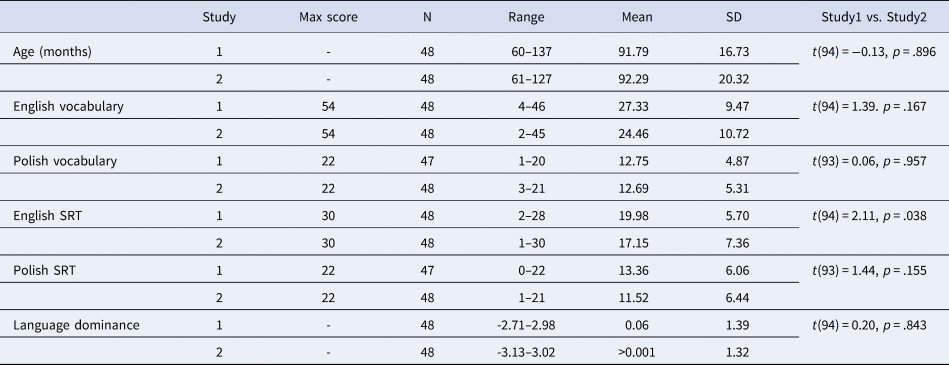
Based on their vocabulary scores, we calculated a language dominance score for each child: their English and Polish vocabulary scores were converted to Z scores and we subtracted their Polish vocabulary score from their English score. As such, a positive score indicates English dominance and a negative score indicates Polish dominance. Overall, the group tended to be English-dominant (M = 0.06) which is not surprising given that English is the societal language and the language of education.
As a measure of language exposure and use, parents received an early version of the Q-BEx questionnaire in English (De Cat et al., Reference De Cat, Kašćelan, Prévost, Serratrice, Tuller and Unsworth2022), which was completed by approximately 75% of parents (N = 36) – however, upon inspection we had to exclude six questionnaires where parents had given inaccurate answers (for example, responding 0 to the number of school holiday days in a year). Given the large amount of missing data we decided not to include a measure of language exposure and use in the analyses.
The Humanities and Social Sciences Research Ethics Committee at the University of Warwick reviewed the research. All procedures contributing to this work comply with the ethical standards of the relevant national and institutional committees on human experimentation and with the Helsinki Declaration of 1975, as revised in 2008.
Design
The study had a 2 x 2 within-subjects design with Target Language (Polish or English) and Prime Structure (prenominal adjective vs postnominal RC structures; possessor-first vs possessor-second structures) as within-subjects and within-items independent variables.
Materials
The experimental materials consisted of pictures and associated prime descriptions for two Snap game syntactic priming tasks (Branigan et al., Reference Branigan, McLean, Jones, Brugos, Clark-Cotton and Ha2005) and additional items for a pre-priming baseline task. The same items were used in the English and Polish versions of the task. ClipArt images were displayed in PowerPoint slideshows with the experimenter's picture on the left of the slide and the participants’ picture on the right.
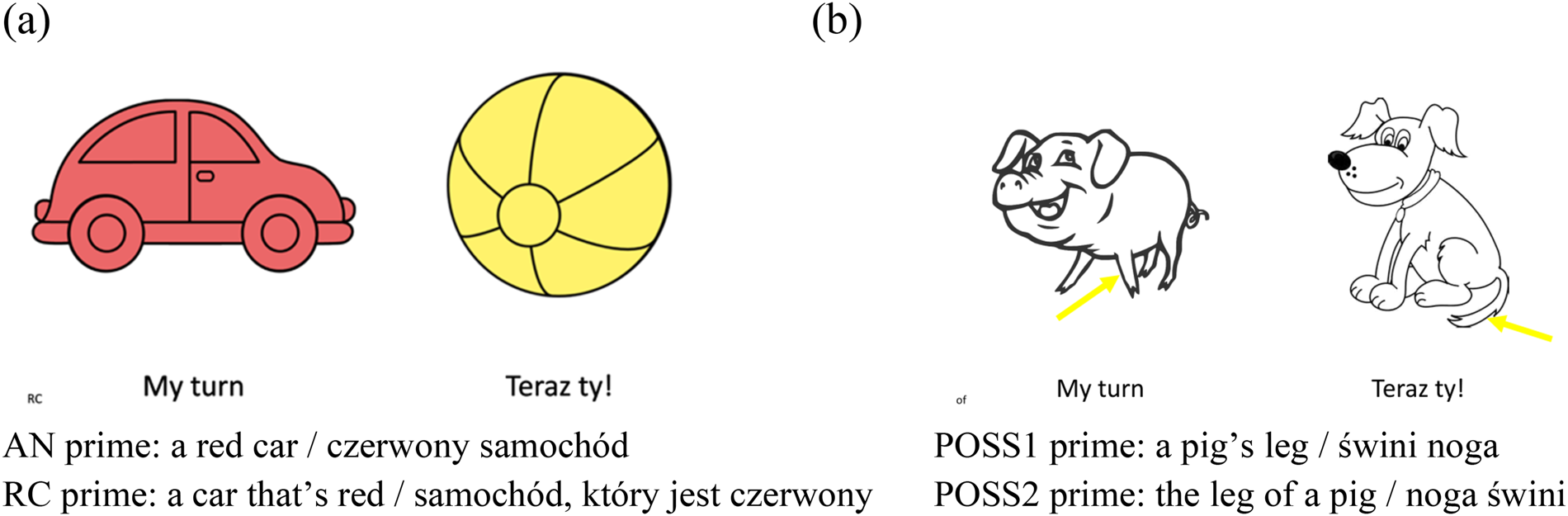
For the attributive construction items, we used 12 inanimate object target nouns in English and Polish (ball/piłka, bath/wanna, bed/łóżko, bicycle/rower, book/książka, chair/krzesło, crayon/kredka, house/dom, key/klucz, shoe/but, star/gwiazda, wheel/koło) and 12 inanimate object prime nouns (aeroplane/samolot, car/samochód, clock/zegar, dress/sukienka, fork/widelec, kite/latawiec, ladder/drabina, lollipop/lizak, sock/skarpetka, spoon/łyżka, table/stół, truck/ciężarówka) four times each with one of four different colours (red/czerwony, green/zielony, blue/niebieski and yellow/żółty) to create the 48 prime and 48 target images. We avoided nouns that were cognates in English and Polish and there was no lexical overlap between prime and target items. We paired semantically unrelated primes and target images in different colours to create 48 experimental items. Each prime picture was associated with a prenominal adjectival (AN) and a postnominal RC prime phrase (see Figure 1a); a full list of items is provided in the Supplementary Materials.
Example pair of (a) attributive and (b) part-of possessive prime and target stimuli.
We created two experimental lists – in each list, each target occurred once in one of the two prime conditions and an even number of items occurred in each prime condition. Each participant received an individually randomised order of items in which items alternated between prime conditions. We added eight filler items (in which the same image appeared for the prime and target creating ‘Snap’ items) using eight new nouns (candle/świeczka, cup/kubek, glove/rękawiczka, hat/kapelusz, jumper/sweter, ring/pierścionek, slide/zjeżdżalnia, window/okno), paired with the same four colours. Snap items were inserted at random intervals into each participant list. We created an additional four practice items, one of which was a ‘Snap’ item, to introduce the game to participants. Two of these were described with AN primes and two with RC primes.
For the possessives items, half the images involved ‘part-of’ possession, depicting an animal with a body part highlighted, and half involved object-possession, depicting a human with an inanimate possession. Avoiding Polish–English cognates, we used 12 animate characters as target possessor nouns (dog/pies, cat/kot, monkey/małpa, cow/krowa, elephant/słoń, goat/koza, cook/kucharka, fairy/wróżka, fireman/strażak, footballer/piłkarz, king/król, teacher/nauczycielka) and 12 animate characters as prime possessor nouns (mouse/mysz, lion/lew, fox/lis, horse/koń, pig/świnia, sheep/owca, nurse/pielęgniarka, painter/malarz, postman/listonosz, queen/królowa, singer/piosenkarz, witch/czarownica). As possessum nouns, we used eight part-of features (tail/ogon, eye/oko, paw/łapa, ear/ucho, foot/stopa, leg/noga, tooth/ząb, tongue/język) and eight object nouns (shoe/but, glove/rękawiczka, glasses/okulary, bicycle/rower, watch/zegarek, cake/ciasto, coat/płaszcz, book/książka). Prime and target images were paired within possession type (part-of or object-possession) and avoiding lexical overlap to create 48 items; each item had a possessor-first (POSS1) prime and a possessor-second (POSS2) prime description (see Figure 1b). Item lists, practice items and snap items were created as described for the attributive items; see Supplementary Materials for a full list.
Each priming task was preceded by a baseline measure to establish the children's preferred grammatical constructions. In the attributives baseline, children were presented with six images (flower/kwiat, shirt/koszulka, sweet/cukierek, bench/ławka, bowl/miska, feather/pióro) in the same colour options as the stimuli. In the possessives baseline children were asked to choose one from a pair of items: three object-possession (e.g., grandpa's car/dziadka samochód versus girl's tricycle/dziewczynki rowerek) and three part-of possession examples (e.g., frog's leg/żaby noga versus duck's eye/kaczki oko) (see Procedure).
Procedure
The study consisted of two sessions (Polish–English; English–Polish) conducted and recorded via Microsoft Teams approximately one week apart by experimenters who were fluent English–Polish bilinguals. Sessions were completed in one target language at a time; the order of language presentation and the order of priming tasks were counterbalanced across participants.
The session began with the baseline and Snap tasks – each Snap task directly followed its corresponding baseline task. In the baseline tasks, children were asked to name pictures; if the child failed to do so, the researcher modelled both structures before moving on to the next item. In the attributive baseline, the children were asked to describe each item (it was highlighted to them that they needed to provide the colour of the item when describing it). In the possessives baseline they were asked to choose between two items and describe the chosen option. The priming task started with the experimenter explaining the game to the child using the practice items, followed by the games with the experimental items. Children were told it was a special Snap game where the experimenter would describe their pictures in one language and that they should describe theirs in the other. The experimenter and participant took turns to describe the pictures with the experimenter always describing first according to the scripted primes. Children were encouraged to say ‘Snap’ as soon as they noticed a matching pair of pictures in order to maintain the guise of the card game.
After the priming tasks, children completed the language measures. For expressive vocabulary, the researcher showed one picture at a time which the child named until the task was completed or the discontinuation rules were met. For sentence repetition (SR), each sentence was read out loud by the experimenter once (unless there was a problem with the internet connection and the child did not hear the sentence) and the child was asked to repeat it. The sessions lasted between 30–45 minutes. After the second session, the parents were sent a link to the QBEx questionnaire.
Coding
Participants’ responses on the baseline and priming tasks were transcribed and coded for syntactic structure. We used strict, lenient, and extra lenient coding schemes to capture different aspects of the bilinguals’ abilities (Messenger et al., Reference Messenger, Branigan, Buckle, Lindsay and Messenger2022). Strict coding corresponded to adult-like utterances; lenient coding allowed for errors in inflectional morphology, whilst the extra lenient coding included utterances that followed the same word order but not necessarily the full syntactic form of the target structures (see examples below, see also Supplementary Materials). The purpose of the lenient coding was to capture children's attempts at reproducing the word order of the prime even in the absence of target-like morphology.
For attributive constructions, we coded responses in which an adjective preceded a noun as prenominal AN in all coding schemes. Responses in which the noun was named first followed by a relative clause headed by that, which or what in English and które in Polish and including an adjective were coded as postnominal RC in all coding schemes. For the lenient coding we included Polish RCs headed by co (what)Footnote 1. For the extra lenient coding, we included copular phrases (the ball is red/piłka jest czerwona) and uninflected noun-adjective phrases (ball red/piłka czerwona), where the word order matched that of the relative clause structure (the ball that is red), as RC.
For possessive constructions, we coded responses in which the possessor preceded the possessum as possessor-first (POSS1): for the strict coding, these required the possessive s in English and genitive marking in Polish to be included on the possessor noun. We coded responses in which the possessum preceded the possessor as possessor-second (POSS2): in the strict coding, these required the possessive preposition of in English and the genitive case marking on the possessor noun in Polish. For the lenient coding, we included utterances that were missing inflections, note that the genitive case is a notoriously hard case to acquire in Polish (Dąbrowska, Reference Dąbrowska2001, Reference Dąbrowska2008), and we included responses that used a different preposition, ‘od’ (from); the preposition od marks genitive case in Polish. We expected that these may be instances of crosslinguistic influence where children produced a case-marking preposition in Polish after an English N of N prime (24 of the 27 N od N constructions were produced after an English of construction).
Results and analysis
First we examined whether there were any correlations between English and Polish language scores. We found that there were significant correlations between age and English vocabulary (r = 0.66, p < .001) and English SR (r = 0.38, p = .007); English vocabulary and English SR (r = 0.59, p < .001); Polish vocabulary correlated with Polish SR (r = 0.77, p < .001); lastly, English SR scores correlated significantly with Polish SR scores (r = 0.31, p = .032). The correlation between English and Polish sentence repetition scores suggests that, in addition to language ability, verbal working memory may explain their performance on this task. In the analyses below we therefore used vocabulary scores only as independent measures of language proficiency.
Analysis method
We analysed the priming data (AN/POSS1 response = 0, RC/POSS2 response = 1) with logistic mixed-effects models using the lme4 package (Bates et al., Reference Bates, Maechler, Bolker and Walker2015) in R (version 4.1.2; R Core Team, 2021). We fit maximal models (Barr et al., Reference Barr, Levy, Scheepers and Tily2013) with a full random effects structure including by-participant random slopes for within-subjects factors and by-item slopes for within-items factors. For all experiments, we first fit a model with the fixed effects of Prime Structure (sum-coded using contrast coding: AN/POSS1 prime = −0.5, RC/POSS2 prime = 0.5) and Target Language (English = −0.5, Polish = 0.5) and the interaction between the two. Where maximal models did not converge, the random effects structure was simplified by removing higher-order terms that explained the least variance until the model converged (Barr et al., Reference Barr, Levy, Scheepers and Tily2013). We then explored whether age, language ability (English and Polish vocabulary scores converted to Z scores) or language dominance score improved the model (all continuous variables were centered). We added each factor (and its interaction with Prime Structure and Target Language) to the converging model separately and compared the models with and without the measure using the anova function – where there was a significant difference, we selected the model with the lowest AIC value, otherwise the simplest model is reported. We repeated each analysis with the data from the different coding schemes – however, since the overall pattern of findings generally did not change, we report only the analyses with the strict coded responses here (see Supplementary Materials for details of the lenient and extra lenient results and analyses).
Attributive constructions
Table 2 presents the frequency of attributive responses and other responses (including lenient and extra lenient coding or irrelevant responses) in the baseline and priming tasks, according to our strict coding. Children produced substantially more AN phrases than RC structures in both languages in both the baseline and priming tasks. Only 13/48 children produced at least one RC structure in English, and only 11/48 children produced at least one in Polish.
Frequency (% of total responses in each condition1) of (a) attributive and (b) possessive responses in the baseline and Snap tasks for Study 1
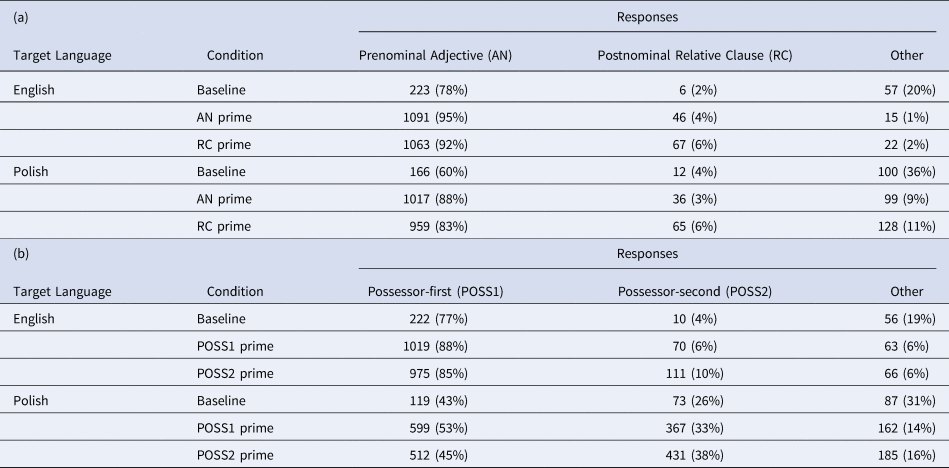
1. Note that the percentages in Table 2 take into account other responses in each condition, whereas the priming effects reported in the text do not.
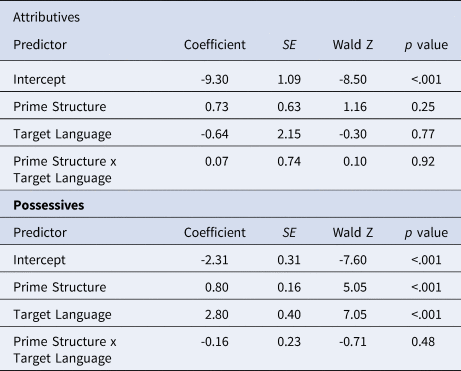
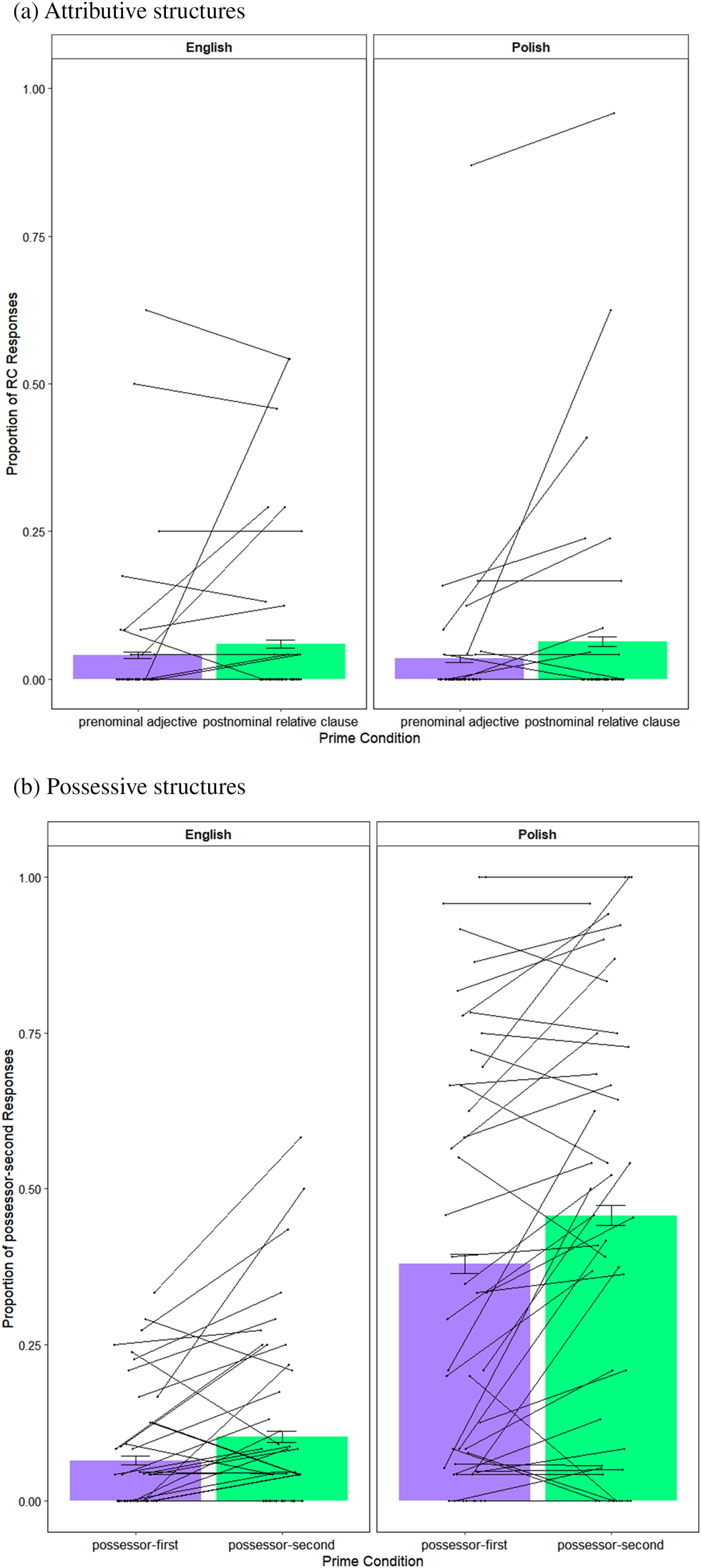
The best fitting model included by-participant random slopes for Prime Structure and Target Language and by-item random slopes for Prime structure; neither age, language dominance, nor vocabulary improved the model fit (see Table 3). No predictors were significant within this model, nor in the model of the lenient-coded data. As shown in Figure 2a, there was no significant priming across the group: very few children produced very few RC target responses. There was a significant effect of Prime Structure (β = −2.61, SE = 0.86, Z = −3.03, p = .002) in the model of the extra lenient-coded data, as well as a significant effect of Target Language (β = −2.61, SE = 0.86, Z = −3.03, p = .002; see OSF for the full model): this coding included noun-adjective responses which shared word order with RC responses; these responses were more frequent after RC primes than AN primes and in Polish than English.
Output of the converging models for Study 1 for strict scored attributivea and possessiveb responses
a Strict_score = glmer(Strict_score~PrimeCon*TargetLang + (1+PrimeCon+TargetLang|SubNo) + (1+PrimeCon|ItemNo), control=glmerControl(optimizer=c(“bobyqa”)), adjdata, family=binomial)
b Strict_score_between = glmer(Strict_score~PrimeCon*TargetLang + (1+PrimeCon+TargetLang|SubNo) + (1 |ItemNo), control=glmerControl(optimizer=c(“bobyqa”)), possdata, family=binomial)
Mean proportions of responses in English and Polish in the crosslinguistic priming tasks with (a) prenominal adjective and postnominal relative clause primes and (b) possessor-first and possessor-second primes. Error bars represent the standard error of the condition mean; dots indicate individual proportions of responses in each condition and lines connecting dots indicate the difference (i.e., priming) between conditions for each individual.
Possessive constructions
Table 2 also presents the frequency of strict coded possessive responses in the baseline and priming tasks. In the baseline task, children showed a strong preference for POSS1 phrases compared to POSS2 phrases in English; in Polish, they showed a milder preference for POSS1 phrases, and were more likely to produce POSS2 phrases than in English. Since POSS2 is the preferred order in (monolingual) Polish speakers, children's slight bias towards the POSS1 construction in the baseline is likely to be a consequence of their knowledge of English, but this is only an educated guess as we do not have data from monolingual Polish-speaking children. In the priming tasks, these preferences persisted but production of POSS2 phrases increased. Overall, 27 children produced at least one POSS2 structure in English, and 40 produced at least one in Polish.
The best fitting model included by-participant random slopes for Prime Structure and Target Language; neither age, language dominance, nor vocabulary improved the model fit (see Table 3). The results showed a significant effect of Target Language (β = 2.80, SE = 0.40, Z = 7.05, p < .001) – irrespective of priming condition, participants produced more POSS2 constructions in Polish (26% responses) than in English (7% responses; see Figure 2b). Furthermore, there was a significant effect of priming (β = 0.80, SE = 0.16, Z = 5.05, p < .001): participants produced more POSS2 responses after hearing POSS2 primes (27% possessive responses) than after hearing POSS1 primes (21%). There was no interaction of Target Language and Prime Structure (Z = −0.71, p = .48) and thus no evidence that priming was stronger in one language than the other. Children were more likely to produce POSS2 responses in Polish after POSS2 primes in English (7% priming effect) and to produce POSS2 responses in English after POSS2 primes in Polish (4% priming effect; see Figure 2.b). Separate models for each target language confirmed that there was a significant effect of priming for English (β = 0.60, SE = 0.18, Z = 3.42, p < .001) and Polish (β = 0.63, SE = 0.16, Z = 4.06, p < .001) responses respectively (see OSF materials for model outputs).
Study 1 Discussion
In the attributives priming task, children produced very few postnominal RC constructions in either language and consequently we did not observe any priming in either direction when English and Polish had equivalent structures; a priming effect only emerged when responses with similar word order in the extra lenient coding were included. We did however find a bidirectional effect of priming for possessive structures, despite the syntactic structures not being identical across Polish and English. Children produced significantly more POSS2 constructions in Polish, though the magnitude of priming did not vary by language.
The findings of these two crosslinguistic priming tasks are mixed in that children were not primed across the board, and syntactic overlap was not a predictor of priming as we expected. One possibility is that children from this population have not acquired suitably abstract representations of all of these structures in each language to have either shared or connected representations to support crosslinguistic priming. To investigate this, we conducted a follow-up study with a different group of Polish–English bilingual children in which we tested priming within languages.
Study 2: Within-languages priming for attributive and possessive structures
Method
Participants
We recruited 48 new participants (21 male), aged between 5 and 11 years (mean age 7;8 years). Participants were recruited on-line following the same procedures as in Study 1. In this sample, only two of the 48 participants spoke English with one parent and Polish with the other; the remainder spoke Polish with both parents. Two further participants were recruited and tested but excluded due to low vocabulary or grammar scores in both languages.
Participants completed the same standardised language measures of Study 1. Independent samples t-tests (2-tailed) revealed no significant differences in age or language abilities between the participants in Study 1 and those in Study 2 (see Table 1), except children in Study 1 scored higher on the English Sentence Repetition task than those in Study 2; as in Study 1 – however, we only used vocabulary scores as language measures in the analyses. There were significant correlations between age and all language measures (English vocabulary r = 0.57, p < .001, English SR r = 0.44, p = .002, Polish vocabulary r = 0.39, p = .007, Polish SR r = 0.40, p = .005); English vocabulary correlated with English SR (r = 0.84, p < .001) and Polish SR (r = 0.36, p = 0.11); Polish vocabulary correlated with Polish SR (r = 0.85, p < .001); and as before, English SR correlated with Polish SR (r = 0.47, p < .001).
Design, materials and procedure
Study 2 followed the same design, materials and procedure as Study 1. The same items were used with the only difference being that within the session the prime and target language were the same for the child and experimenter: children completed one session entirely in English and another entirely in Polish, usually one week apart.
Results and analysis
The data were coded according to the same coding schemes used in Study 1 and analysed using the same method as previously described.
Attributive constructions
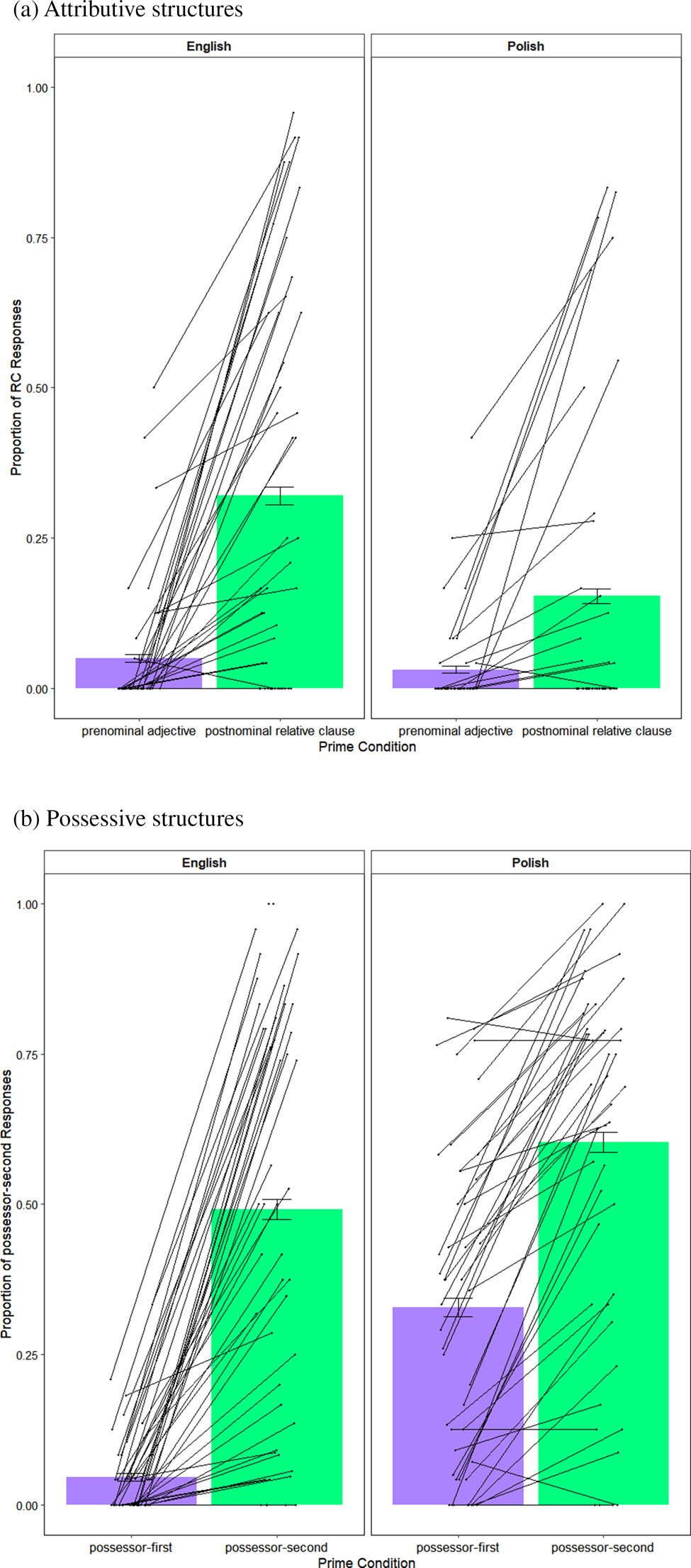
As in the crosslinguistic study, children rarely produced RC structures in the baseline (see Table 4) but following priming, children were more likely to produce RC responses in both English (18% of attributive structures) and Polish (9% attributives). 33/48 children produced at least one relative clause structure in English, and 17/48 produced at least one in Polish.
Frequency (% of total responses in each condition1) of (a) attributive and (b) possessive responses in the baseline and priming tasks for Study 2
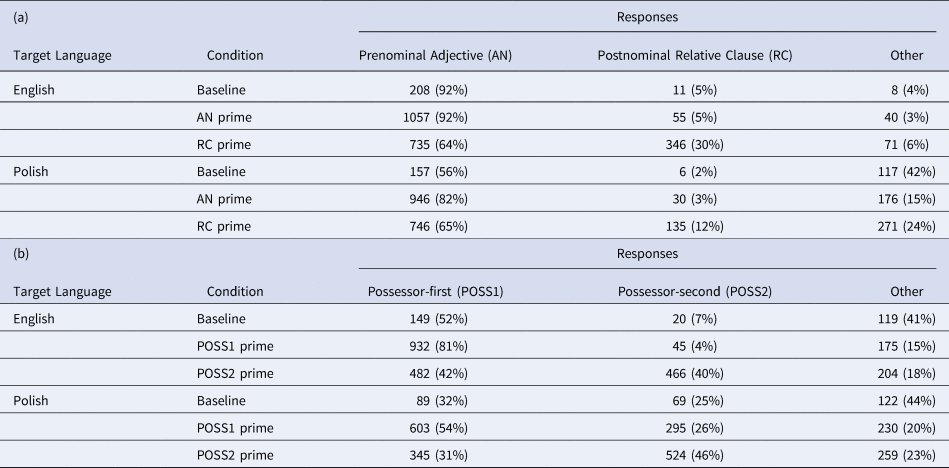
1. Note that the percentages in Table 4 take into account other responses in each condition, whereas the priming effects reported in the text do not.
The best fitting model of the data included by-participant slopes for Prime Structure and Target Language; neither age, language dominance nor vocabulary scores improved the model fit (see Table 5). There was an overall effect of Target Language (β = −2.61, SE = 0.86, Z = −3.03, p = .002): children produced more RC responses in English than in Polish. Nonetheless, children showed a significant effect of Prime Structure (β = 2.39, SE = 0.51, Z = 4.73, p < .001): they produced more RC responses after RC primes than after AN primes. A significant interaction between Prime Structure and Target Language (β = −0.99, SE = 0.48, Z = −2.06, p = .04) showed that priming was stronger in English (25%) than in Polish (9%; see Figure 3a).
Output of the converging models for Study 2 for strict scored attributivea and possessiveb responses
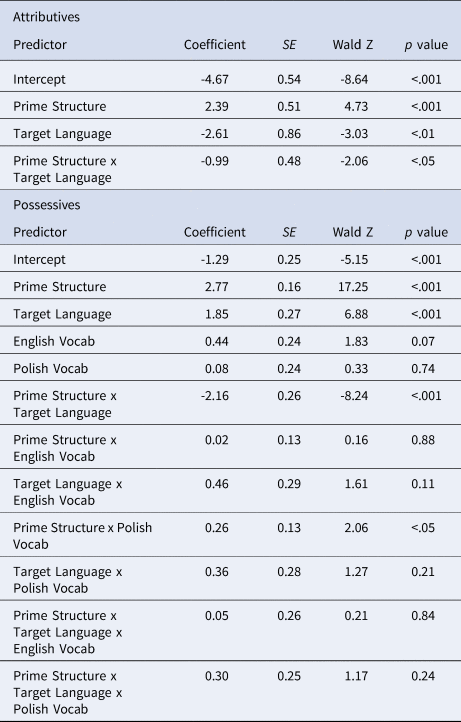
a Strict_score_within = glmer(Strict_score~PrimeCon*TargetLang + (1+PrimeCon+TargetLang|SubNo) + (1|ItemNo), control=glmerControl(optimizer=c(“bobyqa”)), adjdata, family=binomial)
b Strict_score_vocab = glmer(Strict_score~PrimeCon*TargetLang*CenterEVscoreZ + PrimeCon*TargetLang*CenterZNOscore + (1+TargetLang|SubNo) + (1|ItemNo), control=glmerControl(optimizer=c(“bobyqa”)), possdata, family=binomial)
Mean proportions of responses in English and Polish in the within-languages priming tasks with (a) prenominal adjective and postnominal relative clause primes and (b) possessor-first and possessor-second primes. Error bars represent the standard error of the condition mean; dots indicate individual proportions of responses in each condition and lines connecting dots indicate the difference (i.e., priming) between conditions for each individual.
Possessive constructions
As in the crosslinguistic study, before priming children were less likely to produce POSS2 responses in English than in Polish (see Table 4). Children tended to produce more POSS2 responses in Polish (46% of possessive structures) than in English (26%) even after priming, but 43/48 children produced at least one in English and in Polish.
The best fitting model included by-participant random slopes for Target Language; neither age nor language dominance improved the model fit, but vocabulary scores marginally did (χ2 (5, N = 48) =10.44, p = .06); see Table 5. There was an effect of Target Language (β = 1.87, SE = 0.27, Z = 6.78, p < .001): children produced significantly more POSS2 responses in Polish than in English. Children also showed a significant effect of Prime Structure (β = 2.82, SE = 0.13, Z = 21.71, p < .001): they produced more POSS2 responses after POSS2 primes than after POSS1 primes. A significant interaction between Prime Structure and Target Language (β = −2.45, SE = 0.26, Z = −9.59, p < .001) showed that priming was stronger in English (36%) than in Polish (20%; see Figure 3b). There was a significant interaction between Polish vocabulary and Prime Structure (β = 0.26, SE = 0.13, Z = 2.03, p = .04): children with greater Polish vocabularies were more likely to show priming of possessives. The three-way interaction between Target Language, Prime Structure and vocabulary was not significant, either for Polish vocabulary (Z = 1.17, p = 0.24) or English vocabulary (Z = 0.21, p = 0.84).
Study 2 discussion
When priming was tested within languages, we found significant priming effects for both postnominal RCs and POSS2 possessives. This suggests that this population of children have acquired the appropriate abstract syntactic representations within each language to support priming across lexically unrelated utterances, ruling out the possibility that crosslinguistic priming in Study 1 did not occur because the representations were not acquired. We also observed stronger priming in English than in Polish for each structure: this could reflect inverse preference effects on priming (Jaeger & Snider, Reference Jaeger and Snider2008) whereby priming is stronger for a more dispreferred structure (e.g., of possessive in English), and/or it may reflect stronger language production skills in the societal language (English).
Combined analyses of possessives priming task in Study 1 and Study 2
Since we found significant priming of possessives in both the crosslinguistic and the within-languages studies, we conducted an additional analysis to examine whether there were differences in the degree of priming across the two experiments. We added Experiment and its interaction with Prime Structure and Target Language as a between-participants factor (Study 1 = −0.5, Study 2 = 0.5). The best-fitting model included by-participant random slopes for Prime Structure and Target Language; all predictors and interactions were significant. There was a significant main effect of Experiment (β = 0.76, SE = 0.07, Z = 10.25, p < .001): children produced more POSS2 responses overall in the within-languages study (36% of possessive responses) than in the crosslinguistic study (24% of possessive responses). There was a significant interaction between Target Language and Experiment (β = −0.83, SE = 0.15, Z = −5.57, p < .001): the extent to which children produced more POSS2 responses in Polish than in English was greater in the crosslinguistic study compared to the within-languages study. Critically, there was a significant interaction between Prime Structure and Experiment (β = 2.02, SE = 0.15, Z = 13.76, p < .001): overall, priming within-languages was stronger (49%) than between (11%). However, these results are qualified by a three-way interaction of Prime Structure, Target Language and Experiment (β = −2.32, SE = 0.29, Z = −7.91, p < .001): children showed greater priming in English than in Polish in the within-languages study but there was no difference in the crosslinguistic study.
General discussion
In two crosslinguistic structural priming studies with a group of Polish–English bilingual children, we set out to investigate whether crosslinguistic priming effects vary as a function of structural overlap, whether there are effects of directionality on crosslinguistic priming, whether the degree of priming varies between and within languages, and whether language proficiency predicts such priming. Contrary to our predictions, we did not find a significant effect of crosslinguistic priming in either direction where there was complete phrase structure overlap across Polish and English for both the prenominal adjectival construction and the postnominal RC construction. However, we did find a significant and bidirectional effect of crosslinguistic priming where the syntactic structures differed across languages, but where in both languages the order of the possessum and possessor alternates in the same way. Because of the absence of a priming effect in Study 1, we conducted a within-language follow-up study with a different group of Polish–English bilingual children drawn from the same population of UK-based bilinguals and with equivalent ages and language proficiency (Study 2). We found significant effects of within-language priming for both structures and in both languages. Moreover, within-language priming was stronger than between languages. This pattern of findings has implications for the necessary but not sufficient conditions for priming in young bilinguals, for whether syntactic structures or whole constructions get primed, for effects of directionality, and for the role of language proficiency.
Structural overlap: a necessary and/or sufficient condition for priming?
In Study 1, the syntactic alternation was between a prenominal adjectival construction (e.g., the red ball) and a construction including postnominal modification by a RC (e.g., the ball that's red). These two constructions vary in terms of frequency: prenominal adjectival constructions occur more frequently in English child-directed speech. In a corpus of American English, Thorpe and Fernald (Reference Thorpe and Fernald2006) report that parents used prenominal adjectival constructions in 52% of the 3067 occurrences, with colour words appearing even more frequently in prenominal position, approximately 70% of the time. In a larger corpus of British English child-directed speech, adjectives occurred prenominally 52% of the time (Davies et al., Reference Davies, Lingwood and Arunachalam2020). Postnominal RC constructions are syntactically more complex and longer, while the prenominal adjectival construction is shorter, less complex, and it is also the canonical option to realise the linguistic relationship between an entity (e.g., ball) and a modifying adjective (e.g., red). These differences in terms of frequency, complexity, and canonicity are bound to make the postnominal construction less accessible, and the prenominal construction more accessible, in terms of both representation and processing.
In a study with monolingual English-speaking adults, Cleland and Pickering (Reference Cleland and Pickering2003) successfully primed both prenominal adjectival constructions and postnominal RC constructions both when the head noun or the adjective overlapped between prime and target, and when they did not. However, while a prenominal prime virtually always led to a prenominal target description, this was not the case for postnominal primes where postnominal target descriptions varied between 50% and roughly 80%. In addition, when there was no lexical overlap, the magnitude of priming for postnominal RC constructions decreased from 31–47% to 8–11% across three experiments. Three studies with children of varied ages have found mixed priming of these constructions: van Beijsterveldt and van Hell (Reference van Beijsterveldt and van Hell2009) found priming of postnominal RC constructions in Dutch-speaking 7- to 8- and 11- to 12-year-olds’ written production; only the younger children showed stronger priming with lexical overlap. Foltz et al. (Reference Foltz, Thiele, Kahsnitz and Stenneken2015) found priming of postnominal RC constructions in monolingual German-speaking 4- to 6-year-olds, but no effect of lexical overlap. Branigan et al. (Reference Branigan, McLean, Jones, Brugos, Clark-Cotton and Ha2005) found that monolingual English-speaking 3- to 4-year-olds produced more prenominal adjectival constructions when primed than when not, and significantly more so when there was lexical overlap.
In our studies, participants were of similar ages as these previous developmental studies, but they were also bilingual and hence with less experience of the more complex, less frequent, and less canonical postnominal RC construction. Moreover, we did not have any lexical overlap for head nouns or adjectives across primes and targets in either of our studies. All of these factors could have affected the likelihood of priming for postnominal RC constructions in our studies, both across and within languages. Study 1 showed no evidence of crosslinguistic priming in either direction, but we did find a within-language priming effect in both languages in Study 2, although the effect was stronger when children responded in English. This effect of within-language priming suggests that, at least by the age of five, bilingual children can develop syntactic representations that are sufficiently robust to support abstract priming in each of their languages, and particularly so in the societal language, which is also the language of schooling, in which they receive both oral and written exposure to complex syntactic constructions.
We therefore propose that the reasons why we did not find an effect of crosslinguistic priming in Study 1 are threefold: 1) because of a weak abstract representation in the language of the prime, the postnominal RC construction did not always reach the minimal threshold for activation when the prime was parsed; 2) even if the prime structure was parsed appropriately, because the child did have a strong enough representation in the language of the prime, priming failed if there was no corresponding structure in the language of the target; 3) children had syntactic representations in each of their languages but they were not yet shared. Because hypotheses 1 and 2 assume that there is no, or only a weak, abstract representation yet in one or both of the child's languages, the implication is that there should not be any within-language priming, an option that was proved incorrect by our within-language results for both Polish and English, although the follow-up was with a different set of children, albeit well-matched on age and language proficiency. These three hypotheses are not mutually exclusive and could in fact all be true at different times for different children.
Let us first consider the issue of parsing of the prime and the cascading effect that it has on the likelihood of priming. Upon hearing a prime, children attempt to parse the incoming input: to do so, they need to activate the combinatorial nodes associated with the lemma in the prime; in this case either an [A,N] node, or a [N,RC] node. While for adults we can assume that, at least in their first language, combinatorial nodes associated with different lemmas will be sufficiently entrenched as a function of several years of language experience, the same assumption cannot be made for children who are still in the process of developing linguistic representations. In the specific case of bilingual children, whose language experience is distributed across two languages, we also need to consider that it might take them longer than monolingual children to gain knowledge of the range of combinatorial nodes that are associated with different lemmas in each of their languages. While parsing a frequent and simple prenominal adjectival construction may be relatively unproblematic, a longer, syntactically more complex, and less frequent postnominal RC construction will need more exposure before it gets robustly entrenched. The notion of entrenchment is now well established in developmental accounts (see Ambridge et al., Reference Ambridge, Bidgood, Twomey, Pine, Rowland and Freudenthal2015) and originates in Langacker's (Reference Langacker1987) proposal that every use of a structure increases its entrenchment, with higher frequency of occurrence leading to deeper entrenchment. A weakly entrenched representation will lead to low levels of activation of the corresponding combinatorial node upon hearing a prime. Unlike L2 adult speakers who already have a well-established connection between lemmas and combinatorial nodes at least in their L1, for bilingual children we need to assume that these representations are still developing in both their La and their Lb, and that representations are initially separate for each language. Low activation in one language decreases the likelihood that the corresponding combinatorial node in the other language will also be activated, even if a representation does exist in the other language. Here we follow Hartsuiker and Bernolet's (Reference Hartsuiker and Bernolet2017) developmental account in assuming that children – similarly to L2 learners in the initial stages of L2 acquisition – initially have separate lemmas and associated combinatorial nodes for each language and that only gradually do they develop representations that are shared. Consider now the second hypothesis: children have a robust syntactic representation of a postnominal RC construction, but only in the language where they are processing the prime in comprehension. If they have not had a chance to develop a parallel representation in the other language, activation of the prime will have nothing to tap into when it comes to target production.
Finally, it is conceivable that children may have more or less entrenched syntactic representations of the postnominal RC construction in each of their languages, as shown by the findings of our within-language study, but they are not yet shared in any meaningful way making priming between languages impossible (hypothesis 3). Bernolet and Hartsuiker (Reference Bernolet, Hartsuiker, Miller, Bayram, Rothman and Serratrice2018) made this developmental proposal for adult L2 learners and we suggest that it can be applied to developing bilinguals with the caveat that bilingual children, unlike adults, are still building their representations in all of their languages (Gámez et al., Reference Gámez, Vasilyeva, Perry and Messenger2022). In the case of simultaneous bilingual children, identifying an L1 and L2 is not necessarily straightforward and therefore the developmental precedence of one or other language is not entirely clear. Even for children who are sequential bilingual learners, what may initially count as an L1 can over time be vulnerable to language attrition – for example, in contexts of migration to a new host country – with resulting consequences for the entrenchment of syntactic representations in the heritage language (Blom et al., Reference Blom, Boerma, Karaca, de Jong and Küntay2022).
The current findings particularly point to the plausibility of hypothesis 3, i.e., evidence for syntactic representations for the postnominal RC construction in both languages (Study 2), but no shared representation (Study 1), though the children were not the same in each study, so any conclusion must be cautious. Nevertheless, the two groups came from similar Polish–English communities in the UK and did not differ significantly with respect to age or expressive vocabulary. Although there was a significant difference in the English SRT accuracy, it was the children in Study 1, who had higher scores than those in Study 2, who were not primed.
The role of syntactic structure overlap - or lack thereof
One of the aims of the studies was to investigate the role of syntactic structure overlap on priming. Possessive constructions are not syntactically identical in Polish and English; while English uses genitive marker s in the possessor-first construction and the case marking preposition of in the possessor-second construction, Polish uses inflectional case morphology to realise the possessive relationship between possessor and possessum and alternates the word order of the two. Our evidence of priming both within- and between-languages shows that the bilingual children in our studies had syntactic representations for both constructions in each language and, more interestingly, that single-language representations were also shared between languages. It is also of note that priming was successful even in the absence of any lexical overlap, thus providing evidence for the sharing of abstract representations beyond the lexically specific level. Our findings are reminiscent of the results of two studies with L1 adult speakers of Dutch with L2 English (Bernolet et al., Reference Bernolet, Hartsuiker and Pickering2012, Reference Bernolet, Hartsuiker and Pickering2013). In these studies, the possessor-first construction in Dutch, where the possessor is followed by a full pronoun preceding the possessum (De non haar ei, literally ‘the nun her egg’) primed the English possessor-first construction (The nun's egg). For within-L2 English priming, the effect was larger when there was lexical overlap between prime and target, thus suggesting a degree of lexical specificity in syntactic representations in these adult L2 learners. Bernolet and colleagues concluded, on the basis of significant crosslinguistic priming effects, that syntactic structures are shared across languages even though the morphosyntactic realizations are not identical between English and Dutch.
As in these studies, we also found that, even when syntactic structures were different, children were primed crosslinguistically, but we would argue that rather than a syntactic structure being shared, what is shared across languages is a construction, i.e., a mapping of form and meaning/function (see Hwang et al., Reference Hwang, Shin and Hartsuiker2018; Vasilyeva & Waterfall, Reference Vasilyeva and Waterfall2012). In a study with monolingual Russian-speaking children, Vasilyeva and Waterfall (Reference Vasilyeva and Waterfall2012) found that a passive prime increased the likelihood of producing a target sentence with a discourse function similar to that of the prime but whose syntactic structure was not always necessarily that of the passive prime. They argued that these results can be explained by the activation of functional information, either discourse information or thematic role information; more specifically they claim that what gets activated, and hence primed, is a construction, i.e., the “stored pairing of form and function” (Goldberg, Reference Goldberg2003, p. 219). By comparison, in our studies, what was activated in the priming of possessive constructions was the linear order of thematic roles. Regardless of the crosslinguistic differences between Polish and English in how they map the meaning of the relationship between a possessor and a possessum onto a linguistic form, hearing a prime construction where the thematic role of possessor is in second position activated another construction where the possessor is also in second position.
The fact that, for the most part, the bilingual children in both studies used a grammatical language-specific target when they were primed is further evidence that they were primed at the construction level rather than at the syntactic structure level. Priming at the syntactic structure level could result in ungrammatical structures, which would be evidence for crosslinguistic influence (Serratrice, Reference Serratrice2016, Reference Serratrice and Messenger2022). Interestingly however, in Polish, children did produce a small number (N = 27) of NP od NP (NP from NP) structures: e.g., Ogon od kota, literally ‘tail from a cat’; the preposition od requires genitive case in Polish but is not used to express possession. Twenty-four of these were produced after a possessor-second ‘of’ prime in English and we take these to be instances of crosslinguistic influence where children were primed to produce an ungrammatical structure following the syntactic structure of the English prime. Children also produced a small number of ungrammatical RC responses in Polish with co (what), e.g., X co jest X (X what is X), in each study. Of the 56 co RCs they produced after English primes (Study 1), 32 (57%) were produced after RC primes, and of the 127 co RCs that they produced, intriguingly, after Polish primes (Study 2), 91 (72%) were produced after RC primes. In contrast, in English, the children's societal language, there were no cases of omission of case markers or articles or production of ungrammatical English phrases. This asymmetrical pattern of crosslinguistic influence from the societal language to the heritage language is commonly attested (see van Dijk et al., Reference van Dijk, Van Wonderen, Koutamanis, Kootstra, Dijkstra and Unsworth2022). More opportunities to encounter the English structures will lead to higher entrenchment and raise the level of activation of English structures relative to Polish representations. This discrepancy predicts the directionality of crosslinguistic influence.
Limitations and future research
One limitation of this study is that we could not include a measure of language exposure as a predictor in our analyses, as not enough parents completed the Q-BEx questionnaire. Although we did collect independent measures of proficiency, we did not find an effect of proficiency on crosslinguistic priming, unlike in studies with adult L2 learners, which have shown a predictive role of proficiency on the likelihood of priming (Bernolet et al., Reference Bernolet, Hartsuiker and Pickering2013; Hartsuiker & Bernolet, Reference Hartsuiker and Bernolet2017). Individual variation existed in the extent to which children were primed (see Figures 2 and 3), and in the extent to which they were proficient or dominant in English or Polish; this finding remains so far unexplained.
To test the limits of what crosslinguistic structural priming can achieve, we did not include any lexical overlap between the primes and targets in our studies. However, previous research with monolingual participants has shown that such overlap facilitates priming. One crosslinguistic priming study with bilingual children included lexical overlap but did not find a facilitation effect (Gámez & Vasilyeva, Reference Gámez and Vasilyeva2020), though the number of target responses was possibly not great enough to show any differences. Exploiting lexical overlap in both across- and within-languages priming with bilingual children in future work would shed more light on the extent to which bilingual children start out with lexically-specified syntactic representations, and the extent to which this manipulation facilitates crosslinguistic priming in children.
Taking a developmental approach, we have not found that the bilingual children in our sample were consistently primed crosslinguistically before the age of 10, suggesting that these Polish–English bilinguals did not develop shared syntactic representations early in acquisition, despite seemingly having within-language representations. It remains an empirical question as to whether more opportunities to encounter complex postnominal RC constructions in both languages would eventually result in shared constructions in older children. In current work, we are testing this hypothesis with teenagers to determine whether shared structures are the inevitable outcome of simultaneous bilingual language acquisition, or a feature of only certain types of bilingualism, e.g., that of adult L2 learners.
Conclusion
We compared crosslinguistic and within-languages priming in Polish–English bilingual children. We found that crosslinguistic priming can occur across constructions that do not overlap syntactically but that share semantic-level structure (thematic role order). We also found that priming does not necessarily occur, even when constructions have equivalent phrase constituent structures. These apparent limits of shared syntax in bilingual children will need to be further refined in future studies addressing the role of lexical overlap, and including a measure of the bilingual language experience that can account for the hitherto unexplained individual variation in the likelihood of priming.
Supplementary material
The supplementary material for this article can be found at https://osf.io/b2rvs/.
Data availability
The data that support the findings of this study are openly available in the Open Science Framework (OSF) at https://osf.io/b2rvs/.
Acknowledgements
We thank all the participating schools and families and the volunteer RAs who assisted with transcription. This research was funded by a Leverhulme Trust Research Project Grant (RPG-2019-328). For the purpose of open access, the author has applied a Creative Commons Attribution (CC BY) licence to any Author Accepted Manuscript version arising from this submission.
Competing interests
The authors declare none.


 Open access

