


Introduction
Electric power networks have become a ubiquitous part of the Anthropocene, connecting and co-occurring with human populations across nearly all habitats and landscapes (Bevanger, Reference Bevanger1994; Ferrer, Reference Ferrer2012; Dwyer et al., Reference Dwyer, Harness, Gallentine and Stewart2019). Effects on natural areas and wildlife occur during construction (e.g. water and soil disturbance, and habitat loss), operation (e.g. electrocutions and persistent habitat fragmentation) and maintenance (e.g. disturbance and sound pollution; Ferrer, Reference Ferrer2012; Bessède, Reference Bessède2014; El-Harbawi, Reference El-Harbawi2022). Although some species thrive in power line rights-of-way (the cleared land corridors beneath and arround power lines), particularly species nesting on pylons where natural nesting substrates are rare or absent (Moreira et al., Reference Moreira, Martins, Catry and D’Amico2018; Cathey, Reference Cathey2019; Plewa et al., Reference Plewa, Jaworski, Tarwacki, Gil and Horák2020; Kolnegari et al., Reference Kolnegari, Hazrati, Khodaei Tehrani and Dwyer2022b), power lines more often create novel threats and challenges to wildlife (Bevanger, Reference Bevanger1994; APLIC, 2006; Kolnegari & Harness, Reference Kolnegari and Harness2020).
Electrocution is a common way in which power lines affect wildlife (Bevanger, Reference Bevanger1994; Ferrer, Reference Ferrer2012; Bessède, Reference Bessède2014; Kolnegari et al., Reference Kolnegari, Conway, Basiri, Panter, Hazrati and Rafiee2020), most often when birds perched on overhead distribution pylons simultaneously contact two differently energized conductors, or an energized conductor and a path to ground (APLIC, 2006; Kolnegari & Harness, Reference Kolnegari and Harness2020). Less often, animals enter substations or other electrical enclosures such as switchboards, or chew buried cables (Shumake et al., Reference Shumake, Sterner and Gaddis2000; Csanyi, Reference Csanyi2011; Barret, Reference Barret2015).
Most research has focused on electrocutions involving avifauna and overhead power lines. Electrocutions of mammals, reptiles, amphibians and invertebrates (hereafter, non-avian animals) are understudied and underreported (Kolnegari et al., Reference Kolnegari, Turk Ghashqaei, Hazrati, Basiri, Mojaver Tork Abad and Ferrer2018; Feng et al., Reference Feng, Owolabi, Schafer, Sengupta, Wang and Matteson2022; Martín Martín et al., Reference Martín Martín, Garrido Lopez, Clavero Sousa and Barrios2022). These incidents probably do not occur as frequently as avian mortalities, but they do frequently kill the animal involved, and cause equipment damage, outages and economic losses. For example, in Kenya, a vervet monkey Chlorocebus pygerythrus electrocution caused a country-wide blackout lasting 4 h (McCluskey, Reference McCluskey2016). Primate electrocutions have also been reported elsewhere in Kenya (Katsis et al., Reference Katsis, Cunneyworth, Turner and Presotto2018), and in Algeria, Bangladesh, Brazil, Costa Rica, Kumar, India, Indonesia and Sri Lanka (Pereira et al., Reference Pereira, Dias, Castro, Landi, Melo and Wilson2020; Dwyer & Harness, Reference Dwyer, Harness, Martín-Martín, Garrido López, Clavero Sousa and Barrios2022).
In South Carolina, USA, over 5,000 customers of a local electric utility experienced outages after three separate electrocutions of snakes in substations; these were just three of nearly 60 reported in the area that year, mostly caused by snakes (HECI, 2020). Reptiles in particular pose risks to substations and their maintenance personnel as reptiles inside electrical enclosures easily bridge the gaps around high-voltage conductors (Fischbach, Reference Fischbach2013).
Fires resulting from wildlife electrocutions are an emerging concern as global warming creates drier, hotter conditions more prone to catastrophic wildfires (Barnes et al., Reference Barnes, Dwyer, Mojica, Petersen and Harness2022). Although rare, birds can be ignited as they are electrocuted, and then drop flaming into dry brush at the base of a pole or pylon, as has been documented in Iran (Kolnegari et al., Reference Kolnegari, Conway, Basiri, Panter, Hazrati and Rafiee2020), Spain (Guil et al., Reference Guil, Soria, Margalida and Perez-Garcia2018), the USA (Fenster et al., Reference Fenster, Donohue and Tran2021; Barnes et al., Reference Barnes, Dwyer, Mojica, Petersen and Harness2022), Australia, Asia, Europe and North America (Dwyer et al., Reference Dwyer, Harness, Gallentine and Stewart2019). Although known for birds, information concerning electrocution-caused wildfires involving other vertebrates has not previously been reported. In this study, we contribute to the growing pool of knowledge of animal-caused fires by documenting eight fire ignitions caused by a domestic cat, three murids and four colubrids. This new information will raise awareness about wildlife interactions with the national power network in Iran, and motivate ecologists elsewhere to investigate such interactions.
In Iran, the first recorded interaction between a non-avian animal and the power network occurred in 1961 when a domestic cat pursued a rat (possibly a brown rat Rattus norvegicus) into electrical infrastructure, causing an outage throughout Tehran (Ettela’at, 1961). Numerous other records of non-avian incidents have occurred in Iran since, but have not been catalogued. In this study, we catalogued incidents to identify the taxa, animal behaviours and equipment involved, and to document how frequently incidents caused outages and fires.
Study area
Iran is the world’s 18th largest country, with a population of approximately 82 million people. Iran generates c. 90,000 Megawatts of electrical energy, mostly via thermal power plants (80%), and provides electricity to its population through approximately 127,581 km of transmission lines and 815,367 km of distribution lines (Ministry of Energy, 2019). Electricity use is growing by c. 8% per year (Ministry of Energy, 2019). Wildlife includes 548 bird, 242 reptile, 194 mammal and 22 amphibian species (Kolnegari & Hazrati, Reference Kolnegari and Hazrati2020).
Methods
In areas where social media such as Telegram (2023) are used by electric utility personnel to exchange knowledge and information about electrical systems, posts on these platforms can provide unique insights into wildlife interactions with electrical infrastructure (Kolnegari & Dwyer, Reference Kolnegari and Dwyer2021; Kolnegari et al., Reference Kolnegari, Hazrati, Khodaei Tehrani and Dwyer2022b). We examined postings in Telegram from 1 January 2014 to 31 December 2023 in which electric utility personnel described animal electrocutions. These posts were created voluntarily by utility personnel. From each post, we extracted as much of the following information as possible: the species or taxonomic group involved, any behaviours noted that could have contributed to the incident, the equipment and voltage involved, whether the equipment malfunctioned and the consequences of the incident (e.g. fire ignition, power outage). When only some of these details were available in the original posting, we contacted reporting personnel through Telegram to request additional information. We limited our investigation to Iran, because we knew Iranian utility personnel frequently used Telegram, and we were unaware of similar user groups elsewhere (Kolnegari & Dwyer, Reference Kolnegari and Dwyer2021; Kolnegari et al., Reference Kolnegari, Hazrati, Khodaei Tehrani and Dwyer2022b).
Results
We identified 120 reports of electrocutions across various voltages (Table 1, Fig. 1). All electrocutions involved vertebrates, except one involving a centipede. Electrocutions involved 74.1% mammals, 24.1% reptiles and 0.8% amphibians. Domestic dogs and cats were most often involved, accounting for 28 incidents (23.3%). Amongst wild animals, the families Muridae (rodents), Colubridae (snakes) and Mustelidae (mustelids), accounted for the highest number of electrocution incidents, comprising 22.5%, 19.2% and 5.8% of all incidents, respectively (Table 1). Six of the species involved are protected nationally, and one is categorized as Near Threatened on the IUCN Red List.
Number of non-avian electrocutions and consequent outages in Iran, derived from reports posted by linemen and power technicians on Telegram during 1 January 2014–31 December 2023.

1 NT, Near threatened.
Animal families (Table 1) electrocuted on overhead lines, ground-mounted components, wall-mounted components and underground cables (Table 2) in Iran’s power network according to reports posted during January 2014–December 2023. The width of each band is proportional to the number of incidents in that group.

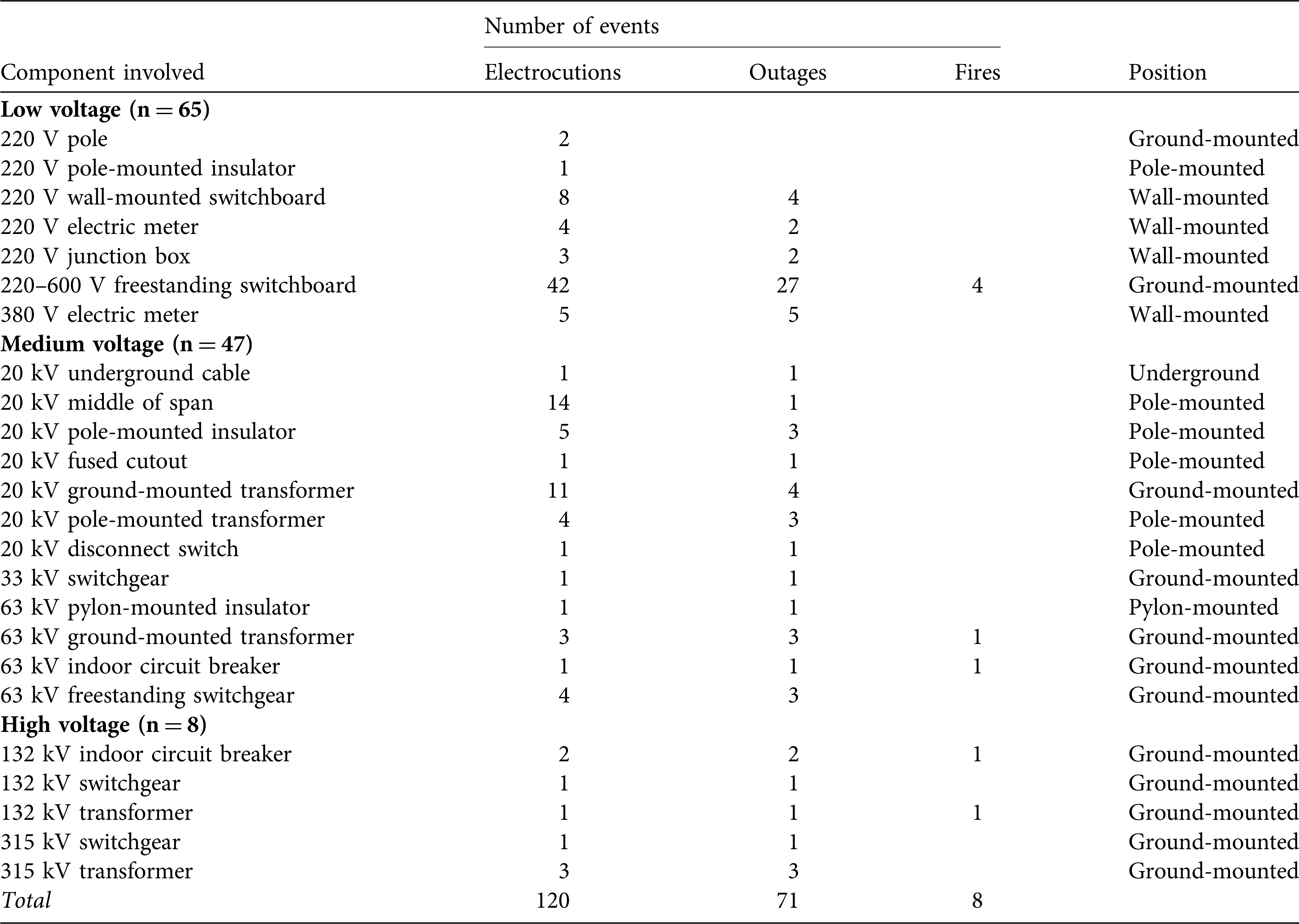
Low- (up to 600 V) and medium-voltage (20–63 kV) power components were involved in 54.2% and 39.2% of the incidents, respectively. Among specific power components, 220–600 V freestanding switchboards accounted for the highest number of electrocution incidents (42, 35.0%); these were included in the ground-mounted components group, which collectively accounted for 60% of electrocutions (Plate 1). Pylon-mounted (i.e. overhead) and wall-mounted components were also involved in non-avian electrocutions (22.5% and 16.6%, respectively). Only eight electrocutions (6.6%) occurred in substations, where all incidents on high-voltage power components (132–315 kV) took place (Table 2).
Example non-avian electrocutions on electrical infrastructure in Iran reported during January 2014–December 2023. (a) Desert monitor Varanus griseus in a 600 V switchboard; red arrow indicates a bird nest (probable cause of predator attraction into the cabinet), (b) rough bent-toed gecko Cyrtopodion scabrum on the fuses of a 600 V switchboard, (c) Schokari sand racer Psammophis schokari on a 132 kV vacuum circuit breaker, where a resulting fire ignited in the switchgear and (d) red fox Vulpes vulpes on a 20 kV ground-mounted transformer.

Iran’s power network components involved in 120 non-avian electrocutions, categorized based on nominal voltages. ‘Outages’ indicates the number of electrocutions that led to permanent faults requiring technician intervention to restore power and ‘fires’ indicates the number of electrocutions that led to fire ignitions.

Fire ignitions
In eight cases (6.6%; one domestic cat, three murids and four colubrids), electrocution of animals led to fire ignitions. These fires occurred in switchboards (4), switchgears (2) and outdoor substations (2). Seven of these fires were extinguished before spreading beyond electrical equipment to adjacent vegetation. One fire escaped to ignite a wildfire.
Interspecific interactions in electrocution incidents
In seven incidents (6.6%), bird nests were noted near the non-avian electrocutions. Although the birds were not believed to be involved directly, the non-avian animals involved could have been attempting to reach the nests to consume the contents (Plate 1a). In one incident, a raptor carrying a non-avian prey item landed on a pylon-mounted component, leading to the electrocution of both animals.
Electrocution caused by power network malfunctions
Nine non-avian electrocutions (7.5%) occurred when conductors fell on or near animals. Eight incidents occurred when pylons collapsed, killing Eurasian lynx Lynx lynx, European wildcat Felis silvestris and striped hyaena Hyaena hyaena. In two electrocution incidents, metal pylons were energized when insulators failed, and dogs contacting the pylons were electrocuted.
Outage-prone electrocutions
Seventy-one electrocution incidents (59.2%) led to outages requiring technician intervention to restore power. Of these, some had considerable consequences, including three city-wide outages, one outage involving police headquarters, one a holy shrine and one a soccer stadium during a match.
Discussion
To our knowledge, this is the first study documenting electrocutions of a suite of 29 non-avian species on electrical systems, including six species of conservation concern, in Iran. Electrocutions of primates have been documented elsewhere (e.g. Fritts, Reference Fritts2002; Kumar & Kumar, Reference Kumar and Kumar2015; Katsis et al., Reference Katsis, Cunneyworth, Turner and Presotto2018; Pereira et al., Reference Pereira, Dias, Castro, Landi, Melo and Wilson2020; Martín Martín et al., Reference Martín Martín, Garrido Lopez, Clavero Sousa and Barrios2022), but non-avian electrocutions involving other animal groups are understudied. We documented electrocution of a wide variety of animals other than birds or primates. Among them, the electrocution of a lemon-yellow tree frog Hyla savignyi may be the first recorded amphibian electrocution on overhead conductors. Although novel, our the scope of our findings is limited by voluntary reporting and by opportunistic surveying. Future research could contribute further by formalizing data collection on mammal, reptile, amphibian and invertebrate electrocutions in Iran and elsewhere. Nevertheless, our data provide some insights relevant to wildlife conservation and to improving the reliability of electrical networks.
This is the first study documenting electrocutions on a suite of 90 wall-mounted, ground-mounted and underground electrical components. Prior research has focused primarily on overhead electrical systems (e.g. Ferrer, Reference Ferrer2012; Kolnegari et al., Reference Kolnegari, Hazrati, Khodaei Tehrani and Dwyer2022b; Dwyer et al., Reference Dwyer, Karyakin, Garrido López and Nikolenko2023). However, our findings indicate that other components of electrical systems also pose hazards to animals. We hypothesize these hazards are less well known for three reasons. Firstly, they may occur less frequently than avian electrocutions. Secondly, bird watchers may be more aware of and more likely to explore bird-caused outages than outages caused by other animals. Thirdly, these hazards occur mostly in areas where access and visibility are limited to electric company personnel, who may often resolve the outages with internal, but not external, reporting.
The incidents we report have implications not only for the animals involved, but also for the reliability of electrical systems, which affects electric utility companies and their customers. Momentary electrical faults associated with wildlife electrocutions can damage electrical equipment, resulting in the need for potentially costly and poorly timed equipment replacement. Electrocutions can cause outages, which must be investigated and cleared before power can be restored to affected portions of the electrical system (Kolnegari et al., Reference Kolnegari, Conway, Basiri, Panter, Hazrati and Rafiee2020). Outages have been reported as occurring in < 10% (Dwyer & Mannan, Reference Dwyer and Mannan2007) and 6% of electrocutions (Kemper et al., Reference Kemper, Court and Beck2013) in raptor-focused studies. We found a considerably higher outage rate from electrocutions (59%), probably because many of the incidents involved animals that were inside closed cases when electrocuted, and so fell across energized components when they died, rather than falling free of pylons as large birds commonly do (Ferrer, Reference Ferrer2012).
As in some previous studies (Guil et al., Reference Guil, Soria, Margalida and Perez-Garcia2018; Dwyer et al., Reference Dwyer, Harness, Gallentine and Stewart2019; Kolnegari et al., Reference Kolnegari, Conway, Basiri, Panter, Hazrati and Rafiee2020; Barnes et al., Reference Barnes, Dwyer, Mojica, Petersen and Harness2022), we report electrocution incidents igniting wildfires. We document six fires in wall-mounted and ground-mounted equipment, which were contained by the equipment, and two uncontained fires in substations (Plate 1c). These fires were accompanied by flashover explosions, igniting nearby materials, and required considerable firefighting effort to extinguish. Incidents such as these can lead to toxic oil leakage, air pollution, high repair and replacement costs, and prolonged outages (Guil et al., Reference Guil, Soria, Margalida and Perez-Garcia2018; El-Harbawi, Reference El-Harbawi2022), in a cascading series of negative ecological and economic consequences (Stine, Reference Stine and McDonald2012).
The incidents in this study involving pylon-mounted equipment could probably be prevented through the installation of insulation intended to prevent avian electrocutions. Several mitigation methods for preventing avian electrocutions are already being used in Iran (Kolnegari & Hazrati, Reference Kolnegari and Hazrati2020; Kolnegari et al., Reference Kolnegari, Conway, Basiri, Panter, Hazrati and Rafiee2020), and have yielded considerable benefits (Kolnegari & Harness, Reference Kolnegari and Harness2020; Kolnegari & Dwyer, Reference Kolnegari and Dwyer2021). Retrofitting to prevent avian electrocutions frequently focuses on hotspot areas following the hypothesis that most incidents occur on relatively few pylons (Ferrer, Reference Ferrer2012). The same is probably true of non-avian electrocutions. Consequently, it is important to pinpoint where animal-caused faults and outages occur, to prioritize the implementation of preventive measures in these hotspots (Kolnegari et al., Reference Kolnegari, Conway, Basiri, Panter, Hazrati and Rafiee2020). Although fault detectors can be useful in this respect, Iran’s power distribution lines often lack modern fault detectors used to help technicians locate the cause and location of outages (Kolnegari et al., Reference Kolnegari, Turk Ghashqaei, Hazrati, Basiri, Mojaver Tork Abad and Ferrer2018). Poorly designed and aged electrical enclosures provide a venue for serious conflict with non-avian animals. Intrusion of animals into enclosures, especially switchboard metal boxes, comprised around one-third of the electrocutions we documented. These unreliable enclosures seem to occur in rural areas that are not routinely monitored, repaired or maintained. Old wooden pylons of 20 kV distribution lines are also subject to destruction by animals (such as wild boar Sus scrofa and termites) and are prone to fall in inclement weather, creating an electric trap for terrestrial carnivores (Kolnegari et al., Reference Kolnegari, Turk Ghashqaei, Hazrati, Basiri, Mojaver Tork Abad and Ferrer2018). We found this type of incident responsible for nine electrocutions and the mortality of nationally protected wildlife species.
Regulations regarding non-avian conflicts with power networks have been neglected globally, whereas mitigating avian electrocutions is required by various national regulations and implemented in practical guidelines (APLIC, 2006; Ferrer, Reference Ferrer2012; Feng et al., Reference Feng, Owolabi, Schafer, Sengupta, Wang and Matteson2022; Martín Martín et al., Reference Martín Martín, Garrido Lopez, Clavero Sousa and Barrios2022; Kolnegari et al., Reference Kolnegari, Hazrati, Basiri, Moghimi, Mohammadi and Valizadeh2022a; Dwyer et al., Reference Dwyer, Karyakin, Garrido López and Nikolenko2023). Although mitigation to prevent electrocutions on overhead lines is generally similar for avian and non-avian animals, in substations and other ground-mounted structures different guidelines are needed. These guidelines will need to consider the specific location, habitat and equipment to be effective in preventing the unique situations created by various combinations of animals and electrical components that are vulnerable to animal-caused outages (Stine, Reference Stine and McDonald2012; Barret, Reference Barret2015; Feng et al., Reference Feng, Owolabi, Schafer, Sengupta, Wang and Matteson2022). The morphology and ecology of susceptible species in each region should be taken into account, together with technical features of each power network such as configuration of conductors, physical profile of structures, vulnerable bare conductors and minimum clearance; i.e. the vertical distance between energized components and the ground (Dudderar et al., Reference Dudderar, Winterstein and Sangstei1995). For example, in substations in the USA, outages caused by squirrels Sciurus sp. are common, as are outages caused by raccoons Procyon lotor and snakes in some areas (Dudderar et al., Reference Dudderar, Winterstein and Sangstei1995; Eaton, 2015). In contrast, in our dataset, rats, cats and snakes were involved in the majority of non-avian electrocutions and outages. Future research should continue to explore, document and identify patterns in and prevention methods for non-avian electrocutions and outages, in Iran and elsewhere.
Author contributions
Study design, investigation, data analysis, writing: MK; supervision, validation, revision: JFD, JG-C, FST.
Acknowledgements
We thank power technicians Amir Hosseini Nejad, Ardeshir Daraiezadeh, Mohsen Malhan, and Naser Karami, who reported non-avian electrocutions, and especially those whose photographs are used here. This research received no specific grant from any funding agency, or commercial or not-for-profit sectors.
Conflicts of interest
None.
Ethical standards
Our study is based on the reports of utilities personnel. Photograph credits are not reported in line with the preferences of reporting personnel. No ethical approval was required for this research, and it abided by the Oryx guidelines on ethical standards.
Data availability
The data supporting our findings are available on request from the corresponding author.



 Open access

