


In 1997, Miles Kahler regretted that a proper academic debate between the Latin American theory of dependencia and the US theory of interdependence had not taken place. Even though these contemporaneous intellectual efforts both aimed at grasping the interconnectedness of world politics after 1945, the exponents of the two schools ignored each other. What is more, by the end of the Cold War, the two theories followed rather opposite trajectories in the field of international relations (IR): dependencia was driven from the field, while Robert Keohane and Joseph Nye’s theory of interdependence evolved into neoliberal institutionalism and became part of the mainstream (Kahler Reference Kahler, Doyle and Ikenberry1997, 34–35). The obvious lack of debate has become more prominent in recent years with, on the one hand, the return of concepts such as core–periphery, unequal exchange, and dependency to IR journals and, on the other, the repositioning of structural asymmetries at the center of the US scholarship on weaponized interdependence (WI).
Here, I want to reconstruct this “missing debate” and spell out its main implications for thinking about contemporary world politics. I do this by exploring a set of central works in both schools of thought. In the case of the Latin American theory of dependencia, I look at the first-generation scholars who worked in Santiago de Chile between 1965 and 1973, at a time when the city was a hub for progressive intellectuals attracted by the ongoing processes of sociopolitical change as well as the presence of several research centers, first and foremost the United Nations Economic Commission for Latin America (Comisión Económica para América Latina, CEPAL). As most of these works were published in Spanish and never translated into English, they were never fully integrated into what US and European scholars consumed as “dependency theory.” I also include some of the most recent works of contemporary scholars who engage with and update the assumptions and concepts of that first generation.
For the case of the US theory of interdependence, I focus on what is usually considered to be the theory’s seminal book—Keohane and Nye’s Power and Interdependence—and subsequent fundamental works written later by Keohane and his colleagues during the 1990s and early 2000s in what came to be known as neoliberal institutionalism. I also include the most recent works by Henry Farrell, Abraham Newman, and colleagues that introduce the concept of WI, hitherto the latest version of the theory of interdependence.
In reconstructing this five-decades-long missing great debate, I put forward three main claims. First, the first generation of Latin American theorists of dependencia shared a common interest with Keohane and Nye’s Power and Interdependence, which consisted of theorizing asymmetrical forms of interdependence. Second, any such common interest faded away with the transition from Power and Interdependence toward neoliberal institutionalism. In fact, I argue that this transition should be regarded as a discontinuity rather than an evolution. Third, after the 2008 financial crisis the interest in structural asymmetries returned to IR due to a new generation of researchers engaging with the theory of dependencia, as well as through the critiques that US scholars of WI make against neoliberal institutionalism. This comeback must be situated in the broader context of a “hierarchy turn” in IR theory.
The Unacknowledged Common Ground: Interdependence as Structural Asymmetries
An obvious place to start reconstructing the imaginary debate is Power and Interdependence. Published in 1977, the book came right after some major works by Latin American dependentistas and put forward the theoretically sophisticated concept of complex interdependence. Keohane and Nye made a single, broad reference to “dependency theory” in a preface footnote, only to rapidly dismiss it from the rest of the book. In that footnote they mention Stephen Hymer, Johan Galtung, and Robert Kaufman as leading figures. Only one Latin American scholar—Osvaldo Sunkel—is appended to the list (Keohane and Nye Reference Keohane and Nye1977, vii). To be sure, the indifference was mutual, as Latin American scholars of dependencia did not pay much attention to Power and Interdependence either.Footnote 1
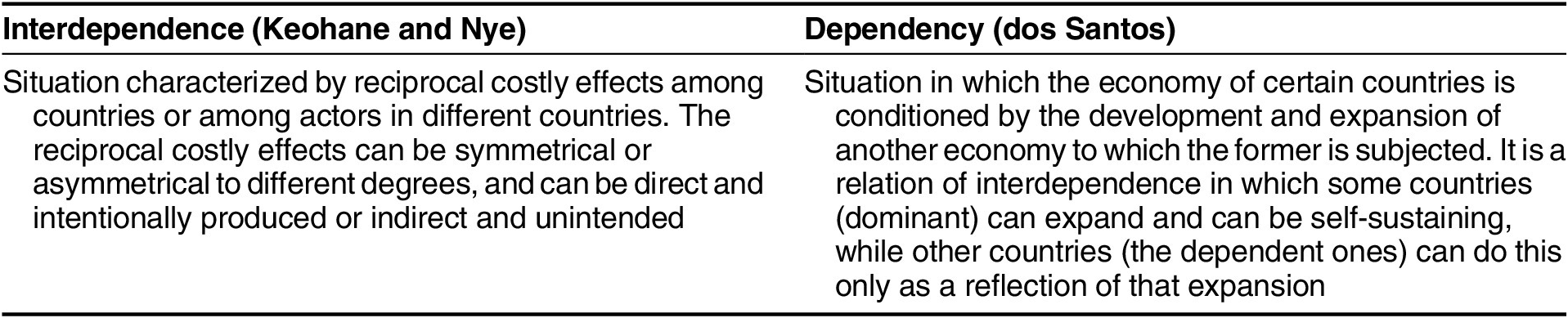
Nevertheless, Keohane and Nye’s book and the theory of dependencia are connected through a common theoretical interest. Both start from the assumption that interdependence—rather than anarchy or imperialism—has been a fundamental aspect of world politics, especially since 1945. More importantly, both regard asymmetry as a crucial aspect of interdependence and seek to theorize its implications. This common ground becomes evident if we compare the definitions of “interdependence” and “dependency” respectively (see table 1).
Two Mirroring Definitions Based on Keohane and Nye (Reference Keohane and Nye1977) and Dos Santos (Reference dos Santos1970)

In their definition, Keohane and Nye propose a concept of interdependence that ranges from symmetrical to asymmetrical relationships. The authors are particularly interested in asymmetrical forms of interdependence, from which they derive an alternative way to conceptualize power. In an asymmetrical interdependent relationship, the party that faces less costly effects is more powerful because changes in the relationship (which the actor may be able to initiate or threaten) will be less costly to it than to other parties (Keohane and Nye Reference Keohane and Nye1977, 11). Under this framework, asymmetrical interdependence—and not the distribution of military capabilities, as it is for neorealists—becomes the primary source of power (11; see also Nye Reference Nye1976, 133).
Keohane and Nye developed this way of theorizing power after reading Albert O. Hirschman’s National Power and the Structure of Foreign Trade (Keohane and Nye Reference Keohane and Nye1987, 728).Footnote 2 Hirschman ([Reference Hirschman1945] 1969) had argued that asymmetries in trade relations were a source of power that states in dominant positions could leverage over others. He explicitly used the concept of “dependence” to describe the situation that arises from “the power to interrupt commercial or financial relations” with a trade partner. Hirschman’s analysis was confined to trade relations and therefore had a more restricted scope in comparison with the studies conducted by the Latin American dependentistas and Keohane and Nye three decades later.Footnote 3 Nonetheless, Hirschman’s book is an important—and largely overlooked—connection between the theory of interdependence and the theory of dependencia. It has also become a source of inspiration for the recent scholarship on WI, as we will see later.
Theotônio dos Santos, in turn, presents dependency as a form of asymmetrical interdependence, in which one party is identified as dominant or superordinate and another as dependent or subordinate. As with Keohane and Nye, for dos Santos and the first-generation dependentistas, power derives from the asymmetries between interdependent polities. The subordinate party is dependent because its own development is conditioned by the actions—intentional or unintentional—taken by the superordinate party. This gives the dominant party leverage over subordinate polities and economies and renders its decision making consequential far beyond its own national borders (see also Cardoso and Faletto Reference Cardoso and Faletto1979, xx; Jaguaribe Reference Jaguaribe, Jaguaribe, Ferrer, Wionczek and dos Santos1969; Pinto and Kñakal Reference Pinto and Kñakal1972, 13).
This interest in asymmetrical interdependence and in the connection between asymmetry and power constitutes a common ground for an imaginary debate between the two traditions (see Caporaso Reference Caporaso1978). Nevertheless, there are three important differences that might explain the lack of real engagement: the conception of the global economy in which asymmetries are inscribed, the level at which the analysis of asymmetries is located, and the intended audiences and purposes of these analyses.
First, Power and Interdependence is rooted in the liberal tradition of international political theory, which emphasizes the global economy’s potential for progress and cooperation—in sharp contrast to realism as well as Marxism. The global economy is conceptualized in the second chapter of Power and Interdependence as “complex interdependence” (Keohane and Nye Reference Keohane and Nye1977, 24–25). Asymmetries between states—in terms of sensitivity and vulnerability—are inscribed within such a system of complex interdependence and, therefore, are potentially conducive to absolute gains not only for the more powerful party, but also for the system as a whole.Footnote 4
Grounded in a heterodox Marxist tradition, first-generation dependentistas had a radically different conception of the global capitalist economy. Global capitalism is primarily understood as a polarizing force that creates hierarchies between and within polities and societies (dos Santos Reference dos Santos1970; Kvangraven Reference Kvangraven2021; Sunkel Reference Sunkel1970, 16). Asymmetrical relations among polities are the consequence of such a polarizing force, with constraining effects on the dependent polities, especially in terms of their capacity to make political decisions and adopt policies.
Second, Power and Interdependence situated the analysis of asymmetrical relations at a different level than dependencia (Caporaso Reference Caporaso1978). In Keohane and Nye’s book, the use of the concept of asymmetrical interdependence is confined to understanding processes of bargaining under conditions of complex interdependence (Keohane and Nye Reference Keohane and Nye1977, 225).Footnote 5 It is at the level of interstate bargaining where foreign policy analysts and policy makers could assess the degrees of sensitivity and vulnerability of other governments and nonstate actors and predict their behavior. Those who are more affected by the actions of a state—or more liable to pay the costs of policy externalities—are expected to exhibit a greater commitment to negotiate. It is also at the level of bargaining processes that opportunities for issue linkages, and therefore room for cooperative solutions, can be found.Footnote 6 Keohane and Nye illustrate these dynamics in four case studies: two issue areas (money and ocean space) and two bilateral relations (US–Canada and US–Australia). Third World states play a minor role in these case studies, which instead focus on bargaining processes between First World industrialized polities.
In contrast, first-generation dependentistas went beyond interstate dynamics. As a more multidisciplinary group,Footnote 7 they looked at the effects of asymmetries at deeper levels in the economic, political, and social structures of the subordinate-dependent polities. They investigated the value transfers that take place from subordinate to dominant economies through the unequal exchange of goods and services, the superexploitation of workers in the periphery, the monopolization of technology through patents and intellectual property rights regimes, and the transfer of financial assets to creditors in central economies (Bambirra Reference Bambirra1974; dos Santos Reference dos Santos1978; Marini Reference Marini1969; Reference Marini1973; Sunkel Reference Sunkel1972). These mechanisms of dependency tended to lock peripheral economies into paths of underdevelopment and subordination. The first-generation dependentistas also looked at the effects of dependency on social structures. They explored the emergence of marginal masses and their spatial segregation through the growth of favelas, slums, and informal labor markets (Marini Reference Marini1969; Nun Reference Nun1969; Quijano Reference Quijano1966; Schteingart Reference Schteingart1973), the associations and alliances between capitalists from subordinate economies and transnational corporations (TNCs) established in central countries (Bambirra Reference Bambirra1974; Cardoso Reference Cardoso and Stepan1973; Reference Cardoso1977; Evans Reference Evans1979; Sunkel Reference Sunkel and Bielschowsky1971) and the patterns of conspicuous consumption among the new high-income sectors in dependent societies (Furtado Reference Furtado1979; [Reference Furtado1973] 2021). By theorizing and investigating the effects of dependency (or asymmetrical interdependence) on the internal structures of peripheral polities, first-generation dependentistas provided a multidimensional and multiscalar perspective to understand the global inequalities of the post-1945 international order.
The third explanation for the mutual indifference lies in the different intended audiences and purposes envisioned by Power and Interdependence and the dependentistas. Keohane and Nye (Reference Keohane and Nye1977, 4–5) wrote Power and Interdependence with US scholars and US policy makers in mind: “Our central policy concern had to do with American foreign policy. … Since the United States is the most important actor in the system, our focus on American actions can be justified on theoretical as well as policy grounds.” Understanding interdependence is for the authors a means to an end, which is to help Washington deal with what Keohane and Nye perceived as the new challenges of a complex interdependent world: “We [Americans] will have to learn both to live with interdependence and to use it for leadership” (242). Well-rooted in the liberal tradition, they believed that international institutions were the best way to manage complex interdependence. Hence, their ultimate purpose was to help Washington to develop a type of international leadership based on institutionalized multilateralism (231; see also Keohane and Nye Reference Keohane and Nye1985; Reference Keohane and Nye1987).
In contrast, Latin American dependentistas wanted to understand the implications that flow from asymmetrical interdependence for the subordinate party—for the dependent polities and economies that in the 1970s coincided with Third World countries. The role of the scholar in their view was to equip progressive forces—intellectuals, political actors, and social movements—with analytical tools that could allow them to tame and/or overcome situations of dependency.Footnote 8 In short, while Power and Interdependence aspired to be a theory of global governance, dependencia sought to be a theory of global transformation.
The Divergence Widens
In the 1980s, Keohane published a second book, After Hegemony, which inquired how interstate cooperation was possible in an interdependent world without a great power that had the ability and willingness to enforce rules. The book inspired a second generation of scholars who called themselves neoliberal institutionalists. With the move from Power and Interdependence to neoliberal institutionalism, the interest shared with the dependentistas in theorizing asymmetrical interdependence faded away.
After Hegemony takes on some of the inquiries explored in Power and Interdependence, such as the role of international institutions or regimes in regulating complex interdependence. But the core puzzle of the book is of a different nature: How can cooperation take place without hegemony?Footnote 9 As in Power and Interdependence the explicit debate is with realism, but now the target is more precisely the theory of hegemonic stability, which predicts that in the absence of a hegemon that supplies international order, cooperation is impossible (Keohane Reference Keohane1984, 183, 214). As an alternative to the theory of hegemonic stability, Keohane offers a functional theory of international regimes that stresses the role of international institutions in reducing transaction costs and uncertainty under anarchy. By reducing transaction costs and uncertainty, international institutions make cooperation possible even in the absence of an actor powerful enough to enforce rules (Keohane Reference Keohane1984, 184, 240).Footnote 10 International regimes help states to mutually adjust their policies without the need for hierarchical authority.
In a way, it is After Hegemony—rather than Power and Interdependence—that sets the scene for the next three decades of neoliberal research in IR.Footnote 11 Neoliberal institutionalists see institutions as having a causal effect—independent of the cooperation problem structure—over cooperative outcomes.Footnote 12 They seek to understand processes of interstate bargaining by focusing on two causal mechanisms: the structure of the cooperation problem and the independent effect of international institutions (Keohane Reference Keohane1984; Keohane and Ostrom Reference Keohane and Ostrom1995; Mitchell Reference Mitchell, Milner and Moravcsik2009).
The structure of the cooperation problem took the place of the previous theory of asymmetrical interdependence. For instance, neoliberals will talk about heterogeneity instead of asymmetry, a concept that is more amenable for the type of interdisciplinary dialogue, mostly with neoclassical microeconomists, that they are interested in (Keohane and Ostrom Reference Keohane and Ostrom1995). Under heterogeneity, neoliberals include several variables that have little to do with asymmetrical interdependence, such as heterogeneity of information, preferences, and preference intensity (Abbott et al. Reference Abbott, Genschel, Snidal, Zangl, Abbott, Genschel, Snidal and Zangl2015; Keohane and Ostrom Reference Keohane and Ostrom1995, 6–10; Martin Reference Martin, Keohane and Ostrom1995; Snidal Reference Snidal1985).Footnote 13 In addition, neoliberals focus on how the type of good sought out by (cooperative) actors shapes the structure of the cooperation problem (the incentive structure). They especially focus on the different cooperation structures that emerge around common-pool resources, public goods, and club goods, looking at how these different goods shape incentive structures across policy areas. Game theory becomes a preferred tool to formalize these different cooperation structures (Mattli Reference Mattli1999; Snidal Reference Snidal1985).
The second causal mechanism theorized by neoliberals is the independent effect of international institutions. The interest in institutions is twofold: on the one hand, theorizing the factors that explain different institutional designs, and on the other, theorizing the effects of different institutional designs on cooperative outcomes (see Abbott et al. Reference Abbott, Keohane, Moravcsik, Slaughter and Snidal2000; Keohane and Victor Reference Keohane and Victor2011; Koremenos, Lipson, and Snidal Reference Koremenos, Lipson and Snidal2001).
Overall, neoliberal institutionalists maintained the centrality of complex interdependence as a container for world politics, but their theoretical and empirical interest moved from structural asymmetries toward an almost exclusive focus on cooperation and the effects of heterogeneity and institutions on cooperative outcomes.Footnote 14 By bringing cooperation and institutions to the forefront and pushing asymmetrical interdependence to the background, neoliberal institutionalists significantly watered down the bold claim made by Power and Interdependence that asymmetrical interdependence constituted an alternative theory of power to the one advanced by realists.
On a more epistemological and methodological level, neoliberals abandoned the kind of historical sociology that Keohane and Nye had inherited from their mentor, Stanley Hoffmann, and had used to craft the case studies in Power and Interdependence and to some extent in After Hegemony too. Instead, neoliberal institutionalists turned to rational choice and game theory to converse with neoclassical microeconomics and neorealism. Sharing a common framework based on anarchy and rationality and a common methodology based predominantly on econometrics and game theory, neoliberalism and neorealism divided the field: the former claimed exclusivity in the realm of security, and neoliberalism did so in the realm of international political economy. This “neo-neo synthesis” has dominated the field ever since, especially in the US (Keohane Reference Keohane1989; Moravcsik and Milner Reference Milner, Milner and Moravcsik2009; Richardson Reference Richardson, Reus-Smit and Snidal2010).
Meanwhile, the first-generation dependentistas and their academic production were in disarray. Already the 1973 coup d’état against Chile’s socialist president, Salvador Allende, had dissolved the research centers with which dependentistas were affiliated and forced most of them to flee the country. The late 1970s were a period of internationalization and diffusion rather than of new theoretical developments. Many exponents of dependencia established productive academic exchanges with scholars in the US and Europe, influencing research agendas such as world system theory and the studies on the developmental state (for an historical account of this, see Fajardo Reference Fajardo2022; Magnelli, Maia, and Martins Reference Magnelli, Maia and Martins2024; Ruvituso Reference Ruvituso2020).
This phase of internationalization ended in the 1980s. The liberalization of the markets of goods and capital (what came to be known as globalization) that started with the end of Bretton Woods and accelerated with the end of the Cold War made interdependence appear as a better-suited descriptor than dependence for the type of interconnectedness that was emerging. The post–Cold War liberal international order, and particularly its neoliberal economic script based on the idea of free markets, promised prosperity and the end of global inequalities. Emerging economies—especially in East Asia—were used as empirical evidence (Haggard Reference Haggard1990). The mood of the time was well captured by the former Federal Reserve chair Ben Bernanke: “The traditional distinction between the core and the periphery is becoming increasingly less relevant, as the mature industrial economies and the emerging market economies become more integrated and interdependent” (quoted in Fischer Reference Fischer2015).
Some Latin American first-generation dependentistas struggled to insert themselves into the new political and academic environment (Wasserman Reference Wasserman2022). Others abandoned the framework of dependencia and adopted more mainstream theories closer to realism and neoliberalism.Footnote 15 The rise of neoliberal institutionalism as mainstream IR went hand in hand with the disappearance of dependencia from the discipline. But this changed with the 2008 global financial crisis and ensuing Eurozone crisis. Dependencia had an unexpected comeback.
The Comeback
The return of dependencia to journals, classrooms, and conferences has been directly led by a new generation of researchers, mostly from Europe and Latin America, who have picked up the assumptions and concepts of the first generation and applied them to the study of the structural asymmetries of global capitalism. They combine the dependencia framework with other approaches in international and comparative political economy as well as in IR (see Antunes de Oliveira Reference Antunes de Oliveira2024; Bulfone, Madariaga, and Tassinari Reference Bulfone, Madariaga and Tassinari2025; Kvangraven Reference Kvangraven2021). Indirectly, dependencia’s focus on structural asymmetries has also been brought back into the core of the discipline by the weaponized interdependence (WI) scholarship, specifically through their rediscovery of Albert Hirschman’s work on asymmetrical interdependence and their critique of neoliberal institutionalism.Footnote 16 Similar to the previous iterations of the missing debate, the scholarship on WI and the most recent scholarship on dependencia have run along separate tracks thus far.
In 2019, the American political scientists Henry Farrell and Abraham Newman published an influential article in International Security entitled “Weaponized Interdependence: How Global Economic Networks Shape State Coercion.” The concept of “weaponized interdependence” swiftly diffused in academia and policy circles in the US and Europe.
In a way, Farrell and Newman shed light on the coercive aspects of interdependence, an aspect largely overlooked by neoliberals. In this way, they go back to the notion—shared by Hirschman, by dependencia, and by Power and Interdependence—that power flows from asymmetrical interdependence. Borrowing terminology from complex systems theory and network theory, they argue that complex interdependence tends to produce asymmetric structures, in which some nodes (hubs) are far more connected than others (Farrell and Newman Reference Farrell, Newman, Drezner, Farrell and Newman2021a, 21). Those states and nonstate actors that control those hubs gain a bargaining advantage, as they can weaponize interdependencies in their own interest (50).
Underlying the notion of WI is a concept of structural power, understood as the control over hubs in networks of money, information, and goods.Footnote 17 Structural power is about the control of resources (or hubs in which those resources concentrate) that are structurally connected to specific networks. Structural power works more deeply than the concept of power introduced by Keohane and Nye in Power and Interdependence, which was circumscribed to processes of bargaining in which one party can exploit the sensitivities and vulnerabilities of the other partner. Indeed, Farrell and Newman carefully explain that their account of power is different from market power (control over access to one’s domestic market) and from pressure over an economic partner as captured by Keohane and Nye’s asymmetrical interdependence. For them, global asymmetric networks allow some states to weaponize interdependence “on the level of the network itself” (Farrell and Newman Reference Farrell, Newman, Drezner, Farrell and Newman2021a, 29).Footnote 18
Using the concept of structural power, Farrell and Newman bring WI scholarship closer to the way in which researchers working within the dependencia framework have conceptualized power since the 1960s: power stems from asymmetrical relations and manifests in the constraints of others’ agency. The effects of power are felt not only at the level of specific bargaining processes, but at the level of structures. WI scholars argue that structurally powerful states can wield leverage over others by blocking crucial information (what they call “panopticon effects”) and by limiting or penalizing the use of specific hubs (what they call “chokepoint effects”) (Farell and Newman Reference Farrell, Newman, Drezner, Farrell and Newman2021a, 30).
These mechanisms recall some of those investigated by first-generation and contemporary dependencia researchers. The monopolization of technology by industrial TNCs (Sunkel Reference Sunkel and Bielschowsky1971) in the 1960s and by big tech today in the form of access to digital platforms and infrastructure (Rothstein Reference Rothstein2024; Reference Rothstein2025) can be regarded as cases in point of panopticon and chokepoint effects leveraged by central states and their agents (TNCs) on peripheral economies. Chokepoint effects also arise from the unequal exchange in critical goods, as well as from the asymmetries in financial markets in which peripheral economies occupy the subordinated position of overindebted borrowers (Kvangraven, Koddenbrock, and Sylla Reference Kvangraven, Koddenbrock and Sylla2021; Reis and Antunes de Oliveira Reference Reis and de Oliveira2021).
On a more general level, both dependencia and WI share a hierarchical view of the global economy and the international order, in which asymmetries and inequalities play a central role. The core–periphery model used by dependentistas finds a parallel in the hub-and-spoke analogy used by the WI scholarship (Farell and Newman Reference Farrell, Newman, Drezner, Farrell and Newman2021a, 24–26). For both theories, the global economy is not a decentralized and leveled playing field—as it is for liberals and neoliberals—but a hierarchical structure where interdependence serves as a conduit for power.
A Possible Dialogue
Against this backdrop, I believe that a more substantive engagement between the current research on dependencia and WI would be fruitful. In fact, both bodies of literature could help to address some of their own blind spots. One of the main challenges for the contemporary scholarship on dependencia is to break away from its tendency to look exclusively at the peripheral side of world politics. WI scholars face exactly the opposite challenge: to avoid becoming a theory that is only for and about great powers. Getting inspiration from each other would enable them to broaden their analysis of world politics to encompass the entire spectrum of asymmetrical structures.
For instance, while the focus on the subordinated side of interdependent relationships has been dependencia’s flagship trait since the outset, the framework could arguably benefit from theorizing the effects of structural asymmetries on both sides of the interdependent relations. The lack of theoretical attention to the core was already one of Hirschman’s (Reference Hirschman1978) early friendly criticisms of first-generation dependentistas. While some researchers working in the framework of dependencia have started to look at the effects of dependent relationships on the superordinate side (see Nölke Reference Nölke, Madariaga and Palestini2021), WI scholarship could help to address this gap more systematically by spelling out the conditions under which and the mechanisms whereby dominant states (and nonstate actors) wield structural power over peripheral actors. Dependencia scholars could integrate, for instance, some of the causal mechanisms theorized by WI, such as the panopticon and chokepoint effects, into their tool kits.
In contrast, just like Keohane and Nye in the 1970s, WI scholars write for US foreign policy makers. The policy-oriented purpose of their theory is to advise Washington—and its allies—to make good use of structural power and be aware of the dangers entailed in a world of asymmetric networks. Even though Farrell and Newman (Reference Farrell and Newman2023, 101–2) might have been surprised when they found out that their paper in International Security had been read and embraced as a playbook by foreign policy makers in the first administration of Donald Trump, it is hard to believe that influencing US foreign policy was not part of their intended purpose.
In fact, their research agenda explicitly seeks to warn US foreign policy makers of the risks and opportunities entailed in the weaponization of asymmetric networks. A major concern for them is the “overuse” by foreign policy makers of WI (Farrell and Newman Reference Farrell and Newman2023, 7; James Reference James, Drezner, Farrell and Newman2021, 102; Mastanduno Reference Mastanduno, Drezner, Farrell and Newman2021, 78–80; Oatley Reference Oatley, Drezner, Farrell and Newman2021, 124). They warn their readership that the adversaries of the US, such as China and Russia, as well as allies like the European Union, are engaging in WI as a way to contest its overuse by Washington, an argument that resonates even more strongly during the second Trump administration.
As a consequence of the focus on US policy makers, WI scholarship shows little interest in the agency of the actors that find themselves on the subordinate side of asymmetrical networks. Weaponized interdependence is conceived as a foreign policy tool, a specific form of economic statecraft (Mastanduno Reference Mastanduno, Drezner, Farrell and Newman2021) that only a handful of powerful states and perhaps TNCs can use. The most generous list includes the US, the EU, China, Russia, and—on the private side—big tech and some of their key suppliers, such as the Taiwan Semiconductor Manufacturing Company. That said, Farrell and Newman (Reference Farrell and Newman2023) seem to believe that only the US is in a position to fully weaponize interdependence.Footnote 19 As Tusikov (Reference Tusikov, Drezner, Farrell and Newman2021, 142) admits, “[t]he rest of the world has a deep familiarity with what it means to be in an interdependent relationship with a more powerful country and, in particular, has long experienced the ability of the United States to exert this type of power on allies and enemies alike.”
In one of the few attempts at looking at the subordinated side from a WI perspective, Jentleson (Reference Jentleson, Drezner, Farrell and Newman2021) identifies three available counterstrategies for subordinate states: decoupling, hedging, and the development of their own capacities for WI. These strategies resonate with the past and present scholarship on dependencia. In fact, while critics argue that the first-generation dependentistas did not give any room for agency to actors in the periphery,Footnote 20 the truth is that, as critical scholars, they were most concerned with identifying paths of change that could overcome or at least tame the effects of dependency. In this sense, decoupling—or delinking—was a strategy already advised by Marxist dependentistas such as dos Santos, Marini, and Bambirra. For them, cutting ties with transnational capitalist networks was the domestic side of a broader project of world making based on enabling the emergence of a new international economic order.
Hedging and building capacities for WI—the second and third counterstrategies identified by Jentleson—can also be found in the work of the institutionalist branch of dependentistas. Jaguaribe (Reference Jaguaribe1973, 376), for instance, conceives of autonomy as the utmost foreign policy goal for peripheral states embedded in a hierarchical international order. Autonomy consists of the set of conditions that allow free decision making by individuals and agencies that represent a polity, as well as the deliberate resolution to exercise those conditions. Like contemporary advocates of hedging, Jaguaribe (Reference Jaguaribe1979) argues that peripheral states have had to take advantage of specific windows of opportunity to gain autonomy. In the context of rivalry between global powers, this means avoiding alignment with any specific power, diversifying economic and political relations, and seeking cooperation with other peripheral states. These ideas have been re-elaborated recently by a group of Chilean diplomats and scholars advocating for a policy based on “active nonalignment” (Fortin, Heine, and Ominami Reference Fortin, Heine and Ominami2023).
Two other institutional dependentistas, Furtado and Cardoso, prescribe building state capacities and using them as leverage in international relations with central capitalist states. Furtado (Reference Furtado1979) argues that state control over specific natural resources (e.g., energy, critical minerals) can provide structural power to peripheral states that could be amplified through alliance building among peripheral states. Current proposals regarding building alliances among critical mineral exporters could be interpreted from this perspective. Cardoso’s concept of “dependent development”—a precursor to the concept of the developmental state—in turn, was about using the domestic institutions of the state to regulate relations with transnational capital to build up state capacities. The core of this strategy was to channel foreign direct investment toward strategic sectors of the economy driven by public, national champions (Cardoso Reference Cardoso and Stepan1973; Reference Cardoso1977; Clark Reference Clark1987; Evans Reference Evans1979; Kohli Reference Kohli2004). Although some contemporary scholars have cast doubt on the possibility of building developmental states in today’s capitalism (Antunes de Oliveira Reference Antunes de Oliveira2024; Naseemullah Reference Naseemullah2022; Osorio Reference Osorio2015), others have empirically shown that peripheral states can tame dependency by using state capacities to implement development strategies (see Bruszt and Vukov Reference Bruszt and Vukov2024; Bulfone, Madariaga, and Tassinari Reference Bulfone, Madariaga and Tassinari2025; Burchardt, Dietz, and Warnecke-Berger Reference Burchardt, Dietz, Warnecke-Berger, Madariaga and Palestini2021).
In sum, the strategies traditionally advocated by the dependencia school—from Furtado’s resource-based structural power to Cardoso’s “dependent development”—can be reinterpreted as precursors to contemporary counterweaponization. By leveraging critical minerals or state-led industrial policy, peripheral actors attempt to upgrade their positions in asymmetrical networks. This suggests that while WI offers a description of structural power from the viewpoint of the central nodes, dependencia provides politico-economic blueprints for resisting it from peripheral positions (see also Long Reference Long2015; Narlikar Reference Narlikar, Drezner, Farrell and Newman2021).
Conclusion
The article has reconstructed the five-decades-long missing debate between the US theory of interdependence and the theory of dependencia. I have argued that a common ground for this imaginary great debate is the interest in theorizing structural asymmetries in an increasingly interdependent world. This common theoretical interest was shared by first-generation dependentistas and Keohane and Nye’s Power and Interdependence. While this shared interest faded away with the neoliberal institutionalist scholarship in the 1990s and 2000s, it has become evident again in the recent scholarship that draws on dependencia, and it constitutes a new opportunity for an engagement with the US scholarship on WI.
Some might think that a dialogue between dependencia and the recent scholarship on WI is as improbable today as it was before, mainly because of their different intended audiences and the different purposes ascribed to theory in world politics. It is evident that WI scholars and the dependencia scholarship answer Robert Cox’s famous questions—“Theory for whom and for what purpose?”—differently. Yet within the context of IR, a dialogue between dependencia and WI could be facilitated by the so-called hierarchy turn in IR theory. The increasing dissatisfaction with the “states-under-anarchy” framework (McConaughey, Musgrave, and Nexon Reference McConaughey, Musgrave and Nexon2018) to which neoliberal institutionalism and neorealism subscribe has led IR scholars to replace assumptions of anarchy and sovereign equality with assumptions of hierarchy and stratification in world politics. These assumptions are well aligned with those of dependencia and WI.
Furthermore, both dependencia and WI can productively contribute to this hierarchy turn. While most of the recent literature on international hierarchies focuses on processes by which political authority is conceded (Cooley and Spruyt Reference Cooley and Spruyt2009; Lake Reference Lake2009; Mcconaughey, Musgrave, and Nexon Reference McConaughey, Musgrave and Nexon2018) or on processes of sociocultural stratification (Adler-Nissen Reference Adler-Nissen2014; Adler-Nissen and Zarakol Reference Adler-Nissen and Zarakol2021; Mattern and Zarakol Reference Mattern and Zarakol2016; Sharmann Reference Sharman2013), dependencia and WI emphasize hierarchies resulting from structural economic asymmetries. Recent research drawing on dependencia looks, for instance, at big tech’s structural power over peripheral economies (Rothstein Reference Rothstein2025), or at the effects of asymmetrical financial networks on local financial actors, national governments, and workers (Ruiz Bruzzone Reference Ruiz Bruzzone, Madariaga and Palestini2021). Barbara Stallings (Reference Stallings2020; Reference Stallings2025) looks at the structural power of China in trade and finance over Latin American economies, systematically comparing it with the structural power wielded by the US in earlier periods. These structural economic asymmetries could be regarded as operating in the background of other forms of stratification.
In this sense, the seminal works of first-generation dependentistas provide a useful source of inspiration. Due to their multidisciplinary background, first-generation dependentistas sought to integrate economic, political, and sociocultural forms of stratification into a theory of dependent capitalism. Furthermore, they described hierarchies at different spatial scales—from the global to the local—thereby blurring any ontological division between “international” and “domestic” (Caporaso Reference Caporaso1997). This way of understanding hierarchical relations brings dependencia closer to and enables a dialogue with contemporary multilevel or nested approaches to hierarchy in IR (Donnelly Reference Donnelly2021; Mcconaughey, Musgrave, and Nexon Reference McConaughey, Musgrave and Nexon2018), as well as relational approaches in global historical sociology (Barnett and Lawson Reference Barnett and Lawson2023; Go and Lawson Reference Go and Lawson2017). In so doing, dependencia offers to the researchers of world politics an entry point and a vocabulary to understand the politics of inequality in its multiple dimensions.Footnote 21
The reconstruction of the great debate between the Latin American theory of dependencia and the US theory of interdependence has been an exercise in interpretation and imagination. No real exchange or cross-referencing has so far taken place between them. This was no impediment to the exercise. As the recent historiography of IR argues (see Kahler Reference Kahler, Doyle and Ikenberry1997; Lake Reference Lake2013), rather than real historical events, great debates are narrative tools for making sense of the development of the discipline. As such, they are open for contestation and reinterpretation. The relevance of the great debates lies, therefore, in their capacity to shed light on the implications that the theoretical paths taken (or not taken) entail for the understanding and making of world politics and world ordering.
Acknowledgments
I am grateful to the anonymous reviewers and the editorial team of Perspectives on Politics for their attentive reading and insightful comments. Previous versions of this manuscript were presented at the panel “World Making and International Ordering” at the Pan European Conference of the European International Studies Association, Bologna, in September 2025, as well as at the Institute of International Studies of the Universidad de Chile (Santiago, in January 2026). I thank the participants in these events and especially Taylor Borowetz, Cristóbal Bywaters, Irina Domurath, Tom Long, John Narayan, Arlo Poletti, Federico Rojas de Galarreta, and Fernando Sossdorf for their critical comments and suggestions.

 Open access

