





Being able to distinguish right from wrong does not always mean that people behave accordingly (Bussey, Reference Bussey and Jensen2020). People sometimes engage in wrongdoings in everyday situations even when they know it is wrong. Bandura (Reference Bandura, Kurtines, Gewirtz and Lamb1991a) labeled this social cognitive process of engaging in wrongdoings while maintaining a view of oneself as a moral person, and using various reasoning mechanisms to justify these wrongdoings, as moral disengagement. Although youth's moral disengagement is concerning in its own right, it is also linked to elevated problem behavior (e.g., aggression and violence; Ettekal & Ladd, Reference Ettekal and Ladd2020; Gini, Pozzoli, & Hymel, Reference Gini, Pozzoli and Hymel2014; Paciello, Fida, Tramontano, Lupinetti, & Caprara, Reference Paciello, Fida, Tramontano, Lupinetti and Caprara2008; Sijtsema, Rambaran, Caravita, & Gini, Reference Sijtsema, Rambaran, Caravita and Gini2014) and less prosocial behavior (e.g., helping and volunteering; Bandura, Caprara, Barbaranelli, Pastorelli, & Regalia, Reference Bandura, Caprara, Barbaranelli, Pastorelli and Regalia2001; Hardy, Bean, & Olsen, Reference Hardy, Bean and Olsen2015; Paciello, Fida, Cerniglia, Tramontano, & Cole, Reference Paciello, Fida, Cerniglia, Tramontano and Cole2012). However, relatively few studies have examined the developmental antecedents of moral disengagement.
Social cognitive theory has argued that morality is grounded in two processes: (a) self-regulatory mechanisms such as self-control and (b) positive social interactions such as cooperation (Bandura, Reference Bandura, Kurtines, Gewirtz and Lamb1991a). The current study seeks to test these propositions in social cognitive theory by considering the development of self-control and cooperation during middle childhood as two separate antecedents of moral disengagement. In addition, the developmental cascade framework (Dodge et al., Reference Dodge, Malone, Lansford, Miller, Pettit and Bates2009; Masten & Cicchetti, Reference Masten and Cicchetti2010) suggests that children's developing competencies (e.g., self-control or cooperation) support their adaptive functioning later in life. Guided by social cognitive theory and a developmental cascade framework, and using longitudinal data from the National Institute of Child Health and Human Development (NICHD) Study of Early Child Care and Youth Development (SECCYD), we examined how children's initial levels and growth in self-control during middle childhood as reported by parents and teachers predict the extent to which youth internalize these strengths and view themselves as exhibiting self-control in middle adolescence, which then predicts less moral disengagement in late adolescence. Likewise, to identify the potential cascading effects of early positive social interactions, we examined how children's initial level and growth in cooperation during middle childhood as reported by parents and teachers predicts youth's internalized views of being cooperative in middle adolescence and is linked to less moral disengagement in late adolescence.
Moral Disengagement and Its Antecedents
Moral disengagement involves selective deactivation of regulatory mechanisms and moral standards due to situational pressures, resulting in individuals with internalized moral values sometimes engaging in wrongdoings (Bandura, Reference Bandura, Kurtines, Gewirtz and Lamb1991a; Bandura, Barbaranelli, Caprara, & Pastorelli, Reference Bandura, Barbaranelli, Caprara and Pastorelli1996; Bussey, Reference Bussey and Jensen2020). When individuals morally disengage, they detach from their moral standards but preserve a view of the self as a moral person. To preserve that positive view, individuals use various mechanisms to justify their wrongdoings to avoid moral emotions (e.g., guilt, shame) or self-sanctions, such as moral justification (e.g., “It is alright to fight to protect your friends”), advantageous comparison (e.g., “Damaging some property is no big deal when you consider that others are beating people up”), and displacement of responsibility (e.g., “If kids are living under bad conditions they cannot be blamed for behaving aggressively”) (Bandura et al., Reference Bandura, Barbaranelli, Caprara and Pastorelli1996, p. 374). Although there is some evidence of longitudinal relations between reports of empathy/prosociality at age 12 and less moral disengagement among 15-year-old youth (Hyde, Shaw, & Moilanen, Reference Hyde, Shaw and Moilanen2010) and concurrent relations between reports of self-regulatory efficacy and less moral disengagement among 11-year-old children (Bandura et al., Reference Bandura, Caprara, Barbaranelli, Pastorelli and Regalia2001), longitudinal studies of the developmental antecedents of less moral disengagement during adolescence are scarce.
According to social cognitive theory and value internalization models more broadly, the childhood years are characterized by a transition from externally oriented to internally oriented values and behaviors (Bandura, Reference Bandura, Kurtines, Gewirtz and Lamb1991a; Grolnick, Deci, & Ryan, Reference Grolnick, Deci, Ryan, Grusec and Kuczynski1997; Hoffman, Reference Hoffman1977). Children first comply with their parents’ or other socialization agents’ moral values and then, through a process of internalization, they gradually accept those moral values and integrate them as part of the self (Grusec & Goodnow, Reference Grusec and Goodnow1994; Kochanska, Reference Kochanska2002a, Reference Kochanska2002b). During this internalization process, socialization agents express beliefs about children's self-control and cooperation abilities, expectancies, and values, and support children's autonomy (Eccles, Reference Eccles and Jacobs1993; Grolnick et al., Reference Grolnick, Deci, Ryan, Grusec and Kuczynski1997). In line with this view, it is important to understand the extent to which parents and teachers, who are central adults in children's lives, believe children possess self-control and cooperate with others. According to theory, children should gradually internalize others’ beliefs about their self-control and cooperation abilities, expectancies, and values into their sense of self, viewing themselves as individuals who have these strengths that they can draw on in the future. By the time children reach adolescence, they have more internalized moral values and personal standards, have become more principled in their moral understanding, are more caring and sensitive to others’ needs, and have a mature moral self/identity (Eisenberg, Reference Eisenberg1986; Hardy & Carlo, Reference Hardy and Carlo2011; Hart & Carlo, Reference Hart and Carlo2005). Therefore, we first consider the degree to which parents’ and teachers’ views of children's self-control and cooperation from middle childhood are internalized during middle adolescence by examining whether parents’ and teachers’ reports of self-control and cooperation during middle childhood are linked to youth's internalized views of self-control and cooperation in middle adolescence.
Guided by the developmental cascade framework, we then consider whether adolescents’ reports of self-control and cooperation provide a foundational set of assets or skills that support less moral disengagement later in adolescence. The developmental cascade model (Dodge et al., Reference Dodge, Malone, Lansford, Miller, Pettit and Bates2009; Masten & Cicchetti, Reference Masten and Cicchetti2010) builds on social cognitive theory and value internalization models by arguing that “competence begets competence as the skills formed in one period of development become the tools for achieving success in the future” (Masten, Desjardins, McCormick, Kuo, & Long, Reference Masten, Desjardins, McCormick, Kuo and Long2010, p. 680). The competencies individuals develop in one area (e.g., self-control or cooperation) support their continued development not just in that area but more broadly (Dodge et al., Reference Dodge, Malone, Lansford, Miller, Pettit and Bates2009; Masten & Cicchetti, Reference Masten and Cicchetti2010). Moreover, development of competencies is cumulative over time (Dodge et al., Reference Dodge, Malone, Lansford, Miller, Pettit and Bates2009; Masten & Cicchetti, Reference Masten and Cicchetti2010) and, as a result, scholars need to examine how the development of competencies over time is associated with later adjustment.
The tenets of the developmental cascade model support Bandura's (Reference Bandura, Kurtines, Gewirtz and Lamb1991a) argument that both self-regulatory mechanisms and relational processes might predict the frequency of youth's subsequent moral disengagement. Middle childhood is an important time for the development of self-control and cooperation that sets the stage for internalization of these strengths and moral development (Bandura, Reference Bandura, Kurtines, Gewirtz and Lamb1991a; Eisenberg, Spinrad, & Knafo-Noam, Reference Eisenberg, Spinrad, Knafo-Noam, Lamb and Lerner2015; Hardy & Carlo, Reference Hardy and Carlo2011). These strengths can help adolescents navigate new autonomous environments as they spend increasing time away from parents or other adults, which often necessitates adolescents making several moral decisions on their own (Hart & Carlo, Reference Hart and Carlo2005). Moreover, because adolescents’ increased willingness to engage in risky behaviors often brings new moral challenges (Gardner & Steinberg, Reference Gardner and Steinberg2005; Hart & Carlo, Reference Hart and Carlo2005), these strengths help adolescents stay on the moral path. Thus, this necessitates understanding the development of self-control and cooperation during middle childhood, prior to adolescence.
Self-control
Bandura (Reference Bandura1991b) argued that self-regulatory mechanisms (e.g., self-control) form the basis of purposeful behaviors. In the current study, self-control is defined as individuals’ volitional control of their behavior, emotion, attention, and impulses in social interactions. According to social cognitive theory (Bandura, Reference Bandura1991b), moral self-regulation works through three subfunctions: self-monitoring, judgment, and self-reactions. First, to have successful self-control, individuals need to closely monitor, evaluate, and pay attention to their behaviors, and understand motivations behind their behaviors and reactions in particular situations. Second, individuals need to judge their behaviors based on their internalized moral values and standards. The judgment subfunction plays a major role in self-control and helps to keep behaviors consistent with internalized moral values and personal standards. Third, self-reactions regulate behaviors, helping individuals to behave in ways that bring positive self-reactions and avoid behaving in ways that bring self-censure (Bandura, Reference Bandura1991b, pp. 249–257). Consequently, when youth have strong self-control skills, they are equipped with the necessary tools to resist social pressures to morally disengage and “behave in ways that violate their standards” (Bandura, Reference Bandura, Kurtines, Gewirtz and Lamb1991a, p. 69). Prior research has shown that self-regulation promotes prosocial behaviors and inhibits aggression and rule-breaking behaviors concurrently and longitudinally among adolescents (e.g., Hardy et al., Reference Hardy, Bean and Olsen2015; Padilla-Walker, Harper, & Jensen, Reference Padilla-Walker, Harper and Jensen2010) and self-regulatory efficacy concurrently predicts less moral disengagement among children (Bandura et al., Reference Bandura, Caprara, Barbaranelli, Pastorelli and Regalia2001). To our knowledge, however, there is no prior work that has examined the predictive role of self-control on moral disengagement.
Self-control develops through childhood and adolescence. In previous studies utilizing the NICHD SECCYD data set, increases in self-control were found between 8 and 15 years (Holmes, Brieant, Kahn, Deater-Deckard, & Kim-Spoon, Reference Holmes, Brieant, Kahn, Deater-Deckard and Kim-Spoon2019), between 4.5 and 15 years (Vazsonyi & Huang, Reference Vazsonyi and Huang2010; Vazsonyi & Jiskrova, Reference Vazsonyi and Jiskrova2018), and between 8 and 11 years (Gülseven et al., Reference Gülseven, Liu, Ma, Yu, Simpkins, Vandell and Zarrett2021). Other research using other data sets has also shown growth in children's effortful control and decreases in impulsivity from 3rd to 5th grade (King, Lengua, & Monahan, Reference King, Lengua and Monahan2013). Based on theory (e.g., Bandura, Reference Bandura, Kurtines, Gewirtz and Lamb1991a; Grolnick et al., Reference Grolnick, Deci, Ryan, Grusec and Kuczynski1997; Masten & Cicchetti, Reference Masten and Cicchetti2010) and the prior work (e.g., Gülseven et al., Reference Gülseven, Liu, Ma, Yu, Simpkins, Vandell and Zarrett2021; King et al., Reference King, Lengua and Monahan2013; Vazsonyi & Jiskrova, Reference Vazsonyi and Jiskrova2018), we hypothesized both the overall level (i.e., intercept) and the growth (i.e., slope) of self-control as reported by parents and teachers during middle childhood would be linked to self-reports of self-control in middle adolescence and then to less moral disengagement in late adolescence.
Cooperation
Cooperation has been defined as a type of prosocial behavior that involves coordinating and collaborating actions for the concurrent benefit of self and others (Eisenberg & Miller, Reference Eisenberg and Miller1987). Developmental scholars suggest that successful cooperation involves individuals balancing their own needs and self-interests with others’ needs and interests (Killen & Smetana, Reference Killen, Smetana and Lamb2015; Vaish & Tomasello, Reference Vaish, Tomasello, Killen and Smetana2014). Because cooperation and prosocial behaviors more broadly are care-based behaviors (Carlo, Reference Carlo, Killen and Smetana2006), these behaviors ascribe responsibility toward others and motivate individuals to consider the consequences of their acts on others (Colby & Damon, Reference Colby and Damon1992). However, when individuals morally disengage in daily life, they engage in behaviors that meet their own needs and self-interest while bringing negative consequences to others (Bandura, Reference Bandura2002). Therefore, because cooperation involves balancing self-interest and selfish needs with others’ interests and needs, we hypothesize that the development of cooperative behaviors during middle childhood can function to reduce selfish motives associated with moral disengagement. Although previous research has examined the protective roles of prosocial behaviors more broadly against aggressive and antisocial conduct (Caprara et al., Reference Caprara, Tisak, Alessandri, Fontaine, Fida and Paciello2014; Carlo et al., Reference Carlo, Mestre, McGinley, Tur-Porcar, Samper and Opal2014), to our knowledge, there is no prior work that has examined the predictive role of cooperation on reducing moral disengagement.
Developmental scholars suggest that cooperation and prosocial behavior more broadly develop throughout childhood and adolescence (Eisenberg et al., Reference Eisenberg, Spinrad, Knafo-Noam, Lamb and Lerner2015). This research suggests increases in children's cooperation from early childhood to early adolescence (Malti et al., Reference Malti, Ongley, Peplak, Chaparro, Buchmann, Zuffianò and Cui2016; Takahashi, Okada, Hoshino, & Anme, Reference Takahashi, Okada, Hoshino and Anme2015; see Gülseven et al., Reference Gülseven, Liu, Ma, Yu, Simpkins, Vandell and Zarrett2021 for mean-level continuity during middle childhood with significant variability across children). Based on theory (e.g., Bandura, Reference Bandura, Kurtines, Gewirtz and Lamb1991a; Grolnick et al., Reference Grolnick, Deci, Ryan, Grusec and Kuczynski1997; Masten & Cicchetti, Reference Masten and Cicchetti2010) and the prior work (e.g., Malti et al., Reference Malti, Ongley, Peplak, Chaparro, Buchmann, Zuffianò and Cui2016; Takahashi et al., Reference Takahashi, Okada, Hoshino and Anme2015), we ask if the overall level (i.e., intercept) and the growth (i.e., slope) of children's cooperation as reported by parents and teachers during middle childhood are linked to youth's self-views of their cooperation in middle adolescence and then to less moral disengagement in late adolescence.
Present Study and Hypothesis
Social cognitive theory suggests that self-control and cooperation represent two separate developmental processes that help individuals to stay on the moral path, including exhibiting less moral disengagement (Bandura, Reference Bandura, Kurtines, Gewirtz and Lamb1991a). For this reason, in the current study, we examined these two processes as separate antecedents of moral disengagement. In addition, developmental cascade models suggest that development is cumulative and strengths individuals develop in one area support their continued development in that area as well as more broadly (Dodge et al., Reference Dodge, Malone, Lansford, Miller, Pettit and Bates2009; Masten & Cicchetti, Reference Masten and Cicchetti2010). Guided by these tenets, the development of children's self-control and cooperation in middle childhood as viewed by parents and teachers is expected to be related to adolescents’ internalization or self-views of their self-control and cooperation, which, in turn, will be related to their subsequent moral disengagement. Several developmental theories suggest that children shift from externally oriented to internally oriented moral values and behaviors from childhood to adolescence (e.g., Bandura, Reference Bandura, Kurtines, Gewirtz and Lamb1991a; Grolnick et al., Reference Grolnick, Deci, Ryan, Grusec and Kuczynski1997; Hart & Carlo, Reference Hart and Carlo2005; Hoffman, Reference Hoffman1977). Specifically, we expected that children's initial level of self-control at age 8 and growth from age 8 to age 11 would be positively related to youth's self-views of their self-control at age 15, which in turn, would be linked to less moral disengagement at age 18 (Hypothesis 1). In addition, we expected that children's initial level of cooperation at age 8 and growth from age 8 to age 11 would be positively related to youth's self-views of their cooperation at age 15, which in turn, would be linked to less moral disengagement at age 18 (Hypothesis 2).
We make use of a large, multisite prospective longitudinal study, the NICHD SECCYD, to test these hypotheses. This data set is ideal for the purpose of this study because multiple respondents (mothers, fathers, teachers) reported children's self-control and cooperation at four consecutive years during middle childhood (age 8, 9, 10, and 11) enabling us to examine how key adults in children's lives view the development of self-control and cooperation during middle childhood. Although some previous research using the NICHD SECCYD data set studied the trajectories of self-control in relation to problem behavior (Holmes et al., Reference Holmes, Brieant, Kahn, Deater-Deckard and Kim-Spoon2019; Vazsonyi & Huang, Reference Vazsonyi and Huang2010; Vazsonyi & Jiskrova, Reference Vazsonyi and Jiskrova2018) and examined the relations between the trajectories of self-control and cooperation with relations to early parenting behaviors (Gülseven et al., Reference Gülseven, Liu, Ma, Yu, Simpkins, Vandell and Zarrett2021), the current study extends the literature by examining the relations between the trajectories of self-control and cooperation and later moral disengagement.
In addition, previous studies have typically relied on single reporters (usually mothers) or averaged mothers’ and fathers’ scores or mothers’ and children's scores (e.g., Holmes et al., Reference Holmes, Brieant, Kahn, Deater-Deckard and Kim-Spoon2019; King et al., Reference King, Lengua and Monahan2013; Vazsonyi & Jiskrova, Reference Vazsonyi and Jiskrova2018). Our model inclusion of multiple respondents (mothers, fathers, and teachers) during middle childhood captures a broader perspective on the development of children's self-control and cooperation in multiple contexts (i.e., home and school) using a second-order latent growth curve model (LGCM; see Gülseven et al., Reference Gülseven, Liu, Ma, Yu, Simpkins, Vandell and Zarrett2021 for inclusion of multiple respondents). One advantage of this approach is that it allows us to estimate latent constructs of self-control and cooperation and lessens bias associated with using a single reporter (Grimm, Ram, & Estabrook, Reference Grimm, Ram and Estabrook2017; Little, Reference Little2013).
Method
Participants
In 1991, a total of 1,364 children and their parents (48% female; 76% White, 13% Black, 6% Hispanic, and 5% other) were recruited at 10 different locations in the United States (for complete study information, see https://www.nichd.nih.gov/research/supported/seccyd/overview; NICHD Early Child Care Research Network, 2005). In the present analyses, we used data from birth to age 18, which was collected at the end of high school. Of the 1,364 children and parents, a total of 1,103 children were included in current analyses (50% female; 77% White, 12% Black, 6% Hispanic, and 5% other; mean income to needs ratio = 3.60, SD = 2.64).
Measures
Mothers, fathers, and teachers reported children's self-control and cooperation at age 8, 9, 10, and 11 (in 3rd, 4th, 5th, and 6th grades). Adolescents self-reported their self-control and cooperation at age 15 (beginning of high school), and they self-reported moral disengagement at age 18 (end of high school). Child- and family-level covariates were collected when study children were 1 month of age through 72 months.
Self-control
When children were 8, 9, 10, and 11 years of age, mothers, fathers, and teachers reported children's self-control (10 items; e.g., “Control temper in conflict situation”) using the social skills rating system (Gresham & Elliott, Reference Gresham and Elliott1990). All items were rated using a 3-point scale (0 = never, 1 = sometimes, and 2 = very often). We calculated the mean scores of children's self-control separately for mothers, fathers, and teachers, with higher scores indicating a stronger affinity to demonstrate self-control. Cronbach's alpha reliability coefficients ranged from .81 to .83 for mothers, from .81 to .86 for fathers, and from .88 to .89 for teachers.
Adolescents self-reported their self-control (10 items; “Control temper when people are angry”) at age 15 using a modified version of the social skills rating system (Gresham & Elliott, Reference Gresham and Elliott1990) that consisted of 10 items and were rated using a 3-point scale (0 = never, 1 = sometimes, and 2 = very often). We calculated the mean scores of self-control (Cronbach's alpha was .73). One item from the self-control subscale was omitted from analyses due to low inter-item correlation.
Cooperation
When children were 8, 9, 10, and 11 years of age, mothers, fathers, and teachers reported children's cooperation (10 items; “Helps with tasks without being asked”) using the social skills rating system (Gresham & Elliott, Reference Gresham and Elliott1990) on a 3-point scale (0 = never, 1 = sometimes, and 2 = very often). We calculated the mean scores of children's cooperation separately for mothers, fathers, and teachers, with higher scores indicating a stronger affinity to demonstrate cooperation. Cronbach's alpha reliability coefficients ranged from .79 to .81 for mothers, from .79 to .82 for fathers, and from .90 to .92 for teachers.
Adolescents self-reported their cooperation (10 items; “Listen to adults when talking”) at age 15 using a modified version of the social skills rating system (Gresham & Elliott, Reference Gresham and Elliott1990) that consisted of 10 items and were rated using a 3-point scale (0 = never, 1 = sometimes, and 2 = very often). We calculated the mean scores of cooperation (Cronbach's alpha was .79). One item from the cooperation subscale was omitted from analyses owing to low inter-item correlation.
Moral disengagement
Adolescents reported their moral disengagement by using the Mechanisms of Moral Disengagement scale (Bandura et al., Reference Bandura, Barbaranelli, Caprara and Pastorelli1996) on a 3-point scale (1 = disagree, 2 = neither agree nor disagree, and 3 = agree) at age 18. The Mechanisms of Moral Disengagement scale consists of 32 items (e.g., “Slapping and shoving someone is just a way of joking.” and “It is alright to beat someone who bad mouths your family.”), with higher scores indicating greater moral disengagement (Cronbach's alpha was .91).
Covariates
Child gender (female is the reference group), ethnicity (White is the reference group and we tested for Black, Hispanic, and other races), location of data collection (nine dummy coded variables for data collection site in the US) and income-to-needs ratio collected during early childhood were statistical control variables. The average score of income-to-needs ratio in early childhood (1, 6, 15, 24, 36, and 54 months, kindergarten, and 72 months) was created for each child.
Data analysis plan
After examining descriptive statistics (e.g., means, correlations, covariates, and missing data) in SPSS, we tested our main hypotheses with structural equation modeling in Mplus version 8.3. We used full information maximum likelihood with robust standard errors to include participants with missing data (see below for information on missing data) (Enders, Reference Enders2010; Reference Muthén and MuthénMuthén & Muthén, 1998–2017). Model fit was assessed based on several fit indices including the root mean square error of approximation (RMSEA ≤ .06) with 90% confidence interval (CI), comparative fit index (CFI > .90) and Tucker–Lewis index (TLI > .90), and standardized root mean square residual (SRMR ≤ .08; Hu & Bentler, Reference Hu and Bentler1999).
We tested our hypotheses for self-control and cooperation in separate models. Thus, separate identical models were estimated for self-control to test Hypothesis 1 and cooperation to test Hypothesis 2. We expected that children's initial level of self-control at age 8 and growth from age 8 to age 11 would be positively related to their self-views of self-control at age 15, which in turn, would be linked to less moral disengagement at age 18 (Hypothesis 1). Similarly, children's initial level of cooperation at age 8 and growth from age 8 to age 11 would be positively related to their self-views of cooperation at age 15, which in turn, would be linked to less moral disengagement at age 18 (Hypothesis 2). Several preliminary steps were completed to build each of these two models. Below we describe all of the steps in depth for self-control under Hypothesis 1; the same steps were used to test cooperation under Hypothesis 2.
For Hypothesis 1, we estimated the changes in children's self-control from 8 to 11 years based on mothers’, fathers’, and teachers’ reports with second-order LGCM. Second-order LGCMs allow for (a) the use of repeated measures over time reported by several respondents, (b) testing the assumption of factorial invariance over time, and (c) differentiating measurement error from reliable construct variance (Geiser, Keller, & Lockhart, Reference Geiser, Keller and Lockhart2013, p. 480; Grimm et al., Reference Grimm, Ram and Estabrook2017; Little, Reference Little2013). Specifying the optimal second-order LGCMs necessitated testing for measurement invariance and the optimal functional form of the changes over time. First, we tested for measurement invariance over time to assess whether self-control represented similar underlying latent constructs over time (at age 8, 9, 10, and 11) (Grimm et al., Reference Grimm, Ram and Estabrook2017; Little, Reference Little2013). The latent indicator at each time point was identified by the mean scores of self-control reported by mothers, fathers, and teachers. We estimated a series of sequential invariance models (i.e., configural, weak, strong, and strict invariance; Little, Reference Little2013). Then, we compared the respective model fit by calculating the change in CFI by which the suggested value should be less than 0.01 (Cheung & Rensvold, Reference Cheung and Rensvold2002; Little, Reference Little2013). We also considered other model fit indices to assess the fit of each model (see Grimm et al., Reference Grimm, Ram and Estabrook2017). These analyses are reported in detail in Table S1 (see Supplementary Material). Second, we examined the optimal functional form describing the change in children's self-control from age 8 to age 11 to assess whether there was (a) no change (i.e., intercept only), (b) linear change, or (c) quadratic change. To identify these models, we used a marker variable approach and selected mother report as a referent indicator in each time point (Grimm et al., Reference Grimm, Ram and Estabrook2017). In all models, we set the intercept at age 8. To determine the best-fitting second-order LGCM, we compared the models in terms of the significance of change in their chi-square values and overall model fit indices (e.g., RMSEA, CFI, and TLI), and the statistical significance of the means and variances of the intercepts and slopes (Grimm et al., Reference Grimm, Ram and Estabrook2017). These analyses are reported in detail in Table S2 (see Supplementary Material).
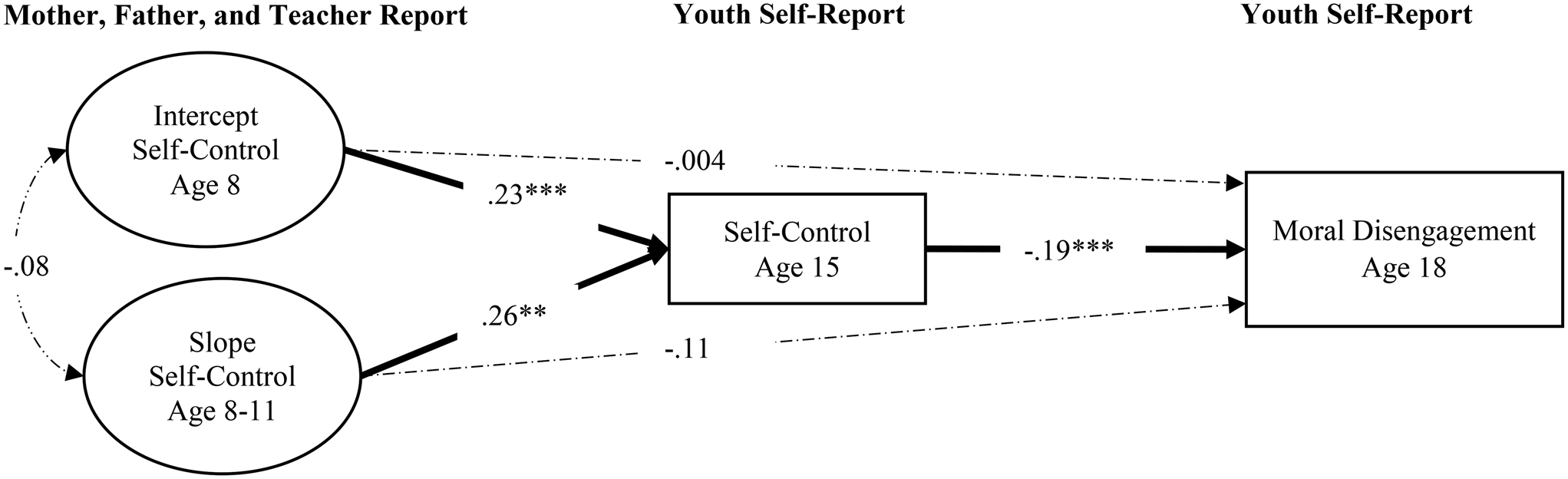
After identifying the optimal second-order LGCMs (e.g., holding strong measurement invariance and determining the best-fitting model), we estimated a structural equation model in which children's self-control at age 8 (i.e., intercept) and their changes in self-control from age 8 to 11 years (i.e., slope) predicted self-reported self-control at age 15, which, in turn, predicted moral disengagement at age 18 (see Figure 1). We used the Model Indirect command in Mplus with bootstrap resampling to test the indirect effects with bias-corrected 95% confidence intervals (Bollen & Stine, Reference Bollen and Stine1990; MacKinnon, Lockwood, & Williams, Reference MacKinnon, Lockwood and Williams2004; Muthén & Muthén, Reference Muthén and Muthén1998–2017) from childhood self-control to age 15 self-control and to age 18 moral disengagement. We particularly focused on indirect effects; however, we also estimated the direct effects from children's self-control at age 8 (i.e., intercept) and their changes from age 8 to 11 years (i.e., slope) to moral disengagement at age 18 (see Figure 1). We statistically controlled for the effects of gender, race/ethnicity, income-to-needs ratio, and data collection site on all of the indicators shown in Figure 1 (i.e., the intercept and slope of self-control, age 15 self-control, and age 18 moral disengagement).
Childhood self-control in relations to subsequent self-control and moral disengagement in adolescence.
Note: Model fits the data well: N = 1,061, χ2 (210) = 382.96, p < .001, root mean square error of approximation, RMSEA (90% confidence interval [CI]) = 0.03, [0.02, 0.03], comparative fit index, CFI = 0.97, Tucker–Lewis index, TLI = 0.96, standardized root mean square error, SRMR = 0.04. Only standardized estimates are shown. Bold arrows indicate significant indirect effects and dashed arrows indicate non-significant paths. Gender, race/ethnicity, the average score of income-to-needs ratio from first month to 72 months, and data collection sites were statistically controlled, but not depicted in the figure for the sake of simplicity. **p < .01. ***p < .001.
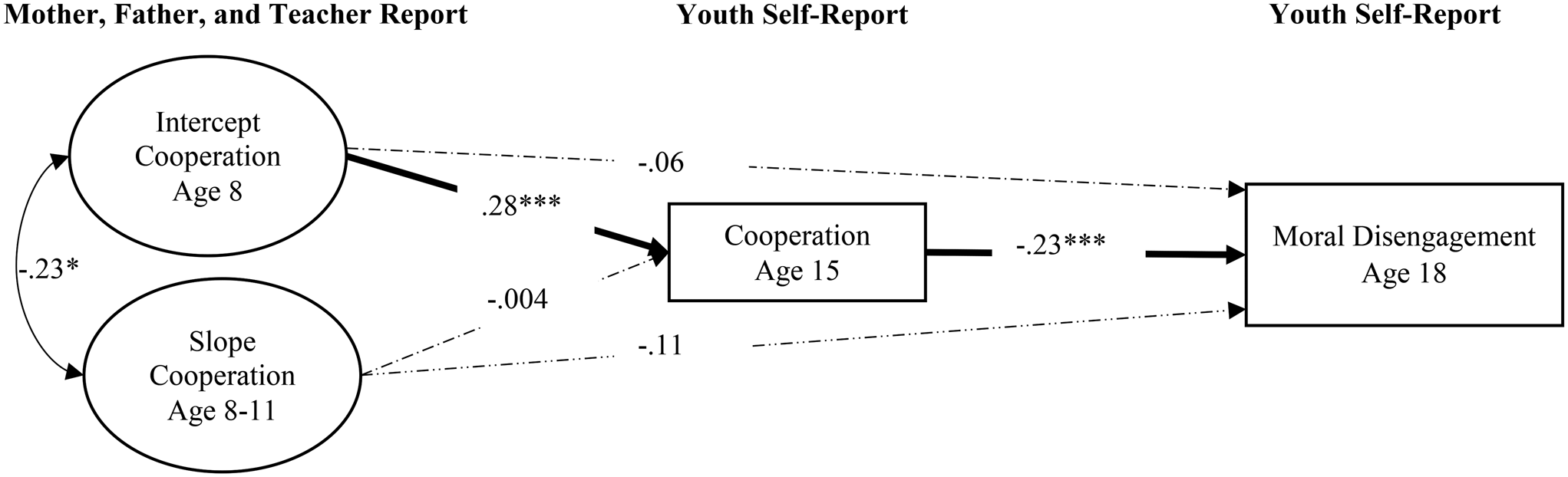
As illustrated in Figure 2, the same analytic steps were completed to estimate a structural equation model in which children's cooperation at age 8 (i.e., intercept) and their changes in cooperation from age 8 to 11 years (i.e., slope) predicted self-reported cooperation at age 15, which, in turn, predicted moral disengagement at age 18. We statistically controlled for the effects of gender, race/ethnicity, income-to-needs ratio, and data collection site on all of the indicators shown in Figure 2 (i.e., the intercept and slope of cooperation, age 15 cooperation, and age 18 moral disengagement).
Childhood cooperation in relation to subsequent cooperation and moral disengagement in adolescence.
Note: Model fits the data well: N = 1,061, χ2 (210) = 461.99, p < .001, root mean square error of approximation, RMSEA (90% confidence interval [CI]) = 0.03, [0.03, 0.04], comparative fit index, CFI = 0.96, Tucker–Lewis index, TLI = 0.94, standardized root mean square error, SRMR = 0.04. Only standardized estimates are shown. Bold arrows indicate significant indirect effects and dashed arrows indicate non-significant paths. Gender, race/ethnicity, the average score of income-to-needs ratio from first month to 72 months, and data collection site were statistically controlled, but not depicted in the figure for the sake of simplicity. *p < .05. ***p < .001.
Robustness check
Lastly, we created a subset of the analytic sample to check the robustness of our findings for participants who had self-reported moral disengagement data at age 18 (N = 755). In the robustness analyses, we re-estimated the final self-control and cooperation models on this subsample.
Missing data
Of the 1,364 children, 261 (19%) had no reports of self-control and cooperation from mother, father, or teacher at 8, 9, 10, or 11 years and these children were excluded from all analyses. A total of 1,103 children were included in the analytic sample as they had self-control and cooperation data for at least one time point from age 8 through 11 years reported by mother, father, or teachers. In the analytic sample, the missing data rate was around 7% for mother-reported variables, ranging from 32% to 36% for father-reported variables, and ranging from 11% to 23% for teacher-reported variables from age 8 to age 11. The missing data rate was 13% for youth self-reported variables at age 15 and 32% at age 18. We conducted further analysis within the analytic sample and compared participants with available and missing data at middle adolescence and late adolescence by the child- and family-level covariates. There were no significant differences at middle adolescence (age 15). Participants with available data at late adolescence (age 18) were more likely to be female (χ2 [1] = 7.54, p = .006, Cramer's V = 0.08), White (χ2 [1] = 19.56, p < .001, Cramer's V = 0.13), and live in higher income households (t [1,059] = 2.94, p = .003, Cohen's d = 0.19). Thus, we included these indicators in our analyses to help account for missing data (Enders, Reference Enders2010).
Results
Preliminary analysis
Means and standard deviations for all variables are presented in Table 1. We also conducted zero-order bivariate correlations and assessed the preliminary associations among the main study variables. As presented in Table 1, we found significant positive correlations among mother, father, and teacher reports of children's self-control (r values ranged from .21 to .75) and cooperation (r values ranged from .19 to .71). In addition, mother, father, and teacher reports of children's cooperation from age 8 to 11 were positively correlated with adolescents’ self-reports of cooperation at age 15 (r values ranged from .16 to .31). Correlation coefficients were similar for reports of children's self-control (r values ranged from .09 to .22). In general, higher reports of self-control and cooperation at all ages based on all reporters typically were related to lower reports of moral disengagement at age 18 (r values ranged from −.09 at p < .05 to −.28 at p < .01).
Descriptives, means, standard deviations, and bivariate correlations among main study variables

Note: M: mother, F: father, T: teacher, S: self-report. 8, 9, 10, 11, 15, and 18 stand for the respective ages.
* p < .05.
** p < .01.
Main analysis
We expected that children's initial level of self-control at age 8 (i.e., intercept) and growth from age 8 to age 11 (i.e., slope) would be positively related to self-views of self-control at age 15, which, in turn, would be linked to less moral disengagement at age 18 (Hypothesis 1). Similarly, we expected that children's initial level of cooperation at age 8 (i.e., intercept) and growth from age 8 to age 11 (i.e., slope) would be positively related to self-views of cooperation at age 15, which, in turn, would be linked to less moral disengagement at age 18 (Hypothesis 2). To test these hypotheses, we used a structural equation framework and estimated two models separately for self-control and cooperation. In both models, we statistically controlled for the effects of children's gender, race/ethnicity, income-to-needs ratio in early childhood, and data collection site on all of the indicators shown in Figures 1 and 2.
To estimate the intercepts and slopes, we estimated second-order LGCMs. We conducted preliminary analyses for the second-order LGCMs. First, we tested for measurement invariance across time for self-control and separately for cooperation. Second, we tested the three functional forms of the change (i.e., no growth, linear, and quadratic) in children's self-control and cooperation from age 8 to 11. Below we present results for self-control and cooperation separately.
Development of self-control as an antecedent of less moral disengagement
Development of self-control in middle childhood
Results from measurement invariance analyses demonstrated configural, weak, strong, and strict invariance for self-control, which means that each of these latent constructs represented statistically similar underlying constructs over time (see Table S1 in the Supplementary Material). Results from the functional form analyses showed that changes in children's self-control were best described by linear change. As shown in Table S2 in the Supplementary Material, the linear model for self-control fits the data well according to a variety of model fit indicators (χ2 (50) = 79.35, p = .005, RMSEA (90% CI) = 0.02 [0.01, 0.03], CFI = 0.99, TLI = 0.99, SRMR = 0.04) and significantly improved model fit when compared to the no growth model (Satorra–Bentler scaled Δχ2 (3) = 18.08, p < .001; Satorra & Bentler, Reference Satorra and Bentler2010). Moreover, the more complex quadratic model did not significantly improve the fit of the model. The factor loadings of linear model can be seen in Figure S1.A in the Supplementary Material.
The mean intercept of children's self-control at age 8 was significantly different from zero (Meanintercept = 1.37, SE = 0.01, p < .001). As we expected, there was a small, statistically significant increase in children's self-control from age 8 to 11 (Meanslope = 0.01, SE = 0.002, p = .012). The variances of the intercept and slope of children's self-control were statistically significant and indicated adequate variability to estimate inferential analyses (Varianceintercept = 0.05, SE = 0.01, p < .001; Varianceslope = 0.001, SE = 0.00, p = .004).
Self-control as an antecedent of less moral disengagement
We tested whether children's initial level of self-control at age 8 and growth from age 8 to age 11 would be positively related to self-views of self-control at age 15, which, in turn, would be linked to less moral disengagement at age 18. The hypothesized self-control model fit the data well: N = 1,061, χ2 (210) = 382.96, p < .001, RMSEA (90% CI) = 0.03, [0.02, 0.03], CFI = 0.97, TLI = 0.96, SRMR = 0.04 (see Figure 1). We found support for Hypothesis 1. In the self-control model, both the higher levels of children's initial self-control as reported by mothers, fathers, and teachers at age 8 (β = 0.23, SE = 0.05, p < .001) and greater increases over time in these reports (β = 0.26, SE = 0.09, p = .007) were significantly linked to higher adolescent self-views of self-control at age 15. Greater adolescent self-views of self-control at age 15 were then linked to less moral disengagement at age 18 (β = −0.19, SE = 0.05, p < .001). Of particular interest, the indirect effect of children's self-control at age 8 on adolescents’ moral disengagement at 18 via their self-views of self-control at age 15 was statistically significant (β = −0.04, SE = 0.03, 95% CI = −0.08, −0.01). Similarly, the indirect effect of children's increases in self-control over time to adolescents’ moral disengagement at 18 via their self-views of self-control at age 15 was also statistically significant (β = −0.05, SE = 0.10, 95% CI = −0.13, −0.01).
Development of cooperation as an antecedent of less moral disengagement
Development of cooperation in middle childhood
Results from measurement invariance analyses demonstrated configural, weak, strong, and strict invariance for cooperation, which means that each of these latent constructs represented statistically similar underlying constructs over time (see Table S1 in the Supplementary Material). Results from the functional form analyses showed that changes in children's cooperation were best described by linear change. As shown in Table S2 in the Supplementary Material, the linear model fits the data well (χ2 (50) = 92.65, p < .001, RMSEA (90% CI) = 0.03 [0.02, 0.04], CFI = 0.99, TLI = 0.99, SRMR = 0.04) and significantly improved model fit when compared to the no growth model (Satorra–Bentler scaled Δχ2 (3) = 18.16, p < .001; Satorra & Bentler, Reference Satorra and Bentler2010). Further, the more complex quadratic change model did not significantly improve the fit of the model. The factor loadings of the linear model can be seen in Figure S1.B in the Supplementary Material.
The mean intercept of children's cooperation at age 8 was significantly different from zero (Meanintercept = 1.22, SE = 0.01, p < .001). Contrary to our expectation, there was no average systematic change in children's cooperation from age 8 to 11 (Meanslope = −0.001, SE = 0.003, p = .779). The variance of the intercept and slope of children's cooperation were statistically significant and indicated adequate variability to conduct inferential analyses (Varianceintercept = 0.05, SE = 0.01, p < .001; Varianceslope = 0.002, SE = 0.00, p = .001). In other words, although cooperation did not change for everyone on average from age 8 to 11, there is significant variability among children where some children exhibited changes in their cooperative behaviors.
Cooperation as an antecedent of less moral disengagement
We tested whether children's initial level of cooperation at age 8 and growth from age 8 to age 11 would be positively related to self-views of cooperation at age 15, which, in turn, would be linked to less moral disengagement at age 18. The hypothesized cooperation model fit the data well: N = 1,061, χ2 (210) = 461.99, p < .001, RMSEA (90% CI) = 0.03, [0.03, 0.04], CFI = 0.96, TLI = 0.94, SRMR = 0.04 (see Figure 2). We found partial support for Hypothesis 2. In the cooperation model, higher levels of children's cooperation at age 8 (β = 0.28, SE = 0.05, p < .001) was significantly linked to higher adolescent self-views of cooperation at age 15; however, the parallel path for the changes in children's cooperation and their self-views of cooperation at age 15 was not statistically significant (β = −0.004, SE = 0.08, p = .959). Greater adolescent self-views of cooperation at age 15 were then linked to less moral disengagement at age 18 (β = −0.23, SE = 0.04, p < .001). Of particular interest, the indirect effect of children's cooperation at age 8 on adolescents’ moral disengagement at 18 via their self-views of cooperation at age 15 was statistically significant (β = −0.06, SE = 0.02, 95% CI = −0.10, −0.03).
Robustness check
We tested the robustness of our findings by re-estimating our final hypothesized models with a subset of the analytic data (n = 755) in which we selected participants who had self-reported moral disengagement data at age 18. Both self-control and cooperation models fit the data well and we found similar findings as those in the main analysis except for one path: the slope of self-control from age 8 to 11 to self-control at age 15 was no longer significant (β = 0.25, SE = 0.16, p = .119) and the indirect effects tested with bootstrap resampling were no longer significant (β = −0.05, SE = 0.06, 95% CI = −0.10, 0.01 for intercept and β = −0.04, SE = 0.21, 95% CI = −0.18, 0.01 for slope) in the self-control model (see Figures S2.A and S2.B in the Supplementary Material).
Discussion
Guided by social cognitive theory and the developmental cascade framework, the purpose of this study was not to consider self-control and cooperation as competing processes or to test the relative strength of these two processes in relation to later moral disengagement. Rather, we tested both the individual self-control pathway and interpersonal cooperation pathway separately, finding longitudinal evidence that both processes were linked to lower levels of moral disengagement consistent with Bandura's theory. More specifically, we found that children's self-control at age 8 and increases in self-control from age 8 to 11 as viewed by others were positively linked to higher self-views of self-control at age 15, which, in turn, were linked to less moral disengagement at age 18. Similarly, we found that children's higher cooperation at age 8 was linked to higher self-views of cooperation at age 15, which, in turn, were linked to less moral disengagement at age 18. These longitudinal findings have implications for understanding the development of childhood self-control and cooperation and demonstrate the potential roles of self-control and cooperation in reducing the frequency of moral disengagement 10 years later.
Overall, our findings yield supportive evidence for social cognitive theory (Bandura, Reference Bandura, Kurtines, Gewirtz and Lamb1991a) and suggest that self-control and cooperation are two developmental processes that help individuals act in moral ways and reduce the frequency of moral disengagement later in life. These findings are also consistent with the developmental cascade framework (Dodge et al., Reference Dodge, Malone, Lansford, Miller, Pettit and Bates2009; Masten & Cicchetti, Reference Masten and Cicchetti2010). Developmental cascades occur when adaptive functioning in an area during one developmental period supports individuals’ broader adaptive functioning later in life (Masten & Cicchetti, Reference Masten and Cicchetti2010). Our findings suggest that the development of children's self-control and cooperation in middle childhood and the extent to which adolescents see themselves as having these strengths can help to extenuate moral disengagement in late adolescence. In addition, as suggested in social cognitive theory and value internalization models (Bandura, Reference Bandura, Kurtines, Gewirtz and Lamb1991a; Grolnick et al., Reference Grolnick, Deci, Ryan, Grusec and Kuczynski1997; Grusec & Goodnow, Reference Grusec and Goodnow1994; Hoffman, Reference Hoffman1977), our results point to the importance of children's transition from externally oriented to internally oriented moral values and behaviors. Consistent with these arguments, our findings imply that the development of children's self-control and cooperation in middle childhood predicted the extent to which youth saw themselves as having these strengths in middle adolescence.
Self-control during middle childhood as an antecedent of less moral disengagement
With respect to self-control, we tested the extent to which the initial level and growth of children's self-control in middle childhood as reported by parents and teachers were linked to youth's view of themselves as having self-control in middle adolescence, which, in turn, predicted less moral disengagement in late adolescence. Our findings indicate that children who had higher self-control skills at age 8 and exhibited increases also reported stronger self-views of self-control when they were 15 years old, which, in turn, was linked to reports of less moral disengagement later in adolescence. These findings lend support for the social cognitive theory (Bandura, Reference Bandura, Kurtines, Gewirtz and Lamb1991a), which has argued that self-regulatory mechanisms such as self-control play a central role in regulating moral behaviors. Self-control helps individuals to self-monitor their behaviors and judge their own behaviors based on their internalized moral values (Bandura, Reference Bandura1991b). Further, affective self-reactions, such as anticipated self-satisfaction and self-respect, motivate youth to engage in behaviors that are consistent with their internalized moral values and personal moral standards (Bandura, Reference Bandura1991b). As a consequence, they are less likely to morally disengage. In other words, strong self-control skills equip youth with the necessary tools to resist social pressures to engage in wrongdoings and thus, highly skilled youth are less likely to need to use moral disengagement mechanisms.
Our analyses indicated that children's self-control as reported by mothers, fathers, and teachers modestly increased during middle childhood. These findings are aligned with previous research, which has shown that the growth rate in children's self-control tends to slow down during middle childhood, especially compared to the much steeper growth observed during early childhood utilizing NICHD SECCYD data (Vazsonyi & Huang, Reference Vazsonyi and Huang2010; Vazsonyi & Jiskrova, Reference Vazsonyi and Jiskrova2018). Of note, although the present data have been partially published in these previous works, our findings extend previous research, demonstrating that self-control during middle childhood can be an antecedent of less moral disengagement in late adolescence.
Cooperation during middle childhood as an antecedent of less moral disengagement
We also examined the extent to which the initial level and growth of children's cooperation in middle childhood as viewed by others were linked to youth's view of themselves as cooperating with others in middle adolescence, which, in turn, predicted less moral disengagement in late adolescence. Here, our findings indicate that children who had higher cooperation at age 8 also reported higher self-views of cooperation when they were 15 years old, which, in turn, was linked to lower moral disengagement in late adolescence. These findings are consistent with social cognitive theory (Bandura, Reference Bandura, Kurtines, Gewirtz and Lamb1991a, Reference Bandura1991b) arguing that affective self-reactions motivate youth to cooperate with others because youth expect to have self-satisfaction and self-respect as a consequence of these prosocial acts. Further, because cooperative behaviors are care-based behaviors and involve individuals balancing their self-interests with others’ interests and needs (Carlo, Reference Carlo, Killen and Smetana2006; Vaish & Tomasello, Reference Vaish, Tomasello, Killen and Smetana2014), cooperative behaviors can help to reduce selfish motives associated with moral disengagement. In addition, cooperative behaviors increase the responsibility toward others and encourage youth to act in ways consistent with their internalized moral values and consider the consequences of their acts on others (Colby & Damon, Reference Colby and Damon1992). Therefore, when youth behave cooperatively and in ways consistent with their internalized values, they are less likely to morally disengage.
Contrary to previous research that suggested some changes in cooperation over childhood (Malti et al., Reference Malti, Ongley, Peplak, Chaparro, Buchmann, Zuffianò and Cui2016), we did not find increases in parents’ and teachers’ reports of children's cooperation between 8 and 11 years. There are a few possible explanations for this difference between our findings and previous findings. First, the study by Malti et al. (Reference Malti, Ongley, Peplak, Chaparro, Buchmann, Zuffianò and Cui2016) examined the development of children's cooperation on average over a broader age range from 6 to 12 years, whereas our data covered a shorter span from age 8 to age 11. The longer developmental span in the Malti et al. (Reference Malti, Ongley, Peplak, Chaparro, Buchmann, Zuffianò and Cui2016) study may help to identify the developmental trajectories of cooperation if growth is modest. Second, Fabes and Eisenberg (Reference Fabes and Eisenberg1998) argue that the growth in children's prosocial behavior (e.g., cooperation) might be different across research due to the methodology used in the study design (e.g., different reporters). Children's cooperative behaviors have been almost exclusively reported by their primary caregivers (mostly mothers) in previous research. However, in this study, changes in children's cooperative behaviors were defined by relying on multiple reporters, namely mothers, fathers, and teachers – all of whom are likely to be familiar with children's cooperative behaviors during middle childhood in different contexts (home and school). Therefore, the stability we found in children's cooperative behavior may characterize a more comprehensive indicator of developmental changes across contexts during middle childhood.
Commonalities and differences in self-control and cooperation models
Our self-control and cooperation models showed similar patterns, except the changes in cooperation over time were not linked to moral disengagement at age 18. Although cooperation, on average, did not significantly change from age 8 to 11, there was significant variability among children, with some exhibiting larger changes in their cooperative behavior compared to others. In such cases where there is little to no average change but significant variability among children, the changes in children's cooperation may still be associated with other indicators. Those associations did not emerge for cooperation, however. Even though the changes in children's cooperation from ages 8 to 11 were not predictive in our models, this might be found earlier. Both self-control and cooperation at age 8 were significantly, indirectly associated with moral disengagement, suggesting that growth prior to age 8 also may be consequential. Thus, future studies are warranted to investigate further the extent to which the developmental trajectories of self-control and cooperation starting at early ages predict adolescent moral disengagement.
In addition, although the bivariate correlations suggested that parents’ and teachers’ reports of children's self-control and cooperation during middle childhood were each typically associated with less moral disengagement, there were no direct effects once we accounted for adolescents’ self-views of their self-control and cooperation at age 15 in the model. These findings provide support for our findings from our main analyses and point to the potential importance of internalization of self-control and cooperation.
Limitations and Conclusion
There are limitations in this study that researchers should consider when interpreting our findings. First, due to the correlational nature of this study, causal connections cannot be drawn. Second, self-control and cooperation were assessed using questionnaires. Even though we used multi-informant data to account for shared method variance and social desirability concerns, future studies using alternative reporters (e.g., peers) and methods (e.g., observations) can help complement the current insights. Third, the last wave of the NICHD SECCYD data that were used in the present study (age 18, around the end of high school) were collected between 2008 and 2010. Although the participants are only in their late 20s today, it will be important to test cohort or historical differences. Fourth and finally, although the NICHD SECCYD sample is economically and geographically diverse, Latino/a participants are under-represented relative to the US population in 2020 (NICHD Early Child Care Research Network, 2005). Future studies with more ethnically diverse samples are needed.
Despite these limitations, our findings are the first to demonstrate relations between self-control and cooperation during middle childhood and less moral disengagement in late adolescence. These results may be used to inform intervention and prevention programs during middle childhood and adolescence that share the goal of fostering moral development and decreasing moral disengagement. In particular, given the significant roles of self-control at age 8 and growth in self-control from age 8 to 11, fostering self-control might be important to ensure continued growth from early childhood through middle to late childhood. In addition, given that cooperation at age 8 was indirectly associated with moral disengagement, promoting cooperation earlier than middle childhood would be particularly beneficial to ensure its development by age 8 and growth from early childhood through middle to late childhood. Nurturing children's self-control and cooperation may help to keep youth on the moral path later in their life.
Supplementary Material
The supplementary material for this article can be found at https://doi.org/10.1017/S0954579421000584
Acknowledgments
A cooperative agreement (5 U10 HD027040) between the Study of Early Child Care and Youth Development (SECCYD) study investigators, which included Deborah Lowe Vandell, and the Eunice Kennedy Shriver National Institute of Child Health and Human Development supported the design and data collection of the SECCYD from birth through age 15 years. The Charles Stewart Mott Foundation provided support to Deborah Lowe Vandell (PI) for end-of-high-school data collection (G-2006-00365.01). The content is solely the responsibility of the authors and does not necessarily reflect the official views of the funders. We thank the study participants for their willingness to be a part of this longitudinal project that began shortly after their birth.
Funding Statement
The current analyses were supported by grants from the Charles Stewart Mott Foundation to Deborah Lowe Vandell (G-2006-00365.01) and the Sir John Templeton Foundation to Sandra D. Simpkins, Deborah Lowe Vandell, Nicole Zarrett, and Jacquelynne Eccles (#161089).
Conflicts of Interest
None.


 Open access

