




Introduction
Far from his kingdom’s shores, projecting authority and sangfroid, King Manuel I of Portugal (r. 1495-1521) rides a mottled sea monster on a sheet of Martin Waldseemüller’s 1516 world atlas, the Carta Marina (see Figure 1). By placing the seafaring monarch off the coast of Southern Africa, on a folio devoted to the Western Indian Ocean, the German cartographer and his associates marshalled the latest news trickling into Europe about the contours of the world’s continents, reworking tradition to meet new ends. Instead of representing the Roman god Neptune astride a sea creature, as precedent would have it, the creators of the Carta Marina showed “Emanuel, the very Christian King of Portugal” raising a scepter in the high seas.Footnote 1 Confirming this projection of Lusitanian power, the figure of Manuel holds in his other hand both a long cross (to which is tied a banner adorned with the Portuguese crest) and the bridle of a sea creature whose head emerges from the surf with a bit in its jaws. The otherwise ominous marine monster, of the kind that medieval and early modern cartographers traditionally inserted to represent the limits of human influence, appears under Manuel’s grip to be tamed and steered in the direction desired by the monarch. The placement of the figure and its accompanying text, which proclaims Manuel’s ‘victory,’Footnote 2 hammers home the point: just as Portugal’s sovereign tamed the sea monster, so had he subjected under his authority – or at least aspired to subject – the navigators and traffickers who transited with increasing frequency during the years of his reign between the Indian and Atlantic Oceans.
Depiction of King Manuel I astride a sea creature in the Southwestern Indian Ocean. Martin Waldseemüller, “Carta marina navigatoria Portvgallen navigationes…” Plate 11. (Strasbourg, 1516). Jay I. Kislak Collection, United States Library of Congress.

Figure 1 Long description
A historical map showing a depiction of King Manuel I astride a sea creature in the Southwestern Indian Ocean. The map includes detailed illustrations of coastlines, islands and navigational lines. A compass rose and a grid overlay are present, along with a decorative border featuring various figures and symbols. The map is part of Martin Waldseemüller's work, titled 'Carta marina navigatoria Portvgallen navigationes,' Plate 11, from 1516.
There was the assertion of domination and there was the far messier reality. The perception of this disjuncture between idealized and realized claims was as debated in Manuel’s time as it has been in the centuries since. Some five hundred years after the death of Manuel, a group of international scholars came together at the University of Coimbra, in a conference series held by the Centre for the History of Society and Culture, to consider and debate old and new historical treatments of the early modern monarch and the sprawling imperial enterprises launched during his reign.Footnote 3 Like the cartographers of Waldseemüller’s day, the scholars gathered in Coimbra selectively borrowed from precedent while also diverging from conventional readings of global history. The conference’s point of departure, and the representative essays of participants gathered in the present volume, reject in various ways the centrality of Portugal, let alone Manuel, for the emergence of the early modern global order. Contributors presented a range of interventions that grappled with a central provocation: How does deemphasizing the exceptionality or centrality of Portugal, and examining more closely the ways in which the Iberian empire was co-created with the wider world, transform understandings of the chronologies, spatial frameworks, and agents of change traditionally used to narrate histories of the dawn of the Portuguese empire?
This proposition likely would not have been on the table half a century ago. In the latter decades of the twentieth century, as independence movements in the formal possessions of the Portuguese empire in Asia and Africa gave way to a postcolonial and neo-imperial world order, scholars in Portugal subjecting King Manuel I and his era to renewed scrutiny helped launch an internationalist project adopting moderately critical forms of remembrance.Footnote 4 Nevertheless, perspectives in vogue at the time tended to underscore the singular figure of the monarch, his entourage, and the ideological contours of elite European political culture as a key driver of Portuguese imperialism denoted as ‘expansion.’
For Luís Filipe Thomaz, who lent much emphasis to the image of the monarch in Waldseemüller’s map, the messianic and eschatological thought of Manuel and his most hawkish advisers went a long way towards explaining the why and the how of Portuguese imperialism in the early sixteenth century.Footnote 5 According to this view, Vasco da Gama’s first voyage to India (1497-8) helped foment an imperial ideology resting on the tenets of oceanic domination, commerce, and evangelization. In 1506, the year after the first viceroy was appointed to govern Portuguese India, the royal secretary Duarte Galvão outlined in his Crónica de D. Afonso Henriques the prophetic emergence of a Christian empire that would span the globe, destroying Muslim enemies of Christ re-encountered by the Portuguese in Asia, and allowing for the evangelization of all the world. In the same period, Duarte Pacheco Pereira, in his politico-geographic treatise Esmeraldo de situ orbis, dubbed the king ‘Manuel Caesar.’ This global imperial ideal steeped in eschatological and classical thought, so central in Thomaz’s influential account of Manuel and Portugal’s rise to global prominence, gradually grew from the pens and minds of officials in the royal court and, importantly, in Rome. At the seat of the Catholic church, where European kingdoms began to have permanent representation, the Italian poet and clergyman Egidio da Viterbo proclaimed Manuel in 1507 to be a ‘Lusitanian David,’ echoing the messianic perspectives on the king that were being dreamed up in Lisbon.Footnote 6 Waldsemüller’s representation of Manuel in the Carta Marina, a decade later, is of a piece with this generation of imperial boosters foregrounding the figure of the king in global space and religious history.
Other major Portuguese scholars in the twentieth century brought more material concerns to bear on their treatment of Manuel. For Vitorino Magalhães Godinho, commercial initiatives in which the state played a central role constituted a focal point of Manuel’s power and, by extension, Portugal’s place in the early modern world. In a dense and exhaustive analysis influenced by Annales school methodologies, Godinho proposed that mercantile domination spurred the Portuguese crown’s expansionist projects from which the ‘pepper king’ derived his empire. In an interpretation that went on to be influential with many economic and social historians outside of Portugal, this commercial empire laid the structural foundations for the early modern world economy.Footnote 7 For others such as Luís de Albuquerque, Portuguese maritime enterprises furthered empirical approaches to understanding the natural world in emergent disciplinary formations of science, mathematics, and cartography – a thread that has been taken up by many scholars since.Footnote 8 The material foundations of empire and its ancillary projects entailed, in these frameworks of analysis, specifically Portuguese contributions to world history.
International scholars outside of Portugal working contemporaneously to Thomaz, Godinho, and Albuquerque channeled some of these insights towards more ample perspectives, in an arena of scholarly historical production that tended to reinforce some of the more Eurocentric premises of the Portuguese imperial historians. Charles Boxer pioneered a vision of the particularities of Portugal’s early global enterprises in relation to other European empires, though he did not foreground Manuel’s specific role.Footnote 9 Later, Russell-Wood focused on the impact of the maritime Portuguese voyages on the circulation of people, commodities, natural products, and ideas, but still in a framework centred on the motivations and rhythms imposed by the Portuguese.Footnote 10
By contrast, in an approach pioneered by scholars of the early modern Indian Ocean world, Sanjay Subrahmanyam, Ângela Barreto Xavier, Jorge Flores, and others recontextualized the arrival of Europeans within the longstanding realities and conjunctures of South Asian and, more broadly, maritime trading routes and political cultures.Footnote 11 In a certain sense, many of these perspectives were first opened up by Jean Aubin. His studies, addressing a range of dimensions and spatial contexts, introduced new analytical horizons by decentring the gaze from the Manueline court and redirecting it towards an understanding of Asian power brokers and the decisive role they played in shaping the configuration of Portuguese influence (or the lack thereof) in Asia.Footnote 12 The figure of Manuel in Waldsemüller’s map required new interpretations.
An international community of scholars have since risen to the occasion. Into the first decades of the twenty-first century, a confluence of historiographic currents has significantly changed modes of writing and conceptualizing the global dimensions of the early modern Portuguese world. Such emergent frameworks include but are not limited to:
a) a rise to prominence in the study of material and visual culture;Footnote 13
b) multi-scalar methodologies incorporating local and oceanic frameworks of analysis;Footnote 14
c) attention to political culture in new iterations of diplomatic history;Footnote 15
d) critical engagements with trans-regional histories of enslavement, ethnicity, race-making, gender, religion, capitalism, and other modalities of inclusion and exclusion;Footnote 16
e) questions of individual, collective and non-human agency, and the varied modalities of resistance.Footnote 17
This renewal in the historiographic landscape has propelled new approaches, many of them anticipated by the Portuguese historians Francisco Bethencourt and Diogo Ramada Curto. In the introduction to their landmark edited volume from 2008, the authors argued against conceiving the Portuguese empire as a bounded entity.Footnote 18 Bethencourt’s own contribution in the same volume figured among the first to argue for the ‘improvised’ nature of empire, dependent on conquests, negotiations, and compromises with others.Footnote 19 Likewise, emphases on the importance of the role played by individual actors at the margins of formal structures of empire who crossed diverse boundaries was suggested by Cátia Antunes and Amélia Polónia.Footnote 20 Polónia also sought to foreground the role of individuals and networks organized in spaces outside of Lisbon.Footnote 21 These approaches tend to be more compatible with rendering non-European perspectives with more precision, and the perceptions that diverse peoples who interacted with the Portuguese from Manuel’s time onward gradually constructed of the Portuguese – angles of analysis that have been the subject of key interventions by scholars working in Asian, African, and Indigenous Brazilian histories.Footnote 22
These recent trends, which benefit from collaborative investigation and bring together authors from various scholarly traditions, have used connected and comparative analyses of the early modern Iberian empires, an avenue opened by the work of Serge Gruzinski, who insisted that the supposedly inevitable and unstoppable advance of the Iberian empires in the early decades of the sixteenth century is an illusion.Footnote 23 The Islamic world, the Aztec eagle, and the Chinese dragon, to use his metaphor, confirm the contingent nature of a multipolar world. These interpretations tend to underscore the many entanglements and reciprocal influences that characterized those Iberian empires, which otherwise tend to be read in oppositional terms.Footnote 24 By contrast, scholars have increasingly seen the dynamics of territorial and economic expansion of both Portugal and Spain’s empires as a continuation of processes with roots in the medieval Christian reconquista of the Iberian Peninsula. The pattern would have seen the substitution of neighboring Muslim authorities with their conquerors, the imposition of rule by Christian kings, the forced removal and forcible baptism of Jewish populations, the doling out of land concessions to new proprietors, the attribution of subaltern status to newly subjected populations – all concerted political acts enforced through violence.Footnote 25 Building on this connected perspective, further works position Iberian empires as key but not sole instigators of globalization.Footnote 26 Opening the vantage point to “global interconnectivity” and ever more intensifying dynamics of integration spurred by the voyages of Vasco da Gama and Pedro Álvares Cabral appear in a recent synthesis of the scholarship marked by a global historical approach, a scholarly current that has likewise brought important new contributions to the field.Footnote 27
Global horizons nevertheless are still hobbled by blind spots. French, Dutch, and English rivalries with Iberian empires have been a perennial topic of European historiographies – inspiring a host of comparativist treatments usually oriented more towards highlighting contrasts between empires – but the recent approaches pioneered by scholars of Portugal and Spain before and after the union of the Iberian crowns in 1580 provide important lessons for comprehending the co-constructed nature of broader trans-European imperial configurations in the early modern era. The emerging vision is one of shared chronologies, contested spaces, and overlapping networks. Franco-Iberian relations in the Manueline era and its aftermath offer an underexplored and consequential arena of inquiry, where rivalries on the Brazilian coast, the Caribbean, and Atlantic Africa prefigured important global European disputes in later decades and centuries.Footnote 28 That mapmakers in Dieppe in 1547 chose to depict the French monarch François I astride a sea creature off the southern African coast in what has since become known as the Vallard Atlas – a figure explicitly rivaling Manuel’s depiction in Waldseemüller – suggests that antagonisms and conflicts among elites in Europe entailed less a diametrically opposed approach to empire-building than a form of interaction in their own right, aligned in the ways in which they sought to further European interests in a larger world.Footnote 29
A similar area for further research, already pursued by scholars of Indigenous Americas and critical archival studies, involves integrating European space and agents into coeval global circuits, rather than seeing historical change in a world arena as driven by outwardly moving Europeans.Footnote 30 Discourses of novelty have long structured this framing. The years of Manuel’s reign represented, as is widely recognized, a world-historical conjuncture when Portuguese and European elite discourses touted newness from the parapets, particularly in relation to the opening of ‘new’ oceanic routes, the expansionist designs on the so-called ‘New’ World of the Americas, and the production and diffusion in previously unmatched volumes of commodities like sugar. Yet developments closer to Portuguese shores were also afoot, as a national historiography has traced in detail the character of municipal reforms that included the reissue of ‘new’ town charters (forais novos) and other legal and administrative restructurings generally glossed as ‘Leitura Nova.’ The fact that, with the notable exception of recent work by Ângela Barreto Xavier,Footnote 31 continental Portuguese reforms tend not to be seen in the light of global transformations, even as they also participated in coeval discourses of newness, suggests that understanding strategies of rule in ‘metropolitan’ spaces as a function of global processes might yield new perspectives on Portugal’s place in the early modern world. The consideration of this historiographic disjunction between kingdom and empire, or more broadly, Europe and the world, suggests that there is more work to do beyond this special issue to consider the potentials for embedding histories of Portugal and the Portuguese empire in the transformations of the early modern world.
An area where scholars of the Lusophone world have most clearly engaged in this line of inquiry is in Iberian confessional politics, and specifically the persecution of Jews and Muslims during the reign of D. Manuel. A culmination of complex processes of multi-confessional negotiation and religious orthodoxy, the royal Portuguese decrees of 1496-7 forced tens of thousands of Jewish people in Portugal to convert to Christianity. In the same sequence of promulgations, Crown officials also forced scores of Muslim people into exile. Scholars have explored how these royal policies involved deliberate calculations on the part of Manuel and his court, with an eye to the internal politics of the kingdom, dynastic maneuvering with Castile, and regional conjunctures in Europe, North Africa, and beyond.Footnote 32 Waves of persecution against religious minorities in late fifteenth- and early sixteenth-century Iberia portended great consequences for the fortunes of the Portuguese royal treasury, the peninsula’s religious composition, Muslim-Christian relations writ large, and the subsequent contours of the Western Sephardic Diaspora.Footnote 33 For sixteenth-century Jewish chroniclers such as Samuel Usque, Manuel was less the ‘Fortunate’ king lauded by his supporters than he was an unjust monarch who betrayed the Iberian Sephardim.Footnote 34 Although no firsthand sixteenth-century accounts of the Manueline expulsions of Muslims have survived, many of those who experienced or witnessed them no doubt shared a similar critique, while others silenced their opposition and accepted the forced baptism policies.Footnote 35
Manuel’s persecution of religious minorities burnished his militant Roman Catholic credentials, but some unintended consequences of the expulsions would soon become evident to the Portuguese royal court. Decades earlier, Jews in the Algarve had formed a critical hub of the nascent printing industry on the Peninsula. The first-ever printed book in Portugal, from the presses of the Algarve typographer Samuel Porteiro in the 1480s, was in Hebrew.Footnote 36 Following the expulsions, Manuel’s court encountered greater difficulties than they otherwise would have to find a printer in Portugal with the technology and capacity to publish the latest edition of a revamped legal compendium known as the Ordenações Manuelinas.Footnote 37 They looked in the 1510s to the Seville-based printer Jakob Cromberger. It is likely, as argued Clive Griffin, that the 1521 Cromberger edition of the Ordenações, which claimed to be published in Lisbon and Évora, was in fact made in Seville.Footnote 38 Extending this hypothesis, Gabriel Rocha found that paper used in a copy held at the John Carter Brown Library of Cromberger’s 1521 Ordenações bears the distinctive watermark of a scepter and armillary sphere: symbols that were associated with Manuel and would come to enter the symbology of the Portuguese Crown and later nation-state(see Figure 2). In European papermaking technology of Manuel’s time, watermarks were introduced at the point of production, and the high-quality paper required by a sumptuous display of Portuguese royal power would likely have been produced and imported from Italy.Footnote 39 As such, an instrument of Portuguese law intended to project the monarch’s authority outward to the kingdom’s vassals and the broader world likely exemplified, in its material composition, a Portugal shaped by external forces. Likewise, few months after the completion of Cromberger’s 1521 Ordenações Manuelinas, the Portuguese king expired in Lisbon from a transcontinental outbreak of bubonic plague.Footnote 40
Reproduction of watermark depicting armillary sphere and star-pointed scepter included in Ordenações Manuelinas, Bk. 5 (Lisbon/Évora, 1521). John Carter Brown Library. Traced from image of original by Gabriel Rocha.
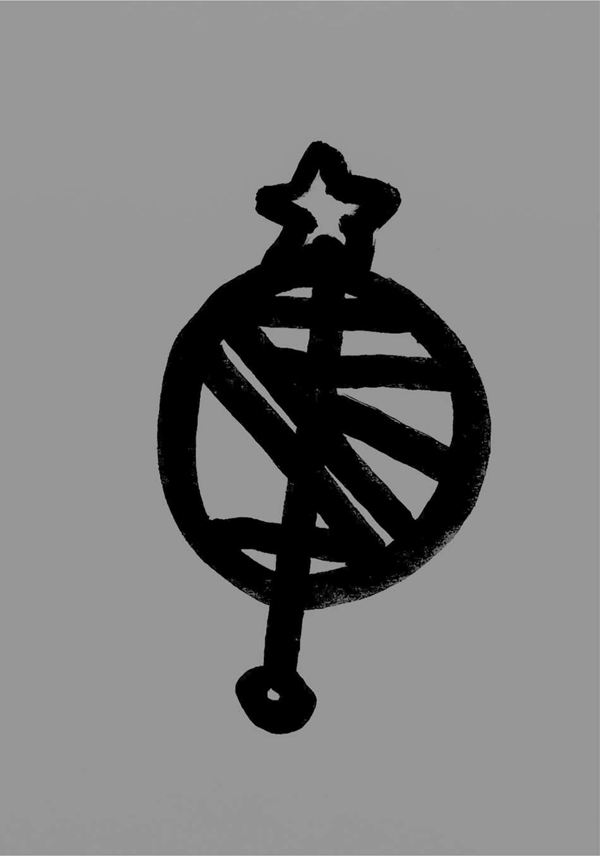
Figure 2 Long description
The image shows a stylized illustration of an armillary sphere intersected by a diagonal line. At the top of the sphere is a scepter with a star-shaped tip. The sphere is composed of circular bands and the scepter extends vertically through the center, ending in a circular base.
Recent historiographical currents examining Portugal in early modern global history, as discussed above, open the possibility of comprehending, among other things, how a printed legal code claiming to have been printed in Lisbon and Évora emerged materially and politically from factors far beyond the Iberian kingdom’s borders. In this way, the geographies by which historians of Portugal in the world centre their narratives is now, more than ever, an open question. Scholars are now more likely to accept, from the outset of analysis – as they did at our conference in Coimbra – the limitations of narratives and interpretations constructed around Portuguese or other European actors in early modern histories of global empires. Building on such important developments in the historiography, contributors to this special issue of Itinerario take this one step further by illustrating, individually and collectively, the multi-polar interactions that shaped the emergence of Portuguese imperial formations across various world regions. Where a previous historical model tended to approach the political and economic structures of empire as imposed by one group (whether restricted to political or economic elite with various degrees of connection to the court of Manuel I, or more broadly to subjects identified as Portuguese), the contributors here examine processes of change and struggle that created – from the earliest phases of Portuguese imperial enterprises – unstable and multiply determined social, political, religious, and cultural formations more than often marked by violence, hierarchy, pragmatism, and adaptation.
The contributions together help advance current historiographic debates around how to articulate what Sanjay Subrahmanyam has called “connected histories” at various scales, how best to account for the “equal shares of history,” as put forward by Romain Bertrand, or how to demystify Victor Lieberman’s “strange parallels” in cycles of transformation across disparate parts of the early modern world.Footnote 41 The variety and commonalities of the issue’s contributions coalesce around (without being fundamentally circumscribed to) early modern Portuguese imperial spheres during Manuel’s reign and its wake. Read together, they present a unique opportunity to break new ground in ascertaining plural perspectives and simultaneous explanatory frameworks inherent in early modern global histories.
As a whole, therefore, the dossier furthers a historiographic turn towards open-ended and non-teleological approaches of early modern global history at the pivotal historical conjuncture of Manuel I’s reign. From different geographic, historiographic, and disciplinary vantage points, contributors help to better elucidate the role of non-Portuguese actors and contexts, in addition to the improvisations, adaptations, false starts, mutual influences and local experiences that influenced the trajectories of empires in the Manueline era. At heart, they offer a better sense of how histories traditionally deemed ‘Portuguese’ were interlaced with a broader world marked by swift and unexpected transformations. Such considerations help advance thinking on the range of methodologies that historians and other scholars in allied disciplines can use to study the ever ‘entangled’ multinational nature of early modern imperialism writ large.
To pursue these objectives, the issue’s contributions variously cross disciplinary boundaries, drawing from methodologies that span History, Art History, Religious Studies, and/or Anthropology. Within History, they engage with distinct historiographical traditions, from Africa, the African Diaspora, and Colonial Latin America, to Native Studies of South America, the Indian Ocean World, and Early Modern Europe. Notably, aside from one of the co-editors, no participant in this dossier is a Portuguese national: an indication of the degree of internationalization of early modern Lusophone studies in recent decades, and a sign of how diverse scholarly traditions and backgrounds can continue to help reshape conventional understandings of Portugal’s empire in the age of Manuel I.
We are pleased and grateful to have gathered leading scholars of early modern global history for this endeavor, as exciting as it is challenging. Sanjay Subrahmanyam, whose previous studies were integral to the recontextualization of Portugal in global history (see above), brings in the opening essay of this volume a focus on the impact of Islamic elite political and religious cultures across the Asian and African continents on nascent Portuguese imperial structures and strategies of rule. Subrahmanyam’s contribution makes especially visible how the Portuguese neither determined the tempo by which their imperial holdings emerged, nor their subsequent transformations, strongly conditioned by non-European agents. Far beyond thinking of empire as part of an expansionist strategy delineated by Manuel I and his courtiers, Subrahmanyam’s essay makes explicit how a series of geopolitical transformations triggered by the death of Timur in 1405 created complex repercussions in diverse Sunni, Mamluk, Timurid, Ottoman, Deccan, and Gujarati polities. At heart, he underscores that factors that were extrinsic to Portuguese designs, particularly the defeat of the Mamluks by the Ottomans in 1516-7, opened a window of opportunity for the Portuguese in Asia.
David Wheat examines the ocean-spanning social, economic, and cultural pathways that displaced scores of enslaved Africans to Europe, the Caribbean and the Americas in the sixteenth century. Through new archival finds, particularly from the vast holdings of the Archivo General de Indias that lay witness to the porous divide between Portuguese and Spanish mercantile interests, his essay examines how Iberian and other European merchants forged new connections with their African, Caribbean, and global counterparts in the span of the early sixteenth century around the emerging transatlantic trade in enslaved Africans. With keen attention to the changing fortunes and geographies of trafficking circuits, Wheat shows how European merchants and mariners coordinated to develop colonial entrepôt and plantation slavery enterprises across the East Atlantic islands - Madeira, Arguin, Canaries, Cabo Verde, and São Tomé – to traffic African people across even greater expanses, including, from the last years of Manuel’s reign onward, to the Americas. Undoubtedly, Portuguese people played primary roles in establishing the complex social and economic structures of slavery in the early Atlantic; nevertheless, Wheat’s essay adds to the growing chorus of scholars showing that Portuguese mercantile and royal elites, let alone seafaring people from Portugal, did not act in isolation from other Europeans beyond their Iberian neighbors. Italy, the Low and Baltic Countries, England, Germany and France all contributed, to different degrees and at different moments – including in the times of Manuel I – their great shares of financiers, traders, and conveyors of early Atlantic slavery.
Adding to this reconceptualization of the Portuguese empire, Maria Regina Celestino de Almeida approaches the foundational role of diverse Native South American peoples – their societies and cultures, their political structures of rule and sovereignty – in making colonial Brazil. While Manuel’s reign saw the arrival of the first waves of Portuguese (and other European) peoples in the vast lands previously known by some as Pindorama, and later as America, Celestino de Almeida shows that Native peoples brought forward, through the cataclysms of contact in the sixteenth century, longstanding cultural and social practices of exchange, taking on perseverant, vital and changing spiritual and political forms. These ongoing and transformative processes, driven foremost in Brazil by a diverse mosaic of Indigenous peoples including the Tupi-Guarani, influenced key aspects of Portuguese royal policy even as Native Brazilians faced multifaceted enterprises of trade and warfare that furthered European projects of slavery and dispossession in their lands. Celestino de Almeida’s essay builds on key works in the historiography, as well as inter-disciplinary scholarly approaches particularly from Anthropology, that have established the foundational impact of Indigenous political culture on the Portuguese project of empire in the Americas as it began to take shape from the Manueline period. This synthetic approach suggests even further possibilities for piecing together histories of South America’s reach in Atlantic and global histories.
Rounding out the collection, and charting other inter-disciplinary waters, Urte Krass offers a bracing portrait of the circulation of Roman Catholic relics and devotional objects, which she notes reflect changing patterns of religious devotion in colonial Iberian and European spaces. In an original approach centred on the material and visual culture of Christian spirituality, Krass also considers how a clerical error might have conditioned history: ancient texts registered a story of a German princess who set a deadline for her pagan fiancée to convert to Christianity, sending him to Rome accompanied by eleven virgin women. Centuries later, a medieval scribe read the ‘eleven’ as ‘eleven thousand’ and the error sparked the emergence of a crowded material and discursive field for the circulation of proliferating relic objects that took hold in Europe. This spiritual cult of saintly relics also gained traction in Manueline Portugal and, from then on, in bones and images, diffused and circulated across diverse spans of the Portuguese empire, from Goa to Brazil, assuming new characteristics, influencing new religious practices, and gaining new forms of visual representation.
The picture of Manuel that emerges from this quartet of essays presents a smaller silhouette of the monarch in a more crowded tableau of global actors. Taken together, these considerations transform potential readings of the image of Manuel in Waldseemüller’s Carta Marina. Although the messianic and authoritative projection of power is undeniable, taking seriously the peripherality and strategic insertion of ‘Portuguese’ interests in the Indian Ocean – one that the engravers no doubt also knew – underscores that the figure of the monarch lies off-centre in the map, rather than at its core. Manuel’s title – “King of the navigation, conquest, and commerce” – put forward a sovereign assertion not to the oceanic space itself, but to the mariners and merchants who sought access to a larger domain. From this perspective, the grandiose claim appears more conditioned by the reality of limited power: Manuel’s back is turned to the Indian Ocean, as if beating a hasty retreat. Beyond his reach lies the Atlantic African coast, where other sovereigns articulated their own geopolitical designs and economic schemes. Beyond that, still, lay the landmass that began to be known in some European circles in Manuel’s years as America, with their diverse and powerful sovereign peoples. An oceanic mercantile network traversed these spaces in ways that monarchs and rulers of various parts of the world sought to regulate, inflect, and otherwise integrate with mixed success – Manuel and his European rivals, including the French king depicted in the Vallard atlas, among them. Seen in light of the trends in Portuguese imperial and early modern global historiography, therefore, the articles in this special issue help crystallize a new vision of the king portrayed by Waldsemüller: not just as exemplifying a gap between messianic vision and a messier reality, but rather illustrating an aspirational vision of supremacy that carried within its own articulation an attenuated view of what could be plausibly achieved. The king who wished to dominate the sea and trade, for all his messianic leanings, was limited to steering a sea creature away from the Indian Ocean, catching a ride on the ocean’s mightier currents.
Acknowledgements
The authors wish to thank the participants of the international conference cycle “Beyond King Manuel I: The Portuguese Empire in a Changing World, 1450-1550,” held at the Centro de História da Sociedade e da Cultura in Coimbra, Portugal in 2021-22. Particular gratitude goes to conference co-organizers Ângela Barreto Xavier, Jorge Flores, Maria Berbara and Giuseppe Marcocci who were instrumental to the success of the gatherings. This essay draws from some of the language initially drafted by all the co-organizers in the call for proposals.
Funding Information
We express our gratitude to the Fundação Engenheiro António de Almeida (Porto) for its generous support in enabling the Congress from which this special issue originates. The Congress likewise benefited from the support of the Centro de História da Sociedade e da Cultura – UIDB/00311/2020, and of the Fundação para a Ciência e Tecnologia (FCT).


 Open access

