


Introduction
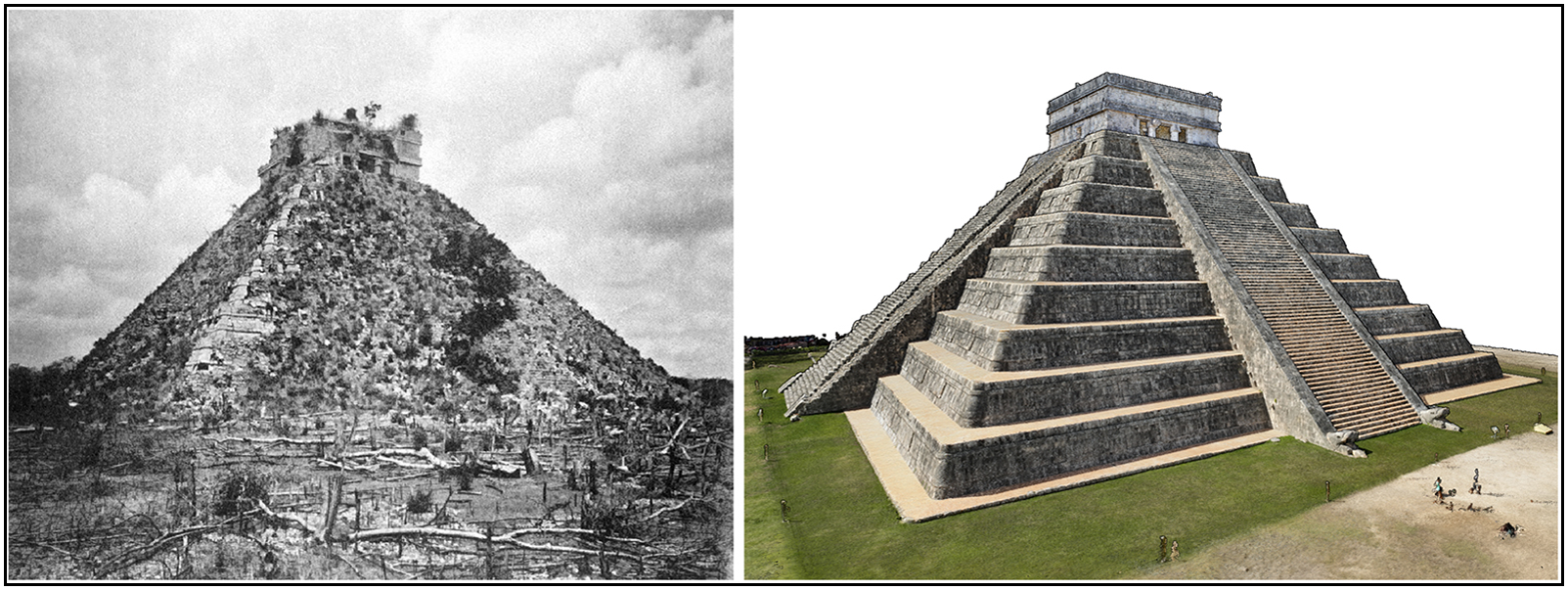
Chichen Itza’s El Castillo (Pyramid of K’uk’ulkan) is one of Mesoamerica’s most recognisable monuments. The structure had lost much of its original exterior stonework, including pieces of the monumental limestone feathered-serpent columns that support the portico of the upper temple (Figure 1). In 1905 the Instituto Nacional de Antropología e Historia (INAH) and the Carnegie Institute of Washington began a reconstruction effort that substantially modified the temple’s exterior (Miller Reference Miller and Wren2018). Though interpretations vary, some scholars regard the feathered serpent as a central deity, a manifestation of the wind, responsible for carrying the sun in its daily sojourn across the sky (Coltman Reference Coltman and Stanton2023). While the site features many carved serpent heads, those associated with El Castillo’s upper temple portico (Figure 2) are perhaps some of the most important, given their central location.
A photograph of El Castillo prior to reconstruction efforts (left) and a 2023 photogrammetric 3D reconstruction (right) (photograph from Maudslay Reference Maudslay1902: volume III, pl. 57; figure by authors).

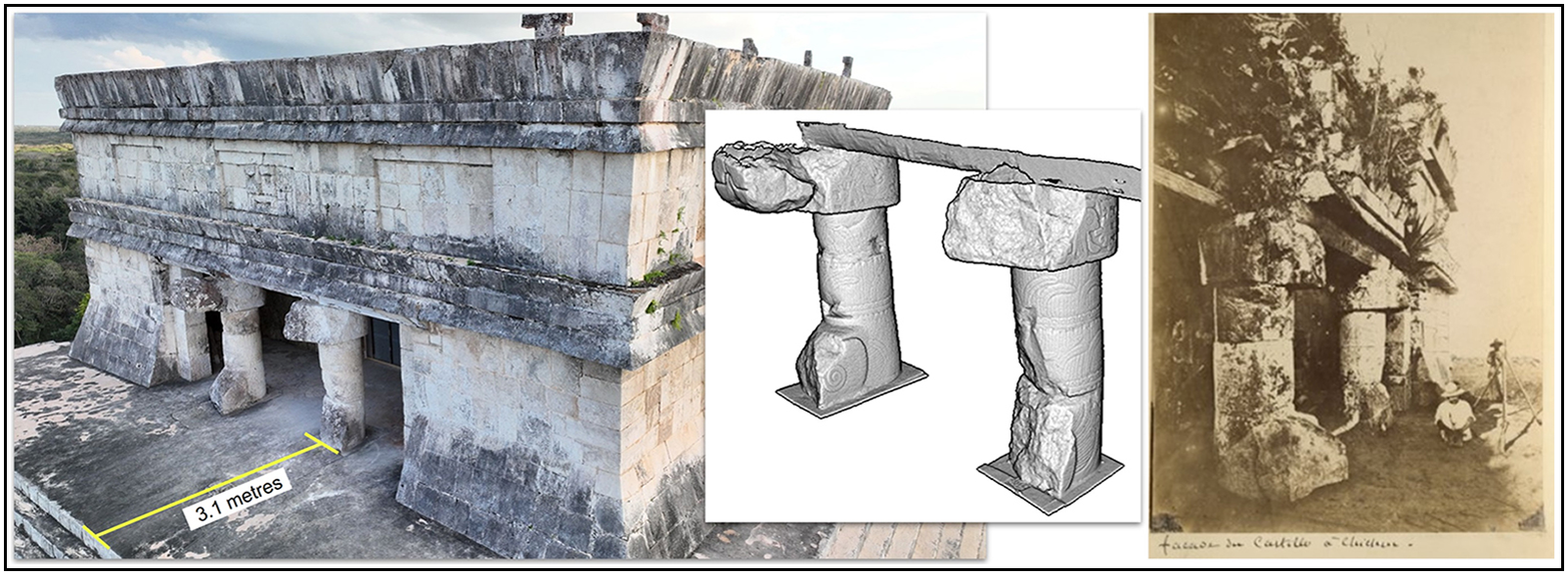
El Castillo temple, north side with central serpent columns. Drone image (left), high-resolution 3D model showing carved detail (centre) and photograph showing previous state (right) (photograph from Charnay 1882: 343; figure by authors).

Background
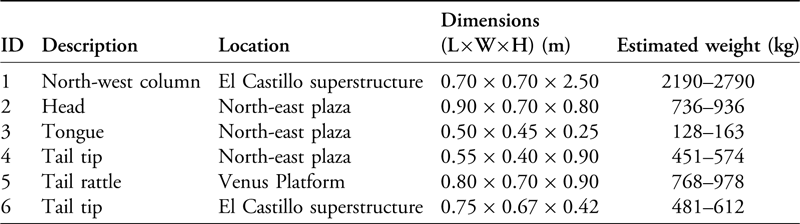
In 2023, a substantial 3D-scanning campaign, coupled with a new geospatial visualisation framework, resulted in the creation of the Chichen Itza 3D Archaeological Atlas (McAvoy et al. Reference McAvoy2023). The project archive contains more than 750 individual assets, including multiple aerial lidar datasets showing the placement of buildings and topographic features beneath the dense forest canopy, mobile and terrestrial lidar datasets, photogrammetry datasets showing architectural features, and sub-millimetre structured light scans of artefacts from multiple museums and archaeological storage facilities. This system enabled a site-wide digital search for the missing pieces of the serpent columns, leading to the identification of four original fragments constituting the head and tail of the western column (see Table 1). The Atlas is a collaboration between INAH and the OpenHeritage3D project, which seeks to provide public access to 3D-survey data. By enabling simplified navigation and measurement of full-resolution datasets in web-browsers, we hope to empower site managers, researchers and the public to reuse these models in a multitude of ways.
Fragments associated with the serpent columns.

Serpent columns at Chichen Itza
Serpent columns are found in multiple locations at Chichen Itza, with similar construction techniques. All are made from the same limestone common to La Gran Nivelación (De la Rosa-García Reference De la Rosa-García, Sierra-Fernández, García Solís, Soberanes García, Quintana, Sergio Gómez-Cornelio and Fort2024). The base of the column is a protruding serpent head, with cylindrical segments stacked on top and an L-shaped ‘tail’ capital composed of an overlapping scaled ‘rattle’ and plumed tip. These capitals once supported wooden lintels and are especially prone to damage as deterioration of the wood removes the tension holding the piece in place. The columns at the north entrance of El Castillo support a portico in front of the entrance to the temple’s inner chamber. Each has a diameter of 0.7m and is approximately 2.5m tall. Both columns are missing their heads and large sections of their tailpieces, though the eastern column maintains a piece of the serpent’s cheek (perhaps a Maya breath motif) and the lower segment (rattle) of the tail (Figure 2, centre). In front of the columns is a flat terrace (Figure 2, left).
The fragments
The western serpent column (fragment 1) was already damaged at the time of Désiré Charnay’s visit to the site in the 1880s (Charnay Reference Charnay1887). The stable placement of the serpent heads suggests intentional destruction and the deliberate displacement of the fragments.
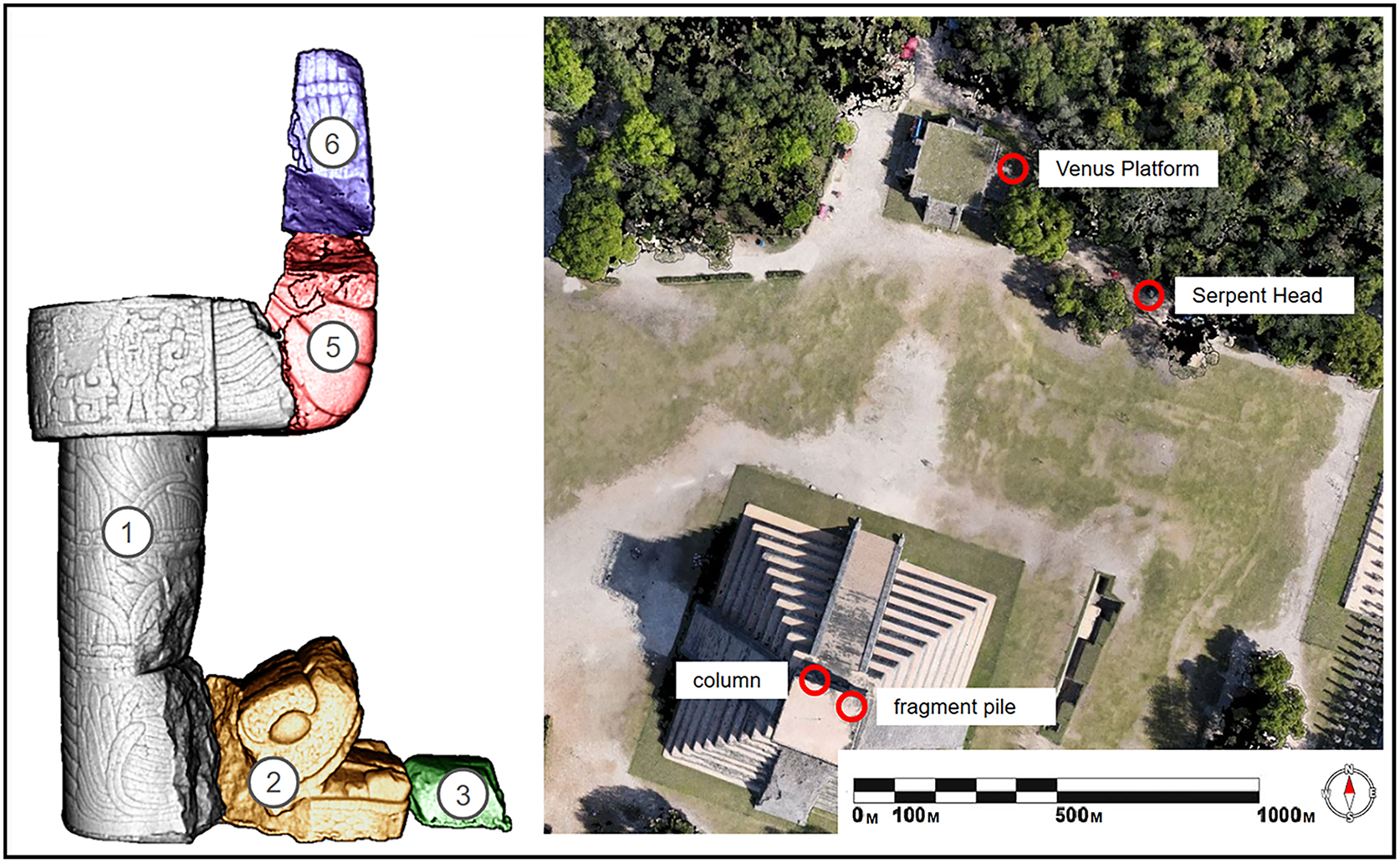
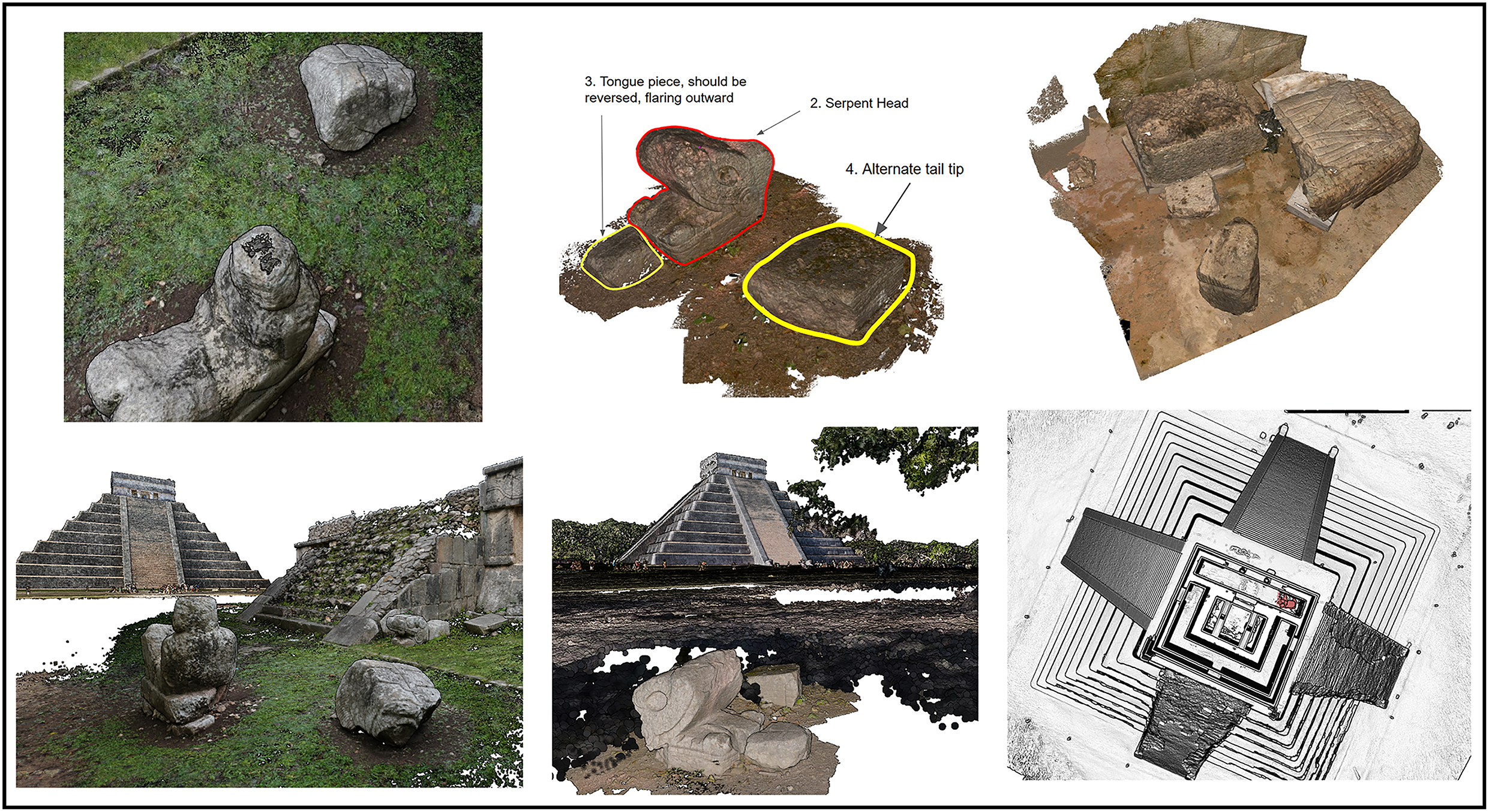
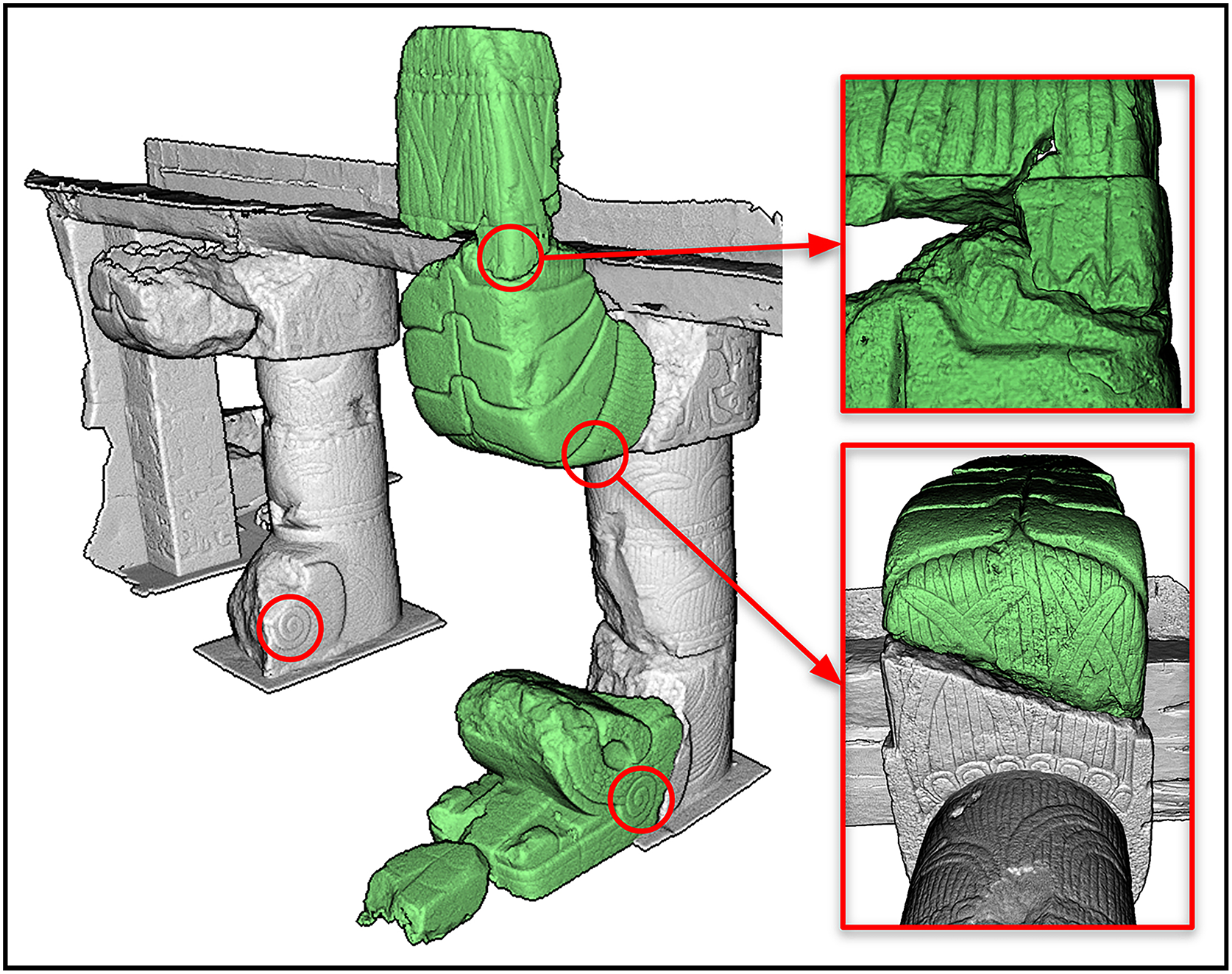
The serpent’s head (fragment 2), sits in the plaza some 110m north-east of the western column, between the Venus Platform and temple of the big tables (Figures 3 & 4). Beside it sits a piece of the tongue (fragment 3) and a tip piece of tail (fragment 4), likely from the eastern column (Figure 4). The alignment of multiple 3D scans, showing matching dimensions and complementary fracture lines, confirms that this head originated from the western column. Additionally, a spiral shape on the serpent’s cheek matches the bottom piece of its eastern sister column (Figure 5).
The column fragments and their find locations (figure by authors).

The fragments in their find contexts (figure by authors).

Scattered fragments (green) digitally reconstructed on unmodified columns (white) (figure by authors).

The rattle of the serpent’s tail (fragment 5) lies east of the Venus Platform, found 120m north-northeast of the column, and 41m west of the head (Figure 4). The pairing with the western column is evidenced by the scale of the fragment, the alignment of crossing feathers with the tailbase still in place (Figure 5), and the matching form attached to the eastern column, though the provenance of this piece is unknown.
The tail’s tip (fragment 6), was found still atop the temple, in a small pile of fragments just inside the exterior awning portico (Figure 4). Though the pieces now share very little of their borders, the pairing is evident from block dimensions, the break pattern on a small protrusion and the alignment of three small feathers overlapping between the rattle and the tip (Figure 5).
Method
The temple portico, remaining columns and individual fragments were digitised using an Artec Leo SLAM-based structured light scanner. Models vary in resolution between 0.3 and 0.5mm resolution, ranging from 10 million to 1.2 billion points, maintaining full data resolution. Given the scale and density of information involved, a specialised visualisation system was developed (Campiani et al. Reference Campiani2023) with the intention of removing the unsettling need to blindly reduce useful fine detail for analysis and visualisation.
Results
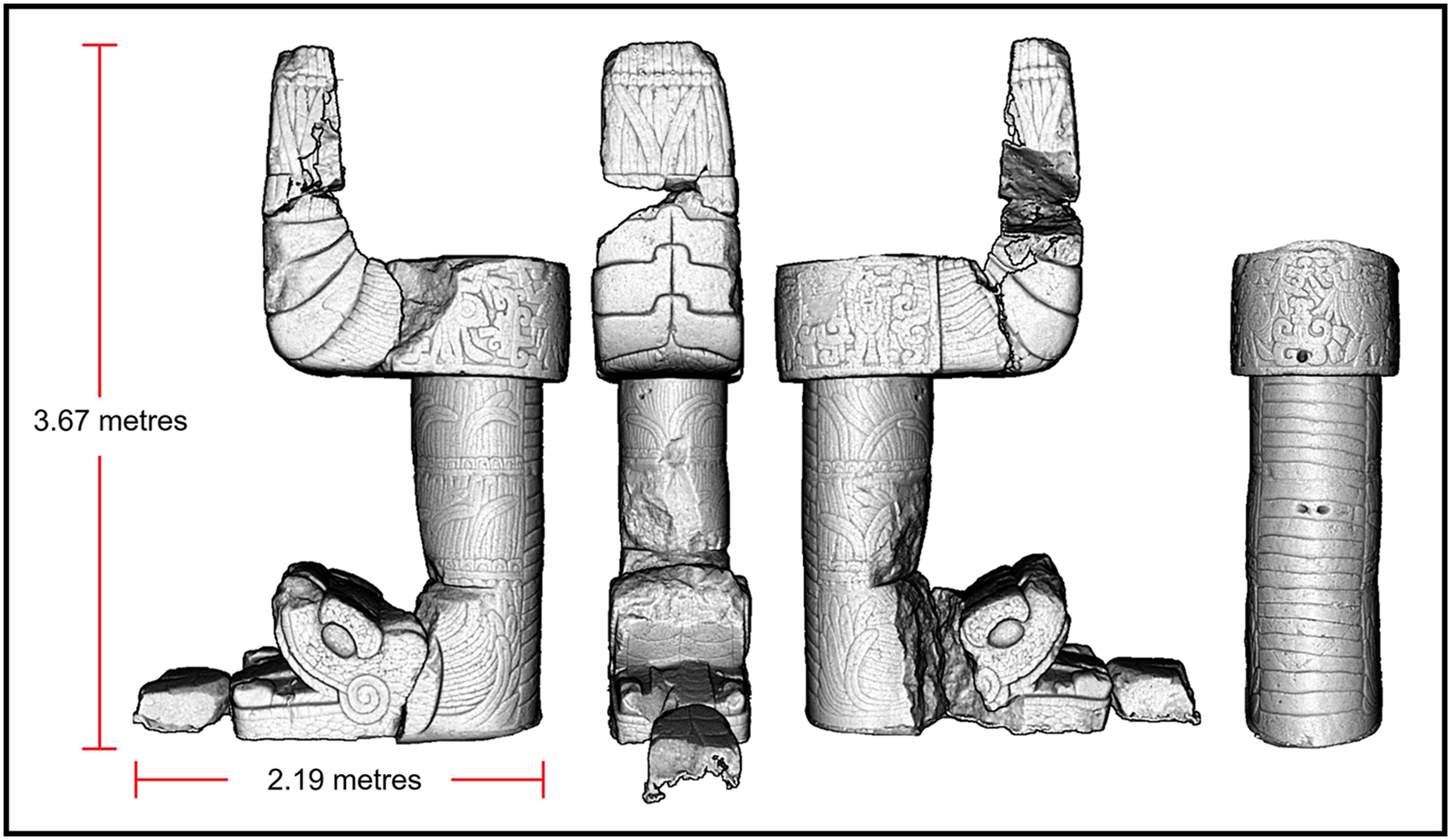
The resultant model contextualises, with reasonable confidence, the original locations of five fragments belonging to the pair of serpent columns from the upper temple façade (Figure 6). The western column is thereby made nearly complete. Overall dimensions, shared decorative features and complementary break patterns between each paired fragment lend veracity to this reconstruction. These digital investigations contribute to a conservation plan involving the physical relocation and installation of the fragments into the positions outlined here. This use case is one of numerous potential applications for the Chichen Itza 3D Archaeological Atlas project, and it is our hope that this example will help communicate our vision for an open and accessible digital replica environment, enabling wide reuse of complex survey data.
3D reconstruction of serpent column (figure by authors).

Funding statement
Support for this work was provided by the Strauss Family Fund for Mesoamerican Studies, the Kinsella Fund, and the Qualcomm Institute at UC San Diego.
Author contribution: CRediT Taxonomy
Scott McAvoy: Conceptualization-Lead, Data curation-Lead, Formal analysis-Lead, Investigation-Lead, Methodology-Lead, Software-Lead, Visualization-Lead, Writing - original draft-Lead. Claudia Garcia-Solís: Conceptualization-Equal, Formal analysis-Equal, Investigation-Equal, Methodology-Equal, Project administration-Lead, Writing - original draft-Supporting, Writing - review & editing-Equal. Jeremy Coltman: Formal analysis-Supporting, Investigation-Supporting, Resources-Equal, Writing - original draft-Supporting, Writing - review & editing-Equal. Jose Francisco Osorio León: Conceptualization-Equal, Funding acquisition-Equal, Investigation-Equal, Methodology-Equal, Project administration-Equal. Francisco Pérez Ruiz: Conceptualization-Equal, Investigation-Equal, Methodology-Equal, Project administration-Equal. Dominique Rissolo: Conceptualization-Equal, Formal analysis-Equal, Investigation-Equal, Methodology-Equal, Project administration-Equal, Writing - review & editing-Supporting. Travis Stanton: Conceptualization-Equal, Investigation-Equal, Methodology-Equal, Project administration-Equal, Writing - review & editing-Supporting. Jesus Gallegos Flores: Conceptualization-Equal, Data curation-Equal, Investigation-Equal, Methodology-Equal, Software-Supporting. Luis Rodríguez Catana: Conceptualization-Equal, Formal analysis-Equal, Investigation-Supporting, Methodology-Equal. Falko Kuester: Funding acquisition-Equal, Project administration-Equal, Writing - review & editing-Equal.

 Open access

