

Hostname: page-component-89b8bd64d-x2lbr Total loading time: 0 Render date: 2026-05-10T00:44:04.143Z Has data issue: false hasContentIssue false

Turbulence and mixing from neighbouring stratified shear layers

Published online by Cambridge University Press:  13 May 2024

Chih-Lun Liu*
Affiliation:
College of Earth, Ocean and Atmospheric Sciences, Oregon State University, Corvallis, OR 97331, USA
Alexis K. Kaminski
Affiliation:
Department of Mechanical Engineering, University of California, Berkeley, Berkeley, CA 94720, USA
William D. Smyth
Affiliation:
College of Earth, Ocean and Atmospheric Sciences, Oregon State University, Corvallis, OR 97331, USA
*
Email address for correspondence: chihlunl@gmail.com

Abstract

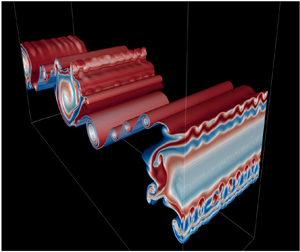
Studies of Kelvin–Helmholtz (KH) instability have typically modelled the initial mean flow as an isolated stratified shear layer. However, geophysical flows frequently exhibit multiple layers. As a step towards understanding these flows, we examine the case of two adjacent stratified shear layers using both linear stability analysis and direct numerical simulations. With sufficiently large layer separation, the characteristics of instability and mixing converge towards the familiar KH turbulence, and similarly when the separation is near zero and the layers add to make a single layer, albeit with a reduced Richardson number. Here, our focus is on intermediate separations, which produce new and complex phenomena. As the separation distance $D$ increases from zero to a critical value $D_c$, approximately half the thickness of the shear layer, the growth rate and wavenumber both decrease monotonically. The minimum Richardson number is relatively low, potentially inducing pairing, and shear-aligned convective instability (SCI) is the primary mechanism for transition. Consequently, mixing is relatively strong and efficient. When $D\sim D_c$, billow length is increased but growth is slowed. Despite the modest growth rate, mixing is strong and efficient, engendered primarily by secondary shear instability manifested on the braids, and by SCI occurring on the eyelids. Shear-aligned vortices are driven in part by buoyancy production; however, shear production and vortex stretching are equally important mechanisms. When $D>D_c$, neighbouring billow interactions suppress the growth of both KH instability and SCI. Strength and efficiency of mixing decrease abruptly as $D_c$ is exceeded. As turbulence decays, layers of marginal instability may arise.

Information

Type
JFM Papers
Copyright
© The Author(s), 2024. Published by Cambridge University Press

Access options

Get access to the full version of this content by using one of the access options below. (Log in options will check for institutional or personal access. Content may require purchase if you do not have access.)

Article purchase

Temporarily unavailable

Supplementary material: File

Liu et al. supplementary movie 1

A cross-sectional view of the buoyancy field, showing the separation distance D=0.5. Initially, the stationary primary Kelvin-Helmholtz (KH) billows are formed, followed by turbulent pairing. Eventually, the KH billows are broken down by turbulence.
Download Liu et al. supplementary movie 1(File)
File 7.7 MB
Supplementary material: File

Liu et al. supplementary movie 2

A cross-sectional view of the buoyancy field, showing the separation distance D=2. Two trains of Kelvin-Helmholtz (KH) billows are formed, creating oscillation. Eventually, the billows are broken down by turbulence.
Download Liu et al. supplementary movie 2(File)
File 21.8 MB
Supplementary material: File

Liu et al. supplementary movie 3

A cross-sectional view of the buoyancy field, showing the separation distance D=1. Large stationary Kelvin-Helmholtz (KH) billows are formed, followed by secondary shear instability (SSI). Eventually, billows become turbulent.
Download Liu et al. supplementary movie 3(File)
File 4.8 MB