

The use of psychoactive plants to induce a variety of physiological effects, including altered states of consciousness, appears to be a nearly universal human tendency with potentially deep coevolutionary roots (Hagen and Tushingham Reference Hagen, Tushingham, Henley, Rossano and Kardas2019). Researchers have suggested that at least some toxic plant use evolved in primates to self-medicate against a variety of parasites and other infections, causing primates to experience consciousness-altering effects as an accidental side effect (Hagen et al. Reference Hagen, Sullivan, Schmidt, Morris, Kempter and Hammerstein2009, Reference Hagen, Roulette and Sullivan2013). Humans take a more active approach, deliberately harnessing the cognitive performance–enhancing properties of many psychoactive plants—those containing nicotine and caffeine (Einöther and Giesbrecht Reference Einöther and Giesbrecht2013; Sullivan et al. Reference Sullivan, Hagen and Hammerstein2008)—which may themselves represent an evolved response on the part of the psychoactive plant (Hagen and Tushingham Reference Hagen, Tushingham, Henley, Rossano and Kardas2019; Hagen et al. Reference Hagen, Sullivan, Schmidt, Morris, Kempter and Hammerstein2009; Rezvani and Levin Reference Rezvani and Levin2001). Cultures throughout the world have utilized both profoundly psychoactive plants (e.g., datura or various psychotropic mushrooms) and milder substances (e.g., tobacco or plant-derived ethanol), which are taken in heavy doses to induce highly altered states of consciousness, for thousands of years (Furst Reference Furst1972; Schultes et al. Reference Schultes, Hofmann and Rätsch2001; VanPool Reference VanPool2009).
There are also strong, highly specific cultural norms regulating the use of psychoactive substances—plant-derived or synthesized. In traditional, nonindustrial societies, the use of psychoactive substances as entheogens may be limited to ritual specialists (i.e., shamans or traditional medical practitioners) or to individuals undergoing rites of passage (VanPool Reference VanPool2009). Other psychoactive plants, or the same plant used in different ways or concentrations, might be taken more casually as medicine or for recreation, although often with other kinds of limitations based on age, gender, or social status (Hagen et al. Reference Hagen, Garfield and Sullivan2016). Archaeologists are contributing to understanding this human predilection by exploring both the human–plant relationships that developed in the past as well as the material cultures that developed around the use of psychoactive plants.
As people have experimented with a wide range of psychoactive substances, they have also developed a variety of methods and implements to facilitate the ingestion of intoxicant plants and to enhance their physiological effects. Perhaps the most important element of this material culture is the “delivery system,” which enables a person to transform a plant into drug. Smoking is a typical means of doing so, but even this method allows for many different approaches. In the southern Coastal and Inland Pacific Northwest of North America, stone—and to a lesser extent, clay—smoking pipes provide the clearest evidence that peoples of the region have been smoking for over 4,500 years, as evidenced by the oldest stone pipes collected in the region from a cache in the central Columbia Plateau (Galm and Komen Reference Galm, Komen, Reid and Galm2012).
Elsewhere in the Americas, however, researchers have documented a wide variety of artifacts associated with the ancient use of tobacco and other intoxicants, including storage vessels (Zagorevski and Loughmiller-Newman Reference Zagorevski and Loughmiller-Newman2012); cups, bowls, and larger vessels used for preparation and consumption (Loughmiller-Cardinal Reference Loughmiller-Cardinal and Fitzpatrick2018; Milanich Reference Milanich and Hudson1979); enema tubes (Carod-Artal Reference Carod-Artal2015; Seinfeld Reference Seinfeld and Fitzpatrick2018); and snuff trays and tubes (Torres Reference Torres1996).
In this article, we focus on stone smoking pipes, taking a multiproxy approach to explore traditional smoking practices among the Native peoples of the Pacific Northwest. We test the hypothesis that precontact use followed the same distribution documented by early twentieth-century ethnographers (Gunther Reference Gunther1973; Kroeber Reference Kroeber1941; Setchell Reference Setchell1921; Teit Reference Teit and Boas1900, Reference Teit and Boas1909) and others (Douglas Reference Douglas1914)—that is, that people smoked throughout the region, except in its farthest northern areas, and that tobacco in particular was smoked along the southern Northwest Coast and the central Northwest Plateau, but that it was absent in the southern Columbia Plateau. We consider how smoking practices have changed or been maintained by Native groups through time, as well as the shortcomings of reliance on the ethnographic record to reflect the realities of contemporary practices and those that may be considered “traditional” in the near or distant past.
Following an examination of the ethnohistoric record, we present findings from a database of stone smoking pipes compiled from published and gray literature from the region, as well as the more direct investigation of archaeological site collections themselves. This research reveals references to the presence of pipes or pipe fragments at 60 sites throughout the Pacific Northwest, as well as 56 artifacts from 26 sites whose collections are held at the Washington State University Museum of Anthropology (Damitio Reference Damitio2018). Finally, we present the results of chemical residue analyses, both published (Tushingham et al. Reference Tushingham, Ardura, Eerkens, Palazoglu, Shahbaz and Fiehn2013, Reference Tushingham, Snyder, Brownstein, Damitio and Gang2018) and previously unpublished. Improved extraction methodologies and ancient residue metabolomics techniques developed by Brownstein and colleagues (Reference Brownstein, Tushingham, Damitio, Nguyen and Gang2020) have been applied to a large sample of archaeological materials from western North America. Understanding the spatial distribution of these results, both positive and negative, allows us to understand ancient tobacco use in the region.
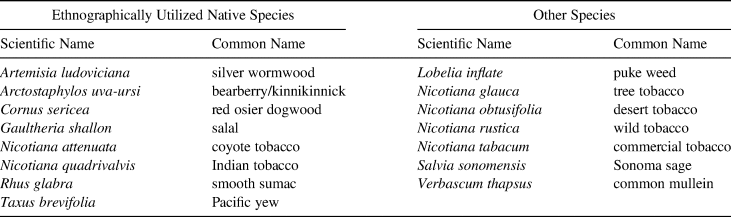
Our efforts have yielded compelling evidence that smoking tobacco and other plants has been important in the lives of Inland Northwest peoples for thousands of years. Tobacco was not the only smoke plant used both ethnohistorically and, as chemical evidence demonstrates, in the deeper past. Arctostaphylos uva-ursi (kinnikinnick, or bearberry) has been identified ethnographically as an important plant smoked in both the Coastal and Inland Northwest to produce a narcotic effect (Gunther Reference Gunther1973:44; Kroeber Reference Kroeber1941). Plants such as Rhus glabra, species of Cornus, Taxus brevifolia, and others (Table 1) were also smoked where available throughout the region. The results not only reveal the time depth of human interest in psychoactive plants in general but also reflect the durability of particular human-plant relationships through the longue durée.
Species Compared to Archaeological Pipe Extracts.
Ethnohistoric Smoking
The Pacific Northwest of North America is a geographically and culturally diverse region traditionally divided into two distinct culture areas: the Northwest Coast and the Plateau. The region extends thousands of kilometers from northern California to southeastern Alaska. Major river systems, including the Fraser and Columbia and their tributaries, connected peoples throughout the region. Bearing this in mind, the ethnohistoric record enables us to make some generalizations about smoking in the Northwest.
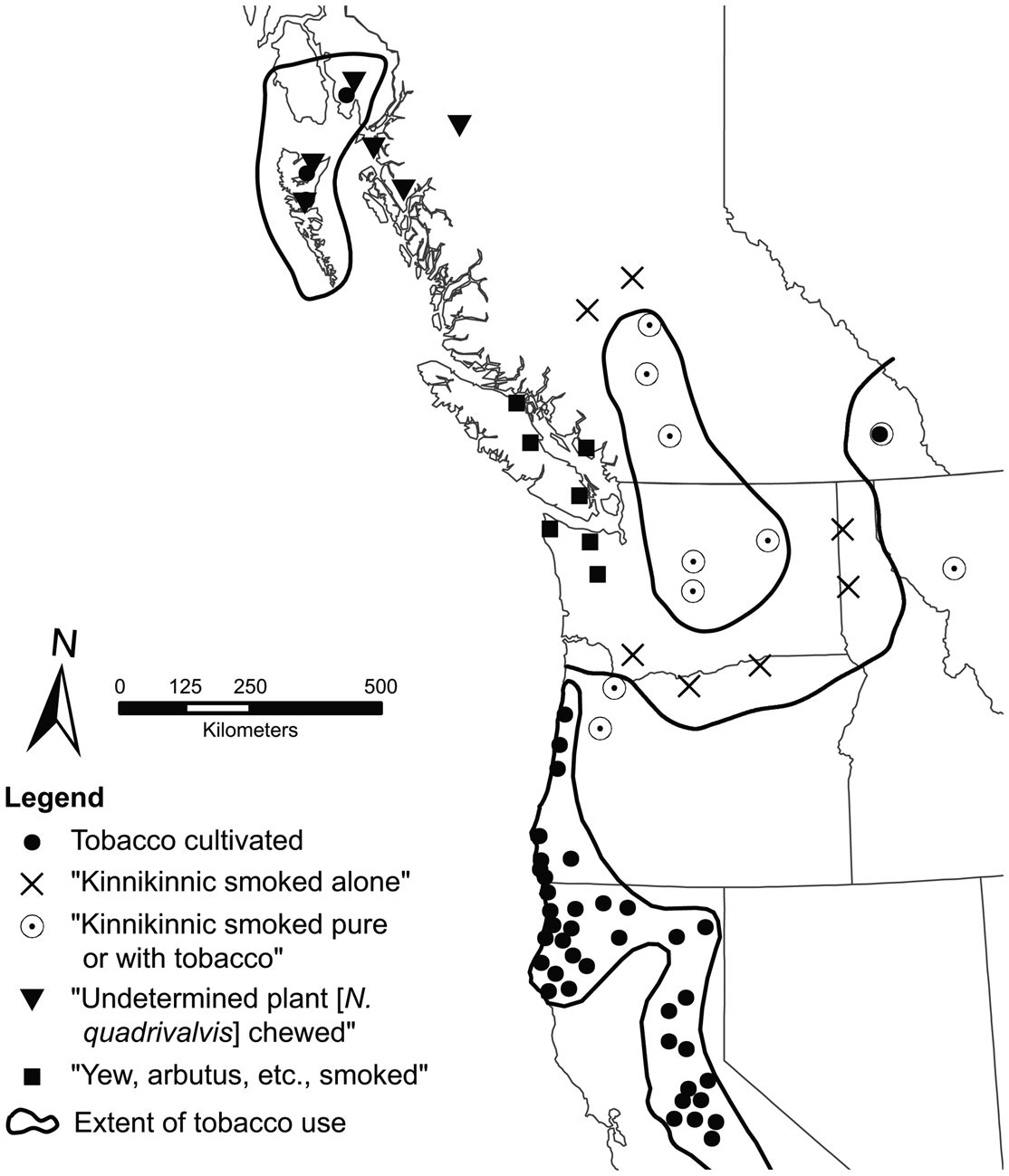
Kroeber (Reference Kroeber1941) produced a summary of tobacco and smoking data that revealed a great deal of variability across the Pacific Northwest with regard to whether Native people smoked and, if so, whether tobacco was among the plants in use (Figure 1). Kroeber's picture should be considered a flawed and incomplete overview at best; however, it distills a great deal of roughly contemporaneous ethnographic data demonstrating at the very least that smoking was a nearly universal practice in the Pacific Northwest from the Oregon coast to the Northern Fraser Plateau in present-day British Columbia (Kroeber Reference Kroeber1941). Farther north, Haida and Tlingit were recorded as having grown and chewed some plant—later found to be Nicotiana quadrivalvis (Turner and Taylor Reference Turner and Taylor1972)—mixed with lime derived from marine shell.
Partial adaptation of Kroeber Reference Kroeber1941, Maps 8 and 9. This map illustrates Kroeber's summary of data related to smoking and tobacco planting among western North American Native groups at that time.
In the Plateau and on the Northwest Coast, plants were smoked alone or as part of a mixture of plants (Table 1; Kroeber Reference Kroeber1941). Arctostaphylos uva-ursi was often an element of smoking mixtures in the Interior and Coastal Northwest following contact, as was Taxus brevifolia (Pacific yew) on the coast (Gunther Reference Gunther1973:44; Taylor and Taylor Reference Taylor and Taylor1981). Teit (Reference Teit and Boas1909:574–576; Turner Reference Turner2014:213), however, suggests that the practice of mixing kinnikinnick with tobacco came only after the introduction of Euro-American trade tobacco, which was perceived—among the Secwepemc (Shuswap), at least—to be stronger than the native varieties. Writing earlier in the nineteenth century, Douglas (Reference Douglas1914) makes no note of any mixing of other plants with native tobaccos in the southern Columbia Plateau, although he does indicate that A. uva-ursi was smoked alone.
We have given particular attention to A. uva-ursi in our residue studies because it is so often mentioned specifically as an important smoke plant by early twentieth-century ethnographers as either an element in mixes with tobacco or a smoke plant in its own right. Understanding the relationship between A. uva-ursi and tobacco smoking in the more distant past may help to untangle the sometimes contradictory information given to us regarding kinnikinnick use through the ethnohistoric record.
Tobacco in the Pacific Northwest
The genus Nicotiana (family: Solanaceae) includes a number of species of leafy herbs and shrubs. The presence of the psychoactive alkaloid nicotine in the leaves of Nicotiana species has made tobaccos plants of interest for peoples around the world. Several species, including the hybrid N. tabacum used in the production of modern commercial tobacco products, are indigenous to the Americas, with the ultimate origins of most species lying in South America (Goodspeed Reference Goodspeed1954). Although the Pacific Northwest is at the northern limit of the natural range of the genus, two species—N. attenuata (coyote tobacco) and N. quadrivalvis (Indian tobacco; syn: N. bigelovii)—were in the region before contact, and both are important to Indigenous peoples of the Plateau and Northwest Coast.
Kroeber (Reference Kroeber1941) reports that a large area from the central Columbia Plateau through the Fraser Plateau is populated by groups who traditionally smoked tobacco. The Columbia Plateau to the south and east of this area was supposedly without traditional tobacco use (but see Tushingham et al. Reference Tushingham, Snyder, Brownstein, Damitio and Gang2018). This is summarized by Kroeber (Reference Kroeber1941) in his Map 8, reproduced in part here (Figure 1). In the Pacific Northwest outside of the Plateau, there is more variability in the use of tobacco. West of the Cascade Range and north of the Columbia River, no coastal peoples included in the survey indicated that they traditionally smoked tobacco. Instead, coastal peoples smoked a variety of other plants, including T. brevifolia needles, A. uva-ursi leaves, and others (Gunther Reference Gunther1973; Kroeber Reference Kroeber1941). Given the profound effects of contact on Indigenous practices, it is difficult to say with complete confidence that coastal peoples never used tobacco. Furthermore, the lack of a durable material culture associated with smoking on the coast (Gunther Reference Gunther1973:35; Turner Reference Turner1998:163–164) limits the potential for relevant material culture to preserve archaeologically.
The two tobaccos native to the region, N. attenuata and N. quadrivalvis, have distinct, but overlapping, distributions. The former species is endemic to the Plateau, occurring wild and under cultivation as far north as Secwepemc country in southern-central British Columbia (Teit Reference Teit and Boas1909), whereas the current natural range of the latter extends only as far north as central Oregon (Goodspeed Reference Goodspeed1954; Hammet Reference Hammet and Winter2000; Turner and Taylor Reference Turner and Taylor1972; Winter Reference Winter and Winter2000). Both species were used in different contexts by various peoples of the Plateau. Except for chewing of N. quadrivalvis among the Haida and Tlingit (Turner and Taylor Reference Turner and Taylor1972), we could not find any references indicating tobacco cultivation or use on the coast north of the mouth of the Columbia River.
For the Pacific Northwest peoples who used tobacco, it was regarded as a sacred and powerful plant that could serve in recreational, ceremonial, and medicinal roles. Early interactions between Natives and non-Natives in the Pacific Northwest were often punctuated by the trading or sharing of tobacco (Douglas Reference Douglas1914). In these cases, smoking (of tobacco, at least) is an activity that signaled and reinforced positive interpersonal relationships and doubled as a means of conflict resolution. Other perspectives, including those drawing on present-day discussions with Indigenous people, emphasize the sacred nature of tobacco and the durability of its importance to Native communities (Phillips Reference Phillips, Bollwerk and Tushingham2016; Snyder Reference Snyder, Bollwerk and Tushingham2016). Tobacco is frequently singled out as having supernatural origins by Interior Northwest peoples. For example, Keddie (Reference Keddie, Bollwerk and Tushingham2016) citing (Teit Reference Teit and Boas1900:309) notes that Syilx (Okanagans) would smoke ceremonially before all “serious undertakings.” Likewise, Turner (Reference Turner2014:213) explains that for a number of interior peoples “all councils and many feasts began with smoking ceremonies.” This practice is continued today as what Turner (Reference Turner2014:214) identifies as part of “routine rituals of respect for the spirits . . . that provide for the people.”
Previous Research
In his seminal article, Rafferty (Reference Rafferty2002) demonstrated the utility of chemical residue analysis to test archaeological pipe contents from the northeastern United States for compounds associated with tobacco. Researchers have since used chemical analyses to study the ancient use of tobacco and other intoxicants in regions throughout the Americas. For example, Carmody and colleagues (Carmody, Davis, et al. Reference Carmody, Kassabaum, Hunt, Prodanovich, Elliott and Russ2018; Carmody, Kassabaum, et al. Reference Carmody, Kassabaum, Hunt, Prodanovich, Elliott and Russ2018) have identified nicotine in stone pipes from two sites in the southeastern United States. In Chile, researchers have detected nicotine in ancient human hair, pipes, and other artifacts (Echeverría and Niemeyer Reference Echeverría and Niemeyer2013; Echeverría et al. Reference Echeverría, Planella and Niemeyer2014; Niemeyer et al. Reference Niemeyer, de Souza, Camilo and Echeverría2018). Nicotine has likewise been identified in small ceramic vessels of the late Mayan period in Mesoamerica (Zagorevski and Loughmiller-Newman Reference Zagorevski and Loughmiller-Newman2012).
In northwestern North America, the earliest tobacco residue study examined the carbonized contents of several steatite pipe bowls from the Keatley Creek site (EeRl-17) in British Columbia. Hayden (Reference Hayden and Hayden2000) detected no nicotine in the samples tested. No further work evaluating chemical residues associated with Pacific Northwest stone pipes was performed until Tushingham and colleagues (Reference Tushingham, Ardura, Eerkens, Palazoglu, Shahbaz and Fiehn2013) identified nicotine in six precontact pipes and pipe fragments from the northern California coast. Following Rafferty (Reference Rafferty2002, Reference Rafferty2006) and Rafferty and colleagues (Reference Rafferty, Lednev, Virkler and Chovanec2012), Tushingham and colleagues (Reference Tushingham, Ardura, Eerkens, Palazoglu, Shahbaz and Fiehn2013) analyzed their samples using gas chromatography–mass spectrometry but developed a method whereby artifacts were soaked in a chemical solvent and sonicated, permitting the extraction of residues from the matrix of stone and clay pipes rather than from charred organic material associated with the pipes. These methods were developed further in a multiyear study funded by National Science Foundation-Archaeometry (Brownstein et al. Reference Brownstein, Tushingham, Damitio, Nguyen and Gang2020), and they were applied in a 2018 study by Tushingham and colleagues that found nicotine to be associated with artifacts from three precontact sites in southeastern Washington state.
Previous biomolecular studies resulted in the identification of nicotine in pipes and pipe fragments from sites in the southern Columbia Plateau (Tushingham et al. Reference Tushingham, Snyder, Brownstein, Damitio and Gang2018), as have studies from the southern Northwest Coast (Tushingham et al. Reference Tushingham, Ardura, Eerkens, Palazoglu, Shahbaz and Fiehn2013). Farther south on the California coast, Eerkens and colleagues (Reference Eerkens, Tushingham, Brownstein, Garibay, Perez, Murga, Kaijankoski, Rosenthal and Gang2018) have identified nicotine in ancient human dental calculus. These studies have confirmed what is suggested by the ethnohistoric record: that tobacco was used by Pacific Northwest peoples prior to the arrival of Euro-Americans. Below, we discuss the results of previously unpublished residue studies that further expand the spatial and temporal scope of such analyses in the region.
Methods and Materials
To test hypotheses outlined in this study, we took an interdisciplinary approach that similarly draws from varied methods and sources. The study includes an updated synthesis of published and unpublished data on the distribution of pipes in the region originally compiled by Damitio (Reference Damitio2018), and chemical and ancient residue metabolomics studies of a sample of these archaeological pipes. All previously unpublished results presented in this article were obtained following new methodology detailed by Brownstein and colleagues (Reference Brownstein, Tushingham, Damitio, Nguyen and Gang2020) using liquid chromatography–mass spectrometry (LC-MS).
Artifact Distribution Analysis
To explore the precontact distribution of smoking across time and space, we synthesized data from (1) a review of published and gray literature, (2) an exploration of the collections held by numerous institutions in the United States and Canada via the Reciprocal Research Network (RRN; see Rowley Reference Rowley2013), and (3) a systematic search of the collections databases of the Washington State University Museum of Anthropology (WSU MoA), which curates extensive collections from over 600 sites in the Pacific Northwest (Damitio et al. Reference Damitio, Gilreath-Brown and Tushingham2018; for details of search methodology, see Supplemental Text 1). Many of the references to pipes or pipe fragments had only very general provenience. However, only data on smoking artifacts with proveniences in well-documented archaeological contexts were included in the study. Site location and other data were compiled in a Microsoft Access database and exported to ArcGIS Desktop 10 for visualization and analysis.
Chemical Analyses
We employed chemical methods developed in part for this project that involve both basic biomarker screening and ancient residue metabolomics approaches. The biomarker approach employed here and by others (e.g., Echeverría et al. Reference Echeverría, Planella and Niemeyer2014; Eerkens et al. Reference Eerkens, Ardura, Fiehn, Blake, Lentz, Tushingham and Palazoglu2012; Rafferty Reference Rafferty2002, Reference Rafferty2006; Rafferty et al. Reference Rafferty, Lednev, Virkler and Chovanec2012; Tushingham et al. Reference Tushingham, Ardura, Eerkens, Palazoglu, Shahbaz and Fiehn2013, Reference Tushingham, Snyder, Brownstein, Damitio and Gang2018) relies on the identification of a small number of compounds associated with specific plants. This approach can suggest the association of an artifact with a plant taxon, but further refinement is often impossible because target compounds are typically associated with more than one plant species or taxonomic group. Thus, while the biomarker nicotine indicates a likely association with tobacco, the biomarker approach cannot distinguish between species of Nicotiana.
Metabolomics is the study of the comprehensive complement of compounds involved in cellular metabolism. Every organism relies on many thousands of such compounds—metabolites—for both basic and specialized biological functions. Most metabolites are shared across large taxonomic groupings, but some are unique in their presence or absence, or in their quantity within a species or genus (e.g., nicotine in the genus Nicotiana). A metabolomics approach in archaeological residue analysis seeks to reduce reliance on the presence of a single compound, as in the biomarker approach, and improve the possibility of species-level identification by instead comparing the entire metabolic “fingerprint” of the target species with the compounds extracted from an archaeological specimen. This fingerprint consists of the total metabolome—all of the metabolites in a biological sample—as characterized through chemical extraction and detection using a variety of instrumentation.
In this study, we characterized the chemical residue contents of archaeological artifacts and experimental specimens using methods developed and discussed in detail by Brownstein and colleagues (Reference Brownstein, Tushingham, Damitio, Nguyen and Gang2020). For residue extraction, samples were submerged sequentially in three solvents—2% aqueous tartaric acid, acetonitrile:2-propanol:water [3:2:2], and methyl tert-butyl ether—and sonicated for 10 minutes in each. We employed three solvents in sequence to extract the broadest possible range of compounds. Because the metabolomics analysis is untargeted, it is important that the compounds extracted and characterized be as nearly representative of the total metabolic fingerprint as possible in order to capture the uniqueness of each sample.
Following drying and resuspension in a smaller, more concentrated volume, extracts were analyzed using a liquid chromatography–mass spectrometry (LC-MS) system (see Brownstein et al. [Reference Brownstein, Tushingham, Damitio, Nguyen and Gang2020] for details and technical specifications). The LC-MS data were processed using MZmine v2.32 (Pluskal et al. Reference Pluskal, Castillo, Villar-Briones and Orešič2010). Among other things, this resulted in a list of all compounds in each analysis with the mass-to-charge ratio (m/z, which corresponds to the molecular mass of the detected compound), the retention time, and the peak intensity for each compound.
Before comparing the metabolic fingerprints of each sample, we conducted a targeted analysis of each specimen for known biomarkers. Although the vast majority of the compounds in the output of the LC-MS analysis are unidentified, it is possible to locate known compounds using chemical standards run under the same conditions. This was done for, among others, anabasine, cotinine, and nicotine as biomarkers for tobaccos and arbutin as a biomarker for A. uva-ursi. The tabular output of the LC-MS analysis was checked for these compounds in all specimens. Additionally, the presence or, more commonly, the absence of these compounds was confirmed through a direct visual analysis of the chromatograms and mass spectra produced by the LC-MS analysis.
For metabolomics analysis, the compounds extracted from each archaeological specimen were compared with the compounds present in pipes each experimentally smoked with one of 15 different plant species (Table 1) from a list compiled by Tushingham and colleagues (Reference Tushingham, Snyder, Brownstein, Damitio and Gang2018; see also Brownstein et al. Reference Brownstein, Tushingham, Damitio, Nguyen and Gang2020). This list encompasses plants known to have been used by Pacific Northwest peoples as well as a number of plants smoked elsewhere in precontact North America. These experimental samples were produced using commercially purchased unglazed ceramic pipes and plant samples either obtained from herbaria or grown by Brownstein under controlled conditions. Plant samples were dried, placed in the pipe bowl, and ignited. The smoke was then repeatedly drawn through the pipe and then expelled using a large syringe. Each experimentally smoked pipe was replicated five times, and each replicate was used to smoke five full bowls of the plant in question. For comparison to archaeological specimens, the replicates were combined.
To compare the contents of the residues extracted from archaeological specimens to the experimentally smoked plants, a Venn diagram method was used. The LC-MS output data were processed using Microsoft Excel to produce lists for each sample of the compounds present (represented by arbitrary unique numerical identifiers). This list for each archaeological specimen was compared to the compound lists for all experimentally smoked pipes and a blank control pipe using the Draw Venn Diagram web application (Van de Peer Reference Van de Peer2015). Of greatest relevance to our analysis are the categories where there are compounds shared uniquely between an archaeological specimen and a single plant species. Where there are compounds shared only between a single plant species and a pipe specimen, there is evidence that the pipe was used to smoke that species. This association is strengthened by the presence of more than one shared compound between a plant and a pipe specimen, as do consistent matches across solvents (the extracts from each of the three solvents were treated as separate samples, meaning that each archaeological specimen or experimental pipe generated three analytical samples).
Contamination
The possibility of contamination is a major concern in the development and execution of ancient residue analyses (Washburn et al. Reference Washburn, Washburn, Shipkova and Pelleymounter2014). The artifacts included in this study were collected in the mid-twentieth century, when tobacco use by researchers was more common, and little or no precautions would have been taken to avoid contamination either during initial collection and processing or in later collections work. Although strict precautions were taken during our lab work to avoid outside introduction of nicotine or other compounds, or cross-contamination between artifacts, we cannot say with absolute certainty that the nicotine and other compounds detected in this study were not introduced. With that disclaimer, however, we are confident that our results are not the result of contamination. First, all but one artifact (45GR30.2197, which was briefly on public display at a small museum) have been in closed repository storage since their collection except during rehousing and occasional examination by researchers in a few cases. Second, we do not see the consistent presence of any compound or group of compounds across any group of the artifacts analyzed that would suggest systematic exposure to a contaminant. In other words, we would be more concerned had we identified nicotine in many of the artifacts analyzed, instead of one.
Mid-Columbia Pipe Study
Thirty-four precontact pipes and pipe fragments from Interior Northwest archaeological sites are in collections at the WSU MoA. Of these, 12 pipes from three sites in the Mid-Columbia region were selected for biomarker and metabolomics analyses, all of which were collected from cache (45DO172), house floor (45GR27, 45GR30), and roasting feature (45GR27) contexts ranging in age from approximately 620 to 4500 cal BP (Table 2). Perhaps unsurprisingly, given the range of time covered, the study artifacts represent a diverse suite of styles and materials in use in the region (Figure 2). Materials include steatite (n = 8), basalt (n = 2), and fine-grained sedimentary rock (i.e., siltstone; n = 2). Styles include a thin tubular stem with a bell-shaped bowl and thickened mouthpiece (n = 6); a more robust conical bowl, likely used with a separate stem and mouthpiece (n = 2); the oblong pipes from the Cox's Pond site (n = 3); and the cigar-shaped specimen from Cox's Pond (n = 1).
Radiocarbon Dates from Sites in the Mid-Columbia Study.
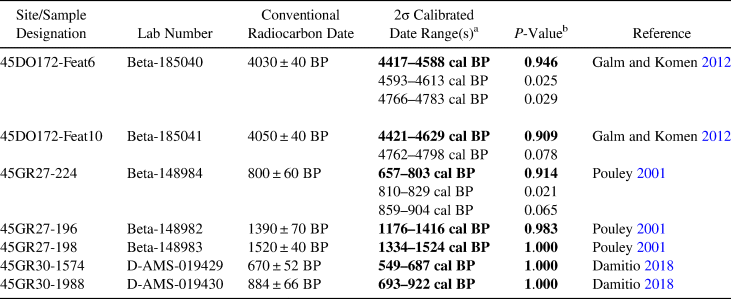
a Dates calibrated against the IntCal13 curve (Reimer et al. Reference Reimer, Bard, Bayliss, Warren Beck, Blackwell, Ramsey and Buck2013) using CALIB rev. 5.0 (Stuiver et al. Reference Stuiver, Reimer and Reimer2005).
b Ranges where p < 0.01 are omitted.
Selected pipes from the Mid-Columbia study representing the stylistic diversity of pipes in the region: (a) 45GR27.116, a conical granite pipe bowl; (b) 45GR30.2197, a fragment of a thin-walled tubular steatite pipe; and (c) 45DO172.2224, a robust oblong steatite pipe with regular incisions. Illustration by Trent Raymer.

45DO172
The Cox's Pond site (45DO172) in central Washington near the Columbia River consists of a variety of features, including hearths, house pits, and caches, and it was excavated in 1971 by the WSU Laboratory of Anthropology (Hartmann Reference Hartmann1975). The four tested artifacts from this site are all complete pipes, and each was collected from different cache features dating to the earlier occupation that were set in or near house floors (Galm and Komen Reference Galm, Komen, Reid and Galm2012). In each case, the pipes were stored along with burned stoned and bone tools, often with uniform orientation. In their reanalysis of the site, Galm and Komen (Reference Galm, Komen, Reid and Galm2012) argue that the caches, and in particular the pipes, are linked to the Western Idaho Archaic Burial Complex described by Pavesic (Reference Pavesic, Plew, Woods and Pavesic1985). In support of this interpretation, Galm and Komen (Reference Galm, Komen, Reid and Galm2012) obtained two radiocarbon dates for 45DO172, giving the artifacts from this site an age of about 4500 cal BP (Table 2).
The 45DO172 pipes represent two rare pipe forms in the region. Three pipes (45DO172.2221, 2222, and 2224) are roughly ovate in shape and relatively flat, with an elliptical transverse cross section (Figure 2c). A roughly contemporaneous pipe from a lower Snake River site resembling these artifacts tested positive for nicotine (Tushingham et al. Reference Tushingham, Snyder, Brownstein, Damitio and Gang2018). A fourth pipe from 45DO172 (45DO172.2223) has an unusual, elongated cigar-shaped form, which is round in cross section and tapers at one end, likely forming the mouth of the pipe.
45GR27
The Ridge Bottom Village site (45GR27) is located near 45GR30 (see below) along the shore of Moses Lake in central Washington state. The site consists of 33 generally circular depressions, likely house pits, three of which were excavated (Daugherty Reference Daugherty1952). Two pipe artifacts were collected from the site, and both were selected for analysis: a complete pipe bowl (45GR27.116) found in association with Feature 1, identified by Pouley (Reference Pouley2001) as a roasting pit, and a pipe fragment (45GR27.74) found in the floor of House Pit 1. The complete granite bowl is conical and thick walled, and it was likely used in conjunction with an inset stem made of some perishable material. The pipe fragment is similarly robust in construction and material, suggesting it was similar in style to the recovered bowl (Daugherty Reference Daugherty1952:381), even though these artifacts were recovered from contexts dating several hundred years apart. The roasting pit associated with the complete pipe bowl dates to 1520 ± 40 BP (1334–1524 cal BP; Table 3; Pouley Reference Pouley2001). House Pit 1, the context for the pipe fragment, has not been radiocarbon dated, but Pouley (Reference Pouley2001:83–84) suggests that it is roughly contemporaneous with the adjacent House Pit 2, which dates to 800 ± 60 BP (657–803 cal BP).
Summary of Results by Site.
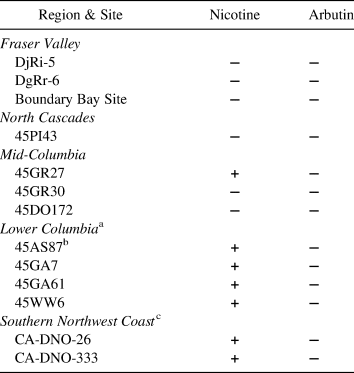
a See Tushingham et al. Reference Tushingham, Snyder, Brownstein, Damitio and Gang2018.
b Postcontact context.
c See Tushingham et al. Reference Tushingham, Ardura, Eerkens, Palazoglu, Shahbaz and Fiehn2013.
45GR30
Long Beach Village (45GR30) excavations were part of the 45GR27 project by Daugherty (Reference Daugherty1952). A total of 11 pipe fragments were collected from the floor of the single excavated house pit. All were recovered at similar depths, but their distribution did not reveal any apparent distribution or pattern. Notably, all 11 pipe fragments collected at 45GR30 are distinctly different from those from nearby 45GR27. Where the complete pipe and fragment from the latter site are robust and conical in form, the fragments from the former are delicate and made of steatite, likely representing pieces of tubular pipes. Most of the 45GR30 specimens are small, averaging a maximum length of 2.22 cm. The most complete specimen from 45GR30 (45GR30.2197, Figure 2b) suggests the form of the pipes from which the other fragments originated: tubular with a bell-shaped bowl and flared mouthpiece.
Six of the 11 pipe fragments from 45GR30 were included in the study. Those exhibiting charring on their interior surface and/or other characteristics suggesting that they were a bowl or mouthpiece fragment (e.g., grinding on one surface) were preferred candidates for residue analysis.
Radiometric dating of materials from 45GR30 indicates that the site (and associated pipes) dates to the Late Archaic period (2000–230 BP, as defined by Andrefsky [Reference Andrefsky, Prentiss and Kuijt2004]). This date is supported by two charcoal samples, both recovered from charred areas in the occupation floor and identified as species of Artemisia (sagebrush). A younger date (670 ± 52 BP; 549–687 cal BP) is closely associated with artifact 45GR30.118, whereas an older dating sample (884 ± 66 BP; 693–922 cal BP) was collected from a large, diffuse charred area in the main house pit that also yielded three of the 11 pipe fragments collected at the site.
Fraser Valley Pipe Study
Thirty-five pipes, pipe fragments, and pipe blanks from Esilao (DjRi-5), a pithouse village in the Fraser Canyon dating from 5490 ± 500 BP to the early nineteenth century AD (Borden Reference Borden, Berger and Libby1965; Mitchell Reference Mitchell1963), were included in the study. Tested pipe artifacts from DjRi-5—a subset of a total of 62 such artifacts collected from House Pit 1—include a variety of forms constructed primarily of ground and carved steatite. The majority are similar to tubular forms common in the Mid-Columbia study, but they have comparatively thicker walls (for a detailed discussion of stylistic variation of site pipes, see Mitchell [Reference Mitchell1963]). Chronology at the site is difficult to parse from published materials, but most pipes from Esilao also appear to date from the Late Archaic, whereas some are associated with postcontact deposits. One siltstone pipe from the Marpole (2400–ca. 1300 BP; Moss Reference Moss2011:98) component of the Glenrose Cannery site (DgRr-6) on the Fraser River nearer the coast (Matson Reference Matson and Matson1976:154) was tested in addition to those from DjRi-5.
Other Studies
Pipes found in relative isolation were also tested: a pumice pipe bowl from Fryingpan Rockshelter (45PI43) on the eastern slopes of Mt. Rainier and a carved steatite pipe recovered during construction at a residence in Pasco, Washington, in 2017. Lubinski and Burtchard (Reference Lubinski and Burtchard2005) assign a range of 250–1150 cal BP to the human use of 45PI43. The pipe, however, was collected from a cache in the wall of the rockshelter (Rice Reference Rice1965) and cannot be confidently associated with any particular date or period. The pipe from Pasco, Washington, is difficult to contextualize, although its material and intricate decorative carving suggest a link to the Late Archaic (e.g., Duff Reference Duff1956). This latter pipe was collected and stored for some time by a nonprofessional, and it may have been exposed to greater risk of contamination.
Results
Artifact Distribution
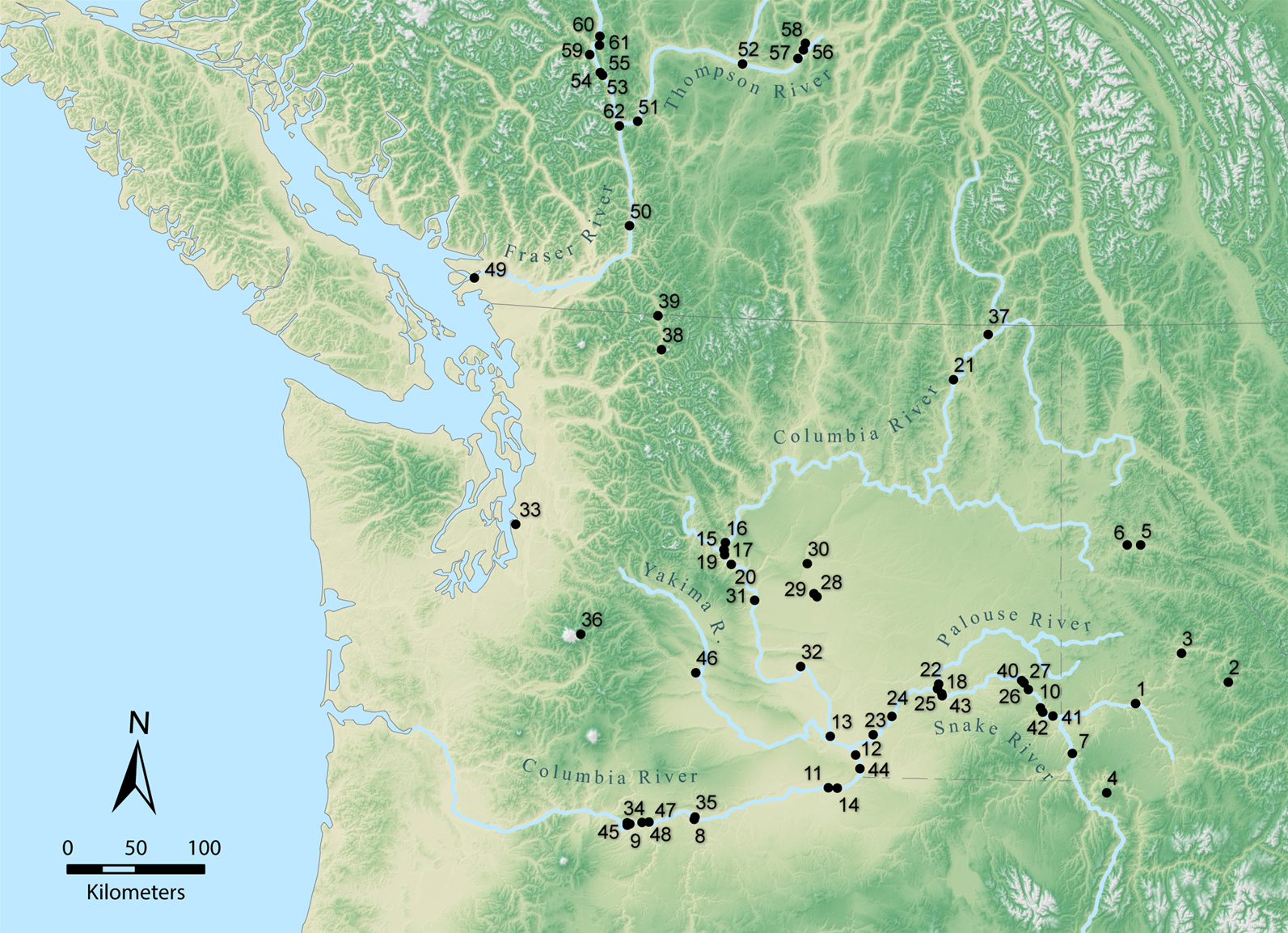
At least 62 archaeological collections from the Pacific Northwest contain stone pipe artifacts from well-provenienced contexts (Figure 3). This includes several dozen pipes or pipe fragments from 36 sites discovered through the literature and the Reciprocal Research Network survey, as well as 56 pipe artifacts from 26 sites documented in WSU MoA collections. Figure 3 illustrates the spatial distribution of these artifacts, indicating a regional pattern of distribution wherein stone pipes are rare west of the Cascade Range and largely limited to the Columbia and Fraser Plateaus, as well as along the Pacific Coast south of the Columbia River. Most of the pipe artifacts in the region lack fine-grained chronological associations. However, the majority are from throughout the Late Archaic (2000 BP–230 BP), with the Cox's Pond artifacts serving as older outliers. Although additional specimens may be discovered and added to this database in the future, this is currently the most comprehensive compilation of pipes from the region and therefore the best spatiotemporal snapshot of precontact pipe-smoking practices we have at present.
This map shows archaeological sites throughout the Pacific Northwest where pipes or pipe fragments have been identified. See Supplemental Text 2 for a key to sites and references. (Color online)
Chemical Residue Analysis
All 49 artifacts from the studies presented here tested negative for the presence of arbutin, the compound associated with A. uva-ursi, and all but one sample tested negative for the presence of nicotine, which is associated with Nicotiana species (Table 3). A pipe bowl from 45GR27 tested positive for the presence of nicotine, and metabolomics results indicate an association with N. quadrivalvis and additional smoke plants, particularly Rhus glabra (smooth sumac; see Supplemental Table 1).
Mid-Columbia Pipe Study
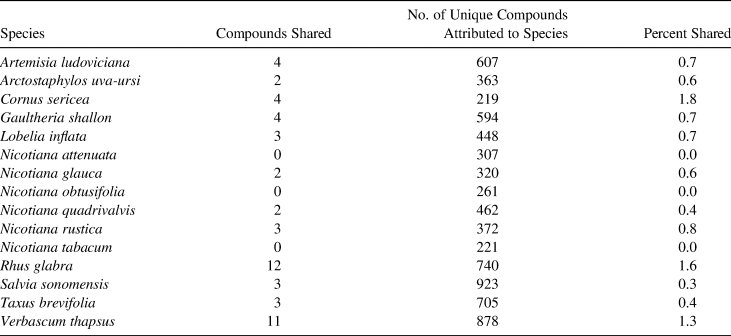
Ancient residue metabolomics analyses of the 12 specimens from the three Mid-Columbia sites provided insights beyond presence/absence biomarker analyses. The results of these analyses show evidence for the species of tobacco in use as well as for the use of smoke plants other than tobacco. One artifact—45GR27.116, a basalt pipe bowl from near Moses Lake, Washington (Figure 2a)—was found to have contained nicotine. This artifact also contained the most interesting metabolomic fingerprint, showing more shared compounds across more species than any other specimen in the study (Table 4). 45GR27.116 was shown to also be associated with species including A. uva-ursi, Verbascum thapsus, and, most strongly, Rhus glabra. Of the compounds extracted from that artifact, 12 were shared with those extracted from a pipe experimentally smoked with R. glabra. A more focused analysis of this artifact by Brownstein and colleagues (Reference Brownstein, Tushingham, Damitio, Nguyen and Gang2020) supports and strengthens this association, and it further demonstrates that N. quadrivalvis is the most likely tobacco species smoked using this bowl. V. thapsus was shown to have a similarly strong association in this analysis, but it is a non-native species that arrived in the region no later than the late eighteenth century, and it could not have been smoked using 45GR27.116. It is possible that a related or metabolically similar plant was smoked. These results show unambiguously that nontobacco plants were smoked alone or in mixtures in this region in the past.
Results of Metabolomics Analysis for 45GR27.116—A Nicotine-Positive Pipe.
While the rest of the specimens in this study show numbers of shared compounds low enough to attribute to noise, it may be worth noting that all of the 12 tested pipes shared two compounds uniquely associated with N. quadrivalvis and either one or two compounds associated with T. brevifolia. These results are not conclusive evidence for the consistent use of these two species in the region, but they are consistent with our expectations based on the ethnohistoric record. Additional analyses of pipes in the future from the area will increase our confidence in this interpretation.
Fraser Valley Pipe Study
None of the 35 tested artifacts from DjRi-5 and DgRr-6 contained biomarkers for tobacco or A. uva-ursi metabolomics analysis of the specimens, however, revealed some compelling patterns (Supplemental Table 1). Artifacts DgRr-6_1343 and DjRi-5_5244 shared the most metabolites with pipes smoked with Salvia sonomensis, whereas DjRi-5_8317 shared the most metabolites with Cornus sericea. The present distribution of S. sonomensis is restricted to California (USDA, NRCS 2021), indicating that another Salvia species may have been smoked. No patterns of shared metabolites were observed in the other artifacts.
Other Studies
The pumice pipe collected at 45PI43 did not contain biomarkers for tobacco or A. uva-ursi. Metabolomics analysis of the artifact did not indicate a strong association with any plant taxon, although extracts from the pipe did contain single compounds shared with A. ludoviciana, L. inflata, and N. tabacum.
The results of metabolomics analysis of the residues extracted from the Pasco pipe are also inconclusive. There was no detection of nicotine or other known biomarkers, but the residues from the pipe share compounds with every species in our analysis, including each tobacco species and commercially available tobacco. We interpret this unique prevalence of matches across unrelated species as evidence of contamination either through taphonomic processes or during handling following collection.
Discussion
Pipes have been used in the Americas to ingest mind-altering plants for thousands of years. The pipes discussed in this article range in age from the mid-Holocene—pipes from the Cox's Pond site dating to approximately 4500 cal BP are the oldest in the region and among the oldest in the Americas—to the end of the precontact era. Nearly all of the pipes from the region were collected from Plateau sites on major rivers, many thousands of miles from the geographic origin of domesticated tobaccos. The detection of nicotine in 45GR27.116 is the northernmost evidence of tobacco use in ancient North America as well as the oldest chemical evidence of tobacco use in the West. Charred Nicotiana sp. seeds from a Paleoindian site in Utah predate this evidence by several thousand years at approximately 12,300 cal BP (Duke et al. Reference Duke, Rice and Young2019). Carmody, Davis, and colleagues (Reference Carmody, Davis, Tadi, Sharp, Hunt and Russ2018) demonstrate tobacco use in southeastern North America at 3635–3480 cal BP, suggesting distinct timelines for the spread of tobacco species extant in the east (N. tabacum, N. rustica) and those in the west (N. attenuata, N. quadrivalvis, N. glauca).
In the Inland Pacific Northwest, pipes are commonly perceived to be found almost exclusively in burial contexts. The fact that many of the pipes found as grave goods were constructed of steatite—an uncommon, soft stone desirable for the ease with which it may be carved (Duff Reference Duff1956)—has led to pipes being interpreted as a prestige good or wealth indicator that would have been possessed largely by elites (Hayden and Schulting Reference Hayden and Schulting1997). Although it is true that pipes are a common feature of burial assemblages (Schulting Reference Schulting1995), our study shows that pipes and pipe fragments have been collected from a variety of archaeological contexts, including house floors, hearth features, and caches. Furthermore, pipes were also frequently constructed from materials including basalt and medium to fine-grained sedimentary rocks, not just fine-grained steatite, which would have been an exotic resource imported to areas distant from quarries. Such evidence suggests a broader role for pipes than as an indicator of status. Pipe smoking may have been more common than previously thought, with uses in various spheres of life.
Although the biomarker nicotine has been rare, and arbutin nonexistent (Table 3), the nicotine-positive result from 45GR27 in central Washington state is significant. First, this represents the northernmost identification of nicotine in a precontact pipe anywhere in the Americas. Second, with a date of 1334–1524 cal BP, this is the oldest pipe in western North America to be chemically associated with tobacco use, demonstrating the deep-time continuity of a practice that the Indigenous peoples of this region continue to this day. Metabolomics analyses show that the tobacco used was likely N. quadrivalvis (Brownstein et al. Reference Brownstein, Tushingham, Damitio, Nguyen and Gang2020), indicating use of an ethnographically preferred species (Douglas Reference Douglas1914; Kroeber Reference Kroeber1941; Setchell Reference Setchell1921; see also Turner and Taylor Reference Turner and Taylor1972) as well as ancient plant management and cultivation practices, given that N. quadrivalvis is very rare outside of cultivation so far north.
Situating the two larger studies considered in this article in the context of previous research in this area, we begin to get a sense of the northern limits of past tobacco use. The Fraser Valley study suggests that tobacco was not in use in the distant past on the western edge of the Inland Plateau, at least at DjRi-5. Furthermore, although we have found one positive datum supporting tobacco use in the past in the Mid-Columbia region, it rests among many negatives. Whereas in the Mid-Columbia study presented here 12 artifacts from three sites yielded only one nicotine-positive result, Tushingham and colleagues (Reference Tushingham, Snyder, Brownstein, Damitio and Gang2018) found nicotine in seven of 11 tested precontact smoking artifacts from the southern Columbia Plateau. This incongruity suggests to us that the positive result from 45GR27 was an outlier: tobacco use was less common in the past the further northwest one goes from the Lower Columbia and Upper Snake Rivers.
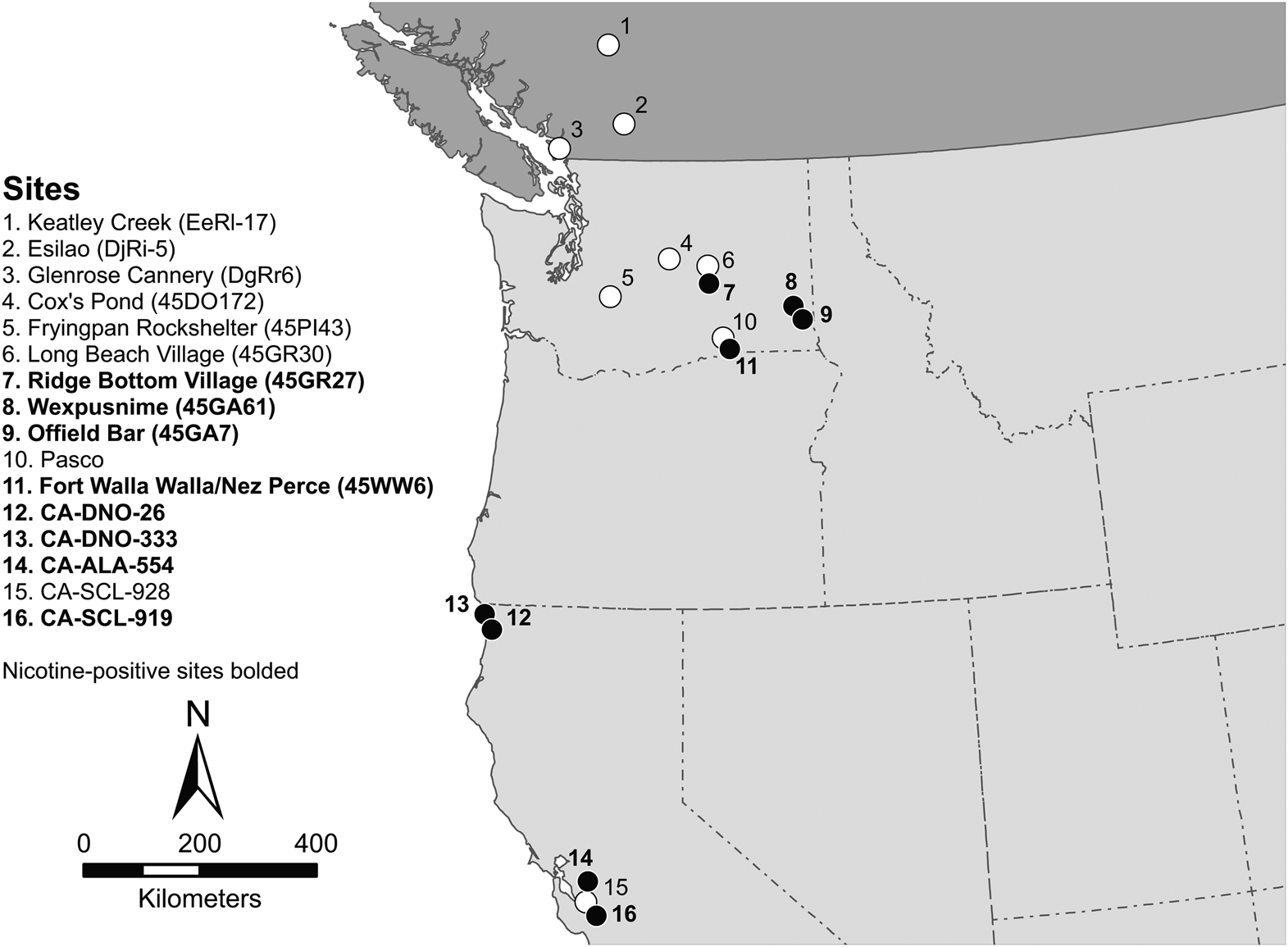
This trend is illustrated in Figure 4, which summarizes the results of all previous ancient residue testing for nicotine throughout the Pacific Northwest, as well as at three sites in central coastal California from which dental calculus was tested (Eerkens et al. Reference Eerkens, Tushingham, Brownstein, Garibay, Perez, Murga, Kaijankoski, Rosenthal and Gang2018). It is clear from studies published in the past decade or so that tobacco use was largely limited to the southern Inland Pacific Northwest. Significant gaps remain, however, in the geographical coverage of testing for the occurrence of nicotine and other compounds in ancient contexts in the region, particularly when compared with the distribution of stone smoking pipes found in archaeological contexts (Figure 3).
This map shows all sites from which pipes were tested for nicotine. Black circles indicate sites where a specimen contained nicotine.
Smoking residues have only been tested from one site (Keatley Creek; Hayden Reference Hayden and Hayden2000) in the Inland Plateau of British Columbia. Further studies should be undertaken that cover more sites in the region. Additionally, this and other studies have largely failed to address the possibility of ancient tobacco or other smoking in the Northwest Coast and Plateau in Oregon. Kroeber (Reference Kroeber1941) and others (see Phillips Reference Phillips, Bollwerk and Tushingham2016) indicate an Indigenous tradition of tobacco cultivation along the Oregon coast nearly to the mouth of the Columbia River (Figure 1). This—in conjunction with an archaeological record clearly indicating past smoking (Endzweig Reference Endzweig and Minor1989; Nelson Reference Nelson2000; Phillips Reference Phillips, Bollwerk and Tushingham2016)—suggests that the picture remains incomplete. It is also important to bear in mind that smoking is not the only way that the peoples of this region consumed intoxicating plants. Tobacco is an important plant to the Haida and Tlingit of the northern coast, but it may be archaeologically invisible because it was chewed rather than smoked (Turner and Taylor Reference Turner and Taylor1972).
Our results have also provided insights into the utilization of plants other than tobacco. There is evidence from DjRi-5 that Cornus sericea and some species of Salvia were smoked in the past. The latter may perhaps be S. dorrii, which is native to the Plateau region and is known to have been utilized by Plateau peoples in nonsmoking medicinal practices (Moerman Reference Moerman1998:510). C. sericea, on the other hand, is known to have been used for smoking in the postcontact era. Compounds associated with R. glabra were found the in the extracts from the nicotine-positive pipe from 45GR27 and in smaller numbers in other pipes. R. glabra was used medicinally (but not smoked) by a number of Plateau peoples (Moerman Reference Moerman1998:471–472) and was smoked “like tobacco” by at least one group—the Northern Secwepemc of the Fraser Plateau to the north (Parish et al. Reference Parish, Coupé and Lloyd1999:70). One Secwepemc elder, Lilly Harry of Dog Creek, commonly referred to the plant as “Indian tobacco” (Ignace and Ignace Reference Ignace and Ignace2017:49, 508). We interpret the presence of compounds associated with this species in pipes from the middle Columbia as a smoking practice that perhaps did not persist from the past through to the contact era. This is intriguing considering that R. glabra was used in other ways by peoples of the central Plateau at the time of European contact.
The use of metabolomics analysis in this kind of archaeological study is new, and we are beginning to explore its potential (Brownstein et al. Reference Brownstein, Tushingham, Damitio, Nguyen and Gang2020). In the studies presented here, metabolomics analyses have allowed us to detect compounds in artifacts associated with species that would otherwise have been invisible to us archaeologically.
Summary and Conclusion
The archaeological record of stone smoking pipes in the Inland and southern Coastal Pacific Northwest alone confirms the deep antiquity of smoking in the region, and it is among the earliest and longest records of ancient smoking pipes anywhere in the Americas. This study has considered the spatiotemporal distribution of this artifact type and broader implications for understanding smoking in the past. Drawing on an ethnohistoric record indicating that many plants were traditionally smoked in this region, we have sought to explore through residue analyses of stone smoking pipes presented here and elsewhere (Brownstein et al. Reference Brownstein, Tushingham, Damitio, Nguyen and Gang2020; Tushingham et al. Reference Tushingham, Ardura, Eerkens, Palazoglu, Shahbaz and Fiehn2013, Reference Tushingham, Snyder, Brownstein, Damitio and Gang2018) how long these plants have been used for this purpose.
We focused on tobaccos (N. attenuata and N. quadrivalvis) and kinnikinnick (A. uva-ursi) by testing for biomarkers known to be associated with these species, given that they are among the most frequently referenced smoke plants. We found that the oldest artifact to test positive for nicotine in the region was from the Ridge Bottom Village site (45GR27) in central Washington state, and it was associated with a radiocarbon date of 1334–1524 cal BP. This site is also the northernmost in the region to be positively associated with tobacco use in the precontact era. Our findings superficially contradict ethnographic data showing traditional tobacco use in the northern Plateau among the Nlaka'pamux (Thompson), Secwepemc, Kutenai, and others (Teit Reference Teit and Boas1900, Reference Teit and Boas1909; Turner Reference Turner2014; Turner and Taylor Reference Turner and Taylor1972). However, our samples are limited chronologically and spatially. Tobacco smoking among these peoples may have appeared later in the precontact or early contact eras after the deposition of the artifacts tested in our studies. Cultural practices are never static, after all. Alternatively, spatial lacunae in our testing (in Secwepemcor Nlaka'pamux areas, for example) may mean that we are simply missing evidence of ancient tobacco use in the northern Plateau.
None of the specimens tested were associated with A. uva-ursi. Although our evidence does not indicate that A. uva-ursi was smoked, paleoethnobotanical studies have shown that the plant was in use in both inland British Columbia (Lepofsky and Lyons Reference Lepofsky and Lyons2013; Lyons et al. Reference Lyons, Prentiss, Peacock and Angelbeck2018) and the Columbia Plateau (e.g., Carney Reference Carney2018). Our synthesis of residue studies suggests that the Middle Columbia area may constitute the northern limits of tobacco use in the Late Archaic. Very low positive rates for tobacco use in that area contrast with frequent positive results for nicotine on the Lower Columbia and Upper Snake Rivers (see Tushingham et al. Reference Tushingham, Snyder, Brownstein, Damitio and Gang2018).
Future work should expand the geographic distribution of tested artifacts, focusing on the northern Columbia Plateau, inland British Columbia, and the Oregon coast. Archaeological smoking pipes evince that smoking has been an important part of Indigenous lifeways for thousands of years, and we attempt in this study to contribute to a growing understanding of the spatial and temporal limits of these practices in the Northwest and throughout the Americas.
Acknowledgments
The authors thank the Confederated Tribes of the Colville Reservation for their support and permissions to work with the artifacts analyzed in the Mid-Columbia study. We thank the Nez Perce Tribe of Idaho for its support and permissions in previously published studies also discussed here. We also thank the U.S. Bureau of Reclamation, the Washington State Department of Transportation, and the Walla Walla District of the US Army Corps of Engineers for their permissions. For their permissions to analyze artifacts in the Fraser Valley study, we thank Kwantlen First Nation and the Yale First Nation. We also thank the Musqueam Indian Band and the Sto:lo Nation. We also thank Patricia Ormerod of the University of British Columbia Laboratory of Anthropology for her invaluable efforts enabling us to conduct the portions of this research that took place there. This material is based in part on work supported by the National Science Foundation under grants No. 1419506 and No. 1918966.
Data Availability Statement
Microsoft Excel spreadsheets containing the unprocessed results of LC-MS analyses are available from the authors upon request.
Supplemental Materials
For supplemental materials accompanying this article, visit https://doi.org/10.1017/aaq.2021.39.
Supplemental Text 1. Explication of Pipe Artifact Search Methods.
Supplemental Text 2. Key to Figure 3 with References.
Supplemental Table 1. Detailed Results of Mid-Columbia and Fraser Valley Residue Analyses.


 Open access

