




Charles Darwin was an imperial magpie. The two volumes of The Descent of Man are a cornucopia of diverse information about animals, birds and human societies gleaned from a large array of books and an even larger network of correspondents. What enabled Darwin to access this wide network of authors and correspondents, as Janet Browne points out, was his ‘assured place in the intellectual elite, at the heart of an expanding scientific and social meritocracy that in turn lay at the hub of one of the most powerful and systematically organized empires known to history’.Footnote 1
Whereas Darwin's implication in imperial networks has often been noted, a systematic audit of the extent to which empire might have enabled, shaped and informed this nineteenth-century intellectual giant remains missing. The extant scholarship maps Darwin's relation to the empire through one of two images. The first, captured in insights such as Browne's, evokes the empire as a source of information: a database.Footnote 2 The second, best exemplified perhaps in Marwa Elshakry's brilliant Reading Darwin in Arabic, evokes the empire as a site of elaborations, appropriations and contestations: a receptacle.Footnote 3
The first image insists that Darwinism pays its debt to empire, but does so leaving little room for the epistemic frameworks of the colonized people. The second image insists that the empire was a vibrant intellectual space with its own independent intellectual traditions and agendas, but does so by tracing reactions to Darwin. What both images omit is how intellectual traditions and cosmological frameworks of the colonized peoples might have impinged upon and aligned, or indeed misaligned, with Darwin's own project. When he consumed the empire, through letters and books, as ‘nature’, what happened to the ‘culture’ that had shaped that nature? Was it so easy to extricate a set of ‘natural facts’ denuded of all ‘cultural’ framing?
Recent approaches to imperial science, especially inspired by the ‘ontological’ and ‘decolonial’ turns, have revived earlier calls for ‘cognitive justice’ which insist that historians see the empire as neither simply a database nor a receptacle, but as a space with its own rich epistemic and cosmological frameworks.Footnote 4 To relocate Darwin's project within this new approach would compel us to go beyond affirming that Darwin acquired his information from colonized spaces or that he was widely read and repurposed in the colonized societies. It would compel us to locate Darwin within the bustling plurality of competing and collaborating traditions of ‘making natural knowledge’.Footnote 5
Central to The Descent was Darwin's notion of ‘sexual’, as opposed to ‘natural’, selection. One of the key aspects of ‘sexual selection’ was what Darwin called the ‘law of battle’; that is, the violent contest of males over access to females. As Erika Milam points out there are essentially two principal mechanisms at play in sexual selection. First is the issue of female choice. Second is the issue of male-to-male competition.Footnote 6 The ‘law of battle’ encapsulates the latter. Evelleen Richards has, in fact, argued that this was the earliest part of his theory of ‘sexual selection’ and had its roots in Darwin's grandfather Erasmus Darwin's work.Footnote 7 In establishing this ‘law’ in The Descent, Darwin deployed a significant number of examples of avian combat observed in British India. It is these examples that I will interrogate in this paper.
I will demonstrate that Darwin fundamentally misunderstood these combats by seeing them as ‘natural’ expressions of the birds’ desire for mates. Far from being such ‘natural’ acts, these combats were most often carefully calibrated jousts produced by human labour and agency. Working within an economy of social power, prestige, taste and entertainment, not only were these combats organized by humans, but also the birds were in fact often highly trained prizefighters. Recovering the history of such human-enabled and human-sculpted avian combat will show that the empire was not simply a neutral database that supplied objective data for Darwin's consumption. More importantly, his framing of imperial nature as something outside and independent of colonial cultures materially mediated the ways in which he interpreted these avian combats.
Darwin's birds
Birds featured prominently in Charles Darwin's thinking on evolution in The Origin of Species. Descent of Man was no different. Historians who have examined Darwin's engagement with birds, however, have looked almost exclusively at the birds that mattered in The Origin of Species and hence for the development of the theory of natural selection, such as pigeons and finches.Footnote 8 This is in keeping with the more general and continued trend in the historiography on Darwin to ‘pay more attention to natural than sexual selection’.Footnote 9
A rough sense of the prominence Darwin gave to birds in The Descent can be gauged by the fact that a total of four out of twenty-one chapters were devoted to them. By contrast, fishes, reptiles and amphibians got one chapter each, as did molluscs and other lower members of the animal kingdom, whilst insects and mammals got two chapters each. All the four chapters devoted exclusively to birds were focused on ‘secondary sexual characters’. This prominence afforded to birds is easily explained by Darwin's own comment: ‘Secondary sexual characters are more diversified and conspicuous in birds, though not perhaps entailing more important changes of structure, than in any other class of animals’.Footnote 10
Clifford B. Frith has argued that Darwin's interest in birds has a long history. Darwin had, since his childhood, engaged with birds in a number of different ways before he took them up for scientific study. As a young boy, like many others of his generation, Darwin had collected birds’ eggs; likewise as a teenager he had hunted and watched birds. Hence when he finally came to studying them critically, there was both a deeper personal interest and an experience of birds and their habits.Footnote 11 Richard W. Burkhardt points out that Darwin was in fact an important node within a larger genealogy of animal behaviourists who were keen birdwatchers. For instance, the young Darwin had been inspired to take up birdwatching after reading the Rev. Gilbert White's writings, whilst Darwin himself was inspirational for a number of younger British ornithologists and animal behaviourists, like Edmund Selous, Henry Eliot Howard, Frederick Kirkman and Julian Huxley.Footnote 12
When it came to exotic birds, excepting the few he had briefly seen on his travels, he lacked long familiarity or experiential depth. Yet he felt confident to rely on his vast army of correspondents to reconstruct avian behaviour without worrying too much about how far the reports he received were refracted by complex cultural practices or schemas. In some ways, Darwin's use of avian behaviour was the opposite of the imperial displays recently scrutinized by Sadiah Qureshi.Footnote 13 Rather than rendering human beings and artefacts from the empire into objectified Victorian displays engendering notions of exotic and primitive ‘culture’, Darwin's imperial birds and their behaviours were shorn of all traces of ‘culture’ and rendered as raw ‘nature’. As Suman Seth points out, ethnology was simultaneously an important source as well as a troublesome challenge to Darwin's construction of his theory of ‘sexual selection’.Footnote 14 What I am arguing, therefore, is not simply that ‘nature’ and ‘society’ intersected, but rather that Darwin's very rhetorical constitution of imperial avian combats as purely ‘natural’ was built upon a series of very significant misunderstandings of the extent to which such combats, as well as the reports about them, were carefully sculpted by contemporary colonial cultures.
Evelleen Richards points out that Darwin's own historically specific aesthetics were naturalized through his descriptions of avian behavior.Footnote 15 Darwin, Richards observes, ‘came to sexual selection not from his study of the sexual differences and mating behaviors of birds … but the other way round: from his very Victorian interpretation of the human practices of wife choice, courtship, and marriage, which he then extended to animals’.Footnote 16 Something very similar happened with Darwin's use of imperial data on avian combats. His lack of intimate personal experience of the birds or the colonial culture that generated the reports, however, made the mediation of his interpretations far more significant.
Darwin devoted about eleven pages to discussing the ‘law of battle’.Footnote 17 It was the very first aspect of the ‘secondary sexual characteristics’ of birds that he discussed. In this lengthy discussion, he listed numerous examples of global avian combats, including a number of South Asian instances. These included the water-cock (Gallicrex cristatus), a Sri Lankan jungle fowl (Gallus stanleyi), the Indian partridge (Ortigornis gularis), the peacock (Pavo cristatus), the fire-backed pheasant (Euplocamus erythropthalmus), the spurfowls (Galloperdix), the amadavat (Estrelda amandava) and the bulbuls (Pycnonotus haemorrhous). In each of these cases Darwin gave detailed descriptions of how the combat occurred, when it took place and so on. In many cases he also described the ‘sexual weapons’ that the birds had developed.
In nearly half of these cases – three out of seven – Darwin's own sources reported local human agents playing a significant mediating role in staging the avian. In the case of the water-cocks, for instance, Darwin's source mentioned that the males were ‘so pugnacious during the breeding-season, that they are kept by the natives of Eastern Bengal for the sake of fighting’.Footnote 18 Instead of commenting on this, Darwin simply followed this up with his comment on bulbuls. ‘Various other birds are kept in India for the same purpose, for instance the bulbuls (Pycnonotus haemorrhous) which “fight with great spirit”’.Footnote 19 In a similar vein but slightly later, Darwin wrote again that ‘Bengali baboos make the pretty little males of the amadavat (Estrelda amandava) fight together by placing three small cages in a row, with a female in the middle; after a little time the two males are turned loose, and immediately a desperate battle ensues’.Footnote 20
Besides these cases where Darwin himself notes, but then ignores, the role of humans, even in the cases of at least some of the other four species of birds mentioned there is some ground to suspect human intervention. In the case of the spurfowls, for instance, T.C. Jerdon, an author Darwin relies on heavily for his information, describes some spurfowls as being of a ‘dwarfed and degraded nature’ popular amongst the ‘sportsmen of the South [of India]’. Somewhat unclearly Jerdon calls these birds a separate ‘race’ but gives no separate name for it. Perhaps even more interestingly, Jerdon also mentions that this bird is sometimes confused with the ‘double-spurred partridge’.Footnote 21 Darwin, drawing upon Jerdon, described the existence of the two spurs in the Indian partridge as a secondary sexual characteristic in the males, right next to his discussion of the spurfowl, but made no mention of the complications regarding its identification with birds seemingly specially kept for sport.Footnote 22 Other observers also noted the existence of a culture of making specially trained partridges fight in India.Footnote 23
At least three, and possibly five, of the seven examples Darwin used from India to establish his ‘law of battle’ were therefore instance of humans organizing, encouraging and even training the birds to fight. Yet Darwin presented them as ‘natural’ facts that supported his theory of sexual selection.
In discussing the complex role of ethnographic data in The Descent, Seth points out that one of Darwin's key moves in developing the theory of sexual selection was to replace the ‘geological analogy’ with an analogy between humans and animals. The former had been a style of reasoning followed by some of Darwin's closest friends and allies, whereby social evolution of human societies of the past was understood with reference to the extant behaviours of the so-called ‘savage’ races of the world. Darwin sought to subtly displace this mode of reasoning and posit that animal behaviour supplied a much better analogical resource for understanding human behaviour of the past.Footnote 24 Whereas in The Origin Darwin had been at pains to affirm the role of human interventions in shaping certain animals, such as fancy pigeons,Footnote 25 in The Descent his analogical reasoning relied upon clearly delineating an autonomous domain of animal behaviour.
Thus, while Darwin conspicuously used ethnographic data in The Descent, he clearly marked it off from the allegedly purely ‘natural’ avian data by placing both in separate chapters and volumes. ‘Culture’ and ‘nature’ were thus neatly separated and permitted to function as analogies.
This systematic downplaying of ethnographic descriptions of human agency is particularly striking given Darwin's earlier use of domesticated animals as a productive analogy to establish the theory of natural selection. As Jean Gayon points out, through an early disagreement with Wallace, Darwin came to develop a robust defense of why he thought domesticated animal varieties were permanently transformed and how this fact allowed him to build the theory of natural selection. Gayon thus argues that the ‘domestic analogy’, i.e. the use of transformations effected in animals through direct human intervention, was ‘not a pedagogic device’; it was ‘methodologically essential’ to the theory of natural selection. Without this crucial analogy, it is doubtful whether Darwin would ever have been able to develop or substantiate his hypothesis.Footnote 26
Having thus relied so heavily on the capacity of humans to intervene in species transformation, it seems odd that Darwin would ignore the role of human agency in shaping avian combat. At the very least we might have expected Darwin to omit citing the examples where human mediation or involvement in avian combat was clearly stated, and rely instead on the other examples.Footnote 27 Indeed Bert Theunissen has argued that even in developing the domestic analogy with respect to natural selection, Darwin had used the evidence selectively by ignoring popular breeding practices such as in-breeding and cross-breeding that did not fit his theory well.Footnote 28 Why, then, did he not simply omit the references to bulbuls and amadavats and rely instead on the other seemingly unmediated combats?
Given the openness with which Darwin presented these instances, I am convinced that Darwin's attitude towards these examples of avian combat was informed by a fundamental misunderstanding rather than by a deliberate attempt to twist the evidence to suit his arguments. I will argue that Darwin's prior work with British animal domestication had led him to conceptualize ‘domestication’ exclusively through breeding practices. By contrast, when it came to fighting birds, South Asian domestication practices tended to privilege training rather than breeding.
This breeding-centric idea of domestication allowed Darwin to write that ‘it is an error to speak of “man tampering with nature” and causing variability. If organic beings had not possessed an inherent tendency to vary, man could have done nothing’. A footnote explained that the reason why Darwin offered this clarification was to refute Felix-Archimède Pouchet's contention that ‘domestication throws no light on the natural modification of species’.Footnote 29 Domestication, for Darwin, then, merely expressed what was already an ‘inherent tendency’ in the organism. Man, in the course of domestication, merely ‘unintentionally exposes his plants and animals to various conditions of life’.Footnote 30
Shauq
Bird fighting was a form of both popular and elite entertainment in many parts of South Asia during Darwin's time. Naturally, South Asian authors, too, have left records of these fights. Comparing these reports with Darwin's data helps us appreciate the extent to which the fighting birds were specially trained and made to fight.
One of the most fulsome accounts of bird fights comes from the Urdu journalist, littérateur and chronicler Abdul Halim Sharar. Sharar was a denizen of the opulent north Indian city of Lucknow. The latter had been the capital of one of the most powerful post-Mughal states, Awadh, whose eventual absorption into the British Empire in 1856 was one of the main causes for the outbreak of the so-called ‘Indian Mutiny’ in 1857. After the demise of the Awadh state, Sharar wrote eloquently about the past grandeur of the city and its urban culture. Animal baiting in general and bird fighting in particular formed a major part of these reminiscences.
Sharar noted that making large beasts of prey fight was a hugely expensive affair and could only be done with the support of the royal court. Bird fighting, however, ‘was different. Rich and poor alike could indulge in it. Any interested person, if he took the trouble, could train cocks and quails to fight’.Footnote 31 As a result, a number of different birds, i.e. cocks, bush quails, lavwas (a type of partridge smaller than a quail), guldums (a type of bulbul), lals (amadavat), pigeons and parrots were made to fight. Sharar also admonished the ‘educated people who made a show of modern culture’ by denigrating these older forms of culture because they were ‘totally unaware of the degree to which their devotees had raised them [i.e. bird fights] having in fact made them a fine-art’.Footnote 32
Sharar's emphasis was clearly on the training imparted to these birds. To prepare cocks and jungle fowls for fighting, Sharar declared,
the owners would show their skill not only in the feeding and upkeep: they also massaged the bird's limbs, sprinkled it with water, tended its beak and claws and displayed their dexterity in tying up the claws and removing any signs of fatigue. From fear that the beak might be injured by pecking food from the ground they sometimes fed grain by hand.Footnote 33
For fighting quails, the regimen was even more elaborate:
To prepare a quail for fighting it is first necessary to keep him wet with drops of water and to hold him in one's hand for hours. He then becomes quite tame and starts chirping and chirruping. After this he is starved and subsequently given a purgative containing a large amount of sugar so that his inside is thoroughly cleansed. Then late at night his trainer shouts the word ‘ku’ into his ear and this is known as kukna, winding up. By these methods the quail loses his surplus fat and any awkwardness and his body becomes very active and strong. The more diligently these details are carried out the more efficient is the quail when the bird begins to fight.Footnote 34
In the case of partridges, which Sharar said was only engaged in by ‘villagers and lower-class people’, the birds were ‘trained by being rolled in the dust and made to race. They are fed with termites to make them worked up and excited’.Footnote 35 The guldums were trained by making them fight over sprinkled grain.Footnote 36 Most tellingly perhaps, in the case of the lals (amadavats), we learn that these birds are actually difficult to train because they tend to fly away rather than fight. Making them do otherwise, therefore, was a matter of skill. As a result, it apparently never became very popular, partly because the skilled trainers were rare.Footnote 37
Interestingly, Sharar discussed bird fighting together with pigeon fancying. Clearly, to him, they were part of the same broader culture of distinctive animal domestication. Anthropologist Muhammad A. Kavesh has described pigeon flying, cockfighting and dogfighting together as constitutive of shauq – an Urdu term designating ‘activity that is routinely carried out to fulfill a personal enthusiasm’.Footnote 38 Etymologically derived from the Arabic šauq, it appears throughout South Asian, South East Asian and Indian Ocean languages in a variety of spellings. An early ethnographic list compiled in Afghanistan in the mid-twentieth century gives everything that could be considered part of shauq, including gambling; collecting various things ranging from weapons of different types to scorpions and lizards; playing musical instruments; patronizing dancing boys or girls; lavishly decorating objects; sports like kite flying; and ‘raising, training and fighting various animals (quails, partridges, roosters, dogs, camels)’.Footnote 39
Shauq operates at a ‘tangent to a person's primary identity or form of livelihood’ by affirming the ‘value of aesthetic delight and emotional well-being over pragmatic financial considerations’. Equally importantly for us, it ‘generates sociality through the vertical transmission of knowledge across generations and through sometimes formalized roles of teacher and disciple’.Footnote 40 Shauq, therefore, clearly entails the development and transmission of specialized forms of knowledge.
The grouping of bird fighting together with pigeon flying in a culture of shauq draws attention once again to the role of skilled expert trainers as bearers and transmitters of knowledge. It also, simultaneously, provides us with an obvious contrast with the English pigeon-fancying cultures that were so crucial to Darwin's thinking.
Sharar recalled several famous pigeon trainers in Lucknow's past. During the reign of Nawab Shuja-ud-Daula (1754–75), the founder of the kingdom of Awadh, a man called Sayyid Yar Ali of Bareilly was employed as a pigeon expert. During the reign of Nasir-ud-Din Haider (1827–37), another pigeon trainer named Mir Abbas achieved fame by being able to make his pigeons respond to his whistles no matter how high they flew. Another famous trainer, Nawab Paley, could make his pigeons turn tricks and somersaults in the air upon his signal.Footnote 41 Some trainers even excelled in teaching their pigeons to contort themselves through tiny apertures.Footnote 42
Whilst breeding might have been part of what these trainers did, it is clear from Sharar's descriptions that the men were respected and patronized for their ability to train pigeons rather than simply breed them. Indeed, some men went further and acquired fame and royal patronage by surgically modifying pigeons. One unnamed gentleman living in the reign of Nasir-ud-Din Haider, for instance, had produced several ‘composite pigeons’. One of these was an artificial ‘double pigeon’, created by surgically amputating one wing each from two separate pigeons immediately after birth and then attaching them to each other. He then raised and trained this ‘double pigeon’ to fly and behave as a single organism. Another pigeon manipulator, Mir Aman Ali, had invented a technique of individually pulling out the feathers of pigeons and replacing them with artificial or different-coloured feathers. By using this technique he produced not only pigeons of unusual colours but also pigeons that bore artistic designs and floral patterns on their wings. Both the composite pigeons and the artificially coloured pigeons were much sought after and commanded a high price. Even the king himself lavishly rewarded those who produced such pigeons.Footnote 43
Sharar's descriptions of the celebrity achieved by pigeon trainers echoes an earlier, and more famous, royal chronicle, Abul Fazl's Ain-i-Akbari, detailing the life and times of the Mughal emperor Akbar (1556–1605). The emperor was extremely fond of pigeon flying and did much to codify, patronize and promote it. ‘The amusement which His Majesty derives from the tumbling and flying of the pigeons reminds of the ecstasy and transport of enthusiastic dervishes: he praises God for the wonders of creation’.Footnote 44
The emperor himself was said to have devised a training system that improved upon the system of the ‘pigeon trainers of former times’. The pigeons were taught special tricks and manoeuvres. One popular movement was the charkh, described as a ‘lusty movement ending with the pigeon throwing itself over in a full circle’. Indeed, each movement that the pigeons learnt had it own name. An incomplete somersault was called a katif, another movement in which the bird had its feet upwards and turned a circle was called bazi or mu'allaq zadan. When a bazi and charkh were confused, the move was called gululah. These movements were further repeated in intricate series.Footnote 45 The birds were hand-reared from an early age and gradually taught to build their stamina and endurance by strict dietary and exercise regimes.Footnote 46 Akbar's pigeons were specially ‘trained as to be let fly at night, even to great heights’.Footnote 47
Naturally, such intricate training required skilled trainers. Fazl mentioned how ‘many a poor man anxious to make his way, has found in the training of superior pigeons a means of getting rich’.Footnote 48 Pigeon trainers came to the court from far and wide in search of employment. Amongst the most famous were Qul Ali of Bukhara, Masti of Samarkand, Mullahzada, Pur-i-Mullah Ahmed Chand, Muqbil Khan Chelah, Khwaja Chandal Chelah, Mumin of Herat, Abdullatif of Bukhara, Haji Qasim of Balkh, Habib of Shahrsabz, Sikander Chelah, Maltu, Maqsud of Samarkand, Khwaja Phool, Chelah Hiranand. The elaborate regimes and skilled trainers had produced, according to Fazl, the most perfectly trained birds in history.Footnote 49 Describing Mohanah, the ‘chief of the imperial pigeons’ and Akbar's favourite, Fazl wrote that his descendants had brought ‘the trained pigeons’ of ‘Umar Shaikh Mirza, the father of Emperor Babur, founder of the Mughal dynasty, and Sultan Husain Mirza ‘into oblivion’.Footnote 50 Clearly mastery in pigeon training was not only prized but also memorialized. Trainers of the past became legendary and contemporary trainers were measured against these past greats.
Illustrated page from a late eighteenth-century pigeon-keeping manual titled Kabutar-namah (Book of Pigeons) by Sayyid Muhammad Musavi Valih. British Library, No. IO Islamic 4811.
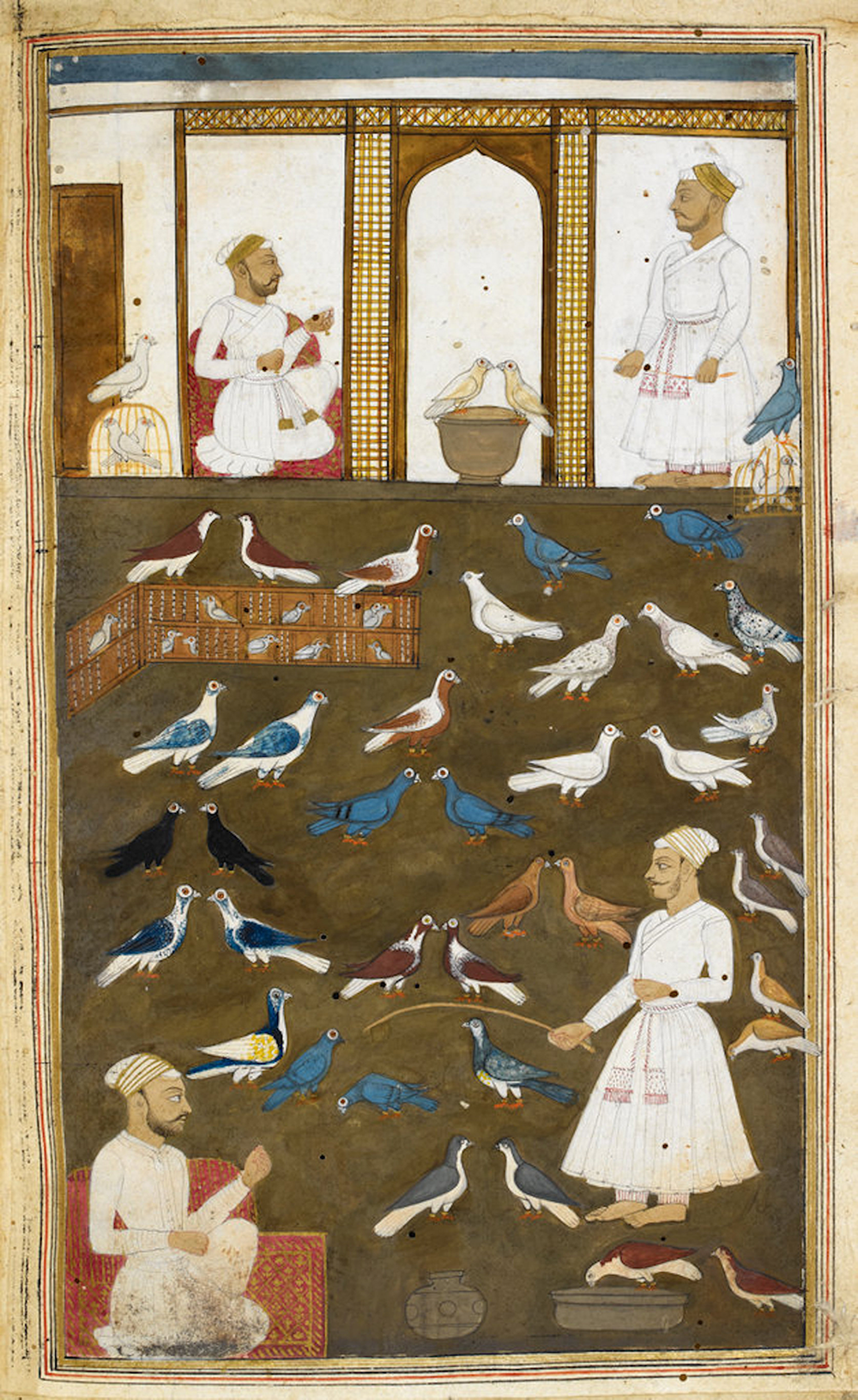
The importance of pigeon fancy to Darwin's thought and his own involvement in keeping fancy pigeons makes these South Asian discussions of the shauq of pigeon flying particularly pertinent. It is clear that English pigeon fancying and South Asian pigeon flying had very different emphases. The former, at least in Darwin's view, emphasized breeding as a way of making natural traits manifest, whereas the latter – though not ignoring breeding – mainly emphasized complex regimes of training. In extreme cases, as we have seen, the birds were even surgically transformed.
Rather than letting some innate ‘nature’ manifest itself through careful breeding, South Asian cultures of domestication emphasized the role of skill and training in sculpting and shaping the bird's behaviour. Likewise, avian combat in South Asia was seen – perhaps most clearly in the case of the amadavats – as encounters engineered by human skill, rather than the consequence of natural instincts.Footnote 51
Colonial history and Darwin's networks
The Mughal Empire began to decline at the beginning of the eighteenth century. The British Raj did not substantially replace its territorial dominance until the early nineteenth century. In the intervening century, there emerged a number of smaller successor states, such as Awadh, Bengal, Hyderabad and Punjab. These states retained the fiction of Mughal suzerainty, developed complex political and cultural relations with the rising English power and produced new social elites at their regional centres. By Darwin's time, as the British Raj absorbed the last remnants of these states, they also absorbed some of the cultural practices and social formations developed by these states in the previous century.
It was the brute fact of empire that finally yoked Mughal shauq and Victorian natural history. Two factors directly tied to empire permitted Darwin to consume reports of avian combat. First was the sheer presence of a number of Englishmen on the ground as colonial officials who were able to observe the combats and report back to Darwin. Second was the likely spike in the shauq of bird fighting through the emergence of a new class of wealthy patrons seeking to appropriate earlier patterns of royal behaviour.
Darwin relied on two principal sources for his information on the pugnacious birds of South Asia. The first of these was a series of personal communications with and brief write-ups by Edward Blyth (1810–73), who had been the curator of the Museum of the Asiatic Society of Bengal for over twenty years. The second was Thomas Caverhill Jerdon's (1811–72) three volumes on The Birds of India. It was from Blyth that Darwin learnt of the fighting water-cocks and the amadavats, while he owed the information on fighting bulbuls and other birds to Jerdon.
It was Blyth who supplied Darwin with explicit statements that seemed to fit into the ‘law of battle’. In a letter dated 5 April 1868, he told Darwin,
In Gallicrex cristatus, the frontal shield is small and pointed in winter, but at the breeding season it rises into a caruncle [a small fleshy growth] thus [Blyth has added an image here], being of a red colour, and at this time the males are very pugnacious, and are kept for fighting by the inhabitants of Eastern Bengal, who designate the bird the Kora. As it is one-third larger than its female, I think there can be little doubt of its being polygamous.Footnote 52
Jerdon, who also discussed the bird, had been much more circumspect, writing, ‘The male birds are said to fight furiously, and are much prized by the natives, who keep them for that purpose, especially in Dacca, Sylhet etc., they fetch a high price’.Footnote 53 In fact, Jerdon had relied upon James Taylor for his information on the Gallicrex cristatus. Taylor, a doctor who lived in Dhaka and authored a highly informative book on the ‘topography and statistics’ of the city in 1840, had stated that the kora was ‘trained by the Mussulmans [sic] to fight and a good game Korah frequently sells as high as 15 to 20 rupees’.Footnote 54
Blyth, who was based in Calcutta, does not seem to have ever travelled to eastern Bengal, viz. the region around Dhaka, where the birds were actually found. His report seems to have been based on four museum specimens of the bird acquired between 1842 and 1845. He did note at length the pronounced caruncle of the male specimens.Footnote 55 It is likely, therefore, that he had merely fitted the snippets of ethnographic information to his knowledge of the specimens, without ever having witnessed a real kora fight.
It is also worth noting that Blyth's own interests in fighting animals went beyond merely scientific curiosity. He had often acted as an animal dealer and even sought to involve Darwin himself in a business to supply British animals to the deposed nawab of Awadh, Wajid Ali Shah.Footnote 56 The nawab, exiled to Calcutta after the British takeover of Lucknow, sought to re-create the culture of Lucknow in Calcutta, including patronizing bird fights. In fact, some of the most skilled bird trainers of Lucknow, such as Darogha Ghulam Abbas, had followed the deposed king into exile.Footnote 57
Blyth's involvement with the exiled Awadhi court as an animal seller would have provided him several opportunities to observe avian combats. But these would always have been combats curated by human skill rather than wild encounters. It is important, then, that it was Blyth, rather than Jerdon, who ‘became Darwin's chief consultant on the fauna, domestic and wild, of the Indian subcontinent’.Footnote 58 Indeed, Blyth's earlier publications in the 1830s had been amongst the formative influences that led Darwin to ‘sexual selection’ in the first place. Though Darwin differed in the thrust of his argument from Blyth's early ideas, the latter's descriptions of male combat over females had helped Darwin formulate his own thoughts on the matter.Footnote 59 The point I wish to emphasize here is a simple one, viz. Blyth was an important element in Darwin's formulation and both the fact of Blyth's presence in Calcutta and his opportunity to see avian combat were direct results of the British Empire.
The impact of the British Empire on promoting such fights, however, might actually have started even earlier. Sharar is clear that the culture of cockfighting commenced in Lucknow during the reign of Nawab Shuja ud Daula (1754–75); that is, the first independent king of Awadh. Quail fighting commenced slightly later during the reign of Nawab Sadaat Ali Khan (1798–1814),Footnote 60 having arrived in Lucknow with some ‘gypsy women’ from the Punjab before receiving royal patronage. Clearly the culture of bird fighting was intimately linked to the history of the kingdom of Awadh itself and the patronage of it by successive monarchs.
Several reporters suggest a very similar timeline for the emergence of such fights in Calcutta. Bipin Bihari Gupta, a chronicler of old Calcutta, recalled that the practice of bulbul fighting in the city commenced in the days of the independent nawabs of Bengal in the eighteenth century.Footnote 61 Bengali historian Nemai Sadhan Bose likewise moralized that with the advent of colonial rule in the eighteenth century, ‘morality and moral standards reached their lowest ebb’. People had turned, he disdained, to prodigal pursuits, and ‘kite-flying, bird fighting’ and other ‘debased forms of entertainments’ flourished.Footnote 62
Awadh and Bengal were both post-Mughal states that emerged in the eighteenth century and quickly became military allies, clients and eventually parts of the British Empire. These new states produced a range of new wealthy patrons. In Lucknow this included East India Company officers such as Major Claude Martin and Major Soirisse.Footnote 63 In Calcutta, a new class of Bengali men who had prospered through business contacts with the company became conspicuously connected with bird fighting. Two men most famously associated with bird fighting in Calcutta were Narasingha Rai Bahadur, the second son of Raja Sukhomoy of Posta, and Ashutosh Deb, better known as Chhatubabu, whom Partha Chatterjee, following S.N. Mukherjee, has called one of the five richest and most influential people in early nineteenth-century Calcutta.Footnote 64 Both the rajas of Posta and the Debs owed their rise directly to their close ties with the company in the eighteenth century and were considered part of the new parvenu elite which had accumulated enormous wealth by working with John Company.
Anand Pandian's work on the Mughal tiger hunt and Jagjeet Lally's account of Mughal equestrian paintings have argued that political claims were tightly entwined with the control and representation of animals in the Mughal world.Footnote 65 It is tempting to read echoes of such a culture in the post-Mughal states. But it is equally important to note both their intensification and their transformation. Kavesh has suggested that shauq was originally pegged to high-status codes of masculinity, but then came to be gradually mimicked by lower-status men.Footnote 66 Increasingly evacuated of putative political authority, post-Mughal patrons seem to have adapted avian combats into an arsenal of spectacular elite competitions. No longer connected directly to claims of royal sovereignty, such combats now became metaphors for elite status rivalries.
One lengthy report in the Bengali newspaper Sambad Prabhakar, published on 18 January 1853, gives us a glimpse of ways in which elite rivalries promoted bird fighting as a spectacle. The two main competitors, Babu Dayalchand Mitra and Raja Brajendranarayan Ray Bahadur, met on an open field near Ashutosh Deb's house on the morning of 16 January for a series of duels. Each had brought several fighting bulbuls and they fought by turns from 10 a.m. to 2 p.m. Out of a total of thirty-seven match-ups, Mitra's birds triumphed twenty-seven times and the Ray's won the rest of the contests. Describing the contestants, the reporter wrote, ‘every year both these eminent rivals enjoy themselves in the winter by such avian battles. For this they collect birds from far and away [desh-bidesh], employ a large number of people and also provide entertainment to the public at large’. Commenting about the interest in such contests, he stated,
Our greatest joy, one which we do not taste on any other occasion, is that all the rich people of the city assemble together accompanied by their sons, grandsons and advisers on the field to witness this joust. On no other occasion does this happen. Invitations for other major celebrations and religious festivals are often honored by sending representatives, but on this one occasion the moment they hear of it, all come in haste and take up whatever place they can find.Footnote 67
The reporter ended by describing how the loser, Raja Brajendranarayan in this case, left the arena in tears and shame.
Baidyanath Mukhopadhyay, amateur local historian and raconteur of old Calcutta, reported that bulbul fights had been the greatest spectacle of the winter months. Poems and songs were written about these birds and their jousts. He also detailed the different types of bulbul that were available, as well as marshalling some of the popular lore about these birds.Footnote 68 Summing up, he wrote,
The unlimited wealth of the Babus rained down on the courageous combat of the bulbuls. Seeing it [some] wrote poems. And the common man carried new doggerels about it on their lips. It is impossible to say precisely when bulbul fighting commenced in Calcutta or exactly when they ceased. Apparently, these fights had come into vogue in the time of the Nawabs.Footnote 69
What such accounts show is that irrespective of the exact origins of bird fighting, the social changes produced by empire – especially the minting of new wealthy patrons often without traditional claims to aristocratic status – were amplifying the performance of public avian combats. Just as the presence of men like Blyth, Jerdon and Taylor provided willing observers who could relay avian combats to Darwin, it was the new elites in South Asia who helped make the combats conspicuous on the ground. Whilst the latter caused the combats to be enacted as grand urban spectacles, the former observed and reported them back to Darwin. Both were crucial for Darwin to access the information.
The romance of the bulbul
Fighting bulbuls could not have simply been a dry piece of information for Darwin. By the time he encountered reports of these combats, birds such as bulbuls and amadavats were already well-established symbolic objects in British Romanticism. In this penultimate section, I want to explore congruence between the symbolic frameworks for representing some of these birds and Darwin's ‘law of battle’.
Several scholars, such as Gillian Beer, Evelleen Richards, Ian Duncan and others, have explored the mutual impact of Victorian literature and Darwin's thinking.Footnote 70 Most of them have also noted the particularly prominent role of Romanticism in mediating this connection. Indeed, Robert Richards has located Darwinian science squarely within a broad Continental tradition of Romantic science deriving from Humboldt and Goethe.Footnote 71 George Levine, following David Kohn, describes Darwin on the Beagle as already being ‘a more or less self-conscious child of Romantic poetry and painting’.Footnote 72
Eastern, and especially Persianate, themes had been hugely important for the development of British Romanticism since its birth in the late eighteenth century. It was in fact the work of eighteenth-century British orientalists in India, such as the Calcutta judge Sir William Jones, and the Asiatic Society that he founded, that were largely responsible for the communication and popularity of Persian poetry in Britain.Footnote 73 As Nigel Leask points out, Jones's ‘heavily doctored translations’ of Persian poets like Firdausi, Hafiz and Sadi not only were able to feed into a late eighteenth-century British ‘fad for Persian poetry’, but also exercised ‘a strong influence’ on Romantic poets like Landor, Southey, Coleridge, Byron and Moore. Since Persian remained the official language of the British Raj until 1834 and an ever-growing number of British soldiers, administrators and merchants working in the expanding Indian empire were compelled to learn it, there was a large and receptive readership for such English poetry with Persian influences.Footnote 74
The influence of this poetry on Darwin is not a matter of conjecture. He himself admitted to his deep and early interest in the works of Wordsworth, Coleridge, Shelley and Byron.Footnote 75 One of the most prominent motifs that the British Romantics acquired from their Persian sources was that of gul u bulbul or ‘the rose and the nightingale’, viz. the bulbul/nightingale's excessive love for the rose. Originally introduced into English through a translation of a Turkish love poem by Lady Mary Wortley Montagu in 1717, it was widely deployed in minor Romantic poetry in the period between 1770 and 1825, before being raised almost to canonical status through Byron's use of it.Footnote 76
Darwin would therefore likely have encountered it repeatedly in his early years of fascination with Romantic poetry. We can affirm at least two sources where he most certainly encountered the trope. First, we know from Darwin himself that he had read, possibly not for the first time, Byron's The Giaour in the summer of 1841. This was one of the poems where Byron prominently deployed the rose and nightingale motifs. Second, and even more importantly, none other than Darwin's grandfather, Erasmus Darwin, in his The Love of Plants, had written, ‘So, when the Nightingale in eastern bowers / On quivering pinion woos the Queen of flowers’.Footnote 77 The elder Darwin even added a footnote stating, ‘There is a wonderful conformity between the vegetation of some plants, and the arrival of certain birds of passage’, before wondering whether ‘a similar coincidence of appearance in some parts of Asia gave rise to the story of the love of the rose and the nightingale’. Indeed, he even explicitly attributed the motif to ‘eastern poets’.Footnote 78
Evelleen Richards has pointed out that his grandfather's botanic poetry had been a major influence on Darwin's ideas about ‘sexual selection’. What is more, Richards points out that it was precisely around the time, in the late 1830s, when he was reflecting on his grandfather's theories of sexual competition, that he read two reports of male combat that seemed to confirm his evolving theory. One of these two reports was from none other than Blyth, who in turn himself had been influenced by Erasmus Darwin's Zoonomia. Footnote 79 The lovesick nightingale, as a symbolic object, therefore overlapped intimately with Darwin's naturalized object of the pugnacious males fighting for females.
What remains to be said, however, was that the gul u bulbul motif had itself undergone change in the hands of the British Romantics. Elham Nilchian points out that while the original Persian motif had presented the male lover as a pining symbol of world-weariness lapsing gradually into the arms of death, the British Romantics increasingly turned the male lover into a roguish, vengeful killer violently avenging himself on the world for his separation from his beloved. It was the female lover who now pined and wasted away. The key work that Nilchian identifies as establishing this latter motif is Byron's The Giaour.Footnote 80 Its militant and murderous hero, Selim, stands in sharp contrast to the maudlin Persian Mejnoun.
While Darwin might have picked up the nightingale's devotion to its mate from his grandfather, it was in Byron that he would have read how that devotion might inspire acts of extreme violence when frustrated.
These overlaps between the symbolic and the natural should not be seen as mere happenstance. Darwin himself had reflected on literary ‘associations’ in scientific work. David Arnold refers to an exchange Darwin had with his friend and supporter, the botanist J.D. Hooker, on precisely this issue. In Arnold's opinion the exchange demonstrated that around the middle of the nineteenth century, at least within the intellectual circle around Darwin, ‘science and sensibility still operated in tandem’. The sensibility was cultivated by earlier readings, especially of Romantic literature, and this in turn produced ‘associations’ between the literary texts and the scientific ‘impressions’ that these men of science came to hold.Footnote 81
Conclusion
It was precisely a century after The Descent, that Clifford Geertz produced what remains perhaps the most celebrated ethnographic account of a bird fight, Notes on the Balinese Cockfight.Footnote 82 Geertz, using his method of thick description, illuminated how Balinese cockfights animated and mutually articulated status rivalries and socio-moral hierarchies. Above all, however, Geertz argued that the cockfights were the way the Balinese interpreted their own society and its values, organization and aspirations. Geertz's justly famous interpretive method has done much to dislodge the reductionist paradigms, such as functionalism and psychologism, which had dominated earlier ethnographic traditions. Yet, and here's the rub, it remains haunted by the same absolute split between the ‘natural’ and the ‘social’ or ‘cultural’ that had informed The Descent.
More than once Geertz alludes to this split between the social and natural and the ‘crosswise doubleness’ of the event of the fight as, on the one hand, a ‘fact of nature’ engendered in ‘untrammelled rage’ and, on the other hand, a ‘sociological entity’.Footnote 83 It was this split, I presume, that led even so attentive an observer as Geertz to quickly gloss over the elaborate ways in which the Balinese sought to transform the cocks themselves by manipulating their bodies, diets and temperaments, with practically no analysis whatsoever.Footnote 84 It is against this inattention and the split between ‘nature’ and ‘society’ that I want to place this article of mine.
As Evelleen Richards argues, the ‘social’ was not merely a ‘context’ external to Darwinian theory. Rather we must come to terms with the ‘complex on-going interplay between theories of nature and theories of society’.Footnote 85 Darwin's own location within a specific historical moment allowed him to access information about human-enabled avian combat in the British Raj. But it also shaped the way he was able to access this information. An earlier observer in the late seventeenth century or a later one in the mid-twentieth century would not have had the same opportunities to encounter multiple bird fights with as much ease as a Jerdon or a Blyth. Both the new social hierarchies of empire and the brute fact of having more willing observers on the ground enabled the documentation of such fights and their communication to Darwin.
Likewise, Darwin's own sensibility, shaped as it was by an early interest in Romantic poetry, very likely influenced how he interpreted the information Blyth and others sent him from British India. The long tradition of deploying the gul u bulbul motif, mobilized amongst others by Erasmus Darwin, and transformed by Lord Byron, found its echoes in Darwin's ‘law of battle’.
What Darwin, as much as Geertz almost a century later, failed to realize was how much of what his correspondents saw and he interpreted was sculpted and curated by Asian cultures of bird training. Birds were specially reared, fed and trained to fight, and these fights became major urban spectacles. The training regimes were often themselves highly codified and organized into well-established stages of progress with their specific sets of dietary stipulations and exercise regimes. Some even reported the owners of fighting birds physically modifying the birds by, for instance, sharpening their beaks and claws with penknives, or applying a poisonous oil to the beaks of their birds.Footnote 86 Finally, the birds were encouraged and even goaded to fight by their owners. The bird fights that ensued were therefore carefully crafted productions rather than natural events.
Darwin occasionally noted the involvement of humans in these fights, but did not seem to appreciate the extent of their involvement. Bent on locating the ‘law of battle’ in a realm of ‘nature’, he consistently failed to observe how a highly specialized culture was intervening in and sculpting that ‘nature’. Especially acute was his failure to notice the enormous investments of human labour and knowledge in producing these fights.
To be fair, ‘law of battle’ did not stand by just the South Asian examples, and Darwin's misconstrual of them does not by itself damn the theory. Unpicking these examples, however, proves two important things about Darwinian science. First, its involvement with empire cannot be fully captured in the two extant images of empire-as-database and empire-as-receptacle. The influence of empire on Darwin was much more multifaceted, multilayered and multidirectional. From the ‘associations’ of circulating Persianate motifs in British Romantic poetry to Darwin's correspondents being able to observe bird fights patronized by newly minted South Asian elites, empire was a polyvalent reality in Darwin's thought and world.
Second, Darwin and his European peers were not the only ones producing knowledge about birds in the British Empire. A wide variety of bird trainers, manipulators and patrons in South Asia were also producing their own forms of knowledge and practice. These drew upon earlier, established cultures of shauq and sought to perfect their birds through complex modes of training. To appreciate Darwin's dialogue or the lack of it with such parallel, but frequently interacting, traditions of knowledge, we must not simply put Darwin within an imperial space but also embed him in an epistemic pluriverse.Footnote 87
Acknowledgements
An earlier draft of this paper was presented at the Delaware Valley British Studies Reading Group organized by Lynn Lees and Seth Koven. Feedback I received at the session was most helpful. Farid Azfar's suggestions that I further explore the role of Romanticism in my argument proved to be particularly productive. Marcy Norton and Yingchen Kwok generously read and commented on earlier drafts, while Erika Milam and Suman Seth read multiple different drafts and made several significant suggestions. All of this has greatly improved the article and I remain deeply indebted to all of them.


 Open access

