




As the last decade of the twentieth century dawned, the European Community found itself at a historical moment of transformation.Footnote 1 After the protectionist policies of the Member States had curtailed the European Commission’s ambitions during the 1970s, the 1986 Single European Act (SEA) removed national veto powers, revitalising the European project.Footnote 2 The SEA fulfilled a long-promised goal: the creation of the single market, ensuring the free circulation of people, goods, capital and services.Footnote 3 In 1992, the Maastricht Treaty further expanded the Community’s competences, paving the way for a common currency and introducing new policy areas such as culture, education and health.Footnote 4 The European Commission was convinced that this transfer of national sovereignty to the supranational level needed to be paired with a significant effort of public communication. A persuasive public narrative was therefore crafted to anchor the new European policies. Jacques Delors, Commission President since 1985, warned that ‘you cannot fall in love with the single market’.Footnote 5 He understood that public support for the institutions depended on symbolic construction and emotional resonance.Footnote 6
When Spain invited the European Community to participate in the 1992 Universal Exposition in Seville, the Commission recognised a unique chance ‘to talk to the hearts of European citizens’.Footnote 7 Expo 92, which promised to be one of the world’s most widely attended and visible events of the late twentieth century, provided an unparalleled platform to share the Community’s vision in the pivotal year of the Maastricht Treaty. The European Community’s participation in the Expo emerged as a highly symbolic act of public diplomacy, representing one of its most prominent interventions in the shaping of public discourse about its identity, purpose and legitimacy on the eve of the European Union (EU).Footnote 8
Since the Great Exhibition in London in 1851, Universal Expositions, also called World’s Fairs or Expos, have served as major global stages for cultural representation. These events showcased technological breakthroughs and offered new forms of leisure and entertainment, mirroring the ambitions, anxieties and ideological currents of their time.Footnote 9 Yet Universal Expositions did only reflect their historical realities, they also actively participated in shaping them. Pliable to the political and epistemological exigencies of their moment, Expos were moulded by the ambitions of the host and official participants alike, who used them to project authority and articulate competing visions of modernity.Footnote 10 On the fairgrounds, a miniaturised, highly hierarchical representation of the world emerged, particularly evident in colonial exhibitions, which promoted imperial ideologies and were used to ‘sell’ the empire to domestic audiences in the metropole.Footnote 11 While their peak was contemporaneous with the age of high imperialism, Universal Expositions persisted throughout the twentieth century and became a key site of the cultural Cold War.Footnote 12
The European Community had been an eager participant in Universal Expositions since its founding, employing cultural diplomacy as a key instrument to shape its public image.Footnote 13 Since the establishment of the European Community, a Community pavilion was constructed for every Expo before Seville: in Brussels in 1958, in Seattle in 1962, in Montreal in 1967 and in Osaka in 1970. For Expo 58 in Brussels, the European Coal and Steel Community (ECSC) erected an enormous steel-and-glass palace that served as a bold architectural representation of the new organisation’s ambition.Footnote 14 The exhibition, which spanned over 4,000 square metres, included displays on the new institutions and their social policies, as well as a fully mechanised model of a metallurgic plant and a real-size coal mine shaft (a 3D reconstruction of the pavilion can be visited in my virtual exhibition at https://expo-58.historia.europa.eu/). The planning of the ECSC’s participation in Expo 58 was overseen by the Community’s Information Service.Footnote 15 Established in the early 1950s, the service aimed not only to inform the public about the new institutions and their policies but also to cultivate support and a sense of collective identification with the Community project. With missionary zeal, European officials sought to stimulate the emergence of a European consciousness. By educating and persuading the public on the merits of the Community, they attempted to foster a form of European patriotism that could complement, and ultimately transcend, national loyalties.Footnote 16
The European Commission’s symbolic staging of the Community project has been widely interpreted as an attempt to consolidate the public legitimacy of the European institutions.Footnote 17 Central to this effort was the crafting of a teleological narrative full of promise and expectancy, which enabled the Community to distinguish itself from other organisations involved in European integration.Footnote 18 Indeed, during the Cold War, the Community’s symbolic role arguably carried greater weight than its concrete political agency.Footnote 19 Studies on the ‘discursive battleground of Europe’ have shown that ‘it is in the interaction of language that the ways in which it is possible for us to conceptualise European governance are decided’.Footnote 20 Yet the struggle over Europe’s future was not fought through words alone. While language shaped conceptual possibilities, the ‘weapons’ in this contest extended beyond speech and written texts to include visual media and performative acts. Visual discourse operates as a powerful tool of communication and persuasion, as visual cultural artefacts are often created to convey complex meanings and engage audiences on emotional levels.Footnote 21 The power of visual communication was thoroughly understood by the Community’s Information Service, which produced materials such as brochures, films and other visual media to promote European unification.Footnote 22 It is thus essential to look beyond the treaties, resolutions and press releases and to consider less conventional formats as sites where the Commission engaged in discursive legitimisation.
Museums and exhibitions are particularly powerful sites for shaping collective belonging through visual strategies and symbolic practices.Footnote 23 These immersive environments are highly intentional products of visual culture, designed and curated by political and cultural elites, sometimes with the explicit goal of educating citizens and influencing the ways societies understand and imagine themselves. The potential of museums to foster a European identity was a driving force behind the establishment the House of European History, which opened in Brussels in 2017 at the initiative of the European Parliament.Footnote 24 Alongside the supranational museum, national museums have also increasingly integrated European narratives into their display. Together, they function as ‘arenas for the negotiation of future orders’, seeking to shape and delineate the public understanding of Europeanisation.Footnote 25 Research on national museums and their narration of a teleological historical trajectory has demonstrated their central role in building the ‘imagined community’ of the nation-state.Footnote 26 Building on this assumption, both politicians and museum professionals have sought to harness museums’ symbolic power to cultivate European collectivity.
While museums provide a stable and semi-permanent setting for shaping collective memory, Universal Expositions operate as temporary, spectacular arenas where similar processes of identity construction take place on a global stage. Just like museums, Universal Expositions have been studied extensively in relation to national representation.Footnote 27 Since the 1860s, the dominant format of exhibiting at the Expo has been through the construction of national pavilions, each designed to showcase a country’s identity and achievements. At Expo 92, the European Community had its own pavilion, a format traditionally associated with sovereign states, in which it presented its transnational project.
This article offers a multi-layered analysis of the European Community’s participation in Expo 92, beginning with the overall master plan of the fairgrounds, moving through to the design and symbolism of the European pavilion’s architecture and then examining the exhibition itself, down to seemingly mundane merchandise sold at the gift shop.Footnote 28 Taken together, these scales of communication show the translation of the Community’s ideological and political agendas into physical space, revealing how European integration was visually staged and performed for a global audience. This study draws on accessible archival material, including press releases and official publications, the exhibition brief and the winning bid, minutes of meetings and reports as well as several oral history interviews.Footnote 29 This material illuminates the deliberations and curatorial choices of the European politicians, civil servants, architects and exhibition makers who shaped the Seville pavilion.Footnote 30 Visual sources are especially important to reconstructing the outcomes of their discursive deliberations. Yet while the pavilion’s exterior is well documented, only a few photographs capture the displays inside. A short television clip of the pavilion offers the most direct sense of the visitor experience and serves as a visual prelude to the analysis that follows.Footnote 31
In this article, I argue that the European Community’s participation in Expo 92 constituted not merely a communication initiative but also a deliberate attempt at supranational nation-building. By adopting symbolic practices traditionally associated with the modern nation-state – monumental architecture, mythologised historical narratives, emotionally charged exhibitions and the strategic use of identity markers such as a flag and a currency – the European Commission sought to produce a unified European subjectivity. This project was marked by paradoxes: while the Community claimed to transcend nationalism, it depended on the symbolic language of the nation-state to secure its legitimacy.
To fulfil its ‘desire to develop a common identity, to make Europe “European”’, the Commission presented an essentialist vision of Europe, a singular European civilisation.Footnote 32 The pavilion’s celebration of the ‘Age of Discovery’ revived imperial hierarchies and Eurocentric notions of global leadership, positioning Europe as the historic engine of progress. The exhibition suggested that European unity, destroyed by violent conflict, had been restored by the work of the Community institutions. The narrative echoed the words of Jean Monnet, who, as the first President of the ECSC in 1952, described the integration project as ‘the great European Revolution of our age … which seeks to bring about a new flowering of our civilization and open up a new renaissance’.Footnote 33 By framing European integration as a new Renaissance of Europe, the pavilion inserted the 1992 momentum into a teleological story of European progress, evoking continuity with a glorified past and positioning the European Community as the logical and inevitable culmination of that civilisational trajectory.
Situated at the end of the Cold War and the collapse of the bipolar order, Expo 92 provided a stage for reasserting European primacy on a global scale. Through its ‘new Renaissance’ rhetoric, the pavilion positioned the Community as a model for post–Cold War governance on the eve of the new millennium. The exhibition thus reinforced a vision of Europe as both the custodian of a glorious past and the architect of the future.
This paper contributes to the broader historiography of European integration by shifting attention away from institutional developments and towards the symbolic and affective dimensions of legitimacy-building. It suggests that visual and spatial media were not ancillary tools but rather central instruments in shaping the EC’s political imaginary – especially at moments of constitutional transformation such as the Maastricht Treaty.
A Towering Vision: Europe’s Architectural Statement
When Spain’s Minister of Foreign Affairs, Francisco Fernández Ordóñez, invited the European Community to participate in the last Universal Exposition of the millennium, Jacques Delors accepted with enthusiasm, recognising the event’s symbolic potential.Footnote 34 Yet participating in an Exposition of this magnitude could not be financed through the Commission’s regular budget for fairs and exhibitions. In a formal communication to the European Council and the European Parliament, the Commission requested a substantial special allocation for the Community participation, emphasising the symbolic significance of both the timing and the location of the event.Footnote 35 By early 1989, the Council had approved an allocation of 11.7 million ECU, with an additional 1 million ECU secured from the Parliament. Private sponsorship, 800,000 provided by the Electricité de France and the Group of Savings Banks, brought the total budget for the Community’s participation to 13.5 million ECU.Footnote 36 This sum, which exceeded the Commission’s entire budget foreseen for the cultural sector in 1992 and represented almost one-sixth of its total annual spending for information and communication activities, highlights the considerable importance the Community attributed to its contribution to Expo 92.Footnote 37
The European Commissioner for Audiovisual and Cultural Affairs in the second Delors Commission, Jean Dondelinger, was appointed Commissioner General of the pavilion.Footnote 38 Yet the Deputy Commissioner General, Guy Simon from the Commission’s Directorate-General X (DG X), was arguably more influential in shaping the Community’s participation. Originating as the Information Service of the early 1950s, DG X was responsible for the Commission’s actions in information, communication and culture. Simon had already played a key role in developing the Community’s contributions to the previous two Universal Expositions, in Montreal (1967) and Osaka (1970).Footnote 39 Over the following decades, he served as the civil servant primarily responsible for preparing for the Community’s participation in fairs and exhibitions.Footnote 40
In 1988, the European Council’s Working Party on Fairs and Exhibitions visited Seville to survey the site for Expo 92. The Isla de la Cartuja, an island in the Guadalquivir River and the historic home to the Monastery of Santa María de las Cuevas, was in the process of being transformed into the exhibition grounds. The master plan, which allocated plots to participating states and organisations, was designed by Spain and served as a strategic instrument for articulating the host’s vision of a new global order. For the ruling Spanish Socialist Workers’ Party (PSOE), Expo 92 offered a unique opportunity to present Spain as a prosperous and liberal democracy, finally freed from the shadow of Francoism.Footnote 41 Spain’s accession to the Community in 1986 had brought an end to nearly half a century of political isolation.Footnote 42 The Office of Commissioner General of Expo 92, the governmental body responsible for organising the event, declared that the Exposition would ‘serve the highest interests of the State by showing the world a new image of Spain and by drawing the attention of the international community to a nation fully integrated within Europe’.Footnote 43 Spain offered the Community a lot of 50,000 m2, large enough to accommodate both the European pavilion and those of the individual Member States.Footnote 44 The Community area, entitled Avenida de Europa, was situated perpendicular to the Camino de los Descubrimientos, the main axis of the exhibition site. Its prominent location emphasised Spain’s ambition to display its European vocation at the very heart of the fairgrounds.Footnote 45 For the Community, this shared location affirmed the Parliament’s goal to ‘take all steps to ensure that in Seville the European Community is presented alongside its Member States, as a coherent entity, offering a common front to the challenges facing us’.Footnote 46
The layout of the Avenida de Europa (Figure 1) was the fruit of a German–French collaboration.Footnote 47 Twelve towers, inspired by the chimneys of the nineteenth-century ceramic factory at the Cartuja monastery, were designed to symbolise the twelve Member States. Between these conical structures stretched a tensile structure that provided shade, while also visually articulating the idea of interdependence between the Member States.Footnote 48 In the very centre of the Avenida stood the European Community pavilion itself.
Model of the Avenida de Europa. Oficina Del Asesor Ejecutivo Para la Expo, Fichas Pabellones, Archivo General de Andalucía, Leg 3845.

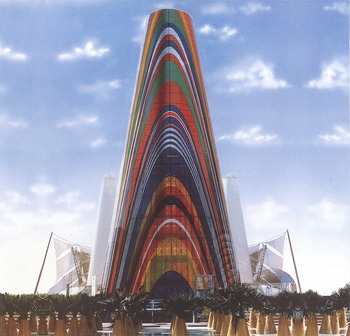
The tall European tower functioned as a rhetorical gesture within the spatial politics of the Expo. As its designer, the German architect Karsten K. Krebs, explained, the structure deliberately invited multiple interpretations: ‘Minaret or cathedral, or both at the same time, Maghreb traffic light or Andalusian festival architecture, light dome or industrial chimney’.Footnote 49 By embedding these diverse symbolic references in his design, Krebs created a form open to varied readings. Still, its obelisk-like silhouette, drawing the visitors’ gaze upward, clearly intended to inspire a sense of aspiration and progress. At 50 metres tall, the tower rose above all other pavilions, asserting the European Community’s prominence on the Expo grounds.Footnote 50 Yet its impact derived from not only its size but also its radiant visual presence. The vibrant colours of its thermoplastic polymer shell contrasted sharply against the blue Andalusian sky, ensuring high visibility and conveying a festive, celebratory tone. On its flattened frontage, the tower displayed the twelve flags of the Member States, stacked vertically. Around its curved edges, these national symbols unfolded into a rhythmic cascade of multicoloured lines (Figure 2).
The Façade Arrière of the European Community pavilion. Collection of Karsten K. Krebs.

The architectural project was selected through an official tender, which attracted 224 companies, of which sixty-two submitted final proposals.Footnote 51 The shortlisted designs were exhibited at the Fondation pour l’architecture in Brussels.Footnote 52 The jury, composed of architects and Community representatives, ultimately chose Krebs’s design.Footnote 53 Jean Dondelinger explained that the jury selected the tower for its embrace of traditional monumental architecture.Footnote 54 The design’s abstract geometrical clarity, symmetry and grandeur endowed the pavilion with a classic sense of formality and monumentality. At the same time, its light and playful design, appropriate to the Festarchitektur of a Universal Exposition, aligned with the architectural trend of new monumentalism, which had grown in popularity since the 1970s.Footnote 55 According to its ideator, the architecture critic Sigfried Giedion, new monuments had to inspire ‘pride, joy, and excitement’ and community life.Footnote 56 For Krebs, this collective meaning was central: he envisioned the pavilion as a ‘symbol of the transformation of national egoism to a pluralistic Europe’.Footnote 57 Its true essence, he argued, could only be fully appreciated by moving around the three-dimensional monument.Footnote 58 By doing so, visitors could witness the visual dissolution of the national flags and see ‘the symbolic fusion into something new’, a united Europe.Footnote 59
In his design, Krebs deliberately omitted the European flag, which had been proposed only a few years earlier by the Adonnino Committee with the explicit goal of increasing ‘the credibility of the Community’ and ‘to strengthen and promote its identity and its image’.Footnote 60 Since its official adoption in 1985, the flag had quickly become the most prominent widely recognised symbol of the European Community. For the Community officials, its presence on the pavilion was non-negotiable.Footnote 61 In a letter to Krebs, Thierry Daman, a member of Dondelinger’s cabinet and a part of the Commissariat General, argued that its omission would be ‘unsellable’.Footnote 62 Daman insisted that the European flag should not be seen as competing with the national flags but rather as complementary. From the perspective of Krebs’s architectural metaphor, however, the European flag did not belong: it would represent one of the very elements that were to be visually dissolved into a new supranational form. After prolonged negotiations, Krebs eventually agreed to integrate the European symbol into the sequence of flags.Footnote 63 It was strategically placed at the base of the tower, which visually suggested that the supranational project was the foundation on which the Member States rested, while also ensuring that it served as the backdrop for official photographs and ceremonies.
With its monumental tower and the European flag, the European Community’s pavilion visually claimed a place within the familiar grammar of the modern nation-state. It presented the EC as both like a state – possessing its own pavilion, symbols and architectural grandeur – and more than a state, embodying a supranational project that sought to transcend national boundaries. While the pavilion’s exterior asserted this political presence through monumental form, the exhibition inside was designed to deepen and extend this symbolic work. Through affective and narrative strategies in the development of the exhibition space, the Community sought to emotionally engage its citizens and craft a powerful historical mythology of European integration.
An Exhibition to Spark the Emotions of European Citizens
The adoption of the European flag was just one of a series of measures that had been taken to boost public visibility for the Community project. By the 1970s, as the clear economic benefits of integration began to wane, support for the European institutions could no longer be taken for granted, marking an end to the era of ‘permissive consensus’.Footnote 64 At the same time, Europeans’ support for the institutions was increasingly considered to be essential to the functioning of the Community as a political project. In response, DG X, which had previously focused its outreach on elites as information multipliers, shifted strategy, expanding its efforts to engage the general public more directly.Footnote 65
During the 1980s, the ambitious agenda of the Single European Act drove a more interventionist approach to public communication.Footnote 66 The Community ventured further into the cultural realm with initiatives such as the European City (later Capital) of Culture programme, which aimed to encourage citizens to shift their loyalties from the national to the European level.Footnote 67 Franz Froschmaier, head of DG X from 1981, expressed disappointment that the results of the information policy to date had not been able to ‘ensure a massively pro-Community trend’. In response, he argued that ‘the focus should not be on the rational argument’ but that the Commission ‘should appeal more to the emotions and use psychology’.Footnote 68 This affective turn marked a decisive shift in strategy, privileging symbolic and emotional engagement over purely informational outreach. It directly shaped the Seville pavilion’s exhibition, designed to create a powerful emotional experience, in order to foster identification with the European project.Footnote 69
To conceptualise the storyline and set the tone of the exhibition inside the European pavilion, the Commission enlisted four external consultants, men with expertise in history, national representation and exhibition design.Footnote 70 These experts produced the ‘Cahier des charges spécifiques pour l’aménagement’, a closed tender document outlining the objectives and parameters of the exhibition.Footnote 71 The brief prioritised emotion over didacticism, stating that the exhibition should leave visitors with a lasting impression rather than detailed factual knowledge.Footnote 72 Guy Simon also believed that Universal Expositions should prioritise ‘surprise, play, and spectacle’ over didactic presentations.Footnote 73 The London-based design firm Imagination, which had one of its employees serving on the expert panel, ultimately won the tender.Footnote 74
Imagination’s proposal focused on European citizens as ‘the pride and purpose’ of Europe, placing the visitor at the centre of the narrative.Footnote 75 As early as 1975, the Tindemans report had warned that ‘no one wants a technocratic Europe’ and that the Community ‘must be close to its citizens’.Footnote 76 By framing European citizens as both the protagonists and beneficiaries of integration, Imagination’s design translated this ideal into an immersive, affective experience. This exhibition concept aligned closely with late twentieth-century exhibition and museology trends. Since the 1970s, the rise of ‘new museology’ had been transforming the practice of exhibition-making.Footnote 77 Caused by a radical re-examination of museums’ role in society, focus had shifted from the objects on display to the experience of the visitor.Footnote 78 Exhibition concepts increasingly foregrounded creating experiential and immersive environments, an approach fully embraced in the European pavilion.
The pavilion’s hollow tower, conceived as a sculpture on a pedestal, concealed the exhibition spaces in its basement. Visitors descended twelve symbolic steps into darkness, a deliberate design choice to isolate them from the surrounding Expo environment, where they were ‘bombarded with high-tech images and media’.Footnote 79 The European pavilion, by contrast, sought to engage visitors on a deeper, more emotional level.Footnote 80 This transition from spectacle to intimacy set the stage for the exhibition’s core message, which was structured around twenty-seven anchor points. These so-called icons, perhaps best described as tableaux vivants, took the form of partly mechanised sculptural installations crafted by Imagination. Seemingly made of plaster, as can be seen in the final image of Figure 5, they bordered on the kitschy or carnivalesque. They were designed to evoke instant recognition without the need for explanatory texts.Footnote 81 The displays featured theatrical mock-ups of historical and contemporary references. Unlike earlier Community Expo pavilions, the exhibits did not include authentic objects such as pieces of machinery, treaties or original artworks.Footnote 82 This potential loss of aura was mitigated by the exhibition’s scenography: Imagination relied on theatre techniques and dramatic lighting to create a memorable experience.Footnote 83
The visitor’s movement through the pavilion was integral to the storytelling. The spatial arrangement of the exhibition followed a carefully constructed narrative, emphasising sequences and a clear sense of progression.Footnote 84 This unfolding storyline was reinforced by an audio soundtrack composed by Imagination. The music began with early instruments such as flute and harpsichord, then shifted through ‘a martial theme, a strong romantic symphony, a rock ballad and a space-age electronic piece’.Footnote 85 The changing soundtrack accompanied visitors as they moved through the exhibition, heightening the drama and emotion of the experience while underscoring the temporal journey from Europe’s past to its envisioned future.
The Renaissance and the Discovery of the World as Exponents of European Civilisation
The exhibition’s historical narrative was anchored in a civilisational mythology. The Renaissance was framed as the foundational moment of European identity, and the theme of ‘discovery’ functioned to elevate Europe as the epistemological and moral centre of the world. The Community pavilion’s historical narration began with what was called the ‘Europe of the great discoveries’ (1450–1550). Nine icons (Figure 3) highlighted breakthroughs in planetary knowledge, science, trade, philosophy, religion and art.Footnote 86 Dramatic lighting and shadow effects created an air of mystery and awe, while warm, earthy tones evoked a historical sensibility, and golden hues suggested opulence and grandeur. The iconography of the sculptures, suspended and layered three-dimensional collages, centred on the Italian Renaissance with references to Filippo Brunelleschi’s dome in Florence, Raphael’s School of Athens and Leonardo da Vinci’s Vitruvian Man. Portraits of ‘Great Europeans’, a recurring feature in Community Expo pavilions since the 1950s, highlighted the achievements of exceptional men.Footnote 87 Yet the spare labels avoided attributing discoveries to specific individuals. Instead, labels such as ‘Europe discovers humanism’ and ‘Europe draws the first paths of space’ positioned Europe itself as the historical agent. By framing these achievements as collective European milestones, the exhibition aimed to inspire pride in Europe’s historical legacy and global influence.
The icons of discoveries. Exhibition views in VIP Catalogue of the Community Pavilion. Author’s collection, kindly provided by Jean-Pierre Malivoir.

In the decades leading up to the Seville Expo, memory politics had taken on a strategic stake in the Community’s information activities. From the 1970s onward, the Community adopted the concept of a shared European cultural heritage from the Council of Europe.Footnote 88 This approach was later formalised in the Maastricht Treaty, which mandated that the Member States should bring ‘the common cultural heritage to the fore’, thereby embedding the concept of a shared European heritage into the Community’s legal framework.Footnote 89 Notably, at the very moment scholars were unpacking the role of the ‘invention of tradition’ and the construction of ‘imagined communities’ as tools for establishing the modern nation-state, the Community itself started deploying similar strategies to discursively produce a collective European history.Footnote 90 In doing so, the critical vocabulary developed to analyse nationalism was effectively repurposed as an instrument for supranational identity-building, transforming critique into a resource for European integration.
One of the Commission’s key initiatives in memory politics was its support for French historian Jean-Baptiste Duroselle’s project to write a comprehensive book on the history of Europe.Footnote 91 Duroselle described Europe as ‘a historical reality dating back to prehistoric times’, a ‘genuine civilisation’, and argued that:
the new Europe brought into being by the endeavours of the Community Member States is slowly but surely reconstructing the European identity of ancient times and the European genius generated by the synergy between diverse cultures belonging to one and the same civilization. Europe predates the Nation States. As we approach the turn of the century Europe is returning to its roots.Footnote 92
The book aligned closely with the Community’s interest in cultivating an essentialist view of European civilisation with a shared, glorious past. As one of the four experts and the only historian on the exhibition brief committee, Duroselle likely played a pivotal role in shaping the exhibition’s historical narrative, embedding this civilisational discourse into the very foundations of the Seville exhibition.Footnote 93
The fifteenth century, which in the exhibition was presented as the cradle of European civilisation, not only marked the birth of the Renaissance, it was also the century that witnessed the rise of European imperialism. During this period, maritime powers such as Portugal and Spain launched transoceanic voyages of exploration and conquest, establishing the first global trade routes and overseas empires. In fact, Europe’s surge in scientific and cultural innovation was deeply intertwined with the knowledge and wealth extracted through this expansion, as resources, ideas and technologies flowed back from the colonised territories. The pavilion’s representation of the fifteenth century as a period of European awakening deliberately obscured the violent foundations of Europe’s global ascendancy.
At Expo 92, the public memory of Europe’s imperial past presented a sensitive and politically charged challenge. The Universal Exposition was deeply entwined with Spain’s national programme commemorating the quincentenary of Christopher Columbus’s 1492 arrival in the Americas. The proposal for an Exposition to celebrate the 500th anniversary of Columbus’s voyage was initially announced by the Spanish King during the first Spanish royal visit to Latin America in five centuries, shortly after the monarchy resumed its duties following Francisco Franco’s death.Footnote 94 The project echoed the imperial exhibitions of the past, and the long tradition of Expositions that celebrated colonial rule. In the years leading up to the event, however, the Spanish narrative of 1492 underwent significant revisions. The Expo’s theme was renamed from ‘Birth of a New World’ to ‘Age of Discoveries’.Footnote 95 This shift reflected a reorientation of the political agenda, influenced by postcolonial activists who challenged the legitimacy of celebrating the so-called discovery of the Americas.Footnote 96 Moreover, when the PSOE assumed power in 1982, the party sought to distance the project from the Francoist historical perspective shaped under the previous conservative government.Footnote 97 An official Expo publication even questioned the very premise of discovery, critiquing ‘the unilateral Europe-centred interpretation which attributes an active protagonism to the “discoverers” and gives the impression of relegating a passive role to inhabitants of the “discovered” territories’.Footnote 98 As a result, the event rebranded Columbus’s arrival as an encounter between two old worlds rather than the discovery of a new one. Despite this recalibration, the Expo continued to face criticism for its overly benign portrayal of Spanish imperialism.Footnote 99 Nonetheless, the Spanish government was intent on avoiding a narrative that would overtly glorify the Spanish empire, carefully balancing commemoration with a more modern image of Spain.
The paradigm shift in Spain’s national narrative was not reflected in the European Community’s stance. In 1988, the European Parliament debated its role in Spain’s commemorative programme. Arturo Escuder Croft, the rapporteur from the European People’s Party, asserted that the discovery of the Americas ‘had opened up a new continent for world civilisation’.Footnote 100 When other Members of the European Parliament questioned the legitimacy of celebrating the aftermath of 1492 due to the violence and dispossession caused by colonisation, Croft dismissed these concerns, insisting the resolution was ‘not the right place to talk about conquests, deaths or what you might call the dark side of history’.Footnote 101 Despite these objections, the Parliament ultimately voted to pass the resolution to support Spain’s quincentenary celebration.Footnote 102
While Spain’s Expo narrative cautiously reframed the legacy of 1492, the European Community pavilion presented a triumphalist vision of exploration and conquest. The exhibition icons dedicated to what Jean Dondelinger described as ‘the conquest and penetration’ of the Americas were titled ‘Europe discovers that the Earth is round’ and ‘Discovery of new continents and sea routes – Europe encounters other civilizations’.Footnote 103 Their imagery, featuring maps and golden celestial globes, conveyed mastery and domination over the world. A cornucopia overflowing with cacao, grapes, corn, golden fish and a chameleon echoed colonial fairs, which showcased the bounty of the overseas territories.Footnote 104 The absence of non-European artefacts effectively erased indigenous cultures from the narrative. In his prologue to the exhibition’s catalogue, Jean Dondelinger wrote that the ‘resources extracted from the territories conquered and scientific progress that ensued throughout Europe had the immediate effect of making Europe the power centre of the planet’.Footnote 105 This assertion, however, was not framed as a critique. Overall, the visual communication and discursive framing of the Community’s Expo participation – portraying the fifteenth century as the period in which Europe became the ‘most important center of civilization in the world’ – not only reflected a Eurocentric worldview but also actively reinforced it.Footnote 106
The pavilion’s framing of imperial history was perhaps most evident in its treatment of Christopher Columbus. At Expo 92, Columbus was ‘most notable by his absence’.Footnote 107 There was not a single statue of the historical figure anywhere on the fairgrounds. Yet within the Community pavilion, he took centre stage. As visitors entered, they were immediately confronted by a striking sculptural depiction of the explorer (Figure 4). Pavilion director Jean-Pierre Malivoir described the portrait as a ‘flamboyant’ tribute.Footnote 108 The white sculpture, its gaze fixed firmly on the horizon, stood before a richly adorned golden frame, from which a stylised white ship extended into the exhibition space. This dramatic composition sought to ‘pay homage to the great navigator’.Footnote 109 Columbus was cast as the ‘ideal symbol for Europe’s first age of discovery’, emblematic of ‘courage and vision’, with exploration framed as a noble and heroic pursuit rather than as a moment of conquest and domination.Footnote 110
A flamboyant Columbus. Exhibition view in VIP Catalogue of the Community Pavilion.

The contentious subject of Columbus’s legacy could have been delegated entirely to the Member States.Footnote 111 The Spanish Commissioner General had cautioned national participants that it was ‘not easy, and often impossible, to establish the paternity of a discovery or to attribute it exclusively to a particular nation’, warning that engaging in ‘futile rivalries’ would be a mistake.Footnote 112 Nonetheless, European states eagerly competed to assert their roles in the history of exploration.Footnote 113 Still, rather than deferring to these national narratives, Escuder Croft emphasised that Columbus’s ships were ‘manned by citizens of what are now Community countries, financed by the Kings of what is now a Community country and departing from ports which are now in the Community’.Footnote 114 This story was deliberately appropriated by the Community, reflecting an effort to ‘communitarise’ the memory of discovery and conquest, recasting them not as the achievements of individual nations but as foundational elements of a shared European civilisation.
The EU’s memory programmes have faced growing criticism for their long-standing silence on colonial history, despite its deep entanglement with the history of European integration.Footnote 115 Scholars argue that this institutional amnesia has reinforced the power asymmetries rooted in European colonialism.Footnote 116 Since the 2000s, the crimes committed under colonialism and imperialism have gradually begun to appear in official memory actions initiatives.Footnote 117 The European Community pavilion’s approach to colonial history, however, cannot be characterised as one of amnesia and neglect, as the subject was addressed directly. Nor, however, can it be viewed as an early iteration of the new institutional reckoning with the painful legacy of Europe’s colonial past. Instead, the history of European imperialism was deliberately framed in a positive light. Europe’s imperial expansion was presented as not a source of violence and exploitation but rather a civilisational achievement, central to the narrative of European progress.
Total War and a New Renaissance of Europe
Having celebrated Europe’s outward expansion as a civilising mission, the exhibition then turned inward, confronting the darker consequences of nationalism and war within the continent itself. The exhibition itinerary continued along a ramp, condensing four centuries of European history (1550–1950) into just a few metres. This section juxtaposed Europe’s cultural, scientific and industrial advancements with violent outbursts of nationalism, highlighting the tension between the expansion of European power and the escalation of internal conflicts. Ten icons were created to convey this narrative, though the catalogue documents only the negative forces (Figure 5).Footnote 118 Gloomy black-and-white images of cannons and executions illustrate the destructive exploits of nationalism.Footnote 119
The dangers of nationalism. Exhibition views in VIP Catalogue of the Community Pavilion. Photograph on the bottom right taken by author in 2021 during interview with Jean-Pierre Malivoir.

This part of the exhibition culminated in a dramatic visualisation of the Second World War, a conflict central to the European Community’s foundational myth. In its aftermath, the Schuman Declaration had proposed creating a supranational authority for coal and steel to make war between France and Germany ‘not merely unthinkable, but materially impossible’.Footnote 120 However, during the first decades, official Community communications often deliberately avoided direct references to the war, preferring more symbolic or abstract representations. For instance, at the Expo in Montreal, the Commission chose to sideline the architect’s proposal to display ruins of war, instead opting for a more abstract representation.Footnote 121 By contrast, in 1992, ‘the atrocities of the Third Reich’ were not only explicitly acknowledged in a Commission press release on ‘l’année de l’Europe’ but were also given direct visual representation within the pavilion itself.Footnote 122 The pavilion presented a striking visualisation (Figure 6) of the ‘aftermath of the bloodthirsty war’, a moment in which ‘our economies were ruined, the dignity of man and the values of civilisation destroyed’.Footnote 123 The designers staged a scene of destruction: of burnt wood and shattered glass, possibly referencing the November pogrom. Behind this installation, a grid of historical photographs depicted a destroyed cityscape, a military cemetery and scenes of civilian suffering. Among these images were photographs of women and children herded into a street and a boy standing behind barbed wire, evoking the horrors of the Holocaust and the human cost of total war.Footnote 124
From the rubble of war, the Community arises. Exhibition view in VIP Catalogue of the Community Pavilion.

While the exhibition avoided addressing the dark aspects of imperialism, it gave prominence to the commemoration of internal European suffering. This inclusion of ‘negative heritage’, the representation of traumatic events, in the narration of a European past marked a novel institutional approach.Footnote 125 It was not until 1993 that the European Parliament began passing resolutions explicitly addressing the memory of the Second World War and the Holocaust.Footnote 126 The pavilion’s visual representation of the war therefore anticipated the inclusion of a difficult past in the European memory landscape, foreshadowing a trend that would only gain momentum in the following decades.Footnote 127 The Seville exhibition thus stood at the forefront of this emerging memory paradigm, introducing the idea of a shared European trauma to the public and linking it to the project of integration.
From this representation of destruction and trauma, the exhibition narrative shifted decisively towards renewal, framing European integration as the necessary response to the continent’s darkest chapter. The last two photographs in the gallery in Figure 6 – depicting the 1957 Treaty of Rome signatures and the signing ceremony on Capitoline Hill – clarify why the Second World War was featured: the rise of the European Community was presented as Europe’s solution, its saviour. A blue ribbon with twelve yellow stars ascends from the rubble, just as Europe rises as a phoenix from its ashes.
Jean Monnet had equated national sovereignty in Europe with a thousand years of ‘aggressive nationalism, futile but bloodstained conflict to dominate one another’ and argued that only the Community had managed to cause a ‘breach in the citadel of national sovereignty which bars the way to European unity’.Footnote 128 This narrative, framing the Community as transcending nationalism to save Europe through an enlightened political project, had become the orthodox institutional story.Footnote 129 The Delors Commission reinforced this normative story, portraying European integration as a triumph of progress over national egoism.Footnote 130
It was in the final section of the exhibition that the Community took central stage. Here, the icons reintroduced vivid colour to the narrative, presenting European policies in playful, almost cartoon-like style (Figure 7).Footnote 131 The icon for the common currency, for instance, depicted the ECU as the cement binding together the national building blocks of a unified European wall. In contrast to Expo 58 in Brussels, where portraits of Robert Schuman and Jean Monnet were centrally positioned, the Seville exhibition made no reference to the ‘founding fathers’. Instead, the focus shifted to illustrating how Community governance was the ‘natural foundation of European life’, emphasising the tangible ways in which new policies would benefit European citizens in their everyday lives.Footnote 132
Life in the European Community. Exhibition views in VIP Catalogue of the Community Pavilion.

At the conclusion of the itinerary, ‘Citizens’, a spectacular video installation produced by Imagination, was screened across ninety-eight synchronised monitors. The rapidly alternating images created a kaleidoscopic display dominated by primary colours.Footnote 133 Footage of moving trains and airplanes, metaphors for the Community project connecting Europe, was interwoven with scenes of ordinary Europeans to celebrate the ‘young and old, men and women, beautiful and less beautiful, who form the Community of today and especially of tomorrow’.Footnote 134 The installation was designed to give visitors the impression that they were ‘participating in an exceptional movement’, fostering pride in their contribution to ‘the spirit of History’.Footnote 135 At the climatic finale, the cinema’s ceiling opened to reveal the towering exterior structure, as sunlight filtered dramatically through its colourful stripes.Footnote 136 Beethoven’s Ode to Joy, the Community’s anthem since 1985, played alongside a recording of cheering crowds. Responding to this carefully orchestrated crescendo, audiences often broke into spontaneous applause, a reaction that Community officials interpreted as evidence of the exhibition’s success in generating powerful emotions and reinforcing positive perceptions of the Community.Footnote 137
European Superstate and the Issue of National Diversity
The documentation hall, the pavilion’s only brightly lit space, was the final stop before the exit. Here, visitors could consult newly created databases through interactive videodiscs, which provided bibliographies for further reading on the European institutions.Footnote 138 Publications were available for purchase in the boutique, alongside branded umbrellas and other souvenirs designed to ‘materialise the existence of one Europe’.Footnote 139 The Community sought to create a modern and marketable image of European integration, extending its symbolic project into the realm of consumer culture. This strategy anticipated what would, only a few years later, be theorised as ‘nation branding’ – the deliberate use of marketing techniques to shape collective identity and promote political legitimacy.Footnote 140
One notable feature of this hall was a cash machine where visitors could use their credit cards to withdraw free specimen ECU notes printed by the European Savings Bank (Figure 8). Although purely symbolic, these notes served as a tangible preview of the future European currency, which according to European officials would ‘undoubtedly cause a shock’ to the public.Footnote 141 Offering the ECU notes at the Expo allowed visitors to experience this abstract monetary policy first-hand; they were not given ‘texts for reading’ but, rather, ‘props for exercising’.Footnote 142 By withdrawing 10 ECU from an ATM, visitors engaged in an ‘anticipatory futuring of the self’ and rehearsed their roles as European consumers in a unified economic space. This small but carefully staged interaction exemplified how the pavilion blurred the boundaries between spectacle and practice, transforming passive spectators into active participants in the construction of a supranational Europe.
The ECU bank note. European Savings Bank.

With a pavilion, flag, currency and even the celebration of a ‘national day’, the European Community’s self-fashioning at the Expo employed symbols traditionally associated with nationhood. While the official Expo 92 guidebook categorised the Community as an international organisation, it presented itself as a ‘super-nation rather than a supranation’.Footnote 143 Just like a nation-state – and unlike the United Nations, which omitted such details – the Community highlighted its population and territorial size.Footnote 144
With 100 countries participating in Expo 92, national representation remained the dominant paradigm. This was also reflected in the scale of participants’ budgets. While the Community’s 828 million pesetas for constructing its pavilion was significant – especially compared to the International Olympic Committee’s 98 million – it was dwarfed by the contributions of some of its Member States, including France (2,300 million), Great Britain (2,040 million) and Spain (1,842 million).Footnote 145 These figures underscore how nation-states prioritised the promotion of their national identities over collective European representation.Footnote 146 Even though the Commissioners General of the Member States’ pavilions met regularly to cooperate, tensions persisted. The French pavilion’s exhibitions coordinator even described the European pavilion as ugly and hollow in the press.Footnote 147 Malivoir recalled that the Member States were ‘very individualistic’, adding that accepting ‘the very fact of saying you are no longer Italy, you are no longer only national pavilions, but you are part of a whole’ remained challenging.Footnote 148 The most contentious issue was the design of the Avenida de Europa. In the Council’s Working Party, some national representatives objected to the proposed towers, as they would ‘break the perspective and block the view’ of their pavilions.Footnote 149 While this resulted in a reduction in the tower’s height, the Greek, Portuguese and Italian delegations formally recorded their dissatisfaction.Footnote 150
These disputes over visibility and representation underscored the ongoing challenge of balancing national interests with the collective ambitions of the European project. In the years leading up to the Expo, national diversity had gained prominence in the Community’s identity discourse. Jean Dondelinger emphasised that the Commission sought to nurture Europe’s diversity of cultures, stating there was not one European culture, but many.Footnote 151 His statement highlights the sensitive issue of complementarity between national and European identity. By the end of the millennium, the phrase ‘United in Diversity’ would replace the ‘Ever Closer Union’ slogan, deemed too teleological.Footnote 152 The European pavilion, with its icon dedicated to the subject of ‘Unity in Diversity’, presented an early iteration of this emerging paradigm.
National participants were explicitly instructed by the Spanish Commissariat General to avoid traditional displays of nationalist self-glorification. As the guidelines stated:
An excessively nationalistic attitude, ethnocentric in its aspirations, would be in flagrant contradiction, moreover, with the philosophy of Expo 92, and the celebration of its theme, which celebrates, precisely, the universality of man’s capacity for discovery – man understood as a species above and beyond his nationalistic and ideological prides and prejudices.Footnote 153
Most national pavilions refrained from overtly national references.Footnote 154 Unlike earlier Universal Expositions, nations presented themselves as no longer culturally pure but rather heterogeneous and fluid, reflecting the late twentieth-century turn towards multiculturalism. Yet this postmodern critique of homogeneity had clear limits: Western nations ultimately ‘orchestrated a simulacrum of unity in diversity’.Footnote 155 In this configuration of multiculturalism, only superficial differences were celebrated while deeper structural inequalities and power hierarchies remained unaddressed.Footnote 156 Spain’s own representation of diversity at the Expo is particularly telling. The country’s seventeen autonomous regions established in the post-dictatorship Constitution were given the chance to showcase their regional identities in separate pavilions. At the same time, one of the Expo’s central goals was to foster greater cohesion within the Spanish nation. Seeking to depoliticise regional diversity, Spain framed the distinct customs and cultures of its regions as elements that could only be fully recognised as part of the national whole.Footnote 157
A striking parallel can be drawn to the vision of diversity promoted by the European Community. Guy Simon, for instance, stressed that the exhibition should present the Community as a mosaic of cultures.Footnote 158 A mosaic, of course, only reveals its image when viewed as a whole, implying that the individual pieces derive their meaning only through their integration into a larger design. The Commission thus developed a diversity paradigm in which national cultures were not seen as a threat to the project of unity but rather conceptualised as subordinate to an overarching European civilisation.Footnote 159 Similar to Spain’s approach, there were clear limits to how much diversity the Community was willing to celebrate at the Expo.
The limits of the Community’s concept of diversity were particularly evident when considering questions of gender and religion. The pavilion itself, with its overtly phallic architectural design, and the exhibition inside were almost exclusively shaped by men. This gender imbalance was reflected in the storyline as well: women were largely absent. They were not featured among the ‘Great Europeans’ of the past and the few female figures depicted in the more contemporary sections were mostly portrayed as passive victims of national aggression rather than as active historical agents in their own right. Another striking absence concerned the representation of Europe’s religious landscape. While the exhibition did not foreground religious themes, they were central to the teleological account of European history presented in an essay historian Gilbert Trausch wrote for the catalogue.Footnote 160 According to Trausch, the continent ‘owes its sense of history to Christianity’, ‘a single faith that binds all Europeans together.’Footnote 161 Although he briefly acknowledged religious diversity, this was solely framed within a Christian context by limiting his focus to the Reformation. By asserting that Europe ‘at its heart is Christianity’, Trausch erased the multitude of religions practised on the continent, a particularly glaring omission given southern Spain’s complex legacy of Jewish, Muslim and Christian coexistence and conflict. These silences reveal that the vision of diversity promoted by the Community at Expo 92 was highly selective and deeply circumscribed. Diversity was celebrated only insofar as it reinforced a narrative of European unity that privileged dominant cultural, gendered and religious norms while marginalising alternative histories and identities.
The European Union as an Aspirational Example for the Rest of the World
Beyond presenting internal European narratives, the pavilion also projected an outward-facing vision of Europe’s role in the world, positioning the Community as a model for global governance, using the rhetoric of peace, democracy and universalism to assert moral leadership.Footnote 162 For the Commission, Expo 92 presented an opportunity to showcase how the Maastricht Treaty’s Common Foreign and Security Policy could serve to increase the EU’s influence in global affairs in the post–Cold War context.Footnote 163 The architecture of the Community pavilion, described as the ‘pillar of the new European architecture,’ translated abstract policy ambitions into a dramatic physical form.Footnote 164 Its obelisk-like structure recalled architectural elements historically associated with imperial power. Crowning the structure, the European flag seemingly signified the pinnacle of civilisation, suggesting the Community’s place at the apex of both a European and a global hierarchy. This imagery recalls interpretations of the EU as ‘the newest manifestation of European civilization’s drive for mastery of the rest of the world’.Footnote 165 Yet the Commission was careful to frame this monumental symbolism in less aggressive terms, stating the Community should appear less ‘like a fortress but more like a lighthouse’.Footnote 166 The building’s design embodied this duality and embraced the lighthouse aesthetic, as light radiated through the tower’s semi-transparent skin (Figure 9), casting a luminous glow that symbolised guidance and enlightenment.
The Community as a beacon of light. Photograph of model in the collection of Karsten K. Krebs.

The metaphor of the Community as a shining beacon was addressed primarily to visitors from outside its borders, with a particular focus on Eastern Europeans. The Community was meant ‘to appear as a pole of attraction to be reckoned with, or as a source of inspiration for future development’.Footnote 167 In the years leading up to Expo 92, the geopolitical order that had for decades been defined by a capitalist West and a communist East rapidly unravelled. The fall of the Berlin Wall in 1989 and the dissolution of the Soviet Union two years later had immediate repercussions on what was presented at the fairgrounds.Footnote 168 At Expo 92, the Community aimed to communicate to visitors from Eastern Europe that the European integration was ‘their only salvation, the only alternative worth considering’.Footnote 169 This statement by Gilbert Trausch underlined the very ‘irrefutability and choicelessness’ that often characterised narrations of European integration.Footnote 170 At the same time, it incorporated Eastern European publics into the Community’s teleological story, positioning them as participants in Europe’s inevitable march toward unity.
The spatial layout of the Expo master plan clearly signalled who was included in the Community project and who still remained on its periphery. Despite being named the Avenida de Europa, rather than the Avenida de la Comunidad Europea, only pavilions of Community Member States occupied the plot. Official candidate countries, such as Turkey, Sweden and Austria, were placed in the second row, while Eastern European nations like Czechoslovakia and Yugoslavia were positioned even further back.Footnote 171 According to Malivoir, this arrangement did not stop the staff of the Eastern European pavilions from regularly visiting the Community pavilion. He recalls that the Romanians came almost daily, often bringing their official visitors. For him, this indicated ‘a desire to appear European above all’.Footnote 172 Seemingly, Eastern European states demonstrated their interest in ‘returning to Europe’.Footnote 173
There was a strong element of conditionality tied to the accession of nations from Eastern Europe.Footnote 174 The Copenhagen criteria, which would be published in 1993, listed the political, economic and legislative requirements to meet in order to join the EU. Only by undergoing a process of transition could potential Member States become part of what has been described as the ‘empire by example’.Footnote 175 This discourse of conditionality was also promoted by the host country. On Hungary’s national day at the Expo, Spanish Commissioner General Emilio Casinello warned that, like Spain, Hungary would have to change its image and gather strength ‘in order to develop and enter into the European project’.Footnote 176 In other words, a process of development was essential before being deemed worthy of joining the Community. Dondelinger advised Eastern European nations to avoid ‘seek[ing] affirmation of their identity by reverting to the self-centred nationalism of the past century’.Footnote 177 Instead, they were urged to look towards the Community, which promised to put its ‘common heritage of democratic values at the service of all the world’.Footnote 178 This rhetoric reinforced a hierarchical relationship: while Eastern European states were invited to ‘return to Europe’, they were expected to do so on terms set by the Community.
Democratic values were presented as a fundamental part of the European Community’s shared heritage and thus framed as inherently European. At the same time, they were conceived as transferable to third parties.Footnote 179 Just as the Community had become a synecdoche of the broader efforts of European cooperation, ‘a specific project, but one directed to a much larger reality’, its values were positioned as simultaneously particular to Europe and applicable beyond its borders. This duality underpinned a broader narrative that cast the Community as both unique and exemplary, capable of offering a governance model that transcended its own regional context.Footnote 180 This paradox has been described as ‘EUniversalism’, a form of unilateral universalism where the Community’s norms and values are positioned as both distinctly European and universally applicable. Such discourse echoes earlier forms of European universalist claims associated with imperial projects, where Europe positioned itself as the standard-bearer of civilisation.Footnote 181 In this narrative, the ‘colonial democracy and human rights denier of yesteryear’ was refashioning itself a promotor of democratic values in the world, projecting an image of enlightened leadership while obscuring the historical asymmetries that underpinned its rise.Footnote 182
This framing of universal values was closely tied to the Community’s self-image as a civilian power. This concept, coined in the 1970s, emphasised normative influence over military strength in shaping the Community’s international role.Footnote 183 The Maastricht Treaty’s CFSP actually introduced provisions for the development of a common defence policy, signalling a increase in military cooperation. However, this shift was not paired with a departure from the civilian power discourse that had long been a cornerstone of the Community’s foreign policy narrative. By emphasising the externalisation of benign European values – such as the promotion of democracy and the rule of law – the Community maintained continuity in its narrative of European moral superiority.Footnote 184 Once again, the Community presented as a normative leader, projecting an image of enlightened guidance while downplaying the geopolitical ambitions underlying its expanding global role.
A Fading Vision?
The European Community’s participation in Expo 92 was one of its most ambitious and symbolic public outreach efforts at a defining historical moment. Aimed at shaping perceptions of European integration, the pavilion in Seville sought to craft a persuasive narrative of the legitimacy of European institutions and their ambitions. Through a combination of grand architectural symbolism, immersive storytelling and a selective historical framing, the Community sought to strengthen the symbolic foundations of the integration project.
The pavilion presented Europe’s past as a cohesive, linear story: a grand civilisational arc beginning with the Renaissance, interrupted by the rise of nationalism and the devastation of war and ultimately restored through the process of European integration. By favouring a united and essentialist vision of European civilisation, it sidestepped the more contested and controversial realities of European history. A key element of this historical framing was the pavilion’s treatment of Europe’s imperial past. The exhibition celebrated the Renaissance century as the genesis of Europe’s global influence, adopting a triumphalist perspective that celebrated the expansion of European power. Nationalism, by contrast, was presented as violent and destructive, reinforcing the idea that European integration was the necessary antidote to war. From the rubble of the Second World War, the European Community was cast as the saviour of the continent, now poised to usher in a new Renaissance of Europe in the post–Cold War era.
Some inherent paradoxes lay at the core of the European Community’s public legitimacy puzzle. These included the necessity to ‘make Europe European’ despite an essentialist understanding of Europe, the simultaneous claim that Europe was both united and diverse, and the assertion that certain values were distinctively European while also universally valid. In the teleological narrative of the Expo 92 exhibition, many of these tensions were resolved through a story of historical progress culminating in European integration. One paradox, however, remained unresolved. The European Community presented itself as a sui generis organisation whose fundamentally different form of governance had transcended the pitfalls of nationalism. An official brochure depicted the Community as neither inward-looking nor “Eurocentric,” not a fortress, and as a project to which the very notion of hegemony was foreign.Footnote 185 Yet, for all its emphasis on transcending nationalism, the Community’s participation in Seville relied heavily on the symbolic repertoire of the modern nation-state to consolidate its public legitimacy. Its historical narrative was inherently hegemonic, shaped by essentialist, civilisationalist and patriarchal assumptions. The very strategies that had once been used to forge national identities in the nineteenth century – such as historical mythmaking, symbolic architecture and cultural memory – were now repurposed to promote a European identity.
The Seville pavilion is a striking testament to the emerging identity paradigm of the Commission of the late twentieth century. The European civil servants, architects and designers experimented with new modes of storytelling. For instance, the pavilion tested a narrative that positioned the memory of the Second World War as the founding myth of European integration and introduced themes that would later crystallise in the ‘United in Diversity’ slogan. A reworked version of the Community as a civilian power, later reframed as the EU’s role as a soft power, was also embedded in the pavilion’s design. This was most clearly expressed through its metaphorical positioning as a lighthouse and through the discursive emphasis on the European project as a vehicle for peace and democracy, particularly for the countries of Eastern Europe emerging from the Cold War.
Notwithstanding the highly sanitised historical narrative and the overly rosy portrayal of the Community, verbal surveys and visitor books document a largely positive perception of the exhibition.Footnote 186 Close to two million people visited the Community pavilion.Footnote 187 This figure amounts to twice the number of visitors to the House of European History during the first six years after opening.Footnote 188 Moreover, an additional 10 million people who attended the Seville Expo encountered the Community pavilion from the outside, while countless others engaged with it indirectly through press coverage.Footnote 189 To ensure extensive media coverage, the Commission had gone as far as chartering a plane to bring sixty Brussels-based journalists for a two-day visit to Seville, allowing them to witness the Community’s Expo preparations first-hand.Footnote 190 The pavilion subsequently appeared on the covers of magazines throughout Europe.Footnote 191 The press was largely affirmative, perhaps due to a broad societal acceptance of the Community’s project at the time, though early cracks in this consensus were already beginning to emerge.
The limits of the Community’s communication strategy became evident later that year, when Maastricht Treaty referendums revealed divisions within the European public. The narrow ‘yes’ vote in France and Denmark’s outright rejection signalled that the expansion of the sovereignty of the Community was far from universally embraced. While the pavilion had crafted a compelling and optimistic vision of Europe’s future, it shielded the growing scepticism and anxieties surrounding integration. These counter-currents would only intensify in the years to come, culminating most dramatically in Brexit. Today, the Community pavilion still stands in Seville, but it bears the marks of time.Footnote 192 The scorching Andalusian sun has bleached the colours of the Member States’ flags, rendering some nearly unrecognisable (Figure 10). Notably, the reds in the Belgian, French and – fittingly – the British flags have faded most dramatically. By contrast, the European flag remains vibrant and intact. Sheltered at the base of the tower, its deep blue and golden stars have endured, a striking metaphor for the resilience and continued ambition of the European project, even amidst the challenges and fractures of the present day.
The faded national colours of the Community. Photograph taken in 2021 by author.

Acknowledgements
I would like to thank José B. Segebre, Giulia Quaggio, the Project House Europe colloquium participants at LMU Munich and the anonymous reviewers for their comments on this paper and Matteo Giovannuzzi for editing the photographs.



 Open access

