

22.1 Societal Relevance of Urban Sustainability Transitions Research
Urban sustainability transition research has become a major field of study since the early 2000s. A rapidly growing number of scholars from a wide range of disciplinary strands engaging with urban change contributed to its emergence (cf. Frantzeskaki et al. Reference Frantzeskaki, Castán Broto, Coenen and Loorbach2017). Their shared concern for the urgent necessity to better understand and navigate transformative urban dynamics builds on the empirical observation that:
§ Urbanisation represents a global megatrend of the twenty-first century, fostering the expansion and sprawl of urban areas and proliferation of urban lifestyles in all societies (Brenner and Schmid Reference Brenner and Schmid2015),
§ Multiple sustainability problems and crises converge in urban areas (climate change, resource depletion, pollution, biodiversity loss, inequality, migration, etc.), creating massive pressure for change and investment in urban infrastructures and fabrics (Wolfram and Frantzeskaki Reference Wolfram and Frantzeskaki2016),
§ Urban areas form hotspots creativity and innovation (Florida Reference Florida2002) that concentrate knowledge diversity with great potential to initiate and accelerate systemic change,
§ Urban areas are characterised by institutional thickness (Amin and Thrift Reference Amin and Thrift1994), i.e. a high degree of the density, diversity, proximity and accessibility of their actors, institutions and networks, providing specific conditions that may in turn constrain or enable sustainability transitions.
This chapter summarises the historic development of the recent debates in this research field. In Section 22.2, we present the emergence of the field and provide basic definitions, epistemological entry points and methodological implications to study urban sustainability transitions. In Section 22.3, we outline very recent discussions and controversies in the field, while Section 22.4 gives an example of how urban sustainability transition research could be applied. Section 22.5 concludes with an outlook on further research topics and methodological prospects.
22.2 Introduction to Urban Sustainability Transitions Research
Since the formation of the field, sustainability transition research has largely overlooked spatial aspects, relegating them to the background. It was only in the late 2000s and early 2010s that a spatial perspective emerged within this community (Coenen et al. Reference Coenen, Benneworth and Truffer2012; cf. Chapter 21 on place and scale). Early critics argued that foundational frameworks like the Multi-level perspective (MLP) and Technological Innovation Systems (TIS) neglected the spatial configuration of institutional arrangements and niche–regime interactions, asserting that sustainability transitions play out differently in different locations. Later, other authors emphasised that cities would serve as geographical hubs where transitions across multiple sectors (e.g. mobility, energy, food) and dimensions (e.g. social, institutional, cultural, technological, ecological) intersect and influence one another (Frantzeskaki et al. Reference Frantzeskaki, Castán Broto, Coenen and Loorbach2017; Hoelscher and Frantzeskaki Reference Hölscher and Frantzeskaki2021). In this context, urban sustainability transitions are understood as place-based shifts within urban areas, emphasising the interplay between sustainability transitions and urban change to foreground the patterns and dynamics of local action in urban contexts (Bulkeley et al. Reference Bulkeley, Castán Broto, Hodson and Marvin2011; Torrens et al. Reference Torrens, Westman, Wolfram, Castán Broto, Barnes, Egermann, Ehnert, Frantzeskaki, Fratini, Håkansson, Hölscher, Huang, Raven, Sattlegger, Schmidt-Thomé, Smeds, Vogel, Wangel and von Wirth2021).
Pioneering work on urban sustainability transitions focused on single case studies, such as Berlin (Monstadt Reference Monstadt2007) and London (Hodson and Marvin Reference Hodson and Marvin2009), and specifically on low carbon transitions in cities (Bulkeley et al. Reference Bulkeley, Castán Broto, Hodson and Marvin2011). Some researchers drew on strategic niche management (Coenen et al. Reference Coenen, Raven and Verbong2010) or place-based experimentation (Nevens et al. Reference Nevens, Frantzeskaki, Gorissen and Loorbach2013) to underscore the significance of the urban dimension. Others explored the embedding of urban transitions in regional discourses (Späth and Rohracher Reference Späth and Rohracher2010) and multi-level governance systems (Späth and Rohracher Reference Späth and Rohracher2012). Some authors proposed a ‘second generation’ multi-scalar MLP explicitly incorporating spatial scale (Raven et al. Reference Raven, Schot and Berkhout2012), while Hansen and Coenen (Reference Hansen and Coenen2015) conducted the first systematic review of spatial aspects in sustainability transitions.
This foundational work on urban perspectives in sustainability transition research fuelled a growing number of empirical studies, especially in Europe. Examples include comparative studies on mechanisms to accelerate urban sustainability transitions (Ehnert et al. Reference Ehnert, Frantzeskaki, Barnes, Borgström, Gorissen, Kern, Strenchock and Egermann2018a and Reference Ehnert, Kern, Borgström, Gorissen, Maschmeyer and Egermann2018b) or the efficiency of local sustainability initiatives to address climate change (Celata et al. Reference Celata, Dinnie and Holsten2019), but also international single case studies that applied urban transition frameworks (Frantzeskaki et al. Reference Frantzeskaki, Castán Broto, Coenen and Loorbach2017). Reflecting on these and further studies, Hoelscher and Frantzeskaki (Reference Hölscher and Frantzeskaki2021) suggested three analytical lenses as a structuring approach for integrating knowledge about urban transitions: systemic change dynamics within cities (transformations in cities), systemic change outcomes for cities (transformations of cities) and systemic change driven by cities on global and regional levels (transformations by cities).
By 2019, a decade of research on urban sustainability transitions informed the Sustainability Transitions Research Network (STRN) agenda, emphasising the importance of urban and regional visions and related politics (Köhler et al. Reference Köhler, Geels, Kern, Markard, Wieczorek, Alkemade, Avelino, Bergek, Boons, Fünfschilling, Hess, Holtz, Hyysalo, Jenkins, Kivimaa, Martiskainen, McMeekin, Mühlemeier, Nykvist, Onsongo, Pel, Raven, Rohracher, Sandén, Schot, Sovacool, Turnheim, Welch and Wells2019). Torrens et al. (Reference Torrens, Westman, Wolfram, Castán Broto, Barnes, Egermann, Ehnert, Frantzeskaki, Fratini, Håkansson, Hölscher, Huang, Raven, Sattlegger, Schmidt-Thomé, Smeds, Vogel, Wangel and von Wirth2021) outlined a more specific agenda for the coming decade, advocating for a focus on urban ecology, urban change politics and the roles of urban planning and governance while also calling for a less Eurocentric perspective on urban sustainability transitions.
Theoretical and conceptual contributions in urban sustainability transition research draw from multiple scientific fields concerned with spatial development and sustainability dynamics. Some of these fields have long conceptualised ‘transformation’ as whole-system change (esp. in social-ecological research), which is why both ‘transition’ and ‘transformation’ remain relevant in the literature (cf. Hölscher et al. Reference Hölscher, Wittmayer and Loorbach2017). However, for consistency, this chapter will use the term ‘transition’. Within the broad range of urban sustainability transition studies, at least four interconnected perspectives on urban spaces can be identified, each explicitly or implicitly guiding the research.
§ First, a biophysical view emphasises the complex interplay of built environments and ecosystems in urban settings shaping options and constraints for deep structural change (Pickett et al. Reference Pickett, Cadenasso, Grove, Boone, Groffman, Irwin, Kaushal, Marshall, McGrath, Nilon, Pouyat, Szlavecz, Troy and Warren2011). The particular geology and topography and green, blue and grey infrastructures, (e.g. green corridors, rivers, settlement patterns) establish systemic conditions for domains like mobility, energy, water and construction transitions (Schiller and Roscher Reference Schiller and Roscher2023). Such factors create synergies and trade-offs, with feedback loops that influence multiple sectors and systems within specific locations.
§ Second, following a social constructionist perspective, space and place are seen as co-constructed through discourses, institutions, policies and everyday practices (Lefebvre Reference Lefebvre1974). This view highlights the critical role of social networks, democracy, community building and belonging in urban governance (Healey Reference Healey2015). When rethinking socio-technical aspects like values, identities, justice or power, this approach underscores urban agglomeration and diversity as key drivers for technological and social innovations, through mechanisms like place-based experimentation and participatory co-design and empowerment (Avelino Reference Avelino2021, cf. Chapter 12 on power).
§ Third, a relational geography approach focuses on social interactions within broader social contexts beyond the historical formation and identity of places, emphasising political-administrative territories, interdependent spatial scales (local, regional, national, etc.) and network relations (e.g. trade, political alliances) (Jessop et al. Reference Jessop, Brenner and Jones2008). This is reflected in research on multi-level urban transition governance, where agency, institutions and networks play a pivotal role (Hodson and Marvin Reference Hodson and Marvin2010). Studies on emerging territorial innovation systems (Fastenrath et al. Reference Fastenrath, Tavassoli, Sharp, Raven, Coenen, Wilson and Schraven2023) explore the mutual influence of urban characteristics – infrastructures, connectivity, knowledge and resource flows – on transition dynamics (Binz and Castaldi Reference Binz and Castaldi2024; Castaldi Reference Castaldi2024). Urban areas are interpreted in terms of actors, groups, organisations, institutions and processes that imply strong path dependencies and incumbent patterns for forming powerful urban regimes (Stoker and Mossberger Reference Stoker and Mossberger1994) but can also create a breeding ground for developing transformative capacity (Wolfram Reference Wolfram2016).
§ Fourth, drawing their sociomaterial perspective from social-ecological and socio-technical systems theory, assemblage thinking, actor-network theory and feminist neo materialism (cf. Deleuze and Guattari Reference Deleuze and Guattari2004; Farias and Bender Reference Farías and Bender2011; Barad Reference Barad2007), some urban transition scholars focus on the continuous mutual shaping of human, natural and technological systems, sometimes attributing agency to ecosystems or materials. It has led to studies on urban resilience within multi-scalar urban social–ecological systems (Ernstson et al. Reference Ernstson, van der Leeuw and Redman2010) and the enduring nature of urban infrastructures as socio-technical systems (Hommels Reference Hommels2005). It includes work on and biophilia (love of life) place attachment and sense of place (Stedman Reference Stedman2003), human-nature resonance in urban policies and practices (Artmann Reference Artmann2023), and the emotional dimensions of urban transitions (Raymond et al. Reference Raymond, Stedman and Frantzeskaki2023).
Given the complexity, urban sustainability transition research demands and has established inter- and transdisciplinary methodologies (see Section 22.4) that incorporate one or more of these spatial perspectives, extending beyond changes in socio-technical systems. Furthermore, this field embraces transformative research, which carries far-reaching methodological implications, sparking a fundamental debate on the role of science and scientists as societal actors (Wittmayer and Schäpke Reference Wittmayer and Schäpke2014). While opponents of transformative research argue for scientific neutrality, contending that science should observe realities without normative or pre-established assumptions (Strohschneider Reference Strohschneider, Brodocz, Herrmann, Schmidt, Schulz and Schulze Wessel2014), proponents assert that science has never been entirely neutral and advocate for a transparent approach that acknowledges and clarifies the normative perspectives and assumptions that shape research (Schneidewind and Singer-Brodowski Reference Schneidewind and Singer-Brodowski2014).
22.3 Unpacking Recent and Emerging Debates in Urban Sustainability Transitions Research
Urban sustainability transitions research has been implemented in many policy fields (energy, food, transport, etc.) and has addressed a large number of topics (e.g. climate change, nature-based solutions, circularity in cities). While each such study offers domain and topic specific insights, many share three key aspects informed by transition thinking. These include, first, an actor and agency perspective to understand the role of different actors (e.g. civil society, public officials, policymakers, entrepreneurs, scientists) and their interactions (e.g. intermediation, partnerships, conflicts) in urban change. Second, urban governance approaches to specifically address systemic change (e.g. Transition Governance, Transition Management, Strategic Niche Management). Third and most recently, a debate on urban transformative capacities that societies must develop to be able to adequately address urban transitions. This section gives additional insights into these three debates.
22.3.1 Urban Change Makers, Intermediary Actors and Urban Partnerships
There is consensus in literature that actors and agency are important aspects in sustainability transitions (cf. Chapters 17–20 on actors and agency in transitions). As demonstrated by studies on urban sustainability transitions, specific changemakers, communities of practices and intermediary actors play vital roles in driving systemic change towards sustainability in urban areas. Since 2000, a variety of global movements – such as Transition Towns, urban gardening, repair workshops, impact hubs, energy and food cooperatives and community supported agriculture – along with numerous single and place-specific initiatives have developed in urban contexts, all striving for sustainability transitions (Ehnert et al. Reference Ehnert, Frantzeskaki, Barnes, Borgström, Gorissen, Kern, Strenchock and Egermann2018a). Emerging primarily from civil society (Frantzeskaki et al. Reference Frantzeskaki, Dumitru, Anguelovski, Avelino, Bach, Best, Binder, Barnes, Carrus, Egermann, Haxeltine, Moore, Mira, Loorbach, Uzzell, Omman, Olsson, Silvestri, Stedman, Wittmayer, Durrant and Rauschmeyer2016; Gorissen et al. Reference Gorissen, Spira, Meyers, Velkering and Frantzeskaki2018), these communities address patterns of urban unsustainability – such as challenging the paradigm of the car-centric city – and seek urban specific solutions, like reconnecting urban lifestyles with nature (cf. Artmann Reference Artmann2023; Pereira et al. Reference Pereira, Frantzeskaki, Hebinck, Charli-Joseph, Drimiel, Dyer, Eakin, Galafassi, Karpouzoglou, Marshall, Moore, Olsson, Siqueiros-Garcia, van Zwanenberg and Vervoort2019; Pereira et al. Reference Pereira, Karpouzoglou, Frantzeskaki and Olsson2018). While these solutions have often demonstrated their potential to promote sustainable lifestyles and behaviour, their overall impact on changing urban spaces and society remains opaque. This has raised questions about the amplification of such solutions within scientific discourse, including the processes of scaling, replicating or embedding sustainability initiatives within broader urban contexts (Lam et al. Reference Lam, Martin-Lopez, Bennett, Frantzeskaki, Milcu-Horcea, Wiek and Lang2020). Additionally, there is a focus on empowering the actors and communities of practice engaged with these alternatives. The present research highlights the potential to foster such amplification (Ehnert et al. Reference Ehnert, Frantzeskaki, Barnes, Borgström, Gorissen, Kern, Strenchock and Egermann2018a) and to empower civil society, especially through place-based approaches (Baatz Reference Baatz2024; Baatz et al. Reference Baatz2024; Horlings et al. Reference Horlings, Roep and Mathijs2020; Frantzeskaki et al. Reference Frantzeskaki, van Steenbergen and Stedman2018), while also revealing certain limitations (Augenstein et al. Reference Augenstein, Bachmann, Egermann, Hermelingmeier, Hilger, Jaeger-Erben, Kessler, Lam, Palzkill, Suski and von Wirth2020; Ehnert et al. Reference Ehnert, Frantzeskaki, Barnes, Borgström, Gorissen, Kern, Strenchock and Egermann2018a). Notably, embedding these solutions in the wider urban physical, political and societal context – leading to a reconfiguration of systems – remains unproven, since longitudinal studies assessing the long-term impact of urban experimentation with sustainability solutions are still lacking.
In this context, intermediation has become a critical area of study in urban sustainability transitions (cf. Chapter 18 on intermediaries; Kivimaa Reference Kivimaa, Boon, Hyysalo and Klerkx2019). Similar to different economic sectors and specific systems, intermediation between urban change agents and communities of practice, on one hand, and system actors in public administration, policy, business and science, on the other, has been examined in terms of fostering new cross-sectoral partnerships and highlighting the diverse roles of intermediaries in enabling local transitions (Ehnert Reference Ehnert2023a; Ehnert et al. Reference Ehnert, Egermann and Betsch2022). Findings indicate that intermediaries can play a catalytic role in advancing transformative agendas, translating insights from place-based experiments into urban policies and programs to extend their impact outreach. For example, the Resilient Melbourne intermediary for the Urban Forestry strategy has facilitated transformative actions across metropolitan Melbourne area, demonstrating the potential of such outreach (Frantzeskaki and Bush Reference Frantzeskaki and Bush2022).
22.3.2 Governing Urban Sustainability Transitions
Considering the unique conditions, patterns, dynamics and the array of actors, institutions and networks within urban settings, the governance of urban sustainability transitions has garnered substantial research interest (cf. Chapter 3 on transition governance; Frantzeskaki et al. Reference Frantzeskaki, Castán Broto, Coenen and Loorbach2017). This focus includes understanding how specific conditions influence system change at the local level, which is embedded within a multi-level governance system that extends from regional and national structures to European and international frameworks. Research indicates that this embeddedness clearly impacts the limitations and opportunities for initiating systemic change at the local level (Ehnert et al. Reference Ehnert, Kern, Borgström, Gorissen, Maschmeyer and Egermann2018b), shaped by general capacities and formal authority to act (e.g. the strong local autonomy of federalism vs. centralism) and by national policy frameworks within which local actors operate (Kern et al. Reference Kern, Rogge and Howlett2019).
Empirical studies, however, reveal considerable differences in the progress toward urban sustainability, reflecting varying capacities to address transformative change at the urban level (see Section 22.3.3). Existing urban governance structures and instruments, shaped since World War II with the goal of growing and stabilising urban systems, still lack the capacity to fundamentally change these systems. As a result, transition scholars have proposed new governance approaches, such as Strategic Niche Management (Kemp et al. Reference Kemp, Schot and Hoogma1998; cf. Chapter 5 on strategic niche management) and Transition Management (Loorbach et al. Reference Loorbach, Wittmayer, Shiroyama, Fujino and Mizuguchi2016; cf. Chapter 3 on transitions governance), to address these gaps. The latter, in particular, has become a prominent framework to scientifically underpin the governance of sustainability transitions (Loorbach et al. Reference Loorbach, Rotmans and Kemp2012). Beyond theoretical developments, Transition Management provides practical tools to direct change in strategic orientations, practices and institutions, with variations being applied at the urban level (Hartl et al. Reference Hartl, Harms and Egermann2024; Hölscher Reference Hölscher, Frantzeskaki, Hölscher, Bach and Avelino2018; Roorda and Wittmayer Reference Roorda and Wittmayer2014). Its key components – system analysis, vision building, pathway development, experimentation and learning – have become integral to governing urban sustainability transitions more broadly.
However, emerging approaches to urban sustainability governance emphasise the need to move from hierarchical to horizontal, networked governance (Loorbach Reference Loorbach2022). This shift aims to forge new cross-sectoral partnerships among public, private and civil society actors, facilitating new processes and instruments for co-producing knowledge as part of transition governance. While transdisciplinary research has a long history dating back to the mid twenty-first century, urban transition studies have established urban experimentation (e.g. real-world labs, urban labs) as an instrument that promotes learning through action extending transdisciplinary research to more transformative methodologies (Schneidewind and Singer-Brodowski Reference Schneidewind and Singer-Brodowski2014) that purposefully shape the field of study and recognises the role of science and scientists as agents of societal change. It views research not as an isolated body of knowledge but as an integral component of the urban ecosystem itself.
Globally, urban experimentations in sustainability transitions have proliferated as components of urban governance systems (for a systematic overview, cf. Ehnert Reference Ehnert2023b). Although longitudinal studies on their impacts remain missing, initial empirical evidence points to outcomes of learning and actor empowerment (Baatz and Ehnert Reference Baatz and Ehnert2023) as well as potential disempowerment, resistance activation and the episodic nature of real-world interventions, which might reinforce ‘projectified’ urban governance (Torrens and von Wirth Reference Torrens and von Wirth2021).
22.3.3 Urban Transformative Capacities
Acknowledging both the specific challenges of urban settings and society’s limited capacity to address transformative change, urban and transition scholars have worked to identify the foundational capacities needed to govern urban sustainability transitions, extending beyond specific approaches and instruments. To this end, Wolfram (Reference Wolfram2016) introduced a framework to assess ‘urban transformative capacities’. Drawing on a broad multi-disciplinary systematic review of studies related to ‘capacity’ notions and development processes, it identifies ten components that critically influence the ability of cities and their stakeholders to initiate and navigate transformative change. This includes transformative leadership, governance modes and empowered communities of practice as key agency components. It also highlights the processes that contribute to capacity building, namely creating system awareness, sustainability foresight, urban experimentation, innovation embedding and social learning. Additionally, all these components are seen as interrelated through different levels of agency and spatial scales.
In turn, also Hölscher et al. (Reference Hölscher, Frantzeskaki, McPhearson and Loorbach2019) developed a framework for ‘transformative climate governance’ that identifies four types of capacities: Stewarding capacity to anticipate, protect and recover from uncertainty and risk; unlocking capacity to recognise and reduce drivers of unsustainability and mal-adaptation; transformative capacity to create and embed innovative alternatives; and orchestrating capacity to foster synergies and minimise trade-offs between multi-actor processes across scales, sectors and time. Both frameworks also address the need to move beyond the niche–regime dichotomy for explaining transition dynamics, looking instead at the more diverse relationships among actors, institutions and governance processes in urban transitions.
Subsequent studies have used the framework by Wolfram (Reference Wolfram2016) for empirical work, illustrating for instance a flagrant deficit in transformative capacity development through sustainability initiatives overall, especially due to the lack of social learning practices (Castán Broto et al. Reference Castán Broto, Trencher, Iwaszuk and Westman2019). Some have also further refined capacity aspects, primarily within transformation research and resilience studies (Sousa et al. Reference Sousa, Cruz and Breda-Vázquez2024). Recent research has also applied the framework to assess transformative design characteristics in urban experiments, further operationalising it through design thinking (Shahani et al. Reference Shahani, Pineda-Pinto and Frantzeskaki2022).
22.4 Transition Governance in Practice: Experimentation and Exploration in Dresden
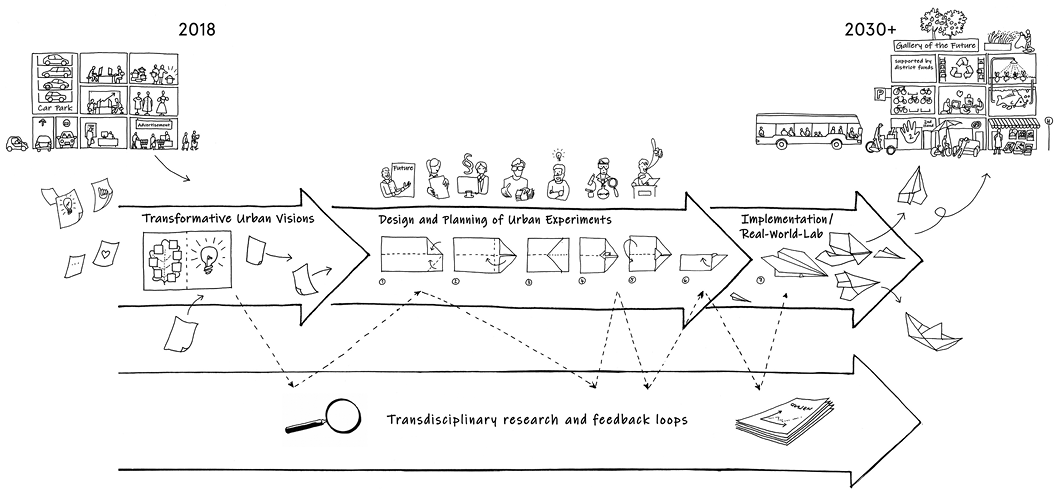
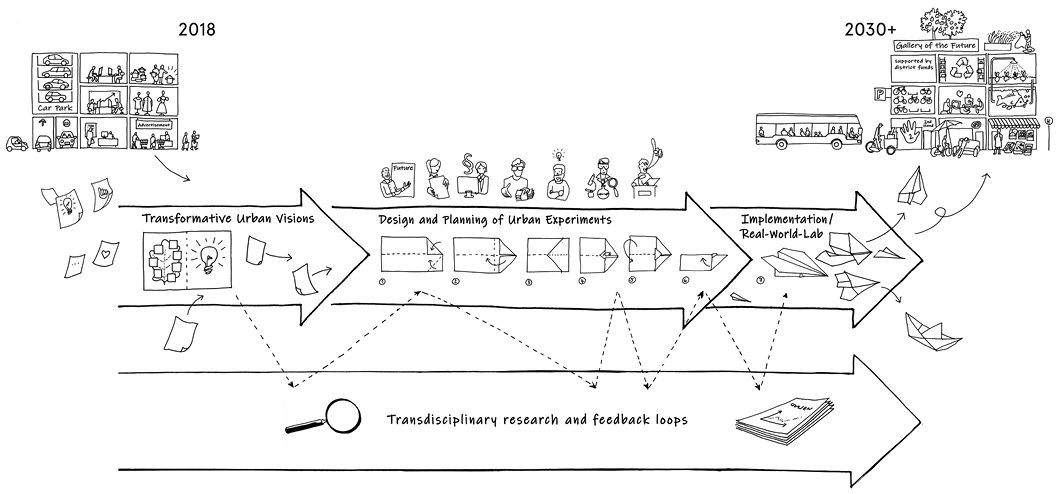
Insights from the above three main topics of urban sustainability transition studies – agency, governance and capacities – have informed numerous transdisciplinary research projects, including the ‘City of the Future’project (2015–2022) in Dresden (Germany). This section provides an illustration of governing urban sustainability transitions in Dresden (Germany), a city in the Global North that is shifting from a post-socialist framework towards a socio-ecological transformation. ‘Dresden – City of the Future: Empowering Citizens, Transforming Cities!’ (DCF) was a transdisciplinary research project that built on the co-creation of knowledge from multiple stakeholders in science and society. Funded by the Federal Ministry of Research and Education’s ‘City of the Future’ programme, the project encouraged local public officials to explore participatory governance and co-creation, in contrast to traditional top-down governance. DCF was structured around three phases: Visioning (2015–2016), Planning (2017–2018) and Experimenting (2019–2022) (see Figure 22.1).
In this transdisciplinary research process based on co-creation, citizens developed transformative urban visions and designed and implemented urban experiments as part of ‘Dresden – City of the Future 2030+’
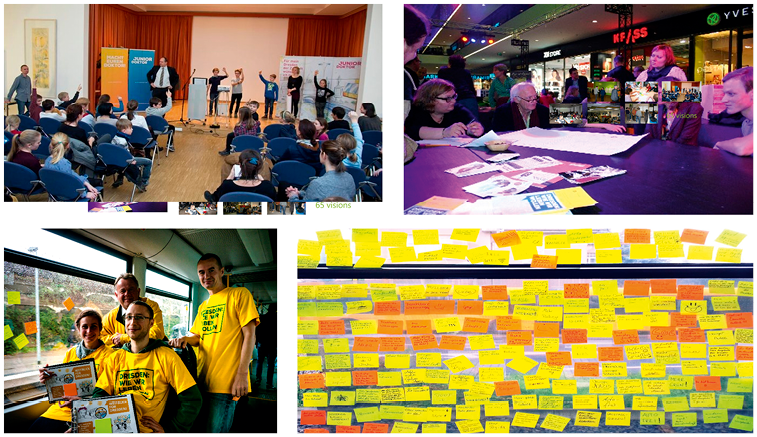
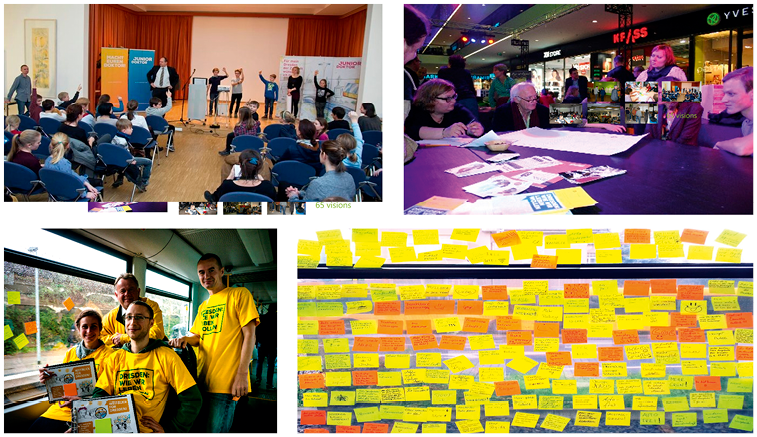
In the first phase, citizens envisioned the Dresden’s future for 2030 and beyond. Over 800 citizens participated in barcamps, where they developed urban sustainability visions (see Figure 22.1, up), hosted in collaboration with local institutions such as the public energy provider, the public transport company and a housing association. To broaden engagement, two city trams were repurposed for a day, allowing citizens to post their wishes and ideas for a sustainable city in over 700 notes on the windows of the trams (see Figure 22.2, down). These visions were synthesised into a unified vision, ‘Dresden – City of the Future 2030+’,Footnote 1 emphasising themes such as local action, global responsibility (though the Sustainable Development Goals), resilience, a local action framework, local cycles of production and consumption, community building and participation.
Impressions from the 25 barcamps (up) and the re-designed city trams (down), which gathered ideas and wishes from citizens who might not usually engage in city-led participatory formats
Building on this vision, citizens proposed transition experiments in the planning phase, which were finally implemented in the experimenting phase, covering a broad range of social innovations such as edible cities, car-free districts, sustainable business models, nature education, participatory governance within districts and the circular economy. An ‘Office of City of the Future’ was established in the Mayor’s Office to coordinate the overall project, acting as a mediator between the citizen-led initiatives and the municipal bodies.
The DCF project demonstrates the potential of bottom-up governance to cultivate alternative visions of sustainability, moving away from economic growth-centred paradigms and ecological modernisation towards sufficiency and the common good. However, this often competed with Dresden’s dominant political focus on economic development. DCF also provided a space to experiment with different forms of intermediation in transformative governance. ‘Transition intermediaries’ play critical roles by bridging innovative niches and dismantling entrenched regimes (Kivimaa et al. Reference Kivimaa, Boon, Hyysalo and Klerkx2019), fostering cross-sectoral cooperation and partnerships. Whereas ‘regime intermediaries’ are connected to the established regime through institutional ties, ‘niche intermediaries’ advocate for grassroots innovations (Kivimaa et al. Reference Kivimaa, Boon, Hyysalo and Klerkx2019; Sovacool et al. Reference Sovacool, Turnheim, Martiskainen, Brown and Kivimaa2020). Adopting an exploratory approach, the project studied both types of transition intermediaries to examine niche–regime interactions and their distinct roles in urban experimentation processes.
Empirical findings reveal that the DCF office, e.g. along with the ‘Material Mediation’ and the ‘Food Bin’ experiments, played a prominent role in mediation and translation. Project teams advancing these transition experiments functioned as niche intermediaries, acting as visionaries, knowledge brokers and advocates of change. By contrast, the DCF office operated as a regime intermediary, guiding and facilitating the process, establishing an institutional infrastructure and coordinating local activities (Ehnert Reference Ehnert2023a). The office fostered networks, resolved conflicts and mediated between the municipality, project teams and broader urban society, promoting new cross-sectoral collaboration. It had to bridge the gap between the hierarchical, rule-based culture of the administration and the open-ended, experimental and exploratory nature of the projects. Given its limited strategic connections and the lack of sustainability as a mandatory municipal responsibility (per the Saxon Municipal Code), the office had to actively mobilise support for the project and advocate for an administrative culture more open to co-creation and institutionalisation of sustainability initiatives within the city structures (Frantzeskaki and Bush Reference Frantzeskaki and Bush2022), posing the risk that real-world experimentation could remain fragmented and episodic (Evans Reference Evans2016; Karvonen et al. Reference Karvonen, Evans and van Heur2014; Torrens and von Wirth Reference Torrens and von Wirth2021).
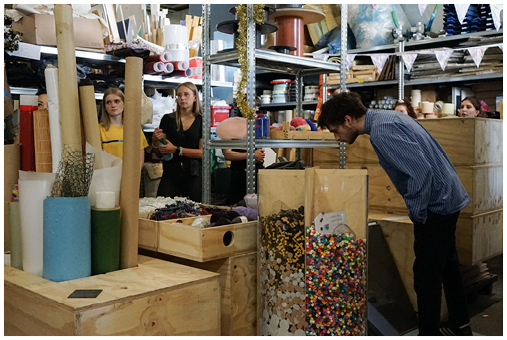
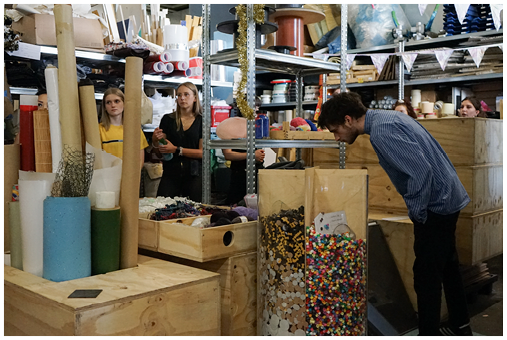
In contrast, niche intermediaries like ‘Material Mediation’ and ‘The Food Bin’ played stronger roles in envisioning and advocating for sustainability, facilitating learning and mobilising support for change. Envisioning change, ‘Material Mediation’, for example, critiqued consumer culture, promoted resource cycles within a circular economy framework and also advocated for the common good, with resources and knowledge being shared rather than privatised. Through workshops on resource cycles and re-using materials (see Figure 22.3), it sought to redefine waste as a valuable resource and foster a do-it-yourself ethos, empowering consumers as opposed to established industry actors. The initiative also helped establish a national network of similar initiatives to support knowledge transfer and local innovation. However, it struggled and failed to secure municipal support for a civic–public partnership for a shared communal waste management infrastructure.
(left): ‘Material Mediation’ storage place
Similarly, the ‘Food Bin’ experiment aimed to raise awareness around food waste and to encourage regional, seasonal food consumption. Through educational workshops and cooking events, the ‘Food Bin’ engaged participants in both cognitive and emotional learning processes (see Figure 22.4), creating a space for shared emotional experiences around foods, including the senses of optics, taste and haptics. Like ‘Material Mediation’, it sought to empower individuals to become independent of the food industry, teaching them to cook with leftover and regional foods. The Food Bin cultivated a network of diverse community members, shifting from indoor events to novel forms of outreach including mobile formats involving a cargo bike, cooperation with neighbourhood cafés and churches and events held in public spaces to reach broader audiences.
(right): ‘Food Bin’ neighbourhood cooking event

In conclusion, DCF created a valuable space for experimenting with governance innovations such as participatory co-creation formats, intermediary actors and structures, and the social innovations generated by the transition experiments. However, it also revealed how the culture of experimentation, entailing openness and learning-by-failing, clashed with the accountability and rule-based orientation of public administration (Bulkeley et al. Reference Bulkeley, Marvin, Palgan, McCormick, Breitfuss-Loidl, Mai, von Wirth and Frantzeskaki2019; Farrelly and Brown Reference Farrelly and Brown2011; Nevens et al. Reference Nevens, Frantzeskaki, Gorissen and Loorbach2013). Mediation is thus essential to reconcile traditional governance structures with experimental approaches, facilitating the integration of change agents into urban governance processes.
22.5 Conclusions and Outlook
A spatial perspective, and particularly the focus on urban environments, has become a critical corner stone in sustainability transitions research in the last decade. While the full ontological and epistemological potential of a spatial, urban lens is yet to be fully developed, existing studies have already made significant contributions. Reflecting on the current state of the art of urban sustainability transition research, several promising directions may help advance both the scientific field and the practical implementation of urban sustainability transitions.
Firstly, scientific discourse on urban sustainability transitions could benefit significantly from viewing urban spaces not only as contexts but as levers for transformation, leveraging various ontological and epistemological understandings of space (see Section 22.2). This dual perspective could strengthen collaboration between urban and transition scholars, fostering new and robust heuristics for comparative studies on urban sustainability transitions. It would also offer urban practitioners new entry points to initiate and accelerate transformative change on the ground, potentially enhancing existing urban development strategies, processes and instruments.
Secondly, typifying urban experiments beyond sectoral categories could clarify the relationship between experiment design (purposeful objectives) and the way they influence their context, driving urban transitions. There is still limited understanding of how experiment-based innovations are embedded within urban governance structures (Hodson et al. Reference Hodson, Evans and Schliwa2018), how they facilitate learning at individual, collective and institutional levels, how they interact with and impact power dynamics, either enabling or obstructing empowerment, leading to a reconfiguration of urban systems.
Thirdly, urban sustainability transition research could further explore how urban transitions are affected by recent societal trends, including societal polarisation, post-factual narratives and opposition to liberal democratic systems. Questions of legitimacy and governance decision-making in urban transition are critical, particularly as transition governance approaches such as transition management are sometimes perceived as bypassing local democratic processes (de Geus et al. Reference de Geus, Wittmayer and Vogelzang2022). While this is seen positively when existing mechanisms are deemed inadequate for urgent transitions to sustainability, it also raises concerns about societal stability and the legitimacy of democratic institutions, particularly given opposition from both right- and left-wing extremists. Therefore, research is needed on how urban transition governance can better align with democratic frameworks without losing its effectiveness in promoting urban sustainability transitions.
Fourthly, there is significant potential in bridging socio-technical systems (STS) and socio-ecological systems (SES) research within urban contexts. As local governments work to improve urban ecosystems to address climate, biodiversity and pollution challenges, research could investigate how people-nature connections and investments in ecological infrastructure (such as nature-based solutions) facilitate urban sustainability transition. Further investigation is also warranted into how urban ecosystem investments and nature-driven place transformations may either stall or accelerate various urban transitions. This aligns with calls for integrated social–ecological–technological systems (SETS) frameworks (Andersson et al. Reference Andersson, Lennerfors and Fornstedt2024; McPhearson et al. Reference McPhearson, Cook, Berbés-Blázquez, Cheng, Grimm, Andersson, Barbosa, Chandler, Chang, Chester, Childers, Elser, Frantzeskaki, Grabowski, Groffman, Hale, Iwaniec, Kabisch, Kennedy and Troxler2022), well-suited to the complexity of urban sustainability transitions.
Fifthly, incorporating decolonial perspectives could enhance future research on urban transitions by guiding the design, evaluation and objectives of urban governance for more equitable futures. Decolonial thinking can help identify key actors outside traditional sectoral categories, scrutinise narratives and frames guiding urban transitions and propose alternative interventions for transformative change through a decolonial lens. This perspective is also critical for urban regeneration initiatives, ensuring they do not inadvertently reinforce neo-colonial narratives or path dependencies that undermine sustainability.
Sixthly, current impact evaluation frameworks often focus on short-term impacts of experimentation due to project design and funding (Torrens and von Wirth Reference Torrens and von Wirth2021). To capture the medium- (15–25 years) and long-term impacts of urban sustainability efforts, research should investigate the lasting institutional integration of lessons learnt. This points to a need for fundamentally rethinking research project design and funding models. Urban real-world laboratories should be envisioned as long-term social research infrastructures (Schneidewind et al. Reference Schneidewind, Augenstein, Stelzer and Wanner2018) fostering sustained partnershipsFootnote 2 between science, administration, policy, business, civil society and citizens to collectively experiment with and learn how to navigate transformative changes across multiple systems simultaneously.


 Open access