


Fruit and vegetables are essential components of a healthy diet and are a significant source of vitamins, minerals and other bioactive substances. Epidemiological studies demonstrate that sufficient consumption of fruit and vegetables is a relevant protective factor against infectious and diet-related non-communicable diseases. Associations have been indicated between higher fruit and vegetable intake and reduced risk of CHD(Reference Nikolic, Nikic and Petrovic1–Reference Dauchet, Amouyel and Hercberg3) and stroke(Reference He, Nowson and MacGregor4). A probable protective effect is also considered in connection with certain cancers(Reference Key, Schatzkin and Willet5, 6), mainly of the digestive tract(6, 7). The low energy density and high fibre content of fruit and vegetables may play a role in weight management(Reference Sherry8–10), which is important in view of the increasing occurrence of overweight and obesity in the European region. The prevalence of obesity continues to rise and the situation is alarming particularly among children and adolescents. These facts reflect the importance of adequate fruit and vegetable intake for human health over a whole lifetime.
Many activities to promote fruit and vegetable consumption are aimed at children because eating habits are formed in childhood and maintained to adulthood. There is scientific evidence that people who ate lots of fruit and vegetables as children have better eating habits as adults(Reference Nicklaus11). Thus improving the availability of fruit and vegetables to children is considered an important determinant of consumption patterns. Schools offer many potential benefits as intervention sites, providing the opportunity to modify dietary behaviour and promote healthful eating patterns(Reference Havas, Heimendinger and Damron12). The Pro Children Project could be mentioned as an example of an activity designed for developing and testing effective strategies for promoting an adequate consumption level of fruit and vegetables among schoolchildren(Reference Klepp, Perez-Rodrigo and De Bourdeaudhuij13). Another high-profile project at the European level, the so-called School Fruit Scheme, has been started as a union-wide intervention programme for distributing fruit and vegetables to schoolchildren(14). There are also many other national and local projects for promoting fruit consumption in schools, such as the Dutch and Norwegian programmes(Reference Reinaerts, Crutzen and Candel15, Reference Bere, Veierød and Klepp16). Studies indicate that school programmes have the potential to increase fruit intake and can have a long-term impact on consumption(Reference de Sa and Lock17–Reference French and Stables19).
WHO/FAO recommends a minimum intake of 400 g of fruit and vegetables daily (excluding potatoes and tubers) for the prevention of chronic diseases(7). In the Czech Republic the Nutrition Society recommends a daily intake of fruit and vegetables (excluding potatoes) of at least 500 g, including heat-treated vegetables. The amount of vegetables consumed should be two times higher than the amount of fruit consumed(Reference Dostalova, Kunesova and Otoupal20). Nutritional recommendations have also been issued by the Czech Ministry of Health(21). A minimum daily intake of 400 g of various fruit and vegetable types is recommended in their publication and food-based dietary guidance depicted as a food pyramid is part of the recommendation. Daily consumption of three to five servings of vegetables (potatoes included) and two to four servings of fruit are the recommended quotas for the general population.
The objective of the present paper is to describe fruit and vegetable intake in pre-school and elementary-school children (aged 4–14 years) in the Czech Republic and to provide information about their preferences and dietary habits concerning these food groups.
Methods
The results presented here are based on data collected during the individual food consumption study (Studie individuální spotřeby potravin, SISP) which was realized in the Czech Republic in 2003 and 2004(Reference Ruprich, Dofkova and Rehurkova22). SISP was a national cross-sectional dietary survey conducted by the use of repeated 24 h recall on an age- and gender-representative sample of the population. Sampling and interviews with respondents were carried out in cooperation with the market research agency, GfK Company. The assistance of a survey agency was evaluated as the best solution considering the extent of the study. The sample – 2590 males and females aged 4 to 90 years – was selected by multistage sampling combining random and quota selection based on data from the National Population and Housing Census in 2001, which served as the sampling frame. Systematic random cluster selection of urban and rural areas was followed by simple random selection of streets, buildings and households. A quota selection of sampling units (respondents) according to age and gender was the final stage. Institutionalized, homeless people and people speaking other than Czech/Slovak languages were not included. The overall response rate was 54 %; 31 % of contacted individuals (eligible according to the quota criteria) refused to participate and 15 % did not complete the study (dropped out).
Data collection was proportionally distributed during the whole year to limit the influence of seasonality in the consumption of some foods. The calendar of the survey was organized in order to represent an adequate ratio of week and weekend days at the group level. Two non-consecutive 24 h recalls were realized with every participant. Respondents were asked to report all foods and beverages consumed over a 24 h period (from midnight to midnight). To estimate portion sizes a picture book and household measures such as cups, graduated jars and spoons were used. Recalls were conducted as face-to-face interviews by trained interviewers and took place in the participants’ households. Children up to 15 years of age were interviewed in the presence of parents. Small children were interviewed with assistance from parents. The second interview was conducted within a period of 1 to 6 months after the first recall and addressed another day of the week. Respondents received no incentives for participation. Self-reported body weight and height were used to estimate BMI.
A group of 602 children was extracted from the whole survey sample to investigate fruit and vegetable consumption. The subgroup was divided into three age categories: 4–6 years, 7–10 years and 11–14 years for the subsequent analyses (see Table 1). Growth charts yielded from the results of the sixth nationwide anthropological survey were applied to classify normal weight and overweight respondents(Reference Vignerova23). Children within the 10th to 90th percentile range were classified as having normal weight and those exceeding this interval as overweight(Reference Vignerova, Humenikova and Paulova24).
Characteristics of the sample of Czech children aged 4–14 years

TEI, total energy intake.
Average intakes in g/d represented by mean and standard deviation were calculated for every age category. The Multiple Source Method (MSM) program version 1·0 (Department of Epidemiology, German Institute of Human Nutrition Potsdam-Rehbrücke; https://nugo.dife.de/msm/) was used to estimate usual dietary intake. The amount of fruit and vegetables consumed was also expressed as the number of servings. One portion was considered equal to 80 g of fruit or vegetables, which is the quantity accepted as a standard portion in other studies(Reference Bere, Veierød and Klepp16, Reference Agudo25, Reference Gibson, Wardle and Watts26). Obtained results were compared with available recommendations(7, 21). With respect to classification of studied food groups, potatoes were not included in the vegetable group and were evaluated separately; and juices were excluded from the fruit group. The reason for this step was to have comparable categorization to other publications(7, Reference Yngve, Wolf and Poortvliet27). Presented results refer to edible portions of raw foods.
Data were elaborated in Paradox for Windows database version 10 (Corel Corporation, Ottawa, Canada) and statistical analyses were performed using Total Access Statistics software (FMS Inc., Vienna, VA, USA). The Kolmogorov–Smirnov goodness-of-fit test was used to determine probability distributions and the t test and Mann–Whitney U test were used for evaluating differences in food consumption with respect to gender or body weight. Analyses were carried out separately for all age categories. Evaluation of body weight was not performed for children aged 11–14 years because of the low number of overweight individuals in the sample.
Results
The characteristics of the children are summarized in Table 1. In the total sample, 19 % of children were classified as overweight or obese. The highest proportion of overweight individuals was detected in children aged 4–6 years (24 %).
Average usual fruit and vegetable intakes for children are summarized in Table 2. Usual intake distributions are presented in Table 3 and Fig. 1. Results showed that fruits were consumed almost twice as much as vegetables in all studied subgroups of children. No statistically significant differences between boys and girls, or between normal weight and overweight subjects, in relation to fruit and vegetable consumption emerged in any of the age categories studied.
Usual intakes of fruit, vegetables, juices and potatoes (g/d) among Czech children

Distribution of usual intake (MSM method) of fruit and vegetables (g/d) among Czech children

P, percentile.
Distribution (density plot) of fruit and vegetable intake in Czech children aged 4–6 years (a), 7–10 years (b), and boys (c) and girls (d) aged 11–14 years (FV_c_m, mean of the fruit and vegetable intakes on consumption days in the short-term measurement; FV_c_usual, usual daily intake of fruit and vegetables in consumers calculated by the MSM method; FV_all_m, mean of the fruit and vegetable intakes for all days of the short-term measurement; FV_all_usual, usual daily intake of fruit and vegetables for all participants calculated by the MSM method)

Amounts presented in grams were recalculated as the number of servings, revealing that the usual intake of fruit and vegetables corresponded to 2·6 servings for children aged 4–6 years, 2·9 servings for children aged 7–10 years, and 3·6 and 3·3 servings respectively for boys and girls aged 11–14 years. Only 22 % of children had total daily intake of fruit and vegetables equal to five or more servings on the day of the survey.
Fruit
Average usual intakes of fruits were 139 (sd 40) g, 148 (sd 65) g, 161 (sd 86) g and 162 (sd 98) g daily for children aged 4–6 years, 7–10 years, and boys and girls aged 11–14 years, respectively. Because fruit juices are included in the fruit group in some recommendations, information about juice consumption can also be found in Table 2. Intake of fruit juices was relatively high among the Czech children but was not taken into account in our calculations due to uncertainties about the composition of beverages classified as fruit juices. It is very probable that respondents did not distinguish between pure fruit juices, nectars and other soft drinks with fruit content. No statistically significant difference in fruit consumption between normal weight and overweight children or between boys and girls was detected.
Data regarding the most frequently consumed kinds of fruit during the year are shown in Fig. 2. Negligible differences were detected in the spectrum of consumed fruits among age categories. Apples and bananas represented more than half of all fruit intake – on average apples comprised 37 % and bananas 27 % of the total amount consumed. Other frequently consumed types of fruit were oranges, mandarins, peaches and grapes.
Proportion of different kinds of fruit in the total intake during the year among Czech children aged 4–14 years

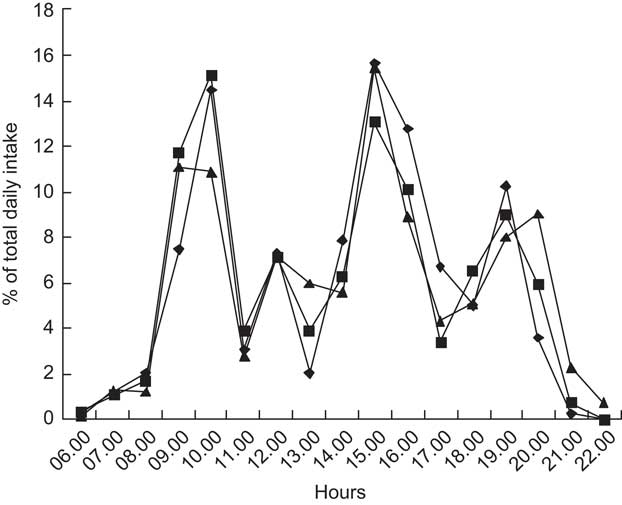
Seasonal and daily variations in fruit consumption were also studied. The highest fruit intake was registered in December (12 % of the overall annual consumption) and a higher level of consumption was also seen in January, February and during the summer. Fruits from temperate zones were consumed mainly in the summer and tropical and subtropical fruits predominated in the winter. The lowest fruit intake was evident during May and October at only 6 % of the overall annual consumption. Concerning daily variations, fruit was most often consumed as a snack during morning time and in the afternoon, less in the evening or as a part of lunch (see Fig. 3).
Daily variations in fruit consumption in the Czech child population aged 4–6 years (—⧫—), 7–10 years (—▪—) and 11–14 years (—▴—)
Vegetables
Usual average vegetable intakes (excluding potatoes) amounted to 69 (sd 33) g/d and 79 (sd 35) g/d in children aged 4–6 and 7–10 years, and 123 (sd 8) g/d and 101 (sd 45) g/d for boys and girls aged 11–14 years, respectively. Potatoes are included in the vegetable food group in some national recommendations(21), which is why potato intake values are also shown in Table 2. No statistically significant difference related to vegetable intake was detected between normal weight and overweight individuals or between boys and girls.
The proportion of different vegetable groups consumed during the year is presented in Fig. 4. Fruiting vegetables (mainly tomatoes, cucumbers, green peppers and water melons) made up 35 % of all vegetables consumed. This vegetable subgroup was the most frequently consumed in all surveyed age categories. Other most frequently consumed subgroups – root vegetables (carrots, celeriac, parsley) and bulbous vegetables (onions, garlic, leek) – amounted to 17 % and 14 % of the overall consumption, respectively.
Proportion of vegetable subgroups in the total intake during the year among Czech children aged 4–14 years

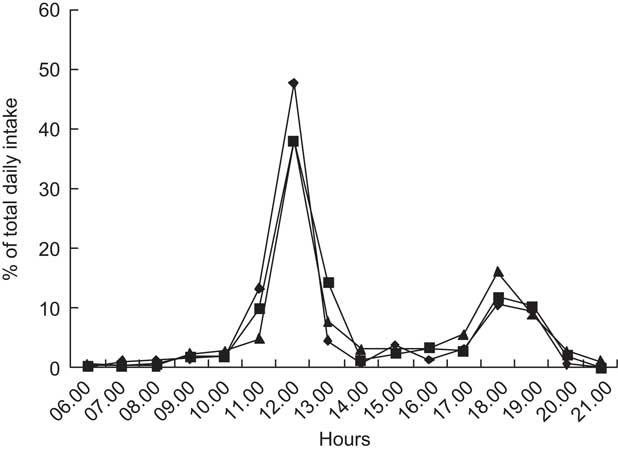
As for seasonal variation, vegetable consumption was highest in the summer period whereas in winter time it was markedly lower. The amount of vegetables consumed during summer months (June–September) made up more than 45 % of the overall annual consumption. Data regarding daily variations in vegetable consumption are shown in Fig. 5. Almost all vegetables were consumed during lunch. Hot meals are most frequently consumed at lunchtime in the Czech Republic.
Daily variations in vegetable consumption in the Czech child population aged 4–6 years (—⧫—), 7–10 years (—▪—) and 11–14 years (—▴—)
Discussion
Description of usual intake distribution in a population is of cardinal importance for assessment of nutritional status. Available statistical tools allow estimation of long-term intake based on short-term measurements such as 24 h recalls. Only two repeated measurements, which cover all seasons and week days, are required for the calculation(Reference Hoffmann, Boeing and Dufour28).
The usual intake recognized in the studied sample confirmed the expectation that Czech children consume an insufficient amount of fruit and vegetables. Intakes of these food groups in all age categories fell short of national recommendations(Reference Dostalova, Kunesova and Otoupal20, 21) and the WHO population goal (400 g/d)(7). Since the presented recommendations are intended for the general population it is not entirely clear how to apply them to children. Similar studies in which fruit and vegetable consumption in children was investigated compared results directly with the WHO population goal or national food-based dietary guidelines. The American Institute for Cancer Research/World Cancer Research Fund states that fruit and vegetables should make up 7 % or more of the total energy intake(Reference Glade29). If energy requirement values published in the report of the European Scientific Committee for Food(30) are applied, calculated minimum intakes of fruit and vegetables correspond to 251 g/d in children aged 4–6 years, 286 g/d in children aged 7–10 years, and 311 g/d for girls and 369 g/d for boys aged 11–14 years. Although these calculated amounts are lower, the fruit and vegetable intakes (without fruit juices and potatoes) in the Czech children failed to achieve even these adjusted recommendations.
The outcomes of our study are similar to results in other countries. Mean fruit and vegetable intake ranging from 143 to 265 g/d was observed in a survey focused on 11-year-old children from nine European countries. The highest consumption was recorded in Austria, Portugal, Denmark and Sweden; conversely the lowest consumption was seen in Iceland and, surprisingly, Spain(Reference Yngve, Wolf and Poortvliet27). In our group of 11–14-year-old Czech children the observed average fruit and vegetable intake was 284 (sd 133) g/d in boys and 261 (sd 140) g/d in girls. The data from both studies are comparable because 24 h recalls combined with the FFQ were used for assessing consumption in the above-mentioned European research. Higher consumption of fruit over vegetables was detected among our Czech children. Such findings were also described in other studies in which fruit and vegetable intakes or eating patterns were investigated(Reference Gibson, Wardle and Watts26, Reference Yngve, Wolf and Poortvliet27, Reference Basch, Zybert and Shea31, Reference Lakkakula, Zanovec and Silverman32). A preference of children for foods with a sweeter taste is thought to be the reason for this(Reference Lakkakula, Zanovec and Silverman32).
A fairly low variety of consumed fruit and vegetables was seen in the researched sample (see Figs 2 and 4). Apples were the most frequently eaten fruit type, accounting for 40 % of overall fruit consumption. This result was to be expected because apples are commonly grown in the Czech Republic, are available all year round and are mostly inexpensive. Apple predominance in fruit consumption was also observed in an international survey aimed at adults. Apples were recognized as the most frequently consumed fruit in all countries participating in the European Prospective Investigation into Cancer and Nutrition (EPIC), accounting on average for 25 % of the total fruit intake(Reference Agudo, Slimani and Ocke33). Only three sorts of fruits – apples, bananas and oranges – presented 70 % of the total fruit intake in the group of Czech children. Similar findings were identified in the northern and western countries studied in EPIC (Germany, Sweden, Denmark and Norway)(Reference Agudo, Slimani and Ocke33). Berries and stone fruits, which are also commonly cultivated in the Czech Republic, were consumed less, mostly during the summer. The explanation for this could be the lower availability of these fruits on the market in off-season months. A relatively low diversity of consumed vegetables was also seen. The reason could again be lower supply, but most likely is related to the fact that vegetables are not a dominant part of Czech cuisine. Not many vegetable types are traditionally used for meal preparation and use of non-traditional ones is spreading only tentatively.
Levels of fruit and vegetable intake are often affected by seasonality. The highest vegetable consumption among Czech children was seen in summer months, when fresh vegetables have better availability and are less expensive. Many families also grow their own vegetables during summer, thus supplementing their intake. Seasonal changes in fruit intake distribution were different. The highest level of consumption was recorded in December, when fruit consumption is traditionally considerable during Christmas, mostly consisting of citruses and tropical fruit. Relatively high consumption was detected in January and February. This can be associated with attempted prevention of respiratory diseases which are common at this time among the child population.
Fruit and vegetable consumption was studied in relation to BMI in the Czech children. Statistically significant differences in fruit and vegetable consumption were not detected between groups of children with normal weight and overweight or obese children; nor have any such differences been confirmed by any other studies(Reference Lakkakula, Zanovec and Silverman32, Reference Patterson, Block and Rosenberger34, Reference Van Sluijs, Skidmore and Mwanza35). On the other hand, a relationship between amounts of fruit and vegetables consumed and BMI was described in Lakkakula et al.'s survey(Reference Lakkakula, Zanovec and Silverman32) where results suggested that children with low fruit and vegetable intake were at higher risk of obesity than those with higher consumption.
The availability of fruit and vegetables appears to be an important factor affecting the dietary patterns of children(Reference Klepp, Perez-Rodrigo and De Bourdeaudhuij13, Reference Neumark-Sztainer, Wall and Perry36) and schools have been identified as a favourable setting for intervention. Taking into account the variations in fruit and vegetable consumption during the course of a day among Czech children, the question is whether a programme aimed at fruit distribution in schools would increase total fruit intake or just replace fruit brought by children as a snack from home. Available surveys confirm the usefulness of projects where fruit distribution was connected with multi-component programmes(Reference Ciliska, Miles and O'Brien37). The effects of vegetable distribution in schools are not so clear. Most of the projects have focused on fruit only and those which were also aimed at vegetable intake concluded that interventions for increasing vegetable consumption are less successful(Reference Bere, Veierød and Klepp16, Reference Ciliska, Miles and O'Brien37).
Conclusions
Fruit and especially vegetable consumption is low among Czech children. Ascertained intakes of fruit and vegetables did not reach national recommendations or the WHO population goal in any of the surveyed age categories. Intakes were also lower than corrected recommendations based on minimal energy share of fruit and vegetables in the diet. The amount of fruit consumed exceeded the amount of vegetables consumed in all age groups, which is actually the direct opposite of what is recommended. Variety in consumed types of fruit and vegetables was also low.
The results demonstrate the necessity of altering dietary patterns in the Czech child population and underline the suitability of interventions. Programmes realized at schools appear to be appropriate promotional instruments, but a regular part of them should also be an evaluation of changes in children's nutritional habits.
Acknowledgements
This research received no specific grant from any funding agency in the public, commercial or not-for-profit sectors. There has been no conflict of interest. M.J. wrote the first draft of the manuscript; M.D. and J.R. discussed and revised the draft and approved the final version.



