

Introduction
Academics and policymakers are divided on whether political and economic development are closely tied to gender and racial equality. One strand of the literature argues that, in some cases, a rising tide does indeed lift all boats (Doepke and Tertilt, Reference Doepke and Tertilt2009; Uberti and Douarin, Reference Uberti and Douarin2023). Inclusion can also improve growth and development. In the US, Hsieh et al. (Reference Hsieh, Hurst, Jones and Klenow2019) demonstrate that between 1960 and 2010, 20% to 40% of aggregate output growth can be attributed to the increased inclusion of women and Black men in highly skilled occupations.
Another strand of the scholarship, however, points out that gender and racial inequality have largely persisted throughout the world, despite significant economic, political, and technological advances. Berik and Rodgers (Reference Berik and Rodgers2023) warn that neoliberal policies targeted at economic growth are not gender neutral: economic growth often goes hand in hand with low wages for women, insecure and precarious jobs, and informal employment. Similarly, Buckman et al. (Reference Buckman, Choi, Daly and Seitelman2022) show that in the US, structural barriers – such as the legacies of discriminatory practices, including Jim Crow laws and redlining – create labour market gaps for racial and ethnic minorities. Hudson et al. (Reference Hudson, Bowen and Nielsen2021) further argue that throughout history, gender inequality has led to poor governance, conflict, less stability, worse economic performance, worse food security, worse health, worse demographic problems, worse environmental protection, and worse social progress.
In this paper, we contribute to the research agenda by investigating how the institutional legacies of the Habsburg and Ottoman Empires affect present-day attitudes towards women and under-represented groups in Romania. Cultural beliefs can be viewed as decision-making heuristics or ‘rules of thumb’ that are employed in uncertain or complex environments, particularly when acquiring information is costly or imperfect (Alesina et al., Reference Alesina, Giuliano and Nunn2013; Boyd and Richerson, Reference Boyd and Richerson1988; Kahneman, Reference Kahneman2011). Moreover, gender norms may explain the emergence and persistence of the exclusion of women and minorities (Farré and Vella, Reference Farré and Vella2013; Fernandez, Reference Fernández2013; Fernandez and Fogli, Reference Fernández and Fogli2009; Ganguly and Nikolova, Reference Ganguly and Nikolova2023; Heintz et al., Reference Heintz, Kabeer and Mahmud2018).
Investigating the historical institutional drivers of attitudes towards women and under-represented groups makes an important contribution to the scholarship on the historical persistence of culture and institutions. An influential strand of the literature argues that culture is stable, as it is vertically transmitted (Bisin and Verdier, Reference Bisin and Verdier2011) or influenced by long-term historical events, such as the legacies of empires (Becker et al., Reference Becker, Boeckh, Hainz and Woessmann2016; Grosfeld and Zhuravskaya, Reference Grosfeld and Zhuravskaya2015). While a growing scholarship examines the historical legacy of empires on cultural attitudes and beliefs (e.g., Lowes et al., Reference Lowes, Nunn, Robinson and Weigel2017) and some recent work connects historical institutions to violence and discrimination (see Heldring, Reference Heldring2021 and Heldring, Reference Heldring2023 for the cases of Rwanda and Prussia, respectively, and Ochsner and Roesel, Reference Ochsner and Roesel2024 for the case of Austria),Footnote 1 to the best of our knowledge, no existing study has investigated how imperial legacies affect gender and minority attitudes. This is an important gap, because we know that historical factors shape attitudes towards women and women’s role in society (Alesina et al., Reference Alesina, Giuliano and Nunn2013; Grosjean and Khattar, Reference Grosjean and Khattar2019).
This paper addresses this gap in the literature by focusing on Romania. Romania provides a particularly relevant setting for this study for two main reasons: the contemporary importance of gender inequality and marginalised minorities, and the identification opportunity created by its historical exposure to different imperial institutions. First, gender inequality in Romania today is pervasive, and some minorities – such as the Roma – tend to live in poverty and not participate in the labour market. Romania has the highest gender gaps in labour force participation and the second-lowest gender equality index among all EU countries. These gender and minority gaps exhibit strong regional heterogeneities and translate into significant productivity losses and lost revenues (OECD, 2025; World Bank, 2023). As we discuss in the next section, the Habsburg and Ottoman Empires differed significantly in their treatment of women and under-represented groups within society.Footnote 2 Therefore, it is important – and highly policy-relevant – to examine the impact of regional long-run imperial legacies on attitudes towards women and minorities today.
Second, our research design is well-suited to identifying imperial legacies because different parts of present-day Romania were historically exposed to distinct imperial administrations. Regions such as Transylvania were formally incorporated into the Habsburg Empire after 1699, while other regions, including Wallachia and Moldavia, remained under Ottoman rule for much longer periods. This variation in imperial governance allows us to examine the effects of historical institutional exposure at a disaggregated sub-national level. At the same time, a further strength of this study is that it examines a state that is currently centralised, ensuring that respondents on both sides of the historical border share the same institutional setting and are unlikely to differ in their judicial system, exposure to inefficient state institutions, corruption, or related factors. Moreover, the border between the Habsburg and Ottoman Empires in present-day Romania remained remarkably stable for more than two centuries (1699–1918). This long-standing divide created sustained differences in institutional exposure, making Romania a natural setting to study the long-term effects of contrasting imperial legacies on cultural attitudes.
Our historical analysis highlights the stark institutional differences in the treatment and status of women and minorities in the two empires. In the Ottoman part of Romania (Wallachia and Moldavia), residents were free to practise their religion (Eastern Orthodoxy) and were not forced to convert to Islam. In exchange, Ottoman rulers demanded the payment of taxes and tributes. Importantly, Romanian women had access to both local courts and Ottoman courts when resolving disputes and often opted for Ottoman courts, which were more women-friendly and less biased. By contrast, in the Habsburg Empire, Romanians of the Eastern Orthodox faith were discriminated against, both de facto and de jure. Religious conversion to Protestantism was sought and encouraged, thus leaving religious minorities in the position of second-class citizens. Similarly, legislation and courts in the Habsburg Empire prohibited women from owning, controlling, or inheriting property, as women were considered completely dependent on their husbands. Therefore, we hypothesise that attitudes towards women and minorities will be more liberal in Romanian localities that were historically part of the Ottoman Empire and less liberal in those belonging to the Habsburg Empire.
To test these hypotheses, we utilise the 2016 EBRD-World Bank Life in Transition Survey (LiTS),Footnote 3 a rich nationally representative household survey, along with additional data from the Romanian National Institute of Statistics and data on sub-national geographical characteristics from Popescu and Popa (Reference Popescu and Popa2022). Unlike much of the existing literature, we examine the historical legacy of empires in Romania on present-day attitudes separately for men and women since recent work in feminist economics argues that social attitudes are empirically and conceptually different across genders (Litchfield et al., Reference Litchfield, Douarin and Gashi2024). Feminist economics emphasises that gender attitudes are shaped by gendered roles in households, labour markets, and political institutions, implying that the same historical or institutional exposure may operate through different mechanisms for men and women (e.g., differential access to resources, agency, or enforcement of norms) (Pearse and Connell, Reference Pearse and Connell2016). Examining gender attitudes separately, therefore, allows us to identify whether historical imperial institutions left distinct imprints on men’s and women’s beliefs, rather than implicitly assuming a common attitudinal formation process.
Overall, our results largely support the hypotheses that historical Ottoman rule is associated with more liberal contemporary attitudes toward women and under-represented groups in Romania. Respondents living in former Ottoman areas generally express more progressive views across several dimensions, whereas those in former Habsburg areas tend to hold less tolerant attitudes. For gender attitudes, the picture is nuanced. While some individual attitudes in former Habsburg areas appear less traditional (particularly among women), these do not translate into greater empowerment within the household. On the contrary, across several dimensions of household decision-making, women in former Habsburg areas are reported to have systematically less decision-making power, as reported by both male and female respondents. This contrasts with former Ottoman areas, where women’s relative bargaining position within the household appears stronger. We propose one explanation for this pattern: residents of the Habsburg Empire were exposed to a higher presence of women among political leaders, such as Maria Theresa, who served as a role model and shaped some of the positive attitudes towards women which we observe. Conversely, the relatively higher legal independence that women had in the Ottoman Empire could have led to a legacy of higher bargaining power within the household, which required women to have concrete outside options.
Attitudes toward under-represented groups exhibit a pattern consistent with our hypotheses. Men and women living in former Habsburg territories are significantly less tolerant towards several minorities, including racial minorities, gay people, Jews, and Roma, while no systematic differences emerge for attitudes toward religion, language, or immigrants. Taken together, these findings suggest that although some gender norms in former Habsburg areas appear less traditional in isolation, historical Ottoman institutions are more consistently associated with both more inclusive social attitudes and greater female bargaining power within the household today.
It is important to acknowledge our research approach has two important shortcomings. First, since we lack highly disaggregated historical data from the Ottoman and Habsburg periods, we cannot credibly determine the exact transmission mechanism linking historical institutions and attitudes towards women and minorities today. We examine three potential mechanisms – education, family transmission, and religious and judicial institutions – but find limited support for education as a primary driver, since communist-era policies largely equalised schooling across regions, and our results are robust to detailed controls for individual and parental education. By contrast, family and institutional channels appear more relevant: Ottoman legal pluralism may have fostered more egalitarian household norms, which were then transmitted both horizontally and vertically. We also find that Habsburg rule is associated with lower female decision-making power and lower tolerance towards minorities, consistent with the persistence of patriarchal and less tolerant norms rooted in historical religious and judicial institutions.
A second important limitation, shared with related works such as Popescu and Popa (Reference Popescu and Popa2022), concerns the lack of detailed historical data on other variables that may affect long-term imperial legacies, such as rates of mixed marriages, population movements, and population mixing across both sides of the former historical border. Despite such potential attenuating forces, we find persistent effects of imperial legacies in our setting. Moreover, we are able to rule out that our results are driven by differences in communist exposure across Romania. We collected data on the distance of each LiTS PSU to the nearest former communist prison or forced labour camp and included it as a control in the regression, with our results remaining robust. We believe that, despite these shortcomings, the paper presents novel and insightful findings on the impact of institutions and empire on contemporary cultural attitudes.
Previous literature, conceptual framework, and hypotheses
Historical background: the Ottoman and Habsburg Empires in Romania
A significant part of present-day south and northeastern Romania (Moldavia and Wallachia) was occupied by the Ottoman Empire since the 15th century. These territories managed to liberate themselves only after the Russo-Turkish War of 1877–1878. However, rather than being directly incorporated into the Ottoman Empire, Moldavia and Wallachia were ruled as vassal states.
Even though the other historical region of present-day Romania, Transylvania (in the northern and northwestern part of the country), was formally part of the Ottoman Empire between 1541 and 1699 as a vassal state, it remained de facto governed by Hungarian princes overseen by Ottoman sultans (Kellogg, Reference Kellogg1995). In 1699, the Habsburg monarchy gained possession of Transylvania through the Hungarian crown. After the failure of Rákóczi’s War of Independence in 1711, Habsburg control of Transylvania was consolidated, and Hungarian Transylvanian princes were replaced with Habsburg imperial governors (Bartos-Elekes, Reference Bartos-Elekes2023). During the Hungarian Revolution of 1848, the Hungarian government proclaimed union with Transylvania in the April Laws of 1848 (Brubaker and Feischmidt, Reference Brubaker and Feischmidt2002). After the failure of the revolution, the March Constitution of Austria decreed that the Principality of Transylvania be a separate crown land entirely independent of Hungary. The separate status of Transylvania ended with the Austro-Hungarian Compromise of 1867, and it was reincorporated into the Kingdom of Hungary as part of the Austro-Hungarian Empire (Fazakas and Kisteleki, Reference Fazakas, Kisteleki and Veress2023).
Figure A1 in the Online Appendix shows the former Habsburg-Ottoman border and the location of primary sampling units in the LiTS. Table B1 and Figure B2 in the Online Appendix provide a detailed summary of imperial rule in Romania.
Differences in institutional frameworks: the Ottoman part (Wallachia and Moldavia) versus the Habsburg part (Transylvania)
The two parts of Romania were subject to very different legal environments. As vassal states that were required to pay tribute to the Ottoman sultan, the Ottoman-controlled parts (Moldavia and Wallachia) retained significant religious and legal autonomy. As a result, Romanians living under the Ottoman Empire did not convert to Islam en masse. The Ottomans extended protection (zimmi) to Wallachians and Moldavians, which included the prohibition of enslavement, the protection from plunder, and the safeguarding of their religion. In exchange, the local leaders (voivodes) were responsible for paying tribute to the sultan. Voivodes had the status of local governors and were nominated and approved by the sultan for a period of three years (Panaite, Reference Panaite2013; Papp, Reference Papp2013).
Due to their vassal status, residents of Moldavia and Wallachia had access to local and Ottoman laws to resolve legal conflicts (Vintilã-Ghiţulescu, Reference Vintilă-Ghiţulescu2019). Under the Ottoman system of legal pluralism, non-Muslim subjects were allowed a choice of Islamic or autonomous courts (the latter was only applicable absent any Muslim involvement). Until the 18th century, religious minorities (including the Romanians, who were Eastern Orthodox) tended to use Islamic courts for business matters and generally sought litigation in Islamic courts (Kuran, Reference Kuran2004).
Even though Transylvania formed a distinct geographical region in the Habsburg Empire, Hungarian law was imposed on Transylvania. Only the nobility (who could be either Catholic or Protestant, but not Eastern Orthodox or Jewish) could own land. While in the Ottoman part of Romania, non-Muslims were given full religious freedom; in the Habsburg Empire, the Eastern Orthodox faith was legally marginalised and labelled as ‘heresy’ (Balázs, Reference Balázs2013). The laws written in Protestant theological language emphasised the sermon, which stood in opposition to Catholicism and Eastern Orthodoxy, where icons play an important part (Balázs, Reference Balázs2013). Unlike in the Ottoman Empire, religious conversion to Protestantism by those not professing the Protestant faith was sought and encouraged (Balázs, Reference Balázs2013; Floroaia, Reference Floroaia2014). Furthermore, the legal capacity of individuals was determined by the religion of the population (Homoki-Nagy, Reference Homoki-Nagy2020). In 16th century Transylvania, the justice system discriminated against Romanians and favoured Hungarians and Saxons. In legal terms, a Romanian was worth less than half a ‘rightful’ Christian. In the 16th and 17th centuries, Orthodox Romanians were denied citizenship and excluded from power by legally binding official decisions. While the Catholics were also discriminated against, no legal rules were used to do so. The four legally accepted religious denominations were Catholic, Lutheran, Calvinist, and Unitarian. By contrast, the Orthodox were denied official recognition (Pop, Reference Pop2013).
Women in the Habsburg versus Ottoman Empires
In this subsection, we synthesise and compare the statuses of women in the two empires, with a particular focus on the differences over the 18th and 19th centuries. We provide more detailed qualitative evidence on women and minorities in the two empires in the Online Appendix, Part 2. We argue that the significantly more women-friendly courts in the Ottoman part of Romania are responsible for the more liberal attitudes towards women and higher female bargaining power observed in former Ottoman localities in today’s Romania. Moreover, there is historical evidence that the different institutional structures led to historical differences in women’s positions in the two parts of Romania. For example, Jianu (Reference Jianu2003) utilises extensive historical evidence on consumption, family law, law codes, schooling, and professional opportunities to show that, between 1750 and 1850, Romanian women in Wallachia and Moldavia held important power both in the domestic and public arenas (28). Specifically, Jianu (Reference Jianu2003) emphasises that while gender-based violence (such as rape) did happen, women were quite aware of their rights and were willing to take their cases to court despite intimidating procedures such as the oath or decisions not to prosecute rape (73).
Women’s access to and use of courts was an important difference between the two empires. In early modern Europe (including in Habsburg-controlled territories), following the Austrian Civil Code and the Napoleonic Code, women were considered dependents of their husbands, with limited rights to inherit property, enter contracts, bring suits to court or serve as witnesses (Bucur, Reference Bucur2018; Coşgel et al., Reference Coşgel, Genç, Özer and Yıldırım2024). In 1782, Joseph II’s Edict of Tolerance established civil courts for marriage in Habsburg Romania and allowed marriages among different religious denominations. However, the Catholic Church and nobility were against this. After the end of Joseph II’s reign (1790), the old practices of separate ecclesiastical courts for each religion were re-established. While women in Habsburg Romania could also take legal action and enter contracts without their husbands’ approval, the Austrian civil code was not implemented uniformly and continued to co-exist with ecclesiastical courts, especially in rural areas inhabited by those of the Jewish and Eastern Orthodox faiths (Bucur, Reference Bucur2018). Importantly, Orthodox courts were not accepting of women. Although the Orthodox Church faced political constraints under Ottoman rule, it retained jurisdiction over family and personal status matters through ecclesiastical courts. These courts continued to adjudicate issues such as marriage, divorce, and inheritance, meaning their norms could still shape gender relations (Peirce, Reference Peirce2003). As Bucur (Reference Bucur2018) explains, the Eastern Orthodox dogma at the time was misogynistic, with women’s role largely circumscribed to the reproductive sphere, and with domestic violence sanctioned by the Church. Men, compared to women, suffered less serious consequences in terms of infidelity.
Women (and other residents) in Wallachia and Moldavia had an important advantage compared to those in Habsburg-controlled Transylvania: they could use Islamic courts, which were usually more likely to rule in their favour in specific cases (Vintilã, Reference Vintilă2022). Women appealed to Ottoman courts, which were less likely to be influenced by local power relations.Footnote 4 Similarly, in matters of divorce, Orthodox couples could turn to Sharia courts, which, unlike Orthodox courts, allowed for the possibility of divorce by mutual consent (Catholic/Protestant marriage law did not provide provisions for divorce) (Griesebner and Doxiadis, Reference Griesebner and Doxiadis2023). Using early-19th-century Ottoman court data, Coşgel et al. (Reference Coşgel, Genç, Özer and Yıldırım2024) show that women accounted for approximately 30% of claimants, with a fairly modest male advantage of 8–10% in the claimant win rate, which varied depending on the type and context of the case (e.g., provincial courts vs. capital courts and inheritance and property disputes). In particular, in family disputes, women were more likely to win. In the 18th century, in Wallachia and Moldavia, there were 420 divorce cases, and 269 of them (64%) were initiated by women (Bucur, Reference Bucur2018). While in principle both men and women could inherit property, some deeds show generosity towards daughters, and others do not. Some deeds specifically state that brothers should protect their sisters and provide a dowry for them. However, women had no rights over property when they entered marriage (usually around age 16) (Bucur, Reference Bucur2018).
Importantly, Sharia (qadi) court proceedings were not centralised in Istanbul, and the qadi operated in many towns and cities throughout the Ottoman Empire, including territories of present-day Romania. Therefore, Wallachian and Moldavian women from lower social classes could appeal directly to the local qadi without the need to travel to the capital. As Peirce (Reference Peirce2003) explains, the judicial proceedings of the Islamic courts (qadi) were decentralised (no exclusiveness for the imperial capital, Istanbul) and embedded in other important jurisdictions (kaza) and administrative units (sancak or liva) of the empire, including in the Romanian regions, such as Moldavia and Wallachia.
Women from lower social classes (e.g., peasants, labourers, orphans, and nomads) could appeal directly to the local qadi authority without requiring long-distance travel to Istanbul. Cases were resolved locally, sometimes with referrals from nearby provinces (e.g., Aleppo). There is no evidence that women bypassed local judges by travelling to Istanbul for routine matters. They could speak ‘like men’ in front of judges, but still, courts were not uniformly open to women. In particular cases, women who were not allowed in the courts instead used alternative methods to make their voices heard, especially in cases related to defending their moral reputation. For instance, the court in Aintab acted as a flexible moral arbiter, allowing women to use displays of remorse to restore their moral standing. By acknowledging that its own formal rules were imperfect, the court allowed defendants to rehabilitate themselves through testimony. Judges focused on listening to individual narratives, which created space for multiple ‘moralities’ shaped by different local microcultures (Peirce, Reference Peirce2003).
The Ottoman legal system in core regions proved relatively rational and predictable, operating on the basis of sharia, kanun (sultanic law), and local custom (Gerber, Reference Gerber1994, 175–176). Although customary legal regimes are often associated with weaker protections for women (Anderson, Reference Anderson2018), the Ottoman system combined multiple legal sources. This legal pluralism allowed litigants, including women, to appeal to different norms and courts, which in some cases expanded their practical legal options. Even if Ottoman women were still discriminated against, a growing literature suggests that women in Ottoman society participated actively in courts to defend their rights and property. One of the crucial advantages of the Ottoman system was that women could initiate lawsuits independently rather than only through their husbands, as was the case in Europe (and in the Habsburg Empire) (Coşgel et al., Reference Coşgel, Genç, Özer and Yıldırım2024). As a result, many Orthodox women living in the Ottoman Empire settled disputes in Ottoman rather than local courts.
Minorities in the Habsburg versus Ottoman Empires
In this subsection, we briefly summarise the positions of minorities in the Habsburg and Ottoman parts of Romania. We argue that Ottoman laissez-faire tolerance via the millet system allowed religious freedom (Karpat, Reference Karpat, Braude and Lewis1982), while Habsburg policies enforced conversion and second-class status for Orthodox Romanians and other minorities (Pop, Reference Pop2013). In turn, the relatively more privileged stance of minorities in the Ottoman part of Romania can explain why former Ottoman localities still have more minority-friendly attitudes today.
Compared to Ottoman rule, different ethnic, religious, and linguistic minorities inside the Habsburg Empire benefited from a much lower level of autonomy and tolerance. Based solely on ethnicity, Germans and Hungarians enjoyed a much more privileged status compared to Romanians or Slavic peoples (Barany, Reference Barany2002, 29). The Roma (historically called Gypsies) were not considered equal citizens like other subjects of the empire; they were merely tolerated, living outside of villages, although interacting with the locals, especially for commerce (Barany, Reference Barany2002, 86–87). In Transylvania, Roma communities were present at least from around 1500 and appeared as royal serfs with tax and labour obligations to the crown; thus, at least a part of them were not fully enslaved. However, during the second half of the 17th century, the Habsburg policies of sedentarisation and social integration of Romas were aggressive, including, among others, forced settlement in localities, confiscation of carts and horses, prohibition of the Romani language, endogamous marriages, traditional clothing and certain nomadic crafts, military incorporation of young Roma (over 16 years of age), participation in Catholic services, financial compensation for giving children to adoption to non-Roma, and other restrictions and social control policies. Due to active resistance by the Roma communities, the cultural assimilation represented a failure for the Habsburgs (Achim, Reference Achim2004, 69–86). As Barany (Reference Barany2002, 355) argues, the Habsburg rulers ‘were more interested in closely controlling their populations because they were keener to undertake empire-wide projects (e.g., administrative, infrastructural, and economic) than their counterparts in Istanbul, and such projects necessitated more extensive and intensive control of the population. The Romas’ historical experience in the two empires clearly reflected these different approaches’. While the Ottomans manifested a liberal treatment of Jews, the status of Jews in the Habsburg Empire varied considerably: while Jews were fully acknowledged in Bukovina and Bosnia-Herzegovina, in Austria and Hungary they were partially or even not recognised at all (Kann, Reference Kann1950, 30).
By contrast, in the Ottoman Empire, ethnic and religious minorities were governed by the ‘millet system’, which regulated certain rights and freedoms regarding their religions, cultural specificities and customs, but also administrative, economic and political duties (Karpat, Reference Karpat, Braude and Lewis1982, 141–142). The scope of the administrative system for this religious and ethnic flexibility and tolerance towards various minorities was based on its rational intention to collect more/all taxes rather than impose a forced religious uniformisation or ethnic isolation (Aydingun and Dardagan, Reference Aydingün and Dardagan2006). Minorities, such as Christians, Jews, and Armenians, had access to Islamic courts, and many of them were influential enough to serve as moneylenders and financial intermediaries to high-ranking Muslim officials. Although the Ottoman societal system consisted of Muslims (‘true believers’) and non-Muslims (‘infidels’), minorities were given full freedom to practise their religion and customs. Since the 16th century, the Roma were considered a special category of citizens, with Muslims being more privileged. However, the civil status of the Roma in the Ottoman Empire was better than that in Western Europe, since the Ottoman Empire ‘accepted the idea of minority–majority or developed a political sense of nationality it could easily have liquidated the patch-work of races and religions under its rule transforming them into one homogenous Muslim or Turkish group’ (Karpat, Reference Karpat1973, 39).
Hypotheses
The preceding historical discussion motivates the two hypotheses, which will be tested in this paper.
Hypothesis 1 Areas under former Ottoman control will have more liberal attitudes towards women today compared to areas under former Habsburg control.
Hypothesis 2 Areas under former Ottoman control will have more liberal attitudes towards minorities and under-represented groups today compared to areas under former Habsburg control.
Data and empirical setup
Our primary data source is the third round of the EBRD-World Bank Life in Transition Survey (LiTS III), conducted in Romania during the fall of 2016. The survey, known as LiTS, encompasses 29 post-communist nations as well as Cyprus, Germany, Greece, Italy, and Turkey, providing a nationally representative sample for each country. In earlier rounds (2006 and 2010), participants aged 18 and above were randomly selected through a two-stage sampling method, utilising electoral districts, polling station territories, census enumeration districts, or geo-administrative divisions as primary units and households as secondary units. For the 2016 survey, the sample was formed by reusing all primary units from 2010 and randomly selecting respondents within them, along with the addition of 25 extra primary units to ensure national representation. The third wave features the most extensive coverage to date, comprising approximately 1,500 households across 75 PSUs per country and 20 households per PSU. Weights based on demographic and geographic attributes like age, gender, and urbanity were applied to ensure the sample’s representativeness relative to the population.
Dependent variables
Attitudes towards women
We use eight statements from LiTS III regarding gender roles on which the respondent’s agreement or disagreement is scored:
-
1. Women are as competent as men to be business executives.
-
2. Men make better political leaders than women do.
-
3. A woman should do most of the household chores even if the husband is not working.
-
4. It is important that my daughter achieves a university education.
-
5. It is important that my son achieves a university education.
-
6. Co-habiting partners should be married.
-
7. It is better for everyone involved if the man earns the money and the woman takes care of the home and children.
-
8. Equal rights for women as citizens are important.
Responses are rescaled to a unit interval [0, 1] in 0.25 increments, where 0 represents the most conservative opinion and 1 the most liberal stance. We also create an attitude index which averages all the scores for the eight questions.
Decision-making within the household
To measure intra-household bargaining power, we make use of the following question in the LiTS III: ‘Who makes the decisions about the following issues in your household?’, with options for:
-
1. Managing day-to-day spending and paying bills.
-
2. Making large household purchases (e.g., cars, major appliances);
-
3. The way the children are raised.
-
4. Social life and leisure activities.
-
5. Savings, investment and borrowing.
-
6. Looking after the children.
The answer options are: (1) mostly the respondent, (2) shared equally between the respondent and their partner, or (3) mostly the respondent’s partner. We first identified the gender of the respondent and their partner. Then, we identified who in the household made the decisions regarding each of the sub-questions. We also cross-checked the gender and decision-making information against each other to assign the variables a value of 0 if a decision is made primarily by a man, 0.5 if it is shared equally between a woman and a man, and 1 if it is mostly made by a woman. Higher values thus imply greater female agency.
Attitudes towards minorities and under-represented groups
We make use of the following question from the LiTS III: ‘On this list are various groups of people. Could you please mention any that you would not like to have as neighbours?’ The respondent can then answer either no (which we code as 0) or yes (which we code as 1). While the question has a total of 15 options, we pick the seven options that we believe are most relevant given the theoretical discussion, which emphasises cultural and religious differences: (1) immigrants/foreign workers; (2) gay people; (3) Romas; (4) people of a different religion; (5) people of a different race; (6) Jews and (7) people who speak a different language. We omit categories less relevant to our theoretical framework of imperial legacy, such as families with children, paedophiles, drug addicts, people who have AIDS, elderly people, heavy drinkers, and unmarried people living together.
Independent variables
We include the following individual controls: the respondent’s age; marital status (a dummy variable for being divorced, separated, or widowed); household monthly income (in RON); dummies for whether the respondent and their father completed secondary and tertiary education (with the omitted category being primary education or below); a variable capturing the state of the respondent’s health (on a scale of 1 – very good, 0.75 – good, 0.5 – medium, 0.25 – bad, and 0 – very bad); and a dummy variable capturing the respondent’s migration status (0 if the respondent lived their whole life in the particular town, and 1 otherwise).
At the locality/PSU level, we include a dummy variable for whether the respondent lives in an urban location (1 – urban, 0 – rural); PSU geographical coordinates (latitude and longitude); agricultural suitability (wheat); log distance to sea lines; and log distance to large rivers, with the latter two variables serving as a proxy for trade.Footnote 5
To make sure our results are not driven by economic differences among localities, we control for 2015 county-level GDP per capita, measured in millions of RON and current prices.Footnote 6 To account for differences in the communist legacies across PSUs, we also include a variable that captures the distance to the nearest former communist prison or forced labour camp compiled by the Institute for the Investigation of the Crimes of Communism and the Memory of the Romanian Exile (IICCMER), a government structure established in 2009 (IICCMER, 2013; Tismăneanu, Reference Tismăneanu2006). The variable includes both prisons that were discontinued after 1989 and prisons that were also transformed into post-communist prisons after 1989. All of Romania was communist at the same time, but it could have been that the communist party was more active or engaged in more repression in some parts of Romania than others. Figure A2 in the online appendix shows the location of these former communist prisons in Romania, relative to the former Habsburg-Ottoman border.Footnote 7
Empirical setup
The baseline empirical specification on which the analysis is based is the following: $Attitud{e_{ipr}} = {\rm{ }}{\beta _0} + {\rm{ }}{\beta _1}HabsburgEmpir{e_{pr}} + {\beta _2}{X_{ipr}} + {\rm{ }}{\beta _3}{Z_{pr}} + {\rm{ }}{v_r} + {\rm{ }}{\varepsilon _{ipr}}$
where for each respondent i (male or female) in PSU p and region r, Attitude is one of the dependent variables discussed above: (1) attitudes towards women; (2) decision-making within the household; and (3) attitudes towards minorities and under-represented groups. HabsburgEmpire is a binary variable which captures whether each PSU was part of the Habsburg Empire or not. X ipr is a vector of control variables at the individual level, Z pr is a vector of control variables at the PSU level, while v r is a fixed effect at the level of sub-national regions. In the LiTS, Romania is divided into eight distinct regions: the Bucharest and Ilfov area, centre, north-east, north-west, south (Muntenia), south-east, south-west (Oltenia), and west. Of these, three regions (centre, northwest, and west) are located on the territory of the former Habsburg Empire (now Transylvania), and four others (Bucharest-Ilfov, south, southeast, and southwest) are located in the area dominated by the former Ottoman Empire (the former vassal principalities of Wallachia and Moldavia). The last region, Northeast, is crossed by the former historical border of the Habsburg Empire, with the northern part of the region, or future Bukovina (most of the current county of Suceava and small parts of the northern county of Botosani), becoming part of it in 1775, while the rest of the region (today the counties of Iaşi, most parts of Botoşani, Neamţ, Vaslui, and Bacău) remained under Ottoman suzerainty as part of Moldavia (until the union of 1859 and independence in 1877). Consequently, the variation in our treatment variable comes mainly from comparisons between (historical) regions. Specifically, only the north-east part of Romania offers variations within the region in terms of imperial legacy. This should be borne in mind when interpreting specifications that include regional fixed effects, as they capture and absorb a significant portion of the interregional variation (see the robustness analysis in Section 5).
ϵ ipr is the error term, and errors are adjusted for spatial correlation using the Conley (Reference Conley1999) method and a 150 km cut-off.Footnote 8 Survey weights, which ensure that the data is representative at the country level, are included in all analyses.Footnote 9
By focusing on imperial legacies in a single country, our empirical setup mitigates unobserved cross-country heterogeneity, thus allowing us to draw conclusions that are more likely to be causal. However, our approach also raises several potential identification problems. First, since the analysis is based on cross-sectional data, unobserved individual and locality-level variables could undermine the results. To deal with this, we control for a wide range of observable characteristics at both the individual and locality levels, including household income, employment status, and individual and parental education, as well as Primary Sampling Unit (PSU) characteristics such as urbanity, latitude, and longitude. Our analyses also include fixed effects at the level of sub-national regions, which allows us to account for region-specific unobserved confounders, such as geography, industrial structure, or climate. We also account for more detailed sub-national level confounders (in addition to those available in the LiTS) by controlling for county-level GDP per capita and PSU-level geographic suitability for wheat and trade, the latter proxied by the log distance to sea lines and large rivers.Footnote 10 To rule out geographic sorting of respondents, all specifications include a binary control for mobility (i.e., whether the person has ever moved from their place of birth). Finally, to make sure that our results are not driven by spatial autocorrelation, all specifications include Conley (Reference Conley1999) errors with a 150 km cut-off. Our multi-pronged approaches, therefore, make us more confident that the relationships we uncover are more likely to be causal rather than simply correlations.
Following Popescu and Popa (Reference Popescu and Popa2022) and Ochsner and Roesel (Reference Ochsner and Roesel2024), in the robustness checks (presented in the Online Appendix), we also implement a geographic regression discontinuity design. Recent scholarship has also argued that the border separating the Ottoman and Habsburg Empires is quasi-random, primarily reflecting military and geo-strategic considerations (Popescu and Popa, Reference Popescu and Popa2022; Becker et al., Reference Becker, Boeckh, Hainz and Woessmann2016), which lends further credibility to our research design.Footnote 11 While these results should be treated as only suggestive due to the small number of observations and the limited set of controls that we are able to include, it is reassuring that they are very similar to the results from our original specification.
Results
Attitudes towards women
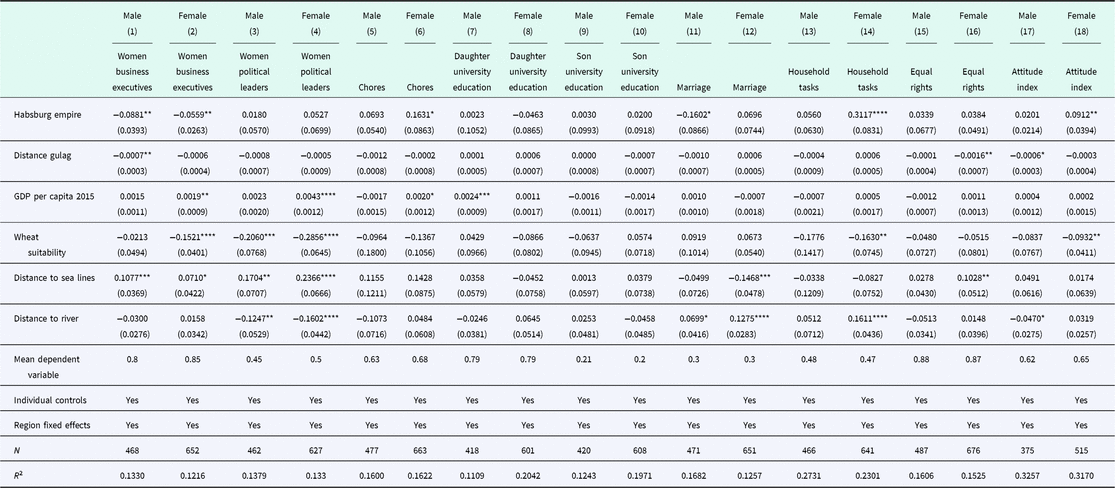
Table 1 examines the association between Habsburg imperial legacy and attitudes towards women. Consistent with Hypothesis 1, we find that male and female respondents living in former Habsburg areas are 8.8% and 5.6% less likely to view women as competent business executives, respectively, compared to respondents living in former Ottoman areas (relative to the mean of the dependent variable, these effects correspond to 11.0% and 6.6%). Similarly, male respondents living in former Habsburg areas are more likely to agree that cohabiting partners should be married (with the effect size relative to the mean being over 50%). However, Table 1 also contains some findings that go against Hypothesis 1. Female respondents located in former Habsburg localities are significantly more disapproving of the statement that ‘A woman should do most of the household chores even if the husband is not working’, and more likely to disagree with the statement that ‘It is better for everyone involved if the man earns the money and the woman takes care of the home and children’ compared to women living in former Ottoman areas (the effect sizes are large: 24.0% and 66.3% relative to the mean of the dependent variable). When we average all attitudes (excluding the variable capturing preferences for a son’s education) in an index (columns 17 and 18), we find that women located in former Habsburg areas indeed have more women-friendly attitudes.Footnote 12 In short, the specifications investigating attitudes towards women reveal some support for Hypothesis 1.
Determinants of attitudes towards men and women

Note: Standard errors are in parentheses. *, **, *** and **** indicate significance at 10%, 5%, 1% and 0.1%. Standard errors are adjusted for arbitrary spatial correlation with a 150 km threshold using the acreg package in Stata developed by Colella et al. (Reference Colella, Lalive, Sakalli and Thoenig2023), a modification of Conley (Reference Conley1999). Controls (not shown) include age, marital status, household income, education, father’s education, health status, migration status, urban residence, latitude and longitude.
One possible explanation for the mixed results is that exposure to female leaders in the Habsburg Empire – such as Maria Theresa, who ruled the Habsburg monarchy from 1740 to 1780 – may have changed perceptions of rigid gender roles, making women in former Habsburg regions more predisposed to reject the idea of gender-based allocation and division of household tasks. Maria Theresa was the only female ruler of the Habsburg Empire in her own right, but several other Habsburg women served as regents or governors, exercising real power even if they were not the official sovereign.Footnote 13 Historians suggest that Maria Theresa’s rule was without precedent and that her ascent to the throne shifted perceptions of kingship and rigid gender roles (Varga, Reference Varga2021). It is important to note that, as shown in columns 3–4 of Table 1, the coefficients on perceptions of women as political leaders are statistically insignificant (albeit positive) for both male and female respondents. One reason for this discrepancy lies in the fact that the communist regime in Romania (1948–1989) actively promoted women’s participation in politics, so that attitudes toward women as political leaders may have become more uniform on both sides of the former imperial border. On the other hand, attitudes towards the allocation of chores and household tasks (columns 6 and 14), which were internal to the household and much less affected by communist politics, managed to preserve more of the former historical imprint.
Household decision-making
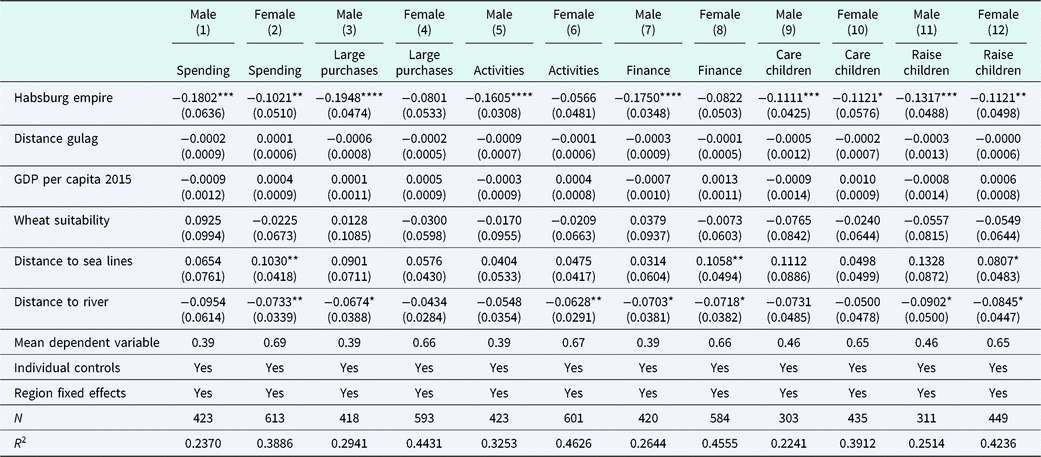
Table 2 examines the impact of the historical legacy of the Habsburg Empire on intra-household bargaining between men and women. As predicted by Hypothesis 1, the table shows strong evidence that, overall, women in former Habsburg areas have less decision-making power within the household. Both female and male respondents report that women have less power when it comes to decisions on spending, the care of children, and raising children. Male respondents report that women have less influence on decisions related to large purchases, activities, and finance, while the coefficients for women are also negative but less precisely estimated. The magnitude of the effects is large, ranging from 10.2% for spending (women) to 49.9% for large purchases (men) relative to the mean of the respective dependent variables. While the coefficients in columns 4, 6, and 8 are imprecisely estimated, they are negative, with magnitudes that are similarly large (ranging from 8.4% to 12.5% relative to the mean of the respective dependent variables). Importantly, while respondents residing in former Habsburg locations do not have overwhelmingly negative attitudes towards women (Table 1), they are much less women-friendly when it comes to decision-making within the household (Table 2). We argue that this has to do with the relatively higher legal independence, due to the presence of Islamic courts, that women in the Ottoman Empire enjoyed. It is plausible that such independence increased female bargaining power within the household and that this stronger decision-making power persisted until today, either through formal or informal institutions.
Household decision-making: men and women

Note: Standard errors are in parentheses. *, **, *** and **** indicate significance at 10%, 5%, 1% and 0.1%. Standard errors are adjusted for arbitrary spatial correlation with a 150 km threshold using the acreg package in Stata developed by Colella et al. (Reference Colella, Lalive, Sakalli and Thoenig2023), a modification of Conley (Reference Conley1999). Controls (not shown) include age, marital status, household income, education, father’s education, health status, migration status, urban residence, latitude and longitude.
Attitudes towards minorities
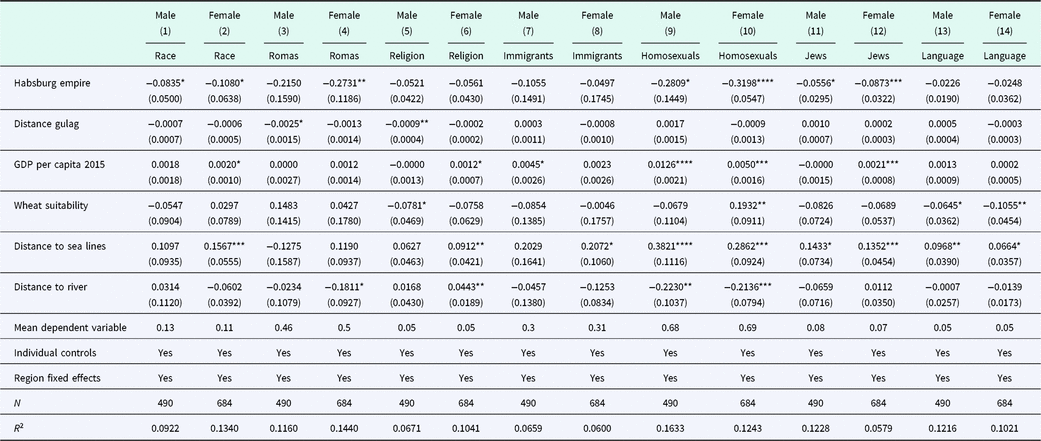
Next, we examine how imperial legacies influence contemporary attitudes towards under-represented groups and minorities. In line with Hypothesis 2, Table 3 shows that male and female residents of ex-Habsburg territories are less supportive of people of a different race, gay people, and Jews. Women living in former Habsburg locations also exhibit lower tolerance towards the Roma community. There are no differences between those living in former Habsburg and Ottoman areas when it comes to attitudes towards people of a different religion, immigrants, and those speaking a different language. In terms of magnitude, the effects are substantial. Relative to the mean of the dependent variable, the Habsburg legacy is associated with a 64.2% reduction in tolerance towards people of a different race among men (column 1) and a 98.2% reduction among women (column 2). For attitudes towards gay people, the effects represent approximately 41.3% and 46.3% of the respective dependent variable means. Effects on tolerance towards the Roma are sizable but significant only for women (–0.2731, column 4, representing 54.6% of the mean). Similarly, attitudes towards Jews show significant negative effects for women (–0.0873, column 12) and marginally significant effects for men (–0.0556, column 11), with effect sizes of approximately 124.7% and 69.5% relative to the low baseline means of 0.07 and 0.08, respectively.
Attitudes towards minorities: men and women

Note: Standard errors are in parentheses. *, **, *** and **** indicate significance at 10%, 5%, 1% and 0.1%. Standard errors are adjusted for arbitrary spatial correlation with a 150 km threshold using the acreg package in Stata developed by Colella et al. (Reference Colella, Lalive, Sakalli and Thoenig2023), a modification of Conley (Reference Conley1999). Controls (not shown) include age, marital status, household income, education, father’s education, health status, migration status, urban residence, latitude and longitude.
These results are consistent with differences in how diversity was historically governed under the two empires. As discussed in Section 2, the Ottoman millet system institutionalised long-term coexistence among religious and ethnic communities, while Habsburg rule more often emphasised religious and ethnic assimilation or suppression. Because communities such as Jews and Roma were historically present and locally embedded, attitudes toward them were reinforced through repeated social and economic interaction over centuries and may have been more resistant to later communist attempts at homogenisation. Since we argued that imperial institutions shaped broader norms regarding ethnic diversity, these attitudes could also extend to contemporary views toward immigrants, even though immigration itself is largely a modern phenomenon. By contrast, religion and language were more directly and actively targeted by communist policies aimed at persecuting and suppressing religious practice and promoting linguistic standardisation through centralised institutions such as education and the media (Pop-Eleches and Tucker, Reference Pop-Eleches and Tucker2017), which may have attenuated earlier local differences along these dimensions.
Robustness
In the Online Appendix, we show that our results survive a battery of robustness checks. In Tables A3, A4, and A5 of the Online Appendix, we present results that exclude potential post-treatment variables. In Tables A6–A8 in the Online Appendix, we show that our results are similar when we implement a regression discontinuity design specification, with additional robustness for the RDD presented in Table A9. To check the sensitivity of our results to the inclusion of control variables, in Tables A10–A12, we exclude all controls and region fixed effects from the regressions. In Tables A13A/B–A15, we drop the sub-national fixed effects from the estimation. In Tables A16A and A16B, we use binary coding for the different attitudes towards women, where the original values of 0 and 0.25 are coded as 0, and the values of 0.5 and 1 are coded as 1. In Tables A17A/B–A19, we include additional controls for the respondent’s mother’s education, with results that are nearly identical to those in our main specifications. In Tables A20A/B–A22, we also control for each PSU’s distance to the respective empire’s historical capital (Vienna for the Habsburg Empire and Constantinople (Istanbul) for the Ottoman Empire). In Table A23, we estimate regressions for attitudes towards minorities by pooling the male and female samples. Finally, in Tables A24A/AB, A25, and A26, we replace the Habsburg Empire dummy with a different variable (proportion Habsburg) from Popescu and Popa (Reference Popescu and Popa2022), who coded all historical border changes for Romania between 1329 and 1922 at the EU NUTS-3 level. These results are discussed more extensively in the Online Appendix, part B, section ‘Robustness checks and multiple hypothesis testing – discussion’.
Potential mechanisms
Even though the lack of disaggregated historical data prevents us from clearly identifying the causal mechanisms behind our results, we can broadly evaluate the role of three broad channels: (1) education and human capital; (2) family/community and intergenerational transmission; and (3) religious and judicial institutions. It is unlikely that education is a primary driver: existing work shows that Wallachia and Moldavia (as part of the Ottoman Empire) had lower literacy rates due to poorer schooling infrastructure compared to Transylvania under the Habsburg Empire (Popescu and Popa, Reference Popescu and Popa2022). However, during communism (1948–1989), these regional disparities were attenuated due to uniform educational curricula and equal and non-discriminatory access to education. In addition, our results remain robust when controlling for the education of the respondent and both parents (Tables A17A–A19), suggesting that education does not mediate imperial persistence.
By contrast, intergenerational cultural transmission appears to be a more plausible mechanism. Historical institutional environments likely shaped norms and beliefs that were subsequently transmitted within families and communities. For instance, Ottoman legal pluralism provided women with relatively greater access to courts in certain domains, which may have fostered more egalitarian household norms (Coşgel et al., Reference Coşgel, Genç, Özer and Yıldırım2024). In line with this, we find that female respondents in formerly Habsburg regions report lower decision-making power within the household than those in formerly Ottoman regions (Table 2), consistent with the persistence of more patriarchal norms. Religious institutional differences may have reinforced these dynamics: the relatively hierarchical and exclusionary structure of the Habsburg system toward Orthodox populations and the promotion of Catholicism (see the Online Appendix subsection ‘The importance of Catholicism in Transylvania’), in contrast with the more accommodating Ottoman millet system. These essential differences may have generated enduring effects on norms and attitudes (Mendelski and Libman, Reference Mendelski and Libman2014). Importantly, we do not interpret contemporary institutional differences – particularly in the legal domain – as the direct drivers of our results, given the shared legal framework imposed on Romania after unification. Rather, we view institutions as historically formative: past religious and legal arrangements shaped norms that likely persisted through intergenerational transmission. In this sense, culture – rooted in past institutional exposure – constitutes the primary transmission mechanism, with historical institutions acting as its origin.
Conclusion
Using a novel research design, our study examines the enduring influence of historical imperial legacies on contemporary attitudes towards women and minority groups in Romania. Building upon the rich historical context of the Ottoman and Habsburg Empires, we find evidence suggesting that the legacy of these empires continues to influence attitudes in Romania today. The findings in this paper make an important contribution to a growing literature that investigates the long-run legacies of the Ottoman and Habsburg Empires across Europe. The existing scholarship has overlooked how these imperial legacies influence present-day attitudes towards women and minorities, which is a critical gap for both academics and policymakers. As Voth (Reference Voth2021) points out, rather than leading to fatalism, understanding the long-run drivers of prosperity and beliefs can guide more realistic and effective policy interventions.
Our results suggest that persistence operates primarily through intergenerationally transmitted norms rather than current institutional differences, with important implications for policy. While this points to the need for interventions that target beliefs and social norms, it also implies that changes in attitudes alone may not be sufficient to alter behaviour. Accordingly, policies should not rely exclusively on shifting stated beliefs but also address how these translate into outcomes within households and communities. This includes measures that directly strengthen women’s bargaining power, such as promoting joint household decision-making (e.g., co-signature or joint registration in property or loan contracts), targeted information campaigns aimed at both men and women on intra-household rights, and initiatives that increase women’s visibility in local leadership roles. The findings also indicate that national-level anti-discrimination efforts may have limited impact when underlying beliefs remain persistent, highlighting the value of more localised and sustained interventions. Examples include school-based programmes that incorporate the history and contributions of minority groups into curricula, structured intergroup contact initiatives (such as mixed-group projects or exchanges), and community-level dialogue programmes involving local leaders to address stereotypes and social distance.
Acknowledgments
The authors thank the editor (Esther-Mirjam Sent), five anonymous referees, participants at the 2024 GLO-EBES conference in Berlin, Dragana Amedoski, Elodie Douarin, and Hayk Gyuzalyan for their useful comments.
Competing interests
The authors declare that they have no conflict of interest. The authors declare that no funds, grants, or other support were received during the preparation of this manuscript. The authors have no relevant financial or non-financial interests to disclose. The survey data used in the paper is publicly available on the EBRD website, and all other data and codes will be made publicly available after acceptance.

 Open access

