




1. Introduction
Comparative research on syntactic movement has revealed a wide range of variation across languages with respect to movement. Complicating the picture further is the fact of variation within a single language, posing additional challenges to a comprehensive theory of syntactic movement. The phenomenon of bridge verbs, a central topic in Chomsky’s influential treatment of wh-movement (1977), is a case in point.
A’-movement (wh-movement, relativization, etc.) can in principle cross finite complement clause boundaries in English; however, not all finite clauses are equally transparent to movement. Consider the contrast shown in (1). The verbs say and forget in (1a,b) both take finite CP complements, but only say allows a wh-element that originates in its complement to move across it. Verbs like say are categorized as bridge verbs in English (they act like bridges that allow elements to move across the clausal boundary), and verbs like forget are categorized as non-bridge verbs. The contrast between sentences like (1a) and (1b) is called the bridge effect.
-
(1)
-
a. Where did the professor say that the student was?
-
b. *Where did the professor forget that the student was?
-
Chomsky’s (Reference Chomsky, Culicover, Wasow and Akmajian1977) discussion of bridge verbs, based on observations in Erteschik-Shir (Reference Erteschik-Shir1973), pointed out two additional significant facts that must be taken into consideration. First, there are languages where wh-movement is clause-bound independently of the identity of the clause-embedding verb; Chomsky mentions GermanFootnote 1 and Russian.Footnote 2 Second, even the grammatical status of bridge verbs in English is not clear-cut; Chomsky provides the following examples:
-
(2)
-
a. *What did John complain that he had to do this evening?
-
b. *What did Mary quip that John saw?
-
c. ?Who did Mary murmur that John saw? (Chomsky Reference Chomsky, Culicover, Wasow and Akmajian1977, p. 85)
-
In the current study, based on corpus and experimental evidence drawn from English and Mandarin Chinese, we propose an account for the bridge effect that allows for variation, both across languages and across verbs within a single language. Our proposal, explained in detail in Section 2, is a learning-theoretic one: the bridge status of verbs results from learning and generalization from positive evidence in the input that long-distance wh-dependencies are possible across certain verbs. This approach is inspired by early learning-based accounts, dating back to Chomsky (Reference Chomsky, Culicover, Wasow and Akmajian1977).
Chomsky’s (Reference Chomsky, Culicover, Wasow and Akmajian1977) treatment of bridge verbs is essentially one of lexical learning. Clause-embedding verbs are by default non-bridge, which accounts for the lack of movement out of an embedded ‘that’ clause across a bridge verb in Russian, (varieties of) German, and other languages that pattern similarly. For English, a speaker’s bridge verbs are those that they have encountered as bridges in their linguistic experience, which accounts for the uncertainty and variability about the judgments in 2.
Indeed, the subset of bridge verbs in English appears very small, as shown by research in recent years that attempts to provide a more comprehensive assessment of bridge effects. For example, Richter & Chaves (Reference Richter and Chaves2020) provide a list of 135 relatively common clause-embedding verbs, but identify only those listed below as bridge verbs.
-
(3)
-
a. believe, claim, comment, decide, declare, establish, feel, hope, remark, reply, report, respond, say, think, write
-
An account based solely on lexical learning also faces challenges. Since it is highly unlikely for a speaker to exhaustively encounter all clause-embedding verbs used as bridge verbs during acquisition,Footnote 3 we should predict no language where all clause-embedding verbs are bridge verbs by default under a lexical learning account, without the help of a process of productive generalization. However, to preview the findings of the current study, Mandarin appears to be such a language. Therefore, an account of the bridge effect based solely on lexical learning is inadequate.
Various other accounts of the bridge effect that depart from Chomsky’s original approach have also been proposed in the literature. One class of accounts attributes the bridge/non-bridge distinction to the discourse functions of the clause-embedding verbs as determined by their lexical meanings (Erteschik-Shir Reference Erteschik-Shir1973, Reference Erteschik-Shir2007; Ambridge & Goldberg Reference Ambridge and Goldberg2008; Lu et al. Reference Lu, Pan and Degen2025). For example, factive verbs (e.g. know, regret, discover), as part of their lexical entries, encode the speakers’ commitment to the truth of their complement clauses (i.e. their complements are presupposed) (Kiparsky & Kiparsky Reference Kiparsky, Kiparsky, Bierwisch and Heidolph1970). It is thus pragmatically odd to form a wh-question seeking information about something that the speaker already commits to as true by virtue of using a factive verb in the utterance. Similar accounts have also been used to explain the non-bridge status of manner-of-speaking verbs in English (e.g. whisper, yell). For example, Erteschik-Shir (Reference Erteschik-Shir1973) claims that compared to the bridge verb say, manner-of-speaking verbs like whisper and yell encode an extra manner component in their lexical meanings; this extra manner component makes manner-of-speaking verbs more likely to be interpreted as focused, and in turn their complements as presupposed. As a result, the complements of manner-of-speaking verbs are opaque to movement in the same way that the complements of factive verbs are. Since this class of accounts all explain the bridge effect with the pragmatic ill-formedness of questioning presupposed contents, we shall call these accounts the “pragmatic accounts” for ease of discussion.
Unlike the lexical learning approach, the pragmatic accounts make it possible for speakers to acquire a verb as a bridge verb without directly observing it being used as a bridge verb. Based on the lexical meaning of a newly acquired clause-embedding verb, speakers should be able to derive its bridge status: verbs that fall inside the non-bridge verb classes (e.g. factive verbs) should be non-bridge verbs, and those that do not are bridge verbs. Therefore, the pragmatic accounts predict that the lexical meaning of verbs dictates their bridge status. Unfortunately, this prediction is not borne out. Focusing on just English for a moment, large-scale behavioral studies have shown that while discourse and processing factors may improve acceptability ratings, they do not eliminate the independent grammatical effect of bridgeability (Huang et al. Reference Huang, Almeida and Sprouse2025; Lu et al. Reference Lu, Pan and Degen2025). For example, while it may be pragmatically odd to form a wh-question out of factive verbs such as know, that does not explain why a number of verbs that are neither factive nor manner-of-speaking are nevertheless non-bridge verbs – maintain, suppose, assert, to name a few from Richter & Chaves (Reference Richter and Chaves2020) – while others are bridge verbs, such as believe, claim, and hope in 3. Moving beyond English, we find that clause-embedding verbs in other languages do not necessarily share the bridge status of their English counterparts. For example, the Polish verb myśleć “think” (Witkoś Reference Witkoś1995) has been reported to be a non-bridge clause-embedding verb, even though its English counterpart think is clearly a bridge verb.Footnote 4 Conversely, Jordanian Arabic also exhibits a bridge/non-bridge distinction, but categorizes ∫akk “doubt” and zann “guess” as bridge verbs (Jarrah Reference Jarrah2019), whereas English does not (Richter & Chaves Reference Richter and Chaves2020).
On the flip side, we also have languages in which there appears to be no factive island effect. For example, Schurr & Kandybowicz (Reference Schurr and Kandybowicz2023) argue that Shupamem (Eastern Grassfields: Cameroon) is such a language, and provide illustrative data demonstrating that, as expected, the CP complement of ∫áʔá ŋwàt “regret” is presupposed, and yet behaves as a bridge verb.Footnote 5 The pragmatic accounts clearly cannot capture such crosslinguistic variation in the bridge effect: think is predicted by these accounts to be a bridge verb given its lexical meaning and discourse function in English and Polish alike; similarly, factive verbs should always be non-bridge verbs regardless of whether the language is English or Shupamem. Finally, we should note that not only is factivity a poor predictor for a verb’s bridge status, but the category of factive verbs as a verb class is also poorly defined. Experimental findings by Degen & Tonhauser (Reference Degen and Tonhauser2022) show that verbs traditionally labeled as factive are in fact more heterogeneous than assumed by previous literature, and the binary division between factive and non-factive verbs may not even be cognitively real; see also Hazlett (Reference Hazlett2010).
Another class of accounts attributes the bridge effect to a special syntactic status of the CPs selected by the non-bridge verbs (Tsai Reference Tsai1994; Kayne Reference Kayne1981; Cinque Reference Cinque1990; Kiparsky & Kiparsky Reference Kiparsky, Kiparsky, Bierwisch and Heidolph1970; Rooryck Reference Rooryck1992; Adams Reference Adams1985; Rizzi Reference Rizzi1990). For example, Cinque (Reference Cinque1990) posits that the embedded CPs introduced by factive and manner-of-speaking verbs are not structural complements of the verbs, but are adjoined. Similarly, Rizzi (Reference Rizzi1990), following Kiparsky & Kiparsky (Reference Kiparsky, Kiparsky, Bierwisch and Heidolph1970) and Adams (Reference Adams1985) among others, posits that the embedded CP introduced by factive verbs is structurally adnominal: factive verbs select a nominal projection under which the CP is embedded. Under such analyses where the embedded CP is not a structural complement of a verb, movement out of that CP is expected to be degraded, particularly for wh-adjuncts. For example, in the terminology of Chomsky (Reference Chomsky1981), any wh-adjunct trace occupying the specifier position of such a CP would not be properly governed, and thus the movement of wh-adjuncts across that CP would be ruled out by the Empty Category Principle (the ECP: Chomsky Reference Chomsky1981). Along similar lines, Adams (Reference Adams1985) posits that factive verbs assign a nominal feature [+N] to the head of the embedded CP, which in turn blocks the antecedent government of any lower wh-adjunct trace by the intermediate trace at the [+N] CP edge, violating the ECP.
Tsai (Reference Tsai1994) extends this analysis to Mandarin and beyond factive verbs. In Mandarin, a wh-in situ language, wh-elements do not undergo overt movement. For simplicity of discussion, we follow Huang (Reference Huang1982) and assume that wh-elements undergo covert wh-movement in Mandarin, so the bridge effect would then be a restriction on this covert movement. This assumption is not core to our discussion: one can alternatively assume that the dependencies between wh-elements and their scope positions are achieved without movement (e.g. through unselective binding, Pesetsky Reference Pesetsky, Reuland and ter Meulen1987, i.a.); the bridge effect would then be a verb-specific restriction on this wh-scope dependency formation. Whatever the mechanism employed to derive the scopal interpretation of in situ wh-phrases across an embedding verb, from the current perspective, it is important to note that wh-in situ languages do show a range of behaviors for the bridge phenomenon, just like wh-movement languages. Some wh-in situ languages, like Hindi, exhibit no bridge verbs, disallowing wh-movement out of finite clauses regardless of the identity of the embedding verb (see Mahajan Reference Mahajan1990, Srivastav Reference Srivastav1991, Dayal Reference Dayal1996, i.a.). Other languages, like Japanese, exhibit a bridge/non-bridge distinction (see Fukui Reference Fukui1988, Butler Reference Butler1989, i.a.). According to Tsai (Reference Tsai1994), Mandarin also has non-bridge verbs, all of which select for [+N] complement CPs, blocking covert movement of wh-adjuncts from within.Footnote 6 Bridge verbs, on the other hand, select for [-N] complement CPs, allowing wh-adjunct traces to occupy their specifier positions. An example from Tsai (Reference Tsai1994) is provided in (4). Even though the wh-element
weishenme
“why” does not overtly move, the clause-embedding verb
tongyi
“agree” appears to prevent it from taking scope in the matrix specifier of CP, just as non-bridge verbs block overt wh-movement in English. Nevertheless, one should note that the data point in (4) does not definitively show that there is a bridge effect in Mandarin. Previous experimental work has shown that long-distance covert movement of
weishenme
is overall degraded (possibly due to a processing penalty), regardless of the type of structure spanned by the movement (Lu et al. Reference Lu, Thompson and Yoshida2020; Kim et al. Reference Kim, Li and Lu2023). Furthermore,
tongyi
“agree” is not a natural clause-embedding verb in Mandarin: sentence (5a), in which
tongyi
takes a finite complement clause without wh-dependency, sounds less acceptable than (5b), the same sentence but with
tongyi
replaced by the canonical bridge verb
shuo
“say.” In the current study, we shall show how this apparent “bridge effect” in Mandarin can be explained by a combination of an overall penalty on long-distance
weishenme
dependencies, and penalties on verbs taking finite embedded clauses.Footnote 7
(4)
Claimed bridge effect for wh-in situ in Mandarin
*Ni
tongyi
[Lisi
weishenme
cizhi]?
you
agree
Lisi
why
resign
“What is the reason x you agree that Lisi resigned for x?” (Tsai Reference Tsai1994, p140)
(5)
a.
tongyi taking a finite complement clause
?Zhangsan
tongyi
Lisi
yinwei
jiating
yuanyin
cizhi
le
Zhangsan
agree
Lisi
because
family
reason
resign
ASP
“Zhangsan agrees that Lisi resigned because of family reasons.”
b.
shuo taking a finite complement clause
Zhangsan
shuo
Lisi
yinwei
jiating
yuanyin
cizhi
le
Zhangsan
say
Lisi
because
family
reason
resign
ASP
“Zhangsan says that Lisi resigned because of family reasons.”
In addition to claiming a bridge effect in Mandarin, Tsai (Reference Tsai1994) also provides an explicit account of how the bridge/non-bridge distinction is acquired. During acquisition, learners by default assume that all clause-embedding verbs select for [+N] complement CPs (i.e. they are non-bridge verbs by default), until they see positive evidence for cross-clausal wh-adjunct movement, at which point they acquire the clause-embedding verb as a bridge verb that selects for [-N] complement CPs. Despite the differences in implementation, Tsai’s approach is a return to Chomsky’s account of lexical learning: bridge verbs are the result of experience and language acquisition. We believe this approach to be on the right track: lexical learning is clearly necessary in acquiring the bridge/non-bridge distinction, especially since the bridge/non-bridge status of verbs cannot be entirely derived from lexical meaning. Nevertheless, it inherits the limitation of Chomsky’s lexical learning account that we discussed earlier: it fails to capture generalization of the bridge property beyond the input data.
Note that although the class of structural accounts discussed above differ in the particular syntactic analyses of clausal complements they adopt, they all attribute the islandhood of non-bridge verb complements to the ECP. As a result, they all make the same prediction that the bridge/non-bridge distinction should only hold for wh-adjuncts but not wh-arguments (i.e. an “argument-adjunct asymmetry”). Nevertheless, this prediction may not actually hold even in English: in a large-scale experimental survey, Huang et al. (Reference Huang, Almeida and Sprouse2025) showed that different clause-embedding verbs induce a varying degree of extraction penalty for wh-arguments, with a number of verbs showing a high extraction penalty, e.g. complain, disagree, and stutter. This demonstrates that the bridge effect does apply to wh-arguments in English, contrary to what the ECP-based accounts predict. In the rest of the paper, we will also present experimental evidence against an argument-adjunct asymmetry in the bridge effect for Mandarin.
In the coming sections, we will present a novel account of the bridge effect and provide supporting corpus and experimental evidence from English and Mandarin. Our proposal retains the key intuition of Chomsky’s (Reference Chomsky, Culicover, Wasow and Akmajian1977) and Tsai’s (Reference Tsai1994) accounts. Lexical learning should be the consequence of some other learning procedure reached by the child based on the language-specific input data. More specifically, this procedure holds that clause-embedding verbs are by default non-bridge verbs, the bridge status is the result of learning. When applied to languages such as English and Polish, it should inform the learner that the bridge verbs must be learned lexically. But for some other languages – such as Mandarin, as we show in the present paper – it may reach the conclusion that the bridge effect is productive: all clause-embedding verbs are bridge verbs. Section 2 presents such a learning procedure, through which we also explain the productive generalization of bridge status. In Sections 3–6, we will present evidence from corpus analyses of English and Mandarin, as well as a post hoc analysis of an existing experiment on English and three experiments on Mandarin that support our account and challenge the competing pragmatic and ECP-based accounts.
2. Learning Generalizations about Movement
Our approach to bridge effects builds on important insights from Chomsky (Reference Chomsky, Culicover, Wasow and Akmajian1977), Fodor (Reference Fodor, Goodluck and Rochemont1992), Tsai (Reference Tsai1994), and others. These authors recognize the arbitrariness of bridge verbs within and across languages, which in turn suggests that the speaker’s learning experience with language must play a critical role in the choice of bridge verbs: an embedding verb is lexicalized as a bridge verb if the speaker has encountered its usage as such, presumably sufficiently frequently. It must be noted, however, that lexical learning is by definition bound by the input. It must be embedded in a general theory of language acquisition that extends beyond the input, when appropriate, for otherwise the infinite productivity of language cannot be accounted for.
Such a general theory of learning is the main innovation of our theory of bridge effects. It is built around a computational mechanism that identifies productive generalizations when possible but resorts to lexicalization when necessary. As we will see, the situation of bridge verbs in English results from the failure to discover productive properties in the input data – lexicalization becomes the only option. In the case of Mandarin, however, the same mechanism detects a productive generalization, from a finite sample of input data, whereby all clause-embedding verbs are bridge verbs, and we report the results from three experimental studies in support of this conclusion.
2.1. A threshold for generalization
Learning a language requires discovering rules that correctly generalize beyond a finite sample of data. The Tolerance Principle (TP) is a theory of how such generalizations are formed (Yang Reference Yang2005, Reference Yang2016). Specifically,
-
(6) Let a rule R be defined over a set of N items (e.g. words). R is productive (i.e. can generalize to novel instances) if and only if e, the number of items among N that do not support R, does not exceed θN:


If e exceeds θN, the learner can only memorize the attested items as following R but will not generalize beyond.
The TP is a parameter-free learning model. Productivity is determined by two input values (i.e. N and e), which are cardinality values in an individual learner’s experience: a categorical prediction is then made without additional degrees of freedom. By its very nature, the TP is only concerned with the provisional coverage of a hypothesis with respect to the learner’s experience such as vocabulary. This proves especially important for the language acquisition process. It is now well established that the core properties of the grammar must be learned on a very modest vocabulary. Research has shown that across languages, the vocabulary size for two-year-olds is only in the range of 200–300 words, and the most advanced three-year-olds may have up to 1,000 words (Fenson et al. Reference Fenson, Dale, Reznick, Bates, Thal, Pethick, Tomasello, Mervis and Stiles1994; Bornstein et al. Reference Bornstein, Cote, Maital, Painter, Park, Pascual, Pêcheux, Ruel, Venuti and Vyt2004); the categories (e.g. verbs, prepositions) over which syntactic operations are defined are even smaller. The TP has the mathematical property that a smaller value of N, the set of lexical items over which a rule is defined, requires a proportionally smaller amount of positive evidence to warrant productivity. It is therefore easier for learners to learn rules when their vocabulary size is small, as is the case for young children. Furthermore, the early vocabulary is strongly correlated with frequencies of usage (Goodman et al. Reference Goodman, Dale and Li2008): high-frequency words are, of course, more likely to be attested in the syntactic processes they support, thereby effectively enhancing the evidence available to the child learner to form generalizations.
Because of its simplicity, the TP has been widely applied to learning problems in phonology, morphology, and syntax, and has been shown to have implications for language change (e.g. Björnsdóttir Reference Björnsdóttir2021; Hsieh Reference Hsieh2021; van Tuijl & Coopmans Reference van Tuijl and Coopmans2021; Pearl & Sprouse Reference Pearl and Sprouse2021; Trips & Rainsford Reference Trips and Rainsford2022; Dresher & Lahiri Reference Dresher, Lahiri, Los, Cowie, Honeybone and Trousdale2022; Henke Reference Henke2022; Kodner Reference Kodner2023; Belth Reference Belth2023, Reference Belth2025; Thoms et al. Reference Thoms, Adger, Caroline Heycock and Smith2025; Kanampiu et al. Reference Kanampiu, Martin and Culbertson2025; Nowenstein Reference Nowenstein2026). All these studies use corpus data to approximate the vocabulary of learners/speakers and to calculate productivity predictions, and they are supported with converging evidence from experiments, naturalistic production, dialectal surveys, historical sources, etc. Additional evidence for the TP comes from artificial language and pattern learning studies: the experimental stimuli and their frequencies are under strict control and the outcome of learning (i.e. the status of rules) can be assessed and tested precisely. For example, Schuler et al. (Reference Schuler, Yang and Newport2016) show that the TP correctly predicts generalization when a rule covers 5 out of 9 items in the training data (θ 9 = 4) and no generalization when a rule covers only 3 out of 9. Shi & Emond (Reference Shi and Emond2023) provide an even more stringent test. Fourteen-month-old infants with no experience with the Russian language heard 16 three-word Russian sentences (denoted as ABC) playing in the background while playing in the lab. Some of the sentences were followed by a word order alternation that switched the order of two words (e.g. ABC → BAC). For one group of infants, 11 of the 16 sentences were attested with the alternation; for the other group, only 10 were. When tested on novel ABC sentences, only the former but not the latter group recognized the alternation in the training data. The results were predicted by the TP: θ 16 = 5,Footnote 8 thus only 11/16 constitutes sufficient evidence for generalization but not 10/16, despite being the clear majority. Recall that the infants had no knowledge of Russian and were otherwise engaged with other activities: the TP must be a general learning principle independent of its domain of operation (see Guilbeault et al. Reference Guilbeault, Caplan and Yang2026 for an application to decision-making under uncertainty).
At the moment it is not clear why the TP should work as well as it does. Nor is it clear how the brain actually implements something like the TP. Quite importantly, the experimental results show that unlike the dominant approach to learning (e.g., Russell & Norvig Reference Russell and Norvig2004), generalization is not probabilistic. For example, a rule that applies with a probability 0.56 (5/9; Schuler et al. Reference Schuler, Yang and Newport2016) generalizes, but one that applies with a probability 0.63 (10/16; Shi & Emond Reference Shi and Emond2023) does not.Footnote 9 It is critical that the learner tracks both the numerator and denominator values. It is unclear how ratio tracking is implemented in the neurological system although behavioral evidence for such quantitative processing is ubiquitous across tasks and species (e.g. Aslin & Newport Reference Aslin and Newport2012) as is the evidence for threshold-like principles of learning and decision-making (e.g. Gold & Shadlen Reference Gold and Shadlen2007).
2.2. Generalizing movement
Our approach to bridge verbs can be viewed as a case study in an alternative approach to movement phenomena in language (Legate & Yang Reference Legate and Yang2025). The traditional view, as indicated by terms such as “islands,” seeks to identify both universal principles and language-particular choices (e.g. Chomsky Reference Chomsky1981; Rizzi Reference Rizzi1982; Chomsky Reference Chomsky1986) that restrict movement, which is by itself free and unlimited (“Move alpha”). Language acquisition is about learning what is impossible.
Our alternative view, as developed in Legate & Yang (Reference Legate and Yang2025), is that language acquisition is about learning what is possible. Instead of identifying conditions that prohibit movement, this theory aims to characterize the conditions that allow movement, and more precisely, how children discover them. The underlying intuition is that children must receive positive input to determine what is possible in their language. From this perspective, that clause-embedding verbs are by default non-bridge does not need to be stated as an independent property of the grammar. By default, nothing is possible, until the child encounters positive evidence that it is possible; hence, long-distance wh-movement (for a wh-movement language) or construal (for a wh-in situ language) is impossible until the child encounters evidence that it is.
For languages that lack bridge verbs altogether (e.g. certain varieties of German and Russian), the learner presumably will never encounter wh-questions across a clause-embedding verb, and so will never consider the possibility for their language. For a language that does exhibit long-distance questions, like English or Mandarin, the child presumably will encounter such questions in the input. Our proposal assumes only that a key component of the child’s acquisition of such questions is centered around the identity of the matrix verb; this much seems inescapable. The theoretical explanation of this is immaterial – it could be due to the selectional properties of the matrix verb (selecting a CP complement versus adjunct, selecting a DP versus CP, etc.), or the need to learn a movement/construal step from the embedded CP to the matrix VP (adopting the long-standing insight that non-local dependencies are composed of local steps), or something else. Regardless, the task of the child is to determine which verbs allow for long-distance wh-questions across them. Initially, the child will hear some clause-embedding verbs attested as bridge verbs, supporting lexically specific categorizations, for example, Vthink allows bridging.Footnote 10 As the child encounters more long-distance questions, the task becomes to determine whether a sufficient number of clause-embedding verbs are attested as bridges, calculated according to the Tolerance Principle, to justify generalizing the bridging property, either to an easily identifiable natural class of clause-embedding verbs, or to the category of clause-embedding verbs as a whole. In the coming section, we present two corpus analyses examining the use of clause-embedding verbs in English and in Mandarin child-directed speech. We shall see that the input available to children justifies generalizing the bridge property to the class of clause-embedding verbs as a whole in Mandarin, but not in English, where the bridge property remains lexically specific.
3. Corpus analysis
3.1. English CHILDES
We conducted a principled examination of the use of clause-embedding verbs in child-directed English from the CHILDES corpus (MacWhinney Reference MacWhinney2000). Our study makes use of a 13-million-word (2.7-million-utterance) corpus of child-directed speech, which corresponds to about two to three years of linguistic input for typical child learners. The corpus has been lemmatized and part-of-speech tagged (MacWhinney Reference MacWhinney2000). While the annotation is not perfect, it does facilitate effective extraction of sentential patterns, aided by the fact that child-directed sentences are very simple – the average sentence length is about 5 words – so that even hierarchically organized structures can be approximated by linear string-based searches. The automatic search results were submitted for manual inspection and correction when necessary. The corpus contains approximately 188,000 wh-questions. Of these, just over 500 are long-distance questions, where extraction originates from an embedded CP, corresponding to a frequency of roughly one every other day. English-learning children start to produce long-distance wh-questions relatively early, at a mean age of 2;10, albeit still about six months after the emergence of matrix questions. As in adult speech, long-distance questions are also relatively rare in children’s speech: only 200 out of a total of 12,000 wh-questions (Stromswold Reference Stromswold1995).
Approximately 80 of the clause-embedding verbs from Richter & Chaves (Reference Richter and Chaves2020) appeared at least once in declarative sentences in the child-directed corpus, including 10 out of the 15 bridge verbs in the above list. Even if all ten were attested in long-distance extraction, this would be nowhere near the threshold for generalization (which is 62 out of 80), predicting that the attested bridge verbs are simply lexically memorized. The actual data is even sparser: only five bridge verbs are attested with long-distance extraction in the child-directed input corpus at all. Recall that there are only just 500 long-distance questions to begin with. Given the statistical sparsity of linguistic structures (e.g. Yang Reference Yang2013), it is not surprising to find that think, followed by say, constitute the majority of the sample. The other three bridge verbs were, in fact, used exactly once each, reproduced below:
-
(7) What do you suppose tigers eat then?
What are we going to decide they are?
What would you recommend that I take?
There is no chance for bridgeability to ever emerge as a productive process. Nor do the attested bridge verbs seem to form any coherent lexical class: factivity, for example, is clearly inadequate as discussed earlier. Limiting the verbs to children’s vocabulary yields similar results, while providing a more developmentally appropriate illustration of the learning process: after all, not all clause-embedding verbs, some of which are fairly low in frequency, will be learned as such by children. By the age of acquiring long-distance wh-questions, children should have approximately 20 clause-embedding verbs in their vocabulary (Li Reference Li2023; Diessel & Tomasello Reference Diessel and Tomasello2001). For there to be a productive rule that all clause-embedding verbs are bridge verbs, one needs at least 14 out of the 20 clause-embedding verbs to be explicitly used as bridge verbs in the input. The mere 5 bridge verbs that appear in the English CHILDES corpus do not suffice. Therefore, the learner lexicalizes the attested bridge verbs but does not generalize beyond – the state of the grammar as originally described by Chomsky (Reference Chomsky, Culicover, Wasow and Akmajian1977).
3.2. Mandarin CHILDES
A search for Mandarin clause-embedding verbs in the Mandarin section of the Chinese CHILDES corpus (henceforth the Mandarin CHILDES) yields drastically different results from English. We took all adult utterances from the corpus (approximately 3.6 million words), all of which are dependency parsed. We identified verbs that take embedded CP complements based on the dependency parsing, and then manually verified that they were genuinely used as CP-embedding verbs in the corpus. There are a total of 48 CP-embedding verbs in the corpus. Select examples of CP-embedding verbs in the Mandarin CHILDES corpus are shown in (8). We then collected the most frequent 20 CP-embedding verbs: we are not aware of any study that specifically targets Mandarin-learning children’s vocabulary of CP-embedding verbs, so we used the estimates from English-learning children’s vocabulary discussed earlier (Diessel & Tomasello Reference Diessel and Tomasello2001; Li Reference Li2023) in light of the robust findings that children’s vocabulary size and composition develop at comparable rates across languages including Mandarin (Hao et al. Reference Hao, Shu, Xing and Li2008; Bornstein et al. Reference Bornstein, Cote, Maital, Painter, Park, Pascual, Pêcheux, Ruel, Venuti and Vyt2004). The list of verbs is shown in Table 1.
The top 20 most frequent clause-embedding verbs in the Mandarin CHILDES corpus

Table 1. Long description
The table is organized into two columns and three rows.
Row 1. The left column is labeled Attested with both w h-argument and w h-adjunct questions. The right column lists the following verbs with English translations: kan see, shuo say, zhidao know, juede feel or think, gaosu tell, jiang speak, xiwang hope, tingshuo hear, xiang think, pa worry, jide remember, jiandao see, cai guess, and ganjue feel.
Row 2. The left column is labeled Attested only with w h-argument questions. The right column lists: shuoming explain, faxian discover, xihuan like, haipa fear, and xie write.
Row 3. The left column is labeled Not attested with w h-questions. The right column lists: jiazhuang pretend.
We then searched for long-distance wh-questions among the sentences with the verbs in Table 1 taking finite complement clauses, where the wh-elements originate inside the complements of these verbs. Select examples from the corpus of CP-embedding verbs used as bridge verbs are shown in (9). Since the previous literature on bridge effects in Mandarin makes a distinction between argument and adjunct wh-questions, we conducted the search for the two wh-types separately. Among the 20 verbs, 19 are attested with wh-argument questions, 14 are attested with wh-adjunct questions, and there is only one ( jiazhuang , “pretend”) that does not appear in long-distance wh-questions of either type.
Assuming the Tolerance Principle, a rule that applies to 20 items is productive if it holds for at least 14 items (following the equation in (6), the generalization threshold for 20 items is 20 – θ 20 or 14). Our counts for both wh-argument and wh-adjunct clear the threshold of productive generalization. Mandarin-speaking children should thus posit a productive rule that all clause-embedding verbs are bridge verbs.
In the following sections, we put this prediction to the test in a series of acceptability judgment experiments with Mandarin speakers.
(8)
Select examples of CP-embedding verbs in the Mandarin CHILDES
a.
wo
jide
wo
you
yi
ci
gen
pengyou
chuqu
chifan
I
remember
I
have
one
time
with
friend
go.out
eat
“I remember that I once went out for a meal with friends.”
b.
wo
zhidao
ni
hen
bang
I
know
you
very
good
“I know that you are very good.”
c.
ta
xiwang
naxie
haoxin
ren
jiandao
xiao
maomi
he
hope
those
good.hearted
people
pick.up
little
kitten
“He hopes that those good hearted people picked up the little kitten.”
(9)
Select examples of CP-embedding verbs used as bridge verbs in the Mandarin CHILDES
a.
ni
jide
na
ci
fasheng
le
shenme
shiqing?
you
remember
that
time
happen
asp
what
matter
“What do you remember that happened that time?”
b.
ta
zhidao
nali
you
da
yaoguai
ya?
he
know
where
have
big
monster
prt
“Where does he know that there are big monsters?” (What is the place x such that he knows that there are big monsters at x?).
c.
ni
xiwang
ta
de
shenme
bing?
you
hope
he
get
what
disease
“What disease do you hope that he gets?”
4. Experiment 1
In this experiment, we examine the prediction that Mandarin lacks a bridge/non-bridge distinction by testing the acceptability of extraction from the complements of a variety of clause-embedding verbs in Mandarin. Among the verbs tested, there are three that were classified as bridge verbs by Tsai (Reference Tsai1994):
shuo
“say,”
cai
“guess,” and
renwei
“think,” which we shall refer to as the three canonical bridge verbs in Mandarin. This classification is also supported by corpus results: both
shuo
“say” and
cai
“guess” appear in wh-questions as bridge verbs in the Mandarin CHILDES corpus (examples shown in (10a,b)). Although the CHILDES corpus lacks examples for
renwei
“think,” a search in other corpora returns plenty of examples of
renwei
used as a bridge verb (example (10c), taken from the BLCU Chinese Corpus (Xun et al. Reference Xun, Rao, Xiao and Zang2016)). Sentences in (10) also sound perfectly acceptable to Mandarin speakers.
(10)
Naturally occurring examples of the three canonical bridge verbs
a.
Ni
shuo
ta
weishenme
you
wang
waimian
kan?
You
say
he
why
again
towards
outside
look
“Why did you say that he looked outside again?” (What is the reason x such that you said he looked outside again because of x)? (Mandarin CHILDES)
b.
Ni
cai
ta
weishenme
dao-le
you
guess
it
why
fall-pfv
“Why do you guess it fell?” (What is the reason x such that you guess it fell because of x)? (Mandarin CHILDES)
c.
Ni
renwei
Zhou
Jielun
weishenme
bu
xuanze
Cai
Yilin
you
think
Zhou
Jielun
why
not
choose
Cai
Yilin
“Why do you think that Zhou Jielun didn’t choose Cai Yilin?” (what is the reason x such that you think Zhou Jielun didn’t choose Cai Yilin because of x)?” (BLCU Chinese Corpus)
Therefore, in this study, we assume these three verbs are bridge verbs, and compare the other unclassified verbs against these three canonical bridge verbs. If there is no bridge/non-bridge distinction as predicted, we should expect the extraction penalty induced by the unclassified verbs to show no significant difference from, or to be smaller than, the extraction penalty induced by the three canonical bridge verbs.
4.1. Methods
4.1.1. Participants
We recruited 240 self-reported native speakers of Mandarin on the online crowdsourcing platform Prolific. We excluded 31 participants based on the following pre-registered exclusion criteria: (i) more than one incorrect response to any of the practice trials (rating a grammatical practice item below the midpoint of the scale, or rating a word salad practice item above the midpoint of the scale), or (ii) overlapping of the 95% confidence intervals of their ratings of the acceptable fillers and the word salad fillers.
4.1.2. Materials
Example stimuli sentences are shown in 11. All stimuli sentences are declaratives with three clausal layers. The matrix verb is
xiangzhidao
“wonder,” which necessarily selects for an interrogative CP and thus anchors the scope of the embedded wh-element at the edge of the intermediate CP. The intermediate CP contains a clause-embedding verb taking another finite CP as its complement. A total of 14 clause-embedding verbs were tested:
shuo
“say,”
cai
“guess,”
renwei
“think,”
juede
“feel/think,”
xiwang
“hope,”
shuoming
“explain,”
xiang
“think/presume,”
pa
“worry/fear,”
xihuan
“like,”
jide
“remember,”
jiazhuang
“pretend,”
haipa
“fear,”
ganjue
“feel,” and
xie
“write.” The verbs were chosen from the top 20 most frequent clause-embedding verbs attested in the Mandarin CHILDES corpus, excluding ones that are not compatible with why questions (
kan
“see,”
tingshuo
“hear,”
jiandao
“see,”
zhidao
“know,”
faxian
“discover”), and one verb that requires a direct DP object and is therefore incompatible with the experimental design (
gaosu
“tell”). Among the 14 verbs tested, Tsai (Reference Tsai1994) classifies
shuo
“say,”
cai
“guess,” and
renwei
“think” as bridge verbs, whereas the rest of the verbs are not classified.
(11)
Example stimuli for the clause-embedding verb shuo “say”
a.
wh-argument, short
faguan
xiangzhidao
shei
shuo
jingcha
shenwenle
xuesheng
judge
wonders
who
say
police
interrogated
student
“The judge wonders who said that the police officer interrogated the student.”
b.
wh-argument, long
faguan
xiangzhidao
lüshi
shuo
jingcha
shenwenle
shei
judge
wonders
lawyer
say
police
interrogated
who
“The judge wonders who the lawyer said that the police officer interrogated.”
c.
wh-adjunct, short
faguan
xiangzhidao
lüshi
weishenme
shuo
jingcha
shenwenle
xuesheng
judge
wonders
lawyer
why
say
police
interrogated
student
“The judge wonders why the lawyer said that the police officer interrogated the student.” (asking why the lawyer said so)
d.
wh-adjunct, long
faguan
xiangzhidao
lüshi
shuo
jingcha
weishenme
shenwenle
xuesheng
judge
wonders
lawyer
say
police
why
interrogated
student
“The judge wonders why the lawyer said that the police officer interrogated the student.” (asking why the police officer interrogated the student)
We manipulated two factors: wh-type (argument vs. adjunct), and dependency length (short vs. long). The wh-argument condition sentences contain the wh-element shei “who,” and the wh-adjunct condition sentences contain the wh-element weishenme “why.” In the short dependency sentences, the wh-phrase originates and takes scope in the intermediate clause. In the long dependency sentences, the wh-phrase originates in the most embedded clause, but takes scope in the intermediate clause; hence, the wh-dependency crosses the boundary of the finite CP that the clause-embedding verb takes as its complement. Unlike English wh-adjunct questions, which are often ambiguous because the origination site of the wh-element is not marked, the Mandarin stimuli sentences in this experiment are all unambiguous: the origination site of the wh-element is marked by its surface position, since Mandarin is a wh-in situ language, and its scopal position is anchored by the matrix predicate xiangzhidao “wonder,” which selects for an embedded interrogative. For each verb, the acceptability contrast between the short and long dependency conditions represents the penalty of moving a wh-element across that clause-embedding verb. If an unclassified verb behaves like a bridge verb, the movement penalty it induces should be similar to or less than that of the three canonical bridge verbs; by contrast, if an unclassified verb behaves like a non-bridge verb, its movement penalty should be larger than that of the canonical bridge verbs.
4.1.3. Procedures
The stimuli sentences were presented to the participants one at a time, and the participants were asked to rate how acceptable the sentences sound to them using a continuous sliding scale. The left end of the scale was labeled completely unacceptable, and the right end was labeled completely acceptable in Mandarin. An example trial is shown in Figure 1.
Example experimental interface.

Each participant was tested on 8 verbs: 2 bridge verbs and 6 unclassified verbs, randomly sampled from the pool of 3 bridge verbs and 11 unclassified verbs.
4.2. Results
All ratings on the sliding scale were transformed to a numeric value between 0 and 1, with 0 representing the completely unacceptable end of the scale, and 1 representing the completely acceptable end. Figure 2 shows the average acceptability ratings for sentences containing the three canonical bridge verbs. Figure 3 shows the average acceptability ratings for sentences with each unclassified verb, compared to the average ratings for the bridge verb sentences.
Acceptability ratings for the bridge verb sentences in Experiment 1.

Figure 2. Long description
A multi-panel figure containing three line graphs. All graphs share a common Y axis labeled Mean acceptability rating ranging from 0.00 to 1.00 and an X axis labeled Condition with two points: short and long. A legend at the bottom indicates that solid lines represent argument w h-type and dashed lines represent adjunct w h-type.
* The first panel on the left is titled shuo say. The argument line shows a slight decrease from approximately 0.70 at short to 0.65 at long. The adjunct line shows a sharper decrease from approximately 0.75 at short to 0.48 at long.
* The middle panel is titled cai guess. The argument line remains nearly flat at approximately 0.50 for both short and long conditions. The adjunct line shows a decrease from approximately 0.60 at short to 0.42 at long.
* The third panel on the right is titled renwei think. The argument line shows a very slight decrease from approximately 0.70 at short to 0.68 at long. The adjunct line shows a significant decrease from approximately 0.70 at short to 0.50 at long.
All data points include vertical error bars with horizontal caps indicating confidence intervals.
Acceptability ratings for the unclassified verb sentences compared against the bridge verb sentences in Experiment 1.

Figure 3. Long description
A grid of 11 line graph panels, each representing a specific verb: juede, xiwang, shuoming, xiang, pa, xihuan, jide, jiazhuang, haipa, ganjue, and xie.
Each panel shares a common layout:
- The Y-axis represents Mean acceptability rating from 0.00 to 1.00.
- The X-axis represents Condition with two points: short and long.
- Each panel is split into two sub-charts: argument on the left and adjunct on the right.
- Two data series are plotted: bridge verbs in orange and unknown verbs in teal, both with error bars.
General Trends:
- In the argument sub-charts, ratings for both bridge and unknown verbs remain relatively stable or show a slight decline from short to long conditions. Bridge verbs consistently score higher than unknown verbs, except in juede and jiazhuang where they overlap.
- In the adjunct sub-charts, there is a sharp downward trend for both verb types from the short to the long condition. The bridge verbs typically start at a higher rating around 0.75 and drop to approximately 0.50, while unknown verbs start lower around 0.50 and drop to approximately 0.35.
- The gap between bridge and unknown verbs is most pronounced in verbs like xihuan, xiang, and xie, where the teal line for unknown verbs is significantly lower than the orange line for bridge verbs across all conditions.
First, we fitted a linear mixed effect regression model predicting the acceptability ratings of the bridge verb sentences with the sum-coded fixed effects of dependency length (short vs. long), wh-type (argument vs. adjunct), and their interaction. The model also includes the maximal by-participant and by-item random effect structure. There is a significant main effect of dependency length (β = 0.063, SE = 0.0093, t = 6.77, p < 0.001) where the long dependency sentences were rated lower than the short dependency ones. There is also a significant main effect of wh-type (β = -0.021, SE = 0.0073, t = -2.88, p < 0.01) where the wh-adjunct sentences were rated lower than the wh-argument ones. Crucially, there is also a significant interaction of dependency length and wh-type (β = 0.050, SE = 0.0075, t = 6.60, p < 0.001), where the length penalty is larger for the wh-adjunct sentences than for the wh-argument sentences. This suggests that there is an “argument-adjunct asymmetry” in extraction penalty even for the three canonical bridge verbs.
Then, for each of the unclassified verbs we tested, we fitted a linear mixed effect regression model predicting the acceptability ratings with the sum-coded fixed effects of dependency length (short vs. long), wh-type (argument vs. adjunct), and their interaction, as well as the maximal by-participant and by-item random effect structure allowing convergence. The model estimates are shown in Table 2. The dependency length main effect is significant for all unclassified verbs except for haipa “fear” (for which the effect is marginally significant), where the long dependency conditions are rated lower than the short dependency conditions. The wh-type main effect is significant for only one unclassified verb: jiazhuang “pretend,” where sentences with wh-adjuncts are rated lower than those with wh-arguments. The interaction effect is significant for six of the unclassified verbs: juede “feel/think,” xiwang “hope,” pa “worry,” jiazhuang “pretend,” haipa “fear,” and ganjue “feel,” where the extraction length penalty is greater for the wh-adjunct sentences than for the wh-argument sentences.
Estimates for LMER models predicting the acceptability of Exp.1 sentences containing each unclassified verb with sum-coded fixed effects of dependency length (short vs. long), wh-type (argument vs. adjunct), and their interaction, as well as the maximal by-participant and by-item random effect structures allowing convergence. Shaded boxes represent statistically significant effects

Table 2. Long description
The table consists of 13 columns. The first column lists the verbs: juede, xiwang, shuoming, xiang, pa, xihuan, jide, jiazhuang, haipa, ganjue, and xie. The remaining columns are grouped into three main categories: Dependency Length, Wh-type, and Interaction. Each category contains four sub-columns: beta, S E, t, and p.
Key statistical findings include:
* Dependency Length: Significant positive effects (p < 0.05) for all verbs except haipa (p = 0.076). The highest t-value is for jide (t = 6.42, p < 0.001).
* Wh-type: Only jiazhuang shows a significant effect (beta = -0.066, t = -4.44, p < 0.001). All other verbs are non-significant (p > 0.15).
* Interaction: Significant interactions (p < 0.05) are observed for juede, xiwang, pa, jiazhuang, haipa, and ganjue. The strongest interaction effect is for xiwang (t = 4.72, p < 0.001).
Next, we move on to examine whether the unclassified verbs behave like bridge verbs or not. Since there is a possibility that the bridge status of verbs may be specific to a particular type of wh-element, the following analysis was done for the wh-argument conditions and the wh-adjunct conditions separately. For each of the unclassified verbs tested, we pooled all the sentence ratings for that verb together with the ratings for the bridge verb sentences, and fitted a linear mixed-effects regression model predicting acceptability with the fixed effects of verb type (bridge vs. unclassified), dependency length (short vs. long), and their interaction. Also included were the maximal by-participant and by-item random effect structures allowing convergence. The regression model estimates are shown in Table 3, with significant effects shaded gray.
Estimates for LMER models predicting the acceptability of Exp.1 sentences containing the bridge verbs and each unclassified verb with sum-coded fixed effects of dependency length (short vs. long), verb type (bridge vs. unclassified), and their interaction, as well as the maximal by-participant and by-item random effect structures allowing convergence. Shaded boxes represent statistically significant effects

Table 3. Long description
The table is organized with columns for beta, S E, t, and p values grouped under three main headers: Dependency Length, Verb Type, and Interaction. Each row represents a specific verb with sub-rows for Argument and Adjunct structures.
* juede (feel/think): Argument shows no significant effects. Adjunct shows significant Dependency Length (beta 0.12, p < 0.001) and Verb Type (beta -0.033, p < 0.05).
* xiwang (hope): Argument shows significant Verb Type (beta 0.064, p < 0.001). Adjunct shows significant Dependency Length (beta 0.11, p < 0.001) and Verb Type (beta 0.051, p < 0.001).
* shuoming (explain): Argument shows significant Dependency Length (beta 0.023, p < 0.05) and Verb Type (beta 0.079, p < 0.001). Adjunct shows significant effects across all three categories, including Interaction (beta 0.040, p < 0.001).
* xiang (think/presume): Adjunct shows significant Interaction (beta 0.036, p < 0.01).
* pa (worry): Argument shows significant Dependency Length (beta 0.068, p < 0.001) and Interaction (beta 0.051, p < 0.001).
* xihuan (like): Adjunct shows significant Interaction (beta 0.037, p < 0.001).
* jide (remember): Argument shows significant Interaction (beta -0.039, p < 0.01).
* haipa (fear), ganjue (feel), and xie (write) primarily show significant main effects for Dependency Length and Verb Type in Adjunct positions but no significant interactions.
For a variety of verb/wh-type combinations, there are significant main effects of dependency length and/or verb type, where the long dependency sentences are rated as less acceptable than the short dependency sentences, and the sentences with unclassified verbs are rated lower than those with the three canonical bridge verbs. There are also significant interaction effects of dependency length and verb type for the following four verb/wh-type combinations: shuoming “explain” with wh-adjunct, xiang “think/presume” with wh-adjunct, pa “worry” with wh-argument, and jide “remember” with wh-argument. For the first three verb/wh-type combinations, the interaction effect is in the direction where the length penalty is greater for the canonical bridge verbs than for the unclassified verbs. For jide “remember” with wh-argument, the length penalty is greater for jide than for the canonical bridge verbs. There is no significant interaction between dependency length and verb type for any of the other verb/wh-type combinations.
To further confirm that the unclassified verbs are indeed bridge verbs, we verified the null interaction between dependency length and verb type with a Bayes factor analysis. Using the R package BayesFactor (Morey et al. Reference Morey, Rouder, Jamil and Morey2015), we estimated the Bayes factors comparing the regression models reported in Table 3 with ones that are otherwise identical but lack the interaction term, using three different prior width settings (medium, wide, and ultra-wide). The Bayes factor estimates are shown in Table 4.
Bayes factors for the Dependency Length * Verb Type interaction terms of the models reported in Table 3, estimated using the BayesFactor package in R (Morey et al. Reference Morey, Rouder, Jamil and Morey2015)

Table 4. Long description
The table is organized into five columns: Verb, Wh-type, and three Prior width categories: Medium, Wide, and Ultra-wide.
* juede (feel/think): Argument type has values of 0.12, 0.096, and 0.066. Adjunct type has values of 0.11, 0.082, and 0.068.
* xiwang (hope): Argument type has values of 0.35, 0.22, and 0.17. Adjunct type has values of 0.12, 0.087, and 0.057.
* shuoming (explain): Argument type has values of 0.15, 0.11, and 0.076.
* xiang (think/presume): Argument type has values of 0.12, 0.10, and 0.059.
* pa (worry): Argument type has values of 0.11, 0.076, and 0.056. Adjunct type has values of 0.12, 0.090, and 0.061.
* xihuan (like): Argument type has values of 0.13, 0.11, and 0.062.
* jide (remember): Adjunct type has values of 0.12, 0.057, and 0.057.
* jiazhuang (pretend): Argument type has values of 0.14, 0.10, and 0.066. Adjunct type has values of 0.13, 0.088, and 0.057.
* haipa (fear): Argument type has values of 0.16, 0.10, and 0.071.
* ganjue (feel): Argument type has values of 0.15, 0.099, and 0.070. Adjunct type has values of 0.18, 0.11, and 0.075.
* xie (write): Argument type has values of 0.15, 0.095, and 0.067.
Following previous conventions, we take BF < 0.3 as evidence for the null hypothesis (Rouder et al. Reference Rouder, Speckman, Sun, Morey and Iverson2009). All Bayes factors calculated are below 0.3, except for one: the verb xiwang “hope” with wh-argument under a medium prior width setting, where BF = 0.35, suggesting an inconclusive result. But we should note that the interaction effect for xiwang with wh-argument is numerically in the direction where the length penalty for xiwang is smaller than the length penalty for the canonical bridge verbs. Even if the experiment is underpowered and we failed to detect a significant effect for xiwang, the verb xiwang should still be classified as a bridge verb since it induces a significantly smaller penalty than the canonical bridge verbs.
4.3. Discussion
There are two main takeaways from Experiment 1.
First, there is no clear bridge/non-bridge distinction among the verbs tested in Experiment 1. If an unclassified verb behaves like a non-bridge verb, the length penalty (i.e. the acceptability degradation of having a wh-dependency crossing the verb) should be greater for the unclassified verb than for the canonical bridge verbs. Among all twenty-two combinations of unclassified verbs and wh-types tested in Experiment 1, we only found jide “remember” to behave like a non-bridge verb when the wh-element moving across it is a wh-argument. Three combinations ( shuoming “explain” with wh-adjunct, xiang “think/presume” with wh-adjunct, pa “worry” with wh-argument) showed smaller length penalty than the canonical bridge verbs, and all other combinations showed no significant difference in length penalty compared to the bridge verbs. The null effects are further confirmed by a Bayes Factor analysis. These results suggest that with the sole exception of jide “remember,” all the unclassified verbs tested should be classified as bridge verbs.
As for jide , it also does not display the properties one would expect for a non-bridge verb in Mandarin. Note that jide only behaves like a non-bridge verb with respect to wh-arguments. When the wh-element moving across it is a wh-adjunct, jide behaves bridge-like. This pattern is in fact the opposite of the previous generalization by Tsai (Reference Tsai1994): non-bridge verbs in Mandarin are claimed to restrict wh-adjuncts but not wh-arguments. Although our account cannot explain why jide restricts wh-arguments but not wh-adjuncts, this puzzling observation poses a challenge for alternative accounts of the bridge effects alike. Furthermore, jide is in fact attested as a bridge verb with wh-arguments in CHILDES despite the bridge-like effect observed in the experiment. One naturally occurring example in CHILDES was shown earlier as (9a). The existence of such examples suggests that the bridge-like effect with jide should be considered a subliminal island effect: an effect where the movement penalty is statistically detectable, but sentences affected are still naturally produced and perceived as marginally or even fully acceptable by speakers (Keshev & Meltzer-Asscher Reference Keshev and Meltzer-Asscher2019; Almeida Reference Almeida2014; Tanaka Reference Tanaka2025). Subliminal island effects arguably reflect processing-level penalties, as opposed to true grammatical constraints (Keshev & Meltzer-Asscher Reference Keshev and Meltzer-Asscher2019). If so, jide should still be considered a bridge verb.Footnote 11
The second key takeaway from Experiment 1 concerns the argument-adjunct asymmetry of the bridge effect. Our findings reject the existence of such an asymmetry: among the verbs we tested, there is simply no bridge effect for all but one verb; the only verb that induces a potential bridge effect is jide “remember,” and it restricts wh-arguments as opposed to wh-adjuncts, the opposite of the claimed asymmetry. But this does not mean that the previous generalizations were entirely spurious: we did find significant interaction effects between dependency length and wh-type for a majority of the verbs we tested, suggesting that wh-adjunct induces a greater extraction penalty than wh-argument. However, this effect also applies to the three canonical bridge verbs, and thus simply reflects a general penalty on long-distance wh-adjunct dependencies and is orthogonal to the bridge effect. This general penalty on long-distance wh-adjunct dependencies in Chinese has been attested in previous experimental studies (Lu et al. Reference Lu, Thompson and Yoshida2020; Kim et al. Reference Kim, Li and Lu2023). The exact source of this penalty is unclear. Here we offer two speculations: first, this asymmetry possibly arises due to the lower frequency of embedded clausal questions with wh-adjuncts like why, versus wh-arguments like who. Alternatively, there could be a higher processing cost associated with long-distance wh-adjunct questions than wh-argument questions, since a wh-adjunct question shares the same argument structure as its wh-argument counterpart but contains one extra adjunct, which may add to complexity and processing cost. Further psycholinguistic work is needed to pinpoint the source of this penalty on long-distance wh-adjunct dependencies.
In sum, Experiment 1 shows no evidence for a clear bridge/non-bridge division among the verbs tested, and challenges the argument-adjunct asymmetry of the bridge effect claimed in the previous literature. These results provide support for our account of the bridge effect: based on the corpus analysis, we found that a vast majority of clause-embedding verbs are used as bridge verbs in Mandarin child-directed speech for both wh-argument dependencies and wh-adjunct dependencies, clearing the threshold for children to acquire a productive rule that all clause-embedding verbs in Mandarin are also bridge verbs for both types of wh-elements. This prediction is verified by the findings of Experiment 1.
One caveat of Experiment 1 is that the verbs we tested are relatively high in frequency and are likely acquired early by children, since they all appear at least once in the Mandarin CHILDES corpus. It is possible that Mandarin-speaking children have direct exposure to these verbs being used as bridge verbs in their input, and thus have acquired their bridge status directly through lexical learning, as opposed to through a productive rule as we hypothesized. To tease apart this alternative possibility from our account, we need to examine verbs that are highly infrequent: ones that are unlikely to be present in children’s input even in declarative sentences, let alone in sentences with long-distance wh-dependencies. If the findings in Experiment 1 are solely the result of lexical learning, we would expect at least some of the infrequent verbs to remain non-bridge verbs; if Mandarin speakers acquire a productive rule that all clause-embedding verbs are bridge verbs, infrequent verbs that are acquired late in the acquisition process should also gain bridge status. We test these predictions in Experiment 2.
5. Experiment 2
Experiment 1 established that the clause-embedding verbs appearing in CHILDES are acquired as bridge verbs, even those that do not appear as bridges for that type of wh-dependency in CHILDES (wh-adjunct with shuoming “explain,” xihuan “like,” haipa “fear,” and xie “write”), and even jiazhuang “pretend,” which is not attested as a bridge in CHILDES at all. In Experiment 2, we move on to less frequent clause-embedding verbs that do not appear in CHILDES; if Mandarin-learning children lexically learn the bridge status of each verb independently, then these verbs would be predicted to pattern as non-bridge. If, however, Mandarin-learning children acquire a productive rule that all clause-embedding verbs are bridge verbs, such less frequent clause-embedding verbs acquired after their grammars have become fairly stable should automatically gain bridge status due to the productive rule. Therefore, we predict that the low-frequency verbs tested in Experiment 2 should pattern as bridge verbs, just as the verbs tested in Experiment 1.
5.1. Methods
5.1.1. Participants
We recruited 240 self-reported native speakers of Mandarin on the online crowdsourcing platform Prolific. We applied the same exclusion criteria as in Experiment 1, and a total of 18 participants were thereby excluded.
5.1.2. Materials
A total of 14 clause-embedding verbs were tested: the three canonical bridge verbs ( shuo “say,” cai “guess,” renwei “think”), and 11 unclassified verbs: huaiyi “doubt,” jiancheng “maintain,” fouren “deny,” baoyuan “complain,” chengren “concede,” jieshou “accept,” baozheng “assure,” toulu “disclose,” zhengshi “verify,” chongshen “reiterate,” and rentong “agree.” The 11 unclassified verbs satisfy all of the following criteria: first, each of them appears at least once taking a finite complement clause in Penn Chinese Treebank 9.0 (Xue et al. Reference Xue, Zhang, Jiang, Palmer, Xia, Chiou and Chang2016), a corpus of approximately 2 million words of parsed written text such as news articles, government documents, and magazine articles. Although we are not aware of studies on adult Mandarin speakers’ vocabulary, we draw support from the well-established practice in the study of English that words appearing at least once per million can be regarded as familiar to typical speakers (Nagy & Anderson Reference Nagy and Anderson1984). This establishes that the verbs tested in Experiment 2 are clause-embedding verbs in adult grammar. Second, the unclassified verbs do not appear in the Mandarin CHILDES corpus as clause-embedding verbs. This suggests that they are relatively infrequent in child-directed speech compared to the verbs tested in Experiment 1, and thus are likely acquired later by children. Third, their English counterparts are non-bridge verbs based on the classification by Richter & Chaves (Reference Richter and Chaves2020). We further confirmed the non-bridge status of their English counterparts through a post hoc analysis of Huang et al. (Reference Huang, Almeida and Sprouse2025). In a large-scale acceptability rating experiment, Huang et al. (Reference Huang, Almeida and Sprouse2025) tested sentences such as (12a, b).
-
(12) Example stimuli from Huang et al. (Reference Huang, Almeida and Sprouse2025), for the verb think.
-
a. short: Who thought that the duchess would invite the arrogant knight?
-
b. long: Who did the princess think that the duchess would invite?
-
The contrast between the long and short conditions in Huang et al. (Reference Huang, Almeida and Sprouse2025) represents the penalty of extracting a wh-element across the clause-embedding verb. We compared the extraction penalties of the English counterparts of each of the unclassified verbs tested in Experiment 2 against two uncontroversial bridge verbs in English, say and think. For each unclassified verb, we fitted a linear mixed-effect regression model predicting sentence acceptability z-score with the sum-coded fixed effects of dependency length (long vs. short), verb type (unclassified vs. bridge), and their interaction, as well as a random by-participant intercept. The model outputs are shown in Table 5. For every unclassified verb, there is a significant interaction between dependency length and verb type, suggesting that the length penalty is significantly larger for the unclassified verb than for the canonical bridge verbs say and think. This further verifies that the English counterparts of the unclassified verbs tested in Experiment 2 are indeed non-bridge verbs.
Post hoc analysis results of Huang et al. (Reference Huang, Almeida and Sprouse2025). The table shows the estimates for LMER models predicting the acceptability of the test sentences containing the two canonical bridge verbs in English (say, think), and each unclassified verb with sum-coded fixed effects of dependency length (short vs. long), verb type (bridge vs. unclassified), and their interaction, as well as a random by-participant intercept

Table 5. Long description
A table with 13 columns and 12 rows including headers. The columns are grouped into three main categories: Dependency length, Verb type, and Interaction. Each category contains four sub-columns: beta, S E, t, and p.
* doubt: Dependency length (beta 0.67, t 7.54, p less than 0.001); Verb type (beta 0.59, t 7.41, p less than 0.001); Interaction (beta minus 0.48, t minus 4.25, p less than 0.001).
* maintain: Dependency length (beta 0.42, t 5.25, p less than 0.001); Verb type (beta 0.55, t 7.07, p less than 0.001); Interaction (beta minus 0.23, t minus 2.29, p less than 0.05).
* deny: Dependency length (beta 0.57, t 5.92, p less than 0.001); Verb type (beta 0.72, t 8.21, p less than 0.001); Interaction (beta minus 0.38, t minus 3.15, p less than 0.01).
* complain: Dependency length (beta 0.80, t 8.76, p less than 0.001); Verb type (beta 0.87, t 10.35, p less than 0.001); Interaction (beta minus 0.61, t minus 5.21, p less than 0.001).
* concede: Dependency length (beta 0.54, t 6.46, p less than 0.001); Verb type (beta 0.55, t 7.21, p less than 0.001); Interaction (beta minus 0.35, t minus 3.27, p less than 0.01).
* accept: Dependency length (beta 0.73, t 7.60, p less than 0.001); Verb type (beta 0.82, t 9.37, p less than 0.001); Interaction (beta minus 0.54, t minus 4.45, p less than 0.001).
* assure: Dependency length (beta 0.85, t 9.24, p less than 0.001); Verb type (beta 0.82, t 9.52, p less than 0.001); Interaction (beta minus 0.66, t minus 5.43, p less than 0.001).
* disclose: Dependency length (beta 0.75, t 8.32, p less than 0.001); Verb type (beta 0.57, t 7.05, p less than 0.001); Interaction (beta minus 0.56, t minus 4.89, p less than 0.001).
* verify: Dependency length (beta 0.52, t 6.96, p less than 0.001); Verb type (beta 0.37, t 5.17, p less than 0.001); Interaction (beta minus 0.33, t minus 3.39, p less than 0.001).
* reiterate: Dependency length (beta 0.41, t 4.79, p less than 0.001); Verb type (beta 0.47, t 5.94, p less than 0.001); Interaction (beta minus 0.22, t minus 2.04, p less than 0.05).
* agree: Dependency length (beta 0.43, t 5.53, p less than 0.001); Verb type (beta 0.29, t 3.97, p less than 0.001); Interaction (beta minus 0.24, t minus 2.47, p less than 0.05).
5.1.3. Procedures
Experiment 2 adopts the exact same design as Experiment 1.
5.2. Results
Like in Experiment 1, all ratings on the sliding scale were transformed to a numeric value between 0 and 1, with 0 representing the completely unacceptable end of the scale, and 1 representing the completely acceptable end. Figure 4 shows the average acceptability ratings for sentences containing the three canonical bridge verbs. Figure 5 shows the average acceptability ratings for sentences with each unclassified verb, compared to the average ratings for the bridge verb sentences.
Acceptability ratings for the bridge verb sentences in Experiment 2.

Figure 4. Long description
A multi-panel figure with three line graphs arranged horizontally. Each graph shares a Y-axis labeled Mean acceptability rating from 0.00 to 1.00 and an X-axis labeled Condition with two points: short and long. A legend at the bottom indicates that a solid line represents argument W H type and a dashed line represents adjunct W H type.
* The first graph, titled shuo say, shows the argument rating starting at approximately 0.75 for short and slightly decreasing to 0.68 for long. The adjunct rating starts at 0.78 for short and drops sharply to 0.45 for long.
* The second graph, titled cai guess, shows the argument rating starting at 0.50 for short and remaining nearly flat at 0.52 for long. The adjunct rating starts higher at 0.62 for short and drops to 0.35 for long.
* The third graph, titled renwei think, shows the argument rating starting at 0.70 for short and decreasing slightly to 0.65 for long. The adjunct rating starts at 0.72 for short and drops sharply to 0.38 for long.
All data points include vertical error bars and horizontal confidence interval markers.
Acceptability ratings for the unclassified verb sentences compared against the bridge verb sentences in Experiment 2.

Figure 5. Long description
The grid contains 11 panels, each representing a specific verb. Each panel has a Y-axis for Mean acceptability rating from 0.00 to 1.00 and an X-axis for Condition with short and long categories. Each panel is split into two sub-plots: argument on the left and adjunct on the right. Data is plotted for bridge verbs in orange and unknown verbs in teal.
* Row 1: huaiyi (doubt), jiancheng (maintain), fouren (deny), baoyuan (complain).
* Row 2: chengren (concede), jieshou (accept), baozheng (assure), toulu (disclose).
* Row 3: zhengshi (verify), chongshen (reiterate), rentong (agree).
In all panels, the argument sub-plots show relatively stable ratings between short and long conditions, with bridge and unknown lines often overlapping or remaining parallel near the 0.50 to 0.75 range. In contrast, the adjunct sub-plots show a sharp linear decrease in acceptability from the short to the long condition for both verb types. In most cases, the orange bridge verb line remains higher than the teal unknown verb line, particularly in the adjunct condition for verbs like fouren, chengren, jieshou, and baozheng.
First, we fitted a linear mixed effect regression model predicting the acceptability ratings of the bridge verb sentences with the sum-coded fixed effects of dependency length (short vs. long), wh-type (argument vs. adjunct), and their interaction. The model also includes the maximal by-participant and by-item random effect structure. There is a significant main effect of dependency length (β = 0.090, SE = 0.0080, t = 11.20, p < 0.001) where the long dependency sentences were rated lower than the short dependency ones. There is also a significant main effect of wh-type (β = –0.039, SE = 0.0064, t = –6.09, p < 0.001) where the wh-adjunct sentences were rated lower than the wh-argument ones. Crucially, there is also a significant interaction of dependency length and wh-type (β = 0.070, SE = 0.0061, t = 11.44, p < 0.001), where the length penalty is larger for the wh-adjunct sentences than for the wh-argument sentences. This suggests that there is an argument-adjunct asymmetry in extraction penalty for the three canonical bridge verbs. These results are qualitatively the same as in Experiment 1.
Then, for each of the unclassified verbs we tested, we fitted a linear mixed effect regression model predicting the acceptability ratings with the sum-coded fixed effects of dependency length (short vs. long), wh-type (argument vs. adjunct), and their interaction, as well as the maximal by-participant and by-item random effect structure allowing convergence. The model estimates are shown in Table 6. All unclassified verbs tested showed significant main effects of dependency length, where long dependency sentences were rated lower than short dependency sentences. Four of the unclassified verbs also showed significant main effects of wh-type, where wh-adjunct sentences were rated lower than wh-argument sentences. Crucially, all unclassified verbs showed significant interaction effects between dependency length and wh-type: the dependency length effect is greater when the wh-element is a wh-adjunct than a wh-argument. Just like the three canonical bridge verbs, the unclassified verbs in Experiment 2 also demonstrate an argument-adjunct asymmetry in extraction penalty.
Estimates for LMER models predicting the acceptability of Exp.2 sentences containing each unclassified verb with sum-coded fixed effects of dependency length (short vs. long), wh-type (argument vs. adjunct), and their interaction, as well as the maximal by-participant and by-item random effect structures allowing convergence. Shaded boxes represent statistically significant effects

Table 6. Long description
The table contains 11 rows of verbs with their corresponding statistical values for beta, S E, t, and p across three main categories.
1. huaiyi (doubt): Dependency Length beta 0.070, p less than 0.001; Wh-type beta -0.017, p 0.21; Interaction beta 0.081, p less than 0.001.
2. jiancheng (maintain): Dependency Length beta 0.089, p less than 0.001; Wh-type beta -0.020, p 0.12; Interaction beta 0.081, p less than 0.001.
3. fouren (deny): Dependency Length beta 0.069, p less than 0.001; Wh-type beta -0.022, p 0.13; Interaction beta 0.072, p less than 0.001.
4. baoyuan (complain): Dependency Length beta 0.090, p less than 0.001; Wh-type beta -0.057, p less than 0.001; Interaction beta 0.060, p less than 0.001.
5. chengren (concede): Dependency Length beta 0.094, p less than 0.001; Wh-type beta -0.012, p 0.11; Interaction beta 0.088, p less than 0.001.
6. jieshou (accept): Dependency Length beta 0.10, p less than 0.001; Wh-type beta -0.014, p 0.33; Interaction beta 0.043, p less than 0.01.
7. baozheng (assure): Dependency Length beta 0.048, p less than 0.01; Wh-type beta -0.038, p less than 0.01; Interaction beta 0.038, p less than 0.01.
8. toulu (disclose): Dependency Length beta 0.087, p less than 0.001; Wh-type beta -0.11, p less than 0.001; Interaction beta 0.073, p less than 0.001.
9. zhengshi (verify): Dependency Length beta 0.069, p less than 0.001; Wh-type beta -0.087, p less than 0.001; Interaction beta 0.049, p less than 0.001.
10. chongshen (reiterate): Dependency Length beta 0.050, p less than 0.001; Wh-type beta -0.0063, p 0.63; Interaction beta 0.039, p less than 0.05.
11. rentong (agree): Dependency Length beta 0.11, p less than 0.001; Wh-type beta -0.021, p 0.098; Interaction beta 0.077, p less than 0.001.
We then examine whether the unclassified verbs behave like bridge verbs or not. Just like in Experiment 1, the following analysis was done for the wh-argument conditions and the wh-adjunct conditions separately. For each unclassified verb/wh-type combination, we pooled all the sentence ratings for that verb together with the ratings for the bridge verb sentences, and fitted a linear mixed-effect regression model predicting acceptability with the fixed effects of verb type (bridge vs. unclassified), dependency length (short vs. long), and their interaction. Also included were the maximal by-participant and by-item random effect structures allowing convergence. The regression model estimates are shown in Table 7, with significant effects shaded gray.
Estimates for LMER models predicting the acceptability of Exp.2 sentences containing the bridge verbs and each unclassified verb with sum-coded fixed effects of dependency length (short vs. long), verb type (bridge vs. unclassified), and their interaction, as well as the maximal by-participant and by-item random effect structures allowing convergence. Shaded boxes represent statistically significant effects

Table 7. Long description
The table presents statistical data for several verbs, each divided into Argument and Adjunct rows. The columns are grouped into three main categories: Dependency Length, Verb Type, and Interaction, each containing sub-columns for beta, S E, t, and p values.
* huaiyi (doubt): For Adjunct, Dependency Length beta is 0.15, p is less than 0.001.
* jiancheng (maintain): For Adjunct, Dependency Length beta is 0.17, p is less than 0.001.
* fouren (deny): For Adjunct, Dependency Length beta is 0.15, p is less than 0.001; Verb Type beta is 0.059, p is less than 0.001.
* baoyuan (complain): For Argument, Dependency Length beta is 0.025, p is less than 0.05. For Adjunct, Dependency Length beta is 0.16, p is less than 0.001; Verb Type beta is 0.023, p is less than 0.05.
* chengren (concede): For Adjunct, Dependency Length beta is 0.17, p is less than 0.001; Verb Type beta is 0.043, p is less than 0.001.
* jieshou (accept): For Argument, Dependency Length beta is 0.035, p is less than 0.001; Verb Type beta is 0.11, p is less than 0.001. For Adjunct, Dependency Length beta is 0.15, p is less than 0.001; Verb Type beta is 0.076, p is less than 0.001.
* baozheng (assure): For Adjunct, Dependency Length beta is 0.12, p is less than 0.001; Verb Type beta is 0.11, p is less than 0.001; Interaction beta is 0.037, p is less than 0.001.
* toulu (disclose): For Argument, Verb Type beta is negative 0.027, p is less than 0.01. For Adjunct, Dependency Length beta is 0.16, p is less than 0.001; Verb Type beta is 0.044, p is less than 0.001.
* zhengshi (verify): For Argument, Dependency Length beta is 0.020, p is less than 0.05. For Adjunct, Dependency Length beta is 0.14, p is less than 0.001; Verb Type beta is 0.043, p is less than 0.001; Interaction beta is 0.021, p is less than 0.05.
* chongshen (reiterate): For Argument, Dependency Length beta is 0.020, p is less than 0.05; Verb Type beta is 0.10, p is less than 0.001. For Adjunct, Dependency Length beta is 0.12, p is less than 0.001; Verb Type beta is 0.071, p is less than 0.001; Interaction beta is 0.039, p is less than 0.001.
* rentong (agree): For Adjunct, Dependency Length beta is 0.17, p is less than 0.001; Verb Type beta is 0.047, p is less than 0.001.
There are three verb/wh-type combinations that showed significant interaction effects between dependency length and verb type: baozheng “assure” with wh-adjunct, zhengshi “verify” with wh-adjunct, and chongshen “reiterate” with wh-adjunct. The significant interaction effects were all in the direction such that the unclassified verbs induced a smaller length penalty than the canonical bridge verbs, suggesting that the unclassified verbs are also bridge verbs. For all other verb/wh-type combinations tested, there is no significant interaction between dependency length and verb type. This suggests that there is no evidence for any of the tested verbs being non-bridge verbs.
Since our argument for bridge status of the tested verbs depends on null effects, we further verified the null interaction effects reported in Table 7 with a Bayes factor analysis. Using the R package BayesFactor (Morey et al. Reference Morey, Rouder, Jamil and Morey2015), we estimated the Bayes factors comparing the regression models reported in Table 7 with ones that are otherwise identical but lack the interaction term, using three different prior width settings (medium, wide, and ultra-wide). The Bayes factor estimates are shown in Table 8.
Bayes factors for the Dependency Length * Verb Type interaction terms of the models reported in Table 7, estimated using the BayesFactor package in R (Morey et al. Reference Morey, Rouder, Jamil and Morey2015)

Table 8. Long description
The table consists of five columns: Verb, Wh-type, and three columns under the heading Prior width (Medium, Wide, and Ultra-wide).
* huaiyi (doubt): Argument (0.31, 0.20, 0.15); Adjunct (0.12, 0.078, 0.061).
* jiancheng (maintain): Argument (0.16, 0.087, 0.065); Adjunct (0.13, 0.092, 0.066).
* fouren (deny): Argument (0.18, 0.14, 0.095); Adjunct (0.18, 0.12, 0.080).
* baoyuan (complain): Argument (0.10, 0.098, 0.065); Adjunct (0.13, 0.087, 0.059).
* chengren (concede): Argument (0.13, 0.090, 0.061); Adjunct (0.17, 0.22, 0.093).
* jieshou (accept): Argument (0.29, 0.25, 0.18); Adjunct (0.18, 0.11, 0.083).
* baozheng (assure): Argument (0.12, 0.090, 0.057).
* toulu (disclose): Argument (0.11, 0.079, 0.055); Adjunct (0.11, 0.077, 0.059).
* zhengshi (verify): Argument (0.12, 0.077, 0.054).
* chongshen (reiterate): Argument (0.11, 0.076, 0.051).
* rentong (agree): Argument (0.12, 0.077, 0.061); Adjunct (0.18, 0.12, 0.099).
Following previous conventions, we take BF < 0.3 as evidence for the null hypothesis (Rouder et al. Reference Rouder, Speckman, Sun, Morey and Iverson2009). All Bayes factors calculated are below 0.3, except for one: the verb huaiyi “doubt” with wh-argument under a medium prior width setting, where BF = 0.31, suggesting an inconclusive result. But the interaction effect under question is in fact numerically in the opposite direction of a bridge effect: the length penalty for huaiyi is smaller than the length penalty for the three canonical bridge verbs. Therefore, the Bayes factor analysis provides further support for the lack of a bridge/non-bridge distinction among the verbs tested in Experiment 2.
5.3. Discussion
Experiment 2 replicates the results of Experiment 1. The two main conclusions of Experiment 1 are further confirmed with Experiment 2: first, there is no clear bridge/non-bridge verb distinction among the clause-embedding verbs in Mandarin; second, the so-called argument-adjunct asymmetry of the bridge effect in Mandarin simply reflects a general penalty on long-distance wh-adjunct dependencies, which is orthogonal to the bridge effect.
Experiment 2 also goes one step beyond Experiment 1 by testing clause-embedding verbs that are low in frequency. These verbs are most likely acquired much later than the verbs tested in Experiment 1, since none of the unclassified verbs in Experiment 2 appear in the Mandarin CHILDES corpus. These verbs are used in adult speech as clause-embedding verbs, but rarely in sentences with wh-dependencies. We checked the distribution of these verbs in two corpora of written text and adult speech: the Penn Chinese Treebank 9.0 (approximately 2 million words), and the BLCU Chinese Corpus (15 billion characters, approximately 8 billion words). In these two corpora, none of the unclassified verbs tested appear along with long-distance wh-dependencies. It is highly unlikely that children would ever encounter these verbs directly used as bridge verbs in the input during acquisition. Therefore, their bridge status strongly supports our hypothesis that during acquisition Mandarin speakers acquire a productive rule that all clause-embedding verbs are bridge verbs, and this rule applies to every clause-embedding verb acquired thereafter, including ones without direct evidence for their bridge status in the input.
Alternative accounts that attribute the bridge status of verbs to their lexical meaning cannot capture the results of Experiment 2. Recall that the English counterparts of the verbs tested in Experiment 2 are non-bridge verbs based on the classification by Richter & Chaves (Reference Richter and Chaves2020) and a post hoc analysis of Huang et al. (Reference Huang, Almeida and Sprouse2025). If the bridge status of a verb is determined solely by its lexical meaning (e.g. factors such as factivity), we would expect the Mandarin counterparts of non-bridge verbs in English to also be non-bridge verbs in Mandarin. Experiment 2 shows that the opposite is true.
6. Experiment 3
Experiment 3 examines the same set of clause-embedding verbs tested in Experiment 2, but with a slightly different design. In Experiments 1 and 2, the length penalty of extraction across clause-embedding verbs is done by comparing long-distance wh-questions with cross-clausal dependencies and sentences with short dependencies that do not span a finite clause boundary. The example sentences in (13), repeated from (11), illustrate this design.
(13)
Example stimuli of Experiments 1 and 2, using the clause-embedding verb shuo “say.”
a.
wh-argument, short
faguan
xiangzhidao
shei
shuo
jingcha
shenwenle
xuesheng
judge
wonders
who
say
police
interrogated
student
“The judge wonders who said that the police officer interrogated the student.”
b.
wh-argument, long
faguan
xiangzhidao
lüshi
shuo
jingcha
shenwenle
shei
judge
wonders
lawyer
say
police
interrogated
who
“The judge wonders who the lawyer said that the police officer interrogated.”
c.
wh-adjunct, short
faguan
xiangzhidao
lüshi
weishenme
shuo
jingcha
shenwenle
xuesheng
judge
wonders
lawyer
why
say
police
interrogated
student
“The judge wonders why the lawyer said that the police officer interrogated the student.” (asking why the lawyer said so)
d.
wh-adjunct, long
faguan
xiangzhidao
lüshi
shuo
jingcha
weishenme
shenwenle
xuesheng
judge
wonders
lawyer
say
police
why
interrogated
student
“The judge wonders why the lawyer said that the police officer interrogated the student.” (asking why the police officer interrogated the student)
In the wh-adjunct conditions of this design (sentences (13c,d)), there is a potential confound. The acceptability of sentence (13c) is affected by how well the clause-embedding verb shuo “say” combines with the wh-adjunct weishenme “why” that attaches to it. Sentence (13d), however, is not affected by the compatibility between the clause-embedding verb and the wh-element. If a clause-embedding verb is less compatible with the wh-adjunct weishenme , we might underestimate the acceptability contrast between the short and long conditions and run the risk of falsely classifying a non-bridge verb as a bridge verb.
To control for this potential confound, we replaced the short condition in the design with sentences simply without wh-dependencies. Experiment 3 tests the same batch of verbs as in Experiment 2, but with this updated design.
6.1. Methods
6.1.1. Participants
We recruited 240 self-reported native speakers of Mandarin on the online crowdsourcing platform Prolific. We applied the same exclusion criteria as in Experiments 1 and 2, and a total of 7 participants were thereby excluded.
6.1.2. Materials
Experiment 3 tests the same 14 clause-embedding verbs tested in Experiment 2: the three canonical bridge verbs ( shuo “say,” cai “guess,” renwei “think”), and 11 low-frequency, unclassified verbs: huaiyi “doubt,” jiancheng “maintain,” fouren “deny,” baoyuan “complain,” chengren “concede,” jieshou “accept,” baozheng “assure,” toulu “disclose,” zhengshi “verify,” chongshen “reiterate,” and rentong “agree.”
Since the potential confound that Experiment 3 addresses only arises in the wh-adjunct conditions, we only tested wh-adjunct sentences. Example stimuli are shown below. We manipulated wh-dependency type (declarative vs. long). Notice that the short dependency condition from Experiment 2 is replaced by sentences without a wh-dependency (i.e. the declarative condition). This way, we can control for the confound introduced by the variable compatibility between the clause-embedding verbs and the wh-adjunct
weishenme
. We take the contrast between the no wh condition and the long condition as the extraction penalty. If a verb behaves like a bridge verb, its extraction penalty should be equal to or smaller than the extraction penalty of the canonical bridge verbs. If a verb behaves like a non-bridge verb, its extraction penalty should be larger than that of the canonical bridge verbs.
(14)
Example stimuli of Experiment 3, using the clause-embedding verb shuo “say.”
a.
declarative
faguan
zhidao
lüshi
shuo
jingcha
shenwenle
xuesheng
judge
knows
lawyer
say
police
interrogated
student
“The judge knows that the lawyer said that the police officer interrogated the student.”
b.
long
faguan
xiangzhidao
lüshi
shuo
jingcha
weishenme
shenwenle
xuesheng
judge
wonders
lawyer
say
police
why
interrogated
student
“The judge wonders why the lawyer said that the police officer interrogated the student.” (asking why the police officer interrogated the student)
6.1.3. Procedures
Experiment 3 adopts the same experimental procedures as Experiments 1 and 2.
6.2. Results
Like in Experiments 1 and 2, all ratings on the sliding scale were transformed to a numeric value between 0 and 1, with 0 representing the completely unacceptable end of the scale, and 1 representing the completely acceptable end. Figure 6 shows the average acceptability ratings for sentences containing the three canonical bridge verbs. Figure 7 shows the average acceptability ratings for sentences with each unclassified verb, compared to the average ratings for the bridge verb sentences.
Acceptability ratings for the bridge verb sentences in Experiment 3.

Figure 6. Long description
A multi-panel figure with three line graphs arranged horizontally. Each graph shares a common Y-axis labeled Mean acceptability rating ranging from 0.00 to 1.00 and an X-axis labeled Condition with two categories: declarative and long.
* The first panel on the left is titled shuo say. The declarative condition has a mean rating of approximately 0.75 with error bars extending from 0.70 to 0.80. The long condition shows a decrease to a mean of approximately 0.42 with error bars from 0.38 to 0.48.
* The middle panel is titled cai guess. The declarative condition has a mean rating of approximately 0.55 with error bars from 0.50 to 0.60. The long condition shows a decrease to a mean of approximately 0.35 with error bars from 0.32 to 0.40.
* The third panel on the right is titled renwei think. The declarative condition has a mean rating of approximately 0.68 with error bars from 0.62 to 0.72. The long condition shows a decrease to a mean of approximately 0.35 with error bars from 0.30 to 0.40.
In all three panels, a solid black line connects the two data points, showing a consistent downward trend from the declarative condition to the long condition.
Acceptability ratings for the unclassified verb sentences compared against the bridge verb sentences in Experiment 3.

Figure 7. Long description
A multi-panel figure containing 11 line graphs arranged in a 3 by 4 grid with the final slot empty. Each graph has a Y axis labeled Mean acceptability rating from 0.00 to 1.00 and an X axis labeled Condition with two points: declarative and long. Two lines are plotted in each graph: an orange line for bridge and a teal line for unknown.
Row 1 from left to right:
* huaiyi doubt: Bridge starts at 0.65 and drops to 0.38. Unknown starts at 0.55 and drops to 0.35.
* jiancheng maintain: Bridge starts at 0.65 and drops to 0.38. Unknown starts at 0.60 and drops to 0.30.
* fouren deny: Bridge starts at 0.65 and drops to 0.38. Unknown starts at 0.58 and drops to 0.28.
* baoyuan complain: Bridge starts at 0.65 and drops to 0.38. Unknown starts at 0.62 and drops to 0.40.
Row 2 from left to right:
* chengren concede: Bridge starts at 0.65 and drops to 0.38. Unknown starts at 0.58 and drops to 0.32.
* jieshou accept: Bridge starts at 0.65 and drops to 0.38. Unknown starts at 0.45 and drops to 0.30.
* baozheng assure: Bridge starts at 0.65 and drops to 0.38. Unknown starts at 0.35 and drops to 0.22.
* toulu disclose: Bridge starts at 0.65 and drops to 0.38. Unknown starts at 0.55 and drops to 0.40.
Row 3 from left to right:
* zhengshi verify: Bridge starts at 0.65 and drops to 0.38. Unknown starts at 0.52 and drops to 0.30.
* chongshen reiterate: Bridge starts at 0.65 and drops to 0.38. Unknown starts at 0.38 and drops to 0.32.
* rentong agree: Bridge starts at 0.65 and drops to 0.38. Unknown starts at 0.52 and drops to 0.32.
In all graphs, the orange bridge line remains higher than the teal unknown line, and both show a downward trend from the declarative condition to the long condition.
First, we fitted a linear mixed effect regression model predicting the acceptability ratings of the bridge verb sentences with the sum-coded fixed effect of dependency type (declarative vs. long), and the by-participant and by-item random intercepts and slopes for the fixed effect. There is a significant main effect of dependency type (β = 0.28, SE = 0.020, t = 14.12, p < 0.001) where the long dependency condition was rated lower than the declarative condition. This suggests that even for the canonical bridge verbs, extracting wh-adjuncts from their complements leads to acceptability degradations.
Then, we move on to examine whether the unclassified verbs behave like bridge verbs or not. For each unclassified verb, we pooled all the sentence ratings for that verb together with the ratings for the bridge verb sentences, and fitted a linear mixed-effects regression model predicting acceptability ratings with the fixed effects of verb type (bridge vs. unclassified), dependency type (declarative vs. long), and their interaction. Also included were the maximal by-participant and by-item random-effect structures allowing convergence. The regression model estimates are shown in Table 9, with significant effects shaded gray.
Estimates for LMER models predicting the acceptability of Exp.3 sentences containing the bridge verbs and each unclassified verb with sum-coded fixed effects of dependency type (declarative vs. long), verb type (bridge vs. unclassified), and their interaction, as well as the maximal by-participant and by-item random effect structures allowing convergence. Shaded boxes represent statistically significant effects

Table 9. Long description
The table presents estimates for L M E R models predicting acceptability across three main categories, each with sub-columns for beta, S E, t, and p values.
* huaiyi (doubt): Dependency type beta 0.12, p less than 0.001; Verb type beta 0.039, p less than 0.001; Interaction beta 0.017, p 0.13.
* jiancheng (maintain): Dependency type beta 0.14, p less than 0.001; Verb type beta 0.031, p less than 0.01; Interaction beta negative 0.00043, p 0.96.
* fouren (deny): Dependency type beta 0.15, p less than 0.001; Verb type beta 0.039, p less than 0.001; Interaction beta negative 0.0090, p 0.33.
* baoyuan (complain): Dependency type beta 0.12, p less than 0.001; Verb type beta 0.015, p 0.20; Interaction beta 0.014, p 0.16.
* chengren (concede): Dependency type beta 0.13, p less than 0.001; Verb type beta 0.029, p less than 0.01; Interaction beta 0.0061, p 0.55.
* jieshou (accept): Dependency type beta 0.11, p less than 0.001; Verb type beta 0.081, p less than 0.001; Interaction beta 0.033, p less than 0.001.
* baozheng (assure): Dependency type beta 0.097, p less than 0.001; Verb type beta 0.012, p less than 0.001; Interaction beta 0.042, p less than 0.001.
* toulu (disclose): Dependency type beta 0.11, p less than 0.001; Verb type beta 0.025, p less than 0.05; Interaction beta 0.030, p less than 0.001.
* zhengshi (verify): Dependency type beta 0.13, p less than 0.001; Verb type beta 0.052, p less than 0.001; Interaction beta 0.012, p 0.21.
* chongshen (reiterate): Dependency type beta 0.081, p less than 0.001; Verb type beta 0.078, p less than 0.001; Interaction beta 0.058, p less than 0.001.
* rentong (agree): Dependency type beta 0.12, p less than 0.001; Verb type beta 0.042, p less than 0.001; Interaction beta 0.023, p less than 0.05.
There are five verbs that showed significant interaction effects between dependency length and verb type: jieshou “accept,” baozheng “assure,” toulu “disclose,” chongshen “reiterate,” and rentong “agree.” The significant interaction effects were all in the direction such that the unclassified verbs induced a smaller extraction penalty than the canonical bridge verbs, suggesting that the unclassified verbs are also bridge verbs. For all other verbs tested, there is no significant interaction between dependency length and verb type. This suggests that there is no evidence for any of the tested verbs being non-bridge verbs.
To further confirm the null interaction effects reported in Table 9, we conducted a Bayes factor analysis using the BayesFactor package in R (Morey et al. Reference Morey, Rouder, Jamil and Morey2015). We estimated the Bayes factors comparing the regression models reported in Table 9 with ones that are otherwise identical but lack the interaction term, using three different prior width settings (medium, wide, and ultra-wide). The Bayes factor estimates are shown in Table 10.
Bayes factors for the Dependency Length * Verb Type interaction terms of the models reported in Table 9, estimated using the BayesFactor package in R (Morey et al. Reference Morey, Rouder, Jamil and Morey2015)

Table 10. Long description
The table consists of four columns and seven rows. The first column lists the Verb Type, while the remaining three columns are grouped under the heading Prior width, categorized as Medium, Wide, and Ultra-wide.
* Row 1: huaiyi (doubt) has values of 0.43 for Medium, 0.31 for Wide, and 0.23 for Ultra-wide.
* Row 2: jiancheng (maintain) has values of 0.096 for Medium, 0.074 for Wide, and 0.054 for Ultra-wide.
* Row 3: fouren (deny) has values of 0.13 for Medium, 0.095 for Wide, and 0.070 for Ultra-wide.
* Row 4: baoyuan (complain) has values of 0.18 for Medium, 0.12 for Wide, and 0.088 for Ultra-wide.
* Row 5: chengren (concede) has values of 0.13 for Medium, 0.083 for Wide, and 0.061 for Ultra-wide.
* Row 6: zhengshi (verify) has values of 0.23 for Medium, 0.16 for Wide, and 0.11 for Ultra-wide.
Following previous conventions, we take BF < 0.3 as evidence for the null hypothesis (Rouder et al. Reference Rouder, Speckman, Sun, Morey and Iverson2009). All Bayes factors calculated are below 0.3, except for one: the verb huaiyi “doubt” under medium and wide prior width settings. But the interaction effect under question is in fact numerically in the opposite direction of a bridge effect: the length penalty for huaiyi is smaller than the length penalty for the three canonical bridge verbs. Therefore, the Bayes factor analysis provides further support for the lack of a bridge/non-bridge distinction among the verbs tested in Experiment 3.
6.3. Discussion
Experiment 3 replicates the findings of Experiment 2 while controlling for the confound resulting from the variable attachment compatibility between the clause-embedding verbs and the wh-adjunct weishenme . The unclassified verbs tested all induced extraction penalties similar to or smaller than those induced by the canonical bridge verbs, and thus should also be categorized as bridge verbs. This finding supports our hypothesis that there is no bridge/non-bridge distinction in Mandarin.
7. General Discussion
The current study investigates the bridge/non-bridge distinction (more precisely, the lack thereof) in Mandarin with three acceptability judgment experiments. In Experiment 1, we showed that among the top clause-embedding verbs attested in the Mandarin CHILDES corpus, there is no bridge/non-bridge distinction. All clause-embedding verbs allow both wh-adjunct and wh-argument movements across them. Experiments 2 and 3 replicate the findings of Experiment 1 with a different set of clause-embedding verbs that are low in frequency, not attested at all in the Mandarin CHILDES corpus, never co-occurring with wh-dependencies in the Penn Chinese Treebank corpus, and whose English counterparts are non-bridge verbs. These verbs also show no bridge/non-bridge distinction, and permit wh-movements across them.
7.1. Implications for theories of bridge effect
Our findings have important implications for the theory of bridge effects. Recall our earlier discussion of the various accounts of the bridge effect. Pragmatic accounts attribute the bridge/non-bridge distinction to the lexical meaning and the discourse functions of the clause-embedding verbs (Erteschik-Shir Reference Erteschik-Shir1973, Reference Erteschik-Shir2007; Ambridge & Goldberg Reference Ambridge and Goldberg2008; Lu et al. Reference Lu, Pan and Degen2025). For example, factive verbs (e.g. regret, discover) encode the speakers’ commitment to the truth of their complement clauses (i.e. their complements are presupposed) as part of their lexical entries (Kiparsky & Kiparsky Reference Kiparsky, Kiparsky, Bierwisch and Heidolph1970). As a result, it is pragmatically odd and hence unacceptable to form a wh-question seeking information about something embedded inside the complement of factive verbs. Our findings challenge these pragmatic accounts: if lexical properties such as factivity determined the bridge status of clause-embedding verbs, we would expect a very limited degree of crosslinguistic variation in the bridge/non-bridge distinction. Factive verbs like regret and discover, regardless of which language they are in, should encode factivity. However, we observed that in Mandarin, all clause-embedding verbs (including ones whose English counterparts are non-bridge verbs) are in fact bridge verbs, contrary to the prediction of the pragmatic accounts. Notably, among the verbs tested in the current study,
jide
“remember,”
xihuan
“like,”
toulu
“disclose” behave like factive verbs: when they are used in sentences to take CP complements, the embedded content in the complements would be interpreted as presupposed.Footnote 12 This is shown in examples (15)–(17): native speakers interpret the embedded proposition “Wangwu hit Lisi” as presupposed in all six sentences. Importantly, the meaning projects over sentential negation in (15b), (16b), and (17b), a signature of presupposition. Despite the fact that their complements are interpreted as presupposed,
jide
,
xihuan
and
toulu
behaved as bridge verbs in our experiments,Footnote 13 and were attested as bridges in our corpus study.
(15)
a.
Zhangsan
jide
Wangwu
da
le
Lisi
Zhangsan
remember
Wangwu
hit
asp
Lisi
“Zhangsan remembers that Zhangsan hit Lisi.”
b.
Zhangsan
bu
jide
Wangwu
da
le
Lisi
Zhangsan
not
remember
Wangwu
hit
asp
Lisi
“Zhangsan doesn’t remember that Wangwu hit Lisi.”
(16)
a.
Zhangsan
xihuan
Wangwu
da
le
Lisi
Zhangsan
like
Wangwu
hit
asp
Lisi
“Zhangsan likes that Wangwu hit Lisi.”
b.
Zhangsan
bu
xihuan
Wangwu
da
le
Lisi
Zhangsan
not
like
Wangwu
hit
asp
Lisi
“Zhangsan doesn’t like that Wangwu hit Lisi.”
(17)
a.
Zhangsan
toulu
Wangwu
da
le
Lisi
Zhangsan
disclose
Wangwu
hit
asp
Lisi
“Zhangsan likes that Wangwu hit Lisi.”
b.
Zhangsan
mei
toulu
Wangwu
da
le
Lisi
Zhangsan
not
disclose
Wangwu
hit
asp
Lisi
“Zhangsan didn’t disclose that Wangwu hit Lisi.”
Our findings also show that the ECP-based accounts of bridge effects (Tsai Reference Tsai1994; Kayne Reference Kayne1981; Cinque Reference Cinque1990; Kiparsky & Kiparsky Reference Kiparsky, Kiparsky, Bierwisch and Heidolph1970; Rooryck Reference Rooryck1992; Adams Reference Adams1985; Rizzi Reference Rizzi1990) do not apply to Mandarin. These accounts analyze the embedded CPs introduced by non-bridge verbs as syntactically distinct from the complement CPs of bridge verbs, by virtue of being adjuncts or adnominals, or bearing nominal features that regular CP complements to V lack. Despite their differences, these accounts all attribute the islandhood of non-bridge verb complements to the ECP: any wh-adjunct traces at the edge of these special CPs would not be properly governed. As a result, they all make the same prediction that the bridge/non-bridge distinction should only hold for wh-adjuncts but not wh-arguments. Whether or not this argument-adjunct asymmetry holds true in other languages aside, we did not find such an asymmetry in Mandarin. In Experiments 1 and 2, we showed that wh-adjunct extractions from clausal complements are rated lower than wh-argument extractions, but the contrast is driven by a general penalty on long-distance wh-adjunct dependencies which applies even to the canonical bridge verbs and is thus orthogonal to the bridge effect.
Notably, our results do not constitute a direct challenge to the ECP itself. The ECP could still apply in general, but the bridge status of verbs is not derived from the adjunct/complement status of the embedded clauses they introduce, and therefore the ECP does not apply to restrict extractions from embedded CPs.
Furthermore, although there is no argument-adjunct asymmetry of the bridge effect in Mandarin, there could still be such an asymmetry in other languages. Therefore, it is possible that the ECP-based accounts of bridge effects still apply to such languages where there is an argument-adjunct asymmetry. Note, however, that our learning-based account of the bridge effect can capture any asymmetries between types of wh-elements, based on their distributions in the input data. See Legate & Yang Reference Legate and Yang2025 for related discussion compatible with the current approach.
7.2. Implications for theories of language acquisition
The study supports a learning-theoretical treatment of bridge effects, which is empirical and language specific. The bridge/non-bridge status of clause-embedding verbs in a speaker’s grammar is determined by the type of input the speaker is exposed to and the generalizations, if any, they draw from the input. The input forms a relatively small vocabulary during the period of child language acquisition; the resulting knowledge is likely stable. For example, the CP-embedding verbs in Experiment 2 are quite rare and are only found in printed materials. Even though they are unattested as bridge verbs, subjects treat them as bridge verbs, just like the high-frequency bridge verbs attested in a modest child-directed corpus – exemplifying the productive extension of knowledge (Section 3.2). By contrast, their counterparts in English are judged as non-bridge verbs (Huang et al. Reference Huang, Almeida and Sprouse2025), since the set of bridge verbs is lexicalized and does not generalize, which is also learned during the period of language acquisition (Section 3.1).
It is important to stress that the learning-theoretic account requires positive evidence in the input data. As such, an argument-adjunct asymmetry in the bridge effect is not inherent: any wh-element, including wh-adjuncts, could be immune to the bridge effect as long as the learner witnesses enough positive evidence for a wh-element crossing (overtly or covertly) clause-embedding verbs to posit a productive rule that all clause-embedding verbs are transparent to that particular wh-element. In principle there could be a language without a bridge/non-bridge distinction among the clause-embedding verbs, or an argument-adjunct asymmetry in extraction penalty from clausal complements, a possibility not predicted by any other accounts discussed above. In this study, we show that Mandarin is such a language.
The contrast between Mandarin and English also highlights the importance of type frequency in the acquisition of the bridge effect. The current account assumes that the learners track the proportion of clause-embedding verbs (i.e. types) that are explicitly used as bridge verbs in the input as opposed to the token frequency. This contrasts with probabilistic approaches to movement that learn by calibration of token frequencies (Reali & Christiansen Reference Reali and Christiansen2005; Perfors et al. Reference Perfors, Tenenbaum and Regier2011; Pearl & Sprouse Reference Pearl and Sprouse2013). For example, Pearl & Sprouse (Reference Pearl and Sprouse2013) suggests that the ungrammaticality of syntactic island violations results from the low probabilities of local dependencies defined over trigrams of successive projections. Because language acquisition consumes a finite amount of data, it is essential for the Pearl & Sprouse (Reference Pearl and Sprouse2013) model to implement smoothing: a small amount of probability mass must be reserved for all trigrams, which will increase for the attested and decrease for unattested. In effect, the absence of evidence constitutes evidence of absence, and it becomes stronger when the sample size gets larger. The original study did not deal with lexical effects such as bridge phenomena, but a subsequent study on bridge verbs (Dickson et al. Reference Dickson, Pearl, Futrell, Ettinger, Hunter and Prickett2022) follows the same strategy: all CP-embedding verbs are asserted as bridge verbs with a baseline frequency of 0.5 in the corpus, which are then adjusted according to their empirical frequencies in the input data.Footnote 14 This approach may yield appropriate results for a language such as English: Only those attested as bridge verbs will steadily increase their probabilities. But baking in the assumption of lexical learning is effectively telling the child that they are acquiring a language like English, and runs into difficulties with a language like Mandarin, where even low-frequency verbs never attested in long-distance dependencies are treated as bridge verbs (Experiments 2 and 3). Lexical learning and generalization need to be a conclusion that the child learner discovers about their input language.
7.3. The origins of bridge verbs
Our distributional learning treatment of bridge verbs is inherently empirical. It detects their distributional regularity, or the lack thereof, in the input data but has nothing direct to say on the origin of their drastically different profiles between English and Mandarin, and indeed, across languages more generally. Here we enter some speculative grounds but our reasoning is still rooted in learnability considerations advocated throughout.
As discussed in Section 1 in the context of English, and then amplified across the three experiments in Mandarin, it is clear that the semantic properties of CP-embedding matrix verbs cannot provide a causal explanation for bridge effects. Nevertheless, semantic factors may still be reflected as tendencies across languages, at least for those that show the bridge vs. non-bridge distinction. We suggest that the crosslinguistic tendencies arise through the factors affecting language use, which will in turn have consequences on the grammar acquired and then transmitted to later generations in an iterative process. In the case of bridge verbs, such factors notably include the discourse functions of clause-embedding verbs, verb frequencies, and their interactions that were pointed out in previous studies.
If the complement of a verb is likely to be presupposed, the embedded contents are naturally less likely to be questioned since they are already in the common ground (Kroch Reference Kroch1989; Goldberg Reference Goldberg, Sprouse and Hornstein2013; Oshima Reference Oshima2006). Therefore, clause-embedding verbs that allow for presupposition projection (i.e. the “presupposition holes”: Karttunen Reference Karttunen1973) have the tendency to be non-bridge verbs crosslinguistically. On our approach, however, these pragmatic properties are not grammatically determinative, but simply affect the likelihood of such a verb being used with a long-distance dependency. Such discourse-pragmatic tendencies are not absolute: given the right circumstances and context, some adult speaker may well use a presupposition-projecting verb in a long-distance wh-question, which has the potential of being internalized as positive evidence by the child language learner.
Verb frequency, a property of language use, is also likely to play a major role in shaping the bridge verbs within and across languages. High verb frequency provides more opportunities for the verb to occur with a long-distance dependency in the learner’s input. Their high frequencies will also make them more likely to be acquired by children and stably transmitted across generations. By contrast, verbs that are much lower in frequency rarely appear in young children’s input at all, let alone appear with long-distance dependencies spanning them. As a result, they are more likely to be non-bridge verbs crosslinguistically. It is thus not surprising that for languages like English, the bridge verbs tend to be high in frequency (Liu et al. Reference Liu, Ryskin, Futrell and Gibson2022) even though the frequency effects are by definition stochastic and there are plenty of high-frequency CP-embedding verbs that are not bridge verbs (e.g. know, see, remember, forget) as discussed in Section 1.
Tendencies are, of course, just tendencies. The item-by-item process by which a verb becomes a bridge or falls into disuse cannot account for the wholesale differences between Mandarin and English. In particular, recall that the ratio of bridge verbs in a language such as English is very low, even among the most frequent CP-embedding verbs that form the basis of language acquisition (Section 3.1): the profile of language use would have to change radically to turn English into a Mandarin-like language. An excavation into the history of these languages offers an interesting clue as to the source of the difference between them, although a full investigation must be left for future research.
So far as we know, the history of embedded clauses in English has been a matter of continuity. There have been occasional claims in prominent reference works (e.g. Mitchell Reference Mitchell1985) that clausal embedding in English evolved over time, “(a)s the loose association of clauses (parataxis) gives way to more precise indications of logical relationship and subordination (hypotaxis)” (Baugh & Cable Reference Baugh and Cable2013, 238). However, the quantitative analysis of historical corpora finds no evidence to support such a claim as the ratio of clause embedding has remained largely stable from the earliest attested period of Old English onward (Walkden Reference Walkden, Porck and Luisella2024).Footnote 15 Indeed, long-distance wh-movement can be found in Old English (Allen Reference Allen1980). It is likely that English has always maintained a lexicalized bridge vs. non-bridge distinction, which is also implicated in various other syntactic processes across the Germanic family (e.g., Vikner Reference Vikner1995; Broekhuis & Corver Reference Broekhuis and Corver2016).
The diachrony of clausal embedding in Chinese is, by contrast, very different, which we believe may hold the key to the uniform availability of bridge verbs. Classical Chinese can be divided into the Archaic period and the Middle period demarcated by the Han Dynasty (second century BCE). It is well documented (e.g. Pulleyblank Reference Pulleyblank1995) that CP-embedding was essentially absent in Archaic Chinese: the language employed multiple clauses (parataxis) or nominalized clauses with clause-internal markers such as
zhi
(18a) and
qi
(18b):
(18)
a.
…
bu
ru
denggao
zhi
bojian
ye
(3rd C BCE; Xunzi, 1/7)
…
not
like
climbing-high
nmlz
broad-view
ptcl
‘… It was (not like the seeing all around of climbing up high =) not as good as climbing up high and seeing all around.
b.
yi
shi
zhi
qi
tian
ye
(4-2nd C BCE; Zhuangzi, 3/13)
therefore
cop
know
nmlz
Heaven
ptcl
‘By this I know that it was Heaven [that did it]’ (adapted from Pulleyblank (Reference Pulleyblank1995, p66)
These markers began to disappear in Middle Chinese. The contrast can be seen in (19), which presents two very similar sentences in Archaic Chinese (19a) and Early Middle Chinese (19b).
(19)
a.
[Tianxia
zhi
wu
dao
ye]
jiu
yi.
(5th C. BCE; Analects, Bayi)
world
nmlz
not.have
way
cop
long
perf
‘It is a long time since the world has been without the proper way.’
b.
[Tianxia
wu
dao]
jiu
yi.
(1st C. CE; Shiji, Kongzi Shijia)
world
not.have
way
long
perf
‘It is a long time since the world has been without the proper way.’ (Aldridge Reference Aldridge2013, 59)
In the absence of the nominalizer, structures that were previously analyzed as nominalized would instead be analyzed as CP-embedding. If CP-embedding indeed emerged in Middle Chinese, it must have, as an incipient change, appeared with relatively few matrix verbs. Generalization is very easy for small N’s under the Tolerance Principle. Plausibly, a productive generalization that all CP-embedding verbs are bridge verbs was formed immediately and has been stably transmitted since: a novel CP-embedding verb, once incorporated into the language, was immediately treated as a bridge verb very much as we have demonstrated in Experiments 2 and 3.
8. Conclusion
In the current study, we propose that no clause-embedding verb is inherently a bridge verb or a non-bridge verb, but rather, verbs are acquired as bridge verbs based on direct evidence in the input of their use as bridge verbs. With enough clause-embedding verbs acquired as bridge verbs, speakers will be led to posit a productive rule that all clause-embedding verbs are bridge verbs, yielding a language without a bridge/non-bridge distinction. In the current study, we demonstrated that Mandarin Chinese is such a language. A corpus analysis shows that the vast majority of clause-embedding verbs found in child-directed speech are also explicitly used as bridge verbs, clearing the threshold for productive generalization. We therefore predict that Mandarin should not have a bridge/non-bridge verb distinction. This prediction is confirmed by a series of acceptability judgments: the verbs tested (including ones that are not attested as bridge verbs in CHILDES, and whose English counterparts are non-bridge verbs) induce similar or even smaller extraction penalties than the control verbs that are uncontroversially considered bridge verbs in the previous literature. This finding supports our learning-based account of the bridge effect, and challenges alternative proposals.
Acknowledgments
The authors are grateful to the three anonymous reviewers at the Journal of Linguistics, the Penn Syntax Lab, and the audiences at HSP 2025, Northwestern University, Pomona College, Harvard University, University of Massachusetts Amherst, Rutgers University, and California Institute of Technology for their constructive feedback at various stages of this project. All remaining errors are our own.
Data availability statement
Stimuli, data, and analysis scripts of the current paper can be found at https://github.com/lu-jiayi/chinese-bridge-effect.
Funding statement
This study was partially funded by the Integrated Language Sciences and Technology (ILST) Initiative Small Grant from the University of Pennsylvania.
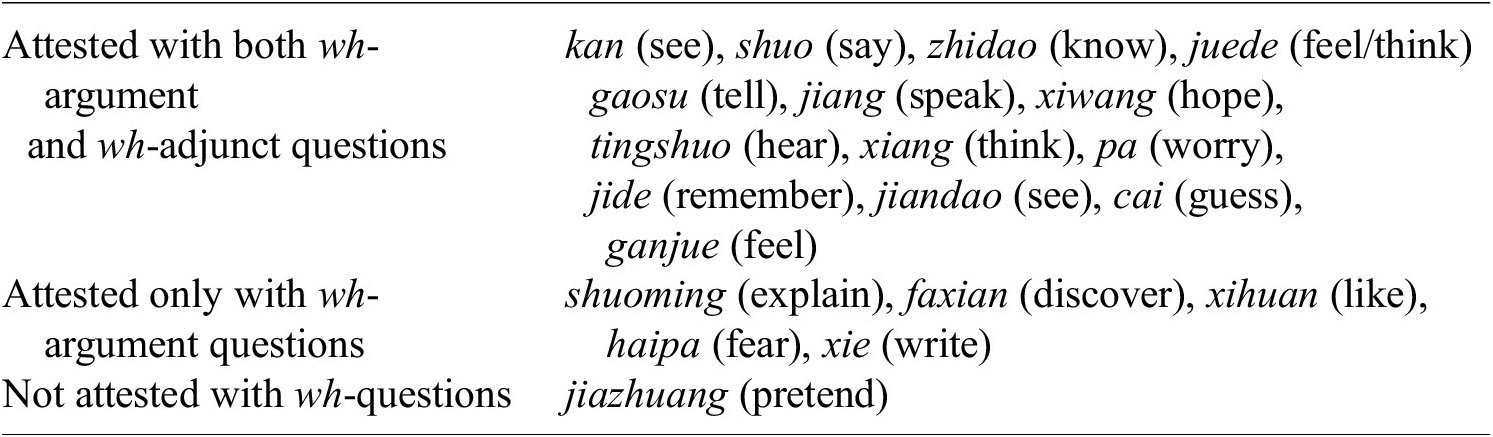

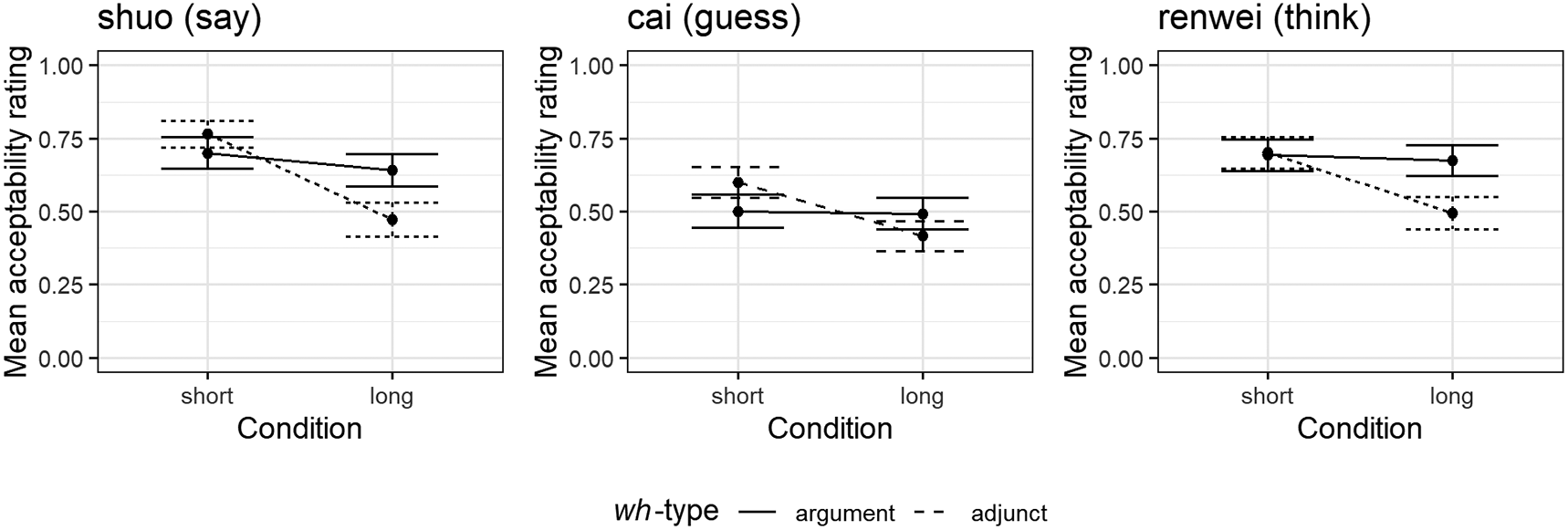

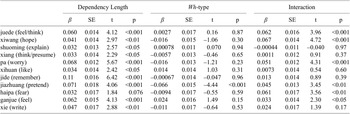

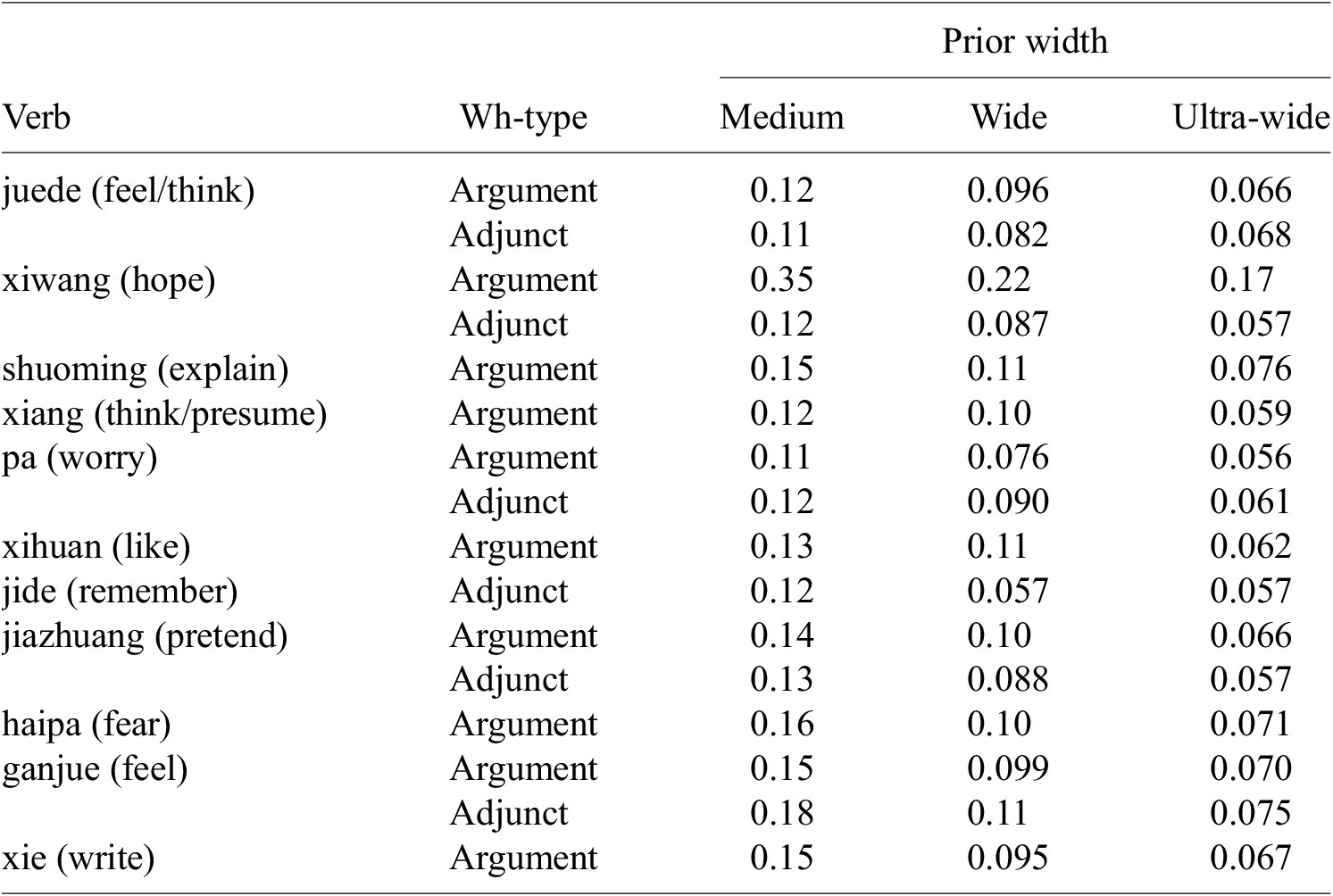

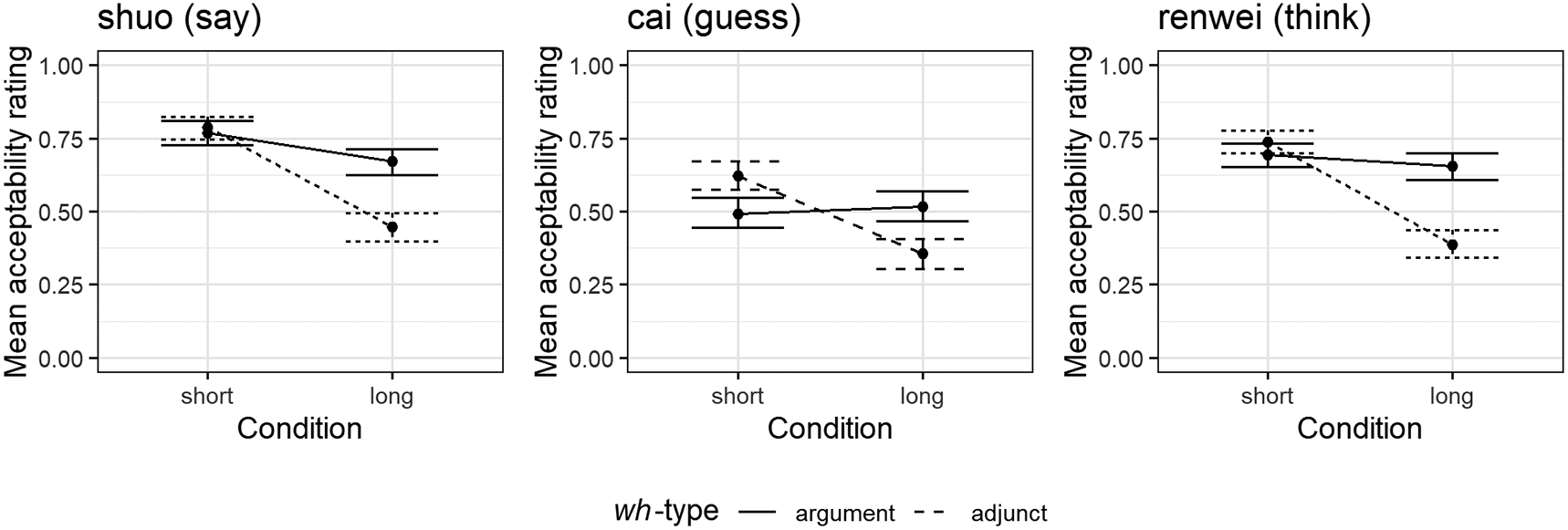


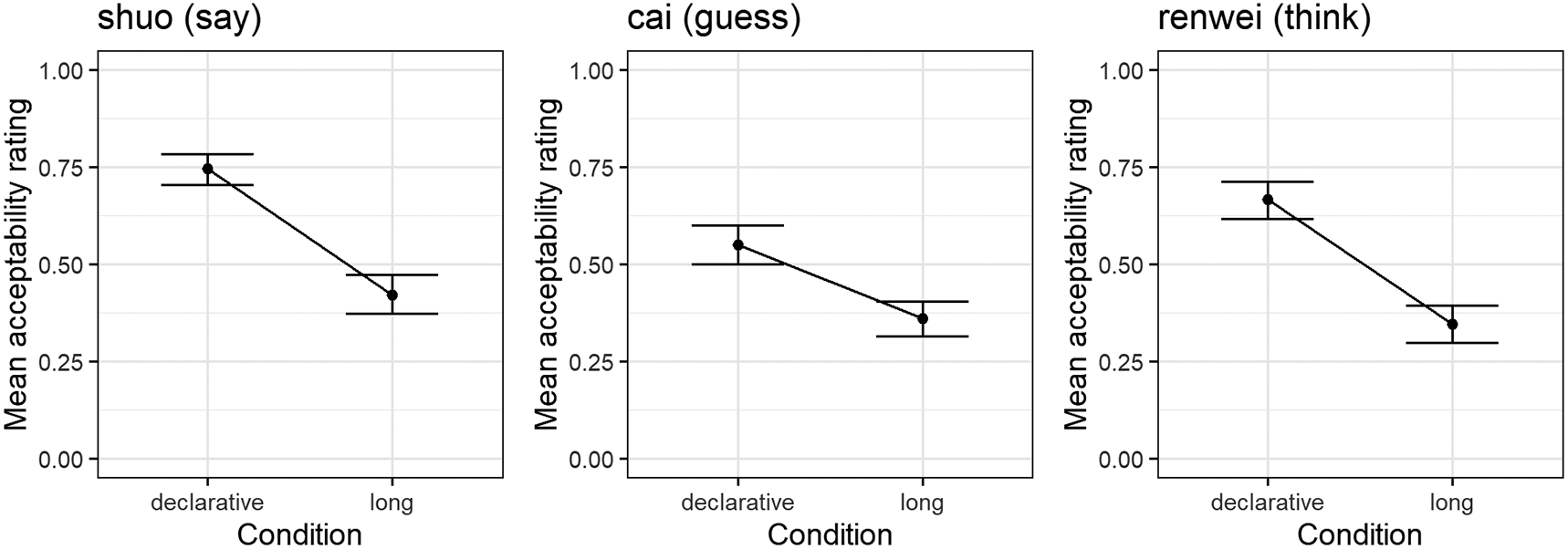


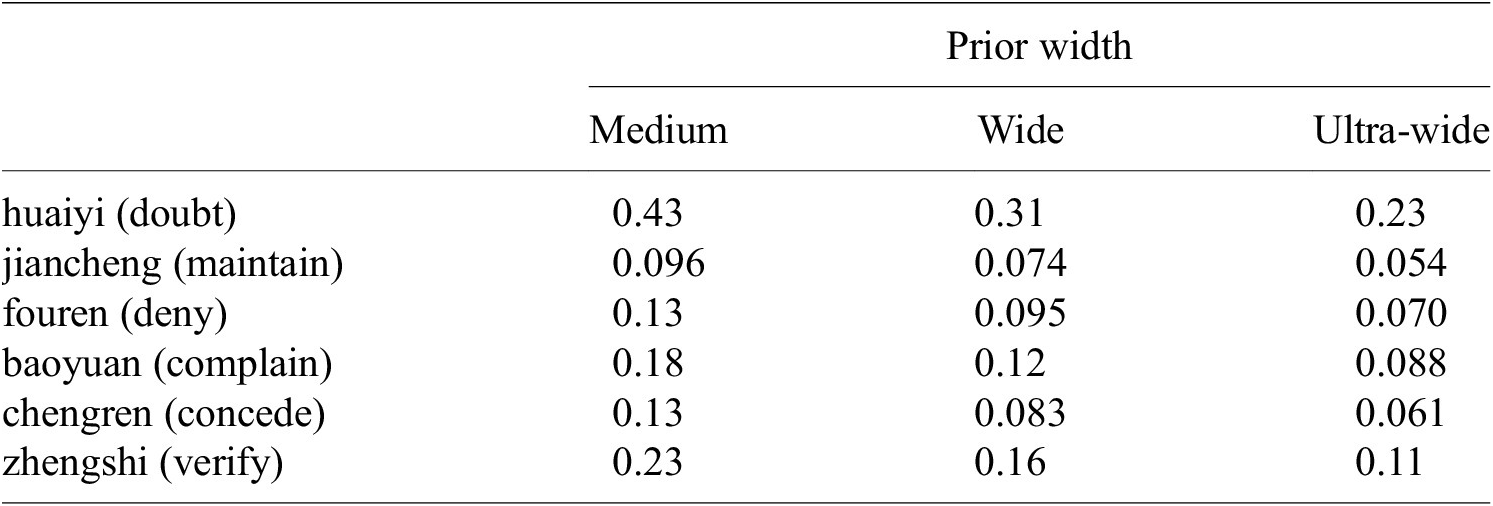

 Open access

