


Introduction
Populist radical parties and politicians Footnote 1 from both the left and the right have become a stable feature of most European systems. Their electoral success has often led them to achieve government office in various forms. Sometimes they provide external support to the cabinet, as was repeatedly the case for the Danish People’s Party. At other times, they are a small partner in coalition with larger mainstream actors, as was the Finns Party in the 2015 Sipilä Cabinet. In other cases, they are instead the protagonists of the coalition, as has been the case for Viktor Orbán’s Fidesz in Hungary or SYRIZA in Greece. Often, we tend to consider government parties as the expression of the political mainstream. Would this mean that governing populist radical parties (PRPs) have lost their “challenger” connotation and become moderate actors? Or rather that social norms and values about what stances are considered politically acceptable have changed in favor of the populists (Valentim, Reference Valentim2021)?
It is controversial whether populist parties in power moderate their positions or rhetoric (Riera and Pastor, Reference Riera and Pastor2022; Schwörer, Reference Schwörer2022). Even though it has been argued that engaging in electoral competition gradually hampers the ideological extremeness of radical actors (van Spanje and van der Brug, Reference van Spanje and van der Brug2007; van Spanje and de Graaf, Reference van Spanje and de Graaf2018), some studies contradict this “inclusion-moderation thesis” (Brocker and Künkler, Reference Brocker and Künkler2013; Akkerman, Reference Akkerman2015; Bernhard, Reference Bernhard2020). Moreover, we do not know how the public perception of populist radical actors changes when they are in government: are they perceived as ideologically more moderate? Under what conditions?
Indeed, the public perception of party positions might matter even more than their actual stances. First, people vote for a party because of how they see it, more than what it really stands for. We know that individual perceptions may differ, as that they are influenced by a variety of factors, including issue salience and party communication strategies (Bos et al., Reference Bos, van der Brug and de Vreese2011; Elias et al., Reference Elias, Szöcsik and Isabel Zuber2015; Banducci et al., Reference Banducci, Giebler and Kritzinger2017; Meyer and Wagner, Reference Meyer and Wagner2020; Wagner and Meyer, Reference Wagner and Meyer2023). Second, people see a party in a certain way not only because of what the party says, but also because of what the party does. In short, voters rely on informational shortcuts to infer party positions: for instance, leadership changes (Fernández-Vázquez and Somer-Topcu, Reference Fernández-Vázquez and Somer-Topcu2019) or elite interactions (Adams et al., Reference Adams, Weschle and Wlezien2021). This suggests that the extent to which the public image of parties changes has consequences for party performance and voting behavior, but also for the quality of representation more generally.
This paper addresses government participation as a key informational cue for party positions. In fact, voters’ perception of political parties is also affected by the company they keep, i.e., which parties they form coalitions with (Adams et al., Reference Adams, Ezrow and Wlezien2016). Research has shown that coalition partners are seen as closer to each other (Fortunato and Stevenson, Reference Fortunato and Stevenson2013), with a greater influence of larger and more centrist actors (Bowler et al., Reference Bowler, Gschwend and Indridason2020). However, we do not know whether such findings also hold for PRPs, as previous studies have mainly investigated the effects of coalescing with a radical actor from the perspective of mainstream parties (Hjermitslev, Reference Hjermitslev2022).
I instead posit that joining a government coalition is both an opportunity and a challenge for PRPs, which could produce peculiar dynamics. Public office enables incumbents to intervene on the political agenda and deliver the policies desired by their voters. But if being part of a coalition makes populist radical actors be seen as part of the political mainstream, this might also expose them to the risk of losing protest voters. The public perception of PRPs’ ideology therefore matters for their future electoral performance. Moreover, it can contribute to our understanding of how social norms about the acceptability of radical stances might evolve. This paper thus aims to answer the following research question: are populist radical parties perceived as more moderate when they are in government?
First, I link my research question to the – seldom connected – literatures on coalition heuristics and the inclusion-moderation debate. Then, I rely on time-series cross-sectional data from 29 elections in 20 European countries to investigate the perceptions of PRPs in government. The results of the multi-level regression models do not bring conclusive evidence that those parties are perceived as more moderate than either similar parties that are not in government or governing parties that are not populist nor radical. Still, finding that participation in government does not lead populist radical actors to be perceived as more moderate is an unexpected but important result. On the one hand, it could mean that voters can still recognize radical parties as such, therefore at least potentially threatening for ideological polarization and systemic stability. On the other, being perceived as distant from and uncompromising with the establishment might allow PRPs to prosper electorally, without paying the price of being in office.
Assessing the position of governing parties
Coalition behavior is considered an important heuristic from which voters can infer political parties’ policy positions. Previous literature has found that voters consider political actions of parties in addition to (if not more than) their programmatic stances. In fact, perceived changes in party position only weakly correlate with their actual shifts in policy platforms (Fernández-Vázquez, Reference Fernández-Vázquez2014) and are moderated by perceived salience (Plescia and Staniek, Reference Plescia and Staniek2017). We know that not only stable cooperation but mere coalition signals can change the assessment of party policy positions (Falcó-Gimeno and Muñoz, Reference Falcó-Gimeno and Muñoz2017), with important implications for affective polarization (Wagner and Praprotnik, Reference Wagner and Praprotnik2023) and voting behavior (Gschwend et al., Reference Gschwend, Meffert and Stoetzer2017).
There is abundant evidence that joining a coalition changes the perception of party positions. Fortunato and Stevenson (Reference Fortunato and Stevenson2013) find that coalition partners are perceived as ideologically closer than parties that are not in the same coalition. Still, they do not test if the perceived position is more proximate to that of the main coalition partner or the most moderate or extreme one. A partial answer comes from Fortunato and Adams (Reference Fortunato and Adams2015), showing that voters perceive the policy position of junior partners as closer to that of the Prime Minister’s party. Similarly, Bowler et al. (Reference Bowler, Gschwend and Indridason2020) conclude that voters tend to perceive larger and more centrist parties as having a greater influence on the policy of the coalition. We might therefore assume that a coalition will be perceived as more moderate if it includes a big, traditional (and relatively centrist) party as the main partner. At the same time, however, small parties seem to have a disproportionate weight in shaping the ideological perception of a coalition (Warwick and Druckman, Reference Warwick and Druckman2006; Lin et al., Reference Lin2017). In some cases, cooperating with a small extreme party might even lead mainstream actors to be perceived as more radical (Hjermitslev, Reference Hjermitslev2022). In short, even though coalition behavior seems to affect most smaller parties’ perceptions, radicalism might matter more than party size.
Nonetheless, some studies (Adams et al., Reference Adams, Ezrow and Wlezien2016; Adams and Bernardi, Reference Adams and Bernardi2019) show that although coalition partners are perceived to shift position in the same direction, there is no strong evidence of convergence over time. And indeed, limiting such perceived convergence might be beneficial for parties. Especially as elections get closer, parties might have incentives to differentiate themselves from their coalition partners by highlighting differences in their policy profiles. Similarly, Spoon and Klüver (Reference Spoon and Klüver2017) argue that respondents’ ability to disentangle the policy positions of coalition partners depends on the degree of internal conflict in the coalition. If parties are more conflictual, they will adopt stances that are clearer and more distant from each other.
This generates a trade-off between the benefits of institutionalization and the risk of losing radical supporters – especially for populist radical actors. Although mainstream (generally larger and more centrist) parties usually shift the perception of their coalition closer to their stances, smaller partners might be electorally rewarded for maintaining their distinctiveness by highlighting positions on which they are further apart. We know that, under some conditions, parties do emphasize extreme positions with a view to achieving policy differentiation (Wagner, Reference Wagner2012). In particular, populist radical actors – that often mobilize on anti-establishment sentiments – should benefit from a larger perceived distance from their mainstream coalition partners. In fact, although being perceived as more moderate might help radical populists to become institutionalized, it exposes them to the risk of alienating voters who supported them exactly because of their characterization as outsiders.Footnote 2
Populist radical parties in government
How do voters react to populist and/or radical parties in office? There are studies showing overall positive effects of legitimizing populist radical (right) actors on the attitudes of their voters. Indeed, when such parties gain representation in parliament (Reinl and Schäfer, Reference Reinl and Schäfer2021) or enter government (Haugsgjerd, Reference Haugsgjerd2019; Harteveld et al., Reference Harteveld2021) their supporters’ satisfaction with democracy increases. Similarly, the inclusion of protest parties in government improves the institutional trust of their voters (Kriesi and Schulte-Cloos, Reference Kriesi and Schulte-Cloos2020; Muis et al., Reference Muis, Brils and Gaidytė2022). Seeing their preferred party gain office makes these voters feel more represented and overall less critical of the country’s democratic quality. Still, we do not know if these effects also apply beyond party supporters. Moreover, as shown in the previous section, there is a gap in current literature when it comes to how government participation affects the public perception of PRPs specifically, as research on inclusion-moderation and coalition heuristics provide mixed evidence.
There are several reasons to expect that populist radical parties in office will be perceived as more moderate. First, as for any ruling party (not necessarily in a coalition), the fact that PRPs enter government might be interpreted as a sign of responsibility on their side. In fact, it could show that they are willing to accept the rules of the game and the perks of office, as well as the possible policy constraints. This might therefore generate the expectation that PRPs will tone down their policy proposals to make them more realistic or to comply with practical external constraints to government action (e.g., budget limits or European Union guidelines). According to this normalization argument, voters would get accustomed to the idea that a PRP can be in government, enjoying the legitimation of at least part of the electorate, and perceive the party as an institutionalized actor.
Second, participation in a government coalition might reinforce the perceived moderation of PRPs. Collaboration with other actors signals that the party is open to political compromise, or at least available to negotiate some policy positions. This is especially the case when the coalition includes mainstream parties that are more established and more centrist. On the one hand, this is because traditional parties might have more experience and leeway to limit the policy influence of PRPs; on the other hand, because this cooperative behavior might signal that PRPs are suitable and legitimate partners. In other words, this argument would suggest that voters perceive PRPs as more moderate due to coalition heuristics.
There are, however, also possible counterarguments. The fact that a PRP reaches government might lead voters to see it as less moderate. Literature on affective polarization has found evidence of a legitimation/moderation effect when populist radical right parties increase their electoral success, which however does not seem to hold for government participation (Harteveld et al., Reference Harteveld, Mendoza and Rooduijn2022). Instead, the power gain of PRPs could increase the perception of threat by some parts of the electorate, in particular their political opponents (out-partisans). This is in line with some recent evidence from Italy (Seddone and Zulianello, Reference Seddone and Zulianello2023). According to this backlash effect argument, the increasing influence of PRPs on the national political agenda might raise concerns for the state of democracy and increase the perception of those parties as even more radical.
Indeed, perceptions of moderation might be driven by actual position shifts. It is possible that PRPs do moderate their positions, with a view to becoming governing partners. However, we lack sufficiently fine-grained data to measure how parties change positions immediately after taking office, compared to the election campaign. In this paper, therefore, I adopt a different strategy and assess whether, all else being equal, government participation of populist radical parties leads voters to perceive them differently from other PRPs outside government and from non-PRPs in government. In other words, this paper does not show how the perceived position of populist radical parties evolves over time but rather if their inclusion in government has a special effect compared to other actors. Furthermore, although lacking data on real party positions, I use expert evaluations of political parties as a reference to understand if PRPs in government are seen as more moderate than they actually are.
Overall, I expect that the inclusion of a PRP in a governing coalition may lead to that party being perceived as more legitimate, and thus ideologically more moderate, by the broad electorate (H1). This could be due to a legitimizing effect of institutional inclusion (normalization argument) but also to coalition behavior (coalition heuristics argument). Especially when the coalition is announced, in fact, partners will highlight agreement and similarities in their programs, even though incentives for differentiation might emerge later on. This would lead to a general perception of moderation. More specifically, I expect that:
Hypothesis 1a: Populist radical parties in government are perceived as ideologically more moderate.
The coalition heuristics literature, however, also shows that the perceived position of political parties might depend on their role in the coalition. This could be particularly the case for populist radical parties forming a coalition with mainstream parties: not only for the legitimation effects that follow, but also for the expected influence in the coalition. The party of the Prime Minister (PM), in particular, might be forced to adhere to its institutional role and moderate some of its stances, for instance to gain respectability in the international arena. In brief, although any government role should boost the perceived moderation of populist radical parties, I expect this effect to be larger when the PRP is the PM party compared to when it is a junior partner, according to the normalization and coalition heuristics arguments.
It could also be the case that junior partners benefit from the government cue more than PM parties. It is possible that populist radical parties that are junior partners are seen as more manageable partners, who can be somewhat domesticated by mainstream actors, while a PRP being the main coalition partner could trigger backlash effects, leading to the perception of mainstream parties as more radical than they are. Still, I argue that the party of the Prime Minister enjoys a special responsibility role that should increase its perceived moderation. My second hypothesis thus follows:
Hypothesis 1b: The perceived moderation is larger for the PM party than for junior coalition partners.
Furthermore, following the backlash effect argument, I propose that the extent to which citizens perceive a PRP as either more or less ideologically extreme depends on their partisan beliefs. First, I expect that voters who identify with a party (partisans) and those who do not feel attached to any party (non-partisans) assess party positions differently. Second, I argue that supporters of PRPs may react differently to their party joining government compared to voters supporting either a coalition partner or an opposition party. Several arguments corroborate these claims.
The first argument suggests that, in general, some voters will use coalition heuristics more than others. In fact, we can expect voters who identify rather strongly with a party to be more informed about politics and, specifically, about their preferred party. Instead, non-partisans would need to rely more on other types of cues, including coalition behavior, to assess the ideological placement of a party. Similarly, Fortunato and Stevenson (Reference Fortunato and Stevenson2013) show that less politically knowledgeable and interested citizens rely more significantly on coalition heuristics.
Accordingly, I expect that the effect of government participation on the perceived moderation of PRPs depends on party identification (H2). As citizens who do not support any specific party are supposedly less interested in politics, the public framing of PRPs should have the strongest impact on these non-partisans, who should be more sensitive to the portraying of those actors either as extremists or as legitimate government members, for instance in the media. I therefore formulate a first hypothesis connected to partisan beliefs, suggesting that voters with no strong identification (non-partisans) will perceive governing PRPs as more moderate compared to voters with strong attachment to any political party:
Hypothesis 2a: The effect of the government participation cue is larger for non-partisans than for other types of voters.
Another argument proposes that party placements by voters are biased by their specific political affiliation. For instance, literature on assimilation and contrast effects (Drummond, Reference Drummond2011; Grand and Tiemann, Reference Grand and Tiemann2013; Calvo et al., Reference Calvo, Chang and Hellwig2014) shows that, when assessing party positions, voters tend to overestimate the ideological proximity to parties they like (assimilation) and the distance from those they do not like (contrast). This argument is also connected to motivated reasoning, suggesting that partisanship selectively alters information-processing (Jerit and Barabas, Reference Jerit and Barabas2012). In fact, it has been shown that supporters of different parties differ in the assessment of government corruption and responsibility (Blais et al., Reference Blais, Gidengil and Kilibarda2017; Plescia et al., Reference Plescia, Kritzinger and Spoon2022). Moreover, this perceptual bias would make supporters’ perceptions more stable over time, as strong party identification might lead them to discount the actions of their preferred party. In other words, they might tend to justify their party when it moves in a direction they dislike or be less willing to accept that their preferred party has changed positions.
I therefore formulate a second hypothesis concerning the role of partisan beliefs, in which I account for the identification with specific parties, rather than with any party. In brief, I argue that government participation should have the least effect on the perception of a PRP for its supporters (in-partisans), who might discount the coalition behavior of their preferred party due to motivated reasoning. Supporters of non-PRP opposition parties (out-partisans) should also be reluctant to acknowledge moderation of the PRP because they already hold strong opinions about (and possibly dislike) their out-party. However, this effect could be different for supporters of another coalition partner: they might justify the coalition behavior of the party they identify with by projecting its positions onto their populist radical coalition partner – a typical assimilation effect. In short, while in-partisans and out-partisans of populist radical parties are unlikely to change their perceptions much, supporters of other coalition partners (coalition in-partisans) should be the most likely to update their perception of the PRP. More specifically, I hypothesize that:
Hypothesis 2b: The effect of the government participation cue is larger for partisans of a coalition partner of the populist radical party than for other partisans (supporters of the populist radical party or an opposition party).
It is also possible that there are no such differences between groups of voters. For instance, political sophistication might have a rather small impact in case of new and relatively unknown parties, running against H2a. Conversely, if a PRP has been contesting the elections and included in the party system for multiple electoral cycles, voters might have time to grasp the positions of the party, which will therefore be more stable. Moreover, in contrast to H2b, PRP supporters could perceive their party in government as “selling out” and compromising with mainstream parties. Therefore, they might see the party as even more moderate, thus relying on the government cue more than supporters of other parties. However, this effect should be limited to cases when supporters of the PRP were opposed to joining the coalition from the outset – something that, unfortunately, we cannot test comparatively with current data.
In a nutshell, the proposed causal mechanism suggests that participating in government affects the perceived position of PRPs, and that this effect is moderated by partisanship.
Data and methods
The empirical analysis of this paper uses time-series cross-sectional data from the Comparative Study of Electoral Systems (CSES). Its latest release at the time of writing, from December 2024, provides information on citizens’ perception of political parties in multiple countries, besides individual-level information on respondents. I rely on Modules 5 and 6, spanning between 2015 and 2022 and covering a total of 29 elections in 20 countries.Footnote 3 This data is precious because it incorporates several levels simultaneously by capturing individual-, party-, and country-level variables. Furthermore, it pools together multiple parties, countries, and elections, providing us with more cases of PRPs in and outside government. This also entails the possibility to observe alternative counterfactuals to the phenomenon of interest, allowing me to compare PRPs in government to both PRPs outside government and non-PRPs in government. Lastly, the dataset reports information on government status after the election (including the exact role in the coalition) as well as experts’ assessment of party positions and populism. This enables me to estimate models with an alternative outcome, measuring not only the perceived placement but also the relative placement compared to the “correct” party position.
The data also has some limitations. First, since it consists of post-election waves, it fails to capture the change in perception produced from the government cue but only measures the final perception resulting from that cue. I cannot, therefore, compare how a party was perceived before and after taking up government but rather if its perception in government is different from the perception of similar parties in and out of government. Second, some relevant cases are not within the scope of the dataset, for instance Italy in 2022, with the victory of Fratelli d’Italia (Marini and Piccolino, Reference Marini and Gianluca2023), and Spain in 2020, when Podemos joined the government (Orriols and León, Reference Orriols and León2020). In some cases, this is due to the partial coverage of the CSES modules; in others, to the fact that not every government alternation follows elections – as is evident in the case of Spain. Another disadvantage of these missing data is the limited variation in the governmental roles held by PRPs. In particular, there is no case of a PRP entering government for the first time as PM party. For the sake of simplicity, I therefore only account for the role in the coalition and disregard the timing – although it would be theoretically important to disentangle the effect of previously holding office. Accordingly, the predictor of government role is only focused on whether the party is in government after the election, regardless of whether it had also been in the previous term(s).
To begin with, I identify populist radical parties based on the expert assessments included in CSES. I code parties that are placed below 3 on the 0-to-10 scale as “radical left” and those that are placed above 7 as “radical right.” I then code as “populist” all parties that score 5 or above on the populism scale. From the combination of these dummy variables, I classify as PRP all parties that are populist and either radical left or radical right. The remaining parties are classified as non-PRP. This classification largely overlaps with the one provided by the PopuList dataset (Rooduijn et al., Reference Rooduijn2024), but being slightly more permissive allows us to explore some grey zones in the coding.
To test my hypotheses, I estimate a series of multi-level models that take into account the government status and role of the party and individual-level drivers of party perceptions while controlling for country- and year-level contextual specificities. I estimate hierarchical (mixed) models, including random effects for country, election year, and respondent,Footnote 4 and robust standard errors. This makes the computation quite demanding (especially on models that require subsampling or with multiple interactions), providing for a rather hard test of the hypotheses. In fact, although all analyses are at the level of respondents, I use different specifications to achieve the best possible estimation. I first estimate models for PRPs and non-PRPs separately, then introduce a dichotomous variable distinguishing between these two party types. I do the same to test H2, by first splitting the sample into supporters of different parties and then incorporating this information as a categorical variable through an interaction term.
I use two dependent variables to estimate the effect of government participation on the perception of PRPs. First, I assess the perceived extremism of the party through the survey item asking respondents to place parties on a left-right continuum. My dependent variable thus corresponds to the absolute values of the rescaled 0-to-10 variable.Footnote 5 This makes my coefficients directly interpretable: negative signs indicate that the party is perceived as more centrist (i.e., moderate) and positive signs that it is seen as ideologically more radical. The second dependent variable instead leverages on the inclusion of an expert assessment of “actual” party positions. Although technically this is still measuring a perception (by experts instead of common voters), I use it to test whether PRPs are perceived as more moderate than they actually are – in other words, how accurate public perceptions are. To calculate this variable, I take the difference between the absolute values of the left-right placement by the expert and by the respondent. Therefore, negative coefficients indicate that the party is perceived as less moderate by voters compared to experts, while positive signs indicate an overestimated centrism.
The main predictor to test H1 is the government status and role of the party. I create a categorical variable indicating if the party is in opposition, in government as junior coalition partner, or as the PM party. This allows me to test the coalition heuristics mechanism in depth, by including the variable individually and as an interaction with party type. To test H2, I distinguish different types of partisans based on whether respondents identify with the PRP (in-partisans), a non-PRP coalition partner (coalition in-partisans), an opposition non-PRP (out-partisans), or no specific party (non-partisans).Footnote 6 This is coded through another categorical variable. All models further control for the respondent’s self-placement on the left-right scale, political interest, gender, age, and education level – all individual features that might influence party perceptions.
The empirical analysis is structured as follows. In the first part, I estimate if respondents consider populist radical parties in government as more moderate than (1) other PRPs that are in opposition and (2) other governing parties that are non-PRPs. I then test if this effect is different for supporters of different parties. In the second part of the empirical section, I turn to the alternative dependent variable to test if populist radical parties are perceived as significantly more centrist than they actually are, compared to the other types of party, and if partisanship moderates this effect.
Empirical analysis
Are governing populist radical parties perceived as more moderate than other parties?
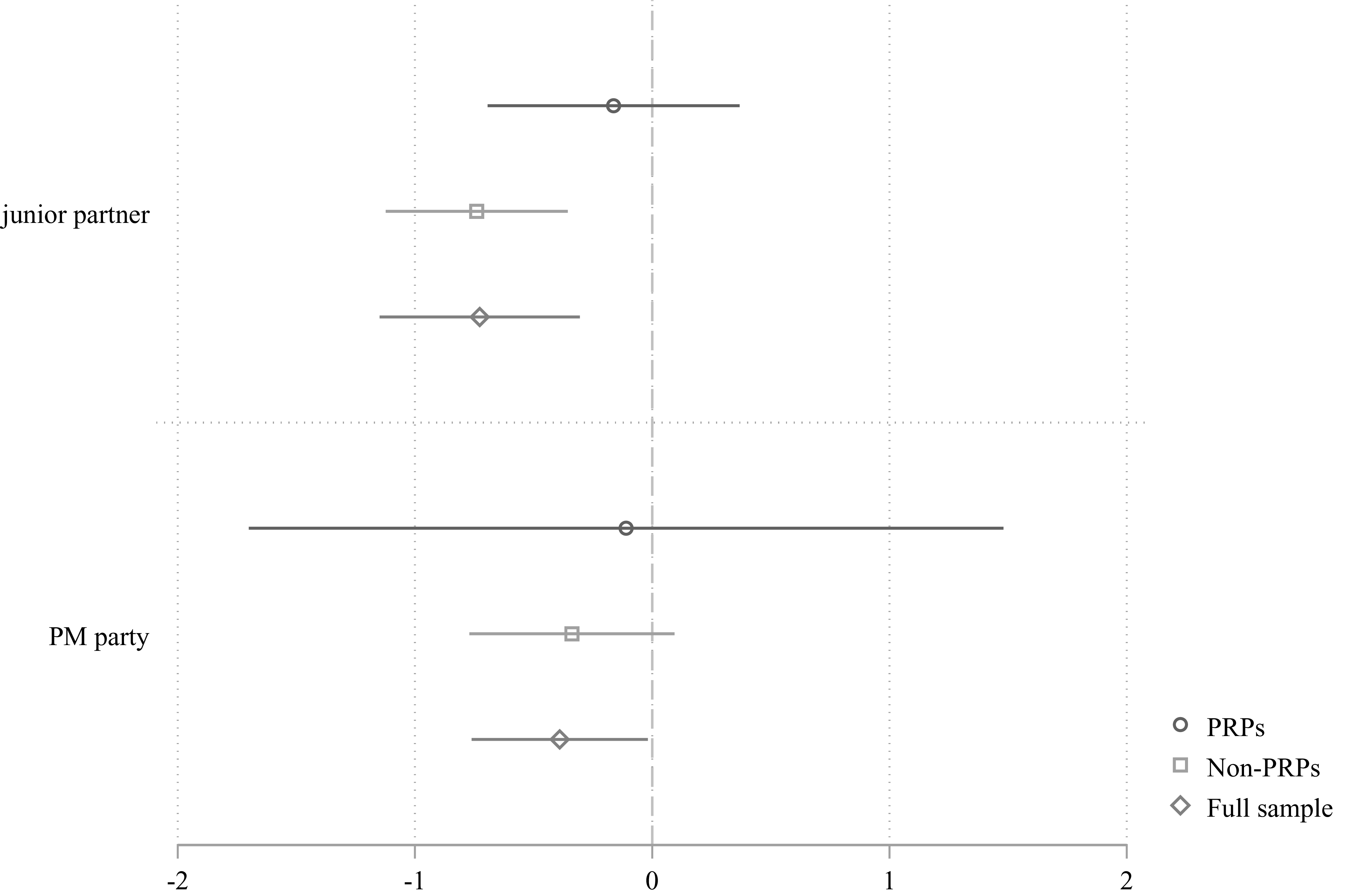
To answer this question, I proceed stepwise with different subsampling of the data. Figure 1 plots the relevant coefficients from these three different models. Overall, we can see that parties in government are generally considered more moderate than opposition parties (the reference category), as all coefficients have a negative sign. Moreover, this seems to be especially the case when they are the junior partner in the coalition, as estimated coefficients are larger in size. For more specific analyses, let us now examine each model separately.
Plot of coefficients with 95% CIs from Models A, A1, and B (Table A2).

First, the sample is limited to PRPs, and only the direct coefficient for government status is assessed (Model A in Table A2). Results from this model are not statistically significant, although the signs point in the expected direction, which would indicate that populist radical parties that are in government (regardless of whether they are junior partners or the PM party) are seen as more moderate than those in opposition. The corresponding coefficients plotted in Figure 1 (with the circle marker) show that populist radical parties in government are not considered significantly more moderate than opposition PRPs, regardless of their role within the coalition. This brings no evidence in favor of H1a or H1b, as there is no difference between PRPs with different roles in government.
Then, I model this on a subsample of non-PRP parties (Model A1) to understand whether the pattern is the same or the opposite. From this model we see that only non-PRP junior partners are considered as more moderate than non-PRP opposition parties at a conventional level of statistical significance. Comparing these results with those from Model A, we see that coefficients are larger and more precise for non-PRPs, suggesting that non-PRPs in government are perceived as more moderate than governing PRPs. The second pair of coefficients plotted in Figure 1 (square marker) shows that non-PRPs are perceived as more moderate than opposition parties when they are the junior partner in the coalition, while the effect is not significant when they are the PM party. Overall, it seems that the evidence for non-PRPs goes against the logic of H1b, as it is junior partners that are considered most moderate due to government participation.
Second, I estimate models on the full sample by adding a dummy for PRPs in Models B and C (Table A2). The former model (with no interaction effects) shows that governing parties are overall seen as significantly more moderate, especially when they are the junior coalition partner. It is also visible from the coefficients in Figure 1 (diamond marker), showing that both types of government partners seem to benefit from a higher perceived moderation. That model also clearly shows that populist radical parties are perceived as significantly more radical than non-PRPs, with a magnitude of more than 1 unit on the 0–5 scale.
In Model C, in order to assess the perception of PRPs in government, I add an interaction between PRP classification and government role. We see that, compared to non-PRP opposition parties, there is no statistically significant difference in how governing PRPs are perceived by respondents. The interaction terms, however, suggest that the perceived moderation of junior partners is lower when they are also PRPs, while it is stronger for PM parties that are PRPs. Although the interaction terms fail to reach conventional levels of statistical significance, results thus suggest that, in line with H1b, PRPs expressing the PM are perceived as more moderate than PRPs acting as junior partners.
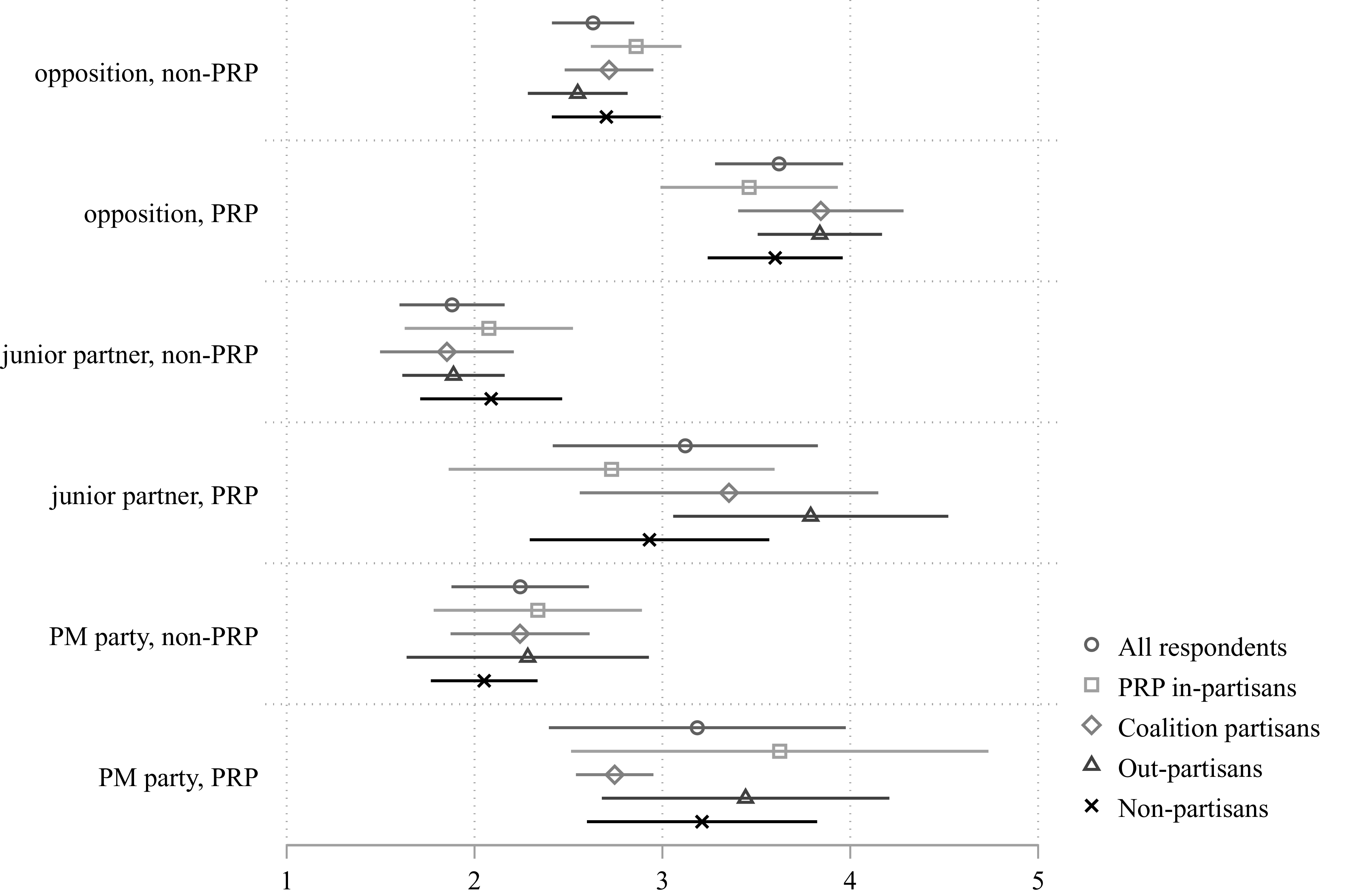
Model C is also plotted in Figure 2, showing the predictive margins for all possible combinations of the independent variables (government status and PRP). The circle markers at the top show that opposition parties are perceived by respondents in the full sample as slightly more radical compared to both junior partners and PM parties, be they PRPs or not, holding all other variables constant. PRPs in opposition are seen as the most extremist on average, followed by both types of governing populist radical parties. Non-PRPs are seen as most moderate when they are the junior partner in a government coalition and most radical when outside government. However, the differences between these groups are not statistically significant.

Finally, let us address H2: is this effect different for supporters of different parties? I estimate again Model C on subsamples based on partisanship (Models D1 to D4 in Table A3, predictive margins plotted in Figure 2). I first subset the sample to supporters of the PRP (Model D1), where we see that the interaction terms are positive and not significant. For supporters of other coalition partners (Model D2), we find that they tend to perceive PRPs in government as more moderate only when they express the PM, while in case of them being junior partners we see no significant effect. Lastly, supporters of opposition parties (Model D3) or of no specific party (Model D4) do not seem to differentiate between PRPs and non-PRPs, nor among parties with a different government role, at conventional levels of statistical significance.
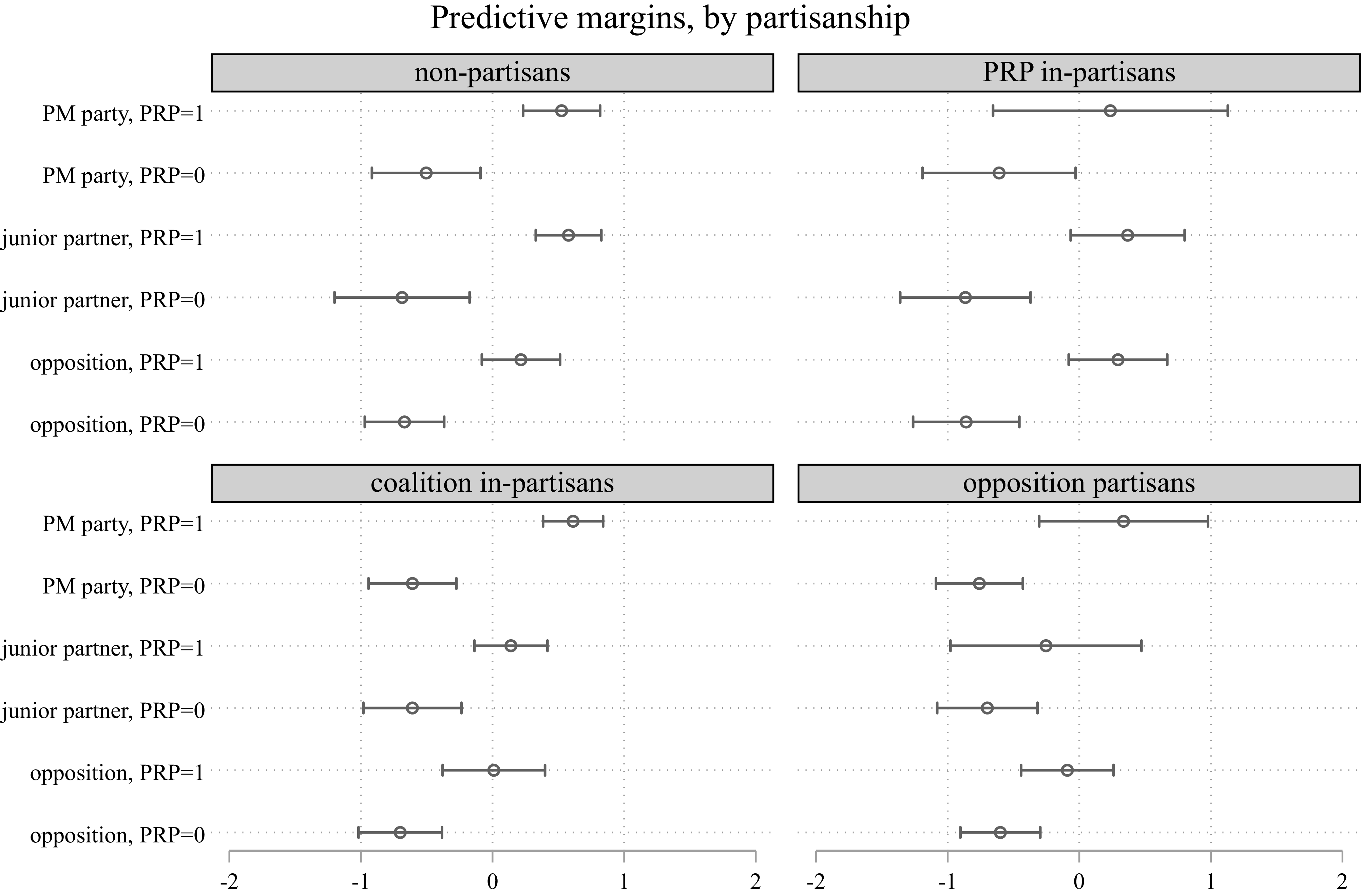
Looking at Figure 2, we see no substantial difference among partisan groups in the perception of parties in and outside government. The only exception is that supporters of other coalition partners consider populist radical parties that are the main coalition partner (PM party) as significantly more moderate compared to the other groups. This finding supports H1b – because PM parties are seen as more moderate than junior partners – and H2b – because we see this effect for supporters of fellow coalition parties, but not for in-partisans of the PRP nor for out-partisans. However, it provides no evidence for H2a, since non-partisans do not seem more susceptible to government participation cues than other groups of voters.
Then, I estimate a model with a triple interaction between government role, PRP classification, and partisanship (Model E in Table A3). Here again, the only group of voters that seems to differentiate between PRPs and non-PRPs when they enter government are supporters of other coalition partners. However, this is only significantly the case when the PRP is the PM party: then, it is seen as more moderate. For supporters of the PRP, the effect (although not significant) seems to go in the opposite direction, with government participation leading to a perception of the party as more radical overall. Figure 3 illustrates this triple interaction by plotting the predictive margins for each combination of government role and PRP by partisanship. Although the average party placement is similar across groups of supporters, partisans of other coalition partners perceive PRPs that express the Prime Minister as significantly more moderate compared to all other groups.
Predictive margins (linear prediction, 95% CIs) of government role and PRP. Model E (Table A3).

H2 is therefore not fully supported by these models: all in all, there seems to be no conclusive evidence that partisanship significantly moderates the effect of government participation, except for supporters of non-PRP coalition partners (H2b).
Are governing populist radical parties perceived as more moderate than they actually are?
Next, I turn to the alternative outcome, that I calculate as the absolute difference between the placement by the CSES experts and by the respondent. Negative coefficients here indicate that the party is seen as more extreme by respondents than by experts, therefore my hypotheses are confirmed by positive coefficients. I follow the same steps as with the other outcome: first with subsets of the data and then with interaction terms on the full sample.
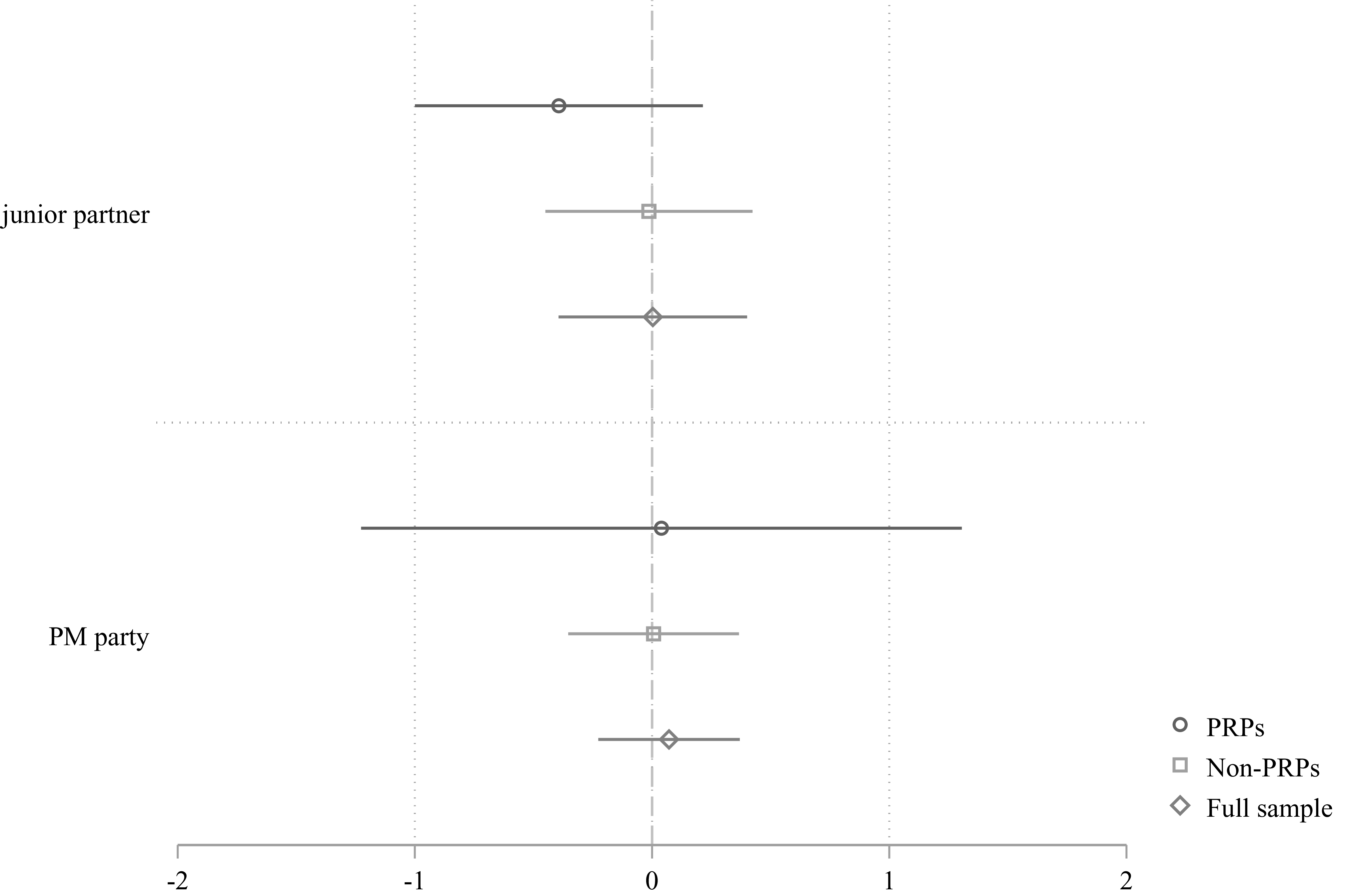
To begin with, I estimate the effect of government status on perceived party positions on a subsample of PRPs only (Model F in Table A4). It does not seem to be the case that respondents see PRPs as more moderate than the experts when they are in government, as coefficients are not statistically significant (and for junior partners the negative sign would even suggest that they are seen as more radical than they actually are). This is also illustrated in Figure 4 through the plot of coefficients (circle markers), showing no statistically significant effect. As before, I then estimate the model on a subsample of non-PRPs (Model F1). Here again, we see that non-PRPs are not perceived as significantly more centrist than they should, when they are in government. In Figure 4, this is shown by the square markers, both very close to 0. The results thus do not change if we compare governing PRPs to the two comparison groups: PRPs out of government and non-PRPs in government.
Plot of coefficients with 95% CIs from Models F, F1, and G (Table A4).

Then, I model this by adding a coefficient for PRP to the full sample (Model G in Table A4). It seems that governing parties are not overall estimated to be more centrist than they are, as also shown in Figure 4 by the last set of coefficients (diamond marker). Still, this model shows that populist radical parties are clearly perceived as significantly more moderate compared to expert judgments (the coefficient points to a magnitude of 0.86 on a 10-point scale).
Finally, when I model this with an interaction term (Model H), it seems that PRPs are perceived as more moderate compared to expert assessments when they are in government, but not at a conventional level of statistical significance. Therefore, there seems to be no significant difference in voter perceptions across PRPs and non-PRPs in government. This is further illustrated in Figure 5, plotting the predicted difference between expert and respondent estimates of party positions, on the whole sample (circle markers). The accuracy in the placement of PRP and non-PRPs does not change depending on their government role, although PRPs tend to be seen as more moderate by respondents than experts, while the opposite is true for non-PRPs. In some way, populist radical parties therefore do enjoy a boost in perceived moderation compared to actual party positions.

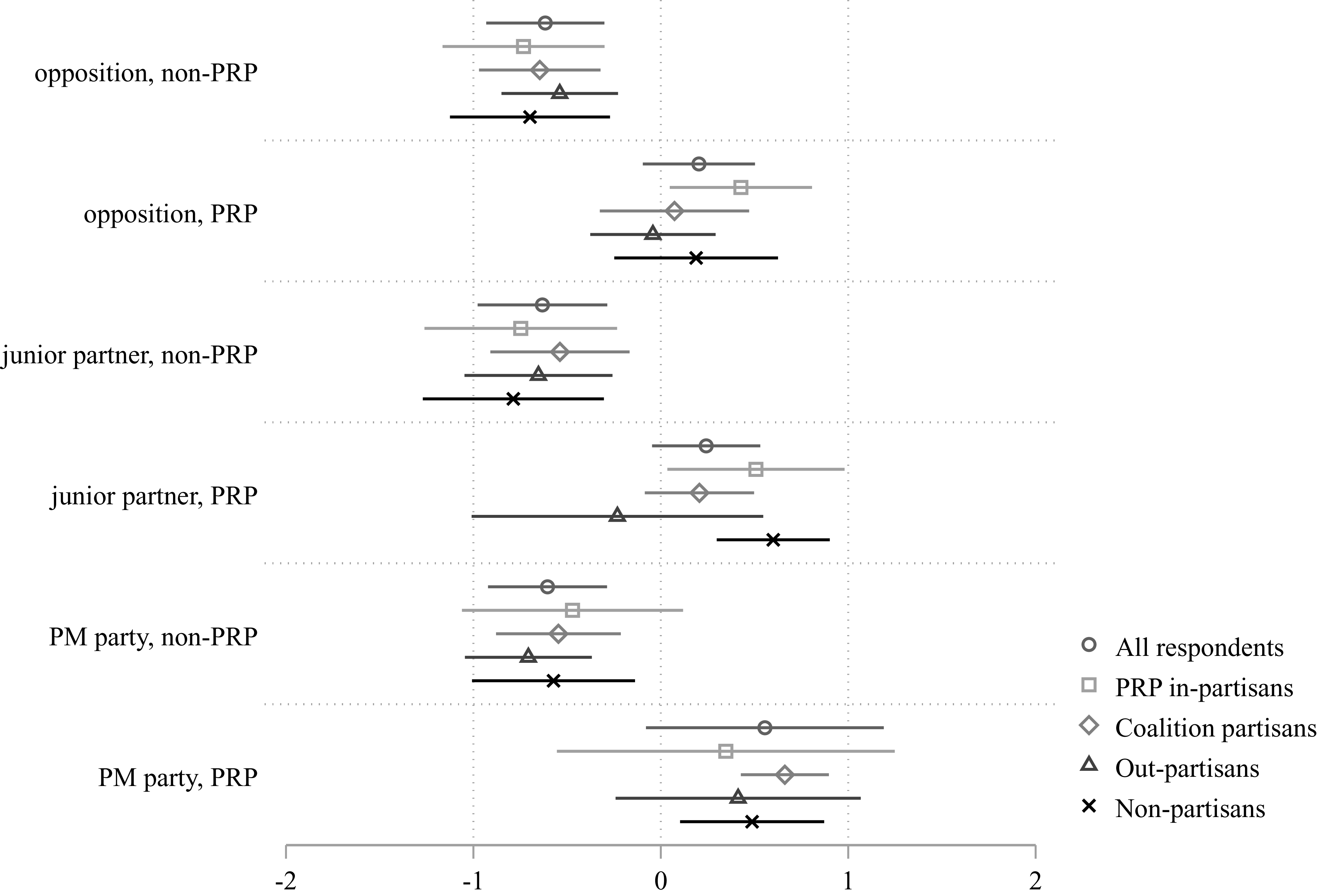
As a last step, I test again the moderating role of partisanship. I estimate a series of models on different subsamples of the data, depending on the party which the respondent feels closest to. All of them are shown in Figure 5, with predictive margins for each combination of government role and PRP. We see that overall there are no substantial deviations in the accuracy of respondents’ perceptions compared to experts, across subsamples. Two findings, however, stand out. One is that supporters of other coalition partners slightly overestimate the moderation of PRPs when they are the PM party (in line with H1b and H2b). This is also consistent with the results based on the first outcome, reinforcing this finding. The other is that non-partisans disproportionately consider moderate populist radical parties that are governing as junior partners. This partly contradicts H1b while supporting H2a.
More in detail, supporters of a populist radical party (Model I1) seem to perceive PRPs in government as less moderate than experts when PM parties, and more moderate when junior partners – although this is not estimated with a sufficient level of precision. Supporters of other coalition partners (Model I2) see PRPs as more moderate when they are in government in either role, but the effect is again non-significant. Supporters of non-PRP opposition parties (Model I3) do not seem to estimate PRP positions different from experts, regardless of their coalition status (with opposite and non-significant coefficients for main and junior partners). Finally, respondents who do not support any specific party (Model I4) see PRPs as significantly more moderate when they are junior members of the coalition (against H1b), while the coefficient for PM party is not significant although also positive.
Lastly, I model this through a triple interaction between government role, PRP status, and party support (Model J). No interaction term is significant, the only exception being coalition in-partisans, for which the effect is negative (underestimating PRP centrism). Overall, it seems that junior PRP partners are seen as less moderate by all groups, and PRPs nominating the PM are seen as more moderate, except from their own supporters. To better illustrate this, Figure 6 shows the predictive margins by group of supporters. From the figure, we see how all groups have a similar level of accuracy in their perception of party positions. We also see that, on average, the moderation of PRP is overestimated especially by supporters of non-PRPs when the PRP is the PM party and by non-partisans when PRPs are junior partners.
Predictive margins (linear prediction, 95% CIs) of government role and PRP. Model J (Table A5).

Again, there is thus no conclusive evidence that partisanship moderates the effect of government role on the public perception of PRPs, although there seem to be small differences in terms of accuracy for non-partisans compared to other party supporters – in line with H2a – and for coalition-partisans compared to in- and out-partisans – as suggested by H2b.
Discussion and conclusion
The findings of the study, summarized in Table 1, are largely unsupportive of my hypotheses. Governing populist radical parties are not considered to be significantly more moderate than those in the opposition, nor than non-PRPs in government (H1a). There is also no significant difference in the estimated placement of junior partners compared to the PM party, when these are PRPs (H1b). Partisanship does not seem to matter in this regard, either (H2a); the only exception are supporters of parties that are in the same coalition as the PRP but as junior partners – they perceive populist radical parties to be significantly more moderate than other groups of voters do (as per H2b, and H1b).
Summary of results: evidence for H1 and H2

Concerning the accuracy of party perceptions, results are very similar. Respondents do not significantly overestimate the moderation of PRPs in government compared to experts (H1a), and this is true regardless of their role in the coalition (H1b). Partisanship seems to play a role, though: non-partisans (H2a) see PRPs in government as more moderate than they actually are, while the effects are mixed for supporters of other coalition partners (H2b). However, for the former group, this only holds when PRPs are junior partners, providing evidence against H1b as well.
What we can conclude from this study is that populist radical parties are not, in general, seen as more moderate when they are in government. This has important implications for our understanding of the mainstreaming of these actors and party institutionalization more generally. A key implication is that we can have normalization not because a party has indeed moderated its positions, but because voters perceive it as more moderate due to its participation in government. This shows again the centrality of perceptions when studying political phenomena. If populist radical parties are still considered radical when they are in office, we can interpret this as a signal that their positions are not fully normalized yet – not even when they are the PM party. In other words, we should not equate inclusion in government as a full ideological normalization of populist radical parties, since voters still acknowledge that they have extreme positions.
However, although this study brings evidence against the inclusion-moderation argument, there could be other forms of mainstreaming. For instance, it could be perceived as normal to have a PRP in government: we cannot know with this type of data if voters consider this to be in any way threatening or dangerous for democracy.Footnote 7 If they do not, then it might be a sign that these are no longer pariah parties, in the sense that they are integrated in political competition despite their radical positions, with no expectations that they tone those down. Different research designs, for instance with survey and experimental data, would be needed to explore this question.
Moreover, the fact that governing populist radical parties are not seen as more moderate might indeed be beneficial for their electoral performance. If they succeed in maintaining ideological differentiation from their mainstream coalition partners and avoid policy sell-outs, this “purity” could be rewarded by voters in following elections. On the contrary, if they were seen as compromising and accommodating the positions of their more centrist partners, part of their electorate might feel disappointed and desert them. Although this is beyond the scope of this paper, we could expect that PRPs coalescing with mainstream parties might lose some anti-establishment supporters but could gain vote switchers from mainstream parties if perceived as moderate enough. In short, there are both up- and downsides to policy differentiation, and boosting their perceived moderation might not be the best strategy for populist radical parties – at least if they want to cultivate their own support base instead of mobilizing mainstream voters.
But this paper also shows that there is a group of voters that is indeed susceptible to the governmental cue: supporters of other coalition partners (H2b). Those voters do believe that the PRP is significantly more moderate compared to PRPs in opposition and seem to overestimate the centrism of those parties compared to experts. Government cues therefore seem to work for voters that have the strongest incentive to apply motivated reasoning to justify the coalition behavior of the mainstream party they identify with. As predicted by coalition heuristics literature, they project the stances of their preferred party on those of their populist radical coalition partner. Finding that PRPs in government become normalized in the eyes of supporters of coalition partners is important because these voters could become potential switchers to PRPs in the next elections. Furthermore, supporters of a governing mainstream party are a relatively large voting pool that could be beneficial for populist radical parties to recruit from. After all, it is likely that intra-block volatility occurs more easily and frequently than inter-block volatility, so supporters of fellow coalition partners should be the perfect target group for PRPs to gather new voters. This is also important because mainstream parties are usually those who can enable or gatekeep government participation of populist radical parties. If their voter base considers PRPs as normalized, then the costs of future collaboration in government will be lower, paving the way for successive government inclusion of PRPs. And although it is beyond the scope of this paper, we can argue that having previously participated in a coalition (i.e., multiple instances of inclusion in government) helps normalizing populist radical parties.
Overall, this study has some limitations. The main issue relates to the coverage of the CSES dataset, that overlooks some countries, elections, and government formations that could be relevant to analyze. A different research design that devotes enough space to the discussion of individual case studies could help shed more light on most- or least-likely cases, possibly accounting for their contextual specificities. In this paper, I privileged a large-N time-series cross-national approach to provide readers with a broader picture of the perceived positions of PRPs in government. Still, a different approach – and appropriate data sources – would be needed to investigate whether and how the public perceptions of PRPs change before and after they join a government coalition. The dataset also prevents us from exploring the perceived position of populist radical parties beyond the general left-right scale, e.g., on specific issues like immigration or welfare. This would be worth researching to understand the role played by issue ownership in shaping coalition perceptions.
This paper thus raises additional questions: on what issues is the perceived position of populist radical parties altered by their government participation? What effect, if any, does this have on their mainstream coalition partners? How exactly do perceptions of populist radical parties change over time when they enter a coalition government? Finally, how long do these effects last? Are they still visible in the following elections?
This paper takes a first step in answering such questions. It contributes to the literature on coalition formation, voter perceptions and party institutionalization, by assessing the effect of entering government on the public perception of populist radical parties. This – still relatively under-explored – avenue of research bears important consequences for the mainstreaming of ideologically extreme actors in contemporary Europe.
Supplementary material
The supplementary material for this article can be found at https://doi.org/10.1017/S1755773926100368.
Data availability statement
The empirical analysis of the paper is entirely based on publicly available data from the Comparative Study of Electoral Systems (CSES). Replication files can be shared by the corresponding author upon reasonable request.
Acknowledgements
I would like to thank all colleagues at the Department of Government of the University of Vienna – especially Ida Bæk Hjermitslev and Svenja Krauss – for their detailed feedback on earlier versions of the manuscript.
Financial support
The author received no specific funding for this work.
Competing interests
No potential conflict of interest was reported by the author.
Ethical standard
This research only used anonymized, publicly available secondary data from the Comparative Study of Electoral Systems (CSES). No human participants were directly involved by the author.




 Open access

