


The site
The Early Neolithic site of Eilsleben in Germany (c. 5375 cal BC; Schwarz Reference Schwarz and Meller2021) marks the northernmost outpost of the first waves of Neolithic settlement in Central Europe (Shennan Reference Shennan2018), linked to the spread of the Linear Pottery Culture (Linearbandkeramik or LBK; Figure 1) from 5600 BC onwards. Situated in the loess-rich region of Saxony-Anhalt, the site reflects the initial arrival of farming populations, targeting outpost areas that had fertile soils (Brigand et al. Reference Brigand, Dubouloz and Weller2022). Excavations between 1973 and 1989 (Kaufmann Reference Kaufmann1984, Reference Kaufmann1990; Einike Reference Einicke1995) and in 2024 revealed rows of postholes, typical LBK house ditches (Figure 2) and numerous pits associated with the LBK and later traditions (Stroke Ornamented Pottery, Bernburg, Únetice). At least nine LBK burials are documented, along with five ‘anatomical contexts’ (deposits of articulated hands/feet, or skulls with mandibles) and six isolated skulls. Finds include abundant pottery—some with very early LBK motifs—stone and flint tools, and animal bones. With an excavated area of over 10 000m2, Eilsleben ranks among the most extensively investigated archaeological sites in Germany.
Early LBK sites in Europe and the location of Eilsleben (map by F. Becker after Fischer & Hilpert Reference Fischer, Hilpert, Kerig, Nowak and Roth2016: fig. 1; base map: Natural Earth).

Eilsleben: geomagnetic plan with overlay showing possible house structures and fortifications. Excavation trenches (white areas, including excavation years) and identified archaeological features are also shown (© Landesamt für Denkmalpflege und Archäologie Sachsen-Anhalt (D. Kaufmann, M. Heikkinen, E. Zamzow) & Martin-Luther University Halle (L. Dietrich & F. Becker)).

Tracing the Neolithic in its borderland
Eilsleben has been extensively studied (Kaufmann Reference Kaufmann1990), and the discovery of three potential fortification systems of ditches, ramparts and palisades makes the site unique. Recent geomagnetic work (Figure 2) shows the site is much larger than previously thought, with more than 80 000m2 of prehistoric structures enclosed by possible defensive lines. The earliest and most extensive ditch-rampart system (Figure 2: purple; relative dating based on stratigraphy; Kaufmann Reference Kaufmann1990), appears to have enclosed a settlement more than 400m wide, although this awaits archaeological verification and absolute dating. Ceramic typology indicates this settlement belonged to the earliest LBK (the ‘older LBK’; Kaufmann Reference Kaufmann1984; Schwarz Reference Schwarz and Meller2021), tentatively making Eilsleben the only fortified outpost of the earliest LBK in Central Europe’s Neolithic borderland. Later, smaller structures of the younger LBK (5100–4900 BC) include a sub-circular enclosure (Figure 2: blue), around 150m wide with an entrance and double ditch, and a rectangular annex (Figure 2: light blue), both with ditch, rampart and palisade.
These fit the broader phenomenon of increased conflict and fortification in the youngest LBK (Kerig Reference Kerig, Veit, Kienlin, Kümmel and Schmidt2003). The interpretation of these features as fortifications rests on the V-shape and dimensions of the ditches, as well as their association with ramparts and palisades. Comparable later structures are interpreted as territorial demarcations, meeting-place boundaries or cultic enclosures (Kerig Reference Kerig, Veit, Kienlin, Kümmel and Schmidt2003; Furholt et al. Reference Furholt, Müller-Scheeßel, Wunderlich, Cheben and Müller2020); at Eilsleben, however, the combination of these characteristics with new geomagnetic data provides tentative but consistent evidence for their role as fortifications.
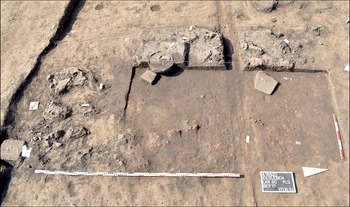
New excavations in 2024 in the centre of the settlement revealed very well-preserved settlement layers, including concentrations of burnt daub (Figure 3), located in a slight depression and thus protected from later agricultural work. This is an exceptional situation for Early Neolithic settlements in Central Europe, which mostly lack intact deposits (Stäuble & Wolfram Reference Stäuble, Wolfram, Link and Schimmelpfennig2012), which allows the reconstruction of activity areas through a modern multidisciplinary programme that includes archaeobotany, micromorphology and soil analysis. Contextual reconstruction of houses and activity areas, site stratigraphy and extensive radiocarbon dating of the fortifications are central to our research strategy, which also includes the analysis of 70 000 finds from earlier excavations that are currently held by the State Office for Heritage Management and Archaeology Saxony-Anhalt. Future work will also focus on skeletal deposition phenomena in settlement contexts.
Excavation trench from 2024: activity area with in situ ceramic vessel and grinding stones and concentrations of burnt daub from a destruction horizon (© Martin-Luther University Halle, F. Becker).

Searching for the Mesolithic in the Neolithic
In addition to its exceptional early enclosures, Eilsleben contains artefacts of probable Mesolithic origin. A rich assemblage of antler tools and flakes suggests on-site production, with types and techniques typical for Mesolithic assemblages (Pratsch Reference Pratsch2004). Noteworthy are T-shaped antler axes (Figure 4), characteristic of Late Mesolithic and Early Neolithic contact zones in south-eastern and northern Europe (Czerniak Reference Czerniak, Grygiel and Obst2022; Lübke et al. Reference Lübke2024), and a roe deer antler mask with direct analogies in the grave of the Bad Dürrenberg ‘shaman’, dating to around 7000 BC (Figure 5; Dietrich et al. Reference Dietrich, Meller and Orschiedtin press). Antler punches and transverse flint arrowheads (Wechler Reference Wechler1992) also point to contacts with local foragers (Figure 6, right), but most tools found at the site clearly reflect Neolithic traditions (e.g. stone axes, Figure 6, left).
T-shaped antler axe with broken and polished edge. Possibly used as hoe. Scale = 100mm (© Martin-Luther University Halle, L. Dietrich).

Roe deer antler mask, discovered in a pit of the early Neolithic settlement. Scale = 110mm (© Landesamt für Denkmalpflege und Archäologie Sachsen-Anhalt, J. Lipták).

Left) Neolithic stone axes; right) transverse flint arrowhead, drill, scraper and bone awls. Scale = 100mm (© Landesamt für Denkmalpflege und Archäologie Sachsen-Anhalt, J. Lipták).

We approach the question ‘What is the Mesolithic in the Neolithic?’ (Schier et al. Reference Schier, Orschiedt, Stäuble and Liebermann2021) from the perspective of technology transfer between hunter-gatherers and LBK farmers, visible in tool production and use. These particularities of the material culture at Eilsleben, together with the longue durée of enclosures at the site, will help construct and test new and more detailed models of interaction, exchange, adoption and consumption of social and material elements between LBK farmers and local Mesolithic groups in one of Europe’s long-standing frontier regions.
Acknowledgements
We thank the State Office for Heritage Management and Archaeology in Saxony-Anhalt, the Börde Museum and the city hall Obere Aller for their support.
Funding statement
The excavation was funded by the State Office for Heritage Management and Archaeology Saxony-Anhalt. The research was supported by the German Research Foundation (project no. 508492694) as part of Laura Dietrich’s Heisenberg funding.
Author contributions: CRediT Taxonomy
Laura Dietrich: Conceptualization-Lead, Formal analysis-Equal, Funding acquisition-Equal, Investigation-Equal, Methodology-Equal, Project administration-Equal, Writing - original draft-Equal. Franziska Knoll: Conceptualization-Supporting, Funding acquisition-Equal, Investigation-Equal, Methodology-Supporting, Project administration-Supporting, Writing - original draft-Supporting, Writing - review & editing-Equal. Henny Piezonka: Conceptualization-Supporting, Investigation-Equal, Methodology-Equal, Writing - original draft-Equal, Writing - review & editing-Equal. Jörg Orschiedt: Investigation-Equal, Methodology-Equal, Writing - review & editing-Equal. Mikko Heikkinen: Formal analysis-Supporting, Investigation-Supporting, Methodology-Supporting, Validation-Supporting, Writing - review & editing-Supporting. Franz Becker: Formal analysis-Supporting. Erik Zamzow: Formal analysis-Supporting. Harald Meller: Funding acquisition-Lead, Project administration-Equal, Writing - review & editing-Equal.




 Open access

