





1. Introduction
Picture naming tasks are commonly used in psycholinguistics to examine language function because they tap into the structure and accessibility of the mental lexicon (Cuitiño et al., Reference Cuitiño, Soriano, Jaichenco, Steeb and Barreyro2019). In these tasks, participants must say the word that corresponds to the image shown. Outcome measures include accuracy (i.e., the number of correct responses) and latency (i.e., the amount of time that elapses between stimulus onset and naming). Traditionally, naming latencies have been predicted by variables such as word frequency (WF) and age of acquisition (AoA). More recently, contextual diversity (CD), which is defined as the number of distinct linguistic contexts in which a word occurs, has emerged as an important factor in lexical processing (Adelman et al., Reference Adelman, Brown and Quesada2006). This measure is grounded in the principle of likely need from the rational analysis of memory (Anderson, Reference Anderson1974; Anderson & Milson, Reference Anderson and Milson1989; Anderson & Schooler, Reference Anderson and Schooler1991), according to which a word that has been encountered in many contexts is more likely to be needed in future contexts, and thus should be more readily accessible in the lexicon (see Jones et al., Reference Jones, Dye, Johns and Ross2017 for a more thorough discussion of these issues). CD is measured by a document or context count, which is operationalized as the number of documents or contexts (with a context being defined at different lexical units; e.g., a sentence, paragraph or chapter in a book) in which a word occurs across a corpus (Johns et al., Reference Johns, Sheppard, Jones and Taler2016b; Jones et al., Reference Jones, Johns and Recchia2012). Among others, Adelman et al. (Reference Adelman, Brown and Quesada2006) compared WF and CD and found that CD was more predictive of word naming and lexical decision reaction times than WF (Adelman & Brown, Reference Adelman and Brown2008; Brysbaert & New, Reference Brysbaert and New2009; Johns et al., Reference Johns, Sheppard, Jones and Taler2016b, Reference Johns, Taler and Jones2022).
1.1. Effects of aging and bilingualism on lexical access
The present study examines the role of CD in picture naming across aging and bilingualism. First, studies have shown that bilingualism affects picture naming ability. When compared to monolinguals, bilinguals are less accurate (Bialystok et al., Reference Bialystok, Craik and Luk2008; Kohnert et al., Reference Kohnert, Hernandez and Bates1998; Sheppard et al., Reference Sheppard, Kousaie, Monetta and Taler2016) and slower to respond (Gollan et al., Reference Gollan, Montoya and Bonanni2005a, Reference Gollan, Montoya, Fennema-Notestine and Morris2005b, Reference Gollan, Fennema-Notestine, Montoya and Jernigan2007; Ivanova & Costa, Reference Ivanova and Costa2008; Roberts et al., Reference Roberts, Garcia, Desrochers and Hernandez2002). Bilingual adults also have more tip-of-the-tongue retrieval failures for object names than monolinguals (Gollan et al., Reference Gollan, Montoya and Bonanni2005a). Similarly, findings regarding the impact of normal aging on picture naming ability point toward an age-related decline. Older adults are significantly less accurate (Ardila & Rosselli, Reference Ardila and Rosselli1989; Burke & Mackay, Reference Burke and Mackay1997; Feyereisen, Reference Feyereisen1997; Ivnik et al., Reference Ivnik, Smith, Malec, Petersen and Tangalos1995; Mackay et al., Reference Mackay, Connor, Albert and Obler2002; Mitrushina & Satz, Reference Mitrushina and Satz1995; Nicholas et al., Reference Nicholas, Brookshire, Maclennan, Schumacher and Porrazzo1989; Rosselli et al., Reference Rosselli, Ardila and Rosas1990; Zec et al., Reference Zec, Markwell, Burkett and Larsen2005, Reference Zec, Burkett, Markwell and Larsen2007) and are slower to respond on picture naming tasks than younger adults (Paesen & Leijten, Reference Paesen and Leijten2019; Shafto & Tyler, Reference Shafto and Tyler2014). In addition, older adults also experience more tip-of-the-tongue retrieval failures than younger adults (Burke & Mackay, Reference Burke and Mackay1997; Shafto et al., Reference Shafto, Burke, Stamatakis, Tam and Tyler2007; Shafto & Tyler, Reference Shafto and Tyler2014; Silagi et al., Reference Silagi, Bertolucci and Ortiz2015).
Mägiste’s (Reference Mägiste1979) interdependence hypothesis of bilingual storage suggests that multilinguals experience slower lexical retrieval due to less frequent use of their languages and interference from competing language systems. The frequency lag hypothesis (Gollan et al., Reference Gollan, Montoya, Fennema-Notestine and Morris2005b, Reference Gollan, Montoya, Cera and Sandoval2008, Reference Gollan, Slattery, Goldenberg, Van Assche, Duyck and Rayner2011) holds that the regular use of two languages creates a disadvantage because bilinguals have less experience with words in each of their languages compared to monolingual speakers of that language. However, because bilinguals routinely navigate between two linguistic systems and must attend to language-specific cues, they may develop enhanced sensitivity to contextual information (Gollan & Ferreira, Reference Gollan and Ferreira2009; Johns et al., Reference Johns, Sheppard, Jones and Taler2016b). This ability may enable them to better distinguish among competing lexical items by exploiting CD, or the variety of linguistic or situational contexts in which a word appears.
Similarly, poorer picture naming performance in older adults has been attributed to an age-related decline in the efficiency of lexical access (Burke & Shafto, Reference Burke and Shafto2004; Kavé et al., Reference Kavé, Kukulansky-Segal, Avraham, Herzberg and Landa2010). Ramscar et al. (Reference Ramscar, Hendrix, Shaoul, Milin and Baayen2014) proposed the information accumulation perspective on aging, which suggests that the age-related decline in performance on cognitive tests reflects accumulated linguistic knowledge over the lifespan. In other words, older adults perform worse on cognitive tasks not because of cognitive decline, but because of the higher information-processing costs of navigating the cumulative knowledge in their cognitive systems (Ramscar et al., Reference Ramscar, Hendrix, Shaoul, Milin and Baayen2014). CD may mitigate this challenge by providing more retrieval cues and reducing reliance on frequency-based access. Words that have been experienced in more diverse contexts are more richly embedded in semantic memory, which could make them more accessible despite a general age-related decline in processing speed or control.
Both bilingualism and aging can impact language production. More specifically, they may affect lexical access, which involves a speaker activating and choosing the right word from their mental lexicon (Levelt et al., Reference Levelt, Roelofs and Meyer1999). It has been hypothesized that both languages are activated when bilinguals produce language, and cognitive processes inhibit the nontarget language in language-specific situations (Costa & Caramazza, Reference Costa and Caramazza1999; Green, Reference Green1998; Hermans et al., Reference Hermans, Bongaerts, De Bot and Schreuder1998). Initially, all activated options compete for selection, but a late-acting process reduces the activation of the nontarget language to enable the selection of an appropriate response (Misra et al., Reference Misra, Guo, Bobb and Kroll2012). Therefore, the stronger first language (L1) must be inhibited to enable production in the weaker second language (L2), which in turn impacts performance in the L1 (Kroll et al., Reference Kroll, Bobb, Misra and Guo2008; Levy et al., Reference Levy, McVeigh, Marful and Anderson2007; Linck et al., Reference Linck, Kroll and Sunderman2009; Philipp et al., Reference Philipp, Gade and Koch2007). Aging, in turn, is associated with declines in processing speed and inhibitory control (Christ et al., Reference Christ, White, Mandernach and Keys2001; West & Alain, Reference West and Alain2000), which can impair the suppression of competing words and increase the likelihood of retrieval difficulties, such as tip-of-the-tongue experiences (Burke & Mackay, Reference Burke and Mackay1997).
1.2. The role of contextual diversity and semantic distinctiveness
CD may help in each of these cases by strengthening word representations through repeated exposure in different situations (Adelman et al., Reference Adelman, Brown and Quesada2006; Johns et al., Reference Johns, Sheppard, Jones and Taler2016b). Words that are encountered across diverse contexts may form stronger or more varied retrieval pathways, in turn making them easier to access in populations where retrieval requires more effort. As such, CD may serve as a compensatory mechanism that supports more efficient lemma selection, which could help bilinguals and older adults during lexical access.
While CD has emerged as an important factor in lexical processing, it cannot operate in isolation. Picture naming is also shaped by more established psycholinguistic variables, most notably age of acquisition and word frequency, both of which have long been recognized as influences on word retrieval. AoA refers to the age at which a given lexical item is learned. The consensus is that the earlier a word is learned, the faster and more accurately it can be accessed (Alario et al., Reference Alario, Ferrand, Laganaro, New, Frauenfelder and Segui2004; Barry et al., Reference Barry, Morrison and Ellis1997; Bonin et al., Reference Bonin, Chalard, Méot and Fayol2002, Reference Bonin, Peereman, Malardier, Méot and Chalard2003; Cuetos et al., Reference Cuetos, Ellis and Alvarez1999; Dell’acqua et al., Reference Dell’acqua, Lotto and Job2000; Ellis & Morrison, Reference Ellis and Morrison1998; Khwaileh et al., Reference Khwaileh, Mustafawi, Herbert and Howard2018; Perret & Bonin, Reference Perret and Bonin2019; Snodgrass & Yuditsky, Reference Snodgrass and Yuditsky1996; Valente et al., Reference Valente, Bürki and Laganaro2014). WF refers to the number of times that a word appears in a particular corpus (Perret & Bonin, Reference Perret and Bonin2019). High-frequency words will be accessed more quickly and accurately than lower-frequency words (Alario et al., Reference Alario, Ferrand, Laganaro, New, Frauenfelder and Segui2004; Barry et al., Reference Barry, Morrison and Ellis1997; Bonin et al., Reference Bonin, Peereman, Malardier, Méot and Chalard2003; Cuetos et al., Reference Cuetos, Ellis and Alvarez1999; Cuitiño et al., Reference Cuitiño, Soriano, Jaichenco, Steeb and Barreyro2019; Ellis & Morrison, Reference Ellis and Morrison1998; Snodgrass & Yuditsky, Reference Snodgrass and Yuditsky1996), although it should be noted that some studies have failed to replicate this effect (Bonin et al., Reference Bonin, Chalard, Méot and Fayol2002; Dell’acqua et al., Reference Dell’acqua, Lotto and Job2000; Valente et al., Reference Valente, Bürki and Laganaro2014). WF, in particular, has been a central aspect of psycholinguistic theory for decades (Brysbaert et al., Reference Brysbaert, Mandera and Keuleers2018) and is a key component in most models of lexical organization and word integration (Coltheart et al., Reference Coltheart, Rastle, Perry, Langdon and Ziegler2001; Goldinger, Reference Goldinger1998; Morton, Reference Morton1969; Murray & Forster, Reference Murray and Forster2004; Norris, Reference Norris2006).
Research on the level of representation at which WF, AoA, and CD effects occur within the language production system is inconclusive. In a seminal paper, Jescheniak and Levelt (Reference Jescheniak and Levelt1994) proposed that the WF effect arises during the retrieval of word forms (also known as lexeme retrieval). However, a growing body of evidence suggests that WF affects lemma selection (Corps & Meyer, Reference Corps and Meyer2023; Navarrete et al., Reference Navarrete, Basagni, Alario and Costa2006; Wheeldon & Monsell, Reference Wheeldon and Monsell1992), which is the process by which one selects the semantically appropriate item (Jescheniak & Levelt, Reference Jescheniak and Levelt1994; Roelofs, Reference Roelofs1992). In fact, Corps and Meyer (Reference Corps and Meyer2023) determined that in picture naming tasks, WF does not exclusively affect word form retrieval, but also lemma access.
There is debate over whether the locus of AoA effects reflects internal properties of the lexicon or external properties of the learning process (Hernandez & Li, Reference Hernandez and Li2007). WF and AoA are correlated (Wang & Chen, Reference Wang and Chen2020), and Brysbaert and Ghyselinck (Reference Brysbaert and Ghyselinck2006) propose that AoA effects are partly frequency-related and partly frequency-independent. This frequency-independent component of the AoA effect has been thought to have a semantic locus (Brysbaert & Ellis, Reference Brysbaert and Ellis2016; Wang et al., Reference Wang, Jiang and Chen2023). Wang and colleagues used event-related potential (ERP) techniques to examine the underlying mechanisms of the L2 AoA effect on three distinct levels: sub-lexical, lexical and semantic. First, they found that L2 AoA effects specifically were not influenced by WF (Wang et al., Reference Wang, Jiang and Chen2023). However, the authors also determined that the L2 AoA effect had both lexical and semantic routes and that, like WF, AoA effects arise from both semantic representation and spelling–sound connections (Wang et al., Reference Wang, Jiang and Chen2023).
CD and WF are correlated, which suggests that they may reflect the same underlying processes (Adelman et al., Reference Adelman, Brown and Quesada2006; Vergara-Martínez et al., Reference Vergara-Martínez, Comesaña and Perea2017). If this is the case, CD could substitute for WF in models of lexical organization and word integration with few theoretical implications (Plummer et al., Reference Plummer, Perea and Rayner2014). However, ERP research shows that CD and WF originate from different sources during the access of lexical-semantic representations (Vergara-Martínez et al., Reference Vergara-Martínez, Comesaña and Perea2017). Vergara-Martínez et al. (Reference Vergara-Martínez, Comesaña and Perea2017) determined that higher CD words elicit larger negativities than lower CD words, which is the opposite of WF, where higher frequency words elicit smaller negativities. Furthermore, they determined that the scalp distributions differ: the anterior distribution of the CD effect is consistent with previous effects related to semantically richer words (Vergara-Martínez et al., Reference Vergara-Martínez, Comesaña and Perea2017). Overall, these findings suggest that the CD effect resembles other factors related to “semantic richness” (Rabovsky et al., Reference Rabovsky, Sommer and Abdel Rahman2012), but this effect cannot be explained in terms of these variables because the stimuli were matched for these factors (Vergara-Martínez et al., Reference Vergara-Martínez, Comesaña and Perea2017).
Understanding the locus of effects for WF, AoA and CD helps clarify how these variables impact picture naming in bilinguals and older adults. Recent research suggests that WF and CD influence lexical access at the lemma level (e.g., Corps & Meyer, Reference Corps and Meyer2023; Vergara-Martínez et al., Reference Vergara-Martínez, Comesaña and Perea2017). Factors that may impact lemma selection, including increased lexical competition in bilinguals (Kroll et al., Reference Kroll, Bobb, Misra and Guo2008; Levy et al., Reference Levy, McVeigh, Marful and Anderson2007; Linck et al., Reference Linck, Kroll and Sunderman2009; Philipp et al., Reference Philipp, Gade and Koch2007) or decreased inhibitory control in older adults (Christ et al., Reference Christ, White, Mandernach and Keys2001; West & Alain, Reference West and Alain2000), may influence naming performance. Furthermore, AoA effects, which involve both lexical and semantic processes (Wang et al., Reference Wang, Jiang and Chen2023), may be amplified in bilinguals, who have less exposure to high-frequency words (Gollan et al., Reference Gollan, Montoya, Fennema-Notestine and Morris2005b, Reference Gollan, Montoya, Cera and Sandoval2008, Reference Gollan, Slattery, Goldenberg, Van Assche, Duyck and Rayner2011), and in older adults, who may rely more on semantic access as phonological retrieval declines with age (Burke & Shafto, Reference Burke and Shafto2004). CD’s association with semantic richness (Rabovsky et al., Reference Rabovsky, Sommer and Abdel Rahman2012) aligns with evidence that bilinguals are attuned to contextual cues, suggesting that CD may support lexical access when retrieval is more effortful. Together, these findings highlight that lexical access is shaped not only by how often or how early a word is learned but also by the diversity of its conceptual and semantic representations.
The above sections focusing on the mechanisms of AoA, CD and WF highlight the importance of semantic information in models of lexical organization. These lexical characteristics not only capture how often a word is encountered or when it is learned but also reflect the diversity of the contexts in which it is used. Building on this view, Johns (Reference Johns2021; see also Chang et al., Reference Chang, Jones and Johns2023 and Johns & Jones, Reference Johns and Jones2022, for additional analyses) offers a refinement of traditional CD measures, using these more socially-based theoretical constructs. This proposal offers two theoretical notions of the types of contexts in which words can occur: 1) discourse contextual diversity (DCD) or 2) user contextual diversity (UCD). These measures were derived from analyzing communication patterns of over 300,000 users across more than 30,000 discourse topics (subreddits) on the internet forum Reddit, with a total word count exceeding 55 billion for each metric. The UCD measure quantified the number of users who used a particular word, while the DCD measure tracked the number of discourses in which the word appeared. These count measures significantly improved upon the traditional WF and CD metrics for both response time and accuracy data in both lexical decision and naming tasks (Chang et al., Reference Chang, Jones and Johns2023; Johns, Reference Johns2021; Johns & Jones, Reference Johns and Jones2022), as well as related tasks such as item-level effects in recognition memory (Johns et al., Reference Johns, Taler and Jones2022).
DCD and UCD measures offer substantial improvements over WF and CD measures, especially concerning accuracy (Johns, Reference Johns2021). This finding suggests that measuring contextual word usage at the discourse and user level is more advantageous than using smaller, non-socially based, count measures.
1.3. Semantic distinctiveness model
Although CD measures consistently outperform WF measures (Adelman et al., Reference Adelman, Brown and Quesada2006; Adelman & Brown, Reference Adelman and Brown2008; Brysbaert & New, Reference Brysbaert and New2009), there may still be an important information source missing: the semantic diversity (SD) of the contexts in which a word occurs (Johns et al., Reference Johns, Sheppard, Jones and Taler2016b). To examine the role of SD in lexical organization, Jones et al. (Reference Jones, Johns and Recchia2012) proposed the semantic distinctiveness model. The semantic distinctiveness model belongs to a class of models entitled distributional models of language, which use the statistical structure of the language environment to learn the meaning of words (see Kumar, Reference Kumar2021 for a recent review). However, instead of constructing the meaning of a word (which the model can do; Johns & Jones, Reference Johns and Jones2008), the goal of the model is to generate more refined measures of a word’s lexical strength. The strength measures generated by the semantic distinctiveness model are based on the semantic diversity of the contexts (with context being defined differently across the development of the model) in which a word occurs across a corpus, where words that occur in more unique semantic contexts have higher memory strength than those in more redundant contexts (Jones et al., Reference Jones, Johns and Recchia2012). The semantic distinctiveness model has been repeatedly demonstrated to provide a more accurate measure of a word’s strength in memory, evaluated upon datasets using varied behavioral data from across language and episodic memory (Chang et al., Reference Chang, Jones and Johns2023; Johns, Reference Johns2021; Johns et al., Reference Johns, Dye and Jones2016a, Reference Johns, Sheppard, Jones and Taler2016b, Reference Johns, Dye and Jones2020, Reference Johns, Taler and Jones2022; Johns & Jones, Reference Johns and Jones2022).
Transformations based on the semantic distinctiveness model have been used to modify the DCD and UCD measures to better explain the importance of the semantic content of linguistic contexts (Johns, Reference Johns2021). Previous research indicates that SD-transformed models fit the relevant data better than count models (Chang et al., Reference Chang, Jones and Johns2023; Johns, Reference Johns2021; Johns et al., Reference Johns, Dye and Jones2016a; Reference Johns, Dye and Jones2020; Jones et al., Reference Jones, Johns and Recchia2012). Coherent with CD measures, the semantic distinctiveness model counts the number of contexts a word appears in. However, each context is given a graded measure between 0 and 1 depending on the semantic similarity between a word’s representation (stored in memory) and the context representation. More surprising, or distinct, contextual usages of a word are given greater weight in a word’s strength in memory. This is accomplished by taking the vector cosine between a word’s representation stored in memory and the current context representation and modifying this with an exponential transformation where high similarity values are transformed to low SD values and low similarity values are transformed to high SD values (Jones et al., Reference Jones, Johns and Recchia2012).
The main change that Johns (Reference Johns2021) made to the semantic distinctiveness model architecture was modifying the representational assumptions of the model. Specifically, in Johns (Reference Johns2021), two types of representation types were tested within the model’s framework: 1) word representations and 2) population representations. The word representation, initially introduced by Johns et al. (Reference Johns, Dye and Jones2020), involves a vector representing the count of how often each word appears within a specific contextual unit (either a discourse for DCD or a user for UCD). Thus, the word representation is fundamentally linguistic in nature; a context is represented by the words that occurred within that context.
In contrast, the population representation is based not on word usage patterns but on commenting patterns within a given context. For the DCD measure, the population context representation counts the number of comments each user made within a specific discourse, with the dimensionality of the representation being the number of users contained in the corpus. Consequently, the context representation for each discourse is a vector where each element represents a user, and the value of the element is the number of comments that the user made in that discourse (e.g., how many comments user X made in discourse Y).
For the UCD measure, the population context representation counts the number of comments each user made across various discourses. Each user’s context representation is a vector where each element represents a specific discourse (e.g., r/AskReddit), and the value indicates how many comments the user made in that discourse. Because there are more users than discourses, the UCD measure receives more updates than the DCD measure.
Population representation models were found to offer a significant advantage over their count-based counterparts and word representation models, suggesting that linguistic contexts encompass not only the words used but also communicative details, such as who produced the language and in which discourse. For concrete examples of how these representations are constructed, refer to Johns (Reference Johns2021) and Johns and Jones (Reference Johns and Jones2022). Importantly, the same advantages for the UCD and DCD measures that Johns (Reference Johns2021) found for young adult lexical retrieval data were found to generalize across the aging spectrum for monolingual lexical decision data (Johns et al., Reference Johns, Taler and Jones2022).
1.4. Current study and hypotheses
Previous research has investigated SD in samples of young English speakers. Johns et al. (Reference Johns, Sheppard, Jones and Taler2016b) were the first to extend the semantic distinctiveness model to examine word recognition across aging and bilingualism. Differential language experience plays a key role in Gollan et al.’s (Reference Gollan, Montoya, Cera and Sandoval2008) frequency lag hypothesis and Ramscar et al.’s (Reference Ramscar, Hendrix, Shaoul, Milin and Baayen2014) information accumulation perspective on aging. Therefore, exploring how CD may affect these groups is essential. Using a lexical decision task, they determined that bilinguals and older adults were more sensitive to SD information than younger monolinguals. They concluded that the unique language experiences of bilinguals and older adults lead to greater importance being placed on contextual information. In the present study, we extend these findings to examine the role of SD in picture naming ability across aging and bilingualism, and include L1 and L2 English speakers. Similar to previous work, CD measures are hypothesized to account for more variance across the groups than WF. Furthermore, we expect that the UCD-SD measure will outperform the DCD-SD measure.
Over time, older adults have increased their lexical knowledge, including contextual information (Ramscar et al., Reference Ramscar, Hendrix, Shaoul, Milin and Baayen2014). Their lexical organization may therefore rely more on this information source than it would for younger adults (Johns et al., Reference Johns, Sheppard, Jones and Taler2016b). Similarly, bilinguals, who must decide which language(s) to use in a given situation (Gollan & Ferreira, Reference Gollan and Ferreira2009), develop a heightened ability to discriminate between contexts. This ability helps them organize their lexicon more effectively by using context to determine which language to speak. As a result, the variability of contexts plays a larger role in lexical organization (Johns et al., Reference Johns, Sheppard, Jones and Taler2016b). In addition, because bilinguals must split their time between two languages, they have a lower level of experience with words in each language (Gollan et al., Reference Gollan, Slattery, Goldenberg, Van Assche, Duyck and Rayner2011). They may depend more on other linguistic information, such as contextual cues, for organizing their lexicon to compensate for their lower level of experience compared to monolinguals (Johns et al., Reference Johns, Sheppard, Jones and Taler2016b).
Therefore, we hypothesized that bilinguals and older monolinguals would show greater sensitivity to the CD measure, compared to young monolinguals. Because older bilinguals have more language experience and acquired lexical information, we predicted that the SD measures would account for the most variance in this group.
Within the bilingual sample, we anticipated that L1 English speakers would be more sensitive to the CD measure because they have more English linguistic experience, including exposure to varying contexts. On the other hand, because L2 English speakers have less experience in English compared to L1 speakers, they rely on different strategies. We therefore, expected that the L2 English speakers would be more sensitive to WF and AoA than the CD measures.
2. Methods
2.1. Participants
The present study uses data from a larger project that aims to develop a new 30-item picture naming task that is appropriate for French, English and bilingual Canadians. Participants included the following groups: monolingual younger adults (n = 49) and bilingual younger adults (further divided into L1 [n = 22] and L2 English [n = 21]), as well as monolingual older adults (n = 64) and bilingual older adults (further divided into L1 [n = 21] and L2 English ([n = 31]). The sample size obtained in this study met the minimum required for conducting a Rasch analysis for the 30-item version of the naming task (see Linacre, Reference Linacre1994 for a detailed explanation). Younger participants were aged 18-30, while the older participants were aged 65 and above. Monolingual participants were fluent in English only, while bilingual participants were fluent in both English and French, and did not speak any other languages. Participants were categorized as fluent in a language if they reported their speaking, reading and auditory comprehension as at least 4, and writing as at least a 3 on a five-point Likert scale (1 = no ability at all; 2 = very little ability; 3 = moderate ability; 4 = very good ability; 5 = native-like ability). While self-ratings of language proficiency are commonly used in bilingualism research, there is evidence that these measures may not be completely reliable; bilinguals often underreport their proficiency (Tomoschuk et al., Reference Tomoschuk, Ferreira and Gollan2019; Wagner et al., Reference Wagner, Bialystok and Grundy2022). In our experience, French speakers tend to rate their writing skills lower than English speakers do. Based on this pattern and previous work with this population, we accepted a rating of 3 (“moderate ability”) as indicative of functional writing proficiency for group inclusion.
We first compared the performance of all bilinguals to that of monolinguals and then separated the bilingual sample into L1 and L2 English speakers. L1 English speakers acquired English first and French second, whereas L2 English speakers acquired French first and English second. All bilinguals had attained a high degree of proficiency in both languages before age 13. Proficiency data for the bilingual groups are presented in Table 1.
Participants’ demographic, neuropsychological and language characteristics (reported as mean ± standard deviation)
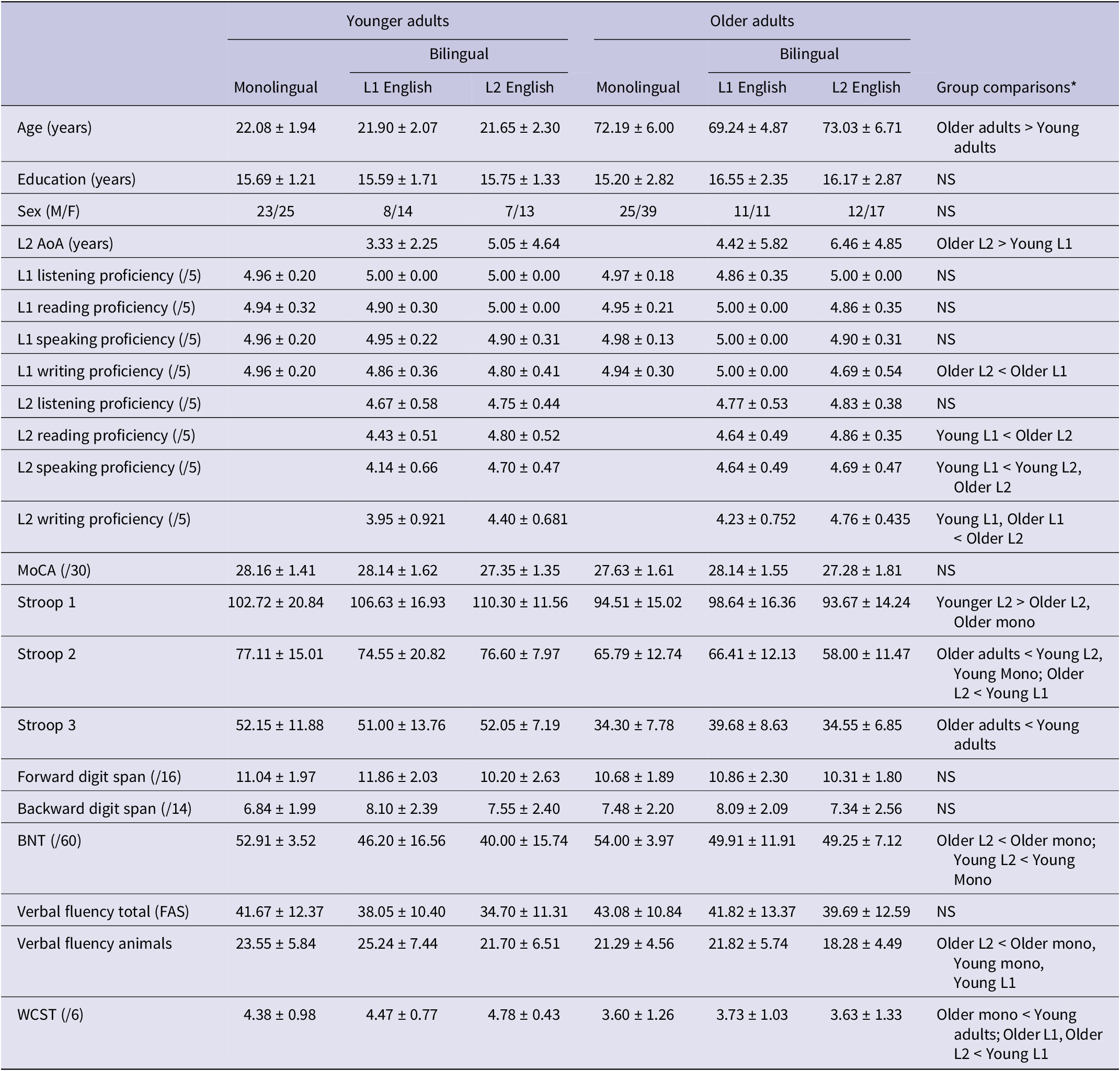
Note: *All comparisons significant at p < .05. NS = not significant; Mono = monolingual, L1 = English first, L2 = English second, AoA = Age of Acquisition, MoCA = Montreal Cognitive Assessment, BNT = Boston Naming Test, WCST = Wisconsin Card Sorting Task.
All participants were recruited through word of mouth and advertisements in community centers in Ottawa, Ontario, Canada. To determine eligibility, interested participants were contacted by telephone to discuss their language, education, and medical history. At the time of recruitment, participants self-reported no major neuropsychological problems and overall good health.
2.2. Materials
2.2.1. Neuropsychological battery
To characterize participants’ cognitive functioning across domains relevant to language processing and aging, each participant completed a neuropsychological assessment comprised of the following tests: Montreal Cognitive Assessment (MoCA; Nasreddine et al., Reference Nasreddine, Phillips, Bédirian, Charbonneau, Whitehead, Collin, Cummings and Chertkow2005), letter-number sequencing, a version of the Stroop color-word interference test (Stroop, Reference Stroop1935), forward and backward digit span subtest of the Wechsler Memory Scale (Wechsler, Reference Wechsler1997), Wisconsin Card Sorting Task (WCST; Grant & Berg, Reference Grant and Berg1948), Boston Naming Test (BNT; Kaplan et al., Reference Kaplan, Goodglass and Weintraub1983), as well as category and letter verbal fluencies (Benton & Hamsher, Reference Benton and Hamsher1976). This battery assessed general cognitive status, working memory, executive function and lexical access. These background measures were used to ensure that participants met inclusion criteria and to compare cognitive profiles across groups. Scores by participant groups are provided in Table 1.
Montreal Cognitive Assessment. The MoCA (Nasreddine et al., Reference Nasreddine, Phillips, Bédirian, Charbonneau, Whitehead, Collin, Cummings and Chertkow2005) is a 10-minute cognitive screening test scored out of 30. It was designed to detect mild cognitive impairment and assess eight cognitive domains: short-term memory recall, visuospatial ability, executive function, attention, concentration, working memory, language, and orientation to time and place. A cut-off score of 24 was applied, in line with education-adjusted norms (i.e., with one additional point awarded for participants with <12 years of education) (Pugh et al., Reference Pugh, Kemp, van Dyck, Mecca and Sharp2018).
Letter-Number Sequencing. The letter-number sequencing task is a measure of working memory and attention. In this task, participants heard a series of letters and numbers read aloud and were asked to reorder them by stating the numbers in ascending order, followed by the letters in alphabetical order (e.g., 4-O-8-H would be repeated as 4, 8, H, O). The task comprised seven items with three trials each, for a maximum score of 21. One point was awarded for each correct trial.
Forward and Backward Digit Span. Participants completed the forward and backward digit span subtests from the Wechsler Memory Scale (Wechsler, Reference Wechsler1997). In the forward span, which assesses short-term memory, participants repeated 16 sequences of numbers in the order presented. In the backward span, which assesses working memory, they repeated 14 sequences in reverse order. One point was awarded for each correctly recalled sequence, with a maximum score of 16 for the forward span and 14 for the backward span.
Stroop. Participants completed the Stroop task (Stroop, Reference Stroop1935), which assesses inhibitory control, and is comprised of three conditions: word reading (Stroop 1), color naming (Stroop 2) and incongruent color naming (Stroop 3). Each condition consisted of a page displaying 120 stimuli. Participants were instructed to read the stimuli sequentially and were given 45 seconds per condition to name as many items as possible. The number of correct responses within the time limit was recorded for each condition.
Wisconsin Card Sorting Task. The WCST is a set-shifting test that assesses cognitive flexibility (Grant & Berg, Reference Grant and Berg1948). Participants were given 64 cards, one at a time and were asked to organize each card according to three categories (color, shape and number). Participants were not told how to sort the cards; they were only informed whether their choice was “correct” or “incorrect” after they laid the card down. Cards were sorted first by color, then by shape and finally by number, with the category changing after 10 cards were correctly sorted. One point was awarded for each set of 10 consecutive correct responses, with a maximum score of six points.
Boston Naming Test. The BNT (Kaplan et al., Reference Kaplan, Goodglass and Weintraub1983) comprises 60 line drawings displayed on a white background and arranged in increasing order of difficulty. Participants were asked to name each image while the researcher recorded their responses. There was no time limit for the task. Participants were scored out of 60.
Verbal Fluencies. Participants completed two fluencies: letter and category (Benton & Hamsher, Reference Benton and Hamsher1976), which are measures of lexical access. The letter fluency task required participants to generate as many words as possible that begin with a given letter. Each participant completed this task for three letters: F, A, and S, for a final total letter fluency score. In the category fluency, participants were given a category (animals) and were asked to list as many words as they could that belonged to that category. Each fluency was recorded for 60 seconds, and one point was given for every acceptable word that the participant provided.
2.2.2. 120-item naming task
The 120-item Naming Task includes high-quality digital images, 100 of which were selected from the colored Snodgrass and Vanderwart set (Rossion & Pourtois, Reference Rossion and Pourtois2001) and 20 of which were developed specifically for this task (see Appendix A, Table A1 for the full list of items and their lexical properties). The Snodgrass and Vanderwart images were chosen for their varying difficulty and strong name agreement, while the additional 20 images were created to match the Snodgrass and Vanderwart set but with increased naming difficulty. The images were displayed on a white background with Microsoft PowerPoint in the same randomized order for all participants. Participants were asked to name each image while the researcher logged their responses. If the participant provided the correct response, the researcher checked the “Correct Response” box. If the participant misinterpreted the picture, a stimulus cue was provided, and the participant could respond again (see Appendix A, Table A1 for the items and their corresponding cues). Stimulus cues were semantic; for example, the cue for the item “pomegranate” was that “it is a type of fruit.” Any other responses provided by the participant were written down. One point was awarded for each correct, uncued response, for a maximum of 120 points. Of the 120 items, 17 images were removed from the subsequent analyses because the objects were multi-word, had low name agreement, or participants had difficulty visually identifying the item. The highest naming task score that participants were able to receive in this study was therefore 103.
2.3. Procedures
Participants completed two sessions at the Bruyère Health Research Institute in Ottawa, Ontario, Canada, that were each approximately 2 hours long. Over the two sessions, participants completed a neuropsychological battery, including the 120-item Naming Task. For monolinguals, language tasks were completed in English only, while bilingual participants completed all language tasks three times: in French, in English, and in a condition in which they could respond in either language. Ordering effects were eliminated by counterbalancing these language administrations. For bilingual participants, two of the language administrations were completed during the first session, while a third administration was completed during the second session. In the present analyses, the English-only scores were used for the bilingual participants. Participants received $10/hour compensation. The study procedures received ethical approval from the Research Ethics Board at the Bruyère Health Research Institute and the University of Ottawa. Prior to testing, the participants were briefed on the study procedures before providing written consent.
3. Results
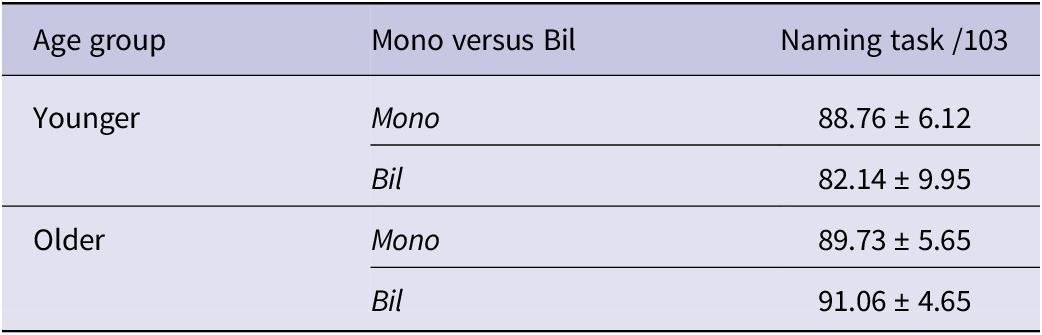
A two-way ANOVA (see Table 2) examined the effect of age (younger and older) and language (monolingual and bilingual) on naming task scores. The main effects for age, F(1, 209) = 9.82, p = .002, η 2 = .039, and language, F(1, 209) = 32.93. p < .001, η 2 = .130, were both significant. However, there was no statistically significant interaction between the effects of age and language on naming task scores, F(1, 209) = 0.704, p = 0.402, η 2 = .003.
Mean scores and standard deviations across the different age groups for the English administration of the 103-item version of the naming task
As a first pass at understanding the fit of the picture naming data and the various lexical variables (AoA, WF, DCD-SD and UCD-SD), Table 3 shows the correlations between the variables and behavior of the four participant groups. The table displays standard results, with the younger participant groups having higher correlations to the lexical strength variables than the older participant groups. Replicating the previously reported results of Johns (Reference Johns2021) and Johns et al. (Reference Johns, Taler and Jones2022), the CD measures had stronger correlations across all groups when compared to WF. Additionally, the UCD-SD measure outperformed the DCD-SD measure across all groups, also consistent with past results. AoA had the strongest correlation for the younger participant groups, while UCD-SD had the strongest correlation for the older participant groups. Since the UCD-SD variables provide a superior level of fit compared to the DCD-SD variable, UCD-SD is the only CD measure used in subsequent analyses.
Correlations between naming performance for different participant groups and lexical variables
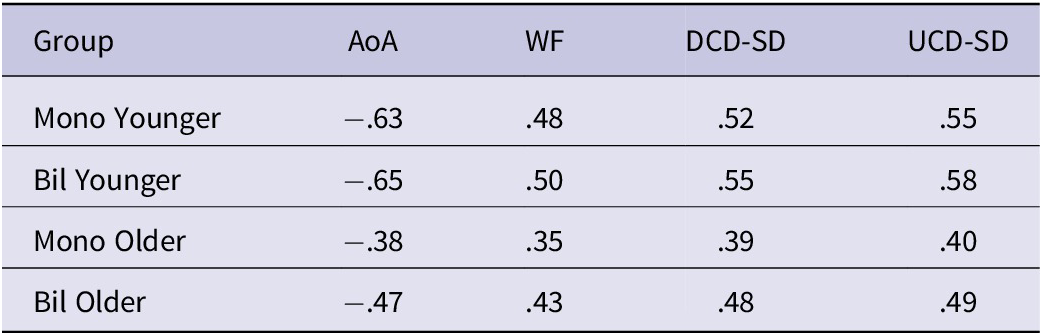
Note: Number of words = 103; all correlations significant at p < 0.001. AoA = Age of acquisition, WF = Word frequency, DCD-SD = Discourse contextual diversity modified by the semantic distinctiveness model, UCD-SD = User contextual diversity modified by the semantic distinctiveness model.
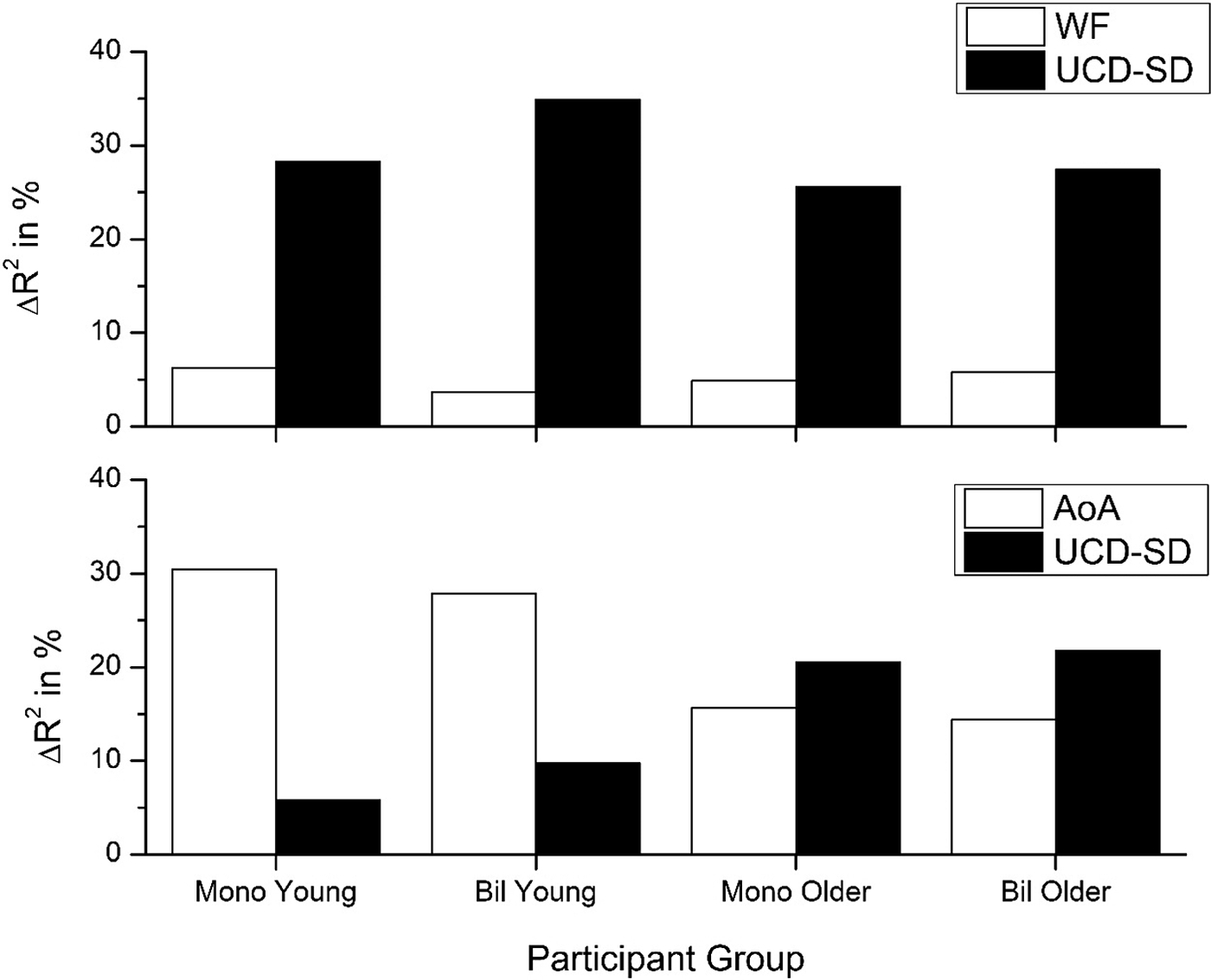
To examine the separate effects of the different variables on the naming data, we conducted multiple sets of hierarchical linear regressions (HLRs), following the methodology of previous studies (Adelman et al., Reference Adelman, Brown and Quesada2006; Adelman & Brown, Reference Adelman and Brown2008; Chang et al., Reference Chang, Jones and Johns2023). Specifically, we conducted HLRs comparing WF and UCD-SD to determine which lexical strength variable accounts for the greatest amount of unique variance and to determine if the superiority of the UCD-SD measure over WF holds for picture naming data. An additional HLR was conducted comparing AoA and UCD-SD to determine which is the most powerful variable overall for the different age groups. In an HLR, the unique contribution of one variable over the competing variables was indexed by the percentage of ΔR2 in percent between the respective models (e.g., the percent increase in ΔR2 for WF and UCD-SD compared to just WF). See Chang and colleagues (Reference Chang, Jones and Johns2023) for more discussion of these analysis techniques.
The results of the regression analyses are contained in Figure 1. The top panel of this figure displays the amount of unique variance that WF and UCD-SD account for when compared against each other. Consistent with past results, it is found that UCD-SD accounts for the most unique variance while reducing the contribution of WF. This finding suggests that picture naming may operate under similar organizing principles as other lexical behaviors, such as lexical decision tasks (see also Van Assche et al., Reference Van Assche, Duyck and Gollan2016). The bottom panel contrasts AoA and UCD-SD, which produced divergent results for the older and younger groups. Specifically, for the younger groups, AoA accounted for the most unique variance, while for the older groups, the UCD-SD measure accounted for greater amounts of unique variance for both monolinguals and bilinguals. This finding suggests that older adults’ greater linguistic experience increases the sensitivity of the measures of lexical strength calculated by the UCD-SD measure.
Hierarchical linear regression analyses comparing the amount of unique variance accounted for when comparing WF and UCD-SD (top panel) and AoA and UCD-SD (bottom panel) across the different age groups.
However, as can be seen from Figure 1, there are not many divergences in fit for the bilingual groups compared to the monolingual groups. To gain a better understanding of the performance of the bilingual participant groups, the young and older bilingual groups were split into two groups depending on whether they were L1 English speakers or L2 English speakers (see Table 4). A two-way ANOVA examined the effect of age (younger and older) and language dominance of the bilingual participants (L1 English and L2 English) on naming task scores. A similar pattern was observed in these split groups, where main effects of age, F(1, 89) = 7.41, p = .008, η 2 = .064, and language dominance F(1, 89) = 18.54, p < .001, η 2 = .161, were both significant. Again, there was no statistically significant interaction between the effects of age and language dominance on naming task scores, F(1, 89) = 0.443, p = 0.507, η 2 = .004.
Mean scores and standard deviations across the split bilingual groups for the English administration of the 103-item version of the naming task

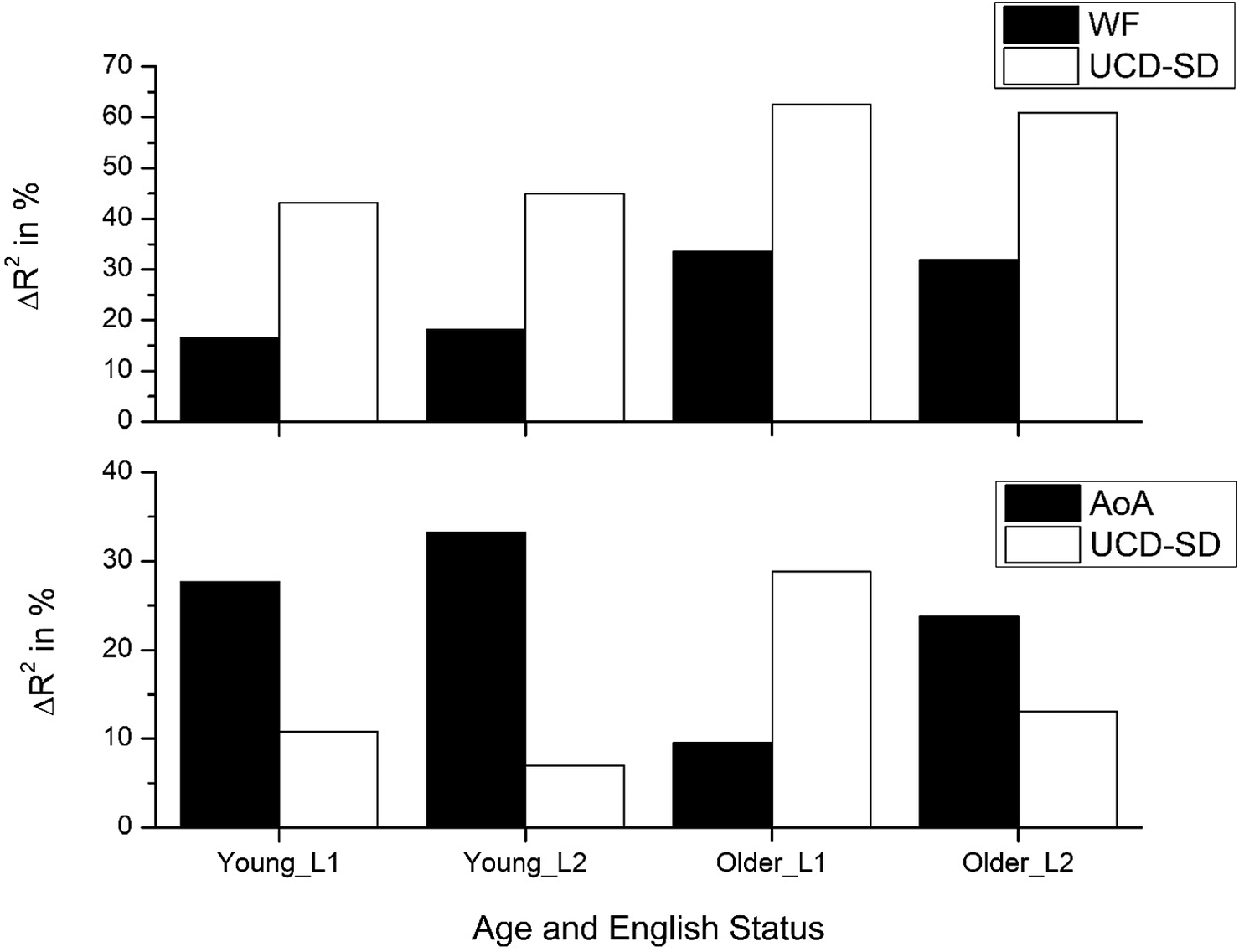
Hierarchical regression analyses with the same comparisons as contained in Figure 1 were used to assess the amount of unique variance that the different lexical variables account for across the split bilingual groups. The results of the regression on the split bilingual groups are shown in Figure 2, with the top panel displaying the WF versus UCD-SD comparison and the bottom panel displaying the AoA versus UCD-SD comparison. For the WF and UCD-SD comparison, the results are similar to those shown in Figure 1, with UCD-SD accounting for the most unique variance across all groups. However, there is a difference in the AoA versus UCD-SD comparison, where for the older L1 English group, the UCD-SD variable accounts for more variance than AoA, while for the older L2 English group, AoA accounts for the most unique variance, similar to the young participants. This finding suggests that the older L2 English group’s more limited lexical experience with English reduces the contribution of the lexical strength values of the UCD-SD measure.
Hierarchical linear regression analyses comparing the amount of unique variance accounted for when comparing WF and UCD-SD (top panel) and AoA and UCD-SD (bottom panel) for the split bilingual groups.
4. Discussion
The present study aimed to examine the role of CD in picture naming in aging and bilingualism. Picture naming ability was measured in a sample of young and older English monolinguals and English–French bilinguals. A comparison between WF, AoA, DCD and UCD was conducted to determine which information source best fits the lexical organization of the groups. Overall, these findings indicate the necessity of recognizing how linguistic experiences are shaped by age and bilingualism. As previously mentioned, Ramscar et al. (Reference Ramscar, Hendrix, Shaoul, Milin and Baayen2014) and Gollan et al. (Reference Gollan, Montoya, Cera and Sandoval2008) emphasize the importance of including contextual information when understanding differences in lexical access.
Akin to Johns (Reference Johns2021), it was determined that the UCD-SD offers a superior level of fit compared to the DCD-SD across all groups, and was especially superior to the classic WF variable. These results replicate previous findings that suggest that the CD effect is stronger than the WF effect (Adelman et al., Reference Adelman, Brown and Quesada2006; Adelman & Brown, Reference Adelman and Brown2008; Brysbaert & New, Reference Brysbaert and New2009; Johns et al., Reference Johns, Sheppard, Jones and Taler2016b, Reference Johns, Taler and Jones2022; Vergara-Martínez et al., Reference Vergara-Martínez, Comesaña and Perea2017). The UCD measure is based on how likely a large group of people is to use particular words and therefore provides a more social type of information than the DCD measure (Johns, Reference Johns2021). Usage-based theories of language acquisition such as Tomasello (Reference Tomasello2003) propose that language is learned through observation and understanding how others use language in a communicative environment (Johns et al., Reference Johns, Taler and Jones2022).
As anticipated, UCD-SD accounted for the most variance in all groups compared to WF, as has been seen consistently in the literature (e.g., Adelman et al., Reference Adelman, Brown and Quesada2006; Adelman & Brown, Reference Adelman and Brown2008; Brysbaert & New, Reference Brysbaert and New2009; Johns et al., Reference Johns, Sheppard, Jones and Taler2016b, Reference Johns, Taler and Jones2022). This finding indicates that picture naming and other lexical behaviors may share common organizing principles. Larger contextual measures of word usage can provide a more precise understanding of whether a word has been encountered previously (Johns, Reference Johns2021). In addition, these findings contradict the suggestion that CD could substitute for WF in models of lexical organization and word integration (Plummer et al., Reference Plummer, Perea and Rayner2014). As Vergara-Martínez and colleagues (2017) observed, CD and WF effects may be correlated, but are separate. Therefore, we suggest that people may use more abstract cues, like SD and CD, to organize their lexicon, compared to repetition-based learning mechanisms like WF (Johns, Reference Johns2021; Senaldi et al., Reference Senaldi, Titone and Johns2022). These results support a theoretical shift toward models of lexical access that emphasize socially grounded, semantically enriched, and context-sensitive measures.
Interestingly, we found that the strength of the CD measure was affected by age. Ramscar et al. (Reference Ramscar, Hendrix, Shaoul, Milin and Baayen2014) proposed that older adults have more accumulated linguistic knowledge compared to younger adults. Our findings support this notion: older adults were more sensitive to CD information than younger adults, who instead relied more on AoA. This result indicates that strategies used for lexical encoding shift over the lifespan, with older adults’ additional lexical experience resulting in a greater sensitivity to CD. Using a lexical decision paradigm, Johns et al. (Reference Johns, Sheppard, Jones and Taler2016b) similarly demonstrated that older adults used information derived from the semantic distinctiveness model to a greater extent than younger adults. Qiu and Johns (Reference Qiu and Johns2020) propose that older adults’ increased language experience allows more SD information to be encoded in the lexical memory compared to younger adults. Regardless, these findings emphasize the importance of semantic information, whether that be in the form of CD or AoA, over WF in models of lexical organization for both younger and older adults.
Because the bilingual groups completed the naming task three times, it is likely that the WF effect (or at least an immediate version of this effect) would be stronger for the bilinguals than the monolinguals. However, our results show no significant differences in WF across the monolingual and bilingual groups, providing further evidence to support the importance of semantic and contextual information in lexical encoding for bilinguals over WF.
To gain a deeper understanding of the impact of these variables on picture naming performance in bilinguals, we divided the bilingual sample into L1 and L2 English speakers. Because L1 English speakers have more linguistic experience in English, we expected them to be more sensitive to the CD measure than L2 English speakers, who we hypothesized would rely more on other information such as WF and AoA. This rationale held for the AoA measure, with L1 speakers relying more on SD and CD information than L2 speakers, while the L2 speakers relied more on AoA.
When the effects of AoA and WF were compared to those of UCD-SD, contrasting results were found. L2 speakers relied more on AoA than UCD-SD information, likely because they have less lexical experience in English, which was the language of testing. Among the four groups, only older L1 English speakers relied more on CD information than on AoA. This may be because the older L1 English speakers, being both bilingual and older, have accumulated more semantic knowledge over time than other groups. However, no such effect was found when comparing WF and UCD-SD. Rather, all groups were more sensitive to the UCD-SD measure than to WF. That is, even when bilinguals are tested in their L2, they are more sensitive to contextual than WF information. This division into L1 and L2 bilinguals offers a novel contribution to the bilingualism literature, showing that the type and extent of English language experience modulate sensitivity to different lexical predictors.
Finally, it is important to note that the WF measure consistently provided the worst fit for all the groups in this study. Research on WF and picture naming ability has shown mixed results, with some studies highlighting its importance (e.g., Alario et al., Reference Alario, Ferrand, Laganaro, New, Frauenfelder and Segui2004; Barry et al., Reference Barry, Morrison and Ellis1997; Bonin et al., Reference Bonin, Peereman, Malardier, Méot and Chalard2003; Cuetos et al., Reference Cuetos, Ellis and Alvarez1999; Cuitiño et al., Reference Cuitiño, Soriano, Jaichenco, Steeb and Barreyro2019; Ellis & Morrison, Reference Ellis and Morrison1998; Snodgrass & Yuditsky, Reference Snodgrass and Yuditsky1996), while others have failed to find any effect (e.g., Bonin et al., Reference Bonin, Chalard, Méot and Fayol2002; Dell’acqua et al., Reference Dell’acqua, Lotto and Job2000; Valente et al., Reference Valente, Bürki and Laganaro2014). Our findings replicate those reported in the latter studies, suggesting that frequency measures may not be as useful or informative as initially believed and that more social aspects of language acquisition, like CD, play a larger role in picture naming. Beyond this, these findings emphasize the importance of semantic information, which encompasses both AoA and CD, in the organization of the lexicon over WF.
One limitation in the present study is that only accuracy data were available; including naming latency data would shed further light on the phenomena examined here. Other accuracy-based measures, such as error patterns and cued responses, should also be investigated, as these data could provide insight into how CD impacts word retrieval. However, in the present study, only 0.28% of all naming task responses were cued, limiting their analytical value. Studies investigating picture naming in other populations, such as individuals with aphasia, where cued responses are more common (Meteyard & Bose, Reference Meteyard and Bose2018), may be better suited to explore this aspect. Furthermore, this study investigated a limited number of psycholinguistic variables: UCD, DCD, AoA and WF. Other variables, such as name agreement (Alario et al., Reference Alario, Ferrand, Laganaro, New, Frauenfelder and Segui2004; Barry et al., Reference Barry, Morrison and Ellis1997; Bonin et al., Reference Bonin, Chalard, Méot and Fayol2002, Reference Bonin, Peereman, Malardier, Méot and Chalard2003; Cuetos et al., Reference Cuetos, Ellis and Alvarez1999; Cuitiño et al., Reference Cuitiño, Soriano, Jaichenco, Steeb and Barreyro2019; Dell’acqua et al., Reference Dell’acqua, Lotto and Job2000; Ellis & Morrison, Reference Ellis and Morrison1998; Khwaileh et al., Reference Khwaileh, Mustafawi, Herbert and Howard2018; Perret & Bonin, Reference Perret and Bonin2019; Snodgrass & Yuditsky, Reference Snodgrass and Yuditsky1996; Valente et al., Reference Valente, Bürki and Laganaro2014), imageability (Alario et al., Reference Alario, Ferrand, Laganaro, New, Frauenfelder and Segui2004; Ballot et al., Reference Ballot, Mathey and Robert2021; Bonin et al., Reference Bonin, Chalard, Méot and Fayol2002, Reference Bonin, Peereman, Malardier, Méot and Chalard2003; Ellis & Morrison, Reference Ellis and Morrison1998; Khwaileh et al., Reference Khwaileh, Mustafawi, Herbert and Howard2018; Perret & Bonin, Reference Perret and Bonin2019) and concept familiarity (Cuetos et al., Reference Cuetos, Ellis and Alvarez1999; Cuitiño et al., Reference Cuitiño, Soriano, Jaichenco, Steeb and Barreyro2019; Ellis & Morrison, Reference Ellis and Morrison1998; Khwaileh et al., Reference Khwaileh, Mustafawi, Herbert and Howard2018; Perret & Bonin, Reference Perret and Bonin2019; Snodgrass & Yuditsky, Reference Snodgrass and Yuditsky1996), have been shown to impact picture naming ability as well. Finally, future research should also examine more fine-grained aspects of language usage in bilingual speakers, such as code-switching behavior and variation in the languages a person uses in different settings (e.g., at home, at work, with friends). This variation can be computed as language entropy and is based on the proportion of time a person uses different languages (Gullifer et al., Reference Gullifer, Kousaie, Gilbert, Grant, Giroud, Coulter, Klein, Baum, Phillips and Titone2021). Exploring the interconnectedness of CD and language entropy may also be relevant, as both contribute to a bilingual’s language experience.
5. Conclusion
Previous research has shown that context in lexical organization plays an important role in many aspects of lexical processing (Adelman et al., Reference Adelman, Brown and Quesada2006; Chang, Jones & Johns, in press; Jones et al., Reference Jones, Dye, Johns and Ross2017; Reference Jones, Johns and Recchia2012). In an initial inquiry into the relationship between context, bilingualism and aging, Johns et al. (Reference Johns, Sheppard, Jones and Taler2016b) found that bilinguals and older adults were more sensitive to SD information during a lexical decision task than monolinguals and younger adults. The present study extends these findings by demonstrating that the same effects were present for picture naming ability. We determined that older adults and L1 English speakers are more sensitive to CD information than younger adults and L2 English speakers, and that the latter group instead relies primarily on AoA. These findings emphasize how individual linguistic experiences, which are shaped by both age and bilingualism, impact lexical processing. Moreover, the present study illustrates the theoretical importance of delving deeper into the language function of older adults and bilinguals.
Data availability statement
Please contact the corresponding author to request access to the de-identified data used in this study.
Acknowledgements
This research was supported by an Alzheimer Society of Canada Research Grant awarded to Vanessa Taler (Grant #1423).
Competing interest
The authors declare none.
Appendix A
Lexical properties from the English Lexicon Project database (Balota et al., Reference Balota, Yap, Hutchison, Cortese, Kessler, Loftis, Neely, Nelson, Simpson and Treiman2007) for each word in the picture naming task
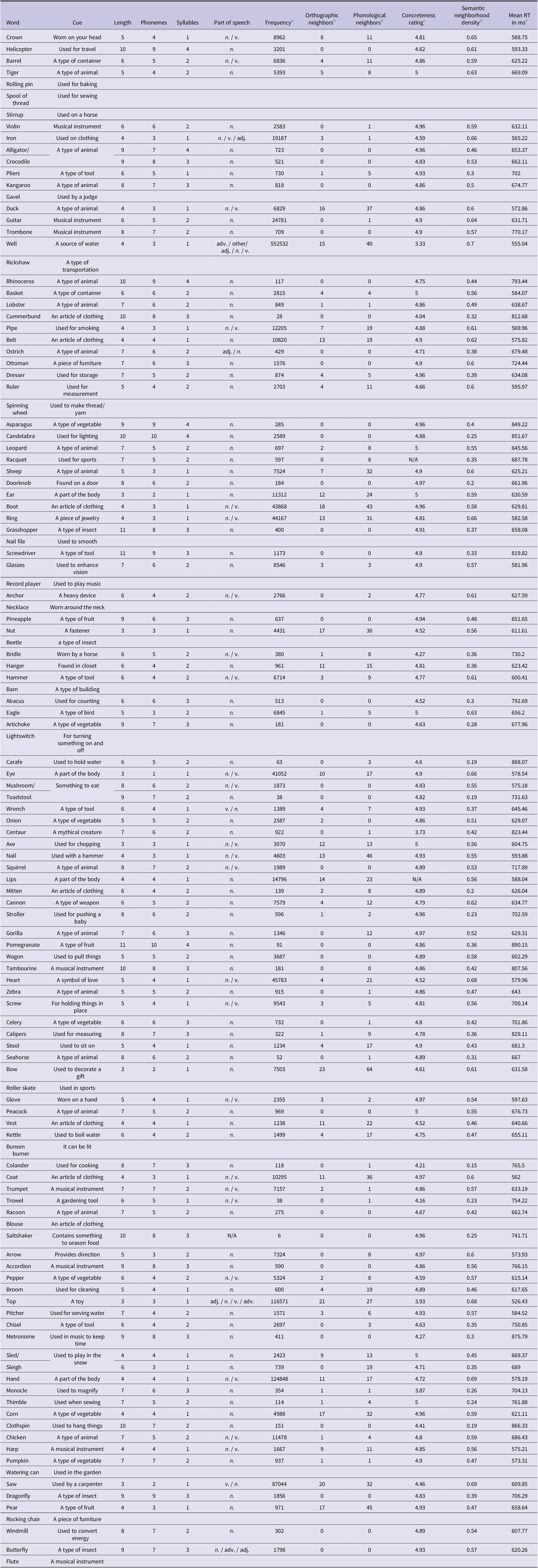
Note: The following items were not included in the analyses of this study: rolling pin, spool of thread, stirrup, gavel, rickshaw, spinning wheel, nail file, record player, necklace, beetle, barn, ironing board, Bunsen burner, blouse, watering can, rocking chair and flute. The items alligator/crocodile, mushroom/toadstool and sled/sleigh had two correct responses and therefore have descriptive characteristics for both options. n. = noun, v. = verb, adj. = adjective, adv. = adverb, RT = Reaction Time.


 Open access

