


Introduction
Neurological events, particularly Bell’s Palsy and transverse myelitis (TM), following vaccination, have been described in case reports or case series. Reference Williams, Pahud and Vellozzi1,Reference Sejvar2 While racial and ethnic differences in vaccine uptake have been observed, Reference Egede and Zheng3,Reference Quach, Hamid and Pereira4 it is unknown if rates of neurological events following vaccination differ by ethnicity. As up to 76% of the world’s population received at least one dose of COVID-19 vaccine (WHO estimate), it may be an ideal setting to evaluate rates of neurological events after a vaccine as well as potential ethnic differences. A large-scale study in the UK, involving 8 million people, found no association between COVID-19 vaccination and neurological events, Reference Li, Raventós and Roel5 but ethnic differences were not studied. Despite the lack of previous reports on ethnic differences in COVID-19 vaccine-related complications, concern about side effects was the most common cause for not getting vaccinated among ethnic groups compared to Whites in large-scale surveys in the UK and the US. Reference Nguyen, Joshi and Drew6 Hence, it is important to evaluate if COVID-19 vaccine-related complications vary by ethnicity.
Our objective was to estimate the rate of neurological events within 42 days (6 weeks) of receiving COVID-19 vaccine in adult Ontarians, and its variation by ethnicity. We compared the rates of neurological events in Chinese and South Asian ethnic groups because together they form the largest non-Caucasian ethnic group in Canada, making up 11.8% of its total population.
Methods
We conducted a retrospective cohort study in Ontario, Canada using linked health administrative databases. These datasets were linked using unique encoded identifiers and analyzed at Institute of Clinical Evaluative Sciences (ICES) (formerly known as the Institute for Clinical Evaluative Sciences). Use of these data is authorized under section 45 of the Ontario Personal Health Information Protection Act and does not require review by a research ethics board.
Ontario residents have access to the Ontario Health Insurance Program (OHIP), a universal, publicly funded health insurance plan that covers the cost of COVID-19 vaccines, inpatient care and emergency department (ED) visits.
Study population
We included all persons identified in the Ontario Registered Persons Database (RPDB) who were alive, eligible for OHIP and between 18 and 105 years of age on December 1, 2020 (index date) (e-figure 1). Non-Ontario residents, those who had no contact with the health system in the 5 years prior to index date, and those who were not continuously eligible for OHIP services in the year prior to index date were excluded. Information on the dates and types of COVID-19 vaccines administered were ascertained using the provincial COVID-19 vaccine registry (COVaxON). We collected data on first and second-dose vaccinations provided between the index date and June 30, 2021. Second-dose vaccinations administered less than 21 days after the first dose were excluded.
Exposure
We used the ETHNIC dataset, a version of the RPDB where a surname-based algorithm was used to classify Ontario residents as Chinese, South Asian or Others (regarded as “general population”) to define our exposure groups. Reference Shah, Chiu and Amin7 Individuals who could not be linked to the ETHNIC database were excluded.
Outcomes
We used the Canadian Institute for Health Information Discharge Abstract Database and the National Ambulatory Care Reporting System to ascertain hospitalizations and ED visits for the following neurological conditions occurring within 42 days of either the first or second COVID-19 vaccination dose: Bell’s palsy, TM, Guillain Barre syndrome (GBS), ischemic stroke, intracerebral hemorrhage (ICH) and cerebrovenous sinus thrombosis (CVST). We included hospitalizations/ED visits where the diagnosis of an outcome of interest was suspected and/or included in any diagnostic code space on the record (e-Table 1 for details).
Covariates of interest
We obtained information on age, sex, rural residence and neighborhood-income quintile from the RPDB, and information on residence in a long-term care home based on the Ontario Drug Benefit and Continuing Care Reporting System datasets. We used hospitalization data in the five years prior to index date to compute the Charlson Comorbidity score. These variables were only used to provide description of baseline characteristics of the cohort. Information on vaccine type was collected from COVaxON: Pfizer, Moderna or Other (e-Table 1).
Statistical analyses
We computed crude outcome rates (per 1,000,000 doses) of each outcome in the 42 days following first and second dose of COVID-19 vaccination for each exposure group. We used multivariable logistic regression to determine whether ethnicity was associated with outcome rates after controlling for age, sex and vaccine type. We used separate models for first and second-dose vaccinations. Given low event rates, we did not adjust for medical comorbidities.
Results
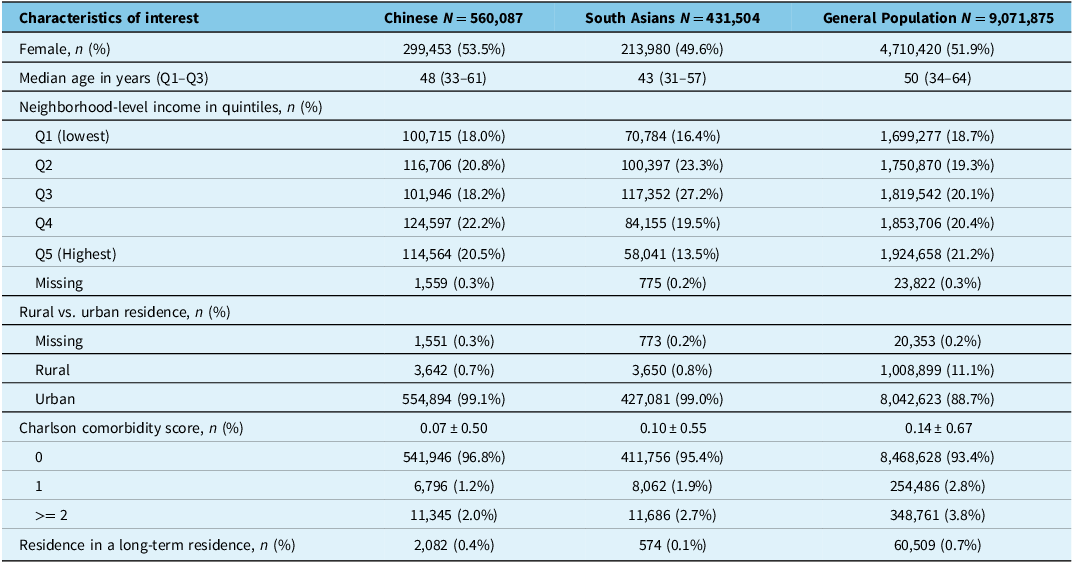
We included 10,063,466 Ontario residents aged 18 years and over, who received 19,933,221 vaccinations. Of these, 857,289 vaccinations were received by South Asians and 1,112,832 by Chinese. Compared to Chinese and the general population, South Asians were younger and less likely to live in the highest neighborhood-income quintile. Both Chinese and South Asians had lower comorbidity scores than the general population and were less likely to reside in long-term care homes (Table 1).
Characteristics of the included cohort with at least one COVID-19 vaccine in Ontario, Canada

In total, 2,419 people developed ischemic stroke, 505 developed ICH and 542 developed Bell’s Palsy within 42 days following first dose of vaccine. The total number of people developing CVST (n = 52), GBS (n = 72) and TM (n = 25) was low which did not allow us to evaluate the differential effect of ethnicity on these outcomes.
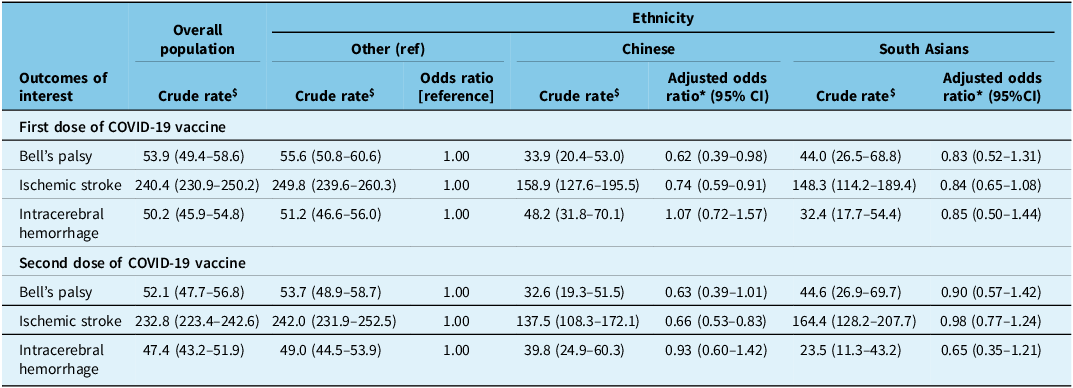
Overall, crude rates of ischemic stroke and ICH after the first dose of COVID-19 were lowest in South Asians while Bell’s palsy were the lowest in Chinese (Table 2). Chinese ethnicity was associated with a lower adjusted odds of ischemic stroke (adjusted odds ratio [aOR] 0.74; 95% CI, 0.59–0.91) and Bell’s Palsy (0.62, 0.39–0.98). Compared to the general population, South Asians had lower adjusted odds for each of the three complications albeit with wide confidence intervals that included null values (Table 2). Similar results were observed for crude rates after second dose (Table 2). Again, Chinese ethnicity was associated with a lower adjusted odds of ischemic stroke compared to the general population (0.66; 0.53–0.83), but not Bell’s Palsy (0.63; 0.39–1.01); whereas, like the first dose, odds of ICH were non-significantly lower in South Asians compared to the general population.
Neurological events within 42 days following the first and second COVID-19 vaccine

$Crude rates are per 1,000,000 people. *Adjusted for age, sex and type of COVID-19 vaccine (Pfizer [ref], Moderna vs Other).
Discussion
In this population-based retrospective cohort study in Ontario, rates of neurological events following the first or the second dose of COVID-19 were low and were largely similar after both doses. The crude rates were lower in South Asians and Chinese, with no ethnic differences in these rates after accounting for age, sex and vaccine type.
In Georgia, United States of America (USA), the rate of ischemic stroke within 21 days of COVID-19 vaccination was 8.14 to 10.48 per 100,000 doses, depending on vaccine type. Reference Nahab, Bayakly and Sexton8 In a large-scale study across the entire US, among people ≥ 65 years with Medicare benefits, rates of ICH were 48% higher (IRR 1.48; 1.41–1.56) and that of ischemic stroke were 7% lower (IRR 0.93; 0.90–0.96) in Asians compared to Whites. We too found a lower rate of ischemic stroke in Chinese in Ontario, but no difference in the rate of ICH. Further, our observed rates of these events are similar to the baseline rates observed in Ontario in the years preceding COVID-19 infection, Reference Nasreen, Calzavara and Sundaram9 and the known ethnic differences in the incidence of stroke and its subtypes. Reference Vyas, Austin and Pequeno10
While our strength includes use of population-based registry to track COVID-19 vaccination, and linked health records to identify incident neurological events, the use of latter can lead to some misclassification inherent to use of health administrative data. Reference Funk and Landi11 Also, some neurological events such as Bell’s Palsy may rarely require emergency visit or hospitalization, i.e., patients get diagnosed as an outpatient, not requiring ER visit or hospitalization. Reference Lee, Carnahan and McPheeters12 Thus, our observed estimates of the incidence of these conditions could be underestimated. Our surname algorithm is specific although for those with hyphenated names or those who change surnames after marriage could be incorrectly classified. Lastly, the incidence of a neurological event in the weeks after vaccination cannot be attributed directly to the vaccine itself.
We observed overall low rates of neurological events following COVID-19 vaccine in Ontario adults, without significant ethnic differences. This should encourage all ethnic groups to be vaccinated by showing lack of vaccine-associated complications by ethnicity.
Supplementary material
The supplementary material for this article can be found at https://doi.org/10.1017/cjn.2024.299.
Acknowledgments
We thank IQVIA Solutions Canada Inc. for use of their Drug Information File. This document used data adapted from the Statistics Canada Postal CodeOM Conversion File, which is based on data licensed from Canada Post Corporation, and data adapted from the Ontario Ministry of Health Postal Code Conversion File, which contains data copied under license from ©Canada Post Corporation and Statistics Canada. Parts of this material are based on data and/or information compiled and provided by Canadian Institute of Health Information (CIHI) and the Ontario Ministry of Health. The analyses, conclusions, opinions and statements expressed herein are solely those of the authors and do not reflect those of the funding or data sources; no endorsement is intended or should be inferred. We acknowledge the administrative support by Ms. Raquel Duchen of ICES.
Author contributions
Study conceptualization- JYC, MVV, RC; Writing of manuscript- MVV; Statistical analysis – IS. All authors interpreted the results, critically revised the manuscript for important intellectual content, and approved the final version for publication.
Funding statement
This study was supported by ICES, which is funded by an annual grant from the Ontario Ministry of Health (MOH) and the Ministry of Long-Term Care. This study was also supported by the Ontario Health Data Platform (OHDP), a Province of Ontario initiative to support Ontario’s ongoing response to COVID-19 and its related impacts. The opinions, results and conclusions reported in this paper are those of the authors and are independent from the funding sources. No endorsement by the OHDP, its partners or the Province of Ontario is intended or should be inferred.
This study was supported by Department of Medicine, University of Toronto: fund # 472617/FC 100089/CC 10,895; and the Research Committee, Chinese Canadian Heart and Brain Association.
Competing interests
MVV holds grants from the Canadian Institute of Health Research (CIHR), the Heart and Stroke Foundation of Canada, the National Multiple Sclerosis Society and Multiple Sclerosis Society of Canada. He has provided statistical support from Canadian Neuromuscular Disease Registry. RC holds grants from the CIHR, the University of Toronto, Dystonia Medical Research Foundation, National Institutes of Health and Parksinson Foundation. He has received consulting fees from Oxford University Press, Abbvie, Merz and Ipsen. JYC has received support from the Ministry of Health, Ontario Health Data Platform, the University of Toronto and the University of Ottawa Heart Institute.


 Open access

