




Non-technical Summary
A study of a group of conservative ammonites from the Late Cretaceous, which lived approximately 90–66 million years ago, allows for greater refinement of age placement and paleoecological interpretations. Over 100 specimens were examined from the Nanaimo Group rocks among the Gulf Islands of southern British Columbia in the eastern North Pacific. A reappraisal of this group addresses the range of variation within several forms, proposes a consistent framework of diagnostic characters, and sees the erection of a new species with description of the full development from juvenile to adult. Exclusive death assemblages of the new species support the inference of a gregarious mode of early life.
Introduction
Upper Cretaceous ammonites of Campanian age have been described extensively from the eastern North Pacific ranging from Alaska (Imlay and Reeside, Reference Imlay and Reeside1954; Jones, Reference Jones1963), through British Columbia and Washington State (e.g., Meek, Reference Meek1876; Whiteaves, Reference Whiteaves1903; Usher, Reference Usher1952; Ward, Reference Ward1978a; Haggart, Reference Haggart1989), to California and Mexico (e.g., Smith, Reference Smith1900; Anderson, Reference Anderson1958; Matsumoto, Reference Matsumoto1960; Ward et al., Reference Ward, Haggart, Mitchell, Kirschvink and Tobin2012, Reference Ward, Haggart, Mitchell and Catlin2015). Among the most renowned localities, exposures of the upper Campanian Northumberland Formation along western Hornby Island have reached legendary status in the region due to the abundance of well-preserved macrofossils that have been the focus of professional researchers and amateur collectors alike for over a century (e.g., Whiteaves, Reference Whiteaves1879; Usher, Reference Usher1952; Ludvigsen and Beard, Reference Ludvigsen and Beard1998). Namely the beds of Collishaw Point, a syncline platform projecting up to one kilometer outward into the Salish Sea from northwestern Hornby Island, present a major extent of outcrop at low tide, which has been the source of a diverse array of invertebrate (e.g., Usher, Reference Usher1952; Haggart, Reference Haggart1989; McLachlan and Haggart, Reference McLachlan and Haggart2018; Nyborg et al., Reference Nyborg, McLachlan, Garassino, Vega, Phillippe and Champagne2019) and vertebrate (e.g., Dyke et al., Reference Dyke, Wang and Kaiser2011; Martin-Silverstone et al., Reference Martin-Silverstone, Witton, Arbour and Currie2016; McLachlan et al., Reference McLachlan, Kaiser and Longrich2017; Cappetta et al., Reference Cappetta, Morrison and Adnet2021) material.
However, fossiliferous exposures of the Northumberland Formation are not restricted to the western shore, as the section transects the island with its lowermost beds cropping out on the south-eastern coast (Katnick and Mustard, Reference Katnick and Mustard2001, Reference Katnick and Mustard2003; Mustard et al., Reference Mustard, Haggart, Katnick, Treptau, MacEachern and Woodsworth2003). An older molluscan fauna characterized by previously unknown heteromorph ammonite taxa has recently been described from these beds and assigned to the Nostoceras (Didymoceras?) adrotans subzone of the Pachydiscus suciaensis Zone (McLachlan and Haggart, Reference McLachlan and Haggart2018). The section also yields an unusually high concentration of juvenile ammonite death assemblages concentrated in calcareous concretions. Among these ammonites are representatives of a new member of the Pachydiscidae, (Anapachydiscus) haegerti n. sp., with taphonomic evidence reinforcing a planktic mode of life and association between individuals of the same species during their early stages. The occurrence of other closely allied species in the eastern North Pacific (e.g., Usher, Reference Usher1952; Jones, Reference Jones1963; Saul, Reference Saul1979; Haggart, Reference Haggart1989; Haggart and Ward, Reference Haggart and Ward1989) presents an opportunity to further address the relationships between inflated pachydiscids with projected ornamentation during the Campanian in approach to the end of the Cretaceous.
Geological setting and historical background
The Nanaimo Group is an Upper Cretaceous sedimentary rock succession ranging from at least Turonian to Maastrichtian in age situated along eastern Vancouver Island (e.g., Mustard, Reference Mustard and Monger1994; Haggart et al., Reference Haggart, Ward and Orr2005) overlying the ancestral Wrangellia terrane of the Western Cordillera Insular Belt (e.g., Wheeler and McFeely, Reference Wheeler and McFeely1991; Yorath et al., Reference Yorath, Sutherland Brown and Massey1999; Alberts et al., Reference Alberts, Gehrels and Nelson2021). Investigations into Nanaimo Group stratigraphy followed the discovery of coal measures in the Nanaimo and Comox areas during the mid-nineteenth century, which proved to be of considerable economic significance to the region with mining of these deposits reaching its zenith in the early twentieth century (e.g., Bickford and Kenyon, Reference Bickford and Kenyon1987; Gardner, Reference Gardner1999). The Nanaimo Group succession reflects a multibasinal depositional environment that underwent an evolution from terrestrial to open marine with strata characterized by fluvial to nearshore facies marked by increasing marine influences of finer sedimentary sequences into the Santonian and Campanian (Bain and Hubbard, Reference Bain and Hubbard2016; Huang et al., Reference Huang, Dashtgard, Kent, Gibson and Matthews2019; Kent et al., Reference Kent, Dashtgard, Huang, MacEachern, Gibson and Cathyl-Huhn2020; Girotto et al., Reference Girotto, Dashtgard, Huang, MacEachern, Gibson and Cathyl-Huhn2024). With regard to the upper Nanaimo Group, fossiliferous mudstone to sandstone beds belonging to the Cedar District Formation are exposed continuously along the coast of western Denman Island from Boyle Point on its southern tip 18 km north-west to herein informally named ‘Gladstone Bay’ accessible via Gladstone Way. Similar rocks of the Northumberland Formation crop out for 2 km along eastern Denman Island and across the Lambert Channel on adjacent northwestern to southeastern Hornby Island intermittently over 10 km (Cathyl-Bickford and Hoffman, Reference Cathyl-Bickford and Hoffman1998; Katnick and Mustard, Reference Katnick and Mustard2001, Reference Katnick and Mustard2003; Fig. 1). Although previously interpreted as corresponding to Trent River Formation and Lambert Formation equivalents in the Comox Sub-basin, respectively (Williams, Reference Williams1924; Usher, Reference Usher1952; Cathyl-Bickford and Hoffman, Reference Cathyl-Bickford and Hoffman1998), these strata are now understood to have been deposited following early Campanian flooding of the Georgia Basin (Girotto et al., Reference Girotto, Dashtgard, Huang, MacEachern, Gibson and Cathyl-Huhn2024).
(1) Location of study area in western Canada. (2) Location of Denman and Hornby islands in the Georgia Straight, British Columbia, Canada. (3) Geological map of Denman and Hornby islands after Katnick and Mustard (Reference Katnick and Mustard2001, Reference Katnick and Mustard2003), Mustard et al. (Reference Mustard, Haggart, Katnick, Treptau, MacEachern and Woodsworth2003), and McLachlan and Haggart (Reference McLachlan and Haggart2018) with representation of the Cedar District, De Courcy, Northumberland, and Geoffrey formations belonging to the Upper Cretaceous Nanaimo Group. Localities mentioned in this study: 1, western coast, Denman Island; 2, ‘Gladstone Bay’, northwestern Denman Island; 3, ‘Paradise Bay’, southeastern Hornby Island; 4, Shingle Spit, western Hornby Island; 5, Phipps Point, western Hornby Island; 6, Manning Point, northwestern Hornby Island; 7, Collishaw Point, northwestern Hornby Island.

The earliest paleontological fieldwork in proximity to the southern coast of Hornby Island was conducted by James Richardson in 1871 for the Geological Survey of Canada, whose exploration of the main islet of Norris Rocks resulted in the collection of a single fossil fragment belonging to the inner whorls of a planispiral ammonite assigned to Gaudryceras denmanense Whiteaves, Reference Whiteaves1901 (Whiteaves, Reference Whiteaves1879, Reference Whiteaves1895, Reference Whiteaves1903). Norris Rocks is comprised of coarse clastic conglomerates of the De Courcy Formation, which are also exposed along southeastern Denman Island 2 km away on the opposite side of the Lambert Channel (Katnick and Mustard, Reference Katnick and Mustard2001). It is therefore likely that this material was reworked from the underlying Cedar District Formation where the species is also noted to occur (Haggart, Reference Haggart1989).
Although early mapping efforts would see various nomenclatural assignments for the finer-grained sedimentary units of Hornby Island (e.g., Williams, Reference Williams1924; Usher, Reference Usher1952; Muller and Jeletzky, Reference Muller and Jeletzky1970), the highly fossiliferous beds along the southeastern shore at informally named ‘Paradise Bay’ are now recognized as belonging to the lowermost Northumberland Formation, following adoption of unified basin terminology for the upper Nanaimo Group (Huang et al., Reference Huang, Dashtgard, Haggart and Girotto2022). The lower beds of the Northumberland Formation are also exposed west of the ferry terminal on southeastern Denman Island where detrital zircon analysis of lithic arenite established their maximum depositional age as 74.2 ± 1.4 Ma (Matthews et al., Reference Matthews, Guest, Coutts, Bain and Hubbard2017; Coutts et al., Reference Coutts, Matthews, Englert, Brooks, Boivin and Hubbard2020, fig. 4; Fig. 2). In a southwest to northeast transect along the southeastern shore of Hornby Island, they constitute an approximately 60-m-thick contiguous interval between the conglomeratic sandstones of the overlying Geoffrey Formation and underlying De Courcy Formation (McLachlan and Haggart, Reference McLachlan and Haggart2018). The ‘Paradise Bay’ locality, which had been largely overlooked for more than a century, would continue to remain uninvestigated until 1978, following the arrival of prolific local fossil collector, Joseph Haegert of Victoria, British Columbia, after having viewed the coastal cliffs across the straight from Qualicum Beach on Vancouver Island.
Biostratigraphic distribution and spot occurrences of inflated pachydiscid taxa throughout the Campanian of the Upper Cretaceous Nanaimo Group succession as inferred from occurrences on Saturna Island (Haggart, Reference Haggart1989), South Pender Island (Haggart and Ward, Reference Haggart and Ward1989), North Pender Island (Haggart and Ward, Reference Haggart and Ward1989), Denman Island (herein), and Hornby Island (Whiteaves, Reference Whiteaves1903; Usher, Reference Usher1952; Jones, Reference Jones1963; herein). Lithostratigraphy adapted from Mustard (Reference Mustard and Monger1994), Katnick and Mustard (Reference Katnick and Mustard2001, Reference Katnick and Mustard2003), Mustard et al. (Reference Mustard, Haggart, Katnick, Treptau, MacEachern and Woodsworth2003), and McLachlan and Haggart (Reference McLachlan and Haggart2018) presented as a simplified schematic diagram (stratigraphy not to scale); DC = De Courcy Formation; GF = Geoffrey Formation. Position (red arrows) and maximum depositional ages (MDA) of selected detrital zircon samples from Denman and Hornby islands (determined by Coutts et al., Reference Coutts, Matthews, Englert, Brooks, Boivin and Hubbard2020, fig. 4D; samples CD1, CD2, and NU3 after Matthews et al., Reference Matthews, Guest, Coutts, Bain and Hubbard2017). Molluscan biozones adapted from Haggart et al. (Reference Haggart, Ward, Raub, Carter and Kirschvink2009, Reference Haggart, Graham, Beard, Haggart and Smtih2011), Haggart and Graham (Reference Haggart and Graham2018), and McLachlan and Haggart (Reference McLachlan and Haggart2018). Localities: 1, western coast, Denman Island; 2, ‘Gladstone Bay’, north-western Denman Island; 3, ‘Paradise Bay’, southeastern Hornby Island; 4, Shingle Spit, western Hornby Island; 5, Phipps Point, western Hornby Island; 6, Manning Point, north-western Hornby Island; 7, Collishaw Point, northwestern Hornby Island.

Materials and methods
Fossil materials were obtained from exposures of the Cedar District Formation on western Denman Island and the Northumberland Formation along western and southeastern Hornby Island in accordance with British Columbia provincial law through surface collection using hand tools. All localities comprise coastal outcrops within the intertidal zone to cliff face, and all geospatial coordinates are presented in decimal degrees corresponding to the WGS84 datum. Specimens were prepared using a suite of pneumatic and rotary tools to enable accurate measurement, diagnosis, and photographic presentation. In some cases, a balance between complete and partial removal of the surrounding matrix was achieved to preserve taphonomic context. Photography was conducted using a Nikon D7100 digital camera and through a Leica M205A stacking microscope with DFC450 camera using Leica Application Suite X version 3.0.12.21488. Composite specimen figures were assembled using Macromedia Fireworks 8 software and image modification was limited to the balancing of brightness and contrast through black-level adjustments.
Vector line tracing of sutural elements was conducted in Adobe Illustrator CS2 over photographs sequentially rotated to compensate for shell surface curvature. Measures of sutural complexity follow the lateral saddle proxy method of Ward et al. (Reference Ward, Haggart, Mitchell and Catlin2015, fig. 3.2) wherein the length of the full run of the lateral saddle is divided by its narrowest width. This was achieved with a traced path in Adobe Illustrator CS2. Herein termed Fractal Dimension Index (FDI) values were obtained from the most mature sutures available using the Lateral Lobe Saddle (LLS) method of Marriott and Chamberlain (Reference Marriott and Chamberlain2021) to ascertain parameters of sutural complexity. Lateral Lobe Saddle values were first acquired using step counts based on a rule size of 1/10 Lmax in keeping with the Richardson method of complete end-to-end hemisutural transect stepping employed by Lutz and Boyajian (Reference Lutz and Boyajian1995). Fractal Dimension Index values were then established following the formula FDI = log (Nlls/V)/log(1/L) where Nlls is the number of steps recorded, L is the step size (or divisor of Lmax), and V is the Richardson-equivalent conversion value. A Richardson conversion value of 1.56 was determined from the intermediary inflated species Pachydiscus (Pachydiscus) hornbyense Jones, Reference Jones1963, given the formula V = Nlls/Nr where V is the conversion value, Nlls is the LLS step count, and Nr is the Richardson step count (Marriott and Chamberlain, Reference Marriott and Chamberlain2021) (Supplementary Data, Fig. 1.2). This conversion value was then applied as a baseline to enable FDI calculations for other species from which LLS values were obtained.
Illustrations of morphological progression and ontogenetic development in Anapachydiscus (Anapachydiscus) haegerti n. sp. from the upper Campanian Northumberland Formation, ‘Paradise Bay’, Hornby Island. (1) Schematic rendition with final volution cross-section reconstructed at 90° through body chamber (gray) based on the holotype RBCM P2022.185.0002. Note spines at mid flank in intermediary stage. (2) UWI (umbilical width index) and CWI (conch width index) comparative ratio plot; bubble size refers to maximum-diameter bracket; images in the background show the shape of the last complete whorl (see morphosectors of Korn, Reference Korn2010). (3–5) Juvenile septal suture lines, scale bar = 0.5 mm; (3) paratype RBCM P2022.185.0019 at whorl height (Wh) = 0.5 mm; (4) paratype RBCM P2022.185.0013 at Wh = 1.5 mm; (5) paratype RBCM P2022.185.0027 at Wh = 2.5 mm. (6) Suture line of paratype GSC 142951 at Wh = 19.5 mm; dashed regions inferred based on succeeding suture on the same specimen at Wh = 20 mm. (7) Penultimate suture line of holotype RBCM P2022.185.0002 at Wh = 26 mm; tips of overlying folioles from preceding saddles illustrated in gray. L = lateral lobe; U2 = second umbilical lobe.

Measurements ≥ 1 mm were taken with a digital vernier caliper and those below were obtained through the Leica Application Suite. All measurements were taken between ribs (intercostal). For instances where shell was not present at a point of measurement but intact on an adjacent surface, the shell thickness was recorded and added to the reading obtained from the internal mold to extrapolate a more accurate value. To maximize use of material, the two measurement end points from the whorl expansion rate formula of Raup (Reference Raup1966, Reference Raup1967; see Tendler et al., Reference Tendler, Mayo and Alon2015, fig. 2) were reduced from those corresponding to one full 360° volution to two measurements separated by one half volution. As such, vertical and lateral whorl expansion rate values were obtained by dividing the later of two directly opposing whorl heights or widths by the earlier. The descriptive approach traces ontogenetic progression to provide clarity of differentiation between stages of shell development. Terminology and conch morphometric indices follow those of Korn (Reference Korn2010). The reader is also referred to Klug et al. (Reference Klug, Korn, Landman, Tanabe, De Baets, Naglik, Klug, Korn, De Baets, Kruta and Mapes2015) for a detailed discussion on terminology and conventions.
Morphometric abbreviations
D = whorl volution diameter; Uw = umbilical width; Wh = whorl height (umbilical margin to mid-venter); Ww = whorl width (flank to flank); WWI = whorl width index established from Ww/Wh; CWI = conch width index calculated from Ww2/D; UWI = umbilical width index obtained from Uw/D; LX = lateral conch expansion rate derived from Ww2/Ww1; VX = vertical conch expansion rate determined from Wh2/Wh1; RI = rib index representing the primary ventral rib count per one half volution between Wh1 and Wh2. FDI = suture fractal dimension index after Marriott and Chamberlain (Reference Marriott and Chamberlain2021). Sc = measure of sutural complexity after Ward et al. (Reference Ward, Haggart, Mitchell and Catlin2015, fig. 3.2). High quality specimen preservation enabled the illustration of suture line elements from a range of ontogenetic stages for certain taxa. As such, sutural terminology follows the system proposed by Wedekind (Reference Wedekind1916) and reviewed by Kullmann and Wiedmann (Reference Kullmann and Wiedmann1970), where E = external lobe; I = internal lobe; L = first lateral lobe; U = umbilical lobe.
Repositories and institutional abbreviations
The specimens incorporated in this study are reposited within the paleontological collections of the Royal British Columbia Museum (RBCM, Victoria, BC, Canada), the Geological Survey of Canada (GSC, Vancouver, BC, Canada), the Courtenay and District Museum and Palaeontology Centre (CDMPC, Courtenay, BC, Canada), and the Smithsonian National Museum of Natural History (NMNH and USNM, Washington, DC, USA).
Systematic paleontology
Order Ammonoitida Hyatt, Reference Hyatt1889
Suborder Ammonitina Hyatt, Reference Hyatt1889
Superfamily Desmoceratoidea Zittel, Reference Zittel1895
Family Pachydiscidae Spath, Reference Spath1922
Genus Anapachydiscus Yabe and Shimizu, Reference Yabe and Shimizu1926
Type species
Pachydiscus (Parapachydiscus) fascicostatum (Yabe and Shimizu, Reference Yabe and Shimizu1921, p. 57, pl. 8, fig. 5; pl. 9, figs. 2–5) by original designation.
Emended diagnosis
Inflated pachyconic pachydiscids with ventral depression throughout ontogeny such that Ww exceeds Wh in ephebic to intermediate growth stages with Ww ≥ Wh in the gerontic stage. Conches subinvolute, narrowly umbilicate with rounded umbilical margin, convex flanks, and broadly arched venter. Ornamentation consisting of rectiradiate to feebly sinuous or prorsiradiate primary ribs becoming more pronounced, retaining expression, or diminishing throughout the intermediate to gerontic stage. Intermediate stage marked by the development of tubercles or conical spines projecting from the umbilical shoulder. Constrictions may or may not occur.
Occurrence
Members of the genus Anapachydiscus, as corresponding to the refined diagnostic parameters of the present study, are restricted to strata of at least early Coniacian to late Campanian age, having been recovered from Europe (Schlüter, Reference Schlüter1872; Błaszkiewicz, Reference Błaszkiewicz1980), Madagascar (Collignon, Reference Collignon1955) and the Circum-Pacific region encompassing Japan, Far East Russia, the Western Americas, and Antarctica (e.g., Yokoyama, Reference Yokoyama1890; Paulcke, Reference Paulcke1907; Anderson and Hanna, Reference Anderson and Hanna1935; Matsumoto, Reference Matsumoto1951, Reference Matsumoto and Matsumoto1954, Reference Matsumoto1984a; Jones, Reference Jones1963; Leanza, Reference Leanza1963; Saul, Reference Saul1979; Kennedy et al., Reference Kennedy, Crame, Bengtson and Thomson2007; Olivero, Reference Olivero2012; Reguero et al., Reference Reguero, Gasparini, Olivero, Coria and Fernández2022).
Remarks
The original description of Yabe and Shimizu (Reference Yabe and Shimizu1926) offered little more than comparative remarks for a group pertaining to densely rectiradially ribbed forms that occupied intermediary morphospace between their ‘Mesopachydiscus’ and ‘Neopachydiscus’ genera; the former characterized by Pachydiscus haradai Jimbo, Reference Jimbo1894 (now Eupachydiscus; see Spath, Reference Spath1922; Wright et al., Reference Wright, Calloman [sic], and Howarth and Kaesler1996) and the latter characterized by Pachydiscus naumanni Yokoyama, Reference Yokoyama1890 (now Anapachydiscus following Matsumoto, Reference Matsumoto1984a; Menuites according to Wright et al., Reference Wright, Calloman [sic], and Howarth and Kaesler1996). Subsequent diagnoses given by Matsumoto (Reference Matsumoto1951, Reference Matsumoto and Matsumoto1954, Reference Matsumoto1984a) accommodate a wide range of forms that express coarsening, retention, or disappearance of rib ornament into maturity as well as the presence or absence of constrictions (Haggart, Reference Haggart1989, p. 197). Seventeen described species have been attributed to the genus: A. arrialoorensis (Stoliczka, Reference Stoliczka1865) (e.g., Collignon, Reference Collignon1952); A. constrictus Olivero, Reference Olivero1984; A. deccanensis (Stoliczka, Reference Stoliczka1865) (e.g., Matsumoto, Reference Matsumoto1955); A. fascicostatus (Yabe and Shimizu, Reference Yabe and Shimizu1921) (e.g., Matsumoto, Reference Matsumoto1951); A. franciscae Collignon, Reference Collignon1955; A. fresvillensis (Seunes, Reference Seunes1890) (Ward and Kennedy, Reference Ward and Kennedy1993); A. hauthali (Paulcke, Reference Paulcke1907) (e.g., Katz, Reference Katz1963; as A. patagonicus of Olivero, Reference Olivero1984; Riccardi and Aguirre-Urreta, Reference Riccardi and Aguirre-Urreta1988; Menuites hauthali comb. Kennedy et al., Reference Kennedy, Crame, Bengtson and Thomson2007); A. hourcqi Collignon, Reference Collignon1955; A. naumanni (Yokoyama, Reference Yokoyama1890) (e.g., Matsumoto, Reference Matsumoto1951); A. nelchinensis Jones, Reference Jones1963; A. peninsularis (Anderson and Hanna, Reference Anderson and Hanna1935) (Saul, Reference Saul1979); A. steinmanni (Paulcke, Reference Paulcke1907) (Leanza, Reference Leanza1963); A. subtililobatus (Jimbo, Reference Jimbo1894) (e.g., Matsumoto, Reference Matsumoto1951); A. sutneri (Yokoyama, Reference Yokoyama1890) (e.g., Matsumoto, Reference Matsumoto1951); A. terminus Ward and Kennedy, Reference Ward and Kennedy1993; A. vistulensis Błaszkiewicz, Reference Błaszkiewicz1980; and A. wittekindi (Schlüter, Reference Schlüter1872) (e.g., Collignon, Reference Collignon1955).
Kennedy (Reference Kennedy1986c) and Cobban and Kennedy (Reference Cobban and Kennedy1993) hypothesized sexual dimorphism wherein smaller, bituberculate forms constitute microconchs belonging to Menuites and macroconchs assignable to Anapachydiscus, with the implication that the latter genus is a dimorphic junior synonym of the former. This is of important consideration with Matsumoto (Reference Matsumoto1984a) having suggested that Menuites sanadai Matsumoto, Reference Matsumoto1984a, could represent the dimorphic counterpart to the type species A. fascicostatus, the likely basis upon which Wright et al. (Reference Wright, Calloman [sic], and Howarth and Kaesler1996) synonymized Anapachydiscus under Menuites. Although discussion of taxa co-occurrence lending to this interpretation has been based on extensive material from Japan (Matsumoto, Reference Matsumoto1951, Reference Matsumoto1955), the United States Western Interior (Cobban and Kennedy, Reference Cobban and Kennedy1993), and Europe (e.g., Kennedy, Reference Kennedy1986c; Kennedy and Summesberger, Reference Kennedy and Summesberger1986; Kennedy and Kaplan, Reference Kennedy and Kaplan1997), Cobban and Kennedy (Reference Cobban and Kennedy1993) acknowledged that dimorphic counterparts have yet to be established and linked for all species, including the holotype Menuites menu (Forbes, Reference Forbes1846). Jagt et al. (Reference Jagt, Motchurova-Dekova, Ivanov, Cappetta and Schulp2006) later suggested Menuites as a subgenus of Anapachydiscus without explanation, whereas Jagt-Yazykova (Reference Jagt-Yazykova2011) maintained Anapachydiscus as a subgenus of Menuites in her examination of ammonite bio-events in the western North Pacific. More recently, Anapachydiscus has been retained and assigned to specimens recovered from the James Ross Basin, Antarctica (Olivero, Reference Olivero2012; Reguero et al., Reference Reguero, Gasparini, Olivero, Coria and Fernández2022).
Members of the genus Menuites are distinctly bituberculate, characterized by umbilical as well as ventrolateral projections and a pre-apertural constriction (Spath, Reference Spath1922; Matsumoto, Reference Matsumoto1955). Dimorphism demonstrable among the Hornby Island pachydiscids cannot be defined on the basis of quadrituberculate ornament as recognized in Menuites, since all known examples are devoid of constrictions and tuberculate to spinous ventrolateral projections. For this reason, the present study refrains from adopting the classification of Wright et al. (Reference Wright, Calloman [sic], and Howarth and Kaesler1996). While resolution of the taxonomic placement of all pachydiscid species is beyond the scope of the present study, prevalence and general consistency of ventral depression and projected umbilical ornament as associated traits among pachyconic forms lend support to the Anapachydiscus genus concept. However, establishment of definitive generic parameters remains to be borne out through broader comparative character analysis among the Pachydiscidae.
Future investigations could determine that certain taxa placed within Anapachydiscus may indeed be more appropriately reassigned to other genera. Anapachydiscus arrialoorensis, from the Campanian of southern India, Madagascar, and eastern Europe (e.g., Kennedy and Summesberger, Reference Kennedy and Summesberger1984), was regarded by Kennedy (Reference Kennedy1986b) to be a possible senior synonym of A. vistulensis from the upper Campanian of eastern Europe (Błaszkiewicz, Reference Błaszkiewicz1980). This would render both species potential candidates for Eupachydiscus as was surmised for the latter by Matsumoto (Reference Matsumoto1955; pers. comm. in Haggart, Reference Haggart1989) on the basis of reduced whorl depression and similar rib prominence from an early stage. The lectotype for Anapachydiscus wittekindi (Schlüter, Reference Schlüter1872, pl. 22, figs. 1–3) designated by Błaszkiewicz (Reference Błaszkiewicz1980) from the original German suite has Wh ≥ Ww, while other forms he assigned to the species from Poland do not indicating a need for review of the species concept given inconsistent expression in a genus-level character. While all occurrences of A. wittekindi are noted within upper Campanian strata, Błaszkiewicz (Reference Błaszkiewicz1980, p. 50) made the important observation that “specimens which are higher [Wh] than thick [Ww] mostly occupy a higher stratigraphic position.” Anapachydiscus fresvillensis (Seunes, Reference Seunes1890), from the upper Maastrichtian of Europe, Asia, South Africa, Madagascar, Australia, Chile, and possibly Brasil (Klinger et al., Reference Klinger, Kennedy, Lees and Kitto2001), is another distinct outlier in possessing Wh ≥ Ww at maturity (Salazar et al., Reference Salazar, Stinnesbeck and Rubilar-Rogers2013) and is therefore of closer affinity with Pachydiscus, as acknowledged by Henderson and McNamara (Reference Henderson and McNamara1985). Likewise, with Anapachydiscus terminus Ward and Kennedy, Reference Ward and Kennedy1993, described from the uppermost Maastrichtian strata of France, Spain, Denmark, and Azerbaijan. All specimens of this species reported by Ward and Kennedy (Reference Ward and Kennedy1993) are crushed prohibiting cross-sectional conch reconstruction, although Machalski (Reference Machalski2005, fig. 6D–F) figured a coeval specimen from Poland that confirms Wh ≥ Ww. Regardless, assignment of this species to Anapachydiscus cannot be based on the presence of umbilical tubercles alone.
In the Nanaimo Group, the only record of specimens attributable to Menuites hails from middle Campanian exposures of the Cedar District Formation on South Pender Island, within the regional Metaplacenticeras cf. M. pacificum zone (Menuites sp. of Ward, Reference Ward1976a, unpublished data; Menuites cf. menu of Haggart and Ward, Reference Haggart and Ward1989). These specimens of Menuites sp. have been recovered from the same interval as several examples of Anapachydiscus nelchinensis on North Pender Island (Ward Reference Ward1976a, unpublished data; Haggart and Ward, Reference Haggart and Ward1989). The latter species exhibits umbilical tubercles and is nearly smooth throughout ontogeny. Other taxa attributed to Anapachydiscus from Nanaimo Group strata are also limited to isolated occurrences of fragmentary specimens from exposures of the Cedar District Formation (Fig. 2). These include a specimen assigned to A. cf. A. nelchinensis Jones, Reference Jones1963, from North Pender Island with only sparse, weakly pronounced ribs that arise at the umbilical shoulder and terminate mid-flank (Haggart and Ward, Reference Haggart and Ward1989) and a partial whorl collected on Saturna Island attributed to A. sp. aff. A. subtililobatus (Jimbo, Reference Jimbo1894) of Haggart (Reference Haggart1989) characterized by evenly spaced, radial ribs.
Subgenus Anapachydiscus (Anapachydiscus) Yabe and Shimizu, Reference Yabe and Shimizu1926
Type species
Pachydiscus (Parapachydiscus) fascicostatum Yabe and Shimizu, Reference Yabe and Shimizu1921, p. 57, pl. 8, fig. 5; pl. 9, figs. 2–5; by original designation.
Diagnosis
Inflated pachyconic pachydiscids with ventral depression throughout ontogeny such that Ww ≥ Wh is ever present. Conches subinvolute, narrowly umbilicate with rounded umbilical margin, convex flanks, and broadly arched venter. Ornamentation consisting of rectiradiate to feebly sinuous or prorsiradiate primary ribs becoming more pronounced or retaining expression throughout the intermediate to gerontic stage. Intermediate stage marked by the development of tubercles or conical spines projecting from the umbilical shoulder. Constrictions absent.
Occurrence
Members of the subgenus Anapachydiscus, as corresponding to the diagnostic parameters upheld herein, are restricted to strata of at least Santonian to late Campanian age recovered from Europe (Schlüter, Reference Schlüter1872; Błaszkiewicz, Reference Błaszkiewicz1980), Madagascar (Collignon, Reference Collignon1955), Japan (Yokoyama, Reference Yokoyama1890; Matsumoto, Reference Matsumoto1984a), Far East Russia (Matsumoto, Reference Matsumoto1951, Reference Matsumoto and Matsumoto1954), and western North America (Anderson and Hanna, Reference Anderson and Hanna1935; Saul, Reference Saul1979).
Remarks
Haggart (Reference Haggart1989) noted that Matsumoto (Reference Matsumoto1984a) retained Neopachydiscus of Yabe and Shimizu (Reference Yabe and Shimizu1926) as a subgenus within Anapachydiscus for forms with periodic constrictions accompanied by major ribs. These taxa are exemplified by A. naumanni from the lower Campanian of Japan and Far East Russia (Matsumoto Reference Matsumoto and Matsumoto1954, Reference Matsumoto1984a), A. constrictus from the lower Campanian of James Ross Island, Antarctica (Olivero, Reference Olivero1984, Reference Olivero2012), A. hauthali from the Campanian of Chile (Paulcke, Reference Paulcke1907) and upper Coniacian–lower Campanian of James Ross Island, Antarctica (Kennedy et al., Reference Kennedy, Crame, Bengtson and Thomson2007), and A. steinmanni from the Campanian of Chile (Paulcke, Reference Paulcke1907; Leanza, Reference Leanza1963) and lower Coniacian–lower Campanian of James Ross Island, Antarctica (Kennedy et al., Reference Kennedy, Crame, Bengtson and Thomson2007). Likewise, A. nelchinensis, described from the lower Campanian of Alaska (Jones, Reference Jones1963), should belong to a separate subgenus as well with rib ornament diminishing to a state of virtual absence at maturity in keeping with the concept of Pachydiscus (Neodesmoceras) (e.g., Matsumoto, Reference Matsumoto1951; Kennedy and Summesberger, Reference Kennedy and Summesberger1984).
Anapachydiscus (Anapachydiscus) haegerti new species
Figures 3.1–3.7, 4.1–4.23, 5.1–5.13
(1–23) Anapachydiscus (Anapachydiscus) haegerti n. sp. from the upper Campanian of the lower Northumberland Formation, ‘Paradise Bay’, south-eastern Hornby Island. (1–3) Paratype RBCM P2022.185.0009; (1) protoconch with view of siphuncle at junction with first septum; (2) ventral view; (3) left flank. (4, 5) Paratype RBCM P2022.185.0007, protoconch partially enveloped by first volution septae; (4) right flank; (5) ventral view. (6) Paratype RBCM P2022.185.0008, with succeeding volutions in cross-section. (7–9) Paratype RBCM P2022.185.0019; (7) left flank; (8) apertural view; (9) right flank. (10–12) Paratype RBCM P2022.185.0013; (10) left flank; (11) apertural view; (12) right flank. (13–17) Paratype RBCM P2022.185.0030; (13) ventral view; (14) left flank; (15) apertural view; (16) right flank; (17) ventral view at max Ww. (18) Paratype RBCM P2022.185.0028, left aperturolateral view, retained in situ next to (19) paratype RBCM P2022.185.0029, left ventrolateral view. (20, 21) Paratype RBCM P2022.185.0020; (20) ventral view; (21) right flank. (22) Paratype RBCM P2022.185.0025, ventral view, retained in situ next to (23) paratype RBCM P2022.185.0026 in cross-section.

Holotype
The holotype is specimen RBCM P2022.185.0002 (Figs. 3.1, 3.7, 5.7–5.11) reposited within the collections of the RBCM, recovered from a float concretion having weathered from the intertidal outcrop of the upper Campanian Northumberland Formation at ‘Paradise Bay’ along the southeastern coast of Hornby Island, British Columbia (Fig. 1.3, loc. 3; 49.49508°, −124.65217°).
Paratypes
Specimens RBCM.EH2008.011.11254, RBCM P2022.185.0007, RBCM P2022.185.0008, RBCM P2022.185.0009, RBCM P2022.185.0013, RBCM P2022.185.0019, RBCM P2022.185.0020, RBCM P2022.185.0025, RBCM P2022.185.0026, RBCM P2022.185.0027, RBCM P2022.185.0028, RBCM P2022.185.0029, and RBCM P2022.185.0030 housed within the collections of the RBCM. Specimen GSC 142951 is reposited within the collections of the GSC.
Diagnosis
A moderate to large-sized species of Anapachydiscus. Conch transitioning from thickly globular, involute, to thinly pachychonic, subinvolute. Whorl cross-section strongly embracing and depressed progressing to moderately embracing, weakly depressed. CWI avg. = 0.82. WWI ranges from 7.5 to 1.08 with ontogeny. UWI avg. = 0.22. LX and VX rates avg. = 1.32 and 1.58, respectively. Ornamentation consisting of laterally sinuous to biconvex lirae with intermittent prorsiradiate ventral primary ribs separated by transverse lirae. Rib projection and frequency increasing significantly on gerontic body chamber; ventrally prorsiradiate becoming weakly sinuous to biconvex in continuation across flanks separated by lirae. Spines present at intermediate stage along umbilical margin. Suture line complex and florid.
Occurrence
All specimens of Anapachydiscus (Anapachydiscus) haegerti n. sp. were collected from concretions either occurring as float or excavated in-situ among the intertidal exposures of the upper Campanian Northumberland Formation from the ‘Paradise Bay’ embayment along the southeastern coast of Hornby Island, British Columbia. The species is constrained within the Nostoceras (Didymoceras?) adrotans subzone (McLachlan and Haggart, Reference McLachlan and Haggart2018) of the Pachydiscus (Pachydiscus) ootacodensis–Pachydiscus (Pachydiscus) suciaensis Concurrent-range Zone (see biozonation of Haggart et al., Reference Haggart, Ward, Raub, Carter and Kirschvink2009, Reference Haggart, Graham, Beard, Haggart and Smtih2011, and Haggart and Graham, Reference Haggart and Graham2018, emended herein).
Description
The combination of specimens representative of earliest ephebic to latest gerontic stages allows for a virtually complete reconstruction of a 7- to 8-volution conch at maturity (Fig. 3.1) and the extent of morphological change throughout ontogeny (Table 1). In paratype RBCM P2022.185.0007, the protoconch (~550 × 940 μm) is of greater width than the initial half volution (850 μm), which expands with LX = 0.90, transitioning to 1.08 at completion of the first volution (Fig. 4.4, 4.5). This is not the case in paratype RBCM P2022.185.0009, which has a markedly smaller protoconch (390 × 600 μm) and initial half volution LX of 1.07 (Fig. 4.1–4.3). Juvenile conches comprise the bulk of the dataset (Fig. 3.2), and the earliest volutions are seen to be thickly globular, involute, and reniform in cross-section (Figs. 3.1, 3.2, 4.6, 4.8, 4.11). The shell appears essentially smooth at D ≤ 2.0 mm, above which fine growth lines begin to become discernable. These growth lines gradually transition into more pronounced, low-relief lirae analogous to the robust ribs present at maturity separated by finer intermediary lirae (Fig. 4.16, 4.17). The ventrally prorsiradiate primary ribs of the intermediary conch are somewhat broadly spaced becoming weakly sinuous to biconvex in continuation across the flanks, and increasingly more proximate until they are ultimately separated by only 6–8 lirae on the gerontic body chamber (Fig. 5.9–5.11). Over the last 270° of the final volution, the ventral ribs increase in frequency such that their separation is reduced from 22° to 4° in approach to the aperture. Spines develop along the umbilical margin during the intermediate stage where D = ~30–60 mm (Fig. 5.12), at which point the conch has progressed from thinly globular to thickly pachyconic, subinvolute. Across the final volution in the holotype, RBCM P2022.185.0002, WWI reduces from 1.32 to 1.08 (avg. 1.19), accompanying an overall decrease in ventral depression with growth resulting in a thinly pachyconic, subinvolute profile. The holotype apertural dimensions (Wh = 47.1 mm; Ww = 53.8 mm) present a WWI of 1.14. The holotype maximum CWI could not be measured due to erosion of the ventral face, although a UWI of 0.22 is attainable at D = 101.8 mm. Near the gerontic aperture, the shell thickness is greatest at 0.9 mm on the umbilical shoulder, tapering along the flanks to 0.6 mm on the venter. The shell is composed of two major inner layers of approximately equal thickness (~0.2 mm at Wh = 28) supporting a thin outer layer (Fig. 5.13). The largest Ww measurement of 63.8 mm was obtained from apertural fragment RBCM.EH2008.011.11234. The mature suture line is complex and florid, marked by intricate lobe-incision elements and narrow-stemmed external, lateral, and second umbilical saddles (Fig. 3.6, 3.7); an FDI of 1.94 and Sc of 4,466 was obtained from the holotype at Wh = 26 mm.
(1–13) Anapachydiscus (Anapachydiscus) haegerti n. sp. from the upper Campanian of the lower Northumberland Formation, ‘Paradise Bay’, southeastern Hornby Island. (1–4) Paratype RBCM.EH2008.011.11254; (1) left flank; (2) ventral view; (3) ventral view at max whorl width = 11.6 mm; (4) right flank. (5, 6) Paratype GSC 142951. (7–13) Holotype RBCM P2022.185.0002; (7) apertural view; (8) terminal phragmocone ventral view; (9) left flank; (10) ventral view of gerontic body chamber; (11) right flank; (12) spines at intermediate stage both free standing and appressed to umbilical wall; (13) cross-section of multi-layered ventrolateral shell at whorl height = 28 mm.

Dimensions of Anapachydiscus (Anapachydiscus) haegerti n. sp. at successive stages of ontogeny. D = whorl volution diameter (mm); WWI = whorl width index; CWI = conch width index; UWI = umbilical width index; LX = lateral conch expansion rate; VX = vertical conch expansion rate; n = number of specimens; * = holotype; () = averages

Etymology
The species name honors Joseph John Haegert (b. 1939) of Victoria, British Columbia, a prolific collector of Nanaimo Group fossils who discovered what he deemed the ‘Paradise Bay’ locality on southeastern Hornby Island in 1978.
Material
Thirty-seven specimens housed within the collections of the GSC and RBCM (Supplementary Data, Table 1.1) recovered from concretionary matrices of the upper Campanian Northumberland Formation at ‘Paradise Bay’ (Fig. 1.3, loc. 3) along the southeastern coast of Hornby Island, British Columbia. GSC 142951 (paratype, in situ; 49.495485°, −124.653039°), RBCM.EH2008.011.00484 and paratype -11254 (float; 49.49618°, −124.65346°), -11233 (float; 49.49527°, −124.65405°), -11234 (float; 49.49609°, −124.65353°), RBCM P2022.185.0002 (holotype, float; 49.49508°, −124.65217°), -0003–0006 (float; 49.4944°, −124.6535°), and -0007–0033 (in situ; 49.49598°, −124.65308°).
Remarks
Anapachydiscus (Anapachydiscus) haegerti n. sp. is distinct from all other species assigned to the genus due to the presence of fine, flexuous ribs with periodicity of increased ventral projection, which undergo a pronounced transition to greater proximity across the final volution. This is the first time that the complete ontogenetic progression of a species of Anapachydiscus has been incorporated into its description, as well as the first time that the earliest stage has been photographed, since Matsumoto (Reference Matsumoto1951, fig. 1a) observed and illustrated the protoconch of Pachydiscus yezoensis Yabe, Reference Yabe1909 (= Anapachydiscus deccanensis, Matsumoto, Reference Matsumoto1955). However, limited specimens combined with the development of spines at what can only be characterized as the intermediary stage (D = ~30–60 mm) in the holotype RBCM P2022.185.0002 and paratype GSC 142951 provide no evidence of sexual dimorphism in the species as could be argued if projected ornament were restricted to a diminutive form (microconch).
The closest comparable pachydiscid is Pachydiscus (Pachydiscus) hornbyense Jones, Reference Jones1963, also from within the Nanaimo Group as reported from the overlying upper Campanian Northumberland Formation exposures of western Hornby Island on the grounds of spinous ornament in the intermediary stage and periodicity of projected transverse ventral ribbing. However, the latter trait is uniformly expressed throughout later ontogeny in the aforementioned species and lacks the sinuosity observed in A. (A.) haegerti n. sp. Pachydiscus (Pachydiscus) neevesi Whiteaves, Reference Whiteaves1903, known from isolated specimens from the middle Campanian of the Cedar District Formation on Sucia Island, Washington State (Usher, Reference Usher1952), and possibly the Trent River Formation at Northwest Bay, eastern Vancouver Island (D. Nunnallee, pers. comm. in Haggart, Reference Haggart1989), presents similar sinuosity and cord-like sculpture in its ribbing, although expressed with uniformity in proportionate relief and density. Both P. (P.) hornbyense and P. (P.) neevesi are taxa firmly placed within the genus Pachydiscus in being more compressed, evolute, and discoidal than species attributable to Anapachydiscus.
Anapachydiscus (Anapachydiscus) cf. A. (A.) fascicostatus (Yabe and Shimizu, Reference Yabe and Shimizu1921)
(1–3) Anapachydiscus (Anapachydiscus) cf. A. (A.) fascicostatus Yabe and Shimizu, Reference Yabe and Shimizu1921 from the middle Campanian of the Cedar District Formation, western Denman Island, RBCM.EH2013.047.0003.001; (1) right flank with faintly discernable rib ornament; (2) ventral view, dashed lines denote extrapolated phragmocone cross-section; (3) septal suture at Wh = 15 mm. (4) UWI (umbilical width index) and CWI (conch width index) comparative ratio plot; bubble size refers to maximum diameter bracket, and images in the background show the shape of the last complete whorl (see morphosectors of Korn, Reference Korn2010); diamonds denote values pertaining to Pachydiscus (Pachydiscus) hornbyense; circles denote values pertaining to Pachydiscus (Pachydiscus) ootacodensis; white circles = macroconchs, gray circles = mircoconchs. (5) Septal suture of P. (P.) hornbyense, RBCM.EH2008.011.11272, western Hornby Island, at whorl height (Wh) = 25 mm. (6–9) Septal sutures of P. (P.) ootacodensis from the upper Campanian Northumberland Formation, scale bar = 5 mm; (6) RBCM.EH2008.011.11257, Collishaw Point, Hornby Island, at Wh = 9.5 mm; (7) RBCM.EH2008.011.11264, Collishaw Point, at Wh = 17.5 mm; (8) RBCM.EH2008.011.11256, Collishaw Point, Hornby Island, at Wh = 26.5 mm. (9) RBCM.EH2008.011.11273, north of Phipps Point, at Wh = 46 mm. E = external lobe; L = lateral lobe; U1 = first umbilical lobe; U2 = second umbilical lobe.

Occurrence
Within the Nanaimo Group, Anapachydiscus (Anapachydiscus) cf. A. (A.) fascicostatus is known only from a spot occurrence in the middle Campanian of the Cedar District Formation within or above the Metaplacenticeras cf. M. pacifcum Zone (see biozonation of Haggart et al., Reference Haggart, Ward, Raub, Carter and Kirschvink2009, Reference Haggart, Graham, Beard, Haggart and Smtih2011; Haggart and Graham, Reference Haggart and Graham2018). Indisputable specimens of A. (A.) fascicostatus are otherwise known only from Campanian rocks of the Yezo Group, Hokkaidō (Matsumoto, Reference Matsumoto1951, Reference Matsumoto and Matsumoto1954, Reference Matsumoto1984a; Shigeta et al., Reference Shigeta, Izukura, Nishimura and Tsutsumi2016).
Description
A fragmentary specimen composed of two partial volutions of phragmocone. The right flank of the outer volution is convex with subdued, densely concentrated rectiradiate ribs of low relief at Wh = 45 mm (Fig. 6.1). The ventrolateral surfaces of the inner volution are essentially smooth. The ventral region is moderately depressed on both inner and outer volutions, and the outer volution is strongly embracing (Fig. 6.2). The extrapolated WWI of the outermost volution is 1.37 at Wh = 45 mm. The external lobe and ventrolateral saddles visible on the inner volution are complex and florid (Fig. 6.3).
Material
A single partial specimen, RBCM.EH2013.047.0003.001, housed within the RBCM (Supplementary Data, Table 1.2) collected on western Denman Island (Fig. 1.3, loc. 1; 49.52555°, −124.80620°), 1.56 km southeast of the ferry terminal, in situ at the base of the coastal cliff face.
Remarks
The specimen is left in open nomenclature due to its fragmentary nature rendering any bifurcation or fasciculation of ribs indiscernible. Otherwise, the flank exhibits a fine, dense rib ornament, depressed, broadly inflated whorl section, and complex septal suture consistent with examples of the type species figured by Yabe and Shimizu (Reference Yabe and Shimizu1926, pl. 8, fig. 5, pl. 9, figs. 2a–2e) and Matsumoto (Reference Matsumoto and Matsumoto1954, pl. 7(23), fig. 3a, 3b, text-fig. 13(59)c; 1984a, pl. 4, figs. 2a, 2b, pl. 5, fig. 2, text-figs. 4a–4c).
Genus Pachydiscus Zittel, Reference Zittel, Schimper, Scudder and Schenk1884
Type species
Ammonites neubergicus von Hauer (Reference von Hauer1858, p. 12, pl. 2, figs. 1–4, pl. 3, figs. 1, 2) by the subsequent designation of de Grossouvre (Reference de Grossouvre1894, p. 177).
Emended diagnosis
Discoidal pachydiscids ranging from depressed to compressed, becoming more compressed throughout ontogeny. Conches subinvolute, with high, flat, or convex flanks. Ornament consisting of rectiradiate to feebly sinuous or prorsiradiate primary ribs, which may or may not be feebly umbilically bullate, with well-differentiated intercalaries. Ornament may persist, reduce to umbilical ribs, with or without feeble umbilical bullae, or disappear completely in approach to maturity. Sexual dimorphism distinguished on the basis of microconch diminutive size with presence of umbilical bullae, or greater development of umbilical bullae and presence of ventrolateral tubercles.
Occurrence
Members of the genus Pachydiscus span an interval from Santonian to latest Maastrichtian in age with a worldwide distribution reflected by abundant records from Europe (Kennedy, Reference Kennedy1986b, Reference Kennedyc; Kennedy et al., Reference Kennedy, Bilotte and Melchior1995), the Middle East (Lewy, Reference Lewy1990), Africa (Spath, Reference Spath1922; Klinger et al., Reference Klinger, Kennedy, Lees and Kitto2001), Madagascar (Collignon, Reference Collignon1955, Reference Collignon1971), Asia (Stoliczka, Reference Stoliczka1865; Kossmat, Reference Kossmat1898), Japan (Matsumoto, Reference Matsumoto1951, Reference Matsumoto1984a), Australia (Henderson and McNamara, Reference Henderson and McNamara1985), the Americas (Usher, Reference Usher1952; Matsumoto Reference Matsumoto1960; Jones, Reference Jones1963), and Antarctica (Macellari, Reference Macellari1986; Crame et al., Reference Crame, Francis, Cantrill and Pirrie2004).
Remarks
The emended diagnosis essentially reflects that provided by Kennedy (Reference Kennedy1986b, Reference Kennedyc) with the adopted terminology of Korn (Reference Korn2010) and microconch ornament morphology. Kennedy (Reference Kennedy1986c, p. 31) recognized Pachydiscus (Pachydiscus) haldemsis (Schlüter, Reference Schlüter1867) as the only dimorphic species in the genus. Unlike Pachydiscus (Pachydiscus) ootacodensis considered in this study, both macro- and microconchs of P. (P.) haldemsis bear umbilical bullae, the principal differentiating factor of ornament being the increase in their projection and presence of ventrolateral tubercles in the microconch (Kennedy and Summesberger, Reference Kennedy and Summesberger1984).
Subgenus Pachydiscus (Pachydiscus) Matsumoto, Reference Matsumoto1947
Type species
Ammonites neubergicus von Hauer (Reference von Hauer1858, p. 12, pl. 2, figs. 1–4, pl. 3, figs. 1, 2) by subsequent designation of de Grossouvre (Reference de Grossouvre1894, p. 177).
Emended diagnosis
Discoidal pachydiscids ranging from depressed to compressed, becoming more compressed throughout ontogeny. Conchs subinvolute, with high, flat or convex flanks. Ornament consisting of rectiradiate to feebly sinuous or prorsiradiate primary ribs, which may or may not be feebly umbilically bullate, with well-differentiated intercalaries. Ornament may persist or reduce to umbilical or lateral ribs, with or without feeble umbilical bullae, into maturity. Sexual dimorphism distinguished on the basis of microconch diminutive size and presence of umbilical bullae, or greater development of umbilical bullae and presence of ventrolateral tubercles.
Occurrence
As for the genus.
Remarks
The emended diagnosis essentially reflects that provided by Kennedy (Reference Kennedy1986b, Reference Kennedyc) with the adopted terminology of Korn (Reference Korn2010). A number of workers (e.g., Kennedy and Summesberger, Reference Kennedy and Summesberger1984; Wright et al., Reference Wright, Calloman [sic], and Howarth and Kaesler1996; Ifrim et al., Reference Ifrim, Stinnesbeck, Garza and Ventura2010) followed Matsumoto (Reference Matsumoto1947, Reference Matsumoto1951), as does the present author, in recognizing two subgenera within Pachydiscus: P. (Pachydiscus) as the autonym in contrast to P. (Neodesmoceras) proposed by Matsumoto (Reference Matsumoto1947) on the basis that members of the former retain some aspect of rib expression into maturity whereas those attributable to the latter see their ornament dimmish early such that the conch appears essentially smooth in the gerontic stage.
Pachydiscus (Pachydiscus) hornbyense Jones, Reference Jones1963
(1–14) Pachydiscus (Pachydiscus) hornbyense Jones, Reference Jones1963 from the upper Campanian of the upper Northumberland Formation, western Hornby Island. (1–3) RBCM.EH2008.011.00459, Phipps Point area; (1) left flank exhibiting prominent spine bases along the umbilical shoulder; (2) ventral view; (3) right flank. (4, 8, 9) RBCM.EH2008.011.11270, Phipps Point area; (4, 9) ventral views; (8) left flank. (5, 6) RBCM.EH2008.011.11268, Phipps Point area; (5) ventral view; (6) right flank. (7) Paratype USNM PAL 131210 of Jones (Reference Jones1963, pl. 33, fig. 4), right flank, Collishaw Point. (10) Holotype USNM PAL 131209 of Jones (Reference Jones1963, pl. 32, fig. 6), left flank with band-slit pathology, Collishaw Point. (11, 12) RBCM.EH2008.011.11271, Phipps Point area; (11) ventral view; (12) right flank. (13, 14) RBCM.EH2016.010.0001, Collishaw Point; (13) right flank; (14) apertural view.

Reference Whiteaves1903 Pachydiscus otacodensis (Stoliczka); Whiteaves, p. 340, pl. 46, fig. 1; text-fig. 20.
Reference Usher1952 Pachydiscus ootacodensis (Stoliczka); Usher, p. 85, 86, pl. 17, figs. 1–5; pl. 18, fig. 1.
?Reference Hoen1958 Pachydiscus sp. A Hoen, p. 74, 75, pl. 14, fig. 2.
Reference Jones1963 Pachydiscus (Pachydiscus) hornbyense Jones, p. 38–40, pl. 32, figs. 2–6; pl. 33; text-fig. 19.
?Reference Larson, Jorgensen, Farrar and Larson1997 Pachydiscus cf. hornbyense Larson et al., p. 61, unnumbered fig.
Reference Kennedy and Cobban1999 Pachydiscus (Pachydiscus) hornbyense Jones; Kennedy and Cobban, p. 121, 123, pl. 1, figs. 1–3; pl. 2.
Holotype
USNM PAL 131209 recovered from the wavecut platform of the upper Campanian Northumberland Formation at Collishaw Point (Fig. 1.3, loc.7; 49.55°, −124.69°) along the northwestern coast of Hornby Island, British Columbia, as designated by Jones (Reference Jones1963) and reposited within the NMNH.
Emended diagnosis
A large to very large-sized species of Pachydiscus. Intermediate conch transitioning from thickly discoidal, subinvolute, to thinly discoidal, subinvolute with maturity. Whorl cross-section strongly embracing and weakly depressed to weakly compressed. CWI avg. = 0.50. WWI avg. = 1.09. UWI avg. = 0.24. LX and VX rates avg. 1.45 and 1.56, respectively. Ornamentation consisting of continuous ribs transverse from the flanks across the venter at even intervals with intercalary ribs. Spines present at intermediate stage along umbilical margin. Suture line complex and florid.
Occurrence
Pachydiscus (Pachydiscus) hornbyense is known from the upper Campanian Northumberland Formation exposed along western Hornby Island, British Columbia (Whiteaves, Reference Whiteaves1903; Usher, Reference Usher1952; Jones, Reference Jones1963) occurring within the Nostoceras (Nostoceras) hornbyense subzone (McLachlan and Haggart, Reference McLachlan and Haggart2018) of the Pachydiscus (Pachydiscus) ootacodensis–Pachydiscus (Pachydiscus) suciaensis Concurrent-range Zone (see biozonation of Haggart et al., Reference Haggart, Ward, Raub, Carter and Kirschvink2009, Reference Haggart, Graham, Beard, Haggart and Smtih2011, and Haggart and Graham, Reference Haggart and Graham2018, emended herein). Beyond Hornby Island, the species has been reported from the upper Campanian–lower Maastrichtian Bearpaw Formation of Montana (Kennedy and Cobban, Reference Kennedy and Cobban1999) and potentially the upper Campanian of the Pierre Shale of South Dakota based on a few isolated specimens (Larson et al., Reference Larson, Jorgensen, Farrar and Larson1997; Kennedy and Cobban, Reference Kennedy and Cobban1999) as well as possible occurrences within Maastrichtian strata of Madagascar (Collignon, Reference Collignon1971).
Description
Specimens are representative of the intermediate to gerontic stage, reaching large to occasionally very large dimensions with somewhat rounded flanks that become more compressed with maturity (Figure, 6.4; Table 2). Ornamentation consists of ventrally prorsiradiate primary ribs presenting on the intermediary conch (Fig. 7.5, 7.9, 7.11), which become feebly prorsiradiate to rectiradiate in continuation across the flanks with intercalary ribs arising from the flank above the umbilical shoulder (Fig. 7.7, 7.8). Spines begin to develop as tubercles in the intermediary stage where D = ~30 mm and may persist to D = ~90 mm (Fig. 7.1, 7.10). Ribs continue to be raised to the extent that they are reflected on the internal mold with prominent bases on the umbilical shoulder until maturity, with ornament becoming progressively more subdued in some individuals following the intermediate stage. The mature suture line is complex and florid, marked by intricate lobe incision elements and narrow-stemmed external, lateral, and umbilical saddles (Fig. 6.5); an FDI of 1.89 and Sc of 2,013 was obtained from specimen RBCM.EH2008.011.11272 at Wh= 25 mm.
Dimensions of Pachydiscus (Pachydiscus) hornbyense Jones, Reference Jones1963, at successive stages of ontogeny. D = whorl volution diameter (mm); WWI = whorl width index; CWI = conch width index; UWI = umbilical width index; LX = lateral conch expansion rate; VX = vertical conch expansion rate; n = number of specimens; ex = extrapolation; * = holotype; () = averages

Material
Sixteen specimens reposited within the GSC, NMNH, and RBCM (Supplementary Data, Table 1.3) collected from intertidal outcrops of the upper Campanian Northumberland Formation along the western coast of Hornby Island, British Columbia: RBCM.EH2008.011.11235 from north of Shingle Spit (Fig. 1.3, loc. 4; 49.5215°, −124.7055°); RBCM.EH2008.011.00444 from south of Phipps Point (Fig. 1.3, loc. 5; 49.5342°, −124.7114°); RBCM.EH2008.011.00459, -11236, -11268, and -11270–11272 from the Phipps Point area (Fig. 1.3, loc. 5; 49.5367°, −124.7121°); RBCM.EH2008.011.11274 from the cliffs of Manning Point (Fig. 1.3, loc. 6; 49.5433°, −124.7069°); and GSC 5850, 10051, 10052, RBCM.EH2008.011.11101, RBCM.EH2016.010.0001, holotype USNM PAL 131209, and -131210 from Collishaw Point (Fig. 1.3, loc. 7; 49.55°, −124.69°).
Remarks
Macellari and Zinsmeister (Reference Macellari and Zinsmeister1983) provided unfigured records of what they described as Pachydiscus cf. hornbyense from the López de Bertodano Formation of Seymour and Snow Hill islands, Antarctica. Macellari (Reference Macellari1986) later argued that Pachydiscus (Pachydiscus) hornbyense should remain as a synonym of Pachydiscus (Pachydiscus) ootacodensis due to ambiguity in the definition of the latter species in light of the broad range of variation in the ornamentation of Stoliczka’s original type series. However, the specimens in the present study further uphold the lines of evidence established by Jones (Reference Jones1963, p. 40) for distinguishing P. (P.) hornbyense as a distinct species from P. (P.) ootacodensis. Among them, what Jones (Reference Jones1963) described as secondary ribs at an early stage in P. (P.) hornbyense. These would be more appropriately referred to as intercalary ribs, following the terminology of Klug et al. (Reference Klug, Korn, Landman, Tanabe, De Baets, Naglik, Klug, Korn, De Baets, Kruta and Mapes2015, fig. 1.6) based on the concept of Arkell (Reference Arkell and Moore1957), given that they develop independently with emergence along the flanks and do not represent furcations or offshoots of primary ribs. The presence of intercalary ribs underscores a tendency of P. (P.) hornbyense to exhibit greater rib frequency at an earlier stage as well. In terms of qualitative rib discernment, P. (P.) ootacodensis has greater sinuosity of the primary ribs, which sweep across the ventrolateral margin to carry forward prorsiradially across the venter. In profile, P. (P.) hornbyense has a higher CWI above D = 50 mm than P. (P.) ootacodensis with even less-compressed flanks and acutely rounded venter. The specimen figured by Hoen (Reference Hoen1958, pl. 14, fig. 2) from western Hornby Island, which has a WWI of 0.79 at Wh = 29 mm with transverse and intercalary ribs lending to an RI ≥ 20, as evinced by the plate photograph, is likely assignable to P. (P.) hornbyense, although its UWI of 0.27 is difficult to discern from an eroded umbilical margin. Conversely, it is challenging to definitively place Pachydiscus cf. hornbyense of Larson et al. (Reference Larson, Jorgensen, Farrar and Larson1997, unnumbered fig.) because the specimen is largely an internal mold with a UWI of 0.22.
Ornamentation between P. (P.) hornbyense and P. (P.) ootacodensis becomes difficult to differentiate at more mature stages due to a shared increase in rib density and gradual rib transition to low relief, broadly spaced undulations toward the ultimate smoothing of the ventral region at D > 400 mm (Jones, Reference Jones1963, p. 38). Not only does ornament become subdued throughout ontogeny in both species, but the flanks of the conch become increasingly compressed. Kennedy and Cobban (Reference Kennedy and Cobban1999) recorded considerable compression for P. (P.) hornbyense at D = 230 mm with a WWI of 0.88. For these reasons, consideration needs to be given to differences in shell geometry more clearly expressed in the early to intermediate stages with P. (P.) hornbyense possessing less-compressed flanks, a broadly rounded venter, and a proportionality wider umbilicus reflected in slightly higher UWI values.
Jones (Reference Jones1963) placed emphasis on the presence of umbilical tubercles as a trait that distinguishes examples of P. (P.) hornbyense from those of P. (P.) ootacodensis. In actuality, umbilical tubercles—or bullae—are present in some diminutive specimens of P. (P.) ootacodensis (Jones, Reference Jones1963, pl. 32, fig. 1; Fig. 8.1–8.6, 8.8), herein attributed to a microconch dimorph. Beyond D = ~40 mm, these forms lack umbilical bullae that progress into the prominent spinous tubercles characteristic of P. (P.) hornbyense. Another point of differentiation lies in P. (P.) hornbyense presenting ridges along the umbilical shoulder in connection with more well-developed transverse primary ribs in comparison to the steplike, smooth umbilical shoulder with an overhanging wall in P. (P.) ootacodensis. In instances where specimens of P. (P.) hornbyense have lost their spines and elevated ridges along the umbilical shoulder following damage, the bases of these features usually remain evident as a bulge on the internal mold and exposed septate surface following complete removal of the outer shell layers.
(1–22) Pachydiscus (Pachydiscus) ootacodensis (Stoliczka, Reference Stoliczka1865) from the upper Campanian of the Cedar District and Northumberland formations exposed on Denman and Hornby islands, respectively. (1–9) Inferred microconchs with bullae and intermittent rib projection along the umbilical shoulder. (1, 2) RBCM.EH2008.011.11246, north of Shingle Spit; (1) right flank; (2) ventral view. (3–5) RBCM P2022.183.0001, south of Phipps Point; (3) left flank; (4) ventral view; (5) right flank. (6) RBCM.EH2008.011.11250, north of Shingle Spit, ventral view. (7–9) RBCM.EH2008.011.11264, Collishaw Point; (7) right flank; (8) apertural view; (9) ventral view with unusual ribbing obliquity along left ventrolateral margin. (10–22) Inferred macroconchs with subdued ornamentation along the umbilical shoulder throughout ontogeny. (10, 11) RBCM.EH2008.011.11248, south of Phipps Point; (10) left flank; (11) ventral view. (12, 13) RBCM.EH2008.011.27501, ‘Gladstone Bay’; (12) right flank; (13) ventral view. (14, 15) RBCM P2022.183.0003, Collishaw Point; (14) right flank; (15) ventral view. (16, 17) RBCM P2022.183.0002, ‘Gladstone Bay’; (16) left flank; (17) ventral view. (18, 19) RBCM.EH2008.011.11256, Collishaw Point; (18) apertural view; (19) right flank with band-slit pathology. (20, 21) RBCM.EH2008.011.11258, ‘Paradise Bay’ (20) right flank; (21) ventral view. (22) RBCM.EH2008.011.11284, Manning Point, right flank.

Pachydiscus (P.) hornbyense approaches Anapachydiscus morphology based on inflation, ventral depression, spinous-tuberculate umbilical ornament, and rib pronunciation, but the key CWI and WWI metrics reflect Wh ≥ Ww as the conch becomes more compressed with maturity. Jones (Reference Jones1963) remarked that P. (P.) hornbyense can be perceived as an intermediary form between members of Pachydiscus and Anapachydiscus. Among species attributed to the latter genus, P. (P.) hornbyense bears greatest similarity to Anapachydiscus peninsularis known from the upper Campanian–?lower Maastrichtian of the Great Valley Sequence and Santa Ana Mountains of California (Anderson and Hanna, Reference Anderson and Hanna1935; Ward and Signor, Reference Ward and Signor1983), as well as the strata of Baja California (Anderson and Hanna, Reference Anderson and Hanna1935; Beal, Reference Beal1948; Saul, Reference Saul1979; Ward et al., Reference Ward, Haggart, Mitchell, Kirschvink and Tobin2012), and probably Oregon (cf. peninsularis of Howard, Reference Howard1961; Bourgeois, Reference Bourgeois1980; see Taylor and Lucas, Reference Taylor and Lucas2018, for biostratigraphic commentary), with the differences becoming apparent in late ontogeny. The former species differs from A. peninsularis in having greater consistency of rib continuity and projection across the venter as well as in being less depressed. The whorls of A. peninsularis remain wider than high among the largest specimens where D > 350 mm (Anderson and Hanna, Reference Anderson and Hanna1935)—an inflation parameter retained to over twice the diameter of the most depressed individuals of P. (P.) hornbyense. In addition, the UWI at 0.22 is slightly lower in A. peninsularis compared to P. (P.) hornbyense with an average of 0.24 between the specimens measured herein and by Jones (Reference Jones1963). Both taxa lose their spinous ornament where D > 90 mm.
Pachydiscus (Pachydiscus) ootacodensis (Stoliczka, Reference Stoliczka1865)
Figures 6.4, 6.6–6.9, 8.1–8.22
Reference Stoliczka1865 Ammonites ootacodensis Stoliczka, p. 109, 110, p1. 54, figs. 3, ?4, pl. 56, figs. 1, 2a, 2b (not p1. 57).
Reference Kossmat1898 Pachydiscus ootacodensis (Stoliczka) Kossmat, p. 98–101, p1. 16, figs. 1a, 1b, p1. 17, fig. 1.
Reference Spath1922 Parapachydiscus aff. ootacodensis (Stoliczka), Spath, p. 132, 133, p1. 7, fig. 6.
Reference Anderson and Hanna1935 Parapachydiscus ootacodensis (Stoliczka); Anderson and Hanna, p. 20, 21, pl. 6, figs. 1, 2.
?Reference Usher1952 Pachydiscus ootacodensis (Stoliczka); Usher, p. 85, 86, pl. 19, fig. 1, pl. 20, figs. 1, 2.
Reference Hoen1958 Pachydiscus ootacodensis (Stoliczka); Hoen, p. 70–72, pl. 13, figs. 1, 1a, 2, 2a.
Reference Jones1963 Pachydiscus (Pachydiscus) ootacodensis (Stoliczka); Jones, p. 38, pl. 29, figs. 1–3, 13–16, pl. 30, figs. 1–3, pl. 31, figs. 1, 2, pl. 32, fig. 1.
?Reference Collignon1971 Pachydiscus otacodensis (Stoliczka); Collignon, p. 40, pl. 656, fig. 2419.
?Reference Zakharov, Haggart, Beard and Safronov2013 Pachydiscus cf. ootacodensis (Stoliczka); Zakharov et al., fig. 4.
Holotype
Undesignated with no lectotype instated following a lack of confirmation from the Curatorial Division of the Geological Survey of India as to the status of Stoliczka’s (Reference Stoliczka1865) original material. The author agrees with Jones (Reference Jones1963) that in the absence of a holotype from the series of Stoliczka (Reference Stoliczka1865), the specimen illustrated by Kossmat (Reference Kossmat1898, p1. 16, fig. la, b) from the Ariyalur Group of southern India stands as a suitable representative of the predominant species morphotype.
Emended diagnosis
A small to very large-sized species of Pachydiscus. Intermediate conch transitioning from thickly discoidal, subinvolute, to thinly discoidal, subinvolute with maturity. Whorl cross-section strongly embracing and weakly depressed to weakly compressed with step-like umbilical shoulder. Ornamentation consisting of strongly projected prorsiradiate ventral primary ribs, which vary in continuity across the flanks. Microconch: generally small with umbilical bullae; CWI avg. = 0.52; WWI avg. = 1.10; UWI avg. = 0.22; LX and VX rates avg. 1.47 and 1.50, respectively. Macroconch: large to very large with progressively diminishing ribbing; CWI avg. = 0.46; WWI avg. = 0.94; UWI avg. = 0.21; LX and VX rates avg. 1.53. Suture line complex and florid.
Occurrence
In British Columbia, Pachydiscus (Pachydiscus) ootacodensis has its first occurrence in exposures of the upper Campanian of the Cedar District Formation at ‘Gladstone Bay’ on northwestern Denman Island with continuation into the Northumberland Formation on Hornby Island (Hoen, Reference Hoen1958; Jones, Reference Jones1963; cf. ootacodensis of Zakharov et al., Reference Zakharov, Haggart, Beard and Safronov2013), sharing the same range of the regional zonal index taxon Pachydiscus (Pachydiscus) suciaensis (Meek, Reference Meek1862) (see biozonation of Haggart et al., Reference Haggart, Ward, Raub, Carter and Kirschvink2009, Reference Haggart, Graham, Beard, Haggart and Smtih2011; Haggart and Graham, Reference Haggart and Graham2018). Pachydiscus (P.) ootacodensis was originally described from southern India by Stoliczka (Reference Stoliczka1865) where it was later re-examined by Kossmat (Reference Kossmat1898). Forms attributed to the taxon have subsequently been reported from the upper Campanian of Alaska (Keller and Reiser, Reference Keller and Reiser1959; Popenoe et al., Reference Popenoe, Imlay and Murphy1960; Jones, Reference Jones1963; Jones in Grantz, Reference Grantz1964; Koepnick et al., Reference Koepnick, Burke, Denison, Hetherington, Nelson, Otto and Waite1985; cf. ootacodensis of Imlay and Reeside Reference Imlay and Reeside1954), California (Matsumoto, Reference Matsumoto1960; Popenoe et al., Reference Popenoe, Imlay and Murphy1960; Vedder et al., Reference Vedder, Howell, McLean, Howell, Vedder and McDougall1977; Ward, Reference Ward1978a; Elder and Miller, Reference Elder and Miller1993; cf. ootacodensis of Matsumoto, Reference Matsumoto1960); Baja California (Anderson and Hanna, Reference Anderson and Hanna1935; Beal, Reference Beal1948), eastern Europe (Pratz, Reference Pratz and Pethő1910), the Middle East (Lewy, Reference Lewy1990), South Africa (aff. ootacodensis of Spath, Reference Spath1922), and the Maastrichtian of Madagascar (Collignon, Reference Collignon1938, Reference Collignon1971). Isolated specimens from upper Maastrichtian strata of Antarctica have also been assigned to the species (Macellari, Reference Macellari1986; Crame et al., Reference Crame, Pirrie, Riding and Thomson1991, Reference Crame, Francis, Cantrill and Pirrie2004).
Description
Specimens are representative of the late-juvenile to gerontic stages, attaining large to very large dimensions with increasingly compressed flanks and an evenly rounded venter throughout ontogeny (Figure, 6.4; Table 3). Approximately 93% of all measured specimens where D > 100 mm express a WWI < 1. The CWI for the largest specimen, NMNH “1” of Jones (Reference Jones1963), is 0.45 at Wh = 442 mm, consistent with a gradual trend toward lateral compression with maturity. Ornamentation consists of characteristic prorsiradiate ribs with greatest projection along the venter (Fig. 8.4, 8.13, 8.15), which vary in their expression of continuity across the flanks.
Dimensions of Pachydiscus (Pachydiscus) ootacodensis (Stoliczka, Reference Stoliczka1865) at successive stages of ontogeny. D = whorl volution diameter (mm); WWI = whorl width index; CWI = conch width index; UWI = umbilical width index; LX = lateral conch expansion rate; VX = vertical conch expansion rate; n = number of specimens; * = microconch values; () = averages

Among inferred microconchs, bullae develop along the umbilical margin from the inception point of raised ribs, which diminish to mid-flank at D = 20–50 mm (Fig. 8.1–8.6, 8.8). These projections may present as tubercles but are more commonly characterized as elongate nodes arising from ‘pinched’ ribs. Mature microconchs seldom exceed D = 50 mm and retain raised, projected ribs and bullate ornament. In forms lacking umbilical bullae, herein regarded as macroconchs, the continuity of ribs can be seen to more readily dissipate at mid-flank with termination prior to a smooth step-like umbilical shoulder.
In the macroconch morphotype, the RI of the broad, ventral ribs increases with ontogeny while ribs in general exhibit diminishing relief as to render them subdued undulations along an essentially smooth shell surface typically where D > 150 mm (Fig. 8.20–8.22). The mature suture line is complex and florid, marked by intricate lobe incision elements and narrow-stemmed external, lateral, and umbilical saddles (Fig. 6.6–6.9); an FDI of 1.96 and Sc of 4,005 were obtained from specimen RBCM.EH2008.011.11273 at Wh = 46 mm.
Material
Fifty-eight specimens reposited within the collections of the RBCM, NMNH, and CDMPC (Supplementary Data, Table 1.4). Three specimens, RBCM.EH2008.011.27500, -27501, and RBCM P2022.183.0002, were collected from intertidal outcrops of the upper Campanian of the Cedar District Formation, ‘Gladstone Bay’, northwestern Denman Island (Fig. 1.3, loc. 2; 49.584°, −124.841°), and 54 from exposures of the upper Campanian Northumberland Formation along the southeastern and western coasts of Hornby Island, British Columbia; RBCM.EH2008.011.11251 and -11259 from ‘Paradise Bay’ (Fig. 1.3, loc. 3; 49.4953°, −124.6533°); RBCM.EH2008.011.00472, -11246, and -11250 from north of Shingle Spit (Fig. 1.3, loc. 4; 49.5215°, −124.7055°). RBCM P2022.183.0001, RBCM.EH2008.011.11237, -11239, -11240, -11242–11245, -11248, -11265, -11275, and -11276 from south of Phipps Point (Fig. 1.3, loc. 5; 49.533°, −124.712°); RBCM.EH2008.011.11241, -11252, -11260, -11261, -11267, -11273, -11277, -11279, -11286, and RBCM.EH2016.011.0001 from north of Phipps Point (Fig. 1.3, loc. 5; 49.5367°, −124.7121°); RBCM.EH2008.011.11278 and -11284 from the Manning Point area (Fig. 1.3, loc. 6; 49.5438°, −124.7111°); RBCM P2022.183.0003, RBCM.EH2008.011.11058, -11108, -11256–11258, -11262–11264, -11266, -11280–11283, and -11285 from Collishaw Point (Fig. 1.3, loc. 7; 49.55°, −124.69°); and CDM 2008.1.20 HUN, -78 HUN, -86 HUN, RBCM.EH2008.011.11247, and -11253 from broadly western Hornby Island. Data from six specimens measured by Jones (Reference Jones1963, p. 38) were included: USNM PAL 131202 and -131203 from USGS Mesozoic loc. 16398, USNM PAL 131204 from USGS Mesozoic loc. 25327, USNM PAL 131208 from USGS Mesozoic loc. 25856, and specimens “1” and “2” of unknown provenance, southern Alaska.
Remarks
Exceptionally large pachydiscids having attained a size in excess of D = 1 m have been recovered from the Northumberland Formation on Hornby Island, with their greatest frequency of occurrence in the section north of Shingle Spit that is characterized by an interval of heightened oxidation resulting in the rusty red exterior of concretionary matrices. It is likely that these specimens represent mature macroconchs of Pachydiscus (Pachydiscus) ootacodensis. However, these examples are fragmentary or, at best, preserved in a single-sided manner such that only one flank of the outermost volutions was immersed in the substrate upon deposition. A step-like umbilical shoulder is clearly evident, but due to the diminishment ornament, shells retaining only faint rib expression, if not exhibiting a virtually smooth surface, at these diameters preclude a definitive diagnosis.
Henderson and McNamara (Reference Henderson and McNamara1985) followed Stoliczka (Reference Stoliczka1865) in considering P. (P.) ootacodensis to be a junior synonym of Pachydiscus (P.) colligatus (Binkhorst van den Binkhorst, Reference Binkhorst van den Binkhorst1861). Kennedy (Reference Kennedy1986b) refuted this interpretation in his revised treatment of the latter species toward resolution of the confusion stemming from the wide range of variability between forms originally accommodated within the P. (P.) ootacodensis concept as presented by Stoliczka (Reference Stoliczka1865). The specimen illustrated by Kossmat (Reference Kossmat1898) is an adequate representative for P. (P.) ootacodensis in the absence of a lectotype designated from Stoliczka’s (Reference Stoliczka1865) figured series.
As noted by Kennedy et al. (Reference Kennedy, Jagt, Hanna and Schulp2000, p. 560), the Antarctic specimens assigned to P. (P.) ootacodensis by Macellari (Reference Macellari1986) lack the characteristic broadly spaced prorsiradiate ventral primary ribs, while exhibiting ribs that extend across the flanks, and umbilical tubercles. These features see Antarctic material bearing closer resemblance to Pachydiscus (Pachydiscus) hornbyense, differing only in a lack of intercalary ribs with lesser proximity and an ornamental affinity to Anapachydiscus peninsularis in the lack of rib continuity across the venter (Macellari, Reference Macellari1986, fig. 40.3). As such, unless more definitive specimens are figured, the Antarctic occurrence of P. (P.) ootacodensis sensu Macellari (Reference Macellari1986) upon which all subsequent inference and discussion relating to the species in the region is based (e.g., Crame et al., Reference Crame, Pirrie, Riding and Thomson1991, Reference Crame, Francis, Cantrill and Pirrie2004; Pirrie et al., Reference Pirrie, Crame and Riding1991; Olivero and Medina, Reference Olivero and Medina2000; Olivero, Reference Olivero2012; Harper et al., Reference Harper, Crame and Sogot2018) is more appropriately assigned to a separate taxon. The specimen figured by Collignon (Reference Collignon1971) from the Maastrichtian of Madagascar is questionably referred to this species due to the transverse continuity of coarse ribs across the venter, its rib density (RI > 20), UWI (0.18), and VX value of 1.55 obtained from the figured image.
Discussion
Biostratigraphic correlation
Anapachydiscus (Anapachydiscus) fascicostatus, known from rocks of the upper Yezo Group in Hokkaidō, is a constituent molluscan fossil of the middle Campanian Metaplacenticeras subtilistriatum Zone in the region (e.g., Matsumoto, Reference Matsumoto1982, Reference Matsumoto1984a; Shigeta et al., Reference Shigeta, Izukura, Nishimura and Tsutsumi2016). In Japan, the M. subtilistriatum Zone occurs as an interval below the range of Baculites subanceps Haughton, Reference Haughton1925 (Shigeta et al., Reference Shigeta, Izukura, Nishimura and Tsutsumi2016), the latter species of which has been identified as a biostratigraphically important index heteromorph ammonite for the North Pacific with presence in the Cedar District Formation of the Nanaimo Group exposed along eastern Vancouver Island, western Denman Island, South Pender Island, and Sucia Island (e.g., Muller and Jeletzky, Reference Muller and Jeletzky1970; Ward, Reference Ward1978b; Ward et al., Reference Ward, Haggart, Mitchell, Kirschvink and Tobin2012, Reference Ward, Haggart, Mitchell and Catlin2015; Bookstein and Ward, Reference Bookstein and Ward2013). The specimen herein attributed to Anapachydiscus (Anapachydiscus) cf. A. (A.) fascicostatus from the Denman Island coast was recovered from below the highest occurrence of Metaplacenticeras cf. M. pacificum (Smith, Reference Smith1900), ~500 m northwest of the Denman Island West ferry terminal (Muller and Jeletzky, Reference Muller and Jeletzky1970). However, due to the chaotic nature of the fossils in situ, the site yielding M. cf. M. pacificum may represent a down-slope deposit of reworked material (R. Graham, pers. comm., 2023). Nevertheless, a position equivalent to or overlying the middle Campanian Metaplacenticeras cf. M. pacificum Zone erected for the eastern North Pacific can be inferred (e.g., Popenoe, Reference Popenoe1942; Matsumoto, Reference Matsumoto1960; Popenoe et al., Reference Popenoe, Imlay and Murphy1960; Muller and Jeletzky, Reference Muller and Jeletzky1970; Ward, Reference Ward1978a; Haggart and Ward, Reference Haggart and Ward1989) supported by sub- and superjacent occurrences of the bivalve Opis vancouverensis Whiteaves, Reference Whiteaves1879, assigned to the middle–upper middle Campanian by Squires and Saul (Reference Squires and Saul2009). Other specimens assigned to Anapachydiscus have been reported from this zone in California including A. deccanensis and A. cf. A. arrialoorensis (e.g., Matsumoto, Reference Matsumoto1960; Popenoe et al., Reference Popenoe, Imlay and Murphy1960). Haggart (Reference Haggart1989) indicated that some overlap is apparent between the ranges of B. subanceps and M. cf. M. pacificum in the Nanaimo Group as has been recognized in California (e.g., Matsumoto, Reference Matsumoto1959, Reference Matsumoto1960; Matsumoto and Obata, Reference Matsumoto and Obata1963; Ward et al., Reference Ward, Haggart, Mitchell, Kirschvink and Tobin2012). While there may be diachroneity between the zones of endemic placenticeratid fauna in the eastern and western North Pacific, it is reasonable to regard the M. cf. M. pacificum Zone as approximately equivalent to the M. subtilistriatum Zone (Matsumoto, Reference Matsumoto1960; Popenoe et al., Reference Popenoe, Imlay and Murphy1960). As such, the position of a pachydiscid comparable to A. (A.) fascicostatus within or superjacent to the corresponding interval for the Nanaimo Group succession is entirely consistent with the Japanese biochronology.
Usher (Reference Usher1952) recognized specimens possibly attributable to Pachydiscus (Pachydiscus) ootacodensis from the upper Campanian of the Nanaimo Group within an interval subsequently renamed the Pachydiscus suciaensis Zone by Jeletzky (Reference Jeletzky and Bamber1970a, Reference Jeletzky, Muller and Jeletzkyb) who also recognized the regional co-occurrence of the species. Matsumoto (Reference Matsumoto1960), Ward (Reference Ward1978a, Reference Wardb), Ward and Stanley (Reference Ward and Stanley1982), and Elder and Saul (Reference Elder and Saul1996) have also noted P. (P.) ootacodensis as an age-diagnostic species for the Pacific Slope of North America.
It is herein considered practical to instate Pachydiscus (Pachydiscus) ootacodensis as a zonal index fossil due to its broader geographic recognition beyond the eastern North Pacific (e.g., Stoliczka, Reference Stoliczka1865; Kossmat, Reference Kossmat1898; Pratz, Reference Pratz and Pethő1910; Spath, Reference Spath1922; Lewy, Reference Lewy1990), whereas Pachydiscus (Pachydiscus) suciaensis is endemic to the region with a distribution ranging from Alaska (Keller and Reiser, Reference Keller and Reiser1959; Popenoe et al., Reference Popenoe, Imlay and Murphy1960; Jones, Reference Jones1963) south through Haida Gwaii (Haggart et al., Reference Haggart, Ward, Raub, Carter and Kirschvink2009) to the Gulf Islands (e.g., Meek, Reference Meek1862, Reference Meek1876; Whiteaves, Reference Whiteaves1879, Reference Whiteaves1903; Usher, Reference Usher1952; Hoen, Reference Hoen1958; Ward et al., Reference Ward, Haggart, Mitchell, Kirschvink and Tobin2012) and California (Ward et al., Reference Ward, Haggart, Mitchell, Kirschvink and Tobin2012). Notably, the faunal assemblage of the Lawn Hill section of the informally named Tarundl formation exposed on the east coast of Graham Island, Haida Gwaii (Haggart et al., Reference Haggart, Ward, Raub, Carter and Kirschvink2009) shares a striking similarity to that of southeastern Hornby Island as described by McLachlan and Haggart (Reference McLachlan and Haggart2018). The only possible exception to P. (P.) suciaensis endemism is an isolated report from strata of the Izumi Group, Awaji Island, Japan, which Matsumoto (Reference Matsumoto1978) assigned to Pachydiscus cf. P. suciaensis. Save for reports attributed to the species from the Maastrichtian of Madagascar (Collignon, Reference Collignon1971) and its use as a zonal indicator for the upper Maastrichtian of the López de Bertodano Formation of Antarctica (e.g., Macellari, Reference Macellari1986, Reference Macellari, Feldmann and Woodburne1988; Crame et al., Reference Crame, Pirrie, Riding and Thomson1991, Reference Crame, Francis, Cantrill and Pirrie2004; Olivero and Medina, Reference Olivero and Medina2000), it would appear that P. (P.) ootacodensis sensu Jones (Reference Jones1963) maintained herein is constrained to strata of late Campanian age. Therefore, the present study proposes the adoption of a P. (P.) ootacodensis–P. (P.) suciaensis Concurrent-range Zone for the upper Campanian of the eastern North Pacific.
Definition of the Pachydiscus (Pachydiscus) ootacodensis–Pachydiscus (Pachydiscus) suciaensis Concurrent-range Zone
A biostratigraphic unit herein designated as an interval for the uppermost Campanian of the eastern North Pacific realm as defined by the mutual first and last occurrences of the ammonite species Pachydiscus (Pachydiscus) ootacodensis (Stoliczka, Reference Stoliczka1865) and Pachydiscus (Pachydiscus) suciaensis (Meek, Reference Meek1862). The proposed type section for the base of the P. (P.) ootacodensis–P. (P.) suciaensis Concurrent-range Zone (Fig. 2) lies within Nanaimo Group exposures of the Cedar District Formation at ‘Gladstone Bay’ on northwestern Denman Island (Fig. 1.3, loc. 2; 49.584°, −124.843°). At this location, specimens of the eponymous species have their first occurrence and are found in association with the ammonite taxa Baculites rex Anderson, Reference Anderson1958, Gaudryceras denmanense Whiteaves, Reference Whiteaves1901, and Hypophylloceras (Neophylloceras) ramosum (Meek, Reference Meek1857). Specimens of P. (P.) ootacodensis have not been recognized from strata of the Cedar District Formation previously, although Ward (Reference Ward1976a, table 3.2) noted rare occurrence at Shelter Point, south of Campbell River on Vancouver Island; an intertidal locality with exposures attributed to this unit (Haggart and Graham, Reference Haggart and Graham2022) also reported to yield pachydiscids assignable to P. (P.) suciaensis (Jeletzky in Richards, Reference Richards1975; Haggart, Reference Haggart1989). Ward et al. (Reference Ward, Haggart, Mitchell, Kirschvink and Tobin2012) would later report the presence of P. (P.) suciaensis within the formation on western Denman Island. However, their claim that the P. (P.) suciaensis range extends to the basal level of the Denman Island section and into the underlying zone of M. cf. M. pacificum is dubious, given that the specimens available from the lowest beds are incomplete representatives of more evolute, constricted forms akin to Canadoceras newbarryanum (Meek, Reference Meek1857).
On Hornby Island, Anapachydiscus (Anapachydiscus) haegerti n. sp. is part of a distinct molluscan assemblage that characterizes a narrow interval within the P. (P.) ootacodensis–P. (P.) suciaensis Concurrent-range Zone represented by lower Northumberland Formation exposures at ‘Paradise Bay’, along the southeastern coast (Fig. 1.3, loc. 3) overlying the zonal base in the upper Cedar District Formation on western Denman Island (Fig. 2). Anapachydiscus (Anapachydiscus) haegerti n. sp. occurs within the Nostoceras (Didymoceras?) adrotans subzone of McLachlan and Haggart (Reference McLachlan and Haggart2018) at this locality alongside P. (P.) ootacodensis in addition to the following ammonites: Baculites cf. B. occidentalis Meek, Reference Meek1862, Damesites cf. D. damesi (Jimbo, Reference Jimbo1894), Exiteloceras (Neancyloceras) aff. E. (N.) bipunctatum (Schlüter, Reference Schlüter1872), Gaudryceras denmanense Whiteaves, Reference Whiteaves1901, Gaudryceras cf. G. tenuiliratum (Yabe, Reference Yabe1903), Hypophylloceras (Neophylloceras) ramosum (Meek, Reference Meek1857), Hypophylloceras (Neophylloceras) surya (Forbes, Reference Forbes1846), Nostoceras (Didymoceras?) adrotans McLachlan and Haggart, Reference McLachlan and Haggart2018, Pachydiscus (Pachydiscus) subcompressus Matsumoto, Reference Matsumoto and Matsumoto1954, Pseudophyllites indra (Forbes, Reference Forbes1846), Phyllopachyceras forbesianum (d’Orbigny, Reference d’Orbigny1850), Phylloptychoceras horitai Shigeta and Nishimura, Reference Shigeta and Nishimura2013, Solenoceras exornatus McLachlan and Haggart, Reference McLachlan and Haggart2018, and Zelandites sp. Curiously, specimens of P. (P.) suciaensis are unknown at ‘Paradise Bay’, perhaps reflecting an ecological limitation of the species in addition to its biogeographical constraints.
The Nostoceras (Nostoceras) hornbyense subzone (e.g., Jeletzky, Reference Jeletzky, Muller and Jeletzky1970b; Ward, Reference Ward1978a; = Nostoceras hornbyense Zone of Haggart et al., Reference Haggart, Ward, Raub, Carter and Kirschvink2009) spans the western coast of Hornby Island upsection from Shingle Spit toward the highest level of the Northumberland Formation at Collishaw Point. An appropriate reference section for the top of the P. (P.) ootacodensis–P. (P.) suciaensis Concurrent-range Zone would be placed at the cliff face perpendicular to the syncline axis at Collishaw Point (Fig. 1.3, loc.7; 49.549°, −124.692°). In addition to the aforementioned index taxa, this interval is marked by a rich ammonite fauna including: Baculites occidentalis Meek, Reference Meek1862, Desmophyllites diphylloides (Forbes, Reference Forbes1846), Diplomoceras (Diplomoceras) cylindraceum (Defrance, Reference Defrance1816), Diplomoceras (Diplomoceras) cf. D. (D.) cylindraceum (Defrance, Reference Defrance1816), Gaudryceras cf. G. tenuiliratum (Yabe, Reference Yabe1903), Hypophylloceras (Neophylloceras) ramosum (Meek, Reference Meek1857), Nostoceras (Nostoceras) hornbyense (Whiteaves, Reference Whiteaves1895), Nostoceras (Nostoceras) aff. N. (N.) pauper (Whitfield, Reference Whitfield1892), Pachydiscus (Pachydiscus) hornbyense Jones, Reference Jones1963, Pachydiscus (Pachydiscus) sp., Pachydiscus (Neodesmoceras) sp., and Pseudophyllites indra (Forbes, Reference Forbes1846). Rarer assemblage constituents consist of: Anagaudryceras politissimum (Kossmat, Reference Kossmat1895), Damesites cf. D. damesi (Jimbo, Reference Jimbo1894), Exiteloceras (Exiteloceras) densicostatum McLachlan and Haggart, Reference McLachlan and Haggart2018, Exiteloceras (Neancyloceras) aff. E. (N.) bipunctatum (Schlüter, Reference Schlüter1872), Fresvillia constricta Kennedy, Reference Kennedy1986a, Gaudryceras aff. G. venustum Matsumoto, Reference Matsumoto1984b (Haggart, Reference Haggart1989), Hypophylloceras (Neophylloceras) surya (Forbes, Reference Forbes1846), Phyllopachyceras forbesianum (d’Orbigny, Reference d’Orbigny1850), Phylloptychoceras horitai Shigeta and Nishimura, Reference Shigeta and Nishimura2013, and Solenoceras cf. S. reesidei Stephenson, Reference Stephenson1941.
Taphonomic considerations and paleoecological implications
Molluscan shells such as the elaborately coiled and ornate conchs of heteromorph ammonites belonging to the Baculitidae, Diplomoceratidae, and Nostoceratidae are rarely recovered as complete specimens from Nanaimo Group strata (e.g., Usher, Reference Usher1952; Ward, Reference Ward1976b; Ward and Mallory, Reference Ward and Mallory1977), and examples known from the Northumberland Formation are no exception (McLachlan and Haggart, Reference McLachlan and Haggart2018). However, planispiral taxa such as members of the Pachydiscidae are typically compact and robust, and therefore less prone to processes of post-depositional disarticulation. The predominantly fine-grained mudstone of the Northumberland Formation allows for high-quality preservation of shell materials (e.g., Zakharov et al., Reference Zakharov, Haggart, Beard and Safronov2013), although planispiral ammonites commonly exhibit single-sided preservation presumably due to effacement of the side not impressed within the substrate after settlement as a result of breakage or scavenging. The best preservation of ammonites is generally observed in calcareous concretions where the cameral chambers are filled by calcite crystals, which developed after the shell became waterlogged and sank to the sea floor under circumstances conducive to complete sediment immersion (Maeda and Seilacher, Reference Maeda, Seilacher, Landman, Tanabe and Davis1996). Sections of phragmocone are generally the most well preserved due to septal buttressing while shattered body chambers provide evidence of unsupported shell wall susceptibility to compaction at depth.
A phenomenon commonly observed within the Northumberland Formation mudstone is the tendency of juvenile ammonites from a wide range of species to occur in clusters within concretions. Such concretions are often densely fossiliferous containing a wide variety of micro- and macrofossils. Unlike modern Nautilus, which has a deep-sea reproductive strategy (e.g., Haven, Reference Haven1977; Saunders, Reference Saunders1984; Saunders and Ward, Reference Saunders, Ward, Saunders and Landman2010), ammonoids are largely regarded to have been planktic drifters in early life (Ward and Bandel, Reference Ward, Bandel and Boyle1987; Landman et al., Reference Landman, Tanabe, Shigeta, Landman, Tanabe and Davis1996; Wani et al., Reference Wani, Kurihara and Ayyasami2011; Laptikhovsky et al., Reference Laptikhovsky, Rogov, Nikolaev and Arkhipkin2012; De Baets et al., Reference De Baets, Landman, Tanabe, Klug, Korn, De Baets, Kruta and Mapes2015). While these death assemblages have been attributed to ocean chemistry changes such as those in proximity to methane seeps (Rowe et al., Reference Rowe, Landman, Cochrane, Witts and Garb2020), the frequent presence of terrestrial botanical matter in these concretions—such as seeds, cones, and wood—suggests the possibility that planktic juveniles became bound in drifting masses conducive to agglutination prior to their deposition. It has been surmised that the transport mediums in question may have been floating algal mats (Stinnesbeck et al., Reference Stinnesbeck, Frey and Zell2016) or the gelatinous egg masses or membranous brood sacs of these very ammonoids (Landman et al., Reference Landman, Tanabe, Shigeta, Landman, Tanabe and Davis1996; Westermann, Reference Westermann, Landman, Tanabe and Davis1996) either suspended in the water column or attached to subsurface debris (Etches et al., Reference Etches, Clarke and Callomon2009; Mapes and Nützel, Reference Mapes and Nützel2009).
A heightened diversity of ammonite assemblages has been interpreted as a function of proximity to nearshore oxygenated environments (Landman and Klofak, Reference Landman and Klofak2012; Slattery et al., Reference Slattery, Harries and Sandness2018). Sedimentological and microfacies analyses have also led to speculation that ammonoids may have spawned in shallow waters below storm wave base (Ifrim et al., Reference Ifrim, Wendler and Lehmann2018). The energetic and tumultuous conditions of an inner neritic setting that would have contributed to the entrapment and rapid burial of juvenile ammonoids are supported by the presence of broken inoceramid shells (Landman and Klofak, Reference Landman and Klofak2012), gastropods, and scaphopods (Wendler et al., Reference Wendler, Wendler and Clarke2016) as well as an abundance of terrestrial plant detritus (Linzmeier et al., Reference Linzmeier, Landman, Peters, Kozdon, Kitajima and Valley2018), all of which are observed in the concretions of the Northumberland Formation section.
It is difficult to discount the associative bias of 26 juvenile specimens of Anapachydiscus (Anapachydiscus) haegerti n. sp. within one concretion as having reflected a gregarious mode of living (Fig. 9). Whether or not this occurrence is indicative of social cohesion is certainly debatable, although the benefits of schooling behavior in extant coleoids are well understood (e.g., Oshima et al., Reference Oshima, di Pauli von Treuheim, Carroll, Hanlon, Walters and Crook2016). It has long been speculated that certain ammonites, such as baculitids, travelled in schools not unlike modern squid, given instances of mass occurrence (Lewy, Reference Lewy2002). This is also due to their associative death assemblages (Klinger and Kennedy, Reference Klinger and Kennedy2001). However, unlike modern squid that swim and spawn in schools, which may or may not precede mass die-offs (e.g., Hanlon et al., Reference Hanlon, Kangas and Forsythe2004; Boyle and Rodhouse, Reference Boyle, Rodhouse, Boyle and Rodhouse2005; Shashar and Hanlon, Reference Shashar and Hanlon2013), the cluster of A. (A.) haegerti n. sp. individuals contained within the Hornby Island concretion in question were far from sexual maturity. If not freely adrift, it is possible their association was a function of enclosure within a medium that hastened their demise amidst adverse conditions. While most specimens in the aggregate have a conch size ranging from D = 5–10 mm, a few are notably smaller, and one body-chamber fragment is indicative of an individual having attained several cm in diameter. These juveniles appear to represent members of multigenerational clutches, suggesting that they occupied the same level in the euphotic zone, although older individuals could very well have been captured in the mass upon its descent.
Artistic rendition of Anapachydiscus (Anapachydiscus) haegerti n. sp. by Katherine L. Marriott. A school of juvenile ammonoids navigates through a drifting algal mass to feed while two adults are seen emerging from the depths below amid turbulent waters.

Mature individuals belonging to Pachydiscus (Pachydiscus) hornbyense, Pachydiscus (Pachydiscus) ootacodensis, and potentially other inflated pachydiscids, may have favored a demersal life habit beginning into early adulthood as evinced by the presence of band-slit pathologies in some Hornby Island specimens (Fig. 7.10, redux Jones, Reference Jones1963, pl. 32, fig. 6; Fig. 8.19). These features, reflecting healed shell damage, have been observed among numerous ammonite taxa (e.g., Landman and Waage, Reference Landman and Waage1986; Landman et al., Reference Landman, Kennedy, Cobban and Larson2010; Keupp, Reference Keupp2012). Various authors (e.g., Keupp, Reference Keupp2006; Hoffmann and Keupp, Reference Hoffmann, Keupp, Klug, Korn, De Baets, Kruta and Mapes2015; Hoffmann et al., Reference Hoffmann, Slattery, Kruta, Linzmeier, Lemanis, Mironenko, Goolaerts, De Baets, Peterman and Klug2021) have surmised that band-slit pathologies were caused by injuries incurred following attempted predation by benthic crustaceans (stomatopods), requiring an ammonoid to have lived in close proximity to the substrate. A shell thickness of 0.4 mm in the A. (A.) haegerti n. sp. holotype (Fig. 5.13) is entirely consistent with that of analogous modern Nautilus pompilius Linnaeus, Reference Linnaeus1758, at equivalent Wh = 28 mm, suggesting the capacity of the species to have withstood pressure at similar depths in excess of 300 m (e.g., Saunders and Wehman, Reference Saunders and Wehman1977; Ward et al., Reference Ward, Dooley and Barord2016). This is contrary to the observation of Saul (Reference Saul1979) with respect to a Baja Californian specimen referred to morphologically allied Anapachydiscus cf. A. arrialoorensis, questionably reported by Matsumoto (Reference Matsumoto1959, Reference Matsumoto1960), that the shell is one-half as thick as that of Nautilus in exhibiting an umbilical margin shell thickness of 0.6 mm at D = 90.5 mm. Regardless of advancing factors of marine predation into the Late Cretaceous (e.g., Ward, Reference Ward1983; Kauffman, Reference Kauffman2004; Takeda et al., Reference Takeda, Tanabe, Sasaki and Landman2016), the morphological variance of these inflated pachydiscids and their life associations are indicative of specialization toward a range of niche adaptations illustrating their versatility as successful r-strategists (e.g., Lukeneder, Reference Lukeneder, Klug, Korn, De Baets, Kruta and Mapes2015).
Conclusion
Pachydiscid ammonites can exhibit dramatic change in the progression of their shell ornamentation, profile, and structural geometry throughout ontogeny. The range of morphospace occupied by a given species is only recently becoming appreciated in the literature due to the early description of specimens based on a particular stage of development limiting diagnostic application and, at worst, lending to ambiguity surrounding what were generally intended to be discrete species concepts. Recently collected specimens from upper Campanian strata of the Cedar District and Northumberland formations of the Nanaimo Group serve to illustrate the wide spectrum of variance within the inflated species Pachydiscus (Pachydiscus) hornbyense and Pachydiscus (Pachydiscus) ootacodensis at intermediate and adult stages. A detailed taxonomic treatment has provided greater resolution of the diagnostic criteria for these species, with biostratigraphic importance reaching beyond the North Pacific realm. Additionally, a review of published records has enabled revision of the morphometric parameters that define and warrant retention of the genus Anapachydiscus. Furthermore, the suite of Anapachydiscus (Anapachydiscus) haegerti n. sp. from the lower Northumberland Formation on Hornby Island enables full reconstruction of the complete developmental progression of the ammonoid shell. The highly inflated pachyconic geometry and character of dense, sinuous ribbing with increasing pronunciation into maturity set specimens of A. (A.) haegerti n. sp. apart from all other pachydiscids in the section. The ontogenetic transition and expression of the ornament distinguish it from all known species. The inference of gregarious behavior in early life is also supported by the depositional circumstances of inner neritic aggregate burial with the exclusion of other ammonite taxa.
Acknowledgments
This study benefited from the inclusion of paratype specimen GSC 142951, collected through the diligence of R. Ross (Comox, BC), and made accessible by J. Haggart of the Geological Survey of Canada (Vancouver, BC). Gratitude is extended to D. Larson and C. Scott of the Royal BC Museum for providing access to facilities which enabled the preparation of specimens collected by J. Haegert (Victoria, BC) and reposition of those collected by the author. Access to Leica imaging equipment was made possible by C. Copley of the Royal BC Museum. Assistance in accessing early literature was provided by K. Tanabe (University of Tokyo, Tokyo, Japan). This manuscript was improved by feedback from two anonymous reviewers. The author would also like to thank M. and S. McLachlan (Comox, BC) for their field assistance as well as R. Graham (Courtenay, BC) and D. Starr (Bellevue, Washington State) for discussions pertaining to the molluscan faunas represented on Denman and Hornby islands.
Competing interests
The author has no conflicts of interest to disclose.
Data availability statement
Supplemental data are available from the Dryad Digital Repository: http://doi.org/10.5061/dryad.qz612jmsg.

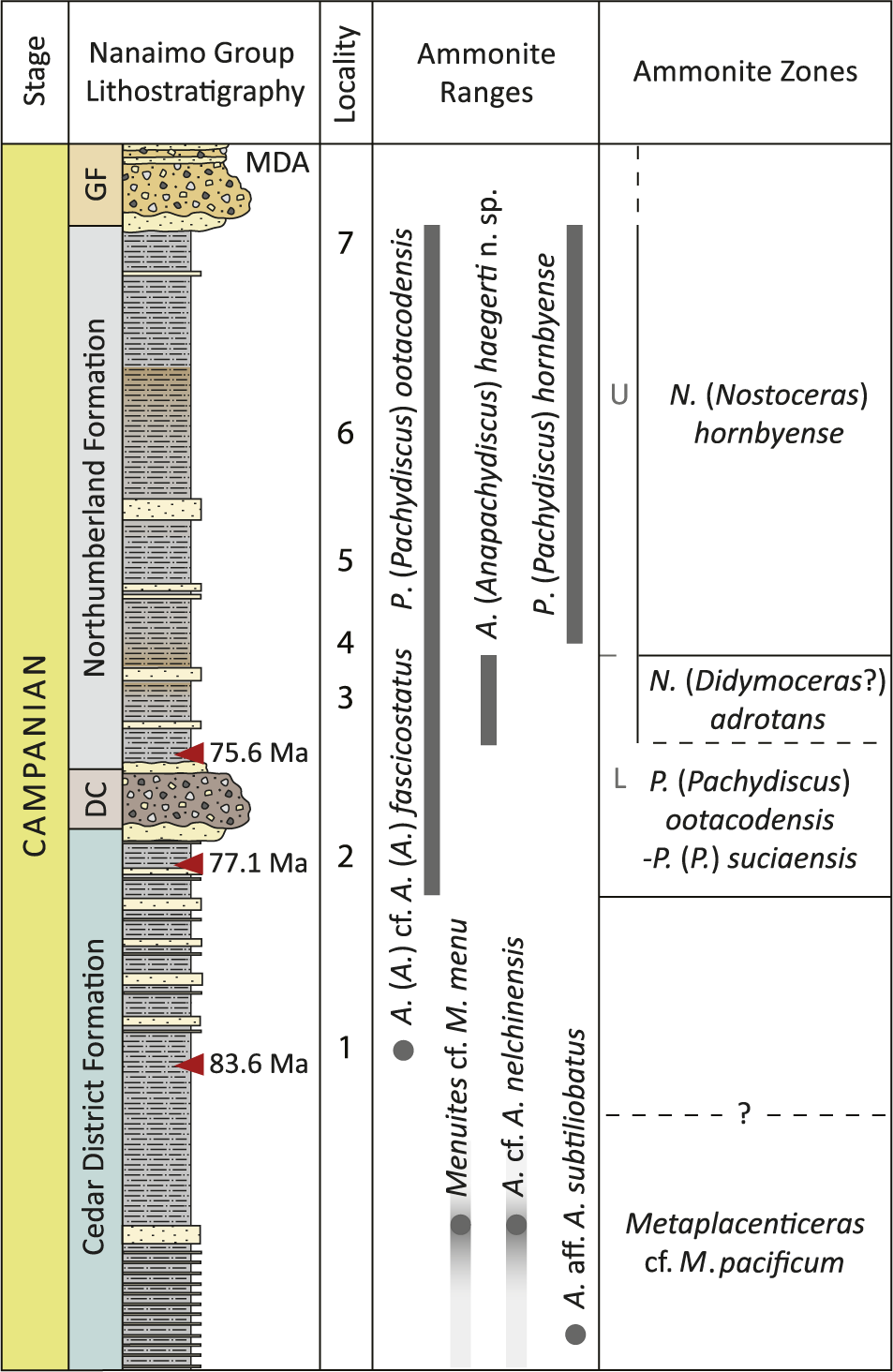
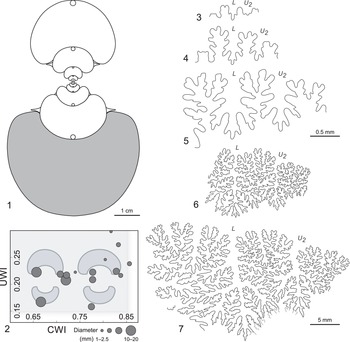
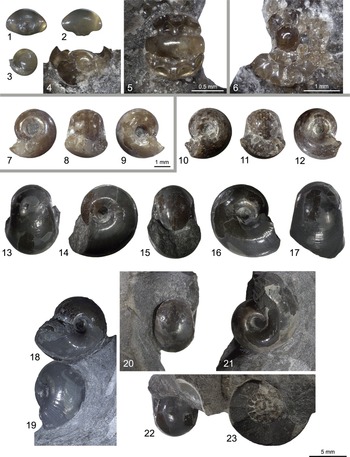
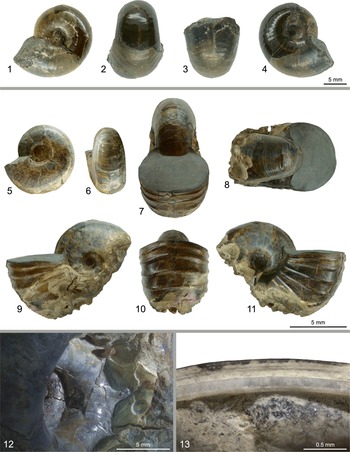
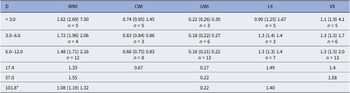
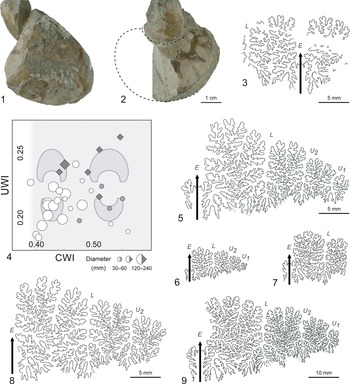
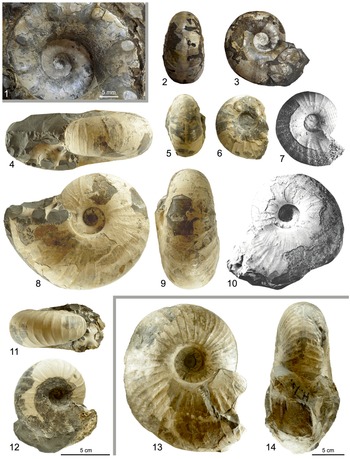

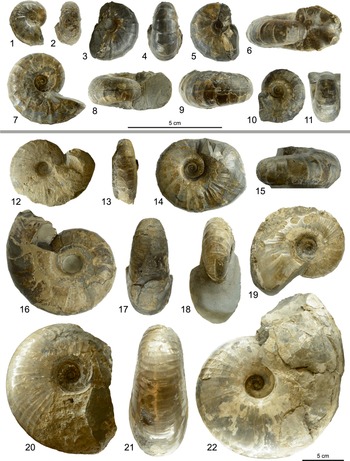
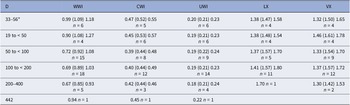

 Open access

