





Introduction
Callous-unemotional (CU) traits as a constellation of characteristics (e.g., a lack of remorse, unconcerned about performance, shallow affect) are linked with multiple psychosocial maladjustments (e.g., antisocial behavior, aggression; Frick et al., Reference Frick, Ray, Thornton and Kahn2014a, Reference Frick, Ray, Thornton and Kahn2014b) and form the basis of the specifier “with Limited Prosocial Emotions (LPE)” for conduct disorder in DSM-V (American Psychiatric Association, 2013). Cumulative evidence suggests that CU traits are malleable and exhibit distinct developmental patterns across individuals (Frick et al., Reference Frick, Ray, Thornton and Kahn2014b). Notably, extant research has primarily investigated the development of CU traits in childhood and adolescence and has demonstrated substantial individual differences in the developmental pattern (e.g., Masi et al., Reference Masi, Pisano, Brovedani, Maccaferri, Manfredi, Milone, Nocentini, Polidori, Ruglioni and Muratori2018; Takahashi et al., Reference Takahashi, Pease, Pingault and Viding2021). Much less is known about the developmental pattern during late adolescence and the transition to young adulthood, a developmental period marked by new stressors and shifting social contexts.
Lifespan developmental approach stresses the inherently interconnected nature of long-term developmental trajectories on a macroscopic level and short-term daily or momentary experiences on a microscopic level (Baltes et al., Reference Baltes, Lindenberger, Staudinger, Lerner and Damon2006; Nesselroade, Reference Nesselroade, Downs, Liben and Palermo1991; Ram & Gerstorf, Reference Ram and Gerstorf2009). Accordingly, the long-term developmental pattern of CU traits may manifest their associations with psychosocial maladjustment in daily contexts. For instance, a long-term developmental pattern of CU traits with elevated and increasing levels could potentially permeate into people’s daily lives and manifest in short-term developmental dynamics involved in daily emotional responses to negative or stressful experiences. A growing body of literature in other substantive fields has examined the within-person dynamics of daily stress and emotion (e.g., Ringwald et al., Reference Ringwald, Shields, Kushner, Herzhoff and Tackett2024; Zheng & Zheng, Reference Zheng and Zheng2024) and has linked long-term accumulation of disease burden to such daily stress–affect dynamics (Gerstorf et al., Reference Gerstorf, Schilling, Pauly, Katzorreck, Lücke, Wahl, Kunzmann, Hoppmann and Ram2023). However, it remains unknown whether and how developmental trajectories of CU traits across multiple years are associated with such daily dynamics. To address this gap, the present study employed a measurement burst design (Sliwinski, Reference Sliwinski2008) to examine the developmental trajectories of CU traits during late adolescence and the transition to young adulthood, their links to long-term socioemotional maladjustment, as well as their associations with daily stress–emotion processes.
Development of CU traits during late adolescence and young adulthood
A growing body of research indicates that CU traits are malleable and demonstrate within-person changes over development (Fontaine et al., Reference Fontaine, McCrory, Boivin, Moffitt and Viding2011; Frick et al., Reference Frick, Ray, Thornton and Kahn2014b). Longitudinal studies employing latent growth curve modeling (LGCM) and group-based trajectory modeling have consistently revealed heterogeneous developmental trajectories of CU traits across childhood and adolescence (Byrd et al., Reference Byrd, Hawes, Loeber and Pardini2018; Docherty et al., Reference Docherty, Beardslee, Byrd, Yang and Pardini2019; Fanti et al., Reference Fanti, Colins, Andershed and Sikki2017; Hawes et al., Reference Hawes, Byrd, Waller, Lynam and Pardini2017). At the group level, several studies have found a gradual decline in CU traits from childhood into adolescence (Masi et al., Reference Masi, Pisano, Brovedani, Maccaferri, Manfredi, Milone, Nocentini, Polidori, Ruglioni and Muratori2018; Takahashi et al., Reference Takahashi, Pease, Pingault and Viding2021; Vaughan et al., Reference Vaughan, Frick, Ray, Thornton, Myers, Robertson, Walker, Steinberg and Cauffman2025), with some extending into young adulthood (Ray et al., Reference Ray, Frick, Thornton, Wall Myers, Steinberg and Cauffman2019). However, some other research has revealed a curvilinear trend, with CU traits declining through adolescence but showing an upturn in young adulthood (Muratori et al., Reference Muratori, Lochman, Manfredi, Milone, Nocentini, Pisano and Masi2016). These mixed findings collectively demonstrate our scant knowledge about the general developmental pattern of CU traits during the transition from late adolescence to young adulthood, which warrants further research attention and effort.
The transition from late adolescence to young adulthood is a critical developmental period, as youth transition from high school to college, university, or workplace and encounter drastic changes across social, academic, and familial contexts (Cage et al., Reference Cage, Jones, Ryan, Hughes and Spanner2021). These changes in multiple aspects and domains bring about chronic stressful contexts and challenges, such as living away from home, increased academic pressure, interrupted interpersonal relationships and networks, and social difficulties (Denovan & Macaskill, Reference Denovan and Macaskill2017; Ewing et al., Reference Ewing, Hamza and Willoughby2019). Importantly, the stressful contexts during the transition may remain ongoing (e.g., academic demands) and evolving across the university years, and early challenges (e.g., moving away from home) may transit into later stressors such as occupational concerns and growing future uncertainty (Cage et al., Reference Cage, Jones, Ryan, Hughes and Spanner2021). This developmental period is therefore a particularly informative context to examine individual differences in emotional responses to stress. Furthermore, CU traits are characterized by emotional detachment, and previous research has linked CU traits to emotional hyporeactivity to distress-eliciting stimuli (e.g., Stadler et al., Reference Stadler, Kroeger, Weyers, Grasmann, Horschinek, Freitag and Clement2011). The broader psychopathy research has also demonstrated the link between stress immunity and CU traits in young adults (e.g., Kimonis et al., Reference Kimonis, Branch, Hagman, Graham and Miller2013; Lilienfeld & Andrews, Reference Lilienfeld and Andrews1996). Specifically, becoming emotionally numbed and unresponsive to stressful contexts provides a psychological buffer to cope with stressful environments (Kerig et al., Reference Kerig, Bennett, Thompson and Becker2012). Taken together, the transition to young adulthood may be a developmentally salient period in which individual differences in stress responsivity relevant to the development of CU traits become especially noticeable in daily life.
The development of CU traits to cope with adverse or stressful experiences may be adaptive in the immediate contexts (e.g., avoid incurring further harm), but may come at the cost of long-term socioemotional maladjustment (Goulter et al., Reference Goulter, Craig and McMahon2023), since elevated CU traits have been consistently linked to maladjustment across multiple domains of psychosocial functioning. Cumulative evidence has shown that individuals with higher levels and increasing patterns of CU traits tend to show lower social competence (Haas et al., Reference Haas, Becker, Epstein and Frick2018), peer rejection (Matlasz et al., Reference Matlasz, Frick and Clark2022), higher antisocial behavior (Docherty et al., Reference Docherty, Beardslee, Byrd, Yang and Pardini2019; Pardini & Loeber, Reference Pardini and Loeber2008), and lower prosociality (Facci et al., Reference Facci, Imbimbo, Stefanelli, Ciucci, Guazzini, Baroncelli and Frick2023; Waller et al., Reference Waller, Wagner, Barstead, Subar, Petersen, Hyde and Hyde2020). Beyond the social domain, some evidence suggests that CU traits are associated with more mental health problems in the long-term. For example, higher CU traits in childhood are associated with higher levels of emotional problems three years later (Moran et al., Reference Moran, Rowe, Flach, Briskman, Ford, Maughan, Scott and Goodman2009), and interpersonal callousness in early adolescence is associated with higher emotional problems at age 18 (Meehan et al., Reference Meehan, Maughan and Barker2019). However, most previous research has focused on the general levels of CU traits (e.g., high vs. low), while scant studies have examined how the change of CU traits are linked to later maladjustment. With the aforementioned heterogeneous developmental patterns of CU traits from childhood through adolescence to young adulthood, developmental trajectories that capture long-term changes over time may offer additional insights beyond the general levels into the developmental consequences of CU traits.
Developmental trajectories of CU traits and daily stress reactivity dynamics
Empirical evidence has suggested that individuals with higher CU traits exhibit blunted emotional and physiological reactivity to negative experiences or stimuli (Frick et al., Reference Frick, Ray, Thornton and Kahn2014b; Stadler et al., Reference Stadler, Kroeger, Weyers, Grasmann, Horschinek, Freitag and Clement2011; Truedsson et al., Reference Truedsson, Fawcett, Wesevich, Gredebäck and Wåhlstedt2019). Yet, it remains unknown whether long-term change of CU traits could manifest similar patterns and associations in people’s daily lives, specifically the link to lower emotional reactivity to daily stress. Studies using the daily diary design have revealed that daily stressors are related to heightened daily emotional problems during the transition period from late adolescence to young adulthood (e.g., Ewing & Hamza, Reference Ewing and Hamza2024; Howland et al., Reference Howland, Armeli, Feinn and Tennen2017; Zheng & Zheng, Reference Zheng and Zheng2024). For some youth, however, a growing pattern of CU traits may function as a buffer against negative or stressful experiences and contexts, manifested as emotional detachment and blunted responses (Craig et al., Reference Craig, Goulter and Moretti2021). In such a case, people who demonstrate increasing patterns of CU traits over years (e.g., faster linear slope) likely are less susceptible or influenced by daily negative experiences in their daily lives and correspondingly demonstrate different dynamics or patterns of emotional reactivity or responses to stress.
Moreover, daily contexts should be examined ideally at different time points on a macro timescale, as the interconnected relations between short-term dynamics and long-term developmental patterns could also change (Baltes et al., Reference Baltes, Lindenberger, Staudinger, Lerner and Damon2006; Nesselroade, Reference Nesselroade, Downs, Liben and Palermo1991; Ram & Gerstorf, Reference Ram and Gerstorf2009). Notably, the links between long-term developmental trajectories of CU traits and daily stress reactivity may shift across the transition to young adulthood. For university students, freshmen often face academic, social, and financial stressors as they leave their families (Denovan & Macaskill, Reference Denovan and Macaskill2017; Ewing et al., Reference Ewing, Hamza and Willoughby2019). In junior and senior years, new challenges and stress would emerge, such as career planning and occupational development (Matud et al., Reference Matud, Díaz, Bethencourt and Ibáñez2020). The changing contexts during this transition period render it necessary to examine the associations between the developmental trajectories of CU traits and daily dynamics (e.g., emotional reactivity to daily stress) over a longer period.
A multi-timescale approach is well-suited to answer these research questions. Particularly, the measurement burst design combines intensive longitudinal design (e.g., daily diaries) with the conventional multi-year longitudinal design (Sliwinski, Reference Sliwinski2008), allowing the decomposition of daily dynamics of emotional reactivity into three components (Gerstorf et al., Reference Gerstorf, Schilling, Pauly, Katzorreck, Lücke, Wahl, Kunzmann, Hoppmann and Ram2023): (1) general levels of emotional problems, reflecting baseline functioning under average stress; (2) stress reactivity, the degree to which daily emotional problems rise in response to daily stress; and (3) stress-unrelated fluctuations, or emotional variability not explained by stress. Following this framework, emerging work has linked long-term developmental patterns of physical disease burden (e.g., high blood pressure) to these daily dynamics in older adults. Specifically, Gerstorf et al. (Reference Gerstorf, Schilling, Pauly, Katzorreck, Lücke, Wahl, Kunzmann, Hoppmann and Ram2023) found that long-term disease accumulation of disease burden is associated with a higher base level of daily negative affect, higher emotional reactivity, and more fluctuation of daily negative affect unrelated to stressors.
To our best knowledge, no research has explored the links between the long-term developmental trajectories of CU traits and the daily dynamics of emotional reactivity. Macro-level developmental changes could partly be reflected in micro-level dynamics (Ram et al., Reference Ram, Conroy, Pincus, Lorek, Rebar, Roche, Coccia, Morack, Feldman and Gerstorf2014), such that individuals’ day-to-day patterns carry signatures of their broader developmental patterns. The desensitized emotional reactivity to daily stress may appear adaptive in the daily contexts yet could potentially reflect blunted reactivity associated with elevated or increasing CU traits (e.g., lack of empathy, shallow affect), which, over the long-term, are associated with socioemotional maladjustment. Therefore, zooming in on daily dynamics (e.g., emotional reactivity) provides a refined window on a microscopic level into elucidating how the influences of long-term developmental trajectories of CU traits unfold and enact in real time, aiding our understanding of short-term adaptation and long-term maladaptation.
The present study
Despite ample evidence documenting the development of CU traits in childhood and adolescence (Frick et al., Reference Frick, Ray, Thornton and Kahn2014b), there remains scant knowledge on the development of CU traits during the transition from late adolescence to young adulthood. This developmental period is marked by major social, academic, and environmental changes (Ewing et al., Reference Ewing, Hamza and Willoughby2019) that often bring out substantial stress (Cheung et al., Reference Cheung, Tam, Tsang, Zhang and Lit2020), making it a critical time window to understand how developmental trajectories of CU traits may shape later socioemotional functioning. Moreover, there is scarce research on how long-term developmental trajectories of CU traits at the macroscopic level are associated with daily developmental processes (e.g., emotional reactivity) at the microscopic level. Addressing these gaps could clarify whether and how individuals with varying long-term developmental patterns of CU traits could exhibit different daily stress–emotion dynamics in the short-term, thereby offering new insights into how CU traits are associated with the general levels of emotions, emotional reactivity to stress, as well as stress-unrelated fluctuations in emotions in daily processes.
Accordingly, using a measurement burst design with two month-long daily diary surveys spanning over two and a half years that followed a group of university students prospectively from freshman year to senior year over three years, this study aimed to fill these gaps with three primary goals. First, we investigated the developmental trajectories of CU traits and individual differences in these developmental patterns from late adolescence to young adulthood over three years using LGCM. We hypothesized that CU traits would demonstrate a modest increase over this period at the group level, given the elevated stress and challenges in this transition period. However, there would be substantial heterogeneity in the developmental patterns regarding the initial levels (i.e., intercepts) and rates of growth (i.e., linear slope). Second, we examined the links between the developmental trajectories of CU traits and socioemotional (mal)adjustment. We hypothesized that higher initial levels and faster increase of CU traits would be linked to more depressive symptoms and peer problems, as well as lower levels of empathy and peer attachment.
Third, we examined whether and how long-term developmental patterns (i.e., intercept and linear slope) of CU traits across multiple years could be linked to emotional reactivity to daily stress as indicated by three short-term dynamics (i.e., general levels of emotional problems, stress reactivity, stress-unrelated within-person fluctuations in emotional problems) captured in the daily diary surveys. We hypothesized that elevated and increasing levels of CU traits would be associated with lower general levels of emotional problems, less stress reactivity, and less stress-unrelated fluctuations in emotional problems. Additionally, we explored whether these cross-timescale associations could change over development from freshman year to junior year, captured by two month-long daily diary surveys two and a half years apart. Given the scarce literature, however, we opted for an exploratory approach without any a priori hypothesis.
Method
Participants and procedure
An initial total sample of 313 Canadian late adolescents and young adults (M age = 18.1 years, SD = 1.31, 294 of participants [93.9%] are between the ages of 17–19, eight participants are 20 years old, and the remaining 10 participants are aged between 21 and 29; 72% female, 53% Asian, 30.3% White, 5% Black, 4.7% Multiracial, 0.7% Native, 1% Latino or Hispanic, 5.3% Others) completed a baseline survey and at least one day of a 30-day daily diary study (6,431 observations in total, M = 21.43 days, SD = 9.65) in Fall 2019 as the first wave of the longitudinal study (Wave 1). Two and a half years later, 204 (64% retention rate) participants completed the baseline survey of the second wave of the longitudinal study in Spring 2022 (Wave 2). Among them, 194 participants provided at least one day of data in the subsequent 30-day daily diary survey (4,018 total observations, M = 21.0 days, SD = 8.84). Six months after Wave 2, 158 participants completed a short follow-up survey (no daily diary surveys) in Fall 2022 (Wave 3). Participants who retained across waves tended to be a bit younger (18.0 ± 0.7 vs. 18.5 ± 1.9, t[310] = 3.58, p < .001, Cohen’s d = 0.43) and reported slightly lower levels of person-average daily emotional problems (0.37 ± 0.31 vs. 0.45 ± 0.39, t[298] = 2.03, p = .044, Cohen’s d = 0.25), but did not differ in sex, ethnicity-race, parental education, baseline CU traits, or person-average level means of daily stress.
Participants were recruited through various channels, including online advertisements, posters displayed on campus, and brief in-class presentations at a large university in Western Canada. In the first wave, all first-year undergraduate students were eligible to participate. For the second and third waves, only those who had completed at least the baseline survey in the first wave were re-contacted, with no new participants being recruited. Daily surveys were distributed via email at 7 PM each evening, and participants were instructed to complete them before going to sleep. Participants provided informed consent online before participating in the study. Participants were compensated with e-gift cards valued at $60, $75, and $15 for Waves 1, 2, and 3, respectively. Further details on the recruitment process can be found in Zheng and Zheng (Reference Zheng and Zheng2026). This study was approved by the research ethics committee at the University of Alberta. Survey instruments were developed and administered using RedCap (Harris et al., Reference Harris, Taylor, Thielke, Payne, Gonzalez and Conde2009).
Measures
Callous-unemotional traits
CU traits were assessed with a 12-item short version of the Inventory of Callous-Unemotional Traits (ICU; Hawes et al., Reference Hawes, Byrd, Waller, Lynam and Pardini2017; Zheng et al., Reference Zheng, Zhang, Huang and Goulter2021) in the three baseline/follow-up (Wave 1–3) surveys, which contains three dimensions: Callousness (6 items; e.g., “I did not care who I hurt to get what I want.”), Uncaring (5 items; e.g., “Feels bad or guilty when I have done something wrong.” [reverse coded]), and Unemotional (1 item; “Does not show emotions.”). We used the shortened ICU because previous psychometric work has shown weaker and less consistent psychometric performance of the full ICU scale, notably the Unemotional subscale (Cardinale & Marsh, Reference Cardinale and Marsh2020; Deng et al., Reference Deng, Wang, Zhang, Shou, Gao and Luo2019), whereas shortened ICU versions have shown acceptable psychometric properties, including in community samples of adolescents and young adults (Corbelli et al., Reference Corbelli, Levantini, Muratori, Senese, Bravaccio, Pisano, Catone and Paciello2024; Zheng et al., Reference Zheng, Zhang, Huang and Goulter2021). Participants reported how well these items described them over the past year (for Waves 1 & 2) or past six months (for Wave 3) on a 4-point Likert scale (0 = not true, 1 = somewhat true, 2 = mostly true, 3 = definitely true). Reverse-worded items (e.g., “I did things to make others feel good.”) were first recoded before analysis. Items were averaged, with higher scores indicating higher levels of CU traits. The ordinal ωs across three waves were 0.85, 0.83, and 0.87, respectively.
To ensure the comparability of the CU traits measure across waves before examining their change over time, we conducted longitudinal measurement invariance tests of the ICU short form across the three waves in our sample. The measurement model reached scalar invariance based on the conventional criteria of ΔRMSEA ≤ 0.015 and ΔCFI ≤ 0.01 (Cheung & Rensvold, Reference Cheung and Rensvold2002), and the Satorra–Bentler scaled nested χ 2 tests were not significant, supporting the comparison of the levels of CU traits over time. Detailed results are reported in Supplementary Table 1.
Daily stress
Daily stress (e.g., “Homesick.” “Time management.” “Conflict with friends.”) was measured using an abbreviated version of the College Chronic Life Survey that has been used and validated in previous daily diary studies (Towbes & Cohen, Reference Towbes and Cohen1996; Zheng & Zheng, Reference Zheng and Zheng2024). Participants reported whether they felt stressed, upset, or worried by the 17 daily stressors on that day on a 3-point scale (0 = never, 1 = just a little, 2 = a lot). Scores were averaged, with higher scores indicating higher levels of stress (Wave 1: ordinal ωw = 0.89, ωb = 0.95; Wave 2: ordinal ωw = 0.85, ωb = 0.94).
Daily emotional problems
Daily emotional problems were assessed with the 5-item emotional problems subscale (e.g., “I was nervous in new situations. I easily lost confidence.” “I was unhappy, depressed, tearful.”) in the Strengths and Difficulties Questionnaire (SDQ; Goodman & Goodman, Reference Goodman and Goodman2009), which primarily assessed depressive and anxiety symptoms and has been validated psychometrically in previous daily diary studies (Zheng & Zheng, Reference Zheng and Zheng2025). Participants indicated how each item applied to them on that day on a 3-point scale (0 = not true, 1 = somewhat true, 2 = certainly true). Average scores were created, with higher scores indicating higher levels of emotional problems (Wave 1: ordinal ωw = 0.70, ωb = 0.85; Wave 2: ordinal ωw = 0.79, ωb = 0.90).
Socioemotional outcomes
Depressive symptoms. Participants reported their depressive symptoms during the past six months with the 18-item Center for Epidemiologic Studies Depression (CES-D; Radloff, Reference Radloff1977). Each item (e.g., “I felt sad.”) was scored on a 4-point Likert scale (0 = rarely or none, 1 = some or a little of the time, 2 = occasionally or a moderate amount of time, 3 = most or all of the time). Items were averaged with higher scores indicating higher levels of depressive symptoms (Wave 3 ordinal ω = 0.95). The same measure was also used at Wave 1, referring to the past year (Wave 1 ordinal ω = 0.94).
Peer attachment. Peer attachment was measured with the 12-item Child Attachment with Friends subscale of the Comprehensive Child Parent Attachment Inventory (Section II; Armsden & Greenberg, Reference Armsden and Greenberg1987), which measured three aspects of peer attachment (trust, communication, and alienation). Participants reported their attachment to their peers in the past six months (e.g., “My friends accepted me as I am.” “My friends sensed when I was upset about something.” “I felt alone or apart when I was with my friends.”) on a 5-point Likert scale (0 = never true, 1 = seldom true, 2 = sometimes true, 3 = often true, 4 = always true). After reverse-coding where necessary, items were averaged with higher scores indicating higher levels of peer attachment (Wave 3 ω = 0.84). The same measure was used at Wave 1, referring to the past year (Wave 1 ω = 0.84).
Peer problems. Peer problems were assessed with four items from the peer problems subscale (e.g., “I would rather be alone than with people of my age.”) from the SDQ (Goodman & Goodman, Reference Goodman and Goodman2009). Participants reported their situation during the past six months on a 3-point scale (0 = not true, 1 = somewhat true, 2 = certainly true). Average scores were created, with higher scores indicating higher levels of peer problems (Wave 3 ordinal ω = 0.66). The same subscales were administered at Wave 1, referring to the past year (ordinal ω = 0.61).
Empathy. Empathy was assessed with the Basic Empathy Scale (Jolliffe & Farrington, Reference Jolliffe and Farrington2006) with 20 items (e.g., “I got caught up in other people’s feelings easily”). Participants reported their situation during the past six months on a 5-point scale (0 = strongly disagree, 1 = disagree, 2 = neither disagree nor agree, 3 = agree, 4 = strongly agree). Average scores were created, with higher scores indicating higher levels of empathy (Wave 3 ω = 0.78). The same subscales were administered at Wave 2 (Wave 2 ω = 0.85).
Demographic covariates
Age, sex (dummy coded as male = 1, female = 0), and race-ethnicity (dummy coded as White = 1, others = 0) were collected as demographic covariates in Wave 1.
Analytic strategy
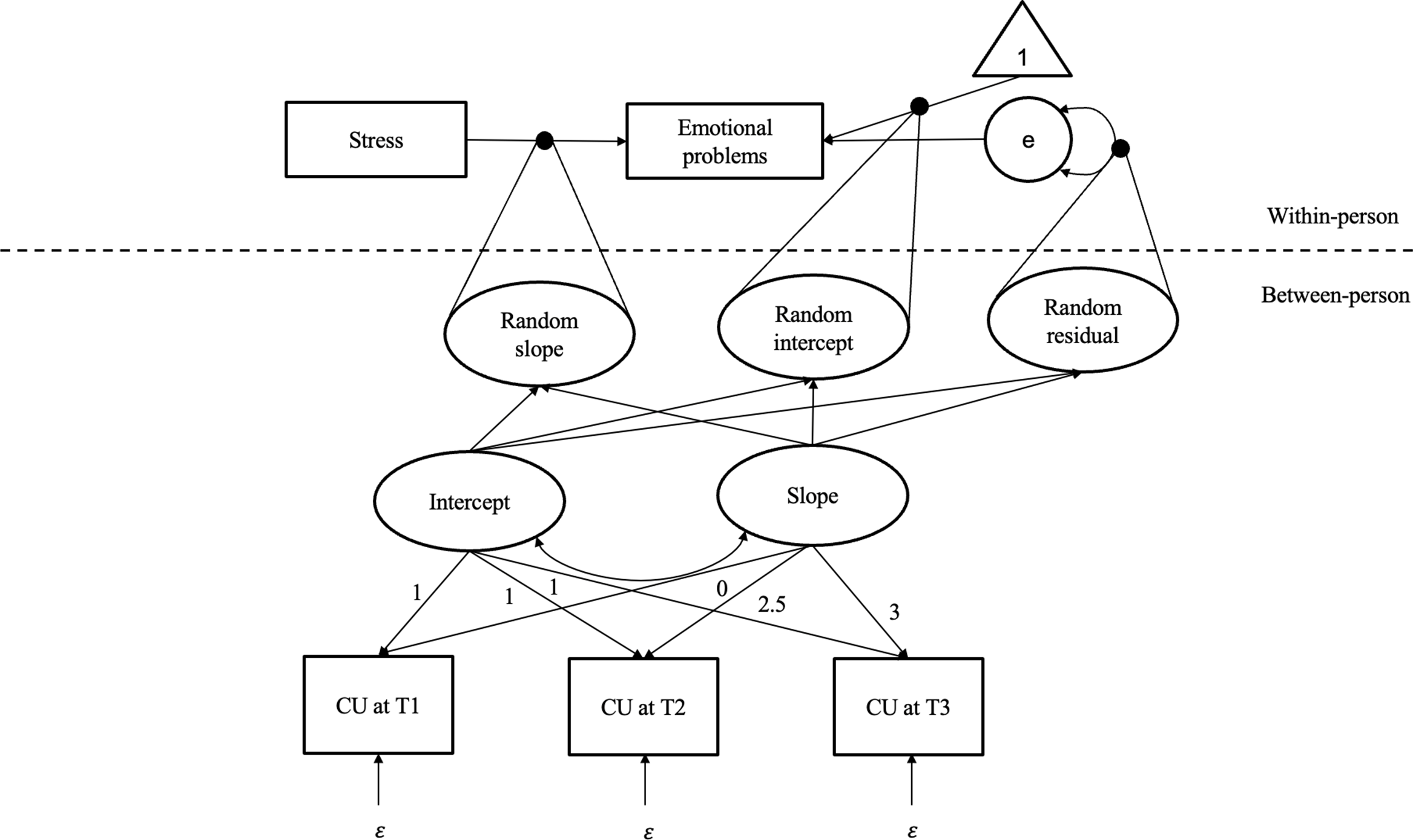
All analyses were conducted using Mplus 8.11 (Muthén & Muthén, 1998–Reference Muthén and Muthén2017). Our data analysis strategy followed two major parts. The first part focused on elucidating the developmental trajectories of CU traits from late adolescence to young adulthood on macro (i.e., years) timescales. As shown in the bottom part of Figure 1, the developmental trajectories of repeated measures of CU traits from the three waves of baseline/follow-up surveys were modeled using the Latent Growth Curve Modeling (LGCM) with the Maximum Likelihood with robust standard error estimator, which captures individual differences in the initial level of CU traits at Wave 1 (i.e., intercept of the trajectories) and the linear rate of change of CU traits over time (i.e., slope of the trajectories). Full information maximum likelihood was used to handle missing data, such that all observations with at least one available wave of data were included in the analyses. Model fit indices include comparative fit index (CFI) > 0.95, Tucker–Lewis index (TLI) > 0.95, the root mean square error of approximation < 0.06, and standardized root mean square residual (SRMR) < 0.08 (Hu & Bentler, Reference Hu and Bentler1999). Based on the best LGCM model built in the first step, we investigated the links between the intercept and linear slope of the CU traits trajectory and several socioemotional outcomes in Wave 3, including depressive symptoms, peer attachment, empathy, and peer problems, while controlling for the autoregression of these variables measured in previous wave. Demographic covariates were also controlled for in sensitivity analyses to examine the robustness of the results.
Conceptual path diagram of estimated multilevel structural equation model across timescales.
Note. CU = Callous-unemotional traits. Black dots represent random components. T = Time.
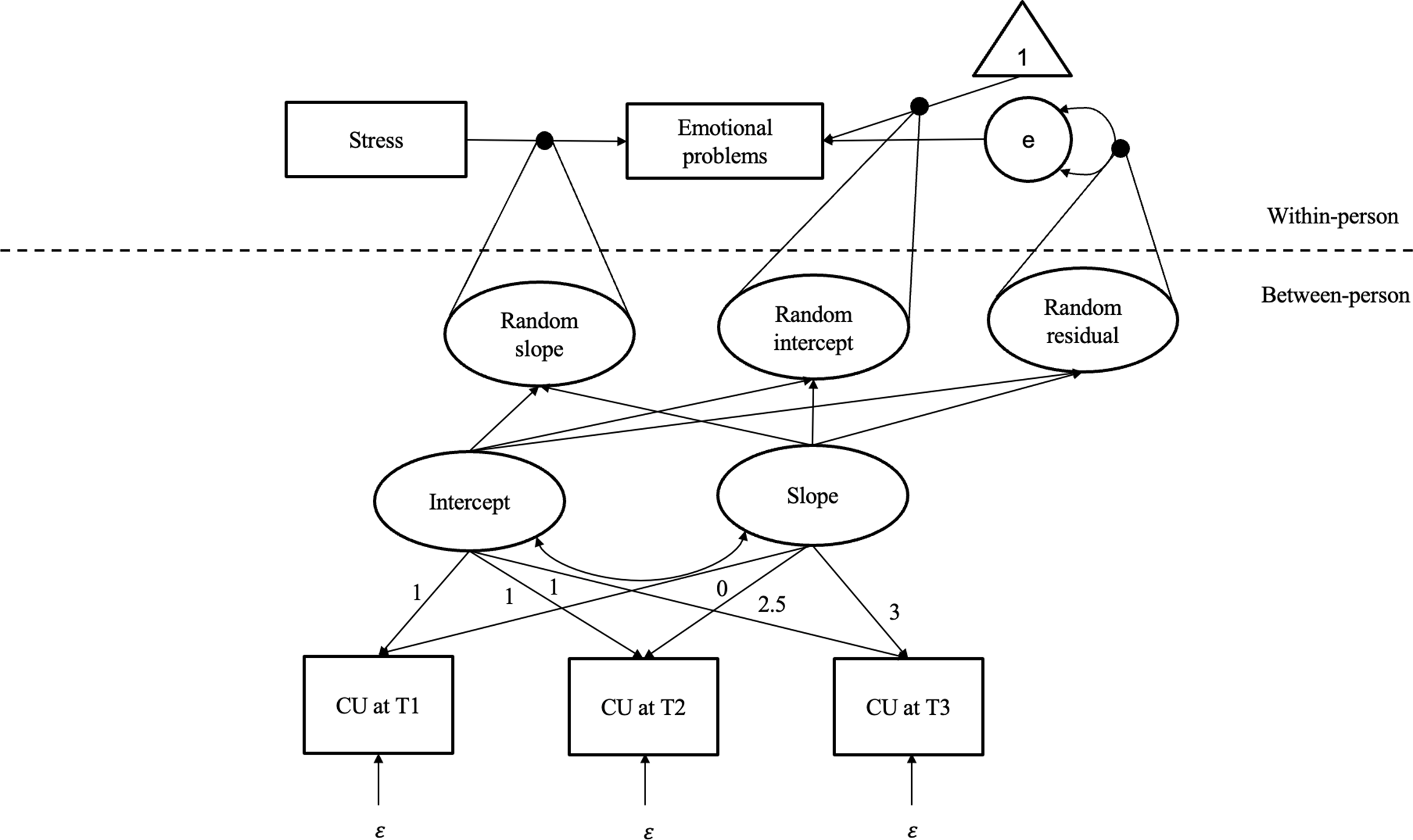
Figure 1. Long description
A conceptual path diagram of a multilevel structural equation model across timescales. The diagram includes various labeled components such as Stress, Emotional problems, Random slope, Random intercept, Random residual, and Callous-unemotional traits at three different time points (T1, T2, T3). The diagram is divided into two sections: Within-person and Between-person. Stress is shown to influence Emotional problems, which in turn affects Callous-unemotional traits at different time points. Random slope, Random intercept, and Random residual are interconnected and influence the relationship between Emotional problems and Callous-unemotional traits. The diagram also includes arrows indicating the direction of influence and numerical values representing specific relationships.
Second, after calculating daily variables’ intraclass correlation coefficients (ICCs) to determine the appropriateness of multilevel modeling, Multilevel Structural Equation Modeling (MSEM) was conducted to examine daily associations on a micro timescale. As shown in the top part of Figure 1, using intensively measured daily data in Wave 1 and Wave 2, the within-person relations between daily stress and same-day emotional problems were modeled in each wave separately using a location-scale multilevel model (McNeish, Reference McNeish2021). Both daily variables were centered at each individual’s person-mean at the within-person level (i.e., level-1) in each wave. The autoregressive effect of the previous day’s emotional problems, the fixed effects of day (coded 0–29, the first day = 0), and the day of the weekend (weekday = 0, weekend = 1) were included to control for potential linear time trend and weekday/weekend effects, and the random slope of the autoregression of daily emotional problems (inertia of emotional problems) was also captured (omitted in Figure 1). This approach allows us to effectively capture inter-individual differences in the within-person stress–emotional problems dynamics on a micro timescale and generates three latent factors at the between-person level (i.e., level-2): the random intercept (individuals’ general levels of emotional problems under their average or typical levels of stress), the random slope of daily relations (stress reactivity), and the random residuals of emotional problems (unexplained residual variance including noise; calculated on the log scale). To link developmental dynamics across micro and macro timescales, cross-level interactions were examined by regressing the three daily latent factors (i.e., the intercept, the slope of daily relations, and residuals in Wave 1 and Wave 2, respectively) on the growth factors (i.e., linear slope and intercept) of the CU traits developmental trajectories. Furthermore, after controlling for all daily dynamics in Wave 1, we also examined the unique effect of growth factors of the CU traits trajectories on daily dynamics in Wave 2 in a separate model. Demographic covariates were also controlled for in sensitivity analyses. MSEM models were estimated using Bayesian estimation with the Markov Chain Monte Carlo with uninformed priors. Model convergence was evaluated with the Potential Scale Reduction statistic, trace plots, and autocorrelation plots (Hamaker et al., Reference Hamaker, Asparouhov, Muthén and Hoyle2021).
Results
Descriptive statistics
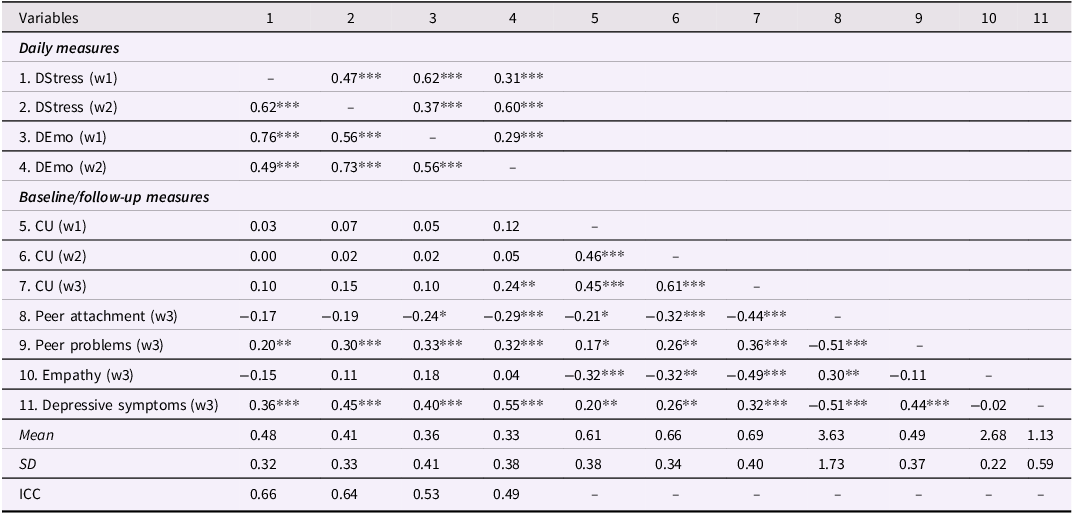
Descriptive statistics and correlations among the investigated variables are shown in Table 1. The ICCs for daily stress and emotional problems ranged from 0.49 to 0.66, indicating substantial day-to-day fluctuations in these variables at the within-person level. Correlation analyses revealed significant positive correlations between stress and emotional problems at both within-person (rs = 0.62 and 0.60, ps < .001) and between-person (rs = 0.76 and 0.73, ps < .001) levels within each wave. Additionally, CU traits across waves were positively correlated (rs = 0.45–0.61, p < .001). CU traits at all three time points were positively correlated with peer problems (rs = 0.17–0.36, ps < .05) and depressive symptoms (rs = 0.20–0.32, ps < .01), and negatively correlated with peer attachment (rs = −0.44–−0.21, ps < .05) and empathy (rs = −0.49–−0.32, ps < .01) in Wave 3. Notably, at the between-person level, except for Wave 3 CU traits and Wave 2 person-average levels of daily emotional problems (r = 0.24, p = .008), CU traits generally were not correlated with person-average levels of daily stress or emotional problems at either wave.
Descriptive statistics and correlations for study variables
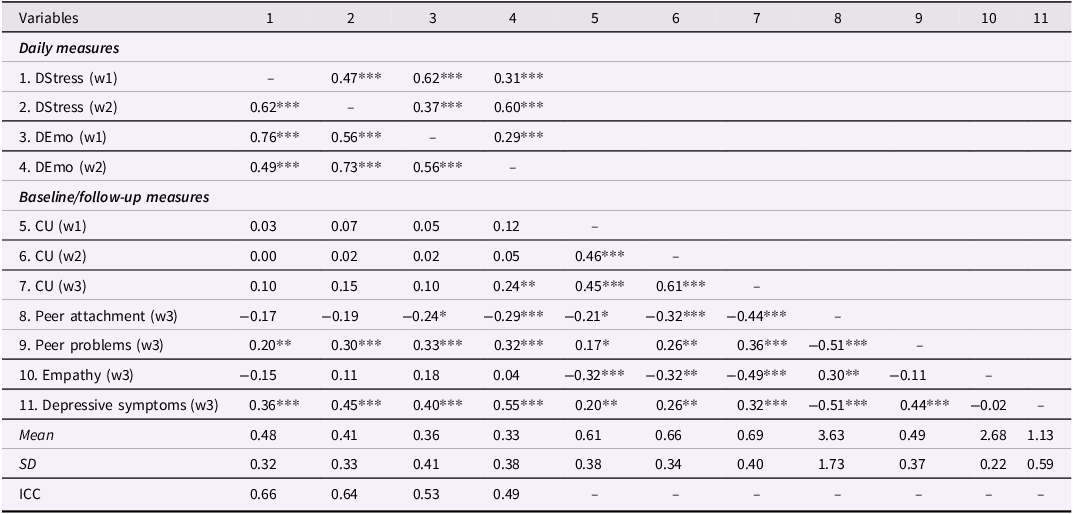
Table 1. Long description
The table presents descriptive statistics and correlations for various study variables. It includes 11 variables measured at different times, with correlations between them. The table is divided into sections for daily measures and baseline/follow-up measures. Each row represents a variable, and each column shows the correlation coefficients between variables. Notable trends include significant positive correlations between stress and emotional problems within and between persons, and correlations between CU traits and other variables like peer problems and depressive symptoms. The table also includes mean values and standard deviations for each variable.
Note. Dstress = Daily Stress. Demo = Daily emotional problems. CU = Callous-unemotional traits. ICC = Intraclass correlation coefficient. w = wave. Between-level correlations are presented under the diagonal, within-level correlations are presented above the diagonal. *p < .05, **p < .01, ***p < .001.
We applied the recommended cutoff for the full ICU reported in Kemp et al. (Reference Kemp, Frick, Matlasz, Clark, Robertson, Ray, Thornton, Wall Myers, Steinberg and Cauffman2023) developed in an adolescent community sample to further understand the CU traits levels in the current young adult sample. Due to the different numbers of items used in different versions of ICU, we calculated the item-average score rather than the total sum score. The results showed that 5.79% (6.67% female, 3.49% male) of the sample in Wave 1, 2.55% (2.74% female, 2% male) in Wave 2, and 7.38% (8.93% female, 2.7% male) in Wave 3 scored above the cutoff.
Developmental trajectories of CU traits across years
An unconditional (i.e., without any predictors or covariates) LGCM model of CU traits over the three waves was first established, which exhibited acceptable fit: RMSEA = 0.05, SRMR = 0.07, CFI = 0.97, TLI = 0.97. The estimated group mean of intercept ( $\widehat\mu $
= 0.61, SE = 0.02, p < .001) on the 0 to 3 scale suggested that participants reported a generally low initial level of CU traits in Wave 1. The estimated group mean of slope (
$\widehat\mu $
= 0.61, SE = 0.02, p < .001) on the 0 to 3 scale suggested that participants reported a generally low initial level of CU traits in Wave 1. The estimated group mean of slope ( $\widehat\mu $
= 0.03, SE = 0.01, p = .004) indicated a generally modest increasing linear trend over the three years. The estimated significant variances of the intercept (σint
2 = 0.09, SE = 0.02, p < .001) and slope (σslope
2 = 0.01, SE = 0.003, p = .049) of the LGCM suggested substantial inter-individual differences in both the initial level and linear rate of change of CU traits. The intercept and slope were negatively correlated (r = −0.39, p = .002), indicating that those with higher initial levels of CU traits in Wave 1 demonstrated a lower rate of increase over three years.
$\widehat\mu $
= 0.03, SE = 0.01, p = .004) indicated a generally modest increasing linear trend over the three years. The estimated significant variances of the intercept (σint
2 = 0.09, SE = 0.02, p < .001) and slope (σslope
2 = 0.01, SE = 0.003, p = .049) of the LGCM suggested substantial inter-individual differences in both the initial level and linear rate of change of CU traits. The intercept and slope were negatively correlated (r = −0.39, p = .002), indicating that those with higher initial levels of CU traits in Wave 1 demonstrated a lower rate of increase over three years.
Linking CU traits trajectories to socioemotional outcomes
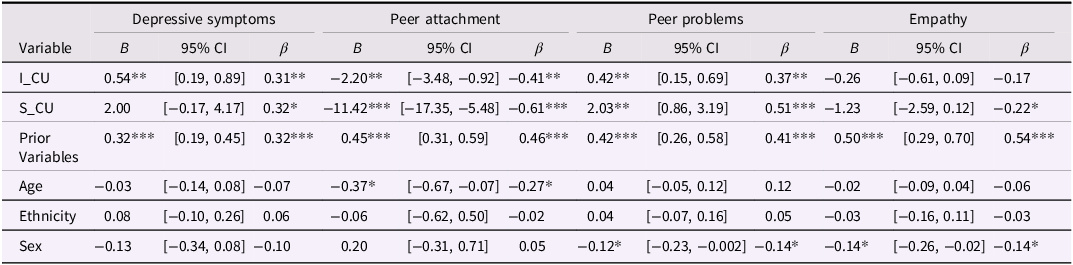
At the between-person level, the intercept and linear slope of the CU traits trajectories over three years were significantly associated with socioemotional outcomes in Wave 3 (Table 2), after controlling for the corresponding variables measured in previous wave. Specifically, participants who reported higher CU traits in baseline tended to have higher level of depressive symptoms (β = 0.31, p = .006) and peer problems (β = 0.37, p = .009), and lower level of peer attachment (β = −0.41, p = .007). The linear growth rate of CU traits was positively associated with depressive symptoms (β = 0.32, p = .045) and peer problems (β = 0.51, p < .001), and negatively associated with peer attachment (β = −0.61, p < .001) and empathy (β = −0.22, p = .043). Sensitivity analyses controlling for demographic covariates indicated consistent results in terms of estimate magnitude and significance level. These results suggest that young adults who demonstrated higher initial levels and faster increases in CU traits tended to experience elevated psychosocial maladjustment.
Multiple regressions examining associations of CU traits trajectories and wave 3 socioemotional outcomes
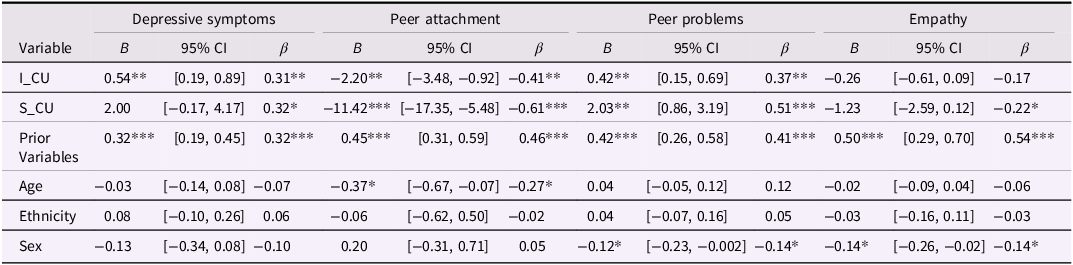
Table 2. Long description
A table with 10 rows and 12 columns. The columns are labeled as Variable, Depressive symptoms B, Depressive symptoms 95 percent CI, Depressive symptoms beta, Peer attachment B, Peer attachment 95 percent CI, Peer attachment beta, Peer problems B, Peer problems 95 percent CI, Peer problems beta, Empathy B, Empathy 95 percent CI, and Empathy beta. The rows are labeled as I CU, S CU, Prior Variables, Age, Ethnicity, and Sex. The table presents the B values, 95 percent confidence intervals, and beta coefficients for each variable across different socioemotional outcomes. Notable trends include significant associations between CU traits and depressive symptoms, peer attachment, peer problems, and empathy.
Note. I_CU = Intercept of CU trajectory. S_CU = Slope of CU trajectory. 95% CI = 95% confidence interval of standardized estimates. *p < .05, **p < .01, ***p < .001.
Daily dynamics between stress and emotional problems
The associations between daily stress and emotional problems in Wave 1 and Wave 2 were first modeled separately without any predictors at the between-person level. The fixed effects of the daily slope (Wave 1: B = 0.47, β = 0.39, p < .001; Wave 2: B = 0.50, β = 0.39, p < .001) indicated positive associations between daily stress and same-day emotional problems at both waves. Therefore, while controlling for the lagged effects of previous day’s emotional problems (Bs = 0.10 and 0.12, βs = 0.13 and .16, ps < .001 in Wave 1 and 2, respectively), higher than person-average levels of stress on one day were associated with higher than person-average levels of emotional problems on the same day. These three parameters were pairwise correlated in each wave (rs = 0.62−0.69 in Wave 1, rs = 0.42−0.71 in Wave 2, ps < .001) and showed significant autocorrelations across waves (rs = 0.51−0.63, ps < .001; Supplementary Table 2), indicating that participants with higher average level of emotional problems tended to have larger emotional reactivity and stress-unrelated within-person fluctuations of emotional problems, and the three dynamics showed moderate stability over two and half years.
In both Wave 1 and Wave 2, the variances of the random intercept (0.09 and 0.08), daily random slope (0.07 and 0.08), and daily random residuals (log-transformed: 1.14 and 1.11) were all significant (ps < .001), suggesting substantial inter-individual differences in these daily dynamic parameters. To illustrate these inter-individual differences, consider the daily random slope at Wave 2 as an example: the standard deviation (SD) of the random effect of daily stress on emotional problems was 0.28 (the square root of the variance [0.08]; fixed effect = 0.50), suggesting that for 68% (± 1 SD) of participants, the link between daily stress and emotional problems fell between 0.22 and 0.78 (0.50 ± 0.28), highlighting substantial between-person differences in daily emotional reactivity.
Linking CU traits trajectories to daily dynamics
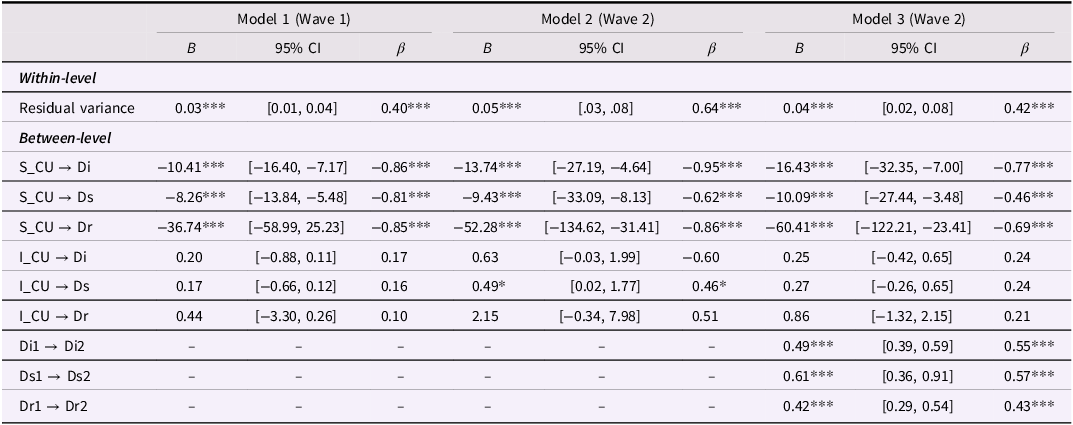
The cross-level interaction models (Table 3) suggested that while controlling for the initial level of CU traits (i.e., the intercept of the CU traits trajectory), the linear slope of the trajectories of CU traits over three years demonstrated consistent negative links with the random intercept (Wave 1: B = −10.41, 95% CI = [−16.40, −7.17]; Wave 2: B = −13.74, 95% CI = [−27.19, −4.64]), random slope (Wave 1: B = −8.26, 95% CI = [−13.84, −5.48]; Wave 2: B = −9.43, 95% CI = [−33.09, −8.13]), and random residuals (Wave 1: B = −36.74, 95% CI = [−58.99, 25.23]; Wave 2: B = −52.28, 95% CI = [−134.62, −31.41]) of the daily association between stress and emotional problems in both Wave 1 and Wave 2, respectively (Model 1 and Model 2). Additionally, as shown in Model 3, after controlling for the initial level of CU traits and the autoregression of the three daily dynamics in Wave 1, the linear slope of CU traits over three years was uniquely associated with all three daily dynamics in Wave 2 with the same pattern, such that higher linear slope of CU traits was related to lower random intercept (B = −16.43, 95% CI = [−32.35, −7.00]), lower random slope (B = −10.09, 95% CI = [−27.44, −3.48]), and lower random residuals (B = −60.41, 95% CI = [−122.21, −23.41]).
Multilevel model results for cross-level interactions between CU trajectories growth factors and daily dynamics
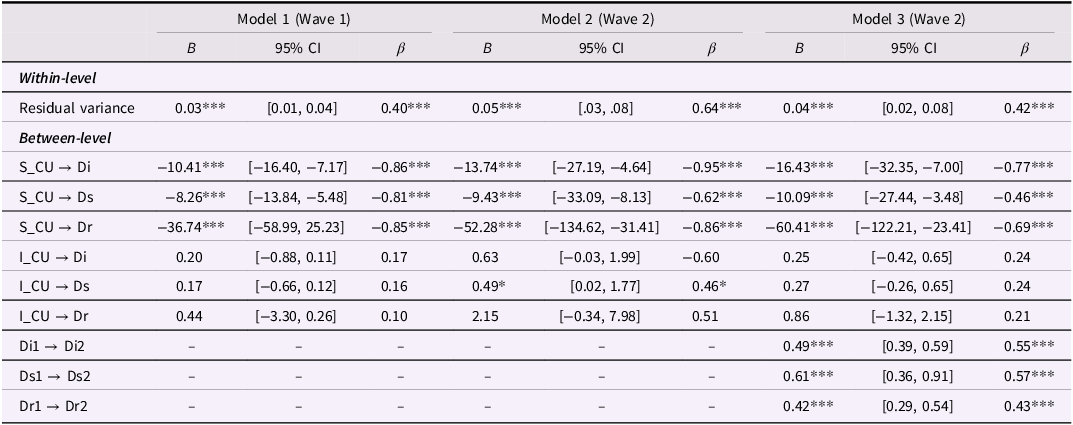
Table 3. Long description
The table presents the results of multilevel models for cross-level interactions between CU trajectories growth factors and daily dynamics. It has 10 rows and 12 columns. The columns are labeled as Model 1 (Wave 1), Model 2 (Wave 2), and Model 3 (Wave 2), each with sub-columns for B, 95% CI, and beta. The rows are categorized into Within-level and Between-level, with specific variables listed under each category. Row 1: Residual variance, Model 1: B 0.03, 95% CI [0.01, 0.04], beta 0.40, Model 2: B 0.05, 95% CI [0.03, 0.08], beta 0.64, Model 3: B 0.04, 95% CI [0.02, 0.08], beta 0.42. Row 2: S_CU -> Di, Model 1: B -10.41, 95% CI [-16.40, -7.17], beta -0.86, Model 2: B -13.74, 95% CI [-27.19, -4.64], beta -0.95, Model 3: B -16.43, 95% CI [-32.35, -7.00], beta -0.77. Row 3: S_CU -> Ds, Model 1: B -8.26, 95% CI [-13.84, -5.48], beta -0.81, Model 2: B -9.43, 95% CI [-33.09, -8.13], beta -0.62, Model 3: B -10.09, 95% CI [-27.44, -3.48], beta -0.46. Row 4: S_CU -> Dr, Model 1: B -36.74, 95% CI [-58.99, -25.23], beta -0.85, Model 2: B -52.28, 95% CI [-134.62, -31.41], beta -0.86, Model 3: B -60.41, 95% CI [-122.21, -23.41], beta -0.69. Row 5: I_CU -> Di, Model 1: B 0.20, 95% CI [-0.88, 0.11], beta 0.17, Model 2: B 0.63, 95% CI [-0.03, 1.99], beta -0.60, Model 3: B 0.25, 95% CI [-0.42, 0.65], beta 0.24. Row 6: I_CU -> Ds, Model 1: B 0.17, 95% CI [-0.66, 0.12], beta 0.16, Model 2: B 0.49, 95% CI [0.02, 1.77], beta 0.46, Model 3: B 0.27, 95% CI [-0.26, 0.65], beta 0.24. Row 7: I_CU -> Dr, Model 1: B 0.44, 95% CI [-3.30, 0.26], beta 0.10, Model 2: B 2.15, 95% CI [-0.34, 7.98], beta 0.51, Model 3: B 0.86, 95% CI [-1.32, 2.15], beta 0.21. Row 8: Di1 -> Di2, Model 3: B 0.49, 95% CI [0.39, 0.59], beta 0.55. Row 9: Ds1 -> Ds2, Model 3: B 0.61, 95% CI [0.36, 0.91], beta 0.57. Row 10: Dr1 -> Dr2, Model 3: B 0.42, 95% CI [0.29, 0.54], beta 0.43.
Note. S_CU = Slope of CU trajectory. I_CU = Intercept of CU trajectory. Di = Random intercept of daily dynamics. Ds = Random slope of daily dynamics. Dr = Residual of daily dynamics (on the log scale). p = Bayesian equivalent to one-side p values; 95% CI = 95% credibility interval of unstandardized estimates. In Model 1, the three daily dynamics used as dependent variables were at Wave 1; in Model 2 and Model 3, the three daily dynamics predicted by the slope and intercept of the CU trajectory were at Wave 2. *p < .025, **p < .005, ***p < .001.
Models 1–3 present the findings without covariates, and these results remained robust after controlling for demographic covariates (Supplementary Table 3, Model 4). We also conducted additional sensitive analyses controlling for random intercepts (i.e., person-average of daily emotional problems; Model 5) and baseline emotional problems (Model 6) respectively, when predicting the daily dynamics, and the results remained unchanged (Supplementary Table 3). The negative associations between the linear slope of CU traits trajectories and all three daily dynamics parameters suggested that participants with faster increasing patterns of CU traits on macro timescales demonstrated lower person-average level of emotional problems, reduced emotional reactivity to daily stressors, as well as less residual variance (i.e., fluctuations; emotional instability) on a daily timescale.
Discussion
Scant research has investigated the developmental pattern of CU traits during the transition from late adolescence to young adulthood, which is often accompanied by major changes in multiple aspects as well as stressful contexts and challenges. There is also a dearth of research focusing on the relations of the development pattern of CU traits with maladjustment on multiple timescales. The present study investigated the developmental trajectories of CU traits across late adolescence and young adulthood and linked these long-term trajectories to both socioemotional outcomes and short-term daily dynamics regarding emotional reactivity to stress. The results revealed that CU traits showed a modest group-level increase over three years, with substantial inter-individual differences in both the initial levels and rates of change. Both higher baseline CU traits and faster increase in CU traits were associated with poorer socioemotional outcomes, including more peer problems and depressive symptoms, as well as lower empathy and peer attachment. Individuals with faster growth in CU traits exhibited lower daily levels of emotional problems, weaker stress reactivity, and reduced stress-unrelated emotional fluctuations, suggesting emotional blunting in daily life.
Developmental pattern of CU traits during the transition to young adulthood
Consistent with emerging evidence that CU traits are malleable (Frick et al., Reference Frick, Ray, Thornton and Kahn2014b), our findings documented a modest increase in CU traits across the transition from late adolescence to young adulthood. This developmental pattern indicates a general tendency toward slightly greater emotional numbing and reduced empathy for others (Waller et al., Reference Waller, Wagner, Barstead, Subar, Petersen, Hyde and Hyde2020) during this developmental period, which diverges from past studies showing a gradual decline of CU traits through mid- to late adolescence (Ray et al., Reference Ray, Frick, Thornton, Wall Myers, Steinberg and Cauffman2019). However, it aligns with research reporting a subsequent upturn in CU traits as youth transition into young adulthood (Muratori et al., Reference Muratori, Lochman, Manfredi, Milone, Nocentini, Pisano and Masi2016). The current study extends previous studies that have focused primarily on childhood and adolescence by contributing novel empirical evidence on the development of CU traits as individuals move into young adulthood, supporting the notion that they should be conceptualized as dynamic developmental phenomena and malleable constructs rather than fixed individual characteristics. Besides, using the recommended cutoff (Kemp et al., Reference Kemp, Frick, Matlasz, Clark, Robertson, Ray, Thornton, Wall Myers, Steinberg and Cauffman2023), 5.79% participants in Wave 1 and 7.38% in Wave 3 met the cutoff and showed elevated and clinically meaningful levels of CU traits, demonstrating the potential utility of the ICU in this age group during the transition period in community samples. The levels of CU traits across waves in this study are also generally comparable with those reported in previous studies using youth community samples (Byrd et al., Reference Byrd, Kahn and Pardini2013; Pechorro et al., Reference Pechorro, Braga, Hawes, Gonçalves, Simões and Ray2019).
Developing emotional numbness and disengagement in response to adverse environments may help alleviate psychological distress and function as a protective mechanism for managing stressful circumstances (Kerig et al., Reference Kerig, Bennett, Thompson and Becker2012). The observed modest increase in our sample may reflect responses to the ongoing and changing stressors across the university years, including academic demands, future uncertainty, and the broader disruptions associated with the Covid-19 pandemic (Ewing et al., Reference Ewing, Hamza and Willoughby2019; Linden et al., Reference Linden, Stuart and Ecclestone2023). Notably, the heterogeneity in the growth patterns underscores the importance of inter-individual differences in the developmental pattern of CU traits, rendering it necessary to further explore the consequences of varying growth patterns.
Linking developmental trajectories of CU traits to socioemotional functioning
Extending previous work that primarily focused on adolescence, the current findings suggest that both the level and change of CU traits continue to be associated with socioemotional functioning in young adulthood. Congruent with ample evidence linking high CU traits with diminished prosociality and empathy (Facci et al., Reference Facci, Imbimbo, Stefanelli, Ciucci, Guazzini, Baroncelli and Frick2023; Waller et al., Reference Waller, Wagner, Barstead, Subar, Petersen, Hyde and Hyde2020) and impaired peer relationships (Matlasz et al., Reference Matlasz, Frick and Clark2022), current findings revealed that young people who demonstrated a faster increase in CU traits over time also reported more interpersonal difficulties and lower peer relationship quality. Recent evidence in a justice-involved adolescent sample using LGCM showed that higher levels of CU traits were linked with poorer friendship quality but found no link between the slope of CU traits and peer functioning (Vaughan et al., Reference Vaughan, Frick, Ray, Thornton, Myers, Robertson, Walker, Steinberg and Cauffman2025). The present finding in the community sample extends this work by showing that both the level and change of CU traits are linked with peer functioning. Individuals with high CU traits tend to show limited empathy and guilt, which are core emotional capacities that facilitate positive social connections (Frick & Kemp, Reference Frick and Kemp2021). As such, individuals who demonstrate an increase in CU traits over time are likely to correspond to waning motivation for prosocial engagement and even show antisocial behavior (Docherty et al., Reference Docherty, Beardslee, Byrd, Yang and Pardini2019), constraining opportunities to develop or maintain high-quality peer relationships during university years.
Moreover, the observed association between increasing CU traits and higher depressive symptoms supports the previous findings suggesting the comorbidity of CU traits and internalizing problems (Meehan et al., Reference Meehan, Maughan and Barker2019; Moran et al., Reference Moran, Rowe, Flach, Briskman, Ford, Maughan, Scott and Goodman2009). Although elevated CU traits may initially serve as a stress immunity mechanism (Kimonis et al., Reference Kimonis, Branch, Hagman, Graham and Miller2013), they may ultimately hinder emotional and social learning, limiting access to protective social relationships for adaptation to the stressful transition contexts in the long-term (Haas et al., Reference Haas, Becker, Epstein and Frick2018; Matlasz et al., Reference Matlasz, Frick and Clark2022). Hence, individuals with an increasing pattern of CU traits may accumulate mental health problems in the long-term. Nonetheless, it is important to note that current findings do not suggest that CU traits causally lead to later socioemotional outcomes but only demonstrate prospective associations, as socioemotional maladjustment could also be linked with the change of CU traits over time as well.
Linking long-term trajectories of CU traits to daily stress reactivity dynamics
A major novel contribution of this study lies in bridging macro-level developmental trajectories over the long-term with micro-level daily dynamics in the short-term. As hypothesized, young people who exhibited a faster increase in CU traits during the transition period also showed blunted emotional reactivity to stress in their daily lives, and they also displayed lower overall levels of emotional problems and smaller stress-unrelated fluctuations in emotional problems. These findings suggest that the increase of CU traits is associated with blunted short-term stress–emotional problem dynamics observable in everyday life. These results also align with physiological and neurobiological evidence supporting that individuals with higher CU traits exhibit reduced responsivity to negative emotional stimuli (Frick et al., Reference Frick, Ray, Thornton and Kahn2014b; Stadler et al., Reference Stadler, Kroeger, Weyers, Grasmann, Horschinek, Freitag and Clement2011). Such blunted reactivity likely reflects a temporarily adaptive but desensitizing adaptation mechanism, through which individuals dampen affective arousal to manage chronic or uncontrollable stress (Kerig et al., Reference Kerig, Bennett, Thompson and Becker2012).
The three daily dynamics demonstrated considerable stability over two and a half years, indicating that young people who displayed higher emotional reactivity in freshman year also showed relatively higher emotional reactivity in junior year, as did the general levels of emotional problems and stress-unrelated fluctuations. This finding suggests that these daily emotion dynamics are robust and reliable indicators of short-term developmental dynamics that are informative or reflective of long-term development (Baltes et al., Reference Baltes, Lindenberger, Staudinger, Lerner and Damon2006; Nesselroade, Reference Nesselroade, Downs, Liben and Palermo1991; Ram & Gerstorf, Reference Ram and Gerstorf2009). Importantly, such long-term stability underscores their potential values as meaningful psychological constructs, which may play a critical role in understanding microscopic emotional processes (Gerstorf et al., Reference Gerstorf, Schilling, Pauly, Katzorreck, Lücke, Wahl, Kunzmann, Hoppmann and Ram2023; McNeish, Reference McNeish2021).
Moreover, the links between the growth of CU traits and daily emotion dynamics in junior year remained even after accounting for daily dynamics in the freshman year, indicating that the association between the increase in CU traits and how young people respond to daily stress is not solely attributable to their prior emotional tendencies or characteristics. Instead, the findings suggest that the long-term developmental pattern of CU traits was also dynamically and uniquely associated with the novel components (i.e., residualized of previous autoregression; change) of short-term daily emotion dynamics at each time (i.e., burst) that emerged from the previous time. Notably, the general pattern and magnitude in these cross-timescale associations also remained stable over two and a half years, suggesting that the association between the growth of CU traits and reduced daily emotional reactivity is robust across changing contexts during university. Collectively, these findings suggest that the evolving emotional detachment over multiple years manifests in stable patterns of daily stress response and further highlight the continuity of the association between long-term macroscopic psychopathology development and short-term microscopic daily functioning during the transitional period.
Theoretically speaking, current findings resonate with the claim that long-term developmental change is reflected in short-term dynamics (Ram et al., Reference Ram, Conroy, Pincus, Lorek, Rebar, Roche, Coccia, Morack, Feldman and Gerstorf2014). In the current case, reduced emotional reactivity to stress among those with growing CU traits represents a micro-level expression of a broader, macro-level orientation of emotional numbing. This cross-timescale pattern suggests that long-term developmental trajectories and everyday emotional functioning are meaningfully linked across timescales (Nesselroade, Reference Nesselroade, Downs, Liben and Palermo1991), consistent with previous cross-timescale work showing that long-term disease burden leaves systematic signatures in individuals’ daily emotional dynamics (Gerstorf et al., Reference Gerstorf, Schilling, Pauly, Katzorreck, Lücke, Wahl, Kunzmann, Hoppmann and Ram2023). Notably, as the lifespan developmental perspective does not specify a direction for such cross-timescale links, the patterns observed in the present study should not be taken to imply that the macroscopic development of CU traits unidirectionally shapes everyday emotional functioning. It remains possible that stable individual differences or developmental changes in daily emotional reactivity also contribute to the emergence or maintenance of CU traits over time. Alternatively, CU traits and daily emotional dynamics may co-develop through reciprocal links, such that long-term changes in CU traits and short-term stress–emotional problem dynamics mutually reinforce one another across development. Most importantly, the present findings highlight the need for future research to treat both CU traits and daily emotional reactivity as dynamic processes and explore their reciprocal associations across multiple timescales.
Besides, our research also highlights a double-edged effect of the long-term increase of CU traits by offering both short- and long-term evidence. While such growth of CU traits may temporarily protect individuals from suffering emotional problems in response to stress, serving an adaptive function in the short-term, they may also signify restricted emotional flexibility and learning, demonstrating maladaptive functioning in the long-term. This adaptive vs. maladaptive pattern over short- vs. long-term development exemplifies a trade-off that emotional numbing may buffer short-term stress but undermine long-term socioemotional adjustment, emphasizing the importance for future research to examine the influence of other emotional or behavioral adaptation mechanisms on different timescales simultaneously.
Strength and implications
Current findings contribute to the scarce pertinent literature on CU traits by linking the development pattern of CU traits to both macroscopic long-term maladjustment and microscopic short-term daily stress–emotional problems dynamics. To our best knowledge, the present study represents the first endeavor to uncover the cross-timescale association between the developmental pattern of CU traits and daily dynamics during the transition to young adulthood. The daily diary approach enhances ecological validity by capturing stress–emotion processes as they unfold in everyday contexts, providing empirical support for the stress immunity mechanism of CU traits. By connecting multi-year CU traits trajectories with daily stress–emotional problems dynamics, the findings underscore a critical paradox: the growth of CU traits may serve as a stress immunity mechanism in the short-term, but it is not adaptive on a long-term timescale. Additionally, we also demonstrate the robustness of these daily emotion dynamics and their associations with long-term trajectories through a measurement burst design combined with a conventional longitudinal design. Importantly, these findings support a dynamic and developmental, rather than a static, conceptualization of CU traits. Understanding CU traits and their manifestations across multiple timescales may offer novel insights into how developmental changes in CU traits are expressed in everyday functioning and contribute to later maladjustment.
From a practical perspective, identifying youth who exhibit desensitized patterns of daily emotional reactivity may help detect early signs of maladaptation. Importantly, fewer daily emotional problems when experiencing more daily stress do not necessarily indicate healthier functioning; rather, they may reflect blunted emotional reactivity characteristic of CU traits, which appears adaptive in the short-term but may undermine long-term socioemotional development.
Limitations and future directions
Several limitations of the present study should be noted. First, all key constructs, including CU traits, stress, and emotional problems, were measured via self-reports. Although self-report measurement captures subjective experiences central to daily adaptation, it is susceptible to shared method variance and recall biases. Incorporating multi-informant assessments (e.g., peer- or parent-reports) or objective indices (e.g., physiological reactivity, behavioral tasks) would provide a more comprehensive understanding of how CU traits development manifests across multiple levels of analysis. Second, the shortened ICU provides limited coverage of the unemotional/restricted affect dimension. Hence, the present findings should be interpreted more as related to the callousness and uncaring components of CU traits than the unemotional component. Future research would benefit from using measures that can better capture the unemotional dimension. Third, with only three waves of CU traits assessment, we were only able to model linear change due to a lack of degrees of freedom. Future studies with more assessments are needed to further elaborate on the potential nuanced non-linear developmental patterns of CU traits.
Fourth, this study does not permit causal or directional inference between macro- and micro-timescale processes given the observational and correlational nature of the data. The long-term change of CU traits and the short-term stress–emotional problem dynamics may co-develop through reciprocal links over time. However, with only two measurement bursts, it is insufficient to capture the full stability or change in these short-term processes across a broader developmental window. Future studies could include more frequent bursts over longer periods to examine how cross-timescale associations evolve as individuals develop over the lifespan, and to test reciprocal links between short-term and long-term timescales. Fifth, the current study used a community sample with a relatively low proportion of individuals with elevated CU traits, which may limit the generalizability of the findings to clinical and forensic populations. However, the proportion of participants that met the recommended clinical cutoff and the average level of CU traits in our sample are generally comparable with previous studies using youth community samples (Byrd et al., Reference Byrd, Kahn and Pardini2013; Kemp et al., Reference Kemp, Frick, Matlasz, Clark, Robertson, Ray, Thornton, Wall Myers, Steinberg and Cauffman2023; Pechorro et al., Reference Pechorro, Braga, Hawes, Gonçalves, Simões and Ray2019). Future studies would benefit from extending this measurement burst design to clinical and forensic samples.
Sixth, the current study did not model distinct trajectory groups since with only three waves of data and a moderate sample size, group-based approaches (e.g., latent class growth modeling) likely will produce less stable results statistically. Future research with more waves and larger samples could test whether distinct CU traits trajectory classes emerge across this developmental period. Besides, future studies would benefit from identifying predictors of individual differences in CU traits trajectories, particularly factors that may help explain why some young people show increasing as opposed to decreasing CU traits across the transition to adulthood. Seventh, future research could also assess CU traits repeatedly during measurement bursts to examine within-person fluctuations in daily CU traits and their dynamic coupling with affect, and explore the potential links between daily CU traits dynamics and long-term developmental processes (e.g., socioemotional adjustment), building on emerging daily diary evidence that CU traits can also show state-like variation in adolescents’ daily lives (Goulter et al., Reference Goulter, Cooke and Zheng2024; Zheng et al., Reference Zheng, Li, Zheng and Pasalich2025).
Conclusion
This study demonstrates that CU traits increase modestly during late adolescence and young adulthood. The increasing pattern is associated with both long-term maladjustment and short-term blunted emotion dynamics. By bridging macro-level developmental trajectories with micro-level daily processes, these findings highlight the growth of CU traits as a double-edged adaptation pattern, with attenuated emotional responses to stress in the short-term while undermining socioemotional development in the long-term. The findings support a dynamic and developmental conceptualization of CU traits and their manifestation over time on multiple timescales. This work highlights the importance of integrating macro- and micro-timescale perspectives to understand how the development of psychopathological symptoms may influence daily (mal)adaptation during developmental transitional periods. Our findings call for future work to further integrate longitudinal and intensive daily approaches to capture how adaptation unfolds across different developmental timescales and the potential double-edged role of increasing psychopathological symptoms as adaptation mechanisms.
Supplementary material
The supplementary material for this article can be found at https://doi.org/10.1017/S0954579426101746.
Acknowledgments
The authors gratefully acknowledge all the participants, research assistants, and the following organizations at the University of Alberta for their support: International Student Services, English for Academic Purposes program, New Chinese Generation, Chinese Students and Scholars Association, iGeek, Undergraduate Research Initiative, China Institute, East Asian Studies Undergraduate Students Association, and Taiwanese Student Association.
Author contributions
RG contributed to the study design, conducted the statistical analyses, interpreted the findings, and drafted the manuscript. HZ contributed to the study design, statistical analyses, interpretation of the findings, and provided critical revisions to the manuscript. YZ designed the study, contributed to the interpretation of the findings, and provided critical revisions to the manuscript. All authors read and approved the final version of the manuscript.
Funding statement
This research was supported partly with funding from the China Institute at the University of Alberta, the Natural Sciences and Engineering Research Council of Canada (RGPIN-2020-04458 and DGECR-2020-00077), and a Killam Research Fund Cornerstone Grant. HZ was supported by a Mitacs Accelerate Grant awarded to YZ (IT 18227) and a Women & Children’s Health Research Institute (WCHRI) Graduate Studentship.
Competing interests
The authors declare no competing interests.
Data availability statement
Availability of Data. The datasets generated and/or analyzed for the current study are not publicly available due to ethics restrictions and confidentiality considerations, but are available from the corresponding author on reasonable request. Availability of Code. The analytic codes for this study are available from the corresponding author. Availability of Materials. The relevant materials for the current study are available from the corresponding author.
Pre-registration statement
The study was not preregistered because we took an exploratory approach given the scarce relevant literature.
AI statement
Generative AI was not used throughout the study and writing process.


 Open access

