





1. Introduction
According to a Belgian newspaper, young people in the Belgian city of Antwerp speak Illegaals “Illegalish”, referring to youth language that is a variety of the Antwerp dialect of Dutch with influences of Arabic, Berber and Turkish (De Preter, Reference De Preter2011). Speakers incorporate words such as shmetta “coward” and wajo “wow” in their language, which were introduced by young people who speak Arabic, Berber or Turkish as their home language rather than or together with Dutch, the dominant language spoken in Antwerp. The borrowing of lexical items from these home languages (also called heritage languages) is a prominent feature in the language use of Arabic/Berber–Dutch and Turkish–Dutch bilinguals, but presumably the home language affects domains other than the lexicon as well. In the current study, we investigate the effects of heritage languages on the dominant language in the syntactic domain.
When bilinguals listen to or speak a language, both languages are active in the brain (see Kroll & Dussias, Reference Kroll and Dussias2013; Kroll & Gollan, Reference Kroll and Gollan2014 for a review on comprehension and production respectively). The fact that the two languages influence each other in proficient bilinguals suggests that the cognitive representations of the two languages are largely shared (cf. Kroll, Dussias, Bice & Perrotti, Reference Kroll, Dussias, Bice and Perrotti2015). Indeed, studies with late L2 learners show that proficient L2 learners have shared or connected representations of syntactic structures whenever these structures are similar enough (e.g., Bernolet, Hartsuiker & Pickering, Reference Bernolet, Hartsuiker and Pickering2009). It is therefore likely that heritage speakers with a high proficiency in both the heritage language and the dominant language have shared or connected syntactic representations of structures that are similar across the heritage language and the dominant L2 language.
Similar syntactic structures that occur in both the heritage language and the dominant language may nevertheless have different properties in the respective languages, such as relative frequencies and production preferences. The presence or absence of similar structures in the heritage language may affect the syntactic representations of the constructions that need to be acquired in the dominant language. In our study, we report evidence for cross-linguistic influence (i.e., a facilitatory effect on production preferences) as well as cross-linguistic overcorrection (i.e., an inhibitory effect on production preferences). Based on these findings, we hypothesize that the direction of the effect on production preferences of syntactic structures may depend on whether structures are shared or connected. Shared structures may lead to an increase in the production of that structure due to frequent activation of that structure in both languages taken together, whereas connected structures may be produced less due to inhibitory effects resulting from competition between structures during sentence processing. In order to compare the production preferences and structural priming effects for passives in Arabic/Berber–Dutch and Turkish–Dutch heritage speakers to those in Dutch native speakers, we used the structural priming paradigm (Bock, Reference Bock1986).
Mental representations of syntactic structures
The nature of mental representations of syntactic structures is often studied by means of the structural priming paradigm, exploiting the tendency of speakers to repeat previously processed syntactic structures (Bock, Reference Bock1986). For instance, when participants are primed with a passive sentence (e.g., the elephant is treated by the veterinarian), they are more likely to describe a transitive target item with a passive sentence (the cheese is being eaten by the mouse) rather than an active sentence (the mouse is eating the cheese) than in an unprimed condition. There are at least two competing accounts of structural priming effects. Pickering and Branigan (Reference Pickering and Branigan1998) assume that structural priming is a short-lived effect caused by residual activation of combinatorial nodes connected to lemmas of verbs and nouns (which contain information on the syntactic structures in which these verbs and nouns can occur), whereas Chang, Dell and Bock (Reference Chang, Dell and Bock2006) suggest that priming is a long-lasting effect that occurs due to the error-based, implicit learning of syntactic structures.
Some evidence is more consistent with the residual activation model, such as the lexical boost effect (priming is stronger when the head of the construction is repeated between prime and target, Pickering & Branigan, Reference Pickering and Branigan1998). Other evidence must be explained from some implicit learning mechanism, especially evidence which points towards more permanent effects of structural priming, such as long-lasting priming (Bock & Griffin, Reference Bock and Griffin2000) and effects of verb bias (Bernolet & Hartsuiker, Reference Bernolet and Hartsuiker2010).
More recent explanations of structural priming attempt to integrate the two accounts in a hybrid model – for example, Reitter, Keller and Moore (Reference Reitter, Keller and Moore2011) and Segaert, Menenti, Weber and Hagoort (Reference Segaert, Menenti, Weber and Hagoort2011). In brief, these hybrid models assume that structural priming is the result of residual activation of the combinatorial node, which is modulated by a base-level activation of the syntactic structure. The base-level activation of syntactic structures arises due to implicit learning. We will sketch a hybrid model which in essence is similar to what Reitter et al. and Segaert et al. propose, but which is tailored to explaining how (bilingual) production preferences follow from the structural representations of syntactic structures. We assume links between verbs and nodes with syntactic information, and the relative strength of these links is determined through implicit learning (cf. Dell & Chang, Reference Dell and Chang2014). Verbs of different languages may be linked to shared or connected nodes with syntactic information. Production preferences in both monolinguals and bilinguals may follow from the relative strength of the links.
Hybrid model of structural representations
According to Levelt, Roelofs, and Meyer's (Reference Levelt, Roelofs and Meyer1999) model of speech production, syntactic information is stored in lemmas in the lexical stratum, also called the lemma stratum (cf. Indefrey & Levelt, Reference Indefrey and Levelt2004; Roelofs, Reference Roelofs1992, Reference Roelofs1997). The lemma stratum consists of a network of lemma nodes containing lexical information that are connected to combinatorial nodes containing syntactic information (Pickering & Branigan, Reference Pickering and Branigan1998). During speech production, activation spreads through this neural network of nodes. The highest activated lemma is chosen during the stage of lexical selection (cf. Levelt et al.). As a consequence of this activation spreading, the combinatorial nodes to which the selected lemma is connected are activated as well.
To illustrate, the verb give is connected to a double-object node and a prepositional object node (Pickering & Branigan, Reference Pickering and Branigan1998). If the double-object node receives the highest activation, the phrase give the dog a bone would be selected for production, whereas a higher activation of the prepositional object node would lead to the production of the phrase give a bone to the dog.
Which node receives the highest activation is partly determined by the strength of the connections between the lemma and the nodes. The strength of these links is determined through implicit learning (either an error-based mechanism, cf. Chang et al., Reference Chang, Dell and Bock2006; Dell & Chang, Reference Dell and Chang2014; or an activation-based mechanism, cf. Reitter et al., Reference Reitter, Keller and Moore2011): through the processing of structures, the relative weight of their representations is strengthened. A relatively stronger connection between a lemma and a combinatorial node means that the lemma has easier access to the grammatical construction. So, when the phrase give the dog a bone is processed, the lemma give, the double-object node and the link between the lemma and the combinatorial node will be activated. As a consequence, the connection between the verb give and the double-object node is strengthened. Presumably, this also leads to a higher base-level activation or a higher relative weight of the double-object node itself, which means that also with other verbs than give, the double-object node will be more easily activated after processing this structure. Processing a double-object phrase thus leads to permanent adjustments to both the verb-specific preferences and the general production preferences of a syntactic structure. As such, more previous experience with the double object construction than with the prepositional object construction leads to a long-term production preference for the double object dative.
Generally, structures with a higher base-level activation are produced more often than structures with a lower base-level activation. In structural priming experiments, production preferences are reflected via the inverse preference effect: less frequent structures show stronger priming effects than more frequent structures (Ferreira & Bock, Reference Ferreira and Bock2006). Additionally, Coyle and Kaschak (Reference Coyle and Kaschak2008) found that verb bias effects are present in long-term priming, which suggests that production preferences reflect the strengths of the links between verbs and combinatorial nodes. However, the bias of one verb affects the choice for a particular structure with other verbs as well (Bernolet & Hartsuiker, Reference Bernolet and Hartsuiker2010). Hence, verb-specific production preferences may arise through the strength of the connection between the verb and the combinatorial nodes, and there may be a more general production preference for one grammatical structure over the other as a consequence of a higher base-level activation of the combinatorial node of that structure. So, production preferences of syntactic structures seem to be partly verb-specific, and partly independent from verb bias.
Bilingual syntactic representations
What happens to the production preferences of similar syntactic structures in bilingual speakers? Hartsuiker, Pickering and Veltkamp (Reference Hartsuiker, Pickering and Veltkamp2004) found that Spanish–English bilingual participants produced more passive sentences in English after a passive prime sentence in Spanish than after a Spanish active prime sentence. These between-language structural priming effects suggest that, assuming the model of Pickering and Branigan (Reference Pickering and Branigan1998), the lemma nodes of Spanish transitive verbs and English transitive verbs are connected to the same combinatorial nodes containing the grammatical information on actives and passives. Hence, combinatorial nodes may not be language-specific and may thus be shared between languages. A consequence of this sharing of combinatorial nodes might be that production preferences are shared between languages as well (Bernolet & Hartsuiker, Reference Bernolet and Hartsuiker2018).
Alternatively, the combinatorial node of a particular structure of one language may be connected to the combinatorial node of that structure of another language. Van Gompel and Arai (Reference Van Gompel and Arai2018) argue that only structures that are completely identical in terms of constituent order and hierarchical structure are fully shared, whereas structures that are similar but not identical are connected rather than shared. Between-language priming effects only imply that structures are at least connected. If the same combinatorial node is activated during syntactic processing in both languages, between-language priming effects should be equally strong as within-language priming effects (Hartsuiker & Pickering, Reference Hartsuiker and Pickering2008), which was indeed found by Kantola and Van Gompel (Reference Kantola and van Gompel2011). If on the other hand combinatorial nodes are connected rather than shared between languages, between-language priming effects should be weaker than within-language priming effects (at least if one assumes the architecture of Pickering & Branigan, Reference Pickering and Branigan1998: in which multiple verbs within a language share their combinatorial nodes), as priming resulting from the repeated use of one combinatorial node is stronger than priming resulting from co-activated nodes (due to activation loss between input and output nodes). Several studies found stronger within-language priming than between-language priming (e.g., Bernolet, Hartsuiker & Pickering, Reference Bernolet, Hartsuiker and Pickering2013; Cai, Pickering, Yan & Branigan, Reference Cai, Pickering, Yan and Branigan2011), and a recent simulation model also suggested that this is the case (Khoe, Tsoukala, Kootstra & Frank, Reference Khoe, Tsoukala, Kootstra and Frank2021).
However, the shared-syntax account and thus the prediction of equally strong within-language priming and between-language priming may only apply to highly proficient L2 learners. Bernolet et al. (Reference Bernolet, Hartsuiker and Pickering2013) found that between-language priming is modulated by proficiency. Structural priming effects between languages seem to become stronger as the L2 proficiency increases, leading to differences in the strength of within- and between-language priming in early learners. Learners might start with item-specific and language-specific (i.e., non-shared) syntactic representations in their L2. Over time, these representations become abstract and shared between the L1 and the L2 (see Hartsuiker & Bernolet, Reference Hartsuiker and Bernolet2017; Bernolet & Hartsuiker, Reference Bernolet and Hartsuiker2018 for a developmental model of the process during which syntactic structures become shared). Therefore only high proficient L2 learners may show abstract structural priming (i.e., priming without lexical overlap) and equally strong between- and within-language priming (i.e., priming based on shared syntactic structures). As such, we may still not expect equally strong between- as within-language priming in studies testing L2 learners who are not highly proficient, even if structures are eventually shared between languages.
Bilingual production preferences
As discussed above, the magnitude of between-language and within-language priming effects is not decisive with regard to the debate on whether combinatorial nodes of syntactic structures are shared or connected between languages in highly proficient bilinguals. Instead, investigating the production preferences of bilingual speakers may inform this debate, as production preferences often differ between languages. Flett, Branigan and Pickering (Reference Flett, Branigan and Pickering2013) investigated the influence of L1 syntactic preferences on L2 production by testing the dative alternation in late learners of English with Spanish as their L1. Unlike English, Spanish only uses the prepositional object dative. We would therefore expect that the Spanish–English bilinguals would produce a larger proportion of prepositional object constructions in English as well. However, the bilinguals did not produce more prepositional object datives in English than the English-speaking control group, so they did not find an influence of L1 preferences on production in the L2. Flett explained this by arguing that – even in shared structures – the production preferences are language-specific. Nevertheless, they only tested items with verb overlap between prime and target. Consequently, the priming effects may be mainly determined by the strength of the connection between the verb and the combinatorial node rather than on the base-level activation of the combinatorial nodes of syntactic structures. Cross-linguistic influence on production preferences of syntactic structures generalized over verbs should therefore be tested in an experiment without lexical overlap between prime and target, as any effects could then be attributed to the activation of the combinatorial nodes themselves.
In an experiment without lexical overlap between primes and targets, Kootstra and Şahin (Reference Kootstra and Şahin2018) found that Papiamento speakers in the Netherlands use more prepositional object datives than Papiamento speakers in Aruba. The prepositional object dative is much more frequent in Dutch than in Papiamento, since Papiamento has a strong preference for the direct object dative. As Papiamento speakers in the Netherlands are exposed more to Dutch than Papiamento speakers in Aruba, their production preferences of the dative construction in Papiamento seem to be affected by the Dutch production preferences.
This increase in the use of the prepositional object dative may be explained by assuming shared combinatorial nodes of syntactic structures. If bilinguals have shared syntactic representations, there is one single combinatorial node for a particular structure in both languages. Exposure to that structure in either language adds to the base-level activation of the combinatorial node of that structure. If one language has a strong preference for one particular structure, the relative weighting of that structure might thus be higher in the other language as well, leading to an increased production of that structure.
In Kootstra and Şahin (Reference Kootstra and Şahin2018), the structures under study were equivalent in both languages. If the structures are not exactly similar, they may be connected rather than shared (Van Gompel & Arai, Reference Van Gompel and Arai2018). Connected syntactic representations, on the other hand, may sometimes lead to a decreased production of that structure. Kupisch (Reference Kupisch2014) investigated adjective placement in German–Italian bilinguals, who have either German or Italian as their dominant language. German only has prenominal adjectives. Italian uses postnominal adjectives, but some adjectives can also occur before the noun. The bilinguals who had German as their dominant language did not produce more prenominal adjectives, but rather more postnominal adjectives than the bilinguals dominant in Italian. Kupisch suggests that the bilinguals have three separate syntactic representations: the German prenominal adjective, the Italian prenominal adjective and the Italian postnominal adjective. During sentence selection, there is competition between the three alternatives, and the bilingual speaker needs to inhibit the alternative from the non-target language. As there is larger competition between similar structures (the German prenominal adjective and the Italian prenominal adjective) than between different structures (the German prenominal adjective and the Italian postnominal adjective), the Italian prenominal adjective is inhibited and the Italian postnominal adjective is overused. Anderssen, Lundquist and Westergaard (Reference Anderssen, Lundquist and Westergaard2018) found the same pattern with prenominal and postnominal possessive structures in heritage speakers of Norwegian with English as their dominant L2. This inhibitory effect is called cross-linguistic overcorrection, and is presumably only found if the relative frequency of the overlapping structures is the opposite between the two languages.
Anderssen and Westergaard (Reference Anderssen, Westergaard, Brehmer and Treffers-Daller2020) propose that cross-linguistic overcorrection only takes place if one of the languages lacks one of the alternatives available in the other language (e.g., German does not have a postnominal adjective), which they call partial overlap. If both languages have the same syntactic alternatives (which they call total overlap), but differ in the relative frequencies of these alternatives, cross-linguistic influence is supposed to occur. This is also what they found for subject-initial and object-initial clauses in Norwegian–English bilinguals. In English, subject-initial clauses are preferred, whereas Norwegian prefers object-initial clauses. The Norwegian–English bilinguals in their study showed an increased production of the subject-initial clause in Norwegian as an effect of the English production preference for the subject-initial clause.
Inhibitory effects such as cross-linguistic overcorrection are not expected to occur under a shared syntax account, as a shared syntax account does not predict competition between similar structures across languages. More specifically, the developmental model of Hartsuiker and Bernolet (Reference Hartsuiker and Bernolet2017) only predicts cross-linguistic influence, as long as syntactic structures of the two languages share a representation and thus a single combinatorial node. Inhibition presumably arises due to competition between combinatorial nodes. Any inhibitory effects between similar structures may therefore be attributed to separate combinatorial nodes that are connected, rather than shared, and that compete with each other during the selection stage of language production. Such effects are known from word selection: picture naming proceeds faster if the name of the object depicted has been processed recently (e.g., Wheeldon & Monsell, Reference Wheeldon and Monsell1992). However, participants are slower to name a pictured object if they were primed with a semantically related word, suggesting that competition takes place between lexical neighbors (Wheeldon & Monsell, Reference Wheeldon and Monsell1994).
The Two-stage Competition model for the production of syntax by Segaert and colleagues (Reference Segaert, Menenti, Weber and Hagoort2011, also see Segaert, Weber, Cladder-Micus & Hagoort, Reference Segaert, Weber, Cladder-Micus and Hagoort2014; Segaert, Wheeldon & Hagoort, Reference Segaert, Wheeldon and Hagoort2016) assumes that such competition occurs in sentence selection as well. Structural alternatives are assumed to be connected by inhibitory connections, sending lateral inhibition during the selection process. Note that this inhibitory mechanism, which has been proposed to reconcile syntactic priming effects found in response tendencies and production latencies, describes competition between the nodes of a particular structural alternation within a language rather than competition between the combinatorial nodes of different languages. Nevertheless, the point remains that inhibitory effects can occur when nodes are connected rather than shared.
To sum up, there are two possible ways in which production preferences can differ between languages. First, languages may have the same number of syntactic alternatives, but differ in the relative frequencies of these alternatives (i.e., total overlap). Alternatively, one of the languages may completely lack one of the alternatives (i.e., partial overlap). If syntactic structures are shared, we expect cross-linguistic influence in either situation: a preference for a structure in one language leads to a higher relative frequency of that structure in the other language (Bernolet & Hartsuiker, Reference Bernolet and Hartsuiker2018). If, on the other hand, structures are connected, we may expect different outcomes between the two situations. If languages have the same syntactic alternatives (i.e., total overlap), we may still find cross-linguistic influence (Anderssen & Westergaard, Reference Anderssen, Westergaard, Brehmer and Treffers-Daller2020). But if one of the languages does not have all the syntactic alternatives available in the other language (i.e., partial overlap), we may find cross-linguistic overcorrection –that is, a decreased production of the structure that overlaps between the languages.
The passive alternation in Dutch
Both situations may occur in bilingual speakers of Dutch. In Dutch, the passive is formed with the auxiliary verb worden and the past participle. The agent is expressed using a prepositional phrase with the preposition door. The by-phrase can occur in sentence-final position (example 1) and in sentence-medial position (example 2). Alternatively, the by-phrase may be left out, resulting in the short passive (SP) (example 3).
(1) PP-final passive
het broodje word- t gegeten door de jongen
the sandwich aux 3sg eat.ptc by the boy
“The sandwich being eaten by the boy.”
(2) PP-medial passive
het broodje word- t door de jongen gegeten
the sandwich aux 3sg by the boy eat.ptc
(3) Short passive
het broodje word- t gegeten
the sandwich aux 3sg eat.ptc
Bernolet et al. (Reference Bernolet, Hartsuiker and Pickering2009) argued that the Dutch PP-final passive and the PP-medial passive do not differ significantly from each other in terms of information structure, but only in terms of constituent structure. Furthermore, they showed that the PP-final passive and the PP-medial passive can be primed separately. As such, these two structures presumably have separate combinatorial nodes competing with each other during sentence selection. The PP-final passive is more frequent than the PP-medial passive in Dutch.
In Turkish, the same syntactic alternatives are available as in Dutch (including other word order variations, such as the PP-initial passive, the discussion of which is beyond the scope of this paper). Similar to Dutch, the by-phrase is often omitted in a short passive (Göksel & Kerslake, Reference Göksel and Kerslake2005) (example 6). If the agent of a transitive sentence is overtly expressed and a full passive is produced, the constituent indicating the agent (by means of the postposition tarafından) mostly occurs immediately before the verb (Göksel & Kerslake; Ketrez, Reference Ketrez2012), which means that on the level of constituent structure, the Turkish passive corresponds to the Dutch PP-medial passive (example 4). Since word order in Turkish is relatively free, Turkish also has a PP-final passive (example 5). So, in the case of the PP-final and PP-medial passive alternation, Dutch and Turkish languages share the syntactic alternatives (i.e., total overlap), but differ in the relative frequencies of these alternatives. The examples are adapted from Öszoy (Reference Öszoy, Kawaguchi, Minegishi and Durand2009, p. 6).
(4) PP-medial passive
araba soför tarafından sür- ül- dü
car driver by drive- pass- past
‘The car was driven by the driver.’
(5) PP-final passive
araba sür- ül- dü soför tarafından
car drive- pass- past driver by
(6) Short passive
araba sür- ül- dü
car drive- pass- past
Arabic usually does not express the agent, nor does Berber (Gutova, Reference Gutova2013), i.e., most passive sentences lack a by-phrase (cf. Abåu Shaqråa, Reference Abåu Shaqråa2007; Badawi, Gully & Carter, Reference Badawi, Gully and Carter2004; Loutfi, Reference Loutfi2015). Example 7 illustrates the passive in Moroccan Arabic. (The Arabic-speaking participants that we tested speak a Moroccan variant, since there is a relatively large group of second and third generation immigrants from Morocco living in Belgium.) In Moroccan Arabic, the morphology of the passive is different from in Modern Standard Arabic. Moroccan Arabic marks the verb with the prefix t-. The formation of the passive in Berber resembles the passive construction in Moroccan Arabic (example 8). So, Dutch, Arabic and Berber all have a short passive, but the PP-final and the PP-medial passive are specific to Dutch (i.e., partial overlap).
(7) l- bab t- hərrəs (Loutfi, Reference Loutfi2015, p. 9)
the- door pass.break.past.m
‘The door was broken.’ (Moroccan Arabic)
(8) aḥuři i- ttwa- ɣars (Gutova, Reference Gutova2013, p. 111-112)
sheep:el 3sg:m pass- slaughter:p
‘The sheep was slaughtered.’ (Tarifiyt Berber)
Note that Van Gompel and Arai (Reference Van Gompel and Arai2018) suggest that identical structures may be fully shared, whereas similar structures may be connected (although there is the theoretical possibility that identical structures are connected as well). In the current study, the syntactic alternatives that are available across the languages are similar rather than identical. Turkish uses postpositions rather than prepositions. In addition, Turkish is an agglutinative language, and passives are marked morphologically rather than syntactically. In Arabic and Berber, the passive is also marked morphologically, and none of the languages uses auxiliary verbs as opposed to Dutch. Therefore the passives in Arabic, Berber and Turkish are presumably predicted to be connected to the Dutch passives, rather than shared under their account.
By contrast, the shared-syntax account (Hartsuiker et al., Reference Hartsuiker, Pickering and Veltkamp2004; Hartsuiker & Bernolet, Reference Hartsuiker and Bernolet2017) assumes shared representations for the most similar structure, despite differences in morphology and pragmatics (also see Hartsuiker, Beerts, Loncke, Desmet & Bernolet, Reference Hartsuiker, Beerts, Loncke, Desmet and Bernolet2016, referring to priming for genitives between English [the nun's hat] and Dutch [the non haar hoed “the nun her hat”] [Bernolet et al., Reference Bernolet, Hartsuiker and Pickering2013]). As far as we know, there are no studies on between-language priming of passives between Arabic/Berber and Dutch and between Turkish and Dutch. However, the small-scale study of Arman Ergin (Reference Arman Ergin2019) reports passive priming between the Turkish PP-medial passive and the PP-final passive in English, implying that the structural representation of the morphologically formed Turkish passive activates the syntactically formed passive in English and therefore presumably also in Dutch.
Current study
In the current study, we compare the use of the Dutch passive by Arabic/Berber–Dutch and Turkish–Dutch heritage speakers to the use of the passive by native speakers of Dutch in a structural priming experiment. The production preferences of the Dutch passive may reflect how the base-level activation level of the combinatorial nodes of the Dutch passive is affected by long-term experience with Arabic/Berber and Turkish passives.
If bilinguals have shared syntactic representations (conforming to the shared-syntax account, Hartsuiker et al., Reference Hartsuiker, Pickering and Veltkamp2004; Hartsuiker & Bernolet, Reference Hartsuiker and Bernolet2017), then Turkish–Dutch bilinguals may produce more PP-medial passives than a Dutch group, and Arabic/Berber–Dutch bilinguals may use more short passives than Dutch speakers. If, on the other hand, syntactic structures are connected rather than shared (in line with Van Gompel & Arai, Reference Van Gompel and Arai2018), then we still expect that Turkish–Dutch bilinguals use more PP-medial passives than a Dutch group, as Turkish and Dutch have total overlap of the alternatives available for the passive structure. But we would expect a decreased use of short passives in Arabic/Berber speakers due to cross-linguistic overcorrection, since there is only partial overlap between Arabic/Berber and Dutch: the short passive is available in both Arabic/Berber in Dutch, but the PP-final and the PP-medial passive are exclusively available in Dutch.
We chose to test heritage speakers, because Kupisch (Reference Kupisch2014) and Anderssen and Westergaard (Reference Anderssen, Westergaard, Brehmer and Treffers-Daller2020) suggest that cross-linguistic overcorrection may only take place in highly proficient heritage speakers. Less proficient speakers or late L2 learners may have more difficulty in inhibiting the other language, leading to cross-linguistic influence even in the case of partial overlap. Since bilingual structural priming studies mostly involve late L2 learners, the current study thus involves an understudied population in the field of bilingual structural priming.
At the same time, most studies on the language of heritage speakers investigate the influence of the dominant L2 on the heritage language rather than vice versa. Any such influence is often attributed to factors such as incomplete L1 acquisition and/or language attrition (see Benmamoun, Montrul & Polinsky, Reference Benmamoun, Montrul and Polinsky2013 for a discussion). These factors explain deviant syntactic representations in the heritage language and imply that such an effect will not occur in the other direction – namely, that the use of syntactic structures in the dominant L2 language will not be affected by the heritage language. A more recent explanation is the role of differential acquisition, acknowledging the fact that the quantity and the quality of the input of the language during language acquisition is different for heritage speakers than for monolingual speakers, which leads to different outcomes (Kupisch & Rothman, Reference Kupisch and Rothman2018). If it is the input of the language which explains the different use of syntactic structures in the heritage language, given that the input of the dominant L2 is also different for heritage speakers than for monolingual speakers, we may expect bidirectional influences between shared or connected syntactic structures in the heritage language and the dominant language. Therefore the production preferences of heritage speakers may not only be different from those of monolingual speakers in the heritage language, as has been demonstrated previously, but also from monolingual speakers in the dominant L2.
We tested the unprimed production preferences of transitive structures (including the active), immediately followed by a structural priming experiment in which we primed the PP-final passive and the PP-medial passive. In the priming experiment participants were required to start their sentence with the patient in order to avoid active responses. Participants could thus respond with a PP-final passive, a PP-medial passive or a SP. We did not prime the SP (which in natural language is the single passive option in Arabic/Berber, and also a frequent alternative in both Dutch and Turkish), because we believe that it would be unnatural in our picture description task showing two entities. We exploited the structural priming paradigm primarily to elicit the low-frequency PP-medial passive. If it would be the case that one of the bilingual groups strongly disprefers one of the passive alternatives and, consequently, would not use that structure spontaneously, structural priming allows us to see whether the bilinguals nevertheless have an underlying representation of the dispreferred structure. In addition, priming effects reflect production preferences. Due to the inverse preference effect (Ferreira & Bock, Reference Ferreira and Bock2006), we expect to find stronger PP-medial priming than PP-final priming in the Dutch group. If the production preferences of the Arabic/Berber–Dutch and Turkish–Dutch bilinguals differ from those of the Dutch group, we may therefore find differences in the relative magnitude of the priming effects as well.
2. Method
2.1 Participants
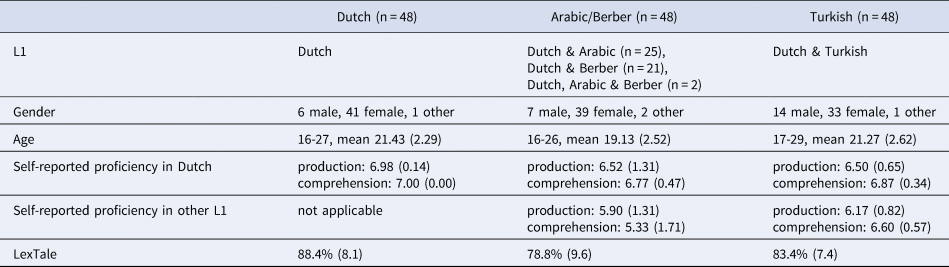
We tested 144 participants: 48 participants who are all native speakers of Flemish Dutch, 48 early bilingual speakers of both Flemish Dutch and Arabic or Berber, and 48 participants who are early bilingual speakers of both Flemish Dutch and Turkish. Participants were classified as early bilinguals if they started learning both languages before the age of 6. All participants were aged between 16 and 30, had normal or corrected to normal vision and had no dyslexia. Participants gave their informed consent prior to the experiment and received a gift voucher for their participation in the experiment.
We asked participants to rate their proficiency in Dutch and in their other L1 on a 7-point scale for both language production and language comprehension. Participants reported a high to very high proficiency in both Dutch and the other L1 in active and receptive language use. Even though numerically, they report a bit lower proficiency in their heritage language than in Dutch, their proficiency in both languages is presumably high enough to assume connected or shared representations (cf. the self-rated proficiencies in Hartsuiker et al., Reference Hartsuiker, Beerts, Loncke, Desmet and Bernolet2016, which reports equally strong between-language priming and within-language priming in L1 Dutch–L2 English, L1 Dutch–L2 French bilinguals and L1 Dutch–L2 German bilinguals).
To further assess their proficiency in Dutch, participants completed the LexTale test for Dutch (Lemhöfer & Broersma, Reference Lemhöfer and Broersma2012). The heritage speakers scored numerically slightly lower on the LexTale test than the L1 speakers. The LexTale test measures vocabulary size, which is known to be lower in bilinguals than in monolinguals (e.g., Bialystok & Luk, Reference Bialystok and Luk2012). Table 1
Participants.
Note: Standard deviations are indicated in parentheses.
2.2 Materials
The materials used were adapted from Bernolet et al. (Reference Bernolet, Hartsuiker and Pickering2009) and included pictures from the International Picture Naming Project (see Bates, Mächler, Bolker & Walker, Reference Bates, D'Amico, Jacobsen, Székely, Andonova, Devescovi and Tzeng2003). We constructed three sets of pictures: a pre-experimental baseline set, a target set and a verification set for the priming experiment.
The pre-experimental baseline set consisted of 12 target and 12 filler pictures. Target pictures showed an agent, a patient, and a Dutch transitive verb. There were 3 items for each combination of the agents’ and patients’ animacy (animate agent/animate patient [AA], animate agent/inanimate patient [AI], inanimate agent/animate patient [IA], inanimate agent/inanimate patient [II]). Filler pictures showed a person or an object and a Dutch intransitive verb. Six of the intransitive verbs were unergative and six were unaccusative.
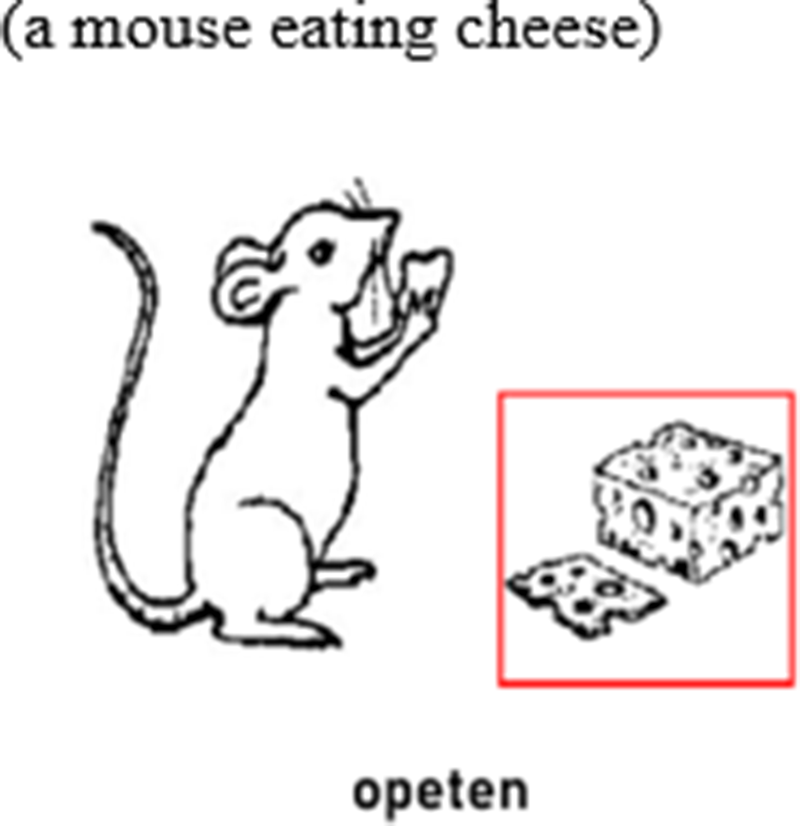
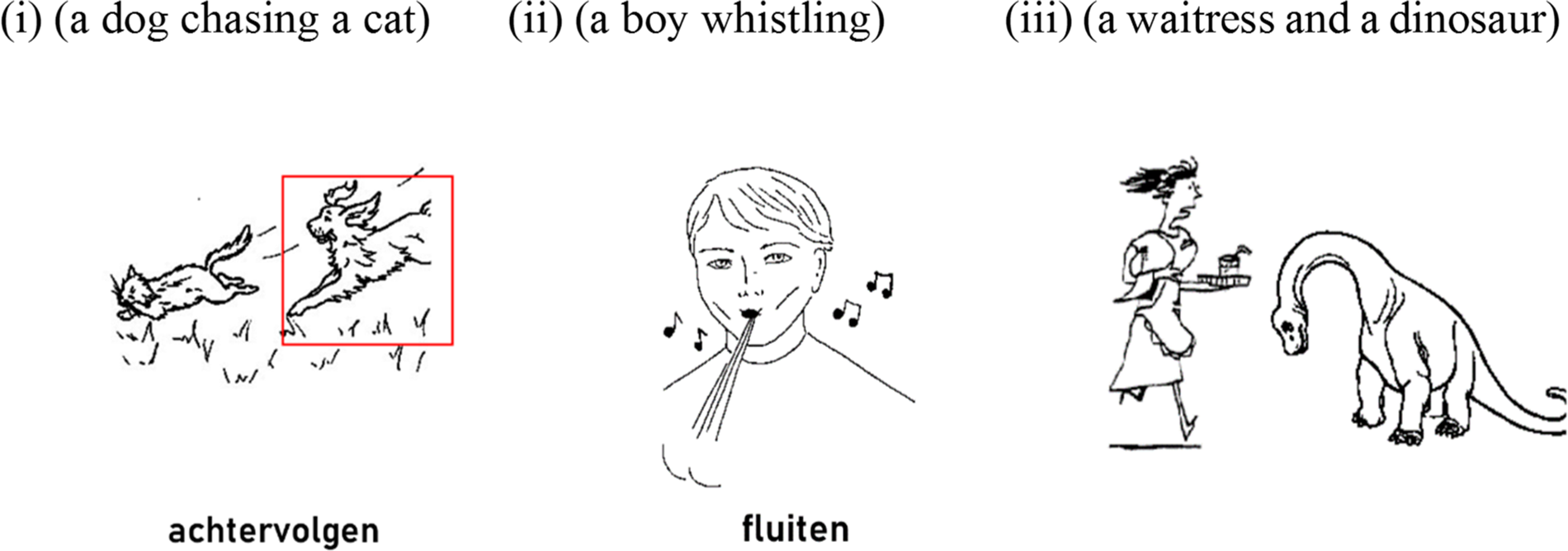
For the target set, we constructed 36 target and 72 filler pictures. Target items showed an agent and a patient and a Dutch transitive verb. The patient was indicated by means of a red frame. In the baseline set, the verb was omitted from the target item, but the patient was still red-framed. There were 9 target items for each animacy combination (AA, AI, IA, II). Filler items either showed (i) an agent, a patient, and a Dutch transitive with a red frame around the agent; (ii) one object/ person and a Dutch intransitive verb, or (iii) two objects/persons without a verb. Of the filler items with an intransitive verb, half of the intransitive verbs involved an unergative verb, whereas the other half used an unaccusative verb. Figure 1 shows a typical stimulus item. Figure 2 illustrates the three types of filler items.
Example of a stimulus item.
Examples of the three types of filler items.
The target items of both the baseline set and the target set were created in two variants: one with the agent depicted on the left and the patient on the right, and a mirrored variant with the patient depicted on the left and the agent depicted on the right. In previous priming studies with passives, the patient was often depicted on the left to elicit more passive responses (e.g., Bernolet et al., Reference Bernolet, Hartsuiker and Pickering2009; Bock, Reference Bock1986). This argument is based on a reading direction from left to right. Since Arabic is read from right to left and this could potentially affect our results, we decided to counterbalance the position of the agent and the patient.
We also constructed a verification set, which included 108 pictures that were similar to the target set. Half of the verification pictures matched the preceding prime sentence and half of the pictures did not match.
In addition to the three sets of pictures, we constructed a set of prime sentences. Similar to the target set, there were 36 critical prime sentences and 72 filler prime sentences. Each critical prime sentence was recorded in three variants, matching the prime conditions (base, PP-final passive, PP-medial passive, see example 9). The sentences were recorded by three female speakers: a speaker of Flemish Dutch, a bilingual Arabic–Dutch speaker, and a bilingual Turkish–Dutch speaker.
(9)
(a) Baseline condition
de dierenarts en de olifant
the veterinarian and the elephant
(b) PP-final passive
De olifant wordt behandeld door de dierenarts.
The elephant aux treat.ptc by the veterinarian
(c) PP-medial passive
De olifant wordt door de dierenarts behandeld.
the elephant aux by the veterinarian treat.ptc
‘The elephant is being treated by the veterinarian.’
2.3 Design
We designed a pre-experimental baseline task and an experimental task (the priming experiment). For the pre-experimental baseline task, we constructed two lists of target pictures. Both lists started with one filler item and alternated between a target item and a filler item. The pseudo-randomized items were always shown in the same order. Half of the target items displayed the agent on the right and the patient on the left, and vice-versa in the other half of the target items. This was counterbalanced across the two lists, so each item appeared equally often either with the agent or the patient on the right.
As for the priming experiment, each item consisted of a prime sentence, a verification picture and a target picture. There was no lexical overlap between the prime sentences and the elicited target sentences. The priming experiment had a target-filler ratio of 1:2. We pseudo-randomized the order of the items in such a way that there was always at least one filler between two target items, and that the experiment started with three fillers. Three different lists were constructed, such that every item was preceded by a prime from a different prime condition (base, PP-final passive, PP-medial passive) across the lists. Within each list, the prime sentences were presented equally often in the three priming conditions. As for the pre-experimental baseline task, we counterbalanced the position of the agent and the patient in the target pictures. For this purpose, we constructed two variants of each list, which led to a total of six lists.
2.4 Procedure
Immediately preceding the priming experiment, we measured the pre-experimental baseline preference for the different transitive alternatives (including the active structure). Participants were told that they would practice with the production part of the priming experiment. They were shown a target picture and were asked to describe this picture using one sentence. These target pictures had no red frame around either the agent or the patient; hence, participants were free to produce either an active or a passive sentence.
During the priming experiment, participants would first listen to the prime sentence through headphones. The voice they listened to belonged to a speaker with a similar language background: the Arabic/Berber-Dutch and Turkish–Dutch bilinguals listened to the sentences as recorded by an Arabic–Dutch speaker and Turkish–Dutch speaker respectively, and the Dutch group listened to a speaker of Flemish Dutch. They were then shown a verification picture and were asked to indicate whether this picture matched the preceding sentence by pressing 1 (matching) or 2 (not matching). After pressing one of the keys, the verification picture was replaced by the target picture. Participants were asked to describe this picture using a sentence that started with the figure indicated by the red frame (cf. the color-coded primes of Segaert et al., Reference Segaert, Menenti, Weber and Hagoort2011).
In addition to the experimental task, participants completed a short language questionnaire and did the LexTale test (a short yes/no-vocabulary test) (Lemhöfer & Broersma, Reference Lemhöfer and Broersma2012). The sessions took place in a quiet room. A session took about 40 minutes. All sessions were recorded with an external audio recorder.
2.5 Coding
Pre-experimental baseline
The target responses of the pre-experimental baseline measurement were coded as Active, PP-final passive, SP, or ‘Other’. (Note that no PP-medial passives were produced in the pre-experimental baseline.) For the coding of PP-final passives and SPs, the same criteria were used as for the coding of the priming experiment (see below). A response was coded as Active if the response included a form of the transitive verb, if the subject was an agent and if the object was a patient. An exception was made for active sentences that contained the past participle (mostly sentences with the present perfect, i.e., a form of the auxiliary hebben ‘have’ and the past participle, see example 10). These were coded as ‘Other’, because they are active in terms of information structure, but their morphological complexity is similar to passives in Dutch. Furthermore, ‘Other’ responses included responses in which a conjugated verb was missing or in which a different verb was used, responses in which either the agent or the patient was not mentioned, responses with reflexives (see example 11) and responses of any other structure.
(10) de jongen heeft het broodje gegeten
the boy aux.3sg the sandwich eat.ptc
‘The boy ate/has eaten the sandwich.’
(11) het meisje steek- t zich aan de cactus
the girl prick- 3sg refl to the cactus
‘The girl gets pricked by the cactus.’
(Expected response:
het meisje word- t gestoken door de cactus
the girl aux- 3sg prick.ptc by the cactus
‘The girl is being pricked by the cactus.’)
Priming experiment
Target responses were coded as PP-final passive, PP-medial passive, SP or ‘Other’. A response was coded as a PP-final passive if the response included a subject, an auxiliary (either worden or zijn), a past participle, and a by-phrase with the preposition door following the past participle. A response was coded as a PP-medial passive if the by-phrase preceded the past participle and if the same elements were present as for the PP-final passive responses. A response was coded as an SP if the response contained a subject, an auxiliary and a past participle and if the agent was not mentioned. Different from the pre-experimental baseline experiment, active responses were coded as ‘Other’. Any other response was coded as ‘Other’ as well. ‘Other’ responses included responses in which a different kind of passive construction was used (PP-initial by-phrase passives, passives with er as subject instead of the agent, passives in which a different preposition than door was used in the PP mentioning the agent) and responses using any other construction.
2.6 Analysis
After the Other responses were excluded, the responses fell into the following categories: Actives, PP-final passives, and SPs in the pre-experimental baseline, and PP-final passives, PP-medial passives, and SPs in the priming experiment. Therefore the results needed to be analyzed using a multinomial generalized linear mixed model rather than a binomial model. We used the Markov chain Monte Carlo (MCMC) algorithm, which allows to approximate likelihood estimates over more complex data such as multinomial data.
The MCMC method utilizes a Bayesian framework, which exploits a prior distribution, a likelihood function and a posterior distribution. The prior distribution represents prior beliefs on the parameters – for example, on probability. Defining a flat prior means that we believe that the probability will be anywhere between 0 and 1. The likelihood function describes what probability value is most likely given the observed data. The prior distribution and the likelihood function are then combined to determine the posterior distribution. The MCMC algorithm generates random samples to calculate the posterior distribution given the prior and the observed data. For each sample, it evaluates whether the random parameter values (i.e., those provided by the likelihood function) are better than the previously stored ones and if so, updates the parameter values of the posterior distribution, storing how much better the new values are. The reported posterior means are thus approximated through repeated sampling. The effective sample size is a measure of autocorrelation (i.e., the sampled parameter values are very similar to the directly preceding ones). The reported parameter value is more reliable if the effective sample size is closer to our sample size. The p-value indicates the probability that the parameter value is larger or smaller than 0.
Similar to a binomial generalized linear effects model, a significant p-value indicates that the posterior mean is significantly higher or lower compared to the reference level. Importantly, as there are three categories instead of two categories within the response variable, a significant effect in one category does however not imply a significant effect in the other category. To illustrate, in a binomial experiment with PP-final passives and PP-medial passives, a significant increase of PP-final passives in a particular condition entails a significant decrease of PP-medial passives. In a multinomial model, this is not the case. A significantly higher posterior mean for PP-final passives means that there are more PP-final passives in that condition compared to the reference level (SPs in our case), but does not say anything about the effect of the increase of PP-final passives on the proportion of PP-medial passives. An increase in the proportion of PP-final passives may go to the expense of both other categories (PP-medial passives and SPs), or may lead to a decrease in only one of the other categories.
We ran our analyses using the R-package MCMCglmm (Hadfield, Reference Hadfield2010). We defined a flat prior following the recommendations of Levshina (Reference Levshina2015). For each separate model, we set the number of iterations to 500,000. The burn-in period was set to 60,000 iterations and the thinning interval was 300. These settings led to good model diagnostics, i.e., a good mixture and an autocorrelation of less than 0.1, as recommended by Hadfield (Reference Hadfield2019).
3. Results
3.1 Pre-experimental baseline
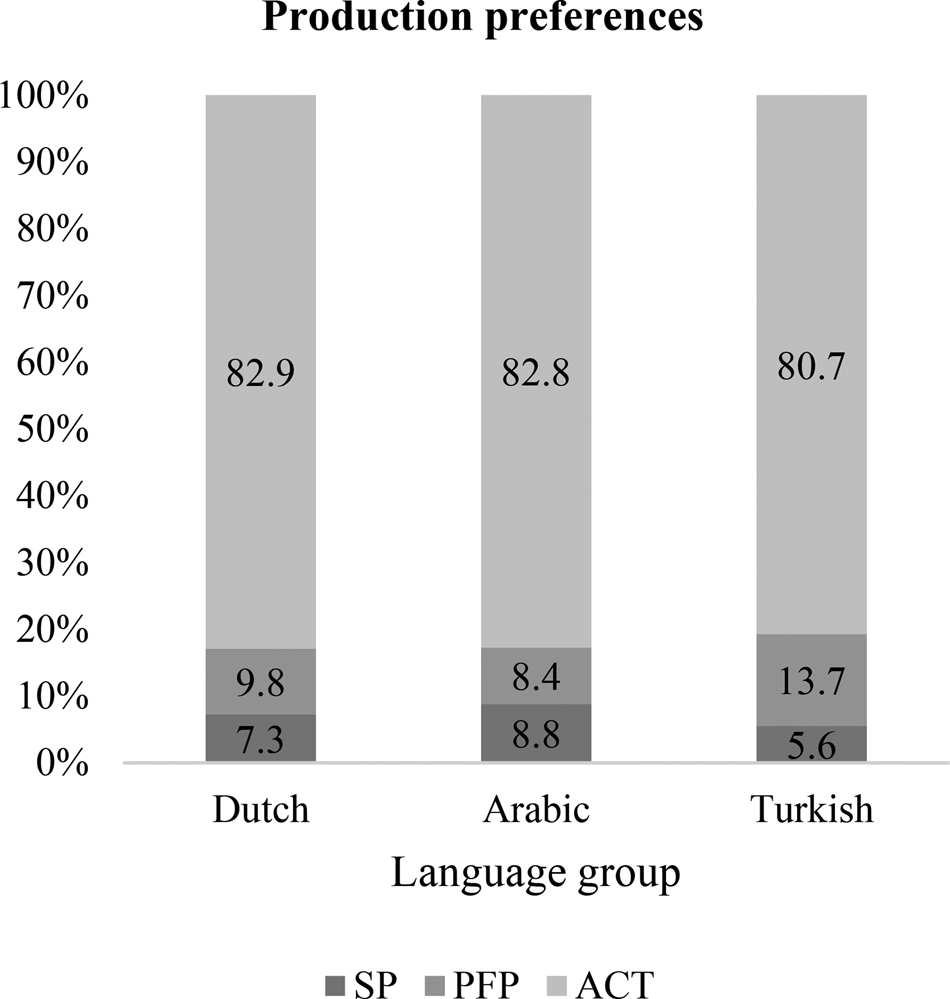
The Dutch-speaking participants produced 432 Actives (75.0%), 51 PP-final passives (8.9%), 38 SPs (6.6%), and 55 Others (9.5%). The Arabic/Berber–Dutch group produced 384 Actives (66.7%), 39 PP-final passives (6.8%), 41 SPs (7.1%), and 112 Others (19.4%). The Turkish–Dutch participants produced 406 Actives (70.5%), 69 PP-final passives (12.0%), 28 SPs (4.9%), and 73 Others (12.7%). No PP-medial passives were spontaneously produced in any of the language groups. The Other responses were disregarded for further analyses. Figure 3 shows the production preferences for Actives, PP-final passives and SPs.
Responses in the pre-experimental baseline for each language group (in %).
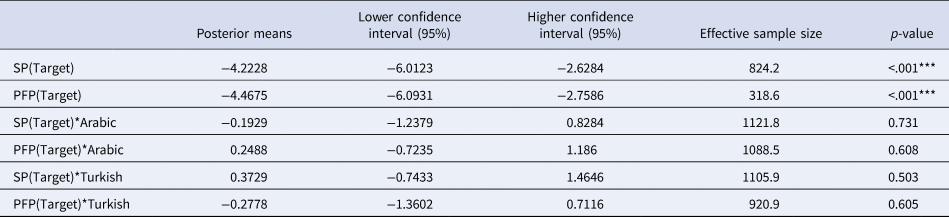
The pre-experimental production preferences were compared between the different groups by fitting a multinomial generalized linear mixed model to the Active, PP-final passive and SP responses. Language was included as a fixed effect. Random effects were inserted for participants and items. The Active target responses and the Dutch language group were treated as the reference levels. Participants produced significantly more Actives than PP-final passives (p < .001) and SPs (p < .001). In the pre-experimental baseline, the Arabic/Berber–Dutch and Turkish–Dutch group did not differ significantly from the Dutch group in any of the conditions. Table 2
Multinomial model of pre-experimental baseline responses (1488 observations, sample size = 1467).
3.2. Priming experiment
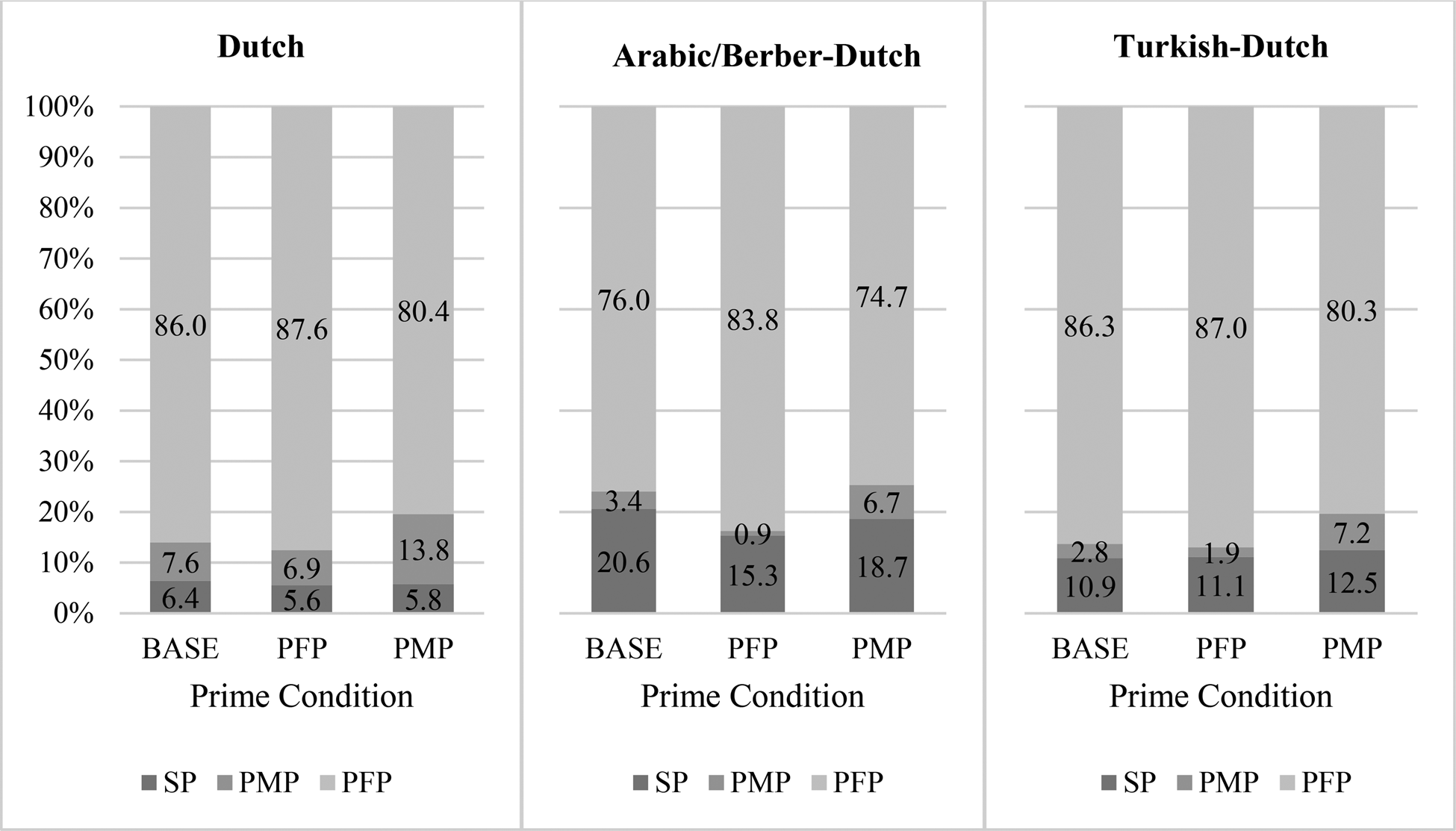
In the critical items of the priming experiment, participants were forced to start their response with the patient. Therefore any Active responses were considered as Other responses here. The Dutch-speaking participants produced 1,319 PP-final passives (76.3%), 147 PP-medial passives (8.5%), 92 SPs (5.3%) and 170 Others (9.8%). The Arabic/Berber–Dutch participants produced 1,068 PP-final passives (61.8%), 51 PP-medial passives (3.0%), 251 SPs (14.5%) and 358 Others (20.7%)Footnote 1. Finally, the Turkish–Dutch participants produced 1,294 PP-final passives (74.9%), 63 PP-medial passives (3.6%), 175 SPs (10.1%), and 196 Others (11.3%). The responses per priming condition are summarized in Figure 4.
Responses per prime condition for each language group (in %).
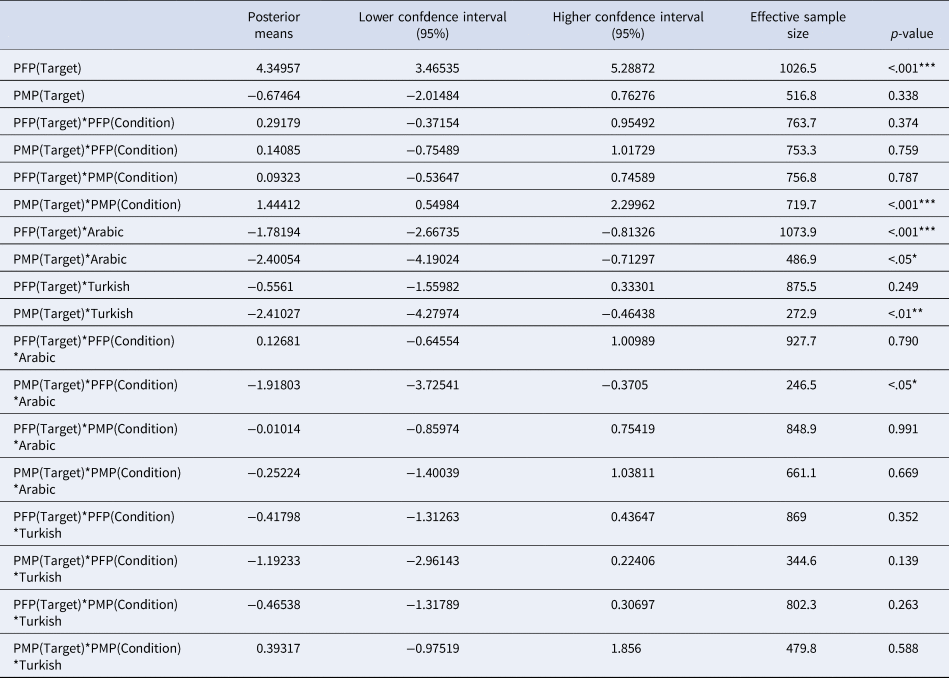
We compared the production preferences and the priming effects between the three language groups using a multinomial generalized linear mixed model with Prime Condition, Language, and their interaction as fixed effects. We added random effects for participants and items. The reference levels were the SP target responses, the baseline prime condition, and the Dutch language group. Because of the inverse reading direction in Arabic, we counterbalanced the position of the agent and the patient in the pictures that participants had to describe rather than placing the patient on the left. There were no significant differences in response patterns between the pictures that had the patient on the left and the pictures that depicted the patient on the right, neither in the Arabic/Berber–Dutch group nor in the other language groups. Therefore this variable was not included in the final analyses.
The Dutch participants showed an overall preference for PP-final passives (p < .001). They produced significantly more PP-medial passives after a PP-medial prime than after a baseline prime (p < .001). We did not observe a significant effect of the PP-final prime on the proportion of PP-final passives produced (p = 0.37).
Arabic/Berber–Dutch speakers used significantly fewer PP-final passives (p < .001) and PP-medial passives (p < .05) than Dutch speakers, i.e., significantly more SPs. The Turkish–Dutch group produced fewer PP-medial passives than the Dutch group (p < .01), but did not differ from the Dutch group with respect to the number of PP-final responses (p = .25). The Arabic/Berber–Dutch and the Turkish–Dutch group did not differ from the Dutch group in terms of PP-medial priming (p = .67 and p = .59 respectively). The Arabic/Berber–Dutch and the Turkish–Dutch group also did not differ from the Dutch group in terms of PP-final priming, i.e., the number of PP-final passive responses after a PP-final passive primes compared to the amount after baseline primes (p = .79 and p = .35 respectively). Nevertheless, the Arabic/Berber–Dutch participants did use fewer PP-medial passives after a PP-final passive prime than the Dutch participants do (p < .05). Table 3
Multinomial model of all responses (n = 4460, sample size = 1467).
4. Discussion
The pre-experimental baseline test did not show any significant differences between the Dutch, the Arabic/Berber–Dutch, and the Turkish–Dutch group. In the priming experiment, we did find differences in terms of production preferences. The Arabic/Berber–Dutch group produced significantly more SPs than the Dutch participants did. The Turkish–Dutch participants had significantly fewer PP-medial responses than the Dutch group. We found significant PP-medial priming but no PP-final priming in all three language groups. The Arabic/Berber–Dutch participants produced fewer PP-medial passives in the PP-final prime condition than in the baseline condition. Otherwise, the Arabic/Berber–Dutch and Turkish–Dutch participants did not differ from the Dutch group in terms of priming effects.
In the pre-experimental baseline test, the proportion of actives was more than 80% in each of the three groups. As a consequence of the high proportion of actives, the number of observations of the three passive structures (i.e., PP-final, PP-medial, and SP) is relatively low. Any differences with regard to the different forms of the passive structure are therefore hard to spot. These results confirm the need of our priming experiment in which we targeted the passive structure only.
We predicted that in the case of shared structures between languages, we would find an increased proportion of SPs in the Arabic/Berber-Dutch group and PP-medial passives in the Turkish–Dutch group as compared to the Dutch group. This would follow the developmental model of L2 syntax of Hartsuiker and Bernolet (Reference Hartsuiker and Bernolet2017). In the case of connected structures, we expected cross-linguistic overcorrection in the Arabic/Berber-Dutch group –that is, a decreased proportion of the SPs, and cross-linguistic influence in the Turkish–Dutch group, which would mean an increased proportion of the PP-medial passives. Such results would follow the predictions of Anderssen and Westergaard (Reference Anderssen, Westergaard, Brehmer and Treffers-Daller2020).
Our results are not in line with either accounts. We find cross-linguistic influence in the Arabic/Berber-Dutch group, since the Arabic/Berber-Dutch participants produce significantly more SPs in Dutch than the Dutch participants. We find cross-linguistic overcorrection in the Turkish–Dutch group, as the Turkish–Dutch group produces fewer PP-medial passives than the Dutch group. Since the shared syntax account of Hartsuiker and Bernolet (Reference Hartsuiker and Bernolet2017) does not predict any inhibition effects such as cross-linguistic overcorrection, our results suggest that structures may be connected rather than shared, at least under certain circumstances, which may give rise to cross-linguistic overcorrection. Nevertheless, contrary to what Anderssen and Westergaard (Reference Anderssen, Westergaard, Brehmer and Treffers-Daller2020) argue, partial or total overlap of the syntactic alternatives available between languages does not seem the factor that is decisive of whether there is cross-linguistic influence or cross-linguistic overcorrection. We find cross-linguistic influence in the case of partial overlap and cross-linguistic overcorrection in the case of total overlap, whereas previous studies found the reverse pattern (Anderssen & Westergaard, Reference Anderssen, Westergaard, Brehmer and Treffers-Daller2020; Anderssen et al., Reference Anderssen, Lundquist and Westergaard2018; Kupisch, Reference Kupisch2014).
The production patterns displayed by the Arabic/Berber-Dutch group may still be the consequence of having shared syntactic structures. Van Gompel and Arai (Reference Van Gompel and Arai2018) suggest that fully identical structures may be shared between languages, whereas similar but non-identical structures are connected. It may be the case that the Arabic/Berber SP is considered ‘identical’ to the Dutch SP, implying a shared structure between languages, whereas the Turkish and PP-medial passive differ too much from each other to be shared (for instance, due to word order differences within constituents: the Dutch by-phrase is formed with a preposition, whereas Turkish uses postpositions). For the Arabic/Berber-Dutch group, we can therefore conclude that the SP is either an instance of shared structures, or that there are connected structures, which would mean that partial overlap of the alternatives available between languages does not always lead to cross-linguistic overcorrection.
As we find inhibition effects in the Turkish–Dutch group, which are not compatible with a shared syntax account, we must assume connected representations in this case. So, contrary to what Anderssen and Westergaard (Reference Anderssen, Westergaard, Brehmer and Treffers-Daller2020) suggest, cross-linguistic overcorrection can occur when there is total overlap of the available syntactic alternatives between languages, i.e., if language B has a parallel alternative for every structure in language A (for a specific alternation).
During the production of Dutch passives, Turkish–Dutch speakers need to inhibit the combinatorial nodes of the high frequent PP-medial passive and the low frequent PP-final passive in Turkish. There is more co-activation of the high frequent structure than for the low frequent structure (cf. Kupisch, Reference Kupisch2014) and thus more lateral inhibition for the PP-medial passive than for the PP-final passive during sentence selection in Dutch. During the competition between the syntactic alternatives, the structure that reaches its activation threshold first is the structure that will be selected. As a consequence of the larger inhibition for the PP-medial passive than for the PP-final passive, Turkish–Dutch bilinguals produce more PP-final passives than non-bilingual Dutch speakers who are not affected by inhibition.
What determines whether one finds cross-lingusitic overcorrection or cross-linguistic influence? Our study differs from the studies on which the predictions of Anderssen and Westergaard (Reference Anderssen, Westergaard, Brehmer and Treffers-Daller2020) are based (Anderssen et al., Reference Anderssen, Lundquist and Westergaard2018; Kupisch, Reference Kupisch2014) mainly in two aspects. First, we tested participants in the dominant L2 rather than in the heritage language. Although both the shared syntax account (Bernolet & Hartsuiker, Reference Bernolet and Hartsuiker2018) and the predictions of Anderssen and Westergaard (Reference Anderssen, Westergaard, Brehmer and Treffers-Daller2020) assume bidirectional influences, it may be the case that language dominance or other extralinguistic factors play a role here. Indeed, Kupisch finds cross-linguistic influence rather than cross-linguistic overcorrection in children, suggesting that age or language awareness may be a factor. Brehmer and Sopata (Reference Brehmer and Sopata2021) also find an effect of age, which interacts with whether bilinguals are simultaneous or sequential bilinguals.
Second, we measured the production preferences in a priming experiment rather than in unprimed conditions such as a production elicitation experiment or a corpus study. When Turkish–Dutch participants are primed with the non-frequent PP-medial passive in Dutch, this may lead to a large prediction error (i.e., the inverse preference effect). A large prediction error leads to relatively high levels of activation. As a consequence, the activation level of Turkish PP-medial passive is temporarily higher, which makes it harder to inhibit. A parallel may be found in the study of Kootstra and Şahin (Reference Kootstra and Şahin2018), who found cross-linguistic influence in an unprimed experiment and cross-linguistic overcorrection in a primed experiment.
Turning to the structural priming effects, we found PP-medial passive priming but no PP-final passive priming in the Dutch group. These results confirm our assumptions and are in line with Bernolet et al. (Reference Bernolet, Hartsuiker and Pickering2009): PP-final passives and PP-medial passives can be primed separately. Different from Bernolet et al., we did not find PP-final priming. In their study, participants could describe the pictures either with an active or a passive sentence, whereas in our study participants were forced to use a passive sentence. As a consequence, the proportion of PP-final passives relative to the total of responses is much higher in our study than in Bernolet et al. As the PP-final passive is the preferred passive structure, no PP-final passive priming is observed due to the inverse preference effect. We also explored whether the difference in results can be attributed to the fact that we included SP responses and performed a multinomial analysis, whereas Bernolet et al. coded SP responses as Others and fit a binomial model to the results. This is not the case: if we omit the SPs from our analyses, we still do not find significant PP-final priming.
With regard to the priming effects in the bilingual groups, we hypothesized that the proportion of PP-final passives would be lower in the Arabic/Berber–Dutch and Turkish-groups and consequently, that the inverse preference effect would be weaker or absent. However, the Turkish–Dutch group did not differ from the Dutch group with regard to the proportion of PP-final passives produced. Similarly, we did not find PP-final priming, which should most likely be attributed to the inverse preference effect as well.
The Arabic/Berber–Dutch group did produce fewer PP-final passives than the Dutch group. Although we did not find significant PP-final passive priming, the proportion of PP-medial responses was lower in the PP-final prime condition than in the baseline prime condition in the Arabic/Berber–Dutch group. Crucially, this is not exactly the same as PP-final passive priming, since we are dealing with multinomial responses. In a binomial paradigm, a decrease in one target condition automatically means an increase in the other target condition. In our design, a significant decrease in the proportion of PP-medial responses but no significant increase in the proportion of PP-final responses implies that the proportion of SPs is higher after a PP-final prime than after a baseline prime. In fact, we also observe a decrease in the number of SPs produced after a PP-final prime, which we interpret as a weakened effect of PP-final passive priming. We thus attribute the absence of PP-final passive priming to the inverse preference effect for all three groups and conclude that Arabic/Berber–Dutch and Turkish–Dutch speakers have similar syntactic representations stored for the PP-final passive in Dutch as the Dutch speakers.
We find PP-medial passive priming in all three language groups. This suggests that Arabic/Berber–Dutch and Turkish–Dutch speakers have representations for the infrequent PP-medial passive in Dutch that are strong enough to be primed in production, even though both groups did produce fewer PP-medial passives than the Dutch group.
To sum up, our data suggest that, at least for the Turkish–Dutch bilinguals, the representations of the PP-final and PP-medial passives are connected between languages rather than shared. Although the passive alternation is an alternation where there is total overlap of the alternatives that are available between languages, we find cross-linguistic overcorrection rather than cross-linguistic influence. More research is needed to understand under which circumstances connected syntactic structures lead to inhibition effects. For instance, it is important to test heritage speakers both in their heritage language and in their dominant L2, and to compare the production preferences of simultaneous and sequential bilinguals in primed and unprimed experiments. Computational modelling of bilingual sentence production with different groups of participants may also contribute to the understanding of cross-linguistic influence and cross-linguistic overcorrection of production preferences in bilingual speakers.
5. Conclusion
Our results suggest that for the Dutch PP-final and PP-medial passive structures, production preferences but not priming effects are affected by different preferences in heritage languages. The priming effects suggest that heritage speakers seem to have developed syntactic representations for the uncommon Dutch by-phrase-medial passive that are strong enough to be primed in production. We find an instance of cross-linguistic influence in the Arabic/Berber-Dutch group, which may be either due to a shared representation of the SP between Arabic/Berber and Dutch or the outcome of competition between connected representations, of which the mechanisms are not yet fully understood. As for the Turkish–Dutch group, we find cross-linguistic overcorrection, which can probably be attributed to inhibition effects induced by competition between connected representations of the PP-final and the PP-medial passive between Turkish and Dutch. Further research is needed to understand the mechanisms behind the competition taking place between connected structures in different groups of bilingual speakers.
Acknowledgements
This work was funded by the Fonds Wetenschappelijk Onderzoek Vlaanderen, grant G027319N.
Data availability
Materials, data and scripts are openly available in the Open Science Framework repository: https://osf.io/kg7w9
Competing interests
The authors declare none.


 Open access

