





1 Introduction
Laser-driven plasma wakefield acceleration (LWFA)[ Reference Tajima and Dawson 1 ] and beam-driven plasma wakefield acceleration (PWFA)[ Reference Chen, Dawson, Huff and Katsouleas 2 ] are both promising high-gradient acceleration schemes that address the critical limitations of traditional radio-frequency accelerators. In LWFA, an ultra-intense relativistic laser pulse drives large-amplitude plasma waves via its ponderomotive force as it propagates through a low-density plasma. In contrast, PWFA relies on the Coulomb field of a relativistic intense electron beam to excite similar plasma wakefields. In both schemes, these wakefields can trap and accelerate electrons with extremely high gradients. Despite their analogous physical principles, LWFA and PWFA possess distinct characteristics and offer complementary advantages[ Reference Hidding, Manahan, Karger, Knetsch, Wittig, Jaroszynski, Sheng, Xi, Deng, Rosenzweig, Andonian, Murokh, Pretzler, Bruhwiler and Smith 3 – Reference Hidding, Assmann, Bussmann, Campbell, Chang, Corde, Cabadağ, Debus, Döpp, Gilljohann, Götzfried, Foerster, Haberstroh, Habib, Heinemann, Hollatz, Irman, Kaluza, Karsch, Kononenko, Knetsch, Kurz, Kuschel, Köhler, Ossa, Nutter, Pausch, Raj, Schramm, Schöbel, Seidel, Steiniger, Ufer, Yeung, Zarini and Zepf 5 ]. LWFA can generate high-energy electron beams, yet its acceleration length is constrained by laser diffraction and dephasing length[ Reference Gordienko and Pukhov 6 , Reference Lu, Tzoufras, Joshi, Tsung, Mori, Vieira, Fonseca and Silva 7 ]. Conversely, PWFA circumvents dephasing limitations, but requires costly kilometer-scale traditional accelerator to deliver the high-energy, high-current electron beam needed as a driver. The hybrid LWFA–PWFA mechanism (LPWFA ) bridges these limitations by employing an LWFA-derived electron beam with kA-scale current to drive the PWFA stage, synergizing the compactness of LWFA with the dephasing-free nature of PWFA.
A clear separation of the LWFA and PWFA regimes can be achieved by employing dual consecutive gas jets to create two separate LWFA and PWFA stages. A steel foil or blocker tape[ Reference Kurz, Heinemann, Gilljohann, Chang, Couperus Cabadağ, Debus, Kononenko, Pausch, Schöbel, Assmann, Bussmann, Ding, Götzfried, Köhler, Raj, Schindler, Steiniger, Zarini, Corde, Döpp, Hidding, Karsch, Schramm, Martinez De La Ossa and Irman 8 – Reference Schöbel, Pausch, Chang, Corde, Couperus Cabadağ, Debus, Ding, Döpp, Foerster, Gilljohann, Haberstroh, Heinemann, Hidding, Karsch, Köhler, Kononenko, Kurz, Nutter, Steiniger, Ufer, Martinez De La Ossa, Schramm and Irman 10 ] is typically positioned between the two gas targets to block the remaining laser energy, allowing only the electron beams to enter the second stage and exclusively drive the plasma wakefield. Over the past decade, this dual-target configuration has established LPWFA as a promising platform for transforming beam energy and brightness[ Reference Hidding, Manahan, Karger, Knetsch, Wittig, Jaroszynski, Sheng, Xi, Deng, Rosenzweig, Andonian, Murokh, Pretzler, Bruhwiler and Smith 3 , Reference Kurz, Heinemann, Gilljohann, Chang, Couperus Cabadağ, Debus, Kononenko, Pausch, Schöbel, Assmann, Bussmann, Ding, Götzfried, Köhler, Raj, Schindler, Steiniger, Zarini, Corde, Döpp, Hidding, Karsch, Schramm, Martinez De La Ossa and Irman 8 – Reference Couperus Cabadağ, Pausch, Schöbel, Bussmann, Chang, Corde, Debus, Ding, Döpp, Foerster, Gilljohann, Haberstroh, Heinemann, Hidding, Karsch, Koehler, Kononenko, Knetsch, Kurz, Martinez De La Ossa, Nutter, Raj, Steiniger, Schramm, Ufer and Irman 13 ]. This approach relies on high-current LWFA-generated electron beams to drive the subsequent PWFA stage, and enables unique electron injection methods[ Reference Hidding, Manahan, Karger, Knetsch, Wittig, Jaroszynski, Sheng, Xi, Deng, Rosenzweig, Andonian, Murokh, Pretzler, Bruhwiler and Smith 3 – Reference Hidding, Assmann, Bussmann, Campbell, Chang, Corde, Cabadağ, Debus, Döpp, Gilljohann, Götzfried, Foerster, Haberstroh, Habib, Heinemann, Hollatz, Irman, Kaluza, Karsch, Kononenko, Knetsch, Kurz, Kuschel, Köhler, Ossa, Nutter, Pausch, Raj, Schramm, Schöbel, Seidel, Steiniger, Ufer, Yeung, Zarini and Zepf 5 , Reference Foerster, Döpp, Haberstroh, Grafenstein, Campbell, Chang, Corde, Couperus Cabadağ, Debus, Gilljohann, Habib, Heinemann, Hidding, Irman, Irshad, Knetsch, Kononenko, Martinez De La Ossa, Nutter, Pausch, Schilling, Schletter, Schöbel, Schramm, Travac, Ufer and Karsch 9 ] in this PWFA stage. Although the conversion efficiency from integrated PWFA driver electron beam energy to integrated injected electron beam energy has already reached the record level of approximately 10% in proof-of-concept experiments[ Reference Foerster, Döpp, Haberstroh, Grafenstein, Campbell, Chang, Corde, Couperus Cabadağ, Debus, Gilljohann, Habib, Heinemann, Hidding, Irman, Irshad, Knetsch, Kononenko, Martinez De La Ossa, Nutter, Pausch, Schilling, Schletter, Schöbel, Schramm, Travac, Ufer and Karsch 9 ], the overall laser-to-electron conversion efficiency is sacrificed in order to realize electron energy and brightness transformers.
The self-mode transition from LWFA to PWFA enables more complete utilization of laser energy[ Reference Pae, Choi and Lee 14 ] in single-stage operation[ Reference Masson-Laborde, Mo, Ali, Fourmaux, Lassonde, Kieffer, Rozmus, Teychenné and Fedosejevs 15 – Reference Wang, Khudik and Shvets 20 ]. Once the driving laser pulse is depleted in the plasma, the LWFA-accelerated electron beam autonomously acts as the main driver of the PWFA. This transition has been experimentally demonstrated under low-density conditions as a feasible method to achieve electron beam energy boosting[ Reference Masson-Laborde, Mo, Ali, Fourmaux, Lassonde, Kieffer, Rozmus, Teychenné and Fedosejevs 15 – Reference Chang, Zeng, Wang and Li 17 ] in the bubble acceleration regime. Recently, the numerical simulations by Horný et al. [ Reference Horný, Bleotu, Ursescu, Malka and Tomassini 18 ] showed that ultrashort laser pulses can generate multi-nC electron beams with energies of hundreds of MeV in the pump-depletion-dominated bubble regime. They found that the single-stage LPWFA can enable the complete depletion of laser energy within the wakefield, and 50% of the laser energy can transfer to the relativistic electrons. However, the ability of the single-stage LPWFA to achieve high laser-to-electron energy conversion efficiency has not yet been experimentally demonstrated.
In this work, we demonstrate the single-target LPWFA scheme using a 300 TW tightly focused laser interacting with a sub-critical density nitrogen gas target. By comparing top-view images and electron energy spectra obtained from 0.3 and 2 mm diameter gas nozzles, the onset hybrid acceleration in the long-nozzle configuration is identified and generates 100-nC-class multi-MeV electron beams with high laser-to-electron energy conversion efficiency. To further figure out the mechanism behind this improved efficiency, we perform quasi-three-dimensional (3D) particle-in-cell (PIC) simulations using parameters closely matched to the experiment. The simulations capture the evolution of the hybrid acceleration process, supporting single-stage LPWFA as a viable approach for producing high-efficiency, high-charge electron beams.
2 Experimental setup
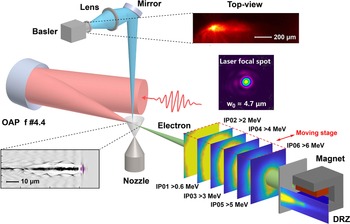
The experiment was conducted using the SECUF-PW laser facility, a Ti:sapphire laser system at the ultrafast X-ray dynamics experimental station of the Synergetic Extreme Condition User Facility (SECUF), Institute of Physics, Chinese Academy of Sciences. The experimental setup is illustrated in Figure 1. A laser pulse with a central wavelength of 800 nm, full width at half maximum (FWHM) duration of 25 fs and energy of 9 J was focused onto the gas target by using an f/4.4 off-axis parabolic mirror. The laser pulse was focused to a spot with radius w 0 ≈ 4.7 μm, containing approximately 47% of the total pulse energy, yielding a peak intensity of approximately 5.2 × 10²⁰ W/cm2 and the normalized vector potential a 0 ≈ 15.6. Two types of gas nozzles were connected to a fast-operating valve respectively in the experiment. The first was a convergent–divergent Laval nozzle with an exit diameter of 300 μm, while the second featured a 2 mm diameter (see Appendix A). Pure nitrogen was used as the working gas to exploit ionization-induced injection and thereby enhance the electron injection rate. Offline density measurements revealed the nitrogen density profile. The 2 mm nozzle consists of a 1000 μm density up-ramp, followed by an 800 μm plateau and then a 1200 μm density down-ramp, while the 0.3 mm nozzle yielded a Gaussian-like density distribution. Plasma density was varied by adjusting the gas backing pressure. The electron spectrometer consists of an 8 cm × 8 cm permanent magnet with a maximum magnetic field of 0.98 T. The accelerated electrons were deflected by the magnet onto the phosphor screen, coupled with a 16-bit visible charge-coupled device (CCD) camera. The spectrometer covered an energy range from 7.5 to 77.5 MeV. A top-view imaging system was used to monitor the plasma channel via the scattered light. The electron beam charge was measured using 20 cm × 20 cm absolutely calibrated image plates[ Reference Tanaka, Yabuuchi, Sato, Kodama, Kitagawa, Takahashi, Ikeda, Honda and Okuda 21 – Reference Ingenito, Andreoli, Batani, Boutoux, Cipriani, Consoli, Cristofari, Curcio, Angelis, Giorgio, Ducret, Forestier-Colleoni, Hulin, Jakubowska and Rabhi 23 ] (IPs, Fuji Film SR series) positioned 24.5 cm away from the target along the beam axis inside the chamber. A series of energy cut-off filters allowed charge measurements across a range of energy thresholds, from more than 0.6 MeV up to more than 6 MeV.
Schematic of the experimental setup.

3 Experimental results
The single-shot electron energy distributions obtained by using the 0.3-mm-diameter nozzle (shot #1) and the 2-mm-diameter nozzle (shots #2–#4) are presented in Figure 2(a). For both nozzles, the laser was focused 300 μm upstream of the nozzle center. For the 0.3 mm nozzle, the electron energy spectrum exhibits a two-temperature distribution of the form ${N}_\mathrm{e}\propto {e}^{\frac{E}{T_{\mathrm{e}1}}}+{e}^{\frac{E}{T_{\mathrm{e}2}}}$
where T
e1 = 7.3 MeV and T
e2 = 19.9 MeV (Figure 2(b)), a typical signature of LWFA in high-density plasma conditions[
Reference Feng, Li, Tan, Wang, Li, Zhang, Meng, Ge, Liu, Yan, Fu, Chen and Zhang
24
]. The measured electron beam charge above 6 MeV was 7.3 nC, with an FWHM divergence angle of approximately 15° at a nitrogen density of approximately 1.7 × 1018 cm–3 (Figure 2(c)), and the laser-to-electron energy conversion efficiency was approximately 1.4%. In contrast, the energy spectra obtained from the 2 mm nozzle show significant enhancements within the nitrogen density range from 1.2 × 10¹⁸ to 2.4 × 1018 cm–3 (Figure 2(b)). Notably, at a density of 1.2 × 1018 cm–3, a prominent plateau emerges around 30 MeV. The integrated charges above 6, 4 and 2 MeV are 31, 63 and 116 nC, respectively, significantly exceeding the prediction from the nonlinear bubble regime scaling law[
Reference Gordienko and Pukhov
6
,
Reference Pukhov and Meyer-ter-Vehn
25
] (see Appendix B). The electron spectrum for energies below 7.5 MeV was extrapolated by fitting the measured charges across different energy thresholds. The laser-to-electron energy conversion efficiency reaches 6.1%, 10.7% and 16.4% for electron energy above 6, 4 and 2 MeV, respectively (see Appendix C). Here, the energy conversion efficiency is defined as the ratio of the total kinetic energy of accelerated electrons to the incident laser energy. The divergence of the electron beam was approximately 22° (Figure 2(d)).
${N}_\mathrm{e}\propto {e}^{\frac{E}{T_{\mathrm{e}1}}}+{e}^{\frac{E}{T_{\mathrm{e}2}}}$
where T
e1 = 7.3 MeV and T
e2 = 19.9 MeV (Figure 2(b)), a typical signature of LWFA in high-density plasma conditions[
Reference Feng, Li, Tan, Wang, Li, Zhang, Meng, Ge, Liu, Yan, Fu, Chen and Zhang
24
]. The measured electron beam charge above 6 MeV was 7.3 nC, with an FWHM divergence angle of approximately 15° at a nitrogen density of approximately 1.7 × 1018 cm–3 (Figure 2(c)), and the laser-to-electron energy conversion efficiency was approximately 1.4%. In contrast, the energy spectra obtained from the 2 mm nozzle show significant enhancements within the nitrogen density range from 1.2 × 10¹⁸ to 2.4 × 1018 cm–3 (Figure 2(b)). Notably, at a density of 1.2 × 1018 cm–3, a prominent plateau emerges around 30 MeV. The integrated charges above 6, 4 and 2 MeV are 31, 63 and 116 nC, respectively, significantly exceeding the prediction from the nonlinear bubble regime scaling law[
Reference Gordienko and Pukhov
6
,
Reference Pukhov and Meyer-ter-Vehn
25
] (see Appendix B). The electron spectrum for energies below 7.5 MeV was extrapolated by fitting the measured charges across different energy thresholds. The laser-to-electron energy conversion efficiency reaches 6.1%, 10.7% and 16.4% for electron energy above 6, 4 and 2 MeV, respectively (see Appendix C). Here, the energy conversion efficiency is defined as the ratio of the total kinetic energy of accelerated electrons to the incident laser energy. The divergence of the electron beam was approximately 22° (Figure 2(d)).
Experiment results of plasma wakefield acceleration. (a) Representative single-shot electron energy distributions for the 0.3-mm-diameter nozzle (shot #1) and the 2-mm-diameter nozzle (shots #2–#4) at different nitrogen densities: shot #1 (1.7 × 1018 cm–3), shot #2 (1.2 × 1018 cm–3), shot #3 (1.8 × 1018 cm–3), shot #4 (2.4 × 1018 cm–3). (b) Corresponding electron energy spectra for shots #1–#4. (c), (d) Angular distribution of electron beams for the 0.3 and 2 mm nozzles, respectively. (e), (f) Top-view images of side Thomson-scattered light for the 0.3 and 2 mm nozzles, respectively. White dashed lines indicate nozzle boundaries, while white solid arrows denote laser propagation directions.

The top-view imaging of scattered light was used to estimate the laser propagation distance, offering insights into the physical mechanisms behind the spectral enhancement. The laser propagation direction is indicated by white arrows in Figures 2(e) and 2(f). For the 0.3 mm nozzle, the laser propagates entirely through the gas target (Figure 2(e)). In contrast, for the 2 mm nozzle, the scattered light extends only half of the nozzle length (Figure 2(f)). This suggests that in the longer nozzle, a transition to PWFA may occur after significant laser energy depletion. In addition, we rotated the magnetic spectrometer to deflect electrons in the plane perpendicular to the laser polarization to assess the presence of direct laser acceleration (DLA). If DLA mechanisms were present, electrons would gain preferential momentum along the laser polarization. The spectrum would split into a forked structure at the high-energy tail[ Reference Shaw, Lemos, Amorim, Vafaei-Najafabadi, Marsh, Tsung, Mori and Joshi 26 , Reference Shaw, Lemos, Marsh, Froula and Joshi 27 ]. However, no forked structure was observed in our spectrum, confirming that the contributions from DLA are negligible.
4 Simulation results
To investigate the physical mechanism behind the enhanced electron beam conversion efficiency, we performed simulations using the quasi-3D PIC code FBPIC[ Reference Lehe, Kirchen, Andriyash, Godfrey and Vay 28 ]. The simulation parameters were set to closely match the experimental conditions. A linearly polarized laser pulse along the x-axis with wavelength of 800 nm, laser intensity a 0 = 14, pulse duration of τ0 = 25 fs (FWHM) and spot size of w 0 = 4.72 μm was focused into a pure nitrogen plasma. For the 2 mm nozzle, the plasma density profile consisted of a 1000 μm up-ramp, an 800 μm density plateau and a 1200 μm down-ramp. In comparison, the 0.3 mm nozzle provided a Gaussian density profile with an FWHM of 300 μm and a total length of 600 μm. The simulations were performed in a cylindrical geometry using two azimuthal modes. The simulation window size was 160 μm (longitudinal, x) × 60 μm (radial, r), with grid resolutions of ∆x = λ/20 and ∆r = λ/4, respectively.
Figure 3 presents the evolution of the electron density distribution, transverse electric field, phase space (x, E
k) of the electron beam and electron energy spectrum above 6 MeV for two distinct nozzles. The nitrogen plasma densities were set to 1.7 × 1018 cm–3 for the 0.3 mm nozzle and 1.2 × 1018 cm–3 for the 2 mm nozzle. For the 0.3 mm nozzle, the laser ponderomotive force rapidly expels electrons to form an ion cavity structure, also known as plasma bubble (Figures 3(a) and 3(e)). This structure captures and accelerates electrons, generating an electron beam of approximately 6 nC, in agreement with experimental measurements. For the 2 mm nozzle, the acceleration process evolves through three distinct stages, namely LWFA, LWFA–PWFA hybrid and PWFA. In Figures 3(b) and 3(f), the early stage is dominated by LWFA, accompanied by minor contributions from ponderomotive acceleration and DLA[
Reference Martelli, Kononenko, Andriyash, Wheeler, Gautier, Goddet, Tafzi, Lahaye, Giaccaglia, Flacco, Tomkus, Mackevičiūtė, Dudutis, Stankevic, Gečys, Račiukaitis, Kraft, Dinh and Thaury
29
,
Reference Yang, Brunetti, Gil, Welsh, Li, Cipiccia, Ersfeld, Grant, Grant, Islam, Tooley, Vieux, Wiggins, Sheng and Jaroszynski
30
]. In the hybrid LWFA–PWFA stage (Figures 3(c) and 3(g)), the wakefield is co-driven by both the laser and the electron beam, which can be described by $ \left(\frac{\partial^2}{\partial {t}^2}+{\omega_\mathrm{p}}^2\right)\frac{\delta {n}}{n_0}=-{\omega_\mathrm{p}}^2\frac{n_\mathrm{b}}{n_0}+{c}^2\varDelta \frac{\overset{\rightharpoonup }{a}}{2} $
[
Reference Götzfried, Döpp, Gilljohann, Foerster, Ding, Schindler, Schilling, Buck, Veisz and Karsch
31
]. Here, ωp denotes the plasma frequency, n
b is the electron beam density and δn = n
e − n
0 represents the plasma density perturbation, where n
e and n
0 are the local and background plasma densities, respectively. As the laser is gradually depleted, the electrons accelerated by the laser cease gaining energy and instead begin to drive the plasma wakefield, which in turn accelerates the tail of the electron beam. At this point, the laser pulse energy is nearly fully depleted in the plasma, and the laser-to-electron energy conversion efficiency reaches its maximum. In the pure PWFA stage, as shown in Figures 3(d) and 3(h), a small fraction of the high-energy drive beam transfers its energy to multiple low-energy witness beams, leading to a significant increase in the charge of the low-energy electrons. In this case, the electron charge above 6 MeV is approximately 26 nC, which is consistent with the charge levels in the experiment.
$ \left(\frac{\partial^2}{\partial {t}^2}+{\omega_\mathrm{p}}^2\right)\frac{\delta {n}}{n_0}=-{\omega_\mathrm{p}}^2\frac{n_\mathrm{b}}{n_0}+{c}^2\varDelta \frac{\overset{\rightharpoonup }{a}}{2} $
[
Reference Götzfried, Döpp, Gilljohann, Foerster, Ding, Schindler, Schilling, Buck, Veisz and Karsch
31
]. Here, ωp denotes the plasma frequency, n
b is the electron beam density and δn = n
e − n
0 represents the plasma density perturbation, where n
e and n
0 are the local and background plasma densities, respectively. As the laser is gradually depleted, the electrons accelerated by the laser cease gaining energy and instead begin to drive the plasma wakefield, which in turn accelerates the tail of the electron beam. At this point, the laser pulse energy is nearly fully depleted in the plasma, and the laser-to-electron energy conversion efficiency reaches its maximum. In the pure PWFA stage, as shown in Figures 3(d) and 3(h), a small fraction of the high-energy drive beam transfers its energy to multiple low-energy witness beams, leading to a significant increase in the charge of the low-energy electrons. In this case, the electron charge above 6 MeV is approximately 26 nC, which is consistent with the charge levels in the experiment.
Simulation results of plasma wakefield acceleration. (a)–(d) Simulated snapshots of the electron density distribution and transverse electric field. (e)–(h) The corresponding longitudinal phase space of the electron beam and electron energy spectrum above 6 MeV.

Figure 4(a) presents the evolution of the laser a 0, the total charge of electrons with energy above 6 MeV and the corresponding laser-to-electron energy conversion efficiency for the case of the 2 mm nozzle. The initial rapid rise in both energy conversion efficiency and electron charge is primarily due to the rapid transfer of energy from the laser to the plasma wakefield, which traps and accelerates a large number of electrons, yielding nearly 18 nC of charge. As the laser gradually depletes, the accelerated electron beam begins to drive the wakefield and transfers energy to multiple low-energy witness electron beams, sustaining continued charge growth, leading to a continued growth of charge up to approximately 26 nC. The conversion efficiency peaks at 15% for electrons above 6 MeV at t ≈ 6 ps. Thereafter, as soon as a 0 drops, the LWFA–PWFA hybrid stage gradually transitions to pure PWFA, resulting in a decrease of the overall laser-to-electron efficiency. The electron energy spectrum evolution for the 2 mm nozzle is shown in Figure 4(b). During the LWFA stage, electrons are accelerated to the maximum energy of approximately 300 MeV by a highly nonlinear plasma wakefield. In the LWFA–PWFA hybrid and pure PWFA stages, the high-energy electron beam decelerates, while multiple electron beams are injected and accelerated to tens of MeV.
PIC simulation results for the 2-mm-diameter nozzle. (a) Temporal evolution of the laser intensity, total charge of electrons with energies of more than 6 MeV and the corresponding laser-to-electron energy conversion efficiency. (b) Evolution of the electron energy spectrum. (c) Laser-to-electron energy conversion efficiency and total electron charge as a function of nitrogen density. (d) Simulated energy spectra for the 0.3 and 2 mm nozzles. (e) Correlation between electron energy and divergence angle.

Figure 4(c) presents the dependence of laser-to-electron energy conversion efficiency and total electron charge on nitrogen plasma density for the 2 mm nozzle. For nitrogen densities below 0.9 × 1018 cm−3, lower densities lead to slower laser energy depletion and stronger diffraction, resulting in inefficient energy transfer to electrons. At densities above 0.9 × 1018 cm−3, higher densities cause faster laser depletion, prompting a rapid transition from the LWFA stage through the hybrid stage to the PWFA stage, leading to enhanced electron charge and conversion efficiency. However, rapid laser depletion prolongs the PWFA stage, ultimately causing a decline in both the average electron energy and conversion efficiency. Figure 4(d) compares the simulated energy spectra for the cases of the 0.3 and 2 mm nozzles. The case of the 2 mm nozzle yields a significantly stronger energy spectrum than the case of the 0.3 mm nozzle, in qualitative agreement with experimental observations. Notably, the energy spectrum of the 2 mm nozzle exhibits a distinct plateau around 30 MeV, closely matching the experimentally observed feature. However, the simulations predict more high-energy electrons than those experimentally observed for the 2 mm nozzle. This discrepancy may arise because higher-energy electrons, which typically exhibit smaller divergence angles (see Figure 4(e)), do not easily pass through the limited collimation aperture of the magnetic spectrometer.
5 Discussion
We compared the laser-to-electron energy conversion efficiencies achieved by different laser-driven acceleration mechanisms. In LWFA, the energy conversion efficiency from the laser to electrons is typically limited to a few percent[
Reference Mangles, Murphy, Najmudin, Thomas, Collier, Dangor, Divall, Foster, Gallacher, Hooker, Jaroszynski, Langley, Mori, Norreys, Tsung, Viskup, Walton and Krushelnick
32
–
Reference Ke, Feng, Wang, Qin, Yu, Wu, Chen, Qi, Zhang, Xu, Yang, Leng, Liu, Li and Xu
37
], primarily because the total charge of electrons rarely exceeds several hundred pC. Even with self-truncated ionization injection, the electron charge typically reaches only the nC level[
Reference Couperus, Pausch, Köhler, Zarini, Krämer, Garten, Huebl, Gebhardt, Helbig, Bock, Zeil, Debus, Bussmann, Schramm and Irman
36
]. Self-modulated LWFA can accelerate significantly higher charges than LWFA[
Reference Santala, Najmudin, Clark, Tatarakis, Krushelnick, Dangor, Malka, Faure, Allott and Clarke
38
–
Reference Shaw, Romo-Gonzalez, Lemos, King, Bruhaug, Miller, Dorrer, Kruschwitz, Waxer, Williams, Ambat, McKie, Sinclair, Mori, Joshi, Chen, Palastro, Albert and Froula
41
]. However, this mechanism relies on a picosecond and kJ-class laser facility, which is extremely rare around the world. DLA can generate electron beams with charges approaching 100 nC[
Reference Gahn, Tsakiris, Pukhov, Meyer-ter-Vehn, Pretzler, Thirolf, Habs and Witte
42
–
Reference Gyrdymov, Cikhardt, Tavana, Borisenko, Gus´kov, Yakhin, Vegunova, Wei, Ren, Zhao, Hoffmann, Deng, Zhou, Cheng, Yang, Novotny, Shen, Pukhov, Jacoby, Spielmann, Popov, Veysman, Andreev and Rosmej
47
], but these beams typically exhibit relatively low energies and large divergences. Ponderomotive acceleration has demonstrated up to 14% conversion efficiency for electrons above 1.2 MeV, although the majority of the accelerated electrons remain below 10 MeV in energy[
Reference Martelli, Kononenko, Andriyash, Wheeler, Gautier, Goddet, Tafzi, Lahaye, Giaccaglia, Flacco, Tomkus, Mackevičiūtė, Dudutis, Stankevic, Gečys, Račiukaitis, Kraft, Dinh and Thaury
29
]. In contrast, the self-mode transition from LWFA to PWFA offers a highly efficient acceleration mechanism that can significantly increase electron beam charge and enhance laser-to-electron energy conversion efficiency. The resulting tens of MeV electron beams with 100 nC charge, along with their secondary particles and radiations, are promising candidates for various applications. For example, they can efficiently pump nuclear isomers through photonuclear excitations[
Reference Feng, Li, Tan, Wang, Li, Zhang, Meng, Ge, Liu, Yan, Fu, Chen and Zhang
24
,
Reference Walker and Dracoulis
48
] for studying short half-life nuclear energy levels, and generate short-pulsed high-flux neutrons via ( $\unicode{x3b3}$
, n) reaction[
Reference Pomerantz, McCary, Meadows, Arefiev, Bernstein, Chester, Cortez, Donovan, Dyer, Gaul, Hamilton, Kuk, Lestrade, Wang, Ditmire and Hegelich
43
] for industrial applications or nuclear data acquisition.
$\unicode{x3b3}$
, n) reaction[
Reference Pomerantz, McCary, Meadows, Arefiev, Bernstein, Chester, Cortez, Donovan, Dyer, Gaul, Hamilton, Kuk, Lestrade, Wang, Ditmire and Hegelich
43
] for industrial applications or nuclear data acquisition.
6 Conclusion
In summary, we have demonstrated a method for generating electron beams in the tens-of-MeV energy range with high laser-to-electron energy conversion efficiency. Through the comparison of 2 and 0.3 mm gas nozzles, gas density scans and simulations we find that the conversion efficiency is enhanced by the self-mode transition from LWFA to PWFA. The PIC simulations further confirm that the single-stage LPWFA mechanism helps deplete the laser energy and enables continual electron injection. The generated electron beams exhibit high charge, with measured charges of 31, 63 and 116 nC for electron energy above 6, 4 and 2 MeV, respectively. The corresponding laser-to-electron conversion efficiencies reach 6.1%, 10.7% and 16.4%, respectively, significantly exceeding those achieved in pure LWFA. The PIC simulations further confirm that the single-stage LPWFA mechanism depletes the laser energy and enables continual electron injection. These results clearly demonstrate that the single-stage LPWFA not only enhances energy conversion efficiency but also modulates the electron energy spectrum, significantly increasing the charge of tens-of-MeV electrons. This high-charge, tens-of-MeV, short-pulse electron beam enables efficient bremsstrahlung in high-Z converters, generating high-flux, short-pulse $\unicode{x3b3}$
rays and producing photonuclear neutrons via the (
$\unicode{x3b3}$
rays and producing photonuclear neutrons via the ( $\unicode{x3b3}$
, n) reaction. In addition, its broad electron spectrum, akin to space radiation conditions, makes it well suited for space radiation-hardness testing[
Reference Hidding, Karger, Königstein, Pretzler, Manahan, McKenna, Gray, Wilson, Wiggins, Welsh, Beaton, Delinikolas, Jaroszynski, Rosenzweig, Karmakar, Ferlet-Cavrois, Costantino, Muschitiello and Daly
49
].
$\unicode{x3b3}$
, n) reaction. In addition, its broad electron spectrum, akin to space radiation conditions, makes it well suited for space radiation-hardness testing[
Reference Hidding, Karger, Königstein, Pretzler, Manahan, McKenna, Gray, Wilson, Wiggins, Welsh, Beaton, Delinikolas, Jaroszynski, Rosenzweig, Karmakar, Ferlet-Cavrois, Costantino, Muschitiello and Daly
49
].
Acknowledgements
This work was supported by the National Natural Science Foundation of China (Grant Nos. 12335016, W2412039, 11991073 and 12305272) and the Strategic Priority Research Program of the Chinese Academy of Sciences (Grant Nos. XDA25030400, XDA25030800, XDA25010100 and XDA25010500). This work was carried out at the Synergetic Extreme Condition User Facility (SECUF, http://cstr.cn/31123.02.SECUF.D3). We thank Dr. Jun Zheng for helpful discussion.
Supplementary material
The supplementary material for this article can be found at http://doi.org/10.1017/hpl.2025.10093.


 Open access

