


Introduction
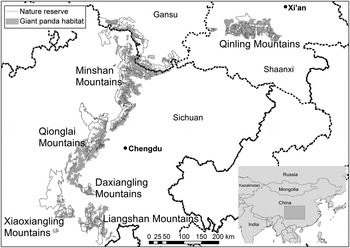
The giant panda Ailuropoda melanoleuca is one of the most threatened mammals and is categorized as Endangered on the IUCN Red List (Lu et al., Reference Lu, Wang and Garshelis2008). The species was widely distributed in south-western China, including Hunan, Hubei, Sichuan, Shanxi, and Gansu Provinces, during the 16–19th centuries (Hu, Reference Hu2001), but as a result of extensive expansion of agriculture and transport systems and the widespread destruction and fragmentation of forest habitat, giant pandas are now confined to six fragmented mountain areas at the edge of the Tibetan Plateau (Fig. 1; Hu, Reference Hu2001; Ran et al., Reference Ran, Du and Yue2009). The smallest population is in the Daxiangling Mountains, where the species remains critically threatened by human disturbance (State Forestry Administration of China, 2006).
Areas of suitable habitat for the giant panda Ailuropoda melanoleuca, and reserves established to protect the species in Sichuan, Gansu and Shaanxi provinces, China.
Understanding how various human activities affect pandas and their populations is critical for effective management and conservation of this charismatic species. Human activities are known to affect wildlife in many ways. Roads alter habitat and result in habitat loss and fragmentation, consequently reducing genetic exchange among populations (Way, Reference Way1977; Andrews, Reference Andrews1990; Carr et al., Reference Carr, Fahrig, Pope and Gutzwiller2002; Zhu et al., Reference Zhu, Zhan, Meng, Zhang and Wei2010, Reference Zhu, Zhang, Gu and Wei2011; Qi et al., Reference Qi, Hu, Gu, Yang, Yang and Wei2012). Hunting or trapping can have a significant impact on local populations; for example, in Beichuan county c. 30 giant pandas were hunted each year before hunting of the species was prohibited by law in 1989 (Hu & Hu, Reference Hu and Hu2008). Logging leads to fragmentation and loss of forest habitat (Van Dyke et al., Reference Van Dyke, Brocke, Shaw, Ackerman, Hemker and Lindzey1986).
Two types of disturbance effects over distance may be identified, one sharply defined by a threshold and the other characterized by a gradual influence over distance from the disturbance until some distance beyond which an effect cannot be detected (Eigenbrod et al., Reference Eigenbrod, Hecnar and Fahrig2009). The effects of some types of disturbances are more pervasive than others, species may respond in various ways (Cuaron, Reference Cuaron2000), and some disturbances may result in non-intuitive impacts, all of which makes it difficult to disentangle the individual effects of various types of disturbances, particularly as they may be occurring at the same time (Previtali et al., Reference Previtali, Lehmer, Pearce-Duvet, Jones, Clay and Wood2010). In the case of the giant panda the influence of various types of disturbances have been investigated individually (Li et al., Reference Li, Guo, Yang, Wang and Niemela2003; Ran et al., Reference Ran, Liu, Wang, Sun, Zeng and Liu2003; Bearer et al., Reference Bearer, Linderman, Huang, An, He and Liu2008; Zeng et al., Reference Zeng, Li, Yan, Fan and Song2009; Gong et al., Reference Gong, Hou, Lin, Song and Ouyang2012) but it is difficult to develop an effective comprehensive protection plan for the species on this basis, as any reserve or protected area is likely to be affected by various disturbances at the same time.
To understand the influence of human disturbance on giant pandas more clearly and to assist managers to design more effective protection plans we studied the relationship between human disturbance and habitat use by giant pandas in the Daxiangling Mountains. Our goals were to determine which types of human disturbance have greater impacts on the habitat use of giant pandas; to study how the impacts of disturbance on habitat use vary with distance from a disturbance; and to improve protection plans for the giant panda based on greater understanding of the impacts of various types of human disturbances.
Study area
Fieldwork was carried out in the Daxiangling Mountains, which lie along a north-west–south-east axis in the south-west of the Sichuan Basin (Fig. 1). The highest peak is 3,552 m. The climate is humid, annual rainfall is typically 1,300–2,000 mm and the mean annual temperature is c. 16°C. Below 1,500 m elevation the vegetation is mainly broad-leaved forest, at 1,500–2,500 m it is mainly mixed forest, and > 2,500 m it is primarily coniferous forest (Hu, Reference Hu2001).
As giant pandas and their habitat mainly occur above 1,500 m (Hu, Reference Hu2001), the study area was initially defined as the area > 1,500 m. To ensure our study area contained all potential habitat of the giant panda, it was expanded to include all areas within 3,000 m of giant panda sign (Fig. 2), as the diameter of the panda's home range is c. 3,000 m (Hu & Hu, Reference Hu and Hu2008). In the Daxiangling Mountains the main human disturbances are roads, residences, hydropower stations, logging, collection of bamboo shoots, trapping and mining (Supplementary Table S1; Hu, Reference Hu2001; Ran et al., Reference Ran, Zeng, Liu and Wang2006; State Forestry Administration of China, 2006; Xu et al., Reference Xu, Ouyang, Viña, Zheng, Liu and Xiao2006).
(a) The locations of giant panda signs and roads and (b) human disturbance in the study area in the Daxiangling Mountains (Fig. 1), Sichuan, China.

Methods
The study area was surveyed by 30 investigators during May−September 2012. We divided the area into 688 2-km2 squares, and in each square investigators followed a transect of > 1.5 km, searching for signs of giant pandas (e.g. faeces, signs of feeding), which were geographically referenced using a global positioning system (GPS). At each location where sign of giant panda was found, elevation, slope and slope aspect were recorded. GPS readings were also recorded at all locations of human disturbance (residences, mines, hydropower stations, logging and tree-felling sites, trap sites and bamboo shoot collection sites). The locations of all roads used by four-wheeled vehicles were obtained from government maps and Google Earth (Google Inc., Mountain View, USA; Fig. 2a; Supplementary Table S1). We treated the road system as one type of disturbance, as all of the roads within the study area had analogous characteristics (Supplementary Table S1). Our study was part of the 4th national survey on the giant panda (Forestry Administration of China, unpubl. data).
We analysed the influence of human disturbance on habitat use by giant pandas in two stages. Firstly, we investigated which types of human disturbance have clearly detectable influences on the habitat use of giant pandas. Secondly, we investigated how the influence of the main types of disturbance on the intensity of habitat use by giant pandas varied as the distance from the disturbance increased.
We used kernel density analysis in ArcGIS v.10.0 (ESRI, Redlands, USA) to calculate a density value for each sign of giant panda, which we used to represent the giant panda's activity intensity. This could also be treated as an index of habitat use intensity. For each giant panda sign we used distance analysis in ArcGIS to calculate the distance of the sign from the nearest road, residence, mine, hydropower station, bamboo shoot collection site, trap site, logging site or tree-felling site.
We then used an information–theoretic approach to determine the main disturbance affecting the giant panda's activity intensity. We created 48 candidate generalized linear models (one null model, seven biogeography models, 20 disturbance models and 20 biogeography + disturbance models), with log link function. The distances from each type of human disturbance were used as independent variables and the giant panda's activity intensity was treated as a dependent variable in these models. Before variables were used in modelling a correlation analysis was conducted to identify multicollinearities among variables, some of which were then excluded from the analysis (Hosmer & Lemeshow, Reference Hosmer and Lemeshow1989). The Akaike information criterion (AIC) was used for model selection, and the lowest AIC scores and highest Akaike weights were used to select the most parsimonious best-fit models (Anderson, Reference Anderson2008).
We hypothesized that human disturbance could affect habitat use intensity within a limited distance, within which range the influence on the giant panda decreased with increasing distance from the disturbance. Thus habitat use intensity may be expected to increase with increasing distance from a disturbance.
We used linear, logistic and exponential decay-fitting analyses to visualize the relationship between distance from human disturbance and habitat use intensity. We divided the study area into 2 km2 squares and established transects in each square such that the survey sites were distributed uniformly throughout the area. We calculated the habitat use intensity as GHI i x = N i /Ai , where GHI i is the habitat use intensity in region i, N i is the number of signs of giant panda in region i, A i is the area of region i (km2), and x is the width of each region (we used x = 60, 100, 120, 180, 200, 240, 300, 360, 400 and 500 m).
Results
We recorded 131 locations of giant panda sign and 301 locations of human disturbance: 63 residences, 45 mines, 76 hydropower stations, 35 logging or tree-felling sites, 48 bamboo shoot collection sites and 34 trap sites (Fig. 2).
The activity intensity of giant pandas correlated positively with elevation and distance from logging or tree-felling sites, hydropower stations, residences and roads, and negatively with distance from bamboo shoot collection sites and trap sites (i.e. the habitat used by giant pandas was far from roads and residences but close to bamboo shoot collection sites and trap sites). There was also a positive correlation between distance from roads and distance to mines, hydropower stations and residences (Table 1).
Correlation between giant panda Ailuropoda melanoleuca activity intensity and distance from various types of disturbance, elevation, slope, and aspect, and correlations between the independent variables.

*,P > 0.05; **, P > 0.01
We evaluated AIC values for 48 candidate models. The best model was the biogeography + disturbance model (Table 2), which gave a better fit than the biogeography and disturbance models individually. The best model included four variables: elevation, and distance from roads, bamboo shoot collection sites and trap sites (Table 2). The Akaike weights of the top three models were significantly larger than for other models (Table 2), indicating that the five variables in these top three models (elevation, and distance from roads, residences, bamboo shoot collection sites and trap sites) had the most significant influence on activity intensity.
Summary of generalized linear models used to predict giant panda activity intensity, with the model variables, number of variables in each model (K), Akaike information criterion (AIC), difference in AIC between the model and the top model (ΔAIC), and the Akaike weight of the ith model (Wi).

*Represents the probability that the ith model is the best model in the candidate group
In line- and curve-fitting analyses only two kinds of human disturbances (roads and residences) showed a good fit with panda habitat use intensity (R 2 > 0.6; Fig. 3). We found that the logistic model and ExpDec1 model had better fits than the linear model (Fig. 3). Both the logistic and ExpDec models showed a significant decrease in habitat use intensity at distances < 1,200 m from roads. At distances > 1,200 m habitat use intensity appeared to be no longer influenced by roads. In Fig. 3b all three types of models show good fits with habitat use intensity, and the curves show a continuous gradual change in slope. These curves suggest that residences have a strong but continuously declining influence on habitat use intensity to a distance of c. 2,500 m, beyond which the influence appears to be minimal.
Line- and curve-fitting analysis of the relationship between the giant panda's habitat use intensity and distance to (a) roads and (b) residences.

Discussion
Both habitat and disturbance variables are important predictors of wildlife distribution and abundance (Morrison, Reference Morrison2001; Bhattarai & Kindlmann, Reference Bhattarai and Kindlmann2013). The habitat requirements of the giant panda have been studied comprehensively (e.g. Hu, Reference Hu2001; Yu et al., Reference Yu, Jiang, Zhao, Wang and Wang2003; Zeng et al., Reference Zeng, Ran, Liu, Sun, Liu and Zeng2003; Ran et al., Reference Ran, Liu, Wang, Zeng, Sun and Liu2004; Liu et al., Reference Liu, Toxopeus, Skidmore, Shao, Dang, Wang and Prins2005; Yang et al., Reference Yang, Zhang, Zhou, Wang and Wang2006; Gong & Song, Reference Gong and Song2011; Qi et al., Reference Qi, Hu, Gu, Li and Wei2009; Kang et al., Reference Kang, Kang, Tan and Li2011; Zhang et al., Reference Zhang, Swaisgood, Zhang, Nordstrom, Wang and Gu2011), and research on the influence of human disturbance is now important for protection of the species. Our results showed that three of four variables in the best generalized linear model were human disturbance variables (Table 2), indicating that human disturbance plays an important role in influencing the giant panda's activity index. Previous studies have found that roads have a significant influence on wildlife distribution (Kerley et al., Reference Kerley, Goodrich, Miquelle, Smirnov, Quigley and Hornocker2002; Boarman & Sazaki, Reference Boarman and Sazaki2006; Eigenbrod et al., Reference Eigenbrod, Hecnar and Fahrig2009; Vanthomme et al., Reference Vanthomme, Kolowski, Korte and Alonso2013), and we found that roads and residences have a strong influence on the habitat use of giant pandas (Table 2). As road building increases and residential areas expand, the distribution of the giant panda may become more isolated, which could affect the long-term survival of the panda population in the Daxiangling Mountains.
The correlation analysis showed a positive correlation between the giant panda's activity index and distance from roads, residences, mines, hydropower stations and logging sites (Table 1), which indicates that the giant panda avoided these disturbances. Distance to roads was also correlated with other fixed disturbances, which should be expected as residences, hydropower stations and mines are all connected by road. Disturbances caused by roads were therefore likely to be related to those caused by residences, hydropower stations and mines. Vanthomme et al. (Reference Vanthomme, Kolowski, Korte and Alonso2013) pointed out that roads could facilitate other human disturbances, as they are conduits for human activity and may also become barriers to wildlife movement (Forman & Deblinger, Reference Forman and Deblinger2000; Trombulak & Frissell, Reference Trombulak and Frissell2000; Coffin, Reference Coffin2007). Thus, evaluating the influence of roads on the activity and distribution of giant pandas objectively and accurately may be critical to giant panda conservation.
Related research has indicated that the level of tolerable disturbance may show a threshold effect with distance (Huggett, Reference Huggett2005; Luck, Reference Luck2005; Groffman et al., Reference Groffman, Baron, Blett, Gold, Goodman and Gunderson2006), which could be used to predict the distribution of wildlife (Kostova & Carlsen, Reference Kostova and Carlsen2005). In our research the relationship between habitat use intensity and distance from roads could be represented by a curve with either of two shapes (Fig. 3a). Despite the difficulty of determining where the inflection point occurs, the use of these curves could provide a logical model illustrating the effect of roads on habitat use intensity. The pattern of the response of habitat use intensity to roads effectively defines a road-effect zone. Such zones have been demonstrated for a variety of wildlife (Forman & Deblinger, Reference Forman and Deblinger2000; Boarman & Sazaki, Reference Boarman and Sazaki2006; Semlitsch et al., Reference Semlitsch, Ryan, Hamed, Chatfield, Drehman and Pekarek2007) but our study is the first to demonstrate a road-effect zone for habitat use by the giant panda. The extent of the road-effect zone is c. 1,200 m, which exceeds the distances used in previous evaluations of giant panda habitat (500 or 720 m; e.g. Liu et al., Reference Liu, Ouyang, Taylor, Groop, Tan and Zhang1999; Xu et al., Reference Xu, Ouyang, Viña, Zheng, Liu and Xiao2006; Shen et al., Reference Shen, Feng, Xie, Ouyang, Li and Pascal2008; Li et al., Reference Li, Li, Li, Qiao, Yang and Zhang2010; Wu et al., Reference Wu, Liu, Shao, Zhu and Cai2010; Fan et al., Reference Fan, Li, Quan, Wu, Hu and Yang2011; Jian et al., Reference Jian, Jiang, Jiang, Zhou, Yu and Peng2012), and therefore the area of suitable habitat for giant pandas may have been previously overestimated. The influence of roads on giant pandas may, however, vary between mountain ranges, depending on the density of giant pandas and road disturbance (State Forestry Administration of China, 2006).
Although giant pandas appeared to avoid roads up to a threshold, there was no threshold in their response to residences; these findings reflect the response patterns reported by Eigenbrod et al. (Reference Eigenbrod, Hecnar and Fahrig2009). Other researchers have claimed, on an empirical basis, that disturbance by residences has no influence on giant panda habitat use at distances > 1,920 m (Liu et al., Reference Liu, Ouyang, Taylor, Groop, Tan and Zhang1999; Xu et al., Reference Xu, Ouyang, Viña, Zheng, Liu and Xiao2006; Wu et al., Reference Wu, Liu, Shao, Zhu and Cai2010; Jian et al., Reference Jian, Jiang, Jiang, Zhou, Yu and Peng2012) but our results show that residences can affect habitat use intensity even at distances up to 2,500 m. Although the effect of residences on habitat use intensity is not the same as their effect on habitat, researchers should consider the influence of disturbance on both habitat and habitat use intensity when considering habitat quality.
We found that habitat use intensity was generally higher when pandas were closer to bamboo shoot collection sites and trap sites (Table 1). Why did the pandas not avoid these two types of disturbance? Their responses may have depended on whether a disturbance was fixed (e.g. roads, residences, mines, hydropower stations) or temporary (e.g. bamboo shoot collection, trapping). Human presence at the latter sites is likely to be less frequent, of shorter duration, and less intrusive. Regarding such non-fixed disturbances, Gill et al. (Reference Gill, Sutherland and Watkinson1996) pointed out that wildlife could return to utilize remaining resources after the disturbance. Wei et al. (Reference Wei, Zhou, Hu, Yang and Wang1996) also found that although pandas retreated from sites where bamboo shoots were being collected, they returned to those sites after the collectors had gone. The same may be true of non-fixed human disturbances in our study area, and therefore bamboo shoot collection and trapping may have only limited effects on the distribution of giant pandas, with the extent of the influence varying according to the frequency, duration and intensity of such non-fixed disturbances.
As all fixed disturbances are closely related to roads, roads may be the most significant source of disturbance to the giant panda. Thus management of roads, and controlling their expansion, is essential in areas of giant panda habitat, particularly within the road-effect zone. Residences are another significant disturbance to the giant panda, and therefore controlling the expansion and location of residences is imperative. The influence of other human disturbances on the giant panda should not be ignored. Bamboo shoot collection, hydropower construction and mining should be controlled to minimize their expansion into areas of undisturbed habitat, and logging and trapping should be prohibited. Our findings show that the type and location of human disturbance can determine their influence on giant panda habitat, and the potential impacts of multiple types of disturbances are complex and need to be considered. We have passed our findings to the appropriate authorities for use in informing conservation efforts for the giant panda.
Acknowledgements
We thank the fourth giant panda survey team of Sichuan Province. This study was supported by the Sichuan Forestry Department.
Biographical sketches
Cheng Zhao studies the landscape ecology and conservation biology of the giant panda and the Sichuan sika deer. Bisong Yue works on the phylogeny of the sika deer and giant panda. Jianghong Ran is committed to giant panda conservation and the study of birds. Timothy Moermond works on bird behaviour and ecology. Ning Hou, Xuyu Yang and Xiaodong Gu work on giant panda conservation.



