




Young infants use gestures, especially pointing, as part of their communicative repertoire with others. They not only produce pointing gestures but are also exposed to others’, especially parents’, pointing gestures. Studies indicated that parents’ pointing frequency is a predictor of infants’ language development (e.g., Iverson et al., Reference Iverson, Capirci, Longobardi and Cristina Caselli1999; Özçalışkan & Goldin-Meadow, Reference Özçalişkan and Goldin-Meadow2005; Pan et al., Reference Pan, Rowe, Singer and Snow2005). By 8 months, infants can follow others’ points and shift their attention to the pointed referent (Ger et al., Reference Ger, Küntay, Ertaş, Koşkulu-Sancar and Liszkowski2023).
Infants’ point-following skills may increase the chance of paying attention to pointed objects or locations and receiving relevant input and interaction about referents. It is possible that infants who have more developed point-following skills benefit more from others’ points to learn new words. However, the role of infants’ point-following has not been examined with respect to the relation between parental pointing and infants’ language development. Here, we investigate (1) whether mothers’ pointing frequency observed monthly from 8 to 12 months predicts infants’ receptive and expressive vocabulary at 14 and 18 months, respectively, and, as a less explored question, we ask (2) whether the interaction between maternal pointing and infants’ point-following performance at 8 to 12 months predicts infants’ receptive and expressive vocabulary.
1. Relation between maternal pointing and infant vocabulary
When caregivers interact with infants, they adjust their gestures to their infants’ language levels and communicative needs (Bekken, Reference Bekken1989; Dimitrova & Özçalışkan, Reference Dimitrova and Özçalışkan2013). Mostly, mothers use deictic gestures, including pointing, to indicate objects to their infants. Moreover, their gestures often convey the same information as the accompanying speech and presumably help infants with limited vocabulary better understand the referent of a word (e.g., Iverson et al., Reference Iverson, Capirci, Longobardi and Cristina Caselli1999; Özçalışkan & Goldin-Meadow, Reference Özçalişkan and Goldin-Meadow2005). Evidence suggests that a predictor of infant pointing and language development is mothers’ pointing with their infants (Liszkowski & Tomasello, Reference Liszkowski and Tomasello2011; Matthews et al., Reference Matthews, Behne, Lieven and Tomasello2012). For example, Pan et al. (Reference Pan, Rowe, Singer and Snow2005) indicated that infants whose mothers used a higher frequency of pointing at 14 months show more growth in vocabulary between 14 and 36 months of age. Furthermore, intervention studies provided further evidence for the link between maternal pointing and early language development (e.g., Choi & Rowe, Reference Choi and Rowe2021; Rowe & Leech, Reference Rowe and Leech2018). For example, Choi and Rowe (Reference Choi and Rowe2021) trained mothers on the importance of pointing for language development and about how to increase pointing in infant-directed interactions. Trained mothers’ pointing frequency increased from 10 to 12 months, compared to a passive control group. Moreover, mothers’ pointing frequency at 12 months predicted infants’ receptive vocabulary at 18 months. These findings together suggest that maternal pointing supports early language development.
However, the predictive value of maternal pointing for later language outcomes is not consistently supported (e.g., Ertaş et al., Reference Ertaş, Koşkulu-Sancar, Ger, Liszkowski and Küntay2023; Lüke et al., Reference Lüke, Ritterfeld, Grimminger, Liszkowski and Rohlfing2017; Rowe et al., Reference Rowe, Özçalışkan and Goldin-Meadow2008; Salo et al., Reference Salo, Reeb-Sutherland, Frenkel, Bowman and Rowe2019). For example, while Salo et al. (Reference Salo, Reeb-Sutherland, Frenkel, Bowman and Rowe2019) showed that mothers’ pointing is concurrently associated with infants’ receptive vocabulary at 12 months, their findings demonstrated no significant association between maternal pointing at 12 months and infants’ later receptive and expressive vocabulary at 18 and 24 months. Similarly, Lüke et al. (Reference Lüke, Ritterfeld, Grimminger, Liszkowski and Rohlfing2017) did not find evidence that maternal pointing frequency at 12 months was associated with infants’ vocabulary 1 year later. Moreover, Ertaş et al. (Reference Ertaş, Koşkulu-Sancar, Ger, Liszkowski and Küntay2023) examined the relation between maternal pointing at 14 months and infants’ concurrent and subsequent vocabulary knowledge at 14 and 18 months using direct (e.g., looking-while-listening paradigm) and indirect assessment methods (e.g., parental report). They found that maternal pointing frequency predicted neither infants’ concurrent nor subsequent vocabulary measured directly or via parental reports. Given these contradictory findings, looking closely at how maternal pointing may or may not promote early language development is essential. Maternal pointing provides nonverbal cues for infants to identify the meanings of spoken words (e.g., Kobayashi et al., Reference Kobayashi, Yasuda and Liszkowski2022). Pointing reduces infants’ likelihood of misunderstanding the referent of a word (Zukow-Goldring, Reference Zukow-Goldring1996). To benefit from mothers’ nonverbal cues, such as pointing, and be able to acquire new words, infants should direct their attention to the referent by following their mothers’ points. In their first year of life, infants begin to follow others’ pointing gestures to objects located in front of them (Butterworth & Jarrett, Reference Butterworth and Jarrett1991; Ger et al., Reference Ger, Küntay, Ertaş, Koşkulu-Sancar and Liszkowski2023), and somewhat later, behind them (Deák et al., Reference Deák, Flom and Pick2000). Infants’ point-following abilities may play a role in whether their mothers’ pointing would contribute to their vocabulary knowledge.
2. Development of point-following and its relation to pointing and language development
The ability to share visual attention with others as a response to social-communicative cues emerges and develops in the second half of the first year (e.g., Butterworth & Itakura, Reference Butterworth and Itakura2000; D’Entremont, 2000). Infants start to follow others’ points and shift their attention to the pointed location or object (Carpenter et al., Reference Carpenter, Nagell, Tomasello, Butterworth and Moore1998), and their point-following skills gradually develop. They start to follow points to the targets within their visual fields (a simpler level of point-following) by 8 months (Ger et al., Reference Ger, Küntay, Ertaş, Koşkulu-Sancar and Liszkowski2023), while they start to follow points to the targets outside of their visual fields (a higher level of point-following) by 12 months (Deák et al., Reference Deák, Flom and Pick2000).
Infants’ point-following may contribute to their language development. Infants’ point-following skills are associated with their pointing frequency. For example, Ger et al. (Reference Ger, Altınok, Liszkowski and Küntay2018) showed that infants’ pointing frequency at 10 months was significantly correlated with their point-following scores at 12 months. And, infants’ pointing frequency is a well-established precursor and predictor of their language development, especially vocabulary (e.g., Colonnesi et al., Reference Colonnesi, Stams, Koster and Noom2010; Kirk et al., Reference Kirk, Donnelly, Furman, Warmington, Glanville and Eggleston2022). Of particular importance is infants’ point-following to targets outside their visual field. For instance, this seems to be associated stronger with index-finger pointing at 12 months (Ger et al., Reference Ger, Küntay, Ertaş, Koşkulu-Sancar and Liszkowski2023; Liszkowski & Tomasello, Reference Liszkowski and Tomasello2011) than merely following points to within the visual field, possibly because it reflects a better understanding of the referential intention of pointing (Liszkowski et al., Reference Liszkowski, Carpenter, Henning, Striano and Tomasello2004). That is, with point-following to targets outside their visual field, infants show understanding of the gesture being not just about directing attention to something visible but also about conveying meaning or intention, even for things beyond their immediate sight. Such advancements in social-cognitive skills, including both pointing and point-following as well as intention or attention sharing, may serve as a precursor to the “comprehension boost” – a qualitative and nonlinear surge in understanding words observed around 12–14 months (Bergelson, Reference Bergelson2020). To date, only one study has directly examined the link between point-following and later vocabulary, focusing on slightly older infants and their expressive vocabulary outcomes. Specifically, point-following to targets outside the visual field at 15 months positively predicted infants’ expressive vocabulary skills at 24 months (Delgado et al., Reference Delgado, Peter, Crowson, Markus, Yale and Schwartz2002).
It is, however, unknown whether infants’ developing point-following skills play a role in how well infants benefit from parents’ pointing in learning new words. Infants’ point-following may contribute to their vocabulary development by facilitating parental language input. That is, when parents point while interacting with their infants, they often provide accompanying verbal input about the referent of their point. Infants with better point-following skills, particularly towards objects outside their visual field, may have more opportunities to share their parents’ focus of attention and benefit from the input provided by parents about pointed objects, thereby supporting vocabulary development.
3. Current study
We investigate the role of point-following performance of infants at 8, 9, 10, 11 and 12 months on the relation between maternal pointing at each month from 8 to 12 and infant receptive and expressive vocabulary development at 14 and 18 months, respectively. It is possible that infants who are able to follow points at a higher level, such as those who shift their gaze beyond the visual field to locate the referent object, are more likely to interact with the referent object and create a link between the referent object and the language input provided about it. They would hence be able to add more words to their vocabulary. In this study, we categorised infants into three groups based on their point-following performance: point-non-followers, visual-field point-followers and advanced point-followers. It is crucial to investigate individual differences in point-following performance of infants when examining the relation between pointing input and infants’ vocabulary. For each testing age (8, 9, 10, 11 and 12 months), we addressed the following research questions:
-
1.a. Does maternal pointing frequency predict infants’ later receptive vocabulary at 14 months?
-
1.b. Does the interaction between maternal pointing frequency and infants’ point following performance (point-non-follower, visual field point-followers and advanced point-followers) predict infants’ receptive vocabulary at 14 months?
-
2.a. Does maternal pointing frequency predict infants’ expressive vocabulary at 18 months?
-
2.b. Does the interaction between maternal pointing frequency and infants’ point-following performance (point-non-follower, visual field point-followers and advanced point-followers) predict infants’ expressive vocabulary at 18 months?
We expect that the effect of maternal pointing input on receptive and expressive vocabulary depends on the level of infants’ point-following performance. For example, infants with advanced point-following performance may benefit more from maternal pointing input and thus have a larger receptive vocabulary compared to infants who are visual field point-followers.
4. Method
4.1. Participants
A total of 56 infants (30 girls) and their mothers participated in monthly assessments from 8 to 12 months of age, as well as further assessments at 14 and 18 months. At the beginning of the study, infants had a mean age of 8.4 months (SD = 0.3, range = 7.8 to 9.0 months). On average, assessments were spaced 30.4 days apart (SD = 1.2). All infants were typically and monolingually developing. Mothers’ mean age at study onset was 31.3 years (SD = 5.2, range = 21 to 43 years). The mothers varied in terms of their educational levels, with 15% with primary education, 13% secondary education, 26% high school, 33% university and 13% graduate education. A total of 46 data points were missing across 31 children, indicating that some infants had missing data at multiple time points. Children with missing data were retained in the analyses, with only the missing data point excluded.
4.2. Measures
Pointing production: The decorated room paradigm, which is designed to elicit pointing (Liszkowski et al., Reference Liszkowski, Brown, Callaghan, Takada and de Vos2012), was used to determine mothers’ and infants’ pointing frequency. Mother–infant pairs were brought into a room adorned with 21 objects displayed on four walls (see Figure 1). Mothers were instructed to spend 5 minutes walking around while holding infants on their hips, without touching objects. We used a timekeeper during the sessions to ensure that all mother–infant pairs spent the same amount of time in the decorated room. We used the ELAN software (Sloetjes & Wittenburg, Reference Sloetjes and Wittenburg2008) to code pointing, using the coding scheme of Liszkowski and Tomasello (Reference Liszkowski and Tomasello2011). In mothers, pointing is typically characterised by an arm extension with the index finger directed towards a referent, whereas in infants, it may involve the index finger or an open palm, similarly directed towards a referent. Four research assistants completed the data coding. Randomly selected 18 percent of the videos were coded to calculate interrater reliability. The intraclass correlations among the four research assistants for the total number of maternal pointing gestures were high, with Cronbach’s alphas ranging from 0.94 to 0.99.

Figure 1. Decorated room paradigm.
Point following: To evaluate infants’ ability to follow pointing gestures to their intended targets, we used a point-following paradigm adapted from Mundy et al. (Reference Mundy, Block, Delgado, Pomares, Van Hecke and Parlade2007). This paradigm included four trials. In each trial, we used one poster sized 50 × 70 cm with distinct animal images measuring 31 × 31 cm. In two trials (i.e., front trials), the posters were positioned within the infants’ direct line of sight, hanging on the wall at 60° angles from the infants’ midline to their left and right. In the other two trials (i.e., behind trials), the posters were placed outside the infants’ immediate visual field, hanging on the wall at 150° angles from the infants’ midline to their left and right back.
The infants sat on their mothers’ laps at a table facing the experimenter (see Figure 2). During each trial, the experimenter attracted the infant’s attention by calling their names, then she turned her head and entire torso towards a poster, pointed at it, and said, “Oh, look at that!” The order of trials was counterbalanced in two ways: clockwise (front left, front right, behind right, and behind left) for half of the infants, and counterclockwise (front right, front left, behind left, and behind right) for the other half. For each of the four trials, we coded the infants’ point following as 1 if they followed the pointing of the experimenter; otherwise, we coded it as 0. For the front trials, infants received a score of 1 only if they looked at the correct poster; simply turning to the side of the correct poster was not sufficient. However, for the behind trials, it was sufficient for them only to turn their heads and search for the correct location without looking at the correct poster (Déak et al., Reference Deák, Flom and Pick2000; see also Ger et al., Reference Ger, Küntay, Ertaş, Koşkulu-Sancar and Liszkowski2023).

Figure 2. Point-following paradigm. Note: Picture a shows the front trial and picture b shows the behind trial.
Infant vocabulary size: Infant vocabulary size was assessed using the Turkish adaptation of the MacArthur-Bates Communicative Development Inventory, called the Turkish Communicative Development Inventory - I and II at 14 and 18 months, respectively (TCDI-I & II; Aksu-Koç et al., Reference Aksu-Koç, Acarlar, Küntay, Maviş, Sofu, Topbaş, Turan and Aktürk- Ari2019). TCDI-I was designed to assess early receptive and expressive language and communicative behaviour. The vocabulary checklist involves 418 items to measure the expressive and receptive vocabulary size. Due to the low variance in expressive vocabulary at this early age (Walle & Campos, Reference Walle and Campos2014), we used only receptive vocabulary scores. TCDI-II was designed to assess expressive language and communicative behaviour. The vocabulary checklist involves 711 items to measure the expressive vocabulary size.
Procedure: When the infants were 8 months old, demographic information (e.g., mothers’ years of education, birthdate of infants, siblings) and informed consent were obtained from the caregivers. At each time point between 8 and 12 months, mother-infant dyads were recorded for the decorated room and point-following sessions in the laboratory, using four cameras in each corner of the room. At 14 months, TCDI-I and at 18 months, TCDI-II were filled out by mothers. At the end of each visit, parents were given a small gift for their infant, such as a children’s picture book. The study was conducted according to the guidelines of the Declaration of Helsinki, with informed consent obtained from parents. All procedures were approved by the Committee on Human Research at [Blinded].
Data preparation and analysis plan: Infant point-following performance was coded as a three-level categorical variable. There were 2 front and 2 behind trials. We categorised the infants as “point-non-followers” if they did not follow any points in the front and the behind trials, as “visual-field point-followers” if they could follow at least one of the points to referents within their visual field, namely in the front trials but not the behind trials. Lastly, infants were categorised as “advanced point-followers” if they could follow at least one of the behind-pointing trials. Table 1 shows infants’ categorisations based on their point-following performance in front and behind trials, and Table 2 shows the distribution of infants’ categorisations based on their point-following performance at 8, 9, 10, 11, and 12 months.
Table 1. Infants’ categorisations based on their performance on front and behind trials

Table 2. Distribution of infants across point-following groups at each age

All analyses were carried out in Jamovi (Version 2.6.26; The jamovi project, 2024). For the preliminary analyses, we ran t-tests, Kruskal–Wallis tests (non-parametric version of one-way ANOVA), and correlation analyses. For the main research questions, we ran multiple linear regression analyses (GAMLj; Gallucci, Reference Gallucci2019) with infants’ receptive vocabulary scores at 14 months and expressive vocabulary scores at 18 months as the outcome variables. We centred all the continuous variables on their means to reduce multicollinearity. To test main effects and interactions (i.e., maternal pointing frequency × point-following categorisation), we used robust standard errors, which provide more reliable inference in the presence of violations of classical regression assumptions, such as heteroscedasticity. By using robust regression techniques for the time points of 8, 9, 10, and 11 months, we address potential violations of normality, heteroscedasticity, and the undue influence of outliers or small group sizes (based on infants’ point-following assessments) that can bias ordinary least squares estimates. This method enhances the stability and reliability of parameter estimates, particularly in developmental datasets where distributional assumptions may not hold (Erceg-Hurn & Mirosevich, Reference Erceg-Hurn and Mirosevich2008). For the time point of 12 months, we did not use the robust regression technique as there was relatively good distribution across infants’ categorisations of visual-field point-followers and advanced point-followers (and no point non-followers) (see Table 2). Post-hoc Bonferroni-corrected pairwise comparisons were conducted to explore differences among point-following groups.
5. Results
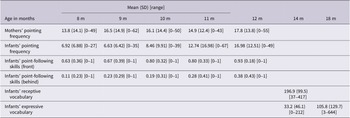
Descriptive statistics for the control variable, predictors, and outcome variable are in Table 3. Independent sample t-tests revealed no significant sex differences in any of the variables. In addition, we conducted Kruskal–Wallis tests to examine whether there were significant differences in maternal pointing among infants who were point-non-followers, visual-field point-followers, and advanced point-followers at each month. The result revealed no significant differences. We then performed correlations (see Supplementary Table 1 for the full correlation matrix). There were positive correlations between maternal years of education and maternal pointing frequency at 9, 10, 11, and 12 months. Hence, we added maternal years of education as a control variable to the analyses. A positive correlation was also observed between infants’ pointing frequency at 11 months and infants’ receptive vocabulary at 14 months. Thus, we added pointing frequency at 11 months as a control variable to the analyses. Lastly, a positive correlation was observed between infants’ pointing frequency at 12 months and point-following performance in the behind trials at 12 months. Hence, we added infants’ pointing frequency at 12 months as a control variable to the analyses.
Table 3. Descriptive statistics of the variables

5.1. Longitudinal predictors of receptive vocabulary
To test our research questions, namely, whether maternal pointing at each age predicts infants’ receptive vocabulary scores at 14 months (1a) and whether this predictive association is moderated by infants’ point-following performance (1b), we conducted (robust) multiple linear regression analyses. Depending on age, slightly different models were tested due to differences in data distribution and relevant control variables. Specifically, for 8 to 11 months, robust multiple linear regressions were applied due to unequal sample size. Maternal years of education was included as a control variable to the analyses conducted at each month. At 11 months, infants’ pointing frequency was included as a control variable, as it was significantly correlated with their receptive vocabulary at 14 months. At 12 months, infants’ pointing frequency was also included as control variables, as it was significantly correlated with their point-following skills.
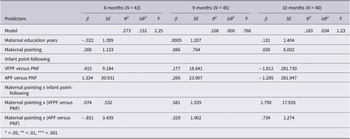
At 8, 9, and 10 months, the model did not reach statistical significance. None of the predictors were significant, indicating that maternal pointing, infants’ point-following group, and their interaction did not explain significant variance in receptive vocabulary at 14 months, p’s > .05 (see Table 4 for the regression results).
Table 4. Summary of multiple regression analyses predicting infants’ receptive vocabulary at 14 months

Note: PNF = point-non-followers, VFPF = visual-field point-followers, APF = advanced point-followers.
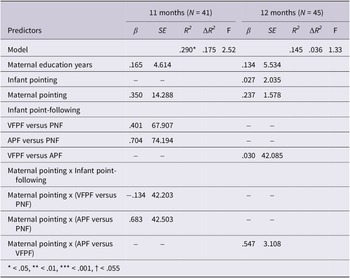
At 11 months, the model was marginally significant, F(7, 33) = 2.26, p = .054, explaining approximately 32.4% of the variance in receptive vocabulary. The interaction between maternal pointing frequency and infants’ point-following group was not statistically significant, F(2, 33) = 0.089, p = .915. Similarly, there was not a significant main effect of maternal pointing frequency at 11 months, β = 0.094, p = .830. However, there was a significant main effect of the point-following group, F(2, 33) = 8.32, p = .007, partial η2 = .187 (see Table 5 for the regression results). Post hoc comparisons with Bonferroni correction indicated that infants categorised as point-non-followers had significantly lower receptive vocabulary scores compared to visual-field point-followers, pbonferroni < .001, and advanced point-followers, pbonferroni = .041. There was no significant difference between visual-field point-followers and advanced point-followers, pbonferroni = 1.000 (see Figure 3 for group differences in receptive vocabulary).
Table 5. Summary of multiple regression analyses predicting infants’ receptive vocabulary at 14 months

Note: PNF = point-non-followers, VFPF = visual-field point-followers, APF = advanced point-followers.

Figure 3. Infant receptive vocabulary at 14 months for non-followers, visual-field followers, and advanced point-followers at 11 months. Note: Bars represent mean receptive vocabulary scores for each group: point-non-followers, visual-field point-followers, and advanced point-followers. Error bars indicate standard deviations. Asterisks (*) denote statistically significant differences between groups (p’s < .05).
At 12 months, the overall model was significant, F(5, 39) = 2.86, p = .027, explaining 26.8% of the variance in receptive vocabulary. The interaction between maternal pointing frequency and point-following group was also significant, β = .721, SE = 2.04, t(39) = 2.50, p = .017, suggesting that the relationship between maternal pointing frequency and receptive vocabulary differed between visual-field point-followers and advanced point-followers. Simple effects analyses revealed that maternal pointing frequency significantly predicted receptive vocabulary for advanced point-followers, F(1, 39) = 4.76, p = .035, partial η2 = .109, but not for visual-field point-followers, F(1, 39) = 1.80, p = .188, partial η2 = .044. Specifically, maternal pointing frequency was effective for those with advanced point-following performance to display better vocabulary skills (see Table 5 for the regression results and Figure 4 for the interaction plot illustrating this effect).

Figure 4. Association between mothers’ pointing frequency at 12 months and receptive vocabulary for visual-field point-follower and advanced point-follower infants at 14 months. Note: Non-centred values are shown in the scatter plot to avoid negative values and facilitate interpretation, although mean-centred variables were used in the statistical analyses.
5.2. Longitudinal predictors of receptive vocabulary
To test our research questions 2a and 2b, namely, whether maternal pointing at each age predicts infants’ expressive vocabulary scores at 18 months and whether this predictive association is moderated by infants’ point-following performance, we conducted (robust) multiple linear regression analyses. Similarly, we added maternal years of education as a control variable to the analyses conducted at each month. In addition, infants’ pointing frequency was included as a control variable at only 12 months because of a significant correlation between their pointing frequency and point-following performance.
At 8, 9, and 10 months, the models did not reach statistical significance. None of the predictors were significant, indicating that maternal pointing, infants’ point-following group, and their interaction did not explain significant variance in expressive vocabulary at 18 months, p’s > .05 (see Table 6 for the regression results).
Table 6. Summary of multiple regression analyses predicting infants’ expressive vocabulary at 18 months

Note: PNF = point-non-followers, VFPF = visual-field point-followers, APF = advanced point-followers.
At 11 months, the overall model was significant, F(6, 37) = 2.52, p = .038, explaining 29% of the variance in expressive vocabulary. However, none of the predictors were significant, indicating that maternal pointing, infants’ point-following group, and their interaction at 11 months did not predict infants’ expressive vocabulary at 18 months (see Table 7 for the regression results).
Table 7. Summary of multiple regression analyses predicting infants’ expressive vocabulary at 18 months

Note: PNF = point-non-followers, VFPF = visual-field point-followers, APF = advanced point-followers.
At 12 months, the model did not reach statistical significance, p > .05. None of the predictors were significant, indicating that maternal pointing, infants’ point-following category, and their interaction at 12 months did not explain significant variance in expressive vocabulary at 18 months (see Table 7 for the regression results).
6. Discussion
We investigated the longitudinal association between mothers’ pointing and infants’ receptive and expressive vocabulary, and whether this association is affected by infants’ point-following performance. Our results indicated a main effect of infants’ point-following skills at 11 months on their later receptive vocabulary at 14 months. Moreover, we found the moderator role of infants’ point-following performance on the relation between maternal pointing input at 12 months and infants’ subsequent receptive vocabulary size at 14 months. Mothers’ pointing at 12 months predicted infants’ receptive vocabulary at 14 months, only for infants who had more advanced point-following skills at 12 months, namely, to the targets outside their visual field. There were no significant main or interaction effects of earlier time points predicting infants’ receptive vocabulary at 14 months. Similarly, neither the main nor interaction effects of maternal pointing and infants’ point-following skills were observed on infants’ expressive vocabulary at 18 months.
Infant–mother interactions are rich in socio-communicative signals that facilitate infants to glean meaning from. Gestures, especially pointing gestures, in infant–mother interaction serve as precursors for early vocabulary development (e.g., Pan et al., Reference Pan, Rowe, Singer and Snow2005). At least two potential explanations have been proposed for how mothers’ pointing gesture supports infants’ vocabulary development. First, previous research documenting associations between parental pointing and infant vocabulary suggests that maternal pointing provides a nonverbal cue for infants to link a word to its referent. As it is well known, infants are sensitive to communicative cues, such as eye movements and pointing of others, as a source to enhance their vocabulary (Csibra & Gergely, Reference Csibra and Gergely2009; Çetinçelik et al., Reference Çetinçelik, Rowland and Snijders2021). Often, ambiguities regarding the referent of a word may be clarified by mothers’ pointing. In other words, mothers’ pointing might support infants in identifying the correct referent of words.
Second, as Choi and Rowe (Reference Choi and Rowe2021) argued, mothers’ pointing provides extended joint attention (JA) episodes. Mothers use pointing to share their interests and refer to specific referents. Studies demonstrated that JA episodes are an optimal environment to support language development (e.g., Mundy et al., Reference Mundy, Block, Delgado, Pomares, Van Hecke and Parlade2007). Many studies have shown that JA is associated with infants’ language development (e.g., Carpenter et al., Reference Carpenter, Nagell, Tomasello, Butterworth and Moore1998; Saxon et al., Reference Saxon, Colombo, Robinson and Frick2000). Moreover, around their first birthday, JA episodes are mostly derived from mothers’ initiatives (Koşkulu et al., Reference Koşkulu, Küntay and Uzundağ2021; Loy et al., Reference Loy, Masur and Olson2018). Therefore, these findings highlight the crucial role of mothers’ pointing gestures in initiating and maintaining JA episodes, which provide a context for infants’ language development.
However, for both of these (related) potential explanations, infants’ ability to follow pointing is an essential component for translating maternal gestural and verbal input into word learning. Maternal pointing does not necessarily ensure infants’ uptake of accompanying verbal or nonverbal information, particularly given the non-significant correlations between maternal pointing and infant point-following reported in some previous studies (Ger et al., Reference Ger, Küntay, Ertaş, Koşkulu-Sancar and Liszkowski2023, Reference Ger, Wermelinger, de Ven and Daum2024; Liszkowski & Tomasello, Reference Liszkowski and Tomasello2011; Ruether & Liszkowski, Reference Ruether and Liszkowski2023). In early development, infants’ point-following allows them to engage in extended JA episodes initiated by maternal pointing, creating optimal conditions for vocabulary acquisition. By accurately following the pointing gesture, infants can effectively link a word to its referent, reducing potential misunderstandings and enhancing word learning. Therefore, our findings suggest that infants’ point-following abilities are fundamental in maximising the benefits of maternal pointing for receptive vocabulary development, in presumably allowing them to actively engage in mother–infant communicative interactions.
Our data showed that infants’ point-following performance at 11 months emerged as a predictor of their receptive vocabulary, such that having the ability to follow points at least within the visual field was related to better receptive vocabulary compared to a lack of ability to follow any points. Nonetheless, given the small sample size of point-non-followers (n = 4) and the marginal significance of the overall model, these findings should be interpreted cautiously. Furthermore, at 12 months, this point-following performance turned to a moderator role in the relation between maternal pointing input to their later receptive vocabulary at 14 months. These findings suggest that the period between 11 and 14 months may reflect a key developmental window in which infants’ growing social-communicative skills, specifically point-following skills, begin to shape word comprehension. Infants with advanced levels of point-following might not only have more opportunities to share attention with their caregivers but also a better understanding of the referentiality of pointing, with the sense of pointing to convey meaning or intention, regarding something beyond and not only within their immediate visual field (e.g., Ger et al., Reference Ger, Küntay, Ertaş, Koşkulu-Sancar and Liszkowski2023; Liszkowski and Tomasello, Reference Liszkowski and Tomasello2011). However, while we propose that infants’ point-following may influence their ability to benefit from maternal pointing in relation to vocabulary development, we did not directly test this mechanism. Future studies should directly investigate point-following to better understand how variations in infants’ point-following skills are involved in how maternal pointing contributes to vocabulary development.
Furthermore, our results are consistent with some previous findings showing nonsignificant direct associations between maternal pointing and infants’ vocabulary (e.g., Lüke et al., Reference Lüke, Ritterfeld, Grimminger, Liszkowski and Rohlfing2017; Rowe, Reference Rowe2000; Salo et al., Reference Salo, Reeb-Sutherland, Frenkel, Bowman and Rowe2019). Although other studies have reported significant associations between maternal pointing and vocabulary development (e.g., Choi & Rowe, Reference Choi and Rowe2021; Iverson et al., Reference Iverson, Capirci, Longobardi and Cristina Caselli1999; Matthews et al., Reference Matthews, Behne, Lieven and Tomasello2012), our findings underscore that such links may depend on infants’ ability to receive and process that input. Specifically, the results highlight that it is not merely the frequency of maternal pointing that matters, but how infants follow adults’ gestures in an experimental point-following paradigm. Infants with more advanced point-following skills may be better able to direct their attention to the referent and connect the referential behaviour to linguistic input, which in turn facilitates receptive vocabulary growth. This suggests that early language development involves an integration of both external (maternal) input and internal (infant) processing skills. Consequently, a full understanding of early language development requires considering how infants’ developing socio-communicative abilities interact with the communicative and linguistic input (Demir & Küntay, Reference Demir and Küntay2014; Göksun et al., Reference Göksun, Aktan-Erciyes, Karadöller and Demir-Lira2024).
The absence of significant associations at 8 to 10 months may be reflecting developmental and methodological factors. Infants at these younger ages typically display limited variability in the different levels of point-following behaviour (e.g., Ger et al., Reference Ger, Küntay, Ertaş, Koşkulu-Sancar and Liszkowski2023). Notably, in our sample, most infants were already able to follow points within their visual fields at 8 months of age. This lack of variance reduces the potential to detect meaningful associations of individual differences in point-following and later vocabulary outcomes. Future studies should examine infants’ point-following skills with more sensitive measures starting in earlier months, to assess their contribution to early emerging language and communicative skills.
Furthermore, the lack of significant main or interaction effects of point-following on expressive vocabulary is inconsistent with prior research indicating that point-following skills at 15 months predict expressive vocabulary at 24 months (Delgado et al., Reference Delgado, Peter, Crowson, Markus, Yale and Schwartz2002). At the earlier age we examined (18 months), we did not replicate this finding. The lack of significant associations of maternal pointing, infants’ point-following, and their interaction and expressive vocabulary at 18 months suggests distinction of the developmental timelines underlying receptive and expressive language. In addition, since expressive vocabulary was assessed only at 18 months in the present study, it remains unclear whether maternal pointing and infants’ point-following skills predict expressive language at later ages, when more is expressed in language. The predictive value of maternal pointing and infants’ point-following skills for expressive vocabulary may appear later, when children’s expressive language skills are more advanced and show greater variability than at the young age examined in this study. Therefore, the null findings regarding expressive vocabulary should not be generalised, particularly given the limited developmental timelines examined in the current study.
Moreover, as infants develop, additional socio-cognitive skills and forms of maternal input may increasingly contribute to how they benefit from maternal input in the development of their expressive vocabulary. Thus, while maternal pointing and infants’ point-following play a role in the development of early word comprehension, the path from gesture to word production likely involves additional layers of development not fully captured by our measures during the first year of life. Future research should explore whether other forms of caregiver input, such as contingent verbal responses or modelling of word production, might be more predictive of expressive vocabulary outcomes and whether the influence of gestural input on expressive vocabulary becomes more pronounced at later developmental stages.
Future studies should examine the predictors or factors associated with infants’ point-following, particularly points directed to outside their visual fields. Identifying these factors could inform intervention designs aimed at enhancing point-following and early language development. For example, recent intervention studies (e.g., Choi & Rowe, Reference Choi and Rowe2021; Rowe & Leech, Reference Rowe and Leech2018) have shown that training mothers about the role of pointing in language development increases both maternal and infant pointing gestures, which is associated with infants’ vocabulary growth. Based on these findings, future interventions should also consider strategies to enhance infants’ point-following abilities to promote better language outcomes. In addition, we approached point-following performance as an individual difference among infants, reflecting their emerging social-cognitive capacities, and thus, the moderation perspective is more fitting to examine our research questions compared to a mediation perspective. However, the mediation model may be theoretically plausible to test whether maternal pointing predicts infants’ point-following skills, which, in turn, may predict receptive vocabulary.
Although prior work has reported associations between infants’ pointing frequency, point-following skills, and later language outcomes, these relations were not consistently observed in the present sample. In the present study, this pattern emerged only partially and in a developmentally specific manner (see Supplementary Table 1 for correlations between the study variables). Infants’ pointing frequency at 12 months was related to their point-following performance both within and beyond the immediate visual field, indicating convergence between pointing production and referential understanding at this age. However, neither the pointing frequency nor the point-following skills at any time point were directly associated with later receptive or expressive vocabulary at 14 and 18 months, respectively. In contrast, pointing frequency at 11 months was associated with later receptive vocabulary, suggesting that the predictive value of pointing may be sensitive to developmental timing. Importantly, the absence of direct association was informative, as point-following skills nonetheless interacted with maternal pointing to predict receptive vocabulary, indicating that point-following may function less as an independent predictor and more as a capacity that conditions how infants benefit from maternal pointing input. Together, these findings highlight that early gesture and language relations may be developmentally time- and context-dependent, which may help explain the mixed results in the existing literature (Colonnesi et al., Reference Colonnesi, Stams, Koster and Noom2010).
A limitation of the current study is that while our findings highlight the importance of this specific socio-communicative skill (i.e., point-following), it is likely that other unexamined factors, such as infants’ general attentional capacities, or infants’ ability to process communicative cues, also play significant roles in how maternal input contributes to language growth. In addition, besides understanding of referentiality, infants’ point-following skills may reflect their domain-general cognitive skills such as executive functions (Hendry et al., Reference Hendry, Jones and Charman2016). These abilities could influence whether infants disengage from salient stimuli to shift attention to distal referents (Sheese et al., Reference Sheese, Rothbart, Posner, White and Fraundorf2008). Future research should explore these additional factors to provide a more comprehensive understanding of the mechanisms that facilitate early vocabulary development. Additionally, we examined infants’ point-following skills in an experimental context and observed maternal pointing in a semi-naturalistic setup. In the decorated room paradigm, the method we used to assess pointing production, the dyads can be assumed to share the same visual field because mothers carried the infant in their arms (see Figure 1). Therefore, we do not know how infants’ point-following behaviours appear naturally, both to the targets within (front) or outside their visual fields (behind). Future research should include natural interactions to examine infants’ point-following skills during parent–child interactions. Last but not least, while mean-centring was applied to reduce multicollinearity, conceptually related predictors included in the regression models (e.g., maternal pointing, infant pointing, and point-following skills) may still share variance. This potential multicollinearity may have limited our ability to detect some unique effects and should be taken into account when interpreting the findings.
7. Conclusion
The current study demonstrated that different levels of infant point-following skills at 11 months were predictive of infants’ receptive vocabulary skills at 14 months. Infants who were visual-field point-followers and advanced point-followers had larger receptive vocabulary size than those who were point-non-followers. Moreover, mothers’ pointing frequency at 12 months was predictive of infants’ receptive vocabulary at 14 months only for infants who had advanced point-following skills to the targets outside of their visual field. Our findings highlight the importance of infants’ early socio-communicative skills in language development, such as point-following. The findings also have theoretical implications that child-internal factors (here, infants’ point-following skills) are needed to make use of child-external factors (here, maternal pointing) for language development. Future research may examine other potential child-internal mechanisms (Demir & Küntay, Reference Demir and Küntay2014) to explore the association between maternal pointing and infant language development.
Supplementary material
The supplementary material for this article can be found at http://doi.org/10.1017/S0305000926100580.
Acknowledgements
This research was supported by a grant from the Scientific and Technological Research Council of Turkey (TÜBITAK) to Aylin C. Küntay (grant number: 113 K006). We are thankful to Hilal Şen, Merve Ataman, and Seda Akbıyık for their assistance in recruitment, data collection and data coding, and to Tilbe Göksun and Aslı Aktan-Erciyes for their valuable feedback. Last but not the least, we greatly appreciate the contribution of the parents and infants who participated in our study.
Statement of ethical approval
The study received approval from the Committee on Human Research at Koç University (Project name: Influence of socioeconomic and immigration status on the cognitive origins of cultural learning; Protocol no.: 2012.048. IRB3.18).






 Open access

