





Introduction
Humanity is facing a global challenge of socio-ecological risk. New ways of thinking and acting in the environment are necessary to understand how environmental change will impact on different places and people, and to develop knowledge to guide appropriate responses for all communities and ecosystems (Sprenger & Nienaber, Reference Sprenger and Nienaber2018). International agreements such as the United Nations Framework Convention on Climate Change (UNFCCC Secretariat, Reference Secretariat2025) and the Kunming-Montreal Global Biodiversity Framework of the Convention for Biological Diversity (CBD, 2025) require governments to ask their citizens to change their relationships with the environment to respond to global risk. Responses to climate change and biodiversity loss need be integrated across society and across generations, but what those actions will look like remain uncertain (Leites & Benito Garzón, Reference Leites and Benito Garzón2023). Many required behavioural and policy changes are not popular, which raises questions about how education systems will help to support people through the global socio-ecological transition by guiding appropriate experiences and understanding of risk, especially for young people who are marginalised culturally, spatially, economically or politically.
This article examines how the forest could help to support students’ understanding of socio-ecological risk. Risk is a notional concept that is shaped by people’s experiences, knowledge and culture (Douglas & Wildavsky, Reference Douglas and Wildavsky1982). For that reason, it is insufficient for education systems to support students to only identify and engage with the benefits and values of the environment – learning about socio-ecological risk must also be normalised in a rapidly changing climate so that sophisticated knowledge of risk and its management can be integrated into thought and action. The discussion below draws from twenty years of research on environmental education and forest management in Australia, Nepal and Switzerland, to discuss how the forest can guide critical learning on socio-ecological risk and engage students to develop understanding of how risk will need to be managed across society.
People perceive of, conceptualise and respond to socio-ecological risk differently (Estoque et al., Reference Estoque, Ishtiaque, Parajuli, Athukorala, Rabby and Ooba2023; Fuchs et al., Reference Fuchs, Karagiorgos, Keiler, Papathoma-Köhle and Nyberg2024). Socio-ecological analysis has been promoted to guide understanding of the complex relationships between humanity and the environment, which in turn can lead to new ways of learning, researching, developing policy and behaving (Olsson et al., Reference Olsson, Folke and Berkes2004; Folke, Reference Folke2006; Ostrom, Reference Ostrom2009; Berkes, Reference Berkes2017). The approach emphasises the importance of renewed, contextual knowledge of socio-ecological relationships, behaviours and policies to inform environmental management that allows for unique variations and learning to continually revise actions in evolving contexts. In such a manner, socio-ecological research helps to reposition the contemporary environmental crisis, not as something independent of humanity, but rather an organic, intimate set of multi-scalar socio-ecological actions, policies and systems that impact society in a range of different ways. For that reason, socio-ecological research is also necessarily political, because different peoples’ ongoing experiences of failing ecosystem services and exogenous risk present a challenge to contemporary hegemonic systems of neo-liberal capitalism.
Political and economic discourse commonly considers socio-ecological relationships as less important in decision-making than social and economic goals (Feindt & Weiland, Reference Feindt and Weiland2018). Applying Robbins’ (Reference Robbins2019) political-ecological conception however, socio-ecological research and education provide both the critical “hammer” to argue against poor decisions while planting “seeds” of opportunity to grow pathways of sustainability unique to local social and environmental contexts. Here we describe research with Indigenous, rural and peri-urban communities in Australia, Nepal and Switzerland, to develop arguments of how understanding of management challenges and opportunities can help to guide targeted forms of risk education.
Risk is increasingly shaping societal institutions and decision-making. In his seminal framing of the concept, Ulrich Beck (Reference Beck1992a, 21) outlined that a new form of modern society is being defined by risk that is “a systematic way of dealing with hazards and insecurities induced and introduced by modernisation itself.” Beck’s (Reference Beck2002) work highlights that emergent risks are generated by human actions and so to be effective, informed decisions must account for the deep uncertainty of the ecological framing of modern society. While a “first modernity” was defined by new technologies, economic growth and the expansion of industrial capitalism, it also destroyed ecosystems, introduced risky technologies and marginalised Indigenous and rural communities, which together have led to the prevalence of socio-ecological risk defining a new or “second modernity” (Bardsley and Knierim, Reference Bardsley and Knierim2020).
Reflexive governance has emerged as an important alternative notion to conceptualise how thought and action will need to evolve to mitigate risk in the second modernity (Beck et al., Reference Beck, Bonss and Lau2003). The approach emphasises the imagination and implementation of management approaches that: develop from sophisticated knowledge of unique socio-ecosystemic conditions of places, systems and people; translate ideas to guide just, bespoke responses; learn iteratively to test the strengths and weaknesses of management; and confront powerful interests that would wish to constrain appropriate, knowledge-led change (Feindt & Weiland, Reference Feindt and Weiland2018; van der Molen, Reference Van der Molen2018; Bardsley et al., Reference Bardsley, Winsborough, Skinner and Drew2024b; Tsoy et al., Reference Tsoy, Baturin, Kairbekova, Kulbekov and Tsoy2024). Such complex environmental governance arrangements need time and investment of social and financial capital to develop, as well as education systems that can develop risk knowledge and skills to support the transition (Greenland et al., Reference Greenland, Saleem, Misra, Nguyen and Mason2023; Duckett et al., Reference Duckett, Rushton and Löfstedt2025).
Active citizens who wish to participate fully within democratic societies will need to understand socio-ecological risk and its management, but not all young people have access to systems of education that guide such learning. There are ongoing concerns that education systems primarily focus on promoting social stability, productivity and wealth largely for a minority, and fail to provide many young people with the knowledge and skills to fully participate in a rapidly changing modern society (Bardsley, Reference Bardsley2007; Berlant, Reference Berlant2011). The scope of new risks that will increasingly define the second modernity now raises particular questions about how young people could be provided with the knowledge and skills to participate and benefit from responses to the emerging global challenge of environmental change (Jucker, Reference Jucker2011; Rousell & Cutter-Mackenzie-Knowles, Reference Rousell and Cutter-Mackenzie-Knowles2020; Ruitenberg, Reference Ruitenberg2020).
Much socio-ecological risk remains abstract for people unless it is grounded locally. The teaching of risk without context and carefully guided pedagogy that advances students through stages of understanding can lead to fear and trauma (Pihkala, Reference Pihkala2020). Justifiably, there is concern amongst educators that young people can be over-burdened by the risk that adults have failed to mitigate (Bardsley, Reference Bardsley2017). More prosaically, young people who are bombarded by lessons on risk will be turned off by sad, dull lessons that appear to raise a myriad of unmanageable concerns without offering answers, or even pathways to answers. New education approaches are emerging from critical analyses of societal norms and structures to help to guide students to learn about and conceptualise responses to risk (Ojala, Reference Ojala2017; Crandon et al., Reference Crandon, Scott, Charlson and Thomas2022; Jukes, Stewart & Morse, Reference Jukes, Stewart and Morse2022; Taylor et al., Reference Taylor, Quinn, Jenkins, Miller-Brown, Rizk, Prodromou, Serow and Taylor2019). In particular, constructivist approaches systematically build theoretical and practical learning to support student development (Piaget, Reference Piaget1972), while helping to frame critical understanding of risk in the world (Bardsley & Bardsley, Reference Bardsley and Bardsley2007; Kritt & Budwig, Reference Kritt and Budwig2022; Hügel & Davies, Reference Hügel and Davies2024).
Constructivist pedagogies can engage students directly with the concept of socio-ecological risk. Learning activities that involve students taking risks themselves can be scaffolded to help students explore the concept, to support analysis, debate and implementation of responses that are appropriate for themselves, their families and communities (Bardsley & Bardsley, Reference Bardsley and Bardsley2007; Christensen, Reference Christensen2009; Bialostok, Reference Bialostok2015; Puttick, Reference Puttick2025). Educators can support such discovery-based learning by building on academic, local or experiential knowledge through practical engagement with local ecosystems to expand knowledge on species, processes, histories, risks and management opportunities (Robertson, Reference Robertson1994; Bardsley, Reference Bardsley2004; Rousell & Cutter-Mackenzie-Knowles, Reference Rousell and Cutter-Mackenzie-Knowles2020). The revised Australian curriculum is explicit about the need to promote the personal and social capabilities for students to develop resilience, but also hope and optimism across the social and physical sciences (ACARA, 2025). Pedagogies of hope do not deny risk. Rather, they help students reconceptualise places and systems to understand how to engage with risk at a personal level to deal with problems in their own lives and in society (Freire, Reference Freire1994; Verlie et al., Reference Verlie, Rousell, de Kleyn, Hartup, Rickards, St Clair, Bayes, Quinton, Blom, Hotko and Cutter-Mackenzie-Knowles2025). This article initially introduces the roles of the forest for risk education and uses examples of socio-ecological research to discuss pedagogical opportunities for the future.
The forest as a pedagogical space
The translation of learning into practice brings hope. There are ways to conceptualise the forest to understand how to better learn about and manage change, to ensure that biodiverse, beautiful, forested landscapes continue to provide multiple values for individuals and society. Kiss et al. (Reference Kiss, Köves and Király2025) argue that the “beautiful” risk of participation in real-world experience is key to teaching strong sustainability by generating confidence in young people. Action-based education can help to overcome a sense of helplessness by providing tools to translate knowledge and feelings into explorations applied through familiar ecosystems to improve monitoring, understanding, management (Bardsley, Reference Bardsley2017). If taught in a manner that empowers young people, hope becomes “a rupturing force that takes on a kind of moral responsibility to engage politically, to actively resist the reproduction of power and privilege” (Lopez, Reference Lopez2023, 799).
Risks are not experienced in the same way by different people (Douglas & Wildavsky, Reference Douglas and Wildavsky1982). The forest provides the opportunity for young people to interact with ecosystems to learn and experience risk in new ways that are vital for personal development and the evolution of appropriate cultures of risk that are reflexive of each person’s situation. If young people are not supported to learn to take calculated risks, they will struggle to engage appropriately with the necessarily relational nature of risk to use their knowledge and experiences to interpret the potential threat of a place or event effectively. Boholm (Reference Boholm2003, 163) notes that the aim is “To teach children moral responsibility over their own actions so that they learn to foresee the consequences of their doings in terms of risks to themselves and other people will therefore be the basic risk management strategy.” Conceptions of risk are also shaped by socio-cultural processes. When mountain bike riding near Adelaide, Australia, or foraging for fungi in Ticino, Switzerland or walking without a map in the Nepali Himalaya, if a person is experienced in these activities and places they will interpret the risks of such actions differently to a newcomer. The social construction of the concept is key to the democratisation of risk, which Beck (Reference Beck1992b, 107) defines as “The right to determine according to their own internal standards the global social question of the most intensely political nature: how safe is safe enough?” Without risk education, people may lack the capacities to shape society to reflect how much risk they are willing to accept.
Forests have been used for risk educational purposes forever. The received wisdoms of ancient times developed in part from the essential accumulated knowledge of the forest: whispered, discussed, sung, prayed, written, and filmed through the millennia to enable generations to build upon their abilities to live within a place. Learning to negotiate untamed, wild places is fundamental to the human condition, but it has also been problematic – see Adam and Eve. Waves of violence proceeded the adoption of agriculture across Europe as Neolithic socio-ecosystems came into conflict with hunter-gather communities dependent on the forest: a process which could be seen to parallel ongoing colonial and neo-colonial alienation from the forest (Li, Reference Li2010; Bardsley & Knierim, Reference Bardsley and Knierim2020; Zanotti & Knowles, Reference Zanotti and Knowles2020; Fibiger et al., Reference Fibiger, Ahlström, Meyer and Smith2023).
Cultures of value and risk can be normalised by the forest. The density of the forest creates beauty and intrigue, cools landscapes and provides vital habitat, but also generates terrors of the unknown and unknowable. The biomass and shadows manifest in the forest hide spaces for potentially dangerous beasts, hazards and people. Parker (Reference Parker2020) emphasises that much of the positioning of the forest in Western literature focuses on the gothic, other-worldly, sinister. The German concept of Waldeinsamkeit evokes both the tension of the longing for the peace and familiarity of the known forest but also the loneliness of nature, linking attraction to our deepest fears (Kirchhoff, Reference Kirchhoff2017). From Aesop to the Brothers Grimm, nursery rhymes situate children in the forest, asking them to survive with bears, wolves, thieves, witches and giants. Poetry by Robert Frost (Reference Frost1915, Reference Frost1923), such as The Road not Taken and Stopping by Woods on a Snowy Evening invoke mysteries of the forest as an important metaphor for the draw of the unknown. In The Lorax, Dr Seuss (1971) appeals to children to speak for the trees. Suzanne Collins (Reference Collins2008) in The Hunger Games uses the forest as a place of learning, respite and resources but also risk, as she contrasts natural beauty with the perversion of the Capitol. Australian literature such as Patrick White’s (Reference White1961) Tree of Man or Kate Grenville’s (Reference Grenville2006) The Secret River present European colonial experiences with the forest as an obstacle to be cleared and subdued to enable safety and development, but critical work on Indigenous relationships with the forest, such as The Bush by Don Watson (Reference Watson2016) and Bruce Pascoe’s (Reference Pascoe2014) Dark Emu are supporting a reinterpretation of the forest as a vital socio-ecosystem that provides shelter, health and opportunity. As global environmental change redefines society, the forest again provides opportunities to develop knowledge on critical themes of risk and value to develop new joint narratives on just responses – and that pedagogical opportunity is key to the argument for forest education.
Rates of climate change are exceeding expectations and governance systems are not responding sufficiently (Armstrong McKay et al., Reference Armstrong McKay, Staal, Abrams, Winkelmann, Sakschewski, Loriani, Fetzer, Cornell, Rockström and Lenton2022; IPCC, 2022). The President of the United States has called on miners to “Drill, baby, drill” (WEF, 2025), withdrawn the US from the Paris Agreement on Climate Change (The White House, Reference House2025) and defunded key climate research (Sainato, Reference Sainato2025). In Australia, we have often had similar anti-environmental rhetoric and policy, with a previous Minister displaying a lump of coal in Parliament, saying “Don’t be afraid” (Murphy, Reference Murphy2017). Young people are paying attention. As they watch adults failing to behave appropriately in the face of evident socio-ecological risk, they have every right to be angry and scared. There is a great danger of leaving young people with fear without contextual knowledge or methods to respond effectively (White et al., Reference White, Breakey, Brown, Smith, Tarbet, Nicholas and Ros2023).
The forest on our doorstep can ground discontent with governance and politics, while providing a tool for learning about sustainable and just outcomes that disrupt simplistic interpretations of ecological futures (Cudworth, Reference Cudworth2021; Kolenatý et al., Reference Kolenatý, Kroufek and Činčera2022; Trott et al., Reference Trott, Lam, Roncker, Gray, Courtney and Even2023). If students can be led to understand the forest, they can become familiar with its changes – to provide detail and depth to feelings of evolution, gain and loss, and to identify themselves in relation to the forest (Banham, Reference Banham2025). Regular scaffolded engagement, play and experimentation with natural ecosystems can lift the veil on mysteries of resistance and social change (Karpudewan & Mohd Ali Khan, Reference Karpudewan and Mohd Ali Khan2017; Morse et al., Reference Morse, Jickling and Quay2018). The forest responds to and adapts to change, promoting different species and systems. Signs of distress in the forest come in many forms. Children can learn to differentiate between normal, seasonal variation and abnormal change, to remark on it, care and fight for appropriate responses (Pitman et al., Reference Pitman, Daniels and Sutton2018; Woods et al., Reference Woods, Nelson, Yazbeck, Danis, Elliott, Wilson and Payjack2018). There are increasing numbers of forums for young people to monitor and advocate for the environment, such as “Citizen science” networks (Mesaglio & Callaghan, Reference Mesaglio and Callaghan2021) including iNaturalist (2025), Natural Resource Management (Grypma et al., Reference Grypma, Bardsley and Sparrow2024), or Friends-of-National Parks (eg. Conservation Council SA, 2025; Friends of Belair National Park, 2025), where schools and universities can work with environmental managers to guide new forms of social learning.
Multiple layers of pedagogical value begin to emerge for educators to open the door to local forests for their students – to learn about the opportunities and risks of change that will bring hope of working together to bring about positive change (Freire, Reference Freire1994; Webb, Reference Webb2013; Finnegan & d’Abreu, Reference Finnegan and d’Abreu2024). Forests are wonderful places for learning and teaching exactly because they introduce students to natural systems and species, but importantly for this article, they are also laden with different types of risk, which students can be supported to engage with appropriately and learn from. Most forests that people encounter regularly – including the examples used here from Australia, Nepal and Switzerland – have been heavily altered by Indigenous, traditional and modern management. So, forest education extends beyond the natural into the socio-ecological to examine the vital management roles of humans – leaving the forest alone where they can but intervening appropriately when essential. Research on risk management within forests in transition are used to develop those themes below.
The Australian forest
Australia has experienced some of the highest native vegetation clearance rates, loss of habitat and forest species extinctions over the last 200 years (Bradshaw, Reference Bradshaw2012). Like many colonial settler states, Australia used tax incentives and threats of lost land tenure to incentivise this destructive process (Evans, Reference Evans2016). Even though the problems with such ecological degradation have long been recognised, bizarrely, logging of old-growth forest continues in parts of Australia (Lindenmayer & Bowd, Reference Lindenmayer and Bowd2022). Slowly, simplistic, productivist goals for the forest are diminishing. The forest now enshrouds most large Australian capitals, cooling human habitats and conserving biodiversity (Figure 1). In South Australia (SA), there has been a ban on large-scale vegetation clearance since the introduction of the SA Native Vegetation Act of 1991, and the SA Biodiversity Act of 2025 aims to provide more opportunities to explicitly value future forests (DEW, 2025).
Forest adjacent to Adelaide, SA, showing parts of the Hills Face Zone.

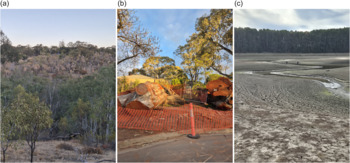
A deep cultural tension between the attraction and repulsion of the forest is reflected in the trauma of Australian colonisation. Much of the original, complex Indigenous management of the forest has been marginalised in academic literatures, official histories and education systems (Connor, Reference Connor2002; Feary et al., Reference Feary, Kanowski, Altman and Baker2010; Bardsley et al., Reference Bardsley, Prowse and Siegfriedt2019). Australian forests provide important evidence of the pathways to colonial dispossession, and there is a new recognition of the vitality of Indigenous biocultural methods of environmental management (egs. Fache & Moizo, Reference Fache and Moizo2015; Bardsley & Wiseman, Reference Bardsley and Wiseman2016). In fact, important histories of conceptual conflict and contested management decisions are everywhere in the forest. For example, should invasive exotic cats or over-abundant native kangaroos be culled to promote healthy forest habitats (Croft et al., Reference Croft and Witte2021; Deak et al., Reference Croft and Witte2021)? Large parts of forested SA have been experiencing their lowest recorded rainfall (BOM, 2025), and there is increasing evidence of dieback in forests around Adelaide (Figure 2A); trees have fallen or dropped limbs (Figure 2B); and enhanced management has been required around reservoirs (Figure 2C). If students can be supported to understand how such change exceeds the “normal,” they can be critically interrogated as indicators of a wider socio-ecological imbalance (Losso et al., Reference Losso, Challis, Gauthey, Nolan, Hislop, Roff, Boer, Jiang, Medlyn and Choat2022).
The forest provides opportunities for learning about socio-ecological risk management including: (a) Forest dieback during drought, (b) Risks of fallen trees and (c) Management of water resources.

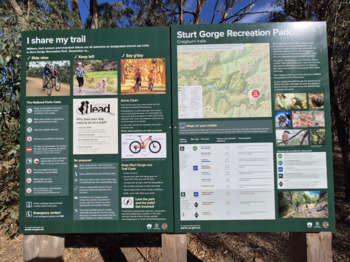
As change is apparent in and around the forest, important lessons emerge that are not just about value or risk, but the importance of ongoing adaptive management. SA implemented a Metropolitan Open Space Scheme in 1967, which integrated reserves and provided formal protection of native vegetation on the Hills Face Zone behind Adelaide since 1971 (Figure 1; Government of SA, 2017). Ready access to such forested spaces provides opportunities for schools to support learning about nature (Green Adelaide, Reference Adelaide2025), but new problems emerge as Australians engage deeply with forested peri-urban areas. For example, as recreational walkers and bikers push further into forests in large numbers, the beautiful ecosystems are altered by the very people who love the place (Figure 3; Ballantyne & Pickering, Reference Ballantyne and Pickering2015). Similar threats from recreation are challenging the way people enjoy forests worldwide (Buckley et al., Reference Buckley, Underdahl, Keto and Chauvenet2024; Ferretti-Gallon et al., Reference Ferretti-Gallon, Griggs, Shrestha and Wang2021), so it is vital for educators to continue to encourage the positive risk taking of engagement and play within the forest, while promoting learning to manage emergent risks and help to regenerate local ecosystems.
Information sign for a mountain biking area in a conservation reserve near Adelaide.

There is also a significant conflict between forest management for biodiversity conservation and bushfire risk mitigation (Moskwa et al., Reference Moskwa, Ahonen, Santala, Weber, Robinson and Bardsley2016). The Eucalyptus forest in SA needs to be managed with prescribed ecological burns to regenerate landscape (Figure 4A). However, when there is little accounting for biodiversity values and fire risk in urban planning, and housing is allowed to abut key conservation areas (Figure 4B), forests are managed intensively to focus on mitigating wildfire risk, diminishing biodiversity values (Bardsley et al., Reference Bardsley, Weber, Robinson, Moskwa and Bardsley2015). As climate change alters the balance between risk and value in the forest by making dangerous wildfire more likely, new thresholds of concern in the socio-ecosystem are becoming increasingly apparent (Bardsley et al., Reference Bardsley, Moskwa, Weber, Robinson, Waschl and Bardsley2018).
(a) A peri-urban prescribed burning site, and (b) Urban development near to a reserve adjacent to Adelaide.

The understanding of the implications of human actions on climate change, resource depletion or biodiversity loss can be developed through forest fieldwork. In an educational setting, students can theorise, experiment with, play and have fun in the forest as ways of testing conceptions of risk (Bardsley & Bardsley, Reference Bardsley and Bardsley2007; Mercer et al., Reference Mercer, Kythreotis, Robinson, Stolte, George and Haywood2017). Beyond such learning however, society needs new outlets for young people to express valid concerns about the future, which can be channelled through the forest as a form of protest. Curriculum can move on from recreation and aesthetics, to examine how ecosystem services can be valued, and risks and hazards negotiated, managed and advocated for (Hurlimann et al., Reference Hurlimann, Cobbinah, Bush and March2021; Eilam, Reference Eilam2022; Rushton & Walshe, Reference Rushton and Walshe2025). Research on forest socio-ecosystems in the mid-hills of Nepal and in southern Switzerland, where mountain forests are expanding, provides further examples of how educators can guide learning in the forest.
Forest stories from Nepal and Switzerland
Working with ForestAction Nepal (2025) for the Australian Centre for International Agricultural Research over the last six years provided opportunities to examine how people perceive of change in the Himalayan forest (Bardsley et al., Reference Bardsley, Cedamon, Gyawali, Paudel, Banjade and Nuberg2020). Nepal has implemented a national reafforestation programme, successfully increasing forest cover within previously denuded, agrarian landscapes (Van den Hoek et al., Reference Van den Hoek, Smith, Hurni, Saksena and Fox2021). That was achieved by providing over 20,000 community forest user groups with governance powers to manage local forests (Nuberg, Shrestha & Bartlett, Reference Nuberg, Shrestha and Bartlett2019). However, in our socio-ecological surveys in 2020 and again in 2023, it became clear that the expansion of the forest is increasing risks of food insecurity, wild animals and wildfires, meaning the ecological transition is perceived by many farming households as undermining the integrity of local socio-ecosystems (Bardsley et al., Reference Bardsley, Cedamon, Paudel and Nuberg2026; Joshi et al., Reference Joshi, Giri, Kuinkel, Kuikel, Devkota, Pradhananga, Marahatta and Pokharel2025; McGunnigle et al., Reference McGunnigle, Bardsley, Nuberg and Pandit2025).
The development of formal education systems has been key to rural development policy in Nepal: enabling community members to capitalise on opportunities from the forest, via both industrial uses such as timber production and food gathering; and the management of forest ecosystem services to meet local needs (Figures 5A and 5B; Bardsley et al., Reference Bardsley, Cedamon, Paudel and Nuberg2022).
Multiple values of the Nepali forest include (a) New timber enterprises and (b) Erosion control around crops.

New forms of education that work with communities to promote a balance in ecological and socio-economic goals from the forest, also help to guide learning about socio-ecological risk more broadly, which will be vital for retaining positive interactions between people and their local ecosystems as they transition (Greenland et al., Reference Greenland, Saleem, Misra, Nguyen and Mason2023). For example, silvicultural skill development across community forest user groups has the potential to both promote techniques to mitigate the risks of wildlife and wildfires, while generating livelihood opportunities in association with the forest (Bardsley et al., Reference Bardsley, Cedamon, Paudel and Nuberg2024a; Nuberg et al., Reference Nuberg, Shrestha and Bartlett2019).
In a similar manner to Nepal, the forests in the Alps of Switzerland have expanded as more mountain farmers abandon the difficult task of managing steep, terraced landscapes for agriculture (Loran et al., Reference Loran, Munteanu, Verburg, Schmatz, Bürgi and Zimmermann2017; Tschurr et al., Reference Tschurr, Feigenwinter, Fischer and Kotlarski2020). As in the Himalaya, that change has led to positive outcomes from an ecological perspective, generating values for conservation and erosion control. However, the forest is replacing specific, biocultural landscapes that rural communities appreciate, and our research suggests that there is also a sense of loss for some people as the forest returns (Bardsley et al., Reference Bardsley, Bardsley and Conedera2023). The rewilding of the landscape does not only represent positive ecological change in areas experiencing hotter, drier conditions, as, again, wildfire and wild animal risks increase for communities integrated into the forest (Figures 6A and 6B; Bardsley et al., Reference Bardsley, Bardsley, Conedera, Pütz, Robinson and Weber2021; Conedera et al., Reference Conedera, Feusi, Pezzatti and Krebs2024).
Management approaches need to promote both ecological values and the socio-ecological needs of communities to ensure that interventions are seen as sustainable in the long term. The modern concept of sustainability is said to have evolved from forest management approaches in central Europe (Ortloff, Reference Ortloff1999). As well as providing conservation, recreation, timber and cultural values for Swiss people, forest experiences have been incorporated into education systems (Frick et al., Reference Frick, Bauer, von Lindern and Hunziker2018). Lindemann-Matthies & Knecht (Reference Lindemann-Matthies and Knecht2011, 165) found that “forest education improves the child-nature-relationship, the students’ motor skills and stamina as well as their social and creative skills.” However, there is also formal acknowledgement that mountains forests can be dangerous places. Switzerland has a comprehensive, decentralised public school system that aims to promote social equity and cultural diversity (Stadelmann-Steffen, Reference Stadelmann-Steffen2012). The national government supports educators to explicitly integrate risk analysis and planning into curriculum, and connected learning to approaches to manage wildfires, avalanches, landslides, floods and other hazards (Bründl et al., Reference Bründl, Romang, Bischof and Rheinberger2009). While such steps help to link environmental education to concepts of both value and risk, transition risks from climate change are increasingly difficult to negotiate, and as Jucker (Reference Jucker2011, 41) highlights, Switzerland, like all countries in a rapidly changing global environment, “will have to redesign our education systems to become capable of contributing to (re)producing a sustainable society.”
Conclusion
One of the great values of the forest is that it is an instrument to learn about risk. As societies work to return the forest to local landscapes and to respond to global environmental challenges, they will not just generate positive ecological change but will increase risk in many places. Such socio-ecological risk is not a vague concept for residents in the case-study nations. Rather, the drying of landscapes, wildfires, flooding and landslides, falling trees, wild animals, and lost cultural values are making some people feel less safe, as well as challenging local livelihoods and identities as forest interactions increase on their doorstep. For that reason, people must be supported to learn about and manage their forests within their unique socio-ecological contexts.
Any reflexive goals will need to be deliberated on and nurtured, and constructivist educational approaches that support learning through lived experiences in the forest in association with formal, theoretical scaffolding can help to guide young people through stages of engagement with their local ecologies. As people become increasingly aware of how risk affects their lives, simply teaching that nature is beneficial will create false expectations that could undermine trust. Rather, students can be guided through stages of learning about ecology and risk to develop critical voices about current and past management of the environment. Forest pedagogies offer pathways of rethinking how people can explore opportunities to mitigate risk while investigating the complex values of the forest (egs. Jukes et al., Reference Jukes, Stewart and Morse2022; Kraftl et al., Reference Kraftl, Ambreen, Armson, Badwan, Curtis, Pahl and Schofield2025). For example, the wonderful recovery of the forest after droughts, fires or storms – or as nature reclaims farmland – provides important lessons of resilience. Key to new critical pedagogical approaches will be to learn from and with Indigenous peoples, who have complex biocultural frameworks for weaving the management of mixed forested landscapes with broader ecological and social goals (Bardsley & Wiseman, Reference Bardsley and Wiseman2012; Zanotti & Knowles, Reference Zanotti and Knowles2020; Poelina et al., Reference Poelina, Wooltorton, Blaise, Aniere, Horwitz, White and Muecke2022).
As humanity is challenged by risk, there remains a concerning pervasive sense that society is simply waiting for young people to respond and current governance systems are unwilling to fully engage with the scope of risk (Thomas et al., Reference Thomas, Martin, Wicker and Benoit2022; White et al., Reference White, Breakey, Brown, Smith, Tarbet, Nicholas and Ros2023). We need contemporary generations to learn how to take the road less travelled – both to contest the modern orthodoxies that have generated risk in the first modernity and to present balanced, reflexive solutions to change society for the second – and that might just make all the difference (Frost, Reference Frost1915). The forest provides evidence to warrant effective criticism of failing governance systems, as it offers sophisticated learning and teaching opportunities that can be supported by education systems:
-
Providing risk knowledge and a sense of hope for young people as they are supported to name, study, enjoy, travel, activate and recreate in the forest with their peers. As well as learn to recognise, monitor and respond to management challenges to generate socio-ecological agency based on their critical understanding of the forest and how it reflects environmental change;
-
Supporting young people to understand change in the forest and become part of a process of positive environmental policy and action across society. Those experiences can lead to aspirations to train, monitor and manage in environmental departments, firefighting or conservation groups, government and industry, to become experts in the sustainable development of their local ecosystems.
As future generations take up the difficult task of responding to the failures of the first modernity, pedagogies of hope need to be emphasised. Education through complex engagement with socio-ecosystems provides opportunities to learn about new ways of anticipating and responding to risk. Schools are beginning to explicitly use ecosystems on their doorsteps to guide such learning, but many young people remain marginalised from nature and must be supported through education systems to engage with their local environments. Risk education in the forest can guide development of critical opinions to highlight to young people, to their peers and communities – and also to those with the power to influence policy – that new (and ancient) sustainable pathways to manage risk need to be (re)conceptualised and made available for everyone.
The forest is returning to surround cities and villages in southern Switzerland: (a) Locarno and (b) Lavertezzo in Ticino, Switzerland.

Acknowledgements
Many people assisted with the research discussed in this article, but I wanted to highlight the support of Ian Nuberg, Edwin Cedamon, Nicola McGunnigle and Naya Paudel in Nepal and Marco Conedera and Marco Pütz in Switzerland.
Ethical standard
Nothing to note.
Financial support
This research received no specific grant from any funding agency, commercial, or not-for-profit sectors.
Author Biography
Douglas K. Bardsley undertakes research on responses to environmental risk in Australia and internationally, and examines how that knowledge could be translated into education systems. He undertook the first integrated assessments of climate change impacts and adaptation opportunities for the Adelaide-Mt Lofty Ranges and Indigenous Alinytjara Wilurara regions in South Australia. Subsequent local work has examined adaptation to wildfire, coastal flooding, farm management risks, biodiversity loss, invasive species, inappropriate development and the energy transition. Recently, he has also been researching responses to socio-ecological risk from different perspectives in China, Egypt, Fiji, France, Ghana, Indonesia, Nepal, and Switzerland.



 Open access

