

I
In 1966, Peter Burke published a survey of the popularity of ancient Greek and Roman historians in early modern Europe.Footnote 1 History – and the history of the classical past, in particular – occupied a special place in the culture of Europe in this age of intellectual development and new print technology, on account of its perceived moral value, as well as its practical political and military applications, and Burke's article has become an extremely influential study, informing numerous pieces of work in the fields of history, literature, and classical reception.Footnote 2
The premise of Burke's survey is that the number of editions of a book produced in any one period can be used as a blunt tool to assess its popularity, and that popularity is an indicator of taste. As Burke points out, the ancient historians ‘were not equally popular in this period, nor with the same people, nor for the same reasons’, and it is a sense of how and why the relative fortunes of the various historians shifted over the years 1450 to 1700 that his article seeks to provide.Footnote 3 But as the legacy of Burke's article has shown, a survey of this kind has the potential to do far more than merely indicate changing tastes in history. History, in the early modern period, was a means by which debates on current affairs could be conducted; history not only shaped, but also reflected, the most pressing issues of the time.Footnote 4 Popularity could also be said to be synonymous with significance, relevance, or influence, rather than representing simply the appetites of the market. After all, publication is not, and never has been, a neutral event, but rather a conscious decision made on the part of one or more individuals, be they publishers or patrons; it can therefore give an insight into more than the ‘taste’ of readers. In the early modern period, books were published for financial gain, when someone invested money in order to make a profit by supplying the demand of an existing market, or creating a new one; publishing was also driven by political motives, by factors to do with status and social standing, and by ideological aims.Footnote 5 These last might include the desire to promulgate a particular moral or religious message, or to create an identity; they might also include the broader humanist ideals that deemed education and active citizenship to be necessary virtues in a successful commonwealth, inspiring across Europe the ‘vigorous cultural programme’ designed to create such a society.Footnote 6
New resources, developed over the half-century since Burke's article first appeared, make it possible to reassess the popularity of the ancient historians, and this is what I aim to do here, in order to make it possible for scholars to re-evaluate accurately the role of these authors in the early modern world. In particular, the Universal short title catalogue (USTC) now provides a ‘collective database’ of books printed on the continent of Europe, to 1600, bringing together existing national catalogues and new comprehensive surveys of early print in such areas as Iberian Peninsula and the Netherlands.Footnote 7 It is this database that I have used to conduct my survey. Its scope far exceeds that of the tools available to Burke: the three volumes of F. L. A. Schweiger's Handbuch der classischen Bibliographie (Leipzig, 1830–4), and the supplementary works used to supply its shortcomings.Footnote 8 Nothing comparable to the USTC yet exists for the seventeenth century, so I have ended my survey at the close of the sixteenth century.Footnote 9 Following Burke, I have counted the works of the ancient historians he selected as most worthy of attention, and classified them, as he did, by language and date of publication. My results suggest modifications to Burke's appraisal of the relative popularities and probable readers of some of these books; my reworking of Burke's data provides, I hope, a more representative foundation for subsequent work on the reception of the ancient historians in the early modern world, and indicates alternative lines of inquiry to those that have been pursued to date.
Printing statistics are the most useful and comprehensive way to begin to make arguments about the relative popularity, or significance, of various texts and authors. Indeed, in the absence of many other indicators that would allow the effective comparison of books – size of print run, proportion of books sold and unsold, evidence of ownership, and so on – the fact that a book was produced in a certain year is one of the only ways to do this.Footnote 10 Nevertheless, there are some problems with using these data, and limitations to the arguments that can be made, and it would be dishonest, as well as counter-productive, not to acknowledge these fully.
A focus on information about book production, such as the year and place of printing, assumes, to some extent, a national model of book production and consumption, which was manifestly not the case in early modern Europe. Not only is it anachronistic to map modern geopolitical concepts onto the early modern world, but given that the majority of printing took place in a small number of printing centres, whence the books were then exported across borders and boundaries, the place of publication is unhelpful in representing accurately either where a book was consumed, or the popularity of that book in a place other than its country of origin. There is not necessarily a correlation between place of printing and language, Spanish books being frequently produced in both France and the Netherlands, for example, as Burke shows in his study.Footnote 11 The situation is, perhaps, slightly different for vernacular translations, which are more likely to have found a substantial share of their market primarily within one region or country; moreover, since scholars have been keen to trace connections between vernacular translation and the popularization of the classics as education improved across the continent, a focus on the language in which a book was printed may be a more useful approach.Footnote 12 Even then, however, it should be noted that vernacular editions were often produced in cities and countries far from where they were destined to be sold, and evidence of book ownership reminds us that many vernacular editions found readers outside their ‘home’ country.Footnote 13
Given that print runs are unknown for the vast majority of books produced in the early modern period, it is also impossible to reach any conclusions about the absolute number of a book in circulation at any one time.Footnote 14 This, in turn, means that the number of editions of a book is not necessarily a reliable indicator of absolute reach or popularity: if Book A entered three editions within ten years, but each of these editions had a print run of 500 books, then as many copies of that book would be available as of Book B, which was produced in a single edition with a print run of 1,500. If all these copies were bought (an unknowable fact), then both books could be said to be equally popular, yet counting the number of editions would suggest that Book A was three times as popular. Nor is it always clear what the production of a new edition meant, without closer examination of the details of that particular book, something that often proves difficult in a large-scale, statistical survey, where the extant copies of many of the books are spread all over the world. If a second or third edition of an existing book was produced after an interval of several years, we might reasonably infer that the first edition had sold out, and more copies were needed; we might also infer that for any edition to be printed, the publisher investing in its production had good reason to think that it would sell, whether this turned out to be the case or not. But a book that differed substantially from earlier products might be offered to the market for any number of reasons – it might cater for a different readership altogether, or it might be intended as a direct competitor to an existing product, which it might or might not outsell – and treating books as numbers obscures these nuances.
Perhaps the most serious disadvantage of a survey of the production of printed editions of ancient historians’ works is the distorting effect upon the realities of the way that early modern people acquired and interacted with books. The analysis of editions is only possible once the technology of print starts to be used, but, of course, the beginning of print did not mean the end of manuscript production.Footnote 15 Any study based on printing statistics necessarily privileges print technology and fails to take account of manuscript transmission, a vital part of textual circulation during the whole early modern period. Nor does a survey of new editions entering the marketplace take account of the used book trade, another highly significant component in the global picture of buying and selling books.Footnote 16
There is no satisfactory way to correct for these biases, and to ignore the possibilities offered by the analysis of print production data because the data are imperfect would be foolish. As long as we bear in mind that they cannot ever provide us with the whole picture, and that any statistical data of this kind can only ever be incomplete and imperfect, we may proceed with caution.
II
In preparing these revised statistics, a number of methodological choices have been made, which have necessarily influenced the outcome. Burke's methodology is not explicitly discussed in detail in his 1966 article, making it difficult to reproduce his study accurately; this is something I hope to avoid here, in explaining the decisions I have taken, and the implications of these for what this study can, and cannot, do. I have followed, for this survey, the methods of the USTC project team regarding editions, issues, and states. The USTC is ‘constructed on the principle of recording bibliographically distinct states of a book as separate items. It should be emphasized that these do not always represent separate editions.’Footnote 17 I have counted as a separate entity every item that has been given an individual USTC number; otherwise-identical texts issued at the same time, but with slightly different details on the title page – usually the name of a different bookseller, publisher, or printer – have therefore been identified as discrete entities, though they do not represent different editions. For example, the eight French octavos of Thucydides's History printed in Paris in 1555 have been identified as eight separate items, because each bears a different imprint, and therefore has its own USTC number.Footnote 18 The same is true if long works were published in multiple volumes, usually in small format: each volume has its own USTC catalogue number, and has therefore been counted as separately, that is, as a distinct collection of pages that a consumer could, in theory, purchase.Footnote 19 My figures are therefore not a record of editions, but of books in different states. I am concerned, throughout, with the production of books: with the choices made by the actors engaged in the production process in order to create books and to sell them, in the course of business; I am therefore interested in the various individual artefacts on the market, and the ways in which they were presented to prospective consumers, so I have counted each of these items, rather than the number of editions, and I refer to ‘books’ rather than to ‘editions’. If a book exists in multiple states within the same edition, it is probably not ‘as popular’, or popular in the same way, as one that enters several editions – though, of course, without knowing the size of each print run, and the proportion of the edition sold, it is impossible to say this for certain. Histories existing in multiple states will therefore inevitably be somewhat over-represented as a result of my method of counting, and the individual figures should be treated as containing a small margin of error.
I have searched the USTC for the ancient authors in Burke's study, using first the ‘author’ field, and then the ‘keyword’ field. I have recorded the books printed in the years up to, and including, 1599, in order to facilitate a comparison with Burke's analysis, which is conducted using fifty-year intervals ending in 1499, 1549, 1599, and so on. To maintain congruity with the sources, I have used the dates in the style given on the books themselves. When works by more than one ancient historian appear within a book, that book has been counted for each author. The sum total for all the authors is therefore slightly greater than the total number of discrete books, since the same book sometimes appears more than once. I have conducted my search by the name of the author: my results only include works by authors that the USTC database identifies by name; therefore, if a collection claiming to be ‘collected out of various ancient authors’ does not bear the name of an author, I will not have found that work, even though substantial portions of an ancient, historical text may be reproduced within that book.
Burke counted the number of particular works by his chosen ancient historians, with the exception of Caesar, whose works he considered together, simply as Commentaries, despite the existence of several books containing only the Gallic Wars or the Civil Wars. I have not followed his lead, instead counting each individual book containing any historical work by the historians Burke selected. Identifying which text by an ancient historian a particular book contains, using the information provided by the USTC, is not always straightforward; consultation of additional printed catalogues, and examination of the books themselves (physically, or via digital facsimile where these exist), is sometimes necessary to determine accurately the precise textual contents.Footnote 20 Often, a book contains more than one text: a volume entitled Opera, for example, will usually contain all the extant works by that author. Ancient historians of whose works several survive – such as Josephus, Tacitus, Caesar, among others – present further difficulties, since numerous combinations of these works appeared in printed form. I have simply counted each book that provided readers with access to one or more of the histories by that author. My study therefore provides information about the relative ‘popularity’ of the ancient historians, not of their individual works.
Some books present particular difficulties. Numerous books bear the title De viris illustribus; this could refer to a work by Aurelius Victor (also frequently attributed to Pliny the Younger), Nepos (also known as Aemilius Probus), Suetonius, Plutarch, or another author. The distinctions between, and attributions of works to, some of these authors were the subject of much mistake and a considerable degree of scholarly debate in the Renaissance; whether an error matters to a modern scholar depends on whether it is the content of the text that is of primary interest, or what people at the time believed they were buying or reading; or, to be more accurate, what producers at the time chose to advertise to their customers. My current focus here is necessarily on the ways in which books were offered for sale – on their marketing and advertising by means of their title pages – because this is the level of information it is possible to extract from a short-title catalogue. This study therefore reflects the world of book selling (encompassing the various ways in which producers marketed their texts to prospective buyers and readers), rather than the world of reading and reception. So, for example, I have chosen to include works purporting to be and advertising themselves as such in their titles, Plutarch's Life of Hannibal and Scipio, or Life of Homer, because although modern scholarship does not recognize these as the work of Plutarch, that is how they were offered for sale in the early modern period. It is the inclusion of Plutarch's name, as author, in the title that determines the inclusion of this book in my survey, rather than anything else; therefore other works containing this same portion of text but not advertising Plutarch's authorship will not have been included, and the same doubtless applies to a number of other texts.Footnote 21
My method also allows for a consideration of historical works wider than those selected by Burke. Of Xenophon's several historical pieces, for example, he selected only two, which he chose to refer to as Cyrus and Expedition.Footnote 22 My method necessitates the inclusion of all Xenophon's historical works, although I have excluded the Socratic dialogues such as the Oeconomicus, or the Renaissance favourite, Hercules (i.e. Heracles), the story of which is spoken by Socrates in Xenophon's Memorabilia. Admittedly, these do function as records for the history of Socrates, and for the history of society in the time of Xenophon, and the episode of ‘Hercules’ is often presented as a piece of historical narration or story: Ein sehr liebliche historische narration oder erzelung von dem edlen jungen helde dem Hercule; aus dem Xenophonte genommen und mit schonen Außlegungen erkleret. Footnote 23 Some of the dialogues also seem intended to function in the same way as histories in the early modern world, as useful guides for the present, such as Xenophontis socratici rhetoris Hieron sive tyrannus, liber utilissimus his qui rempublicam administrant.Footnote 24 The exclusion of these works, on the grounds that they are ‘not historical’, is therefore a decision with which I am not wholly content, but it does facilitate a better comparison with Burke, and some publishers clearly did distinguish between historical and moral works, and entitled their books accordingly, as with L'opere morali (Venice, 1558).Footnote 25
All Tacitus's works have been included in my tally, except the Dialogus. In the case of Suetonius, too, I have incorporated more works than simply the Twelve Caesars selected by Burke. Other partially surviving works include various components of the De viris illustribus, on the lives of the poets, the historians, the grammarians, and the rhetoricians. On many occasions, these fragments appear alongside the Twelve Caesars, but even when they were published separately, readers would have been able to learn about some of the same kind of ‘history’ from these minor works as from the Twelve Caesars: the history of the chief actors in classical history. I have thus included books containing these fragments in my list.
Deciding which books to count is always a subjective, critical exercise, and it becomes even more problematic with books that are ‘versions’ of a text. These might be excerpts, collections or commentaries, or paraphrases or digests. To include only the ‘original’ source text, in translation or in the vernacular, may at first seem a desirable strategy; but there is no such thing as an ‘original’ text of any of the ancient histories. The texts were all necessarily altered, to various extents, in their transmission over the centuries since their composition; a translation from one language into another always results in a transformation of the source text as the translator imbues it with new meanings, intentionally or subconsciously; and excerpts or paraphrases incur yet another layer of modification.Footnote 26 It is therefore sometimes difficult to draw an absolute line between texts ‘by’ the ancient authors, and texts derived from their works but so substantially different as to be wholly new texts in their own right, without close reading of each individual book; even then, given the differences in our understanding of originality, creativity, and plagiarism compared with the norms of early modern Europe, it is possible to make credible cases for a judgement either way.Footnote 27 I have generally erred on the side of generosity when choosing what to count, allowing the advertised author to determine inclusion or exclusion where my own reading has been inconclusive. I have omitted works that, although they resemble the histories of an ancient author, claim to be innovative works by medieval or early modern scholars, but I have included books advertised as commentaries or notes on particular authors, in which large sections of those authors’ histories are included, and collections of excerpts in which parts of multiple texts have been combined. Thus, I have counted books like Le tresor des vies de Plutarque (Antwerp, 1567); compiled from several of Plutarch's works, including the Apophthegms, it contains much historical material from the Lives.Footnote 28 I have cast my net widely when searching for authors whose works circulated under multiple names, in line with predominant fifteenth- and sixteenth-century belief: Josephus's histories existed in several versions, for example, the provenance of which was often misrepresented in the early modern period, and I have thus included books ascribed to Hegesippus and Ben Gorion as works by Josephus.Footnote 29 I have not, however, included the Discorsi by Macchiavelli or Ciccarelli on Livy as a form of Livy's history; numerous of Plutarch's other extant essays, for example the piece on the fortune of the Romans, might also be deemed historical, but I have not included them here. Neither have I included books whose titles contain only vague references to miscellaneous material drawn from the ancient historians, like Sebastiano Corradi's Sebastiani corradi egnatius, sive quaestura, cuius praecipva capita haec sunt: M. T. Ciceronis vita undique collecta, & defensa. Multa è Plutarcho, caeterisque Graecis conversa; although the book contains arguments and quotations from Plutarch, some of which are historical in nature, these have been woven together in such a way that they constitute a wholly new work.Footnote 30
In summary: I have attempted to locate all the books advertised to the market as containing the historical works of the ancient historians in substantial form, books in which readers might access their historical works and thereby learn about the Greek and Roman past, distinguishing these from medieval or early modern works. The numbers of works of the ancient historians that follow are the numbers of the books advertised by their titles as being those in which readers could read a version of an historical text by a particular author.
III
The USTC is a revolutionary resource, the scope, ambition, and execution of which must always command great admiration. It is not, however, without a few challenges for the user. It will always be preferable to consult a copy of the original book, especially where the catalogue is vague, but this has not been practicable in each and every case, so the constraints of the database and the necessarily limited information it provides have sometimes determined the choices I have made.Footnote 31 For example, it is difficult, from the information visible to a USTC user, to distinguish between some works. A book by Xenophon with the short title Cyrus might refer to the Expedition or the Education, or both, but users of the USTC will be unable to determine the exact content without reference to the book itself. Nor can one always tell a text from a commentary on that text from the search results; the USTC does not differentiate between the two with any discernible regularity. Then there are the occasional errors inevitable in a project of such great size, and with so many contributors. Where early modern authors used names similar to those of ancient authors, some mistakes have arisen in a few entries. Some Swiss texts listed as the work of Julius Caesar Scaliger are in fact by Gaius Julius Caesar;Footnote 32 some entries, which have short titles advertising particular works within them, do not in fact contain those works; but these instances are admirably few, and I have corrected for them.
Equally problematic are the occasions on which the information one expects from the USTC is missing. This particularly applies to language and format. The language of the title is sometimes the only clue available as to the language in which the text is printed, which may mean that Greek texts, in particular, are under-represented. Then, for example, no size is given for the edition of Suetonius's Twelve Caesars published in Madrid in 1579.Footnote 33 Sometimes, recourse to the hard copies of the various catalogues of which the USTC is comprised provides an answer, for French, Iberian, or Netherlandish books.Footnote 34 For books from the Holy Roman Empire, the Swiss Confederation, and the Italian states, the entries in the online bibliographies VD 16, GLN 15–16, and EDIT 16, to which the USTC provides a link, usually supply the missing details, as well as other valuable information, but this is only helpful for books produced in the areas those resources cover, and certain details are not recorded in any of these catalogues.Footnote 35
Some questions can arise over authorship. The fardle of facions (London, 1555) contains a ‘Treatise of Josephus, conteyning the ordres, and Lawes of the Jewes commune wealth’; this is returned under an author search for ‘Josephus’, but the author field visible to the user is blank.Footnote 36 The identity of ‘secondary authors’ causes more confusion. These are listed, separated by commas, with rather erratic capitalization, making it initially unclear to whom the entry refers, or even whether it is one person with more than one name, or multiple individuals. Thus, for example, one secondary author listing appears as ‘diodorus, crusius, martin’, signifying that both Diodorus (Siculus) and Martin Crusius are secondary authors; another, ‘diodorus, gambrivius’, denotes Gambrivius Diodorus, and is nothing to do with Diodorus Siculus; and the order in which multiple parts of a name are listed is not always consistent. It should be noted that not all the contributing authors are listed by the USTC as secondary authors; this makes it difficult to see from the USTC which works a book actually contains. For example, a search for ‘Suetonius’ as author returns nine hits under Aurelius Victor, suggesting that something by Suetonius is contained within each of these nine books, but the individual entries for each book do not list Suetonius as a secondary author. An edition attributed to Aurelius Victor, published in Paris in 1545, and entitled De viris illustribus liber. De Claris grammaticis et rhetoribus liber. Prodigiorum liber imperfectus lists Julius Obsequens as the secondary author, although the De Claris grammaticis is by Suetonius.Footnote 37 The Historia Augusta presents a particular problem: sometimes, some authors are named as contributors, when they have been listed on the title page – Plutarch, Suetonius, Dio, and Tacitus, for example – but other times they are not, and appear simply as the ‘authors of the Historia Augusta’.Footnote 38 The contents of the database behind the USTC website will inevitably be fuller than the information presented to the user, but the lack of details like these does present a challenge.
The USTC's commitment to contextual accuracy creates further difficulties, especially where the names by which authors are commonly known vary across Europe. Authors are listed under the names by which they were known in the early modern period; an anglophone user looking for books by Livy must therefore search for ‘Livius’ instead. This is, on the whole, not a problem for anyone familiar with early modern classical culture; but the user must also search for authors by their vernacular tags in order to be sure that they recover the full range of titles. A search for ‘Sallustius’ will return all works by Gaius Sallustius Crispus except those printed in England, which can only be found by searching for ‘Sallust’. The search for ‘Sallustius’ will also reveal that Sallust is variously given the praenomen ‘Gaius’ or ‘Caius’; the same is true of Julius Caesar, and similar issues apply to Josephus, Cassius Dio, and Eutropius. Each variant is listed as a separate entity in the ‘author’ section of the results page, and a search for one will not give results associated with the other, which is to say the USTC has not standardized or unified its entries. Again, this does not represent a problem for those familiar with all variant forms of an author's name, or skilled in Boolean, truncation, and wildcard searching, but it is a trap into which the unwary user may easily fall.
In order to return all the works by an author within the USTC, it is therefore necessary to search for all possible variant forms of all parts of their name, in all languages. It is also necessary to repeat this search using the names as ‘keywords’ instead, as an editor is sometimes listed as the author, with the ancient historian's name appearing only in the short title. And, of course, with Latin spelling, different vernacular names for authors, a lack of orthographical uniformity, and the ever-present possibility of printing errors, the user must also search for all likely forms, spelling variants, and possible mistakes: Svetonii as well as Suetonius, Senophonte as well as Xenophon, and so on.
What does this mean for statistical analyses using the USTC? First and foremost, it means that it is not possible to use the features that seem, at first, to promise a very quick route to statistical success. Each search is automatically sorted, and the user is given the number of books in each language, each format, by each author, and so on; but given the high number of multiple, independent searches that must be undertaken to arrive at all possible books containing work by a particular author, these tallies are effectively useless. The individual checks that must also be performed for each individual book returned in a search, and the subjective critical judgement that must be exercised to determine whether a book ‘counts’ or not, further renders the analysis subjective and, ultimately, irreproducible to 100 per cent accuracy. A statistical study deriving its data from the USTC is therefore not a scientific experiment that can be repeated, by anyone following the same method, to achieve identical results. I do believe, though, that it could be repeated to deliver results that would not, in their essentials, differ substantively from those given here.
IV
In his article of 1966, Peter Burke produced the following table of results – Table 1 – showing the number of editions for his chosen ancient historians and their works, to the end of the seventeenth century. Since I have used the USTC, which only currently comprehensively catalogues books produced up to, and including, the year 1600 for the whole continent, these figures cannot be used to make a direct comparison with my own. However, a subsequent table in Burke's article demonstrates the number of editions produced in each fifty-year period, starting with 1450 to 1499. Burke's totals for the number of editions published to 1599, arranged from most- to least-frequently printed, are shown in Table 2; the order of popularity is not identical with that of the years 1450 to 1700 as a whole, but it is not dissimilar.
Burke's findings, 1450–1700
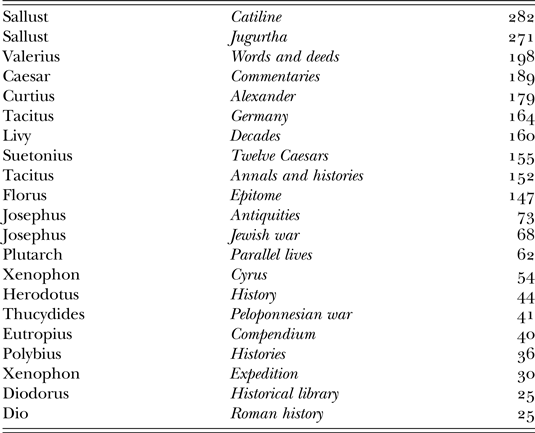
Source: Burke, ‘The popularity of ancient historians’, p. 136.
Burke's findings, 1450–1599
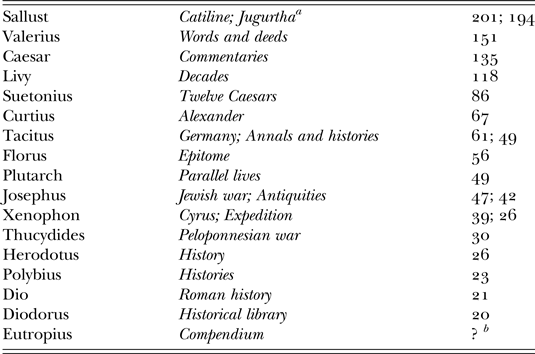
a I have chosen to present Burke's entries with multiple texts by an author combined in the table, so that each author appears only once, and a comparison with my own results is clearer.
b Eutropius does not feature in any of Burke's tables other than Table 1.
Source: Derived from Burke, ‘Popularity of the ancient historians’, p. 137.
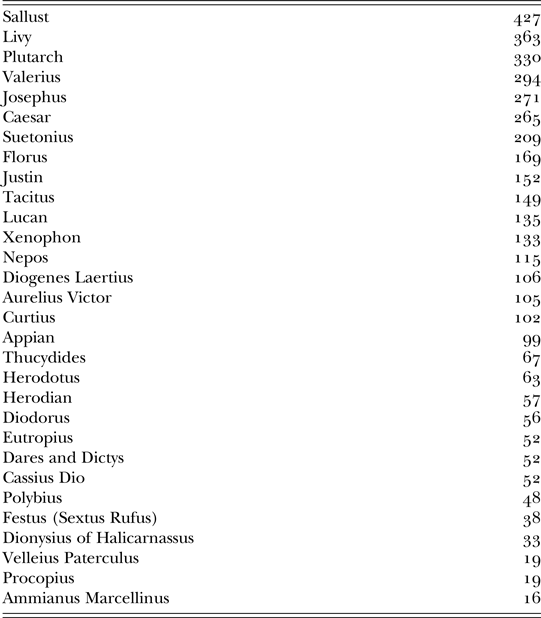
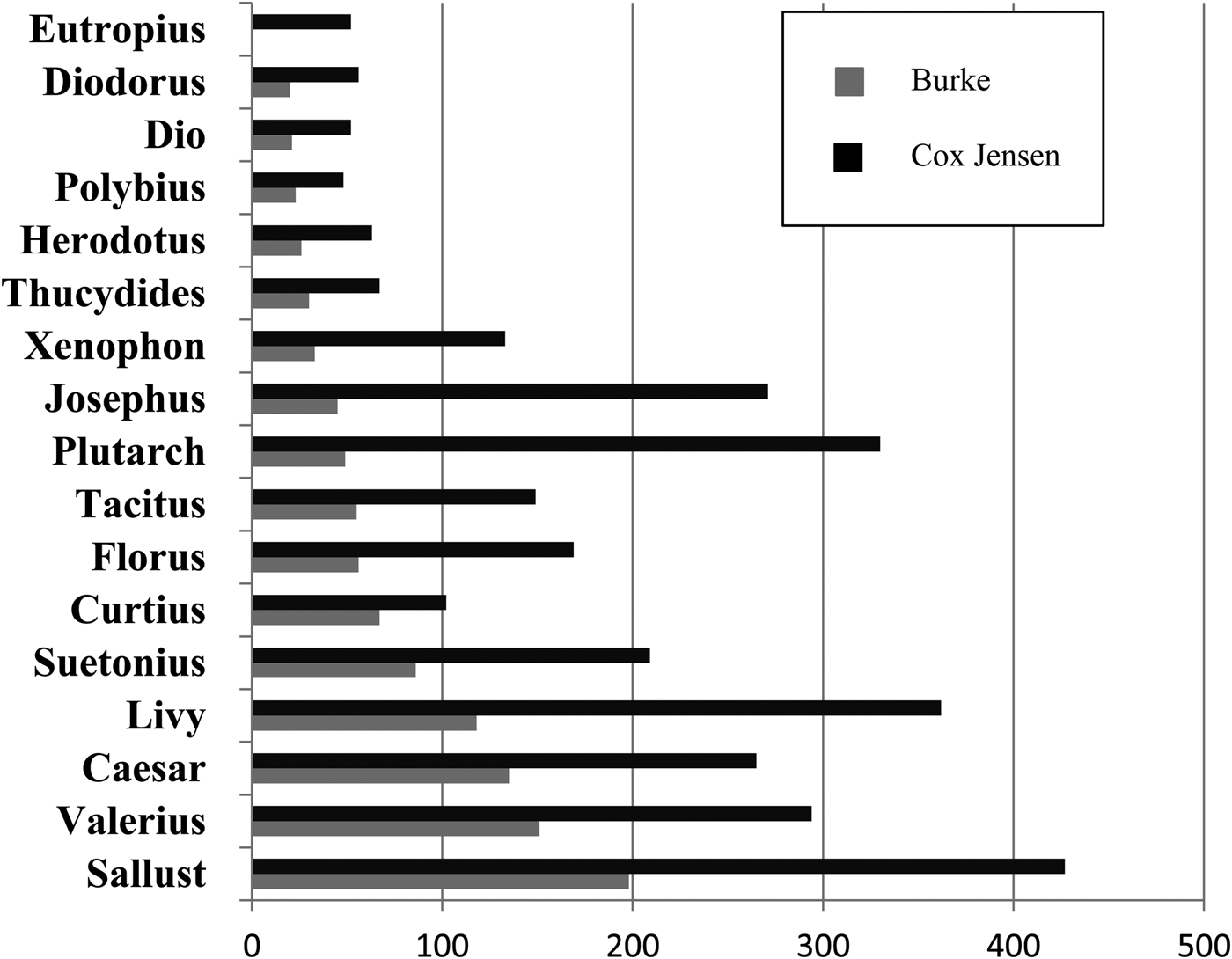
Table 3 presents the results of my survey of the works of the ancient historians, in order of most- to least-frequently printed, according to the method outlined above. A direct comparison of my figures with those of Burke, arranged in Burke's order of popularity, is seen in Figure 1. From this comparison, a few points are immediately apparent:
1. Far more books containing the works of all the ancient historians were printed in the period 1450 to 1599 than has previously been acknowledged.
2. The relative order of popularity posited by Burke is not borne out by evidence in the USTC.
3. The popularity of several authors has, until now, been greatly underestimated: this is particularly true of Plutarch and Josephus.
Comparison of Burke and Cox Jensen, 1450–1599.
My findings, 1450–1599
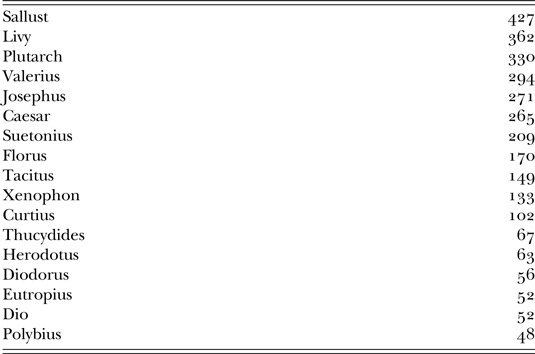
Note: A comparison of data for the authors for whom Burke counted two texts is necessarily problematic, as I have simply counted books of histories by those authors (Sallust, Tacitus, Josephus, and Xenophon). Without repeating Burke's original research – an impractical and unfruitful exercise – it is not possible to tell which work is contained in which book in his survey. Adding the totals together to arrive at a sum for these authors certainly does not represent an accurate total of their works in print: many books contain both histories, and, indeed, my research using the USTC suggests that, if an author wrote more than one history, very nearly all – or at least, far more than half – of the books by that author contain all his histories. For the sake of a moderately useful comparison in graphical form, I have simply taken then mean of the two figures given by Burke. The ‘Burke’ number on the figure is therefore not an accurate reflection of the number of editions, but a nominal average, for illustrative purposes.
In order to offer more useful, critical suggestions about the relative popularity of particular authors, Burke provides an assessment of the shifts in their popularity, in fifty-year periods. I have done the same, to 1599, in Table 4, presenting the authors in order of most- to least-frequently printed in each period.
Number of books produced in each fifty-year period
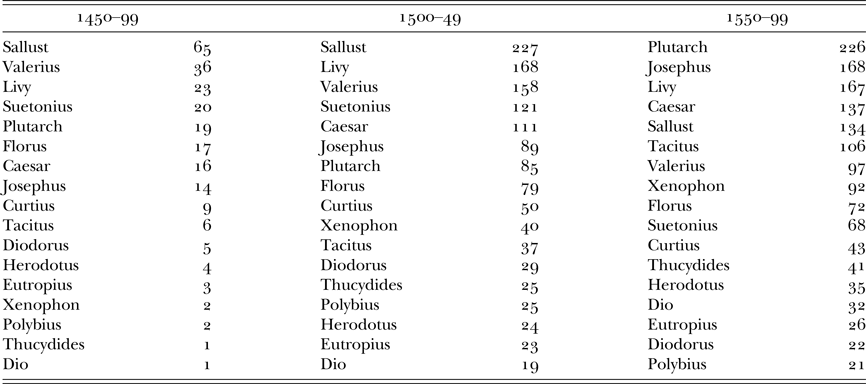
Note: Some books are undated; while it is possible to estimate which fifty-year period many of these fall into, it is not always the case, especially without seeing or handling the books. It has not been possible to date three editions of Livy, one of Florus, three of Valerius Maximus, and one of Caesar.
Understanding how frequently authors were printed within half a century is useful in determining broad trends in rising or decreasing popularity, but it is rather a vague measure of assessing change; the Europe of the 1540s was, after all, dramatically different, politically and religiously, from the Europe of the early 1500s. A rolling two- or three-year analysis is probably preferable in order to discern any correlation between significant political events and an increase in the printing of a particular ancient historian, but it is not easily displayed on the printed page; I have therefore chosen to present my results by decade, to allow a slightly closer comparison between printing frequency, and historical changes, shown in Table 5 and Figure 2.
Number of books printed in each decade, for the six most-printed authors.
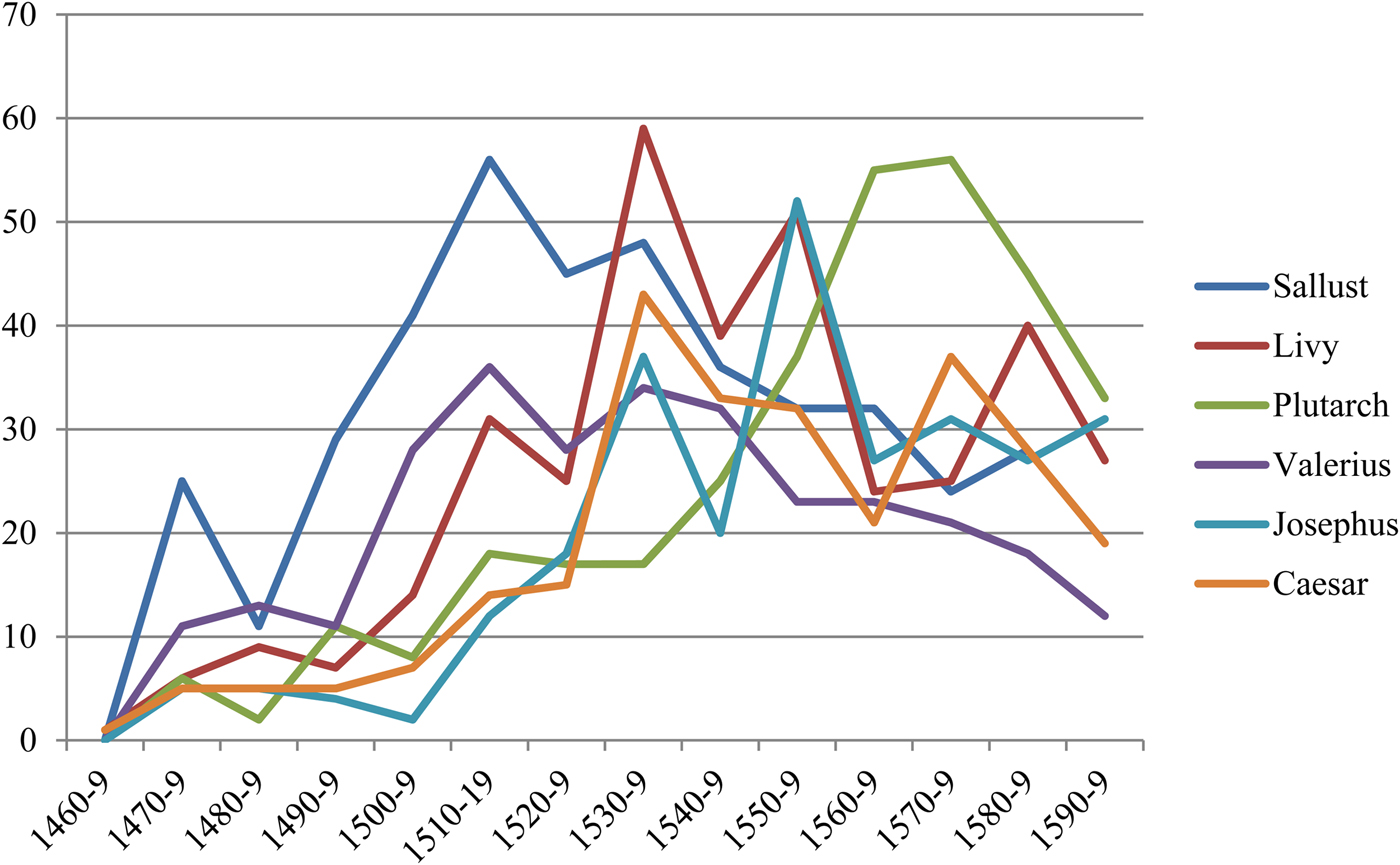
Number of books printed in each decade
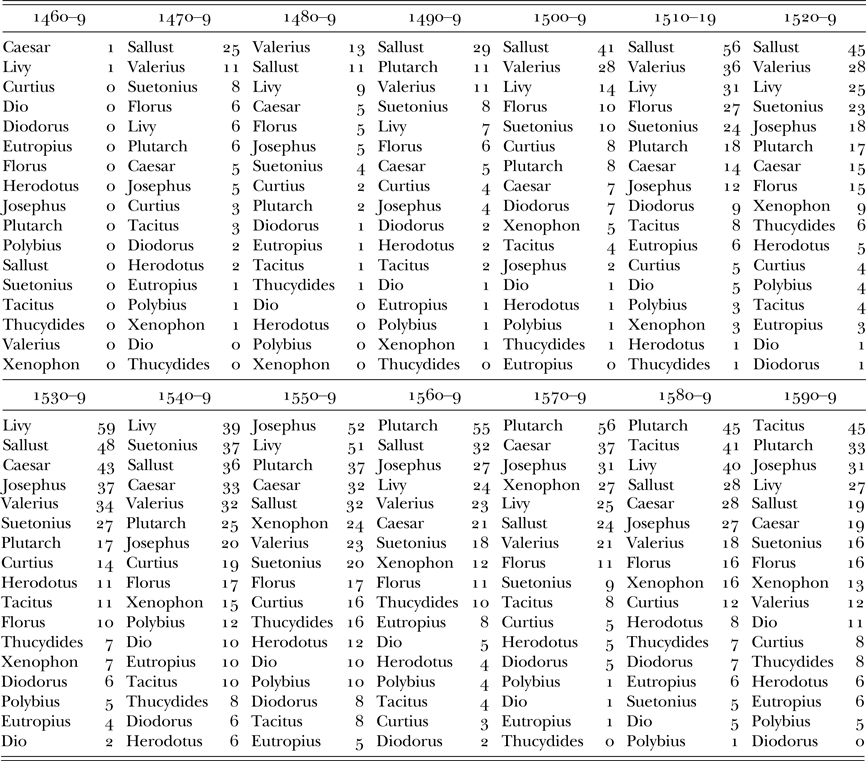
Note: Slightly fewer books are represented here, compared with Table 4, as there are a few that it has not been possible to date to a particular decade.
The languages in which histories were printed was also of interest to Burke, who compared the number of vernacular editions with editions printed in Latin and ancient Greek in order to make arguments about likely readers.Footnote 39 I have performed a similar comparison – Table 6 – adding an indication of the proportion of books circulating in the vernacular.
Number of books in the vernacular compared with Latin/Greek
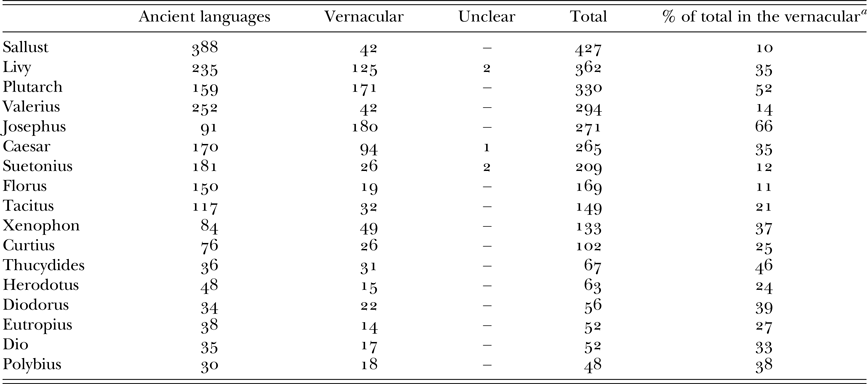
a To the nearest whole number. Given the error margin contained in the data, it should be borne in mind that the percentages should only be taken as a rough indication of the proportion translated into the vernacular, especially for the less frequently printed authors, where one edition more or less would necessarily change the percentage by a greater degree. The same is true for Table 7.
Burke then listed the top three vernacular languages for each author. The USTC indicates that these languages are almost invariably French, followed by Italian, with English, Spanish, Dutch, or German some way behind in third place, so I have not produced a table of these results. Not only are the vernaculars other than French and Italian represented in such small numbers as to render a comparison unhelpful, but the even more infrequent and interesting instances of translation into one of the eastern European languages, for example, will not be represented in such a table. Figure 3 therefore shows when a vernacular edition of part of an historian's work first becomes available for the first time.
First vernacular edition of each author, in each language.
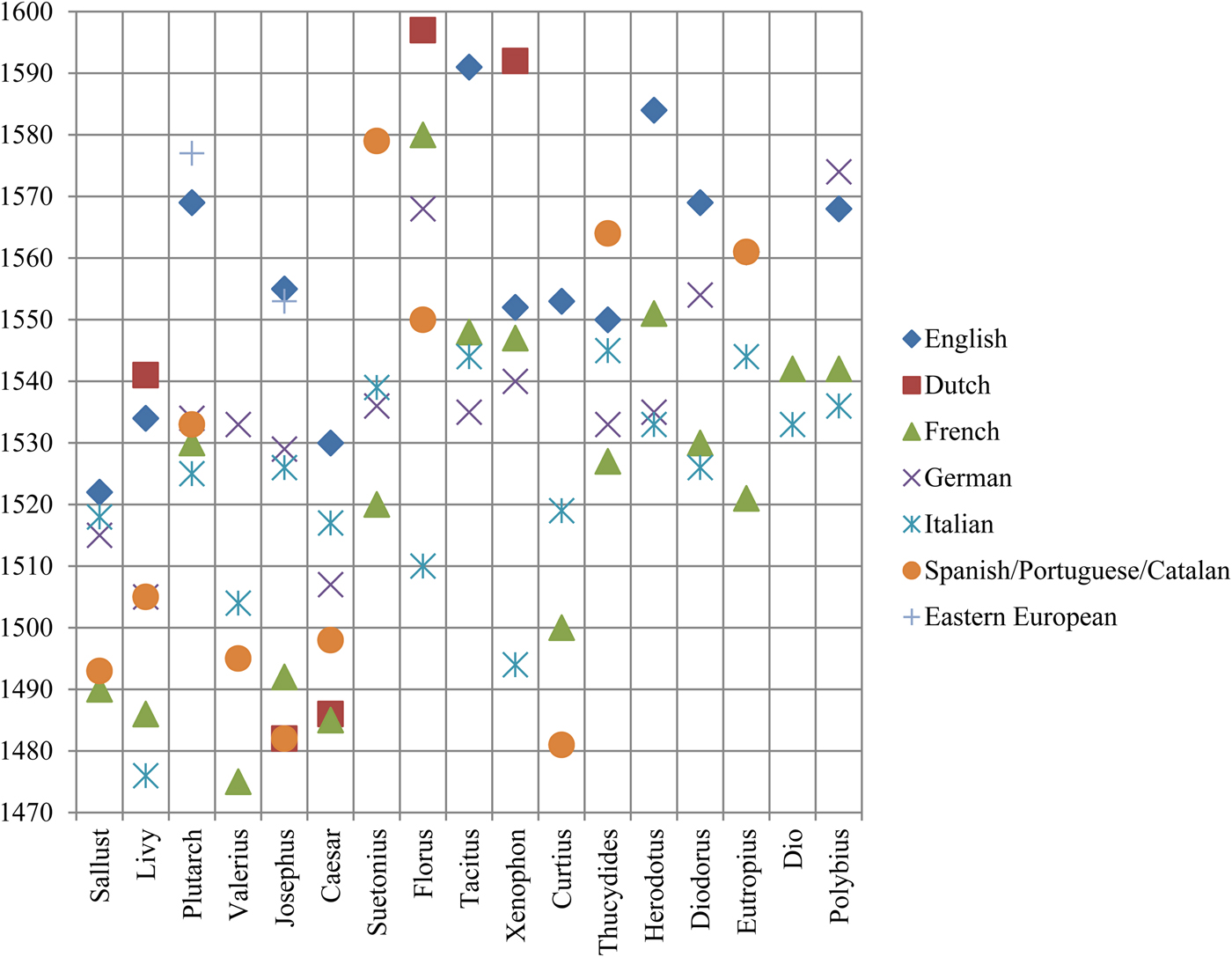
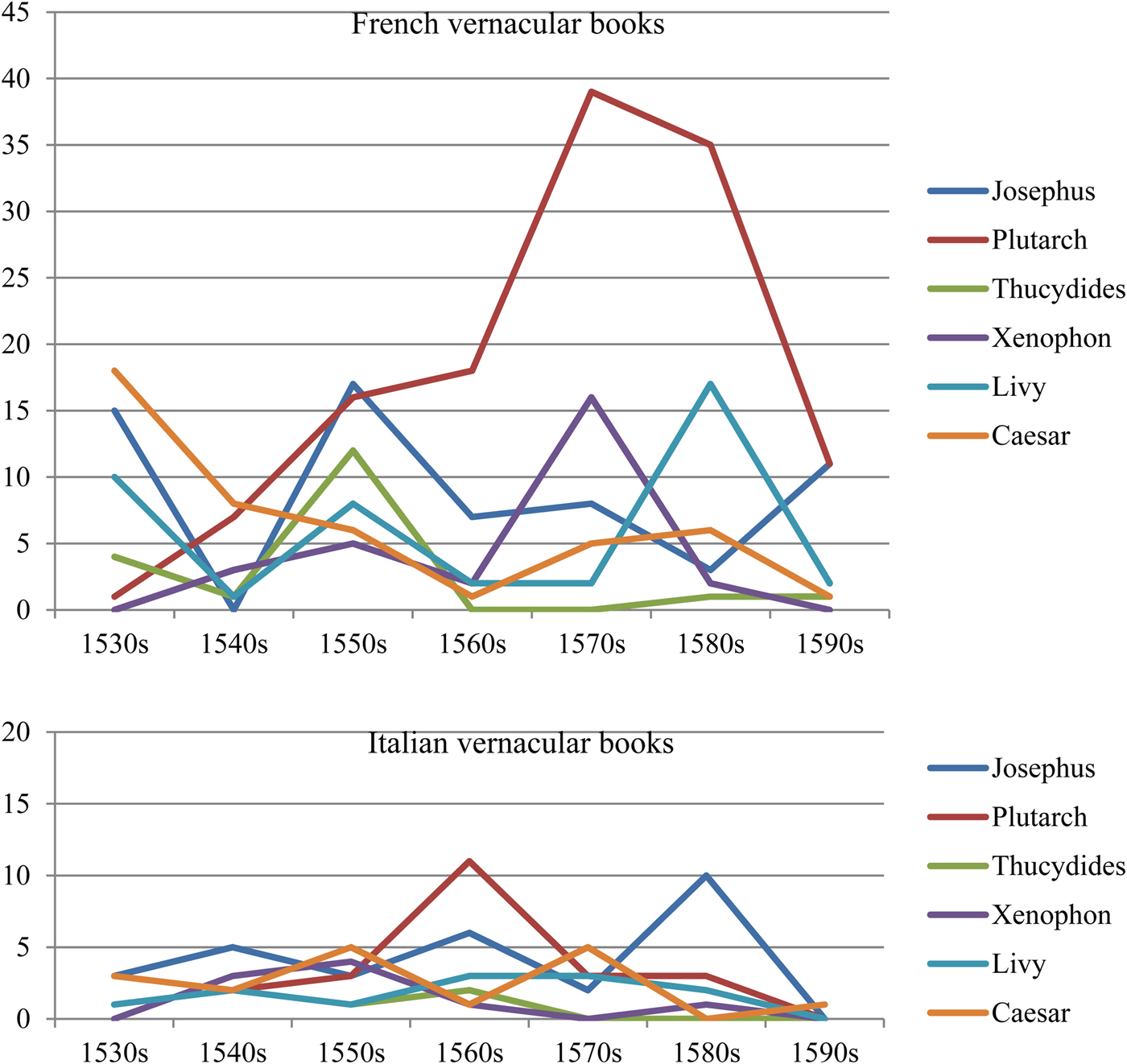
Translations into various vernacular languages were produced from the 1470s on, but it was from the 1530s that such translation began to occur in substantial quantities. The publication of ancient historians most popular in the European vernaculars is shown in Table 7. Although some authors were printed often in German, Spanish, or English, the majority of vernacular translations were into French and Italian.Footnote 40 The distribution of French and Italian books most frequently printed in the vernacular, from the 1530s, may be seen in Figure 4. The French enthusiasm for printing in the vernacular, and for translating into French, is well known, and amply supported by this evidence, while the Italian example perhaps demonstrates the legacies of the earlier Renaissance, now extended to wider audiences through the harnessing of print technology;Footnote 41 both cases also reflect the cultural appropriate of the classics as part of the strengthening of various identities in the face of confessional and territorial conflict, division, and expansion.Footnote 42 The intended purposes of these translations from the classics, and their effects, are beyond the scope of the present survey, but speak to a wide range of scholarly investigations into the relationship between vernacular translation and cultural exchange, the processes of Renaissance and Reformation, and the coalescence of linguistic and national identities throughout the early modern period, and will doubtless repay closer investigation.Footnote 43
Number of books in French and Italian vernaculars, from 1530.
The six ancient historians most popular in European vernaculars
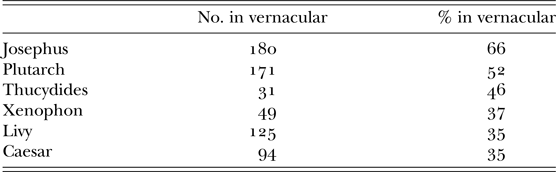
Note: I have selected those whose works appeared in more than thirty vernacular books in the period to 1599, and of whose works more than one third were printed in the vernacular. This is the assumed market share in the vernacular; since an edition size is always uncertain, it does not represent the actual market share.
V
This study has, from the outset, sought to engage with Peter Burke's 1996 ‘Survey’ in order to provide an updated set of data useful to scholars interested in the printing and publishing of the ancient historians in early modern Europe. It also serves as an example of the kind of work that digital resources like the USTC make possible, together with the advantages and challenges they pose. The exposition of similarities with and differences from Burke's findings is intended to facilitate a reappraisal of existing historiographical assertions and assumptions, and to provide an improved (if not wholly perfect) foundation for the field. To explore in detail the various implications of the new data compared with the old would take far more space than is available here, and requires sustained, critical analysis of numerous books, authors, and nations; I have therefore, like Peter Burke before me, confined myself to a brief discussion of the chief points arising, in the hope that others will use this as a starting point for further investigation.
The primary conclusion to be drawn from the results above is that the volume of the trade in ancient histories is far larger than the traditional bibliographies allow.Footnote 44 More books containing the works of the ancient historians were produced than has previously been thought; there were therefore more books containing ancient history available, and more men and women in early modern Europe had the opportunity to engage with them. Several thousand editions of the ancient historians were printed and disseminated across the continent, each amounting to at least several hundred copies. Although they do not compete with the writing of the major religious Reformers, for example, nor with the most popular classical poets, the texts of the ancient historians circulated in substantial quantities in the early modern world.Footnote 45
The five most frequently printed ancient historians of the later fifteenth and sixteenth centuries were Sallust, Livy, Plutarch, Valerius Maximus, and Josephus. Caesar and Suetonius, previously thought to be the third and fifth most-printed authors respectively, are now shown to have been the sixth and seventh most ‘popular’; significant and important, but not printed as frequently as Plutarch and Josephus. This indicates a very different picture of the taste for, and function of, ancient history in the first fourteen decades of print, from that suggested by Burke and assumed, until now, to be the case:
It will be noted that arranged in order of popularity, as measured by the number of editions, almost all the Roman historians are ahead of all the Greeks; the only exception is Eutropius. They are so far ahead that (Eutropius apart) the least popular of the Romans, Florus, is just over twice as popular as the most popular Greek history, the Antiquities of Josephus. In other words, we have here an example of the general rule that the Renaissance was predominantly the rebirth of Roman antiquity, not of Greek.Footnote 46
It is no longer possible to argue that the ‘Greek’ historians were less popular than the Romans; the popularity of Plutarch and Josephus conclusively disproves it. But the labelling of the historians as ‘Greek’ and ‘Roman’ is itself problematic. Burke apparently uses the term to refer to the languages in which the historians wrote, but given the increasing prominence of vernacular translations of the period, the difficulties of printing in Greek,Footnote 47 and the fact that the ancient histories written in Greek were more usually printed in Latin translation,Footnote 48 the definition is not always useful.
It would seem reasonable, given the preoccupation with Rome, rather than Greece, as a model for Renaissance politics and mores, to assume that Roman subject matter would be more popular than Greek content, yet this is not the distinction Burke draws. Across the whole cohort of ancient historians, Roman subject matter is generally more popular than Greek: Sallust, Livy, Caesar, along with other historians of Rome, are more popular than Xenophon, Herodotus, and Thucydides and the other historians of Greece. Once again, Plutarch and Josephus are anomalous; the extent to which their histories are ‘Roman’ is debatable. Plutarch's biographies certainly include prominent Roman figures, but each Roman life is paired with a Greek. There is no way to determine if Plutarch's Roman or Greek characters were generally of greater interest to the majority of readers; nor do the collections of smaller selections of the lives, published separately rather than as a complete work, provide any clue. Josephus's Jewish antiquities and Jewish war describe aspects of the Roman empire, but it is far from clear that early modern readers used Josephus as a source of specifically Roman history. Much of the existing evidence points to Josephus's popularity arising from the value the texts held for Christianity across the confessional divide.Footnote 49 To think of Josephus as an ancient historian qualitatively similar to non-Judaeo-Christian authors is perhaps somewhat misleading, or at the very least only captures part of his appeal for an early modern audience.
Some changes in popularity may be observed over the years to 1600. Among the authors most popular during the period as a whole, the relative popularity of Livy decreased slightly over the period, as did that of Sallust, while the relative popularity of Caesar increased a little, and Plutarch and Josephus increased greatly in popularity in the second half of the sixteenth century. Among the lesser authors, the popularity of Xenophon increased substantially, with a particular focus on printing in the years 1550 to 1579, while Curtius became slightly less popular by the end of the period, compared with the early years of the sixteenth century. The prominence of Tacitus in the final decades of the sixteenth century is, of course, well documented.Footnote 50
Is it hard to discern with any certainty the implication of these trends in publication. An increase in the number of books produced seems relatively straightforward: it represents an increase – or perceived increase – in demand for the work of that particular author, in some form, or it represents an increase in the size of the market. This might mean that the author was becoming more popular among a relatively stable group of people, or it might indicate a growth in the number of people buying books of ancient history. We know that literacy increased over the sixteenth century, as did education, and in many parts of Europe there was an improvement in the living standards of the ‘middling’ sort of people, all of which increased the number of people able to afford and read books of history.Footnote 51 The number of books produced in each half-century shows a general rise in the number of editions of the ancient authors as a group, over the period; any arguments for an increase in popularity based on an increase in the number of editions produced must therefore also take account of the general trend towards greater book production.
A decline in the number of editions produced might appear to demonstrate a decline in popularity, but this need not necessarily be the case. If the size of the market did not grow greatly, then its demands might have been satisfied by the availability of second-hand editions entering the marketplace, after their owners died, for example. A decline in the number of editions of an author's works might also indicate a saturation of the market: all the people who were interested in owning a French copy of Xenophon and were able to do so might already have access to a copy. This seems a plausible inference to draw from some of the publishing patterns, in the vernaculars, especially: a large number of books printed in French or German in one decade was often followed by one or two decades in which few appeared in those languages, suggesting that the existing stock was still being sold, and there was no demand for more.
In nearly all cases, there were more books containing the works of the ancient historians in the classical languages than in the vernacular. Authors whose original Latin texts are relatively straightforward and easily digestible – Sallust, Florus, Suetonius – were printed least frequently in the vernacular, proportionate to their global popularity, with only 10 to 12 per cent of books appearing in translation. Nor were authors whose primary function was to supply Latin phrases for recycling often printed in translation, Valerius Maximus, in particular. These are the authors who were used in schools, and who were frequently recommended for those beginning their reading of ancient history; the formal educational setting in which many of these books were being read thus goes some way to explaining the overwhelming proportion printed in Latin.Footnote 52
The exceptions, once again, are Plutarch and Josephus, of whose works more books were printed in modern languages than in Latin translation or the original classical Greek: these authors are the great anomalies of this survey. The other authors whose works circulate in the greatest proportion in the vernacular also originally wrote in Greek: Thucydides and Xenophon, Diodorus Siculus and Polybius. Given the difficulties of Greek printing, and the disproportionate risks for even the most illustrious printers of producing books in Greek, a translation would make the production of such a text easier and cheaper, as well as marketable to a broader readership.Footnote 53 The translation of Greek texts into neo-Latin formed a central part of the humanist endeavour, first in Renaissance Italy and later throughout Europe, and some vernacular translations were made via these scholarly intermediaries, presenting their impeccable scholarly antecedents as a unique selling point on the title page. Other vernacular editions were not, but existed alongside them, either as competitors or aimed at a different market, pretending less to a level of classical sophistication and erudition and instead capitalizing on the greater connection with contemporary life that a vernacular translation implied.Footnote 54
The popularity of vernacular translations of Greek histories, and the success of Plutarch and Josephus, deserve further study, representing as they do a significant means for a growing readership to interact with the classical past. In the flourishing field of translation studies, Greek texts have attracted comparatively little attention, and the focus has been chiefly on Greek works as sources for translation into Latin, as part of the recent surge in neo-Latin scholarship, and on scientific translations.Footnote 55 Book history studies have not often integrated translation into their analyses as deeply as they might, and it is only very recently that the full potential of the two areas to illuminate one another has begun to be realized.Footnote 56 Just as the popularity of ancient Greek histories suggests avenues for further inquiry, so Alexander Wilkinson's comparative survey of vernacular translation in Britain, France, and the Iberian Peninsula provides preliminary data for the investigation of the relative significance of Greek texts compared with source texts in other languages, and of histories and classical texts compared with other kinds of writing.Footnote 57 Detailed assessments of the reception of the Greek historians in print across early modern Europe seem likely to elucidate further the complexities and instabilities of translation as a cultural practice, and the role of Greek historical writing in the development of early modern society.Footnote 58
In the case of Josephus, the religious significance of the text explains why so many vernacular books were produced; reading in the vernacular would undoubtedly emphasize the contemporary relevance of a text, and make it more accessible to a greater number of readers. Other than Plutarch's juxtaposition of Greek and Roman biographies, which may perhaps have represented an ideal ‘interface’ of both ancient cultures,Footnote 59 there is no such reason for the overwhelming popularity of Plutarch's historical works in the vernacular, although his Moralia were similarly extremely successful, especially in France; the Lives contain some moral comment sympathetic to Christian ideas of virtue and vice, but the same can be said of other authors whose works were nowhere near as popular in the vernacular. Since French translations account for nearly 75 per cent of the total ‘histories’ by Plutarch in all vernaculars, it is clear that there was a special relationship between Plutarch and the French, and an especially strong market for vernacular histories more widely in France; it was the popularity of the translations of Claude de Seyssel and George de Selve in the first half of the sixteenth century, followed by the immense success of Amyot's translation which first appeared in 1559, that accounts for the trends in the statistics.Footnote 60 That some French translations were made at second- or third-hand, from Latin texts that had been translated from the Greek, does not seem to have detracted from the popularity of these texts; if anything, it seems to have added an extra element to a work's pedigree.Footnote 61 French vernacular translations, then, are a special case, fulfilling a different function from other books in more ways than the merely linguistic. Translations into other vernaculars, and the ways in which these books are described and advertised on their title pages, possess a qualitatively different character. This is sometimes true, too, of Latin books produced in particular cities; the Italian books, for example, differ in nature from those produced elsewhere. Is this a product of the southern, rather than the northern, Renaissance, and particular networks of producers? Are the differences in printing fashions the result of trade conditions and practices, or reflective of two, or more, traditions of scholarship and culture in Europe? There are certainly correlations between the editors of particular editions, and the location of printing, and it is likely that other distinctive characteristics of the physical books produced in certain places might be instructive as to regional variations not only in taste or in printing traditions, but also in reading practices.
Burke uses translators’ assertions in their prefaces to infer an expected audience for a particular work; he also assumes that translators and their readers will share similar backgrounds and interests.Footnote 62 And he believes that there is a difference between vernacular and ancient-language editions, and the people reading them are not the same:
If Curtius and Tacitus rise in popularity at the same time, this does not necessarily mean that they rise in popularity with the same people. A preliminary hypothesis is that those who read the books in Latin or Greek (usually in Latin) will be found to have had different tastes from those who read the books in vernacular translations. So it turns out.Footnote 63
I have implied above that this is partially true, but it is not possible to prove it; nor do I think it is always the case. A closer analysis of the physical nature of the various books is necessary in order to be able to estimate the likely cost of particular editions, and therefore their likely consumer. In order to determine whether the ancient histories functioned in similar ways, in different vernacular translations, the nature or quality of the books must be known. The 1570s saw the production of eight books of Josephus in the French language, for example, three in folio, and the rest in octavo; the 1570s also saw fifteen books of Josephus printed in German, of which only the first, printed in 1570, was in octavo. The rest, printed consistently throughout the decade, were folio editions, and were thus certainly intended for a different purpose, which is to say a different market, from the French octavo translations. As the sixteenth century progressed and education improved, a greater number of people were able to read, both in Latin and the vernacular, and only in the vernacular. More people could read in the vernacular than could read Latin and Greek, and vernacular editions were undoubtedly accessible to more people than original-language editions.Footnote 64 However, vernacular editions also provided a ‘short cut’ to classical learning for those who possessed reading ability in Latin and Greek, but for whatever reason chose to read in their native language. Once a man left formal education, his need to use Latin on a daily basis lessened, as daily life was conducted in the vernacular; vernacular editions thus represented an easier way to consume the classics, more similar to the daily practices of most people. Moreover, there are other reasons why vernacular editions might be preferable, even among an audience more than capable of reading in Latin or Greek: reasons of status or fashion, reasons to do with prestige and being seen to own a culturally significant or relevant book, and the creation of national literatures.Footnote 65
In the absence of any convincing method by which to survey comprehensively the reading and reception of ancient histories, the study of the marketing of these books, and thus of the publishers’ perception of their likely or intended reception, is a useful alternative. Individual case-studies of particular readers at certain moments in time can shed valuable light on the practices of extraordinary or identifiable men and women, but it is only through examining the production of these books that we can begin to generalize. Many features of the physical nature of a book are the result of decisions that would now be thought of as product design and marketing, including the content, phrasing, and layout of the title page, and the size and quality of a book. Burke's survey discusses the reputation of several ancient historians in a series of case-studies, in order to determine why certain authors enjoyed the popularity they did, or why they failed to attain greater significance. Much work has been done since then on the place of particular ancient historians in early modern Europe, but so far, less attention has been paid to the way that the reputations of individual authors were constructed by, and reflected in, the physical attributes of the books in which their works appeared.Footnote 66 The use of print technology to disseminate a particular version of history marks the point at which marketing becomes visible, as a tool for selling the new product. The appearance of a text, or edition of a text, in printed form rather than as a scribal publication, is the first time it is offered to a true mass market, and the first time a publisher has taken the risk of investing in the production of a large excess. Marketing can provide clues as to the envisaged consumers of a book: for whom was the book intended, for what purpose, and, perhaps, for people in which area? When new and different editions entered the marketplace, rather than reprints of older editions, the publishers must have intended something different, either in terms of product, or in terms of market, otherwise there would be no reason to invest extra money in the production of something new; claims to novelty, either truthful or disingenuous, were used to market these editions more effectively. A study of when new editions of the works of the ancient historians enter the marketplace therefore seems likely to offer an insight into changing patterns of use, or taste, in a more detailed way.
The combination of works in multi-authored books, and their advertisement – or not – on the title page is of significance here, as is the selection of episodes from particular authors’ histories. Some editions of Diodorus selected the Trojan War for presentation in the book, others the life of Alexander, but the title pages did not always make it clear precisely what was included. Livy's history was often published with Florus's epitome of that work, for example, but editions of Florus's epitome were usually advertised using Livy's name, even when Livy's text was not contained in the book.Footnote 67 Livy's marketing potential was therefore clearly far greater than that of Florus, to the extent that publishers misled customers about the content of the product being sold. Editions of Eutropius that were enlarged and continued by Diaconus and then by Sagax were printed with Eutropius's name on the title page in varying degrees of prominence.Footnote 68 Readers who read the text within would therefore consume the work of Eutropius, but the book had sometimes been marketed with only minimal reference to that fundamental source. What people thought they were buying, or what publishers and printers chose to tell people they were buying, is therefore not always identical with the real nature of the books; it is something this survey does not capture, but which would profit from further investigation.
Burke's survey of the popularity of ancient historians includes the authors published most frequently during the early modern period, as they appeared in his sources. The USTC reveals new patterns of popularity for the authors in Burke's study; it is therefore reasonable to infer that there are other authors equally worthy of consideration, who may have been printed more often than Dio or Polybius, for example. Other ancient historians were printed and read in the fifteenth and sixteenth centuries, and their significance, numerically at least, will only become apparent if they are compared with the classical historians of Greece and Rome Burke chose for his study. Authors such as Appian, Aurelius Victor, and Ammianus Marcellinus also wrote the history of ancient Rome, to name but three among many.
A larger survey is therefore required in order to reach an accurate, global picture of the publishing of ancient histories in early modern Europe. A re-evaluation of the kinds of authors included may also reveal additional, nuanced insights for our understanding of early modern engagement with the ancient past. The definition of ‘history’ has, to some extent, dictated the authors selected for Burke's study, yet the precise nature of such a definition is inherently subjective. Strictly speaking, according to the definitions used in the ancient world in which they were produced, not all the texts are histories, and not all the authors are historians. History, in the narrowest sense, charted the changes in states and constitutions over long swathes of time, as in the works of Tacitus and Livy. Caesar, on the other hand, wrote commentarii, precise records of military campaigns prepared from his field notes by the commander in charge.Footnote 69 Plutarch and Suetonius wrote biographies, accounts of the lives of prominent men with a strong moral element often taking the place of historical details.
An early modern definition of ‘history’ was rather broader than the one understood in the ancient world, and wider, too, than the academic understanding of the term today. Any writings about the past that told the stories of the deeds of men as part of an inquiry into the real or truthful nature of things could count as ‘history’ in the early modern world.Footnote 70 The distinction between ‘literature’, in modern terms, and history, was far from clear, and history could encompass many forms of writing. Burke thus counted Plutarch, Suetonius, and Caesar among the ancient historians; after all, much can be learned from their texts about ancient Greece and Rome. Much can also be learned from a more ‘literary’ text like Lucan's Pharsalia, which presents for his readers the constitutional struggle between Caesar and Pompey; epic poetry it may be, but it is historical writing, too. If Valerius Maximus is included among the historians, then Aulus Gellius, another commonplacer, perhaps deserves a place there too? I have chosen not to count him among the historians, since his Attic nights covers a far wider range of topics than the Words and deeds of Valerius Maximus, which focuses on the actions and words of prominent historical figures, but others might choose to include Gellius, and maybe also Pliny the Younger, or indeed the Elder. And since Livy's history contains some elements of the mythic, it therefore seems reasonable to consider the works of Dares and Dictys as qualitatively similar works.Footnote 71
The ‘ancient historians’ could therefore be taken to be all those whose works aimed primarily to provide their readers with historical information about ancient Greece or Rome, whatever form that work might take. The difficulty in defining the limits of a larger, more inclusive study then becomes a matter of periodicity: how late in antiquity should we look for our authors and their subject matter? And an appreciation of the generic differences between the various works, in combination with a broader survey of their popularity, would allow a more subtle interrogation of the tastes of early modern readers: how did people like their history?
I have suggested in Table 8 an expanded list of ancient historians, with their relative popularities, to 1600. The finer details of their fortuna, and the implications thereof for our understanding of early modern history and culture, are subjects for another discussion.
Number of books of more ancient ‘historians’, 1450–1599