


Introduction
Due to improvements in acute stroke treatments and systems of care more people are surviving after stroke in the past two decades. Reference Schmidt, Jacobsen, Johnsen, Bøtker and Sørensen1–Reference Giang, Björck and Nielsen5 The drop in case fatality, in addition to the aging population, means that the absolute number of people with stroke and associated co-morbidities is increasing worldwide. Reference Krishnamurthi, Feigin and Forouzanfar6 A high proportion of people with stroke have one or more co-morbid conditions, particularly in older individuals. Reference Feigin, Lawes, Bennett and Anderson7–Reference Gallacher, Batty and McLean9 Higher co-morbidity may lead to worse outcomes through impaired baseline functional status, Reference Kilkenny, Phan and Lindley10,Reference Stewart, Greenfield and Hays11 greater stroke severity, poor stroke recovery, or other mechanisms. Reference Gallacher Katie, Jani Bhautesh, Peter, Nicholl Barbara and Mair Frances12 However, there is a paucity information on co-morbidity and functional outcomes after stroke, particularly in population-wide studies. Reference Gallacher Katie, Jani Bhautesh, Peter, Nicholl Barbara and Mair Frances12 A systematic review with predominantly hospital-based cohorts concluded that multiple chronic conditions were associated with worse post-stroke functional outcomes although there was high heterogeneity and population-based studies were found to be lacking. Reference Jiang, Morgenstern, Cigolle, Claflin and Lisabeth13
The impact of co-morbidity on stroke functional outcomes is important to understand to better direct health care service delivery and provide appropriate care to those with co-morbidity at higher risk of poor outcomes. Reference Gallacher Katie, Jani Bhautesh, Peter, Nicholl Barbara and Mair Frances12 In population-wide studies, obtaining functional outcomes such as the modified Rankin Scale is not feasible. Home-time is a novel patient-prioritized global outcome for stroke defined as time alive and at home in a prespecified time period after stroke. Reference Quinn, Dawson and Lees14–Reference Groff, Colla and Lee17 It is highly correlated with mRS, is valued by patients and their caregivers, and can be obtained from administrative datasets. Reference Yu, Rogers and Wang18,Reference Shah, Xian and Olson19
We have previously shown that severe co-morbidity is associated with higher mortality after stroke, particularly in younger individuals. Reference Joundi, King and Stang20 We sought to evaluate whether the impact of co-morbidity and its age dependence extends to home-time as a surrogate of functional outcome. We conducted a large population-wide study using administrative data to determine the association between co-morbidity and 90-day home-time after stroke and assess potential differences with age.
Methods
Data source and participants
The study was conducted using data from the province of Alberta, Canada from 2007–2018 inclusive. The adult population of Alberta in 2018 was 3,340,585. We obtained data from linked administrative databases of Alberta Health, a government ministry that provides universal health care coverage to more than 99% of residents. The administrative health databases were linked deterministically by use of the unique personal health number.
Study sample and administrative data sources
We used the Discharge Abstract Database (DAD) and the National Ambulatory Care Reporting System (NACRS) to identify all first episodes of acute ischemic stroke or intracerebral hemorrhage (ICH) in Alberta between years 2002 and 2018 using International Statistical Classification of Diseases and Related Health Problems, Tenth Revision, Canada codes [ischemic stroke: I63.x (excluding I63.6), I64.x, H34.1; ICH: I61.x]. We included people with hospital admission only. Stroke hospitalization codes were obtained from the most responsible diagnosis position and have excellent positive predictive value for stroke in Canada. Reference Porter, Mondor, Kapral, Fang and Hall21 Information on long-term care was obtained from the Provincial Continuing Care Information System and on rehabilitation from the National Rehabilitation System. The Canadian Vital Statistics Death Database was used to identify deaths.
We excluded patients < 18 or > 105 years of age, those with elective admissions, and those with in-hospital stroke. We excluded individuals who were not registered in the Alberta Provincial Registry during the year of index stroke and the previous two years to ensure we did not include individuals with a recent stroke in another jurisdiction. We excluded individuals with a prior diagnosis of stroke in a 5-year washout period between 2002-2006 to increase the proportion of patients with true incident or first-ever stroke. See Supplemental Figure 1 for study flowchart.
Charlson Co-morbidity Index
The Charlson Co-morbidity Index (CCI) was originally developed as a weighted index of co-morbid conditions extracted from data entered into hospital medical records. The conditions are weighted on the basis of 1-year mortality and summed to give a total score. Reference Charlson, Pompei, Ales and MacKenzie22 More recently, the CCI has been adapted to ischemic stroke in a contemporary cohort and was calculated for this analysis. The new index re-assigned 7 of the weights and is more parsimonious with 10 variables instead of 17, with a small but significant increase in predictive accuracy for 30-day mortality. Reference Hall, Porter, Quan and Reeves23 We calculated the ischemic stroke-weighted CCI with co-morbidities in the 3 years prior to stroke hospitalization using validated algorithms (Supplemental Table I). Co-morbidities included were myocardial infarction, congestive heart failure, dementia, chronic obstructive pulmonary disease, rheumatologic disease, diabetes with chronic complications, primary cancer, and metastatic solid tumor. We excluded cerebrovascular disease and hemiplegia, similar to other studies in stroke. Reference Schmidt, Jacobsen, Johnsen, Bøtker and Sørensen1,Reference Goldstein, Samsa, Matchar and Horner24,Reference Denti, Artoni, Casella, Giambanco, Scoditti and Ceda25 Post-admission co-morbidities for the index stroke admission were not included. As hypertension and atrial fibrillation are not included in the CCI, we obtained information on these co-morbidities separately. The CCI was categorized as 0–2 and 3+ in the main analysis, where 3+ was considered severe co-morbidity as it was above the 75th percentile and similar to the proportion with severe co-morbidity in other studies. Reference Schmidt, Jacobsen, Johnsen, Bøtker and Sørensen1
Stroke severity (PaSSV)
Stroke severity was estimated for hospitalized patients using the Passive Surveillance Stroke Severity Indicator (PaSSV), Reference Yu, Austin and Rashid26 which was calculated from 12 variables extracted from the chart by administrative coders and available at hospital presentation or admission (NACRS and/or DAD): age, sex, triage score, arrival by ambulance, transfer to a stroke center, ataxia, decreased level of consciousness, mechanical ventilation within 2 days, and speech, visual, motor, or sensory symptoms. PaSSV was previously validated against observed stroke severity using data from the Ontario Stroke Registry and in Alberta, Canada. Reference Yu, Austin and Rashid26,Reference Joundi, King and Stang27 We used coefficients that allowed estimation of Canadian Neurological Scale (see Supplemental Table II for more information on variable derivation and coefficients).
Co-variates
Administrative databases were used to obtain age, sex, stroke type, hypertension, and atrial fibrillation. There are two comprehensive stroke centers in Alberta, and we identified whether patients had been admitted or transferred to a comprehensive stroke center at any time during their episode of care.
Home-time
As per previously published methods, home-time was defined as the number of nights spent in the premorbid living setting, whether it was the patient’s own home or that of a relative, with or without home care services, within 90 days of the index episode of care (from first presentation to ED). Reference Yu, Rogers and Wang18 Higher home-time (i.e., more time at home and less in healthcare institutions) has been shown to be associated with lower global disability after stroke. Reference Yu, Rogers and Wang18 Time spent home was inferred when nights were not recorded as being spent in some form of care, including hospitalization, rehabilitation, or long-term care. Return to pre-stroke living situation if the patient was a residence in a long-term care setting was counted as being home. A home-time of zero days indicates inability to return to home due to death, prolonged hospitalization, or new long-term care placement. Patients who died in hospital after the index stroke have a home-time of zero days by definition.
Outcomes
Our primary outcome was 90-day home-time in days. For the analysis, we focussed on the difference in home-time between those with and without severe co-morbidity. Our secondary outcomes were: (1) 1-year home-time, and (2) probability of achieving a home-time threshold of ≥ 80 days within 90 days of the index event (correlating with modified Rankin Scale score 0–1). Reference Yu, Rogers and Wang18
Statistical analysis
We stratified baseline characteristics by CCI group and age group (18–59, 60–69, 70–79, and 80+ years). We reported the mean home-time by age group and sex in those with and without severe co-morbidity. We explored differences in home-time by group graphically. Due to the large number of individuals with zero days of home-time and consequent bucket-shaped distribution, our main analysis was conducted with zero-inflated negative binomial regression. Reference Yu, Fang, Porter, Austin, Smith and Kapral28,Reference Holodinsky, Yu, Kapral and Austin29 Zero-inflated regression simultaneously models the probability that an observation belongs to a latent class that only produces zeroes (zero-inflated model), and that it belongs to a latent class with a negative binomial distribution (count model). Reference Lambert30–32 This method attributes the generation of zeroes to two possible processes; in the case of home-time a value of zero would be attributed to either death before arriving home or remaining in care institutions for 90 or more days.
The main exposure in the zero-inflated model was severe co-morbidity (CCI score 3 + vs. 0–2) and the outcome was 90-day home-time. We included interaction terms between severe co-morbidity and age or sex to assess for modification. We considered effect modification to be present if the p-value for interaction was < 0.05 for either the zero-inflated or count portion of the model, comparing the effect of severe co-morbidity in the 80+ with the < 60 age group. There was significant effect modification by age, but not sex, so the interaction term for age remained in the model. The main models were adjusted for sex, stroke type (ischemic vs. ICH), center type (comprehensive vs. non-comprehensive stroke center), hypertension, atrial fibrillation, and year of study. We additionally adjusted for PaSSV (estimated stroke severity) and pre-stroke supportive living or long-term care in separate models. We plotted the predicted mean difference in home-time days between those with and without severe co-morbidity, by age group. We also calculated the overall (non-age-stratified) association of co-morbidity with home-time.
In secondary analyses we evaluated the impact of severe co-morbidity on predicted probability of ≥80 days of home-time (within 90 days) using logistic regression models, and on 1-year home-time using zero-inflated models. We also assessed whether individual co-morbidities in the CCI were associated with 90-day home-time and if the association was modified by age, while adjusting for the same factors above, as well as all other co-morbidities and PaSSV. Lastly, we evaluated the impact of diabetes without chronic complications (not included in the ischemic stroke-weighted CCI) and all diabetes (with or without chronic complications).
All analyses were done using Stata 17.0 (College Station, TX).
Results
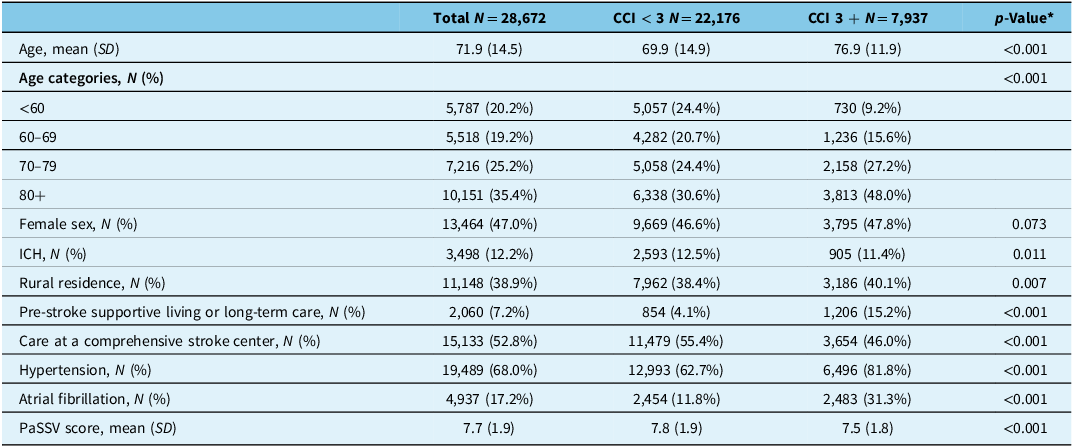
Our final cohort consisted of 28,672 patients, of whom 87.8% had ischemic stroke. Mean age was 71.9 (standard deviation 14.5), and 47.0% were female. Baseline characteristics stratified by CCI < 3 and 3 + are shown in Table 1 and baseline characteristics stratified by age group are shown in Supplemental Table III. Severe co-morbidity was present in 27.7% of individuals. Those with severe co-morbidity were older, more likely to have ischemic stroke, less likely to have care at a comprehensive stroke center, and had higher estimated stroke severity (Table 1). There were 4,804 individuals (16.8%) who died within 90 days.
Baseline characteristics and outcomes stratified by CCI < 3 and 3+

ICH = intracerebral hemorrhage; CCI = Charlson Co-morbidity Index; PaSSV = Passive Surveillance Stroke Severity Indicator (lower score indicates greater estimated stroke severity); SD = standard deviation.
* P-value from Pearson’s chi-squared test for categorical variables and t-test for continuous variables.
The distributions of home-time for all age groups with and without severe co-morbidity are shown in Figure 1. Home-time had the expected bimodal distribution with peaks at 0 days and ≥ 80 days. The difference in home-time comparing those with and without severe co-morbidity was most apparent in those < 60 years, with a larger decrease in proportion of home-time ≥80 days and an increase in home-time of 0 days compared to those 80+ years. Unadjusted mean home-time was lower in those with severe co-morbidity and those at older age, but the difference in those with and without severe co-morbidity was greatest at younger age (Fig. 2). Mean home-times for each age group, with and without severe co-morbidity and the individual co-morbidities are shown in Supplemental Table IV; the lowest home-time was seen in those age 80+ with dementia. Men and women had similar reductions in home-time with severe co-morbidity (Supplemental Table V).
Ninety-day home-time stratified by age group, with (maroon) and without (blue) severe co-morbidity (CCI 3+). CCI = Charlson Co-morbidity Index.

Mean and 95% confidence intervals of 90-day (A) and 1-year (B) home-time by age group, with (dark maroon) and without (light maroon) severe co-morbidity. The difference in home-time with severe co-morbidity was larger at younger age. CCI = Charlson Co-morbidity Index.

In the zero-inflated models, there was a significant interaction between severe co-morbidity and age (Fig. 3), but not sex. Younger age groups had the greatest adjusted reduction in 90-day home-time with severe co-morbidity compared to no severe co-morbidity, with an adjusted mean difference of −13.3 days (95% CI −16.7 – −10.0) at age < 60, −12.3 days (95% CI −15.0 – −9.6) at age 60–69, −11.0 days (95% CI −13.1 – −8.9) at age 70–79, and −7.7 days (95% CI −9.3 – −6.2) at age 80+ (Fig. 3A). There was a similar age-dependent association of severe co-morbidity with home-time at 1 year (Figure 3B), with an adjusted mean difference of −69.0 days (95% CI −84.1 – −53.9) at age < 60, −64.0 days (95% CI −76.4 – −51.6) at age 60–69, −62.7 days (95% CI −72.5 – −53.0) at age 70–79, and −51.4 days (95% CI −58.1 – −44.7) at age 80+. In adjusted logistic regression models for home-time ≥ 80 days (out of 90), there was again a significant interaction between severe co-morbidity and age (Fig. 3C). Severe co-morbidity was associated with greater reduction in probability of achieving ≥ 80 days of home-time at younger age. The change in probability was −22.7% (95% CI −26.4 – −19.0) in those < 60 years, compared to −18.0% (95% CI −21.0 – −14.9) at age 60–69 years, −16.0% (95% CI −18.3− −13.7) at age 70–79, and −9.0% (95% CI −10.6 – −7.4) at age 80+ years.
Adjusted mean difference in home-time with 95% confidence intervals between those with and without severe co-morbidity (CCI 3+), stratified by age group. Those at younger age have greater reduction in 90-day home-time (A, D), 1-year home-time (B, E), and probability of ≥80 days of home-time within 90 days (C, F) in the presence of severe co-morbidity. Models adjusted for sex, stroke type, comprehensive stroke center admission, hypertension, atrial fibrillation and year of study in A–C, and additionally adjusted for PaSSV (estimated stroke severity) in D–F. P-interaction show the p-value for interaction between age and severe co-morbidity for the zero-inflation and the count portion of the zero-inflated model (A,B,D,E) and for the logistic model (C,F). CCI = Charlson Co-morbidity Index; PaSSV = Passive Surveillance Stroke Severity Indicator.

When adjusting for PaSSV, there was attenuation in the age interaction such that differences between age groups for 90-day and 1-year home-time were reduced. However, all groups still had substantially lower home-time with severe co-morbidity (Fig. 3D–F). Adjusting for pre-stroke supportive living or long-term care made negligible change to the estimates (results not shown). When excluding people who died, the age interactions were similar (Fig. 4). While the overall impact of severe co-morbidity on home-time was reduced, as the impact on death (0 home-time days) was removed, the association with lower home-time remained significant in all age groups. All model estimates, overall and age-stratified, are presented in Supplemental Table VI.
Adjusted mean difference in home-time with 95% confidence intervals between those with and without severe co-morbidity (CCI 3+), stratified by age group, excluding those who died within 90 days. Models adjusted for sex, stroke type, comprehensive stroke center admission, hypertension, atrial fibrillation and year of study in A–C, and additionally adjusted for PaSSV (estimated stroke severity) in D–F. P-interaction show the p-value for interaction between age and severe co-morbidity for the zero-inflation and the count portion of the zero-inflated model (A,B,D,E) and for the logistic model (C,F). CCI = Charlson Co-morbidity Index; PaSSV = Passive Surveillance Stroke Severity Indicator.

When co-morbidities were analyzed individually, those that demonstrated age modification (greater impact in younger compared to older patients) were myocardial infarction, diabetes, cancer/metastases, and congestive heart failure (Fig. 5A–E). Heart failure and pulmonary disease were associated with slightly lower home-time but there was no age modification (Fig. 4D–E). Dementia had no age modification but showed the greatest reduction in home-time overall among all the co-morbidities (−13 days; Fig. 4F). Rheumatic fever had no age-specific or overall association. Results were similar after excluding those who died within 90 days, except for cancer where the association was lost (Supplemental Figure 2). Results were also similar for diabetes without complications and all diabetes (Supplemental Figure 3). All estimates shown in Supplemental Table VII.
Adjusted mean difference in 90-day home-time with 95% confidence intervals for different co-morbidities. There is age modification for myocardial infarction (A), diabetes (B), or cancer/metastases (C). There was no significant age modification of heart failure, pulmonary disease, or dementia, but an overall lower home with these co-morbidities (D–F). Dementia was associated with the greatest reduction in home-time. Models adjusted for sex, stroke type, comprehensive stroke center admission, hypertension, atrial fibrillation year of study, and PaSSV (estimated stroke severity). Due to small proportion with dementia in the < 60 years of age group (1%), the < 60 and 60–69 years of age groups were combined. PaSSV = Passive Surveillance Stroke Severity Indicator.

Discussion
We conducted a large population-based study of severe co-morbidity and its age-dependent association with home-time in acute stroke. Severe co-morbidity was independently associated with lower home-time, and this association was strongest in younger individuals. In those under 60 years of age, the presence of severe co-morbidity was associated with approximately 13 less days at home within 90 days after stroke and 69 less days at home within 1 year after stroke, compared to 7 days and 51 days, respectively, for those age 80 years and over. Our findings highlight the importance of co-morbidity in home-time, a patient-prioritized global outcome, particularly among younger individuals.
Prior studies have demonstrated an association between co-morbidity burden and mortality after stroke. Reference Schmidt, Jacobsen, Johnsen, Bøtker and Sørensen1,Reference Joundi, King and Stang20,Reference Saposnik, Hill, O’Donnell, Fang, Hachinski and Kapral33–Reference Bushnell, Lee, Duncan, Newby and Goldstein36 However, information on co-morbidity and functional outcomes is sparse. Co-morbidity is associated with worse functional outcomes after stroke in registry and hospital-based cohorts. Reference Jiang, Morgenstern, Cigolle, Claflin and Lisabeth13,Reference Sennfält, Pihlsgård, Petersson, Norrving and Ullberg37 A systematic review and meta-analysis confirmed that co-morbidity was associated with worse functional outcome after stroke, but there was high heterogeneity and population-based studies were lacking. Reference Jiang, Morgenstern, Cigolle, Claflin and Lisabeth13 More detailed understanding of co-morbidity in stroke is needed on a population level, particularly as it impacts on clinical and patient-centered outcomes. Reference (Ryc) Aquino M.R.J., Turner and Mant38 We used home-time as a surrogate for functional outcome as it is patient-centered, obtained through population-based administrative data linkages, and correlates strongly with modified Rankin Scale score. Reference Yu, Rogers and Wang18 Severe co-morbidity was associated with lower home-time overall, and individual co-morbidities with the strongest association were dementia, heart failure, and diabetes. Younger individuals had greater reductions in home-time at 90 days and 1 year compared to older individuals in the presence of severe co-morbidity, and the difference persisted after adjustment. Due to recent reports of rising incidence of vascular risk factors and stroke in younger individuals, Reference Krishnamurthi, Feigin and Forouzanfar6,Reference Kissela, Khoury and Alwell39–Reference Joundi, Smith, Yu, Rashid, Fang and Kapral42 there is increasing importance of understanding stroke outcomes in the young with co-morbid conditions.
We recently showed in the same cohort that co-morbidity was associated with increased mortality, with a higher hazard ratio at younger age. Reference Joundi, King and Stang20 Therefore, we conducted analyses excluding death to ensure that the impact on home-time was not solely driven by mortality. We found that while the magnitude of reduction in home-time was lessened, it remained significant and the gradient across age remained similar. When examining individual co-morbidities, myocardial infarction, cancer and diabetes showed age-dependent gradients. There are multiple possibilities for the strengthening of associations between co-morbidity and home-time with younger age. First, severe co-morbidity may impact functional outcome through the use of hyperacute stroke treatments or secondary prevention medications, the increased complexity of care, disparities in multidisciplinary care provision, polypharmacy, ability to self-manage, or biological mechanisms such as brain inflammation. Reference Gallacher Katie, Jani Bhautesh, Peter, Nicholl Barbara and Mair Frances12,Reference Drake, Boutin and Jones43,Reference Noël, Frueh, Larme and Pugh44 For example, diabetes may mitigate the benefits of acute stroke therapies. Reference Jean-Philippe, Elena and Julien45 Due to the overall better outcomes at younger age after stroke, it is possible that disruption in pathophysiology, treatments, or care pathways exerts a greater relative impact than at older age. Second, co-morbidities can impact on rehabilitation and recovery through greater anxiety and depression, Reference West, Hill, Hewison, Knapp and House46 and younger patients are more likely to experience depression and anxiety than older patients. Reference Kapoor, Si and Yu47 Third, multiple additional phenomena may account for the attenuation of association in the elderly, including floor effects as the mean home-time in the elderly is already low, selective survival resulting in resistance to the impact of co-morbidities, or competing causes of death and poor outcome. Reference Kaplan, Haan and Wallace48 It is worth noting that although the relative impacts of co-morbidities are greater at younger age, those at older age still have far lower absolute home-time, compatible with prior studies showing worse outcomes in older individuals. Reference Fonarow, Reeves and Zhao49 For example, the mean home-time was 36.8 in those in those aged 80+ years without dementia, and 24.3 with dementia, compared to 60.1 and 37.7 at age < 70 years. The smaller reduction at older age may be due to floor effects or the longer length of stay and higher rate of discharge to long-term care among this group regardless of dementia status due to frailty, stroke severity, and other contributing co-morbidities.
A strength of the study is the use of administrative data to evaluate home-time in a large, population-wide cohort within a universal health care system. This enhances generalizability as approximately 47% of the cohort was from non-comprehensive centers and 39% were living in a rural area. This also ensured no missing data for co-morbidities or home-time. However our study has some limitations. First, our study relied exclusively on administrative data linkages, however diagnosis of stroke admissions using administrative data in Canada has a high positive predictive value. Reference Porter, Mondor, Kapral, Fang and Hall21 Second, we could not capture co-morbidities such as dyslipidemia or smoking status reliably through administrative data, although our focus was on the burden of co-morbidities as measured by the CCI previously shown to be associated with mortality, rather than stroke risk factors. Reference Yu, Austin and Rashid26,Reference Jiménez Caballero, López Espuela, Portilla Cuenca, Ramírez Moreno, Pedrera Zamorano and Casado Naranjo35 Third, dementia is likely under-coded in administrative data, particularly for mild cases. Reference Quan, Li and Duncan Saunders50 Fourth, there are likely to be many unmeasured confounders, the most important of which is stroke severity. However we adjusted for an estimate of stroke severity with a validated approach using administrative data, Reference Yu, Austin and Rashid26 and residual confounding by stroke severity is unlikely to be age-dependent. Fifth, we could not reliably capture the use of acute stroke therapies using administrative data sources.
In summary, severe co-morbidity is associated with lower home-time after acute stroke, particularly in younger people. The lower home-time in people with co-morbidity may impact quality of life and health care costs. These findings reflect the need for additional research to understand the drivers and consequences of co-morbidity after acute stroke across the lifespan.
Supplementary material
The supplementary material for this article can be found at https://doi.org/10.1017/cjn.2024.37.
Acknowledgments
AYXY holds a National New Investigator Award from the Heart & Stroke Foundation of Canada and holds grants unrelated to this study from Heart & Stroke Foundation of Canada, Canadian Institutes of Health Research, Health Data Research Network Canada, and Physician Services Incorporated. MDH was a DSMC Chair of the RACECAT trial, Onvocir Hiltonel trial, DUMAS trial, DSMB member of ARTERSIA trial, and BRAIN-AF trial, President of the Canadian Neurological Sciences Federation, and Board Member of the Canadian Stroke Consortium. MKK holds the Lillian Love Chair in Women’s Health from the University Health Network, Toronto, Canada.
Author contribution
RJ: Conception, data analysis, writing the manuscript.
JK: Data collection and analysis.
JS: Data collection and analysis.
DN: Data collection and analysis.
MH: Critical review of manuscript.
AY: Critical review of manuscript.
MK: Critical review of manuscript.
ES: Critical review of manuscript.
Funding statement
None.
Competing interests
None.


 Open access

