










1 Introduction
Let G be a nontrivial finite transitive permutation group on a set $\Omega $
. An element
$\Omega $
. An element $g \in G$
is a derangement if it has no fixed points on
$g \in G$
is a derangement if it has no fixed points on $\Omega $
, that is, if
$\Omega $
, that is, if $\alpha ^g \neq \alpha $
for any
$\alpha ^g \neq \alpha $
for any $\alpha \in \Omega $
.
$\alpha \in \Omega $
.
Let $\mathcal {D}(G)$
be the set of derangements of G and let
$\mathcal {D}(G)$
be the set of derangements of G and let

denote the proportion of derangements in G, which one can view as the probability that a randomly chosen element of G is a derangement. A result going back to Jordan asserts that $\delta (G)>0$
, and, as discussed by Serre in [Reference Serre21], Jordan’s theorem has significant implications in diverse areas, ranging from number theory to topology.
$\delta (G)>0$
, and, as discussed by Serre in [Reference Serre21], Jordan’s theorem has significant implications in diverse areas, ranging from number theory to topology.
The study of derangements in transitive permutation groups has a long history: in 1708, Montmort, in his foundational work on probability theory [Reference Rémond de Montmort6], introduced the well-known ‘inclusion-exclusion principle’ to obtain the following formula for the proportion of derangements in the symmetric group $S_n$
of degree n:
$S_n$
of degree n:
 $$ \begin{align*} \delta(S_n)=\sum_{i=0}^{n} \frac{(-1)^i}{i!}. \end{align*} $$
In more recent years, an extensive body of research has developed around counting derangements and investigating derangements with specific properties, such as prescribed order. For a comprehensive survey on the subject, we refer the reader to the introductory chapter of [Reference Burness and Giudici4].
In [Reference Spiga22], Spiga obtained a notably simple and explicit formula for the proportion of derangements in the affine general linear group $\operatorname {\mathrm {AGL}}_m(q)$
, which can be viewed as a natural q-analogue of the corresponding problem for the symmetric group, namely:
$\operatorname {\mathrm {AGL}}_m(q)$
, which can be viewed as a natural q-analogue of the corresponding problem for the symmetric group, namely:
 $$ \begin{align*}\delta(\operatorname{\mathrm{AGL}}_m(q))=\sum_{i=1}^{m}\frac{(-1)^{i-1}}{q^{i(i+1)/2}}. \end{align*} $$
Let $\operatorname {\mathrm {U}}_m(q) \le \mathrm {GL}_m(q^2)$
,
$\operatorname {\mathrm {U}}_m(q) \le \mathrm {GL}_m(q^2)$
, $\operatorname {\mathrm {Sp}}_{2m}(q) \le \mathrm {GL}_{2m}(q)$
,
$\operatorname {\mathrm {Sp}}_{2m}(q) \le \mathrm {GL}_{2m}(q)$
, $\operatorname {\mathrm {O}}_{2m+1}(q) \le \mathrm {GL}_{2m+1}(q)$
and
$\operatorname {\mathrm {O}}_{2m+1}(q) \le \mathrm {GL}_{2m+1}(q)$
and $\operatorname {\mathrm {O}}^{\pm }_{2m}(q) \le \mathrm {GL}_{2m}(q)$
denote the isometry groups of, respectively, a nondegenerate unitary, symplectic, quadratic and quadratic of plus (resp. minus) type form over the field
$\operatorname {\mathrm {O}}^{\pm }_{2m}(q) \le \mathrm {GL}_{2m}(q)$
denote the isometry groups of, respectively, a nondegenerate unitary, symplectic, quadratic and quadratic of plus (resp. minus) type form over the field $\mathbb {F}=\mathbb {F}_{q^e}$
, where
$\mathbb {F}=\mathbb {F}_{q^e}$
, where $e=2$
in the unitary case, and
$e=2$
in the unitary case, and $e=1$
otherwise. Moreover, let p denote the characteristic of
$e=1$
otherwise. Moreover, let p denote the characteristic of $\mathbb {F}$
. In this article we establish exact formulas for the proportions of derangements, as well as for derangements of p-power order, in the affine classical groups
$\mathbb {F}$
. In this article we establish exact formulas for the proportions of derangements, as well as for derangements of p-power order, in the affine classical groups
 $$ \begin{align} \operatorname{\mathrm{AU}}_m(q)\text{, } \operatorname{\mathrm{ASp}}_{2m}(q)\text{, } \operatorname{\mathrm{AO}}_{2m+1}(q) \text{ and }\operatorname{\mathrm{AO}}^{\pm}_{2m}(q), \end{align} $$
in their natural actions. Our results hold for both odd and even characteristic. The main result obtained is the following theorem.
Theorem 1.1. The following formulas hold.
-
(a) $\displaystyle \delta (\operatorname {\mathrm {AU}}_m(q))=\frac {1}{q+1}\left (1-\frac {1}{(-q)^{m(m+3)/2}}\right );$
-
(b)
$\displaystyle \delta (\operatorname {\mathrm {ASp}}_{2m}(q))=\frac {1}{q+1}\left (1-\frac {1}{(-q)^{m(m+2)}}\right );$
-
(c)
$\displaystyle \delta (\operatorname {\mathrm {AO}}_{2m+1}(q))=\frac {1}{2}+ \frac {(-1)^{m-1}}{2q^{(m+1)^2}};$
-
(d)
$\displaystyle \delta (\operatorname {\mathrm {AO}}^{\pm }_{2m}(q))=\frac {1}{2} \pm \frac {(-1)^{m-1}}{2q^{m(m+1)}}$
.


Given a non-negative integer j and an indeterminate x, we define

Further, if G is one of the affine classical groups listed in Equation (1), we denote by $\delta _p(G)$
the proportion of derangements of p-power order in G: this quantity plays a crucial role in the computation of the exact formulas for
$\delta _p(G)$
the proportion of derangements of p-power order in G: this quantity plays a crucial role in the computation of the exact formulas for $\delta (G)$
, and we obtain the following result.
$\delta (G)$
, and we obtain the following result.
Theorem 1.2. The following formulas hold.
-
(a)
$\displaystyle \delta _p(\operatorname {\mathrm {AU}}_m(q))= \frac {1}{q^m(q+1)}\sum _{i=1}^m\frac {(-1)^i((-q)^{i+1}-1)}{(-q)^{i(i+1)/2}(-1/q)_{m-i}};$
-
(b)
$\displaystyle \delta _p(\operatorname {\mathrm {ASp}}_{2m}(q))=\frac {1}{q^m(q+1)}\sum _{i=1}^{m}\frac {(-1)^{i-1}(q^{2i+1}+1)}{q^{i(i+1)}(1/q^2)_{m-i}};$
-
(c)
$\displaystyle \delta _p(\operatorname {\mathrm {AO}}_{2m+1}(q))=\frac {1}{2q^m(1/q^2)_{m}}+\frac {1}{2q^{m+1}}\sum _{i=0}^{m}\frac {(-1)^{i-1}}{q^{i(i+1)}(1/q^2)_{m-i}}$
, with p odd; -
(d)
$\displaystyle \delta _p(\operatorname {\mathrm {AO}}^{\pm }_{2m}(q))=\frac {q^m\pm 1}{2q^{2m}}\sum _{i=1}^{m}\frac {(-1)^{i-1}}{q^{i(i-1)}(1/q^2)_{m-i}}$
, with p odd; -
(e)
$\displaystyle \delta _2(\operatorname {\mathrm {AO}}^{\pm }_{2m}(q))=\frac {1}{2q^{m-1}(1/q^2)_{m-1}}\pm \frac {1}{2q^{2m}}\sum _{i=1}^{m}\frac {(-1)^{i-1}}{q^{i(i-1)}(1/q^2)_{m-i}}.$


The proof of Theorem 1.2(a) relies on delicate arguments involving integer partitions. In particular, we derive a generating function for the following class of partitions.
Let
 $$ \begin{align*}\lambda=(\lambda_1,\dots,\lambda_m)\end{align*} $$
denote a partition of some non-negative integer $|\lambda |=\sum _{i=1}^{m}\lambda _i$
into m parts
$|\lambda |=\sum _{i=1}^{m}\lambda _i$
into m parts $\lambda _1 \ge \lambda _2 \ge \dots \ge \lambda _m>0$
. For
$\lambda _1 \ge \lambda _2 \ge \dots \ge \lambda _m>0$
. For $m \in \mathbb {N}$
, let
$m \in \mathbb {N}$
, let

Theorem 1.3. Let $m \in \mathbb {N}$
. The generating function for the number of partitions in
$m \in \mathbb {N}$
. The generating function for the number of partitions in $\Lambda _m$
is
$\Lambda _m$
is
 $$ \begin{align*}\sum_{\lambda \in \Lambda_m}x^{|\lambda|} =\frac{x^m}{1-x}\sum_{i=1}^{m}\frac{(-1)^{i}x^{i(i-1)/2}(x^i-1)}{(x)_{m-i}}. \end{align*} $$
Table 1 provides a few small examples illustrating the content of Theorem 1.3.
Regarding the affine symplectic and orthogonal groups, the proofs of Theorem 1.2 (b)-(e) reduce to the verification of three q-polynomial identities, stated in Theorem 1.4. These identities were conjectured by the author in the first version of this paper, and posted on the arXiv. While the present paper was under revision, they were proved by Fulman and Stanton in [Reference Fulman and Stanton15], and therefore now appear as theorems in the final version. Their proof reveals interesting connections with symplectic and orthogonal Cohen-Lenstra type distributions and with hypergeometric series. Before stating the identities, we fix some notation for integer partitions. Let $\lambda $
be a partition of a non-negative integer
$\lambda $
be a partition of a non-negative integer $|\lambda |$
. We denote by
$|\lambda |$
. We denote by $m_i(\lambda )$
the number of parts of size i, and by
$m_i(\lambda )$
the number of parts of size i, and by $\lambda ^{\prime }_i=\sum _{j\ge i}m_j(\lambda )$
the number of parts of size at least i. Furthermore, we let
$\lambda ^{\prime }_i=\sum _{j\ge i}m_j(\lambda )$
the number of parts of size at least i. Furthermore, we let $o(\lambda )$
denote the number of odd parts of
$o(\lambda )$
denote the number of odd parts of $\lambda $
.
$\lambda $
.
Theorem 1.4 (Fulman and Stanton, [Reference Fulman and Stanton15])
The following identities hold.
-
(a)
$\displaystyle \sum _{\substack {|\lambda |=2m\\ i \text { odd }\Rightarrow m_i(\lambda ) \text { even}}}\frac {1-q^{-\lambda ^{\prime }_1}}{q^{\frac {1}{2}\sum _i(\lambda ^{\prime }_i)^2+\frac {1}{2}o(\lambda )}\prod _i(1/q^2)_{\lfloor \frac {m_i(\lambda )}{2}\rfloor }}= \frac {1}{q^m(q+1)}\sum _{i=1}^{m}\frac {(-1)^{i-1}(q^{2i+1}+1)}{q^{i(i+1)}(1/q^2)_{m-i}}; $
-
(b)
$\displaystyle \sum _{\substack {|\lambda |=2m+1\\i \text { even}\Rightarrow \\m_i(\lambda ) \text { even}}}\frac {1-q^{-\lambda ^{\prime }_1}}{q^{\frac {1}{2}\sum _i (\lambda ^{\prime }_i)^2-\frac {1}{2}o(\lambda )}\prod _i(1/q^2)_{\lfloor \frac {m_i(\lambda )}{2}\rfloor }}=\frac {1}{q^m(1/q^2)_{m}}+\frac {1}{q^{m+1}}\sum _{i=0}^{m}\frac {(-1)^{i-1}}{q^{i(i+1)}(1/q^2)_{m-i}};$
-
(c)
$\displaystyle \sum _{\substack {|\lambda |=2m\\i \text { even}\Rightarrow m_i(\lambda ) \text { even}}}\frac {1-q^{-\lambda ^{\prime }_1}}{q^{\frac {1}{2}\sum _i (\lambda ^{\prime }_i)^2-\frac {1}{2}o(\lambda )}\prod _i(1/q^2)_{\lfloor \frac {m_i(\lambda )}{2}\rfloor }} =\frac {1}{q^m}\sum _{i=1}^{m}\frac {(-1)^{i-1}}{q^{i(i-1)}(1/q^2)_{m-i}}.$


We note that estimates for the proportions of derangements under consideration can be obtained by combining [Reference Guralnick and Huu Tiep16, Proposition 1.1] with results in [Reference Neumann and Praeger19] on the number of derangements for classical groups, in their natural action on the set of nonzero vectors of the natural module.
Small examples for Theorem 1.3.

One of the main tools used to prove Theorems 1.1 and 1.2, is the cycle index for the finite classical groups, introduced by Fulman in [Reference Fulman8]. Cycle indices are generating functions that encode useful information for studying random matrices depending only on their conjugacy classes. They constitute a powerful tool for counting derangements and, notably, were a fundamental tool in Fulman and Guralnick’s remarkable proof of the Boston-Shalev conjecture, which states the proportion of derangements in a transitive action of a simple group on a set $\Omega $
, with
$\Omega $
, with $|\Omega |>1$
, is uniformly bounded away from 0 (see [Reference Fulman and Guralnick9], [Reference Fulman and Guralnick11], [Reference Fulman and Guralnick12] and [Reference Fulman and Guralnick13]). We will recall the definitions of cycle index for each classical group at the beginning of the corresponding section.
$|\Omega |>1$
, is uniformly bounded away from 0 (see [Reference Fulman and Guralnick9], [Reference Fulman and Guralnick11], [Reference Fulman and Guralnick12] and [Reference Fulman and Guralnick13]). We will recall the definitions of cycle index for each classical group at the beginning of the corresponding section.
This work builds on the approach developed for $\operatorname {\mathrm {AGL}}_m(q)$
in [Reference Spiga22], and we adopt the same notation to ensure consistency.
$\operatorname {\mathrm {AGL}}_m(q)$
in [Reference Spiga22], and we adopt the same notation to ensure consistency.
2 Preliminaries
Group theory preliminaries
Let m be a positive integer and let $q=p^f$
be a prime power. Let
$q=p^f$
be a prime power. Let
 $$ \begin{align*}\operatorname{\mathrm{X}}_m(q) \in \{\operatorname{\mathrm{U}}_m(q), \operatorname{\mathrm{Sp}}_{m}(q), \operatorname{\mathrm{O}}^{\epsilon}_m(q)\}, \text{ }\epsilon \in \{+,-,\circ\}.\end{align*} $$
Moreover, let V be the natural module for $\operatorname {\mathrm {X}}_m(q)$
, so that
$\operatorname {\mathrm {X}}_m(q)$
, so that $V=\mathbb {F}_{q^e}^{m}$
, where
$V=\mathbb {F}_{q^e}^{m}$
, where $e=2$
if
$e=2$
if $\operatorname {\mathrm {X}}_m(q)=\operatorname {\mathrm {U}}_m(q)$
and
$\operatorname {\mathrm {X}}_m(q)=\operatorname {\mathrm {U}}_m(q)$
and $e=1$
otherwise. We consider the group
$e=1$
otherwise. We consider the group $\operatorname {\mathrm {AX}}_m(q)$
, the semidirect product of the normal subgroup V and
$\operatorname {\mathrm {AX}}_m(q)$
, the semidirect product of the normal subgroup V and $\operatorname {\mathrm {X}}_m(q)$
, and we refer to it as an affine unitary (resp. symplectic, orthogonal) group. We collectively refer to these groups as affine classical groups. We denote elements of
$\operatorname {\mathrm {X}}_m(q)$
, and we refer to it as an affine unitary (resp. symplectic, orthogonal) group. We collectively refer to these groups as affine classical groups. We denote elements of $\operatorname {\mathrm {AX}}_m(q)$
as follows: for each matrix
$\operatorname {\mathrm {AX}}_m(q)$
as follows: for each matrix $a \in \operatorname {\mathrm {X}}_m(q)$
and vector
$a \in \operatorname {\mathrm {X}}_m(q)$
and vector $v \in V$
, we define the permutation
$v \in V$
, we define the permutation $\varphi _{a,v}: V \rightarrow V$
by
$\varphi _{a,v}: V \rightarrow V$
by
 $$ \begin{align*}\varphi_{a,v}: u \mapsto ua+v.\end{align*} $$
In the introduction, we defined $\delta _p(\operatorname {\mathrm {AX}}_m(q))$
as the proportion of derangements of
$\delta _p(\operatorname {\mathrm {AX}}_m(q))$
as the proportion of derangements of $\operatorname {\mathrm {AX}}_m(q)$
of p-power order. Now, note that
$\operatorname {\mathrm {AX}}_m(q)$
of p-power order. Now, note that $\varphi _{a,v} \in \operatorname {\mathrm {AX}}_m(q)$
is a p-element if and only if a is a unipotent matrix. Hence, if we define
$\varphi _{a,v} \in \operatorname {\mathrm {AX}}_m(q)$
is a p-element if and only if a is a unipotent matrix. Hence, if we define
 $$ \begin{align*}\mathcal{U}(\operatorname{\mathrm{AX}}_m(q)) := \{\varphi_{a,v} \in \mathcal{D}(\operatorname{\mathrm{AX}}_m(q)) \mid a \text{ unipotent}\},\end{align*} $$
then
 $$ \begin{align} \delta_p(\operatorname{\mathrm{AX}}_m(q))= \frac{|\mathcal{U}(\operatorname{\mathrm{AX}}_m(q))|}{|\operatorname{\mathrm{AX}}_m(q)|}. \end{align} $$
We now state the following simple observation.
Lemma 2.1. Let $\varphi _{a,v} \in \operatorname {\mathrm {AX}}_m(q)$
. Then
$\varphi _{a,v} \in \operatorname {\mathrm {AX}}_m(q)$
. Then $\varphi _{a,v}$
is a derangement if and only if
$\varphi _{a,v}$
is a derangement if and only if $v \notin \{u(a-1) \mid u \in V\}$
. Moreover,
$v \notin \{u(a-1) \mid u \in V\}$
. Moreover, $\varphi _{a,v}$
is a derangement of prime power order if and only if a is a unipotent matrix and
$\varphi _{a,v}$
is a derangement of prime power order if and only if a is a unipotent matrix and $v \notin \{u(a-1) \mid u \in V\}$
.
$v \notin \{u(a-1) \mid u \in V\}$
.
Proof. Let $u \in V$
. Then
$u \in V$
. Then $\varphi _{a,v}$
fixes u if and only if
$\varphi _{a,v}$
fixes u if and only if
 $$ \begin{align*}u=u^{\varphi_{a,v}}=ua+v,\end{align*} $$
that is, $v \in \{u(a-1) \mid u \in V\}$
. The two statements follow immediately.
$v \in \{u(a-1) \mid u \in V\}$
. The two statements follow immediately.
In view of Lemma 2.1, we have:
 $$ \begin{align} \delta(\operatorname{\mathrm{AX}}_m(q))&= \frac{1}{|\operatorname{\mathrm{AX}}_m(q)|}\sum_{a \in \operatorname{\mathrm{X}}_m(q)}|\mathbb{F}^m_{q^e} \setminus\{u(a-1) \mid u \in \mathbb{F}^m_{q^e}\}|\nonumber \\ &= \frac{1}{|\operatorname{\mathrm{AX}}_m(q)|}\sum_{a \in \operatorname{\mathrm{X}}_m(q)}\left(q^{em}-q^{e\operatorname{\mathrm{rank}}(a-1)}\right) \nonumber \\ &= \frac{q^{em}}{|\operatorname{\mathrm{AX}}_m(q)|}\sum_{a \in \operatorname{\mathrm{X}}_m(q)}\left(1-q^{-e\dim \ker(a-1)}\right) \nonumber \\ &=1 - \frac{1}{|\operatorname{\mathrm{X}}_m(q)|}\sum_{a\in \operatorname{\mathrm{X}}_m(q)}q^{-e\dim \ker(a-1)}. \end{align} $$
Let $\Delta _{u}(\operatorname {\mathrm {X}}_m(q))$
denote the proportion of unipotent elements of
$\Delta _{u}(\operatorname {\mathrm {X}}_m(q))$
denote the proportion of unipotent elements of $\operatorname {\mathrm {X}}_m(q)$
. Applying again Lemma 2.1, an entirely similar computation yields:
$\operatorname {\mathrm {X}}_m(q)$
. Applying again Lemma 2.1, an entirely similar computation yields:
 $$ \begin{align} \delta_p(\operatorname{\mathrm{AX}}_m(q))&=\frac{1}{|\operatorname{\mathrm{X}}_m(q)|}\sum_{\substack{a \in \operatorname{\mathrm{X}}_m(q),\\ a \text{ unipotent}}}\left(1-q^{-e \dim \ker(a-1)}\right) \nonumber \\ &=\Delta_{u}(\operatorname{\mathrm{X}}_m(q))-\frac{1}{|\operatorname{\mathrm{X}}_m(q)|}\sum_{\substack{a\in \operatorname{\mathrm{X}}_m(q),\\a \text{ unipotent}}}q^{-e\dim \ker(a-1)}. \end{align} $$
In view of Equations (5) and (6), we will also be interested in the following quantities:
 $$ \begin{align} \delta'(\operatorname{\mathrm{X}}_m(q))&=1-\delta(\operatorname{\mathrm{AX}}_m(q))=\frac{1}{|\operatorname{\mathrm{X}}_m(q)|}\sum_{a\in \operatorname{\mathrm{X}}_m(q)}q^{-e\dim \ker(a-1)}, \end{align} $$
 $$ \begin{align} \delta^{\prime}_p(\operatorname{\mathrm{X}}_m(q))&=\Delta_u(\operatorname{\mathrm{X}}_m(q))-\delta_p(\operatorname{\mathrm{AX}}_m(q))=\frac{1}{|\operatorname{\mathrm{X}}_m(q)|}\sum_{\substack{a\in \operatorname{\mathrm{X}}_m(q),\\a \text{ unipotent}}}q^{-e\dim \ker(a-1)}. \end{align} $$
Equations (6) and (8) involve the proportion of unipotent elements in $\operatorname {\mathrm {X}}_m(q)$
. In [Reference Steinberg23, Theorem 15.2], Steinberg proved that if G is a connected reductive group and
$\operatorname {\mathrm {X}}_m(q)$
. In [Reference Steinberg23, Theorem 15.2], Steinberg proved that if G is a connected reductive group and $\sigma $
is a bijective endomorphism of G such that the pointwise stabiliser
$\sigma $
is a bijective endomorphism of G such that the pointwise stabiliser $G_{\sigma }$
is finite, then the number of unipotent elements (equivalently, of p-elements) of
$G_{\sigma }$
is finite, then the number of unipotent elements (equivalently, of p-elements) of $G_{\sigma }$
equals the square of the order of a Sylow p-subgroup, where p denotes the characteristic of the defining finite field. This determines the number of unipotent elements in
$G_{\sigma }$
equals the square of the order of a Sylow p-subgroup, where p denotes the characteristic of the defining finite field. This determines the number of unipotent elements in $\operatorname {\mathrm {U}}_{m}(q)$
and
$\operatorname {\mathrm {U}}_{m}(q)$
and $\operatorname {\mathrm {Sp}}_{2m}(q)$
. Instead, orthogonal groups are disconnected, so Steinberg’s result is not directly applicable. Nevertheless, in odd characteristic, unipotent elements of
$\operatorname {\mathrm {Sp}}_{2m}(q)$
. Instead, orthogonal groups are disconnected, so Steinberg’s result is not directly applicable. Nevertheless, in odd characteristic, unipotent elements of $\operatorname {\mathrm {O}}^{\epsilon }_m(q)$
always lie in
$\operatorname {\mathrm {O}}^{\epsilon }_m(q)$
always lie in $\Omega ^{\epsilon }_m(q)$
, so Steinberg’s theorem does imply that the number of unipotent elements in
$\Omega ^{\epsilon }_m(q)$
, so Steinberg’s theorem does imply that the number of unipotent elements in $\operatorname {\mathrm {O}}^{\epsilon }_m(q)$
, with q odd, is the square of the order of a p-Sylow. Finally, the number of 2-elements in
$\operatorname {\mathrm {O}}^{\epsilon }_m(q)$
, with q odd, is the square of the order of a p-Sylow. Finally, the number of 2-elements in $\operatorname {\mathrm {O}}^{\pm }_{2m}(q)$
with q even was computed by Fulman and Guralnick in [Reference Fulman and Guralnick11, Proposition 6.11] using the cycle index for orthogonal groups, and equals
$\operatorname {\mathrm {O}}^{\pm }_{2m}(q)$
with q even was computed by Fulman and Guralnick in [Reference Fulman and Guralnick11, Proposition 6.11] using the cycle index for orthogonal groups, and equals $q^{2m^2-2m+1}\left (1+\frac {1}{q}\mp \frac {1}{q^m}\right )$
. We collect the values of
$q^{2m^2-2m+1}\left (1+\frac {1}{q}\mp \frac {1}{q^m}\right )$
. We collect the values of $\Delta _u(\operatorname {\mathrm {X}}_m(q))$
in the following lemma.
$\Delta _u(\operatorname {\mathrm {X}}_m(q))$
in the following lemma.
Lemma 2.2. The following formulas hold.
-
(a)
$\displaystyle \Delta _u(\operatorname {\mathrm {U}}_m(q))=\frac {1}{q^m(-1/q)_m}$
; -
(b)
$\displaystyle \Delta _u(\operatorname {\mathrm {Sp}}_{2m}(q))=\frac {1}{q^m(1/q^2)_m}$
; -
(c)
$\displaystyle \Delta _u(\operatorname {\mathrm {O}}_{2m+1}(q))=\frac {1}{2q^m(1/q^2)_m}$
, if p is odd; -
(d)
$\displaystyle \Delta _u(\operatorname {\mathrm {O}}^{\pm }_{2m}(q))= \begin {cases} \displaystyle \frac {q^{m^2-m}}{2(q^m \mp 1)\prod _{i=1}^{m-1}(q^{2i}-1)}, & \text { if } p \text { is odd};\\ \displaystyle \frac {q^{(m-1)^2}(q^m+q^{m-1}\mp 1)}{2(q^m \mp 1)\prod _{i=1}^{m-1}(q^{2i}-1)}, & \text { if } p=2. \end {cases}$


Partition theory preliminaries
We conclude this preliminary section by collecting the notation on partitions that will be used throughout the paper. Let $\lambda =(\lambda _1,\dots ,\lambda _m)$
be a partition of some non-negative integer
$\lambda =(\lambda _1,\dots ,\lambda _m)$
be a partition of some non-negative integer $|\lambda |=\sum _{i=1}^{m}\lambda _i$
into m parts
$|\lambda |=\sum _{i=1}^{m}\lambda _i$
into m parts $\lambda _1 \ge \dots \ge \lambda _m>0$
. We write
$\lambda _1 \ge \dots \ge \lambda _m>0$
. We write $\mathrm {pt}(\lambda )$
for the number of parts of
$\mathrm {pt}(\lambda )$
for the number of parts of $\lambda $
, and
$\lambda $
, and $m_i(\lambda )$
for the number of parts of size i. Let
$m_i(\lambda )$
for the number of parts of size i. Let $o(\lambda )$
denote the number of odd parts of
$o(\lambda )$
denote the number of odd parts of $\lambda $
, counted with their multiplicity. For each
$\lambda $
, counted with their multiplicity. For each $i \ge 1$
, let
$i \ge 1$
, let $\lambda ^{\prime }_i=\sum _{j\ge i}m_j(\lambda )$
be the number of parts of size at least i; the sequence
$\lambda ^{\prime }_i=\sum _{j\ge i}m_j(\lambda )$
be the number of parts of size at least i; the sequence $\lambda '=(\lambda ^{\prime }_i)_i$
defines a partition of
$\lambda '=(\lambda ^{\prime }_i)_i$
defines a partition of $|\lambda |$
, called the dual to
$|\lambda |$
, called the dual to $\lambda $
. Note, in particular, that
$\lambda $
. Note, in particular, that $\lambda ^{\prime }_1=\mathrm {pt}(\lambda )$
. It is often convenient to represent partitions diagrammatically by means of the Ferrers diagram: to each partition
$\lambda ^{\prime }_1=\mathrm {pt}(\lambda )$
. It is often convenient to represent partitions diagrammatically by means of the Ferrers diagram: to each partition $\lambda =(\lambda _1,\dots ,\lambda _m)$
we associate a graphical pattern of dots, in which the i-th row contains
$\lambda =(\lambda _1,\dots ,\lambda _m)$
we associate a graphical pattern of dots, in which the i-th row contains $\lambda _i$
dots; for example, the Ferrers diagram of the partition
$\lambda _i$
dots; for example, the Ferrers diagram of the partition $(6,5,4,2,2)$
is represented in Figure 1.
$(6,5,4,2,2)$
is represented in Figure 1.
A partition $\lambda $
is said to have Durfee square s if s is the largest number such that
$\lambda $
is said to have Durfee square s if s is the largest number such that $\lambda ^{\prime }_s \ge s$
, that is,
$\lambda ^{\prime }_s \ge s$
, that is, $\lambda $
contains at least s parts of size at least s. Graphically, the Durfee square corresponds to the side length of the largest square that fits inside the Ferrers diagram of
$\lambda $
contains at least s parts of size at least s. Graphically, the Durfee square corresponds to the side length of the largest square that fits inside the Ferrers diagram of $\lambda $
. For instance, the partition in Figure 1 has Durfee square 3.
$\lambda $
. For instance, the partition in Figure 1 has Durfee square 3.
Finally, since we will frequently work with generating functions, we remark the following. Let $\mathcal {S}$
be a set of partitions. Unless otherwise specified, by the generating function for (the number of partitions in)
$\mathcal {S}$
be a set of partitions. Unless otherwise specified, by the generating function for (the number of partitions in) $\mathcal {S}$
we mean the power series whose coefficient of
$\mathcal {S}$
we mean the power series whose coefficient of $x^n$
counts the number of partitions in
$x^n$
counts the number of partitions in $\mathcal {S}$
of size n; that is
$\mathcal {S}$
of size n; that is
 $$ \begin{align*}\sum_{\lambda \in\mathcal{S}}x^{|\lambda|}.\end{align*} $$
Ferrers diagram of the partition $(6,5,4,2,2)$
.
$(6,5,4,2,2)$
.

3 Affine unitary groups
The unitary group $\operatorname {\mathrm {U}}_m(q)$
is the subgroup of
$\operatorname {\mathrm {U}}_m(q)$
is the subgroup of $\mathrm {GL}_m(q^2)$
that preserves a nondegenerate unitary form on
$\mathrm {GL}_m(q^2)$
that preserves a nondegenerate unitary form on $\mathbb {F}_{q^2}$
. We begin this section by recalling the definition of cycle index for the finite unitary groups, following the exposition in [Reference Fulman8, Section 4.1]. To this end, we first review the structure of the conjugacy classes of
$\mathbb {F}_{q^2}$
. We begin this section by recalling the definition of cycle index for the finite unitary groups, following the exposition in [Reference Fulman8, Section 4.1]. To this end, we first review the structure of the conjugacy classes of $\operatorname {\mathrm {U}}_m(q)$
.
$\operatorname {\mathrm {U}}_m(q)$
.
Given a polynomial $\phi \in \mathbb {F}_{q^2}[z]$
, with nonzero constant term, define the polynomial
$\phi \in \mathbb {F}_{q^2}[z]$
, with nonzero constant term, define the polynomial $\widetilde {\phi }$
by
$\widetilde {\phi }$
by
 $$ \begin{align*}\widetilde{\phi}=(\phi(0))^{-q}z^{\deg(\phi)}\phi^{q}(z^{-1}), \end{align*} $$
where $\phi \mapsto \phi ^q$
is the map which raises each coefficient of
$\phi \mapsto \phi ^q$
is the map which raises each coefficient of $\phi $
to the qth power.
$\phi $
to the qth power.
The conjugacy class of an element $a \in \operatorname {\mathrm {U}}_m(q)$
is uniquely determined by its rational canonical form and, in [Reference Wall24], Wall proved that it is encoded by the following combinatorial data: to each monic, nonconstant, irreducible polynomial
$a \in \operatorname {\mathrm {U}}_m(q)$
is uniquely determined by its rational canonical form and, in [Reference Wall24], Wall proved that it is encoded by the following combinatorial data: to each monic, nonconstant, irreducible polynomial $\phi $
over
$\phi $
over $\mathbb {F}_{q^2}$
, the element a associates a partition
$\mathbb {F}_{q^2}$
, the element a associates a partition $\lambda _{\phi }=\lambda _{\phi }(a)$
of a non-negative integer
$\lambda _{\phi }=\lambda _{\phi }(a)$
of a non-negative integer $|\lambda _{\phi }|$
, determined by its rational canonical form. The collection
$|\lambda _{\phi }|$
, determined by its rational canonical form. The collection $(\lambda _{\phi })_{\phi }$
represents a conjugacy class in
$(\lambda _{\phi })_{\phi }$
represents a conjugacy class in $\operatorname {\mathrm {U}}_m(q)$
if and only if the following conditions are satisfied:
$\operatorname {\mathrm {U}}_m(q)$
if and only if the following conditions are satisfied:
-
(i)
$|\lambda _z| = 0$
, -
(ii)
$\lambda _{\widetilde {\phi }}=\lambda _{\phi }$
, -
(iii)
$\sum _{\phi } |\lambda _{\phi }| \deg (\phi )=m$
.


From now on, all polynomials $\phi \in \mathbb {F}_{q^2}[z]$
will be assumed to be monic and irreducible. The cycle index
$\phi \in \mathbb {F}_{q^2}[z]$
will be assumed to be monic and irreducible. The cycle index $Z_{\operatorname {\mathrm {U}}}$
for the unitary groups is the formal power series
$Z_{\operatorname {\mathrm {U}}}$
for the unitary groups is the formal power series
 $$ \begin{align*}Z_{\operatorname{\mathrm{U}}} := 1 + \sum_{m=1}^{\infty} \frac{y^m}{|\operatorname{\mathrm{U}}_m(q)|}\sum_{a \in \operatorname{\mathrm{U}}_m(q)} \prod_{\phi \neq z}x_{\phi, \lambda_{\phi}(a)}.\end{align*} $$
Recall the definition of the function $(x)_j$
in Eq. (2) and define
$(x)_j$
in Eq. (2) and define

This notation is used to relate the cycle index for the unitary groups to the cycle index of the general linear groups (see [Reference Fulman8]).
From [Reference Fulman8, Theorem 10], we have the following useful factorisation for the cycle index of the unitary groups:
 $$ \begin{align} Z_{\operatorname{\mathrm{U}}}= \prod_{\phi \neq z, \phi=\widetilde{\phi}} \left( \sum_{\lambda}x_{\phi,\lambda}\frac{(-y)^{|\lambda|\deg(\phi)}}{c_{\mathrm{GL},-q^{\deg(\phi)}}(\lambda)}\right)\cdot \prod_{\substack{\{\phi, \widetilde{\phi}\} \\ \phi \neq \widetilde{\phi}}} \left( \sum_{\lambda}x_{\phi,\lambda}x_{\widetilde{\phi},\lambda}\frac{y^{2|\lambda|\deg(\phi)}}{c_{\mathrm{GL},q^{2\deg(\phi)}}(\lambda)}\right). \end{align} $$
In this section, for $m \ge 1$
, let
$m \ge 1$
, let $d_m(q)$
and
$d_m(q)$
and $u_m(q)$
denote respectively
$u_m(q)$
denote respectively $\delta (\operatorname {\mathrm {AU}}_m(q))$
and
$\delta (\operatorname {\mathrm {AU}}_m(q))$
and $\delta _p(\operatorname {\mathrm {AU}}_m(q))$
, and let
$\delta _p(\operatorname {\mathrm {AU}}_m(q))$
, and let $d^{\prime }_m(q)$
and
$d^{\prime }_m(q)$
and $u^{\prime }_m(q)$
denote respectively
$u^{\prime }_m(q)$
denote respectively $\delta '(\operatorname {\mathrm {U}}_m(q))$
and
$\delta '(\operatorname {\mathrm {U}}_m(q))$
and $\delta ^{\prime }_p(\operatorname {\mathrm {U}}_m(q))$
. Moreover, we set
$\delta ^{\prime }_p(\operatorname {\mathrm {U}}_m(q))$
. Moreover, we set  .
.
From Equations (7) and (8), and Lemma 2.2(a), we have
 $$ \begin{align*} d^{\prime}_m(q)&=\frac{1}{|\operatorname{\mathrm{U}}_m(q)|}\sum_{a \in \operatorname{\mathrm{U}}_m(q)}q^{-2\dim \ker(a-1)}, \\ d_m(q)&=1-d^{\prime}_m(q), \\ u^{\prime}_m(q)&=\frac{1}{|\operatorname{\mathrm{U}}_m(q)|}\sum_{\substack{a \in \operatorname{\mathrm{U}}_m(q), \\a \text{ unipotent}}}q^{-2\dim \ker(a-1)}, \\ u_m(q)&=\frac{1}{q^m(-1/q)_m}-u^{\prime}_m(q). \end{align*} $$
Finally, we define the generating functions


3.1 Derangements of p-power order: proof of Theorem 1.2(a)
In this section, we prove Theorem 1.2(a), assuming Theorem 1.3, which will be established in Section 3.3. Let $a \in \operatorname {\mathrm {U}}_m(q)$
be unipotent. Then the conjugacy class of a corresponds to a partition
$a \in \operatorname {\mathrm {U}}_m(q)$
be unipotent. Then the conjugacy class of a corresponds to a partition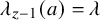 $\lambda _{z-1}(a)=\lambda $
of size m.
$\lambda _{z-1}(a)=\lambda $
of size m.
Lemma 3.1.
 $$ \begin{align*}u_m(q)=(-1)^m\sum_{\substack{\lambda \\ |\lambda|=m}}\frac{1-q^{-2\lambda^{\prime}_1}}{(-q)^{\sum_{i}(\lambda^{\prime}_i)^2}\prod_i(-1/q)_{m_i(\lambda)}}.\end{align*} $$
Proof. The first equality in Eq. (6) gives
 $$ \begin{align*}u_m(q)=\frac{1}{|\operatorname{\mathrm{U}}_m(q)|}\sum_{\substack{a \in \operatorname{\mathrm{U}}_m(q)\\a \text{ unipotent}}}\left(1-q^{-2\dim \ker(a-1)}\right).\end{align*} $$
Note that, if a is unipotent and if the partition associated to $z-1$
is
$z-1$
is $\lambda $
, then
$\lambda $
, then $\lambda _1^{'}=\dim \ker (a-1)$
. Now, it follows from the definition of cycle index for the unitary groups that
$\lambda _1^{'}=\dim \ker (a-1)$
. Now, it follows from the definition of cycle index for the unitary groups that $u_m(q)$
is the coefficient of
$u_m(q)$
is the coefficient of $y^m$
in
$y^m$
in
 $$ \begin{align*}\sum_{\lambda}x_{z-1,\lambda}\frac{(-y)^{|\lambda|}}{(-q)^{\sum_{i}(\lambda^{\prime}_i)^2}\prod_i(-1/q)_{m_i(\lambda)}},\end{align*} $$
when we substitute all variables $x_{z-1,\lambda }$
with
$x_{z-1,\lambda }$
with $1-q^{-2\lambda ^{\prime }_1}$
.
$1-q^{-2\lambda ^{\prime }_1}$
.
Let us define

so that
 $$ \begin{align} u_m(q)=(-1)^mH(-1/q). \end{align} $$
Our strategy to proving Theorem 1.2(a) is to suitably rewrite $H(x)$
. To this end, we first require the following result.
$H(x)$
. To this end, we first require the following result.
Theorem 3.2 [Reference Spiga22, Lemma 4.2 and Theorem 1.3]
Let $m \in \mathbb {N}$
, and let
$m \in \mathbb {N}$
, and let $\Delta _m$
be the set of partitions
$\Delta _m$
be the set of partitions $\lambda =(\lambda _1,\dots ,\lambda _m)$
into m parts such that
$\lambda =(\lambda _1,\dots ,\lambda _m)$
into m parts such that $\lambda _k=k$
for some
$\lambda _k=k$
for some $k \in \{1,\dots ,m\}$
. Let
$k \in \{1,\dots ,m\}$
. Let

denote the generating function for the number of partitions in $\Delta _m$
.
$\Delta _m$
.
Then $G(x)$
admits the following equivalent expressions:
$G(x)$
admits the following equivalent expressions:
 $$ \begin{align*}G(x)=\sum_{|\lambda|=m}\frac{(1-x^{\lambda^{\prime}_1})x^{\sum_i(\lambda^{\prime}_i)^2}}{\prod_i(x)_{m_i(\lambda)}}=\sum_{j=0}^{m-1}\frac{x^{(m-j)^2+j}(x)_{m-1}}{(x)^2_{m-j-1}(x)_j}=x^m\sum_{i=1}^{m}\frac{(-1)^{i-1}x^{i(i-1)/2}}{(x)_{m-i}}.\end{align*} $$
The following lemma provides a useful interpretation of $H(x)$
, which will be fundamental to prove Theorem 1.3.
$H(x)$
, which will be fundamental to prove Theorem 1.3.
Lemma 3.3. Let $m \in \mathbb {N}$
and let
$m \in \mathbb {N}$
and let $\Lambda _m$
be the set of partitions defined in Eq. (3). Let
$\Lambda _m$
be the set of partitions defined in Eq. (3). Let $H(x)$
be the function defined in Eq. (12) and let
$H(x)$
be the function defined in Eq. (12) and let $G(x)$
be as in Theorem 3.2. Let
$G(x)$
be as in Theorem 3.2. Let

Then $H(x)=G(x)+xK(x)$
, and
$H(x)=G(x)+xK(x)$
, and
 $$ \begin{align*}K(x)=\sum_{\lambda \in \Lambda_m}x^{|\lambda|}\end{align*} $$
coincides with the generating function for the number of partitions in $\Lambda _m$
.
$\Lambda _m$
.
Proof. We have
 $$ \begin{align*} H(x)=\sum_{|\lambda|=m}\frac{(1-x^{2\lambda^{\prime}_1})x^{\sum_i(\lambda^{\prime}_i)^2}}{\prod_i(x)_{m_i(\lambda)}}=\sum_{j=0}^{m-1}\left(1-x^{2(m-j)}\right)\sum_{\substack{|\lambda|=m \\ \lambda^{\prime}_1=m-j}}\frac{x^{\sum_i(\lambda^{\prime}_i)^2}}{\prod_i(x)_{m_i(\lambda)}}. \end{align*} $$
Now, from the proof of [Reference Spiga22, Lemma 4.2], we have
 $$ \begin{align*} \sum_{\substack{|\lambda|=m \\ \lambda^{\prime}_1=m-j}}\frac{x^{\sum_i(\lambda^{\prime}_i)^2}}{\prod_i(x)_{m_i(\lambda)}}=\frac{x^{(m-j)^2+j}(x)_{m-1}}{(x)_{m-j-1}(x)_{m-j}(x)_j}. \end{align*} $$
Therefore,
 $$ \begin{align*} H(x)&=\sum_{j=0}^{m-1}(1+x^{m-j})(1-x^{m-j})\frac{x^{(m-j)^2+j}(x)_{m-1}}{(x)_{m-j-1}(x)_{m-j}(x)_j} \\ &=\sum_{j=0}^{m-1}(1+x^{m-j})\frac{x^{(m-j)^2+j}(x)_{m-1}}{(x)_{m-j-1}^2(x)_j}\\ &=\sum_{j=0}^{m-1}\frac{x^{(m-j)^2+j}(x)_{m-1}}{(x)_{m-j-1}^2(x)_j}+\sum_{j=0}^{m-1}\frac{x^{(m-j)^2+m}(x)_{m-1}}{(x)_{m-j-1}^2(x)_j} \\ &=G(x)+x\sum_{j=0}^{m-1}\frac{x^{(m-j)^2+m-1}(x)_{m-1}}{(x)_{m-j-1}^2(x)_j}=G(x)+xK(x), \end{align*} $$
where the last two equalities follow from Theorem 3.2 and the definition of $K(x)$
. This proves the first part of the lemma.
$K(x)$
. This proves the first part of the lemma.
To prove that $K(x)=\sum _{\lambda \in \Lambda _m}x^{|\lambda |}$
, let us look at the summands of
$K(x)=\sum _{\lambda \in \Lambda _m}x^{|\lambda |}$
, let us look at the summands of $K(x)$
, which we rewrite as:
$K(x)$
, which we rewrite as:
 $$ \begin{align*}\frac{x^{(m-j)^2+m-1}(x)_{m-1}}{(x)_{m-j-1}^2(x)_j}=x^{(m-j)^2}\cdot \frac{x^j(x)_{m-1}}{(x)_{m-j-1}(x)_j}\cdot\frac{x^{m-j-1}}{(x)_{m-j-1}}.\end{align*} $$
From [Reference Andrews1, Theorem 3.1],
 $$ \begin{align*}\frac{x^j(x)_{m-1}}{(x)_{m-j-1}(x)_j}\end{align*} $$
is the generating function for partitions $\pi _1$
into exactly j parts, all having size at most
$\pi _1$
into exactly j parts, all having size at most $m-j$
, and
$m-j$
, and
 $$ \begin{align*}\frac{x^{m-j-1}}{(x)_{m-j-1}}\end{align*} $$
is the generating function for partitions $\pi _2$
with
$\pi _2$
with $m-j-1$
parts. Therefore, since every partition
$m-j-1$
parts. Therefore, since every partition $\lambda $
of N is uniquely determined by the pair
$\lambda $
of N is uniquely determined by the pair $(\pi _1(\lambda ),\pi _2(\lambda ))$
, where
$(\pi _1(\lambda ),\pi _2(\lambda ))$
, where $|\pi _1(\lambda )|+|\pi _2(\lambda )|=N-(m-j)^2$
,
$|\pi _1(\lambda )|+|\pi _2(\lambda )|=N-(m-j)^2$
, $\pi _1(\lambda )$
is the partition below the Durfee square of
$\pi _1(\lambda )$
is the partition below the Durfee square of $\lambda $
(which consists of exactly j parts, each of size at most
$\lambda $
(which consists of exactly j parts, each of size at most $m-j$
), and
$m-j$
), and $\pi _2(\lambda )$
is the partition to the right of its Durfee square (which has at most
$\pi _2(\lambda )$
is the partition to the right of its Durfee square (which has at most $m-j$
parts) (see Fig. 2),
$m-j$
parts) (see Fig. 2),
 $$ \begin{align*}x^{(m-j)^2}\cdot \frac{x^j(x)_{m-1}}{(x)_{m-j-1}(x)_j}\cdot\frac{x^{m-j-1}}{(x)_{m-j-1}}\end{align*} $$
is the generating function for partitions into m parts, with Durfee square $m-j$
, and with partition to the right of the Durfee square having exactly
$m-j$
, and with partition to the right of the Durfee square having exactly $m-j-1$
parts.
$m-j-1$
parts.
Example: $\lambda =(8,7,7,4,4,3,3,1,1)$
has Durfee square 4,
$\lambda =(8,7,7,4,4,3,3,1,1)$
has Durfee square 4, $\pi _1(\lambda )=(4,3,3)$
,
$\pi _1(\lambda )=(4,3,3)$
, $\pi _2(\lambda )=(4,3,3,1,1)$
and it satisfies
$\pi _2(\lambda )=(4,3,3,1,1)$
and it satisfies $\lambda _3>\lambda _4=4$
.
$\lambda _3>\lambda _4=4$
.

Therefore, $K(x)$
is the generating function for partitions into m parts, with Durfee square
$K(x)$
is the generating function for partitions into m parts, with Durfee square $m-j$
for some
$m-j$
for some $j \in \{0,\dots ,m-1\}$
, and with the partition to the right of the Durfee square having exactly
$j \in \{0,\dots ,m-1\}$
, and with the partition to the right of the Durfee square having exactly $m-j-1$
parts. Note that (see also Fig. 2) such partitions are exactly the partitions
$m-j-1$
parts. Note that (see also Fig. 2) such partitions are exactly the partitions $\lambda =(\lambda _1,\dots ,\lambda _m)$
into m parts, such that either
$\lambda =(\lambda _1,\dots ,\lambda _m)$
into m parts, such that either $\lambda _1=1$
, or
$\lambda _1=1$
, or $\lambda _{k-1}>\lambda _k=k$
for some
$\lambda _{k-1}>\lambda _k=k$
for some $k \in \{2,\dots ,m\}$
, that is, the partitions in
$k \in \{2,\dots ,m\}$
, that is, the partitions in $\Lambda _m$
. This concludes the proof.
$\Lambda _m$
. This concludes the proof.
We now prove Theorem 1.2(a), assuming Theorem 1.3, which will be established in Section 3.3.
Proof of Theorem 1.2(a)
From Lemma 3.1 we have
 $$ \begin{align*}u_m(q)=(-1)^m\sum_{|\lambda|=m}\frac{1-q^{-2\lambda^{\prime}_1}}{(-q)^{\sum_{i}(\lambda^{\prime}_i)^2}\prod_i(-1/q)_{m_i(\lambda)},}\end{align*} $$
and from Eq. (13) and Lemma 3.3 we have $u_m(q)=(-1)^mH(-1/q)$
, where
$u_m(q)=(-1)^mH(-1/q)$
, where $H(x)=G(x)+xK(x)$
. Combining Theorems 1.3 and 3.2, we get
$H(x)=G(x)+xK(x)$
. Combining Theorems 1.3 and 3.2, we get
 $$ \begin{align*} H(x)&=x^m\sum_{i=1}^{m}\frac{(-1)^{i-1}x^{i(i-1)/2}}{(x)_{m-i}}+ \frac{x^{m+1}}{1-x}\sum_{i=1}^{m}\frac{(-1)^{i}x^{i(i-1)/2}(x^i-1)}{(x)_{m-i}} \\ &=\frac{x^{m+1}}{1-x}\sum_{i=1}^{m}\frac{(-1)^{i-1}x^{i(i-1)/2}(x^{-1}-1)+(-1)^{i}x^{i(i+1)/2}+(-1)^{i-1}x^{i(i-1)/2}}{(x)_{m-i}} \\ &=\frac{x^{m+1}}{1-x}\sum_{i=1}^m\frac{(-1)^{i}x^{i(i+1)/2}(1-x^{-(i+1)})}{(x)_{m-i}}. \end{align*} $$
and therefore,
 $$ \begin{align*} u_m(q)=(-1)^mH(-1/q)=\frac{1}{q^m(q+1)}\sum_{i=1}^m\frac{(-1)^i((-q)^{i+1}-1)}{(-q)^{i(i+1)/2}(-1/q)_{m-i}}.\\[-34pt] \end{align*} $$
3.2 Derangements: proof of 1.1(a)
Let us define
 $$ \begin{align*}T_{\operatorname{\mathrm{U}}}:=\sum_{m=0}^{\infty}\frac{y^m}{q^m(-1/q)_m}.\end{align*} $$
Recall the definitions of $U^{\prime }_{\operatorname {\mathrm {U}}}$
and
$U^{\prime }_{\operatorname {\mathrm {U}}}$
and $D^{\prime }_{\operatorname {\mathrm {U}}}$
in Eq. (11).
$D^{\prime }_{\operatorname {\mathrm {U}}}$
in Eq. (11).
Lemma 3.4. We have
 $$ \begin{align*}D^{\prime}_{\operatorname{\mathrm{U}}}=T^{-1}_{\operatorname{\mathrm{U}}}(1-y)^{-1}U^{\prime}_{\operatorname{\mathrm{U}}}.\end{align*} $$
Proof. Recall that for a unipotent element $a \in \operatorname {\mathrm {U}}_m(q)$
, the partition
$a \in \operatorname {\mathrm {U}}_m(q)$
, the partition $\lambda $
associated with
$\lambda $
associated with $z-1$
satisfies
$z-1$
satisfies $\lambda ^{\prime }_1=\dim \ker (a-1)$
. It follows from the definition of the cycle index
$\lambda ^{\prime }_1=\dim \ker (a-1)$
. It follows from the definition of the cycle index $Z_{\operatorname {\mathrm {U}}}$
that
$Z_{\operatorname {\mathrm {U}}}$
that $d^{\prime }_m(q)$
is the coefficient of
$d^{\prime }_m(q)$
is the coefficient of $y^m$
in
$y^m$
in $Z_{\operatorname {\mathrm {U}}}$
when we assign the variables
$Z_{\operatorname {\mathrm {U}}}$
when we assign the variables $x_{\phi ,\lambda }$
and
$x_{\phi ,\lambda }$
and $x_{\widetilde {\phi },\lambda }$
the value 1 when
$x_{\widetilde {\phi },\lambda }$
the value 1 when $\phi \neq z-1$
, and set
$\phi \neq z-1$
, and set $x_{z-1,\lambda }=q^{-2\lambda ^{\prime }_1}.$
Moreover, observe that if all variables
$x_{z-1,\lambda }=q^{-2\lambda ^{\prime }_1}.$
Moreover, observe that if all variables $x_{\phi ,\lambda }$
and
$x_{\phi ,\lambda }$
and $x_{\widetilde {\phi },\lambda }$
are set to
$x_{\widetilde {\phi },\lambda }$
are set to $1$
in
$1$
in $Z_{\operatorname {\mathrm {U}}}$
, then we obtain
$Z_{\operatorname {\mathrm {U}}}$
, then we obtain $(1-y)^{-1}$
. Similarly, note that
$(1-y)^{-1}$
. Similarly, note that $u^{\prime }_m(q)$
is the coefficient of
$u^{\prime }_m(q)$
is the coefficient of $y^m$
in the factor
$y^m$
in the factor
 $$ \begin{align*}\sum_{\lambda}x_{z-1,\lambda}\frac{(-y)^{|\lambda|}}{(-q)^{\sum_{i}(\lambda^{\prime}_i)^2}\prod_i(-1/q)_{m_i(\lambda)}}\end{align*} $$
of $Z_{\operatorname {\mathrm {U}}}$
, when we set the variables
$Z_{\operatorname {\mathrm {U}}}$
, when we set the variables $x_{z-1,\lambda }$
equal to
$x_{z-1,\lambda }$
equal to $q^{-2\lambda ^{\prime }_1}$
. If we instead set these variables
$q^{-2\lambda ^{\prime }_1}$
. If we instead set these variables $x_{z-1,\lambda }$
equal to 1, the coefficient of
$x_{z-1,\lambda }$
equal to 1, the coefficient of $y^m$
in
$y^m$
in $\sum _{\lambda }\frac {(-y)^{|\lambda |}}{(-q)^{\sum _{i}(\lambda ^{\prime }_i)^2}\prod _i(-1/q)_{m_i(\lambda )}}$
is equal to the proportion of unipotent elements in
$\sum _{\lambda }\frac {(-y)^{|\lambda |}}{(-q)^{\sum _{i}(\lambda ^{\prime }_i)^2}\prod _i(-1/q)_{m_i(\lambda )}}$
is equal to the proportion of unipotent elements in $\operatorname {\mathrm {U}}_m(q)$
, which, by Lemma 2.2, is
$\operatorname {\mathrm {U}}_m(q)$
, which, by Lemma 2.2, is $\frac {1}{q^m(-1/q)_m}$
. Therefore,
$\frac {1}{q^m(-1/q)_m}$
. Therefore,
 $$ \begin{align*}\sum_{\lambda}\frac{(-y)^{|\lambda|}}{(-q)^{\sum_{i}(\lambda^{\prime}_i)^2}\prod_i(-1/q)_{m_i(\lambda)}}= \sum_{m=0}^{\infty}\frac{y^m}{q^m(-1/q)_m}=T_{\operatorname{\mathrm{U}}}.\end{align*} $$
Using the factorisation of $Z_{\operatorname {\mathrm {U}}}$
in Eq. (9), these observations together imply that
$Z_{\operatorname {\mathrm {U}}}$
in Eq. (9), these observations together imply that
 $$ \begin{align*} (1-y)^{-1}=D^{\prime}_{\operatorname{\mathrm{U}}}\cdot U{\prime}^{-1}_{\operatorname{\mathrm{U}}} \cdot T_{\operatorname{\mathrm{U}}}.\\[-34pt] \end{align*} $$
We are ready to prove Theorem 1.1(a) (assuming Theorem 1.3).
Proof of Theorem 1.1(a)
Applying Theorem 1.2(a), we first obtain:
 $$ \begin{align*} u^{\prime}_m(q)& =\frac{1}{q^m(-1/q)_m}-u_m(q) \\ & =\frac{1}{q^m(-1/q)_m}-\frac{1}{q^m(q+1)}\sum_{i=1}^m\frac{(-1)^{i}((-q)^{i+1}-1)}{(-q)^{i(i+1)/2}(-1/q)_{m-i}}\\ & = \frac{1}{q^m(q+1)}\sum_{i=0}^{m}\frac{(-1)^{i}(1-(-q)^{i+1})}{(-q)^{i(i+1)/2}(-1/q)_{m-i}}. \end{align*} $$
We now observe that the following factorisation holds for $U^{\prime }_{\operatorname {\mathrm {U}}}$
:
$U^{\prime }_{\operatorname {\mathrm {U}}}$
:
 $$ \begin{align} \nonumber U^{\prime}_{\operatorname{\mathrm{U}}}=\sum_{m=0}^{\infty}u^{\prime}_m(q)y^m&=\sum_{m=0}^{\infty}\frac{1}{q+1}\sum_{i=0}^{m}\frac{(-1)^i(1-(-q)^{i+1})}{(-q)^{m-i}(-q)^{i(i+3)/2}(-1/q)_{m-i}}(-y)^m\\ \nonumber &=\sum_{m=0}^{\infty}\frac{1}{q+1}\sum_{i=0}^{m}\frac{(-1)^i(1-(-q)^{i+1})}{(-q)^{i(i+3)/2}}(-y)^i\cdot\frac{1}{(-q)^{m-i}(-1/q)_{m-i}}(-y)^{m-i}\\ &=\overline{D}_{\operatorname{\mathrm{U}}}\cdot T_{ \operatorname{\mathrm{U}}}, \end{align} $$
where $\overline {D}_{\operatorname {\mathrm {U}}}$
is defined as
$\overline {D}_{\operatorname {\mathrm {U}}}$
is defined as
 $$ \begin{align*}\overline{D}_{\operatorname{\mathrm{U}}}:=\frac{1}{q+1}\sum_{i=0}^{\infty}\frac{1-(-q)^{i+1}}{(-q)^{i(i+3)/2}}y^i.\end{align*} $$
By Eq. (14) and Lemma 3.4, we have
 $$ \begin{align*} D^{\prime}_{\operatorname{\mathrm{U}}}&=T^{-1}_{\operatorname{\mathrm{U}}}\cdot U^{\prime}_{\operatorname{\mathrm{U}}} \cdot (1-y)^{-1}= \overline{D}_{\operatorname{\mathrm{U}}} \cdot (1-y)^{-1} \\ &=\frac{1}{q+1}\sum_{i=0}^{\infty}\frac{1-(-q)^{i+1}}{(-q)^{i(i+3)/2}}y^i\cdot \sum_{j=0}^{\infty}y^j=\sum_{m=0}^{\infty}\frac{1}{q+1}\sum_{i=0}^{m}\frac{1-(-q)^{i+1}}{(-q)^{i(i+3)/2}}y^m. \end{align*} $$
Hence,
 $$ \begin{align*}d^{\prime}_m(q)=\frac{1}{q+1}\sum_{i=0}^{m}\frac{1-(-q)^{i+1}}{(-q)^{i(i+3)/2}}\end{align*} $$
and
 $$ \begin{align*}d_m(q)=1-d^{\prime}_m(q)=\frac{1}{q+1}\sum_{i=1}^{m}\frac{(-q)^{i+1}-1}{(-q)^{i(i+3)/2}}=\frac{1}{q+1}\left(1-\frac{1}{(-q)^{m(m+3)/2}}\right),\end{align*} $$
where the last equality can be easily verified by induction on m.
3.3 Proof of Theorem 1.3
Let $m\ge 1$
. In the introduction (see Eq. (3)), we defined
$m\ge 1$
. In the introduction (see Eq. (3)), we defined $\Lambda _m$
as the set of partitions
$\Lambda _m$
as the set of partitions $\lambda =(\lambda _1,\dots ,\lambda _m)$
such that either
$\lambda =(\lambda _1,\dots ,\lambda _m)$
such that either $\lambda _1=1$
or
$\lambda _1=1$
or $\lambda _{k-1}>\lambda _k=k$
, for some
$\lambda _{k-1}>\lambda _k=k$
, for some $k \in \{2,\dots ,m\}$
. Considering any number m of parts for such partitions, we define
$k \in \{2,\dots ,m\}$
. Considering any number m of parts for such partitions, we define

For example, the partitions $(6,5,3,3,2)$
,
$(6,5,3,3,2)$
, $(9,6,5,4,3,1,1)$
and
$(9,6,5,4,3,1,1)$
and $(1,1,1)$
belong to
$(1,1,1)$
belong to $\Lambda $
, and all the partitions in
$\Lambda $
, and all the partitions in $\Lambda _1$
,
$\Lambda _1$
, $\Lambda _2$
and
$\Lambda _2$
and $\Lambda _3$
are listed in the first column of Table 1.
$\Lambda _3$
are listed in the first column of Table 1.
As observed in the proof of Lemma 3.3, $\lambda \in \Lambda _m$
if and only if it has Durfee square k (for some
$\lambda \in \Lambda _m$
if and only if it has Durfee square k (for some $k \in \{1,\dots ,m\}$
) and the partition to the right of the Durfee square has exactly
$k \in \{1,\dots ,m\}$
) and the partition to the right of the Durfee square has exactly $k-1$
parts (see also Fig. 2). Partitions satisfying the condition
$k-1$
parts (see also Fig. 2). Partitions satisfying the condition $\lambda _k=k$
for some k were studied by Spiga in [Reference Spiga22], in relation to the proportion of derangements in
$\lambda _k=k$
for some k were studied by Spiga in [Reference Spiga22], in relation to the proportion of derangements in $\operatorname {\mathrm {AGL}}_m(q)$
. In [Reference Blecher and Knopfmacher2], Blecher and Knopfmacher refer to the condition
$\operatorname {\mathrm {AGL}}_m(q)$
. In [Reference Blecher and Knopfmacher2], Blecher and Knopfmacher refer to the condition $\lambda _k=k$
as a fixed point, extending the concept of fixed points from permutation group theory to integer partitions. In addition to the fixed point condition, the partitions in
$\lambda _k=k$
as a fixed point, extending the concept of fixed points from permutation group theory to integer partitions. In addition to the fixed point condition, the partitions in $\Lambda $
impose the extra requirement that
$\Lambda $
impose the extra requirement that $\lambda _{k-1}>k$
, which can be rephrased by saying that the conjugate of the partition to the right of the Durfee square must have first part equal to
$\lambda _{k-1}>k$
, which can be rephrased by saying that the conjugate of the partition to the right of the Durfee square must have first part equal to $k-1$
(see also [Reference Hopkins and Sellers18] and [Reference Hopkins17]).
$k-1$
(see also [Reference Hopkins and Sellers18] and [Reference Hopkins17]).
Theorem 1.3 states that the generating function for the number of partitions in $\Lambda _m$
is
$\Lambda _m$
is
 $$ \begin{align*}\frac{x^m}{1-x}\sum_{i=1}^{m}\frac{(-1)^{i}x^{i(i-1)/2}(x^i-1)}{(x)_{m-i}}.\end{align*} $$
To prove Theorem 1.3, we first establish the following auxiliary lemma. The author would like to thank Fedor Petrov for providing the proof of this lemma, in response to a question posed on MathOverflow, see [Reference Petrov20].
Lemma 3.5. Let a and b be non-negative integers. The following two sets have the same cardinality:

where in the set $\mathcal {B}(a,b)$
,
$\mathcal {B}(a,b)$
, $\mu $
can be the empty partition.
$\mu $
can be the empty partition.
Before starting the proof, let us clarify the definitions of the sets $\mathcal {A}(a,b)$
and
$\mathcal {A}(a,b)$
and $\mathcal {B}(a,b)$
with an example. Let
$\mathcal {B}(a,b)$
with an example. Let $a=9$
and
$a=9$
and $b=4$
. Then
$b=4$
. Then
 $$ \begin{align*} \mathcal{A}(9,4)=\{& ((2,1,1,1),(1,1,1,1)), & \mathcal{B}(9,4)=\{&((1,1,1,1),(1,1,1,1,1)),\\ & ((3,1,1,1),(2,1)), & &((1,1,1,1),(2,2,1)), \\ & ((3,2,1,1),(2)),& &((3,2,1,1),(1,1)), \\ & ((2,2,1,1),(1,1,1)) & & ((3,2,2,2),\emptyset),\\ & ((2,2,2,1),(1,1))& &((4,2,2,1),\emptyset), \\ & ((2,2,2,2),(1))\} & &((5,2,1,1), \emptyset)\}. \end{align*} $$
Proof of Lemma 3.5
Let us define a bijection
 $$ \begin{align*}\Phi(a,b):\mathcal{A}(a,b) \longrightarrow \mathcal{B}(a,b), \quad (\lambda,\mu)\longmapsto (\lambda^*,\mu^*). \end{align*} $$
Figure 3 provides an auxiliary illustration for the proof.
Graphical representation of $\Phi (a,b)$
.
$\Phi (a,b)$
.

To define $\Phi (a,b)$
, we first introduce the following map. For non-negative integers u and v, let
$\Phi (a,b)$
, we first introduce the following map. For non-negative integers u and v, let $\phi _{u,v}$
denote a bijection between pairs of partitions
$\phi _{u,v}$
denote a bijection between pairs of partitions $(\eta _1, \eta _2) \mapsto (\eta _3, \eta _4)$
, where:
$(\eta _1, \eta _2) \mapsto (\eta _3, \eta _4)$
, where:
-
•
$\eta _1$
(meaning its Ferrers diagram) fits in the rectangle
$u \times v$
, -
•
$\eta _2$
fits in the strip
$(u+v) \times \infty $
, -
•
$\eta _3$
fits in the strip
$\infty \times v$
, -
•
$\eta _4$
fits in the strip
$u \times \infty $
, -
•
$|\eta _1|+|\eta _2|=|\eta _3|+|\eta _4|$
.


The existence of such a bijection is guaranteed by the Gaussian binomial identity, which states that
 $$ \begin{align*}\binom{u+v}{u}_q=\frac{(q)_{u+v}}{(q)_u(q)_v},\end{align*} $$
where the q-binomial coefficient $\binom {u+v}{u}_q$
is the generating function for partitions whose Ferrers diagram fits inside a
$\binom {u+v}{u}_q$
is the generating function for partitions whose Ferrers diagram fits inside a $u \times v$
rectangle, and
$u \times v$
rectangle, and $\frac {1}{(q)_u}$
is the generating function for partitions into at most u parts (see, for instance, [Reference Andrews1] or any standard textbook on partitions).
$\frac {1}{(q)_u}$
is the generating function for partitions into at most u parts (see, for instance, [Reference Andrews1] or any standard textbook on partitions).
Now, let $(\lambda ,\mu ) \in \mathcal {A}(a,b)$
, with
$(\lambda ,\mu ) \in \mathcal {A}(a,b)$
, with $\lambda _1=t$
(and hence
$\lambda _1=t$
(and hence $\mu _1=t-1)$
, and assume that the Durfee square of
$\mu _1=t-1)$
, and assume that the Durfee square of $\lambda $
is k, where t and k are positive integers. Let
$\lambda $
is k, where t and k are positive integers. Let $\pi _1(\lambda )$
be the partition to the right of the Durfee square of
$\pi _1(\lambda )$
be the partition to the right of the Durfee square of $\lambda $
, let
$\lambda $
, let $\pi _2(\lambda )$
be the partition below the Durfee square. Note that
$\pi _2(\lambda )$
be the partition below the Durfee square. Note that $\lambda $
is uniquely determined by the size of its Durfee square together with
$\lambda $
is uniquely determined by the size of its Durfee square together with $\pi _1(\lambda )$
and
$\pi _1(\lambda )$
and $\pi _2(\lambda )$
.
$\pi _2(\lambda )$
.
We now define  as follows.
-
•
$\Phi $
preserves the size of the Durfee square of
$\lambda $
, that is
$\lambda ^*$
has the same Durfee square size as
$\lambda $
. -
•
$\Phi $
preserves the partition below the Durfee square of
$\lambda $
, i.e.,
$\pi _2(\lambda )=\pi _2(\lambda ^*)$
. -
• Let
$\mathrm {pt}(\pi _1(\lambda ))=n$
and
$\mathrm {pt}(\mu )=m$
. Define that is,
$\eta _1$
consists of all the parts of
$\pi _1(\lambda )$
, except the first one, and and let. Set


 . Set
. Set 
Then, $\Phi (a,b)$
is indeed a bijection: the construction reduces to check fixed values of t and k, and the conclusion follows from the fact that
$\Phi (a,b)$
is indeed a bijection: the construction reduces to check fixed values of t and k, and the conclusion follows from the fact that $\phi _{t-k,k-1}$
is itself a bijection.
$\phi _{t-k,k-1}$
is itself a bijection.
We are now ready to prove Theorem 1.3. The structure of the proof follows that of [Reference Spiga22, Theorem 1.3].
Proof of Theorem 1.3
Let

denote the generating function for the number of partitions in $\Lambda $
, encoded by size and by number of parts. Define
$\Lambda $
, encoded by size and by number of parts. Define

To prove the claim, we need to show that $F(x,y)=\bar {F}(x,y)$
. Let
$F(x,y)=\bar {F}(x,y)$
. Let

and observe that
 $$ \begin{align} \bar{F}(x,y)=\frac{1}{1-x}F_1(x,y)F_2(x,y). \end{align} $$
Recalling that $x^a/(x)_a$
is the generating function for the number of partitions into a parts, we get that
$x^a/(x)_a$
is the generating function for the number of partitions into a parts, we get that
 $$ \begin{align*}F_1(x,y)=\sum_{\lambda}x^{|\lambda|}y^{\mathrm{pt}(\lambda)}\end{align*} $$
is the generating function for the number of partitions, encoded by size and by number of parts. From [Reference Andrews1, p. 16] (or from any standard textbook on partitions), it follows that
 $$ \begin{align*}F_1(x,y)=\prod_{n=1}^{\infty}(1-yx^n)^{-1}. \end{align*} $$
Now, we turn our attention to
 $$ \begin{align} F_2(x,y)=\sum_{b=0}^{\infty}(x^b-1)x^{\frac{b(b+1)}{2}}(-y)^b=\sum_{b=0}^{\infty}x^{\frac{b(b+3)}{2}}(-y)^b-\sum_{b=0}^{\infty}x^{\frac{b(b+1)}{2}}(-y)^b. \end{align} $$
In view of Eq. (16), let us define

We now require Jacobi’s triple product identity, which states that
 $$ \begin{align} \sum_{j=-\infty}^{\infty}q^{j^2}z^j=\prod_{j=1}^{\infty}(1+zq^{2j-1})(1+z^{-1}q^{2j-1})(1-q^{2j}). \end{align} $$
We apply Eq. (17) to both $F_2^1(x,y)$
and
$F_2^1(x,y)$
and $F_2^2(x,y)$
, obtaining:
$F_2^2(x,y)$
, obtaining:
 $$ \begin{align*} F_2^1(x,y)&=\sum_{b=-\infty}^{\infty}x^{\frac{b(b+3)}{2}}(-y)^b=\sum_{b=-\infty}^{\infty}(x^{\frac{1}{2}})^{b^2}(-yx^{\frac{3}{2}})^b \\ &=\prod_{b=1}^{\infty}(1-yx^{\frac{3}{2}}x^{\frac{2b-1}{2}})(1-y^{-1}x^{-\frac{3}{2}}x^{\frac{2b-1}{2}})(1-x^b)\\ &=\prod_{b=1}^{\infty}(1-yx^{b+1})(1-y^{-1}x^{b-2})(1-x^b), \end{align*} $$
and
 $$ \begin{align*} F_2^2(x,y)&=\sum_{b=-\infty}^{\infty}x^{\frac{b(b+1)}{2}}(-y)^b=\sum_{b=-\infty}^{\infty}(x^{\frac{1}{2}})^{b^2}(-yx^{\frac{1}{2}})^b \\ &=\prod_{b=1}^{\infty}(1-yx^{\frac{1}{2}}x^{\frac{2b-1}{2}})(1-y^{-1}x^{-\frac{1}{2}}x^{\frac{2b-1}{2}})(1-x^b)\\ &=\prod_{b=1}^{\infty}(1-yx^{b})(1-y^{-1}x^{b-1})(1-x^b). \end{align*} $$
Note that $F_2^1(x,y)=-\frac {1}{xy}F_2^2(x,y)$
. Therefore,
$F_2^1(x,y)=-\frac {1}{xy}F_2^2(x,y)$
. Therefore,
 $$ \begin{align} F_2^1(x,y)-F_2^2(x,y)=-\frac{xy+1}{xy}\prod_{b=1}^{\infty}(1-yx^b)(1-y^{-1}x^{b-1})(1-x^b). \end{align} $$
The function we are interested in is $F_2(x,y)$
, which is obtained by restricting the infinite sum
$F_2(x,y)$
, which is obtained by restricting the infinite sum
 $$ \begin{align*}F_2^1(x,y)-F_2^2(x,y)=\sum_{b=-\infty}^{\infty}(-y)^bx^{b(b+3)/2}-(-y)^bx^{b(b+1)/2},\end{align*} $$
to the non-negative indices $b \ge 0$
. In view of Eq. (18), let
$b \ge 0$
. In view of Eq. (18), let $F_3(x,y)$
be the part of the product
$F_3(x,y)$
be the part of the product $-\frac {xy+1}{xy}\prod _{b=1}^{\infty }(1-yx^b)(1-y^{-1}x^{b-1})$
corresponding to the non-negative powers of y. Then
$-\frac {xy+1}{xy}\prod _{b=1}^{\infty }(1-yx^b)(1-y^{-1}x^{b-1})$
corresponding to the non-negative powers of y. Then
 $$ \begin{align*}F_2(x,y)=F_3(x,y)\prod_{n=1}^{\infty}(1-x^n)\end{align*} $$
and hence, using Eq. (15), we have
 $$ \begin{align*}\bar{F}(x,y)=\frac{1}{1-x}F_1(x,y)F_2(x,y)=\prod_{n=2}^{\infty}(1-x^n)\prod_{n=1}^{\infty}(1-yx^n)^{-1}F_3(x,y).\end{align*} $$
Recall that we want to prove that $F(x,y)=\bar {F}(x,y)$
, and to do this, it suffices to verify that
$F(x,y)=\bar {F}(x,y)$
, and to do this, it suffices to verify that $F(x,y)$
satisfies the same identity as
$F(x,y)$
satisfies the same identity as $\bar {F}(x,y)$
, that is
$\bar {F}(x,y)$
, that is
 $$ \begin{align} F(x,y)\prod_{n=2}^{\infty}(1-x^n)^{-1}=\prod_{n=1}^{\infty}(1-yx^{n})^{-1}F_3(x,y). \end{align} $$
To conclude the proof, we proceed to show that for every pair of non-negative integers a and b, the coefficients of $x^ay^b$
on both sides of Eq. (19) coincide.
$x^ay^b$
on both sides of Eq. (19) coincide.
Note that $\prod _{n=2}^{\infty }(1-x^n)^{-1}$
is the generating function for partitions with no part of length 1, hence, dually, it is the generating function for partitions
$\prod _{n=2}^{\infty }(1-x^n)^{-1}$
is the generating function for partitions with no part of length 1, hence, dually, it is the generating function for partitions $\mu $
satisfying
$\mu $
satisfying $\mu _1=\mu _2$
. Since
$\mu _1=\mu _2$
. Since $F(x,y)$
is the generating function of
$F(x,y)$
is the generating function of $\Lambda $
, the coefficient of
$\Lambda $
, the coefficient of $x^ay^b$
on the left hand side of Eq. (19) equals the cardinality of the set:
$x^ay^b$
on the left hand side of Eq. (19) equals the cardinality of the set:
 $$ \begin{align} \mathcal{B}(a,b) =\{(\lambda,\mu) \mid \lambda, \mu \text{ partitions }, \mathrm{pt}(\lambda)=b, |\lambda|+|\mu|=a, \lambda \in \Lambda, \mu_1=\mu_2 \}. \end{align} $$
We now turn our attention to the right hand side of Eq. (19). Since $ F_3(x,y)$
is the partial sum of the infinite product
$ F_3(x,y)$
is the partial sum of the infinite product $-\left (1+\frac {1}{xy}\right )\prod _{n=1}^{\infty }(1-yx^n)(1-y^{-1}x^{n-1})$
, corresponding to the non-negative powers of y, we consider instead the expanded product
$-\left (1+\frac {1}{xy}\right )\prod _{n=1}^{\infty }(1-yx^n)(1-y^{-1}x^{n-1})$
, corresponding to the non-negative powers of y, we consider instead the expanded product
 $$ \begin{align} -\left(1+\frac{1}{xy}\right)\prod_{n=1}^{\infty}(1+yx^n+y^2x^{2n}+y^3x^{3n}+\cdots)\prod_{n=1}^{\infty}(1-yx^n)(1-y^{-1}x^{n-1}) =-A(x,y)-A'(x,y) \end{align} $$
where we have defined

and

Let us compute the contribution to $x^ay^b$
from each factor in
$x^ay^b$
from each factor in $A(x,y)$
(respectively
$A(x,y)$
(respectively $A'(x,y)$
), taking into account that the contributions from the infinite product
$A'(x,y)$
), taking into account that the contributions from the infinite product $\prod _{n=1}^{\infty }(1-yx^n)(1-y^{-1}x^{n-1})$
(respectively
$\prod _{n=1}^{\infty }(1-yx^n)(1-y^{-1}x^{n-1})$
(respectively $\frac {1}{xy}\prod _{n=1}^{\infty }(1-yx^n)(1-y^{-1}x^{n-1})$
) must come from a non-negative power of y. This means that:
$\frac {1}{xy}\prod _{n=1}^{\infty }(1-yx^n)(1-y^{-1}x^{n-1})$
) must come from a non-negative power of y. This means that:
-
(a) in
$A(x,y)$
we must take at least as many ys from the second infinite product as
$y^{-1}$
from the third infinite product; -
(b) in
$A'(x,y)$
, since there is a factor
$(xy)^{-1}$
, we are required to take at least one more y from the second infinite product than the number of
$y^{-1}$
from the third infinite product.


Let us formalise what we have just described. We define an $(a,b)$
-choice in
$(a,b)$
-choice in $A(x,y)$
(resp. in
$A(x,y)$
(resp. in $A'(x,y)$
), or simply, a choice, to be a contribution to the summand
$A'(x,y)$
), or simply, a choice, to be a contribution to the summand $x^ay^b$
in
$x^ay^b$
in $A(x,y)$
(resp. in
$A(x,y)$
(resp. in $A'(x,y)$
). Precisely, an
$A'(x,y)$
). Precisely, an $(a,b)$
-choice is uniquely determined by selecting terms
$(a,b)$
-choice is uniquely determined by selecting terms
 $$ \begin{align*}y^{v_1}x^{v_1c_1},\dots,y^{v_{l_1}}x^{v_{l_1}c_{l_1}}\end{align*} $$
from the first infinite product in $A(x,y)$
(resp.
$A(x,y)$
(resp. $A'(x,y)$
) (and 1 from all other factors in the first product), terms
$A'(x,y)$
) (and 1 from all other factors in the first product), terms
 $$ \begin{align*}-yx^{a_1},\dots,-yx^{a_{l_2}}\end{align*} $$
from the second infinite product (and 1 from all other factors in the second product), and terms
 $$ \begin{align*}-y^{-1}x^{b_1},\dots,-y^{-1}x^{b_{l_3}}\end{align*} $$
from the third infinite product (and 1 from all other factors in the third product). The following conditions must be satisfied:
-
(a) for
$A(x,y)$
:
$l_2 \ge l_3$
,
$\sum _k v_k+l_2-l_3=b$
and
$\sum _k v_k c_k+\sum _ia_i+\sum _j b_j=a$
; -
(b) for
$A'(x,y)$
:
$l_2> l_3$
,
$\sum _k v_k+l_2-l_3=b+1$
and
$\sum _k v_k c_k+\sum _ia_i+\sum _j b_j=a+1$
.


Determining the coefficient of $x^ay^b$
in
$x^ay^b$
in $A(x,y)$
(resp. in
$A(x,y)$
(resp. in $A'(x,y)$
) amounts to summing over all
$A'(x,y)$
) amounts to summing over all $(a,b)$
-choices in
$(a,b)$
-choices in $A(x,y)$
(resp. in
$A(x,y)$
(resp. in $A'(x,y)$
). When performing this summation, many choices cancel out pairwise. We now describe how this cancellation occurs.
$A'(x,y)$
). When performing this summation, many choices cancel out pairwise. We now describe how this cancellation occurs.
Given a fixed $(a,b)$
-choice c in
$(a,b)$
-choice c in $A(x,y)$
(resp.
$A(x,y)$
(resp. $A'(x,y)$
), let n be the maximal index for which either
$A'(x,y)$
), let n be the maximal index for which either $y^{v}x^{vn}$
(for some
$y^{v}x^{vn}$
(for some $v \ge 1$
), or
$v \ge 1$
), or $-yx^n$
appears in c. There are three possible cases.
$-yx^n$
appears in c. There are three possible cases.
-
• If both
$y^{v}x^{vn}$
and
$-yx^n$
appear in c, then c cancels with the choice obtained by replacing
$y^{v}x^{vn}$
with
$y^{v+1}x^{(v+1)n}$
and removing
$-yx^n$
(this corresponds to taking 1 in the factor
$1-yx^n$
of the second infinite product). -
• If
$y^vx^{vn}$
appears in c but
$-yx^n$
does not, then c cancels with the choice obtained by replacing
$y^vx^{vn}$
with
$y^{v-1}x^{(v-1)n}$
and selecting
$-yx^n$
in the second infinite product. -
• Finally, if
$-yx^n$
appears in c but
$y^vx^{vn}$
does not, then this choice cancels with the choice where
$-yx^n$
is replaced by
$yx^n$
(this corresponds to selecting
$yx^n$
in the factor
$1+yx^n+y^2x^{2n}+\dots $
in the first infinite product, and selecting
$1$
in the factor
$1-yx^n$
of the second infinite product).


Observe that we cannot always perform such cancellations: when a term $-yx^n$
is removed from c, we must ensure that the number of terms of the form
$-yx^n$
is removed from c, we must ensure that the number of terms of the form $-yx^m$
in the cancelling choice is at least, for
$-yx^m$
in the cancelling choice is at least, for $A(x,y)$
, (resp. strictly bigger than, for
$A(x,y)$
, (resp. strictly bigger than, for $A'(x,y)$
) the number of terms of the form
$A'(x,y)$
) the number of terms of the form $-y^{-1}x^{m'}$
. Recall that this corresponds to the conditions
$-y^{-1}x^{m'}$
. Recall that this corresponds to the conditions $l_2 \ge l_3$
for
$l_2 \ge l_3$
for $A(x,y)$
, and
$A(x,y)$
, and $l_2> l_3$
for
$l_2> l_3$
for $A'(x,y)$
. Moreover, note that this cancellation process is an involution: applying the same procedure to the cancelling choice recovers the original choice c.
$A'(x,y)$
. Moreover, note that this cancellation process is an involution: applying the same procedure to the cancelling choice recovers the original choice c.
Therefore, in $A(x,y)$
, the
$A(x,y)$
, the $(a,b)$
-choices that remain (i.e., those that do not cancel) are exactly those where the number of y-terms equals the number of
$(a,b)$
-choices that remain (i.e., those that do not cancel) are exactly those where the number of y-terms equals the number of $y^{-1}$
-terms, and
$y^{-1}$
-terms, and $c_{l_1} \le a_{l_2}$
(recall that these quantities appeared in the definition of an
$c_{l_1} \le a_{l_2}$
(recall that these quantities appeared in the definition of an $(a,b)$
-choice above). Similarly, in
$(a,b)$
-choice above). Similarly, in $A'(x,y)$
, the remaining
$A'(x,y)$
, the remaining $(a,b)$
-choices are those where the number of ys is exactly one more than the number of
$(a,b)$
-choices are those where the number of ys is exactly one more than the number of $y^{-1}$
s, and
$y^{-1}$
s, and $c_{l_1} \le a_{l_2}$
. Furthermore, observe that all remaining choices in
$c_{l_1} \le a_{l_2}$
. Furthermore, observe that all remaining choices in $A(x,y)$
have positive sign, while all those in
$A(x,y)$
have positive sign, while all those in $A'(x,y)$
carry negative sign.
$A'(x,y)$
carry negative sign.
Given this analysis, determining the coefficient of $x^ay^b$
in
$x^ay^b$
in $A(x,y)$
(respectively
$A(x,y)$
(respectively $A'(x,y)$
) amounts to counting the number of the following possibilities.
$A'(x,y)$
) amounts to counting the number of the following possibilities.
-
(1) For
$A(x,y)$
, choose:-
(i) a non-negative integer j, and integers
$0<c_1 < \cdots < c_j$
and
$0 <v_1< \cdots <v_j$
(for the terms
$y^{v_i}x^{v_ic_i}$
in the first infinite product), -
(ii) k positive integers
$0<a_1<a_2<\cdots <a_k$
(for the terms
$yx^{a_i}$
in the second product), -
(iii) k non-negative integers
$0 \le b_1 < b_2 < \cdots < b_k$
(for the terms
$y^{-1}x^{b{_i}}$
in the third product),
satisfying
$$ \begin{align*}c_j \le a_k,\text{ } \sum_{i=1}^jv_i=b,\text{ } \sum_{i=1}^{j}v_ic_i+\sum_{i=1}^ka_i+b_i=a.\end{align*} $$
-
-
(2) For
$A'(x,y)$
, choose:-
(i) a non-negative integer j, and integers
$0<c_1 < \cdots < c_j$
and
$0 <v_1< \cdots <v_j$
(for the terms
$y^{v_i}x^{v_ic_i}$
in the first infinite product), -
(ii) k positive integers
$0<a_1<a_2<\cdots <a_k$
(for the terms
$yx^{a_i}$
in the second product), -
(iii)
$k-1$
non-negative integers
$0 \le b_1 < b_2 < \cdots < b_{k-1}$
(for the terms
$y^{-1}x^{b{_i}}$
in the third product),
satisfying
$$ \begin{align*}c_j \le a_k,\text{ }\sum_{i=1}^jv_i=b,\text{ }\sum_{i=1}^{j}v_ic_i+\sum_{i=1}^ka_i+\sum_{i=1}^{k-1}b_i=a+1.\end{align*} $$
-


Then, to obtain the coefficient of $x^ay^b$
on the right hand side of Eq. (19), subtract the number of choices in (2) from the number of choices in (1).
$x^ay^b$
on the right hand side of Eq. (19), subtract the number of choices in (2) from the number of choices in (1).
Note that, for both $A(x)$
and
$A(x)$
and $A'(x)$
, the choice at point (i), with the condition that
$A'(x)$
, the choice at point (i), with the condition that $c_j \le a_k$
, corresponds to selecting a partition
$c_j \le a_k$
, corresponds to selecting a partition $\lambda $
with maximal part of size at most
$\lambda $
with maximal part of size at most $a_k$
.
$a_k$
.
Now, for $A(x)$
, the choices at point (ii) and (iii), correspond to selecting a partition
$A(x)$
, the choices at point (ii) and (iii), correspond to selecting a partition $\mu $
with maximal part equal to
$\mu $
with maximal part equal to $a_k$
. Indeed, for such a partition, let k be the size of its Durfee square, then
$a_k$
. Indeed, for such a partition, let k be the size of its Durfee square, then $a_1,\dots ,a_k$
correspond to the part of the Ferrers diagram above the main diagonal, and
$a_1,\dots ,a_k$
correspond to the part of the Ferrers diagram above the main diagonal, and $b_1,...,b_k$
correspond to the part below it (as in the first example of Fig. 4).
$b_1,...,b_k$
correspond to the part below it (as in the first example of Fig. 4).
Examples of the partitions $\mu $
and
$\mu $
and $\mu^{*}$
arising from the constructions of
$\mu^{*}$
arising from the constructions of $A(x,y)$
and
$A(x,y)$
and $A'(x,y)$
.
$A'(x,y)$
.

On the other hand, for $A'(x)$
, the choices at point (ii) and (iii) correspond to selecting a partition
$A'(x)$
, the choices at point (ii) and (iii) correspond to selecting a partition $\mu $
with maximal part
$\mu $
with maximal part $a_k$
and
$a_k$
and $\mu _2 < \mu _1$
: indeed, for such a partition, let
$\mu _2 < \mu _1$
: indeed, for such a partition, let $\mu _1=a_1$
, and if we write
$\mu _1=a_1$
, and if we write $\overline {\mu }=(\mu _2,\dots ,\mu _r)$
, then, as above,
$\overline {\mu }=(\mu _2,\dots ,\mu _r)$
, then, as above, $a_2,\dots ,a_k$
correspond to the part of the Ferrers diagram of
$a_2,\dots ,a_k$
correspond to the part of the Ferrers diagram of $\overline {\mu }$
above the diagonal of its Durfee square, and
$\overline {\mu }$
above the diagonal of its Durfee square, and $b_1,\dots ,b_k$
to the part below. To clarify these constructions, see the examples in Fig. 4. Note in particular that the motivation for the second construction relies on the fact that the number of
$b_1,\dots ,b_k$
to the part below. To clarify these constructions, see the examples in Fig. 4. Note in particular that the motivation for the second construction relies on the fact that the number of $b_i$
s is one less than the number of
$b_i$
s is one less than the number of $a_j$
s, and that
$a_j$
s, and that $b_1$
may be 0 (as in the second example of Fig. 4).
$b_1$
may be 0 (as in the second example of Fig. 4).
Summing up, we can rephrase points (1) and (2) above as follows:
-
(1) for
$A(x,y)$
choose-
(i) a partition
$\lambda $
with maximal part
$a_k$
, -
(ii) a partition
$\mu $
with maximal part at most
$a_k$
,
satisfying
$\mathrm {pt}(\lambda )=b$
and
$|\lambda |+|\mu |=a$
; -
-
(2) for
$A'(x,y)$
choose-
(i) a partition
$\lambda $
with maximal part
$a_k$
, -
(ii) a partition
$\mu $
with maximal part at most
$a_k$
and
$\mu _1>\mu _2$
,
satisfying
$\mathrm {pt}(\lambda )=b$
and
$|\lambda |+|\mu |=a+1$
. -


Defining

and recalling Eq. (21), we obtain that the coefficient of $x^ay^b$
on the right hand side of Eq. (19) coincides with the difference
$x^ay^b$
on the right hand side of Eq. (19) coincides with the difference $|\mathcal {E}(a,b)|-|\mathcal {F}(a,b)|.$
Note that there is a bijective correspondence between
$|\mathcal {E}(a,b)|-|\mathcal {F}(a,b)|.$
Note that there is a bijective correspondence between $\mathcal {F}(a,b)$
and
$\mathcal {F}(a,b)$
and

obtained by subtracting -1 to the part $\mu _1$
of
$\mu _1$
of $\mu $
in
$\mu $
in $\mathcal {F}(a,b)$
. Therefore,
$\mathcal {F}(a,b)$
. Therefore, $|\mathcal {E}(a,b)|-|\mathcal {F}(a,b)|=|\mathcal {E}(a,b)|-|\mathcal {G}(a,b)|=|\mathcal {A}(a,b)|$
, where
$|\mathcal {E}(a,b)|-|\mathcal {F}(a,b)|=|\mathcal {E}(a,b)|-|\mathcal {G}(a,b)|=|\mathcal {A}(a,b)|$
, where
 $$ \begin{align*}\mathcal{A}(a,b)=\{(\lambda,\mu) \mid \lambda,\mu \text{ partitions}, \mathrm{pt}(\lambda)=b, |\lambda|+|\mu|=a, \lambda_1=\mu_1+1\}.\end{align*} $$
Since we obtained that the coefficient of $x^ay^b$
in the left hand side of Eq. (19) is the cardinality of the set
$x^ay^b$
in the left hand side of Eq. (19) is the cardinality of the set $\mathcal {B}(a,b)$
defined in Eq. (20), applying Lemma 3.5 we can finally conclude.
$\mathcal {B}(a,b)$
defined in Eq. (20), applying Lemma 3.5 we can finally conclude.
4 Affine symplectic groups
The symplectic group $\operatorname {\mathrm {Sp}}_{2m}(q)$
is the subgroup of
$\operatorname {\mathrm {Sp}}_{2m}(q)$
is the subgroup of $\mathrm {GL}_{2m}(q)$
that preserves a nondegenerate symplectic form on the vector space
$\mathrm {GL}_{2m}(q)$
that preserves a nondegenerate symplectic form on the vector space $\mathbb {F}_q^{2m}$
.
$\mathbb {F}_q^{2m}$
.
Before describing the cycle index of the symplectic groups, let us recall Wall’s combinatorial description of its conjugacy classes. We describe in detail the odd-characteristic case, following Fulman’s treatment of the subject in [Reference Fulman8, Sec. 4.2].
Assume q odd. Given a polynomial $\phi \in \mathbb {F}_q[z]$
, with nonzero constant term, define the polynomial
$\phi \in \mathbb {F}_q[z]$
, with nonzero constant term, define the polynomial $\bar {\phi }$
by
$\bar {\phi }$
by
 $$ \begin{align} \bar{\phi}(z)=\phi(0)^{-1}z^{\deg(\phi)}\phi(z^{-1}). \end{align} $$
Wall [Reference Wall24] proved that a conjugacy class in $\operatorname {\mathrm {Sp}}_{2m}(q)$
is parametrised by the following combinatorial data. To each monic, nonconstant, irreducible polynomial
$\operatorname {\mathrm {Sp}}_{2m}(q)$
is parametrised by the following combinatorial data. To each monic, nonconstant, irreducible polynomial $\phi \neq z\pm 1$
associate a partition
$\phi \neq z\pm 1$
associate a partition $\lambda _{\phi }$
of some non-negative integer
$\lambda _{\phi }$
of some non-negative integer $|\lambda _{\phi }|$
. To
$|\lambda _{\phi }|$
. To $\phi $
equal to
$\phi $
equal to $z-1$
or
$z-1$
or $z+1$
associate a symplectic signed partition
$z+1$
associate a symplectic signed partition $\lambda _{\phi }^{\pm }$
, which means a partition of some natural number
$\lambda _{\phi }^{\pm }$
, which means a partition of some natural number $|\lambda ^{\pm }_{\phi }|$
where all odd parts occur with even multiplicity, together with a choice of sign for the set of parts of size i, for each even
$|\lambda ^{\pm }_{\phi }|$
where all odd parts occur with even multiplicity, together with a choice of sign for the set of parts of size i, for each even $i>0$
, see Fig. 5 for an example. These data correspond to a conjugacy class in
$i>0$
, see Fig. 5 for an example. These data correspond to a conjugacy class in $\operatorname {\mathrm {Sp}}_{2m}(q)$
if and only if
$\operatorname {\mathrm {Sp}}_{2m}(q)$
if and only if
-
(i)
$|\lambda _z|=0$
, -
(ii)
$\lambda _{\phi }=\lambda _{\bar {\phi }}$
, -
(iii)
$\sum _{\phi =z\pm 1}|\lambda _{\phi }^{\pm }|+\sum _{\phi \neq z \pm 1}|\lambda _{\phi }|\deg (\phi )=2m$
.


Example of a symplectic signed partition: here, the $+$
corresponds to the part of size 8 and the
$+$
corresponds to the part of size 8 and the $-$
corresponds to the parts of size 4 and 2.
$-$
corresponds to the parts of size 4 and 2.

If q is even, then a precise one-to-one combinatorial description of the conjugacy classes is more delicate to see directly from [Reference Wall24], and we refer the reader to [Reference De Franceschi, Liebeck and O’Brien5] for a recent and comprehensive treatment of the even characteristic case. However, here we are only interested in the $\mathrm {GL}_{2m}(q)$
-rational canonical form data of elements of
$\mathrm {GL}_{2m}(q)$
-rational canonical form data of elements of $\operatorname {\mathrm {Sp}}_{2m}(q)$
. In particular, the number of elements of
$\operatorname {\mathrm {Sp}}_{2m}(q)$
. In particular, the number of elements of $\operatorname {\mathrm {Sp}}_{2m}(q)$
having such fixed rational canonical data depends on q in a way independent of the characteristic. This was proved by Fulman and Guralnick in the following theorem. From now on, all polynomials
$\operatorname {\mathrm {Sp}}_{2m}(q)$
having such fixed rational canonical data depends on q in a way independent of the characteristic. This was proved by Fulman and Guralnick in the following theorem. From now on, all polynomials $\phi \in \mathbb {F}_{q}[z]$
will be assumed to be monic and irreducible, and for
$\phi \in \mathbb {F}_{q}[z]$
will be assumed to be monic and irreducible, and for $a\in \operatorname {\mathrm {Sp}}_{2m}(q)$
, let
$a\in \operatorname {\mathrm {Sp}}_{2m}(q)$
, let $\lambda _{\phi }=\lambda _{\phi }(a)$
be the partition associated to a via the polynomial
$\lambda _{\phi }=\lambda _{\phi }(a)$
be the partition associated to a via the polynomial $\phi $
by means of the
$\phi $
by means of the $\mathrm {GL}_{2m}(q)$
-rational canonical form of a. Define
$\mathrm {GL}_{2m}(q)$
-rational canonical form of a. Define

See also [Reference Fulman8] for explicit computations of the rewritings of $B(q,\lambda _{\phi })$
.
$B(q,\lambda _{\phi })$
.
Lemma 4.1 ([Reference Fulman and Guralnick10], Theorem 5.2)
Let q be either odd or even. The proportion of elements of $\operatorname {\mathrm {Sp}}_{2m}(q)$
with
$\operatorname {\mathrm {Sp}}_{2m}(q)$
with $\mathrm {GL}_{2m}(q)$
-rational canonical form data
$\mathrm {GL}_{2m}(q)$
-rational canonical form data $(\lambda _{\phi })_{\phi }$
is 0 unless
$(\lambda _{\phi })_{\phi }$
is 0 unless $\lambda _{\phi }=\lambda _{\bar {\phi }}$
for all
$\lambda _{\phi }=\lambda _{\bar {\phi }}$
for all $\phi $
, and all odd parts of
$\phi $
, and all odd parts of $\lambda _{z\pm 1}$
occur with even multiplicity. If these conditions are satisfied, then the proportion is
$\lambda _{z\pm 1}$
occur with even multiplicity. If these conditions are satisfied, then the proportion is
 $$ \begin{align*}\prod_{\phi=z\pm1}\frac{1}{q^{\frac{1}{2}\sum_i((\lambda_{\phi})^{\prime}_i)^2+\frac{1}{2}o(\lambda_{\phi})}\prod_i(1/q^2)_{\lfloor\frac{m_i(\lambda_{\phi})}{2}\rfloor}}\prod_{\phi \neq {z\pm1}}\frac{1}{B(q,\lambda_{\phi})}.\end{align*} $$
We define the cycle index $Z_{\operatorname {\mathrm {Sp}}}$
of the symplectic groups by
$Z_{\operatorname {\mathrm {Sp}}}$
of the symplectic groups by

In [Reference Fulman8, Section 4.2], Fulman defines and factorises the cycle index for symplectic groups in odd characteristic by assigning a variable $x_{\phi ,\lambda ^{\pm }}$
to each symplectic signed partition
$x_{\phi ,\lambda ^{\pm }}$
to each symplectic signed partition $\lambda ^{\pm }$
when
$\lambda ^{\pm }$
when $\phi = z \pm 1$
. Since in the present paper we are only interested in the underlying unsigned partition of
$\phi = z \pm 1$
. Since in the present paper we are only interested in the underlying unsigned partition of $\lambda ^{\pm }$
, we adopt the above formulation. This choice also allows for a unified treatment including the even characteristic case.
$\lambda ^{\pm }$
, we adopt the above formulation. This choice also allows for a unified treatment including the even characteristic case.
From Lemma 4.1 (see also [Reference Fulman8, Theorem 12]), $Z_{\operatorname {\mathrm {Sp}}}$
admits the following factorisation:
$Z_{\operatorname {\mathrm {Sp}}}$
admits the following factorisation:
 $$ \begin{align*} Z_{\operatorname{\mathrm{Sp}}}=\prod_{\phi=z\pm1}&\sum_{\substack{|\lambda|=2m\\ i \text{ odd }\Rightarrow m_i(\lambda) \text{ even}}}x_{\phi,\lambda}\frac{y^{|\lambda|}}{q^{\frac{1}{2}\sum_i(\lambda^{\prime}_i)^2 + \frac{1}{2}o(\lambda)}\prod_i(1/q^2)_{\lfloor\frac{m_i(\lambda)}{2}\rfloor}}\\ \cdot \prod_{\substack{\phi=\bar{\phi}\\\phi \neq z\pm1}}&\sum_{\lambda}x_{\phi,\lambda}\frac{(-y^{\deg \phi})^{|\lambda|}}{c_{\mathrm{GL},-q^{\deg \phi /2}}(\lambda)} \cdot \prod_{\substack{\{\phi,\bar{\phi}\}\\\phi \neq \bar{\phi}}}\sum_{\lambda}x_{\phi,\lambda}x_{\bar{\phi},\lambda} \frac{y^{2|\lambda|\deg \phi}}{c_{\mathrm{GL},q^{\deg \phi}}(\lambda)}. \end{align*} $$
In this section, for each $m\ge 1$
, we denote by
$m\ge 1$
, we denote by $d_m(q)$
and
$d_m(q)$
and $u_m(q)$
the values
$u_m(q)$
the values $\delta (\operatorname {\mathrm {ASp}}_{2m}(q))$
and
$\delta (\operatorname {\mathrm {ASp}}_{2m}(q))$
and $\delta _p(\operatorname {\mathrm {ASp}}_{2m}(q))$
, respectively; and we write
$\delta _p(\operatorname {\mathrm {ASp}}_{2m}(q))$
, respectively; and we write $d^{\prime }_m(q)$
and
$d^{\prime }_m(q)$
and $u^{\prime }_m(q)$
for
$u^{\prime }_m(q)$
for $\delta '(\operatorname {\mathrm {Sp}}_{2m}(q))$
and
$\delta '(\operatorname {\mathrm {Sp}}_{2m}(q))$
and $\delta _p'(\operatorname {\mathrm {Sp}}_{2m}(q))$
. Moreover, we set
$\delta _p'(\operatorname {\mathrm {Sp}}_{2m}(q))$
. Moreover, we set  . Explicitly, in view of Equations (7) and (8), and Lemma 2.2(b), we have
 $$ \begin{align} d^{\prime}_m(q)&=\frac{1}{|\operatorname{\mathrm{Sp}}_{2m}(q)|}\sum_{a \in \operatorname{\mathrm{Sp}}_{2m}(q)}q^{-\dim \ker(a-1)}, \end{align} $$
 $$ \begin{align} d_m(q)&=1-d^{\prime}_m(q), \end{align} $$
 $$ \begin{align} u^{\prime}_m(q)&=\frac{1}{|\operatorname{\mathrm{Sp}}_{2m}(q)|}\sum_{\substack{a \in \operatorname{\mathrm{Sp}}_{2m}(q) \\a \text{ unipotent}}}q^{-\dim \ker(a-1)}, \end{align} $$
 $$ \begin{align} u_m(q)&=\frac{1}{q^m(1/q^2)_m}-u^{\prime}_m(q). \end{align} $$
As in the unitary case, we define the generating functions


4.1 Derangements of p-power order: proof of Theorem 1.2(b)
Let $a \in \operatorname {\mathrm {Sp}}_{2m}(q)$
be unipotent. According to Lemma 4.1, the
$a \in \operatorname {\mathrm {Sp}}_{2m}(q)$
be unipotent. According to Lemma 4.1, the $\mathrm {GL}_{2m}(q)$
-rational canonical form of a is determined by a partition
$\mathrm {GL}_{2m}(q)$
-rational canonical form of a is determined by a partition $\lambda $
of
$\lambda $
of $2m$
in which all odd parts have even multiplicity.
$2m$
in which all odd parts have even multiplicity.
Lemma 4.2.
 $$ \begin{align*}u_m(q)=\sum_{\substack{|\lambda|=2m\\ i \text{ odd }\Rightarrow m_i \text{ even}}}\frac{1-q^{-\lambda^{\prime}_1}}{q^{\frac{1}{2}\sum_i(\lambda^{\prime}_i)^2+\frac{1}{2}o(\lambda)}\prod_i(1/q^2)_{\lfloor\frac{m_i}{2}\rfloor}}. \end{align*} $$
Proof. Let $a\in \operatorname {\mathrm {Sp}}_{2m}(q)$
be unipotent, and let
$a\in \operatorname {\mathrm {Sp}}_{2m}(q)$
be unipotent, and let $\lambda _{z-1}(a)$
be its
$\lambda _{z-1}(a)$
be its $\mathrm {GL}_{2m}(q)$
-rational canonical form type, that is
$\mathrm {GL}_{2m}(q)$
-rational canonical form type, that is $\lambda _{z-1}(a)$
is a partition of
$\lambda _{z-1}(a)$
is a partition of $2m$
in which all odd parts occur with even multiplicity. Recalling that
$2m$
in which all odd parts occur with even multiplicity. Recalling that $\dim \ker (a-1)=\lambda _{z-1}(a)^{\prime }_1$
, the first equality in Eq. (6) yields
$\dim \ker (a-1)=\lambda _{z-1}(a)^{\prime }_1$
, the first equality in Eq. (6) yields
 $$ \begin{align*}u_m(q)=\frac{1}{|\operatorname{\mathrm{Sp}}_{2m}(q)|}\sum_{\substack{a \in \operatorname{\mathrm{Sp}}_{2m}(q)\\a \text{ unipotent}}}\left(1-q^{-\dim \ker(a-1)}\right)=\frac{1}{|\operatorname{\mathrm{Sp}}_{2m}(q)|}\sum_{\substack{a \in \operatorname{\mathrm{Sp}}_{2m}(q)\\a \text{ unipotent}}}\left(1-q^{-\lambda_{z-1}(a)^{\prime}_1}\right) .\end{align*} $$
Now, the conclusion immediately follows from the definition of the cycle index $Z_{\operatorname {\mathrm {Sp}}}$
.
$Z_{\operatorname {\mathrm {Sp}}}$
.
The following identity, proven in [Reference Fulman and Stanton15] by Fulman and Stanton, proves Theorem 1.2(b).
Theorem (Restatement of Theorem 1.4(a))
 $$ \begin{align*}u_m(q)=\sum_{\substack{|\lambda|=2m\\ i \text{ odd }\Rightarrow m_i \text{ even}}}\frac{1-q^{-\lambda^{\prime}_1}}{q^{\frac{1}{2}\sum_i(\lambda^{\prime}_i)^2+\frac{1}{2}o(\lambda)}\prod_i(1/q^2)_{\lfloor\frac{m_i}{2}\rfloor}}= \frac{1}{q^m(q+1)}\sum_{i=1}^{m}\frac{(-1)^{i-1}(q^{2i+1}+1)}{q^{i(i+1)}(1/q^2)_{m-i}}. \end{align*} $$
4.2 Derangements: proof of Theorem 1.1(b)
Define

Recall the definitions of $D^{\prime }_{\operatorname {\mathrm {Sp}}}$
and
$D^{\prime }_{\operatorname {\mathrm {Sp}}}$
and $U^{\prime }_{\operatorname {\mathrm {Sp}}}$
in Eq. (28). Analogously to Lemma 3.4,
$U^{\prime }_{\operatorname {\mathrm {Sp}}}$
in Eq. (28). Analogously to Lemma 3.4, $D^{\prime }_{\operatorname {\mathrm {Sp}}}$
factorises as follows.
$D^{\prime }_{\operatorname {\mathrm {Sp}}}$
factorises as follows.
Lemma 4.3. We have
 $$ \begin{align*}D^{\prime}_{\operatorname{\mathrm{Sp}}}=T^{-1}_{\operatorname{\mathrm{Sp}}}(1-y^2)^{-1}U^{\prime}_{\operatorname{\mathrm{Sp}}}.\end{align*} $$
Proof. Proceed as in the proof of Lemma 3.4, noting that, if we set all variables of $Z_{\operatorname {\mathrm {Sp}}}$
equal to
$Z_{\operatorname {\mathrm {Sp}}}$
equal to $1$
, we obtain
$1$
, we obtain $\frac {1}{1-y^2}$
, and if we set all variables
$\frac {1}{1-y^2}$
, and if we set all variables $x_{z-1,\lambda }$
equal to 1 in the factor
$x_{z-1,\lambda }$
equal to 1 in the factor
 $$ \begin{align*}\sum_{\substack{|\lambda|=2m\\ i \text{ odd }\Rightarrow m_i(\lambda) \text{ even}}}x_{z-1,\lambda}\frac{y^{|\lambda|}}{q^{\frac{1}{2}\sum_i(\lambda^{\prime}_i)^2+\frac{1}{2}o(\lambda)}\prod_i(1/q^2)_{\lfloor\frac{m_i(\lambda)}{2}\rfloor}}\end{align*} $$
of $Z_{\operatorname {\mathrm {Sp}}}$
, then the coefficient of
$Z_{\operatorname {\mathrm {Sp}}}$
, then the coefficient of $y^{2m}$
in this sum equals the proportion of unipotent elements of
$y^{2m}$
in this sum equals the proportion of unipotent elements of $\operatorname {\mathrm {Sp}}_{2m}(q)$
. By Lemma 2.2, this proportion is
$\operatorname {\mathrm {Sp}}_{2m}(q)$
. By Lemma 2.2, this proportion is $\frac {1}{q^m(1/q^2)_m}$
. Therefore,
$\frac {1}{q^m(1/q^2)_m}$
. Therefore,
 $$ \begin{align*} \sum_{\substack{|\lambda|=2m\\ i \text{ odd }\Rightarrow m_i(\lambda) \text{ even}}}\frac{y^{|\lambda|}}{q^{\frac{1}{2}\sum_i(\lambda^{\prime}_i)^2+\frac{1}{2}o(\lambda)}\prod_i(1/q^2)_{\lfloor\frac{m_i(\lambda)}{2}\rfloor}}=\sum_{m=0}^{\infty}\frac{1}{q^m(1/q^2)_m}y^{2m}=T_{\operatorname{\mathrm{Sp}}}.\\[-40pt] \end{align*} $$
We can now prove Theorem 1.1(b).
Proof of Theorem 1.1(b)
Applying Theorem 1.4(a) we get:
 $$ \begin{align*} u^{\prime}_m(q)& =\frac{1}{q^m(1/q^2)_m}-u_m(q) \\ & =\frac{1}{q^m(1/q^2)_m}-\frac{1}{q^m(q+1)}\sum_{i=1}^{m}\frac{(-1)^{i-1}(q^{2i+1}+1)}{q^{i(i+1)}(1/q^2)_{m-i}}\\ & = \frac{1}{q^m(q+1)}\sum_{i=0}^{m}\frac{(-1)^{i}(q^{2i+1}+1)}{q^{i(i+1)}(1/q^2)_{m-i}}. \end{align*} $$
Now, note that the following factorisation for $U^{\prime }_{\operatorname {\mathrm {Sp}}}$
holds:
$U^{\prime }_{\operatorname {\mathrm {Sp}}}$
holds:
 $$ \begin{align} \nonumber U^{\prime}_{\operatorname{\mathrm{Sp}}}=\sum_{m=0}^{\infty}u^{\prime}_m(q)y^{2m}&=\sum_{m=0}^{\infty}\frac{1}{q+1}\sum_{i=0}^{m} \frac{(-1)^{i}(q^{2i+1}+1)}{q^{i(i+2)}q^{m-i}(1/q^2)_{m-i}} y^{2m}\\ \nonumber &=\sum_{m=0}^{\infty}\frac{1}{q+1}\sum_{i=0}^{m}\frac{(-1)^i(q^{2i+1}+1)}{q^{i(i+2)}}y^{2i}\cdot\frac{1}{q^{m-i}(1/q^2)_{m-i}}y^{2(m-i)}\\ &=\overline{D}_{\operatorname{\mathrm{Sp}}}\cdot T_{ \operatorname{\mathrm{Sp}}}, \end{align} $$
where we have defined
 $$ \begin{align*}\overline{D}_{\operatorname{\mathrm{Sp}}}:=\frac{1}{q+1}\sum_{i=0}^{\infty}\frac{(-1)^i(q^{2i+1}+1)}{q^{i(i+2)}}y^{2i}.\end{align*} $$
By Eq. (30) and Lemma 4.3, we have
 $$ \begin{align*} D^{\prime}_{\operatorname{\mathrm{Sp}}}&=T^{-1}_{\operatorname{\mathrm{Sp}}}\cdot U^{\prime}_{\operatorname{\mathrm{Sp}}} \cdot (1-y^2)^{-1}= \overline{D}_{\operatorname{\mathrm{Sp}}} \cdot (1-y^2)^{-1} \\ &=\frac{1}{q+1}\sum_{i=0}^{\infty}\frac{(-1)^i(q^{2i+1}+1)}{q^{i(i+2)}}y^{2i}\sum_{j=0}^{\infty}y^{2j}=\sum_{m=0}^{\infty}\frac{1}{q+1}\sum_{i=0}^{m}\frac{(-1)^i(q^{2i+1}+1)}{q^{i(i+2)}}y^{2m}. \end{align*} $$
Hence,
 $$ \begin{align*}d^{\prime}_m(q)=\frac{1}{q+1}\sum_{i=0}^{m}\frac{(-1)^i(q^{2i+1}+1)}{q^{i(i+2)}}\end{align*} $$
and
 $$ \begin{align*}d_m(q)=1-d^{\prime}_m(q)=\frac{1}{q+1}\sum_{i=1}^{m}\frac{(-1)^{i-1}(q^{2i+1}+1)}{q^{i(i+2)}}=\frac{1}{q+1}\left(1-\frac{1}{(-q)^{m(m+2)}}\right),\end{align*} $$
where the last equality follows easily by induction.
5 Affine orthogonal groups
We start by recalling some terminology concerning bilinear forms. A nondegenerate bilinear form N is called null if the vector space V on which it is defined can be decomposed as the direct sum of two totally isotropic subspaces, that is, as the sum of two subspaces on which the form vanishes for all pairs of vectors.
Two nondegenerate bilinear forms Q and $Q'$
are said to be equivalent if
$Q'$
are said to be equivalent if $Q'$
is isomorphic to the direct sum of Q and a null form N. The Witt type of Q is the equivalence class of Q under this equivalence relation. Over
$Q'$
is isomorphic to the direct sum of Q and a null form N. The Witt type of Q is the equivalence class of Q under this equivalence relation. Over $\mathbb {F}_q$
, there exist exactly four Witt types, denoted by Wall [Reference Wall24] as
$\mathbb {F}_q$
, there exist exactly four Witt types, denoted by Wall [Reference Wall24] as $\mathbf {0},\mathbf {1},\delta ,\omega $
, which correspond to the forms
$\mathbf {0},\mathbf {1},\delta ,\omega $
, which correspond to the forms $x^2,\delta x^2,x^2-\delta y^2$
respectively, where
$x^2,\delta x^2,x^2-\delta y^2$
respectively, where $\delta $
is a fixed nonsquare element in
$\delta $
is a fixed nonsquare element in $\mathbb {F}_q$
. The set of Witt types is closed under a natural addition: the sum of two Witt types, represented by forms
$\mathbb {F}_q$
. The set of Witt types is closed under a natural addition: the sum of two Witt types, represented by forms $Q_1$
and
$Q_1$
and $Q_2$
on spaces
$Q_2$
on spaces $V_1$
and
$V_1$
and $V_2$
is the equivalence class of
$V_2$
is the equivalence class of $Q_1\oplus Q_2$
on
$Q_1\oplus Q_2$
on $V_1\oplus V_2$
.
$V_1\oplus V_2$
.
The four orthogonal groups $\operatorname {\mathrm {O}}^{+}_{2n+1}(q),\operatorname {\mathrm {O}}^{-}_{2n+1}(q),\operatorname {\mathrm {O}}^{+}_{2n}(q)$
and
$\operatorname {\mathrm {O}}^{+}_{2n+1}(q),\operatorname {\mathrm {O}}^{-}_{2n+1}(q),\operatorname {\mathrm {O}}^{+}_{2n}(q)$
and $\operatorname {\mathrm {O}}^{-}_{2n}(q)$
are the subgroups of
$\operatorname {\mathrm {O}}^{-}_{2n}(q)$
are the subgroups of $\mathrm {GL}_{m}(q)$
(where m is, accordingly,
$\mathrm {GL}_{m}(q)$
(where m is, accordingly, $2n+1$
or
$2n+1$
or $2n$
) preserving a nondegenerate quadratic form of Witt type
$2n$
) preserving a nondegenerate quadratic form of Witt type $\mathbf {1},\delta ,\mathbf {0}$
and
$\mathbf {1},\delta ,\mathbf {0}$
and $\omega $
, respectively. We remark that the groups
$\omega $
, respectively. We remark that the groups $\operatorname {\mathrm {O}}^{+}_{2n+1}(q)$
and
$\operatorname {\mathrm {O}}^{+}_{2n+1}(q)$
and $\operatorname {\mathrm {O}}^{-}_{2n+1}(q)$
are isomorphic, and we usually denote them simply by
$\operatorname {\mathrm {O}}^{-}_{2n+1}(q)$
are isomorphic, and we usually denote them simply by $\operatorname {\mathrm {O}}_{2n+1}(q)$
. However, Wall’s parametrisation of conjugacy classes in orthogonal groups distinguishes between them, and therefore, throughout this section, it will sometimes be convenient to maintain this distinction.
$\operatorname {\mathrm {O}}_{2n+1}(q)$
. However, Wall’s parametrisation of conjugacy classes in orthogonal groups distinguishes between them, and therefore, throughout this section, it will sometimes be convenient to maintain this distinction.
The description of the conjugacy classes of the finite orthogonal groups differs according to the parity of the characteristic of the defining field and, for clarity, we choose to treat the two cases in separate sections. Before addressing the odd characteristic case, we fix the common notation. For $m\ge 1$
let
$m\ge 1$
let

Moreover, we set  . Note that the quantities related to the difference of the orthogonal groups are nontrivial only when the dimension m is even.
In view of Equations (7) and (8), we have, for every $m \ge 1$
:
$m \ge 1$
:
 $$ \begin{align} \nonumber d^{\prime}_m(q)&=\frac{1}{|\operatorname{\mathrm{O}}^{+}_{m}(q)|}\sum_{a \in \operatorname{\mathrm{O}}^{+}_{m}(q)}q^{-\dim \ker(a-1)}+\frac{1}{|\operatorname{\mathrm{O}}^{-}_{m}(q)|}\sum_{a \in \operatorname{\mathrm{O}}^{-}_{m}(q)}q^{-\dim \ker(a-1)}, \\ \nonumber d_m(q)&=2-d^{\prime}_m(q), \\ \nonumber u^{\prime}_m(q)&=\frac{1}{|\operatorname{\mathrm{O}}^{+}_{m}(q)|}\sum_{\substack{a \in \operatorname{\mathrm{O}}^{+}_{m}(q) \\ a \text{ unipotent}}}q^{-\dim \ker(a-1)}+\frac{1}{|\operatorname{\mathrm{O}}^{-}_{m}(q)|}\sum_{\substack{a \in \operatorname{\mathrm{O}}^{-}_{m}(q) \\ a \text{ unipotent}}}q^{-\dim \ker(a-1)}, \\ u_m(q)&= \begin{cases}\frac{1}{q^{\lfloor m/2\rfloor}(1/q^2)_{\lfloor m/2 \rfloor}}-u^{\prime}_m(q), & \text{ if }q \text{ odd}, \\ \frac{1}{q^m(1/q^2)_m}+\frac{1}{q^{m-1}(1/q^2)_{m-1}}-u^{\prime}_m(q), & \text{ if } q \text{ even}; \end{cases} \end{align} $$
where the equalities for $u_m(q)$
follow from Lemma 2.2(c)-(d), as, for q odd,
$u_m(q)$
follow from Lemma 2.2(c)-(d), as, for q odd,
 $$ \begin{align*} \Delta_u(\operatorname{\mathrm{O}}^{+}_{2m}(q))+\Delta_u(\operatorname{\mathrm{O}}^{-}_{2m}(q))&= \frac{q^{m^2-m}}{2\prod_{i=1}^{m-1}(q^{2i}-1)}\left(\frac{1}{q^m-1}+\frac{1}{q^m +1}\right)\\ &=\frac{q^{m^2}}{\prod_{i=1}^{m}(q^{2i}-1)}=\frac{q^{m^2}}{q^{m^2+m}(1/q^2)_m}=\frac{1}{q^m(1/q^2)_m}, \end{align*} $$
and
 $$ \begin{align*} \Delta_u(\operatorname{\mathrm{O}}^{+}_{2m+1}(q))+\Delta_u(\operatorname{\mathrm{O}}^{-}_{2m+1}(q))=2\Delta_u(\operatorname{\mathrm{O}}^{+}_{2m+1}(q))=\frac{1}{q^m(1/q^2)_m}; \end{align*} $$
while, for q even,
 $$ \begin{align*} \Delta_u(\operatorname{\mathrm{O}}^{+}_{2m}&(q))+\Delta_u(\operatorname{\mathrm{O}}^{-}_{2m}(q))=\frac{q^{(m-1)^2}}{2\prod_{i=1}^{m-1}(q^{2i}-1)}\left( \frac{q^m+q^{m-1}-1}{q^m-1}+\frac{q^m+q^{m-1}+1}{q^m+1}\right)\\ =&\frac{q^{(m-1)^2}}{2\prod_{i=1}^{m}(q^{2i}-1)}\left(2q^{2m}+2q^{2m-1}-2\right)=\frac{q^{m^2-2m+1}}{q^{m^2+m}(1/q^2)_m}\left(q^{2m}+q^{2m-1}-1\right) \\ =&\frac{1+q-q^{1-2m}}{q^{m}(1/q^2)_m}=\frac{1}{q^m(1/q^2)_m}+\frac{q(1-q^{-2m)}}{q^m(1/q^2)_m} =\frac{1}{q^m(1/q^2)_m}+\frac{1}{q^{m-1}(1/q^2)_{m-1}}. \end{align*} $$
Moreover, we have
 $$ \begin{align} \nonumber \bar{d}^{\prime}_{2m}(q)&=\frac{1}{|\operatorname{\mathrm{O}}^{+}_{2m}(q)|}\sum_{a \in \operatorname{\mathrm{O}}^{+}_{2m}(q)}q^{-\dim \ker(a-1)}-\frac{1}{|\operatorname{\mathrm{O}}^{-}_{2m}(q)|}\sum_{a \in \operatorname{\mathrm{O}}^{-}_{2m}(q)}q^{-\dim \ker(a-1)}, \\ \nonumber \bar{d}_{2m}(q)&=-\bar{d}^{\prime}_{2m}(q), \\ \nonumber \bar{u}^{\prime}_{2m}(q)&=\frac{1}{|\operatorname{\mathrm{O}}^{+}_{2m}(q)|}\sum_{\substack{a \in \operatorname{\mathrm{O}}^{+}_{2m}(q) \\ a \text{ unipotent}}}q^{-\dim \ker(a-1)}-\frac{1}{|\operatorname{\mathrm{O}}^{-}_{2m}(q)|}\sum_{\substack{a \in \operatorname{\mathrm{O}}^{-}_{2m}(q) \\ a \text{ unipotent}}}q^{-\dim \ker(a-1)},\\ \bar{u}_{2m}(q)&=\frac{1}{q^{2m}(1/q^2)_{m}}-\bar{u}^{\prime}_{2m}(q), \end{align} $$
where the equality for $\bar {u}_{2m}(q)$
follows from Lemma 2.2(d), as, for q odd,
$\bar {u}_{2m}(q)$
follows from Lemma 2.2(d), as, for q odd,
 $$ \begin{align*} \Delta_u(\operatorname{\mathrm{O}}^{+}_{2m}(q))-\Delta_u(\operatorname{\mathrm{O}}^{-}_{2m}(q))=& \frac{q^{m^2-m}}{2\prod_{i=1}^{m-1}(q^{2i}-1)}\left(\frac{1}{q^m-1}-\frac{1}{q^m +1}\right)\\ =&\frac{q^{m^2-m}}{\prod_{i=1}^{m}(q^{2i}-1)}=\frac{q^{m^2-m}}{q^{m^2+m}(1/q^2)_m}=\frac{1}{q^{2m}(1/q^2)_m} \end{align*} $$
and, for q even,
 $$ \begin{align*} \Delta_u(\operatorname{\mathrm{O}}^{+}_{2m}&(q))+\Delta_u(\operatorname{\mathrm{O}}^{-}_{2m}(q))=\frac{q^{(m-1)^2}}{2\prod_{i=1}^{m-1}(q^{2i}-1)}\left( \frac{q^m+q^{m-1}-1}{q^m-1}-\frac{q^m+q^{m-1}+1}{q^m+1}\right)\\ =&\frac{q^{(m-1)^2}2q^{m-1}}{2\prod_{i=1}^{m}(q^{2i}-1)}=\frac{q^{m^2-m}}{q^{m^2+m}(1/q^2)_m}=\frac{1}{q^{2m}(1/q^2)_m}. \end{align*} $$
Finally, we define the generating functions


In the sequel, we will often refer to the sum or the difference of the orthogonal groups, meaning the sum or the difference of the corresponding quantities for $\operatorname {\mathrm {O}}^{+}_{m}(q)$
and
$\operatorname {\mathrm {O}}^{+}_{m}(q)$
and $\operatorname {\mathrm {O}}^{-}_{m}(q)$
, as in all the definitions above.
$\operatorname {\mathrm {O}}^{-}_{m}(q)$
, as in all the definitions above.
6 Affine orthogonal groups in odd characteristic
In this section, q is always assumed to be odd. We follow, as before, the exposition in [Reference Fulman8, Sec. 4.3]. Let $\phi $
be a polynomial over
$\phi $
be a polynomial over $\mathbb {F}_q$
with nonzero constant term. We consider the following combinatorial data: for each monic, nonconstant, irreducible polynomial
$\mathbb {F}_q$
with nonzero constant term. We consider the following combinatorial data: for each monic, nonconstant, irreducible polynomial $\phi \neq z\pm 1$
assign a partition
$\phi \neq z\pm 1$
assign a partition $\lambda _{\phi }$
of some non-negative integer
$\lambda _{\phi }$
of some non-negative integer $|\lambda _{\phi }|$
. For
$|\lambda _{\phi }|$
. For $\phi $
equal to
$\phi $
equal to $z-1$
or
$z-1$
or $z+1$
associate an orthogonal signed partition
$z+1$
associate an orthogonal signed partition $\lambda ^{\pm }_{\phi }$
, meaning a partition of a non-negative integer
$\lambda ^{\pm }_{\phi }$
, meaning a partition of a non-negative integer $|\lambda ^{\pm }_{\phi }|$
such that all even parts occur with even multiplicity, and each odd
$|\lambda ^{\pm }_{\phi }|$
such that all even parts occur with even multiplicity, and each odd $i>0$
is assigned a sign (see Figure 6). For such
$i>0$
is assigned a sign (see Figure 6). For such $\phi =z\pm 1$
and odd
$\phi =z\pm 1$
and odd $i>0$
, let
$i>0$
, let $\Theta _i(\lambda ^{\pm }_{\phi })$
denote the Witt type of the orthogonal group on a vector space of dimension
$\Theta _i(\lambda ^{\pm }_{\phi })$
denote the Witt type of the orthogonal group on a vector space of dimension $m_i(\lambda ^{\pm }_{\phi })$
, with the sign determined by the choice assigned to the part i. Recall, from the discussion in the symplectic case, the definition of
$m_i(\lambda ^{\pm }_{\phi })$
, with the sign determined by the choice assigned to the part i. Recall, from the discussion in the symplectic case, the definition of $\bar {\phi }$
in Eq. (22).
$\bar {\phi }$
in Eq. (22).
Theorem 6.1 ([Reference Fulman8], Theorem 13)
The data $\lambda ^{\pm }_{z-1},\lambda ^{\pm }_{z+1},\lambda _{\phi }$
represent a conjugacy class of some orthogonal group
$\lambda ^{\pm }_{z-1},\lambda ^{\pm }_{z+1},\lambda _{\phi }$
represent a conjugacy class of some orthogonal group $\operatorname {\mathrm {O}}^{\epsilon }_{m}(q)$
,
$\operatorname {\mathrm {O}}^{\epsilon }_{m}(q)$
, $\epsilon \in \{+,-,\circ \}$
, if and only if
$\epsilon \in \{+,-,\circ \}$
, if and only if
-
(i)
$|\lambda _z|=0,$
-
(ii)
$\lambda _{\phi }=\lambda _{\bar {\phi }}$
, -
(iii)
$\sum _{\phi =z\pm 1}|\lambda _{\phi }^{\pm }|+\sum _{\phi \neq z \pm 1}|\lambda _{\phi }|\deg (\phi )=m$
.


This partition data represents the conjugacy class of exactly one orthogonal group $\operatorname {\mathrm {O}}^{\epsilon }_m(q)$
, where the sign
$\operatorname {\mathrm {O}}^{\epsilon }_m(q)$
, where the sign $\epsilon $
is uniquely determined by the condition that the group arises as the stabiliser of a form of Witt type
$\epsilon $
is uniquely determined by the condition that the group arises as the stabiliser of a form of Witt type
 $$ \begin{align*}\sum_{\phi=z\pm 1}\sum_{i\text{ odd}}\Theta_i(\lambda^{\pm}_{\phi})+\sum_{\phi \neq z\pm 1}\sum_{i \ge1}i m_i(\lambda_{\phi})\omega.\end{align*} $$
Example of an orthogonal signed partition: here the $+$
corresponds to the part of size 3 and the
$+$
corresponds to the part of size 3 and the $-$
corresponds to the parts of size 5 and 1.
$-$
corresponds to the parts of size 5 and 1.

If $a \in \operatorname {\mathrm {O}}^{\pm }_{m}(q)$
, we denote by
$a \in \operatorname {\mathrm {O}}^{\pm }_{m}(q)$
, we denote by $\lambda _{\phi }(a)$
(resp.
$\lambda _{\phi }(a)$
(resp. $\lambda ^{\pm }_{\phi }(a)$
, if
$\lambda ^{\pm }_{\phi }(a)$
, if $\phi =z\pm 1$
) the partition (resp. orthogonal signed partition) associated with a corresponding to the irreducible polynomial
$\phi =z\pm 1$
) the partition (resp. orthogonal signed partition) associated with a corresponding to the irreducible polynomial $\phi $
. For every
$\phi $
. For every $m \ge 1$
, and
$m \ge 1$
, and $\epsilon \in \{\pm \}$
define
$\epsilon \in \{\pm \}$
define

Then, the cycle index for the sum of the orthogonal groups is defined as

Define

and

From [Reference Fulman8, Theorem 14], $Z_{\operatorname {\mathrm {O}}}$
admits the following factorisation.
$Z_{\operatorname {\mathrm {O}}}$
admits the following factorisation.
 $$ \begin{align} Z_{\operatorname{\mathrm{O}}}=\prod_{\phi=z\pm1}&\left(\sum_{\lambda^{\pm}}x_{\phi,\lambda^{\pm}}\frac{y^{|\lambda^{\pm}|}}{c_{\operatorname{\mathrm{O}},q}(\lambda^{\pm})}\right)\prod_{\substack{\phi=\bar{\phi}\\\phi \neq z\pm1}}\sum_{\lambda}x_{\phi,\lambda}\frac{(-y^{\deg \phi})^{|\lambda|}}{c_{\mathrm{GL},-q^{\deg \phi/2}}(\lambda)} \nonumber\\ \cdot& \prod_{\substack{\{\phi,\bar{\phi}\}\\\phi \neq \bar{\phi}}}\sum_{\lambda}x_{\phi,\lambda}x_{\bar{\phi},\lambda} \frac{y^{2|\lambda|\deg \phi}}{c_{\mathrm{GL},q^{\deg \phi}}(\lambda)}. \end{align} $$
Note that, in order to derive formulas for $\delta ({\operatorname {\mathrm {AO}}^{+}_{m}(q)})$
and
$\delta ({\operatorname {\mathrm {AO}}^{+}_{m}(q)})$
and $\delta ({\operatorname {\mathrm {AO}}^{-}_{m}(q)})$
when m is even, we also need a cycle index for the difference of the orthogonal groups. To this end, for the odd-characteristic case, we follow Britnell’s work [Reference Britnell3], which treats separately the cases
$\delta ({\operatorname {\mathrm {AO}}^{-}_{m}(q)})$
when m is even, we also need a cycle index for the difference of the orthogonal groups. To this end, for the odd-characteristic case, we follow Britnell’s work [Reference Britnell3], which treats separately the cases $q \equiv 1 \ \pmod 4$
and
$q \equiv 1 \ \pmod 4$
and $q \equiv 3\ \pmod 4$
.
$q \equiv 3\ \pmod 4$
.
For an orthogonal signed partition $\lambda ^{\pm }$
, and for odd s, let
$\lambda ^{\pm }$
, and for odd s, let $\operatorname {\mathrm {sign}}(s)$
denote the sign corresponding to the parts of
$\operatorname {\mathrm {sign}}(s)$
denote the sign corresponding to the parts of $\lambda ^{\pm }$
of size s. Define, for
$\lambda ^{\pm }$
of size s. Define, for $\phi \in {z\pm 1}$
,
$\phi \in {z\pm 1}$
,

where i denotes the imaginary unity, and

Now, define $Z_{\operatorname {\mathrm {O}}}^{[1]}$
to be the power series obtained from
$Z_{\operatorname {\mathrm {O}}}^{[1]}$
to be the power series obtained from $Z_{\operatorname {\mathrm {O}}}$
under the substitutions
$Z_{\operatorname {\mathrm {O}}}$
under the substitutions
 $$ \begin{align} x_{\phi, \lambda^{\pm}}\mapsto \tau_{\phi}(\lambda^{\pm})x_{\phi, \lambda^{\pm}},&& x_{\phi, \lambda} \mapsto (-1)^{|\lambda|}x_{\phi,\lambda}. \end{align} $$
In [Reference Britnell3, p. 580] it is shown that, if $q \equiv 1\ \pmod 4$
, then
$q \equiv 1\ \pmod 4$
, then
 $$ \begin{align} Z_{\operatorname{\mathrm{O}}}^{[1]}=1+\sum_{m=1}^{\infty} Z_{\operatorname{\mathrm{O}}^{+}_{m}(q)}y^m-Z_{\operatorname{\mathrm{O}}^{-}_{m}(q)}y^m \end{align} $$
is the cycle index for the difference of the orthogonal groups, and if $q \equiv 3 \ \pmod 4$
, then
$q \equiv 3 \ \pmod 4$
, then
 $$ \begin{align} Z_{\operatorname{\mathrm{O}}}^{[1]}=1+\sum_{n=1}^{\infty}i(Z_{\operatorname{\mathrm{O}}^{+}_{2n-1}(q)}y^{2n-1}-Z_{\operatorname{\mathrm{O}}^{-}_{2n-1}(q)}y^{2n-1})+Z_{\operatorname{\mathrm{O}}^{+}_{2n}(q)}y^{2n}-Z_{\operatorname{\mathrm{O}}^{-}_{2n}(q)}y^{2n}. \end{align} $$
Finally, observe that, using Eq. (36), $Z^{[1]}_{\operatorname {\mathrm {O}}}$
factorises as follows:
$Z^{[1]}_{\operatorname {\mathrm {O}}}$
factorises as follows:
 $$ \begin{align} Z^{[1]}_{\operatorname{\mathrm{O}}}=\prod_{\phi=z\pm1}&\left(\sum_{\lambda^{\pm}}\tau_{\phi,\lambda^{\pm}} x_{\phi,\lambda^{\pm}}\frac{y^{|\lambda^{\pm}|}}{c_{\operatorname{\mathrm{O}},q}(\lambda^{\pm})}\right)\prod_{\substack{\phi=\bar{\phi}\\\phi \neq z\pm1}}\sum_{\lambda}x_{\phi,\lambda}\frac{y^{|\lambda|\deg \phi}}{c_{\mathrm{GL},-q^{\deg \phi/2}}(\lambda)} \nonumber \nonumber \\ \cdot& \prod_{\substack{\{\phi,\bar{\phi}\}\\\phi \neq \bar{\phi}}}\sum_{\lambda}x_{\phi,\lambda}x_{\bar{\phi},\lambda} \frac{y^{2|\lambda|\deg \phi}}{c_{\mathrm{GL},q^{\deg \phi}}(\lambda)}. \end{align} $$
6.1 Derangements of p-power order: proof of Theorem 1.2(c)–(d)
Let $a \in \operatorname {\mathrm {O}}^{\epsilon }_{m}(q)$
be unipotent. According to Theorem 6.1, the conjugacy class of a corresponds to an orthogonal-signed partition
$a \in \operatorname {\mathrm {O}}^{\epsilon }_{m}(q)$
be unipotent. According to Theorem 6.1, the conjugacy class of a corresponds to an orthogonal-signed partition $\lambda ^{\pm }_{z-1}(a)$
of size m. Conversely, if
$\lambda ^{\pm }_{z-1}(a)$
of size m. Conversely, if $\lambda ^{\pm }$
is an orthogonal-signed partition of size m, then
$\lambda ^{\pm }$
is an orthogonal-signed partition of size m, then $\lambda ^{\pm }$
determines a unique conjugacy class of a unipotent element
$\lambda ^{\pm }$
determines a unique conjugacy class of a unipotent element $a \in \operatorname {\mathrm {O}}^{\epsilon }_{m}(q)$
, where the sign
$a \in \operatorname {\mathrm {O}}^{\epsilon }_{m}(q)$
, where the sign $\epsilon $
is uniquely specified by the condition that the group arises as the stabiliser of a form of Witt type
$\epsilon $
is uniquely specified by the condition that the group arises as the stabiliser of a form of Witt type $\sum _{i\text { odd}}\Theta _i(\lambda ^{\pm }).$
We say that the unipotent element
$\sum _{i\text { odd}}\Theta _i(\lambda ^{\pm }).$
We say that the unipotent element $a \in \operatorname {\mathrm {O}}^{\epsilon }_{m}(q)$
has rational canonical form of type
$a \in \operatorname {\mathrm {O}}^{\epsilon }_{m}(q)$
has rational canonical form of type $\lambda $
if the underlying (unsigned) partition of
$\lambda $
if the underlying (unsigned) partition of $\lambda ^{\pm }_{z-1}(a)$
, which describes the
$\lambda ^{\pm }_{z-1}(a)$
, which describes the $\mathrm {GL}_{m}(q)$
-rational canonical form of a, is equal to
$\mathrm {GL}_{m}(q)$
-rational canonical form of a, is equal to $\lambda $
. In this case, we write
$\lambda $
. In this case, we write $u(\lambda ^{\pm }_{z-1}(a))=\lambda $
.
$u(\lambda ^{\pm }_{z-1}(a))=\lambda $
.
Before deriving, as in the previous cases, the expressions of $u_m(q)$
and
$u_m(q)$
and $\bar u_m(q)$
from the cycle indices, we record the analogue of Lemma 4.1 for the sum and the difference of the orthogonal groups, which will be useful in deriving these expressions.
$\bar u_m(q)$
from the cycle indices, we record the analogue of Lemma 4.1 for the sum and the difference of the orthogonal groups, which will be useful in deriving these expressions.
Lemma 6.2. Let $\lambda $
be a partition of m where all even parts have even multiplicity, and let
$\lambda $
be a partition of m where all even parts have even multiplicity, and let $\Delta _{u,\lambda }(\operatorname {\mathrm {O}}^{\epsilon }_m(q))$
be the proportion of unipotent elements in
$\Delta _{u,\lambda }(\operatorname {\mathrm {O}}^{\epsilon }_m(q))$
be the proportion of unipotent elements in $\operatorname {\mathrm {O}}^{\epsilon }_m(q)$
having rational canonical form of type
$\operatorname {\mathrm {O}}^{\epsilon }_m(q)$
having rational canonical form of type $\lambda $
. Then
$\lambda $
. Then
-
i.
$\displaystyle \Delta _{u,\lambda }(\operatorname {\mathrm {O}}^{+}_m(q))+\Delta _{u,\lambda }(\operatorname {\mathrm {O}}^{-}_m(q))=\frac {1}{q^{\frac {1}{2}\sum _i (\lambda ^{\prime }_i)^2-\frac {1}{2}o(\lambda )}\prod _i(1/q^2)_{\lfloor \frac {m_i(\lambda )}{2}\rfloor }};$
-
ii.
$\displaystyle \Delta _{u,\lambda }(\operatorname {\mathrm {O}}^{+}_m(q))-\Delta _{u,\lambda }(\operatorname {\mathrm {O}}^{-}_m(q))=\begin {cases}0, &\text {if }\exists i \text { such that }m_i(\lambda ) \text { is odd;} \\ \frac {1}{q^{\frac {1}{2}\sum _i (\lambda ^{\prime }_i)^2}\prod _i(1/q^2)_{\frac {m_i(\lambda )}{2}}}, &\text {if all }m_i(\lambda ) \text { are even}.\end {cases}$


Proof. We start by considering $\Delta _{u,\lambda }(\operatorname {\mathrm {O}}^{+}_m(q))+\Delta _{u,\lambda }(\operatorname {\mathrm {O}}^{-}_m(q))$
. Recall the definition of
$\Delta _{u,\lambda }(\operatorname {\mathrm {O}}^{+}_m(q))+\Delta _{u,\lambda }(\operatorname {\mathrm {O}}^{-}_m(q))$
. Recall the definition of $c_{\operatorname {\mathrm {O}},q}(\lambda ^{\pm })$
in Eq. (35). It follows from the definition of the cycle index
$c_{\operatorname {\mathrm {O}},q}(\lambda ^{\pm })$
in Eq. (35). It follows from the definition of the cycle index $Z_{\operatorname {\mathrm {O}}}$
, that
$Z_{\operatorname {\mathrm {O}}}$
, that $\Delta _{u,\lambda }(\operatorname {\mathrm {O}}^{+}_m(q))+\Delta _{u,\lambda }(\operatorname {\mathrm {O}}^{-}_m(q))$
is the coefficient of
$\Delta _{u,\lambda }(\operatorname {\mathrm {O}}^{+}_m(q))+\Delta _{u,\lambda }(\operatorname {\mathrm {O}}^{-}_m(q))$
is the coefficient of $y^m$
in the factor
$y^m$
in the factor
 $$ \begin{align*}\sum_{\lambda^{\pm}}x_{z-1,\lambda^{\pm}}\frac{y^{|\lambda|}}{c_{\operatorname{\mathrm{O}},q}(\lambda^{\pm})}\end{align*} $$
of $Z_{\operatorname {\mathrm {O}}}$
, when we set the variables
$Z_{\operatorname {\mathrm {O}}}$
, when we set the variables $x_{z-1,\lambda ^{\pm }}$
equal to 1 if
$x_{z-1,\lambda ^{\pm }}$
equal to 1 if $u(\lambda ^{\pm })=\lambda $
, and equal to 0 otherwise.
$u(\lambda ^{\pm })=\lambda $
, and equal to 0 otherwise.
In what follows, after the first step, we will simply write $m_i$
for
$m_i$
for $m_i(\lambda )$
or
$m_i(\lambda )$
or $m_i(\lambda ^{\pm })$
. We have
$m_i(\lambda ^{\pm })$
. We have
 $$ \begin{align*} &\Delta_{u,\lambda}(\operatorname{\mathrm{O}}^{+}_m(q))+\Delta_{u,\lambda}(\operatorname{\mathrm{O}}^{-}_m(q))=\sum_{\substack{\lambda^{\pm}\\u(\lambda^{\pm})=\lambda}}\frac{1}{c_{\operatorname{\mathrm{O}},q}(\lambda^{\pm})} \\&= \frac{1}{q^{\frac{1}{2}\sum_{i}(\lambda^{\prime}_i)^2-\frac{1}{2}\sum_i m_i(\lambda)^2}} \sum_{\substack{\lambda^{\pm}\\u(\lambda^{\pm})=\lambda}}\frac{1}{\prod_{i \text{ even}}q^{-\frac{m_i(\lambda)}{2}}|\operatorname{\mathrm{Sp}}_{m_i(\lambda)}(q)| \prod_{i \text{ odd}}|\operatorname{\mathrm{O}}_{m_i(\lambda^{\pm})}(q)|}\\ &= \frac{1}{q^{\frac{1}{2}\sum_{i}(\lambda^{\prime}_i)^2}} \sum_{\substack{\lambda^{\pm}\\u(\lambda^{\pm})=\lambda}}\frac{1}{\displaystyle\prod_{i \text{ even}}q^{\frac{-m_i^2-2m_i}{4}}\prod_{l=1}^{m_i/2}(q^{2l}-1)\prod_{\substack{i \text{ odd}\\m_i \text{ odd}}}2q^{\frac{-m_i^2-2m_i+1}{4}}\prod_{l=1}^{(m_i-1)/2}(q^{2l}-1)}\\ \cdot & \frac{1}{\displaystyle \prod_{\substack{i \text{ odd}\\m_i \text{ even}}}2q^{\frac{-m_i^2-2m_i}{4}}\prod_{l=1}^{m_i/2-1}(q^{2l}-1)\prod_{\substack{i \text{ odd} \\ m_i \text{ even} \\ \text{sign}(i)=+}}(q^{\frac{m_i}{2}}-1)\prod_{\substack{i \text{ odd} \\ m_i \text{ even} \\ \text{sign}(i)=-}}(q^{\frac{m_i}{2}}+1)}. \end{align*} $$
Let $\bar {o}(\lambda )$
denote the number of distinct odd parts of
$\bar {o}(\lambda )$
denote the number of distinct odd parts of $\lambda $
. Then, if
$\lambda $
. Then, if $\lambda $
is a fixed partition in which all even parts have even multiplicity, there are exactly
$\lambda $
is a fixed partition in which all even parts have even multiplicity, there are exactly $2^{\bar {o}(\lambda )}$
orthogonal signed partitions
$2^{\bar {o}(\lambda )}$
orthogonal signed partitions $\lambda ^{\pm }$
with underlying unsigned partition
$\lambda ^{\pm }$
with underlying unsigned partition $\lambda $
. Therefore
$\lambda $
. Therefore
 $$ \begin{align*} \Delta_{u,\lambda}(\operatorname{\mathrm{O}}^{+}_m(q))+\Delta&_{u,\lambda}(\operatorname{\mathrm{O}}^{-}_m(q)) =\frac{1}{q^{\frac{1}{2}\sum_{i}(\lambda^{\prime}_i)^2}} \cdot \frac{2^{\bar{o}(\lambda)}\prod_{\substack{i \text{ odd}\\ m_i \text{ even}}}q^{\frac{m_i}{2}}}{\displaystyle\prod_{i \text{ even}}q^{\frac{-m_i^2-2m_i}{4}}\prod_{l=1}^{m_i/2}(q^{2l}-1)}\\ \cdot & \frac{1}{\displaystyle\prod_{\substack{i \text{ odd}\\m_i \text{ odd}}}q^{-\frac{m_i}{2}}2q^{\frac{-m_i^2+1}{4}}\prod_{l=1}^{(m_i-1)/2}(q^{2l}-1)\displaystyle \prod_{\substack{i \text{ odd}\\m_i \text{ even}}}2q^{\frac{-m_i^2-2m_i}{4}}\prod_{l=1}^{m_i/2}(q^{2l}-1)}\\ =\frac{1}{q^{\frac{1}{2}\sum_{i}(\lambda^{\prime}_i)^2}} &\cdot \frac{q^{\frac{o(\lambda)}{2}}}{\displaystyle\prod_{i \text{ even}}q^{\frac{-m_i^2-2m_i}{4}}\prod_{l=1}^{m_i/2}(q^{2l}-1)\prod_{\substack{i \text{ odd}\\m_i \text{ odd}}}q^{\frac{-m_i^2+1}{4}}\prod_{l=1}^{(m_i-1)/2}(q^{2l}-1)}\\ \cdot & \frac{1}{\displaystyle \prod_{\substack{i \text{ odd}\\m_i \text{ even}}}q^{\frac{-m_i^2-2m_i}{4}}\prod_{l=1}^{m_i/2}(q^{2l}-1)}\\ =\frac{1}{q^{\frac{1}{2}\sum_{i}(\lambda^{\prime}_i)^2}} &\cdot \frac{q^{\frac{o(\lambda)}{2}}}{\displaystyle\prod_{i \text{ even}} (1/q^2)_{\frac{m_i}{2}}\prod_{\substack{i \text{ odd}\\m_i \text{ odd}}}(1/q^2)_{\frac{m_i-1}{2}}\prod_{\substack{i \text{ odd}\\m_i \text{ even}}}(1/q^2)_{\frac{m_i}{2}}}, \end{align*} $$
hence the conclusion.
The formula for $\Delta _{u,\lambda }(\operatorname {\mathrm {O}}^{+}_m(q)-\Delta _{u,\lambda }(\operatorname {\mathrm {O}}^{-}_m(q))$
follows from similar computations, recalling the definition of
$\Delta _{u,\lambda }(\operatorname {\mathrm {O}}^{+}_m(q)-\Delta _{u,\lambda }(\operatorname {\mathrm {O}}^{-}_m(q))$
follows from similar computations, recalling the definition of $\tau _{\phi }(\lambda ^{\pm })$
in Eq. (37) and observing that if
$\tau _{\phi }(\lambda ^{\pm })$
in Eq. (37) and observing that if $q \equiv 1 \ \pmod 4$
, then
$q \equiv 1 \ \pmod 4$
, then
 $$ \begin{align*}\tau_{\phi}(\lambda^{\pm})=\prod_{\substack{i \text{ odd} \\ \text{sign}(i)=-}}(-1),\end{align*} $$
while if $q \equiv 3 \ \pmod 4$
, then
$q \equiv 3 \ \pmod 4$
, then
 $$ \begin{align*}\tau_{\phi}(\lambda^{\pm})=\prod_{\substack{s \text{ even} \\ \text{sign}(s)=-}}(-1)\prod_{\substack{s \text{ odd} \\ \text{sign}(s)=-}}(-i).\end{align*} $$
The presence of the factor $\tau _{\phi }(\lambda ^{\pm })$
forces the result to be nonzero if and only if the partition
$\tau _{\phi }(\lambda ^{\pm })$
forces the result to be nonzero if and only if the partition $\lambda $
has all parts of even multiplicity: indeed, if there exists any i such that
$\lambda $
has all parts of even multiplicity: indeed, if there exists any i such that $m_i$
is odd, the contributions cancel out due to the sign choices. With this observation, the result follows similarly to the previous case and does not depend on the congruence class of
$m_i$
is odd, the contributions cancel out due to the sign choices. With this observation, the result follows similarly to the previous case and does not depend on the congruence class of $q\ \mod 4$
.
$q\ \mod 4$
.
As a corollary, we easily obtain exact formulas for the proportion of unipotent elements having fixed rational canonical form type, in each of the orthogonal groups $\operatorname {\mathrm {O}}^{\epsilon }_{m}(q)$
.
$\operatorname {\mathrm {O}}^{\epsilon }_{m}(q)$
.
Corollary 6.3. Let $\lambda $
be a partition of m. The proportion
$\lambda $
be a partition of m. The proportion $\Delta _{u,\lambda }(\operatorname {\mathrm {O}}^{\epsilon }_m(q))$
of unipotent elements in
$\Delta _{u,\lambda }(\operatorname {\mathrm {O}}^{\epsilon }_m(q))$
of unipotent elements in $\operatorname {\mathrm {O}}^{\epsilon }_{m}(q)$
having rational canonical form of type
$\operatorname {\mathrm {O}}^{\epsilon }_{m}(q)$
having rational canonical form of type $\lambda $
is 0, unless all even parts of
$\lambda $
is 0, unless all even parts of $\lambda $
occur with even multiplicity. Assume now that every even part of
$\lambda $
occur with even multiplicity. Assume now that every even part of $\lambda $
occurs with even multiplicity.
$\lambda $
occurs with even multiplicity.
-
• If m is odd, or if m is even and there exists i such that
$m_i(\lambda )$
is odd, then
$$\begin{align*}\Delta_{u,\lambda}(\operatorname{\mathrm{O}}_m^{\varepsilon}(q)) = \frac{1}{ 2\,q^{\frac12\sum_i (\lambda_i')^2-\frac12 o(\lambda)} \displaystyle\prod_i (1/q^2)_{\lfloor m_i(\lambda)/2 \rfloor} }. \end{align*}$$
-
• If m is even and
$m_i(\lambda )$
is even for all i, then
$$\begin{align*}\Delta_{u,\lambda}(\operatorname{\mathrm{O}}_m^{\pm}(q)) = \frac{q^{\frac{o(\lambda)}{2}} \pm 1}{ 2\,q^{\frac12\sum_i (\lambda_i')^2} \displaystyle\prod_i (1/q^2)_{m_i(\lambda)/2} }. \end{align*}$$


Proof. By Wall’s combinatorial description of the conjugacy classes in the orthogonal groups $\operatorname {\mathrm {O}}^{\epsilon }_m(q)$
, the rational canonical form of a unipotent element
$\operatorname {\mathrm {O}}^{\epsilon }_m(q)$
, the rational canonical form of a unipotent element $a \in \operatorname {\mathrm {O}}^{\epsilon }_{m}(q)$
uniquely corresponds to an orthogonal-signed partition
$a \in \operatorname {\mathrm {O}}^{\epsilon }_{m}(q)$
uniquely corresponds to an orthogonal-signed partition $\lambda ^{\pm }_{z-1}(a)$
of size m. In particular, the underlying partition
$\lambda ^{\pm }_{z-1}(a)$
of size m. In particular, the underlying partition $\lambda =u(\lambda ^{\pm }_{z-1}(a))$
has all even parts occurring with even multiplicity. This proves that the proportion is
$\lambda =u(\lambda ^{\pm }_{z-1}(a))$
has all even parts occurring with even multiplicity. This proves that the proportion is $0$
if this requirement is not satisfied. If all even parts of
$0$
if this requirement is not satisfied. If all even parts of $\lambda $
have even multiplicity, the formulas immediately follow by Lemma 6.2.
$\lambda $
have even multiplicity, the formulas immediately follow by Lemma 6.2.
Lemma 6.4. The following hold:
-
i.
$\displaystyle u_m(q)=\sum _{|\lambda ^{\pm }|=m}\frac {1-q^{-(\lambda ^{\pm })^{\prime }_1}}{c_{\operatorname {\mathrm {O}},q}(\lambda ^{\pm })}=\sum _{\substack {|\lambda |=m\\i \text { even}\Rightarrow m_i(\lambda ) \text { even}}}\frac {1-q^{-\lambda ^{\prime }_i}}{q^{\frac {1}{2}\sum _i (\lambda ^{\prime }_i)^2-\frac {1}{2}o(\lambda )}\prod _i(1/q^2)_{\lfloor \frac {m_i(\lambda )}{2}\rfloor }};$
-
ii.
$\displaystyle \bar {u}_{2m}(q)=\sum _{|\lambda ^{\pm }|={2m}}\tau _{z-1}(\lambda ^{\pm })\frac {1-q^{-(\lambda ^{\pm })^{\prime }_1}}{c_{\operatorname {\mathrm {O}},q}(\lambda ^{\pm })}=\sum _{\substack {|\lambda |=2m\\ \text {all }m_i(\lambda ) \text { even}}}\frac {1-q^{-\lambda ^{\prime }_1}}{q^{\frac {1}{2}\sum _i (\lambda ^{\prime }_i)^2}\prod _i(1/q^2)_{\frac {m_i(\lambda )}{2}}}.$


Proof. In both statements, the first equality follows immediately from the definition of the cycle index $Z_{\operatorname {\mathrm {O}}}$
. The second one follows by applying Lemma 6.2.
$Z_{\operatorname {\mathrm {O}}}$
. The second one follows by applying Lemma 6.2.
The following identities for $u_{2m+1}(q)$
and
$u_{2m+1}(q)$
and ${u}_{2m}(q)$
were conjectured by the author in the first version of this paper and later proved by Fulman and Stanton in [Reference Fulman and Stanton15].
${u}_{2m}(q)$
were conjectured by the author in the first version of this paper and later proved by Fulman and Stanton in [Reference Fulman and Stanton15].
Theorem (Restatement of Theorem 1.4(b)-(c)).
The following hold.
 $$ \begin{align*} u_{2m+1}(q)&=\sum_{\substack{|\lambda|=2m+1\\i \text{ even}\Rightarrow m_i \text{ even}}}\frac{1-q^{-\lambda^{\prime}_1}}{q^{\frac{1}{2}\sum_i (\lambda^{\prime}_i)^2-\frac{1}{2}o(\lambda)}\prod_i(1/q^2)_{\lfloor\frac{m_i}{2}\rfloor}}=\frac{1}{q^m(1/q^2)_{m}}+\frac{1}{q^{m+1}}\sum_{i=0}^{m}\frac{(-1)^{i-1}}{q^{i(i+1)}(1/q^2)_{m-i}},\\ u_{2m}(q)&=\sum_{\substack{|\lambda|=2m\\i \text{ even}\Rightarrow m_i \text{ even}}}\frac{1-q^{-\lambda^{\prime}_1}}{q^{\frac{1}{2}\sum_i (\lambda^{\prime}_i)^2-\frac{1}{2}o(\lambda)}\prod_i(1/q^2)_{\lfloor\frac{m_i}{2}\rfloor}} =\frac{1}{q^m}\sum_{i=1}^{m}\frac{(-1)^{i-1}}{q^{i(i-1)}(1/q^2)_{m-i}}. \end{align*} $$
In the case of the difference of the orthogonal groups, the analogue of Theorem 1.4(c) can be deduced directly from the corresponding result of [Reference Spiga22] on $\operatorname {\mathrm {AGL}}_m(q)$
. The author would like to thank Tewodros Amdeberhan for helpful comments, which contributed to the proof of this case.
$\operatorname {\mathrm {AGL}}_m(q)$
. The author would like to thank Tewodros Amdeberhan for helpful comments, which contributed to the proof of this case.
Proposition 6.5.
 $$ \begin{align*}\bar{u}_{2m}(q)=\sum_{\substack{|\lambda|=2m\\ \text{all }m_i \text{ even}}}\frac{1-q^{-\lambda^{\prime}_1}}{q^{\frac{1}{2}\sum_i (\lambda^{\prime}_i)^2}\prod_i(1/q^2)_{\frac{m_i}{2}}}=\frac{1}{q^{2m}}\sum_{i=1}^{m}\frac{(-1)^{i-1}}{q^{i(i-1)}(1/q^2)_{m-i}}.\end{align*} $$
Proof. By Lemma 6.4,
 $$ \begin{align*}\bar{u}_{2m}(q)=\sum_{\substack{|\lambda|=2m\\ \text{all }m_i \text{ even}}}\frac{1-q^{-\lambda^{\prime}_1}}{q^{\frac{1}{2}\sum_i (\lambda^{\prime}_i)^2}\prod_i(1/q^2)_{\frac{m_i}{2}}}.\end{align*} $$
This sum ranges over partitions $\lambda $
of
$\lambda $
of $2m$
with even multiplicities, which correspond to partitions
$2m$
with even multiplicities, which correspond to partitions $\mu $
of m via
$\mu $
of m via $\lambda =2\mu $
. In this correspondence,
$\lambda =2\mu $
. In this correspondence, $\lambda ^{\prime }_i=2\mu ^{\prime }_i$
, so the expression becomes
$\lambda ^{\prime }_i=2\mu ^{\prime }_i$
, so the expression becomes
 $$ \begin{align*}\bar{u}_{2m}(q)=\sum_{|\mu|=m}\frac{1-q^{-2\mu^{\prime}_1}}{q^{2\sum_i (\mu^{\prime}_i)^2}\prod_i(1/q^2)_{m_i(\mu)}}.\end{align*} $$
By Theorem 3.2, applied with $x=1/q^2$
, we obtain the desired conclusion.
$x=1/q^2$
, we obtain the desired conclusion.
Proof of Theorem 1.2(c)-(d)
For affine orthogonal groups of odd dimension, we obtain
 $$ \begin{align*}\delta_p(\operatorname{\mathrm{AO}}_{2m+1}(q))=\frac{u_{2m+1}(q)}{2}=\frac{1}{2q^m(1/q^2)_{m}}+\frac{1}{2q^{m+1}}\sum_{i=0}^{m}\frac{(-1)^{i-1}}{q^{i(i+1)}(1/q^2)_{m-i}}. \end{align*} $$
For affine orthogonal groups of even dimension, we have
 $$ \begin{align*}\delta_p(\operatorname{\mathrm{AO}}^{\pm}_{2m}(q))=\frac{u_{2m}(q)+\bar{u}_{2m}(q)}{2}=\frac{q^m\pm1}{2q^{2m}}\sum_{i=1}^{m}\frac{(-1)^{i-1}}{q^{i(i-1)}(1/q^2)_{m-i}}.\\[-34pt] \end{align*} $$
6.2 Derangements: proof of Theorem 1.1(c)–(d)
Define


Recall the definitions of $U^{\prime }_{\operatorname {\mathrm {O}}}$
and
$U^{\prime }_{\operatorname {\mathrm {O}}}$
and $D^{\prime }_{\operatorname {\mathrm {O}}}$
in Eq. (34) and of
$D^{\prime }_{\operatorname {\mathrm {O}}}$
in Eq. (34) and of $T_{\operatorname {\mathrm {Sp}}}$
in Eq. (29). The following factorisations for
$T_{\operatorname {\mathrm {Sp}}}$
in Eq. (29). The following factorisations for $D^{\prime }_{\operatorname {\mathrm {O}}}$
and
$D^{\prime }_{\operatorname {\mathrm {O}}}$
and $\bar {D}^{\prime }_{\operatorname {\mathrm {O}}}$
hold.
$\bar {D}^{\prime }_{\operatorname {\mathrm {O}}}$
hold.
Lemma 6.6. We have
 $$ \begin{align*} D^{\prime}_{\operatorname{\mathrm{O}}}&=T_{\operatorname{\mathrm{Sp}}}^{-1}(1-y)^{-1}U^{\prime}_{\operatorname{\mathrm{O}}}, \\ \bar{D}^{\prime}_{\operatorname{\mathrm{O}}}&=\bar{T}_{\operatorname{\mathrm{O}}}^{-1}\bar{U}^{\prime}_{\operatorname{\mathrm{O}}}. \end{align*} $$
Proof. We proceed as in the proof of Lemma 3.4. To prove the factorisation for $D^{\prime }_{\operatorname {\mathrm {O}}}$
, observe that setting all variables
$D^{\prime }_{\operatorname {\mathrm {O}}}$
, observe that setting all variables $x_{\phi ,\lambda ^{\pm }}$
,
$x_{\phi ,\lambda ^{\pm }}$
, $x_{\phi , \lambda }$
and
$x_{\phi , \lambda }$
and $x_{\bar {\phi }, \lambda }$
equal to 1 in
$x_{\bar {\phi }, \lambda }$
equal to 1 in $Z_{\operatorname {\mathrm {O}}}$
yields
$Z_{\operatorname {\mathrm {O}}}$
yields $\frac {1+y}{1-y}$
, and if we replace the variables
$\frac {1+y}{1-y}$
, and if we replace the variables $x_{z-1,\lambda ^{\pm }}$
by 1 in the factor
$x_{z-1,\lambda ^{\pm }}$
by 1 in the factor
 $$ \begin{align*}\sum_{\lambda^{\pm}}x_{z-1,\lambda^{\pm}}\frac{y^{|\lambda^{\pm}|}}{c_{\operatorname{\mathrm{O}},q}(\lambda^{\pm})}\end{align*} $$
of $Z_{\operatorname {\mathrm {O}}}$
, the coefficient of
$Z_{\operatorname {\mathrm {O}}}$
, the coefficient of $y^m$
in this sum becomes the sum of the proportions of unipotent elements in
$y^m$
in this sum becomes the sum of the proportions of unipotent elements in $\operatorname {\mathrm {O}}^{+}_{m}(q)$
and
$\operatorname {\mathrm {O}}^{+}_{m}(q)$
and $\operatorname {\mathrm {O}}^{-}_{m}(q)$
, which, by Eq. (31), equals
$\operatorname {\mathrm {O}}^{-}_{m}(q)$
, which, by Eq. (31), equals $\frac {1}{q^{\lfloor m/2 \rfloor }(1/q^2)_{\lfloor m/2 \rfloor }}$
. Hence,
$\frac {1}{q^{\lfloor m/2 \rfloor }(1/q^2)_{\lfloor m/2 \rfloor }}$
. Hence,
 $$ \begin{align*}\sum_{\lambda^{\pm}}\frac{y^{|\lambda^{\pm}|}}{c_{\operatorname{\mathrm{O}},q}(\lambda^{\pm})}=\sum_{m=0}^{\infty}\frac{1}{q^{\lfloor m/2 \rfloor}(1/q^2)_{\lfloor m/2 \rfloor}}y^m=T_{\operatorname{\mathrm{O}}},\end{align*} $$
and
 $$ \begin{align} D^{\prime}_{\operatorname{\mathrm{O}}}=T_{\operatorname{\mathrm{O}}}^{-1}\frac{1+y}{1-y}U^{\prime}_{\operatorname{\mathrm{O}}}. \end{align} $$
Now, we require a celebrated theorem of Euler [Reference Euler7], which states that
 $$ \begin{align} \sum_{m=0}^{\infty}\frac{y^m}{q^m(1/q)_m}=\prod_{i=1}^{\infty}\left(1-\frac{y}{q^i} \right)^{-1}. \end{align} $$
We apply Eq. (45) to $T_{\operatorname {\mathrm {O}}}$
, obtaining:
$T_{\operatorname {\mathrm {O}}}$
, obtaining:
 $$ \begin{align} T_{\operatorname{\mathrm{O}}}&=\sum_{h=0}^{\infty}\frac{y^{2h}}{q^h(1/q^2)_h}+\sum_{j=0}^{\infty}\frac{y^{2j+1}}{q^j(1/q^2)_j}=(1+y)\sum_{i=0}^{\infty}\frac{(q y^2)^i}{q^{2i}(1/q^2)_i} \end{align} $$
 $$ \begin{align} &=(1+y)\prod_{i=1}^{\infty}\left(1 -\frac{qy^2}{q^{2i}}\right)^{-1}=(1+y)T_{\operatorname{\mathrm{Sp}}}. \end{align} $$
Combining Eq.s (44) and (46), and using the factorisation of $Z_{\operatorname {\mathrm {O}}}$
in Eq. (36), we conclude that
$Z_{\operatorname {\mathrm {O}}}$
in Eq. (36), we conclude that
 $$ \begin{align*}D^{\prime}_{\operatorname{\mathrm{O}}}=T^{-1}_{\operatorname{\mathrm{Sp}}}(1-y)^{-1}U^{\prime}_{\operatorname{\mathrm{O}}},\end{align*} $$
as wanted.
Similarly, to prove the statement for $\bar {D}^{\prime }_{\operatorname {\mathrm {O}}}$
, observe that, replacing all variables
$\bar {D}^{\prime }_{\operatorname {\mathrm {O}}}$
, observe that, replacing all variables $x_{\phi ,\lambda ^{\pm }}$
,
$x_{\phi ,\lambda ^{\pm }}$
, $x_{\phi , \lambda }$
and
$x_{\phi , \lambda }$
and $x_{\bar {\phi }, \lambda }$
by 1 in
$x_{\bar {\phi }, \lambda }$
by 1 in $Z^{[1]}_{\operatorname {\mathrm {O}}}$
we obtain 1, and if we set all variables
$Z^{[1]}_{\operatorname {\mathrm {O}}}$
we obtain 1, and if we set all variables $x_{z-1,{\lambda ^{\pm }}}$
equal to 1 in the factor
$x_{z-1,{\lambda ^{\pm }}}$
equal to 1 in the factor
 $$ \begin{align*}\sum_{\lambda^{\pm}}\tau_{z-1,\lambda^{\pm}}x_{z-1,\lambda^{\pm}}\frac{y^{|\lambda^{\pm}|}}{c_{\operatorname{\mathrm{O}},q}(\lambda^{\pm})}\end{align*} $$
of $Z^{[1]}_{\operatorname {\mathrm {O}}}$
, the coefficient of
$Z^{[1]}_{\operatorname {\mathrm {O}}}$
, the coefficient of $y^{2m}$
in
$y^{2m}$
in $\sum _{\lambda ^{\pm }}\tau _{z-1,\lambda ^{\pm }}\frac {y^{|\lambda ^{\pm }|}}{c_{\operatorname {\mathrm {O}},q}(\lambda ^{\pm })}$
equals the difference between the proportions of unipotent elements in
$\sum _{\lambda ^{\pm }}\tau _{z-1,\lambda ^{\pm }}\frac {y^{|\lambda ^{\pm }|}}{c_{\operatorname {\mathrm {O}},q}(\lambda ^{\pm })}$
equals the difference between the proportions of unipotent elements in $\operatorname {\mathrm {O}}^+_{2m}(q)$
and
$\operatorname {\mathrm {O}}^+_{2m}(q)$
and $\operatorname {\mathrm {O}}^-_{2m}(q)$
, which, by Eq. (32), is
$\operatorname {\mathrm {O}}^-_{2m}(q)$
, which, by Eq. (32), is $\frac {1}{q^{2m}(1/q^2)_m}$
. Thus,
$\frac {1}{q^{2m}(1/q^2)_m}$
. Thus,
 $$ \begin{align*} \sum_{\lambda^{\pm}}\tau_{z-1,\lambda^{\pm}}\frac{y^{|\lambda^{\pm}|}}{c_{\operatorname{\mathrm{O}},q}(\lambda^{\pm})}=\sum_{m=0}^{\infty}\frac{y^{2m}}{q^{2m}(1/q^2)_m}=\bar{T}_{\operatorname{\mathrm{O}}}, \end{align*} $$
and
 $$ \begin{align*} \bar{D}^{\prime}_{\operatorname{\mathrm{O}}}=\bar{T}^{-1}_{\operatorname{\mathrm{O}}}\bar{U}^{\prime}_{\operatorname{\mathrm{O}}}, \end{align*} $$
which concludes the proof.
We are now ready to derive the formulas for $\delta (\operatorname {\mathrm {AO}}^{\epsilon }_m(q))$
in the odd-characteristic case.
$\delta (\operatorname {\mathrm {AO}}^{\epsilon }_m(q))$
in the odd-characteristic case.
Proof of Theorem 1.1(c)–(d)
Applying Theorem 1.4(b)-(c), we obtain:
 $$ \begin{align*} u^{\prime}_m(q)& =\frac{1}{q^{\lfloor m/2 \rfloor}(1/q^2)_{\lfloor m/2 \rfloor}}-u_m(q) \\ & = \begin{cases} \frac{1}{q^d}\sum_{i=0}^{d}\frac{(-1)^{i}}{q^{i(i-1)}(1/q^2)_{d-i}} & \text{ if }m=2d,\\ \frac{1}{q^{d+1}}\sum_{i=0}^{d}\frac{(-1)^{i}}{q^{i(i+1)}(1/q^2)_{d-i}} & \text{ if }m=2d+1. \end{cases} \end{align*} $$
Now, observe that $U^{\prime }_{\operatorname {\mathrm {O}}}$
can be factorised as
$U^{\prime }_{\operatorname {\mathrm {O}}}$
can be factorised as
 $$ \begin{align} U^{\prime}_{\operatorname{\mathrm{O}}}=\widetilde{D}_{\operatorname{\mathrm{O}}}\cdot T_{\operatorname{\mathrm{Sp}}}, \end{align} $$
where we define

Indeed,
 $$ \begin{align*} U^{\prime}_{\operatorname{\mathrm{O}}} =\sum_{m=0}^{\infty}u^{\prime}_m(q)y^m&=\sum_{d=0}^{\infty}\sum_{i=0}^{d}\frac{(-1)^{i}}{q^{i^2}q^{d-i}(1/q^2)_{d-i}}y^{2d}+\sum_{d=0}^{\infty}\sum_{i=0}^{d}\frac{(-1)^{i}}{q^{(i+1)^2}q^{d-i}(1/q^2)_{d-i}}y^{2d+1}\\ &= \sum_{i=0}^{\infty}\sum_{j=0}^{\infty}\frac{(-1)^i}{q^{i^2}q^j(1/q^2)_j}y^{2(i+j)}+\sum_{i=0}^{\infty}\sum_{j=0}^{\infty}\frac{(-1)^i}{q^{(i+1)^2}q^j(1/q^2)_j}y^{2(i+j)+1}\\ &= \sum_{i=0}^{\infty}\frac{(-1)^i}{q^{i^2}}y^{2i}\sum_{j=0}^{\infty}\frac{y^{2j}}{q^j(1/q^2)_j}+\sum_{i=0}^{\infty}\frac{(-1)^i}{q^{(i+1)^2}}y^{2i+1}\sum_{j=0}^{\infty}\frac{y^{2j}}{q^j(1/q^2)_j} \\ &=\left(\sum_{i=0}^{\infty}\frac{(-1)^i}{q^{i^2}}y^{2i}+\sum_{i=0}^{\infty}\frac{(-1)^i}{q^{(i+1)^2}}y^{2i+1}\right)\sum_{j=0}^{\infty}\frac{y^{2j}}{q^j(1/q^2)_j}=\widetilde{D}_{\operatorname{\mathrm{O}}}\cdot T_{\operatorname{\mathrm{Sp}}}. \end{align*} $$
Note also that
 $$ \begin{align*}\widetilde{D}_{\operatorname{\mathrm{O}}}=1+(1-y)\sum_{d=0}^{\infty}\frac{(-1)^d}{q^{(d+1)^2}}y^{2d+1}.\end{align*} $$
Applying Eq. (48) and Lemma 6.6, we find:
 $$ \begin{align*} D^{\prime}_{\operatorname{\mathrm{O}}}&=T^{-1}_{\operatorname{\mathrm{Sp}}}\cdot U^{\prime}_{\operatorname{\mathrm{O}}} \cdot (1-y)^{-1}= \widetilde{D}_{\operatorname{\mathrm{O}}} \cdot (1-y)^{-1} \\ &=(1-y)^{-1}+\sum_{d=0}^{\infty}\frac{(-1)^d}{q^{(d+1)^2}}y^{2d+1}=\sum_{d=0}^{\infty}y^{2d}+\sum_{d=0}^{\infty}\left(1+\frac{(-1)^d}{q^{(d+1)^2}} \right)y^{2d+1}. \end{align*} $$
Hence,
 $$ \begin{align*}d^{\prime}_m(q)= \begin{cases} 1 & \text{if }m=2d, \\ 1+\frac{(-1)^d}{q^{(d+1)^2}} & \text{if }m=2d+1. \end{cases} \end{align*} $$
and therefore,
 $$ \begin{align} d_m(q)=2-d^{\prime}_m(q)= \begin{cases} 1 & \text{if }m=2d, \\ 1+\frac{(-1)^{d-1}}{q^{(d+1)^2}} & \text{if }m=2d+1. \end{cases} \end{align} $$
For the difference case, similarly, applying Proposition 6.5 we obtain:
 $$ \begin{align*} \bar{u}^{\prime}_{2m}(q)& =\frac{1}{q^{2m}(1/q^2)_m}-\bar{u}_{2m}(q) \\ & =\frac{1}{q^{2m}}\sum_{i=0}^{m}\frac{(-1)^{i}}{q^{i(i-1)}(1/q^2)_{m-i}}. \end{align*} $$
Using Lemma 6.6, we have $U^{\prime }_{\operatorname {\mathrm {O}}}=\bar {D}^{\prime }_{\operatorname {\mathrm {O}}}\cdot \bar {T}_{\operatorname {\mathrm {O}}}$
. Observe that
$U^{\prime }_{\operatorname {\mathrm {O}}}=\bar {D}^{\prime }_{\operatorname {\mathrm {O}}}\cdot \bar {T}_{\operatorname {\mathrm {O}}}$
. Observe that
 $$ \begin{align*} \bar{U}^{\prime}_{\operatorname{\mathrm{O}}}=\sum_{m=0}^{\infty}\sum_{i=0}^{m}\frac{(-1)^{i}}{q^{i(i+1)}q^{2(m-i)}(1/q^2)_{m-i}}y^{2m}&=\sum_{i=0}^{\infty}\frac{(-1)^i}{q^{i(i+1)}}y^{2i}\sum_{j=0}^{\infty}\frac{1}{q^{2j}(1/q^2)_j}y^{2j}\\ & =\sum_{i=0}^{\infty}\frac{(-1)^i}{q^{i(i+1)}}y^{2i}\cdot \bar{T}_{\operatorname{\mathrm{O}}}. \end{align*} $$
Hence,
 $$ \begin{align*}\bar{D}^{\prime}_{\operatorname{\mathrm{O}}}=\sum_{m=0}^{\infty}\frac{(-1)^m}{q^{m(m+1)}}y^{2m},\end{align*} $$
and for every $m \ge 1$
,
$m \ge 1$
,
 $$ \begin{align*}\bar{d}^{\prime}_{2m}(q)=\frac{(-1)^m}{q^{m(m+1)}}.\end{align*} $$
Therefore
 $$ \begin{align} \bar{d}_{2m}(q)=-\bar{d}^{\prime}_{2m}(q)=\frac{(-1)^{m-1}}{q^{m(m+1)}}. \end{align} $$
In view of Equations (49) and (50), we can finally conclude that, if $m=2d+1$
is odd, then
$m=2d+1$
is odd, then
 $$ \begin{align*}\delta(\operatorname{\mathrm{AO}}_{2d+1}(q))=\frac{d_{2d+1}(q)}{2}=\frac{1}{2}+\frac{(-1)^{d-1}}{2q^{(d+1)^2}},\end{align*} $$
and if $m=2d$
is even, then
$m=2d$
is even, then
 $$ \begin{align*} \delta(\operatorname{\mathrm{AO}}^{\pm}_{2d}(q))=\frac{d_{2d}(q)\pm\bar{d}_{2d}(q)}{2}=\frac{1}{2}\pm \frac{(-1)^{d-1}}{2q^{d(d+1)}}.\\[-40pt] \end{align*} $$
7 Affine orthogonal groups in even characteristic
Throughout this section, $q=2^f$
is a
$q=2^f$
is a $2$
-power. As discussed in [Reference Fulman, Saxl and Huu Tiep14, Sec. 4], Wall [Reference Wall24] proved that the
$2$
-power. As discussed in [Reference Fulman, Saxl and Huu Tiep14, Sec. 4], Wall [Reference Wall24] proved that the $\mathrm {GL}_{2m}(q)$
-rational canonical form of an element
$\mathrm {GL}_{2m}(q)$
-rational canonical form of an element $a \in \operatorname {\mathrm {O}}_{2m}^{\pm }(q)$
is described by the following combinatorial data. To each monic, nonconstant irreducible polynomial
$a \in \operatorname {\mathrm {O}}_{2m}^{\pm }(q)$
is described by the following combinatorial data. To each monic, nonconstant irreducible polynomial $\phi $
over
$\phi $
over $\mathbb {F}_q$
, the element a associates a partition
$\mathbb {F}_q$
, the element a associates a partition $\lambda _{\phi }=\lambda _{\phi }(a)$
, determined by its rational canonical form. Recall the definition of
$\lambda _{\phi }=\lambda _{\phi }(a)$
, determined by its rational canonical form. Recall the definition of $\bar {\phi }$
given in Eq. (22). The collection
$\bar {\phi }$
given in Eq. (22). The collection $(\lambda _{\phi })_{\phi }$
represents a conjugacy class in either
$(\lambda _{\phi })_{\phi }$
represents a conjugacy class in either $\operatorname {\mathrm {O}}_{2m}^{+}(q)$
or
$\operatorname {\mathrm {O}}_{2m}^{+}(q)$
or $\operatorname {\mathrm {O}}_{2m}^{-}(q)$
if
$\operatorname {\mathrm {O}}_{2m}^{-}(q)$
if
-
(i)
$|\lambda _z|=0,$
-
(ii)
$\sum _{\phi } |\lambda _{\phi }|\deg (\phi )=2m,$
-
(iii)
$\lambda _{\phi }=\lambda _{\bar {\phi }},$
-
(iv) the odd parts of
$\lambda _{z-1}$
occur with even multiplicity.


The cycles indices of the sum and the difference of the orthogonal groups in even characteristic are
 $$ \begin{align*}1+\sum_{m=1}^{\infty}\frac{y^{2m}}{|\operatorname{\mathrm{O}}^{+}_{2m}(q)|}\sum_{a \in \operatorname{\mathrm{O}}^{+}_{2m}(q)}\prod_{\phi}x_{\phi,\lambda_{\phi}(a)}\pm\sum_{m=1}^{\infty}\frac{y^{2m}}{|\operatorname{\mathrm{O}}^{+}_{2m}(q)|}\sum_{a \in \operatorname{\mathrm{O}}^{-}_{2m}(q)}\prod_{\phi}x_{\phi,\lambda_{\phi}(a)}. \end{align*} $$
We denote the cycle index of the sum by $Z_{\operatorname {\mathrm {O}}(2)}$
(that is, the quantity obtained by choosing the sign
$Z_{\operatorname {\mathrm {O}}(2)}$
(that is, the quantity obtained by choosing the sign $+$
in the expression above) and the cycle index of the difference by
$+$
in the expression above) and the cycle index of the difference by $Z^{[1]}_{\operatorname {\mathrm {O}}(2)}$
, in accordance with the notation used for the odd characteristic case. In [Reference Fulman, Saxl and Huu Tiep14], the following factorisations for
$Z^{[1]}_{\operatorname {\mathrm {O}}(2)}$
, in accordance with the notation used for the odd characteristic case. In [Reference Fulman, Saxl and Huu Tiep14], the following factorisations for $Z_{\operatorname {\mathrm {O}}(2)}$
and
$Z_{\operatorname {\mathrm {O}}(2)}$
and $Z^{[1]}_{\operatorname {\mathrm {O}}(2)}$
were obtained.
$Z^{[1]}_{\operatorname {\mathrm {O}}(2)}$
were obtained.
Theorem 7.1. ([Reference Fulman, Saxl and Huu Tiep14], Theorem 4.1)
 $$ \begin{align*} Z_{\operatorname{\mathrm{O}}(2)}=&\sum_{\substack{|\lambda|=2m\\ i \text{ odd }\Rightarrow m_i \text{ even}}}x_{\phi,\lambda}\frac{y^{|\lambda|}}{q^{\frac{1}{2}\sum_i(\lambda^{\prime}_i)^2+\frac{1}{2}o(\lambda)-\lambda^{\prime}_1}\prod_i(1/q^2)_{\lfloor \frac{m_i(\lambda)}{2} \rfloor}} \\ &\cdot \prod_{\substack{\phi=\bar{\phi}\\\phi \neq z-1}}\sum_{\lambda}x_{\phi,\lambda}\frac{(-y^{\deg \phi)|\lambda|}}{c_{\mathrm{GL},-q^{\deg \phi/2}}(\lambda)} \cdot \prod_{\substack{\{\phi,\bar{\phi}\}\\\phi \neq \bar{\phi}}}\sum_{\lambda}x_{\phi,\lambda}x_{\bar{\phi},\lambda} \frac{y^{2|\lambda|\deg \phi}}{c_{\mathrm{GL},q^{\deg \phi}}(\lambda)}; \\ Z^{[1]}_{\operatorname{\mathrm{O}}(2)}=&\sum_{\substack{|\lambda|=2m\\ \text{all} m_i \text{even}}}x_{\phi,\lambda}\frac{y^{|\lambda|}}{q^{\frac{1}{2}\sum_i(\lambda^{\prime}_i)^2}\prod_i(1/q^2)_{ \frac{m_i(\lambda)}{2}}} \\ &\cdot \prod_{\substack{\phi=\phi^*\\\phi \neq z-1}}\sum_{\lambda}x_{\phi,\lambda}\frac{y^{\deg \phi|\lambda|}}{c_{\mathrm{GL},-q^{\deg \phi/2}}(\lambda)} \cdot \prod_{\substack{\{\phi,\bar{\phi}\}\\\phi \neq \bar{\phi}}}\sum_{\lambda}x_{\phi,\lambda}x_{\bar{\phi},\lambda} \frac{y^{2|\lambda|\deg \phi}}{c_{\mathrm{GL},q^{\deg \phi}}(\lambda)}. \end{align*} $$
7.1 Derangements of 2-power order: proof of Theorem 1.2(e)
Proposition 7.2. The following hold:
-
i.
$\displaystyle u^{\prime }_{2m}(q)=\sum _{\substack {|\lambda |=2m\\i \text { odd}\Rightarrow m_i \text { even}}}\frac {1}{q^{\frac {1}{2}\sum _i (\lambda ^{\prime }_i)^2+\frac {1}{2}o(\lambda )}\prod _i(1/q^2)_{\lfloor \frac {m_i}{2}\rfloor }}=\frac {1}{q^m(1/q^2)_m},$
that is,
$u^{\prime }_m(q)$
is equal to the proportion of unipotent elements of
$\operatorname {\mathrm {Sp}}_{2m}(q)$
; -
ii.
$\displaystyle \bar {u}_{2m}(q)=\sum _{\substack {|\lambda |=2m\\ \text {all }m_i \text { even}}}\frac {1-q^{-\lambda ^{\prime }_1}}{q^{\frac {1}{2}\sum _i (\lambda ^{\prime }_i)^2}\prod _i(1/q^2)_{\frac {m_i}{2}}}=\frac {1}{q^{2m}}\sum _{i=1}^{m}\frac {(-1)^{i-1}}{q^{i(i-1)}(1/q^2)_{m-i}}.$


Proof. It follows from the definition of the cycle index $Z_{\operatorname {\mathrm {O}}(2)}$
that
$Z_{\operatorname {\mathrm {O}}(2)}$
that $u^{\prime }_{2m}(q)$
is the coefficient of
$u^{\prime }_{2m}(q)$
is the coefficient of $y^{2m}$
in
$y^{2m}$
in
 $$ \begin{align*}\sum_{\substack{|\lambda|=2m\\ i \text{ odd }\Rightarrow m_i \text{ even}}}x_{z-1,\lambda}\frac{y^{|\lambda|}}{q^{\frac{1}{2}\sum_i(\lambda^{\prime}_i)^2+\frac{1}{2}o(\lambda)-\lambda^{\prime}_1}\prod_i(1/q^2)_{\lfloor\frac{m_i}{2}\rfloor}}\end{align*} $$
when we substitute all variables $x_{z-1,\lambda }$
with
$x_{z-1,\lambda }$
with $q^{-\lambda ^{\prime }_1}$
. This gives the first equality for
$q^{-\lambda ^{\prime }_1}$
. This gives the first equality for $u^{\prime }_{2m}(q)$
. To obtain the second equality, note that
$u^{\prime }_{2m}(q)$
. To obtain the second equality, note that
 $$ \begin{align*}\sum_{\substack{|\lambda|=2m\\i \text{ odd}\Rightarrow m_i \text{ even}}}\frac{1}{q^{\frac{1}{2}\sum_i (\lambda^{\prime}_i)^2+\frac{1}{2}o(\lambda)}\prod_i(1/q^2)_{\lfloor\frac{m_i}{2}\rfloor}}\end{align*} $$
is the coefficient of $y^{2m}$
in the factor
$y^{2m}$
in the factor
 $$ \begin{align*}\sum_{\substack{|\lambda|=2m\\ i \text{ odd }\Rightarrow m_i \text{ even}}}x_{z-1,\lambda}\frac{y^{|\lambda|}}{q^{\frac{1}{2}\sum_i(\lambda^{\prime}_i)^2+\frac{1}{2}o(\lambda) }\prod_i(1/q^2)_{\lfloor\frac{m_i}{2}\rfloor}}\end{align*} $$
of $Z_{\operatorname {\mathrm {Sp}}}$
, when we replace all variables
$Z_{\operatorname {\mathrm {Sp}}}$
, when we replace all variables $x_{z-1,\lambda }$
by 1, and from the definition of this cycle index, this is exactly the proportion of unipotent elements in
$x_{z-1,\lambda }$
by 1, and from the definition of this cycle index, this is exactly the proportion of unipotent elements in $\operatorname {\mathrm {Sp}}_{2m}(q)$
, which equals
$\operatorname {\mathrm {Sp}}_{2m}(q)$
, which equals $\frac {1}{q^m(1/q^2)_m}$
by Lemma 2.2(b).
$\frac {1}{q^m(1/q^2)_m}$
by Lemma 2.2(b).
The second statement follows from Proposition 6.5, as $\bar {u}_{2m}(q)$
has the same expression regardless of the characteristic of
$\bar {u}_{2m}(q)$
has the same expression regardless of the characteristic of $\mathbb {F}_q$
.
$\mathbb {F}_q$
.
Proof of Theorem 1.2(e)
Recalling the definition of $u^{\prime }_{2m}(q)$
, from Eq. (31) and Proposition 7.2 we have
$u^{\prime }_{2m}(q)$
, from Eq. (31) and Proposition 7.2 we have
 $$ \begin{align*} u_{2m}(q)&=\Delta_u(\operatorname{\mathrm{O}}^{+}_{2m}(q))+\Delta_u(\operatorname{\mathrm{O}}^{-}_{2m}(q))-u^{\prime}_{2m}(q)\\&=\frac{1}{q^m(1/q^2)_m}+\frac{1}{q^{m-1}(1/q^2)_{m-1}}-\frac{1}{q^m(1/q^2)_m}=\frac{1}{q^{m-1}(1/q^2)_{m-1}}. \end{align*} $$
Hence,
 $$ \begin{align*} \delta_2(\operatorname{\mathrm{AO}}^{\pm}(q))&=\frac{u_{2m}(q)\pm\bar{u}_{2m}(q)}{2}\\&=\frac{1}{2q^{m-1}(1/q^2)_{m-1}}\pm \frac{1}{2q^{2m}}\sum_{i=1}^{m}\frac{(-1)^{i-1}}{q^{i(i-1)}(1/q^2)_{m-i}}.\\[-34pt] \end{align*} $$
7.2 Derangements: proof of Theorem 1.1(d)
Recall the definition of $\bar {T}_{\operatorname {\mathrm {O}}}$
in Eq. (43).
$\bar {T}_{\operatorname {\mathrm {O}}}$
in Eq. (43).
Lemma 7.3. We have
 $$ \begin{align*} D^{\prime}_{\operatorname{\mathrm{O}}}=\frac{1}{1-y^2}, \\ \bar{D}^{\prime}_{\operatorname{\mathrm{O}}}=\bar{T}_{\operatorname{\mathrm{O}}}^{-1}\bar{U}^{\prime}_{\operatorname{\mathrm{O}}}. \end{align*} $$
Proof. We prove the equality for $D^{\prime }_{\operatorname {\mathrm {O}}}$
. The proof of the equality for
$D^{\prime }_{\operatorname {\mathrm {O}}}$
. The proof of the equality for $\bar {D}^{\prime }_{\operatorname {\mathrm {O}}}$
is the same as in Lemma 6.6, as all quantities are the same as in the odd-characteristic case.
$\bar {D}^{\prime }_{\operatorname {\mathrm {O}}}$
is the same as in Lemma 6.6, as all quantities are the same as in the odd-characteristic case.
Let

be the generating function for the sum of the proportions of unipotent elements in $\operatorname {\mathrm {O}}^{+}_{2m}(q)$
and
$\operatorname {\mathrm {O}}^{+}_{2m}(q)$
and $\operatorname {\mathrm {O}}^{-}_{2m}(q)$
. Recalling the definition of
$\operatorname {\mathrm {O}}^{-}_{2m}(q)$
. Recalling the definition of $T_{\operatorname {\mathrm {Sp}}}$
in Eq. (29),
$T_{\operatorname {\mathrm {Sp}}}$
in Eq. (29),
 $$ \begin{align} T_{\operatorname{\mathrm{O}}(2)}=(1+y^2)T_{\operatorname{\mathrm{Sp}}}. \end{align} $$
Observe that, setting all variables $x_{\phi , \lambda }$
and
$x_{\phi , \lambda }$
and $x_{\bar {\phi }, \lambda }$
equal to 1 in
$x_{\bar {\phi }, \lambda }$
equal to 1 in $Z_{\operatorname {\mathrm {O}}(2)}$
yields
$Z_{\operatorname {\mathrm {O}}(2)}$
yields $\frac {1+y^2}{1-y^2}$
, and if we replace the variables
$\frac {1+y^2}{1-y^2}$
, and if we replace the variables $x_{z-1,\lambda }$
by 1 in the factor
$x_{z-1,\lambda }$
by 1 in the factor
 $$ \begin{align*}\sum_{\substack{|\lambda|=2m\\ i \text{ odd }\Rightarrow m_i \text{ even}}}x_{\phi,\lambda}\frac{y^{|\lambda|}}{q^{\frac{1}{2}\sum_i(\lambda^{\prime}_i)^2+\frac{1}{2}o(\lambda)-\lambda^{\prime}_1}\prod_i(1/q^2)_{\lfloor \frac{m_i}{2} \rfloor}}\end{align*} $$
of $Z_{\operatorname {\mathrm {O}}(2)}$
, the coefficient of
$Z_{\operatorname {\mathrm {O}}(2)}$
, the coefficient of $y^{2m}$
in this sum equals
$y^{2m}$
in this sum equals $\Delta _u(\operatorname {\mathrm {O}}^{+}_{2m}(q))+\Delta _u(\operatorname {\mathrm {O}}^{-}_{2m}(q))$
. Hence,
$\Delta _u(\operatorname {\mathrm {O}}^{+}_{2m}(q))+\Delta _u(\operatorname {\mathrm {O}}^{-}_{2m}(q))$
. Hence,
 $$ \begin{align*}D^{\prime}_{O(2)}=T^{-1}_{O(2)}\frac{1+y^2}{1-y^2}U^{\prime}_{O(2)}.\end{align*} $$
By Proposition 7.2, $U^{\prime }_{\operatorname {\mathrm {O}}(2)}=T_{\operatorname {\mathrm {Sp}}}$
and applying Eq. (51), we conclude that
$U^{\prime }_{\operatorname {\mathrm {O}}(2)}=T_{\operatorname {\mathrm {Sp}}}$
and applying Eq. (51), we conclude that
 $$ \begin{align*}D^{\prime}_{O(2)}=\frac{1}{1-y^2}.\\[-40pt]\end{align*} $$
Proof of Theorem 1.1(d)
By Lemma 7.3, $d^{\prime }_{2m}(q)$
and
$d^{\prime }_{2m}(q)$
and $\bar {d}^{\prime }_{2m}(q)$
have the same expression regardless of the parity of the characteristic of
$\bar {d}^{\prime }_{2m}(q)$
have the same expression regardless of the parity of the characteristic of $\mathbb {F}_q$
. Hence, as in the odd-characteristic case, we conclude that
$\mathbb {F}_q$
. Hence, as in the odd-characteristic case, we conclude that
 $$ \begin{align*}\delta(\operatorname{\mathrm{AO}}^{\pm}_{2m}(q))=\frac{1}{2} \pm \frac{(-1)^{m-1}}{2q^{m(m+1)}}.\\[-40pt]\end{align*} $$
Acknowledgments
I thank my PhD supervisor, Pablo Spiga, for his thoughtful guidance and constant support. I am also grateful to Fedor Petrov, for providing the proof of Lemma 3.5, to Tewodros Amdeberhan, for useful comments which contributed to the proof of Proposition 6.5, and to Jason Fulman, for helpful discussions on the even characteristic case. I also thank the anonymous referee for valuable comments and suggestions, which have improved the clarity of the paper. The author is a member of GNSAGA.
Competing interests
The author has no competing interests to declare.
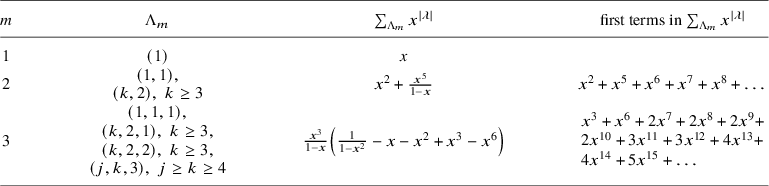
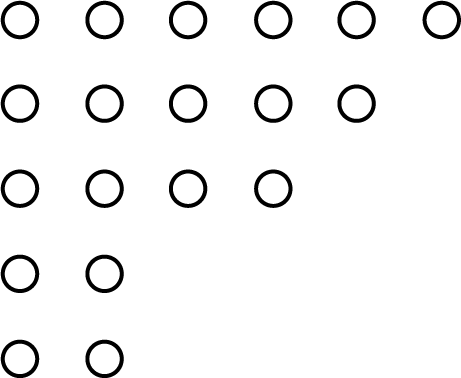

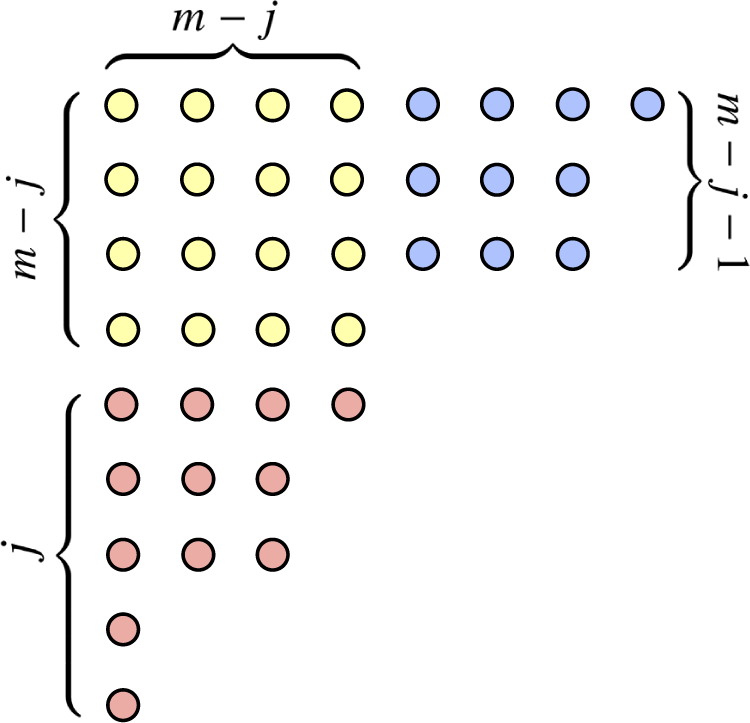


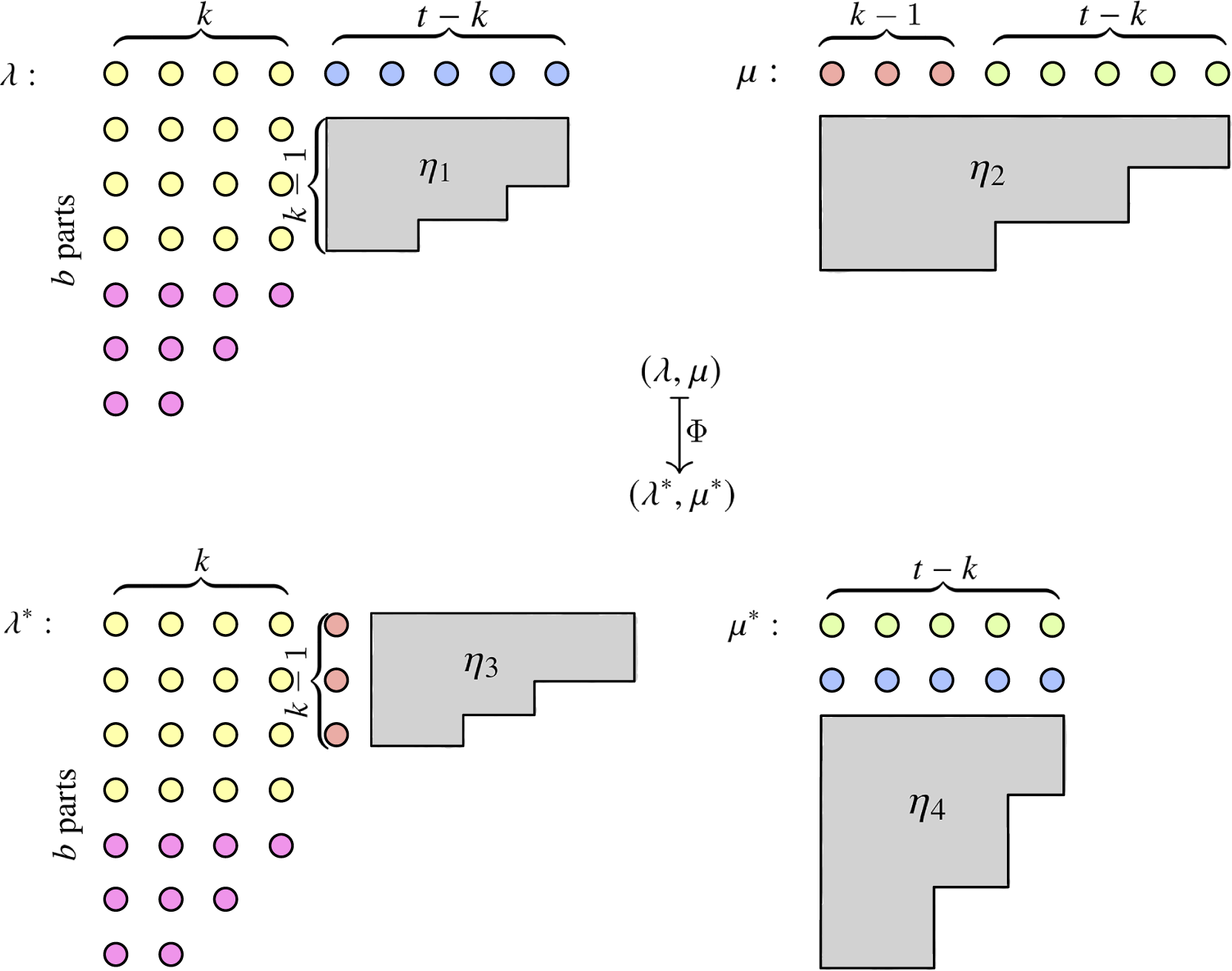

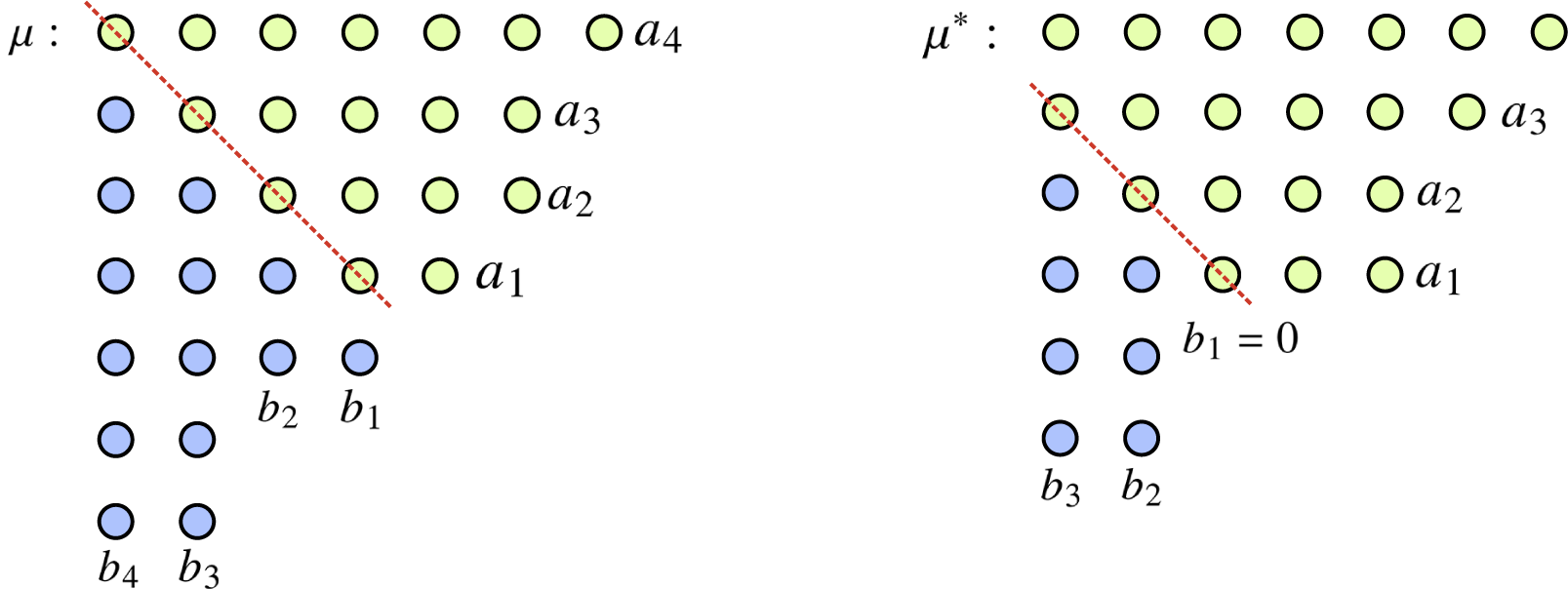


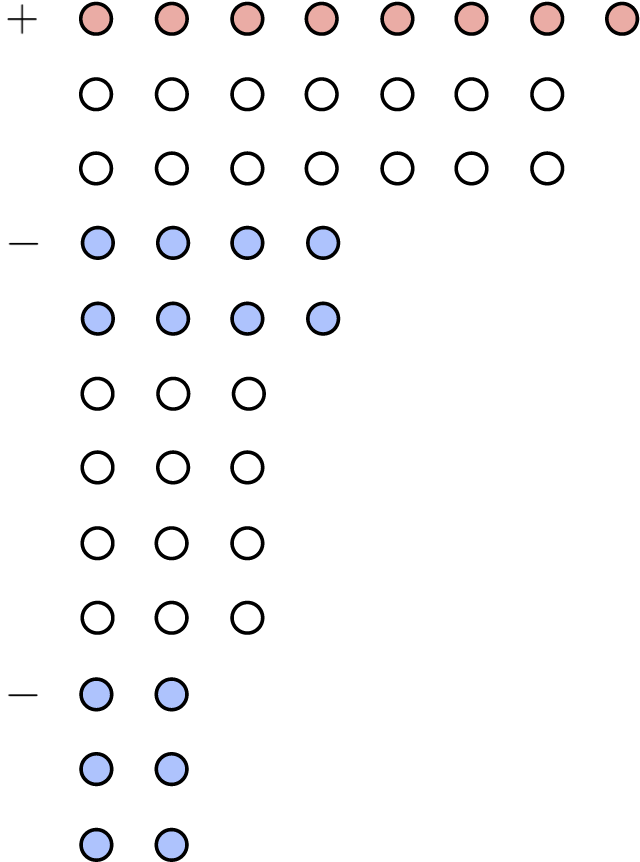


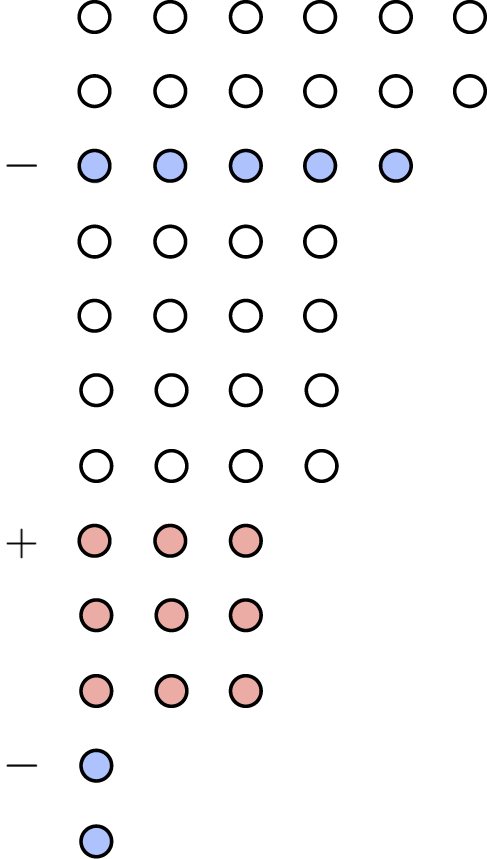


 Open access

