


Introduction
Rapid human population growth is closely associated with land-use changes and habitat fragmentation, forcing people and wildlife into closer proximity and the sharing of resources (Ogutu et al., Reference Ogutu, Owen-Smith, Piepho, Said, Kifugo and Reid2013). These changes lead to increases in the frequency and severity of use of crops by wild animals, livestock depredation, attacks on people, disease transmission and damage to infrastructure, houses and property (Attia et al., Reference Attia, Martin, Forbuzie, Angwafo and Chuo2018; Bond & Mkutu, Reference Bond and Mkutu2018).
In the case of carnivores in Kenya, interactions with people could arise because of competition for pasture and water (Mitchell et al., Reference Mitchell, Bruyere, Otieno, Bhalla and Teel2019) or because of livestock depredation (Packer et al., Reference Packer, Shivakumar, Athreya, Craft, Dhanwatey and Dhanwatey2019). Globally, 0.2–2.6% of domestic livestock is lost annually to predators (Meissner et al., Reference Meissner, Scholtz and Engelbrecht2013), which can be of great financial significance, affecting people's livelihoods (Patterson et al., Reference Patterson, Kaski, Selempo and Kays2004; Okello et al., Reference Okello, Kiringe and Warinwa2014; Muriuki et al., Reference Muriuki, Ipara and Kiringe2017; Sutton et al., Reference Sutton, Downey, Kamande, Munyao, Rinaldi and Taylor2017; LeFlore et al., Reference LeFlore, Fuller, Tomeletso and Stein2019; Manoa et al., Reference Manoa, Mwaura, Thenya and Mukhovi2020).
People have resorted to retaliatory killing of carnivores to prevent or avenge livestock losses, even if they have not experienced such losses first-hand (Inskip et al., Reference Inskip, Carter, Riley, Roberts and MacMillan2016; Kushnir & Packer, Reference Kushnir and Packer2019). This could be because the predatory nature of carnivores incites fear (Dickman & Hazzah, Reference Dickman, Hazzah and Angelici2016; Inskip et al., Reference Inskip, Carter, Riley, Roberts and MacMillan2016). Retaliatory killing is a global concern as it directly reduces the carnivore population (Chetri et al., Reference Chetri, Odden, Devineau and Wegge2019; LeFlore et al., Reference LeFlore, Fuller, Tomeletso and Stein2019). Although this is a complex matter, we hereby collectively refer to these negative interactions between people and carnivores as ‘conflict’.
In the Amboseli Ecosystem, Kenya, the Born Free Foundation's long-running conservation programme Pride of Amboseli, launched in 2010, fortifies traditional bomas to produce predator-proof bomas in which Maasai pastoralists can corral their livestock at night (Manoa & Mwaura, Reference Manoa and Mwaura2016). Predator-proof bomas are part-financed by boma owners, who contribute between 25% (the current rate) and 50% (the rate set in the early days of the programme) of the cost. These bomas are constructed using posts (originally wooden, but robust recycled plastic posts have been in use since 2013), onto which are hung rolls of chain-link fencing to enclose the boma, with one or more metal gates. Acacia thorn bushes are placed against both sides of the chain-link fencing to protect the bomas from damage by livestock and to deter digging carnivores such as hyaenas (Plate 1). Such physical barriers have proven effective at reducing livestock depredation inside the boma (Ogada et al., Reference Ogada, Woodroffe, Oguge and Frank2003; Lichtenfeld et al., Reference Lichtenfeld, Trout and Kisimir2015; Mkonyi et al., Reference Mkonyi, Estes, Msuha, Lichtenfeld and Durant2017; Sutton et al., Reference Sutton, Downey, Kamande, Munyao, Rinaldi and Taylor2017; Kissui et al., Reference Kissui, Kiffner, König and Montgomery2019; LeFlore et al., Reference LeFlore, Fuller, Tomeletso and Stein2019), with the Pride of Amboseli predator-proof boma rated as 91% effective at night and reducing the need to guard livestock at night to 1 day per week (Manoa & Mwaura, Reference Manoa and Mwaura2016).
A predator-proof boma under construction by the Born Free Foundation's Pride of Amboseli programme in 2018 (Acacia thorn bushes have not yet been added to the outside perimeter).

However, it is important to understand how predator-proof bomas persist in the long term and what motivates owners to maintain them. Lack of maintenance compromises the long-term sustainability of the bomas and reduces the overall impact of the intervention (Okello et al., Reference Okello, Kiringe and Warinwa2014). If predator-proof bomas fall into disrepair (defined here as reflecting a high level of damage and/or a low level or absence of maintenance by boma owners), their effectiveness is lowered (Broekhuis et al., Reference Broekhuis, Cushman and Elliot2017). Bomas are subject to wear and tear over time and because of fighting between bulls or physical crowding of livestock up against the boma fence. The motivation to conduct repairs could depend on need: for example, owners might maintain their bomas better if a clustering of nearby traditional bomas attracts predators or if the bomas are situated near wildlife-rich protected areas (demonstrated in Kenya by Okello et al., Reference Okello, Kiringe and Warinwa2014; Broekhuis et al., Reference Broekhuis, Cushman and Elliot2017, and in Ethiopia by Megaze et al., Reference Megaze, Balakrishnan and Belay2017) or in conflict hotspots (e.g. Chetri et al., Reference Chetri, Odden, Devineau and Wegge2019). Proximity to other predator-proof bomas could reduce the occurrence of predators. The motivation to conduct repairs could also depend on investment: for example, having a greater financial stake in the boma could encourage boma maintenance. Our objective was to examine which variables influence the disrepair of predator-proof bomas. We hypothesized that disrepair would: increase with the age of the boma and with proximity to protected areas and other predator-proof bomas; be greater in bomas with greater livestock densities and recycled plastic posts; and decrease with a greater per cent of the cost being contributed by the boma owner, when in areas of high conflict risk, and when in close proximity to a clustering of traditional bomas.
Study area
This study was conducted in the Amboseli Ecosystem, Loitokitok sub-county (County Government of Kajiado, 2018), on the border of Kenya and Tanzania (Fig. 1). The ecosystem comprises Amboseli National Park, group ranches Mbirikani, Olgulului, Mailwa, Rombo, Eselenkei, Kaptei, Kuku and Kimana, and the Enduimet Wildlife Management Area. The group ranch concept was introduced by the Kenyan government in the 1960s, to allow a group of pastoralists to own and manage their land communally with the purpose of commercializing production, and improving pastoralists' well-being and environmental management. Pastoralism is the main economic activity, with > 75% of the population deriving their livelihood from livestock and accounting for 60% of the total labour force (Okello & Kioko, Reference Okello and Kioko2010; County Government of Kajiado, 2018). There are two rainy seasons: the long rains in March–May and the short rains in October–December. Wildlife includes the elephant Loxodonta africana, buffalo Syncerus caffer, zebra Equus quagga, hyaenas Crocuta crocuta and Hyaena hyaena, lion Panthera leo, wildebeest Connochaetes taurinus, giraffe Giraffa camelopardalis and eland Tragelaphus oryx. It is estimated that the Amboseli Ecosystem has 1,800 elephants, c. 700 hyaenas and 880 jackals (Kissui & Kenana, Reference Kissui and Kenana2013), and in 2019 the human population in the sub-county was 191,846 people, with a population density of 51 persons/km2 (Kenya National Bureau of Statistics, 2019).
The study area in Loitokitok sub-county of the Amboseli Ecosystem, indicating the locations of predator-proof bomas in the Mbirikani, Olgulului, Mailwa, Rombo, Eselenkei, Kaptei, Kuku and Kimana group ranches and the Enduimet Wildlife Management Area.

Methods
During April 2010–July 2018 Born Free Foundation's Pride of Amboseli programme constructed 294 predator-proof bomas across the region. We interviewed the head of each homestead on the day of construction (or later if they were absent). We collected information on the size of the homestead (men, women and children from all constituent households combined), on the total number of livestock (cattle, sheep, goats and donkeys combined) and on conflict and perceptions, and we noted post type (wooden or plastic) and the per cent of the cost paid (25 or 50%). We measured the boma circumference using a 100 m tape and recorded the location using a GPS.
In August 2018 we randomly selected a sample of 88 predator-proof bomas using random numbers and a ranking procedure. The sample fell within the following group ranches: Eselenkei (10), Enduiment Wildlife Management Authority (4), Kaptei (8), Kimana (9), Kuku/Rombo (6), Mailwa (1), Mbirikani (29) and Olgulului (21). We interviewed the heads of each of the 88 homesteads using the same methodology as at the time of construction. In addition, we recorded the number of intact and damaged gates, chain-link fences and posts, and boma owners' reports of the causes of damage. We calculated the age of the predator-proof boma in months, the distance to the nearest predator-proof boma and nearest protected area (Amboseli or Tsavo National Parks) and the number of traditional bomas within a 1-km radius, using the distance and buffer tool in ArcGIS 2.2 (Esri, Redlands, USA) and satellite imagery (Esri World Imagery; accessed 1 June 2018). We calculated livestock density of the bomas at construction and in August 2018 to give the number of livestock/100 m2.
Statistical analyses
We used related-samples Wilcoxon signed-rank tests to assess whether there were any changes in boma circumference or the number of livestock between construction and evaluation. We used scatter plots and Kendall's correlation to assess potential correlations between boma size and livestock numbers at the time of construction and at the time of evaluation. We used χ 2 goodness-of-fit tests to assess whether proportions of damage from different causes were equal. Raw, untransformed data on gates resulted in expected frequencies of < 5, so data for causes of damage to gates (e.g. lorry or other vehicle, rotten wooden frame, elephants and unknown) were pooled, resulting in expected frequencies of 8.7. We performed statistical analyses in SPSS Statistics 26 and Statistics 27 (IBM, Armonk, USA).
Drivers of disrepair
We considered total number of damaged components and damage to each component of the predator-proof boma (gates, chain-link fences and posts). We proposed that the following variables could potentially drive disrepair: share of original cost (25 or 50%), post type (wooden or plastic), livestock density (number of animals/100 m2), distance to nearest predator-proof boma (km), boma circumference (m), clustering of traditional bomas (number of traditional bomas within a 1-km radius), distance to nearest protected area (km), months since construction, and homestead size.
We used generalized linear mixed models with a logit link function and binomial distribution to assess the drivers of boma disrepair. Individual predator-proof boma was included as a random effect. One boma did not hold livestock at evaluation and the homestead of another did not house people; we omitted these two bomas from the model, resulting in a sample of 86 predator-proof bomas. To test the influence of the extent of conflict (number of conflict events/km2) as a potential driver of boma disrepair, we built a second dataset using only bomas in the Mbirikani and Olgulului group ranches, where data on conflict events were available, resulting in a sample size of 47 for this analysis.
Model construction
For the full dataset of 86 predator-proof bomas, we included in the initial model the two categorical predictor variables (share of original cost and post type) and three non-correlated quantitative variables with the lowest variance inflation factor values (< 1.3; livestock density, distance to nearest predator-proof boma and boma circumference). The variance inflation factor values for the remaining three predictors not included in the initial model (clustering of traditional bomas, distance to nearest protected area and months since construction) were 1.359–2.607, showing moderate or weak levels of correlation (coefficient range 0.337–0.308). We added these predictors one at a time to the initial model. In addition, we fitted a null model (intercept-only). We conducted four separate analyses using, as the dependent variable, the proportion of damaged components (Supplementary Table 1, Analysis 1a), the proportion of damaged gates (Supplementary Table 1, Analysis 1b), the proportion of damaged posts (Supplementary Table 1, Analysis 1c) and the proportion of damaged chain-link fences (Supplementary Table 1, Analysis 1d).
We employed a similar procedure for the second dataset (n = 47), including four non-correlated predictors with the lowest variance inflation factor values (< 1.2) in the initial model (homestead size, distance to nearest predator-proof boma, clustering of traditional bomas and livestock density). Predictors not included in the initial model (distance to protected area, extent of conflict and months since construction) also had low variance inflation factor values (1.1–1.3) but were weakly correlated with some variables (coefficient range 0.350–0.176).
Based on the criteria defined above, we fitted five models for each analysis. To assess whether the number of variables in each model affected model quality, we compared the Akaike information criterion (AIC) of the null model to the AIC of each model; in addition, we examined binned scatter plots of the relationships between the predicted values and the observed values. This procedure helped us to select final models.
Model evaluation
Amongst all models fitted using the main dataset (n = 86) and proportions of damaged components as the dependent variable (Supplementary Table 1, Analysis 1a), the fit of the initial model (five predictors) was the best, as shown by the AIC values (Supplementary Table 1). The inclusion of an additional predictor, clustering of traditional bomas, also increased the fit, but the fit of models with distance to nearest protected area and months since construction decreased relative to the other models. However, the binned scatter plots of the predicted values against the observed values were similar in all models in always indicating a good fit of the data, thus suggesting that the inclusion of additional variables did not have a major influence on the quality of the models. We therefore included all variables in the final model, given the good fit (Supplementary Fig. 1a). Regardless of the number of predictors included in the different models, the effects of the same two variables (livestock density and boma post type) were consistently significant and the sign of their regression coefficients did not change (−0.0368 to −0.0345 and −3.4183 to −2.9413); other predictors always failed to reach statistical significance. Similar patterns emerged when using proportion of damaged posts as the dependent variable (Supplementary Table 1, Analysis 1c); the final model with all variables also fitted the data well (Supplementary Fig. 1c). The fit of all models built using proportion of damaged chain-link fences as the dependent variable decreased compared to that of the null model (Supplementary Table 1, Analysis 1d); nevertheless, all variables were retained in the final model, which provided a reasonable fit to the data (Supplementary Fig. 1d). Proportion of damaged gates was also used as a dependent variable, but this dataset was poor (most values for the dependent variable were 0) and we obtained no well-fitting model. The initial model built with five variables poorly fitted the data (Supplementary Fig. 1b) and additional variables did not improve the model (Supplementary Table 1, Analysis 1b).
For the second dataset (n = 47), the binned scatter plot for the initial model (four predictors) constructed using proportion of damaged components as the dependent variable suggested a suitable fit of the data (Supplementary Fig. 2a). The AIC values for models with additional variables indicated a decrease of fit relative to the initial model (Supplementary Table 1, Analysis 2a). However, the same predictor was consistently significant in all models, always having a positive influence (regression coefficient range 0.000164–0.000171), whereas all other predictors remained statistically non-significant. Given the limited sample size, we did not include any additional predictors in the final model. Patterns were similar to those of Analysis 2c, which included proportion of damaged posts as the dependent variable (Supplementary Table 1 & Supplementary Fig. 2c), but predictors were statistically non-significant in all models except for one case where the model (with six predictors) yielded P = 0.0496 for distance to nearest predator-proof boma. However, given the limited sample size, we did not consider this as the final model, to avoid overfitting. For models including proportion of damaged gates and proportion of damaged chain-link fences as dependent variables, binned scatter plots of the initial models indicated a considerable lack of fit (Supplementary Fig. 2b, d); other predictors did not change this pattern (Supplementary Table 1, Analyses 2b,d).
Results
Boma characteristics
The mean numbers of livestock per boma were 383.4 ± SD 333.0 (n = 88) at the time of construction and 226.3 ± SD 255.5 (n = 88) at the time of evaluation (Fig. 2). The number of livestock was significantly lower at the time of evaluation (related-samples Wilcoxon signed rank test: Z = −4.893; P < 0.0001). At the time of evaluation, 55 bomas (63%) held ≤ 200 heads of livestock, whereas at the time of construction only 23 bomas (26%) held ≤ 200 heads of livestock and 39 bomas (44%) held 201–400 heads of livestock.
Number of livestock at construction of predator-proof bomas in April 2010–July 2018 and at evaluation in August 2018.

The bomas measured on average 223 ± SD 95.8 m in circumference (n = 88). There were significantly positive relationships between livestock numbers and boma circumference at both construction and evaluation (Kendall's τb = 0.280, P = 0.00013, and 0.207, P = 0.0049, respectively). Bomas were on average 1.93 ± SD 3.99 km (n = 88) from the nearest predator-proof boma and on average 17.68 ± SD 11.21 km from the nearest protected area (n = 88).
Damage to boma components
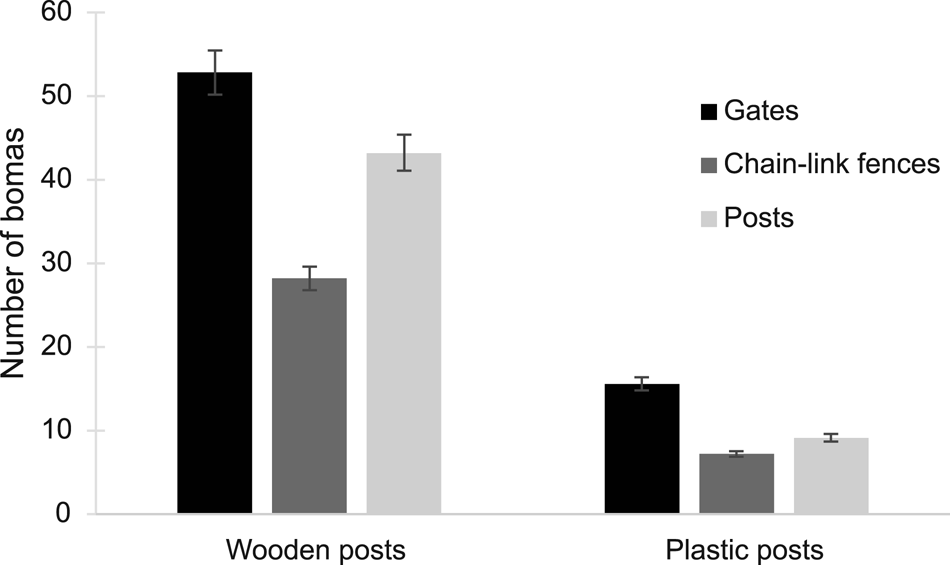
Of all evaluated bomas, 57 (64.8%) exhibited some damage, of which 14 (15.9%) had some damage to all three components (gates, chain-link fences and posts; Table 1). Of the sampled bomas, 78.4% (n = 88) had recycled plastic posts. Bomas with wooden posts exhibited a higher mean level of damage to posts, gates and chain-link fences than those with recycled plastic posts (Fig. 3; Supplementary Table 2). All 19 bomas with wooden posts exhibited some damage, whereas only 55% of the 69 with recycled plastic posts exhibited damage. Furthermore, of the bomas with wooden posts, only one exhibited no post damage.
Number of predator-proof bomas exhibiting damage to three elements (gates, chain-link fences and posts), by predator-proof bomas with wooden posts (n = 19) and with plastic posts (n = 69).
The number of predator-proof bomas suffering damage, as reported by boma owners at evaluation, by types and combinations of components.

Boma owners identified cattle or other livestock to be the most common reason for damage overall and for chain-link damage and loose posts to be the main reason for gate damage, and termites to be the main reason for post damage (Table 2). However, for chain-link fences, gates and posts, differences in the proportions of damage from different causes were not significant (χ 2 goodness-of-fit tests: χ 2 = 5.516, 0.077 and 5.723, respectively; P = 0.138, 0.962 and 0.334, respectively). Nevertheless, analyses conducted with all data combined (total number of reports of damage) revealed statistically significant differences in the proportions of damage from different causes (χ 2 goodness-of-fit tests: χ 2 = 59.904; P < 0.0001).
Causes of damage to the parts of 88 predator-proof bomas, as reported by boma owners at evaluation, with the per cent of cause of damage per boma component.

Drivers of boma disrepair
Damage to bomas was driven largely by livestock density (r = −0.037, P = 0.028), boma post type (r = −2.941, P < 0.001) and distance to nearest predator-proof boma (r < 0.001, P = 0.033). Specifically, the proportion of damaged components and damaged posts decreased in bomas with greater livestock densities; plastic posts were less likely to be damaged compared to wooden posts; and greater proportions of damaged chain-link fences were noted for bomas located far from others (Table 3; Supplementary Table 2a,c,d). Using the subset of data for 47 bomas in the Mbirikani and Olgulului group ranches, bomas located far away from others had greater proportions of damaged components (Supplementary Table 3). Although models built using proportion of damaged gates and proportion of damaged chain-link fences as dependent variables did not fit the data well overall (Supplementary Fig. 2b,d), the individual effect of distance to nearest predator-proof boma was statistically significant (Supplementary Table 2f,h); this was also the case for the main dataset using proportion of damaged gates as the only dependent variable (Supplementary Table 2b). We detected no significant effect (except for the intercept) using the second dataset and proportion of damaged posts as the dependent variable (Supplementary Table 2g).
Summary of generalized linear mixed model showing regression coefficients and P-values for each variable. Analyses were performed using the full dataset (n = 86). Models were fitted using 10 predictors. Cost shared by boma owner and boma post type are categorical; all other predictors are continuous. We calculated three models, one each with all components, posts and chain-link fences as dependent variables. Detailed results are presented in Supplementary Table 1a,c,d.

*P < 0.05; **P < 0.01; ***P < 0.001.
Discussion
Our results reveal there was more disrepair in bomas constructed with wooden posts, confirming the benefit of using recycled plastic posts; in bomas with lower livestock density, suggesting that fewer animals could cause more damage or that such damage is not repaired; and in bomas located further away from a neighbouring predator-proof boma, suggesting a social element encouraging or enabling boma owners to carry out maintenance.
The effect of post type in driving the disrepair of bomas is likely to be a direct result of the robustness of the material; wood is prone to rot and consumption by termites. Furthermore, weak posts reduce the strength of the structure overall, whereas robust recycled plastic posts result in stronger structures and less damage to other boma components. The majority (66.7%) of respondents in Amboseli preferred recycled plastic posts because of their durability and termiteresistant traits (Manoa & Oloo, Reference Manoa and Oloo2016). Extensive, rapid damage because of weak wooden posts could overwhelm boma owners in terms of their financial and technical capacity and the time they have available, thus explaining the importance of this variable in our models.
Contrary to our expectations, the proportion of damaged components (and damage of posts alone) decreased in bomas with greater livestock densities. When there are fewer animals present they have more room to move about, which could result in more high-energy, high-speed scuffles and possible collisions with the sides of the boma. Alternatively, boma owners may invest more in maintenance when they have more livestock as the value of their assets is greater and so they are more able to maintain their bomas. However, livestock species composition and behaviours will vary between bomas, and the type and extent of damage caused could also vary accordingly. We pooled all livestock in our analysis, but for a more accurate assessment of the effect of livestock density repeated measures of damage for each boma, followed by detailed statistical analyses, would be required. The number of livestock held in the sampled bomas ranged from 10 to > 2,000. The mean number of livestock being held in the sampled bomas declined significantly between construction and evaluation. Having a fortified boma could result in the financial benefit of reduced livestock loss, thus enabling boma owners to keep fewer livestock, or to have a greater sense of security, therefore eliminating the need to keep extra livestock as an insurance policy against economic shocks (Alinovi et al., Reference Alinovi, D'Errico, Mane and Romano2010). However, predator-proof bomas were constructed throughout the year, whereas we performed the evaluation in the dry season when livestock can be lost because of insufficient water and grazing opportunities; this may explain the observed decrease in number of livestock. Increasingly common droughts and associated loss of grazing lands in Kenya and Tanzania have led to an overall decline in the livestock economy, which, combined with shifting cultural norms and expectations (e.g. a shift from a nomadic to a sedentary lifestyle or increased occurrence of secondary professions), could potentially influence herd size (Huho et al., Reference Huho, Ngaira and Ogindo2011; Ogutu et al., Reference Ogutu, Piepho, Said and Kifugo2014; Kimiti et al., Reference Kimiti, Western, Mbau and Wasonga2018).
Greater levels of disrepair were related to greater distances to the nearest predator-proof boma, and clustering of traditional bomas had no influence on disrepair. Neighbours who own predator-proof bomas could share knowledge and assist each other in maintaining their bomas, offering skills or tools that are obtained via the Pride of Amboseli programme's training on boma maintenance. Such information transfer has been observed regarding traditional ecological knowledge relating to grazing (Usher, Reference Usher2000). The reduced livestock depredation enjoyed by an owner of a predator-proof boma could encourage others to maintain their bomas so as to receive the same benefits. An isolated predator-proof boma owner will not necessarily experience these social incentives or pressures regarding boma maintenance. The absence of any influence of clustering of traditional bomas on boma disrepair suggests there is no strong influence of pressures or incentives from owners of neighbouring traditional bomas. However, satellite imagery, used to identify the traditional bomas, is subject to change, and cloud cover and poor image quality could have resulted in inaccuracies in identification.
Conflict data were only available for two of the group ranches. The second dataset comprising only those two group ranches had a small sample size (n = 47), so only four predictors could be included in the final model, and because of its relatively high variance inflation factor, we could not include extent of conflict.
Contrary to our expectations, age of predator-proof boma did not drive disrepair. It is possible that other variables not linked to the passing of time have a greater influence on disrepair, thus masking the effect of age (e.g. livestock could damage a boma at any time after construction).
We found no impact of the share of the initial cost, suggesting that a greater financial stake does not encourage boma owners to maintain and repair their bomas. However, as only 17% of owners paid a 50% cost-share, we may not have had sufficient data to provide the statistical power to examine this potential effect.
Distance to protected area did not drive boma disrepair. Although it might be expected that wildlife densities are higher nearer to protected areas, hyaena predation of livestock in northern Tanzania is random in space and time, being unaffected by proximity to protected areas (Kissui et al., Reference Kissui, Kiffner, König and Montgomery2019). In Kenya, the majority (60–70%) of wildlife populations occur outside protected areas (Mureithi et al., Reference Mureithi, Verdoodt, Njoka, Olesarioyo, Van Ranst, Kideghesho and Rija2019; Ontiri et al., Reference Ontiri, Odino, Kasanga, Kahumbu, Robinson and Currie2019). Wildlife densities could be determined by factors that vary over time, such as habitat availability, food and water resources, season and human pressures (Kissui et al., Reference Kissui, Kiffner, König and Montgomery2019). In addition, there are conservancies, migratory corridors and dispersal areas in the ecosystem where wildlife might occur at higher densities; further investigation could tease out such influences.
Reviews have revealed that a combination of factors, including social factors, influence carnivore conservation (Dickman, Reference Dickman2010; LeFlore et al., Reference LeFlore, Fuller, Tomeletso and Stein2019, Reference LeFlore, Fuller, Tomeletso, Dimbindo and Stein2020). It has been suggested that a combination of variables drives the disrepair of predator-proof bomas, including ecological (e.g. livestock predation), cultural and socio-economic (e.g. people's attitudes) influences (Dickman, Reference Dickman2010; Dickman & Hazzah, Reference Dickman, Hazzah and Angelici2016). Our findings similarly suggest that the drivers of disrepair of predator-proof bomas, which play an important role in carnivore conservation, are also complex. These factors, combined with political factors (e.g. conservation policy development and implementation), are likely to influence carnivore conservation more generally (LeFlore et al., Reference LeFlore, Fuller, Tomeletso and Stein2019).
Acknowledgements
We thank the participants and their families from the Amboseli Ecosystem for their participation and collaboration in this study; all donors and supporters of the Born Free Foundation, who enable the Pride of Amboseli programme; and our collaborators, particularly the Kenya Wildlife Service and the Big Life Foundation, for contributing data on conflict. This research received no specific grant from any funding agency or commercial or not-for-profit sectors.
Author contributions
Experimental design: EG, DOM; data collection: DOM, SK, SM, facilitated by TO; data analysis: JW, NT, PB; writing: NT, DOM, PB, with input from all other authors.
Conflicts of interest
None.
Ethical standards
This research abided by the Oryx guidelines on ethical standards.


 Open access

