





1. Introduction
States assert their right to rule by issuing legal commands, accompanied by the claim that citizens have a corresponding duty to obey. A natural objection to political obligation, one that philosophical anarchists (e.g. Wolff Reference Wolff1992) have long pressed, is that it requires citizens to defer their powers of rational decision-making in a way that is incompatible with autonomy. Joseph Raz’s service conception of authority provides one powerful response to this objection. His normal justification thesis (NJT) holds that:
the normal way to establish that a person has authority over another person involves showing that the alleged subject is likely better to comply with reasons which apply to him (other than the alleged authoritative directives) if he accepts the directives of the alleged authority as authoritatively binding and tries to follow them, rather than by trying to follow the reasons which apply to him directly. (Raz Reference Raz1986: 53)
The NJT is an instrumentalist principle: if we assume that autonomous decision-making is valuable only as a means of complying with reason, and if deference to political authority enables us to increase that compliance, then any tension between autonomy and political obligation is no more troubling than the incompatibility between an inferior tool and a superior one.Footnote 1 Indeed, political authority provides a service to citizens by increasing their compliance with reason.
Although Raz’s theory of legitimacy is the most prominent example of a service view, many other theories incorporate what might be called a service component. Notably, while Raz is neutral regarding the kinds of reasons his theory applies to, whether they are prudential or moral, other service theories tend to focus specifically on citizens’ moral obligations. Hence, citizens are said to be obliged to obey the state if doing so enables them to better meet their Samaritan duties (Wellman Reference Wellman1996, Reference Wellman2001), protect basic human rights (Buchanan Reference Buchanan2002), conform to publicly justified rules (Vallier Reference Vallier2019: Ch. 5), or fulfil what could reasonably be seen as a requirement of justice (Quong Reference Quong2011: Ch. 4). This essay uses the term “service theory” to describe any account of authority that grounds the state’s right to impose duties, at least in part, on the condition that its commands increase citizens’ conformity with reason. It identifies a difficulty affecting any service theory, regardless of the kinds of reasons to which it applies.Footnote 2
Service theories are usually understood to evaluate the legitimacy of state authority synchronically by asking whether compliance with state authority helps citizens better comply with reason at the time of evaluation. However, synchronic evaluation overlooks how citizens’ ability to comply with reason by themselves – their self-governance capacity – is endogenous to state authority. The more citizens rely on state authority, the less they may be able to do for themselves. State authority might come to pass a synchronic assessment only via a self-fulfilling dynamic. This happens when citizens need state authority to best comply with reason at the time of evaluation because reliance on state authority has undermined their self-governance capacity or prevented it from developing.
The critical point is that, had the state not originally intervened, citizens would have been even better able to comply with reason by deciding for themselves at the time of evaluation than their dependent counterparts do by obeying the state. In other words, in these self-fulfilling cases, state authority has ultimately diminished rather than enhanced citizens’ conformity with reason over the long run. To address this problem, service theories should incorporate both synchronic and diachronic modes of evaluation when assessing the legitimacy of state authority. If synchronic evaluation only considers whether state authority increases citizens’ conformity with reason given their self-governing competence at the time of evaluation, diachronic evaluation also accounts for how state authority affects that self-governing competence over time.
The argument will proceed as follows. Section 2 outlines the basic conceptual framework, including the distinction between self-governance and state authority. It also outlines this essay’s construal of the NJT – the instrumentalist improvement condition. Section 3 defines a self-fulfilling dynamic and explains how the state might come to meet the instrumentalist improvement condition in this way. Section 4 explains why the possibility of self-fulfilling dynamics means that a service theory should incorporate diachronic evaluation into its legitimacy assessment.
As its label implies, the improvement condition I introduce in section 2 is an instrumentalist principle like the NJT. It places no intrinsic value on self-governance, which is to be preferred to state authority only if it achieves better results. Section 5 shows why self-fulfilling dynamics are more troublesome if we adopt a “pluralist” version of the improvement condition which accords self-governance some (though not absolute) intrinsic value. Section 6 examines prisoner’s dilemma type problems and challenges the assumption that self-fulfilling dynamics are irrelevant in these contexts due to the infeasibility of self-governing solutions. Section 7 responds to the concern that epistemic constraints mean this paper’s prescriptions are difficult to apply in practice. Finally, section 8 concludes by highlighting how this paper’s argument has implications for the ongoing debate about citizens’ political competence.
2. State versus Self-governance
I follow Raz in adopting a piecemeal view of state authority. Instead of asking whether the state has a general (if defeasible) right to impose duties, I ask whether it has legitimate authority over specified functions. This term refers to particular domains of activity in which individuals have reasons for action, whether moral or prudential. Educating one’s children, saving for retirement, and sustainably managing a common-pool resource are all functions in this sense.
Questioning the legitimacy of state authority as such on the basis of self-fulfilling dynamics would require demonstrating that the state’s superiority over self-governance in any function arises solely from these dynamics – even basic Hobbesian functions like the provision of law and order. Such an anarchist conclusion is within the realm of logical possibility. Perhaps citizens need the state to protect themselves from violence and adjudicate their legal disputes only because they haven’t had sufficient practice at fulfilling these functions in a state of nature. I wouldn’t want to dismiss this kind of empirical anarchism from the philosophical armchair, even if it is bold and highly speculative, but neither do I want the practical relevance of this paper to be predicated on its correctness.
Instead, consider the many tasks performed by the contemporary state that extend beyond “nightwatchmen” functions of defence and law and order, such as its welfare and regulatory activities. A more plausible concern is that the state has necessitated its authority over many of these areas via self-fulfilling dynamics. Indeed, many of these tasks were managed by self-governing citizens before the 20th century (Green Reference Green1993; Beito Reference Beito2000). The piecemeal approach, then, enables us to critically assess state authority over specific areas where self-fulfilling dynamics might have occurred without resorting to speculative claims about the viability of an anarchist order.Footnote 3
The question of authority concerns who has the right to decide how a function is fulfilled. Suppose individuals have prudential reasons to save for their retirement. The state has legitimate authority over this function if it has the right to decide matters such as how much citizens should save for their retirement, when they can retire, and what benefits they will subsequently receive, and if citizens have a correlative duty to comply with its decisions. By contrast, self-governing citizens have authority over this function if they independently decide when (or if) they retire, how much of their income to save, whether to rely on family support or investment income, what (if any) investments to make, and so on. The state will also have a corresponding duty not to interfere with these self-governing decisions.
It is important to remember that self-governing citizens can cooperate with one another to solve problems. The appropriate comparison is not the state versus isolated or atomised individuals. Self-governing individuals can cooperate on commercial as well as other terms. For example, individuals might finance their retirement through the stock market, but they could also turn to family, charity, or mutual aid governed by norms of reciprocity. Any plausible account of self-governance would need to include what Alexis De Tocqueville called the “Art of Association”. Both he and John Stuart Mill emphasized that voluntary associations are crucial mechanisms by which self-governing citizens fulfil important functions without the state. For present purposes, we can think of an association as a rule-governed organization that pursues a common purpose (Fuller Reference Fuller, Chapman and Pennock1969). There is a fairly extensive literature documenting how voluntary associations have managed to create and enforce rules to fulfil various functions, from environmental management to social insurance to dispute resolution (Ostrom Reference Ostrom1990; Green Reference Green1993; Beito Reference Beito2000; Scott Reference Scott2009; Stringham Reference Stringham2015).
Now, one might worry that membership of voluntary associations fails to count as genuine self-government. For civil society associations expect members to comply with their formal rules and regulations, even when they conflict with a member’s personal judgement. In other words, citizens are still subject to an external authority when participating in associational life rather than directly reasoning for themselves. However, the right of exit makes an important difference here. Provided citizens are free to leave civil society associations, have a rich range of alternatives to join, and new associations are reasonably easy to create, they remain engaged in self-governance even when complying with associational rules that conflict with their personal judgement in a particular instance. We might say that such individuals remain self-governing on a higher-order level because they exercise choice over the associational authorities that govern them. Additionally, it is more feasible to exercise voice in small-scale civil society associations than in large-scale political authorities. An individual’s vote is more likely to be decisive; it is easier for one person or a small group to organize a winning coalition; and an individual has greater scope to influence both the issues that are on the deliberative agenda and the course of deliberation (Buchanan Reference Buchanan2001: 82–84).
These considerations also explain why I do not regard state intervention by a representative democratic government as an expression of self-governance by the citizenry. The two features that enable meaningful self-governance at the associational level – the relatively low cost of exit and the reasonably high scope for exercising voice – are typically absent in relation to the impersonal state. I do not deny that large-scale representative democracy offers citizens some degree of voice through elections and the ability to petition their representatives (Christiano Reference Christiano2008). However, except in the rare case of a referendum, large-scale democracy does not allow citizens to make substantive decisions themselves. These are made by officials on their behalf. Sometimes, citizens do not even elect these officials. Judges, for instance, are typically unelected. Nor can citizens exit easily to another state whose laws they prefer when they disagree with their government’s decisions. The exit costs of leaving one’s country are significantly higher, both financially and psychologically, compared with leaving a typical association – on this, see Rawls (Reference Rawls1996: 221–22).Footnote 4
Having clarified the conceptual distinction between self-governance and the state, we can now operationalize Raz’s NJT. Let us assume we have a scalar measure of how well the state or self-governance performs a function, which enables us to make “more than”, “less than” or “equal to” comparative judgements. We can think of this as a performance measure. On my construal of Raz’s NJT, the state has legitimate authority over a function iff:
It can perform the function better than self-governing citizens – i.e. it scores higher on our performance measure.
Since a function refers to activities in which citizens have reasons for action, state authority increases citizens’ conformity with reasons that apply to them independently when it meets the improvement condition. I will call this formulation the instrumentalist improvement condition. Like Raz’s NJT, the instrumentalist improvement condition places no intrinsic value on self-governance or state authority. All that matters is which decision-making mechanism performs the function best. (Section 5 will consider a different formulation of the improvement condition.) The next task is to show how the state might come to meet the instrumentalist improvement condition over a function via self-fulfilling dynamics.
3. Self-fulfilling Dynamics
A self-fulfilling dynamic occurs between two parties, A and B, when:
-
(i) A treats B at t0 in a manner consistent with B having a certain trait.
-
(ii) B exhibits that trait at t1 because of A’s treatment.
The classic example is the Pygmalion effect in education (Rosenthal Reference Rosenthal2012: 332–33). Suppose teachers expect some students to perform better than others. They are consequently more encouraging of the students they expect more of, teaching them more material, giving them more detailed feedback on their work, and so on. Subsequently, these privileged students indeed perform better, but only because of the extra help.Footnote 5 With respect to state authority, this basic definition implies that the state meets the instrumentalist improvement condition via a self-fulfilling dynamic iff:
-
(i) The state appropriates authority over the function at t0 – a treatment consistent with citizens performing the function worse than the state.
-
(ii) At t1, citizens indeed perform the function worse than the state (i.e. the instrumentalist improvement condition is met) but only because the state intervened at t0.
An account of a self-fulfilling dynamic needs to identify the mechanism by which A’s treatment causes B to have the trait at t1. This is clear enough in the education case: extra help from the teacher. We need to identify a plausible mechanism by which the state’s appropriation of authority at t0 causes self-governing citizens to be worse than the state at t1.
I will assume that, all other things equal, citizens’ competence in performing a function depends on their opportunities for practice. This entails citizens forming judgements about how they can best fulfil a function and acting on those judgements to learn from the resulting successes or failures. For example, suppose parents have a duty to educate their children to be competent and fully participating members of society. To gain competence in this function, parents not only need the ability to make judgements about which kind of schooling – e.g. homeschooling or schooling with other children – or which curricula will be beneficial. They also need to be able to put these judgements to the test and learn from the outcomes. In short, practice – summarized as “putting judgements into action” – is necessary to acquire competence in self-governance. We can also assume that self-governance capacity will tend to improve with practice – “practice makes perfect” – and, crucially for our purposes, deteriorate without it – “use it or lose it”.
It is worth noting that self-governing citizens not only learn from their own experiences of putting their judgements into action but also from the successes and failures of other citizens. We can meaningfully speak of a society improving its self-governance capacity over time, even across generations, through practice. Once effective methods of performing functions are discovered, they can be imitated by others and passed down to future generations. Conversely, we can speak of a society forgetting its capacities. If the members of one generation are suddenly unable to practise performing a function, societal competence is unlikely to pass through to subsequent generations. The notion that self-governing citizens can collectively learn (or forget) competence intergenerationally is noteworthy regarding functions with limited opportunity for improvement at the individual level because of a lack of second chances. For example, if I fail to plan for my pension adequately, I cannot relive my life to correct this mistake. However, my errors might serve as lessons for members of the next generation.Footnote 6
Note also that our model of competence still applies if individuals exercise self-governance over a function by joining a civil society association. The capacity for associational self-governance is not fixed. It involves a complex set of institutional, social and cooperative norms that associational members can learn over time. Consider Governing the Commons, Elinor Ostrom’s (Reference Ostrom1990) famous study of communities that, often over generations, built up shared rules to safeguard common pool resources. Each community is guided not only by their own experiences but also the successes and failures of others – “information about what has worked well in one setting can be transmitted to others who may try it out in their settings” (Ostrom Reference Ostrom2005: 184). By the same token, however, once citizens lack the opportunity to practice associational self-governance, their competencies are likely to atrophy.
One might question the assumption that competent self-governance requires direct practice.Footnote 7 An alternative view is that theoretical study and reflection may suffice. Perhaps the study of academic works such as Governing the Commons might be enough to teach individuals how to cooperate with peers to solve collective problems. After all, Ostrom identifies several abstract “design principles” that characterize groups which successfully manage common-pool resources.Footnote 8 Individuals could learn these principles without actually participating in a self-governing association.
The necessity of practice becomes apparent when we consider the large body of work arguing that much of our knowledge is experiential and practical in nature (Hayek Reference Hayek1945; Polanyi Reference Polanyi2009), consisting in knowing how rather than knowing that (Ryle Reference Ryle1945). The distinction between theoretical and practical knowledge can be illustrated by the difference between knowing the rules of chess and being a good chess player. Practical knowledge requires a familiarity with the activity in question that one only gains through “learning by doing” (Arrow Reference Arrow1962). This holds not only for an individual who learns a skill but for associational life. Ostrom (Reference Ostrom1990: 32) stresses that communities need to undergo a “considerable amount of trial and error learning” to discover the right solutions to their environmental problems. Abstract knowledge, such as her design principles, may serve as useful schematic summaries of what works, but they are no substitute for the “know how” that comes from practice (Oakeshott Reference Oakeshott1991). This remains true even when we imitate the successful practices of others. Imitation requires not only copying the outward form of a successful method but also learning the intangible or tacit elements that contributed to its success.Footnote 9
We can now straightforwardly identify the causal mechanism that allows the state to meet the improvement condition through a self-fulfilling dynamic: compliance with the state’s legal directives prevents citizens from practising the function themselves. This should be an uncontroversial proposition. I stress it is robust to whether citizens obey out of a genuine sense of obligation or simply to avoid coercive sanction. Suppose, first, that citizens obey out of obligation in the sense of Hart (Reference Hart2011: Ch. 10) or Raz (Reference Raz1986: 38–62). They treat legal directives as content-independent and pre-emptive reasons for action. The mere fact that the state issues a legal directive concerning a function constitutes a reason for action, independent of its substantive content, one that replaces a citizen’s own consideration as to how to fulfil that function. Clearly, under such pre-emptive authority, citizens cannot practise the function independently if state directives override their personal deliberation of the relevant reasons for action.Footnote 10 Alternatively, citizens may not recognize any obligation to obey, complying solely to avoid coercive sanction. Yet, so long as the state possesses sufficient coercive capacity to routinely tilt citizens’ balance of reasons towards compliance, they are still left with limited scope to form, act upon and learn from their independent judgements concerning the function’s fulfilment.
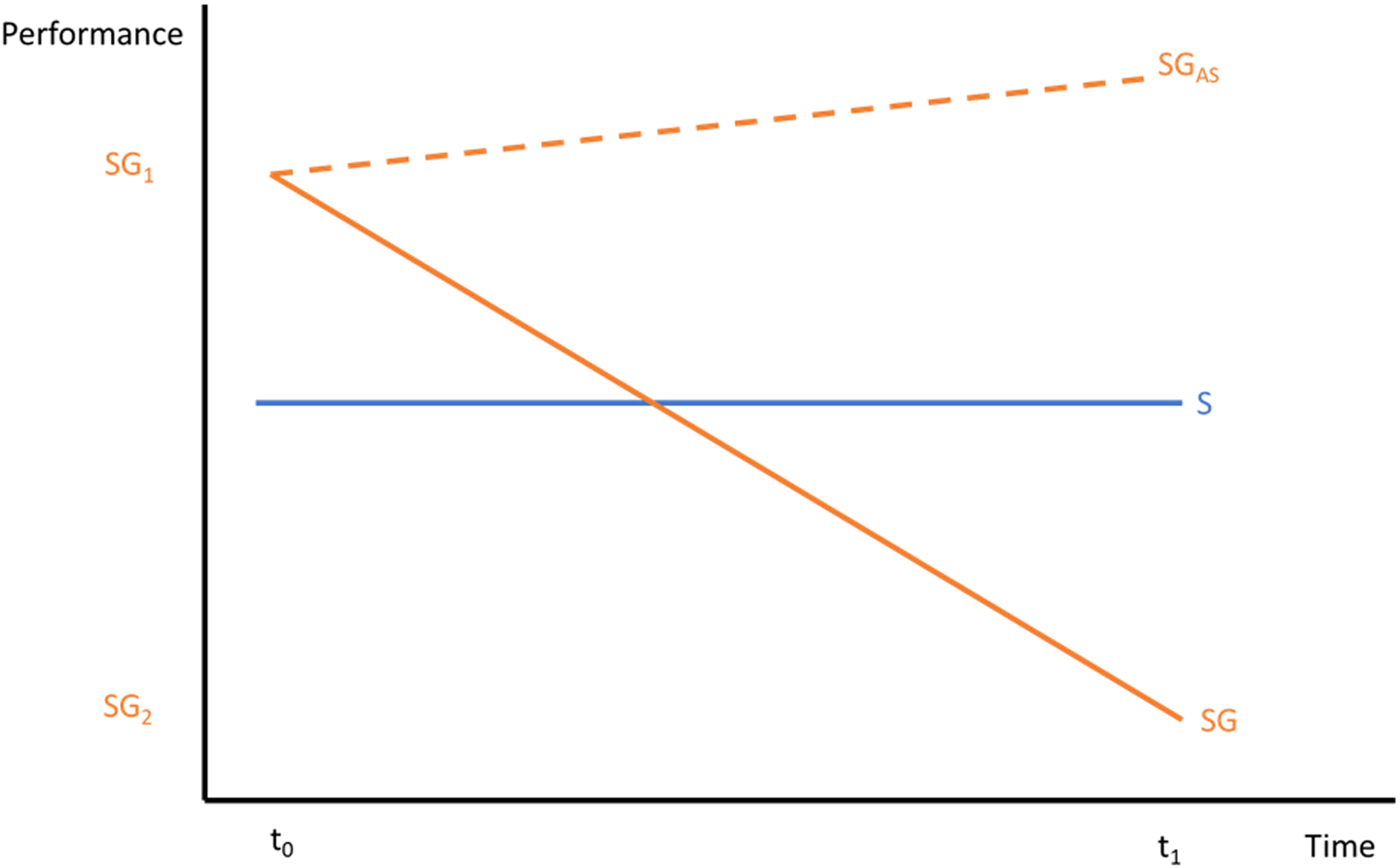
Now we can model slightly more formally one possible way the state might come to meet the instrumentalist improvement condition via a self-fulfilling dynamic. Consider Figure 1.
Diminishment of self-governance capacity.

Figure 1 Long description
A line graph illustrates the performance of different governance systems over time. The x-axis represents time, with two points labeled t0 and t1. The y-axis represents performance, with three levels labeled SG2, S, and SG1. There are three lines: a solid blue line labeled S remains constant over time. An orange solid line labeled SG starts at SG1 at t0 and declines to SG2 at t1. An orange dashed line labeled SGAS starts at SG1 at t0 and rises slightly above SG1 by t1. All values are approximated.
The vertical axis measures effectiveness at performing a function according to our performance measure while the horizontal axis measures time. Line S represents the effectiveness of state authority and line SG the effectiveness of self-governance. Suppose the state appropriates authority over the function at t0 when the improvement condition is unmet. This appropriation of authority is morally illegitimate because the state reduces the fulfilment of the function (i.e. citizens’ conformity with reason). The state not only fails to increase conformity with reason, as a service theory requires, but it actually makes matters worse for citizens in this regard.
Call line SG the actual self-governance baseline. Follow the state’s appropriation of authority, it drops from SG1 to SG2, reflecting how citizens’ self-governance capacity diminishes due to lack of practice.Footnote 11 Line SGAS represents how effective self-governance would have been by t1 had the state not appropriated authority at t0. Call this the alternative socialisation self-governance baseline. In this instance, the state has come to meet the instrumentalist improvement condition at t1 via a self-fulfilling dynamic. Its performance is superior only to citizens rendered dependent on its authority.
4. Self-fulfilling Dynamics Reveal the Inadequacy of Exclusively Synchronic Evaluation
Service theories are conventionally understood to evaluate the legitimacy of authority synchronically. We simply ask whether the state outperforms self-governance at the time of evaluation. Using the diminishment scenario as a foil, I will now argue that the possibility of self-fulfilling dynamics demonstrates why service theories should not evaluate legitimacy solely on a synchronic basis. They should also adopt diachronic evaluation. If synchronic evaluation only considers whether state authority performs better than self-governing citizens given their capacities at the time of evaluation, diachronic evaluation considers how state authority affects self-governance capacity over time. It is a more long-term oriented form of evaluation. Put yet more simply, if synchronic evaluation focuses on the actual self-governance baseline, diachronic evaluation focuses on the alternative socialization one.
Note how synchronic evaluation straightforwardly confers legitimacy to state authority at t1 in diminishment. After all, the state outperforms the actual self-governance baseline. Yet diachronic evaluation reveals important information that the synchronic standpoint misses. It is true that, at t1, citizens can better conform with reason by complying with state directives than by deciding for themselves, given their self-governance capacity at that time. However, it is also true that had they not been made dependent on the state during the period leading up to t1, they would have been able to perform the function even better at that time – as the alternative socialization baseline shows. In other words, when its impact is evaluated from inception at t 0 , state authority has diminished rather than enhanced citizens’ conformity with reason.
Now, one might accept this but still ask what moral difference diachronic evaluation makes to our legitimacy assessment at t 1 in the diminishment scenario. After all, one might object, whatever might have been true in some counterfactual world without state intervention, surely all that matters for assessing legitimacy at t1 is whether compliance with state authority improves citizens’ conformity with reason given their self-governance capacity at that time.
Diachronic evaluation could change our legitimacy evaluation at t1 in one of two ways. First, suppose that self-governance would improve and eventually outperform the state were its authority to cease and citizens able to practise performing the function again. In that case, the diachronic standpoint would reveal a consideration against the state’s continued legitimacy that we would otherwise overlook. While synchronic evaluation speaks in favour of state authority because the state currently outperforms self-governance, diachronic evaluation speaks against it because well-practised self-governance would eventually surpass the state’s current performance. The question is how we adjudicate these competing considerations to form an all-things-considered judgement about the state’s legitimacy with respect to the function at t1.
Given that a service view’s rationale is maximizing conformity to reason, we might automatically opt for the diachronic standpoint, thereby concluding that state authority over the function is illegitimate. However, such a conclusion would be reached too quickly. For self-governing citizens would initially be worse than the state and become better only later. The feasibility literature often analyses this kind of “one-step back, two-steps forward” dilemma, whereby attaining a state of affairs that is superior to the status quo involves transitioning through a worse one (e.g. Simmons Reference Simmons2010: 21; Gilabert Reference Gilabert2012: 48; Gaus Reference Gaus2016: Ch. 2). A feasibility analysis is required to establish whether repeal of state authority at t1 would serve citizens. We can draw on the feasibility literature to identify the main components of this analysis.
Cost-based accounts of feasibility (Raikka Reference Raikka1998; Buchanan Reference Buchanan2003: 36–37) define a feasible outcome as one that can be attained at reasonable cost. We would have to assess whether the long-run benefit of repealing state authority, namely superior self-governance, exceeds the short-run transition costs: citizens will have to endure their own inferior performance of the function for a period of time and bear the burden of learning how to improve that performance. It is also important to distinguish between transition costs that may be justified consequentially if the long-run improvement in self-governance is sufficiently high and those that are deontically unacceptable regardless of the subsequent benefits. For example, we might be prepared to tolerate a temporary deterioration in the provision and upkeep of some public goods, such as parks and local roads, if the state withdrew, so long as we were confident that self-governing civil society associations would eventually manage these better than the state.Footnote 12 By contrast, we might reject any plan to abolish state involvement in pension provision if doing so would result in severe deprivation among the elderly, no matter how much more competent citizens would eventually become at managing their retirement. Whether we adopt the deontic or consequentialist standard would depend on the nature of the function in question.
Suppose we conclude that the consequentialist standard is appropriate, and the transition costs are worth incurring given the expected improvement in self-governance over the long run. This would raise a further moral consideration: the distribution of those costs and benefits. These may be experienced by different individuals depending on how long it takes for self-governing citizens to learn to outperform the state. In other words, the transition might occur within the same generation or it might take several. If the latter, then early generations will experience the transition costs while only future generations will enjoy the benefit of superior competence to the state. My working assumption is that we should avoid imposing costs on the present generation if the corresponding benefits will be realized only by future generations.Footnote 13
Probability based accounts of feasibility (Gilabert and Lawford-Smith Reference Gilabert and Lawford-Smith2012; Lawford-Smith Reference Lawford-Smith2013) define a feasible outcome in terms of the likelihood of its attainment. Above, I simply posited that self-governance would eventually outperform state authority if the latter were repealed. Yet this is not guaranteed. The claim of section 3, that self-governance improves with practice, was a claim that holds ceteris paribus. In reality, a variety of other factors, such as technological trends, cultural norms, and citizens’ own motivation could influence the future development of self-governance. It might improve but more slowly than we expect, or it might improve but never actually exceed the state. Our feasibility assessment must therefore ask how probable it is that self-governance will outperform the state in the long run. In section 7 I discuss how polycentric competition can help with this probability assessment.
One crucial variable to consider here is citizens’ own de facto views of whether state authority over the function is legitimate. If they believe it is, repealing state authority might not even be feasible (or even desirable). If it were repealed anyway against citizens’ wishes, they might lack the motivation to learn to perform a function they think is the state’s responsibility anyway. Competence might develop far more slowly, if at all. Conversely, if citizens themselves are sceptical of the state’s legitimacy, perhaps because they are aware of the troublesome history by which the state came to meet the improvement condition, they may be more motivated to cultivate their self-governance skills following the repeal of state authority.
In summary of the foregoing:
We should revoke state authority iff (i) long-run self-governance is likely to outperform the state, (ii) the transition costs are acceptable on a consequentialist basis and (iii) those costs and benefits are fairly distributed.
Regardless of the final outcome of our feasibility analysis, the crucial point here is that the option of revoking state authority at t1 to allow self-governance to improve would remain entirely hidden under an exclusively synchronic analysis.
There is a second way in which a diachronic evaluation could make a difference to our legitimacy assessment. Suppose that our all-things-considered legitimacy judgement at t1 is that the state should maintain authority because our feasibility analysis speaks against repeal. Still, the manner in which the state necessitated its authority should make us wary of granting it unqualified legitimacy in such an instance. It remains the case that there was no justification for the state’s intervention in the first instance. It has ultimately undermined citizens’ conformity with reason and thereby subverted the underlying rationale of a service view. This wrong should be recognized. Relatedly, giving the state unqualified legitimacy at t1 in cases like diminishment could give rise to perverse incentives. Suppose state actors know that an illegitimate appropriation of authority at t0 could “become” legitimate after sufficient time if the transition costs of reversal are too high. This would make the diminishment scenario more likely to occur in practice, such that states are effectively given sanction to necessitate their authority in a way that does not genuinely serve citizens’ interests.
Thus, if our all-things-considered judgement at t1 is that citizens are best served if state authority continues, we should confer on that authority the status of legitimacy-with-regret. This differs from the unqualified judgement of legitimacy we would have given the state at t1 if we had deployed only synchronic evaluation. Legitimacy-with-regret has the same normative force as unqualified legitimacy: the state has the right to rule over the function, and citizens have a corresponding duty to obey. The difference is that legitimacy-with-regret requires the holder of legitimate power to acknowledge and express regret for the morally tainted history by which their authority was acquired. Such an acknowledgement has intrinsic value insofar as it recognizes the moral status of the citizens whose conformity with reason was ultimately reduced by the state’s illicit appropriation of authority at t0.Footnote 14 Moreover, legitimacy-with-regret implies a moral sanction against the holder of legitimate power for the way they acquired their authority, which carries instrumental value. Specifically, it could act as a kind of moral deterrent, discouraging state actors from acquiring legitimacy in this moral problematic way in the future.
Such a posture would be consistent with our existing moral practices. Consider this analogy. My former university is located in the United States and owns land widely acknowledged to have been illicitly taken from Native American tribes. In various public settings, university representatives make a “land acknowledgement”. They recognize that the university occupies territories that used to belong to Native Americans and express regret over the morally tainted way they were acquired. However, these land acknowledgements contain no recognition that this morally tainted past should affect the normative force of the university’s contemporary authority over the land. There is no suggestion, for example, of giving the land back to the Native Americans. Hence cynicism about such land acknowledgements comes rather easily. Mere acknowledgements look like cheap moral talk.
This being said, there is a more charitable interpretation of my former university’s practice. Let us suppose it is now morally infeasible to give the land back. Even after giving due recognition to the moral entitlements of Native American tribes, we conclude that the university retains legitimate jurisdiction over the land, which others have a moral duty to respect. Perhaps the tribes no longer want to control the territory or there are costly setbacks to other interests (students, the local community, etc.) in giving it back. Still, the expression of historical regret in the land acknowledgement serves two meaningful purposes. It has intrinsic value insofar as it recognises the moral status of the Native American communities wronged in the past and it has instrumental value in representing a commitment not to repeat similar acts going forward.
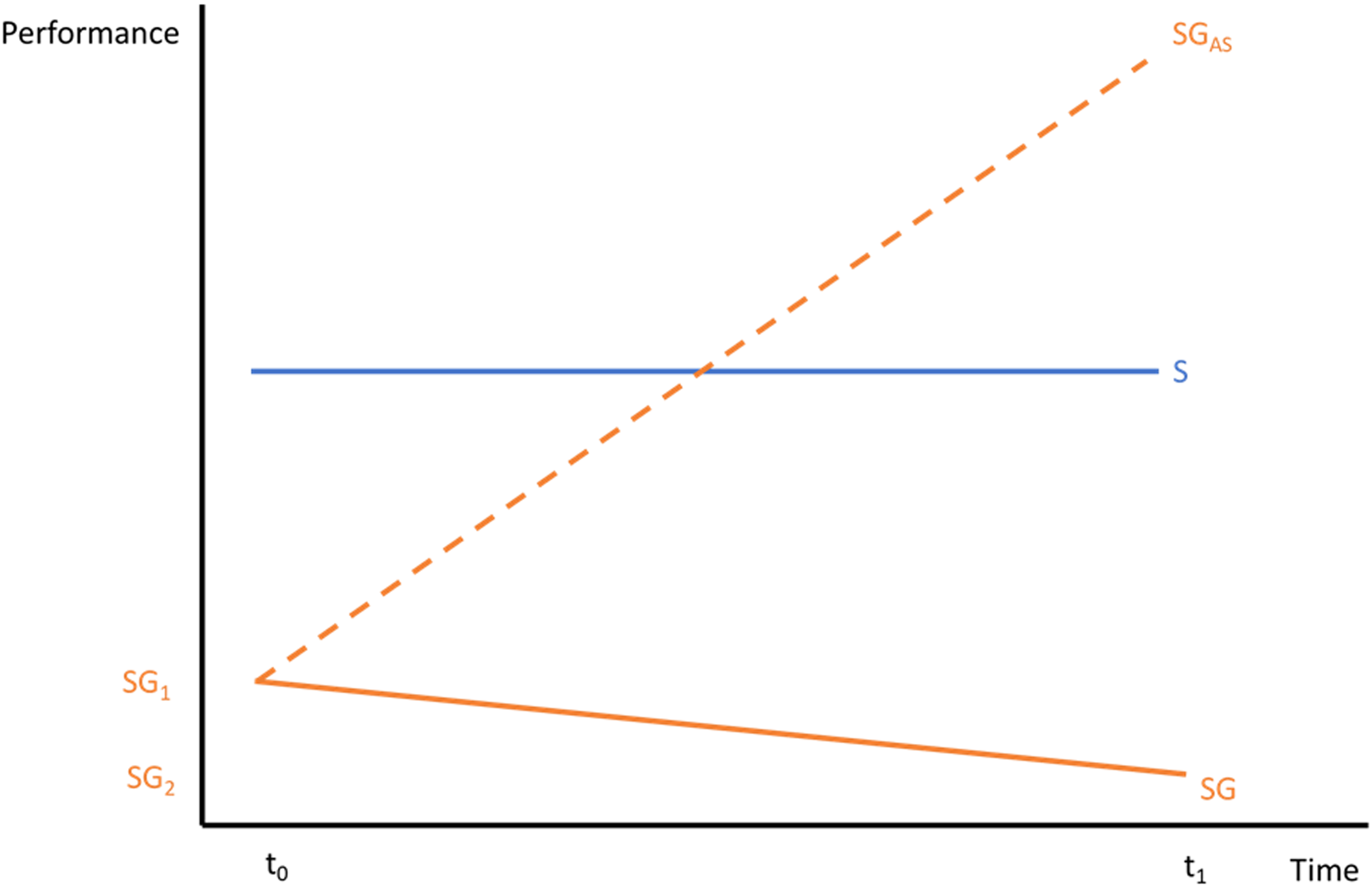
I have used the diminishment scenario to show why service theories should adopt diachronic evaluation in their legitimacy assessments. To wit, diachronic considerations can represent an important – though defeasible – consideration against continuing state authority that our legitimacy assessment might otherwise overlook if it is based exclusively on a synchronic evaluation. But in one crucial respect, diminishment undersells the case I wish to make. In that scenario, the need to balance competing synchronic and diachronic considerations arises only after the state’s wrongful usurpation of authority at t0. At that earlier point, however, synchronic and diachronic considerations are not in tension with one another because neither speaks in favour of state authority. The divergence is present at t1 following the decline in actual self-governance capacity. Yet this dynamic is just an artefact of the way the scenario is constructed. Even a state that has done nothing wrong could still encounter tension between diachronic and synchronic considerations. Consider prevention (Figure 2):
Prevention of self-governance capacity.

Figure 2 Long description
A line graph displays performance over time with three distinct data lines. The x-axis represents time, marked by t0 and t1, while the y-axis represents performance. The solid blue line labeled S remains constant over time. The solid orange line labeled SG starts at a higher performance level at t0 but declines steadily over time. The dashed orange line labeled SGAS starts at the same point as SG at t0 but increases steadily over time, surpassing the performance of S and SG by t1. All values are approximated.
In this scenario, the instrumentalist improvement condition is met at t0 but self-governance is improving and would surpass the state’s performance at t1 if the state does not intervene. If the state does intervene at t0, it will remain superior to self-governance at t1 only because of self-fulfilling dynamics, since self-governance will drop from SG1 to SG2 rather than improve. Now, imagine we are assessing the legitimacy of state authority over the function at t0. An exclusively synchronic evaluation would straightforwardly favour the state’s legitimacy since the state is currently outperforming self-governance. By contrast, a diachronic evaluation would argue against it because intervening now would prevent self-governing citizens from eventually outperforming the state at t1. We can form an overall judgement of the state’s legitimacy at t0 by undertaking a feasibility analysis like the one outlined earlier.Footnote 15 The critical point to emphasize here is that the state did nothing wrong before t0 in prevention, yet the need to balance synchronic and diachronic considerations arises nonetheless.
Prevention, in particular, illustrates how the notion of the state serving citizens in a theory like Raz’s is more complex than often assumed. At t0, we might conclude that state authority is not legitimate if tolerating self-governance that is currently inferior to the state is justified by the prospect of self-governance outperforming the state in the future. In other words, when we adopt a diachronic perspective, the fact that self-governing citizens are currently less effective than the state does not automatically mean it should intervene. Sometimes, the state might serve its citizens better by not helping them even when it could.
Parenting provides a helpful analogy. A similar trade-off between short-term and long-term considerations arises in that context. In the short run, a parent’s role is to promote their child’s flourishing by making good choices on their behalf. In the long run, the parent’s task is to guide their child toward self-reliance and independence. Good parenting balances these considerations when they are in tension. Sometimes, this means not helping one’s child when one could, to give them the opportunity to solve their own problems, ultimately leaving them better off in the long run.
Prevention also brings another important part of my argument to the fore. While the state coming to meet the instrumentalist improvement condition via a self-fulfilling dynamic is undesirable ceteris paribus, it may still be justified all-things-considered. In prevention, the state has legitimate authority to intervene at t0 if the costs of waiting for self-governance to outperform the state are unacceptable—even if this means state authority remains necessary at t1 due to self-fulfilling dynamics. While this does mean that state authority undermines citizens’ conformity with reason over the long run, it is excusable in this scenario because of a countervailing consideration. Crucially, under such circumstances, the state’s continuing authority over the function at t1 would be legitimate without the qualification of regret. Matters differ in diminishment because, in that scenario, there is no trade-off between short-term and long-term fulfilment of the function at t0. Therefore, there is no countervailing consideration to justify the state undermining long-term self-governance capacity by appropriating authority at that time.
5. Self-fulfilling Dynamics and the Intrinsic Value of Self-governance
The instrumentalist improvement condition, my construal of Raz’s normal justification thesis, places no intrinsic value on citizens’ ability to decide for themselves. Both state authority and self-governance are valued instrumentally as means to maximize conformity with reason. In this section, I want to stress that concerns about self-fulfilling dynamics become even more pressing if we adopt a version of the improvement condition that grants self-governance some – though not absolute – intrinsic value.
Self-governance over some functions clearly has intrinsic value. There are some personal decisions, such as whom to marry or which career to pursue, that each individual must make for themselves as a basic requirement of autonomy, regardless of how much better an external authority might perform. A purely instrumentalist approach seems objectionably paternalistic in these areas. In the Introduction we saw that service theorists other than Raz tend to apply the instrumentalist approach only to moral reasons for action, rather than prudential ones relating to one’s personal good (Wellman Reference Wellman1996; Quong Reference Quong2011: 126–31). It is more plausible to claim an intrinsic right to decide for oneself, independently of performance, with respect to one’s own good rather than one’s moral duties towards others. While the prior analysis of the instrumentalist improvement condition was agnostic as to whether it is applied to moral or prudential reasons, I agree that, in practice, the instrumentalist approach is easier to justify with respect to moral reasons. Raz himself is sensitive to this issue. He clarifies that meeting the normal justification condition can legitimate a state’s claim to authority only over areas where deciding for oneself does not have intrinsic value. He calls this requirement the independence condition (Raz Reference Raz2006: 1013–15).
Now, concerns about self-fulfilling dynamics are moot with respect to functions where self-governance is accorded absolute value simply because superior performance by the state could never generate an obligation to obey in those contexts. However, they do arise if we adopt a pluralist position that grants some measure of intrinsic value to self-governance but also values performance of the function, such that under some circumscribed circumstances superior performance by the state could still generate legitimate authority. Raz, to my knowledge at least, does not consider this hybrid possibility. His view appears to be dichotomous: either the independence condition is not satisfied, in which case deciding for oneself has absolute value, or it is satisfied, in which case it has only instrumental value.
The pluralist position could be cashed out in different ways, but I will adopt an adequacy interpretation. The pluralist improvement condition is met iff:
The state’s performance of the function exceeds a basic adequacy threshold and self-governance falls below it.
Hence, if self-governance is at least adequate, it remains preferable even if the state could do better. We might apply the pluralist improvement condition whenever we want to balance an intrinsic respect for self-governance with basic guarantees of welfare. The state may detain someone for psychiatric treatment only when they have severely debilitating mental health problems, or it may deprive parents of their children only if they provide egregiously deficient care. In associational life, a plausible view holds that if a voluntary association can do a reasonably good job of providing its members with a communal good, then the state should not intervene even if it can perform better.
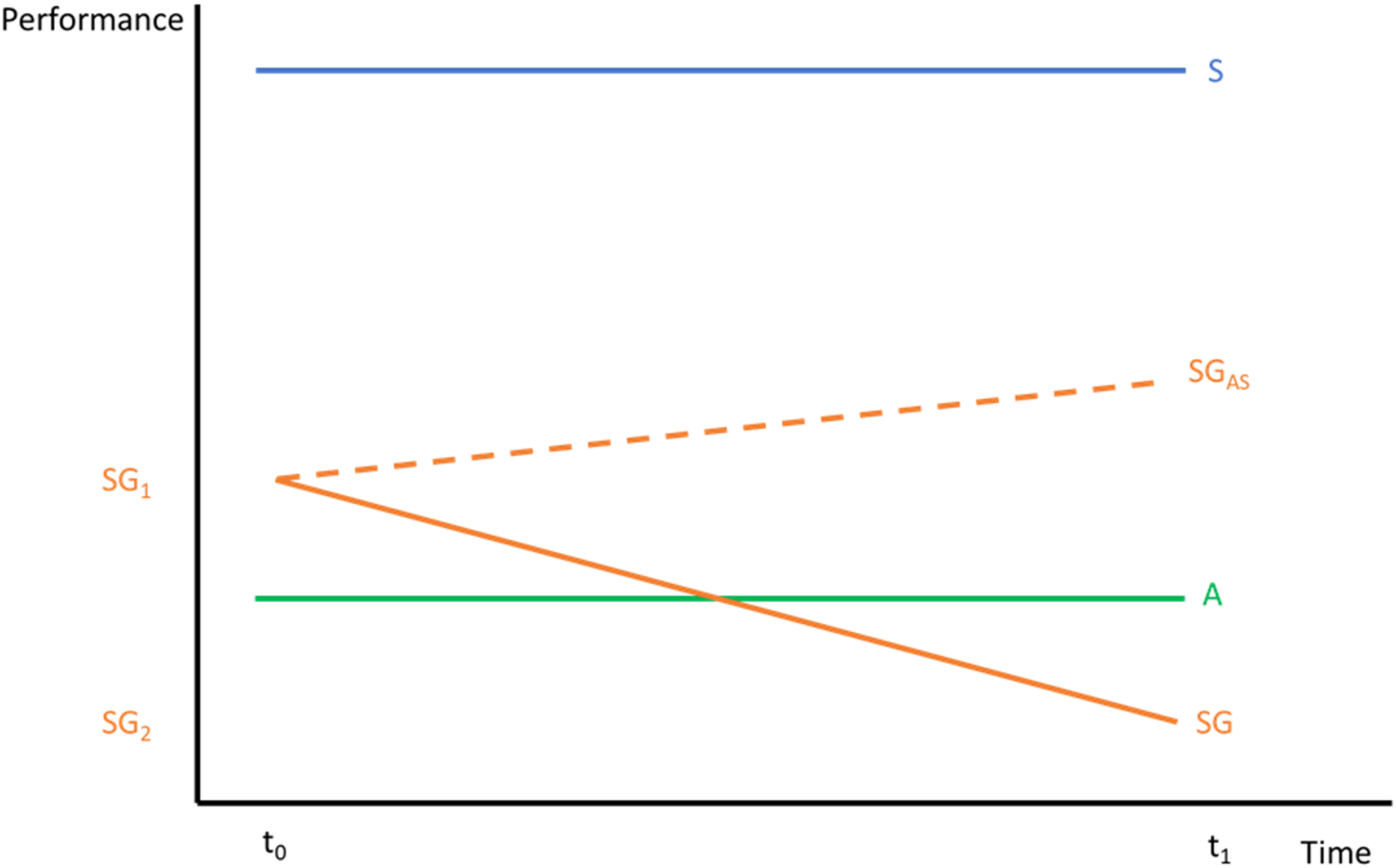
Figure 3 is the “pluralist” version of diminishment:
Diminishment of self-governance capacity (per the Pluralist Improvement Condition).

Figure 3 Long description
The line graph illustrates performance over time, featuring five distinct data lines. The x-axis represents time, marked by two points, t 0 and t 1. The y-axis represents performance, with labels for S, S G 1, A, S G 2, and S G A S. The blue line labeled S remains constant over time. The orange solid line labeled S G 1 starts at S G 1 and declines to S G 2 by t 1. The orange dashed line labeled S G A S starts at S G 1 and rises to S G A S by t 1. The green line labeled A remains constant over time. All values are approximated.
In Figure 3, line A represents the adequacy threshold. The state appropriates authority illegitimately at t0 when the pluralist improvement condition is unmet because self-governance is performing more than adequately. Self-governance capacity subsequently declines from SG1 to SG2 due to lack of practice. As a result, at t1, the pluralist improvement condition is met via a self-fulfilling dynamic.Footnote 16 This means that, at t1, citizens are indeed better off with state authority because they cannot perform the function adequately on their own. Yet it is also true that citizens would have been even better off at t1, according to the evaluative criteria of the pluralist improvement condition, had they not become dependent on the state. For they would have been able to perform the function more than adequately by themselves – even if not as well as the state.
Mutatis mutandis, our earlier analysis about the necessity of diachronic evaluation also applies here. An exclusively synchronic evaluation would automatically confer legitimacy at t1 while a diachronic evaluation would reveal considerations against continuing state authority we would otherwise overlook. Additionally, the way self-fulfilling dynamics harm citizens’ long-run interests is more nuanced and arguably worse under the pluralist view. If self-governance is valued purely instrumentally, the counterfactual loss is that an important value, namely the performance of the function, is realized to a lesser degree than it would have been otherwise. By contrast, if we adopt a pluralist view, citizens fail to realize a distinct value altogether. For had the state not intervened, citizens would not only have enjoyed adequate performance of the function but they would have enjoyed the inherent value of carrying out that performance themselves – a value their dependent counterparts lose out on entirely.Footnote 17
On a pluralist view, where we must balance synchronic and diachronic considerations in our legitimacy assessment, there is a stronger presumption against state authority. To illustrate this, consider a pluralist version of the prevention scenario: suppose self-governance is inadequate at t0 but is improving such that it would become adequate by t1 if the state does not intervene, and suppose the state can perform the function adequately. In our legitimacy assessment at t0, we would need to weigh (i) the short-run benefit of adequate fulfillment of the function through state intervention against (ii) the long-term benefit of adequate and independent fulfilment of the function by well-practised self-governing citizens. That the second option allows us to realize the intrinsic value of self-governance is a consideration against the legitimacy of state authority that does not arise under the instrumentalist version of the prevention scenario.
I end this section by highlighting a broader cost of self-fulfilling dynamics that this paper’s focus on specific functions taken by themselves might lead us to overlook. This broader concern is agnostic as to whether we apply the instrumentalist or pluralist improvement condition and relates to how competences in different functions correlate with one another. Competent self-governance (whether individual or associational) comes in two forms. There are context-specific competences that are useful in the performance of only specific functions and general-purpose competences that are useful for a wide range of functions. Examples of the latter competence for the individual include self-discipline, a sense of organization, courage in the face of uncertainty, and so on. Examples of the latter at the associational level include inclusive norms of deliberation and effective procedures for securing members’ compliance.
Crucially, the existence of general-purpose skills means that competence gained in one sphere can spill-over into others. These spill-over effects may take the form of a virtuous cycle. For example, a local community that manages to maintain its own roads could subsequently be more effective running a local mutual aid fund. By the same token, however, spill-over effects could take the form of a more vicious cycle. Citizens’ reliance on the state to perform one function, to the extent that it leads their general-purpose competences to atrophy, could also necessitate state authority over other functions. In this regard, the costs of self-fulfilling dynamics could be more far-reaching than this paper’s focus on specific functions in isolation suggests.
6. Self-fulfilling Dynamics and the Free-rider Problem
Raz (Reference Raz1986: 56) stresses that solving prisoner’s dilemma type situations is one of the main reasons for having political authority. Conventional wisdom holds that the state has a clear advantage over self-governance in resolving such problems because, by definition, independent decision-making in these contexts leads to suboptimal outcomes. Perhaps, then, self-fulfilling dynamics are simply not a concern here. If the potential capacity of self-governance to solve these problems is highly constrained, there is little scope for state authority to undermine that capacity or prevent it from developing. However, this section will suggest that self-governing citizens are not as powerless in the face of prisoner’s dilemma situations as is often claimed and, consequently, that self-fulfilling dynamics are a cause for concern even in these contexts.
Public goods are difficult to supply while excluding non-contributors.Footnote 18 The standard assumption is that self-governance will underproduce these goods because of the rational temptation of individuals to free-ride on the efforts of others. Each will try to minimize their contribution to the production of the good while maximizing their consumption, causing the good to be underproduced relative to its true demand. Moreover, it is very difficult for self-governing individuals to overcome this dilemma because each can control only their own behaviour yet a satisfactory solution requires a mechanism that can influence all actors simultaneously. In other words, the constraint is not a lack of individual competence, but the strategic dilemma posed by the choice situation. By contrast, the state can offer a solution because it is in “the possession of de facto power, of actual effective power over the behaviour of people” (Raz 1986: 75). This de facto power allows the state to force all citizens to make their contributions, by paying taxes for instance, thereby solving the free-rider problem.
The crucial premise in this common view is that self-governing individuals can control only their own behaviour but not that of their peers. This is why they appear helpless in the face of the free-rider problem. But we saw in section 2 that self-governing individuals need not interact with one another as independent contractors. They can create voluntary associations. The shared rules of an association constitute the critical means by which individuals can influence one another’s behaviour, allowing them to solve the free-rider problem, at least sometimes.
There is now a body of empirical work substantiating this assertion. I mentioned Ostrom’s Governing the Commons earlier. That work studies how self-governing communities manage common-pool resources such as rivers and forests. It is well known that the free-rider problem threatens the sustainable use of these resources. Yet Ostrom (Reference Ostrom1990: Ch. 3) documents many empirical examples of communities crafting sophisticated systems of rules to deal with this problem. Such rules – inter alia – stipulate conditions under which the resource can be consumed, enable cost-effective monitoring of users, and enforce punishments for infractions. Nor is Ostrom the only scholar to have documented how self-governing associations can provide goods vulnerable to free-riding. David Green (Reference Green1993) and David Beito (Reference Beito2000) have shown how fraternal societies provided a range of welfare functions – such as healthcare and pensions – before the rise of state welfare. Edward Stringham (Reference Stringham2015) and Peter Leeson (Reference Leeson2008) have argued that self-governing associations of market actors can even provide contractual enforcement without state involvement.Footnote 19
The empirical evidence indicates, then, that self-governing citizens can sometimes utilize the “art of association” to solve the free-rider problem. Moreover, we saw in section 3 that associational competence depends on the accumulated knowledge that comes with trial-and-error learning. All in all, these considerations suggest that state provision of public goods could undermine pre-existing associational competence (per diminishment) or hinder its development (per prevention). Admittedly, self-fulfilling dynamics are most likely to arise with small-to-medium scale public goods where the transaction costs of self-governing solutions are relatively low and the chances of repeat interaction between the parties are relatively high. Effective associational solutions to large-scale public goods might prove impossible.
7. Should We Worry About Self-fulfilling Dynamics in Practice?
Thus far, I have presented a theoretical argument for why service accounts of legitimacy should be concerned with self-fulfilling dynamics. At crucial junctures of the argument, I have made epistemic assumptions that might not hold in practice. The diminishment scenario, for example, simply assumed that we know what counterfactual self-governance capacity would have been at t1 had the state never intervened. I also assumed that we could reliably predict the likelihood of self-governance overtaking the state if its authority were repealed. Yet both of these epistemic assumptions are questionable since self-governance capacity can be affected by a host of variables that the state does not control, including cultural norms, technological innovations, changes in social capital, and so on. In diminishment, it is hard to assert definitively that any observed decline in self-governance is solely due to the state since other factors may have caused that decline even if the state had not originally intervened. Moreover, particularly where state authority over a function is long-standing, it is difficult to know how self-governance would perform following repeal. The basic worry here is that the diachronic evaluation I have called for is not epistemically feasible. Even if this paper’s argument is convincing in theory, it might lack practical application. This would be an unfortunate result because service theories are supposed to be normatively action-guiding.
It is worth noting that epistemic uncertainty is a general challenge to the application of service theories, affecting even synchronic assessments. When state authority over a function is long-standing, it can be difficult to establish even the actual self-governance baseline. For example, predicting how parents would manage education in the immediate aftermath of the state’s withdrawal (let alone predicting further improvements over time) is highly speculative, as there are no comparable real-world examples.
Perhaps the upshot here is a conservative approach to applying the improvement condition. When state authority over a function is long-standing and it is difficult to determine both the actual and alternative socialization self-governance baselines, we might be inclined to assume that the relevant improvement condition – whether pluralist or instrumentalist – is satisfied, provided the state appears to be performing the function tolerably well. Conversely, when self-governance over a function is long-standing and works reasonably well, and it is difficult to determine how well the state would manage it, we might assume the relevant improvement condition is unmet. Unfortunately, this conservative approach not only risks entrenching whatever status quo happens to prevail. It also precludes the diachronic evaluation called for by this paper.
Instead, I think we can usefully turn to federal (Vallier Reference Vallier2018) and/or polycentric political institutions (Aligica and Tarko Reference Aligica and Tarko2013; Müller Reference Müller2019) to reduce our epistemic uncertainty.Footnote 20 These institutions decentralize decision-making authority to a variety of lower-level jurisdictions, allowing for experimentation with different degrees of state authority over different functions, thereby generating valuable data. Suppose we are members of a jurisdiction where state authority over a function is long established, and we want to estimate (i) how self-governance would have performed had the state never intervened, and relatedly, (ii) how it might develop if state authority were removed. Informative empirical examples could be offered by nearby jurisdictions that are similar to ours in relevant respects (such as language, culture and wealth), but have historically experimented with little or no state authority over that function. In other words, while far from perfect, jurisdictional competition is the closest analogue we have to a controlled scientific experiment that helps us identify the specific causal impact of state authority on self-governance over time.
8. Conclusion
This essay has sought to demonstrate that self-fulfilling dynamics are worthy of enquiry within political philosophy. While the focus here has been on service theories, the topic is potentially relevant to other theories of legitimacy, including consent-based and justificatory approaches. In this concluding section, however, I want to highlight the connections between my argument and another prominent contemporary debate: the question of citizens’ political competence.
Today, many libertarian philosophers and social theorists take an altogether dim view of the electorate’s capacity to make good political decisions (e.g. Caplan Reference Caplan2008; Brennan Reference Brennan2016). Their position can be usefully contrasted with John Stuart Mill in his Considerations on Representative Government. Mill too takes an (in)famously pessimistic view of the political competence of much of the electorate. Yet he also holds that citizens’ political competence is not a fixed constraint but a variable shaped endogenously by political institutions, depending on the opportunities they provide for “political education” (Mill Reference Mill1861: 320). He recognizes that the familiar liberties of participation in national politics – access to a free press, the right to vote, the right to petition one’s representatives, and so forth – provide some degree of political education. But he argues that their impact is limited because citizens still outsource substantive political decision-making to their national representatives: “the practice which they [i.e. the liberties to take part in national politics] give [to citizens] is more in thinking than in action, and in thinking without the responsibilities of action” (Mill Reference Mill1861: 320). This, thinks Mill, is why most voters lack competence.
Mill is here invoking a model of learning similar to the one outlined in section 3. It is not enough that citizens can criticize the decisions of politicians and form contrary private judgements. They also need to adopt the “responsibilities of action” by making their own political decisions and learning from the resulting successes and failures. Hence, Mill (Reference Mill1861: 320) favours greater decentralization to local government bodies to educate the populace in political self-governance. In these settings:
besides the function of electing, many citizens in turn have the chance of being elected, and many, either by selection or by rotation, fill one or other of the numerous local executive offices. In these positions they must act for public interests, as well as to think and to speak, and the thinking can not all be done by proxy.
Mill hopes that the opportunity to make substantive political decisions at the local level will eventually turn citizens into better participants in national politics. By now, I am sure it is clear to the reader how much my arguments concerning self-governance outside of politics have drawn inspiration from Mill’s arguments concerning political self-governance. I think he can be interpreted as arguing that the electorate’s political incompetence results from a self-fulfilling dynamic: the more political decisions are centralized, the fewer opportunities citizens have to participate in substantive political decision-making other than periodically voting in national elections, and the more their political competence atrophies.
It is also the case that the problem-solving competences that citizens learn in civil society could transfer into politics – another instance of spill-over effects. Here, we can refer to Mill’s contemporary, Alexis De Tocqueville. For Tocqueville, citizens are best positioned to exercise democratic control over the grand affairs of state if they have first learned the competence and mores to solve “small and particular” (Tocqueville Reference Tocqueville2002: 653) problems in their own lives. By the same token, if expansive state authority undermines citizens’ competence in civil society self-governance, it could also undermine their political competence. Stated baldly, the Tocquevillian thesis is that individuals who cannot make educational choices for their children, provide for their retirement, or fix potholes in their local roads are unlikely to be capable democratic citizens. Both the Millian and Tocquevillian theses are worthy of further investigation, but a full exploration must regrettably await another occasion. For the moment, I think the following quote of Tocqueville is a fitting way to end this paper:
It is in fact difficult to conceive how men who have entirely renounced the habit of directing themselves could succeed at choosing well those who will lead them; and one will not make anyone believe that a liberal, energetic, and wise government can ever issue from the suffrage of a people of servants. (Tocqueville Reference Tocqueville2002: 653–54)
Acknowledgements
I would like to thank Justin Bruner, Tom Christiano, Johanna Jauernig, William Oberdick, David Schmidtz, Travis Quigley, two anonymous referees, and audiences at Bowling Green University and the University of Arizona for helpful discussion and feedback. I am especially grateful to Steve Wall for his support and encouragement. The usual disclaimer applies.
Kaveh Pourvand is an Assistant Professor at the Institute of Philosophy, Universidad San Sebastián. He previously held positions at the University of Arizona and King’s College London and gained his PhD from the London School of Economics. His research focuses on the social ontology of the state, social complexity and bottom-up self-governance. His work has appeared or is forthcoming in journals such as Politics, Philosophy and Economics, European Journal of Political Theory and Constellations. URL: www.kavehpourvand.com

 Open access

