




INTRODUCTION
In The Making of a Periphery,Footnote 1 Ulbe Bosma emphasizes the role of rapid population growth and systems of labour coercion in shaping island Southeast Asia's economic fortunes in the nineteenth and twentieth centuries. In doing so, he tries to explain why it is that a region that was initially labour scarce, and a recipient of large numbers of migrants from China and India, which produced a wide variety of tropical export commodities – such as rubber, coffee, and sugar – became an exporter of labour in the late twentieth century. In solving the puzzle, Bosma has written an excellent book that adds new insights and depth to important discussions in economic, social, and global history. Bosma takes issue with the dependency theory of Rául Prebisch and the world-systems approach of Immanuel Wallerstein. In these theories it is suggested that the peripheralization of many regions of the Global South, island Southeast Asia among them, is the result of specialization in primary commodity production. In addition, Bosma is largely unconvinced by the works of the economists Daron Acemoğlu, Simon Johnson, and James Robinson, who have suggested that Europeans introduced extractive institutions in tropical colonies (such as those in Southeast Asia) that hindered economic growth in those areas in the long run.
One of Bosma's important contributions is his emphasis that these macro-level explanations do not take into account the large degree of spatial variation in terms of colonial structures, labour regimes, and modes of production within single colonies. Three important claims are at the heart of Bosma's book. Firstly, commodity export production does not necessarily result in peripheralization, which Bosma defines as economic stagnation, depressed wages, and impoverishment (pp. 3–4). Second, peripheralization is instead influenced by the specific mode of production of export commodities. Third, the mode of production is crucially determined by demographic growth and patron-client relationships. These claims are thought-provoking and warrant further discussion.
COMMODITY PRODUCTION AND DEVELOPMENT IN SOUTHEAST ASIA
One of the most provocative arguments made by Bosma is his suggestion that “depressed wages and impoverishment are not the inevitable outcomes of economic reliance on the export of primary products” (p. 3). He points to Australia, Norway, Canada, and Malaysia as “clear examples of the opposite”, adding that “[c]ountries can specialize in the export of commodities rather than in manufactured goods for perfectly sound economic reasons and thrive”. In this section, I will take issue with these statements and show that Australia, Norway, and Canada are exceptions that prove the rule, and that Malaysia, while certainly not the basket case of Southeast Asia, began to thrive only after it switched from primary to manufacturing exports in the late twentieth century.
A large body of economics literature suggests that moving people out of primary production is crucial for generating long-run economic growth. In his seminal work, Simon Kuznets defined the process of “modern economic growth” as “a sustained increase in per capita or per worker product, most often accompanied by an increase in population and usually by sweeping structural changes”.Footnote 2 As per worker output is much higher in the industrial and service sectors than in agriculture, the transfer of workers from agriculture to industry and services will lead to growth.
But to what extent can specialization in primary commodity exports still generate economic growth? An overview of the literature and data suggests that growth is possible, but, on average, at a significantly lower rate than it would be by specializing in manufacturing or having a more diverse package of exports. A comprehensive study by Jonathan Isham and others found that developing countries specializing in the export of minerals and plantation crops had annual economic growth rates that were on average 2.7 per cent lower over the period 1957–1997 compared with those focusing on manufacturing exports.Footnote 3 In the period 1975–1997, this difference was as much as 3.9 per cent, as primary producers grew by only 0.7 per cent per annum, while industrial exports grew on average by 4.6 per cent annually. Isham et al. explain the lower growth rates by noting that primary export specialization led to poor institutions (such as weak rule of law and higher levels of political instability and corruption) – an element of the well-known resource curse.
Jeffrey Williamson adds that the economic growth of primary export producers in the Global South was furthermore hindered by high levels of commodity price volatility, as manufacturing prices are more stable than those of primary products.Footnote 4 Countries with a greater diversification in exports also suffer less from export price volatility. Higher levels of volatility hinder growth as volatility reduces investment in human and physical capital due to higher levels of risk and the need for high levels of savings. Other scholars have shown that primary production also delayed the reduction in fertility and population growth – giving up productivity in exchange for population.Footnote 5 Furthermore, governments highly dependent on revenues from trade duties have a harder time balancing their budgets in the face of large price swings, which impedes public investment.Footnote 6 Finally, it seems that land-abundant primary producing colonies, such as those in Southeast Asia, saw levels of within-country economic inequality increase in the nineteenth and twentieth centuries.Footnote 7 These higher levels of inequality may also have negatively impacted long-term growth rates.Footnote 8 Figure 1 shows that there is a negative correlation between the share of primary exports and levels of GDP in 1870, as well as a negative correlation between the share of primary exports and the growth of GDP between 1870 and 1930. For settlement colonies like Argentina, New Zealand, Australia, and Canada, with very low population densities, the relationship is weakest.
The relationship between primary exports and economic growth, 1870–1930.
Source: Williamson, Trade and Poverty, p. 187.
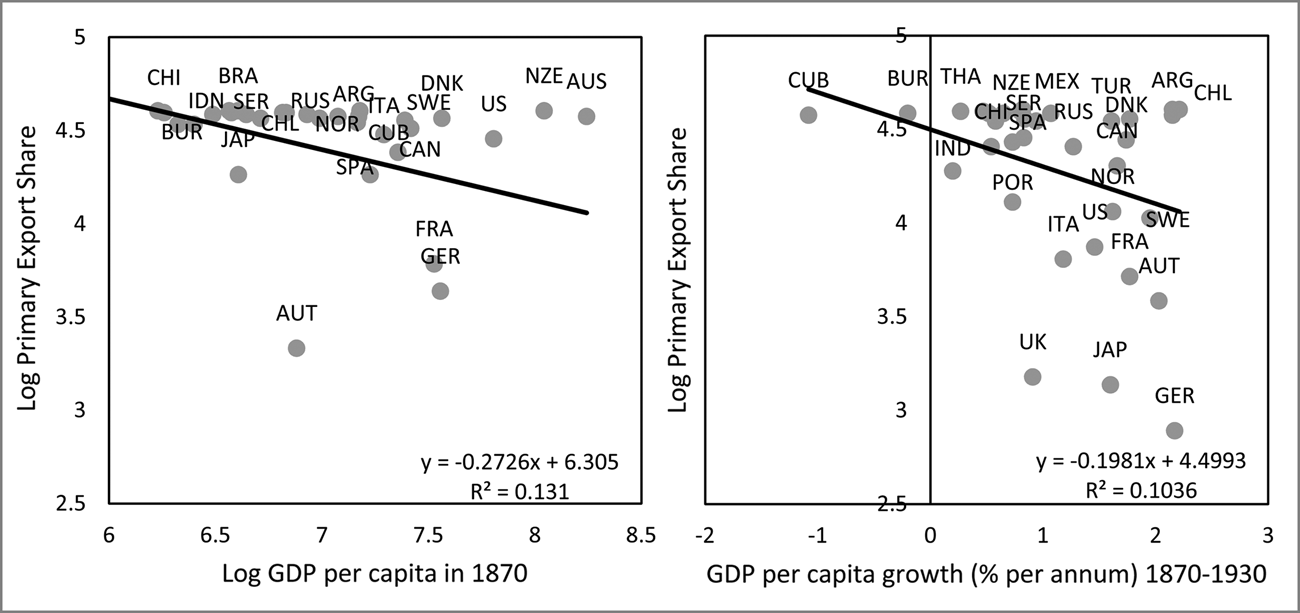
These figures suggest that a focus on primary exports is associated with lower levels of GDP and lower growth rates in the nineteenth and twentieth centuries. Perhaps Asia, or Southeast Asia specifically, is different? This does not seem to be the case; in fact, the relationship seems much stronger. The East Asian miracle of the late twentieth century, which saw extraordinarily high economic growth rates, was driven almost entirely by a shift from agricultural production to manufacturing. Figure 2a shows that Asia's most successful economies in the twentieth centuries (as measured by average annual GDP growth rates) were the countries that had the smallest agricultural sectors by the early twenty-first century. A seminal study into the East Asian miracle suggests the economic growth of Singapore, South Korea, Hong Kong, and Taiwan from the 1960s to the 1990s was driven almost entirely by the transfer of labour from agriculture to industry and the consequently dramatic growth of manufacturing exports.Footnote 9 For Southeast Asia, we can trace the level of GDP per capita together with the share of that GDP produced in the agricultural sector between 1960 and 2015 (Figure 2b). This panel shows, again, the association between GDP growth and the decline of the agricultural sector.
Agriculture and economic growth in (a) Asia, 1900–2015, and (b) Southeast Asia, 1960–2015.
Sources: Agricultural % of GDP 2017: CIA, World Factbook (2018); agricultural % of GDP 1960–2015 for Southeast Asia: Jonathan Rigg and Albert Salamanca, “Aggregate Trends, Particular Stories: Tracking and Explaining Evolving Rural Livelihoods in Southeast Asia”, in Andrew McGregor, Lisa Law, and Fiona Miller (eds), Routledge Handbook of Southeast Asian Development (London, 2017); Annual Growth of GDP per capita, 1900–2015, and GDP per capita in 1960–2015: Jutta Bolt and Jan Luiten van Zanden, “The Maddison Project: Collaborative Research on Historical National Accounts”, Economic History Review, 67:3 (2014), pp. 627–651.

To drive the point home, let us zoom in on one of Bosma's prime examples: Malaysia, which “achieved impressive economic growth figures with its specialization in tin, rubber, and palm oil” (p. 13). Comparing historical levels of GDP per capita between Malaysia and its neighbours, it becomes clear that it did indeed have one of the highest levels of GDP per capita in the region (USD 1,672) in 1913, only slightly below the Philippines (USD 1,852), but above those in Indonesia (USD 1,267), Taiwan (USD 1,194), Thailand (USD 1,173), Vietnam (USD 1,073), and Burma (USD 807).Footnote 10 Already in the late colonial era, however, Malaysia also had the smallest agricultural sector in the region, occupying only 61 per cent of the population in 1930, a proportion closer to 70 in Burma, the Philippines, and Indonesia, and 84 per cent in Thailand.Footnote 11 Between 1913 and 1940, the Malaysian economy grew from USD 1,627 to USD 2,660 per capita,Footnote 12 or some 1.8 per cent per annum. During this period, diversification was limited and a major part of this growth was driven by the export of rubber and tin.Footnote 13 It was, however, in the post-colonial era that economic growth in Malaysia really increased. More than doubling from USD 2,800 to USD 6,792 per capita between 1960 and 1980, but really taking off in the 1980s (Figure 3). The period between 1986 and 1997 is generally considered a golden age, with annual growth rates of over 8 per cent. This growth was spurred by a boom in exports, which grew by double digits annually. It was also accompanied by strong growth in the industrial sector. Manufacturing exports as a share of total exports increased from 4 per cent in the early 1960s, to 33 per cent in 1985, to about 80 per cent in the mid-1990s. This development was the result of deliberate policies targeted at industrialization. Since independence in 1957, the Malaysian government has promoted the manufacturing sector. Initially, Malaysia's development strategy emphasized import-substitution industrialization, and by 1973 three quarters of manufactured consumer goods for the domestic market were produced locally (compared with 43 per cent in 1963).Footnote 14 After that, government strategy targeted export-oriented industrialization by establishing free trade zones and offering tax incentives for manufacturing goods exporters.Footnote 15
The Malaysian economy, 1960–2015.
Sources: GDP per capita: Bolt and Van Zanden, “The Maddison Project”; rural population and agriculture: 1930: Anne Booth, “A Century of Growth, Crisis, War and Recovery, 1870–1970”, in Ian Coxhead (ed.), Routledge Handbook of Southeast Asian Economics (London, 2014), pp. 43–59; 1960–2015: Rigg and Salamanca, “Aggregate Trends, Particular Stories”.

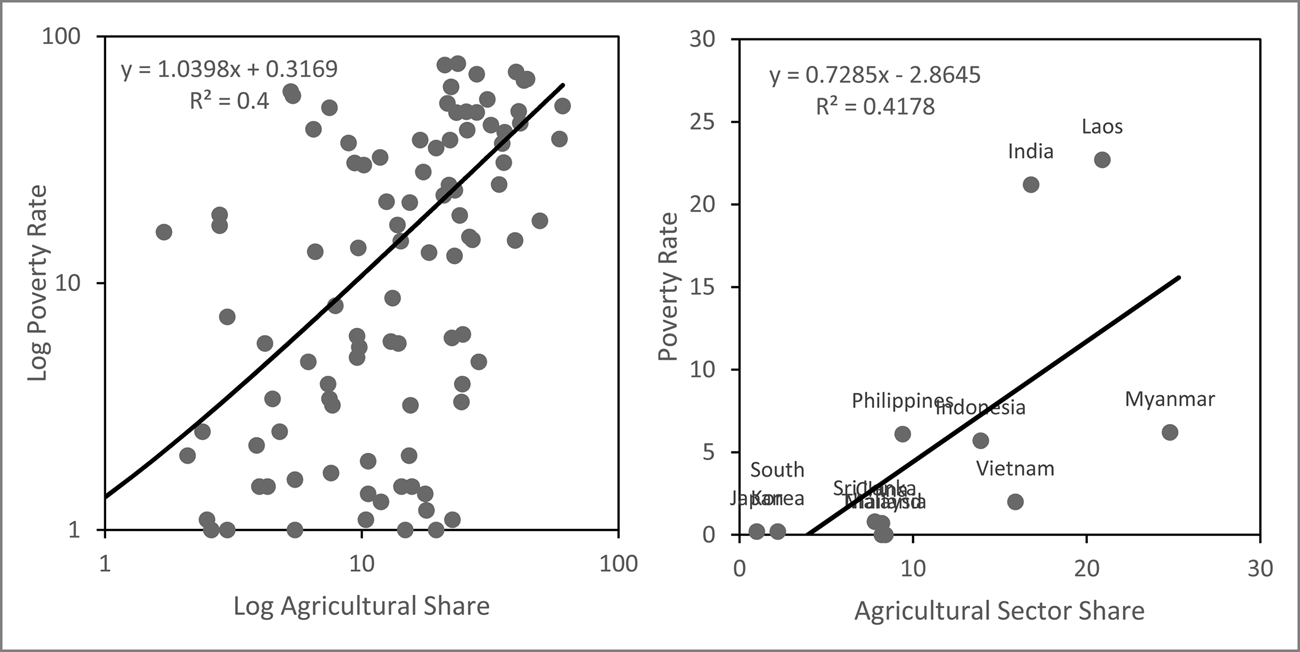
Bosma's claim about primary production relates not only to patterns of economic growth and stagnation, but also to the degree of impoverishment. Unfortunately, there are few data on historical poverty rates, but if we look at data on current-day poverty rates and the share of agriculture in total GDP for both a global sample of countries (Figure 4a), and for Asia specifically (Figure 4b), it becomes clear that there is a strong positive correlation between the share of agriculture in the total economy and the degree of poverty. Correlation does not mean causation, but it does seem that shifting labour from the primary sector to the secondary and tertiary sectors plays an important part in the story of poverty reduction.
Agriculture and poverty, c.2015.Footnote 35
Sources: Agricultural production as a share of total GDP: CIA, World Factbook (2018); poverty rate: World Bank, “Poverty Headcount Ratio at $1.90 a day (2011 PPP) (% of population)”, World Bank Open Data: https://data.worldbank.org/. Version used: 2 October 2019.
It must be concluded therefore that Bosma is perhaps too optimistic about the opportunities for long-run economic growth provided by primary commodity exports. Bosma took up this argument to position himself against the views of, for example, Prebisch and Wallerstein, who see incorporation into the global capitalist trading system as the leading cause of the peripheralization. The evidence shown here suggests that Prebisch and Wallerstein are still largely correct. Throughout global economic history, a focus on commodity export and retaining a large share of the population in the primary sector has not been the road to riches. As Southeast Asia's engagement with the global trading system entrenched the focus of the region on commodity exports,Footnote 16 and possibly even led to a process of deindustrialization in the nineteenth and early twentieth centuries,Footnote 17 there is still much to be said in favour of dependency theory. This also implies that government-supported industrialization remains the best development strategy for poor countries.Footnote 18 Putting up barriers to trade to protect infant industries, reinforced by export subsidies, has proven successful for all major winners of the capitalist world economy in past centuries: Great Britain in the eighteenth, the United States in the nineteenth, and China and Taiwan in the twentieth.
It is important to emphasize, however, that this does not mean that there were no gains from trade for primary producers in the nineteenth century at all; it means that these gains were much smaller for commodity exporters than they were for manufacturing exporters. In that sense, Bosma is right in suggesting that there is the absolute possibility of growth for primary exporters. Furthermore, it should be noted that Bosma is correct in stressing the sub-regional variation in experiences of commodity-exporting regions. Some commodity producers performed much better than others, and this may indeed, as Bosma suggests, be related to demographic developments and the systems of production.
THE CAUSES OF DEMOGRAPHIC DIVERGENCES
According to Bosma, one of the major factors behind the economic stagnation and impoverishment of parts of island Southeast Asia is rapid demographic growth. He observes that those areas with high population densities, like Java and the northern Philippines, are among Asia's poorest regions today (p. 6). Bosma argues that it was smallpox vaccinations rather than other factors, such as natural disasters, military conflicts, and other health conditions, which explains the demographic divergence between Java and the northern Philippines and other areas of the region (pp. 34–43). While he may be right in noting the effects of declining mortality rates, demographic growth is determined by both mortality and fertility. Differences in the fertility rate may have been equally important, perhaps even more important, in determining demographic trends. Variations in birth rates were crucially influenced by both economic and cultural factors.
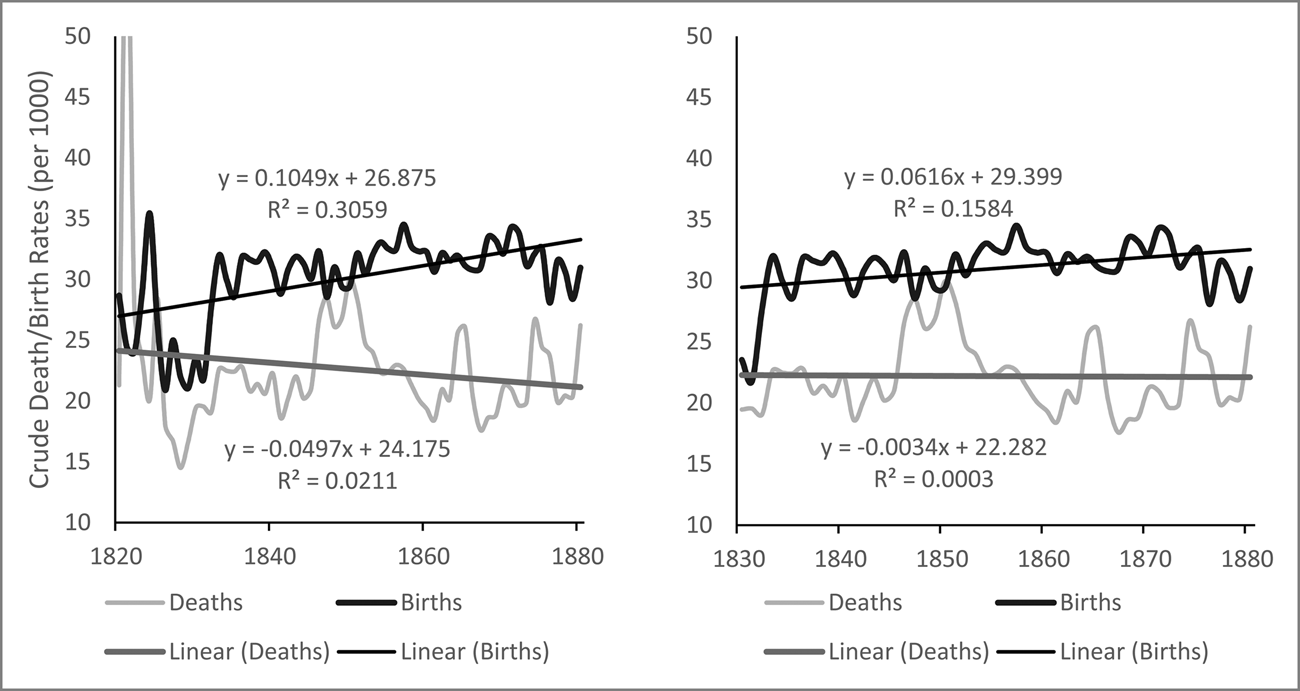
There is disaggregate information about crude birth and death rates for Java in the nineteenth century.Footnote 19 Rather than smallpox vaccinations, which are assumed to have a larger effect on crude death rates, these data suggest changes in fertility are an important element in Java's demographic growth in the nineteenth century. In Figure 5, data on death and birth rates in Java are shown (a) from 1820 and (b) from 1830 and a linear trend line was fitted to the series. Data from the 1820s onwards show a strong upward trend in the birth rate until 1880, with an annual increase of about 0.1 births per 1,000 and R2 = 0.31. At the same time, there is hardly any trend in the death rate, which declined annually by only 0.05 deaths per 1,000, but the linear trend line fits the data very poorly (R2 = 0.02), so the coefficient is insignificant. The data for the 1820s are considered relatively unreliable and are significantly influenced by the Java War (1820–1825). So, what happens if we take into account only the data between 1830 and 1880? The coefficient on the birth rate declines by half, but there still seems to be a clear upward trend. For the death rates, the trend completely disappears, suggesting that death rates remained stable over this long-run period.
Birth and death rates in nineteenth-century Java.
Source: Boomgaard and Gooszen, Population Trends.
A number of scholars have linked the high population growth rates in nineteenth-century Java to the system of forced cultivation (“Cultivation System”) imposed from the 1830s. Both Benjamin White and Jennifer and Paul Alexander suggest that the Cultivation System led to increasing demands on the land and labour of Javanese peasants, pushing them to have more children in order to increase the amount of labour available per household.Footnote 20 Increased fertility also arose from necessity as “increased participation of women in arduous and sustained work” meant shorter lactation periods.Footnote 21 Peter Boomgaard also finds a correlation between fertility rates and forced labour, but attributes this to more positive forces, such as the increased opportunities outside of agriculture that the system created, allowing “people to marry earlier than they could have done if their livelihood had depended entirely upon agriculture”.Footnote 22 While more research is needed to tease out the precise connection between the two,Footnote 23 this does indicate that many more variables may have influenced demographic trends.
To further illustrate this point, I compare the trajectories of two regions of the Dutch East Indies: West Sumatra and Priangan (in West Java).Footnote 24 These areas have a very similar climate and geography and had similar population densities in the mid-nineteenth century, yet, until the late colonial era, Priangan's population grew much faster than West Sumatra's (see Figure 6). Differences in the extent of smallpox vaccination probably do not explain this. West Sumatra was among the non-Java regions with the highest levels of vaccination. Vaccination had already started there in the 1820s in the main coastal city of Padang; in 1851, of the 46,000 vaccinations in the Outer Islands 22,000 were in West Sumatra. In an earlier paper, Bosma cites the colonial apothecary H.F. Tillema, who observed that there were regular vaccinations in West Sumatra and that people willingly accepted them (in contrast to other areas of the archipelago).Footnote 25 For that reason, smallpox casualties there may have been as low as in Priangan. Apart from smallpox vaccination, there were no other public health improvements that could explain the divergence.
Population in West Sumatra and Priangan, 1800–1940.
Sources: Boomgaard and Gooszen, Population Trends; Bosma, “Smallpox, Vaccinations”; Jeroen Touwen, Extremes in the Archipelago: Trade and Economic Development in the Outer Islands of Indonesia, 1900–1942 (Leiden, 2001).

Instead, it seems that the demographic divergence between the two areas was driven by differences in local institutions relating to family systems and property rights that influenced both migration and fertility rates. In the nineteenth century, Priangan had high rates of immigration; in the 1820s, as a result of the Java War,Footnote 26 but also later in the nineteenth century, people left the more densely populated parts of Central Java to settle in Priangan, as Bosma shows (pp. 80–82). West Sumatra, on the other hand, had higher levels of emigration, which may be the consequence of the specific system of female inheritance of property in West Sumatra. The Minangkabau, who populated West Sumatra, had a very peculiar family inheritance system, where irrigated rice fields and houses were generally the communal property of an extended family and inherited through the female line. Women thus controlled economic production. Due to the relatively higher number of men compared with women in this region, many men could not find a wife. This also limited their access to rice fields, forcing many of them to emigrate. This hypothesis draws support from the fact that data from the 1930 census shows that the number of male emigrants was especially high in the district of Old Agam, part of the Minangkabau heartland.Footnote 27 Minangkabau fertility rates were also affected: as property was divided equally among all adult women in the household, it made sense to reduce the number of children. This was also noted by contemporaries, who reported an average of three children per woman.Footnote 28 In the late nineteenth century, abortion was widely practised among the Minangkabau as a means to limit family size.Footnote 29
This comparison is meant merely to exemplify a broader argument: Southeast Asia is an immensely diverse region, home to many different cultures, ethnicities, and family systems. This diversity has a profound impact on demographic development. When explaining the patterns of population growth across these areas, Bosma might have focused too narrowly on the effects of smallpox vaccinations on declining death rates.
THE ROLE OF INDIGENOUS PROPERTY RIGHTS SYSTEMS
Besides demographic growth, Bosma's main explanation for the peripheralization of island Southeast Asia is “a long history of bonded labor embedded in patron-client relationships” (p. 1). This provided an effective means of labour recruitment and also benefitted the colonial governments of Java and the Philippines when they further pushed primary export specialization. The combination of two variables – population growth and the historical presence of systems of labour coercion – determines whether primary production for the global market is produced by plantations (in regions with higher population growth and more labour coercion) or smallholders (lower population growth and less labour coercion). Plantations yielded fewer benefits for the local economy than smallholdings did, and it was especially those regions with a high share of plantation production that suffered peripheralization over the twentieth century.
In his critique of works by Acemoğlu et al., Bosma suggests they have overestimated the importance of property rights and their codification (p. 23). It seems to me, however, that property rights do matter, also in shaping production systems that are central to Bosma's argument. The important thing here is, as Bosma rightly pointed out, that Acemoğlu et al. have overlooked a lot of important variations in property rights within single colonies and that they have erroneously equated private property rights with security and communal rights with insecurity.
The importance of property rights systems for production systems can again be illustrated by comparing Priangan and West Sumatra. In Priangan, almost all sawah land was heritable private property that could be bought and sold.Footnote 30 Land could be obtained as private property by clearing wasteland and turning it into sawah. This “ownership” of land is better viewed as an exclusive, heritable, and commodified right to cultivate a plot of land, as the land was considered to be ultimately owned by the sovereign (in this case the colonial government). Therefore, in return for this right to cultivate the land, rent was owed to the government in the form of compulsory labour services and/or land taxes. However, these land property rights were not very secure, as there was little accurate land registration in nineteenth-century Java. Even by the late 1910s, legal documents recording native land possession “such as certificates of registry and ownership documents, were absent” in Priangan.Footnote 31 Without proper institutions, such as a land register and a notary's and registry's office, it was impossible to prove land possession in court. As a result, it was normal practice in the local aristocracy in nineteenth- and twentieth-century Priangan to alienate lands from small famers. Both landlessness and land inequality increased as a result. Data on the distribution of land in Java in 1903 suggests that over fifty per cent of the adult male population did not own land in Priangan.
The land tenure situation in West Sumatra could not have been more different.Footnote 32 Sawahs were the communal property of an extended family, and sale or any other kind of permanent alienation of family property was not allowed. In addition, uncleared wastelands were the common property of the local village and controlled by the village council. Village members had free access to these lands. Under adat law these lands could not be permanently alienated. These property rights institutions provided far better protection against land alienation than the (insecure) heritable private property rights to land in Priangan. In 1905, only 4.5 per cent of agricultural households did not own land in West Sumatra.
Following the Agrarian Law of 1870 and the Domain Declaration of 1874, all village lands were formally transformed into government lands overnight and these lands could consequently be leased out to Western enterprises. The process of land alienation took off quickly in Priangan, and by around 1900 some 100,000 hectares of arable land had been leased out (about a quarter of total arable land). In West Sumatra, on the other hand, Minangkabau village and property institutions provided better protection against land alienation as only some 11,000 hectares (less than four per cent of total arable lands) were leased out by around 1900. Later, in the twentieth century, more land was alienated also in West Sumatra, but this was mostly in areas that were not densely populated, and before such leases were given out “agreement with village governments was sought”.Footnote 33 As a result, production systems differed greatly between the two regions: export production in West Sumatra was overwhelmingly in the hands of indigenous smallholders (about ninety per cent of total production in the 1920s), while in Priangan plantation production had become dominant (accounting for about eighty per cent of total production by volume).Footnote 34
Property rights clearly had an important effect on variegated development in the Dutch East Indies, even if it was not along the lines of the simple dichotomy between secure private property rights and insecure and extractive property rights, as suggested by Acemoğlu et al.
CONCLUSION
The Making of a Periphery is an important new book that questions some of the larger theses adduced in global economic and social history over past decades. In particular, Bosma criticizes the path dependency literature that has suggested that the global division of labour, with the Global South focusing on primary commodity export, and colonial institutions, can be blamed for long-run economic stagnation and poverty in colonial tropical regions (such as Southeast Asia). In doing so, Bosma rightly stresses the differences between commodity-producing regions within single colonies and emphasizes variations in production systems. He brings more nuance to the discussion on the relationship between demographic growth, labour regimes, institutions, and economic growth. However, as I have suggested in this essay, there is still much to be said for the dependency thesis. Additionally, the determinants of demographic growth may be more complex, and property rights may have played a more important role in the story than Bosma would have us believe. Bosma makes important claims that will spark further debate, and The Making of a Periphery is clearly a major addition to the literature and is bound to have an impact in the years to come.


 Open access

