


Introduction
The energy requirement for systems like Internet of things (IoT), wearable sensors, and biomedical devices is rising annually [Reference Chu and Majumdar1]. With limited natural resources, researchers are exploring new energy harvesting methods [2]. While ambient sources like solar and wind power large systems, they require complex, costly management and are less effective for low-power systems [Reference Sisinni, Saifullah, Han, Jennehag and Gidlund3, Reference Makhdoom, Abolhasan, Lipman, Liu and Ni4]. Wireless sensor networks in IoT technology benefit from harvesting energy from cost-effective, nonnatural sources and wasted energy, offering a promising solution for powering low-power sensors [Reference Amiri, Tofigh, Shariati, Lipman and Abolhasan5]. The far-field RF-energy harvesting with metasurface is one of the methods to utilize the nonnatural wasted energy [Reference Agrahari, Singh, Samantaray, Kumar, Bhattacharyya, Mahto and Jain6]. But they are limited with very low power (in  $\mu $W range). The leaked magnetic-field energy (MFE) radiated from the induction cooktop is a nonnatural energy source and can be employed for low-power devices.
For industrial, domestic, and medical applications, induction heating (IH) is preferred over other traditional heating techniques [Reference Lozinskii7–Reference Stauffer, Cetas and Jones9] due to its advantage of fast heating, efficiency, and safety. In an induction cooktop, heating is produced by the induced alternating magnetic field of frequency range 20–100 kHz from the coil placed inside the cooktop. By utilizing coils and magnetic cores to trap magnetic energy, Faraday’s law allows for the harvesting of these radiated magnetic fields surrounding the induction cooktop.
In the literature, low-frequency mechanical vibrations have been successfully used for magnetic-field energy harvester (MFEH) via piezoelectric and magneto-mechano-electric effects [Reference Wang10–Reference Xu, Chakraborty, Remsing, Klein and Ren13]. The overhead power lines have been utilized to capture the MFE [Reference Yang, Du, Yu and Huang14]. Additionally, bus bars and power cables are other sources for the MFE [Reference Yuan, Huang, Zhou, Xu, Song and Yuan15–Reference Wu, Nguyen, White, Wright, O’Toole and Stetter17] that employ various core shapes placed near power lines for MFEH. Designs such as bow ties and helical-shaped ferrite cores have been utilized to enhance output power [Reference Yuan, Huang, Zhou, Xu, Song and Yuan15, Reference Yuan, Huang, Zhou, Xu, Song and Thompson18]. Jiang et al. [Reference Jiang, Lu, Hashimoto and Lin16] proposed near-field MFEH that uses power lines to store the energy for applications like low-power IoT-based sensors. Similarly, Wu et al. [Reference Wu, Nguyen, White, Wright, O’Toole and Stetter17] introduced a compact and cost-effective MFEH device that couples energy via a rectangular coil. Furthermore, recently the rail currents on electrified railway tracks have been utilized for MFEH to power railway monitoring systems [Reference Kuang, Chew, Ruan, Lane, Allen, Nayar and Zhu19, Reference Espe, Haugan and Mathisen20]. However, MFEH from induction cooktop has not been previously explored.
The proposed low-profile MFEH circuit harvests lost energy from induction cooktops. The RF energy from the harvesting coils is converted to DC using a half-wave rectifier with a capacitor filter. DC voltage and power are measured across various load resistors and coil placements. Experimental results show that, when the coils are 2 cm below the cooktop, a DC voltage of 9.4–9.6 V and power of 1936 mW are achieved for RL = 46.6 Ω. Positioned similarly, the suggested circuit yields 12.75–12.85 V and 1657 mW. Both cases use a 1 mF capacitor. Therefore, by using our proposed techniques, the leaked magnetic energies from induction cooktops can be harvested and used for low-power devices such as mobile charging and IoT-based sensors.With the proposed circuit, energy can be stored in the battery which can be later used to power devices. In addition, the proposed circuit is capable of storing wasted nonnatural energy. The proposed circuit design is a low profile i.e., very simple and cost-effective which makes our device unique.
Theory and design
Faraday’s law of electromagnetic coupling, which states that “the time rate of change of magnetic flux density of the primary coil induces the EMF in the secondary coils,” is the foundation of the IH theory. Magnetic flux density (B), which is strongest at the center of the induction coils, is produced by the cooktop’s induction coil. The magnetic flux generated causes a transfer of heat to the food and utensils as well as eddy current loss. Significant MFE leaks close to the induction cooktop during this procedure.
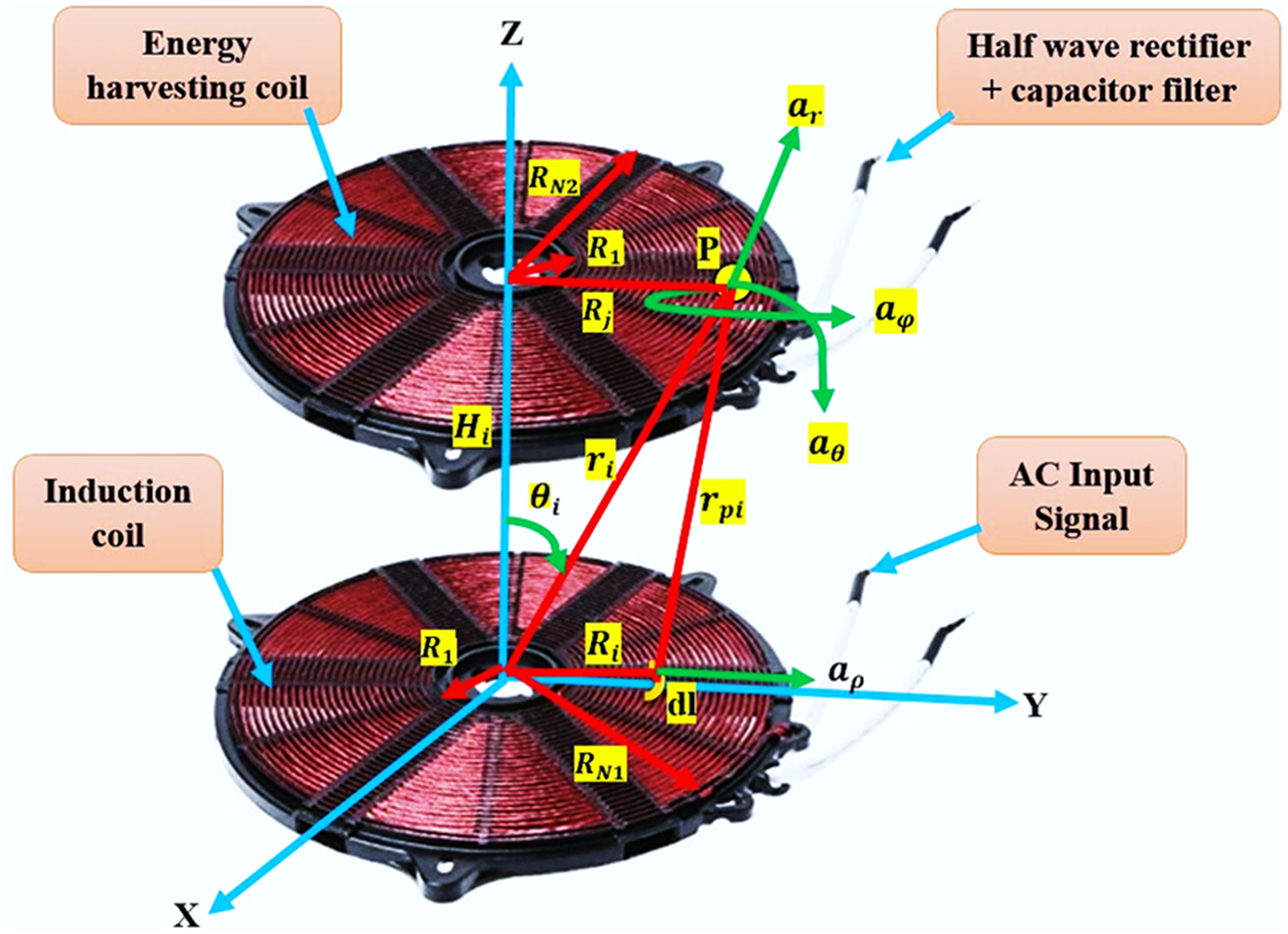
The mechanics of the suggested energy-collecting system is described in Fig. 1. The energy-collecting coil, is used to collect the induced near-field electromagnetic energy, is positioned beneath the height (H) induction coil. The induced AC voltage is converted to DC voltage at the terminal of the energy harvesting coil by a half-wave rectifier equipped with a capacitor filter. Measurements are made of the rectified DC voltage and DC power across the load. The induced voltage at the energy harvesting coil’s terminal is produced by the rate at which the magnetic flux in the induction coil changes with time, as per Faraday’s law of electromagnetic induction. The induced voltage (V 2) is determined by
 \begin{equation}{V_2} = - {N_2}\frac{{d\psi }}{{dt}}.\end{equation}
Structure of the energy harvesting systems of the induction cooktop and various parameters.

Figure 1 shows the flux ψ across a small area at a point P on an energy harvesting coil.
 \begin{equation}\psi = {\mathop \iint}\vec B.\overrightarrow {ds} .{\text{ }}\end{equation}
 Now, the vector magnetic potential  $\vec A$ may be determined by using the curl operation to find the magnetic flux density $\vec B$ at point P
 \begin{equation}\vec B = \nabla \times \vec A.\end{equation}
Thus
 \begin{equation}\vec A = {\mathop \oint}\frac{{{\mu _0}I\overrightarrow {dl} }}{{4\pi \left| {{r_p}} \right|}}.\end{equation}
For N 1 turns, Eq. (4) becomes
 \begin{equation}\vec A = \mathop {{{\mathop \sum}}}\limits_{i = 1}^{{N_1}} {\mathop \oint}\frac{{{\mu _0}I\overrightarrow {d{l_i}} }}{{4\pi \left| {{r_{{p_i}}}} \right|}}\end{equation}
 where 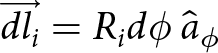 $\overrightarrow {d{l_i}} = {R_i}d\phi {\text{ }}{\hat a_\phi }$, $\overrightarrow {{r_{{p_i}}}} = $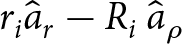 ${r_i}{\hat a_r} - {R_i}{\text{ }}{\hat a_\rho }$ and magnitude of ${\text{ }}\left| {{r_{{p_i}}}} \right| = \sqrt {r_i^2 + R_i^2 + 2{r_i}{R_i}\cos \left( {90 + {\theta _i}} \right)} $. Now, Eq. (4) is modified as
 \begin{equation}\vec A = \mathop {{{\mathop \sum }}}\limits_{i = 1}^{{N_1}} \frac{{{\mu _0}I2\pi {R_i}}}{{4\pi \left| {{r_{{p_i}}}} \right|}}{\hat a_\phi }.\end{equation}
 Here, vector magnetic potential has only  ${\hat a_\phi }$ component. Therefore,
 \begin{equation}{A_\phi } = \mathop {{{\mathop \sum }}}\limits_{i = 1}^{{N_1}} \frac{{{\mu _0}I2\pi {R_i}}}{{4\pi \left| {{r_{{p_i}}}} \right|}}.\end{equation}
 While 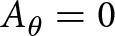 ${A_\theta } = 0$ and ${\text{ }}{A_r} = 0$. The expression of magnetic flux density from Eq. (3) is given as
 \begin{equation}\vec B = \frac{1}{{{r_i}\sin {\theta _i}}}\left[ {\frac{{\partial \left( {{A_{{\phi _i}}}\sin {\theta _i}} \right)}}{{\partial {\theta _i}}}} \right]{\hat a_r} + \frac{1}{{{r_i}}}\left[ { - \frac{{\partial \left( {{r_i}{A_{{\phi _i}}}} \right)}}{{\partial {r_i}}}} \right]{\hat a_\theta }.\end{equation}
 Now, considering the  ${B_r}$ component in Eq. (8), we have
 \begin{align}
{B_r} &= \frac{1}{{{r_i}\sin {\theta _i}}}\left[ {\frac{\partial }{{\partial {\theta _i}}}\left( {\mathop \sum \limits_{i = 1}^{{N_1}} \frac{{{\mu _0}I2\pi {R_i}}}{{4\pi \sqrt {r_i^2 + R_i^2 - 2{r_i}{R_i}\sin {\theta _i}} }}{\text{ }}\sin {\theta _i}} \right)} \right] \nonumber\\
{B_r} &= \frac{1}{{{r_i}\sin {\theta _i}}}\left[ \left( {\mathop \sum \limits_{i = 1}^{{N_1}} \frac{{{\mu _0}I2\pi {R_i}}}{{4\pi \left| {{r_{{p_i}}}} \right|}}{\text{ }}\cos {\theta _i}} \right) \right.\nonumber\\
&\quad \left.+ \left( {\mathop \sum \limits_{i = 1}^{{N_1}} \frac{{{\mu _0}I2\pi R_i^2{r_i}\cos {\theta _i}}}{{4\pi {{\left| {{r_{{p_i}}}} \right|}^3}}}{\text{ }}\sin {\theta _i}} \right) \right]\end{align}
\begin{align}
{B_r} &= \frac{1}{{{r_i}\sin {\theta _i}}}\left[ {\frac{\partial }{{\partial {\theta _i}}}\left( {\mathop \sum \limits_{i = 1}^{{N_1}} \frac{{{\mu _0}I2\pi {R_i}}}{{4\pi \sqrt {r_i^2 + R_i^2 - 2{r_i}{R_i}\sin {\theta _i}} }}{\text{ }}\sin {\theta _i}} \right)} \right] \nonumber\\
{B_r} &= \frac{1}{{{r_i}\sin {\theta _i}}}\left[ \left( {\mathop \sum \limits_{i = 1}^{{N_1}} \frac{{{\mu _0}I2\pi {R_i}}}{{4\pi \left| {{r_{{p_i}}}} \right|}}{\text{ }}\cos {\theta _i}} \right) \right.\nonumber\\
&\quad \left.+ \left( {\mathop \sum \limits_{i = 1}^{{N_1}} \frac{{{\mu _0}I2\pi R_i^2{r_i}\cos {\theta _i}}}{{4\pi {{\left| {{r_{{p_i}}}} \right|}^3}}}{\text{ }}\sin {\theta _i}} \right) \right]\end{align}The contribution of the first term of Eq. (9) in the near field will be negligibly small. Therefore, by considering the second term of Eq. (9), we have
 \begin{equation}{B_r} = \mathop {{{\mathop \sum }}}\limits_{i = 1}^{{N_1}} \frac{{{\mu _0}IR_i^22\cos {\theta _i}}}{{4{{\left| {{r_{{p_i}}}} \right|}^3}}}.\end{equation}
 Similarly, the expression for the  ${B_\theta }$ component is calculated as
 \begin{equation}{B_\theta } = \mathop {{{\mathop \sum }}}\limits_{i = 1}^{{N_1}} \frac{{{\mu _0}IR_i^2\sin {\theta _i}}}{{4{{\left| {{r_{{p_i}}}} \right|}^3}}}.\end{equation}
 If the effective cross-section area of the harvesting coil is directed along the z-direction, then the magnetic flux  $\psi $ from Eq. (2) is given as
 \begin{equation}\psi = \mathop \int_{{R_1}}^{{R_{N2}}} \mathop \int_0^{2\pi } \left( {{B_r}{{\hat a}_r} + {B_\theta }{{\hat a}_\theta }} \right).rdrd\varphi {\text{ }}{\hat a_z}\end{equation}
 Here  ${\text{ }}{\hat a_z} = \cos {\theta _i}{\text{ }}{\hat a_r} - \sin {\theta _i}{\text{ }}{\hat a_\theta }$. If ${r_j}$ is the radius of the energy harvesting coil with ${N_2}$ number of turns,
 \begin{equation}\psi = \mathop {{{\mathop \int }}}\limits_{j = {R_1}}^{{R_{N2}}} \mathop {{{\mathop \int }}}\limits_0^{2\pi } \left( {{B_r}\cos {\theta _i} - {B_\theta }\sin {\theta _i}} \right) \cdot {r_j}d{r_j}d\varphi .\end{equation}
 After putting the values of  ${B_r}$ and ${B_\theta }$ from Eqs. (10) and (11) into Eq. (12), the total flux is given as
 \begin{align}\psi &= \mathop \int_{j = R1}^{{R_{N2}}} \mathop \int_0^{2\pi } \left( \mathop \sum \limits_{i = 1}^{{N_1}} \frac{{{\mu _0}IR_i^22\cos {\theta _i}}}{{4{{\left| {{r_{{p_i}}}} \right|}^3}}}{\text{ }}\cos {\theta _i} \right. \nonumber\\
&\quad \left.- \mathop \sum \limits_{i = 1}^{{N_1}} \frac{{{\mu _0}IR_i^2\sin {\theta _i}}}{{4{{\left| {{r_{{p_i}}}} \right|}^3}}}{\text{ }}\sin {\theta _i} \right) .\, {r_j}d{r_j}d\varphi \end{align}
\begin{align}\psi &= \mathop \int_{j = R1}^{{R_{N2}}} \mathop \int_0^{2\pi } \left( \mathop \sum \limits_{i = 1}^{{N_1}} \frac{{{\mu _0}IR_i^22\cos {\theta _i}}}{{4{{\left| {{r_{{p_i}}}} \right|}^3}}}{\text{ }}\cos {\theta _i} \right. \nonumber\\
&\quad \left.- \mathop \sum \limits_{i = 1}^{{N_1}} \frac{{{\mu _0}IR_i^2\sin {\theta _i}}}{{4{{\left| {{r_{{p_i}}}} \right|}^3}}}{\text{ }}\sin {\theta _i} \right) .\, {r_j}d{r_j}d\varphi \end{align}where current flow in induction coils is “I” and “ψ” is magnetic flux density generated over a small cross-section area (ds) from the center of the energy harvesting coil
 \begin{equation}{\psi _r} = {\text{ }}\mathop \int_{j = R1}^{{R_{N2}}} \mathop \int_0^{2\pi } \left( {\mathop \sum \limits_{i = 1}^{{N_1}} \frac{{{\mu _0}IR_i^22\cos {\theta _i}}}{{4{{\left| {{r_{{p_i}}}} \right|}^3}}}{\text{ }}\cos {\theta _i}} \right) .\, {r_j}d{r_j}d\varphi \end{equation}
 If the energy harvesting coil is placed above or below the induction coil at height (Hi), the angle  ${\theta _i}{\text{ }}$ is much smaller; therefore, the first term of Eq. (14) dominates, and the second term can be ignored. After the simplification, the modified equation is written as
 \begin{equation}{\text{ }}{\psi _\theta } = - \mathop \int\limits_{j = R1}^{{R_{N2}}} \mathop \int\limits_0^{2\pi } \left( {\mathop \sum \limits_{i = 1}^{{N_1}} \frac{{{\mu _0}IR_i^2\sin {\theta _i}}}{{4{{\left| {{r_{{p_i}}}} \right|}^3}}}{\text{ }}\sin {\theta _i}} \right).\,{r_j}d{r_j}d\varphi \end{equation}
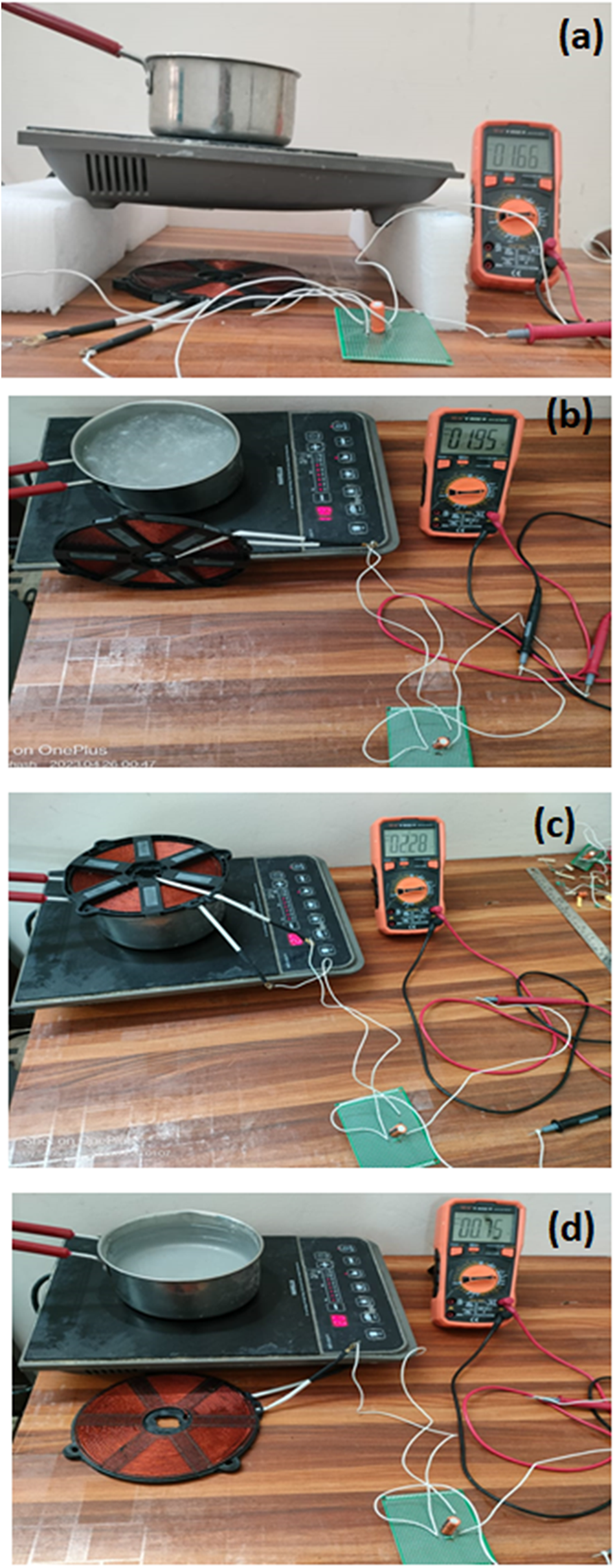
 When the energy harvesting coil is positioned as indicated in Fig. 4(a, b, d), the generated flux in the coil follows Eq. (15). The induced flux follows Eq. (16) if the energy collecting coil is positioned at the location shown in Fig. 4(c) since  ${\theta _i}$ is substantially closer to ${\text{ }}{90^ \circ }$.
Experimental measurement
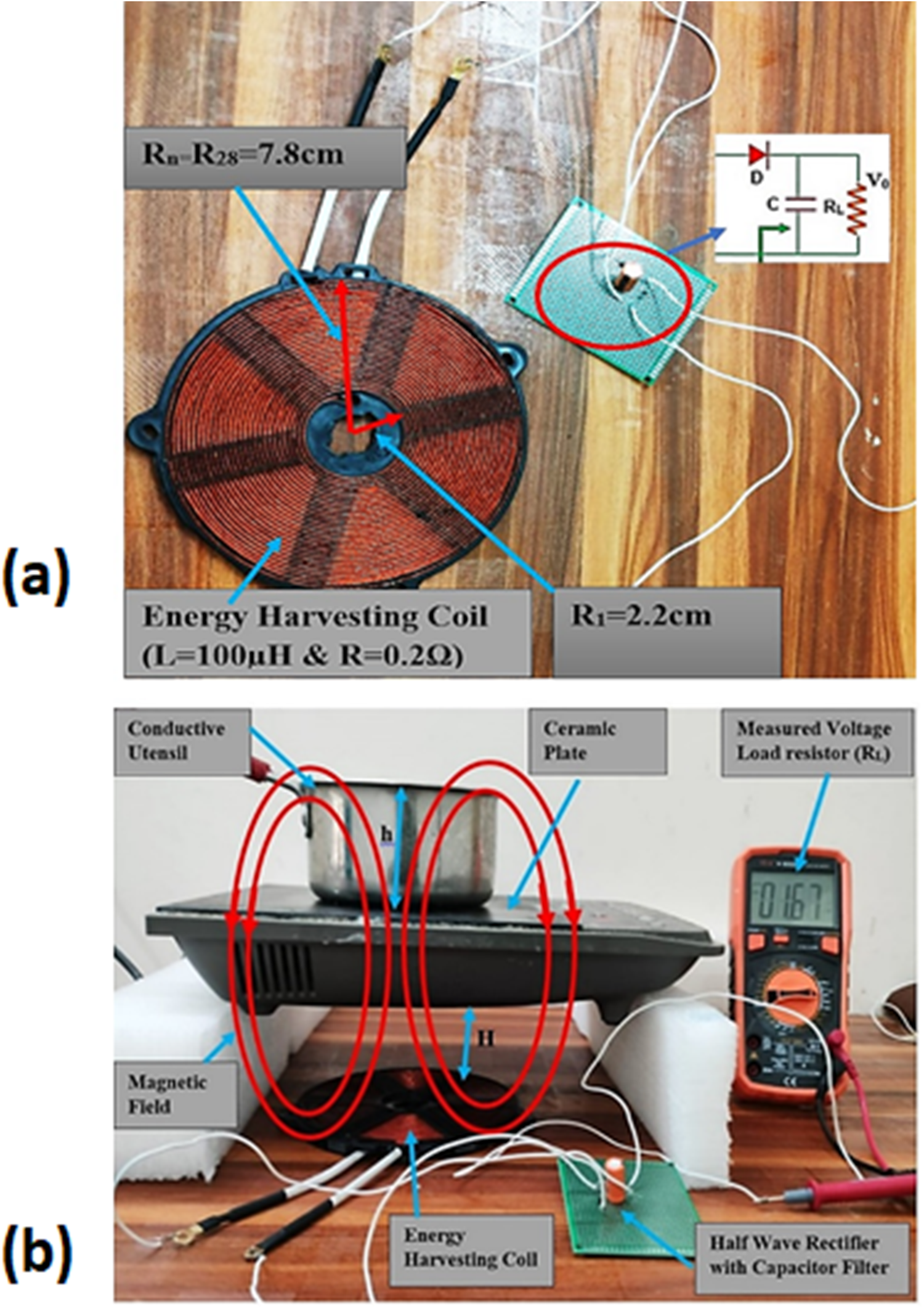
The prototype of the proposed low-cost MFEH system is shown in Fig. 2(a). There are 28 variable spiral coils in the circuit; each has 15 turns and measures 15.6 cm in diameter on the outside and 4.4 cm on the inside. These coils, which have a resistance of 0.2 Ω and an inductance of 100.68 µH, are used to absorb microwave emissions from the cooktop’s main coil. The LCR meter is used for the measurement of coil resistance and inductance. A simple half-wave rectifier with a capacitor filter converts received RF energy of frequency 26 kHz to DC electrical voltage. In order to perform the experiment, an induction cooktop from Havells company with Model no. INSTA COOK PT (230 V, 50 Hz, 120–1600 W) has been used. If we use different power levels on the induction cooktop, there is a small difference in the operation frequency. Through experimentation, it was found that when a utensil with a diameter of 14.5 cm and a height of 7.5 cm is used with a filled water level of 5.5 cm, the induction cooktop produces signals at a frequency of 24–32 kHz while cooking. The chosen induction functions in a variety of switching modes. Its operating frequency can switch between 0.5 kHz, 5 kHz, 25 kHz, and 30 kHz when the power level is less than 700 W, however, it often runs close to the 26 kHz frequency. Assume that the power level is 700 W or greater. Then, depending on the size of the utensil, the induction operates at a steady frequency of 26 kHz with a small fluctuation within the 24–32 kHz range.
(a) Prototype of the complete circuit for MFEH and (b) measurement of DC voltage across RL with induction cooktop and proposed circuit.

The induced voltage generated by magnetic flux is influenced by the distance between the coils, turns in the coil, and location of the coil. As the distance between the induction and harvesting coils increases, mutual coupling decreases, reducing the induced voltage. A half-wave rectifier with a silicon 1N4007S diode, a 300 Ω load, and a 1 mF capacitor filter converts the induced voltage to a DC signal.
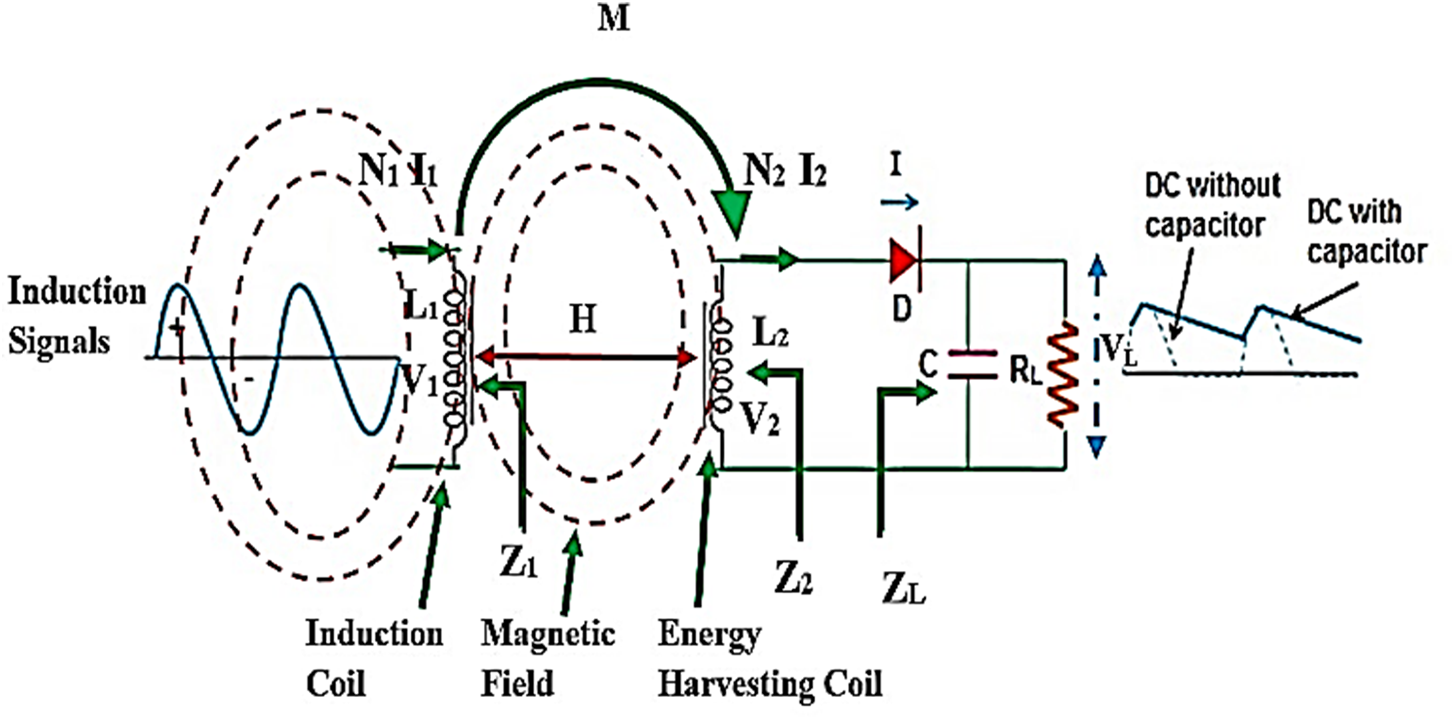
The entire circuit diagram for the suggested energy harvesting circuit is depicted in Fig. 3, where N 1 and N 2 represent the turns in the energy harvesting and induction coils, respectively. The coil’s input impedance is Z 2, while the induction coil’s input impedance is Z 1. Energy harvesting coils and induction coil impedance are connected as
 \begin{equation}{Z_2} = {\left\{ {\frac{{{N_2}}}{{{N_1}}}} \right\}^2}{Z_1}.\end{equation}
 The voltage  ${V_1}$ (at induction coil) and ${V_2}$ (at harvesting coil) are
 \begin{equation}{V_{2{\text{ }}}} = {L_2}\frac{{d{I_2}}}{{dt}} + M\frac{{d{I_1}}}{{dt}}\end{equation}
 \begin{equation}{V_{1{\text{ }}}} = {L_1}\frac{{d{I_1}}}{{dt}} + M\frac{{d{I_2}}}{{dt}}\end{equation}
Equivalent circuit of the proposed MFEH system.

In this case, M is the mutual inductance between the coils, L 1 and L 2 are the inductance, and I 1 and I 2 are the currents in the coils.
If  ${r_d}$ is the forward bias diode resistance, then for maximum power transfer from source to load resistance ( ${R_L}$), the impedance of the energy harvesting coil (Z 2) and diode forward bias resistance ( ${r_d}$) are complex conjugates with load impedance ( ${Z_L}$) and given as
 \begin{equation}Z_L^* = {Z_2} + {r_d}.\end{equation}
The input impedance (Z 2) of the energy harvesting coil is equal to the induction coil impedance (Z 1) since the induction coil and energy harvesting coils are nearly equivalent (L = 100 µH; R = 0.2 Ω) and the induction coil’s number of turns (N 1) is roughly equal to that of the energy harvesting coil (N 2). In situations where the load impedance and the energy harvesting coil (Z 2) impedance are complicated and affect one another, the maximum power transfer from induction coils to load resistance (RL) occurs. Another way to express Eq. (20) in terms of resistance and inductance is as follows:
 \begin{equation}{R_{{\text{coil}}}} + {r_d} + j\omega {L_2} = \frac{{{R_L}\left( {1 + j\omega {R_L}C} \right)}}{{1 + {\omega ^2}R_L^2{C^2}}}.\end{equation}
Now, comparing the real part on both sides, we get
 \begin{equation}{R_{{\text{coil}}}} + {r_d} = \frac{{{R_L}}}{{1 + {\omega ^2}R_L^2{C^2}}}.\end{equation}
 Since 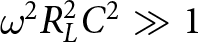 ${\text{ }}{\omega ^2}R_L^2{C^2} \gg 1$, thus
 \begin{equation}{\text{ }}{R_{{\text{coil}}}} + {r_d} = \frac{1}{{{\omega ^2}{R_L}{C^2}}}{\text{ }}\end{equation}
 As 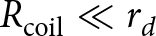 ${R_{{\text{coil}}}} \ll {r_d}$
 \begin{equation}{r_d} = \frac{1}{{{\omega ^2}{R_L}{C^2}}}.\end{equation}
Similarly, by comparing the imaginary part of Eq. (20), we get
 \begin{equation}{L_2} = \frac{{R_L^2C}}{{1 + {\omega ^2}R_L^2{C^2}}}.\end{equation}
 Since  ${\text{ }}{\omega ^2}R_L^2{C^2} \gg 1$, thus
 \begin{equation}{L_2} = \frac{1}{{{\omega ^2}C}}.\end{equation}
Therefore, Eqs. (24) and (26) make it simple to forecast how load impedance (ZL) will behave for maximum power transfer. The symbol for the maximum power transfer across the load is
 \begin{equation}{P_{{L}}} = \frac{{V_2^2}}{{4{R_L}}}.\end{equation}
Ripple voltage across the load resistor is given by
 \begin{equation}{V_r} = \frac{{{V_L}}}{{f{R_L}C}}.\end{equation}
The mutual inductance between these two coils determines the maximum power transmission from induction coils to energy harvesting coils. The mutual inductance is greatest when the induction coils are close to one another, and it lowers when the coils move apart. Several frequency signals (24–32 kHz) are produced by the induction cooktop based on the size of the utensil, the applied power level, and the water level height. However, if induction is active above the 700 W power threshold, it typically functions at 26 kHz. We measured the DC load voltage in the experiments for various load resistors at different positions and other places where the induction cooktop’s energy-collecting coils were located.
Results and discussions
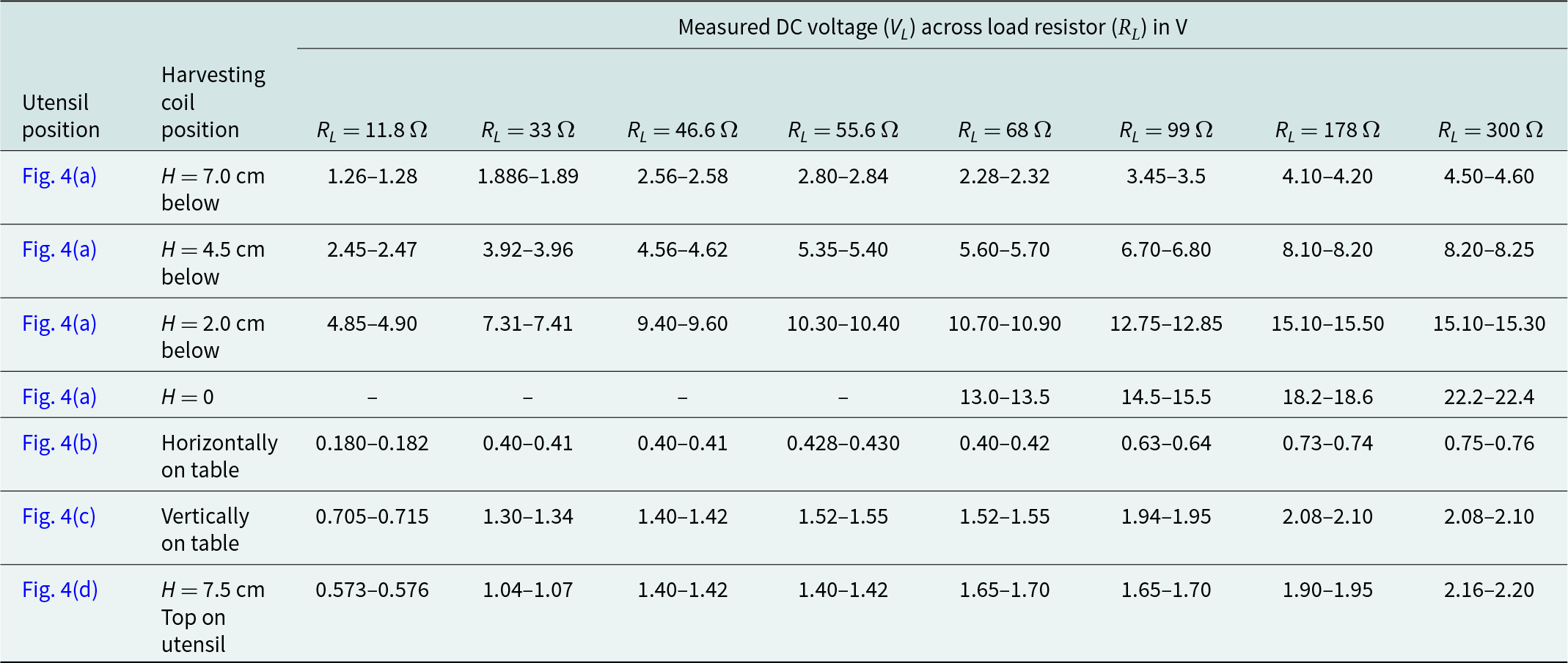
Figure 4 shows voltage measurements across various load resistors (RL) with different energy-collecting coil placements. In Fig. 4(a), the coil is positioned at a distance “H” beneath the induction cooktop, and power is measured at various distances. In Fig. 4(b), the coil is vertically atop the cooktop, and in Fig. 4(c), it is above a water-filled utensil. In Fig. 4(d), the coil is on the table horizontally. The magnetic field from the induction coils heats the steel utensil and water (24–32 kHz). The energy-harvesting circuit captures magnetic energy leakage under the cooktop, converting it to DC for storage in a battery, which can power devices like smartphones, LED lights, and IoT devices. For the various locations of the coils as indicated in Fig. 4, the voltage measured at the various load resistors (RL) with C = 1 mF is tabulated in Table 1. An average voltage of 4.85–4.9 V is created across an 11.8 Ω load resistor at a height of 2 cm below the induction cooktop, as indicated in Fig. 4(a). According to Table 1, when the vertical distance increases, the developed voltage decreases. The voltage drops to 1.26–1.28 V at a height of 7 cm. Figure 4(b) shows the location of the harvesting coil, where a minimum voltage of 0.18 V is detected because of less magnetic field coupling in the harvesting coil. Furthermore, as Table 1, illustrates, an increase in voltage is seen if the energy harvesting coil is positioned at the location shown in Fig. 4(c). For every position shown in Fig. 4, the voltage across the load rises as the load resistance rises. It was noted that at values of RL < 68 Ω, the load resistance was harmed at H = 0 mm. Consequently, when H = 0 mm and RL ≥ 68 Ω, the maximum voltage across the load is observed.
Measurement of DC voltage across the load resistance for various positions of the proposed circuit as shown in 4(a-d).

Measured voltage across different load resistance  ${R_L}$ with constant value of ${\text{ }}C = 1{\text{ }}m{\text{F}}$ at various positions of the coil

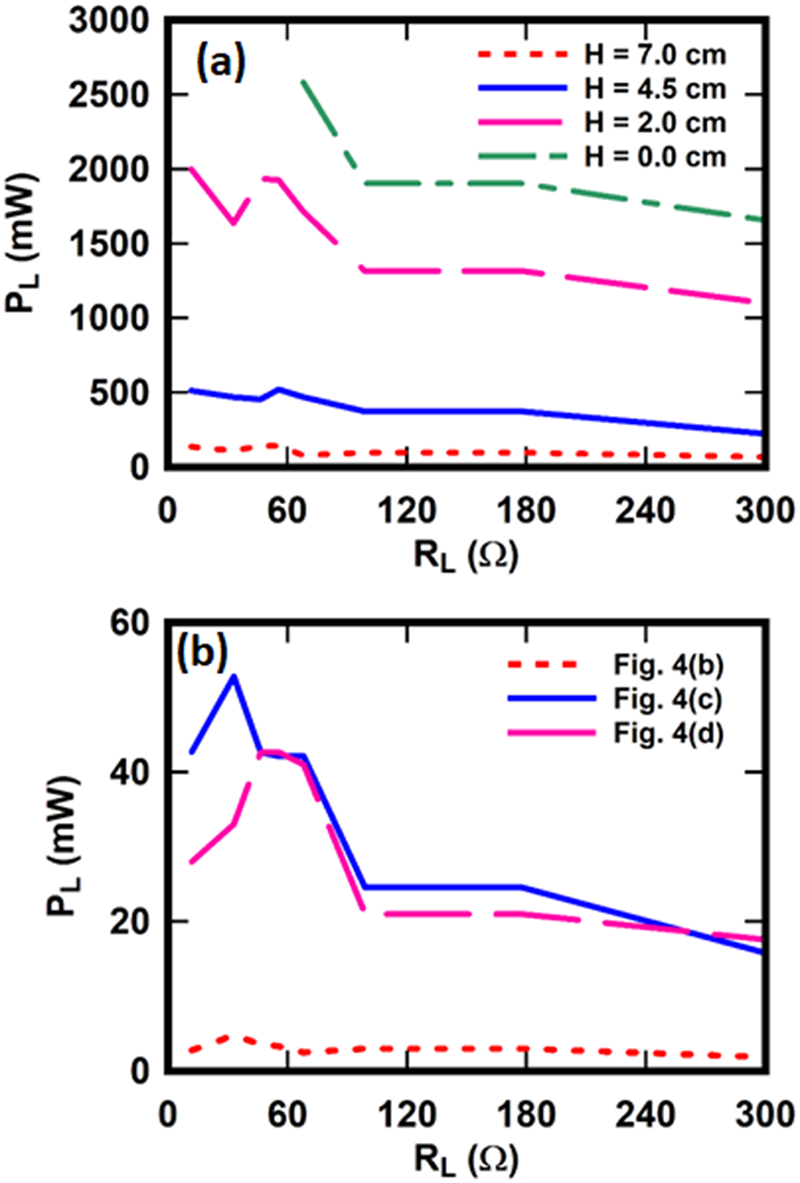
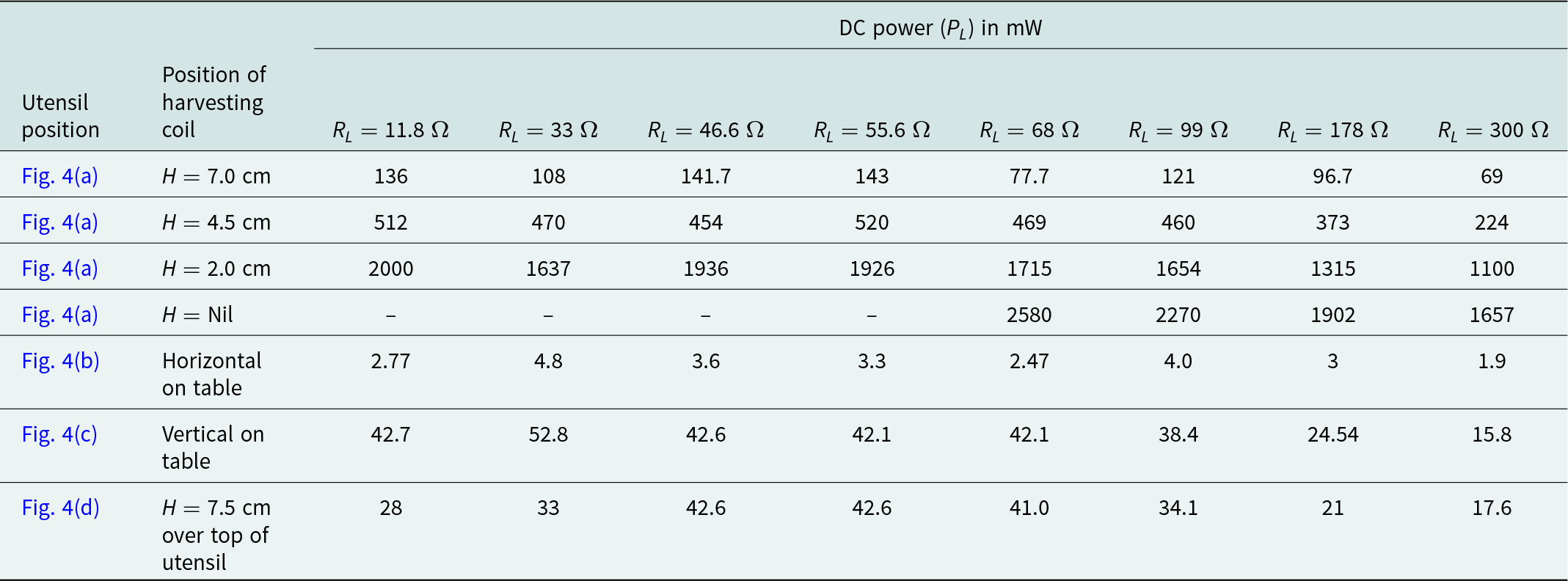
Table 2 shows the average DC power measured across various load resistances with C = 1 mF for different harvesting coil placements in Fig. 4. For RL = 11.8 Ω, an average DC power of 2000 mW is noted at H = 2 cm (Fig. 4(a)). As the distance increases, load power decreases, reaching a minimum of 2.77 mW at the position in Fig. 4(b). Power levels of 42.7 mW and 28 mW are observed for Fig. 4(c) and 4(d), respectively. When the coil is positioned in Fig. 4(a) at H = 0 mm, RL ≥ 68 Ω shows a high average DC load power of 2580 mW. Figure 5(a) displays the average DC power across different load resistances for C = 1 mF with coils positioned at various heights below the cooktop, as shown in Fig. 4(a). Figure 5(a) shows that the power level across the load resistor drops as the load resistor RL value rises. The load resister RL = 68 Ω displays an average DC load power of 2586 mW for H = 0 mm, while the load resister RL = 300 Ω displays a load power measurement of 1657 mW. Since high power across the load burns the load resister for H = 0 mm, we did not measure power for RL < 68 Ω. Similarly, the load power level for  $H \in \left[ {2,{\text{ }}4.5,{\text{ }}7} \right]$cm when ${R_L} \in \left[ {11.8,{\text{ }}33,{\text{ }}46.6,{\text{ }}55.6,{\text{ }}68,{\text{ }}99,{\text{ }}178,{\text{ }}300} \right]{{ \Omega }}$ is plotted in Fig. 5(a). The measured dc power for RL = 11.8 Ω at H = 2.0 cm is roughly 2000 mW. In contrast, a dc power of 1650 mW is seen at 33 Ω, and when the load resister is increased from 46.6 Ω to 55.6 Ω, this power level rises once again to 1900 mW. Impedance matching has improved, which is the cause of the rise in load power. The average dc load power across the load resister RL = 55.6 Ω for H = 7 cm is roughly 143 mW; however, the power level drops as the load resister RL is increased or decreased because of the impedance mismatch between the load and the energy harvesting coil’s output.
DC power measurement across various load resistance (a) for various heights (H) when the coil is located as shown in Figure 4(a); (b) for various positions of the coil shown in Figure 4(b, c, d).

Measured average DC power across the different load resistance  ${R_L}$ with constant value of ${\text{ }}C = 1{\text{ }}m{\text{F}}$ at various positions of the coils

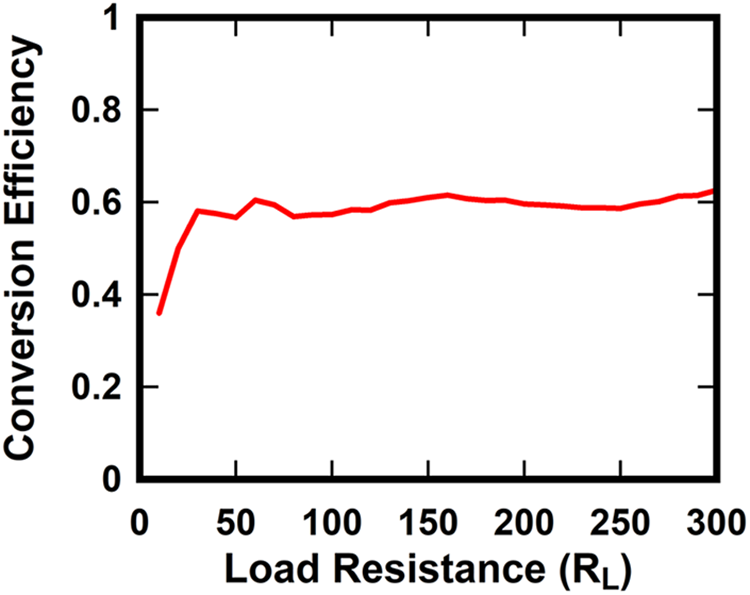
For H = 4.5 cm, the power level across the load RL = 11.8 Ω is 512 mW. The power decreases to 454 mW at RL = 46.6 Ω, then increases to 520 mW at RL = 55.6 Ω due to improved impedance matching. Figure 5(b) shows the average power for different coil placements. At RL = 11.8 Ω, the arrangement in Fig. 4(b) yields 2.77 mW, rising to 4.8 mW at RL = 33 Ω. Power variance is due to impedance matching. In Fig. 4(c, d), power initially rises and then falls as load resistance increases. The conversion efficiency of the proposed circuit with different load resistance is calculated and plotted as shown in Fig. 6. It has been observed that for lower load resistance of 15 Ω, the conversion efficiency is near 40%. However, it varies from 55 to 65% for the load resistance of 30–300 Ω.
Effect of load resistance on the conversion efficiency of the proposed MFEH circuit.

Practical demonstration
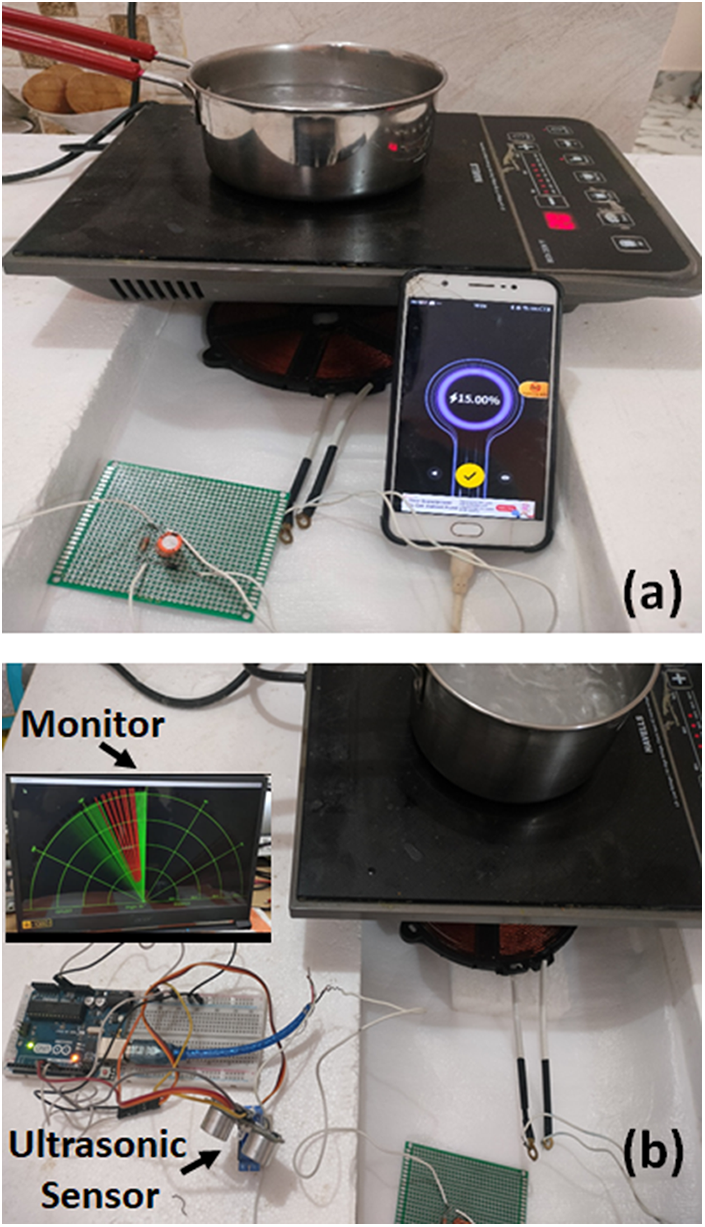
Figure 7 illustrates how the intended harvesting circuit powers the IoT-based sensor and charges the mobile device. The capacitance C = 1 mF and load resistance RL = 2.2 MΩ are connected across the device in all practical examples. As seen in Fig. 4(a), we placed energy-collecting coils for mobile charging applications at a height of H = 7 cm below the induction cooktop. Because the mobile phone model VIVO-Y69 has a high impedance of 16.7 kΩ, we have utilized high load resistance RL = 2.2 MΩ in this case. As a result, when the phone and load resistance are linked in parallel, the phone experiences maximum current flow, which initiates the charging process. Because of the high load resistance, a steady DC voltage of 10.93 V with very little ripple voltage is seen across the load. As illustrated in Fig. 7(b), we also provide our harvesting circuit for supplying power to the low-power IoT sensor. Here, we powered from the suggested circuit to an IoT-based project comprising Arduino Una, a servomotor, and an ultrasonic sensor. This system uses an ultrasonic sensor and servo motor to detect the movement of any object in its path. It then displays the detected object’s location in red on the computer monitor.
Demonstration of wireless powering when the harvesting coil is placed at a position shown in Figure 4(a): (a) mobile phone (VIVO Y69) charging when H = 7 cm, (b) powering low power IoT-based sensor.

The energy harvesting coil is positioned for demonstration at a height H = 4 cm beneath the induction cooktop (refer to Fig. 7(b)). The load resister, RL = 2.2MΩ, is now connected in parallel to the IoT device, which has an input impedance of 2.4 MΩ. As seen in the inset of Fig. 7(b), this supplies power to the sensor, which rotates with the aid of a servo motor and transmits the signal to the computer monitor. In this instance, a DC value of 20.2 V is noted across the RL = 2.2 MΩ load resistor. As a result, our suggested device can supply future smart houses with low-power IoT devices. For experimental demonstration, the proposed circuit is made on a PCB prototype board which makes the system relatively large. However, the circuit can be easily scaled to a small size by designing the rectifier circuit on PCB and using the dry etching technique.
The comparison of the proposed work with the similar work is illustrated in Table 3. It has been cleared from Table 3 that the railway track line and AC power lines were used in the past to harvest the magnetic energy. Furthermore, with our proposed circuit, a maximum power of 2580 mW, DC can be obtained by placing the coil near the induction cooktops with a load resistance of 68 Ω. This much power was not harvested in the previous works. Therefore, our proposed circuit and methods are novel and have many advantages in comparison to previously reported work.
Comparison of proposed work with similar other works

Conclusions
A simple MFE harvester circuit for powering low-power IoT based devices and mobile charging has been presented in this paper. The proposed device harnesses leaked MFE from induction cooktops used in daily kitchen activities. Through extensive experimentation across various positions, significant results have been achieved: at close proximity (within 2 cm), power output peaked at 1936 mW with voltage ranging from 9.4 V to 9.6 V using C = 1 mF and R = 46.6 Ω. Furthermore, it has been observed that load power decreases as load resistance increases, though optimal matching between the load and source can enhance power output at lower resistances. Positioning of the harvesting coil also affects power capture; placing it at certain heights yielded higher efficiencies compared to orthogonal placements. The proposed circuit has been demonstrated to charge mobile devices and powers the low-power IoT device, making it ideal for smart home applications. This unique capability to harvest MFE from induction cooktops distinguishes our device from previous magnetic harvesting circuits.
Declaration
The authors would like to declare that there is no declaration of interest for the paper entitled, “Study of Low-Profile Near-Field Electromagnetic Energy Harvesting” which is accepted for publication in International Journal of Microwave and Wireless Technologies. Thanks & Regards
1. Dr Subash Chandra Yadav
2. Dr Rajan Agrahari.

Dr Subash Chandra Yadav is currently working as an assistant professor in the department of Electronics and Communication Engineering NIT Patna Bihar India. He has completed M.Tech degree in RF and Microwave Engineering from IIT Kharagpur in 2013 and PhD degree in RF and Microwave Engineering from IIT Bombay in 2021. He worked on broadband microstrip antenna during his PhD work and he has published more than 11 SCI Index Journals Papers. Currently he is working as high gain substrate integrated antennas integrated with planner dielectric lens.

Dr Rajan Agrahari is currently working as an assistant professor in the department of Electronics and Communication Engineering NIT Patna Bihar India. He has completed PhD degree in RF and Microwave Engineering from IIT BHU in 2019. He worked on metamaterial and metasurfaces during his phd thesis. He has published more than 15 SCI index Journal snd 5 indian patents.