

Constitutions, electoral laws, or party rules in more than 130 countries require that women be included alongside men as legislative candidates or as representatives (Hughes et al. Reference Hughes, Paxton, Clayton and Zetterberg2019, 219). Gender quota policies are endorsed by organizations including the United Nations and the European Union and are strongly supported by domestic and international women’s movements. Yet, quotas have not been universally embraced. Indeed, they often face considerable resistance before, during, and after their implementation. For example, as Ireland prepared for its first election after adopting a gender quota in 2012, an editorial in The Irish Times argued that quotas would weaken confidence in the government.Footnote 1 In a more recent quota debate among Liberal party members in Victoria, Australia, policy opponents argued that quotas would undermine the egalitarian ethos of the party.Footnote 2
These claims represent a broader concern about quota policies—that by including gender as a criterion for political representation, quotas cast doubt on the legitimacy of political decisions and decision-making institutions. Though a large body of work finds that women’s equal presence improves citizens’ perceptions of their governing bodies (Clayton, O’Brien and Piscopo Reference O’Brien, Piscopo, Franceschet, Krook and Tan2019; Hinojosa and Kittilson Reference Hinojosa and Kittilson2020; Morgan and Buice Reference Morgan and Buice2013; Schwindt-Bayer and Mishler Reference Schwindt-Bayer and Mishler2005; Valdini Reference Valdini2019), skeptics expect either null or negative effects when gender balance is achieved via quotas. Indeed, resistance to adopting gender quotas often centers on concerns that quota-elected politicians may lack legitimacy (Clayton Reference Clayton2015; Franceschet and Piscopo Reference Franceschet and Piscopo2008; Zetterberg Reference Zetterberg2009). This perception could corrode the legitimacy-conferring effects of women’s presence on deliberative institutions.
We examine quotas’ effects on the perceived legitimacy of political decisions and decision-making bodies. We use survey experiments to compare reactions to a local-level council composed of: (1) only men; (2) four men and four women, with no mention of how gender balance was attained; or (3) four men and four women, elected via a rule requiring all parties to run equal numbers of men and women candidates.Footnote 3 Our sample covers 12 democracies with varying quota policies, allowing us to consider whether the percentage of women candidates required by the country’s current policy—the quota threshold—moderates the relationship between women’s presence, quotas, and citizens’ perceptions of legitimacy. To do so, we assess citizens’ views of both quota-elected and non-quota elected local legislative councils (relative to all-male councils and relative to each other), both overall (on our pooled 12-country sample) and by country. Our cases include the full spectrum of countries’ experiences with candidate quotas, from no quotas (the United States) to well-enforced statutory quotas requiring gender parity at every level of government (Mexico).
Citizens strongly prefer gender-balanced governing bodies, even when achieved through quotas. On average, respondents across 12 Anglophone, European, and Latin American democracies perceive the processes and outcomes of decision-making institutions to be fairer when presented with gender-balanced legislatures as compared to all-male legislatures. The legitimacy-conferring effects of gender balance are strongest on measures related to procedural legitimacy, meaning the legitimacy accorded to the decision-making procedures and the institution itself. Importantly, these legitimizing effects persist even when respondents were informed that gender balance was attained via a rule requiring parties to run “equal numbers of male and female candidates.” Respondents view gender-balanced institutions elected without a quota policy as somewhat more legitimate than gender-balanced institutions achieved through quotas, but respondents overwhelmingly see all-male decision-making bodies as the least legitimate composition. Quota penalties are especially weak, and typically not statistically differentiable from zero, for respondents in countries with high quota thresholds.
Our results contribute to the growing literature on citizens’ attitudes toward, and reactions to, gender quota policies (Alexander Reference Alexander2012; Barnes and Córdova Reference Barnes and Córdova2016; Beauregard and Sheppard Reference Beauregard and Sheppard2021; Bolzendahl and Coffé Reference Bolzendahl and Coffé2020; Coffé, Saha, and Weeks Reference Coffé, Saha and Weeks2023; Hinojosa and Kittilson Reference Hinojosa and Kittilson2020; Keenan and McElroy Reference Keenan and McElroy2017; Kerevel and Atkeson Reference Kerevel and Atkeson2013; Kim and Fallon Reference Kim and Fallon2023; Kim and Kweon Reference Kim and Kweon2022; Shiran Reference Shiran2024; Venturini Reference Venturini2024). We find little evidence to support quota skeptics’ claims that raising women’s descriptive representation via affirmative action would diminish democratic legitimacy. Respondents far prefer gender-balanced decision-making bodies attained via quotas to all-male groups. Our findings thus urge scholars, policymakers, and observers to consider the relevant counterfactual when discussing the effects of quota policies on perceptions of democratic legitimacy: the comparison is not between women’s descriptive representation with and without quotas but between men’s political dominance and women’s political inclusion. Because quotas are adopted to remedy women’s systematic under-representation in politics, the alternative state of the world is not political institutions comprised of many women elected “on their own.” Rather, the alternative is institutions that jeopardize their legitimacy by continuing to over-represent men.
REPRESENTATION, GENDER QUOTAS, AND DEMOCRATIC LEGITIMACY
Building on the extensive literature examining the link between women’s representation, gender quotas, and citizens’ attitudes and behaviors, we develop our argument in five parts. First, we propose that, on average and across countries, citizens prefer women’s presence to women’s absence. Second, we describe how surveys show broad support for quotas among citizens in many quota-adopting countries. This generalized support suggests that citizens evaluate quota-elected institutions more favorably than all-male decision-making bodies. Third, we recognize that while researchers often find broad support for quotas, in some cases some citizens perceive quotas as illegitimate, influenced in part by political elites’ critiques of affirmative action. This suggests that quota-elected institutions may be seen as less legitimate than gender-balanced institutions elected without quotas. Fourth, we posit that the size of this “quota penalty” is likely moderated by country-level quota experiences. Finally, we draw on literature linking women’s descriptive representation to women’s substantive representation, contending that the effects of gender-balanced institutions on legitimacy beliefs will be strongest when legislatures debate women’s rights.
Gender-Balanced Institutions and Democratic Legitimacy
Citizens respond to women’s (under)representation in political office. In many cases worldwide, studies have found that women’s descriptive representation influences citizens’ political knowledge (Dassonneville and McAllister Reference Dassonneville and McAllister2018; Wolak Reference Wolak2020), sense of political efficacy (Stauffer Reference Stauffer2021), and belief in women’s ability to govern (Alexander Reference Alexander2012; Alexander and Jalalzai Reference Alexander and Jalalzai2020). In some contexts, women’s representation also appears to bolster women’s political engagement, increasing women’s political interest and participation and even inspiring them to seek elected office (Barnes and Burchard Reference Barnes and Burchard2012; Campbell and Wolbrecht Reference Campbell and Wolbrecht2025; Campbell, Childs, and Lovenduski Reference Campbell, Childs and Lovenduski2010; Desposato and Norrander Reference Desposato and Norrander2009; Hinojosa and Kittilson Reference Hinojosa and Kittilson2020; Lee Reference Lee2022; Stauffer and Fisk Reference Stauffer and Fisk2022).
Women’s equal representation is also increasingly linked to perceptions of democratic legitimacy. Survey research indicates that citizens view governments as more democratic when women are better represented in elected office (Karp and Banducci Reference Karp and Banducci2008; Schwindt-Bayer and Mishler Reference Schwindt-Bayer and Mishler2005), and that support for gender equality in representation is often grounded in democratic and justice-based values (Allen and Cutts Reference Allen and Cutts2016; Espírito-Santo Reference Espírito-Santo2016). In the United States, Stauffer (Reference Stauffer2021) finds that citizens who believe more women are represented in office also view government as more responsive. Among Americans, our previous work shows that women’s presence confers legitimacy to legislative decisions and decision-making processes (Clayton, O’Brien, and Piscopo Reference O’Brien, Piscopo, Franceschet, Krook and Tan2019).
These legitimacy-conferring effects are not confined to specific regions or groups. Kao et al. (Reference Kao, Lust, Shalaby and Weiss2024) demonstrate similar results for respondents in Jordan, Morocco, and Tunisia, and Arnesen and Peters (Reference Arnesen and Peters2018) see similar patterns in Norway. In a framing experiment in Spain and Portugal, Verge, Wiesehomeier, and Espírito-Santo (Reference Verge, Wiesehomeier and Espírito-Santo2020) find that the symbolic effects of women’s representation are driven by citizens’ perceptions that women and men have equal access to power. The legitimizing effects of gender-balanced institutions even hold among citizens who are expected to have weaker preferences for inclusion, including men and right-leaning respondents, particularly when those institutions are making decisions that undermine women’s rights (Clayton, O’Brien and Piscopo Reference O’Brien, Piscopo, Franceschet, Krook and Tan2019; Verge, Wiesehomeier, and Espírito-Santo Reference Verge, Wiesehomeier and Espírito-Santo2020). This growing body of scholarship suggests that across countries citizens accord more legitimacy to political decisions and decision-making processes when institutions are gender-balanced compared to when they are all-male.
Gender Quotas and Democratic Legitimacy
In most countries, progress toward gender-balanced political institutions is achieved through the implementation of gender quotas. Quotas serve as remedies for women’s exclusion from historically male-dominated institutions, but are also often framed as mechanisms to promote gender balance. Rather than explicitly setting thresholds that women must attain, quota policies typically specify minimum representation thresholds for any sex or for the “under-represented sex.” In this way, quotas address both the exclusion of women and the broader goal of gender-equal representation as a means of deepening and strengthening democracy. As Kittilson and Schwindt-Bayer (Reference Kittilson and Schwindt-Bayer2012, 16) observe, “gender quotas are not only institutional mechanisms for getting more women elected to office but are political symbols of the value that government places on gender equality and a truly representative democracy. Quotas symbolize the value that a democratic system places on social inclusion.”
In practice, gender quotas not only promote gender-balanced institutions but also do so without compromising the quality of representation. Research consistently shows that women elected following quota implementation are as qualified and effective as their peers (Allen, Cutts, and Campbell Reference Allen, Cutts and Campbell2016; Franceschet and Piscopo Reference Franceschet and Piscopo2014; Josefsson Reference Josefsson2014; Lühiste and Kenny Reference Lühiste and Kenny2016; Murray Reference Murray2010; O’Brien Reference O’Brien, Franceschet, Krook and Piscopo2012; Weeks and Baldez Reference Weeks and Baldez2015). Following the Swedish Social Democratic Party’s implementation of a 50–50 quota for municipal positions, for example, women became perceived as more qualified for top leadership positions (O’Brien and Rickne Reference O’Brien and Rickne2016). Consistent with these findings, Radojevic (Reference Radojevic2023) finds that a “quota woman” framing did not negatively affect party elites’ evaluations of women politicians in Austria, Germany, and Switzerland.
Quotas may even enhance the quality of representation. In some cases, the implementation of gender quotas can force lower-performing men out of office (Besley et al. Reference Besley, Folke, Persson and Rickne2017). Quotas can also improve women’s standing within political institutions. For instance, quotas can ameliorate gender gaps in prestigious committee appointments (Kerevel and Atkeson Reference Kerevel and Atkeson2013) and participation in legislative debates (Fernandes, Lopes da Fonseca, and Won Reference Fernandes, da Fonseca and Won2023). Quotas may also increase overall diversity in both sub-national (Barnes and Holman Reference Barnes and Holman2020) and national legislatures (Hughes Reference Hughes2011).
Given both the normative arguments in favor of quotas and the broadly positive effects of quota implementation, it is not surprising that citizens often respond positively to these policies when surveyed. Across Latin America, many respondents report that they approve of quota policies (Barnes and Córdova Reference Barnes and Córdova2016). A majority of Brazilian (Batista Pereira, and Porto Reference Batista Pereira and Porto2020) and French (Coffé, Saha, and Weeks Reference Coffé and Reiser2023) survey respondents likewise support quotas, as did a majority of respondents in the Spanish province of Catalonia (Verge and Tormos Reference Verge and Tormos2023). A near majority of Irish respondents agree that “parties should be forced to nominate more women candidates” (Keenan and McElroy Reference Keenan and McElroy2017). In the United Kingdom, voters do not punish quota-elected women (Allen, Cutts, and Campbell Reference Allen and Cutts2016). Even in the United States, Bush, Donno, and Zetterberg (Reference Bush, Donno and Zetterberg2024, 1199) find that American citizens are more likely to perceive countries with gender quotas as more democratic than those without.
Beyond direct support for quota policies, research indicates that quota implementation can positively influence a wider range of voters’ attitudes. Following the implementation of quotas for village-level governments in India, Beaman et al. (Reference Beaman, Chattopadhyay, Duflo, Pande and Topalova2009) find that quota-induced exposure to women leaders decreased implicit gender biases over time. Also at the sub-national level, Clayton (Reference Clayton2018) finds similar results among young women in Lesotho. Focusing on trust in political institutions, Hinojosa and Kittilson (Reference Hinojosa and Kittilson2020) find that both women and men responded positively to Uruguay’s implementation of its national quota law. Coupled with citizens’ broad support for gender-balanced political institutions, this research suggests that citizens accord more legitimacy to political decisions and decision-making processes when women make up an equal share of representatives as compared to all-male decision-making bodies, even if gender balance was achieved via a quota policy.
The Quota Penalty
We expect citizens to view gender-balanced institutions as more legitimate than male-dominated decision-making bodies, even when gender balance is achieved through quotas. At the same time, quota policies do often face criticism, particularly during their adoption. Opponents argue that quotas are illiberal, as they make gender a criterion for candidate selection. They also see quotas as undemocratic, contending that they constrain parties’ autonomy and limit voters’ freedom to choose their representatives (Bacchi Reference Bacchi and Dahlerup2006; International Institute for Democracy and Electoral Assistance 2024). Although gender quotas that apply to candidate lists are written in a “gender-neutral fashion” (Krook and Norris Reference Krook and Norris2014, 1271), both party elites and voters also sometimes view them as handouts to women that undermine merit (Dahlerup Reference Dahlerup2007). The introduction of quotas can generate significant internal conflict within political parties, as incumbent men are displaced to make room for women candidates.
Researchers document how, in some instances, women elected following quota implementation are derided by their fellow legislators. In the early years of Argentina’s statutory quota adoption, congresswomen reported being labeled as “quota women” in ways that minimized their competency (Franceschet and Piscopo Reference Franceschet and Piscopo2008). Women in the British parliament, especially those elected via Labour’s all-women shortlists, reported similar stigmas (Childs and Krook Reference Childs, Krook, Franceschet, Krook and Piscopo2012). Likewise, women in reserved seats in Tanzania reported feeling like “second-class” MPs, with their work receiving inadequate recognition (Yoon Reference Yoon2011).
Just as quota-elected women can be stigmatized by fellow legislators, related work finds that citizens may express skepticism about quota-elected representatives. In Lesotho, for instance, villages reserved for quota-elected councilors saw a decline in women’s political engagement, as citizens viewed the quotas as externally imposed rather than arising from local demand (Clayton Reference Clayton2015). Reflecting on the extensive research into India’s application of gender quotas for village governments, Kudva and Misra (Reference Kudva and Misra2008) wonder whether the limited participation and policy influence of quota-elected women would undermine support for the policies. Indeed, support for quotas appears low in some countries and among some groups. When surveyed in 1990, most Canadians opposed gender quotas (Gidengil Reference Gidengil1996). More recently, the 2014 New Zealand Election Study found little support for increasing women’s representation via quotas (Bolzendahl and Coffé Reference Bolzendahl and Coffé2020). Fewer than a quarter of respondents to the 2016 German Longitudinal Election Study supported legal or voluntary party quotas for women (Coffé and Reiser Reference Coffé and Reiser2023). A growing body of research further highlights skepticism and even backlash toward quota policies within certain segments of the polity (Barnes and Córdova Reference Barnes and Córdova2016; Beauregard and Sheppard Reference Beauregard and Sheppard2021; Brulé Reference Brulé2020; Clayton Reference Clayton2015; Kim and Kweon Reference Kim and Kweon2022).Footnote 4
Taken together, this work suggests the existence of a gender quota penalty. We anticipate that gender quotas somewhat diminish perceptions of the legitimacy of political decisions and processes compared to institutions that achieve gender balance without these policies. At the same time, we expect that citizens prefer inclusive institutions over exclusionary ones, irrespective of how politicians are selected. Across countries, we thus posit that, on average, citizens accord the most legitimacy to political decisions and decision-making processes when institutions are gender-balanced, followed by quota-elected gender-balanced institutions, and lastly by all-male institutions.
Country-Level Quota Experiences
We expect that the legitimizing effect of gender-balanced institutions, whether achieved through quotas or not, will generalize across democracies. At the same time, we recognize that quota policies differ by country. Some democracies have no quotas, and for those that do, policies are shaped by specific political, electoral, and institutional contexts (Hughes et al. Reference Hughes, Paxton, Clayton and Zetterberg2019; Zetterberg et al. Reference Zetterberg, Bjarnegård, Hughes and Paxton2022). Countries’ quota experiences may, in turn, affect their citizens’ reactions to these policies.
Few advanced democracies have neither party nor statutory quotas. The popularity of these policies suggests a clear divide between choosing quotas in some form and eschewing them entirely. Countries and parties that continue to resist gender quota adoption may do so in part because the measures are (assumed to be) unpopular among citizens and counter to the interests of political elites. In these contexts, quotas may have delegitimizing effects.
Conversely, adopting quotas signals an acknowledgment that gender inequality in political institutions constitutes a democratic deficit and that positive action measures are an important remedy for resolving this problem in the short term (Dahlerup and Freidenvall Reference Dahlerup and Freidenvall2005). When campaigning for quotas, advocates rely on discourses that emphasize the importance of gender-balanced representation and link women’s inclusion to democratic quality (Towns Reference Towns2012; Piscopo Reference Piscopo2016). Exposure to arguments connecting gender quotas to democracy throughout the adoption and implementation processes may increase acceptance of these policies.
Beyond the simple presence or absence of a quota, these policies also differ in their design, including variation in penalties for noncompliance and placement mechanisms that ensure women winnable positions (Hughes et al. Reference Hughes, Paxton, Clayton and Zetterberg2019; Schwindt-Bayer Reference Schwindt-Bayer2009). Importantly, quotas also differ in their thresholds—the percentage of candidacies allocated to women. Some policies mandate low thresholds (historically as low as 5%), while others require gender parity (Hughes et al. Reference Hughes, Paxton, Clayton and Zetterberg2019).
Thresholds have symbolic importance. They set a target for women’s representation and signal societal expectations regarding political inclusion. A parity quota communicates that men and women should equally share power, while a 30% quota suggests lesser representation suffices. In democracies, the modal pathway to a high-threshold quota is an initially lower-threshold quota law that is then raised over time (Hughes et al. Reference Hughes, Paxton, Clayton and Zetterberg2019; Piscopo Reference Piscopo2015). These reforms occur at the national, sub-national, and party levels as quotas gradually become more palatable and less contentious (Piscopo and Vázquez Correa Reference Piscopo and Correa2024). Higher threshold quotas thus suggest that elites and voters alike have become accustomed to—and are accepting of—gender quotas. Consistent with this expectation, citizens in democracies that have implemented statutory candidate quotas with high thresholds are more likely to approve of these policies than citizens in other states, irrespective of the level of women’s descriptive representation in the country (Batista Pereira and Porto Reference Batista Pereira and Porto2020; Bolzendahl and Coffé Reference Bolzendahl and Coffé2020; Coffé and Reiser Reference Coffé and Reiser2023; Gidengil Reference Gidengil1996; Verge and Tormos Reference Verge and Tormos2023).
Thresholds also usually affect de facto quota strength. A high threshold is a necessary, though not always sufficient, condition for a quota to achieve gender balance in legislatures.Footnote 5 The overall goal of quota strengthening—such as by introducing placement mechanisms and sanctions—is to reach the threshold: to bring the number of women nominated or elected closer to the level envisioned by the quota policy. Strong quotas that include high thresholds can in turn expose citizens to quota-elected women performing effectively, reinforcing support for women’s representation and mitigating concerns that quotas compromise representation quality. For example, using World Values Survey data from 187 country-waves, Kim and Fallon (Reference Kim and Fallon2023) find that respondents in countries with “robust candidate quotas” are almost 40% more likely to approve of women in politics than those in countries without quotas.
Whether quota discourses are causing more quota acceptance or quotas are being adopted—and their thresholds increased—where polities are already more accepting, a high-threshold quota indicates the polity’s openness to the measure. In contexts of high threshold quotas, we expect that gender balance achieved both with and without quotas has similar effects on citizens’ legitimacy beliefs relative to all-male groups. We thus posit that citizens apply a smaller quota penalty in countries with higher-threshold quota policies.
Issue Area
We have theorized broad legitimacy-conferring effects of gender-balanced political institutions. Our expectations are grounded in the theoretical and empirical connections between diverse, inclusive decision-making bodies and citizens’ perceptions of the fairness and justice of these institutions. Yet, other arguments for promoting gender equality—including via quotas—focus specifically on the importance of women’s presence in deliberations where the outcomes touch on women’s lives. Because of longstanding gender roles, citizens expect women to bring unique experiences, behaviors, and preferences into policymaking (O’Brien and Piscopo Reference O’Brien, Piscopo, Franceschet, Krook and Tan2019). Indeed, although scholars have carefully documented how the link between descriptive and substantive representation is neither automatic nor seamless, women politicians remain generally more likely than men to advocate on behalf of women’s interests (Barnes Reference Barnes2016; Betz, Fortunato, and O’Brien Reference Betz, Fortunato and O’Brien2023; Franceschet and Piscopo Reference Franceschet and Piscopo2008). On average, women’s presence in political office leads to more legislative attention to issues that disproportionately affect women’s rights and women’s welfare (Clayton Reference Clayton2021; Clayton, Josefsson, and Wang Reference Clayton, Josefsson and Wang2017; Weeks Reference Weeks2022).
Women’s presence in deliberations on women’s rights thus serves as an important cue that women’s experiences and perspectives were accounted for. The public seems especially outraged when an all-male group makes decisions on women’s healthcare or reproductive rights, for instance (Clayton, O’Brien and Piscopo Reference O’Brien, Piscopo, Franceschet, Krook and Tan2019). Consequently, although we expect to observe legitimacy-conferring effects across issue areas, we posit that gender-balance—achieved with or without gender quotas—will confer greater legitimacy when legislatures are considering a women’s rights issue as compared to an issue not directly involving women’s rights.
EXPERIMENTAL DESIGN AND MEASUREMENT
We test our hypotheses using a survey experiment in which respondents across 12 countries read a short fictional newspaper article about an eight-member city council in a neighboring municipality.Footnote 6 The article varies on two dimensions. First, we vary the gender composition of the city council to consist of: (1) only men; (2) four men and four women, with no information about how the women were elected; or (3) four men and four women, with information that the women were elected via a quota policy. The relevant treatment language reads (randomized components indicated in brackets): “The council is composed of [all men] / [four men and four women] / [four women and four men, following a new rule that requires all parties to run equal numbers of male and female candidates].” Our quota treatment is designed to reflect the language commonly found in quota legislation, which rarely uses the term “quota” explicitly but instead specifies requirements for the distribution of candidacies by sex/gender.Footnote 7
Second, to test whether our findings differ across issue areas, we vary the policy area under consideration. Though all vignettes explain that the neighboring municipality recently adopted a policy requiring workplace training for certain employees, we vary whether that training applies to a women’s rights issue (sexual harassment) or to an issue not directly related to women’s rights (animal mistreatment on commercial farms). We selected these issue areas following extensive pre-testing on a US sample to select two issues that varied in their substance (clearly signaling women’s rights versus not) but were otherwise comparable on other dimensions (e.g., salience and potential for respondents to have varied views on the topic).Footnote 8 For both issue areas, the substance of the policy decision is held constant. In all treatments, the city council decides to require that the relevant employees complete the training. The complete wording for all six treatment conditions (3 council compositions x 2 issue areas) can be found in the Supplementary Material (SI)D.
Following our previous work, our outcome variables capture two aspects of citizens’ legitimacy beliefs: substantive legitimacy and procedural legitimacy (Clayton, O’Brien and Piscopo Reference O’Brien, Piscopo, Franceschet, Krook and Tan2019). Substantive legitimacy pertains to citizens’ perceptions of the content of the decision reached; it measures whether citizens perceive the decision itself as correct or fair. We measure substantive legitimacy based on respondents’ answers to three questions immediately following the vignette (randomized text to match treatment condition indicated in brackets):
-
1. Please tell us if you agree: the council made the right decision for all local citizens.
-
2. Please tell us if you agree: the council made the right decision for [women / the treatment of animals].
-
3. How fair was this decision [to women / for the treatment of animals]?
Procedural legitimacy gauges citizens’ perceptions of the fairness of decision-making procedures, as captured through citizens’ assessments of the decision-making process, acquiescence to the group’s decisions, and trust in representative institutions. Again following our previous work, we measure procedural legitimacy based on respondents’ answers to the following three questions:
-
1. Thinking for a moment about the gender composition of the council, how fair was the decision-making process?
-
2. Please tell us if you agree: the council’s decision should be overturned. (Reverse coded)
-
3. Please tell us if you agree: the council can be trusted to make decisions that are right for local citizens.
By directly prompting respondents to evaluate the gender composition of the council, our procedural legitimacy measure draws out explicit rather than implicit views on how the council’s gender makeup influences their perceptions of legitimacy.Footnote 9 This is important for elucidating the connection between political representation and procedural legitimacy, and reminiscent of numerous media accounts and activist efforts aimed at highlighting women’s exclusion from political office.Footnote 10
The questions we use for each of the two measures are highly internally correlated and each loads together onto a single factor (for both scales across all countries, Cronbach’s $ \alpha \ge $
0.70). We thus generate composite scores of each legitimacy measure, which closely mirror the 1–4 range, Likert-type scales of the individual response questions (from strongly disagree to strongly agree / very unfair to very fair). We standardize responses within countries such that scores represent standard deviations from the country average.
$ \alpha \ge $
0.70). We thus generate composite scores of each legitimacy measure, which closely mirror the 1–4 range, Likert-type scales of the individual response questions (from strongly disagree to strongly agree / very unfair to very fair). We standardize responses within countries such that scores represent standard deviations from the country average.
MEASURING LEGITIMACY BELIEFS IN 12 COUNTRIES
We analyze how gender quotas influence citizens’ perceptions of democratic legitimacy across 12 established democracies. We focused on democracies from three world regions—the Americas, Europe, and Australasia—and prioritized middle- to high-income countries with reputable online survey firms (see Section A of the Supplementary Material).Footnote 11 Within these criteria, cases were selected to represent variation along several key dimensions, including electoral system (majoritarian, PR, and mixed), strength of democracy (from newly-established to long-established), linguistic and social tradition (Anglophone, Francophone, Hispanophone, Lusophone, and Nordic) and ranking on women’s rights indicators (from second in worldwide gender equality to 95th, see Table SI.2 in the Supplementary Material). Importantly, our cases vary in quota experience (from nonexistent to parity). However, in all countries with gender quotas, the quota had been in place for four or more election cycles before fieldwork, an important scope condition we return to after presenting our results.
We have four cases from Latin America, a region that remains in the vanguard of quota adoption and implementation (Piscopo and Vázquez Correa Reference Clayton, O’Brien and Piscopo2024; Piscopo Reference Piscopo2015). The sample includes Argentina, which led the contemporary era’s quota wave by adopting a 30% quota in 1991, and has since strengthened its quota to parity, and Mexico, which adopted its gender quota in 2002 and then became the first country in the region to implement gender parity across all three government branches. We include Peru, an earlier adopter of gender quotas in 1997 that, unlike Argentina and Mexico, did not make significant strengthening reforms until recently.Footnote 12 We also surveyed respondents in Brazil, an outlier in the region for its weak quota, first adopted in 1997 but inadequately enforced and not well designed to work with the country’s open-list proportional representation system (Wylie and Dos Santos Reference Wylie and Dos Santos2016).
We include four European cases with varying levels of quota adoption and strength. We fielded our study in Spain, which adopted a well-enforced 40% quota in 2007, and Portugal, which adopted a well-enforced 33% quota in 2006 (later increased to 40%) (Hughes et al. Reference Hughes, Paxton, Clayton and Zetterberg2017). Our sample includes France, which adopted a weakly enforced parity quota in 2000. Adherence to this 50% quota has improved over time (Murray Reference Murray2010). We also have data from Norway, one of the first countries in the world in which major parties adopted strong voluntary quotas, beginning in 1974 (Dahlerup and Freidenvall Reference Dahlerup and Freidenvall2005).
We examine four Anglophone countries. We surveyed respondents in Australia and New Zealand, where the main center-left parties implement voluntary quotas. Our sample also contains respondents from the United Kingdom, where the center-left Labour Party applied a voluntary quota, using all-women shortlists in half of its winnable districts for all general elections between 2002 and 2019 (Nugent and Krook Reference Nugent and Krook2016). Finally, we include the United States, which does not use quotas.Footnote 13 In all cases, except for the United States and the United Kingdom, quotas also exist at the sub-national level (the level of government featured in our vignettes). We describe the quota experiences of each of the 12 cases in Section B of the Supplementary Material.
Data Collection
We fielded our surveys online between July 2020 and January 2024 using three survey firms with high-quality proprietary respondent panels in the countries where they operate. In France, Norway, and Australia, we partnered with the survey firm IPSOS, while in the four Latin American countries, Spain, Portugal, the US, and the UK, we worked with Netquest. In New Zealand, we used the market research firm PureSpectrum. All firms collected informed consent as the first step in the survey process and returned anonymized data to us.Footnote 14 In non-English-speaking countries, surveys were translated and reviewed by native speakers, with adjustments made to ensure the translations reflected the national context.Footnote 15
Respondents in each country were selected to create a nationally representative sample of the online population (those with internet access) based on key demographics such as age, race/ethnicity, gender, and geographic region, with additional country-specific variables as needed. On average, we sampled around 1,400 respondents per country, though the sample size was slightly smaller in Peru (n $ \approx $
1,150) and larger in New Zealand (n
$ \approx $
1,150) and larger in New Zealand (n $ \approx $
2,000). A full description of survey sampling is available in Section A of the Supplementary Material. In total, we surveyed over 17,000 respondents across 12 countries. After removing respondents who failed the manipulation check (incorrectly identifying the council’s decision) or completed the experiment module in under 10 seconds, our final sample consisted of 13,274 respondents across six treatment conditions (for replication data, see Clayton, O’Brien, and Piscopo Reference Clayton, O’Brien and Piscopo2025).Footnote 16
$ \approx $
2,000). A full description of survey sampling is available in Section A of the Supplementary Material. In total, we surveyed over 17,000 respondents across 12 countries. After removing respondents who failed the manipulation check (incorrectly identifying the council’s decision) or completed the experiment module in under 10 seconds, our final sample consisted of 13,274 respondents across six treatment conditions (for replication data, see Clayton, O’Brien, and Piscopo Reference Clayton, O’Brien and Piscopo2025).Footnote 16
Identifying Quota Thresholds
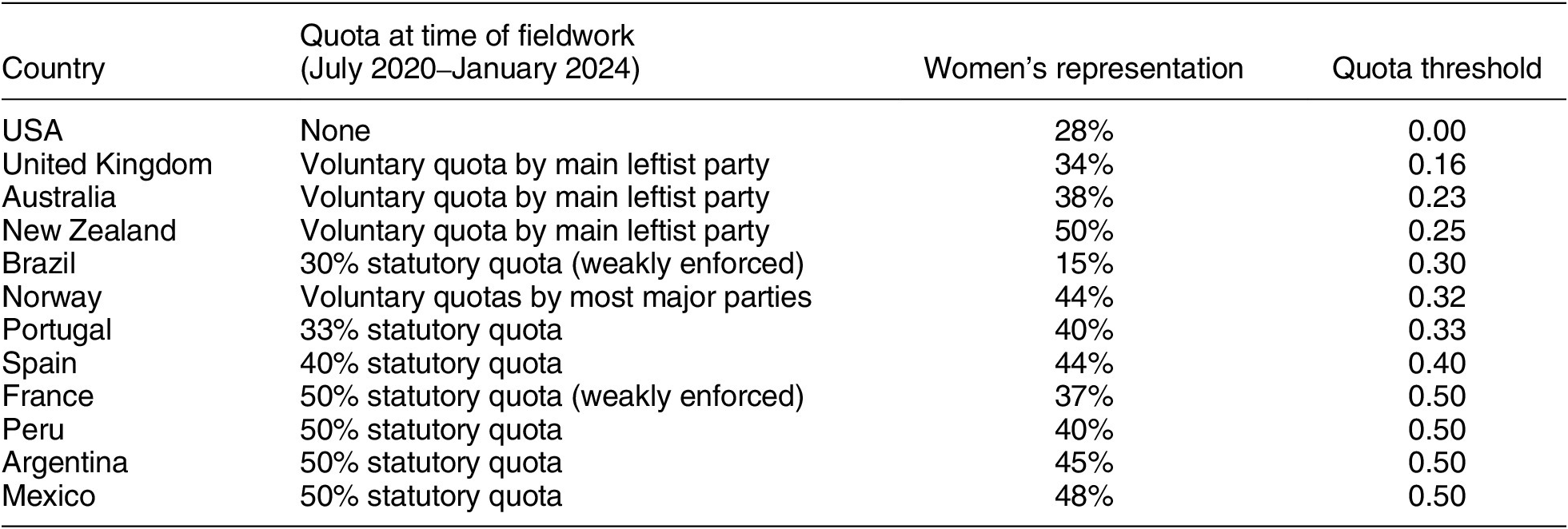
Above we hypothesized that the presence and threshold of quota policies would moderate our cross-country results. Table 1 lists the quota policies in each of our 12 cases, ranked by quota threshold. For mandatory quotas, we calculate the quota threshold simply as the quota’s statutory threshold at the time of fieldwork. These statutory thresholds range from 30% in Brazil to parity in four cases (Argentina, France, Mexico, and Peru).
Quotas in Each of the 12 Cases, Ranked by Quota Threshold

Note: Women’s representation is measured as the percentage of women MPs in the country’s single or lower parliamentary house at the time of fieldwork.
For voluntary party quotas, we account for the percentage of seats in the legislature held by the quota-adopting parties. In these cases, we measure quota strength as the party’s quota threshold multiplied by the number of seats the party holds in its single or lower house. For example, at the time our survey was fielded in the UK, the then-parliament had been elected while the Labour Party applied its 50% candidate quota and controlled 31% of the seats in the British House of Commons. The UK’s quota threshold score is thus: 0.50 x 0.31 = 0.155. This measure allows us to conceptualize statutory and voluntary quotas similarly: in the case of statutory quotas, the multiplier is the whole parliament (effectively 1); for voluntary quotas, the multiplier is the total number of seats held by quota-adopting parties (our highest case being Norway at 66%).Footnote 17 A fuller description of each case and the specific calculations of the quota threshold variable are included in Section B of the Supplementary Material.
We expect that quota thresholds moderate the size of the quota penalty because citizens in countries with stronger quotas are more likely to have encountered political narratives about the importance of gender-balanced representation achieved through these policies. In countries with high quota thresholds—such as those with enforced parity quotas—quota narratives are in discursive circulation; they are a point of discussion among politicians and civil society activists. Conversely, in countries with weak or nonexistent quotas, such narratives are far less likely to enter mainstream discussions. This reasoning suggests that citizens should, on average, be broadly aware of whether their country has a quota policy of some kind, and that this awareness should be correlated with the country’s actual quota threshold. Our survey data support these intuitions. Before our experimental vignette, we asked respondents in each country if they knew whether their country had a quota policy.Footnote 18 Response options ranged from “no” to “no, but some parties adopt them voluntarily,” to a list of growing statutory thresholds.
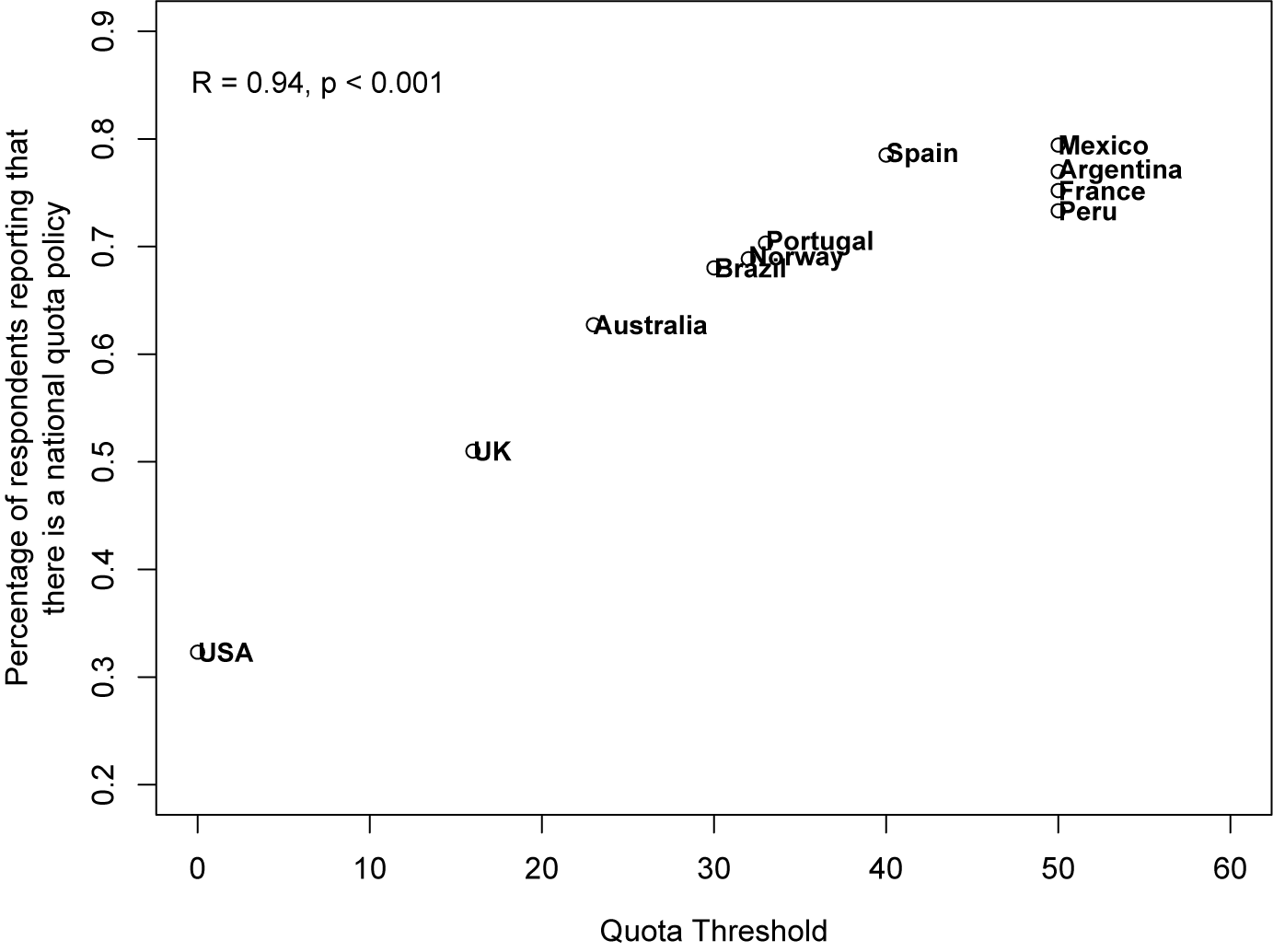
Figure 1 shows the correlation between respondents reporting that their country has any quota policy (i.e., any response option other than “no”) and the country’s actual threshold. Consistent with past research (Hinojosa and Kittilson Reference Hinojosa and Kittilson2020; Stauffer Reference Stauffer2021), respondents often fail to identify their country’s quota policy correctly. On the whole, however, respondents do know if their country, or major parties in their country, have quotas, even if they do not always correctly identify the threshold. Further, in countries with higher quota thresholds, citizens are more likely to (accurately) report that their country has a quota policy. As Figure 1 shows, this cross-national correlation is very high and statistically significant ( $ \rho $
= 0.94,
$ \rho $
= 0.94, $ p\le $
0.001). Thus, we expect that respondents will react to our survey experiment based, in part, on their preexisting knowledge of quota policies in their respective countries.
$ p\le $
0.001). Thus, we expect that respondents will react to our survey experiment based, in part, on their preexisting knowledge of quota policies in their respective countries.
The Correlation between the Percentage of Respondents in a Country Reporting That Their Country Has Some Sort of Statutory or Voluntary Quota Policy as Compared to the Country’s Actual Quota Threshold
Note: See Table SI.3.

RESULTS
We theorize that gender-balanced institutions confer legitimacy on political decisions and decision-making bodies, even when this balance is achieved via gender quotas. We now examine the aggregate effects of quota-elected and non-quota elected institutions on perceptions of substantive and procedural legitimacy when a women’s rights issue is at stake. We then turn to demonstrate that quota penalties are moderated by countries’ quota thresholds, and lastly examine whether our results hold in an alternative issue area (in our case, when women’s rights are not at stake).
Aggregate Effects on a Women’s Rights Issue
We begin by examining the results from respondents who read about a council passing a women’s rights issue: preventing sexual harassment. To test our expectations, Figure 2 plots the average substantive legitimacy scores (left panel) and procedural legitimacy scores (right panel) across the three treatment conditions in this issue area, using data from all 12 countries.
Average Substantive and Procedural Legitimacy Beliefs by Council Composition for the Issue of Sexual Harassment
Note: Scales standardized within countries. Twelve-country sample. n = 8,517 for treatments on this issue area. See also Table SI.6.

For perceptions of substantive legitimacy (left panel), respondents who read about the gender-balanced council with no mention of a quota evaluated the council’s decision 0.30 standard deviations higher than respondents who read about the same decision being made by an all-male council (difference significant at $ p\le $
0.001). Respondents who read about the gender-balanced council elected through a quota still viewed the council’s decision as more legitimate than the all-male council by 0.23 standard deviations (difference significant at
$ p\le $
0.001). Respondents who read about the gender-balanced council elected through a quota still viewed the council’s decision as more legitimate than the all-male council by 0.23 standard deviations (difference significant at $ p\le $
0.001).
$ p\le $
0.001).
The effects are even more pronounced on procedural legitimacy (right panel). Compared to the all-male council, the gender-balanced council with no mention of the quota scores 0.85 standard deviations higher (difference significant at $ p\le $
0.001) and the gender-balanced council elected through a quota scores 0.74 standard deviations higher than the all-male council (difference significant at
$ p\le $
0.001) and the gender-balanced council elected through a quota scores 0.74 standard deviations higher than the all-male council (difference significant at $ p\le $
0.001). Even more than evaluations of the decision that the council reached, the larger effects for procedural legitimacy underscore the connection respondents make between women’s presence and fair decision-making processes.
$ p\le $
0.001). Even more than evaluations of the decision that the council reached, the larger effects for procedural legitimacy underscore the connection respondents make between women’s presence and fair decision-making processes.
Our results also confirm the presence of a modest quota penalty. Respondents evaluate the quota-elected council as slightly less legitimate than when assessing a gender-balanced council with no mention of a quota policy. As shown in Figure 2 this penalty is, on average, small: 0.08 standard deviations across the 12-country sample for substantive legitimacy and 0.11 standard deviations for perceptions of procedural legitimacy (both differences significant at $ p\le $
0.01). Stated differently, the legitimacy benefits of achieving gender-balanced representation through quotas, as compared to having an all-male decision-making body, far outweigh the quota penalty.
$ p\le $
0.01). Stated differently, the legitimacy benefits of achieving gender-balanced representation through quotas, as compared to having an all-male decision-making body, far outweigh the quota penalty.
As robustness checks, we also measure treatment effects in models that include country fixed effects and respondent-level covariates. Estimates across specifications are essentially unchanged (see Tables SI.10 and SI.11). As an additional robustness check, we also examine treatment effects in a sample that excludes left-leaning respondents. This approach addresses the possibility that presenting information about the council’s gender composition and quota rule might inadvertently signal something about the ideology or partisanship of its members (see Dafoe, Zhang, and Caughey Reference Dafoe, Zhang and Caughey2018). To mitigate this concern, our design keeps the council’s decision constant (it always supports the required training). However, it is plausible that respondents observe a gender-balanced council (both with and without mention of a quota) as having more politically left-leaning members than the all-male group. In this scenario, left-leaning respondents might be responding positively to the perceived ideology of the council and not to its gender composition or quota status. As a stronger test of our theory, we remove respondents who identify as leftist (scoring a four or lower on a 10-point left / right ideology scale). Our main results hold among the remaining sample of political moderates and conservatives, although treatment effects are attenuated, as one might expect from this sample (see Tables SI.12 and SI.13). These findings suggest that our results are not driven by left-leaning respondents for whom a gender-balanced council may signal ideological or partisan alignment.
In sum, we find strong support for our expectations. Relative to all-male legislative bodies, women’s equal presence conveys substantive and procedural legitimacy, including when gender balance is attained via quotas. As expected, moreover, quota policies only moderately decrease the legitimacy-conferring effects of gender balance, and quota-elected gender-balanced bodies remain far preferred to all-male institutions.
Quota Penalties Moderated by Quota Threshold
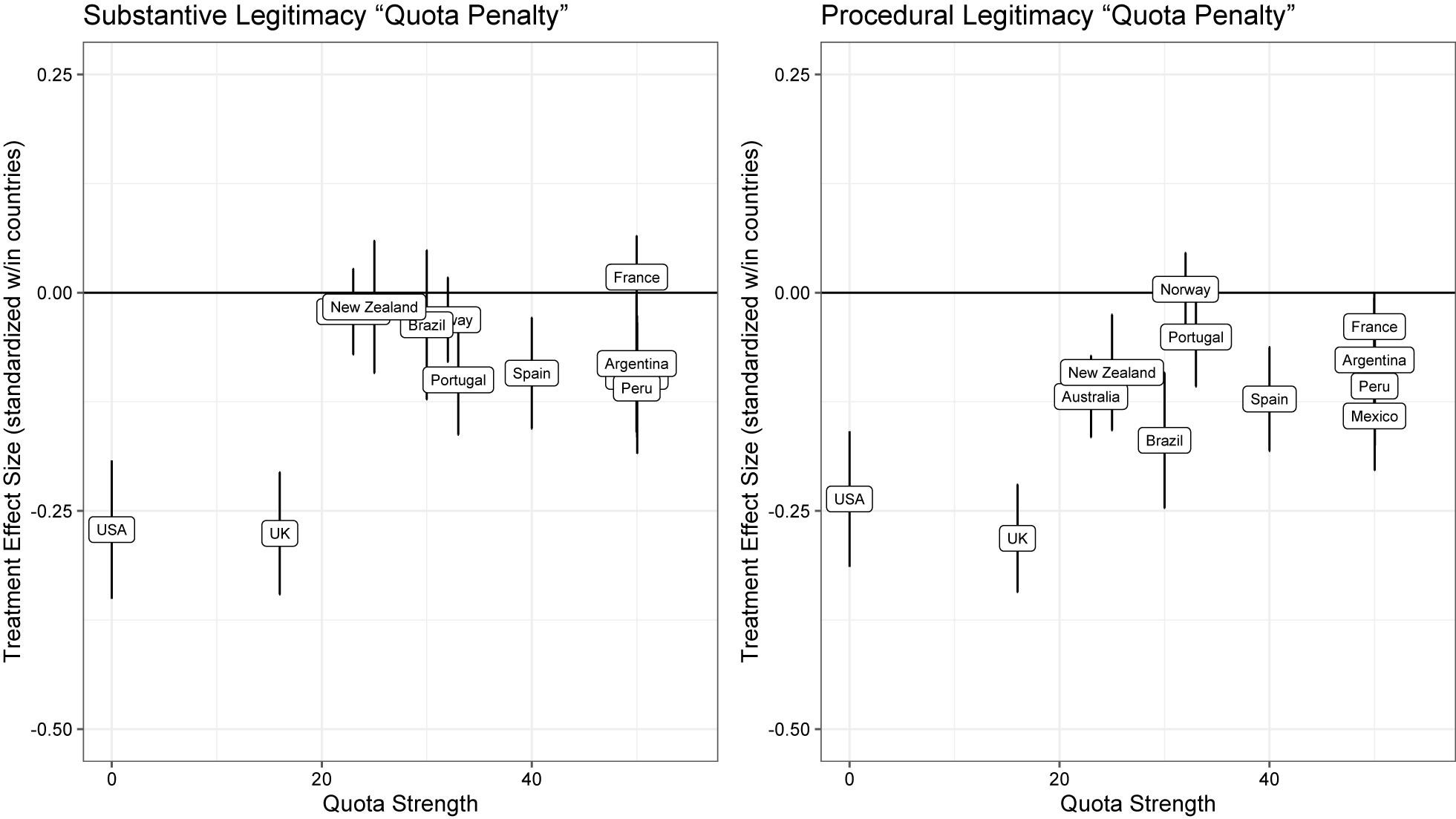
Figure 3 shows each country’s quota penalty: the difference in respondents’ average legitimacy beliefs in the gender-balanced council as compared to the gender-balanced council elected through a quota. We order these effects on the x-axis by the quota’s statutory or voluntary threshold in each case (see Table 1). In all but two instances (France for substantive legitimacy and Norway for procedural legitimacy), these effects are negative: respondents perceive the quota-elected council as having less legitimacy than the non-quota elected gender-balanced council. Consistent with our expectations, the quota penalty tends to be smaller (and is often not statistically differentiable from zero) in countries with high quota thresholds. For both substantive and procedural legitimacy, we find significant correlations between the size of the quota penalty and countries’ quota threshold (i.e., the quota penalty moves closer to zero as the quota threshold increases). For substantive legitimacy, the correlation coefficient is $ \rho $
= 0.57 (
$ \rho $
= 0.57 ( $ p= $
0.055); for procedural legitimacy, the correlation coefficient is
$ p= $
0.055); for procedural legitimacy, the correlation coefficient is $ \rho $
= 0.59 (
$ \rho $
= 0.59 ( $ p\le $
0.05). As a robustness check, we find similar cross-national correlations when we measure quota strength as the country’s threshold combined with women’s parliamentary representation (see Figure SI.1 in Section E of the Supplementary Material).
$ p\le $
0.05). As a robustness check, we find similar cross-national correlations when we measure quota strength as the country’s threshold combined with women’s parliamentary representation (see Figure SI.1 in Section E of the Supplementary Material).
The Quota Penalty for Substantive and Procedural Legitimacy for Each of the 12 Countries Sampled
Note: Countries are arranged on the x-axis by their statutory or voluntary quota threshold. n = 5,765 for two treatments (gender-balanced and quota-elected gender-balanced) on this issue area (sexual harassment). See also Table SI.7.

Two other sets of findings warrant attention from the cross-national results. First, except for the UK, citizens’ responses in countries with quotas are broadly similar in low- and high-threshold cases. For example, the quota penalty in Brazil, which has a weakly enforced 30% statutory quota, is similar to the penalties in Spain, Portugal, Argentina, and Mexico, where higher-threshold statutory quotas are better enforced. Likewise, respondents in countries like Australia and New Zealand, which rely on voluntary quotas and thus have lower thresholds, express similar preferences to respondents in countries where statutory quotas are enforced. This pattern suggests that the adoption of a quota policy—or the prevailing political culture within countries that have implemented such policies—exerts a greater influence on citizens’ perceptions than the strength of the policy per se. Even when quotas are poorly implemented, or implemented by only a subset of parties, there is often little difference in citizens’ evaluations of quota-elected councils compared to nonquota elected councils.
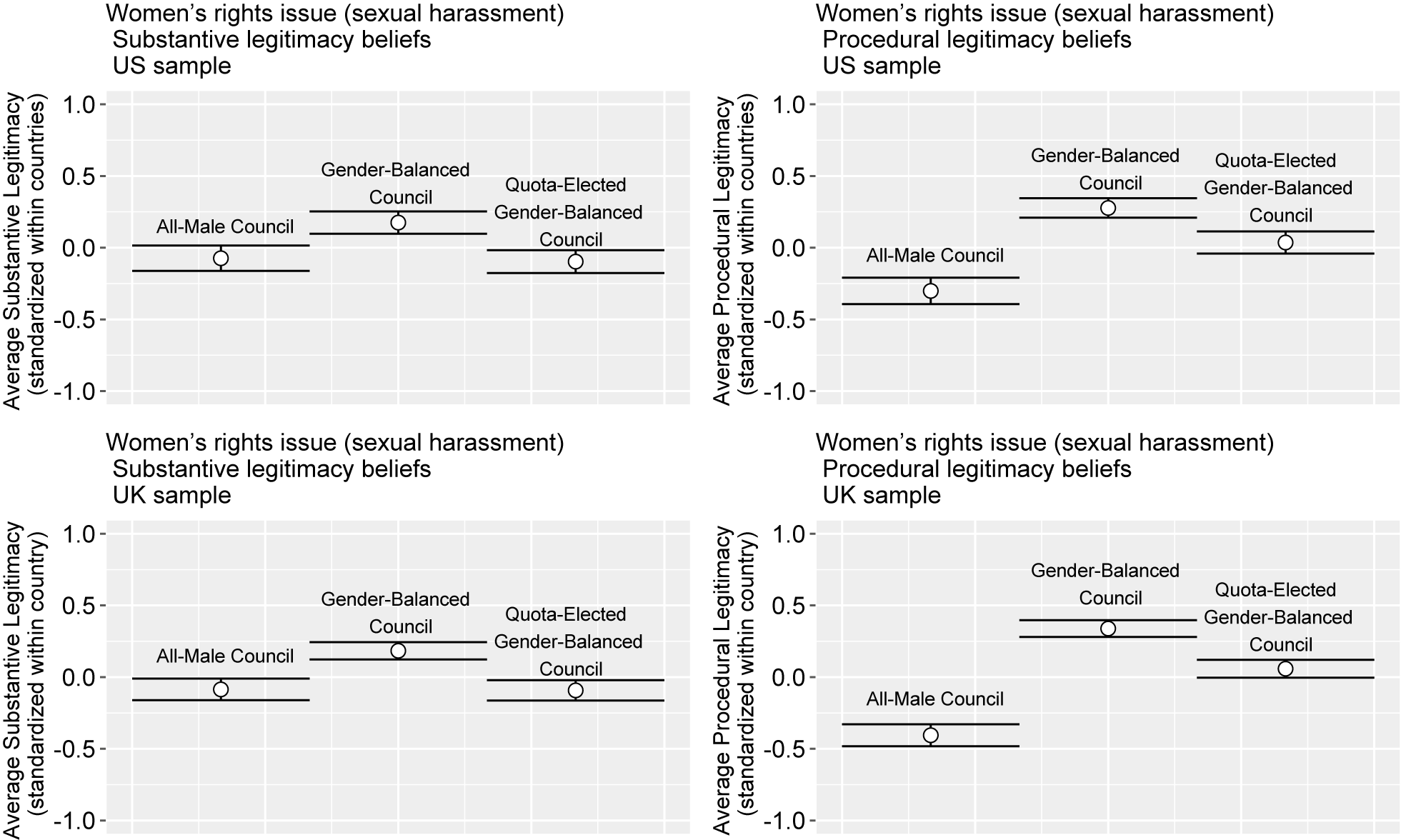
Second, the United States and the United Kingdom have much higher quota penalties than the 10 other countries in our sample. Both countries have single-member district electoral systems, have refrained from adopting quota laws mandating women’s inclusion as candidates or representatives, and do not have quotas in place at the local level. In both countries, women are significantly under-represented in the major right-wing political parties, and political conservatives oppose the use of affirmative action more generally.
Focusing on these quota resisters, Figure 4 shows the average substantive and procedural legitimacy scores for both the US (top row) and the UK (bottom row) for each of the three treatment conditions on the women’s rights issue. Both cases reveal a similar pattern. In both countries, the quota penalty is large enough that substantive legitimacy beliefs are the same in the all-male condition as in the quota-elected council condition (p = 0.79 in the US and p = 0.96 in the UK, also see Table SI.8). Yet, on procedural legitimacy, even American and British respondents view gender-equal councils elected through quotas as more legitimate than the all-male institutions ( $ p\le $
0.01 in both cases, see Table SI.8).
$ p\le $
0.01 in both cases, see Table SI.8).
Average Substantive and Procedural Legitimacy Beliefs by Council Composition for the Issue Area of Sexual Harassment, US (Top Row) and UK (Bottom Row) Samples
Note: n = 443 in for the US, and n = 632 for the UK. See also Table SI.8.

Aggregate Effects Across Issue Areas
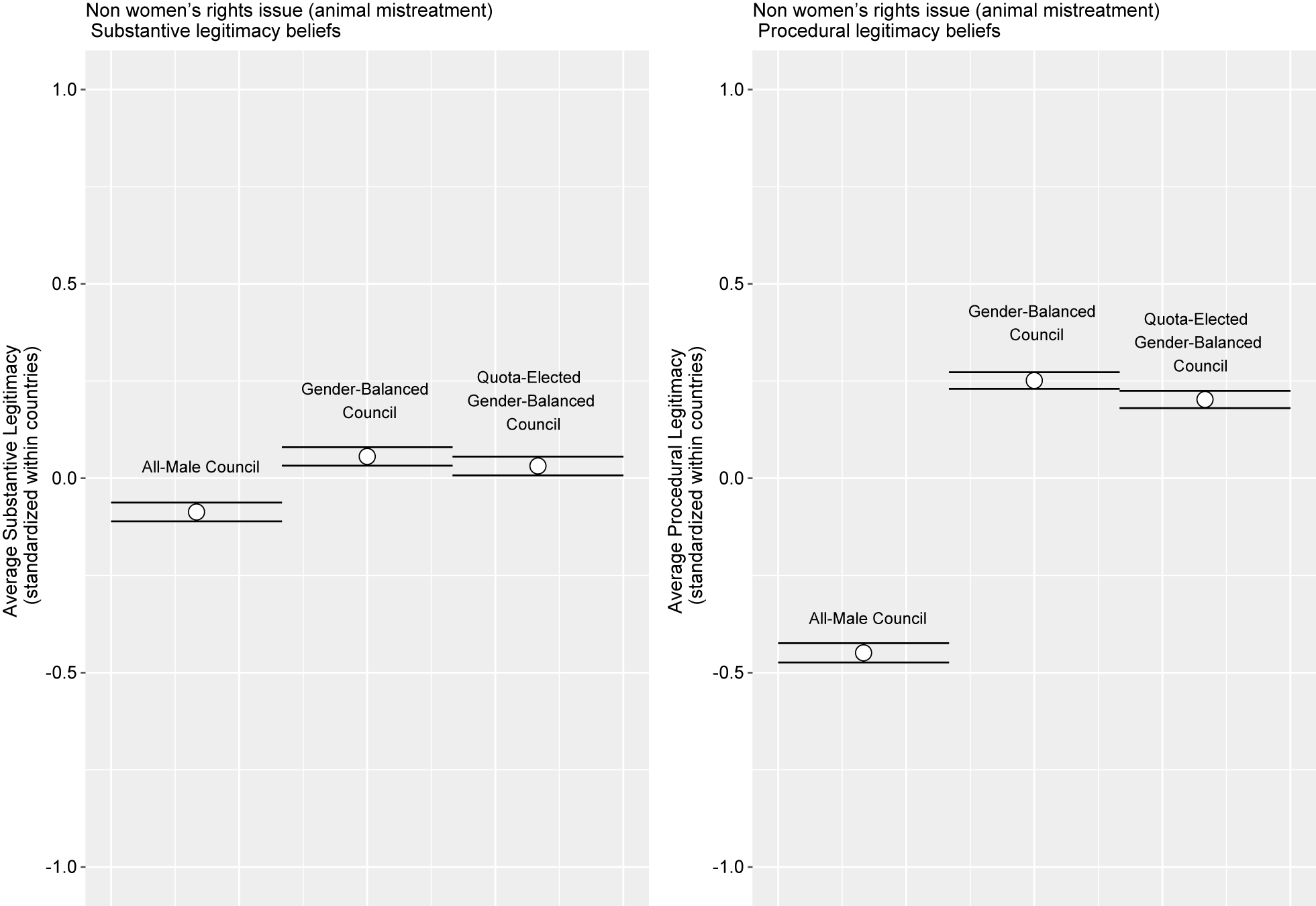
Finally, we ask whether gender balance attained via quotas also confers legitimacy when the council considers an issue that does not directly pertain to women’s rights. Figure 5 shows the averages on the substantive and procedural legitimacy scales for the issue of animal mistreatment.Footnote 19 Consistent with our expectations, the legitimacy conferring effects of gender-balanced institutions are smaller than on the issue of sexual harassment prevention, but they remain statistically significant.
Average Substantive and Procedural Legitimacy Beliefs by Council Composition for the Nominally Non-Gendered Issue (Animal Mistreatment)
Note: Scales standardized within countries. n = 4,757 for treatments on this issue area. See also Table SI.9.

For substantive legitimacy, relative to the all-male council, the gender-balanced council scores 0.14 standard deviations higher, and the quota-elected council scores 0.12 standard deviations higher. These effect sizes, while all statistically significant ( $ p\le $
0.01), are about half of the magnitude of what we found in Figure 2 on the women’s rights issue. When examining the quota penalty, we also find that it is less than half the magnitude that we observed on the women’s rights issue (0.03 v. 0.08 standard deviations). We find this notable, as it suggests that backlash to quotas might be particularly pronounced on the issue of women’s rights (see, e.g., Brulé Reference Brulé2020).
$ p\le $
0.01), are about half of the magnitude of what we found in Figure 2 on the women’s rights issue. When examining the quota penalty, we also find that it is less than half the magnitude that we observed on the women’s rights issue (0.03 v. 0.08 standard deviations). We find this notable, as it suggests that backlash to quotas might be particularly pronounced on the issue of women’s rights (see, e.g., Brulé Reference Brulé2020).
For procedural legitimacy, we also see differences across issue areas, although they are smaller: relative to the all-male council, the gender-balanced council scores 0.70 standard deviations higher and the quota-elected council scores 0.65 standard deviations higher (both significant at $ p\le $
0.01). These effect sizes are also smaller than those on the women’s rights issue, although less so than for substantive legitimacy (0.85 and 0.74 standard deviations, respectively). The quota penalty is also smaller here than on the women’s rights issue (0.05 standard deviations v. 0.11 standard deviations). In sum, these patterns make clear: even on an issue unrelated to women’s lived experiences, citizens across democracies prefer women’s inclusion, with quotas or without, to all-male institutions.
$ p\le $
0.01). These effect sizes are also smaller than those on the women’s rights issue, although less so than for substantive legitimacy (0.85 and 0.74 standard deviations, respectively). The quota penalty is also smaller here than on the women’s rights issue (0.05 standard deviations v. 0.11 standard deviations). In sum, these patterns make clear: even on an issue unrelated to women’s lived experiences, citizens across democracies prefer women’s inclusion, with quotas or without, to all-male institutions.
QUOTA RESISTERS, SCOPE CONDITIONS, AND DIRECTIONS FOR FUTURE WORK
We show that respondents in Anglophone, European, and Latin American democracies perceive political decision-making processes and outcomes as more fair when institutions are gender-balanced. The effects are most pronounced for measures of procedural legitimacy and in contexts where women’s rights are at stake, but they also extend to substantive legitimacy and issues unrelated to women’s rights. Notably, the legitimacy-enhancing effects of gender balance persist even when achieved through gender quotas. Respondents consistently prefer gender-balanced institutions over all-male ones, even when this balance is a product of institutional design.
Our findings are likely generalizable to democracies beyond our sample, particularly given that most countries worldwide implement statutory or voluntary gender quotas (Hughes et al. Reference Hughes, Paxton, Clayton and Zetterberg2019). However, important nuances emerge in specific contexts, particularly in two of our cases. Below we discuss resistance to gender quotas in the United States and Britain, as well as the contextual factors shaping the generalizability of our results.
Resistance in the United States and the United Kingdom
Despite the broad, legitimacy-conferring effects of gender-balanced institutions relative to all-male bodies, we observe particular resistance to gender quotas in the United States and the United Kingdom. What should observers and researchers make of these results, particularly those invested in increasing women’s representation in these countries? On the one hand, even American and British respondents prefer women’s presence to their absence when evaluating procedural legitimacy, especially when women’s rights are at stake. On the other hand, respondents in these two cases remain skeptical of quota policies. Neither country has statutory quotas, perhaps because their political cultures remain especially opposed and/or because voters and elites alike perceive quotas as incompatible with their electoral systems, which use plurality rules to elect representatives from single-member districts in a single round.Footnote 20
This cultural and institutional resistance helps explain why American and British respondents exhibit greater skepticism toward quota-elected bodies and suggests that this bias might persist even if statutory quotas were introduced. However, in many of the other countries in our sample, voters and elites expressed an initial hostility toward gender quotas (Bruhn Reference Bruhn2003; Lépinard Reference Lépinard2016), but now view gender-balanced institutions elected with quotas as no (or minimally) less legitimate than gender-balanced institutions elected without them. This minimal penalty holds in cases like Mexico and France, where the statutory quota applies to the lower chamber’s single-member districts. American and British respondents could then, in theory, become accustomed to quotas over time.
Scope Conditions
Our findings are likely generalizable to democracies beyond our sample. Our dataset encompasses respondents from 12 countries across diverse regions, capturing a range of democratic trajectories and political systems. Nonetheless, elements such as quota effectiveness, time since quota implementation, quota policies’ wording, and the distinctions between democratic and authoritarian contexts constitute important scope conditions relative to our findings.
Quota Efficacy
Our study focuses on highly effective quota policies. We compare a parity quota applied to the fullest extent to women’s total exclusion. In practice, quotas do sometimes lead to dramatic increases in women’s presence in legislatures, increasing their representation by 20 percentage points or more (e.g., in Namibia, South Africa, Senegal, and Kyrgyzstan) (see Clayton and Zetterberg Reference Clayton and Zetterberg2018, 921). However, quotas can also produce more modest results. For example, when France first implemented its parity quota, women’s representation increased by only 2 percentage points. Looking across countries, Clayton and Zetterberg (Reference Clayton and Zetterberg2018) find that, on average, quotas double women’s descriptive representation in national parliaments following their first implementation.
We leave open to future work how citizens perceive quota-elected bodies when quotas are less effective at increasing women’s representation or are applied when women’s representation is already at some meaningful threshold. Still, our results show that citizens are not averse to sizable “quota shocks.” This suggests that when implementing a quota policy, adopting a well-enforced parity law may be better than a partial or weak measure. Indeed, citizens may be skeptical of quotas that result in limited gains in women’s inclusion. For example, in Clayton, O’Brien, and Piscopo (Reference Clayton, O’Brien and Piscopo2019), we found that in the United States, the legitimacy-enhancing effects of women’s presence were absent when the political body included just one woman. The addition of token women representatives—whether elected via quotas or not—appears unlikely to significantly improve public perceptions of legitimacy and may even undermine them.
Critically, all-male groups are often viewed as undemocratic due to their perceived deficits in representation. To foster democratic benefits, alternatives to all-male groups must visibly and meaningfully signal women’s political inclusion, and gender balance is the clearest such signal. Gender quotas are crucial to achieving gender balance, even when they fall short of reaching full parity. Future research should explore the thresholds at which these legitimacy effects emerge and how these thresholds might vary across different political and cultural contexts.
Time Since Implementation
In our 11 quota-adopting cases, the quota existed for some time prior to fieldwork. 8 of the 11 countries adopted quotas before 2000, and in all 11 cases, the country’s quota policies had been implemented for at least four election cycles. Except for the United States, we surveyed respondents exposed to quotas for at least 13 years (Spain) and up to 50 years (Norway).
This exposure time presents a potentially important scope condition for our work. Our results might differ for citizens in countries with more recently adopted quotas. Quotas are sometimes met with initial backlash that dissipates over time as citizens become used to the idea that inclusion achieved through quotas is part of the democratic process. Indeed, quota thresholds often increase as elites and citizens increasingly tolerate quotas (Hughes et al. Reference Hughes, Paxton, Clayton and Zetterberg2019). An extension of our work, which we cannot address with our current sample, could examine whether legitimacy-conferring effects hold for more recent quota adopters.
Policy Wording
Our experiment mirrors the language of quota laws, which do not typically use the word “quota.” Instead, we use the word “rule” (i.e., “a new rule that requires all parties to run equal numbers of male and female candidates”). While this approach follows how actual statutes and policies are written, the negative connotation of “quota” could mean that respondents reacted less strongly to our treatment than if we had used this term. Future work could explore whether explicitly referencing “quotas” leads to different results. Previous work suggests that while “quota” may serve as a useful shorthand for scholars and activists, quota advocates may wish to eschew this language in broader discourse. Indeed, using the term “quota” may underestimate the level of public support for the policy (Coffé, Saha, and Weeks Reference Coffé, Saha and Weeks2023; Gidengil Reference Gidengil1996; Verge and Tormos Reference Verge and Tormos2023).Footnote 21
Authoritarian Regimes
Finally, quotas may not confer democratic legitimacy in autocracies. Given how the stigma of being “quota elected” attaches especially to women representatives, autocracies’ introduction of gender quotas may lead citizens to view women as agents of the regime. Indeed, Kim and Fallon (Reference Kim and Fallon2023) document backlash to robust reserved seat policies, a quota type commonly used by autocratic regimes. Even if quotas do confer legitimacy, this result could reflect a troubling phenomenon wherein savvy autocrats introduce gender-balanced decision-making institutions to distract from their other misdeeds (Valdini Reference Valdini2019). Evidence suggests that this strategy can pay off, as gender quotas improve authoritarian states’ international reputations for democracy (Bjarnegård and Zetterberg Reference Bjarnegård and Zetterberg2022; Bush and Zetterberg Reference Bush and Zetterberg2021; Bush, Donno, and Zetterberg Reference Bush, Donno and Zetterberg2024; Tripp Reference Tripp2019). Using gender quotas to add women to decision-making bodies might diminish regime critics’ ability to denounce authoritarian governments’ abuse of human rights, including women’s rights. Whether our results generalize to non-democratic regimes thus remains an open question and an important direction for future research.
CONCLUSION
Gender quotas, whether adopted by political parties or in statutes and constitutions, exist in more than 130 countries. They are the most popular electoral reform of the late twentieth and early twenty-first centuries, adopted in response to normative and empirical arguments that men’s political over-representation produces democratic deficits (Bjarnegård and Murray Reference Bjarnegård and Murray2018; Clayton, O’Brien, and Piscopo Reference Clayton, O’Brien and Piscopo2023; Reference Clayton, O’Brien and Piscopo2024; Mansbridge Reference Mansbridge1999; Murray Reference Murray2014). Yet detractors worry that applying gender quotas carries costs, in that a quota stigma may attach to the women representatives presumed to benefit from these policies and ultimately to the quota-elected institutions themselves. A quota penalty may thus erode—rather than enhance—democratic legitimacy. Our research directly addresses these concerns by illustrating that, on average, the legitimizing impact of women’s and men’s equal presence endures even when gender-balanced institutions are achieved through quotas. Respondents consistently favor gender balance over an alternative all-male decision-making body, even when equality is achieved by institutional design.
These findings make important contributions to the scholarship on the broader effects of women’s descriptive representation. First, we demonstrate that the legitimacy-conferring effects of women’s presence are neither isolated to the United States nor contingent on countries’ particular histories of women’s political inclusion. In our US-based study, we concluded that our finding linking women’s representation to democratic legitimacy “raises clear questions as to whether [this relationship] varies in countries that have experienced different levels of—and debates around—women’s descriptive representation” (Clayton, O’Brien, and Piscopo Reference Clayton, O’Brien and Piscopo2019, 128). Our work helps answer these questions. We show that across democracies in different world regions, despite varied trajectories of democratization and different national political institutions, women’s equal presence confers democratic legitimacy to decisions and decision-making procedures. Further, these effects persist in countries with fewer women in office relative to the US (e.g., Brazil), a similar number compared to the US (e.g., the UK), or more relative to the US (e.g., Mexico). Respondents in countries with varied levels of women’s descriptive representation view gender-balanced decision-making bodies as more legitimate.
Second, our work does more than replicate the relationship between women’s equal presence and democratic legitimacy across 12 cases. We extend the analysis by considering whether attaining gender balance via electoral gender quotas matters for perceptions of democratic legitimacy. As the most significant electoral reform of the past half century, quotas have played a pivotal role—likely the most significant role—in changing the gendered composition of the world’s national and sub-national legislatures (Hughes et al. Reference Hughes, Paxton, Clayton and Zetterberg2019; Krook, Lovenduski, and Squires Reference Krook, Lovenduski and Squires2009; Paxton and Hughes Reference Paxton and Hughes2015; Schwindt-Bayer Reference Schwindt-Bayer2009; Tripp and Kang Reference Tripp and Kang2008). Where adopted, gender quota policies have not eroded democratic legitimacy, as critics feared. Rather, our findings mirror what often plays out in the real world: in countries that have implemented gender quotas, more gender-balanced institutions foster democratic legitimacy, irrespective of women’s pathways to power.
Of course, neither gender quota adoption nor gender-balanced decision-making institutions are panaceas for democratic deficits. Though citizens prefer women’s political inclusion, including via quota policies, this preference does not negate the challenges faced by women who enter office following quota implementation. Though these policies apply to all legislators, men’s persistent over-representation often leads elites and voters alike to perceive women as the ones benefiting from gender quotas. In addition to navigating individual label effects, women representatives may face collective backlash as they make inroads in traditionally male-dominated arenas (Brulé Reference Brulé2020; Erikson and Josefsson Reference Erikson and Josefsson2019; Kim and Kweon Reference Kim and Kweon2022; Liu Reference Liu2018). Women in both quota-elected and non-quota elected institutions can benefit from broader efforts to change political cultures to be more accepting of women’s presence and contributions (Erikson and Josefsson Reference Erikson and Josefsson2019; Lovenduski Reference Lovenduski2005).
Our study makes an important intervention into the literature on representation, gender quotas, and democratic legitimacy. Our results speak directly to anti-quota arguments that focus on quotas’ alleged delegitimizing effects on elected women and the legislatures they will enter. Contrary to some arguments, the choice is not between decision-making bodies composed of women who can make it on their own versus institutions composed of women benefiting from affirmative action. Rather, given the direct link between adopting and implementing gender quotas and rapidly increasing women’s descriptive representation (Schwindt-Bayer Reference Schwindt-Bayer2009; Tripp and Kang Reference Tripp and Kang2008), the choice is between women’s inclusion via quotas or the continued persistence of male-dominated political bodies. Inclusion matters for legitimacy, and where quotas offer a fast track to inclusion (Dahlerup and Freidenvall Reference Dahlerup and Freidenvall2005), they also bolster citizens’ perceptions that democratic institutions are operating fairly and justly.
SUPPLEMENTARY MATERIAL
To view supplementary material for this article, please visit https://doi.org/10.1017/S0003055425000176.
DATA AVAILABILITY STATEMENT
Research documentation and data that support the findings of this study are openly available at the American Political Science Review Dataverse: https://doi.org/10.7910/DVN/AO4PX0.
ACKNOWLEDEGMENTS
This paper benefited from the feedback we received during presentations at the Royal Holloway University of London, University of Reading, University College London, Kings College London, Australia National University, Washington University in St. Louis, the University of Pittsburgh, University of Houston, Universidad Carlos III de Madrid, Princeton University, Oxford University, the 2021 APSA Annual Meeting, and the 2024 European Conference on Politics and Gender. We are grateful to Rachel Brulé, Soledad Artiz Prillaman, Øyvind Skorge, Jennifer Curtin, and Giulia Venturini, and the reviewers and editors for feedback.
FUNDING STATEMENT
This research was funded by the National Science Foundation (NSF SES-1851457, NSF SES-2215500, and NSF SES-2149224).
CONFLICT OF INTEREST
The authors declare no ethical issues or conflicts of interest in this research.
ETHICAL STANDARDS
The authors declare the human subjects research in this article was reviewed and approved by Occidental College (SP20-009-PISC), Rice University (IRB-FY2021-23), and Vanderbilt University (# 200929). The authors affirm that this article adheres to the principles concerning research with human participants laid out in APSA’s Principles and Guidance on Human Subject Research (2020).



 Open access


Comments
No Comments have been published for this article.