

Hostname: page-component-89b8bd64d-sd5qd Total loading time: 0 Render date: 2026-05-09T07:31:19.426Z Has data issue: false hasContentIssue false

A shear and elongational decomposition approach of the rate-of-deformation tensor for non-Newtonian flows with mixed kinematics

Published online by Cambridge University Press:  10 December 2024

Paulo J. Oliveira*
Affiliation:
Departamento de Engenharia Electromecânica, C-MAST, Universidade da Beira Interior, 6201-001 Covilhã, Portugal
*
Email address for correspondence: pjpo@ubi.pt

Abstract

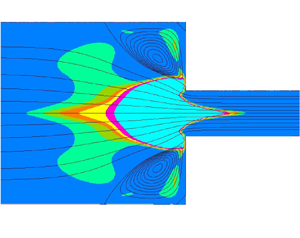
We propose a novel approach for non-Newtonian viscoelastic steady flows based on a decomposition of the rate-of-deformation tensor which here, in a simplified version, leads to an anisotropic generalised Newtonian fluid-like model with separated treatment of kinematics pertaining to shear and extensional flows. Care is taken to assure that the approach is objective and does not introduce spurious effects due to dependence on a specific reference frame. This is done by separating the rate-of-deformation tensor into shear and elongational components, with the local scalar shear and elongation rates being the second invariant of each tensor separately, and by modifying the method used to separate the rate-of-deformation tensor so that it becomes independent of superimposed rigid rotations, thus satisfying the principle of material indifference. We assess the model with two test cases: planar contraction flow, often employed to evaluate numerical methods or constitutive equations and for which experimentally observed corner vortex enhancement and pressure drop increase are seldom found in numerical simulations; and flow past confined or unconfined cylinders, for which experiments indicate a drag increase due to elasticity and most predictions give a drag decrease. With our anisotropic model, incorporating additional elongational-flow-related terms, large vortices and accentuated pressure drop coefficients can be predicted for the contraction problem and enhanced drag coefficient for the cylinder problems. This is the first work where problems of non-Newtonian fluid mechanics are solved numerically with separation of strain rate into shear and elongational components.

Information

Type
JFM Papers
Copyright
© The Author(s), 2024. Published by Cambridge University Press

Access options

Get access to the full version of this content by using one of the access options below. (Log in options will check for institutional or personal access. Content may require purchase if you do not have access.)

Article purchase

Temporarily unavailable