


Introduction
The ageing population faces several challenges related to economic, environmental and social aspects of sustainability (Komp-Leukkunen and Sarasma Reference Komp-Leukkunen and Sarasma2024; Mavrodaris et al. Reference Mavrodaris, Mattocks and Brayne2021; Pillemer et al. Reference Pillemer, Wells, Wagenet, Meador and Parise2011). Despite countries having different health and welfare systems, there are comparable policies dedicated to supporting older adults to age at home as long as possible as opposed to moving to institutional care (World Health Organization 2018). This policy direction often includes a focus on ‘ageing in place’, which is a public health policy that aligns the desire of most people to age and have health-care services provided in their own homes (Pani-Harreman et al. Reference Pani-Harreman, Bours, Zander, Kempen and van Duren2021). Horner and Boldy (Reference Horner and Boldy2008) define ‘ageing in place’ as the extent to which the needs of older persons are met, supporting them to live independently, or with some assistance, for as long as possible. The core of this definition is that support should be provided to meet the needs of older people to live in their own home and community safely, independently and comfortably, regardless of age, income or ability level, for as long as possible without moving to a long-term care facility (Grimmer et al. Reference Grimmer, Kay, Foot and Pastakia2015).
It is critical to note that, regardless of the definition of ageing in place, little is known about the everyday experiences or social needs of older adults in different environmental circumstances (Grove Reference Grove2021). The policy on ageing in place tends to focus on the housing environment and does not consider the need for interactions beyond the housing environment. Previous studies challenge the utopian view of ageing in place by highlighting barriers to person–environmental interaction and the changing dynamic of places (Chaudhury and Oswald Reference Chaudhury and Oswald2019; Gardner Reference Gardner2011; Lewis and Buffel Reference Lewis and Buffel2020). Also, such policy often falsely assumes that a healthy family structure is available for support or that familiar public spaces are accessible for all inhabitants (D’herde et al. Reference D’herde, Gruijthuijsen, Vanneste, Draulans and Heynen2021; Golant Reference Golant2017; Lewis and Buffel Reference Lewis and Buffel2020; Severinsen et al. Reference Severinsen, Breheny and Stephens2016; Sixsmith et al. Reference Sixsmith, Fang, Woolrych, Canham, Battersby and Sixsmith2017). But, without the right environmental conditions, ageing in place can be a lonely experience for some older adults, which has been identified as a risk for overall health and wellbeing (Courtin and Knapp Reference Courtin and Knapp2017; Leigh-Hunt et al. Reference Leigh-Hunt, Bagguley, Bash, Turner, Turnbull, Valtorta and Caan2017).
There are a number of interventions in place to reduce loneliness and health risks associated with social isolation for older adults (Barnes et al. Reference Barnes, MacLeod, Tkatch, Ahuja, Albright, Schaeffer and Yeh2022; Dahlberg et al. Reference Dahlberg, McKee, Frank and Naseer2022; Donovan and Blazer Reference Donovan and Blazer2020; Fakoya et al. Reference Fakoya, McCorry and Donnelly2020; Rudnicka et al. Reference Rudnicka, Napierała, Podfigurna, Męczekalski, Smolarczyk and Grymowicz2020; Victor and Pikhartova Reference Victor and Pikhartova2020), including an increasing interest in the role of technology to reduce social isolation and increase social participation (Baker et al. Reference Baker, Warburton, Waycott, Batchelor, Hoang, Dow, Ozanne and Vetere2018). However, there is a need for more knowledge on how to create built environments that support social interaction, wellbeing and quality of life (Lami and Mecca Reference Lami and Mecca2020). According to Kohon (Reference Kohon2018), the way we design and build environments has moved us away from a socially integrated and inclusive society. For instance, environmental features surrounding the home can support the mobility, social health and wellbeing of older adults with varying needs (Kerr et al. Reference Kerr, Rosenberg and Frank2012; Ottoni et al. Reference Ottoni, Sims-Gould, Winters, Heijnen and McKay2016; Sturge et al. Reference Sturge, Klaassens, Lager, Weitkamp, Vegter and Meijering2021a), while poor quality and suitability of housing environments can cause older adults to be homebound (Lee et al. Reference Lee, Suh and Kim2022; Wang and Durst Reference Wang and Durst2023). Although other reviews have focused on how the built environment can support loneliness (Bower et al. Reference Bower, Kent, Patulny, Green, McGrath, Teesson, Jamalishahni, Sandison and Rugel2023), there has yet to be a focus on how features of an environment can support the social integration and participation of older adults ageing in place. In the context of older adults ageing in place, we understand the environment on two levels. First, we identify the built environment as human-made infrastructure including buildings, building stock, neighbourhoods, cities and regions (Hassler and Kohler Reference Hassler and Kohler2014). Second, we define the social environment as social structures and interpersonal relationships within and beyond the home environment (Hayward et al. Reference Hayward, Ibe, Young, Potti, Jones, Pollack and Gudzune2015). Together, these environments can promote health and provide locations for activities for independence, social connection, feelings of self-worth, and physical and emotional wellbeing for older adults (Barnett et al. Reference Barnett, Zhang, Johnston and Cerin2018; Mazumdar et al. Reference Mazumdar, Learnihan, Cochrane and Davey2018; Molinsky and Forsyth Reference Molinsky and Forsyth2018).
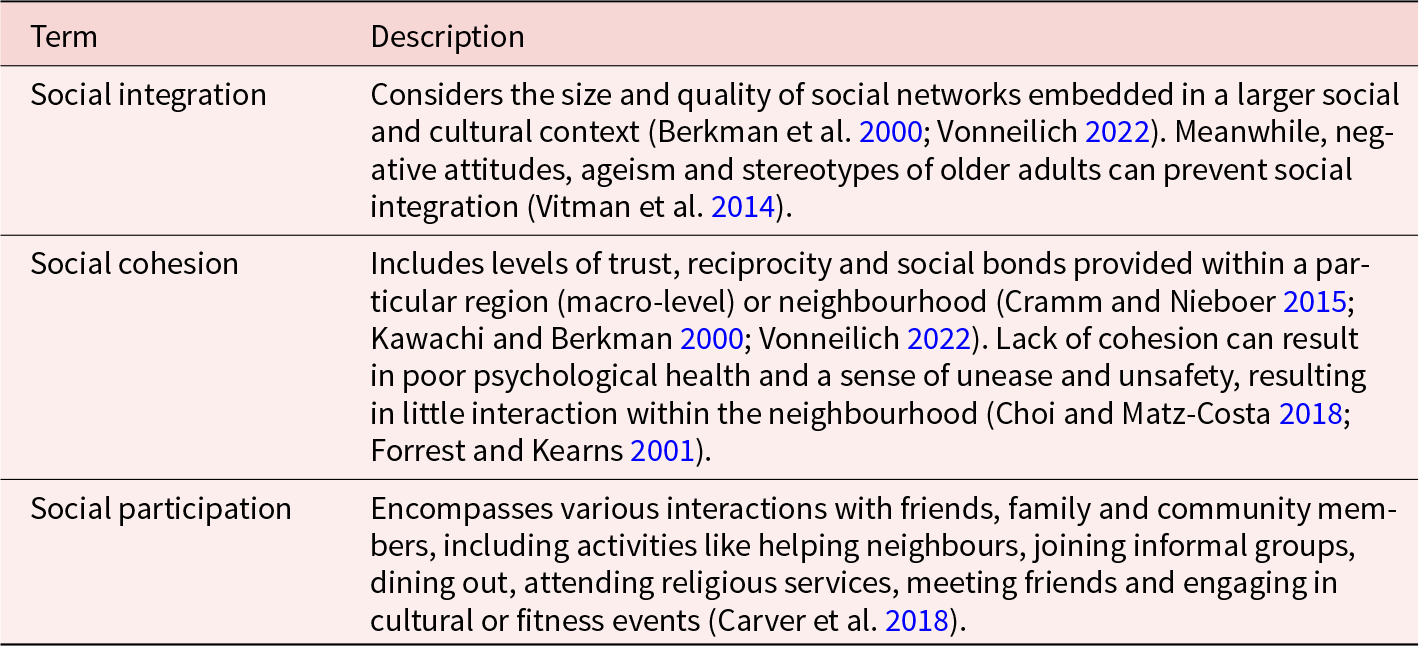
A promising way to design environments for older adults is to focus on the social aspects of environments which facilitate socially resilient and sustainable societies (Eizenberg and Jabareen Reference Eizenberg and Jabareen2017). To achieve this, Hu (Reference Hu2021) suggests a need for a social sustainability discourse related to the housing environments of the ageing population. The concept of social sustainability relates to an environment where individuals satisfy their social needs while allowing future generations to do the same (United Nations 1987). Unlike the other domains of sustainability (i.e. economic and ecological sustainability), social sustainability is not consistently defined or commonly reflected in government policies (Dempsey et al. Reference Dempsey, Bramley, Power and Brown2011; Santosa et al. Reference Santosa, Ng, Zetterberg and Eriksson2020; Shirazi and Keivani Reference Shirazi and Keivani2017). Ghahramanpouri et al. (Reference Ghahramanpouri, Lamit and Sedaghatnia2013) suggest that social equity, the satisfaction of the human need, wellbeing, quality of life, social interaction, cohesion and inclusion, sense of community and sense of place are all contributing factors in defining and conceptualizing social sustainability. Komp-Leukkunen and Sarasma (Reference Komp-Leukkunen and Sarasma2024: 1) have linked the concept of social sustainability to ageing populations by stating a need for a ‘fabric of society’ that enhances social integration, cohesion and participation of current ageing populations and future generations. For this review, we have defined social integration, cohesion and participation in Table 1.
Descriptions of terms related to the concept of social sustainability
To contribute to the discussion related to ageing in place and social sustainability, this review provides an overview based on existing literature on the features of the housing and surrounding environments that support the social sustainability of older adults’ ageing in place.
Design and method
This scoping review is based on the framework outlined by Arksey and O’Malley (Reference Arksey and O’Malley2005) and subsequent studies (Heyn et al. Reference Heyn, Meeks and Pruchno2019; Peters et al. Reference Peters, Godfrey, McInerney, Khalil, Larsen, Marnie, Pollock, Tricco and Munn2022; Pollock et al. Reference Pollock, Davies, Peters, Tricco, Alexander, McInerney, Godfrey, Khalil and Munn2021). The original framework includes the following five stages: (1) identifying the research question; (2) identifying relevant articles; (3) selecting articles; (4) charting the data; (5) collating, summarizing and reporting the results. The study selection process follows the Preferred Reporting Items for Systematic reviews and Meta-Analysis extension for Scoping Reviews (PRISMA-ScR) (Tricco et al. Reference Tricco, Lillie, Zarin, O’Brien, Colquhoun, Levac, Moher, Peters, Horsley, Weeks, Hempel, Akl, Chang, McGowan, Stewart, Hartling, Aldcroft, Wilson, Garritty, Lewin, Godfrey, Macdonald, Langlois, Soares-Weiser, Moriarty, Clifford, Tunçalp and Straus2018) (Appendix A). The review is registered through the Open Science Framework repository (https://osf.io/pr2nc) and is part of a larger research project (Sturge et al. Reference Sturge, Miedema, Elf and Nordin2023).
Identifying the research question and relevant articles
The research question, keywords and search terms were developed in consultation with a specialist librarian (AL) and researchers with expertise in housing, older adults, health care, design and architecture. The research question that guided this review was ‘Which characteristics of housing and surrounding environments support the social sustainability and participation of older adults ageing in place?’.
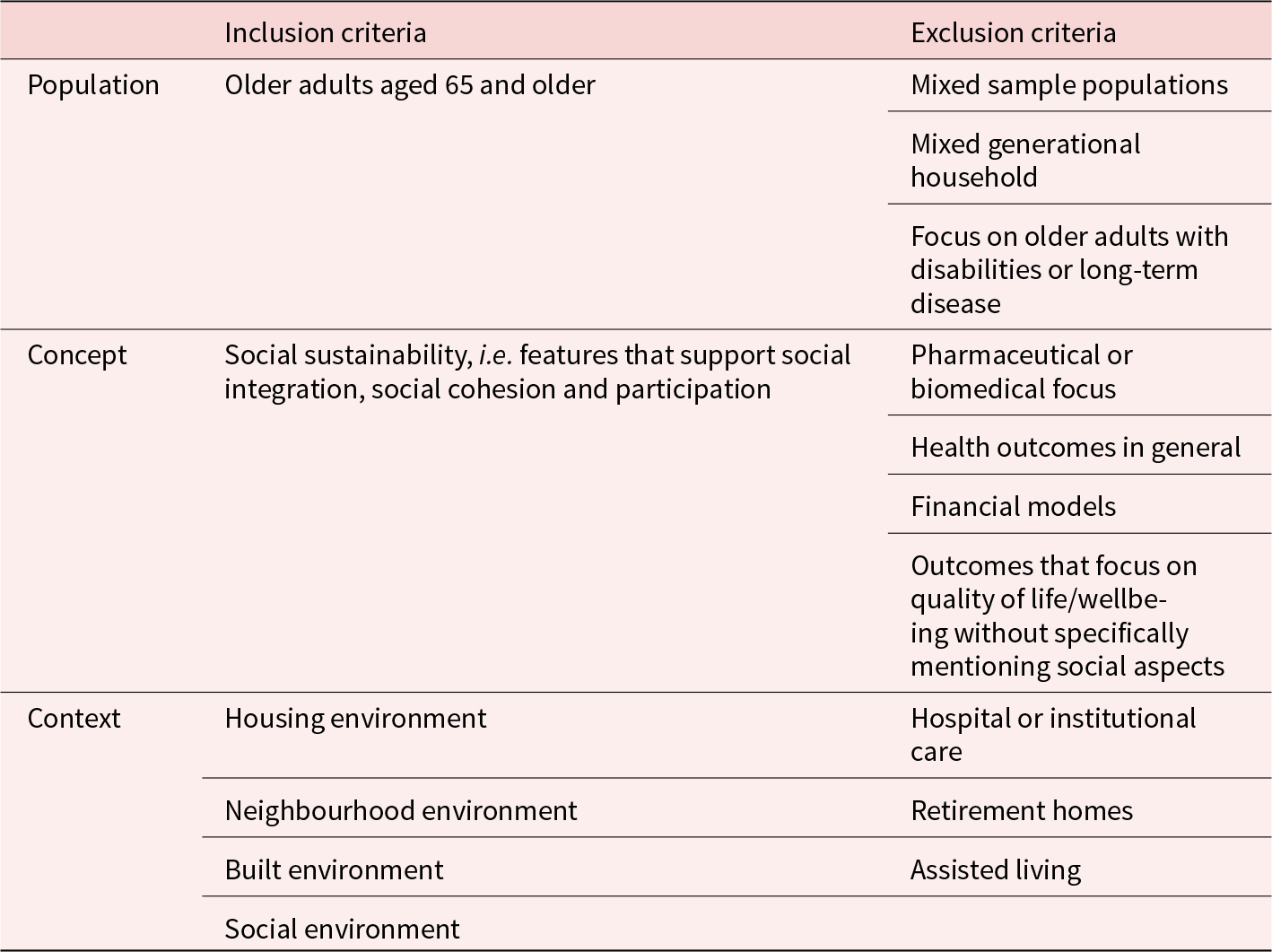
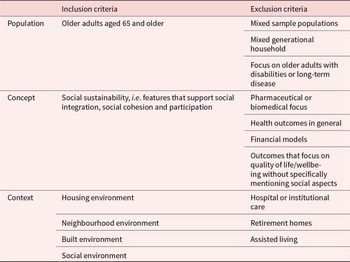
The inclusion and exclusion criteria for the selected articles were based on the population, concept and context (PCC) framework (Peters et al. Reference Peters, Godfrey, Khalil, McInerney, Parker and Soares2015). Broadly, articles were included if they mentioned or included people aged 65 years or older (population), described elements of social sustainability including social integration, social cohesion or social participation (concept) and related to the built housing or social environment (context) (Table 2). Furthermore, articles were included only if published in English between January 2008 and February 2023 without restricting the study location or country. The 15-year time frame was determined based on discussions within the research team who identified the Horner and Boldy (Reference Horner and Boldy2008) ageing-in-place definition as a starting point for investigation. Peer-reviewed articles were included if they were based on empirical qualitative, quantitative and mixed-methods data. The search results were evaluated both through checking the found references for key articles and by manual scanning. Initially, the search strategy was constructed in Medline and then translated to the other databases (see Appendix B). The following bibliographic databases were searched: Medline (Ovid), CINAHL (Ebsco), Scopus and Embase (Elsevier). All database searches were performed by AL (anonymized for peer review). In addition, the search strategies were peer-reviewed by another librarian in accordance with the Peer Review of Electronic Search Strategies (PRESS) 2015 Guideline Evidence-Based Checklist (McGowan et al. 2016).
PCC inclusion and exclusion criteria
Article selection
The search results were downloaded to EndNote and duplicates were removed according to the de-duplication method of Bramer et al. (Reference Bramer, Giustini, de Jonge, Holland and Bekhuis2016). The initial selection based on the eligibility criteria was conducted by the first author (JS). Irrelevant papers were removed based on title, keywords,and abstract, including keywords associated with a different target population (e.g. children and older adults with diseases such as cancer, Alzheimer’s, diabetes, stroke and Parkinson’s). Also, papers were excluded if they mentioned health-care-related outcomes or life circumstances (e.g. fall prevention, homelessness). Grey literature, literature reviews, editorials, conference proceedings and research protocols were excluded. The remaining records (n = 7,550) in the EndNote 20 library were then exported into the Covidence systematic review application (www.covidence.org).
Screening and extracting data
Three reviewers (JS, EM, SN) blindly reviewed the titles, abstracts and full texts in Covidence. This software allowed for a simultaneous review by all reviewers, while keeping track of progress, conflicts and inclusion in the different stages in one place. Moreover, this guaranteed that a minimum of two reviewers assessed each record in each stage. In case of doubt or disagreement, records were further discussed and resolved by all reviewers. The first round focused on title and abstract screening, while the second stage focused on full text reviewing. After the first full-text review in Covidence, the included papers were exported to an Excel-sheet noting (ID number), authors, article title, publication year, journal, doi and abstract. A second round of full-text review allowed for further assessment and initial data extraction based on author, country of study, methodology, participant samples and study findings. This step resulted in a final list of 19 articles for which additional data were extracted (Figure 1).
Search Strategy Flow Chart.

Summarizing and reporting the results
The characteristics of the articles and their findings were summarized narratively using a descriptive analysis. A basic qualitative analysis approach for scoping reviews (Elo and Kyngäs Reference Elo and Kyngäs2008) was used to extract data and group findings based on shared characteristics and common themes reflecting the research questions. The review team met regularly online to discuss initial thoughts, organize distinct themes and report based on the research question.
Findings
Study characteristics
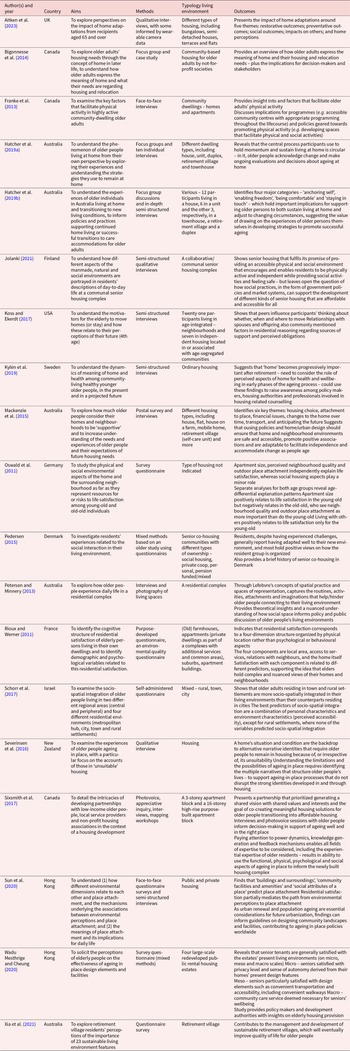
Nineteen (n = 19) articles were identified through the analysis (Table 3). The articles were published between 2011 and 2023, with a majority produced in the last five years. Only one article explicitly described measures for socially sustainable housing for older adults (Xia et al. Reference Xia, Chen, Buys, Skitmore and Walliah2021). The included studies were conducted in Asia (n = 4), Europe (n = 5), North America (n = 4) and Oceania (n = 6) and were predominantly mixed methods (n = 10). There were six qualitative method papers where the use of semi-structured interviews was most prevalent. Four articles were quantitative in nature and involved the use of questionnaires. As per the inclusion criteria, all participants were aged 65 years or older, and the number of participants ranged between 21 and 202 when indicated. The journals of the selected articles mainly published in ageing, gerontological, environmental and housing research.
Summary of included articles
Narrative summary
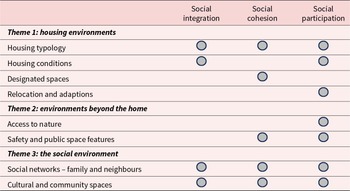
The results are presented and structured across three overarching themes (Table 4) reflecting the study aim – housing environments, environments beyond the house environment and social environments – and three elements of social sustainability – social integration, social cohesion and social participation.
Thematic results by concepts of social sustainability

Theme 1: housing environments
Housing typology
Housing typology, in terms of placement, formation and designated spaces, was found to create opportunities for social participation among older adults. The placement of free-standing homes on the street or arranged in culs-de-sac (dead-end streets) allows for opportunities to establish better relationships for older adults and creates a sense of a big family that supports social cohesion (Bigonnesse et al. Reference Bigonnesse, Beaulieu and Garon2014; Mackenzie et al. Reference Mackenzie, Curryer and Byles2015; Pedersen Reference Pedersen2015). Living in a multi-unit building (i.e. an apartment or a condominium) can provide older adults with direct proximity to neighbours, resulting in a friendly atmosphere in the building (Kylén et al. Reference Kylén, Löfqvist, Haak and Iwarsson2019; Pedersen Reference Pedersen2015), opportunities for social interaction when meeting new people (Franke et al. Reference Franke, Tong, Ashe, McKay, Sims-Gould and Team2013; Pedersen Reference Pedersen2015) and a feeling of not living alone (Bigonnesse et al. Reference Bigonnesse, Beaulieu and Garon2014). Housing typology can differ across urban and rural settlements and impact social interaction. For instance, as seen in Schorr et al. (Reference Schorr, Iecovich, Alfasi and Shamai2017), older people living in a rural area perceive their environment to be more socially accessible compared to those living in a larger metropolitan area.
Housing formation in terms of the size and unit layout is reported to enhance social interactions. For instance, large residential complexes have the potential to positively impact the life satisfaction of older adults (Oswald et al. Reference Oswald, Jopp, Rott and Wahl2011; Sun et al. Reference Sun, Fang, Yung, Chao and Chan2020). However, in the Pedersen (Reference Pedersen2015) study, older adults preferred to live in a setting with between 15 and 25 housing units. Some older adults prefer smaller dwellings as they require less maintenance (Petersen and Minnery Reference Petersen and Minnery2013). However, those living in smaller units need accessible surrounding neighbourhoods to support their social participation (Franke et al. Reference Franke, Tong, Ashe, McKay, Sims-Gould and Team2013; Sun et al. Reference Sun, Fang, Yung, Chao and Chan2020). On the contrary, small bedrooms and apartments can be negatively experienced by some older adults who want the same type of housing as everyone else, not smaller units because of their age (Bigonnesse et al. Reference Bigonnesse, Beaulieu and Garon2014).
Designated spaces
Several articles described designated spaces as places for social participation. For example, front porches, balconies, small terraces and gardens constituted spaces where older adults can easily interact with neighbours and people of every generation (Bigonnesse et al. Reference Bigonnesse, Beaulieu and Garon2014; Kylén et al. Reference Kylén, Löfqvist, Haak and Iwarsson2019). Communal spaces in multi-unit buildings are arenas for social activities such as shared meals (Pedersen Reference Pedersen2015), community coffee time, laundry and learning new skills such as woodwork and knitting (Bigonnesse et al. Reference Bigonnesse, Beaulieu and Garon2014; Jolanki Reference Jolanki2021; Kylén et al. Reference Kylén, Löfqvist, Haak and Iwarsson2019). Further, communal spaces near the front entry can facilitate coincidental and spontaneous meetings as occupants pass through common areas to access their independent units (Petersen and Minnery Reference Petersen and Minnery2013). This means of ‘passing through’ allow residents to use the space in a way that works for them, such as casually talking to others or watching television. Also, designated spaces can be activated with formal activities organized by a community coordinator to, for example, assist residents with computer use and online banking (Jolanki Reference Jolanki2021).
Housing conditions
Our findings indicate that the condition of a housing environment does not need to be pristine to support social integration for older adults. As described in four articles, even in circumstances where the condition and the façade of the housing remain unchanged or in poor condition, older adults relate to these environments (Kondo et al. Reference Kondo, Lee, Kawakubo, Kataoka, Asami, Mori, Umezaki, Yamauchi, Takagi, Sunagawa and Akabayashi2009; Rioux and Werner Reference Rioux and Werner2011; Severinsen et al. Reference Severinsen, Breheny and Stephens2016; Sun et al. Reference Sun, Fang, Yung, Chao and Chan2020).
Relocation and adaptations
For many older adults, especially those who have stayed in their neighbourhood for a long time, relocating to a new house can disrupt long-established social networks (Aitken et al. Reference Aitken, Wilson-Menzfeld, Hodgson and Bailey2023; Hatcher et al. Reference Hatcher, Chang, Schmied and Garrido2019a). The decision to move is often dependent on several factors, including being closer to family (Hatcher et al. Reference Hatcher, Chang, Schmied and Garrido2019b; Jolanki Reference Jolanki2021; Koss and Ekerdt Reference Koss and Ekerdt2017), preparing for future needs by choosing to live on a single level (Koss and Ekerdt Reference Koss and Ekerdt2017), or relocating to a smaller dwelling or avoiding home maintenance concerns by renting instead of owning (Koss and Ekerdt Reference Koss and Ekerdt2017; Pedersen Reference Pedersen2015). Housing choices can be dependent on several social factors such as older adults having enough space for relatives to stay (Bigonnesse et al. Reference Bigonnesse, Beaulieu and Garon2014; Mackenzie et al. Reference Mackenzie, Curryer and Byles2015), living in an environment that allows pets (Koss and Ekerdt Reference Koss and Ekerdt2017; Sixsmith et al. Reference Sixsmith, Fang, Woolrych, Canham, Battersby and Sixsmith2017) and being able to manage their time in their own way (i.e. not being over-programmed) (Hatcher et al. Reference Hatcher, Chang, Schmied and Garrido2019a; Petersen and Minnery Reference Petersen and Minnery2013). For instance, in some residential complexes, older adults can feel restricted by the rules – not being allowed to stay at a friend’s house overnight (Petersen and Minnery Reference Petersen and Minnery2013), having set hours of the day when they can use certain areas or leave the premises, and being unable to decorate the space in a personal way (Bigonnesse et al. Reference Bigonnesse, Beaulieu and Garon2014.
Adaptations to the housing environment can support social participation in several different ways. Modifications, such as a garage door opener or a ramp, can make it easier for older adults to leave their homes or receive guests or packages (Aitken et al. Reference Aitken, Wilson-Menzfeld, Hodgson and Bailey2023; Bigonnesse et al. Reference Bigonnesse, Beaulieu and Garon2014). Further, some older adults continue to live in larger homes but use the space differently, such as deciding to live on one floor of the home (Mackenzie et al. Reference Mackenzie, Curryer and Byles2015). At the same time, adaptations can result in a sense of social stigma as the changes made to the environment (e.g. installations to support mobility) can be interpreted as symbols of old age (Aitken et al. Reference Aitken, Wilson-Menzfeld, Hodgson and Bailey2023).
Theme 2: environments beyond the house
Access to nature
In several articles, contact with nature is found to support social participation. The design and the accessibility of natural environments (e.g. walking paths, transportation and no hills) near the homes of older adults facilitate the possibilities of maintaining social contacts (Jolanki Reference Jolanki2021). Neighbourhood aesthetic features, such as green spaces, parks, lakes or the ocean, encourage older adults to leave their home environments for daily exercise and interaction with others (Bigonnesse et al. Reference Bigonnesse, Beaulieu and Garon2014; Franke et al. Reference Franke, Tong, Ashe, McKay, Sims-Gould and Team2013; Jolanki Reference Jolanki2021; Kylén et al. Reference Kylén, Löfqvist, Haak and Iwarsson2019; Rioux and Werner Reference Rioux and Werner2011). Also, built environment features such as sidewalks and footpaths, paved pathways, bike paths, benches and spaces for walking dogs can enhance opportunities for social participation (Franke et al. Reference Franke, Tong, Ashe, McKay, Sims-Gould and Team2013).
Safety and public space features
A sense of safety can influence how older adults socially interact and engage in activities outside the home. Features such as night lighting, safety guards and security systems (to buzz in visitors) can facilitate social cohesion and a feeling of safety in a housing environment (Bigonnesse et al. Reference Bigonnesse, Beaulieu and Garon2014; Mackenzie et al. Reference Mackenzie, Curryer and Byles2015; Pedersen Reference Pedersen2015). Meanwhile, feeling safe in a neighbourhood can support an older adult’s positive perception and social participation level (Wadu Mesthrige and Cheung Reference Wadu Mesthrige and Cheung2020; Oswald et al. Reference Oswald, Jopp, Rott and Wahl2011). For instance, living in a safe, calm and quiet residential area that has good access to public transportation (Bigonnesse et al. Reference Bigonnesse, Beaulieu and Garon2014; Oswald et al. Reference Oswald, Jopp, Rott and Wahl2011; Rioux and Werner Reference Rioux and Werner2011) and/or public seating is essential for supporting spontaneous social interaction (Wadu Mesthrige and Cheung Reference Wadu Mesthrige and Cheung2020). Also, adequately timed traffic lights to lengthen the time allotted for pedestrians to cross the road safely can provide safe access to services (Sixsmith et al. Reference Sixsmith, Fang, Woolrych, Canham, Battersby and Sixsmith2017).
On the contrary, safety risks such as crime (Mackenzie et al. Reference Mackenzie, Curryer and Byles2015), poorly maintained sidewalks and traffic concerns (Franke et al. Reference Franke, Tong, Ashe, McKay, Sims-Gould and Team2013; Mackenzie et al. Reference Mackenzie, Curryer and Byles2015; Wadu Mesthrige and Cheung Reference Wadu Mesthrige and Cheung2020; Rioux and Werner Reference Rioux and Werner2011), noise levels (Bigonnesse et al. Reference Bigonnesse, Beaulieu and Garon2014; Mackenzie et al. Reference Mackenzie, Curryer and Byles2015) and having to navigate stairs (Hatcher et al. Reference Hatcher, Chang, Schmied and Garrido2019b) can present barriers resulting in older adults being hesitant to leave their house environment.
Theme 3: the social environment
Social networks – family and neighbours
The social interaction of older adults can be supported by the proximity of a network of family members, friends, neighbours and services (Rioux and Werner Reference Rioux and Werner2011) and prevent social isolation (Bigonnesse et al. Reference Bigonnesse, Beaulieu and Garon2014; Franke et al. Reference Franke, Tong, Ashe, McKay, Sims-Gould and Team2013; Hatcher et al. Reference Hatcher, Chang, Schmied and Garrido2019a; Jolanki Reference Jolanki2021; Pedersen Reference Pedersen2015). Neighbours can provide a sense of social connectedness but also assist with house maintenance and other day-to-day needs (Aitken et al. Reference Aitken, Wilson-Menzfeld, Hodgson and Bailey2023; Bigonnesse et al. Reference Bigonnesse, Beaulieu and Garon2014; Kylén et al. Reference Kylén, Löfqvist, Haak and Iwarsson2019; Rioux and Werner Reference Rioux and Werner2011; Sun et al. Reference Sun, Fang, Yung, Chao and Chan2020). Some older adults prefer to live in a mixed-age-group environment for more social participation with other generations (Bigonnesse et al. Reference Bigonnesse, Beaulieu and Garon2014). Communication between neighbours and shop owners, sharing food or even enjoying casual chats can provide a sense of security (Kylén et al. Reference Kylén, Löfqvist, Haak and Iwarsson2019; Petersen and Minnery Reference Petersen and Minnery2013; Sun et al. Reference Sun, Fang, Yung, Chao and Chan2020) and a sense of familiarity, as reciprocal support for older adults (Bigonnesse et al. Reference Bigonnesse, Beaulieu and Garon2014; Hatcher et al. Reference Hatcher, Chang, Schmied and Garrido2019b). These positive relational aspects of their housing situation can support older adults in remaining in their housing environments longer (Severinsen et al. Reference Severinsen, Breheny and Stephens2016).
Social networks are not easily accessible for all older adults. For some, changes in the community, with neighbours or friends moving away or dying, lead to not wanting to socialize (Hatcher et al. Reference Hatcher, Chang, Schmied and Garrido2019a), which impacts their ability to stay socially connected (Hatcher et al. Reference Hatcher, Chang, Schmied and Garrido2019b). Further, not all neighbours provide positive interactions. In some articles, participants describe nosey neighbours who intrude on people’s privacy (Bigonnesse et al. Reference Bigonnesse, Beaulieu and Garon2014; Rioux and Werner Reference Rioux and Werner2011). In other settings, established social groups and dynamics can be challenging to join or integrate with (Bigonnesse et al. Reference Bigonnesse, Beaulieu and Garon2014; Petersen and Minnery Reference Petersen and Minnery2013).
Cultural and community spaces
Cultural and community environments provide culturally diverse experiences with like-minded and culturally similar people (Franke et al. Reference Franke, Tong, Ashe, McKay, Sims-Gould and Team2013; Jolanki Reference Jolanki2021; Oswald et al. Reference Oswald, Jopp, Rott and Wahl2011; Sixsmith et al. Reference Sixsmith, Fang, Woolrych, Canham, Battersby and Sixsmith2017; Xia et al. Reference Xia, Chen, Buys, Skitmore and Walliah2021). For example, accessing spaces to express cultural practices (i.e. saunas in the Finnish culture [Jolanki Reference Jolanki2021]), participating in activities to reminisce about a region where they grew up (Franke et al. Reference Franke, Tong, Ashe, McKay, Sims-Gould and Team2013) and engaging in opportunities to speak native languages mitigate the risk of social isolation among older adults with a migrant or immigrant background (Sixsmith et al. Reference Sixsmith, Fang, Woolrych, Canham, Battersby and Sixsmith2017). Further, non-culturally specific activities, such as recreational activities and community health-care services, also provide opportunities for older adults to engage in new social relationships (Franke et al. Reference Franke, Tong, Ashe, McKay, Sims-Gould and Team2013; Hatcher et al. Reference Hatcher, Chang, Schmied and Garrido2019b; Sun et al. Reference Sun, Fang, Yung, Chao and Chan2020). In addition, less formalized settings in terms of nearby essential services such as shops, grocery stores and health services provide a familiar and accessible social network for older adults (Hatcher et al. Reference Hatcher, Chang, Schmied and Garrido2019b, Reference Hatcher, Chang, Schmied and Garrido2019a; Rioux and Werner Reference Rioux and Werner2011; Sixsmith et al. Reference Sixsmith, Fang, Woolrych, Canham, Battersby and Sixsmith2017).
Discussion
As more older adults age in place, there is a need to focus on designing environments that support the health and wellbeing of this growing population. The concept of sustainability related to ageing in place is unexplored, yet it fosters a vision of a society that promotes health, autonomy and wellbeing. This scoping review contributes to knowledge of older adults and social sustainability by identifying the characteristics of housing and social environments that support older adults’ social integration, cohesion and participation. This research angle offers new insights into ageing in place, which can be of interest to researchers, policy makers and professionals in gerontology, urban planning and public health.
This scoping review identifies characteristics of housing environments (i.e. typology, designated spaces, housing conditions and relocations and adaptations), environments beyond the housing environment (i.e. access to nature, sense of safety and security) and social environments, including social networks as well as cultural and common spaces. Although elements of these environments are critical to support ageing in place, it is how these environmental characteristics come together that make a home environment that can meet the social integration, social cohesion and participation needs of older adults. As several articles in this review describe, the home environment is not merely physical. The home can also be a familiar social setting that enables a sense of autonomy and personal space to engage and connect with others (Hatcher et al. Reference Hatcher, Chang, Schmied and Garrido2019a, Reference Hatcher, Chang, Schmied and Garrido2019b; Kylén et al. Reference Kylén, Löfqvist, Haak and Iwarsson2019; Mackenzie et al. Reference Mackenzie, Curryer and Byles2015; Wadu Mesthrige and Cheung Reference Wadu Mesthrige and Cheung2020).
To design more socially sustainable environments for older adults, the home environment needs to be understood not just as a concrete place but as places of experience that include the home (private space) and the neighbourhood (social space) (Lebrusán and Gómez Reference Lebrusán and Gómez2022). The housing typology for older adults goes beyond physical space and combines interconnected spatial, social and organizational layers for social interaction (Hamers et al. Reference Hamers, Moor and Mohammadi2024). A home environment can be understood as a combination of private and public environments where older adults have spent most of their lives and experienced social roles, such as parents and grandparents (Bigonnesse et al. Reference Bigonnesse, Beaulieu and Garon2014), or a place where significant life changes occurred, such as the death of a spouse (Hatcher et al. Reference Hatcher, Chang, Schmied and Garrido2019a). For some Indigenous people, home is beyond the built and social environment as it is a place of connection to their land and ancestors (Severinsen et al. Reference Severinsen, Breheny and Stephens2016). In relation to social sustainability, ageing in place can be more dynamically, temporally and spiritually understood as ageing in ‘places’ and ‘spaces’ instead of a singular focus on the physical housing environment. This focus aligns with the proposed new definition of ageing in place, which emphasizes choice, independence and the ability to participate in activities (Rogers et al. Reference Rogers, Ramadhani and Harris2020).
Some built environment features, such as balconies, porches and communal spaces, can enhance social participation. However, this review highlights that no one size fits all and environments cannot be simply designed for social integration, cohesion or participation. For instance, when spaces in the built environment are created for social participation, these spaces may not work for all residents as intended. Housing projects may have designated spaces for a social purpose; however, the design of the space is not considered welcoming or used by all resident groups (Tersteeg and Pinkster Reference Tersteeg and Pinkster2016) or it requires staff to activate the space to make it more engaging (Jolanki Reference Jolanki2021). Further, while some older adults enjoy ageing in place in designated housing environments, such as community-based housing models or naturally occurring retirement communities (NORCs) (Chum et al. Reference Chum, Fitzhenry, Robinson, Murphy, Phan, Alvarez, Hand, Laliberte Rudman and McGrath2022; Seetharaman et al. Reference Seetharaman, Mahmood and Chaudhury2020), these models are not widely available; nor can they address all the unique social needs of all residents. For example, some older adults regard these housing models as environments that are segregated from society (Bigonnesse et al. Reference Bigonnesse, Beaulieu and Garon2014), that is, removed from the ‘fabric of society’ (Komp-Leukkunen and Sarasma Reference Komp-Leukkunen and Sarasma2024).
The future of socially sustainable environments for ageing in place
As we develop housing and interventions to support social sustainability among older people, the individuality of the experience across the lifecourse, not just focusing on the older years of life (Dahlberg et al. Reference Dahlberg, McKee, Frank and Naseer2022), needs to be considered. To translate the concept of social sustainability to support ageing in place related to the home environment, it is critical to ensure that context, culture and choice are translated into the design of interventions for older adults. This research direction relates to the growing interest in how the design of housing, technology and the built environment can alleviate the loneliness and social isolation of older adults (Fakoya et al. Reference Fakoya, McCorry and Donnelly2020; Landeiro et al. Reference Landeiro, Barrows, Musson, Gray and Leal2017; Nakanishi and Black Reference Nakanishi and Black2015; Shah et al. Reference Shah, Nogueras, Van Woerden and Kiparoglou2019). The needs and values of older adults are diverse and can be challenging to address with one design. Therefore, policies and interventions that suit the needs of individuals, specific groups and the degree of loneliness experienced need to be developed. Moreover, focusing on individual and community assets that people enjoy can provide valuable insights that support social health and wellbeing to allow people to age at home successfully (Sturge et al. Reference Sturge, Klaassens, Jones, Légaré, Elf, Weitkamp and Meijering2021b). A co-creation approach, inspired by system-based thinking and co-design, is an increasingly promising practice and direction to develop solutions for ageing in place (Kastl et al. Reference Kastl, Rauner, Mayer-Huber, Oestreich, Benstetter and Fettke2024; Nordin et al. Reference Nordin, Sturge, Meijering and Elf2024; Robertson et al. Reference Robertson, Gibson, Greasley-Adams, McCall, Gibson, Mason-Duff and Pengelly2022) that reflect the needs and expectations of older adults. Engaging older adults and stakeholder in design research can result in outside-the-box thinking ans solutions to allow us to rethink housing poiicy, resultinh in more creative ways to support ageing in place (Gomes Reference Gomes, Raposo, Neves, Silva, Correia Castilho and Dias2021). For instance, exploring older adults’ willingness to share a home with a roommate (Gibson et al. Reference Gibson, Pope, Loeffler, Ratliff and Engelhardt2023) or designing new housing environments with designated spaces for caregivers (Cohen and Allweil Reference Cohen and Allweil2020). Further, designing socially sustainable environments for older adults also has a digital element – research suggests that bridging the digital divide (often experienced by older adults) can drastically improve the social connection and ageing in place of older adults (Arieli et al. Reference Arieli, Faulhaber, Bishop, Ferdous and Roberts2023; Peine et al. Reference Peine, Meissner, Wanka, Leichsenring and Sidorenko2024).
Policy and planning implications
This study has socially sustainable planning implications. For instance, changes in the neighbourhood, such as over-development and gentrification, can result in a loss of a sense of cohesion and impact the social participation of older adults (Mackenzie et al. Reference Mackenzie, Curryer and Byles2015). For instance, ‘third places’ (Littman Reference Littman2021) that enrich social participation (i.e. corner stores and shopping centres) can shut down or disappear, which can result in loneliness (Finlay et al. Reference Finlay, Esposito, Kim, Gomez-Lopez and Clarke2019). As these places close, replacing them with similar sites needs to be considered to support social sustainability. Furthermore, when city planners select sites for housing developments for older adults, the location should be close to essential services (Bigonnesse et al. Reference Bigonnesse, Beaulieu and Garon2014) and not necessarily designated as ‘senior only’ as that housing policy label can segregate, not integrate, older people from society (Koss and Ekerdt Reference Koss and Ekerdt2017). Planners can avoid organizing services for older adults to be in one location (as typically seen in retirement communities), where a single location can prevent older adults from going beyond the housing environment, impacting social integration and cohesion in society (Bigonnesse et al. Reference Bigonnesse, Beaulieu and Garon2014). To ensure that public policy directions support social sustainability, policy makers can consider the earlier work of Henri Lefebvre (Petersen and Minnery Reference Petersen and Minnery2013), who highlighted the need for variety in the lives of people and the environment to reflect individual identity and how people seek to shape their place and their ongoing engagement with life. This approach would allow public space policy to reflect the social needs of older adults in a similar way as it considers environmental impact regulations when planning for new developments and community renewal projects. This emphasis and policy direction would enhance the quality and suitability of housing environments for ageing in place in terms of size, location and design for inclusion for future generations.
Limitations
There are limitations to acknowledge in this review. First, despite our having taken a systematic approach to identifying and screening articles, it is possible that some relevant articles are not identified. This review included only articles published in English and excluded grey literature such as books, reports and conference papers. These alternate sources could have provided insights into various innovative and emerging practices related to the research question and topic. Further, our inclusion and exclusion criteria might have complicated decision-making. The interdisciplinary backgrounds of the reviewers – spanning geography, architecture and nursing – along with the diverse disciplines of the articles led to challenges and ongoing discussions during the screening process. Similarly, differences in welfare systems and inconsistent definitions of housing models and terminologies across disciplines and countries may have resulted in missing or excluded relevant studies. Also noted, the studies identified focused on a population aged 65 years and older. While this age is commonly used to define older adults, some contexts and countries consider individuals younger than 65 as part of the older adult population, and these people are excluded from this review. Finally, the review suggests that successful and sustainable ageing requires social integration, cohesion and participation. It is critical to note that older adults are a particularly heterogeneous group, not a homogeneous population (Xia et al. Reference Xia, Chen, Buys, Skitmore and Walliah2021). Therefore, this concept does not apply to everyone, as some individuals may choose not to socialize or face physical or financial barriers that prevent social sustainability.
Conclusion
As the population ages, more older adults will live at home than ever before. As a result, older adults risk becoming more socially isolated, which can impact public health and wellbeing. This review presents ageing in place related to the concept of social sustainability in the context of the home environment and beyond. Through this review, we have explored several places and spaces that older adults engage with to understand how ageing in place relates to social sustainability. Understanding the environmental characteristics, the role of accessible and safe environments beyond the home, and how people and culture support a sense of belonging provides a policy direction for designing socially sustainable environments for older adults in the future. Therefore, more knowledge is needed based on engaging people in the design and policy process of housing and surrounding environments. Co-designing environments based on the needs of older adults – their routines, activities, attachments and imaginations – will provide limitless opportunities and solutions for designing socially sustainable housing environments for all citizens now and in the future.
Author contributions
All authors have made a substantial contribution to the conception and design of the research, or the analysis and interpretation of the data, and the drafting and approval of this article.
Financial support
This work was supported by the Swedish Research Council for Sustainable Development, Formas (2022-00034), supplemented by Dalarna University, School of Health and Welfare and Inholland University of Applied Sciences, division of the Built Environment. Dr Susanna Nordin from Dalarna University is the principal investigator on this project.
Competing interests
The authors declare no competing interests.
Ethical standards
This project did not collect empirical data so ethical approval was not required.
Appendix A
PRISMA-ScR checklist

JBI = Joanna Briggs Institute; PRISMA-ScR = Preferred Reporting Items for Systematic reviews and Meta-Analyses extension for Scoping Reviews.
* Where sources of evidence (see second footnote) are compiled from, such as bibliographic databases, social media platforms and websites.
† A more inclusive/heterogeneous term used to account for the different types of evidence or data sources (e.g. quantitative and/or qualitative research, expert opinion, policy documents) that may be eligible in a scoping review as opposed to only studies. This is not to be confused with information sources (see first footnote).
‡ The frameworks by Arksey and O’Malley (Reference Arksey and O’Malley2005) and Levac and colleagues (Reference Levac, Colquhoun and O’brien2010) and Peters et al., Reference Peters, Godfrey, McInerney, Khalil, Larsen, Marnie, Pollock, Tricco and Munn2022 is a better source) refer to the process of data extraction in a scoping review as data charting.
§ The process of systematically examining research evidence to assess its validity, results and relevance before using it to inform a decision. This term is used for items 12 and 19 instead of ‘risk of bias’ (which is more applicable to systematic reviews of interventions) to include and acknowledge the various sources of evidence that may be used in a scoping review (e.g. quantitative and/or qualitative research, expert opinion, policy documents).
Source: Tricco AC, Lillie E, Zarin W, O’Brien KK, Colquhoun H, Levac D, et al. (2018) PRISMA extension for scoping reviews (PRISMAScR): Checklist and explanation. Annals of Internal Medicine 169, 467–473. https://doi.org/10.7326/M18-0850.
Appendix B
Appendix B – Medline (Ovid) Search Strategy
(Literature search performed 23 February 2023)
1. exp aged/
2. ag?ing.ti,ab,kf.
3. centenarian*.ti,ab,kf.
4. elder*.ti,ab,kf.
5. (late* adj2 life).ti,ab,kf.
6. nonagenarian*.ti,ab,kf.
7. octogenarian*.ti,ab,kf.
8. old* adult*.ti,ab,kf.
9. old* age*.ti,ab,kf.
10. old* citizen*.ti,ab,kf.
11. old* lady.ti,ab,kf.
12. old* ladies.ti,ab,kf.
13. old* m#n.ti,ab,kf.
14. old* people.ti,ab,kf.
15. old* person*.ti,ab,kf.
16. old* population*.ti,ab,kf.
17. old* wom#n.ti,ab,kf.
18. pensioner*.ti,ab,kf.
19. senior*.ti,ab,kf.
20. septuagenarian*.ti,ab,kf.
21. sexagenarian*.ti,ab,kf.
22. or/1-21
23. empowerment/
24. health promotion/
25. personal autonomy/
26. exp ‘quality of life’/
27. social inclusion/
28. exp social integration/
29. social interaction/
30. social isolation/
31. social participation/
32. exp social support/
33. accessib*.ti,ab,kf.
34. autonomy.ti,ab,kf.
35. communit*.ti,ab,kf.
36. empower*.ti,ab,kf.
37. engagement.ti,ab,kf.
38. equity.ti,ab,kf.
39. health promotion.ti,ab,kf.
40. (health adj2 (impact* or outcome* or improv*)).ti,ab,kf.
41. inclus*.ti,ab,kf.
42. participation.ti,ab,kf.
43. quality of life.ti,ab,kf.
44. social cohesion.ti,ab,kf.
45. social exclusion.ti,ab,kf.
46. social integration.ti,ab,kf.
47. social interaction.ti,ab,kf.
48. social isolation.ti,ab,kf.
49. social mix*.ti,ab,kf.
50. social participation.ti,ab,kf.
51. social support.ti,ab,kf.
52. social* sustainab*.ti,ab,kf.
53. well-being.ti,ab,kf.
54. wellbeing.ti,ab,kf.
55. or/23-54
56. exp environment design/
57. exp ‘facility design and construction’/
58. home environment/
59. ‘housing for the elderly’/
60. exp social planning/
61. ((accommodation? or apartment? or condominium? or domestic or dwelling? or flat? or home? or house? or household? or mansion? or residen* or villa?) adj2 (design* or planning)).ti,ab,kf.
62. ag?ing in place.ti,ab,kf.
63. architectural accessibility.ti,ab,kf.
64. architectural barrier*.ti,ab,kf.
65. built environment*.ti,ab,kf.
66. environment* design*.ti,ab,kf.
67. facility design*.ti,ab,kf.
68. home environment*.ti,ab,kf.
69. (housing adj3 (sustainab* or suitab* or secure or social or acces* or inclu* or elder* or old*)).ti,ab,kf.
70. living environment*.ti,ab,kf.
71. social planning.ti,ab,kf.
72. or/56-71
73. 22 AND 55 AND 72
74. exp animals/
75. exp animal experimentation/ or exp animal experiment/
76. exp models, animal/
77. nonhuman/
78. exp vertebrate/ or exp vertebrates/
79. or/74-78
80. exp humans/
81. exp human experimentation/ or exp human experiment/
82. or/80-81
83. 79 not 82
84. 73 not 83
85. 84 and 2008:2023.(sa_year).
86. 85 and English.lg.



 Open access

