



Introduction
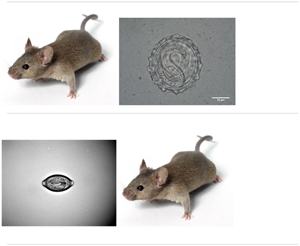
Why study parasite infections in mice? The house mouse, Mus musculus, is a powerful model organism given its similar anatomy, physiology and immunology to humans, its short breeding cycle and the availability of a whole ‘toolbox’ of reagents, transgenic mice and advanced methodologies. In the context of parasitic infection, one of the key research imperatives is a desire to alleviate the ill-health caused by infection in humans and their domestic animals, and research into the soil-transmitted helminth parasites is no exception to this. A variety of gut helminth mouse models exist, including the rodent hookworms Heligomosomoides polygyrus and Nippostrongylus brasiliensis, the whipworm Trichuris muris and the roundworm Ascaris spp. This special edition of Parasitology focuses on the latter two parasites with articles focused upon immunology, immunoregulation, co-morbidities, the microbiome and vaccine development.
Mouse models of Trichuris and Ascaris infections: a selection of the early pioneers

Despite whipworms and roundworms sharing certain commonalities, for example, an association with humans for several thousand years and an ability to trigger a similar quality of immune response (reviewed in Else et al., Reference Else, Keiser, Holland, Grencis, Sattelle, Fujiwara, Bueno, Asaolu, Sowemimo and Cooper2020), these two nematode species also have many differences. Ascaris worms are large; up to 35 cm in length whilst whipworms are small (up to 5 cm in length); whipworms live in the large intestine whilst Ascaris inhabits the small intestine. More than 70 spp. of Trichuris are described, including T. muris in the mouse, whilst in the genus Ascaris only two species are known, A. suum in pigs and the human parasite A. lumbricoides. Notably, whipworms are entirely enteric in their life style whilst Ascaris parasites have a migratory larval phase that contributes to pathology in the liver and lungs in addition to the intestine (Holland, Reference Holland2021). In the context of mouse models, a key difference between the two parasites is that the mouse is a natural host of whipworm infection but not of Ascaris infections, and this difference plays out in some of the ways that mouse models have been used to understand whipworm and roundworm infections, as described within this special collection. Collectively, the articles in this special issue explore the application of these two important nematode parasites, in both basic and applied research, and describe some of the recent advances made through the use of the mouse model.
Historical aspects
Trichuris muris in the mouse has been used as a model system by parasitologists for well over half a century with Shikhobalova reporting studies in ‘white mice' as long ago as 1937 (Shikhobalova, Reference Shikhobalova1937). Detailed studies of the whipworm life cycle in the mouse were published in 1954 (Fahmy, Reference Fahmy1954) and at that time there was a growing desire to understand the host–parasite interaction better. Thus, a number of studies reporting strain variation in the ability to carry a chronic infection were published, including Keeling (Reference Keeling1961) and Worley et al. (Reference Worley, Meisenhelder, Sheffield and Thompson1962), leading to a debate as to whether the inability to carry an infection through to the adult stage represented an incompatibility between the host environment and the parasite, or immune-mediated resistance (or both). Important work by Campbell in 1963 discussed the concept of immune-mediated worm expulsion which was then built upon by numerous elegant studies by Wakelin in the 1960s and 70s (see Wakelin, Reference Wakelin1967, Reference Wakelin1970a, Reference Wakelin1970b). It is interesting, however, to reflect on the early debate around a host environment incompatibility vs immunity, given our new knowledge of the important contribution of the host microbiome to the success of the parasite, a topic discussed by Lawson et al. (Reference Lawson, Roberts and Grencis2021) in this volume, and the fact that Pike had noted changes in the bacterial flora in the caeca of Trichuris-infected mice as long ago as 1976 (Pike, Reference Pike1976) (Table 1).
In contrast to Trichuris, Ascaris does not have a species that infects a natural rodent host where the life cycle is completed. Animal models in which Ascaris does not complete its life cycle but mimic the all important hepato-tracheal migration are described as abnormal hosts. Larval stages of Ascaris do not return successfully to the small intestine to mature into adult worms (Holland, Reference Holland2021). This has undoubtedly hindered research into what is regarded by some as the most neglected of the neglected tropical diseases (Hotez, Reference Hotez and Holland2013). However, it is clear that this phase of infection is likely to be crucial in the manifestation of susceptibility and resistance and successful adult worm establishment (Nogueira et al., Reference Nogueira, Gazzinelli-Guimarães, Barbosa, Resende, Silva, de Oliveira, Amorim, Oliveira, Mattos, Kraemer, Caliari, Gaze, Bueno, Russo and Fujiwara2016) and this is one of the reasons why mice serve as a useful model for the assessment of vaccine candidates (see Gazzinelli-Guimaraes et al., Reference Gazzinelli-Guimaraes, Gazzinelli-Guimaraes and Weatherhead2021).
As early as 1916, investigators used A. suum-infected mice to make novel and important observations concerning the biology of the ascarid (Stewart, Reference Stewart1916; Holland, Reference Holland2021) (Table 1). Since then, mouse models of early Ascaris infection have been used for such diverse investigations as the intestinal hepatic migratory pattern (e.g. Ransom and Foster, Reference Ransom and Foster1920; Slotved et al., Reference Slotved, Eriksen, Murrell and Nansen1998; Dold et al., Reference Dold, Cassidy, Stafford, Behnke and Holland2010). Of particular note are the findings of Slotved et al. (Reference Slotved, Eriksen, Murrell and Nansen1998) who demonstrated, in important comparative work, that the migratory pattern of A. suum is similar in murine and porcine hosts; the hepatic-pulmonary migratory pattern (e.g. Sprent, Reference Sprent1952; Douvres and Tromba, Reference Douvres and Tromba1971; Song et al., Reference Song, Kim, Min and Lee1985; Lewis et al., Reference Lewis, Behnke, Stafford and Holland2006); hepatic pathology (e.g. Bindseil, Reference Bindseil1969; Dold et al., Reference Dold, Cassidy, Stafford, Behnke and Holland2010; Deslyper et al., Reference Deslyper, Colgan, Holland and Carolan2016, Reference Deslyper, Holland, Colgan and Carolan2019); immunological responses (Mitchell et al., Reference Mitchell, Hogarth-Scott, Edwards, Lewers, Cousins and Moore1976; Kennedy et al., Reference Kennedy, Gordon, Tomlinson and Qureshi1987; Gazzinelli-Guimaraes et al., Reference Gazzinelli-Guimaraes, Gazzinelli-Guimaraes, Silva, Mati, de Carvalho Dhom-Lemos, Barbosa, Passos, Gaze, Carneiro, Bartholomeu, Bueno and Fujiwara2013; Nogueira et al., Reference Nogueira, Gazzinelli-Guimarães, Barbosa, Resende, Silva, de Oliveira, Amorim, Oliveira, Mattos, Kraemer, Caliari, Gaze, Bueno, Russo and Fujiwara2016) and host–parasite genetics (e.g. Mitchell et al., Reference Mitchell, Hogarth-Scott, Edwards, Lewers, Cousins and Moore1976; Nejsum et al., Reference Nejsum, Roepstorff, Anderson, Jorgensen, Fredholm and Thamsborg2008; Dold et al., Reference Dold, Pemberton, Stafford, Holland and Behnke2011; Peng et al., Reference Peng, Yuan, Peng, Dai, Yuan, Hu and Hu2012). Furthermore, Gazzinelli-Guimaraes et al. (Reference Gazzinelli-Guimaraes, Gazzinelli-Guimaraes and Weatherhead2021) describe the mouse model as the primary in vivo animal system for the evaluation of vaccine candidates for A. lumbricoides and provide a detailed historical perspective on the studies performed from 1957 to 2021.
Wild immunology
Whilst the early drivers to study T. muris in the mouse were largely driven by curiosity, the majority of the articles in this collection focus on the use of mouse models of infection to further our understanding of human disease, and the article by Mair et al. (Reference Mair, Else and Forman2021) is no exception covering the most recent immunological knowledge gained from studying T. muris in the laboratory mouse. However, in addition, Mair et al. move on to extend the beneficiaries of whipworm research beyond the medical community, highlighting contributions made by mouse whipworm research to the field of host–parasite co-evolutionary relationships, ecology and parasite genetic diversity, enabled by the fact that, unlike Ascaris spp., T. muris is a natural parasite of wild mice. Of course the study of parasites in wild populations is not new and one early pioneer in the context of whipworm research was Behnke who assessed the epidemiology of T. muris in its natural host, the wild house mouse (Behnke and Wakelin, Reference Behnke and Wakelin1973). The new and growing field of Eco-Immunology or ‘Wild Immunology’ is also enabled by the fact that, as mentioned above, T. muris naturally infects mice. Eco-immunologists aim to study immunity to infection in real-world settings rather than the highly controlled laboratory environments where most studies on the immune response to infection are conducted. A number of elegant mouse model systems have recently been developed which move from fully wild settings, to the semi-wild enclosure-based systems pioneered by Graham (reviewed by Graham, Reference Graham2021) and a system where inbred strains of mice carry a ‘wild’ microbiome (Rosshart et al., Reference Rosshart, Herz, Vassallo, Hunter, Wall, Badger, McCulloch, Anastasakis, Sarshad, Leonardi, Collins, Blatter, Han, Tamoutounour, Potapova, Foster St Claire, Yuan, Sen, Dreier, Hild, Hafner, Wang, Iliev, Belkaid, Trinchieri and Rehermann2019). Gut-dwelling helminth parasites live in intimate association with their host and with a large diverse microbial community with which they share their niche. The intricate relationship between the host, its parasites and the gut microbiota is extremely well illustrated by studies using T. muris infection of mice, and these complex relationships are described by Lawson et al. (Reference Lawson, Roberts and Grencis2021). Indeed research in this area has illuminated a dependency of the parasite on the host microbiome for maintenance of its life cycle, with T. muris parasites evolving to respond to microbial cues within the host gut as well as harbouring their own unique microbiome.
Vaccine development
Given the persistently high prevalence of A. lumbricoides and Trichuris trichiura globally, research focussing on vaccine development is a priority. A historical perspective by Gazzinelli-Guimaraes et al. (Reference Gazzinelli-Guimaraes, Gazzinelli-Guimaraes and Weatherhead2021) highlights the challenges associated with the development of a vaccine against a complex helminth infection like Ascaris that produces resistant eggs into the environment, promotes rapid re-infection and has the potential to induce anthelmintic resistance. This is despite the clear imperative to identify immunogenic Ascaris antigens that can enhance larval killing and/or larval expulsion, in order to prevent maturation and the successful establishment of adult worms that induce both chronic and acute ascariasis. Promising recombinant Ascaris antigens such as As14, As16 and As37 (Tsuji et al., Reference Tsuji, Suzuki, Kasuga-Aoki, Matsumoto, Arakawa, Ishiwata and Isobe2001, Reference Tsuji, Kasuga-Aoki, Isobe, Arakawa and Matsumoto2002) have been identified and a recent study by de Castro et al. (Reference De Castro, De Almeida, Cardoso, Oliveira, Nogueira, Reis-Cunha, Magalhaes, Zhan, Bottazzi, Hotez, Bueno, Bartholomeu and Fujiwara2021) outlines the use of a more intricate vaccine target, an adjuvanted chimeric protein derived from the three recombinants with an efficacy of 73.54% in BALB/c mice. Our continued paucity of knowledge of the totality of the Ascaris immune responses and the possibility that other undiscovered proteins may exist and act as better vaccine targets remains an ongoing challenge.
Research advances in whipworm antigen discovery are reviewed in Hayon et al. (Reference Hayon, Weatherhead, Hotez, Bottazzi and Zhan2021) which ends with a view of the global health policy needs if we are to develop and implement vaccine delivery in the field. Whilst a case can be made for anti-whipworm vaccine research based on the impact the parasite itself has on human health, whipworm infections also have substantial, widespread systemic effects despite being localized within the large intestine.
Co-morbidities, immunomodulation and co-infection
Hayes and Grencis (Reference Hayes and Grencis2021) highlight these body-wide influences of Trichuris infection which, in addition to affecting the progression of bowel inflammation, can also worsen stroke outcome, suppress lung inflammation and inhibit anti-tumour immunity. Given the far-reaching effects whipworm has on disease progression at sites distal from the site of infection, unsurprisingly Trichuris parasites are a source of immunoregulatory molecules, in keeping with many other helminth parasites; our current understanding of these molecules is reviewed by Bancroft and Grencis (Reference Bancroft and Grencis2021) including the quantitatively dominant single novel protein T. muris p43.
Mouse models have also provided an opportunity to understand the role of Ascaris infection in the exacerbation of other conditions such as pulmonary fibrosis and pulmonary allergic inflammation as discussed by Magalhães et al. (Reference Magalhães, Nogueira, Gazzinelli-Guimaraes, Oliveira, Kraemer, Gazzinelli-Guimaraes, Vieira-Santos, Fujiwara and Bueno2021). Evidence from a mouse model of both larval ascariasis and lung fibrosis revealed an exacerbation of lung damage and an associated diminishment of pulmonary physiological parameters (Oliveira et al., Reference Oliveira, da Paixão Matias, Kraemer, Gazzinelli-Guimarães, Santos, Amorim, Nogueira, Freitas, Caliari, Bartholomeu, Bueno, Russo and Fujiwara2019). Furthermore, allergic airway disease can be observed in Ascaris-infected mice experiencing tissue damage in the lungs (Weatherhead et al., Reference Weatherhead, Porter, Coffey, Haydel, Versteeg, Zhan, Gazzinelli Guimarães, Fujiwara, Jaramillo, Bottazzi, Hotez, Corry and Beaumier2018). As with whipworm infection, an infection with roundworm can exacerbate lung disease. However, the effects of Ascaris on diseases of the lung do not necessarily evidence a systemic reach, unlike whipworm, given that Ascaris migrates through the lung whilst whipworm is entirely enteric. The role of Ascaris infection in liver inflammation lags behind that of the lungs as outlined by Holland (Reference Holland2021). In contrast to other animal models of ascariasis, mice are the only model for which the basis of resistance and susceptibility has been defined (Holland et al., Reference Holland, Behnke, Dold and Holland2013). Furthermore, two inbred strains of mice with highly consistent and diverging larval burdens in their lungs represent the extremes of the host phenotype displayed in the aggregated distribution of Ascaris adult worm burdens in humans (Holland et al., Reference Holland, Asaolu, Crompton, Stoddart, MacDonald and Torimiro1989; Holland, Reference Holland2009). The establishment of this model provided an opportunity to explore the mechanistic basis that confers resistance and predisposition to light and heavy Ascaris infection with a particular emphasis on the liver. In resistant mice, the most pronounced inflammatory response was observed on day 4 post-infection, a day that coincides with the migration of larvae from the liver to the lungs whereas in susceptible mice occurred later on day 6 post-infection when the majority of the larvae are known to have successfully migrated to the lungs (Dold et al., Reference Dold, Cassidy, Stafford, Behnke and Holland2010). These observations led to several proteomic analyses of hepatic tissues in this mouse model that demonstrated intrinsic differences between the two strains, suggesting that resistance might be associated with the oxidative phosphorylation pathway and reactive oxygen species production (Deslyper et al., Reference Deslyper, Colgan, Holland and Carolan2016) and differential expression of components of the complement system (Deslyper et al., Reference Deslyper, Holland, Colgan and Carolan2019). There is obviously a clear need for further investigation of the role of Ascaris infection in tissue damage to key organs such as the liver and the lungs, a pathology which sets Ascaris apart from any of the other soil-transmitted helminths.
The role of helminths including Ascaris in co-infection and the possible perturbation of other infections particularly microparasites has received considerable attention and conflicting observations (Kirwan et al., Reference Kirwan, Jackson, Asaolu, Molloy, Abiona, Bruce, Ranford-Cartwright, O'Neill and Holland2010; Vaumourin et al., Reference Vaumourin, Vourc'h, Gasqui and Vayssier-Taussat2015). A recent paper by Vieira-Santos et al. (Reference Vieira-Santos, Leal-Silva, de Lima Silva Padrao, Ruas, Nogueira, Kraemer, Oliveira, Caliari, Russo, Fujiwara and Bueno2021) explored concomitant infections of Plasmodium berghei and A. suum in a mouse model and found that co-infection exacerbated reduced respiratory function. As with Trichuris, the immunomodulatory properties of Ascaris parasites have received attention given their potential development as therapeutic tools. Caraballo et al. (Reference Caraballo, Zakzuk and Acevedo2021) provide a review of the cystatins as cysteine protein inhibitors with a particular emphasis on the A1-CPI nematode type 2 cystatin in A. lumbricoides. The production of a recombinant form of A1-CPI has been found to be safe in mice and to manifest intestinal anti-inflammatory properties (Coronado et al., Reference Coronado, Barrios, Zakzuk, Regino, Ahumada, Franco, Ocampo and Caraballo2017) and anti-inflammatory properties in the context of an allergic airway inflammatory mouse model (Coronado et al., Reference Coronado, Zakzuk, Regino, Ahumada, Benedetti, Angelina, Palomares and Caraballo2019). The authors conclude that A1-CPI may prove useful in the immunotherapy of asthma (Caraballo et al., Reference Caraballo, Zakzuk and Acevedo2021).
Conclusion
To conclude, as outlined above, the use of mouse models to understand the complex interplay between two important soil-transmitted helminths – A. lumbricoides and T. trichiura and their human hosts – has a long history. However, novel technologies and perspectives, as illuminated in this volume, demonstrate the continued relevance of such animal model systems and how they can help us to fill some of the gaps in our knowledge. We hope that this special edition will stimulate and enhance scientific interest in two parasites that remain among the neglected tropical diseases.



