




At the end of Mary Elizabeth Braddon’s most famous sensation novel, Lady Audley’s Secret (1862), the eponymous antiheroine is summarily dispatched to a Belgian Maison de Santé. Her incarceration in a foreign, private asylum provides a convenient means of scandal-management, and, as Pamela K. Gilbert has suggested, the male protagonist, Robert Audley, “regains his sanity by locking her away and her secret with her, protecting the Audley identity from scandal and the epic narrative from the intrusion of the voice of the Other.”Footnote 1 This analysis, which foregrounds ideas of secrecy and otherness, speaks to dominant aspects of the middle-class discourse on lunacy in mid-Victorian society; that is, the impulse to “other” and contain the lunatic to prevent “contamination” of the body politic and, concomitantly, the desire within the respectable family for concealment of their own cases of “madness.” In this way, the asylum can be seen as emblematic of the secrecy that Elaine Showalter called “the fundamental and enabling condition of middle-class life.”Footnote 2
Braddon (1835–1915) was most closely identified with sensation fiction, a genre in which mental distress, emotional shock, “madness,” and nervousness are fundamental states of being. Given that the period in which such fiction flourished was also a crucial time in the development of modern psychiatric treatment and a correlating public fixation on insanity and asylums, it is unsurprising that Braddon and other popular authors engaged extensively with ideas about “madness” and incarceration in their novels. As Sally Shuttleworth has noted, “The sensation fiction of the 1860s shared with the emerging science of Victorian psychiatry a preoccupation with psychological excess.”Footnote 3 This article confirms the increasing perception in scholarship in this area that the relationship between popular novels and emergent medical thinking about insanity was frequently a symbiotic one.
The immense success of Lady Audley’s Secret shaped the public perception of its author for the rest of her career and forged an association in the Victorian collective imagination between Braddon and madness. Sensation novels more broadly featured plots centered on insanity and incarceration, with writers like Braddon, Wilkie Collins, and Charles Reade blending critique of contemporary social issues with inherited literary tropes from the gothic. However, our familiarity with insanity as a literary convention in sensation novels can work to obscure the ways in which mental ill health and the asylum were much more than simply a motif in popular fiction; they were also a prominent feature in the daily lives of both authors and readers in the nineteenth century. In 1860 Braddon’s friend, William Sawyer, wrote to her where she was residing in Beverley, Yorkshire: “Are you in an Asylum? Has the extreme hilarity of your Northern retreat yet affected your mind beyond the limits of reason?”Footnote 4 The joke illustrates just how common the idea of the lunatic asylum was in the mid-Victorian period, when every English county had at least one state-provided pauper lunatic asylum and likely a handful of private institutions too. But it also portentously anticipates a period in Braddon’s biography that has so far remained unwritten and which sheds light on the shifting representation of “madness” within her fiction: that is, that the author may herself have spent a period of time in a private lunatic asylum. This is discussed later in the article, following an analysis of the representation and function of the asylum in the sensation novel and in Braddon’s fiction specifically.
In Braddon’s immediate circle at the outset of her writing career, asylums and the mental conditions that caused people to enter them were a familiar feature. John Maxwell, the man with whom from 1860 she lived as husband and wife, was separated from his legal wife who was believed to be in a Dublin lunatic asylum.Footnote 5 It was an open secret in literary circles that Thackeray’s wife, Isabella, had become insane. Braddon’s literary mentor, Edward Bulwer Lytton, had very publicly incarcerated his own rebellious wife, Rosina, in an asylum, and Lady Audley’s Secret was ironically dedicated to him (uncannily echoing Charlotte Brontë’s faux pas in relation to Thackeray). Braddon was almost certainly unaware of Charles Dickens’s attempts around this time to have his wife, Catherine, put away in this manner, but the fact remains that there were a significant number of literary men in Braddon’s orbit whose wives were tainted by the stigma of alleged madness and the lunatic asylum.Footnote 6 Eight years later, at the end of 1868, following the deaths of her mother and sister, and the birth of her daughter Rosie, Braddon herself teetered on the brink of mental collapse.Footnote 7 This article argues that, not only was this personal experience of mental ill health common in the Victorian period, as it is now, but also that it clearly influenced a shift in Braddon’s literary representations of psychological conditions and disorders.
Madness and Asylums in Braddon’s Fiction
It is interesting that the novel which deals with madness in the period immediately preceding Braddon’s illness, Rupert Godwin (Reference Braddon1867), portrays the asylum as a place of terror and abuse. Moreover, her post-1869 representations are notably more realistic and measured in their representations of insanity and asylums, albeit still often imbued with gothic tropes as required by the generic modes in which Braddon was working. Sander Gilman has argued that “the tradition of representing madness within literature is continuous and only marginally influenced by shifting popular or medical views of the nature or scope of madness.”Footnote 8 Gilman’s argument is more nuanced and complex than this rather blunt statement might perhaps suggest, but at its core is a belief that fictional representations have little or nothing to do with medical reality and everything to do with our own needs and prejudices as a particular culture. He continues:
How we “see the insane” is determined by our psychological need for coherence and consistency, for a boundary between ourselves and the Other. But the images that we select and the forms in which we cast them also reflect the historical needs (and models) of a culture and an age. Through such images we differentiate between ourselves—the sane, in control of our world—and the mad.Footnote 9
While agreeing with this account, I would also suggest that Gilman tends at times to homogenize representations of, and responses to, insanity in problematic ways. Undoubtedly, novelistic depictions reflect the fears, prejudices, and agenda of the writer (and sometimes of the broader culture too), but this does not mean that such depictions cannot also reflect shifting theories of, and approaches to, mental ill health in meaningful ways. The relationship between fact and fiction, text and context, actual social change and its fictional representation is obviously a complex one, and even when authors are consciously engaged with contemporary medical thinking, these are inevitably modified by literary conventions and traditions. Yet, given that the mid-nineteenth century was a transformative time for psychiatry as an emergent discipline, it seems reasonable that this would also be a transitional period for adapting and revising older literary representations of madness, producing an inevitable tension between established and new ideas—between the gothic and the modern.
As noted at the beginning of this article, following the success of Lady Audley’s Secret, Braddon became inextricably connected in the public imagination with the figure of the madwoman, even though there are as many male characters affected by insanity in her novels as there are female. A distinct development in Braddon’s treatment of “madness” can be traced over the course of her career—a movement from a reliance on popular stereotypes and sensational excess in the early novels, through to a more sensitive, psychologically credible and informed portrayal in her later fiction, which often drew explicitly on current medical thinking. Sylvia Pamboukian has argued of Braddon’s pseudovampire tale of 1896, “Good Lady Ducayne,” that the “story engages with the experience of day-to-day medical treatment and is strongly invested in medical verisimilitude.” This is true of other Braddon novels in the late 1880s and 1890s, and, as Pamboukian goes on to suggest, “Braddon’s critique of the medical profession is more wide-ranging and more radical than it previously appeared.”Footnote 10
If Braddon demonstrates an informed understanding of specific forms of insanity (as defined by the Victorian medical establishment) and their symptoms and treatment, she also follows most other novelists of the period—for example, Wilkie Collins and Charles Reade—in representing the asylum in overwhelmingly negative terms. In novels such as The Trail of the Serpent (Reference Braddon1861) and Taken at the Flood (Reference Braddon1874), it is a place of wrongful incarceration; or it is shown to exacerbate rather than “cure” madness, as in Rupert Godwin (Reference Braddon1867) and During Her Majesty’s Pleasure (1908). The asylum in Rupert Godwin, we are told, “was a place which seemed eminently calculated to drive the sanest person mad.”Footnote 11 The narrator informs the reader that the atmosphere of the place and the “discordant jargon” of the few genuinely “mad patients” infects those who enter the asylum in full possession of their faculties: “Thus it was not strange that many who entered that place as sane as the wretches who sent them there became at last raving maniacs.”Footnote 12 Such representations are in direct opposition to the claims of the alienists, who had since the 1840s stressed the reformed nature and beneficial effects of the asylum system. Yet Braddon’s depiction echoes the exposés of former patients, such as Richard Paternoster, who claimed of private asylums: “From my own experience I can safely say that, if it were desired to form some system by which persons of sound intellect might be driven mad, and those who are insane kept so, I could conceive no means more adapted to the purpose than the present.”Footnote 13
To a large extent the positive advocacy of “moral management” by lunacy doctors such as John Conolly made little difference to the Victorian public’s ambivalence toward madhouses by the middle of the century: on one hand, the public tacitly supported the asylum system because they sought to segregate the insane from themselves; on the other hand, there was widespread fear about the wrongful incarceration of sane people, fueled by a spate of high-profile cases. Throughout the period, there were also publications by people telling the stories of their own false confinement in asylums, whose accounts are often more gothic and sensationalized than the sensation novels focused on the same topic. Charles George Ethelston makes some startling accusations in his lurid book Brooke House Exposed (Reference Ethelstone1885), echoing many of the criticisms leveled by Richard Paternoster earlier in the century.Footnote 14 Others fictionalized their alleged experiences in novels. George Augustus Sala wrote to Edmund Yates in 1863, asking if he might send him “the manuscript of a sensation novel written by a lady the widow of a mad doctor,” which he described as “a lunacy novel” in the style of Shirley Hall Asylum or Memoirs of a Monomaniac (Reference Gilbert1863).Footnote 15 The public discourse on lunacy was, then, complex and dialogic, ranging across fiction, nonfiction, autobiography, and medical literature.
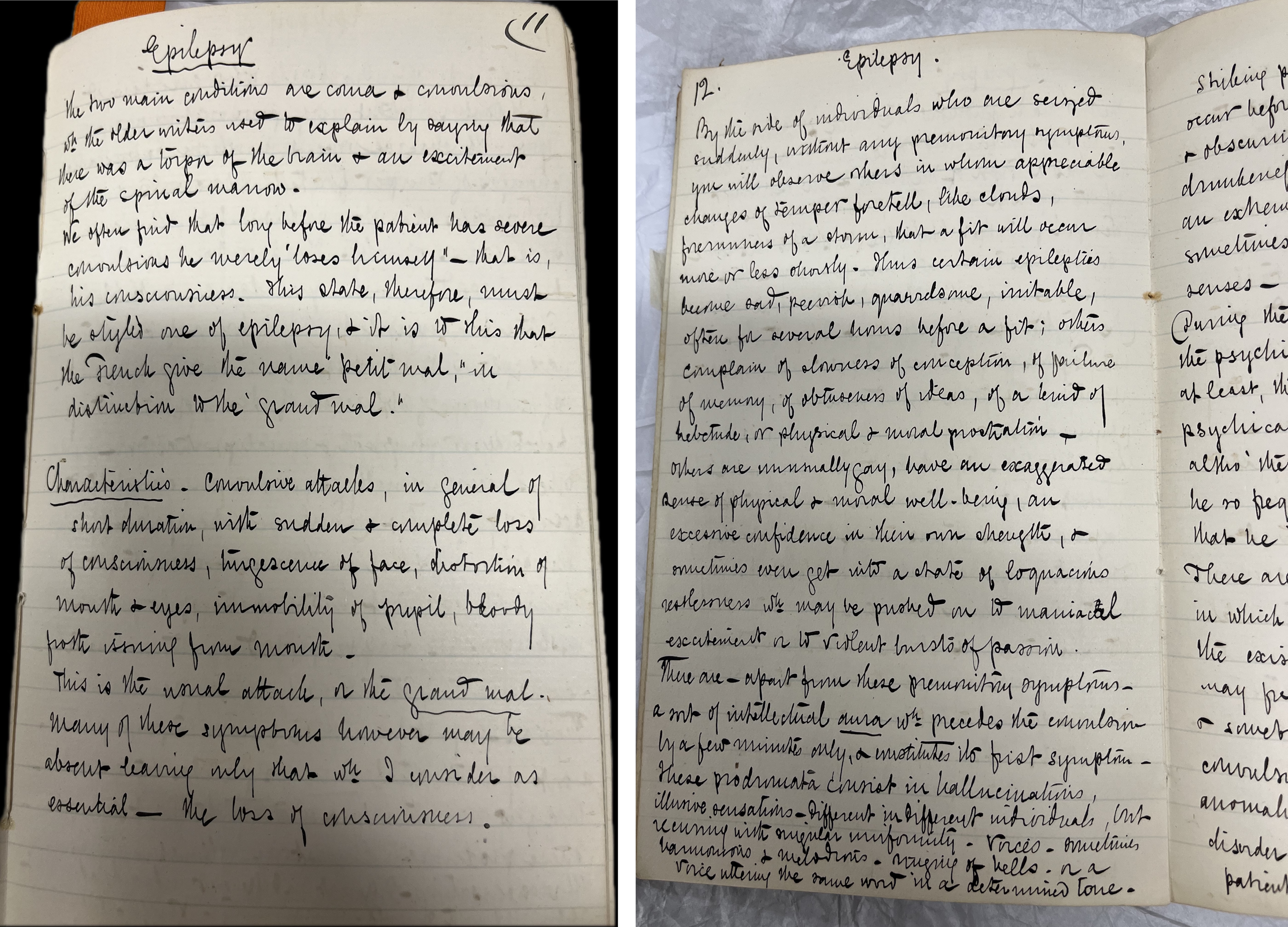
There has been a tenacious perception that Braddon, as a writer who penned her novels at a furious and prolific rate, did not undertake research. She herself contributed to this view by commenting in a late autobiographical article that “Truth in fiction” mattered “[not] one jot.”Footnote 16 Yet by the later decades of the century (and particularly after her own experience of mental crisis), I have found new evidence that Braddon was conducting research for her novels, specifically in relation to different forms of insanity, their symptoms, and treatment. An undated notebook, held in the Mary Braddon Archive at Canterbury Christ Church University and previously undiscussed in scholarship, consists mainly of notes written by the author while planning out some of her late novels (fig. 1). In this notebook, Braddon has transcribed work on various forms of insanity as categorized in the Victorian period, such as monomania, mania, and melancholy, from contemporary physicians including Henry Maudsley and George Fielding Blandford. There is a significant section on epilepsy, which encompasses more than eight pages, and is undoubtedly research for her 1894 novel, Thou Art the Man, in which one of the central characters suffers from this condition.Footnote 17 Indeed, passages in that novel draw heavily on the Maudsley excerpts in her notebook.
Transcriptions in Braddon’s “Black Notebook.” © Undated notebook, CC/U/BR/014.49, Mary Elizabeth Braddon Archive. By permission of the International Centre for Victorian Women Writers, Canterbury Christchurch University.

Braddon’s early fiction tends more to unsophisticated stereotypes and melodramatic treatment. In The Trail of the Serpent (Reference Braddon1861), the hero, Richard Marwood, feigns madness to avoid the death penalty for a murder he did not commit. Richard is instead committed to an insane asylum, where he lingers for eight years before being rescued by the novel’s detective. However, there is no passionate reforming zeal here, such as we encounter in Reade’s Hard Cash (1863). The asylum scenes give rise to comedy rather than gothic horror, since all the inmates appear to be suffering from the exact same form of madness as Richard himself—the grandiose delusion. Richard’s “peculiar hallucination” is “his fancy that he was the Emperor Napoleon the First,” which, we are told, was “little wonder in a place where every wretched creature fancied himself some one or something which he was not.”Footnote 18 With a blithe disregard for probability or medical verisimilitude, Braddon depicts a set of deluded but generally happy people who all believe they are famous:
Queen Victoria is talking to Lady Jane Grey about to-day’s dinner. […] Chronology never disturbs these good people; nobody thinks it any disgrace to be an anachronism. Lord Brougham will divide an unripe apple with Cicero, and William the Conqueror will walk arm-in-arm with Pius the Ninth, without the least uneasiness on the score of probability…Footnote 19
Such scenes seem marked by stereotype, humor, and cliché, but we might also note that even these early depictions draw to some degree on current ideas. There are examples throughout the contemporaneous medical literature of patients experiencing these kinds of delusions. In her study of the West Riding Pauper Lunatic Asylum, Investigating the Body, Jennifer Wallis discusses numerous reports by asylum doctors of patients experiencing delusions of grandeur.Footnote 20
Toward the end of the 1860s, but prior to her own mental breakdown, Braddon’s representations of asylums had taken a darker turn. In Rupert Godwin (Reference Braddon1867), a novel heavily influenced by Reade’s Hard Cash, the bewildered, traumatized, terror-stricken, and anguished states that characters constantly experience blur the line between a notional binary of sanity and insanity. Most of the characters exist in an indeterminate borderland between those two states, which effectively throws into question accepted definitions; the horrors of the asylum are shown to be magnified precisely because of this liminality between madness and rationality. After suffering a brain fever, the young protagonist, Lionel, is declared clinically insane by his doctor: “I am afraid there is no doubt about the case—the young man is mad. That rooted delusion … can only result from madness. The fever has been got under, but the hallucination still remains. There are all the symptoms of insanity.”Footnote 21 Here again Braddon complies with contemporary medical thinking about the distinction between madness and the temporary mental confusion brought on by brain fever. As she defines it in another novel, Sons of Fire (Reference Braddon1895): “that delirium without fever which constitutes lunacy from the standpoint of law and medicine.”Footnote 22 Braddon’s definition is supported by medical dictionaries still in use during the 1860s. As one authority articulates the distinction: “in a phrenitis there is always a fever [and] also a delirium…. But a mania is a Chronical Disorder without an acute fever.”Footnote 23 In this way, fear is generated in the reader through an emphasis on the ambiguous nature of madness and the fallibility of medical judgment. By drawing directly on established medical authority, Braddon creates this ambiguity far more effectively than by resorting to distortion or exaggeration.
Rupert Godwin is a novel that clearly illustrates the ways in which fiction representing lunacy during this period is frequently characterized by a slippage between gothic tropes and a modern medical lexis. This remains evident throughout the century, as demonstrated by Braddon’s Reference Braddon and Talairach1894 fiction, Thou Art the Man—a novel about epilepsy, degeneration, and heredity, written in a register that, as Laurence Talairach has astutely noted, “oscillat[es] between demonic possession and clinical discourse, constructions of epilepsy—and of evil—hesitat[e] between the supernatural and the physiological.”Footnote 24 For the Victorians, epilepsy was barely distinguished from insanity, and lunatic asylum records show just how many people were incarcerated for this condition—many of them for life.
As mentioned previously, Braddon made extensive notes about epilepsy, painstakingly transcribing the work of Maudsley and other contemporary lunacy physicians. Her research ensured that representations and discussions in the novel—of epileptic seizures, theories of cause, and recommended treatments—reflected up-to-date medical thinking in the wake of a nascent understanding of neurology. Yet, importantly, Braddon also deviates from her sources. Whereas Maudsley and other contemporary theorists of epilepsy, such as the physician and criminologist Cesare Lombroso, drew connections between the epileptic and the criminal, Braddon’s narrative resolutely negates this idea. Brandon Mountford has read the medical authorities of the day and internalized their dire warnings to the extent that he is ready to believe himself a murderer. Not only does Braddon interrogate these assumptions, but she also critiques the contemporary widespread practice of institutionalizing those with the condition by demonstrating that incarceration is catastrophic to Brandon’s mental and physical health. The heroine accuses the villain responsible for Brandon’s long confinement of an act tantamount to murder: “the merciless imprisonment of a man for whom, of all men, a free existence under God’s sky meant health and life”; “the slow torture of years—the living death which you, the murderer inflicted on an innocent man.”Footnote 25 In Braddon’s diversion from her medical sources, she proves herself a critical reader and an engaged participant in contemporary medical debates. More than this, her own experiences in the months of 1869 seem to have informed her view (consistently presented in the post-1869 fiction) that incarceration, far from being the solution to illnesses of the mind, may actually prove detrimental.Footnote 26
“Life was a blank”: Braddon’s Mental Crisis of 1868–69
What we have known about Braddon’s breakdown, and the subsequent period when she disappeared from public view for almost a year, is limited and culled entirely from Robert Lee Wolff’s authoritative 1979 biography, Sensational Victorian. Subsequent scholarship has been content to reference Wolff’s version of events, and, until now, nothing additional has been uncovered about the circumstances of Braddon’s illness and treatment. Wolff sees Braddon’s collapse as a consequence of the combined stresses of exhaustion following a decade of intense work and the shock and grief experienced over her mother’s death. “The half-dozen years since the triumph of Lady Audley’s Secret,” he writes, “had been years of intense labor and of occasional bitter disappointment.” Noting the “over rapid production” that had marked Braddon’s career since the outset, Wolff contends that she “became emotionally depressed and professionally cynical, if not disheartened.”Footnote 27 The unrelenting critical attacks by the press throughout the 1860s exacerbated this state of mind, and Wolff plausibly suggests:
The series of domestic griefs that struck [Braddon] in rapid succession at the end of October 1868 found her without her usual resilience. They precipitated a nervous collapse, complicated by an attack of puerperal fever. Madness seemed to hover over her, as the surrounding world grew shadowy. She was forced to lay down her pen for more than a year. During her illness John Maxwell was deeply worried and even after she was well he hated to have her refer to it.Footnote 28
This is the most comprehensive statement of the situation offered by Wolff, and it is notable for its reticence as much as anything else. Despite the level of detail elsewhere throughout his meticulously researched biography, Wolff mentions nothing about Braddon’s doctors, diagnosis, or treatment and merely resumes his narrative in the period immediately following her yearlong hiatus.
The precise sequence of events subsequent to what we would now refer to as Braddon’s mental health crisis is not wholly clear, and I have been unable to discover her official diagnosis.Footnote 29 Wolff states that the birth of her daughter Rosie in December 1868 was complicated by puerperal infection and that “this is remembered in the present generation of the Maxwell family.”Footnote 30 There also seems to have been a widespread recognition that Braddon’s collapse was significantly exacerbated, if not provoked, by mental and physical exhaustion following her remarkable productivity in the preceding eight years. In the press speculation that, as we shall see, abounded during the period of Braddon’s illness and disappearance from public view, more than one journalist ascribed her working habits as a key cause. In September 1869 The Athenaeum, for instance, when Braddon was slowly recovering, stated:
Dangerously ill as one of the hardest workers of her day has been, Miss Braddon, we are glad to hear, is convalescent, and is ready for work, if she is not already at it. Her articles in Belgravia are, however, no proof of the latter, as they may have been written before she was so severely stricken by excess of toil.Footnote 31
Indeed, overwork and the stresses of modern life were commonly implicated by physicians in the perceived rise in lunacy cases during the nineteenth century.Footnote 32 In 1865 a reviewer for the Morning Post had lamented Braddon’s “ill-judged yielding to the fatal temptation to over-work,” claiming that although “not a solitary instance of this unhappy ‘high pressure’ infatuation, … she is so remarkable an instance of it that she must expect to be regarded as almost its type.”Footnote 33 It is most likely that a combination of all these factors—grief, exhaustion, infection, and complications following childbirth—contributed to the mental crisis that overtook her in the final months of 1868.
John Maxwell’s extreme fears for Braddon’s health and sanity, as well as her reputation, meant that little information was given beyond the family. However, gossip was clearly rife, as a letter from George Augustus Sala to his friend Edmund Yates testifies. The letter has an 1868 watermark, and Braddon’s mother, Fanny, had died on the first of November, meaning that this letter was written in either November or December of that year:
My dear Edmund,
Either Don Duffero is the biggest liar out … or the Braddon business has been exaggerated. I think however the first is the case. I met Maxwell today in Fleet Street and asking after Mrs M. he told me that she was “rapidly recovering from a slight attack of nervous prostration into which she had been thrown by the death of her revered parent.”Footnote 34
“Don Duffero” is the nickname Sala habitually used to refer to John Maxwell, and “Mrs M,” of course, is Braddon, who had for several years by this point been styling herself as the legal wife of Maxwell.Footnote 35 Sala proceeds to offer Yates his interpretation of this conversation, with a notable lack of compassion for Braddon, his professed friend:
From all which I perpended that Don Duffero is in a tremendous funk. The last run of the ore in the Richmond mine has been worked. It really does look like Nemesis. How many more 3 vol novels, each representing a ten-roomed house and an acre of land may he not have calculated upon. When I got to Waterloo 2 hours afterwards I met Clarke a bill discounting friend of Gus Mayhew’s and his neighbour at Twickenham. His family doctor is the Maxwell’s physician, and according to his showing poor Braddon is altogether off her chump.Footnote 36
Sala’s inference here is that Maxwell is primarily concerned that Braddon’s illness is not only losing him revenue in the short term but that he fears for her sanity in the long term and, thus, her ability to produce more highly commercial novels. The reference to the “ten-roomed house” alludes to Lichfield House, the Maxwells’ residence in Richmond, which had been bought in 1866 with the profits from Braddon’s lucrative writing. In Sala’s cynical view, then, Maxwell’s attachment to Braddon is purely mercenary, and his distress was not the natural response of an anxious “husband” but due to fear that he may lose the “ore in the Richmond mine.”
Sala’s letter deals in gossip and hearsay, but his reference to meeting Clarke, who is a patient of the same doctor attending Braddon, has a ring of truth.Footnote 37 So too does Sala’s assessment of Maxwell’s desire to downplay Braddon’s illness, which is supported by other sources. Braddon herself, in a letter written after her recovery, requested Bulwer Lytton to not mention the matter to Maxwell, “as that is a point on which my husband is sensitive.”Footnote 38 Maxwell was clearly desperate to keep news of Braddon’s mental distress out of the press, but despite his best efforts, he did not succeed. From February 1869, reports began to appear in various London and provincial newspapers and journals about “Miss Braddon’s illness.” This extensive press discussion of Braddon’s mental health in the first half of 1869 has never previously been identified or discussed in the scholarship.
The Press
On February 24, 1869, the Sheffield Daily Telegraph briefly mentioned that “Miss Braddon is recovering from her severe illness.”Footnote 39 This suggests that a “severe illness” had been previously reported, and the tone indicates a level of assumption that this was generally known. A few days later, the Cosmopolitan reported that “Both Miss Braddon and Miss de la Ramee [Ouida] the well-known authoresses, are recovering from severe fits of illness; the latter from smallpox.”Footnote 40 Again, the precise nature of Braddon’s “illness” is not specified, whereas it is in the case of Ouida.
What is conspicuous in the various notices throughout the following months is the range of tone and differing levels of sympathy expressed. Many publications reported Braddon’s progress respectfully, even with concern, whereas others gleefully took the opportunity to taunt, reminding us of the significant press attacks she had endured throughout much of the decade.Footnote 41 As an example, The Sun commented in early March that
The “conductress” of Belgravia has done wisely, in my opinion, by ceasing to occupy one-half of the magazine with her own writings. Remarkable to relate, the present number contains not a single line from her; the divorce between the Belgravia and Miss Braddon, whom we once considered all but identical, is, at all events for the present, complete. I cannot say I grieve much on that account.Footnote 42
Barely concealed jibes such as this were evident in other newspapers, indicating the hostility in many quarters to Braddon’s brand of sensation fiction and perceived rampant commercialism. The Hampshire Telegraph also felt compelled to comment on Braddon’s perceptible absence from the pages of the periodical she conducted: “Belgravia, without Miss Braddon, is getting to be interesting. The present number contains, so far as we can make out, not a single line by its nominal conductor, and there is no cause for regret on the part of the reader.”Footnote 43
It is difficult to know with any degree of certainty how much these various editors and journalists knew about the precise nature of Braddon’s illness. Certainly, Sala was not noted for his discretion, and it is likely that within the London-based literary circles in which Braddon worked, her mental health crisis was known to at least a small group of friends and colleagues, despite Maxwell’s repeated denials. Nevertheless, it was not until March that the John Bull decided to drop a bombshell and state explicitly the nature of Braddon’s affliction. A single line, in a long column of disparate news items titled “Miscellaneous,” simply read: “We regret to learn that Miss Braddon is out of her mind.”Footnote 44 This brief statement was immediately reprinted by a host of periodicals, under the format “The John Bull regrets to hear that Miss Braddon has become insane.”Footnote 45 Maxwell must have been poised for some such report, because almost immediately The Echo issued a rebuttal, which was instantly taken up and reproduced in numerous London and provincial newspapers:
We are authorised to contradict the statement of the John Bull that Miss Braddon has become insane. It appears that owing to the death of a near relative she has sustained a severe shock.—attributed to The Echo.Footnote 46
John Bull regrets that Miss Braddon is out of her mind. The Echo is authorised to contradict the statement …Footnote 47
Miss Braddon.—The Echo is authorised to contradict the statement of the John Bull that Miss Braddon has become insane. It appears that owing to the death of a near relative she has sustained a severe shock, from which, we are glad to say, she is now recovering.Footnote 48
It is unclear why Maxwell chose The Echo to champion his denials of Braddon’s mental ill health. The Echo, which had only been launched in 1868 as one of the earliest halfpenny evening newspapers, was edited by Arthur Arnold. Arnold divided his time between literary and political interests, and given his staunch radicalism and deep social conscience it is unlikely that he and Maxwell were close friends. Arnold had, however, published two sensation novels during the 1860s, and within the relatively small world of 1860s London literary and publishing circles it is reasonable to venture that the two men were acquainted.Footnote 49 Moreover, Arnold had a reputation as an honest and honorable man, and his personal political beliefs would have inclined him to dislike the strong Tory ethos of John Bull, so it may feasibly have seemed a sensible choice of ally. Regardless of the background to the alliance, The Echo resolutely issued contradictions to the many subsequent reports of Braddon’s “insanity,” even as late in the controversy as August when they “requested to contradict a statement in the Athenaeum of today respecting the health of Miss Braddon. That lady is not dangerously ill.”Footnote 50
One of the fullest statements of the situation was published by a Scottish newspaper, the Elgin Courant and Morayshire Advertiser, only six days after the initial announcement in March by the John Bull. It is worth quoting this notice at some length, because it marks the beginning of a peculiar rumor, which became reprinted, repeated, and discussed more widely in the press. This is also the first report to state that Braddon was residing in an asylum:
Poor Miss Braddon is really in a lunatic asylum. She has been ill for some time, but the ailment was a bodily one, and her mind was as clear as ever. While slowly recovering, she insisted on recommencing work, the habit of writing almost continuously having become almost a second nature with her. Mr. Maxwell, whose wife she is in reality, tried very hard to dissuade her, and her assistant in Belgravia, Mr. Cheltman, told her he could fill the magazine for a year without a line from her; but she insisted on laying the keel of a new story, which she had about half finished when she went wrong. The nature of her disorder is said to consist in continuous unceasing construction of plots. When she can be induced to quit her pen she commences to dictate as if to an amanuensis, and she never advances beyond the mere skeleton or frame work of a sensation plot. She never touches character, never has an interlude of dialogue, but constant plot, plot, plot. It is said several of these skeletons, each of which requires nothing but to be clothed with flesh, is a sensation novel ready to hand, have already come into other and not over scrupulous hands, who are hard at work upon the product of poor Miss Braddon’s insanity. It would seem as if the waste of one brain were superior to the highest effort of another.Footnote 51
It is difficult to read tone here, but the critic’s depiction of Braddon’s “illness” as an excess of plot device echoes critiques of sensation fiction and strongly suggests satire. Rather than being genuinely sympathetic, as the designation “poor Miss Braddon” and the final sentence might suggest, this remarkable word-picture of compulsive but ineffective plot-weaving might be read as a gibe at an author who had been consistently disparaged for sacrificing realistic characterization to dramatic plot. W. Fraser Rae was just one of the many contemporary critics who accused Braddon of sacrificing convincing characterization to plot, reproving her for populating her novels with “unnatural” creations, merely there to propel the action, and which betrayed the author’s “entire ignorance of human nature and mental processes.”Footnote 52 These repeated criticisms of Braddon’s work resonate in the Elgin Courant’s article, through the claims that “she never advances beyond the mere skeleton or frame work of a sensation plot” and “never touches character.”
The Glasgow Herald picked up this story and used it as a springboard for an outright attack on sensation fiction as a genre. Repeating the idea that Braddon in her illness had resorted to “spin[ning] and dictat[ing] the most extraordinary plots for novels” without ever “getting beyond the mere skeletons of the plots,” the writer goes on to explicitly cite Braddon’s particular brand of fiction as a catalyst for mental illness:
But suppose it were true that Miss Braddon, or any other novelist of the sensation school, had become mentally deranged, would there be anything in the circumstance to excite our special wonder? Allowing that there is much in literary pursuits that is productive as well as protective of mental balance, is there, as a matter of fact, anything in the specific department of sensational fiction which can, to the writer, be fairly described as thus productive and protective?Footnote 53
This lengthy critique of popular fiction concludes that the authorship of novels about “forgery, suicide, murder, and scores of other crimes” means that “it is hardly possible to escape [with a] good conscience or mental stability.”Footnote 54 The indictment of sensation fiction here resonates with the numerous reviewers who argued that the reading of sensational narratives induced nervous disorders; as Henry Mansel claimed, such fiction achieved its effects by “preaching to the nerves.”Footnote 55
By August, the reports were becoming fewer, though they remained partisan in terms of the newspapers that made insinuations about Braddon’s continued absence from public life and those immediately rebutting such suggestions. By this time, Braddon was slowly returning to her work at Belgravia and her other writing obligations.
Brooke House and Private Lunatic Asylums
The Elgin Courant’s statement that “Poor Miss Braddon is really in a lunatic asylum” is not proof that this was indeed the case. However, the Lunacy Patients Admission Register gives details of a Mary Maxwell admitted to Brooke House, Hackney, on February 12, 1869, and discharged on July 21 in the same year (fig. 2).Footnote 56 Despite the lack of a legal marriage, “Mary Maxwell” was the name officially used by Braddon from the early 1860s in letters, publishing business, and in official documents such as the census. The dates in the register also fit with the “6 months” that Braddon mentioned to Bulwer; in his footnotes to the Bulwer letters, Wolff notes that her “breakdown lasted from November 1, 1868, past May 1, 1869; but recovery took many months longer.”Footnote 57
Lunacy Patients Admission Registers, 1846–1921 (1869). Entry gives details of Mary Maxwell, admitted to Brooke House on February 12 and discharged on July 21, 1869. This fits precisely with the “6 months” that Braddon mentioned to Bulwer.

Mary Maxwell is listed as a private patient—indeed, Brooke House rarely admitted pauper patients—and on discharge, she is indicated to be “recovered.” I have traced all the Mary Maxwells living at this time through the census returns and marriage and death records to eliminate them. Braddon, as Mary Maxwell, best fits the criteria of status and locality.Footnote 58 I also think it is plausible that Maxwell would choose a private asylum that was in London, but at sufficient distance from Richmond to expedite secrecy. As previously noted, I have been able to discover very little about Braddon’s care and treatment between her initial mental collapse in November 1868 and her recovery in the late summer of 1869. If indeed the “Mary Maxwell” admitted to Brooke House in February was Braddon, then the most probable scenario is that her postnatal complications and mental exhaustion were treated at Lichfield House by the family doctor. When, by February, Braddon was not recovering as hoped, he would presumably have advised Maxwell that she needed specialist treatment. In the absence of surviving documentary proof, this remains speculation, albeit credible given the common recourse to asylum treatment in this period for mental breakdown.Footnote 59
The proprietor of Brooke House, Henry Monro, had the advantage of coming from a well-established family of alienists with a prominent reputation, and Maxwell and Braddon would doubtless have wanted the best care that money could buy; it is clear from the admissions registers that the patient profile of Brooke House was largely upper-middle class and included titled patients.Footnote 60 For most of its nearly two centuries as a private lunatic asylum, Brooke House remained in the ownership of the Monro family, who acted as proprietors through five successive generations. The Monroes were also the chief medical attendants at Bethlem, making them a key dynasty of “madhouse keepers” through the eighteenth and nineteenth centuries.Footnote 61 By the mid-Victorian period, Brooke House was under the superintendentship of Henry Monro, who was also the chief physician at St Luke’s Hospital; he became president of the Medico-Psychological Association in 1864. In the year prior to Mary Maxwell’s admission, Monro formed a partnership with Dr. Josiah Oake Adams, who seems to have quickly taken on the day-to-day management of the asylum. Correspondence held in the National Archives at Kew show Adams as the active partner in relation to Brooke House from the late 1860s, and he continued this position after Monro’s death in 1891.
John Maxwell would probably have been assured of the high reputation of Monro and Adams, and of the exclusive nature of Brooke House. However, the asylum was not without its share of scandals. Richard Paternoster, writing in the early 1840s, before Henry Monro’s time, offered a damning account of Brooke House under Edward Thomas Monro (Henry’s father): “The coercive system is in full force here, as might well be expected from the cruel, brutal disposition of the owner, whose conduct to the patients in Bedlam has so often been a matter of inquiry and comment.”Footnote 62 There is support for these allegations in the fact that Edward Thomas Monro was ultimately dismissed from Bethlem following a series of highly critical reports from the Lunacy Commissioners. According to Iain Macintyre, he was “subsequently admitted as a patient to the family madhouse, Brooke House, where he remained until his death in 1856.”Footnote 63 A later exposé appeared in the 1880s, the inflammatory Brooke House Exposed, self-published by Charles George Ethelstone. Ethelstone, who had been admitted as a patient on November 27, 1878, alleged to have suffered a range of abuses during his time in the asylum, including attempted murder.Footnote 64
Although the Lunacy Commissioners do note a number of problems in their annual reports on the Metropolitan Houses (London’s private lunatic asylums), there is a clear sense that both the building and the day-to-day care were improved and professionalized under Henry Monro’s and Adams’ superintendence. The shift to “moral management” within the asylum system was well and truly established by this point, and Monro’s published works clearly show him to be a follower of the principles of care and nonrestraint established earlier in the century by William Tuke at The Retreat and John Conelly at Hanwell.Footnote 65 In the year that Mary Maxwell was resident, the commissioners reported:
Occurrences which took place in Brook[e] House in June last, and which made it necessary to provide for the better classification of the patients, and a more effectual separation of the sexes, have resulted in important alterations carried out by Dr. Monro in the structural arrangements of the house, which will add materially to the comfort of the patients and the proper working of the establishment.Footnote 66
The nature of these “occurrences” is unclear, but this and other accounts of improvements suggest a concerted effort on the part of Monro and Adams to challenge the largely negative perception of private lunatic asylums in the wider society. To this end, Monro published Articles on Reform in Private Asylums in 1852, his contribution to a highly polarized public debate.Footnote 67 His arguments in this intervention align with the position of leading alienists such as John Conolly, who gave evidence in defense of private asylums to a select committee in 1859. Conolly’s article based on this evidence, published in the Journal of Mental Science in 1861, offered a rebuke to the widespread perception of the private houses as institutions motivated by profit and not accountable to the same degree as the pauper asylums. Conolly complained that the medical men in charge of private asylums “are simply regarded as the keepers of boarding houses, eager for gain, and careless as to the means”; he laments the lack of respect for these alienists (“men of liberal education” and “rank in their profession”), and notes that “they are regarded by law as dishonest tradesmen, and have to apply for a licence, to be renewed yearly, after the manner of public-house keepers, and proprietors of tea-gardens and dancing rooms; a degradation that … might most easily be removed.”Footnote 68
Despite the concerted attempts of the medical men to defend the asylum system, suspicion persisted in the public mind, arguably fueled by sensational representations by such novelists as Braddon herself. At the same time, there is evidence to suggest how common it was for people of the middle and upper classes to enter asylums. To use again the example of Sala’s letters to Yates, a note from Thursday, May 16, 1861, offhandedly mentions that “A set of ill luck has come upon me that wretched brother of mine Albert has been discharged from Hanwell where I hoped he was safe.” In another letter of 1874, Sala gossips about the widow of a mutual friend, Horace Mayhew, laconically commenting that “Poor Mrs Ponny Mayhew off her chump at last. Keepers. Dr Tuke. Alcoholic amentia.”Footnote 69
This sense of the prevalence of such instances involving the “respectable” classes is supported by the number of “lunatics under detention” in the Metropolitan Licensed Houses. These were the private lunatic asylums of London and its environs, catering almost exclusively to the middle and upper classes. On January 1, 1869, there were a total of 2,114 patients in Metropolitan Licensed Houses, and of that number, 862 were new admissions or readmissions during that year. Brooke House itself, at the start of the year 1868, numbered a total of 70 private patients, 38 male and 32 female. There were 42 new admissions during that year, and 32 patients discharged, 14 of whom are marked as “recovered.”Footnote 70 The widespread confinement of individuals in asylums was reflected in the cultural and literary fixation on madness and control—themes that were most prominent in the sensation novel. The final section of this article will consider how the experiences of 1869 affected Braddon’s subsequent fictional representations of mental ill health and the institution of the asylum.
Post-Illness Fictional Representations
Of Braddon’s novels published in the years immediately following her illness, one in particular stands out for its detailed and realistic representation of mental breakdown and the private lunatic asylum. Strangers and Pilgrims was serialized in Belgravia between November 1872 and October 1873, and can arguably be seen as the novel in which Braddon comes closest to fictionalizing her own experience at Brooke House. The novel explores the perils of marrying for wealth rather than genuine attachment through the tragic life of Elizabeth (Lizzie) Luttrell, who despite being in love with her father’s worthy curate, instead marries a wealthy peer. The marriage does not work, Lizzie’s child dies, and in the final sections of the novel, her husband arranges for Lizzie to be admitted to a lunatic asylum. Although the faithful curate ultimately rescues her, Lizzie’s health is broken and she dies, leaving her money to her true love to use for philanthropic purposes.
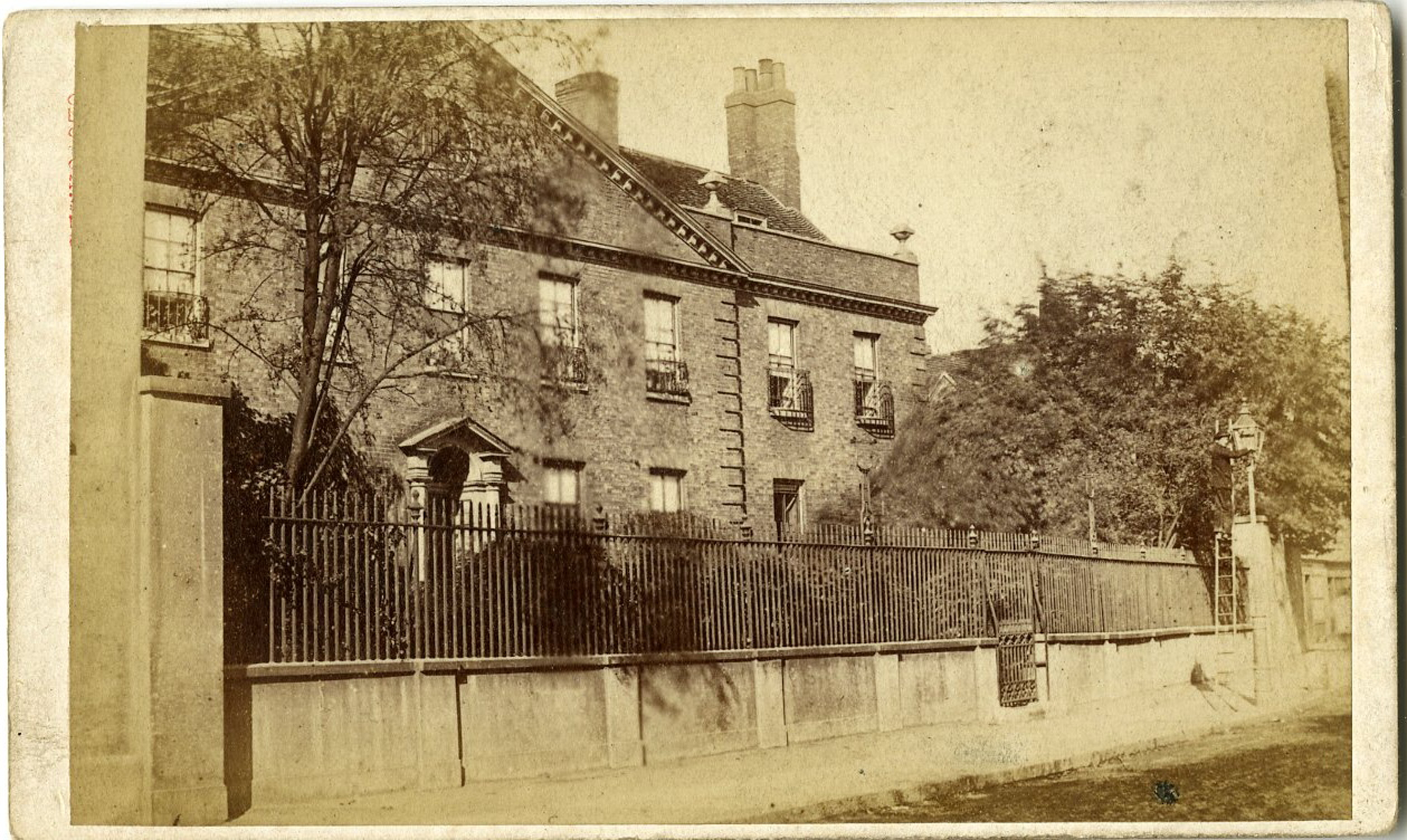
The chapters dealing with Lizzie’s mental breakdown and her subsequent residence in the asylum are starkly different from former representations, such as those previously discussed in The Trail of the Serpent and Rupert Godwin. The detailed descriptions of the asylum building, its daily activities, the patients, and medical attendants are distinct in their realism, specificity, and authenticity (fig. 3). Braddon’s writing is always powerful when based on personal observation, and there are obvious similarities between Hetheridge Hall, the asylum in Strangers and Pilgrims, and Brooke House.
A spacious old-fashioned mansion north of London among the green by-roads between Barnet and Watford; a noble old house, red brick, of the Anne period, with centre and wings making three sides of a quadrangle; a stately old house, lying remote from the high-road, and surrounded by pleasure-grounds and park.Footnote 71
Brooke House, frontage to Upper Clapton Road, looking northwest, ca. 1870. Photograph by George James, courtesy of Hackney Archives. Image reference number P14866.31.

Brooke House was built in the Tudor rather than Queen Anne period, but both asylums originated as grand stately homes, close to London. Like Hetheridge Hall, Brooke House also boasted pleasure gardens and a quadrangle (fig. 3). In contrast to Rupert Godwin, where the relentless horrors of the asylum seem designed to confirm Victorian fears and assumptions, here Braddon resolutely shuts down such stereotypes:
The traveller, lingering a few moments by the park fence to look down the long straight avenue at the grim red façade of Hetheridge Hall, was apt […] to fancy dire scenes of horror within those solid oak walls: secret dungeon chambers underground, in which wretched creatures, forgotten by all the world except one brutal guardian, languished in sempiternal darkness, chained to a damp black wall, against which the slimy rats pushed noiselessly to fight for the madman’s scanty meal. […] But there were neither robora nor piombi in Dr. Cameron’s prosperous and comfortable establishment; and the only horrors within that melancholy mansion were the gloomy thoughts of those among its occupants who were not quite mad enough to be unconscious of their state. (238)
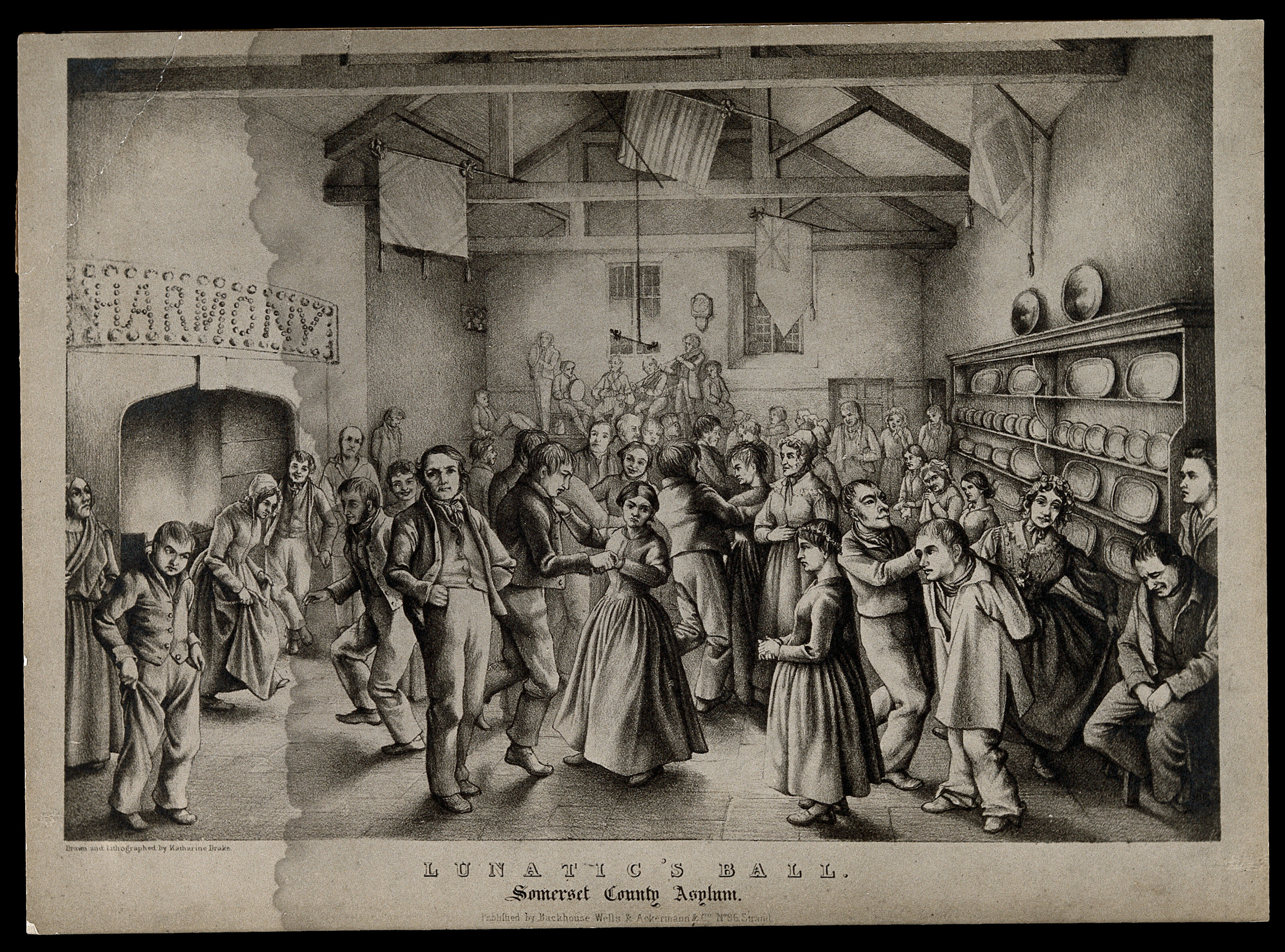
Instead of restraint and ill treatment, the daily routine of Hetheridge Hall accurately reflects the type of activities encouraged in asylums during this period, including entertainments such as music, painting, and dancing (fig. 4).Footnote 72
Here once a week throughout the slow long winter the doctor’s patients pranced and capered through First Sets and Lancers and Caledonians; while the younger and more fashionable among them even essayed round dances […] mild refreshment in the way of white-wine negus and raspberry-jam tarts was dispensed between nine o’clock and ten. (239)
Mentally ill patients dancing at a ball at Somerset County Asylum. Process print after a lithograph by K. Drake, ca. 1850/1855. Attribution-NonCommercial 4.0 International (CC BY-NC 4.0). Source: Wellcome Collection.

The doctor who runs Hetheridge Hall also has similarities to Dr. Monro of Brooke House. A “man of considerable benevolence, who conducted his house on a liberal scale, gave his patients airy rooms, ample service, and good living,” Dr. Cameron, like Monro, is Scottish and not permanently resident at the asylum he owns. Dr. Cameron “did not live at Hetheridge, but drove down from the West-end once or twice a week in his brougham, saw a few particular cases, … took a chop and a glass or two of dry sherry with his subordinate—the medical superintendent at Hetheridge—and then went back to his metropolitan practice, which was a large one” (241). This echoes the situation at Brooke House, where the medical superintendent, Josiah Oake Adams, had responsibility for the day-to-day running, while Monro was physician at St. Luke’s in Islington.
If the detailed descriptions of the asylum and physicians reflect aspects of Brooke House, it is also notable that Braddon’s representation of the actual experience of mental distress marks a new departure from previous literary treatments. Stripped of the melodrama that characterized Lady Audley’s self-declared madness, Lizzie’s state of mind is rendered in a compellingly realistic manner and indeed echoes words and phrases used by Braddon to describe her own illness when writing to Bulwer. For instance, Lizzie’s mind is like “shadows moving in a phantom world” (242), and her illness is marked by “a period of dull apathy, an absolute blank” (248), “a dream-like apathy, in which thought was not” (243). Braddon wrote to Bulwer in June 1872 (a few months before beginning the serial of Strangers and Pilgrims):
For more than six months after that date life was a blank, or something worse than a blank, an interval in which imagination ran riot, & I was surrounded by shadows. […] When that unreal world faded the actual world seemed strangely dull and empty and my own brain utterly emptied out—swept clean of every thought. My first efforts to write after that time were beyond measure feeble, and I thought imagination was dead, – but, thank Heaven, the knack of copy-spinning, at least, has returned. (emphasis mine)Footnote 73
Words such as “dull,” “empty,” “apathy,” and “shadows” are used repeatedly to describe Lizzie’s mental state—“a vast blank interval, a dismal pause wherein life came to a standstill” (249)—and, similarly to her author, the original trigger for Lizzie’s breakdown is grief. Braddon herself clearly pinpoints the beginning of her mental illness from the shock of her mother’s death, which she refers to as “the bitterest hour of my life.”Footnote 74
As I have argued, Braddon represents the asylum in Strangers and Pilgrims in a realistic and knowledgeable manner, with an absence of melodrama or sensationalism. This did not go unnoticed by the reviewers, and the critical reception of the novel was overwhelmingly enthusiastic: “To our thinking Strangers and Pilgrims is, as we have said, the best and most legitimately interesting story Miss Braddon has written.”Footnote 75 The Era agreed that “from a literary point of view,” the novel was “unquestionably the best thing [Braddon] has achieved,” and they particularly praised “the drawing of character so clear and definite,” while “the chief personages of the tale are uncommonly lifelike and real”; “The incidents are exceedingly natural, and the dialogues have an almost photographic fidelity.” It is testament to Braddon’s realistic treatment of the asylum scenes that The Era declares “there is no hint of sensationalism from the first chapter to the last”; instead, the novel is praised as “a natural, lifelike, readable, well-written story.”Footnote 76 The Athenaeum concurred that “Miss Braddon’s new novel is the best piece of work that she has done” and praised the “truth of the life-like pictures of mean lives that fill the greater portion of the book.”Footnote 77 This emphasis in the reviews on “truth” and “fidelity” not only points to the notable departure in Braddon’s style with this novel, but also gestures to the idea that her representations of mental illness and asylum life are truthful and “life-like” because they are based on firsthand experience and observation.
Conclusion
In the absence of extant records from Brooke House, it cannot be proven definitively that Braddon was resident there or that she was the Mary Maxwell admitted in February 1869. The circumstantial evidence, though, is compelling, particularly when coupled with the extensive commentary in the periodical press and the shift in Braddon’s representations of insanity and asylums in her novels. What is interesting is that for all their terror of the asylum, the specter of false incarceration, and the anxieties around madness—in terms of blurred definitions, fear of the Other, and fear of being the Other—Victorians simultaneously seemed to accept the necessity of the asylum. The casual references by Sala to family and acquaintances who have entered lunatic asylums suggests the regularity and, arguably, normality of such occurrences, despite the gothic othering in much public discourse. Peter McCandless states that in 1844, “the number of patients in English and Welsh asylums was about 11,000. By 1854 it had increased to almost 20,000, and by 1866 to over 30,000.”Footnote 78 It would seem likely that the author of one of the most famous Victorian madwomen may have been among that number. More pertinently perhaps, Braddon was a novelist who not only wrote about mental illness but also experienced psychological struggles that significantly hindered her capacity to work and rendered her the subject of public speculation. This biographical context coincided with a marked shift in her literary treatment of madness—from its deployment as a sensationalist trope to a more complex and introspective concern. The public discourse surrounding her mental health reveals entrenched cultural stigmas and the pervasive climate of shame that characterized attitudes toward mental illness in the period.
In the examples of Braddon’s fictional representations discussed here, the symbiotic and dialogic relationship between the worlds of literary authorship and medical science are apparent. A striking example of these connections comes from Henry Maudsley, one of the leading medical authorities that Braddon chose to read and transcribe in her notebook. In his influential book, Responsibility in Mental Disease (1874), Maudsley writes: “Probably the invention of the modern sensation novel, with its murders, bigamies, and other crimes, was an achievement of the epileptic imagination.”Footnote 79 In pathologizing sensation fiction itself here, Maudsley offers a suggestive example of the reciprocal relationship between Victorian literature and medical science.


 Open access

