




Introduction
During the first millennium BC, Europe was a mosaic of distinct yet comparable societies. The geographical distribution of specific types of material culture and practices indicates that elite groups, of similar social status, were interconnected over long distances. In particular, cultural elements, such as the use of prestige goods as part of funerary practices, suggest that Bronze and Iron Age societies across Europe shared a number of social and ideological constructs (Kristiansen Reference Kristiansen2000: 207). One notable expression of this elite connectivity is the practice of using bronze vessels, originally designed for drinking ceremonies, as metal cinerary urns. This type of funerary practice has been widely observed in Mediterranean contexts, including a number of well-known and exceptional burials, such as that of Kourion-Kaloriziki (Cyprus), Lefkandi and Eretria (Greece), or Pontecagnano (Italy) (Verger Reference Verger1995b). The variety of other objects and monumental architecture associated with these burials, alongside their description in Homeric and Hittite textual sources, has generated great interest amongst archaeologists, and many questions about these burials have consequently arisen. These include the notion of the (Homeric) ‘hero’, the relationship between elite funerary practices and their representation in ancient texts, and the diffusion of this form of burial around the Mediterranean (D'Agostino Reference D'Agostino1977: 59–60; Mêle Reference Mêle1982; Morris Reference Morris, Verbanck-Piérard and Viviers1995; Ruby Reference Ruby, Baray, Brun and Testart2007: 342; Crielaard Reference Crielaard and Gallo2016).
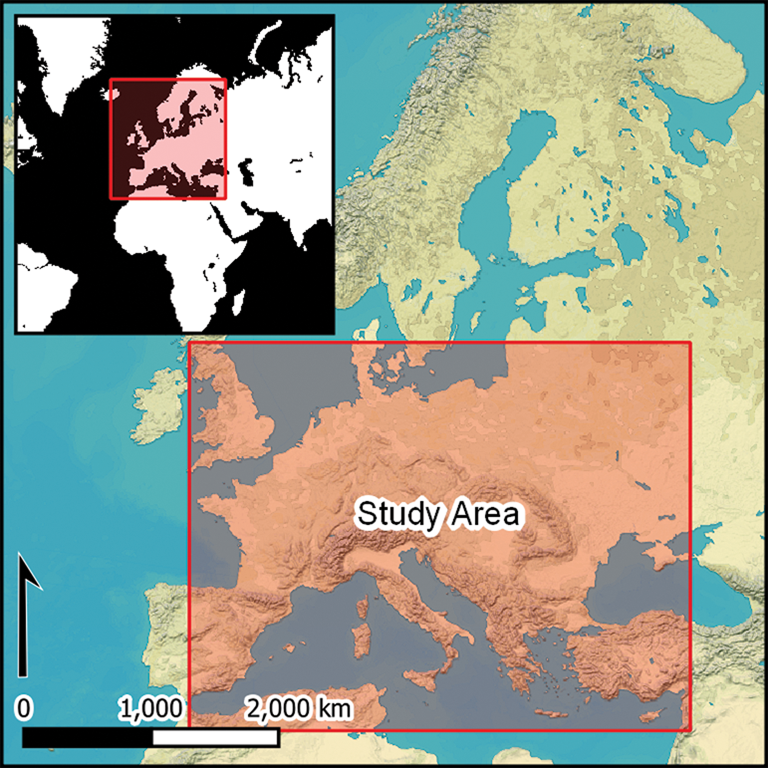
In the present article, I do not discuss the association of the term ‘heroic’ with these funerary practices, nor the significance that has been associated with this concept. Instead, I consider the adoption and practice of this aristocratic funerary custom within three major cultural regions—Northern Europe, Central Europe and the Mediterranean—analysing chronological development, spatial distribution and typological variation. Although there are several studies of this funerary phenomenon for areas of Western Europe (e.g. Verger Reference Verger1995a; Moulherat Reference Moulherat2001), and at a wider European scale (e.g. Verger Reference Verger1995b), the Mediterranean remains the principal focus of scholarly research, leading to a neglect of parallel evidence from Northern and Central Europe. The study area for the present research extends, east to west, from Ukraine to France, and, north to south, from Sweden to Cyprus. This broad geographical approach relegates the importance and relevance of the question of the chronological relationship between such funerary practices and the Homeric and Hittite literary and epigraphic sources (Crielaard Reference Crielaard1995; Ruby Reference Ruby, Baray, Brun and Testart2007). Instead, the two major challenges are inconsistencies in the documentation of excavations and the absence of a harmonised chronology and vessel typology extending across the whole of Europe.
The archaeological inventory of metal urns from across Europe demonstrates that this funerary practice extended far beyond the Greek world. To date, however, it has been perceived and studied as a fragmented phenomenon. In taking a pan-European perspective, the approach adopted here requires the sacrifice of the detail of individual burial sites, and even of the variations specific to wider social groups, in order to move towards a new, synthetic understanding of the practice.
The corpus of metal urns analysed here, totalling 598 examples, demonstrates significant homogeneity: over 95 per cent are of types used for drinking at symposia and feasting ceremonies (Desplanques Reference Desplanques2020). This marked preference reflects the integration of ritualised drinking and associated aristocratic behaviour patterns among the elites of Bronze and Iron Age Europe (Metzner-Nebelsick Reference Metzner-Nebelsick and Sofaer2018: 47–49). Such standardised and enduring aristocratic practices emphasised the social status of these elites and served to legitimise and perpetuate their power.
Fourteenth to ninth centuries BC
The first known occurrences of metal vessels used as cinerary urns are approximately contemporaneous to the north and south of the Alps, appearing between the fourteenth and ninth centuries BC (Figure 1). The precise chronology of these earliest occurrences, however, is uncertain, as many of these burials are poorly recorded and dated.
Map of the geographical distribution of urns between the fourteenth and ninth centuries BC (figure by E. Desplanques).

North of the Alps, the oldest burials of this type belong to elite cremations from southern Germany, southern Scandinavia and south-eastern Central Europe. The adoption in these areas of metal urns for cremation burials correlates with the exchange network that comprised the North Alpine economic complex, which emerged from the Early Hallstatt onwards (Makarová Reference Makarová, van der Vaart-Verschoof and Schumann2017: 34). The only potential occurrence of this funerary tradition pre-dating 1200 BC is an urn from the Allerup basin, Denmark, which has been dated to between 1450 and 1350 BC (Sprockhoff & Höckmann Reference Sprockhoff and Höckmann1979: 65), although it is unclear whether the vessel was specifically used to contain cremated bone. Among the earliest securely dated examples is the well-known Skallerup complex (1300–1100 BC; Müller-Karpe Reference Müller-Karpe1980: 890) (Figure 2).
Cauldron from Skallerup (CC BY-SA, John Lee, National Museum of Denmark).

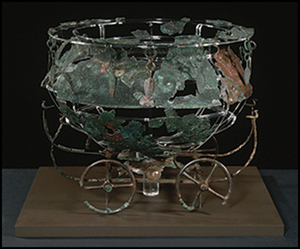
The dates of these earliest examples of metal-urn cremation burials suggest the near contemporaneous emergence of the phenomenon in Central Europe and the Eastern Mediterranean. In Central Europe, the practice is attested by vessels from Peckatel in Germany (1300–1100 BC) (Figure 3), Witonia in Poland (1300–720 BC), and Nezvěstice-Podskalí in the Czech Republic (1300–800 BC) (Müller-Karpe Reference Müller-Karpe1980: 866; Kytlicová et al. Reference Kytlicová, Nekvasil, Podborsky and Siegfried-Weiss1991: 14; Gedl Reference Gedl2001: 50).
Cauldron from Peckatel (LAKD M-V, Landesarchäologie, Sabine Suhr).

In the Eastern Mediterranean, the practice is observed on Crete, Cyprus and Euboea at the end of the Bronze Age, suggesting regular contact between these three islands. On Crete, a lekanis from a burial at Tylissos may have been used to contain cremated bone (1200–1100 BC) (Ruppenstein Reference Ruppenstein, Lochner and Ruppenstein2013: 191). This example is followed by urns from Pantanassa Amariou, Crete (1100–1000 BC), Kourion-Kaloriziki, Cyprus (1125–875 BC), and by the finds from Lefkandi in Greece (1000–950BC and 875–850 BC) (McFadden & Sjöqvist Reference Mazon1954: 131; Popham et al. Reference Popham, Touloupa and Sackett1982; Popham & Lemos Reference Popham and Lemos1995; Tegou Reference Tegou and Stampolidis2001: 131).
The typology, quantity and value of grave goods, such as jewellery, weapons or vessels, deposited in these early cremations are very similar to those of grave goods deposited in contemporaneous elite inhumation burials. Cauldron- and amphora-type urns were widely favoured throughout Europe, although some forms are associated with specific regions, such as the cruciform cauldrons of Central European manufacture that are found in Northern Europe (Thrane Reference Thrane1965: 179–80, Reference Thrane1984).
Ninth to eighth centuries BC
From the ninth century BC, there is a notable increase in the available data, and the practice of metal-urn cremation now appears well established in all the regions discussed above (Figure 4). In addition, the geographical area covered by this funerary phenomenon seems to extend: the Orăștie cauldron from Romania (800–700 BC) (Calomme-Beginne Reference Calomme-Beginne1977: 12) indicates its spread towards south-east Europe, while in the west, the practice is now observed in western Germany.
Map of the geographical distribution of urns between the ninth and eighth centuries BC (figure by E. Desplanques).

In Italy, the use of metal urns first appears in the central part of the peninsula, before spreading to southern Italy and Sicily in the eighth century BC. At Bologna and Este, in the north of Italy, bronze and ceramic cinerary urns were used at the same time, with the former reserved for the richest burials belonging to members of the aristocratic elites that emerged across Etruria, Campania and Latium in the eighth century BC (Morris Reference Morris, Perego and Scopacasa2016: 139). The rituals that accompanied the use of ceramic vessels used as cinerary urns, such as breaking handles or covering urns with cloth, vessels or bronze helmets, were also applied to metal urns (Verger Reference Verger1995b: 40; Cenciaioli & Feruglio Reference Cenciaioli and Feruglio2004: 8). A variety of urn types were used, including cauldrons, biconical amphorae (Figure 5), situlae (buckets), basins and sometimes cistae (chests). Distinct geographical preferences for different vessel types are apparent: the amphora-type urn in particular seems to have been favoured in Este and Bologna.
Bronze amphora from tomb AA1 of the Quattro Fontanili, Veio (photograph by Sailko; reproduced under a Creative Commons Attribution-Share Alike 4.0 International license (https://commons.wikimedia.org/wiki/File:Vaso_cinerario_con_coperchio_ad_elmo_ad_alta_cresta,_bronzo,_necropoli_dei_quattro_fontanili,_tomba_AA1_a_pozzo,_750_ac_ca.jpg)).

The biconical Italic cinerary amphorae are similar to those observed in Northern Europe, especially those from Seddin and Gevelinghausen in Germany (Jockenhövel Reference Jockenhövel1974; May & Hauptmann Reference May and Hauptmann2012; Hansen Reference Hansen, Hansen and Schopper2018) (Figure 6). The burial at Lusehøj in Denmark highlights the similarities between Scandinavian and Italic funerary practices, and their connection with Homeric literature (Thrane Reference Thrane1984: 17). While the grave goods in this particular burial were made locally, the urn may have been produced in Central Europe (Karnten-Steiermark region) and its lid finds a parallel with an example found at Bologna (Thrane Reference Thrane1984). Furthermore, analysis of the textiles recovered from this burial show that the fibres (nettle) did not originate in Denmark; K.M. Frei has suggested that this piece of cloth, used to wrap the cremated bone, may have originated from the region of Austria (Frei, in Bergfjord et al. Reference Bergfjord2012).
Bronze amphora from Gevelinghausen (May Reference May2008: 131, fig. 2).

Late eighth to mid sixth centuries BC
Between the last quarter of the eighth century and the first half of the sixth century BC, the established geographical distribution of metal-urn cremation burials continues, with further expansion of the custom into Western Europe and an increase in its use in Greece (Figure 7). The range of vessel types used increases, with cauldrons still common, but cistae, basins and situlae now also well represented. The identities of the deceased individuals also appear more varied in this period in terms of identifiable ages and sexes, although burials of men still form the majority. In contrast with the previous period, the grave goods found with the metal urns are similar to those associated with ceramic-urn burials or inhumations. The distinction between burials whose furnishings are similar is made by the presence of the metal urn. It is clear that some individuals of high social status were not afforded funerary rites involving cremation in metal urns: the criteria for choosing between cremation and burial are unknown.
Map of the geographical distribution of urns between the end of the eighth and the first half of the sixth centuries BC (figure by E. Desplanques).

In the Mediterranean region, the custom of metal-urn cremation burials takes several different forms. Greek and Cypriot burials dated between the eighth and seventh centuries BC share many common features, without distinct local patterns. On Corfu and Rhodes, however, the practice appears only briefly before disappearing a few decades later (Jacopi Reference Jacopi1929: 109; Metallinou et al. Reference Metallinou, Moulherat and Spantidaki2009). A comparison of urns from Eretria in Greece and Cumae in Italy shows that the aristocratic groups who moved from the former to the latter retained elements of the funerary tradition for two or three generations (Albore-Livadie Reference Albore-Livadie1975). In Magna Graecia (southern Italy) and among non-Greek aristocratic groups in Campania, Etruria and the northern Adriatic area, the use of metal urns was combined with existing local burial practices (Verger Reference Verger1995b: 23).
In Western Europe, metal urns form part of a broader increase in the numbers and capacities of metal drinking vessels observed in funerary deposits (Baray Reference Baray2008: 188), and a new focus of activity emerges in western France. In the northern and central regions of Europe, urns are less numerous than in previous periods, although they are found in localised groups at the mouth of the Rhine (Figure 7: groups 1 and 2) in northern Germany and the Netherlands, with an isolated occurrence in Poland (Desplanques Reference Desplanques2020: 158–65). Unfortunately, many of these burials are generally poorly documented. Objects recovered from the well-known Oss-Vorstengraf burial in the Netherlands attest to an area of exchange between southern Germany, the Netherlands, Bohemia, Slovenia and Italy (van der Vaart-Verschoof & Schumann Reference van der Vaart-Verschoof and Schumann2017: 13).
Mid sixth to fourth centuries BC
Urns dated to the second half of the sixth century and the start of the fifth century BC are numerous and seem to be concentrated in several distinct groups (Figure 8). The number and concentration of burials containing vessels associated with drinking ceremonies, the importance of which had been growing since the Late Bronze Age, suddenly increases. Metal vessels become a defining element of aristocratic funerary practices.
Map of the geographical distribution of urns between the second half of the sixth and the fourth centuries BC (figure by E. Desplanques).

In the north of the Italian peninsula, especially at Este and among the aristocratic groups of the Veneto area, burials with metal urns demonstrate a strong conservatism, dating back to seventh century BC. A new group also appears briefly—lasting only a few generations—in western Slovenia. At Sveta Lucija in particular, the appearance of bronze urns corresponds to a period when the necropolis was organised into large groups of family graves (von Duhn & Messerschmidt Reference von Duhn and Messerschmidt1939: 113).
Cremation in metal urns remained widespread in the Greek world. There are examples in the necropoleis of Attica, a continuity in the practice at the Greek colonies of Sicily and Campania, and an expansion of its use in Thessaly, Macedonia and around the shores of the Black Sea (Desplanques Reference Desplanques2020: 218). The adoption of the practice at Lemnos, for example, is dated to the period following the Athenian conquest of the island c. 500 BC (Marchiandi Reference Marchiandi2012: 221). In contrast with the variety of forms found in Western European burials, urns from burials in the Greek world do not demonstrate a particularly varied typology, being mostly cauldrons and hydria (jugs).
In Central and Northern Europe, various vessel forms are used, including stamnoi, basins, jugs, cistae, situlae, cauldrons and amphorae. Numerous burials are known around the concentrations that emerged during the previous period in the Lower Weser and Lower Moselle (Middle Rhine) valleys (Figure 8: groups 2 and 3).
Further east, five urns constitute a geographically extensive but poorly documented group (Figure 8: groups 11 and 12). On the other hand, the appearance of metal-urn cremations in Baden-Württemberg, Jura and Burgundy seems to imply the adoption and adaptation of a funerary rite in order to partially replace chariot burials (Verger Reference Verger1995a: 342; Gomez de Soto et al. Reference Gomez de Soto, Vernou, Boulestin, Villes and Bataille-Melkon1999: 147; Milcent Reference Milcent2004: 279). There is much debate surrounding the origins of the practice in central and east-central France; Verger (Reference Verger, Brun and Chaume1997) suggests an Italic provenance, while others, including Chaume and colleagues (Reference Chaume, Reinhard and Wustrow2007: 361), prefer a Germanic origin. Either way, it is currently difficult to know whether the two examples from western France are isolated in this area, or whether they belong to a wider group of aristocratic cremations of which we have no further record.
In eastern France, cremation in metal urns appears suddenly, is practised for a few generations and then disappears. From the transition between the First and Second Iron Ages (or the Hallstatt and La Tène), during the first half of the fifth century BC, the wealth of burial deposits (e.g. gold ornaments, ceramic vessels) decreases. The disappearance of metal urns seems to follow the decline of the Hallstatt Culture. The sudden profusion of metal urns that we perceive from the end of the sixth century BC is reversed from the second half of the fifth century BC. From the third century BC onwards, the occurrence of metal urns is widely spaced: a few still appear grouped in Northern Europe, plus three from the Greek world (Figure 9) and single examples from Poland and northern Italy. The latest examples of metal urns for cremation burials date to the first century BC.
Map of the geographical distribution of urns between the third and first centuries BC (figure by E. Desplanques).

Discussion
The distribution of metal-urn cremations across Europe during the end of the second and first millennia BC requires us to go beyond the limitations traditionally set by the historiography of the funerary phenomenon, and to consider this long-term phenomenon on a pan-European scale. Although some relevant contexts are poorly documented, the assessment of the evidence presented here demonstrates that the practice of metal-urn cremation burials in Central Europe slightly pre-dates its adoption in Greece and Cyprus. The Greek and Cypriot burials thus appear to echo an established tradition, and therefore the funerals described in the Hittite and Homeric sources may document the adoption of a practice from beyond the Greek world. The absence of evidence for similar burials in the regions between these early Central European and Greek occurrences could be the result of uneven archaeological investigation, but, equally, could also reflect a historical reality.
The adoption of the practice among distantly separated groups may not only be the result of the same funerary tradition being shared by individuals of similar social status, but also some form of shared worldview. More than simply a model of aristocratic behaviour that could move in one direction or the other, the spread of this practice attests the permeability of European social groups in the Bronze and Iron Ages, and their openness to external ideas and practices that were compatible with local cultural concepts. Taking a pan-European perspective demonstrates that connections between Central Europe and the Greek world were not limited to material exchanges but also included the reconfiguration of funerary rites as an expression of aristocratic identities and power. We should therefore envisage a reciprocal exchange of ideas and behaviours between Attica and Euboea in the south and Central Europe to the north and west.
As defined in the archaeological record, metal-urn cremation burials are restricted to a limited number of aristocratic individuals; this is confirmed by literary sources, such as Hittite tablets (Christmann-Franck Reference Christmann-Franck1971: 64–65), Homeric poems (Iliad 23–24; Mazon Reference Mazon2017; Odyssey 24; Bérard Reference Bérard2012) and later Greek literature (e.g. Plutarch, Life of Demetrius 2: 288; Pierron Reference Pierron1845). Moreover, the selection of metal vessels for this practice appropriates one of the three elements, which, alongside chariots and weaponry, had signalled high social status since the Bronze Age. These metal vessels were distinct from containers not only in terms of their (prestigious) material, but also because of their non-domestic status: most were specifically associated with drinking and feasting ceremonies.
Aristocratic symposia demonstrate both core similarities and regional traditions. Wherever they were practised, they served as a highly visible and effective means of defining elite group membership. Drinking sets also played an important role in highly ritualised feasting contexts connecting the living and the dead (Nebelsick Reference Nebelsick2016; Metzner-Nebelsick Reference Metzner-Nebelsick and Sofaer2018: 47–49). The significance of these vessels, and their use in both feasting and funerary contexts, was intended to be universally understood, and this stability of meaning is reflected in the highly standardised vessel shapes that persisted until at least the sixth century BC. More generally, these vessels were well integrated into other religious and cultural ceremonies, including being carried in processions, presented to the winners of competitions and sacrificed to deities (Amandry Reference Amandry1971: 602 & 615; Bonfante Reference Bonfante1981: 44; Albanese Procelli Reference Albanese Procelli2004: 80).
Before their inclusion in these varied ceremonies, some metal vessels had travelled long distances. One of the most obvious examples is that of the ‘Gevelinghausen-Veio-Seddin’-type amphorae, whose distribution extended from Rome to Jutland, and from the Saar to eastern Hungary (May Reference May2008). Furthermore, some of the cistae found in Belgium, France and Italy probably originated in Central Europe (Bouloumié Reference Bouloumié1976: 25), while situlae and amphorae distributed within the Middle Rhine area are thought to have been made in Italy (Verger Reference Verger1995a: 411). At the same time, however, the selection of vessel type was locally determined, as, for example, in terms of the preference for a particular form during certain periods (e.g. cauldrons in Northern Europe and Greece), or the use of vessels that corresponded to established ceramic forms (e.g. amphorae in Italy). These selected elements point to a preference for well-travelled objects. Metal vessels were therefore well integrated into the enduring framework of a trans-European elite. Between their place of manufacture and the location of their final deposition, these objects were exchanged and used in a variety of ways. Evidence of usage and repair demonstrates that they were used and curated for extended periods of time, and probably by multiple owners. Controlling the circulation of such objects through space and time legitimised the status, power and authority of the individuals who had invested in their manufacture, exchange and use (Kristiansen & Larsson Reference Kristiansen and Larsson2005: 978; Crielaard Reference Crielaard and Gallo2016: 58).
The adoption of any new burial practice represents a significant social, political and symbolic choice; this is particularly the case when the change involves a shift from inhumation to cremation and new ways of treating the deceased. The practice of metal-urn cremation burials therefore expressed a new means of differentiating elites from the wider population, whose funerary practices were unaffected. At the same time, the practice underpinned the cohesion of a trans-European elite group that extended far beyond local social frameworks (Baray Reference Baray2008: 194).
Locally, however, members of the elite may also have sought to express differences through their choice of additional grave goods. In some burials, metal vessels that are typologically identical to the metal cinerary urn were placed near the deceased's remains. In these cases, it is not a question of the availability of grave goods, but of a choice of funerary practice in which the vases do not play the same role. In particular, between the eighth and third centuries BC, metal-urn cremation burials are characterised by selective adaptation and integration into local traditions, expressed, for example, through different methods of closing the urn, or the selection and arrangement of the associated grave goods. The strategies of differentiation implemented involved both the use of collective markers of identity—determined by the selection of objects of shared European style and meaning—and individual markers of identity that were selected according to local reference points. In this way, the elite demonstrated awareness of both past and contemporary traditions, as well as the real or imagined behaviour of their European peers. The selection and use of these objects materialised the shared codes of conduct, which are recognised as one of the characteristics of ‘globalised’ behaviour (van der Vaart-Verschoof & Schumann Reference van der Vaart-Verschoof and Schumann2017: 12). Shared ritual behaviour and modes of social distinction imply an awareness of both self and other; it also implies a community of ideas. Such changes in social practice are only possible when supported by associated beliefs and ideas; this is particularly true in funerary contexts. Expedient political and social objectives alone cannot explain a choice that has deep and complex cultural and ideological roots. It seems, therefore, that European elites shared a global understanding of an ancient worldview linking wine, power and death.
Aristocratic metal-urn cremation burial persisted, with various geographical and temporal variations, for more than a millennium. Today, it is difficult to understand the mechanisms that led to its adoption, adaptation and abandonment. The relative contemporaneity of the appearance of metal urns in cremation burials both north and south of the Alps suggests that a cultural, religious and intellectual framework was already in place before the adoption of this specific funerary rite. Subsequently, the memory of ancient and distant communities could be claimed, reshaped and instrumentalised according to the political and social needs of local elites and their individual alliances and objectives. This memory was made visible, legible and comprehensible: it was embedded in words and gestures and in the material culture of feasting and funerary practices.
The results of this study raise further questions that will be explored in future research. The first step must be to evaluate whether the apparent absence of metal-urn cremation burials in Eastern Europe is real. If this is the case, it will be necessary to consider the possibility of the contemporaneous, independent appearance of this practice in several different regions. More generally, it will be important to deepen our understanding of the dynamics of this funerary phenomenon: its transmission and transformations, in terms of ruptures and continuities of practice.
Conclusions
During the first millennium BC, intensive exchange of objects and ideas across Europe led to the development of aristocratic societies. The analysis of the practice of metal-urn cremation burials presented here underlines the importance of this exchange between European Bronze and Iron Age elites. These links were not limited to commercial transactions, but also led to the transformation of several aspects of social organisation and practice, including funerary customs. These transformations reflect the significant degree of social, cultural and ideological connectivity between aristocratic groups across Europe during the first millennium BC.
Usually selected from sympotic drinking services, the various metal vessels used as cinerary urns were associated with the elite sphere in multiple ways: they referenced a shared, pan-European worldview, demonstrated command of long-distance exchange, provided the means to practise aristocratic commensality through which to enhance and maintain social status, and, as containers for the deceased, formed a link to previous generations. In addition to the meanings conferred by their materials and the technical expertise used to manufacture them, these vessels also embodied significance in terms of their provenance, potential antiquity, rarity, functions and symbolism. Across large parts of Europe, the choice of these metal vessels as cinerary urns therefore represented the selection by Bronze and Iron Age aristocratic groups of highly potent and visible symbols, which they used to express their social status in both life and death.
Funding statement
This research received no specific grant from any funding agency or from commercial and not-for-profit sectors.


 Open access


