


The principle on which [Akbar, Mughal Emperor 1556–1605] secured his conquest was [to show regard] to the right of the Zemindars, the ancient proprietors of the soil.
—Philip Francis
… much the greatest part of the Zemindars … are incapable of judging or acting for themselves, being either minors, or men of weak understandings, or absolute idiots.
—Warren Hastings
The British Indian state in the mid-nineteenth century, initiated by the East India Company, had four features unprecedented in Indian political history. Together, they achieved the political and economic integration of a region long marked by fragmentation and decentralized power. First, the expansion of a standing army from a few thousand in 1765 to 250,000 in 1856, and to a million or more during the two World Wars.Footnote 1 Second, the conversion of the army into a force of regulars (salaried, pensioned), transforming it from troops scraped together “from factory doorkeepers and watchmen” into a trained infantry.Footnote 2 Third, the federalization of finances, which gave the center the authority to design military strategy.Footnote 3 Fourth, institutional innovation, rather than territorial expansion, providing the state with greater access to funds. Estimates of revenue per head and per unit of area show a steady rise in both from the 1770s to around 1800, followed by a sharp increase around 1800–1810.Footnote 4 By around 1850, half of that revenue was allocated to funding the army.
The combined process unfolded over a long time, during which the state’s financial base evolved from its initial dependence on land tax and the accommodation of indigenous bankers to the diversification of the tax base and the securitization of public debt. The process, however, began in the late eighteenth century with the British East India Company’s transformation from a commercial enterprise into a sovereign power. At this time, the new state, with an awkward commitment to profit-making, managed to raise more taxes, bring more of them into its central treasury, and reorient its aim from commerce to governance, without relying heavily on force.
A substantial body of scholarship has examined how the new state established its authority, highlighting strategies such as legitimizing rule, forging alliances and accommodations, and displacing and subverting indigenous power.Footnote 5 These studies frame state capacity in terms of its ideological, political, and cultural dimensions, rather than its fiscal and military aspects—the latter being the central focus of this paper. One influential view in this debate argues that the Company state, in its institutions, showed more continuity than change when compared with Mughal and regional traditions.Footnote 6 This sits uneasily alongside another view: that the Company state was unusually effective at centralizing military and fiscal power, an aim that was shared by several Indian states in the eighteenth century.Footnote 7
Most studies of the eighteenth century note the new state’s concern with revenue, driven by the need to restructure for more effective warfare.Footnote 8 Concentrating military power required not only more money but also the ability to directly monitor taxpayers. Eighteenth-century scholarship has paid little attention to how this monitoring was carried out or how the need for it was framed as a problem. The decentralized fiscal system of the precolonial era, which vested authority in regional warlords and landlords, did not require such monitoring and, therefore, could not support centralization. In short, while the literature acknowledges that there were innovations, it overlooks the institutional innovations that supported centralization.
Initially a coastal state concentrated in trading towns, the Company could not rely solely on trade and transit taxes and needed land revenue. Most taxpayers lived in the countryside. In the 1770s, the regime—foreign, unstable, and under military threat—sought direct control over tax collection. That required reliable statistics on rural revenue potential and on intermediaries like landlords and zamindars (defined below), who traditionally collected taxes for local rulers. Such information was scarce or unreliable. A debate among administrators centered on whether to compromise sovereignty or invest in data gathering.Footnote 9 This debate led to the first major property right reform: the Permanent Settlement, which defined the legally recognized property right to be ownership alone (and not user right or policing right), and delivered it to the landlords.
The Permanent Settlement is the subject of considerable scholarship (see the next section), which has viewed it alternatively as a concession by the state to local magnates or as a replication of an English precedent. This paper reads it differently from both of these perspectives. It was the outcome of a struggle to create an information base, including what Travers calls the “real value of land,” but extending beyond that to include the willingness of taxpayers to disclose the value of their assets.Footnote 10 The raw data could be either gathered by the executive authority or by the judicial system. The Settlement came when the former path had yielded little result, but the judicial infrastructure was sufficiently developed to sustain the expectation that the court would reveal the capacity and intention of the current taxpayers when regulators failed to find trusted informants. Far from empowering magnates, the arrangement significantly weakened them—via the judiciary.
To restate my aim, the paper examines how the East India Company built a new kind of state in late eighteenth-century Bengal, by making four main arguments. First, institutional reform and enhancing fiscal capacity were interdependent goals. The Permanent Settlement aimed chiefly to expand revenue, rather than simply follow precedent. Second, because of this emphasis on state capacity, officials sought better information about taxpayers to make institutional reform more effective, with mixed success, and yet made information control a central aim of state-making. Third, the reforms succeeded, raising revenue per person and per unit of land. Finally, this stronger fiscal base enabled the establishment of a centrally funded army. Overall, the Company’s institutional reform was a more systematic enterprise focused on fiscal consolidation than the Indianist scholarship suggests.
This reinterpretation speaks to broader analytical conversations relating to political transition in India, fiscal modernization in Europe and Asia, the relationship between imperialism and European state formation, and information as power. Popular histories often explain the rise of the British Indian state in the late eighteenth century as a product of disorder, opportunism, and violence—terms like chaos, anarchy, coercion, and perfidy carry that implication, even if the authors themselves do not always intend it.Footnote 11 That image deflects attention from the building blocks of state-making. This paper reinterprets the political transition of late eighteenth-century India not as opportunism but as a process of building state capacity.
The paper has lessons for global debates on fiscal modernization and early-modern state formation. A Europeanist scholarship highlights how war-driven demands and institutional reforms in the seventeenth and eighteenth centuries fostered fiscal centralization.Footnote 12 England is often cast as exceptional: after the Restoration, it built a centralized system with parliamentary oversight, enabling indirect taxation and sustainable wartime borrowing, unlike the fragmented Habsburg Empire. The Indianist scholarship has rarely engaged with this narrative on the emergence of military-fiscal states.Footnote 13 The paper suggests that the Company state was not qualitatively distinct from early modern European states, particularly Britain, which expanded military power through innovations in taxation. At the same time, for a new state led by a commercial body in a new land, the effort remained constrained by pre-existing norms, by how these norms were understood and negotiated by the new regime, and by limited access to reliable information about taxpayers. The central concern of the paper is to explain how a nascent state could work within these constraints, overcoming informational and institutional barriers, while still presenting itself as conforming to established norms.
The paper calls for a tighter integration of military-fiscal historiography and the history of European imperialism. The former historiography has largely ignored empires, leaving open a key question: were colonial empires merely products of European modernization, or integral to its making? The limited research now available on the question suggests two things. The colonies, where they could, pursued their own attempt at modernization. And nowhere did this process follow a blueprint inherited from Europe.Footnote 14 That would be impossible because the nature of the challenge was fundamentally different: premodern Asian and African states generated far less revenue per capita than their European counterparts.Footnote 15 In eighteenth-century Bengal, it could not be a copy of Europe because the Company had inherited a well-developed “tax state” from the Nawabs. On the other hand, the enormous expansion of the standing army would seem to confirm the intuition that “the British state was at its most financially active not in England but in the Empire.”Footnote 16 The paper helps to make the case that military-fiscalism in India shaped the British Empire as a global system. Britain utilized the army from the early 1800s to drive imperial expansion within India and beyond. The creation of a large land army, and to a lesser extent, a bureaucracy, was the first step chronologically toward the formation of a global empire. The Empire’s army was created in India. That broader point should lead us to rethink eighteenth-century Bengal as a military-fiscal project.
The fiscal innovation that made military buildup possible was itself built on information. A key strand of state formation theory emphasizes how evidence-based knowledge shaped the development of Western European states.Footnote 17 Transcontinental exploration fostered practices of data collection and processing, often yielding unforeseen effects. Recent global history scholarship links these practices to the consolidation of industrial capitalism.Footnote 18 I find these ideas compatible with the current project. Any new state-building project would need to gather more and better information, starting with the taxpayers. The Permanent Settlement debate did mark India’s first formal recognition of information as a form of state power. The debate reconfigured the conceptual tools of governance. The role of information has not been overlooked. Some studies of the eighteenth-century transition show that the new bureaucracy relied heavily on information, marking a shift from the face-to-face communication more common in indigenous courts.Footnote 19 “The debate about the Permanent Settlement of the revenues of Bengal and Banaras,” wrote Bayly, “incidentally founded the Indian statistical movement.”Footnote 20 However, the references to information in Bayly and these works are not specifically linked to fiscal modernization, the core theme of the paper.
The rest of the paper has four sections dealing with the historiography of the Permanent Settlement, the fiscal project of the late eighteenth century, the emphasis on information, and the Permanent Settlement and its legacy.
India 1801 (British East India Company territories shaded). Source: Author, based on data in the public domain.

Figure 1. Long description
The map highlights British-controlled regions in 1801.
* In the North and Northeast, a continuous shaded belt covers Rohilkhand, Awadh, Bihar, and Bengal. An annotation for Rohilkhand notes it was ceded by Awadh in 1801. A label for Bengal, Bihar, and Orissa states revenue rights were delivered to the Company in 1765.
* Along the East Coast, a shaded strip connects Bengal to the South. A label for the Northern Circars indicates they were effectively handed over by Hyderabad in 1758 and formally transferred in 1823.
* In the South, shaded regions include the area around Madras, acquired in the 1630s from a local Nayaka ruler, and the territories of Baramahal, Dindigul, and Malabar, acquired after the Third Anglo-Mysore War in 1792.
* In the Southwest, a large shaded block labeled Ceded Districts is noted as being ceded by Hyderabad at the end of the Fourth Anglo-Mysore War in 1799 in exchange for military protection.
* Unshaded regions representing independent or allied states include the Rajputs in the Northwest, Marathas and Peshwa in the West, Hyderabad in the center, and Mysore in the South.
* Key coastal cities marked with squares include Bombay on the West coast, and Calcutta, Balasore, Masulipatnam, Madras, Pondicherry, and Tellicherry on the East and South coasts.
The Zamindar in History and Theory
Zamindars were village-based landholders who mainly collected taxes from peasants.Footnote 21 Though some held military or administrative roles, their power varied widely. In the eighteenth century, wars between the Nawab of Bengal and the Marathas increased tax burdens, weakening many zamindars and making them dependent on local rulers or court officials. Despite this, they retained influence over village life, including minor policing and social authority. Some possessed enough armed power to cause anxiety over potential rebellion and resistance. Indeed, on several occasions in the late eighteenth century, zamindars led protests over tax demands.
The general direction of British Indian land rights reform was to recognize ownership rights as the only legally valid ones.Footnote 22 In 1793, the British introduced the Permanent Settlement, which recognized legal ownership through formal deeds. These deeds defined exact plots, made land inheritable, and allowed it to be sold or mortgaged. Crucially, property rights were now protected by independent courts, not by political or customary expectations, or what Sturman calls “symbologies of property.”Footnote 23 The British offered zamindars these legal deeds of ownership under the Permanent Settlement. In return, they had to pay a fixed land revenue. Zamindars accepted the deal, either because their internal divisions made collective resistance difficult, or because the promise of legal protection was appealing. Both the British and zamindars believed that converting wasteland into farmland could boost income. After 1800, the policy spread to parts of South India.
Historians debate this settlement. Was it new? How was it new?Footnote 24 While private property and land sales existed earlier, the British introduced a new system that combined legal ownership, zamindari authority, territorial law, and independent courts. This mix was unprecedented. Though radical in form, it arguably favored landlords over cultivators. Much of the later scholarship on impact, studying inequality, law, and class power, stems from the intuition that the settlement entrenched rentier dominance at the expense of producers. Its fiscal effect has not been discussed much, if at all.
It is the origin of the arrangement (and the fiscal implications) that interests this paper. Debates on origin focus heavily on property rights and the creation of absolute ownership. One influential view suggests the idea was imported from Britain. James Mill, writing in the early 1800s, claimed that British officials aimed to build an aristocracy modeled on Europe.Footnote 25 Thomas Munro, who opposed the Settlement and designed a different system for South India, echoed this view, arguing that the British tried to impose English-style landholding in a context where it was an anomaly. Some scholars argue this was a case of mistaken identity. Vera Anstey noted that Bengal’s zamindars were wrongly treated as English landlords, while the rights of their tenants were ignored.Footnote 26
In Rule of Property for Bengal, Ranajit Guha reinterpreted the Permanent Settlement as a property rights initiative shaped by European political-economic thought rather than the English class structure.Footnote 27 Guha traced the roots to French physiocrats, who viewed land as the foundation of national wealth, and investment in land as productive and politically stabilizing. These ideas influenced some Bengal administrators like Philip Francis, Henry Pattullo, and Thomas Law, framing the Settlement as an attempt to create capitalist landownership.
Records from the time, however, do not indicate that any administrator of the period explicitly demanded an English-style system, unsurprisingly, since English landlords were declining in fiscal importance by then, as Britain transitioned to an income tax system.Footnote 28 Contemporary discourses, instead, often referred to Mughal precedents, calling them “ancient.” Moreover, the arrangement was debated for over twenty years. Why was it debated for so long if it was just a copy?
Reviews of Guha’s Rule of Property reframed the debate by stressing the context of practice, or the tension between doctrinaire thinkers and pragmatic administrators. P. J. Marshall noted that most Company officials reached similar conclusions to Guha, albeit through practical reasoning. A. Das Gupta critiqued Guha for sidelining administrators who did not fit into European intellectual frameworks.Footnote 29 Yet these reviews rarely specify what practical problems administrators were addressing.
One immediate problem was the lack of reliable information about the landholders’ ability to pay tax. As B. H. Baden-Powell observed, landlord titles were conferred based on inquiries into Indian law, but the nature of these inquiries remains unclear.Footnote 30 There were neither court records nor case law. Effective policy requires not only theoretical justification but also empirical data and contextual justification. When information is scarce, decisions may still be made under pressure, but outcomes may diverge from intended models. The land rights historiography, in its preoccupation with doctrine, neglects context and data.
In sum, while this paper does not deny the significance of the doctrinal debates, it concentrates on two less frequently examined forces: the state’s imperative to expand taxation and military capacity, and the institutional reforms required to stabilize revenue. Achieving these aims necessarily involved rewarding reliable landholders and disciplining willful defaulters. But how was the state to determine who was trustworthy? Addressing this question lay at the heart of the fiscal project of the era.
The Fiscal Project
The need for money to defend power was acute, especially after the Company’s Rohilkhand wars (1773–1774) and its defeat at the hands of Hyder Ali of Mysore (1767–1769). Yet, the Company was trying to raise more money with a broken fiscal system. The system was broken in two ways. First, the officers did not know the taxpayers’ ability to pay. The first step in that project would be to find the correct value of estates, adjusted for their extent and yield. The Company officers did not trust the Nawab’s officers. In 1769, supervisors were appointed to investigate the subject. In 1770, Councils of Revenue were created. In 1772, another new office, the Naib Dewan (chief accountant and bridge between the Nawab’s court and the Company administration), was abolished, and a Committee of Circuit was formed mainly to collect and process data. The Committee’s work was controversial, as we see later.
The flow of revenue throughout was unstable and insufficient to meet expected military needs. In these years, the Company worked on the assumption that the zamindars were hiding their capacity to pay, and that the Nawab’s officers had secret deals with them to defraud the Company. An army of trusted contractors and officers cultivated that impression. Paid officers created more problems than they solved. The enquiries by amins sent to the districts had led to corruption and misinformation.Footnote 31 The administration ran the risk that the lower officers would collude with the old bureaucracy and produce “uncandid investigations.”Footnote 32 Acting on the assumption that the zamindars were short-changing the state, revenue collection rights were auctioned out, usually to moneyed people from outside the estate.
The second factor was an overlap between the commercial and political interests, which diverted revenue into trade and damaged the state’s credibility. After 1757 on a modest scale, and after 1765 on a large scale, the Company could use the Bengal taxes to fund its business investment. The local officers favored increasing investment by utilizing this resource instead of imported silver. This had caused a “drain of specie” and “decay of commerce.” The exact implications for the fiscal system are not well known. Still, a famine in 1770 represented, for some officers, a sign that this conflict had compromised the regime’s ability to act in the public interest.Footnote 33 In this milieu of discontent, the Company decided to go ahead with auctions of the revenue farms. Instead of leaving the land management to the proprietors and collecting a tax from them, the government took over the administration of the land, leaving the proprietors with a fee.
The decision to go ahead with auctions would not have been an outlandish one to the contemporary statesmen of this period. The universal and fundamental rationale for auction is that individuals hold private information. Their valuation of an asset is revealed through a process of competitive bidding and strategic disclosure. Private information is vital to the concept.Footnote 34 When states auction offices, it is not always a sign of weakness in general but of information asymmetry. Warfare or crises can cause such conditions to develop. The auction of venal offices was not only an established practice in early modern Europe (especially France and Spain) but was also compatible with absolutism.Footnote 35 Indeed, through these sales, the state could build partnerships, albeit unequal ones, with the emerging bourgeoisie. These lessons were not unknown to the eighteenth-century officers of Bengal.
And yet, auctions drove a wedge between the old and the new nobility, zamindars and revenue farmers, causing the potential for conflict. The countryside now had two magnates who were not on friendly terms with one another. While the zamindars’ hold over their estates had weakened, their hold over the tenants remained strong.Footnote 36 The existence of the revenue farmer and the zamindar in the same revenue farm, with the division of governance power undefined, made some peasants play off one against the other. The zamindars had enough local influence and policing power to thwart the efforts of a tax contractor. That was not the only problem. Deprived of access to revenues, officers of the old regime imposed arbitrary taxes on zamindars, and zamindars, in turn, imposed arbitrary levies on the farmers.
Auctions, therefore, did not deliver a stable income to the authorities. Conflicts between holders of ancient rights and holders of new offices worried the Company. Philip Francis, a council member, spoke of “the danger of relegating power.”Footnote 37 Warren Hastings, Governor General, was concerned about conflicts between those who controlled land and the law-and-order officers.Footnote 38 A solution to that syndrome was to empower one party. Who would that be? All auctions of public offices entail the distribution of sovereign power. Were contractors capable of using that gift? Did the zamindars deserve that gift? Answers to questions like these were not readily available. And yet, no one disputed that a single contract between one party and the state would give the fiscal system some permanency.
The people who contributed to the permanency discourse spanned an entire generation. The earliest was Alexander Dow (1735/6–1779), army officer and author, who set out a plan for restoring Bengal “to its former prosperity and splendour,” a trope that successive generations of writers would employ to underscore that they represented the long-term public interest and not short-term business interest. According to Dow, the means to do this was to institute a secure title in the land that would place the relationship between the state and the taxpayer on a stable footing. Henry Pattullo was an officer of the Company who wrote similarly about Bengal. His pamphlet on “improvements” appeared two years after the 1770 famine, which had been the immediate impetus to write it. A Jacobite exile living in Paris in the 1750s, he published a pamphlet about landholding in France. The book on Bengal was, in a way, an extension of this earlier pamphlet. But his knowledge of Bengal was theoretical. The one biographical work I am aware of suggests that the Bengal book “offer[s] no evidence that the author ever visited India; most references are to French geography and agriculture.”Footnote 39
The last cluster of works on the subject appeared twenty years later, between 1790 and 1792. Thomas Law (1756–1834), an officer in Bengal service, was encouraged by his boss Charles Cornwallis (the Governor General who enacted the settlement in 1793) to write about economic matters and produce a statement supporting the Permanent Settlement. Guha believes this statement persuaded Cornwallis to carry out the idea. This is not credible. Law did not say anything that was not already known. Finally, John Shore (1751–1834), Cornwallis’ successor and, in the 1780s, a revenue officer in Bengal, agreed that the Company’s best hope in raising revenues was to enter into an arrangement with the zamindars. Shore believed the basis for the settlement was that the zamindars were landowners in the previous system.Footnote 40
Between these two clusters came one more, which set out the terms of the debate. A minor contributor in this cluster, James Grant, chief accountant, described the zamindars as tax collectors, turning the Company into the ultimate landowner. Grant also campaigned for the view that Bengal could yield more taxes to the Company if the zamindars could be brought under a steady contractual arrangement. The main protagonists, however, were Francis (1740–1818), the most vocal member of the council advising the state, who held that the Company needed to secure authority and that tax reform was the first step in meeting that aim, and Hastings (1732–1818), Governor General for most of the 1770s. Hastings was not much of a writer or orator, but he had firm views on Indian administration informed by his Indian associates. These views were at odds with those of Francis. The troubled relationship between these two statesmen and the claustrophobic environment of Calcutta, where they debated the future shape of British rule in India, has been covered in popular history; this paper will not delve into that. Besides, by overplaying their differences, we may miss that these individuals shared a common aim—raising money. They offered different solutions. I will return to that topic from time to time.
In 1773, a Parliamentary committee of three, including Francis, reviewed “the principles on which the country was taxed,” which started a dispute over the correct action plan.Footnote 41 Over the next four years, Francis built an argument to restore estates to hereditary zamindars, some of whom had lost control over their estates because of auctions, and for an agreement with them that would involve a low rate of tax fixed for a long time. In short, the plan was to bring incentive into the relationship between the superior landholders and the state.
Francis based his case on a re-reading of economic history, which argued that the early Company rule had caused Bengal’s economy to decline. When it first acquired the revenues of a part of Bengal in 1757, the Company found a prosperous region and overestimated the wealthier inhabitants’ ability to pay taxes. Thirteen years later, the reality was different. “Its decline…from the decay of commerce, the drain of specie, and the loss of inhabitants” was so profound that nothing short of radical reform was necessary to restore the region to health.Footnote 42 One cause for the decline was the stoppage of silver inflow between 1757 and 1770. A second was the drain of repatriated profits.
The 1770 famine was, in many views, both an effect of misrule and a reason for misrule to persist. The writings of Francis and other contemporary council members and officers like Richard Becher, George Vansittart, and Samuel Middleton were filled with anxieties over the “depopulation” of the countryside. In that scenario, the Company’s appointed amins going around the countryside fixing taxes, manipulating auctions, and flexing their muscles raised further anxiety that corruption and conflict of interest prevented smooth tax collection and gave the Company a bad name.
Francis, however, overdid the decline-and-fall story. The Company’s business and governance sides had ceased to overlap before the famine. Within a few years from 1765, as establishment costs rose, investments, “hitherto paid for by savings out of the revenues, is now purchased by draughts on England, or by certificates from the Board of Trade, on which bonds are to be granted at eight per cent.”Footnote 43 The charge for the armies on service elsewhere and the support of other provinces had risen sharply. By 1776, the principle was well-established: “the East India Company, in their mercantile capacity should go to market for their investment, with no other influence or advantage than that.”Footnote 44
Profits repatriated abroad were a potential drain, but the drain was too small to matter. The revenue of Bengal formed eight percent of the gross domestic product in 1763.Footnote 45 At its peak, about a third of that went to investments. The profits earned on these investments were too small an outflow. Price statistics of the time do not reveal a sharp change in the money supply. To insist that the shortage of silver caused a crisis entails making untestable and exaggerated assumptions about the monetary multiplier and its role in transactions. Most exchanges were conducted in coins made of cheap metals. In a different reading, the trend in silver flow did not reflect shifts in fiscal rights at all. All European merchant firms operating in India reduced their dependence on silver in the late eighteenth century because the Indian money market supplied them with credit.Footnote 46
There have been several attempts to explain the 1770 famine. The most persuasive of these attempts attributes the famine to excessive taxes.Footnote 47 On the other hand, climate reconstruction data suggest an unusual drought in 1769 in the Eastern Hemisphere and the possibility of an ENSO event. Paleoclimatic reconstructions of El Niño chronology do not conclusively prove this point, but the fact of a great drought remains.Footnote 48 In the face of this uncertainty, attempts to explain the famine must remain inferential. There is too little data on living standards and demography to say which sections of the population or regions suffered most and why. However, the causation is less material to the discussion than the mitigation strategy. Could the government reduce its intensity by adjusting taxes, as the literature sometimes suggests that it could?
This is hardly credible. The government’s known remedy was to offer tax relief. The population of Bengal in 1761 was 41 million; in 1770, perhaps 42–43 million.Footnote 49 A third of that population, or 14 million, is said to have died in the famine. If the government had spent its entire revenue of 15 million rupees on buying rice at the famine price of 1770 (0.21 rupees per kilogram), it could have provided the most affected people with enough rice to postpone death by ten days. The famine raged for over 300 days.
The famine did not conclusively prove Bengal was overtaxed. But it opened the question: Was Bengal overtaxed? Francis and Hastings had an exchange on the point. Between 1728 and 1776, the price of rice increased fivefold. The revenue collected by the state about doubled, from 14 million rupees in the former year. Citing these figures, Hastings claimed that the real burden of the revenue was not only modest but had fallen since the Company took over the government. Francis disputed the interpretation. Prices, in his view, reflected supply-side forces in Bengal. “[H]eavy taxes tend to raise the price of labour, consequently of every thing it produces.”Footnote 50 It is pointless to speculate who was right.
Whether the decline was real or imagined, all agreed that the old institutional order on which the land tax system once stood had broken down. In Francis’s recreation of the history of the Company state in its first ten years, the state had inherited an agricultural system that bore the marks of Mir Qasim’s brief reign (1763–65). Qasim, an able accountant, raised revenues by squeezing the zamindars. He was not the first ruler to do this. In the 1740s, Alivardi Khan imposed new taxes to pay for the war against the Marathas, and his successor, Siraj ud-Daula, followed suit. The Company added its pernicious business policy to this mix.
Francis saw the auction era “as a period of violence without system, in which the ancient regulations of the country have been annihilated, and no others, that deserve the name of system, substituted…them.”Footnote 51 Although the new state managed to raise revenues by its experiments, it failed to raise as much money as needed and made the collection uncertain from one year to the next. This was an “arbitrary government,” one that, “by continual variations in the mode of collecting the Revenue, and by continual usurpations on the rights of the people, have fixed in the minds of the Ryots a rooted distrust of the ordinances of Government.”Footnote 52 This statement helps to illuminate where the accent on permanence came from.
In practical terms permanence meant a proposal to reduce revenue demands to a level where the rights-holder could expect to make some profit, acting as an incentive to pay, and leaving one magnate instead of two in the countryside. From a government “whose…object is to exact the greatest possible revenue from the country…let us begin with setting an example of justice and moderation to our subjects. A mild and equitable Government will gradually extend and communicate the principles, on which itself acts, to the ranks and powers subordinate to it. Tyranny creates tyranny, and is obliged to support it.”Footnote 53
Francis thought the hereditary zamindars should be the partners of the state, for the state did not have the means to govern the estates directly. “Their local situation makes [the provincial council] unable, from their own knowledge to judge of the state of the distant districts,…or…to enter into the detail of government.”Footnote 54 Zamindars “ought to be the instruments of government in almost every branch of the civil administration” for a transition period until the government was informed enough to dispense with their mediation.Footnote 55
Francis was not alone in thinking about shared sovereignty. Nor was he the first. Several other officers, who saw the conflict between the contractors and the magnates from up close, came to the same conclusion. “I would also recommend,” wrote Middleton, “leaving the lands, whenever it can possibly be done with security to Government, in the Zemindars’ hands, in preference to indifferent Izardars, although the latter may bid more for the farms.”Footnote 56 “We are unanimously agreed,” said Richard Barwell, council member and an ally of Hastings, “on the three principles for a future reform—fixed valuation of land, reduced revenue demand, and permanency of contract.”Footnote 57 The contrast was not between a changeable tax or a permanent one but between an arbitrary and a stable institutional order. “The idea of liability and permanence has not accompanied any of the institutions hitherto framed for Bengal.”Footnote 58 The alternative would be “to acquire revenue without territory, that is, without any direct interference of the Company or influence of their servants in the internal government of the tributary dominion.”Footnote 59
From the time the discourse began, permanency meant the permanency of the government in Bengal. Permanent represented a project concentrating the authority to tax, govern, legislate, and fight wars. It would mean a government that would affect a “union of different authorities,” to quote a Parliamentary committee explaining the essence of Cornwallis’s wide-ranging institutional reforms.Footnote 60 No doubt, external threats were not the only drivers behind that idea. The Company also witnessed successor states collapsing under a financial burden as they engaged more with fighting each other.
“It is time,” Francis said in a letter to Henry Strachey in 1776, “that something should be proposed for a permanent Settlement of the Country. For my Part I would begin by giving it a Government.”Footnote 61 Almost repeating that idea word for word, he wrote a little later, “It is our duty…to establish some general and permanent system of policy for the internal government of this country; and not to aim at purchasing immediate advantages, inconsistent with the permanency of our dominion.…”Footnote 62 That project entailed distancing the Company as a state from the Company as a firm: “[t]he general question is, whether the real interests of the East-India Company, as a permanent body, are best consulted by a system, which looks only to temporary profits,…or by another…aiming at permanence?”Footnote 63
The case was a sound one. But its success rested on two things. First, if the state were to give up auctions and price discovery, it must discover the land value itself to set a fair tax level. Second, the zamindars must be competent enough to respond to the incentive and cooperate with the state. They knew the actual value of their estates. Would they reveal that value to the state? The state may see them as inheritors of ancient rights and a partner. Did the zamindars see the state as a partner? The administration needed to know.
Information Power
Hastings did not think much of the reference to ancient rights, nor of the theory of Bengal’s decline. Fluent in Persian, he frequently conferred with the Indian officers and grew hostile to the zamindars. He did not think permanency would follow from a deal with a group that had the information advantage. “All that I would here propose is, to collect…every other information, which may…enable the Board hereafter to establish a more permanent and regular mode of taxation.” The land’s ability to pay and the correct tax rate must be discovered first. If Francis thought the zamindars represented the just proprietors of the soil, Hastings thought that most of them were “men of weak understandings, or absolute idiots.”Footnote 64 Or worse, they cheated the state and exploited the farmers.
In saying this, he threw his weight with the tenants, whose property must be secure from arbitrary exactions by the zamindars. The real right-holder was the peasant, so settling a concessional rate with the zamindar would be regressive and inefficient. “All that I now propose is to collect materials of information on this subject…for…determination on the most effectual means of regulating the Pottahs” (contract between the zamindar and tenant).Footnote 65 “Unless the rights of the common people are well defined and well secured,” Barwell echoed, “I am persuaded all our speculations will only tend to enrich the Zemindars.”Footnote 66
The land’s ability to pay was “known only to the Zemindars and old farmers. It was not to be expected that they would share their knowledge…. To find out the real value, the most probable method was to let them to the highest bidders.”Footnote 67 But what if auctions failed too? Then the only option left to the state was to gather data on taxable capacity. “I have already said that the general design of it was to obtain an accurate state of the real value of the lands, as the only ground-work on which the new settlement could be constructed.…”Footnote 68
Hastings and Barwell offered their plan in 1775, which insisted that more data were needed before a permanent arrangement could be considered feasible. They followed this up with a few other proposals that had significant consequences for the future, such as the conversion of vast tracts of land in the swamps and forests of the southern coastal region into new zamindaries. In 1776, the Governor General set out “to obtain accurate states of the real value of the lands, as the grounds on which a new settlement of the Provinces was to be constructed.”Footnote 69 “[T]wo junior servants, with the assistance of a few natives, are employed to collect and digest materials.”
That level of effort in a region of forty million people left the Court of Directors (the Company’s executive in London) unimpressed.Footnote 70 The state had no means of conducting a full public enquiry into the produce of the land and then setting taxes based on the information. This was impractical because of the huge costs of the enquiry and the slight chance that the people employed for the purpose would do the survey with “skill and integrity.” Moreover, the scheme would alarm the zamindars and induce them to hide more facts.Footnote 71
Reference to ancient rights was no help either. The Mughal land registers provided obsolete information because “wars and revolutions…inundations of rivers, the Increase of cultivation in some parts…, and the decrease in others, and the…depredations of the famine, have totally changed the face of the country.”Footnote 72 Hastings said that the Mughal record of rights and classification of revenue villages ( tumar-i-jumma ) had long become obsolete as a guide to understanding the current situation because too many taxes and exemptions were introduced during the mid-eighteenth century. The zamindars would now try to overplay the excess taxes and omit the remissions. Since then, there was some reshuffling among the zamindar class. Below them, the situation of the peasants was practically unknown. Nothing like a system existed to gather this information without the agency of the zamindar. The Nawab’s court had some data, but the Company did not trust it. The tumar had based itself on a standalone survey done centuries ago. Since then, neither the Mughals nor the successor states had conducted a large-scale survey of land records, land values, and holdings.
Therefore, new assessments had been based on a “conjectural valuation” of land, which entailed an unhealthy dependence on local officers and the information they delivered to the state. The temporary settlements produced a wealth of data held by the tax farmers. “To collect these different accounts, and to digest and methodize them for our guidance in forming a new settlement, is one of the principal objects of the temporary office which I have proposed.”Footnote 73
Francis agreed that it would be good to have more facts. However, the scheme was not practicable. The land value was too variable for a geographical reason, so that neither the state nor the zamindar had a firm idea of the average. The value fluctuated from year to year due to the monsoon-tropical climate and its extreme seasonality. The zamindar and the officers took advantage of the uncertainty and cited the weather to cover up poor efforts. “Fixing [land value] from rising in proportion to improvement will prove an encouragement to industry.”Footnote 74 But because the root of the uncertainty was the climate, ultimately, the zamindar deserved help.
Hastings’s insistence that information was power had considerable influence among contemporaries. Everyone used the word “information,” which appears throughout the policy debate documents.Footnote 75 This was not only at the time of the Permanent Settlement in Bengal but also every time a property rights policy was framed in the rest of India. The discussion began with information: information was needed on land values, amounts collected by previous regimes, and local rights and usages.Footnote 76
In 1776, it was the ambition that a firmer knowledge of land value would enable the Company to take hold of the fiscal system. It did make some progress, but not enough. When Cornwallis assumed power in 1786, there was not “information sufficient to enable his lordship to proceed to…the conclusion of a settlement of land revenue…with a view to perpetuity.”Footnote 77 The project was unfinished. “Much was yet to be ascertained with respect to the ancient laws and local usages of the country; the nature of the land-tenure was yet imperfectly understood, and the relative situation and condition of the natives concerned in the production of the revenue, had not been fully explained.”Footnote 78 Cornwallis’s successor Shore, reflecting on the antecedents, “admits that it was impossible, in the state of the revenue administration at that time, to gather such information. The attempts made by Supervisors in 1769 and by Amins in 1777 had proved failures; the attempt of the Committee of Circuit in 1772 to discover the extreme value of each estate by temporary settlement with the highest bidders had proved disastrous.”Footnote 79
So, the information project did not go as planned. But the enquiries did yield three valuable lessons. First, they produced a clearer picture of the zamindars. There was considerable information on who the tenants were and what tenancies they worked under, though this enterprise remained a patchwork. Second, the “Committee [of Circuit] were able to judge from all the information laid before them,” to quote the “Fifth Report,” that “the subjects of the Mogul empire in that province derived little protection or security from any of these courts of adawlut, …though forms of judicature were established and preserved.”Footnote 80 In other words, any regulation on property would need the backing of territorial law and the expansion of the judicial infrastructure, a function the Nawab’s civil administration did not perform systematically. The third lesson was that the zamindar, however incompetent or untrustworthy, had an unassailable information advantage over the regulators: knowledge of their estates’ management and the peasants’ situation. They knew the value of land, knew their tenants, and shared some things with them. “[T]he control that the zamindars had on their tenants or people was considered to be of immense value by the British.”Footnote 81 No arrangement could secure the permanency of British power that excluded this agent.
The outcome would involve utilizing that knowledge in the service of the state. But the state would assign the task of adding checks and balances to the judiciary rather than the executive.
Outcome
Cornwallis took over almost immediately after Hastings left. And he waited seven years to implement the Permanent Settlement. It is specious to suggest that the case for the settlement dawned on him after seven years in office, or that an assistant like Law helped him make up his mind (Guha suggests this). The terms of the debate were set in the 1770s and repeated like a broken record ever since. It is more likely that he faced Hastings’s dilemma—the zamindars were not up to the job. And yet, the state did not have enough resources to observe them and make the fiscal system work.
There were two new developments in his time. First, Cornwallis devoted a significant amount of time and energy to judicial reforms and district administration; both institutions could oversee the zamindar if necessary. Second, there was implicit agreement that the only property right worth having was a legal one, meaning an alienable ownership right. In 1793, the state did yield to the zamindars. Unlike the 1770s, there was now an expectation that the marketability of property deeds, backed by legislation and the judicial infrastructure, would aid the state. The checks and balances were market-based and court-directed. Francis had anticipated this: “The fear of the sale of their lands is the only probable instrument of keeping them to their engagements; and the actual sale of them is the only means of reimbursing the Government if they fail.”Footnote 82 The threat of the sale of the estate would encourage the zamindars to govern the estates themselves. At present, “[t]hey are for the most part ignorant of or inattentive to business, and trust their servants, who defraud or impose upon them.”Footnote 83 The solution sought in the Permanent Settlement entailed weakening the political zamindar and strengthening the entrepreneurial zamindar, thus eliminating the uncertainty of collection. “Lord Cornwallis,” said the historian H.R.C. Wright, “intended that the elimination of unsatisfactory landowners should be hastened by the sale of lands for arrears of land-tax.…”Footnote 84
By relying on the land market, the state left a road open for capital to move in (if not by the auction route). “In such instances as those above mentioned, a transfer of landed property to monied people, who are able to make improvements, will be in some degree advantageous to Government and to the country.”Footnote 85 The land mortgage was another desired field of change. During the auction years, many zamindars borrowed to pay revenue; these loans were stressful for some but left a positive legacy. An interdependence developed between land rights and credit markets. This was no mortgage market; rather, loans were made on the zamindar’s personal security. Francis, however, saw the prospects of integrating the two more closely with some government intervention on the credit side.Footnote 86
A further safeguard came in the form of tenant protection. Documents leading to the settlement used an argument that had not appeared before. The peasants, it went, de facto had the “dominant right,”; the “proprietary right of the zamindar was a very limited one; it was…greatly restricted,” and so the new settlement did not mean their expropriation from a right and handing it to the zamindar. This was no more than rhetoric, but it was a new rhetoric and bound the state to a commitment to hold rents at the level of custom. Cornwallis anticipated that future battles in the countryside would involve the landlord and the tenant and not the landlord and the state. His anxieties had a legacy. In 1833, a Parliamentary proclamation conferred on the government the power to “enact such Regulations as he may think necessary for the protection and welfare of [the] cultivators of the soil; and no zemindar…shall be entitled…to make any objection.…”Footnote 87 The safeguard was not always a credible protection for the tenant. Disputes followed, to be settled by the courts rather than the executive.Footnote 88
Above all, the judicial process stabilized state revenue. The regulations stated that an estate must be auctioned if the tax is not paid on time, regardless of the reason for default. Sales of estates in arrears had been common enough before 1793, but their incidence sharply increased after. These shocks unsettled estates of every size, but the effect was disproportionately greater upon larger estates (like Dinajpur, Chandradwip) because of the diversity of their territories and their dependence on many intermediaries, which made timely collection difficult. The 1793 sale laws exposed them to more frequent and more catastrophic auctions. Some splintered into smaller units, with a few taken over by former employees, while others, notably Burdwan, expanded by purchasing distressed properties.Footnote 89
The sale clause not only removed those zamindars who had already been weakened by debt or mismanagement but also, by encouraging foreclosures, revealed weaknesses so far hidden from the public. The prospect of a forced sale exposed long-standing struggles for control within old, landed families. The newly exposed discords within the agrarian order fueled litigation. Court proceedings brought to light disputes over ownership and partition, boundary conflicts, inheritance cases handled by the Court of Wards, competing claims by creditors, succession contests, the rights of migrant cultivators, and questions surrounding rent-free lands.Footnote 90 In short, the law did generate actionable data where surveys had failed. However, little of this data was structured or usable for political decision-making. Bengal’s local information base remained weak, partly because the Permanent Settlement encouraged the executive to withdraw behind the fiction that the zamindar was responsible for governing land. The state did not acquire a richer information set, but it did strip the zamindars of their ability to conceal information.
With the zamindars’ ability to evade and resist revenue demand eroding via the courtroom, the Permanent Settlement gave a sharp boost to revenue. Transfers ensured revenue flow because the buyer resumed payment on the condition of the payment of tax arrears. The revenue effect was particularly strong in Bengal, by now a province. Between 1793 and 1837, the Company enjoyed a revenue surplus in Bengal.Footnote 91 Revenue of greater Bengal was at £2.6–2.8 million between 1706 and 1768, rising to £5.8 million around 1796.Footnote 92 The rise continued for at least two decades after that. The Company’s territory earned more per head than Mysore, Berar, Bundelkhand, Punjab, or Hyderabad, which yielded a per-head tax that was half or a fourth of the level in Bengal. The divergence was not entirely due to the Permanent Settlement, but the latter was a significant contributory factor. The success with land taxes in Bengal sustained the military enterprise and enabled the state to reduce inland trade duties substantially, encouraging market integration.
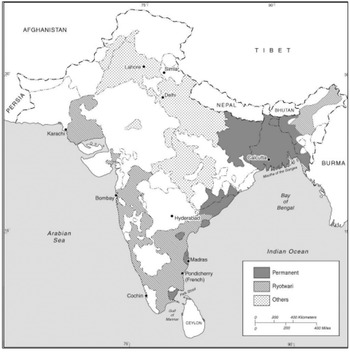
But it was a one-time boost that ran out of steam by 1806. From the second decade of the nineteenth century, the Permanent Settlement ceased to deliver significant benefits to the state. Thanks to the commitment to hold the nominal tax unchanged, the state had lost the capacity to raise taxes even as agricultural prices started to rise from the 1860s. Had the zamindar become entrepreneurial, the state might still gain by taxing trade. It seems safe to conclude that the average zamindar did not change the game and become entrepreneurial. When new territories were acquired, the arrangement had become deeply unpopular and was not followed (see figure 2 for types of land settlements).
Areas under different types of land settlement. Source: Author.

Figure 2. Long description
The map displays the Indian subcontinent with neighboring regions labeled including Afghanistan and Persia to the West, Tibet to the North, and Burma to the East.
Land settlement types are distributed as follows:
* Permanent settlement is represented by solid dark gray shading, concentrated in the Northeast around Calcutta and the Mouths of the Ganges, with smaller pockets along the Southeast coast near Madras.
* Ryotwari settlement is indicated by diagonal hatching, found primarily in the West around Karachi and Bombay, and covering large portions of the South and Southeast including areas near Madras and Cochin.
* Others are shown with a dotted pattern, covering a broad central and northern belt including Lahore, Simla, and Delhi, extending toward the East.
* White areas represent regions without these specific settlement labels.
Key cities marked with black dots include Lahore, Simla, Delhi, Karachi, Calcutta, Bombay, Hyderabad, Madras, Pondicherry French, and Cochin. Bodies of water include the Arabian Sea to the Southwest, the Bay of Bengal to the Southeast, and the Indian Ocean to the South. A legend in the Southeast quadrant defines the three shading patterns. A scale bar at the bottom right indicates distances in kilometers and miles.
Conclusion
The paper intervenes in the debate about the nature of the East India Company’s state-building in late eighteenth-century Bengal by advancing four arguments. First, institutional reform and the expansion of fiscal capacity were deeply intertwined. The Permanent Settlement was driven less by ideology, precedent, or administrative caution than by a pressing need to strengthen the state’s revenue-raising power. Second, Company officials addressed their administrative weaknesses by seeking reliable information about taxpayers. As a result, questions of information gathering and control became central to the evolving conception of state power. By 1792, information gathering through surveys had stalled, but the court system was functional, yielding more data on the taxpayer and making a contractual settlement feasible. The 1793 Settlement formalized this compromise, weakening landlords’ power, and fragmenting estates, though perhaps at the cost of long-term investment. Third, the reforms largely worked as intended: revenue per person and per unit of land increased after the Permanent Settlement. And fourth, this stronger fiscal foundation enabled the Company to finance a centrally controlled army, a development consistent with global trends. The paper attributes this success to the Company’s sustained emphasis on information and institutional restructuring, suggesting that its state-making project was more systematic and universal than often portrayed.
The Bengal pattern was not replicable. In name at least, the Settlement was replanted in coastal South India. The context again differed. The reference to an “ancient” tax authority made little sense. Nicholas Dirks argues that precolonial kings in the South governed through reciprocal entitlements with cultivators, reinforced by gift exchange.Footnote 93 British legal property disrupted this system, sidelining kings and transforming land into alienable private ownership. Property as ownership was one thing in common, not the identity of the proprietors. Where a bureaucratic legacy did not exist, British policy depended on whether the magnates threatened their military power and whether direct governance could potentially add to the tax base. Over a vast area in Andhra Pradesh and Tamil Nadu, the magnates lived on forested and semi-arid lands that produced little revenue and posed little threat. They were left alone as princely states and as zamindars, often in command over tiny slivers of territory, because a deep intervention was not worthwhile.
In the Peshwa’s territory acquired after 1818, conditions were different. In the Maratha areas, the bureaucratic legacy was present. But this was a different legacy from the Mughal one. The Maratha chiefs were primarily military agents, not revenue administrators. Declaring them as zamindars would make no sense. Besides, the twenty-five years that elapsed since 1793 had made the Company state secure enough to gather cadastral and yield statistics and settle a new contract system with the cultivators. The plan was still overambitious. Information asymmetry compromised the ryotwari settlement that followed.Footnote 94 History did repeat in a way.
Acknowledgements
I am grateful to the editors and three reviewers at CSSH for their thoughtful comments and suggestions, which substantially improved the paper. An earlier version was prepared as a lecture in honor of the historian Ranajit Guha, hosted by Maulana Azad College, Kolkata. Subsequently, revised versions were presented at a workshop at Utrecht University (on Empire and Economic Development organized by the European Historical Economics Society and the Posthumus Institute), the Royal Asiatic Society (London), and the University of Chicago’s Institutions, Politics, and Society seminar series. I thank the organizers of these events for their invitations and the participants for engaging and constructive discussions.


 Open access

