





Introduction
Muscadine grape is native to the southeast United States with commercial production primarily in Georgia, Florida, North Carolina, and South Carolina (Hoffmann et al. Reference Hoffmann, Conner, Brannen, Burrack, Mitchem, Cline, Perkins-Veazie and Poling2020). Production is increasing in North Carolina with an estimated 4,600 ha planted commercially, valued at approximately US$400 to $600 per ton if used for processing, and a higher market value if used as a fresh-market crop (MH, personal communication). Most muscadine production occurs between the Coastal Plains and North Carolina Piedmont region (MH, personal communication). Approximately 20 muscadine cultivars are currently used for fresh market production, and four or five cultivars are used commercially for processing (Hoffmann et al. Reference Hoffmann, Conner, Brannen, Burrack, Mitchem, Cline, Perkins-Veazie and Poling2020). Muscadine production in the southeastern United States can occur with lower pesticide inputs compared to other fruit crops such as bunch wine grapes (Hickey et al. Reference Hickey, Smith, Cao and Conner2019; Hoffmann et al. Reference Hoffmann, Perkins-Veazie, Conner, Worthington and Threlfall2021). However, as a perennial crop, weed management options are limited, and strategies should begin during vineyard establishment. Basinger et al. (Reference Basinger, Jennings, Monks, Mitchem, Chaudhari, Heitman, Havlin, Howard and Spayd2018) found that management of under-vine vegetation in V. vinifera L. ‘Cabernet Franc’ affects vine growth, berry composition, and yield in vigorous-growing vines. In muscadine vineyards, weed management recommendations include maintaining a vegetation-free strip under the vine with the use of herbicides, control of woody perennial weeds, and mowing vegetative grass in row middles (Hoffmann et al. Reference Hoffmann, Conner, Brannen, Burrack, Mitchem, Cline, Perkins-Veazie and Poling2020). More than 10 preemergence (PRE) herbicides and six postemergence (POST) herbicides are registered for use in muscadine vineyards in North Carolina, but only carfentrazone has selective control against broadleaf weeds without injury to the grass vineyard cover (Cline Reference Cline2020). The lack of selective broadleaf POST herbicides increases interest in the use of 2,4-D for weed management in muscadine grape vineyards.
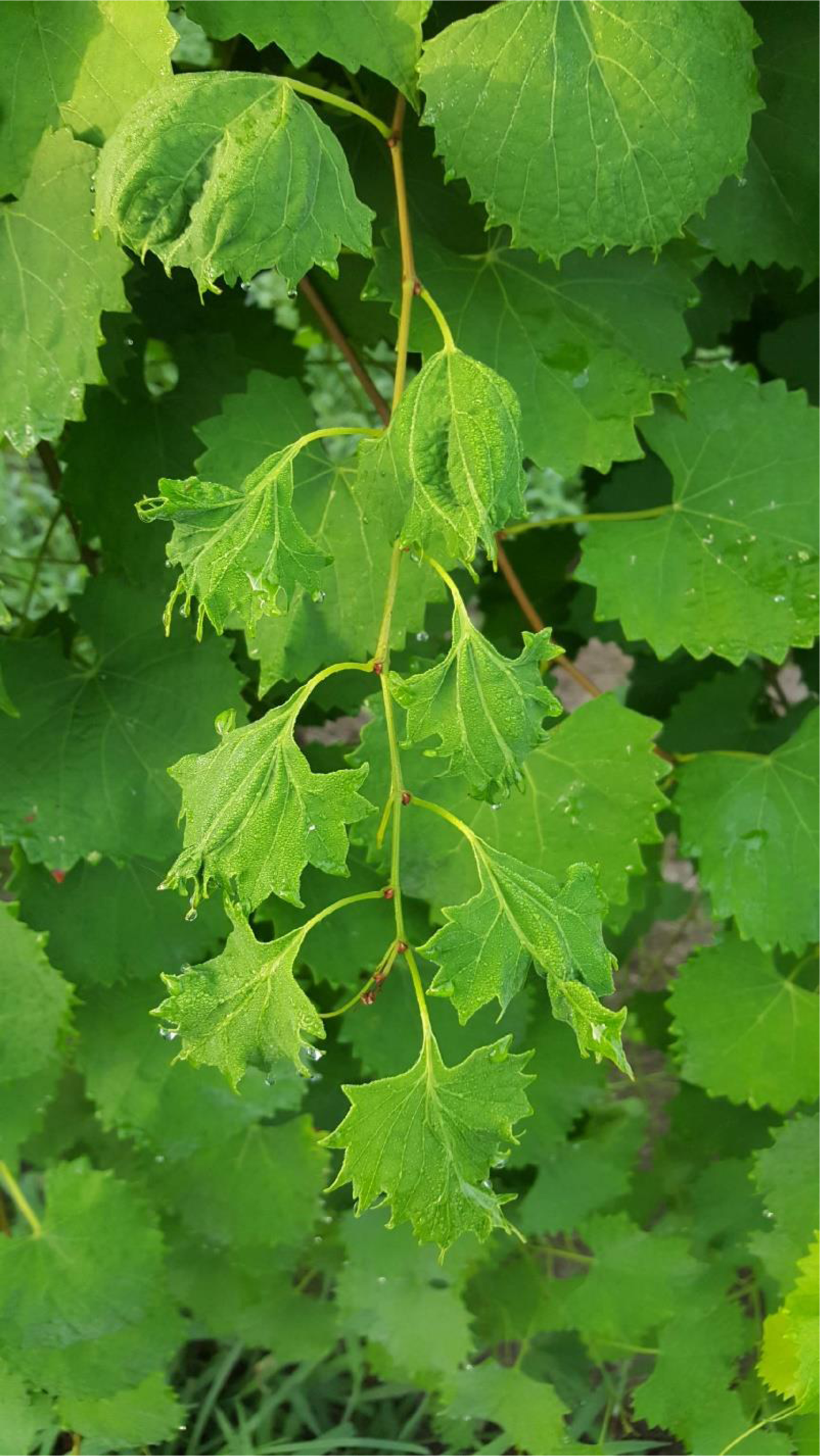
2,4-D is a synthetic auxin in the phenoxy-carboxylic acid family and is categorized as a Group 4 herbicide according to the Weed Science Society of America (Shaner Reference Shaner2014). Inside the plant, 2,4-D mimics indole acetic acid–disrupting processes in the cell wall and alters nucleic acid metabolism (Shaner Reference Shaner2014). Applied as a POST herbicide, 2,4-D affects cell division and growth in meristematic regions (Shaner Reference Shaner2014); when contact is made with foliage of muscadine grapevines, leaf strapping occurs (Figure 1).
Injury on muscadine grape leaf from 2,4-D.
Grape species (Vitis spp.) are sensitive to synthetic auxins, and foliar injury from low rates of 2,4-D amine has been documented on ‘Concord’ (V. lubrusca L.) (Comes et al. Reference Comes, Marquis and Kelly1984; Ogg et al. Reference Ogg, Ahmedullah and Wright1991) and European wine grape cultivars (V. vinifera L.) (Bhatti et al. Reference Bhatti, Al-Khatib and Parker1997; Mohseni-Moghadam et al. Reference Mohseni-Moghadam, Wolfe, Dami and Doohan2016). Rossouw et al. (Reference Rossouw, Holzapfel, Rogiers, Gouot and Schmidtke2019) conducted a study on potted grapevines (V. vinifera L.) to evaluate the effects of 2,4-D, MCPA, dicamba, and glyphosate applied at simulated drift rates on vegetative and reproductive grapevine development. By the third and fourth harvest, primary bud necrosis, which is related to next year’s fruit yield, was observed in 50% to 60% of the buds treated with 2,4-D. The current season’s yield was reduced by 34% and titratable acidity (TA) increased by 9% due to 2,4-D simulated drift.
The 2,4-D choline salt formulation has lower volatility potential than the amine salt formulation due to higher stability and less disassociation from 2,4-D acid, which reduces vapor particle movement (Anonymous 2012; Peterson et al. Reference Peterson, McMaster, Riechers, Skelton and Stahlman2016). These characteristics should reduce the potential for volatility from the application site, thereby reducing drift onto muscadine grape foliage, lowering any potential off-target injury effects. The choline formulation provides similar weed control efficacy as the amine formulation and will control weeds common to muscadine grape vineyards such as cutleaf eveningprimrose (Oneothera laciniata Hill), curly dock (Rumex crispus L.), horseweed (Conyza canadensis L. Cronq.), lettuce (Lactuca spp.), morningglory (Ipomoea spp.), and wild garlic (Allium vineale L.) (Anonymous 2021).
Previous research has evaluated the effects of herbicide injury to grapevines in vineyards, but most were conducted on European and French-American wine grape cultivars. Kadir and Al-Khatib (Reference Kadir and Al-Khatib2006) assessed weed control and crop tolerance with rates and combinations of norflurazon, oryzalin, simazine, oxyfluorfen, and diuron applied in fall and spring to two interspecific French hybrids (Vitis spp. ‘Chardonel’ and ‘Seyval Blanc’). In their study, no crop injury was observed for spring- or fall-applied herbicides. Weed control was near 100% after the fall application, and weeds were controlled by ≥90% 1 mo after spring treatment (MAST) by all herbicides, except oryzalin alone at one site that provided 78% control. Treatments of norflurazon (1.82 kg ha−1) plus oxyfluorfen (0.91 kg ha−1), and oryzalin (2.72 kg ha−1) plus oxyfluorfen (0.91 kg ha−1) provided the greatest weed control 5 MAST with the fall and spring application of both treatments providing 75% and 85% weed control, respectively. Sanguankeo et al. (Reference Sanguankeo, Leon and Malone2009) evaluated several weed management strategies including herbicides (flumioxazin and simazine), cultivation, and cover crops on V. vinfera ‘Zinfandel’. Herbicides and cultivation treatments reduced weed biomass and increased fruit weight compared to the cover crop and nontreated treatments. They concluded that PRE herbicides would stimulate vigor and increase yield in vineyards with reduced vigor. Basinger et al. (Reference Basinger, Jennings, Monks and Mitchem2019) conducted research on muscadine grapevines and compared indaziflam (0, 50, and 73 g ai ha−1) to the grower standard flumioxazin (213 g ai ha−1) when applied alone or sequentially. They did not observe crop injury, fruit yield, or fruit quality affects from herbicides, and thus concluded that indaziflam would be safe for use in muscadine vineyards as part of a weed management system.
With limited studies on weed management in muscadine vineyards and only one POST selective broadleaf herbicide option available for use on muscadine grapes, this study’s objective was to determine the effect of 2,4-D choline applied POST-directed underneath the vine canopy on muscadine grape tolerance, and fruit yield and quality.
Materials and Methods
Field trials were conducted at commercial muscadine vineyards in eastern and western North Carolina in 2018, 2019, 2020, and 2021 with older (≥9 yr) and younger (<9 yr) bearing vines of ‘Nesbitt’ or ‘Carlos’ cultivars (Table 1). Soils in western North Carolina were a sandy clay loam, pH 5.4, and with 3.16% organic matter (OM). Soils in eastern North Carolina were primarily a loamy sand, with pH between 5.6 and 6.4, and between 0.65% and 3% OM (Table 2). Muscadine was managed by commercial vineyard operations using best management practices (Hoffmann et al. Reference Hoffmann, Conner, Brannen, Burrack, Mitchem, Cline, Perkins-Veazie and Poling2020).
Year, location, cultivar, crop age, treatment application dates and harvest date. a

a Studies were conducted to evaluate the effect of 2,4-D on muscadine grape, 2018 to 2021.
b Spring application included single plus first sequential treatments, and summer applications included second sequential treatments.
c GPS coordinates appear in parentheses.

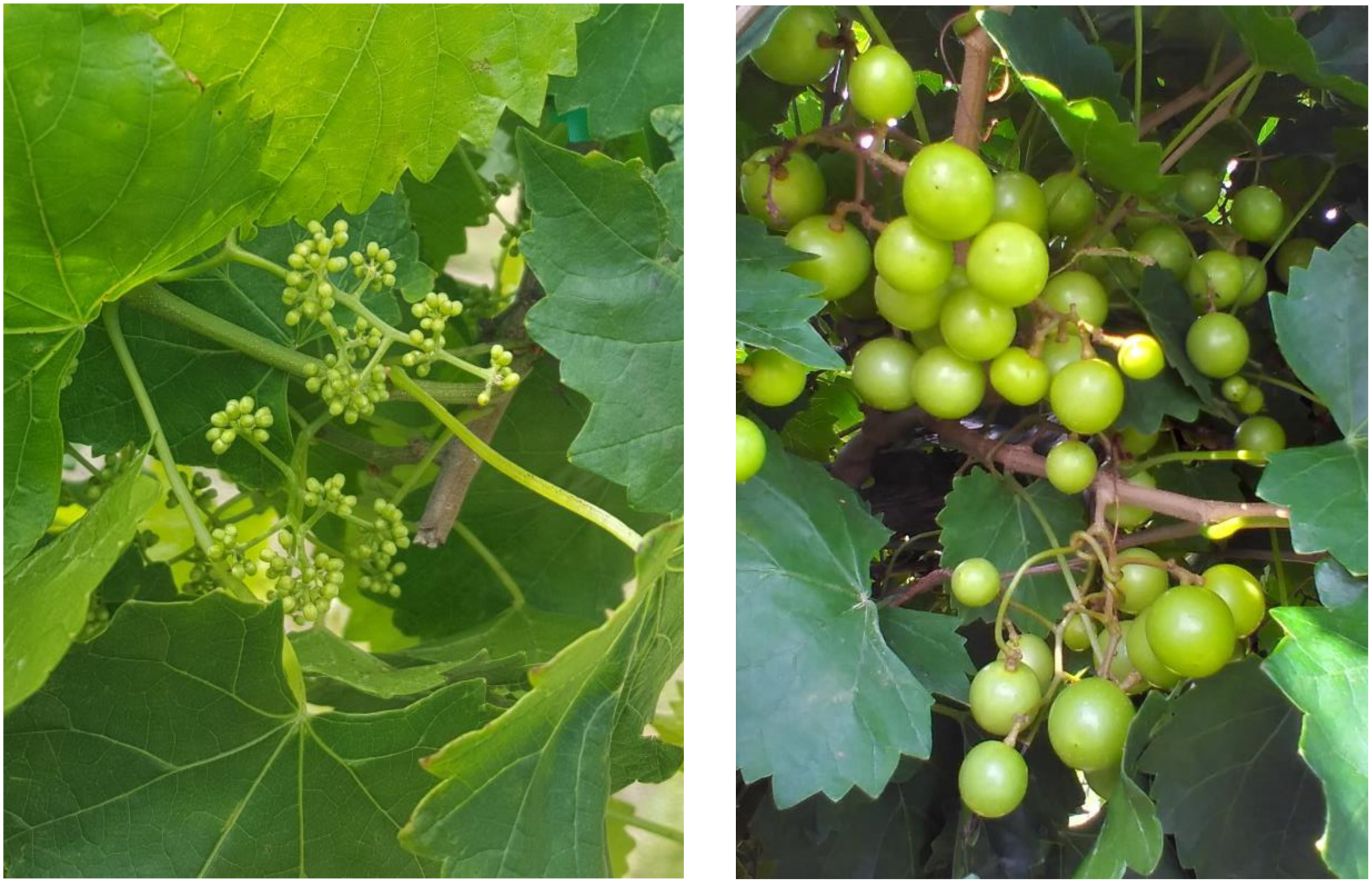
The study design for all trials was a two (application timing) by four (herbicide rate) factorial plus a nontreated control in a randomized complete block with treatments replicated four times. All plots consisted of a single planted row 1.5 m wide by 12.2 m long with two vines spaced 6.1 m apart. Between-row spacing was approximately 3.4 m in all trials. A weed-free strip 1.5 m wide was maintained under all vines. All plots received the same herbicide program applied by the commercial vineyard staff. This program included paraquat at 0.38 kg ai ha−1 applied spring, summer, and fall each year; glyphosate at 1.1 kg ai ha−1 applied winter (2019 and 2020) and late summer (2020, 2021); carfentrazone plus sulfentrazone at 3.06 g ai ha−1 and 27.7 g ai ha−1 applied summer 2019; oryzalin at 1.13 kg ai ha−1 applied summer 2019; flumioxazin at 0.11 kg ai ha−1 applied spring 2020; indaziflam at 14.6 g ai ha−1 applied summer 2021; and simazine at 1.7 kg ai ha−1 applied fall 2019 and winter 2020. Treatments included 2,4-D choline (Embed Extra; Corteva Agriscience, Indianapolis, IN) at 0.53, 1.06, 1.6 and 2.13 kg ae ha−1 applied as single treatments in May or June (spring) at immediate pre- bloom and as sequential treatments applied in May or June followed by (fb) an application in July (summer) at pre-veraison (Table 1; Figure 2). Treatments were directed to the weed-free strip under the crop canopy avoiding contact with the trunk when possible. Treatments were made in a 30-cm band using a CO2-pressurized backpack sprayer calibrated to deliver 187 L ha−1 at 138 kPa equipped with two TeeJet 8003 VS nozzles (TeeJet Technologies, Springfield, IL).
Phenological stages of muscadine grape at applications of 2,4-D: immediate pre-bloom at spring application (left) and pre-veraison at summer application (right).
Data recorded included visual crop injury 1, 2 to 3, 4, and 8 wk after treatment (WAT) for the single application, and 1, 2 to 3, and 4 WAT for the sequential application. Crop injury was characterized by stunting of the shoots or leaf deformation (epinasty or strapping) rated on a scale of 0% (no injury) to 100% (whole plant stunting or leaf deformation). A drift event in 2021 occurred before the 4 WAT of the single application rating. This event obscured the remainder of the single application and following sequential application ratings; therefore, injury data for 2021 were not included in analysis.
Fruit were harvested in September for all trials by stripping all fruit from three randomly selected 30-cm sections per vine for a total of six sections per plot (Table 1) (Basinger et al. Reference Basinger, Jennings, Monks and Mitchem2019). Total harvested fruit weight was taken per vine using an FG-150KBM scale (A&D Company Limited, Tokyo, Japan) and averaged across the plot to determine average yield per vine. Fifty ripe berries were collected from each plot, by randomly selecting 25 berries per vine. Berries were weighed using a Scout SPX421 scale (Ohaus Corporation, Parsippany, NJ) to calculate average ripe berry weight. Ten samples of 50 berries, randomly selected across the plots, were collected and weighed to calculate average unripe berry weight. Unripe berry weight was converted to estimated ripe berry weight using the mean sample weight of ripe and unripe berries and average vine yield per plot, a similar equation used for blueberry yield (Equation 1) (Aldridge et al. Reference Aldridge, Jennings, Chaudhari, Monks and Everman2019; Coneybeer-Roberts et al. Reference Coneybeer-Roberts, Jennings and Monks2016; Meyers et al. Reference Meyers, Jennings, Monks, Ballington and Jordan2016, Sims et al. Reference Sims, Jennings, Monks, Mitchem, Jordan and Hoffmann2022) as follows:
 $$\matrix{ {\left( {{\text{mean ripe fruit weight}}/{\text{mean unripe fruit weight}}} \right)} \hfill \cr {\quad * \, {\text{mean vine yield plo}}{{\text{t}}^{ - 1}}} \hfill \cr } $$
The 50 ripe-berry samples collected from each plot were stored at −20 C in 1-liter sealed polyethylene (PE) bags until berries were analyzed for pH, TA (percent citric acid equivalents [vol/vol]), and total soluble solid content (SSC). Frozen berry samples were thawed to room temperature, then homogenized by hand crushing the berries in the PE bag. The berry juice was extracted from the PE bag using an 8-ml disposable transfer pipette (VWR International LLC, Radnor, PA). The pH of each fruit sample was measured using a PC800 pH meter (Apera Instruments, Columbus, OH) standardized to pH 4 and 7. Soluble solid content and TA were determined by the PAL-BX|ACID F5 pocket Brix-acidity meter (Atago Company, Limited, Bellevue, WA) on Setting 2 for grape.
Response variables of crop injury, yield, and fruit quality (SSC, TA, and pH) were subjected to ANOVA and analyzed using the MIXED procedure with SAS software (version 9.4; SAS Institute, Cary, NC). Herbicide application timings, herbicide rates, and their interactions were considered fixed effects. Year and replication within year were considered random effects when data were not separated by maturity stage; otherwise, year was considered a fixed effect. The nontreated control was not included in visual crop injury analysis, but it was included in fruit yield and fruit quality analyses.
Results and Discussion
Visible crop injury from 2018, 2019, and 2020 were combined to determine the effect of 2,4-D on shoot and leaf injury by application timing (spring, summer). No difference in injury was observed for any rate of 2,4-D at either application timing (Table 3). The maximum observable injury from the single application was 8% 8 WAT from 1.06 kg ha−1 and from the sequential applications was 7% 4 WAT from 1.06 fb 1.06 and 1.6 fb 1.6 kg ha−1. Other studies reported higher injury on V. vinifera from simulated drift of 2,4-D. Al-Khatib et al. (Reference Al-Khatib, Parker and Fuerst1993) reported 75% foliar injury 2 WAT from 374 g ha−1 of 2,4-D simulated drift (1/3 the label rate) in a field study. Mohseni-Moghadam et al. (Reference Mohseni-Moghadam, Wolfe, Dami and Doohan2016) conducted a simulated drift greenhouse study and reported 66% foliar injury 6 WAT from 28 g ha−1 of 2,4-D amine (1/30 the label rate). This could indicate a higher sensitivity of V. vinifera grapevines to 2,4-D than muscadine grapevines. However, in contrast to the previously mentioned simulated drift studies, the treatments in our study were POST-directed under the muscadine grapevine. Thus, the amount of 2,4-D that may have contacted the muscadine grapevines to cause the observable crop injury is unknown but is likely to have been lower than the amounts contacting the grapevine in the simulated drift studies previously mentioned.
Effect of 2,4-D applied postemergence-directed beneath the canopy of muscadine grape on visual crop injury by application. a, c
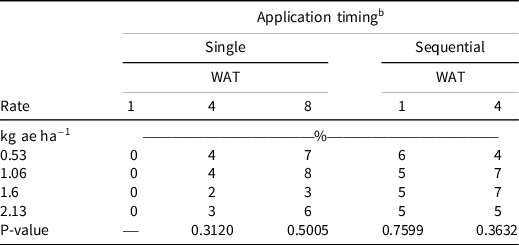
a Abbreviation: WAT, weeks after treatment.
b Muscadine grape injury was recorded on a scale of 0% (no injury) to 100% (whole plant stunting or leaf deformation).
c Single applications of 2,4-D choline were made in May or June. Sequential applications were first made in May or June followed by July.
Yield and fruit quality data were separated by vine maturity (older and younger) to determine whether differences existed in response of grapevine to treatment by age of vine. No year by rate by timing interaction was observed for the younger vines, so data were combined across years. No differences were observed in yield for the younger vines (Table 4). A three-way interaction between rate, timing, and year for older vine yield was observed; therefore, data were analyzed separately by year (Table 4). In 2018, differences were observed by rate for which the 1.6 kg ha−1 2,4-D treatment had a higher yield than the nontreated, 1.06, and 2.13 kg ha−1 treatments. In 2019, a rate by timing interaction was observed for which yield from 0.53 kg ha−1 2,4-D summer treatment was lower than all other summer treatments and 0.53, 1.06, and 1.6 kg ha−1 spring treatments, but it was not different from the nontreated. In contrast to these findings, Rossouw et al. (Reference Rossouw, Holzapfel, Rogiers, Gouot and Schmidtke2019) found yield of V. vinifera treated with 2,4-D amine decreased by 34% when a low dose of 7% of the label rate was applied.
Effect of 2,4-D applied postemergence-directed beneath the canopy of muscadine grape on estimated total yield by maturity stage. a, b, c, d
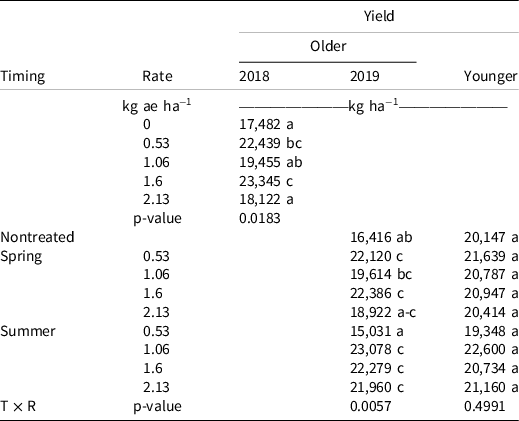
a Abbreviations: R, rate; T, timing.
b Means within a column followed by the same letter are not different according to Fisher’s protected least significant difference test (α = 0.05).
c Spring applications of 2,4-D choline were made in May or June. Summer applications were made in July.
d Estimated yield is based on 533 muscadine grape vines per hectare.
The differences in yield in 2018 and 2019 may be attributed more to pruning technique than an effect of 2,4-D. It has been documented that pruning techniques can affect muscadine grape yield in the coming season when increasing the node count of the vines increases yield; when nodes count per vine increased from 400 to 800 to >1,000, yield per vine increased over a 3-yr period (Sims et al. Reference Sims, Johnson and Bates1990). The vines used in these studies were pruned mechanically and by hand in the winter prior to the first application, but if the vines were not standardized to a set node count per vine, it could explain the inconsistency in yield across treatments.
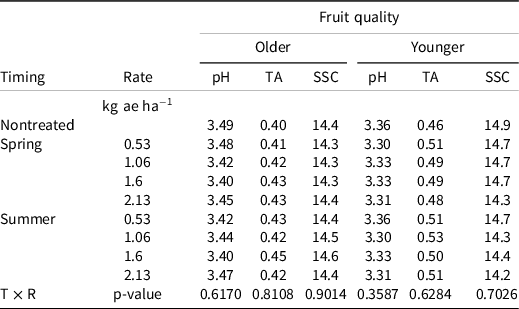
No interaction by year with older or younger vine fruit quality was observed, so data were combined across year by maturity stage (Table 5). No difference was observed in berry chemistry traits (pH, TA, and SSC) for fruit of either older or younger vines. Similarly, Basinger et al. (Reference Basinger, Jennings, Monks and Mitchem2019) did not observe differences in fruit quality when indaziflam was applied beneath the canopy of muscadine grapevines. Rossouw et al. (Reference Rossouw, Holzapfel, Rogiers, Gouot and Schmidtke2019) did not report differences in pH or SSC in nontreated V. vinifera compared with vines treated with 2,4-D (at 7% of the label rate), but there was a 9% increase in TA in the treated vines. The authors suggested the increased TA was due to delayed ripening of the grapes caused by the 2,4-D. The vines in the current study may not have been exposed to a concentration equal to or greater than that in the Rossouw et al. (Reference Rossouw, Holzapfel, Rogiers, Gouot and Schmidtke2019) study to alter muscadine grape quality.
Effect of 2,4-D applied postemergence-directed beneath the canopy of muscadine grape on fruit pH, titratable acidity, and soluble solid content of mature and young vines, combined across years by maturity stage. a, b, c, d
a Abbreviations: R, rate; SSC, soluble solid content; T, timing; TA, titratable acidity.
b Spring applications of 2,4-D choline were made in May or June. Summer applications were made in July.
c TA is measured in percent citric acid equivalents (vol/vol).
d SSC is expressed in Brix.
The results from these trials indicate that 2,4-D applied POST-directed beneath the muscadine vine does not affect crop growth or fruit quality when applied sequentially in spring and summer. Although no differences were observed for visual crop injury, muscadine grape growers will need to be informed that minor injury may occur. Differences in yield of older vines were observed, but it is inconclusive whether that was an effect of pruning technique or 2,4-D exposure. Future research should include a multiyear study to take into consideration grape flower development because floral buds injured during the growing season before they bloom directly affect yield the year after application (Srinivasan and Mullins Reference Srinivasan and Mullins1981). As a perennial crop, a multiyear study on muscadine grape will also determine whether minor injury is compounded over multiple years and affects shoot growth and yield as was observed by Ogg et al. (Reference Ogg, Ahmedullah and Wright1991) on Concord grapes.
Acknowledgments
We thank Corteva Agriscience for funding these studies. We also thank Levi Moore, Cole Smith, Stephen Ippolito, Colton Blankenship, the research assistants of the vegetable and small fruit weed science program at North Carolina State University, and the commercial farm operators for assistance in managing this experiment. No conflicts of interest have been declared.


 Open access

