





Introduction
Physical weed control (PWC), also known as mechanical weed control or cultivation, involves moving tools through the soil to kill weeds through uprooting, dismembering, or burial (Mohler Reference Mohler2001). PWC has several fundamental problems. First, the proportion of weeds killed (efficacy) is usually low, variable, and density independent (Gallandt et al. Reference Gallandt, Brainard and Brown2018). Thus, starting with more weeds results in a proportionally greater density of survivors. Second, the ability to kill weeds but not the crop (selectivity) is inversely related to efficacy and is based on plant size differential (Van der Weide et al. Reference Van der Weide, Bleeker, Achten, Lotz, Fogelberg and Melander2008), a relatively crude mechanism. Rasmussen (Reference Rasmussen1991) defined selectivity in tine harrowing cereals as the ratio between weed control and crop damage, highlighting this “balancing act” of maximizing weed control while minimizing crop damage. Finally, myriad factors affect efficacy and selectivity: soil conditions; crop and weed species, as well as their size; the design of the PWC tool and how it is adjusted; and speed (Gerhards et al. Reference Gerhards, Späth, Sökefeld, Peteinatos, Nabout and Rueda Ayala2021; Kurstjens and Perdok Reference Kurstjens and Perdok2000; Rueda-Ayala et al. Reference Rueda-Ayala, Rasmussen and Gerhards2010). Farmers learn how these factors affect PWC performance mostly by trial and error, accumulating experience that informs how they choose and operate tools; this is the so-called art of PWC (Bowman Reference Bowman2002).
PWC tools for row crops are often grouped into those mostly effective at controlling weeds between crop rows, the “interrow,” or targeting weeds near or within the crop row, the “intrarow.” As tools are operated closer to the crop row center, risk of crop injury or mortality increases, making this operation more effective in large-seeded and/or transplanted crops (e.g., corn [Zea mays L.], bean [Phaseolus vulgaris L.], cabbage [Brassica oleracea L.]), compared with small-seeded, slow-to-establish crops (e.g., carrot [Daucus carota L.], onion [Allium cepa L.], leek [Allium porrum L.]) (Melander et al. Reference Melander, Rasmussen and Bàrberi2005). Finger weeders are perhaps the most widely used intrarow tools, considered to be very effective when cultivating small, cotyledon to 2-leaf weeds in a relatively large, well-anchored crop, for example, able to withstand a “tug-test” to estimate resistance to uprooting (Bowman Reference Bowman2002). Finger weeders were developed in the United States and patented in 1959 by the Buddinghs (U.S. Patent No. 2,912,055). A more widely adopted design with metal drive tines and rubber fingers that is suitable for narrower crop row spacings was patented in Europe by K.U.L.T. Kress in 2001 (EP 1127481B1). Melander et al. (Reference Melander, Lattanzi and Pannacci2015) found finger weeders provided weed control comparable to the Danish Robovator, a modern, so-called intelligent mechanical weeder designed to control intrarow weeds in widely spaced crops such as transplanted cabbage. Asaf et al. (Reference Asaf, Rozenberg, Shulner, Eizenberg and Lati2023) recently completed a mini meta-analysis of a series of finger weeder experiments conducted in irrigated field crops, concluding that finger weeders, with efficacy ranging from 40% to 90%, improved weed control of typical herbicide-based weed management programs. Finger weeders were also a standout tool in previous research on tool “stacking,” providing much higher levels of selectivity than two other intrarow tools, a spring tine harrow, and a torsion weeder (Brown and Gallandt Reference Brown and Gallandt2018). Despite their popularity, we are not aware of research to determine whether finger weeder performance could be improved by optimizing common tool adjustments.
Like farmers, researchers have noted that experience is critical to optimize performance of PWC tools (Melander et al. Reference Melander, Rasmussen and Bàrberi2005; Pannacci et al. Reference Pannacci, Lattanzi and Tei2017). Gallandt et al. (Reference Gallandt, Brainard and Brown2018) concluded a recent review on PWC suggesting that improved mechanistic understanding of the relationships among tools, soil conditions, and crop and weed species as well as size would help to improve PWC outcomes. Systematic testing of PWC tools and their settings could accelerate this learning curve, providing farmers guidelines on tool selection and adjustments for depth, spacing, speed, and angle in various soil, weed, and crop situations. To this end, the controlled conditions of a soil bin research system could be particularly useful, allowing inexpensive, repeatable, and high-throughput testing of PWC tools to prioritize subsequent field experiments.
Researchers have used soil bins for many years, typically to study soil movement and draft of tillage tools at precise settings of angle, spacing, depth, or speed (Clark and Liljedahl Reference Clark and Liljedahl1968; Durant et al. Reference Durant, Perumpral and Desai1980; Mahadi et al. Reference Mahadi, Chen and Botha2017). Soil bins have also been used to evaluate PWC tools. Duerinckx et al. (Reference Duerinckx, Mouazen, Anthonis and Ramon2005) studied the forces exerted on a tine harrow and found that a steep tine angle and slow speed at constant depth increased efficacy and reduced crop damage. Kurstjens and Perdok (Reference Kurstjens and Perdok2000) also used a soil bin in their tine harrow research, showing that higher speed increased overall soil coverage but not weed burial depth and that dry soil was able to spread over a greater area. Zhang and Chen (Reference Zhang and Chen2017) tested four different sweep designs, characterizing disturbance, burial, and uprooting, finding the greatest efficacy with the three-quarter conventional sweep and fin sweep. Parks and Gallandt (Reference Parks and Gallandt2023) recently developed a soil bin system for PWC research, including simple artificial weeds (AWs) and a scoring system to record the fate of individual AWs in response to various tine weeder settings. At a 10-mm tine depth, increasing speed decreased efficacy, an effect not detected at 20- or 30-mm depths. Notably, AWs were more likely to be buried than uprooted at slower speed and shallow tine depth, a mechanistic insight that would be difficult to detect and quantify in the field.
In the research presented here, field and soil bin experiments tested the effects of finger weeder angle, spacing, and speed on weed control efficacy and weed/crop selectivity. We hypothesized that these tool settings could be optimized to improve weed control outcomes. Objectives of this research were to determine: (1) how finger weeder angle, spacing, and speed affects finger weeder performance; and (2) whether the controlled conditions of a research soil bin performed similarly to field experiments in testing finger weeder angle, spacing, and speed.
Materials and Methods
Field Site
Field experiments were conducted in 2021 and 2022 at the University of Maine Rogers Farm, Old Town, ME, USA (44.930223°N, 68.694414°W). Three experiments were conducted on a Nichoville very fine sandy loam (Coarse-silty, isotic, frigid Aquic Haplorthods), and one experiment on a BOOTHBAY silt loam soil (Fine-silty, mixed, semiactive, frigid Aquic Dystric Eutrudepts); organic matter ranged from 3.2% to 4.1% (Table 1). Before experiments were established, fields were chisel plowed, disked, and cultivated with a Perfecta II Harrow field cultivator (Unverferth Manufacturing, Kalida, OH, USA). Fields were fertilized uniformly with pelleted organic chicken manure 4-1-2 at a rate of 2.8 Mg ha−1 (Envirem Organics, Fredericton, NB, Canada).
Metadata for finger weeder field experiments conducted in 2021 and 2022 in Old Town, ME, USA.
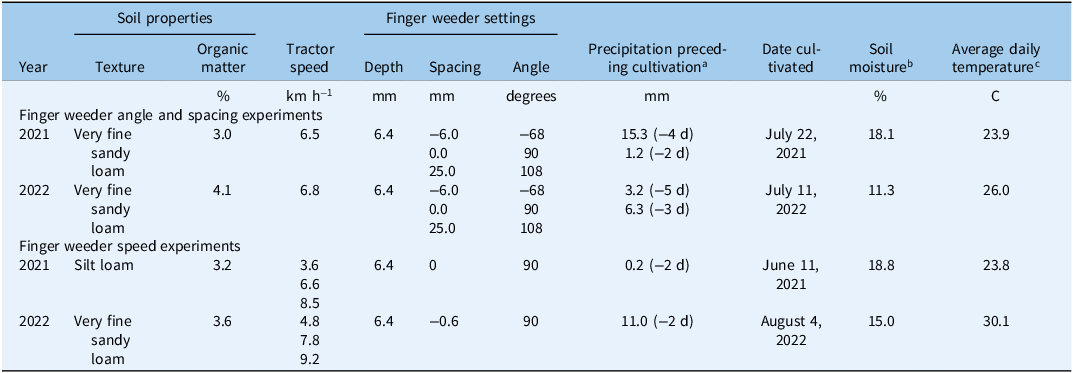
a Precipitation during the 5 d preceding cultivation events (0 d). For example, −4 d = precipitation 4 d before cultivation.
b Volumetric soil moisture measured to a depth of 8 cm. Values are averages for all plots within an experiment due to lack of significant block or treatment effects.
c Average daily air temperature for the 5 d centered on the date of cultivation (e.g., 2 d before cultivation, the day of cultivation, and 2 d after).
Field Angle, Spacing, and Speed Experiments
Angle and spacing were tested in the field using a full factorial, randomized complete block design with four replications. Organic red table beet (Beta vulgaris L.), F1 hybrid ‘Boro’ (Johnny’s Selected Seeds, Winslow, ME, USA) was planted with a vacuum seeder (Wizard SRL, Pontebbana PN, Italy) to a depth of 1.3 cm, at a row spacing of 51.0 cm, and within-row spacing of 3.8 cm. At the cotyledon stage, table beets were thinned to a within-row spacing of 7.6 cm to achieve a target density of 104 plants m−1 row. Plots were 1.2 by 15.2 m, containing two crop rows per plot. Three permanent subsampling locations were randomly positioned within each plot. Within each permanent subsample, a 125 cm by 5 cm quadrat was used for sampling. To increase spatial resolution, the quadrat was divided in half using a string to measure efficacy in a 2.5-cm “intrarow” zone and a 2.5-cm “near-row” zone. Interrow weeds were controlled when table beets were at the first to second true leaf stage, using 26-cm-wide sweeps operated 8 cm from the crop row; 15-cm-diameter cut-away disks accompanied interrow hoes to limit lateral soil movement. A HAK LTC 1 tool carrier (HAK Schoffeltechniek, Bleiswijk, Netherlands) was used to perform all weeding treatments. At the time of interrow hoeing, intra- and near-row ambient weeds at first true leaf stage and larger were hand pulled so the new flush of weeds would be at the desired size for testing finger weeders.
Mustard (Brassica juncea L.) (condiment mustard, Johnny’s Selected Seeds, Winslow, ME, USA) was used as a surrogate weed. It was broadcast seeded with a walk-behind spreader (EarthWay Products, Bristol, IN, USA) at a rate of 860 seeds m−2. Before sowing of surrogates and again after sowing, the intra- and near-row areas were raked by hand to ensure seed/soil contact (tine rake; Johnny’s Selected Seeds, Winslow, ME, USA). Ambient and surrogate weeds were counted separately in the intra- and near-row zones.
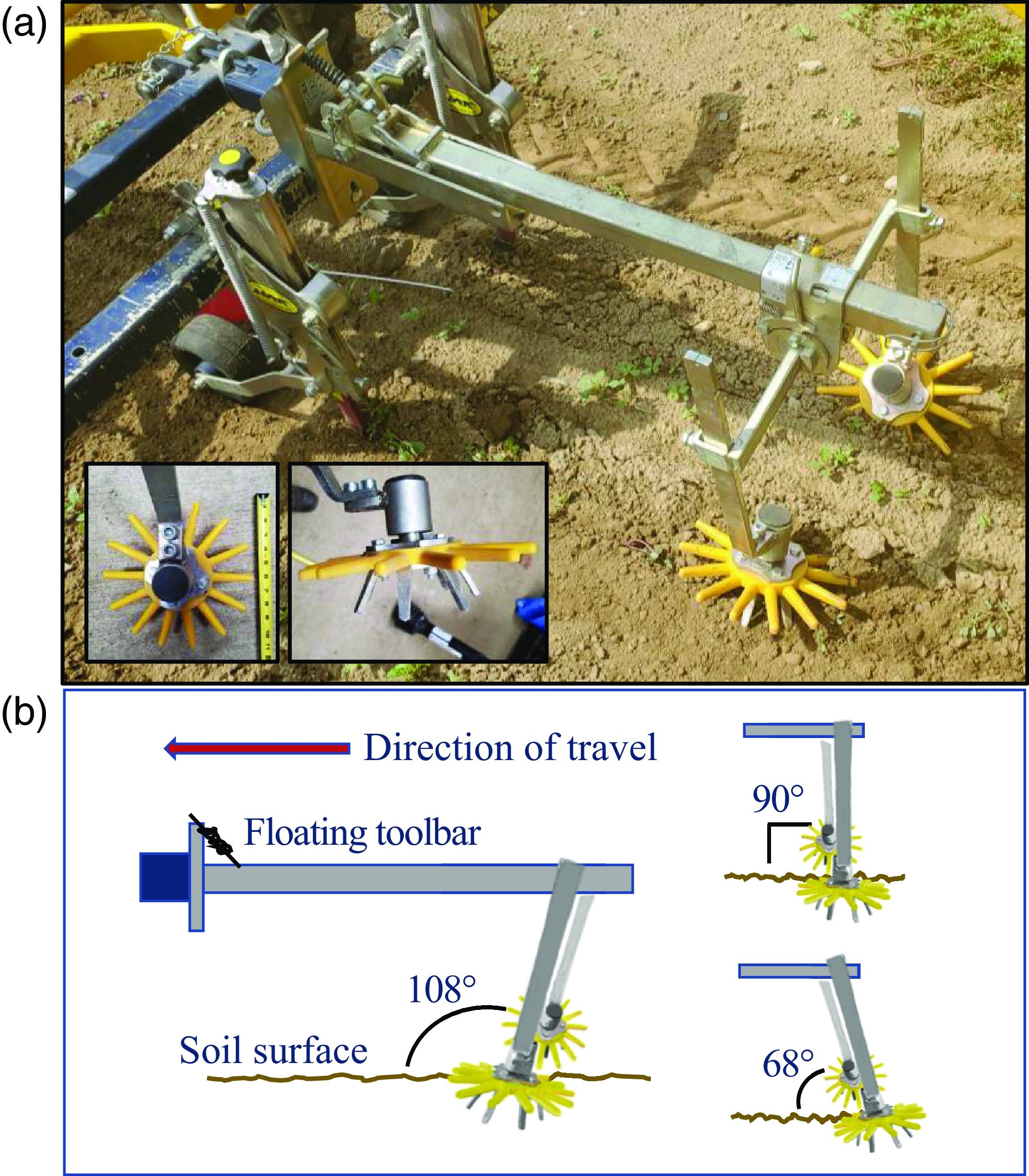
Finger weeding was done when the crop was reached the 9- to 10-true leaf stage and surrogate weeds were at the cotyledon to first true leaf stage (22 d after planting table beets). We used HAK finger weeders, 26-cm diameter, attached to a floating tool bar on the HAK LTC-1 tool carrier (Figure 1A). The HAK finger weeder drive mechanism and rubber fingers are like the more common K.U.L.T. Kress design, but a novel adjustment mechanism allows adjustment of the tool angle. Based on previous field observations of finger weeder efficacy and crop damage in a table beet crop, three angles were selected: 68°, caused hilling of soil into the crop row; 90°, was the typical configuration for most commercial finger weeders; and 108°, which moved soil away from the crop row (Figure 1B). Angles 68° and 108° were the minimum and maximum functioning angle of the HAK finger weeder, respectively. The three finger spacings tested were overlapping (−0.6 cm), touching (0.0 cm), and gapped (2.5 cm). Angle and spacing effects were tested at 7 km h−1. Field testing in table beet showed that finger weeding at a 90° angle at 2.5-cm spacing was not sufficiently aggressive, whereas the 0.0-cm spacing appeared optimal, and −0.6-cm overlap was too aggressive. The tractor’s forward speed was held constant across treatments, averaging 6.5 km h−1 in 2021 and 6.8 km h−1 in 2022 (Table 1). Pretreatment and posttreatment weed and crop plant counts were performed 24 h before and 48 h after treatment, respectively.
Finger weeder used in field and soil bin studies showing the spring-tensioned floating toolbar and angle adjustment mechanism (A) that allowed testing three different angles (B): 108° relative to the soil surface, angled toward the direction of travel; 90°, which is typical for most finger weeders; and 68°, angled away from the direction of travel.
Soil movement was measured using a round wooden dowel (6-mm diameter by 152-mm long) randomly placed in line with the crop row without damaging surrogate or ambient weeds. A line marked at 5 cm demarked the soil surface; a second line was drawn on the dowel to mark the postcultivation soil surface. The distance between these marks provided an estimate of soil movement into the crop row. Volumetric soil moisture of the surface 8 cm was measured at three randomly selected intrarow locations in each plot using a Delta-T HH2 Moisture Meter with a Theta Probe (Delta-T Devices, Burwell, UK). Ambient and surrogate weed counts were also collected 14 d after cultivation to measure subsequent recruitment. Fresh crop biomass was collected after sorting beets into marketable, unmarketable, and marketable with defects categories according to the U.S. Department of Agriculture standards for bunched table beet (USDA 2016).
Finger weeder speed was tested in separate field experiments in 2021 and 2022, using a randomized complete block design with four replications each year. Three target speeds were selected to represent a person pushing a wheeled hand-weeding tool (4 km h−1), a small cultivation tractor (7 km h−1), and a tractor with a camera guidance system (9 km h−1). Actual speeds, averaged over all replications of a given treatment, were slightly below these targets in 2021 and slightly above targets in 2022 (Table 1). In speed experiments, finger weeder angle was set at 90° with fingers overlapping −0.6 cm, a relatively aggressive setting chosen to improve chances of seeing treatment effects.
Due to poor beet establishment in 2021, speed experiments were conducted in organic bush bean, ‘Provider’ (Johnny’s Selected Seeds, Winslow, ME, USA). Beans were planted with the vacuum seeder to a depth of 2.5 cm, a row spacing of 51 cm, and a within-row spacing of 3.8 cm. Bush bean density was 10 plants m−1 of row. Plot dimensions, subsampling procedure, quadrats, finger weeders, and tool carrier were as described previously. Due to labor constraints, crop yield and quality data were not collected in field speed trials. Before field experiments were conducted, adjacent practice rows were used to test and observe tool performance. Angle and spacing were set in the farm shop; speed was measured in the field. Speed varied slightly over the 2 yr of experiments (Table 1) due to the lack of precision in the hydrostatic drive system of the cultivating tractor.
Soil Bin Angle, Spacing, and Speed Experiments
The soil bin was based on the design of Mahadi et al. (Reference Mahadi, Chen and Botha2017) and was described previously in Parks and Gallandt (Reference Parks and Gallandt2023). Soil bin dimensions were 12 m by 2 m containing a 36-cm layer of gravel topped with a 10-cm layer of soil composed of 95% sand, 2% silt, and 3% clay (Owen J. Folsom, Greenbush, ME, USA). In the soil bin, the floating toolbar was mounted to a belt-driven mobile tool carriage that moved on rails above the soil. Standardized methods for soil preparation, including leveling, compacting, and watering, were carried out carried out as described previously (Parks and Gallandt Reference Parks and Gallandt2023).
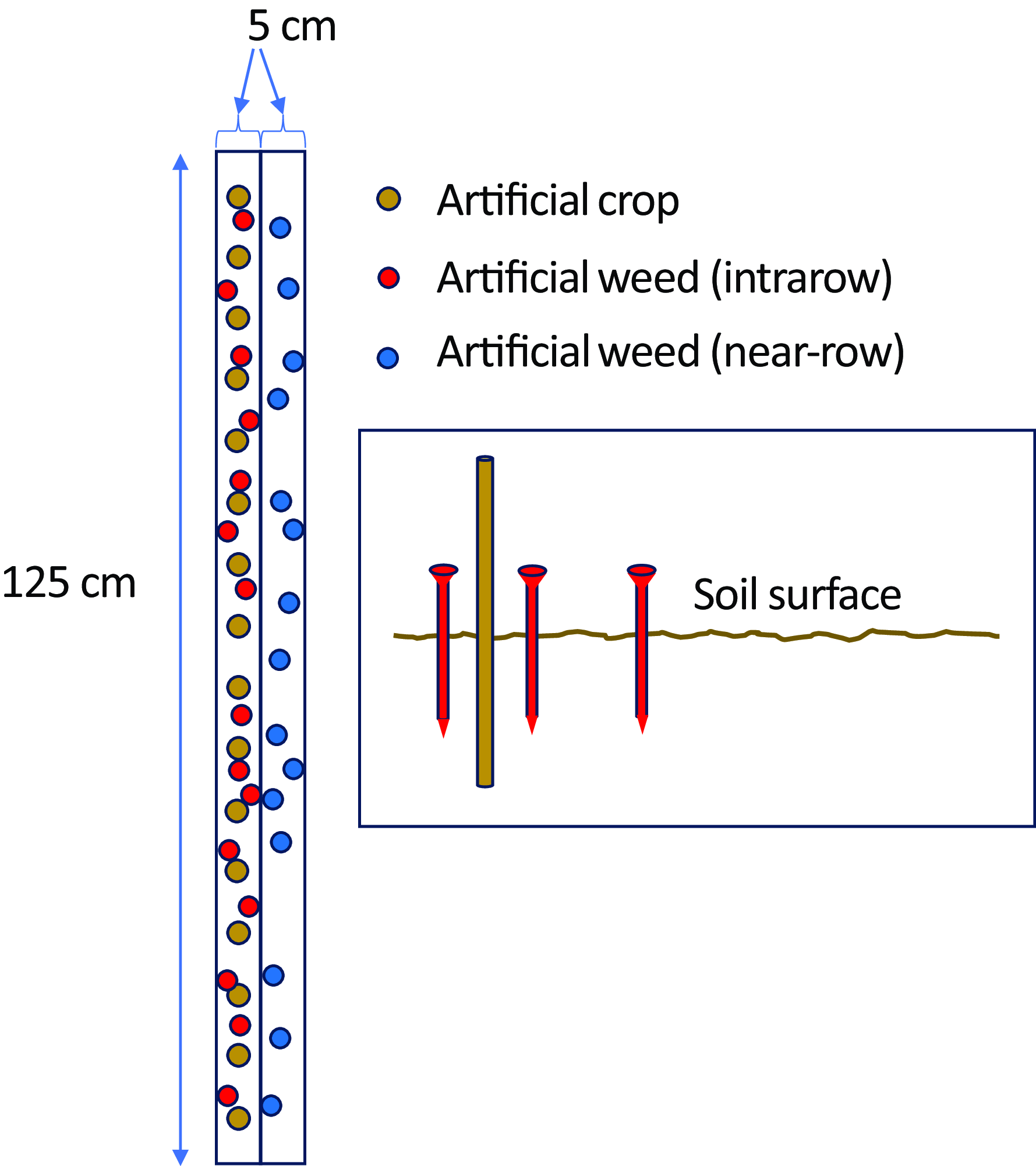
AWs were 70-mm-long wooden golf tees pushed into the soil to a depth of 42 mm, while artificial crops (ACs) were 6-mm-diameter by 152-mm-long wooden dowels pushed into the soil to a depth of 70 mm (Figure 2). A 10 cm by 125 cm quadrat was divided in half with a string to produce a 5-cm intrarow zone and a 5-cm “near-row” zone (Figure 2). Centered within the intrarow zone of the quadrat, a row of 16 ACs was placed at a 7.6-cm intrarow spacing. Fifteen AWs were placed randomly in the intrarow zone, and an additional 15 AWs were placed in the near-row zone, using different colored golf tees for each zone (Figure 2). Following cultivation, AW efficacy and AC mortality were scored using a qualitative scale described previously (Parks and Gallandt Reference Parks and Gallandt2023). For clarity, efficacy measured with AWs is denoted “efficacyAW.” ACs were marked with a line at 70 mm to ensure a constant planting depth. Following cultivation, soil height relative to this planting depth line was measured on upright ACs.
Quadrat dimensions and installation of artificial crop and weeds in soil bin studies. The long narrow quadrats were intended to improve resolution of efficacy measurements of the finger weeder. Artificial weeds were randomly sown in the intra- and near-row zones, using unique colors to track responses in each.
In the soil bin, finger weeder angle and spacing were tested in a factorial, completely randomized design with eight replications. Angle and spacing treatments evaluated in soil bin experiments were the same as those previously described for field experiments. Three speed treatments used previously in field studies were tested in the soil bin: 4 km h−1, 7 km h−1, and 9 km h−1. In speed experiments, finger weeder angle was set at 90° with fingers overlapping −0.6 cm, a relatively aggressive setting chosen to improve chances of seeing treatment effects.
Data Analysis
The statistical software used for data analysis was JMP® Pro v. 16.0.0 (1989–2021; SAS Institute, Cary, NC, USA). ANOVA was used to explore main effects, interactions, and random effects. The assumptions of normally distributed and homoscedastic residuals were verified using the Shapiro-Wilk tests and visual assessment of Studentized residual plots, respectively. Data were transformed if the assumptions were not met, and back-transformed means are reported. When soil bin experiments were compared with field experiments, location was included as a fixed effect in an ANOVA to test for differences between environments (Dixon et al. Reference Dixon, Moore and van Santen2020). If no significant year by treatment effects were observed, random interaction terms were dropped from the model, beginning with the highest-order term. Model reduction was concluded if a fixed variable P-value was ≤0.05, or if only year and block nested within year remained as random effects. If significant main effects or interactions were detected, mean comparisons among factor levels were performed using a Tukey’s Honestly Significant Difference test at α = 0.05.
A logistic regression (Agresti Reference Agresti2012) was used for skewed data where the assumptions of ANOVA could not be met using transformations. Artificial crop mortality in the soil bin angle and spacing trial and near-row efficacyAW in the soil bin speed trial were organized into the categorical variables, “dead” or “alive,” and analyzed using a chi-square test in a logistic regression model. the odds from the model were saved and used to calculate the odds ratios to compare significant treatment effects.
Results and Discussion
Finger Weeder Angle and Spacing
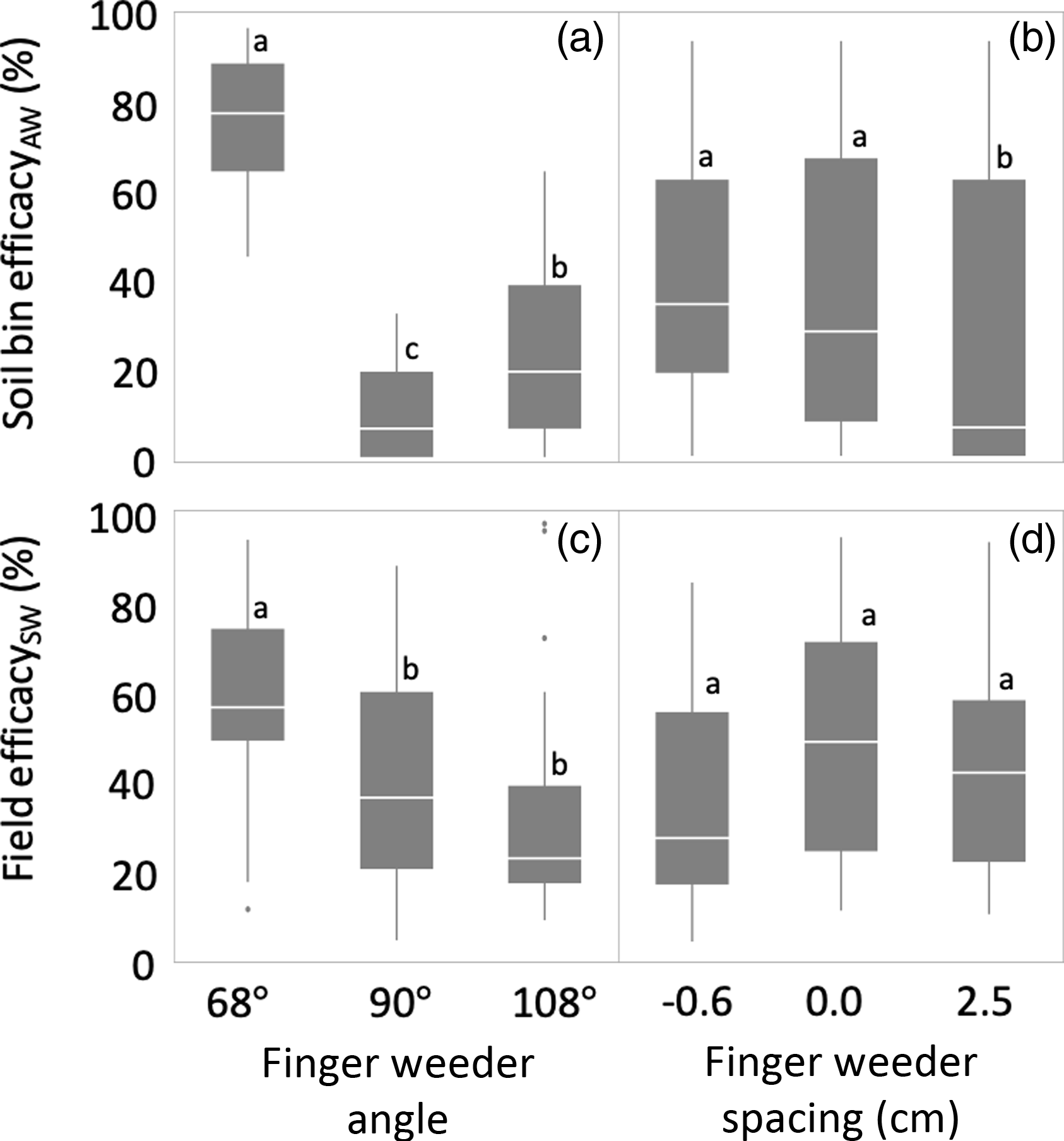
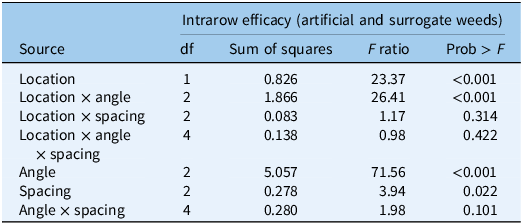
Considering only the intrarow zone, efficacyAW and efficacySW were analyzed in a single model including location as a fixed effect (Table 2). The trailing 68° angle had greater efficacy than 90°or 108° in both the soil bin and field (Figure 3A and 3C, respectively). The location by angle effect appears to be driven by a relatively minor difference between 90°and 108° in the soil bin but not in the field (Figure 3A and 3C). In contrast to the angle response, finger spacing effects were highly variable and, unexpectedly, did not show an inverse relationship between spacing and efficacy (Figure 3B and 3D). Field angle and spacing effects were similar both with surrogate weeds (Figure 3C and 3D) and ambient weeds (data not shown). The 68° angle moved nearly twice as much soil into the crop row, resulting in significant “hilling” of soil, whereas a small amount of soil movement was measured at 90°, and very little movement at 108° (Figure 4A and 4B).
ANOVA testing effects of finger weeder angle (68°, 90°, 108°), finger weeder spacing (−0.6 cm, 0.0 cm, 2.5 cm), and interactions on intra- and near-row efficacy using artificial weeds (AW, 70-mm-long wooden golf tees) in the soil bin and a surrogate weed (Brassica juncea), and ambient weeds in field experiments.
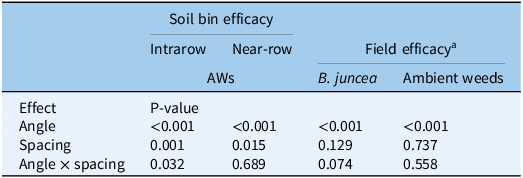
a Intra- and near-row combined.
Finger weeder angle and spacing effects on intrarow efficacy measured with artificial weeds (EfficacyAW) in the soil bin (A, B), and measured in the field using a surrogate weed (EfficacySW; Brassica juncea). Treatments with common letters are not statistically different using Tukey’s Honestly Significant Difference at α ≤ 0.05. Box plots show median center lines, upper and lower quartiles, with whiskers at 1.5× the interquartile; outliers are also shown.
Finger weeder soil movement in the intrarow zone. Treatments with common letters are not statistically different using Tukey’s Honestly Significant Difference at an α ≤ 0.05. Box plots show median center lines, upper and lower quartiles, with whiskers at 1.5 × the interquartile; outliers are also shown.

Brown and Gallandt (Reference Brown and Gallandt2018) observed that angling finger weeders 84° caused hilling in maize. The 68° angle consistently caused the most intrarow hilling, achieving on average 17 mm of soil movement in the soil bin and 12 mm in the field (Figure 4B). Soil movement was greater in the comparatively loose sand of the soil bin (Figure 4A) compared with the field (Figure 4B). While weed burial improved efficacy, there was no effect on crop yield, crop mortality, or crop defects, suggesting that table beets were able to tolerate the treatment (data not shown). Merfield et al. (Reference Merfield, Bennett, Berry, Bluon, O’Connell and Hodge2020) studied soil hilling with mini-ridgers and found that 100-mm-tall plants perished when buried with 10 to 20 mm of soil if the whole plant was covered. Similarly, 25- to 30-mm-tall garden cress (Lepidium sativum L.) was killed when buried to a depth of 15 to 20 mm using a hoe (Terpstra and Kouwenhoven Reference Terpstra and Kouwenhoven1981). Kurstjens and Perdok (Reference Kurstjens and Perdok2000) were able to bury garden cress (Lepidum sativum L.) and perennial ryegrass (Lolium perenne L.) with 10 to 15 mm of soil using a tine harrow, but tool efficacy was reduced because plants were not entirely covered.
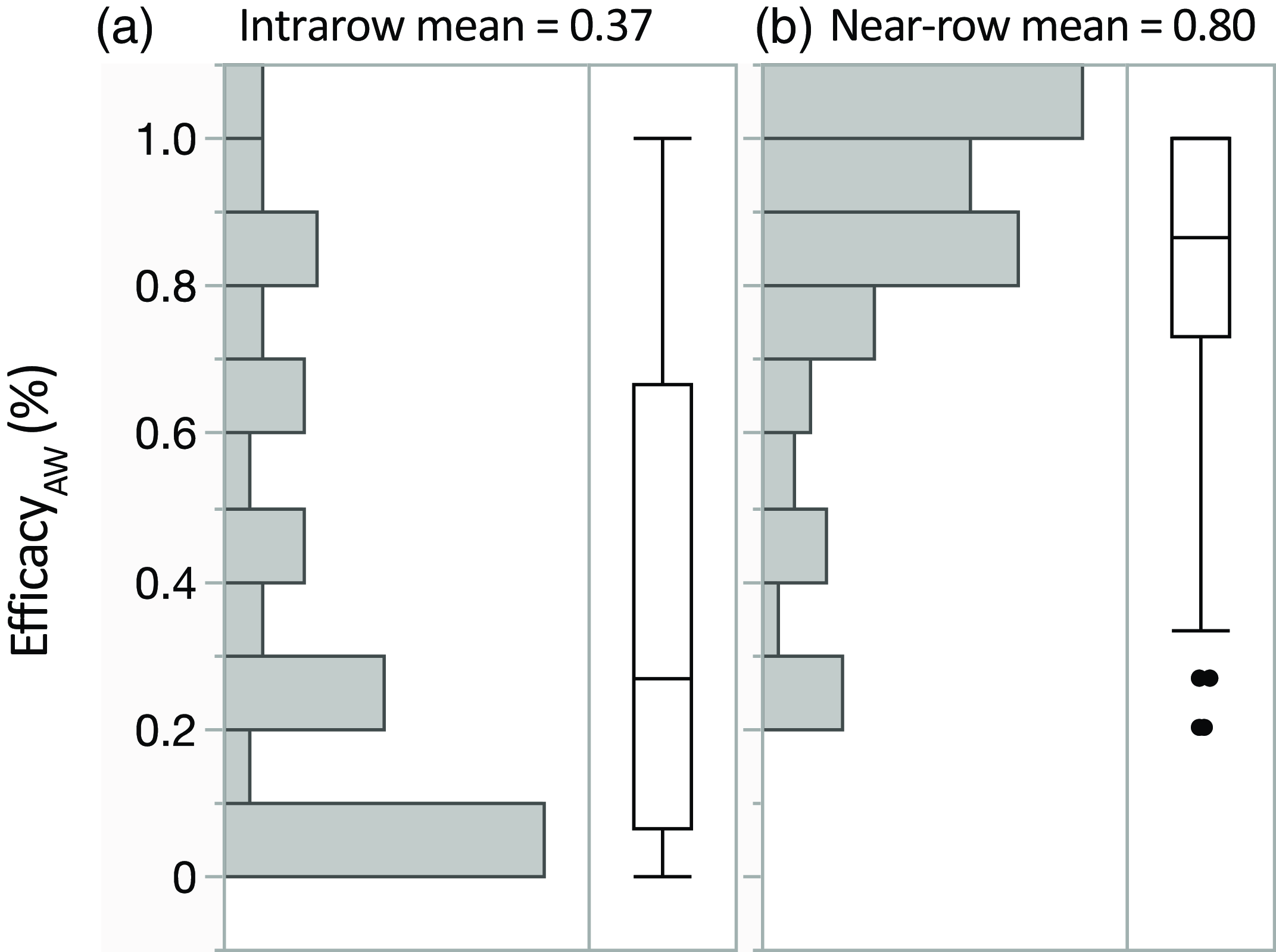
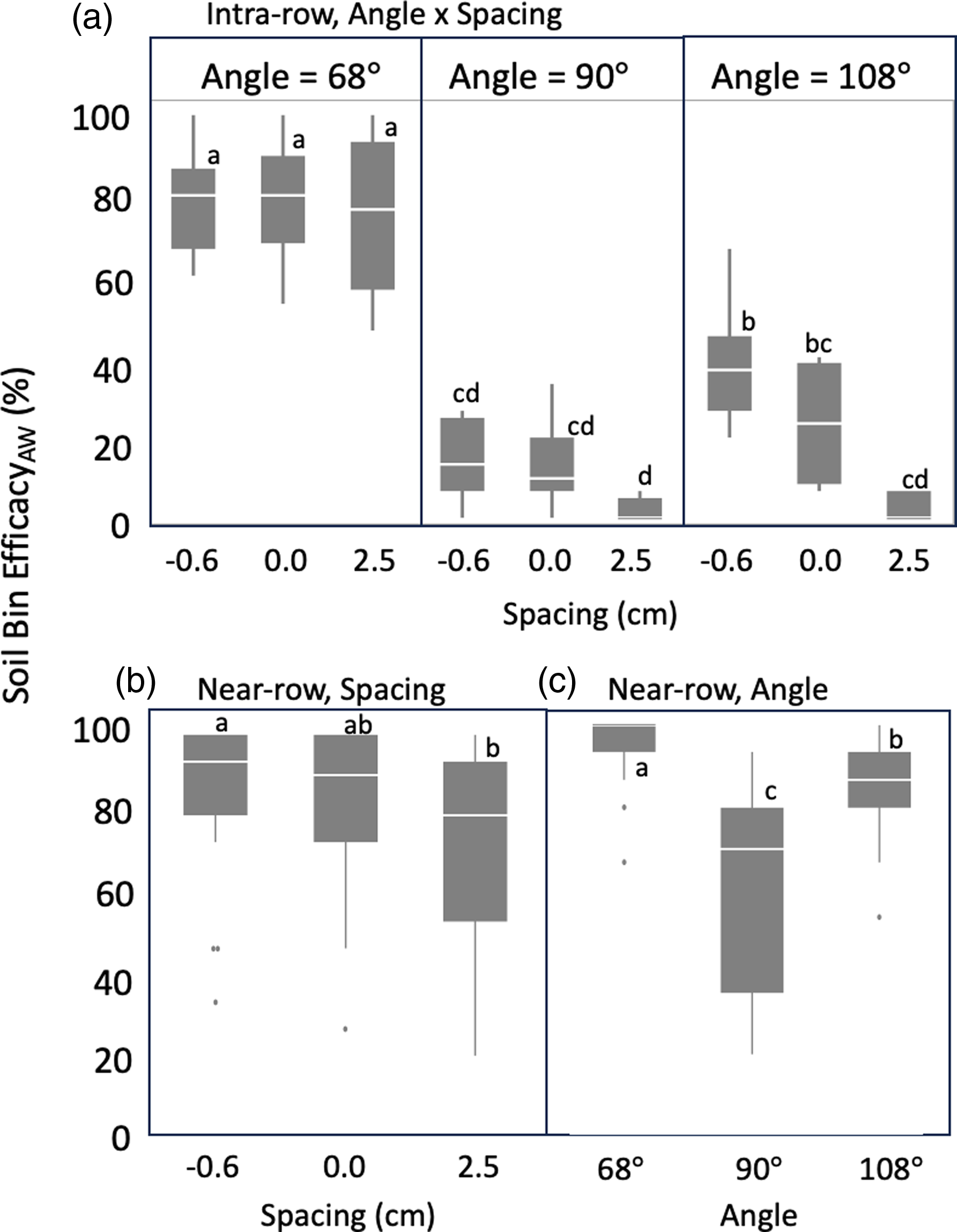
In the soil bin, finger weeder effects on efficacyAW in the near-row zone was much greater than in the intrarow zone, each with highly skewed distributions (Figure 5). Finger weeder angle effect on intrarow efficacyAW varied with spacing (Table 3; Figure 6). Intrarow efficacyAW was very high and unaffected by spacing at 68° (Figure 6A). In contrast, at 108° the −0.6-cm overlap improved efficacyAW compared with the 2.5-cm gapped spacing (Figure 6A); efficacyAW was lowest and unaffected by spacing at the 90° angle. Near-row efficacyAW was predictably greater with the −0.6-cm overlap spacing compared with the 2.5-cm gap spacing (Figure 6B). The main effect of angle averaged over spacing showed greater mean efficacyAW and reduced variability at 68° and 108° compared with 90° (Figure 6C).
Efficacy based on scoring of artificial weeds measured in the 5-cm intrarow (A) and 5-cm near-row (B) zones in two soil bin experiments. Box plots show median center lines, upper and lower quartiles, with whiskers at 1.5× the interquartile; outliers are also shown.
Finger weeder angle and spacing effects on efficacy using artificial weeds (AWs, 70-mm-long wooden golf tees) in a soil bin showing the interaction of angle × spacing on AWs in the intrarow (A), and the main effect of spacing (B) and angle (C) on AWs in the near-row zone. Treatments with common letters are not statistically different using Tukey’s Honestly Significant Difference at α ≤ 0.05. Box plots show median center lines, upper and lower quartiles, with whiskers at 1.5× the interquartile; outliers are also shown.
As spacing decreased, AC mortality increased according to a chi-square test using logistic regression (P < 0.001) (Figure 7). This test only provides a main effect test, but odds ratios showed that at the 2.5-cm gap spacing, AC were much less likely to be scored as “dead” compared with fingers spaced overlapping at −0.6 cm (data not shown). Angle did not affect AC mortality in the soil bin (data not shown).
Finger weeder artificial crop (AC, 6-mm-diameter by 152-mm-long wooden dowels) mortality by spacing. Tool spacing significant (P < 0.001) according to chi-square test. Treatments with common letters are not statistically different using Tukey’s Honestly Significant Difference at α ≤ 0.05. Box plots show median center lines, upper and lower quartiles, with whiskers at 1.5× the interquartile; outliers are also shown.

Neither angle nor spacing affected B. juncea or ambient weed recruitment 14 d after cultivation (data not shown), nor did they affect table beet marketable or unmarketable yield (Table 4). The marketable with defects yield category was analyzed separately by year. In 2021, the 90° with fingers spaced at 0.0 cm resulted in the highest table beet mortality (10%), while the 108° with fingers touching caused the lowest mortality (2%) (data not shown). In 2022, table beet mortality was below 4% for all treatments (data not shown).
The effect of finger weeder angle and spacing on marketable and unmarketable yield of table beet over the 2021 and 2022 field experiments.

a Fingers adjusted to overlap 0.6 cm.
b Angle measured relative to the soil surface and the direction of travel (see Figure 1): 68° moved soil into the crop row, i.e., “hilling”; 90° is typical on most tools; and 108° moved soil away from the crop row, i.e., “scrubbing.”
Efficacy was expected to increase as tool spacing decreased, but soil bin results showed an interaction between angle and spacing on intrarow efficacyAW (Table 3; Figure 6A). In the field, however, efficacy was similar across the spacings tested (Figure 3D) or ambient weeds or table beet yield (Table 4). Correspondingly, crop mortality was expected to increase with decreasing tool spacing due to the increased intensity of the cultivation event; therefore, it is generally recommended to reduce finger weeder spacing as crop plants develop and are able to withstand more intense disturbance (Bowman Reference Bowman2002; Van der Weide et al. Reference Van der Weide, Bleeker, Achten, Lotz, Fogelberg and Melander2008). Asaf et al. (Reference Asaf, Rozenberg, Shulner, Eizenberg and Lati2023) used a 5% to 6% finger overlap on table beets at both the 6-leaf and the 8- to 10-leaf stages, which resulted in greater crop mortality (27%) relative to an herbicide treatment (11%). In future work, it would be informative to include a setting aggressive enough to detect a reduction in crop mortality and yield.
Finger Weeder Speed
In the soil bin, speed of 7 km h−1 significantly increased intrarow efficacyAW by 75% when compared with 4 km h−1 (P = 0.002) (Figure 8A), while 4 and 9 km h−1 were similar. Based on logistic regression, increasing speed increased near-row tool efficacyAW (P < 0.001) (data not shown). At the highest speed tested (9 km h−1), AWs were 11 times more likely to be scored “dead” when compared with 4 km h−1 (P = 0.024) (data not shown). Higher speeds of 7 and 9 km h−1 also moved 36% and 18% more soil into the crop row compared with walking speed, respectively (P = 0.001) (data not shown). AC mortality was not affected by speed (data not shown).
Finger weeder speed effects on efficacy using artificial weeds (EfficacyAW) in the soil bin (A) and using a surrogate weed (EfficacySW; Brassica juncea) in 2021 and 2022 field experiments. Treatments with common letters are not statistically different using Tukey’s Honestly Significant Difference at α ≤ 0.05. Box plots show median center lines, upper and lower quartiles, with whiskers at 1.5× the interquartile.
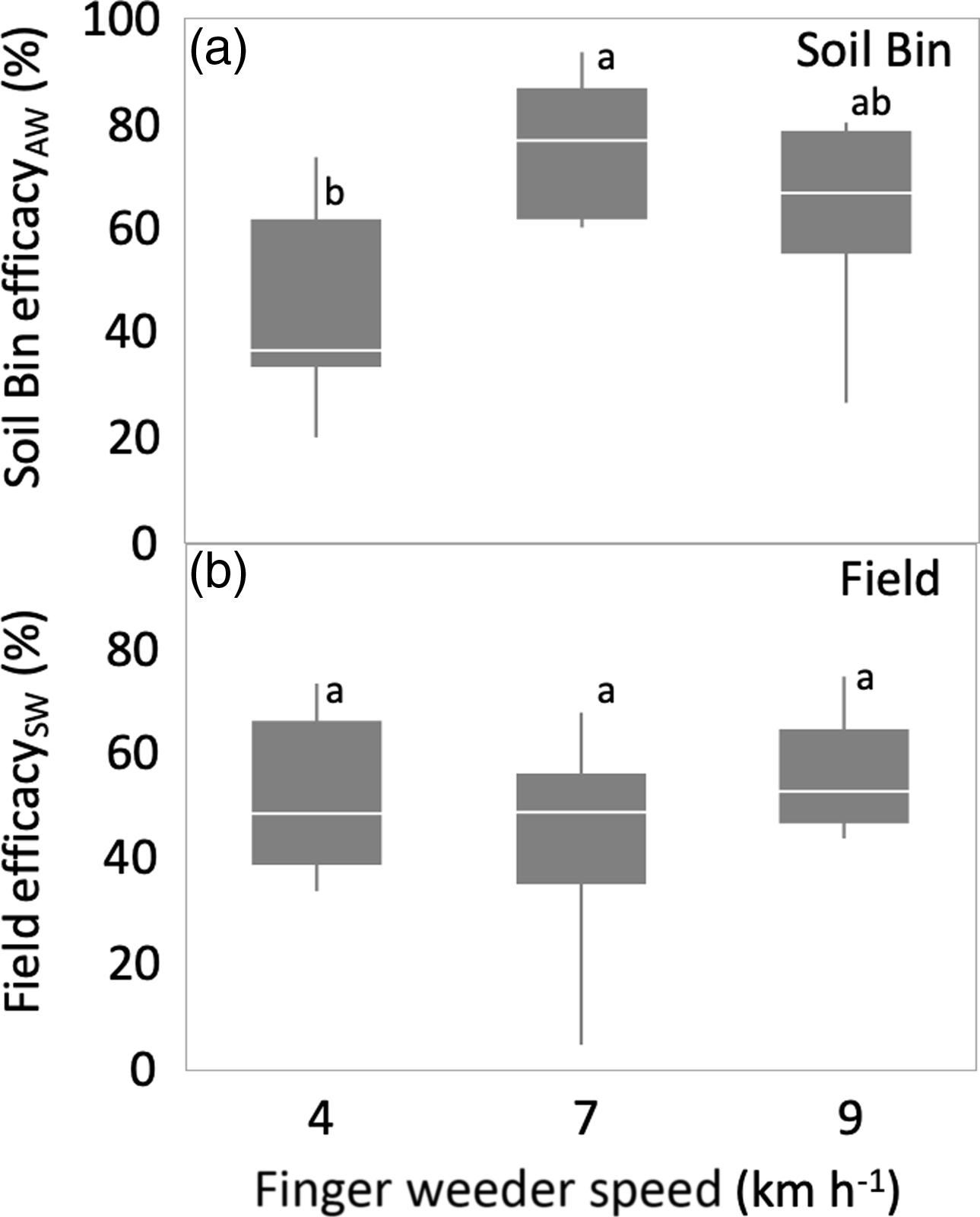
Surrogate weeds were abundant in 2021, but poor germination of the surrogates in 2022 resulted in higher densities of ambient weeds. Data were pooled over surrogate and ambient weeds, and there was no evidence that speed affected efficacy in the field (speed, P = 0.476; Figure 8B). There was also no indication of an interaction of year by speed (considering year as a random effect; Wald P = 0.600).
Increasing the operating speed of ground-driven finger weeders was expected to increase tool efficacy. In the soil bin, efficacyAW increased with increasing speed (Figure 8A), but this was not observed in the field (Figure 8B). Machleb et al. (Reference Machleb, Peteinatos, Sökefeld and Gerhards2021) reported that motorized finger weeders increased efficacy at a higher rpm than conventional finger weeders in sugar beet, but efficacy was similar between the slow and fast rpm settings tested. However, contradicting results have also been reported. Brown and Gallandt (Reference Brown and Gallandt2018) observed a negative effect on efficacy as speed increased from 1.6 to 11.2 km h−1 when operating finger weeders in combination with other tools. In the present study, the speed effect detected in the soil bin could be an artifact of the sand substrate. However, increasing finger weeder speed in the field may not change performance as widely assumed.
Finger weeders are an important tool for many farmers relying on PWC; they are relatively inexpensive and can be used in many different row crops. Lotz and Bleeker (Reference Lotz and Bleeker2006) recommended changing spacing to manage aggressiveness: a 2-cm gap for young crops, with up to a 5-cm overlap of fingers for larger crops. In our research, finger weeder angle emerged as an important setting affecting efficacy (Table 2). Soil hilling with the 68° angle improved efficacy in both the soil bin and field (Figure 3A and 3C). Finger weeder speed and spacing effects were comparatively minor and inconsistent between soil bin and field studies. It is possible that small-effect treatments may be detected in the controlled conditions of the soil bin, but not in more variable field conditions.
ANOVA testing effects of location (soil bin vs. field), finger weeder angle (68°, 90°, 108°), finger weeder spacing (−0.6 cm, 0.0 cm, 2.5 cm), and interactions on intrarow efficacy measured using artificial and surrogate weeds a .
a Location was modeled as a fixed effect, while block (not shown) was included as a random effect.
Rasmussen (Reference Rasmussen2024) recently made a compelling argument for PWC research to address mechanisms instead of simply picking “winners” among a group of treatments. With further refinements, we think that repeatable, high-throughput testing of PWC tools that is possible in a soil bin system could prove useful in this regard, helping to identify quantitative relationships useful for predicting efficacy and selectivity. Soil bin experiments are fast, relatively inexpensive, and can be conducted year-round. They also allow systematic testing of one factor while holding others constant: for example, tool design and settings, soil, and weed and crop. We recognize that the soil bin system has limitations related to the artificial soil, weeds, and crops (Parks and Gallandt Reference Parks and Gallandt2023), but like many laboratory and greenhouse assays, it is an abstraction of field conditions, controlling sources of variability and, ideally, offering insights that may be obscured in field studies. Our soil bin system results related to soil movement were congruent with field results; however, our AWs and ACs were more sensitive to finger weeder action than real plant counterparts in the field (Figure 8). Future PWC soil bin research would benefit from more rationally designed AWs and ACs that have more realistic soil anchorage force profiles and plant-like flexibility.
Acknowledgments
We would like to thank Professor Emeritus William A. Halteman, Department of Mathematics and Statistics at the University of Maine, for statistical advice. We thank Joseph Cannon Jr. and Tom Molloy for assistance with fieldwork; and Emma Gibbons, Sonora Ortiz, Margo Roberts, Joey Lopez Wilen, Noah Fink, and Tommy Owen for research assistance and data collection.
Funding statement
This work was supported by the USDA National Institute of Food and Agriculture Hatch Project, “Efficacy and Sustainability of Seedling- vs. Seed-focused Weed Management” (accession no. 1006745; project no. ME021606). This work was also supported by USDA-NIFA Organic Agriculture Research and Extension Initiative Award 2018-51300-28426, “Integrating Advanced Cultural and Mechanical Strategies for Improved Weed Management in Organic Vegetables.”
Competing interests
The authors declare no conflicts of interest.


 Open access

