


1. Introduction
The challenges posed by climate change and the resulting necessity to reduce greenhouse gas emissions are among the most pressing issues of our time. Hydrogen enables emission reduction in sectors where direct renewable energy use is difficult (BMWK, 2024). A promising approach to reducing greenhouse gas emissions is water electrolysis powered by renewable energies. (IEA, 2023) Hydrogen electrolyzers powered by renewable energy sources can produce green hydrogen, offering a climate-neutral and sustainable energy solution. (IRENA, 2020) In this context, various methods are employed, with Proton Exchange Membrane (PEM) Electrolysis playing a significant role. (IEA, 2023) The manufacturing of most electrolyzers is predominantly manual, resulting in inconsistent quality, high expenditure of time, and high production costs (Reference NeugebauerNeugebauer, 2020). The project H2Giga FertiRob aims to automate the production of electrolyzers, including electrolyzer stacks, to make green hydrogen economically viable and capable of meeting the predicted demand in the future (BMBF, 2020). The electrolyzer stack forms the core of the electrolyzer, where the main process of chemically separating hydrogen and oxygen from water occurs (Reference Smolinka, Wiebe, Sterchele and PalzerSmolinka, 2018). Due to its critical role, developing a production line for the automated assembly of PEM electrolyzer stacks is a primary objective of the FertiRob research project. Through collaboration with 16 partners, the project aims to implement a feasible solution (Reference Yorgun, Egel, Lamers and KuhlenkötterYorgun et al., 2023). Most existing electrolyzer stacks are incompatible with automated assembly and require design modifications before automation can be effectively implemented. Existing design evaluation methods are not directly applicable to the specific requirements. These methods must be adapted to the unique characteristics of electrolyzer stacks.
This paper contributes to engineering design research by developing and adapting a Design for Automation (DFA) approach for PEM stacks. It systematically identifies automation limitations and design weaknesses, providing structured modifications to enhance automation capability. The developed approach will be validated through its application to an existing reference stack, and the insights gained from this process will inform the development of a new redesigned PEM stack. The new stack will emphasize the automation-compatible design and address the limitations identified through the DFA assessment. This paper targets professionals in industrial manufacturing, hydrogen technology, and related research fields. It aims to address a critical gap in industry and academia by providing a systematic approach to evaluating and improving the design of PEM electrolyzer stacks for automation. In the following sections, a PEM stack will first be explained using the PEM stack examined in this study (Figure 1 and 3). Subsequently, the fundamentals of automation-oriented design will be discussed. An analysis of the existing stack will follow this to evaluate its compatibility with automated production. Finally, modifications to the stack will be suggested to enable automated manufacturing.
Reference stack

2. General overview and necessity of the approach
From the early stages, the FertiRob project focuses on different commercially available electrolyzer stacks to build a foundational understanding of their automation potential. In collaboration with hydrogen and automation experts, an analysis of different electrolyzer stacks was conducted to evaluate their suitability for automated assembly. The results identified key limitations, such as design variability and complex, manual-intensive assembly processes. Especially, the lack of standardized interfaces and geometries (Reference LettenmeierLettenmeier, 2018) is a major barrier to automated production. Based on these findings, the project established the need for a systematic approach to evaluate and improve the automation potential of electrolyzer stacks. The following sections provide a general overview of PEM electrolyzer stacks and established DFA methods, highlighting key design features and evaluation approaches.
2.1. Electrolyzer stack and procured reference system
In this work, a representative PEM stack is selected as an exemplary model due to its design weaknesses in automation capability, comparable to the stacks analyzed in the FertiRob project (Figure 1). Using this model, the functionality and structure of the stack will be briefly outlined.
The PEM electrolyzer stack consists of numerous individual cells in which water is split into hydrogen and oxygen. The limited capacity of each cell for hydrogen production requires the combination of multiple cells. Therefore, multiple individual electrolysis cells are combined and stacked into a single cohesive block. (Reference Holst, Aschbrenner, Smolinka, Voglstätter and GrimmHolst et al., 2021) The cell components have diameters ranging from 150 mm to 220 mm, while the endplates measure 297 mm in diameter, 90 mm in thickness, and weigh 40 kg. The design of PEM stacks generally follows a consistent structure, as most cell designs utilize similar membrane electrode assemblies (MEAs). However, specific details may vary depending on the manufacturer. (Reference Smolinka, Wiebe, Sterchele and PalzerSmolinka et al., 2018) The PEM itself is the central element of the PEM stack. The membrane enables proton transport from the anode to the cathode, ensures the electrical separation of the electrodes, and prevents the diffusion of gases and liquids within the cells. For the electrochemical reaction, the membrane is coated with a catalyst layer. Therefore, the entire unit is called a catalyst-coated membrane (CCM). (Reference Liu, Xu, Li, Chen, Yu, Yan, Chen and XiaLiu et al. 2023) The cells are separated by bipolar plates (BPP), whereby a BPP closes off a cell and simultaneously conducts the current from the anode to the cathode of the next cell. It can also be observed that the BPPs often have a flow structure that ensures an even distribution of the media in the cell. (Reference NeugebauerNeugebauer, 2020) The BPP of the reference stack is designed without a flow field structure. Positioned between the BPP and the catalyst layer (CL) are different porous transport layers (PTLs), whose primary functions are to support the transport of the reactant media to and from the CL and to conduct electrical current.
In this stack, three different kinds of PTLs exist. On the cathode side, the PTL is composed of carbon paper while on the anode side, the PTLs consist of titanium and a specific expanded metal. Depending on the design of the cells, various additional components must also be considered. In this case, the construction includes cell frames that connect media channels to the respective half-cells through cut-outs. These channels run along the edge of all stack components. The seals are placed between the frames, the BPPs, and the membranes to ensure sealing. The reference stack is enclosed by two robust end plates, secured by twelve bolts. These bolts are equipped with a series of disc springs and elements for electrical insulation to maintain proper functionality and durability. The use case is a representative example of conventional stacks with challenges in automated assembly, making it particularly suitable for analyzing design limitations.
2.2. Established Design for Automation and Assembly methods in practical applications
In addition to the general principles of assembly-oriented design, various evaluation methods for Design for Automation and Assembly have been developed. This section provides a brief overview of established methods used in industry. The paper aims to ensure applicability in industrial contexts. Therefore, this section focuses on established and proven methods for practical relevance.
According to Trommnau, there are several established methods commonly applied in practice. The most relevant are the Boothroyd and Dewhurst method, the Lucas method, the Hitachi-AEM, the Modified Westinghouse Method, and the DFA2 method by Eskilander (Reference TrommnauTrommnau et al., 2022). The Design for Manufacture and Assembly method (DFMA) by Boothroyd and Dewhurst is an evaluation approach based on the principles of DFMA. As indicated by its name, the method addresses manufacturing and assembly processes. Within the scope, it provides a detailed differentiation between manual, robotic, and automated assembly processes. (Boothroyd et al., 2001) In comparison, the Hitachi Assembly Evaluation method (AEM) is specifically designed for the early stages of product development. It does not differentiate between manual and automated assembly, as the key challenges of assembly are largely independent of the level of automation. (Reference Miyakawa, Ohashi and IwataMiyakawa et al., 1990) The Lucas DFA method is based on the same research project as the DFMA method by Boothroyd and Dewhurst and its principles are largely identical. However, Lucas DFA distinguishes only between manual and automated assembly, without distinction between robotic systems and specialized assembly systems. (Reference EskilanderEskilander, 2001) Further, the Modified Westinghouse Method, developed by Sturges, focuses on quantifying the complexity of manual assembly operations. It evaluates factors such as reaching, gripping, and positioning components in the assembly area and categorizes them into nine subcategories to assess assembly complexity (Reference TrommnauTrommnau, 2022). The conducted literature research demonstrates that these well-established methods, such as those by Boothroyd, Lucas, and Hitachi have a widespread application in the current state of the art (Reference Formentini, Boix Rodríguez and FaviFormentini, 2022). Newer methods are often implemented based on these foundational approaches. Notable examples include the doctoral thesis by Trommnau (Reference Trommnau2022) and the publication by Madapilly and Mork (Reference Madappilly and Mork2021). Trommnau (Reference Trommnau2022) uses the abovementioned approaches to develop a generic methodology for evaluating and optimizing the automated assembly of component combinations with unstable individual parts. Further, Madapilly and Mork (Reference Madappilly and Mork2021) successfully adapted the DFA2 method by Eskilander and implemented new design rules to evaluate and optimize a typical maritime module.
In this work, the developed approach and whereby the redesign of the new stack is based on Eskilander’s DFA2 method. Eskilander analyzed various DFA approaches and subsequently developed his evaluation method for Design for Automated Assembly (DFAA). The DFA2 method is intended for use in the early stages of product development by combining qualitative evaluation with automation-focused design guidelines. A key advantage of DFA2 is its structured approach, which applies design rules systematically while avoiding common pitfalls of overly general or overly specific guidelines. This balance makes it particularly useful for complex assemblies such as PEM stacks.
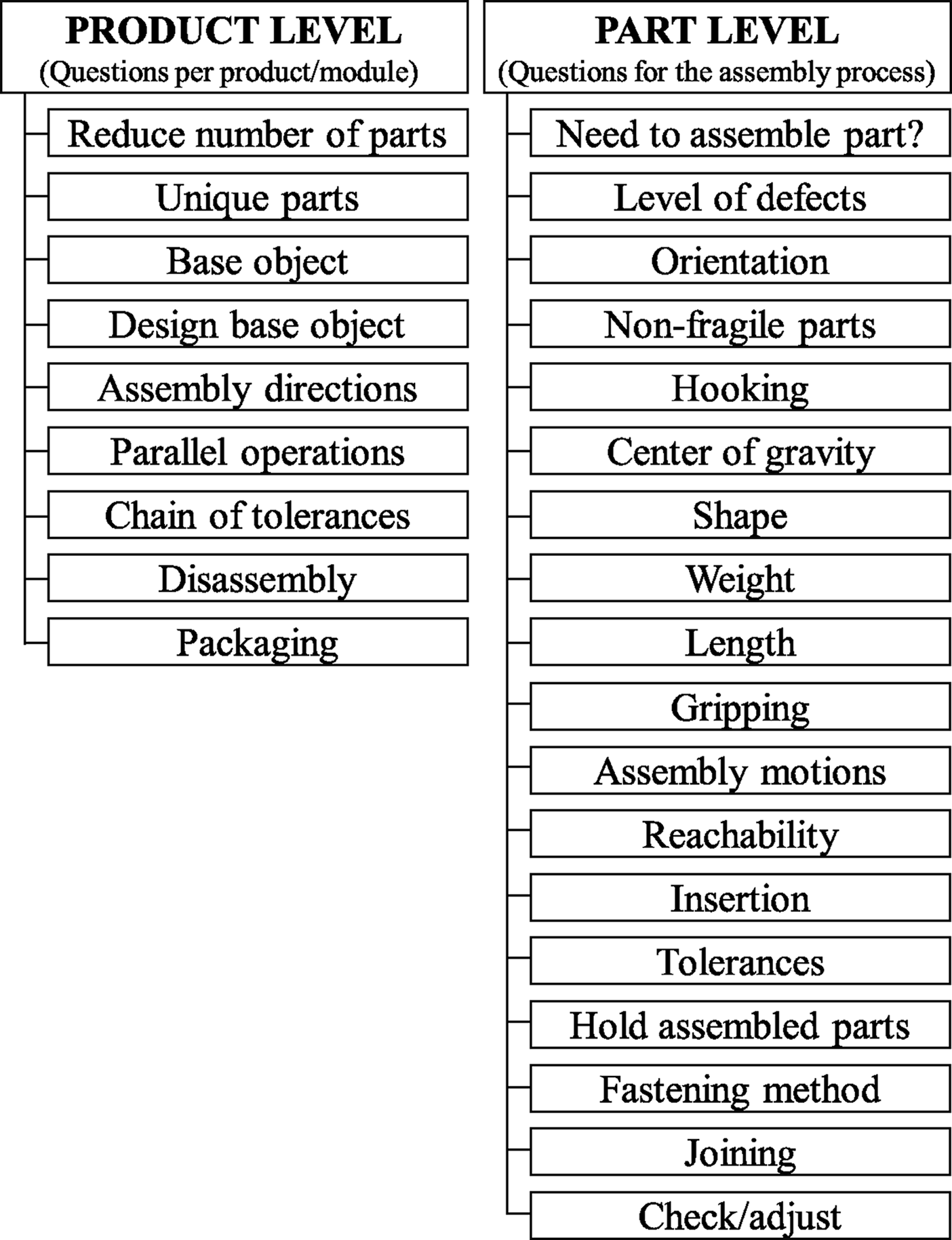
The assessment of the approach is divided into two levels: a product level evaluation, where the entire product or the assembly is assessed, and a part level evaluation, where individual components are analyzed (Figure 2). On the product level, DFA2 evaluates factors such as part count, part diversity, and overall assembly complexity, while the part level assessment focuses on the geometric and technological suitability of each component for automated handling. The DFA2 method employs a qualitative approach assigning scores to individual evaluation criteria. Each criterion is linked to specific design recommendations, ensuring that design improvements are guided by a structured and repeatable methodology. Scores of one, three, or nine points are given in the approach. Nine points are given for the optimal DFAA solution, three points for an acceptable solution, and one point for a solution considered undesirable from the DFAA perspective. The DFA2 method provides evaluation guidelines for each criterion, derived from the corresponding design guidelines. For the final quantification, a DFA2 index must be calculated. (Reference EskilanderEskilander, 2001) The DFA2 index is expressed as a percentage, indicating how well a design meets automation principles, with 100% representing optimal suitability. The structure for the DFAA perspective by Eskilander and the corresponding formula for the DFA2 index is shown below. The mentioned points must be given for each criterion listed in Figure 2.
 $$100*{{Total\,Score\,for\,the\,evaluated\,product} \over {Maximum\,\,ideal\,\,score}} = DFA2 - index\,in{\rm{\% }}$$
Structure of the DFAA method by Eskilander (Reference EskilanderEskilander, 2001)

3. Adapted approach and evaluation of the reference PEM stack
In this chapter, the modified DFA approach will be introduced and directly applied to the reference stack. This integration allows the methodology to be explained in parallel with its practical application.
3.1. Adapted approach
Various methods are available for evaluating designs for automated assembly, as discussed in the previous section. Eskilander’s DFA2 method serves as the basis for this work. The DFA2 method is used because it builds on established approaches and can be applied across all planning phases. Unlike the other described methods, DFA2 provides a structured evaluation at both the product and part levels, making it adaptable to complex assemblies like PEM stacks. Additionally, its scoring system allows for a quantifiable comparison of design variations, which is essential for systematically improving automation compatibility. A detailed description of this method can be found in (Reference EskilanderEskilander, 2001). However, the assemblies analyzed in this work have unique characteristics, primarily due to their stacking configuration. While DFA2 provides a comprehensive framework, it does not fully address the unique complexities of stack designs. To address this, the methodology will be further examined and adapted to reflect the distinctive features of stack-based assemblies. The evaluation here is also conducted using scores of one, three, or nine points, as in the DFA2 method. The DFA2 method evaluates a product on two levels: the product level and the part level. (Reference EskilanderEskilander, 2001) The structure of the DFA2 method is retained in the paper, but adjustments to the evaluation criteria are necessary to adapt it to the specific requirements of the PEM stack configuration. The technology is characterized by a series of vertically stacked components, where the arrangement repeats after a certain number of parts (Reference Smolinka, Wiebe, Sterchele and PalzerSmolinka, 2018).
3.1.1. Product level
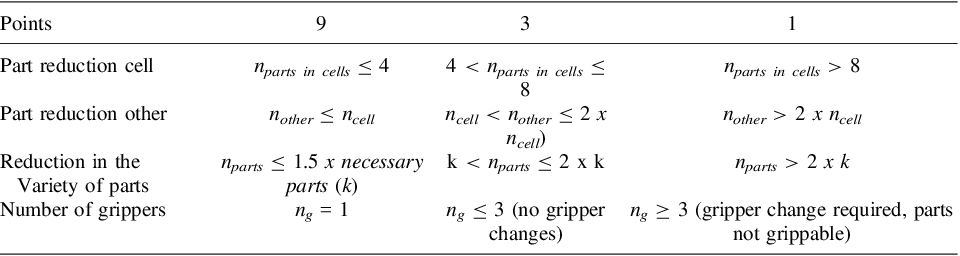
At first, it is necessary to adjust the “part reduction” criterion of the DFA2 method by Eskilander. The stack configuration requires separate consideration between cell components and other components for correct evaluation. The cell components repeat depending on the number of cells multiple times, while the remaining components of the stack typically occur once or twice. To gain a clearer overview and identify which areas are particularly critical in terms of component quantities, a differentiated analysis will be conducted in this work. Therefore, a first criterion for the number of components in a single cell (“part reduction cell”) and a second criterion for the number of the remaining stack components (“part reduction other”) are added to the approach. Another adjustment is made for the “unique parts” criterion, as the DFA2 method evaluates the proportion of unique parts to total components. This proportion is naturally low in stacks due to the repetitive cells, leading to a generally positive evaluation. However, reducing unique parts is essential to simplify the assembly. Therefore, this criterion will be evaluated depending on the “necessary part” criterion of the part level, where components that will be scored with the highest score of nine at the “necessary part” criterion at the part level will be seen as “unique parts”. This criterion is named “reduction in the variety of parts” to describe it more precisely. It is important to note that the evaluation for this criterion must be conducted in collaboration with relevant experts in the field, as specific knowledge is required for the functionality. The final adjustment to the DFA2 method at the product level is the addition of a new criterion addressing the number of grippers needed. In the context of automated assembly, a gripper is a robotic tool that securely handles and precisely positions components, ensuring automation compatibility. While the part level considers whether individual parts can be gripped effectively and whether gripper changes are necessary, an overall assessment is missing. Especially for stack assembly, this overall view is critical, where the large number of components in the cells significantly impacts gripper requirements. As outlined in Table 1, the case is ideal when only one gripper is required for the assembly. Using up to three grippers is considered acceptable, while requiring more than three grippers or necessary manual efforts results in the lowest score. Along with the evaluation basis, the adjusted and newly added criteria are summarized in Table 1. The evaluation of the remaining criteria is oriented to the Eskilander DFA2 method and is comprehensively described in (Reference EskilanderEskilander, 2001).
Adjusted evaluation criteria for assessing the stacks within the product level

3.1.2. Part level
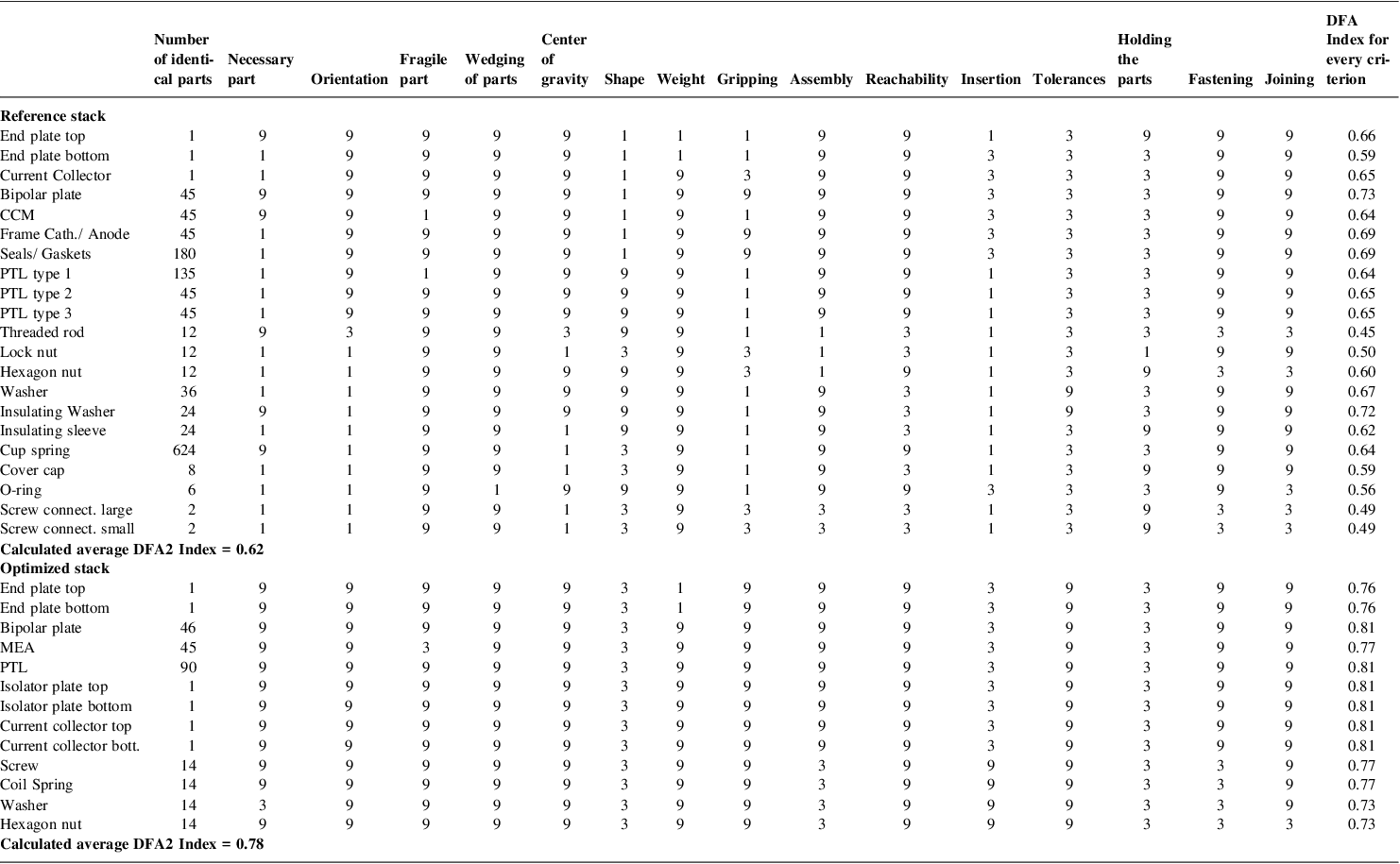
At the part level, no new criteria have been added compared to the DFA2 method by Eskilander. Instead, certain criteria that provided no significant added value were removed. A particularly critical criterion is the “defect rate” which in this paper was excluded due to insufficient data and the variability in material properties specific to the analyzed stack. Furthermore, the “length” criterion is removed. The reason is that generally the length of the stack and its components are not adjustable due to its correlation with the desired hydrogen production, which depends on the required active size of the reactive area of the components (Reference NeugebauerNeugebauer, 2020). In contrast to Eskilander, every criterion will have its own DFA2 index, to enhance comparability with the optimized variant (cf. Table 4, appendix).
3.2. Evaluation of the reference PEM stack
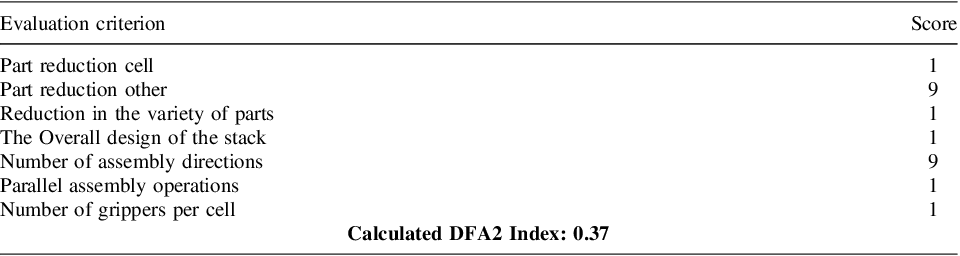
The evaluation at the product level already highlights major automation deficiencies (cf. Table 2). In the assessment, it can be concluded that both the “number of parts within the cell” (eight components per cell) and the “variety of the parts” are excessively high, which negatively impacts the assembly efficiency and automation potential. The potential for “part reduction for other components” of the stack is low, as these typically appear only once or twice and are difficult to eliminate or replace. Although the “overall design” of the stack and components shows a functional design, its execution is questionable. Particularly the use of a round stack configuration poses challenges in handling and assembly accuracy. The round shape was originally chosen to ensure uniform pressure distribution across all cells, reducing leakage risk and enhancing mechanical stability under high operating pressure. However, it complicates automated handling due to the lack of defined edges for stable gripping. In addition, the stack’s endplates have complex freeform surfaces with limited gripping areas, which results in significant challenges for proper handling. On the positive side, the criterion for the assembly directions can be mentioned. Generally, it is preferable to use only one assembly direction, ideally from top to bottom (Reference EskilanderEskilander, 2001). This is largely achieved in the reference stack. However, the assemblies do not deliver satisfactory results regarding the number of grippers needed. Especially, the analysis reveals that many components are inadequately designed, with some being entirely unsuitable for grippers. The calculated DFA2 Index of 0.37 at the product level highlights the limited suitability of the current design for automated assembly, emphasizing the need for an automated capable design.
Product level evaluation of the reference stack

The evaluation at the part level reveals that most stack components received insufficient scores (cf. Table 4, appendix). The average DFA2 score here is 0.62, well below the optimal value of one. The suitability of certain components for automated assembly is highly questionable. For instance, the gripping of the PTL materials is highly complex due to the grid structure and the lack of defined gripping positions. Also, the screw connections and assembly of threaded rods prove to be highly complicated. The absence of guiding features here, which could simplify the assembly process, makes precise alignment challenging and increases the overall assembly complexity. Additionally, the weight of the end plates is a critical factor in choosing a suitable automated system that can provide the required performance while still maintaining high precision for positioning the thinner parts. A key criterion that posed challenges during the evaluation was the “necessary part” section, as it requires considering the functionality of components. The purpose is to identify if a part serves a specific function in the stack and whether another component could take over that function. The aim is to decide if a part is essential or can be eliminated. Each component is considered individually. A representative example here is the PTL parts. Each cell of the reference stack includes three different PTLs. However, the researched literature and other reference stacks observed within the FertiRob project indicate that one or two PTLs are sufficient to fulfill the main function. Since the determined number of necessary parts serves as the basis for evaluating the “reduction in the variety of parts” criterion at the product level, the correct evaluation of the “necessary part” criterion is essential.
Exploded view of the reference PEM stack (left) and of a single cell (right)

4. Development and evaluation of an optimized stack based on the adapted DFA method
In the following, an optimized stack with automation-friendly improvements is presented based on the findings from the previous assessment. The optimized stack will then be evaluated using the same methodology to validate the improvements and highlight the effectiveness of the DFA approach.
4.1. Optimization of the stack
Based on the previously analyzed stack design and the identified deficits, a new optimized stack has been realized according to the developed new approach.
First, the focus for optimization lies on the cell components (cf. Figure 4). In the first step, the round cell geometry was redesigned to a rectangular one and all cell components were adapted to a uniform outer geometry, enabling the use of a universal gripper and a more material-efficient production. In addition, cut-outs are provided in the outer geometry, which is used to precisely position the cell components about each other with an external positioning device. To optimize the cell structure, metallic bipolar plates with integrated flow fields are used, which consist of two bipolar half-plates welded together. This allows different flow fields to be generated cost-effectively for the anode and cathode sides and eliminates the need to use expanded metals or similar materials. Another positive effect of two bipolar half-plates welded together is the generation of a third media channel between the plates that can be used for temperature control of the stack. To further reduce the number of parts, the required seals are applied directly to the welded bipolar plates so that they can be installed as a single assembly and handling is simplified (cf. Figure 4, right). In this regard, the porous transport layers were also optimized. These were integrated into a frame with seals and could be stacked as a pre-assembled unit in the subsequent stacking process using a universal gripper. This gripper could work with a vacuum and grips the components evenly over the entire surface. After optimizing the individual cell components, the other stack components were also optimized. For example, cut-outs were also integrated into the end plates of the stack to make them easier to handle and position. Furthermore, the clearance holes for the screw connection were replaced by lateral cut-outs. These allow the screw elements to be inserted into the stack from the side, which brings advantages in automated handling, especially for very high stacks and eliminates the need for threading over long distances. This also means that the spring washers and a nut with a washer can be pre-assembled at the start of the screw thread. The parts are held in position along the screw by a retaining ring, which is designed to secure them during assembly. The number of parts has also been optimized by replacing the threaded rods with round head screws with a square neck and eliminating the previously used nuts with washers on one side. The square neck prevents the screws from rotating in the groove so that only the nuts need to be tightened for the screw connection. This has the advantage that the installation space of the stack (cf. Figure 4) is reduced and consequently, the fixture technology required for assembly can be simplified.
Optimized PEM stack (left) and exploded view of an optimized single cell (right)

4.2. Evaluation of the optimized stack
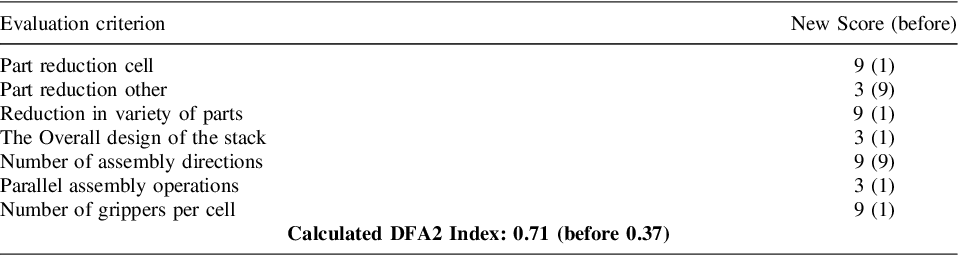
To validate the previous optimizations made to the electrolysis stack, a new evaluation was carried out using the developed method at the product level. The results are shown in Table 3.
Product level evaluation of the optimized stack

Regarding the number of parts per cell, a reduction to four parts per cell was reached and therefore nine points were achieved in the assessment. In the optimized stack, one cell consists of a welded bipolar plate, two porous transport layers with frames, and a MEA. The number of other parts was also reduced to 56, which is why three points were awarded for this evaluation criterion. This improvement primarily resulted from replacing the individual disk springs with coil springs and removing the nuts and washers previously located on the underside of the stack. Since this evaluation criterion depends on the number of cells installed, it is seen as not critical because the rating would increase to nine with a higher number of cells in the stack and the same overall design. Further, the stack’s overall design was optimized for better manageability. For example, the use of round head screws reduces the installation space of the stack, which also reduces the interfering contours for the required gripping technology. Furthermore, positioning and gripping are improved by incorporating geometric features in the end plates. As there is potential for further optimization, but this would directly affect the basic structure of the stack, the overall design is currently rated three. Regarding the mounting directions, the elimination of threaded rods and nuts on both sides and the introduction of lateral cut-outs in the end plates made it possible to rotate a mounting direction originally opposed to the stack formation by 90 degrees. This did not reduce the number of assembly directions, but optimized them, which is why this criterion is rated nine. Furthermore, in this context, there is a direct interaction between the number of assembly directions and the parallel assembly options because by rotating the one original assembly direction and optimizing the end plates, several parallel assembly operations can be optimized for screwing and pressing. This simplifies the insertion of the screw elements into the stack while it is compressed by a press. Thus, parallel assembly operations scored three points. Overall, the evaluation of the optimized stack at the product level resulted in a significantly improved DFA2 Index of 0.71 (+34 %), reflecting a notable enhancement in its automation potential at the product level.
An assessment of the improved stack was also conducted at part level and the results are presented in Table 4 in the appendix. Overall, a general improvement was achieved by excluding certain low-rated components. However, some deficits remain. For example, the upper and lower end plates still have a high weight compared to the other components of the stack, which should be further optimized to achieve energy-efficient electrolyzer production and simplified handling. In addition, further optimizations could be carried out in the screw connections to reduce further parts and improve the assembly and tightening of the screws. Overall, it can be concluded that the DFA2 index at the part level enhanced up to 0.78 (+16 %), reflecting advancements in automation potential through optimization.
5. Conclusion and future work
This study presents a DFA approach tailored to PEM electrolyzer stacks, addressing the challenges associated with their automation potential. By adapting the DFA2 method, new evaluation criteria were introduced to account for the unique characteristics of stacked components. The effectiveness of the approach was particularly evident during the validation process with the reference stack, where it enabled the identification of significant design limitations, such as an excessive number of parts, high part diversity, and inadequate handling features that hinder automation capability. To overcome these challenges, a redesigned stack was developed, with automation-friendly improvements, including a standardized rectangular cell geometry, integrated components, and reduced part diversity. These modifications improved the evaluation score and increased the potential for automated production.
While DFA2 provides a strong framework for automation-oriented design, it lacks specific criteria for stacked assemblies. This research extends DFA2 by adapting it to stacked cell configurations, enhancing its applicability to automation-compatible design. The modularity of the proposed approach allows easy adaptation for different PEM stack applications. This flexibility allows stakeholders to efficiently adjust and implement the methodology and conduct the evaluation for the improvement of their PEM electrolyzer stacks. It is important to note that the assessment focused on the design’s potential for automation. The functionality and operability of the stack were not the subject of this work, as addressing these aspects would exceed the scope of this study. Together with electrolyzer stack experts, future studies should address these aspects together to ensure the practical applicability of the optimized design. Future research should also focus on other electrolyzer technologies to assess the compatibility and adaptability of the approach.
Acknowledgments
The presented work was supported by the Federal Ministry of Education and Research (BMBF) under grant number 03HY113B within the research project H2Giga QT4.2: FertiRob.
Appendix A
Part level evaluation of the Reference and the optimized PEM stack





 Open access

