

This paper examines how ethnic minority dance was choregraphed and thereby transformed into frontier dance (Bianjiang wu 边疆舞), creating a new dance genre in modern China.Footnote 1 It shows how choreography has represented a combination and reorganisation of many elements, including local, western, and ethnographic traditions. The construction of frontier dance in the 1940s, a period of war, trauma, turmoil, political discontinuity and migration, demonstrates the mobility of dance: how it transformed from the rural dance of local ethnic minorities to a form of concert dance mainly popular with the urban Han Chinese. The process of constructing frontier dance provides an arena for creative cooperation and competition between local and national, Chinese and western, and modern and traditional elements.
Scholars who have examined frontier dance of the 1930s and 1940s, have analysed the close relationship between dance and Chinese ethnopolitics, including the constitution of Chineseness. Justin Jacobs, in his work on Xinjiang youth song and dance troupes in Republican-era China, has examined how the Chinese state projected Xinjiang as an integral part of China, and how it sought to develop Chinese imperialist strategy through popular media and the lens of dance (Jacobs Reference Jacobs2008, 545-91). In a study of concert dance in modern China, Emily Wilcox begins her discussion with dances representing ethnic minorities. She highlights the important contribution of Dai Ailian in the creation of Chinese dance as a national form (Wilcox Reference Wilcox2019 13-47). In her study of Yi dance performance in Kunming in the 1940s, Ruby McDougal examines the political tensions which arose from a vibrant partnership between Yi dancers and Han intellectuals. She shows how, for many leftist Han intellectuals in Kunming, the invocation of ethnicity in these dances generated revolutionary meanings, prompting the Kuomintang to impose a temporary ban on Yi dance performances in 1946, on the grounds that the performers were spreading communist messages (MacDougall Reference MacDougall2021, 367-94). The discussion which follows, analyses the choreography of frontier dance within the context of 1940s ethnopolitics. The sources and methodology of choreography play a significant role in the constitution and realisation of Chineseness. An investigation into the many sources which comprise frontier dance complicates our understanding of the dynamic of Chineseness within dance, which requires to be understood with a specific context.
Scholars have studied the transnational and transcultural features of dance in modern China (Miao Reference Miao2022, 50-69; Yeh Reference Yeh, Mezur and Wilcox2020, 44-59; Wilcox Reference Wilcox2017, 518-39). In her study of the transnational history of dance in modern China, Nan Ma has argued how “The Chinese development of modern dance compellingly demonstrates the transcultural and transnational origin of (modern) Chinese dance and the underlying struggles for the discursive authority over the definitions universality, nationality, the modern and tradition.” (Ma Reference Ma2023, 14). Ma highlights the hybrid nature of Chinese dances, and the way in which changing domestic and international politics challenges our understanding of the dynamic of Chineseness. This paper also demonstrates the fusion of multiple sources in inventing frontier dance. It argues that western dance should not necessarily be regarded as the opposite of Chinese dance rather, in combination with other elements, it has contributed to the invention of Chinese dance.Footnote 2 This study of the choreography of frontier dance seeks to destabilize the relationship among dance, Chineseness, and ethnicity. Additionally, the study of the invention of frontier dance is situated within the broader context of cultural representations of Chinese ethnic minorities (Gladney Reference Gladney1994, 95; Harrell Reference Harrell1995; Schien Reference Schien2000; Zhang Reference Zhang2021a, 343-65; Zhu Reference Zhu2020; Rodriguez Reference Rodriguez2022). The choreographic invention of minority dances further enriches our understanding of ways of making ethnicity in modern China and the hierarchical power relations between Han Chinese and ethnic minority groups.
Drawing on reviews, reports and articles, the memoires of dancers as well as photographs and drawings, the discussion examines the sources and methods of the choreography of frontier dance. The first section explores the theoretical framework which underpinned the creation and adaptation of dances in the 1930s and 1940s. The next section argues that the inspiration for the creation of frontier dance transcends local source material. It contends that the duet pattern in Western ballroom dances provided an important physical grammar for the adaptation of frontier dance. The final section sheds lights on the role of ethnography and tradition in the choreography of frontier dance, by highlighting representation of a romantic frontier redolent of free love and marriage. To achieve a comprehensive understanding of frontier dance in the 1940s, it requires a reconsideration of the mobility of dance in both a local and transnational context.
The Creation of Frontier Dance: Field Work, Primary Sources, and Adaptation
The creation and popularisation of frontier dance took place in the 1940s. This section highlights the competition and coalescence of local and western elements, referring to debates on the methodology of choreographing frontier dance. The local and rural dances of ethnic minorities were regarded as crude primary source material for the construction of ‘authentic’ Chinese dance of national form. The unique way of choreographing frontier dance aligns with the conceptualization of Zhonghua minzu and Chineseness in the 1930s and 1940s. Source material combined with a particular approach to choreography define the outlook, nature and boundaries of frontier dance.
In their evocation of Chinese dance, in Chinese national form, Chinese intellectuals as well as influential choreographers insisted on the importance of collecting local material for imitation and recreation, which reflects the multiethnic nationhood in Republican China. In an assessment of frontier dance performed in a local theatre in Wuxi in Jiangsu province, a local newspaper published an article entitled “The Value of Developing Frontier Dance”, and highlighted the significance of developing dance based on Chinese material, which argued that entirely westernised dance did not work in China. It went on:
On one hand, we can go to the people and learn from them their traditional dance; on the other hand, we can also experience their daily life. Thus, we can create dance as an art form which has a real national identity (Xibao 1947).
我们到民间去, 一方面学习他们既成的舞蹈, 一方面还得对他们的实际生活加以体验, 这样才能创造出中国真正的民族形式的舞蹈艺术.
This statement illustrates how field work and first-hand experience were regarded as core elements in the creation of dance in an authentic Chinese national style. Ethic minority dances as well as folk dances, performed by the Han Chinese, were considered part of folk art and, as such, constituted important source material in the invention of Chinese dance. In her widely circulated essay, “The first step of developing Chinese dance”, Dai Ailian 戴爱莲 (1916-2006), who was one of the most important choreographers in Republican-era China, suggests that the collection of dance material from local ethnic minorities and peoples, represented a first move (Dai Ailian 1946a, 9-12). Frontier dance was intimately associated with Chinese dance in the 1940s. Rey Chow (Reference Chow1998, 1-24) acknowledges the particular difficulty of defining “Chineseness” in studies of Chineseness; similarly, several scholars have acknowledged the difficulty of defining Zhongguo wu, and even probe if its English translation as Chinese dance properly indicates its meanings in Chinese (Miao Reference Miao2023; Wilcox Reference Wilcox2012: 206-32; Wu Reference Wu, Yamashita, Bosco and Eades2004, 201). It is important to realize the dynamics of Chinese dance which is required to be understood within a specific cntext. When frontier dance is discussed alongside Chinese dance, ethnopolitics was one of the major concerns. By bringing the dances representing varied ethnic minorities on the same stage, it is a metaphor for celebrating a unified China and the construction of a multiethnic Chinese nationhood in Republican China.Footnote 3 The emphasis on ‘Authentic’ dance in national form suggests that frontier dance is not only a useful tool of frontier governmentality but also a way of performing Chinese identity. The use of local materials was considered a core element in constructing Chinese identity. Through the studies of how frontier dance was constituted and interpreted in different contexts, this paper highlights the complexity of Chinese dance.
Several frontier dances were the result of field work and artists highlighted the significance of collecting and studying local ethnic minority dances. For example, Dai Ailian and her student Peng Song 彭松 (1916-2016) undertook field work in the Tibetan area of Western Sichuan (Dai Reference Dai1946a, 9-12; Peng Reference Peng2011, 3-5). Wu Xiaobang 吴晓邦 (1906-1995) and Jia Zuoguang 贾作光 (1923-2017) choregraphed Mongolian dances following their research visit to Inner Mongolia (You Huihai, Reference You2001; Jia Zuoguang Reference Jia2014, 28-40); Liang Lun 梁伦 (1921-2023), who visited Weishan in Yunnan, composed Axi tiaoyue 阿细跳月 (Axi Dancing under Moonlight) (Liang Lun Reference Liang1990, 97).Footnote 4
The emphasis on dance material collected from local people is associated with the reconceptualization of Chineseness in the 1940s, and the involvement of materials with field work guaranteed elements of “Chineseness”, which is interpreted through its counterpart of the western. In his discussion of the development of Chinese dance, Ye Qianyu 叶浅予 (1907-1995), the husband of Dai in the 1940s, argues that if it had simply been a matter of copying western dance, it could not have lasted very long without the addition of Chinese elements.Footnote 5 He describes Chinese elements drawn from local people as the “flesh and blood 血肉” of Chinese dance (Jin Ge 1948, 17). This intimate relationship between frontier dance and Chineseness is highlighted by Wilcox in her study of history of dance in modern China (Wilcox Reference Wilcox2019, 13-47).
The vision of frontier dance coincides with the recently developed theory of Minzu which was conceived during the second Sino-Japanese war. The meaning of Zhonghua minzu which was defined by political events, wars, government, and public intellectuals, evolved. The term Zhonghua minzu , which appears in the early 20th century, was used by late Qing reformers, including Liang Qichao (Huang Reference Huang2017, 149–54). In the first half of the 20th century, during the establishment of Republican China, the discourse of Zhonghua minzu underwent a process of development embracing the Fourth of May Movement, the Nanjing decades of Republican government, and later the Sino-Japanese War (ibid.: 132–216). Initially, it only referred to the Han Chinese but later, between the 1910s and the 1930s, incorporated the concept of the five major nations: the Manchu, Han, Mongolian, Tibetan, and Muslim. In the 1930s and 1940s, Chinese intellectuals introduced the ethnic minority groups of south-west China (the Miaoyi) into the debate about the definition of Zhonghua minzu (ibid.: 258–64). The introduction to the stage of dances which represented multiple ethnic groups, in particular the ethnic minorities in the Southwest, reflected a newly defined multiethnic Zhonghua minzu. Footnote 6
Chinese intellectuals and choreographers interpreted the significance of local source material in the context of a unique relationship between the ethnic minorities and Han Chinese. From an evolutionary perspective, ethnic minorities were considered to be the preservers of an earlier Han Chinese dance tradition: Han Chinese lost its dance tradition, while ethnic minorities remined ahistorical and preserved earlier Han Chinese dance traditions (Jianwen 1946, 36; Xiao Kun Reference Xiao1946, 22). The assumption that ethnic minority cultures are equated with the culture enjoyed by the Han Chinese at an earlier stage in their history echoes James Leibold’s observation of the construction of a common history, soil, and blood in the Chinese national identity by the male elite in the twentieth century (Leibold Reference Leibold2007, 1-17). Ma has shown how ethnic minority and Japanese dance were both considered to be of equal influence on the Han Chinese during the Tang dynasty. A narrative which constructs a genealogy of ethnic dances, reflects a Han-centric nationalist imperative (Ma Reference Ma2023, 169-71). Moreover, Chinese intellectuals in the 1930s and 1940s rejected an entirely imported western culture; some took a positive view of China’s past as they sought to develop a cultural renaissance in China (Huang and Wang Reference Huang and Feng2006, 129-37). This explains the request to use local materials in creating frontier dance, which was closely associated with the construction of Chinese identity.
The emphasis on the significance of local material is inseparable from the development, in the early twentieth century, of anthropology, with its associated methodology of fieldwork and direct observation.Footnote 7 Anthropology had been introduced to China in the late 19th century. During the first half of the twentieth century, several universities and academic institutions established departments of anthropology (Wang Reference Wang1997, 243-50). Observation and fieldwork were considered to be important methodologies in British and European anthropology (Sera-Shriar Reference Sera-Shriar2013, 109-16). In his studies of frontier field work in China’s borderland, Andres Rodriguez acknowledges the important influence on Chinese anthropology of Malinowski’s fieldwork method of direct engagement with subjects taking place over an extended period (Rodriguez Reference Rodriguez2022, 16-17). Missionaries, soldiers, scholars, artists, anthropologists, and students all engaged with frontier fieldwork. For the Han Chinese who lived in large cities, “Frontier fever” reshaped the interpretation of the frontier (ibid., 77-100). Direct observation and fieldwork were regarded as important methodologies in the production of reliable knowledge, whilst the collection of non-Han dance material through fieldwork, was influenced by anthropology.
During the 1930s and 1940s, and especially during the war, Chinese anthropologists switched the focus of their research from the Han Chinese community, which was located near the east coast, to the ethnic minority groups in the south-western borderlands (Guldin Reference Guldin1993, 57; Wang Jianmin Reference Wang1997, 229–43). Soon after the battle of Marco Polo Bridge and the occupation of large areas by the Japanese army in 1937, the Chinese government announced the relocation of its capital to Chongqing in Sichuan. Government agencies established temporary offices at Hubei in Wuhan, while people, schools, and factories relocated from coastal areas to the interior and the frontier (van de Ven and Drea Reference van de Ven, Drea, Peattie, Peattie and van de Ven2011). Chinese anthropologists believed that anthropology was a useful tool for governing the frontiers (Zhu Reference Zhu2022a, 85-112; Rodriguez Reference Rodriguez2022, 101-27). By combining frontier governmentality with art, frontier dance has evolved along with similar categories, such as frontier art (Bianjiang yishu 边疆艺术), frontier music (Bianjiang yinyue 边疆音乐), and frontier anthropology (Bianjiang renleixue边疆人类学) during the second Sino-Japanese wartime (Zhu Reference Zhu2022c: 358–89). In the 1930s and 1940s, the use of frontier dance to name dances involving ethnic minorities illustrates the important place of dance in frontier governmentality, as the geopolitical value of the frontier became apparent during the second Sino-Japanese war. The use of “frontier dance” indicates the political adoption of dance on the frontier during the 1930s and 1940s. However, the use of frontier dance to name dances representing ethnic minorities is temporary until the end of 1940s, and it was renamed and recategorized as folk dance in the 1950s to better serve the political request of promoting equality among Minzu in China (Wilcox Reference Wilcox2016, 363-86).
Although ethnic minority dance was regarded as an important element in the creation of Chinese dance, it was only regarded as a primary source. Choreographers insisted that ethnic minority dance could not be staged in its natural form but required it to be adapted. In her aforementioned essay, “The first step of developing Chinese dance”, Dai Ailian observed “It could be very simple to introduce the dance of non-Han people on stage. In terms of choreography and form of dance, it has to be adapted so some extent. 这些舞蹈介绍到台上来本来太简单, 为了编制形式上的考虑, 多多少少有些经过改变了的” (Dai Reference Dai1946b, 14). In a review article on Dai’s dance, the author Qinsheng 勤生 commented:
To observe and explore in the remote parts of Xikang and Tibetan is to imbibe the essential spirit of frontier dance. In combination with western dance, it creates a more refined and beautiful dance form. (Qinsheng 1946, 19).
在遼远的西康, 西藏一带, 观摩研讨, 把边疆舞蹈的精髓统统接受过来, 并融合西洋舞艺, 创造出一种更优美的舞蹈艺术。
Qinsheng considered that Dai accepted the best aspects of frontier dance then refined her work under the influence of western dance. An ideal form of frontier dance in Republican-era China appeared to be a combination of local elements and western dance. Although authenticity was important, western dance was not rejected; the fusion of local and western elements was to be expected. Liang Lun shared a similar view on the adaptation and creation of frontier dance. In his article entitled “舞蹈的中国化问题 the problem of transform dance in Chinese forms”, he insisted that it was essential to collect material from Han Chinese people and ethnic minorities but insisted that adaptation was essential:
The tufeng wu (a dance according to local custom) performed on stage in modern cities adapted or recreated by a professional dancer; The original tufeng wu was a form of private entertainment but required to be performed if others were to appreciate it. The original dance movement was very rough, but for a stage version, it requires to be exquisitely refashioned. As regards musical accompaniment of the tufeng wu, the musicians must take pains to retain its spirit highlighting national and local characteristics. Otherwise, the delight and value of the tufeng wu would be sacrificed.
现在都市舞台上演出的土风舞, 是经过职业舞蹈家整理过, 或是再创造过的东西。因为原来的土风舞本来是自己跳来娱乐的, 现在却要表演给别人欣赏。本来的动作很粗糙, 舞台上的动作必须经过精细的加工, 但舞蹈家处理土风舞时, 必得小心翼翼来保持和发挥它的民族和地方的特性和精神, 不然便会失掉了土风舞的趣味和价值。(Liang Reference Liang1947, 14).
Liang distinguished between folk dances and dances performed in the theatre, with reference to performers, audiences, and respective functions. He recognised the risks of losing the spirit of folk dance by inappropriate or excessive adaptation (Liang Reference Liang1948, 17). His view reflected a Han-centred view of the hierarchy of ethnicity and culture: the dances of ethnic minorities were conceived as crude and therefore needed to be refashioned in a more delicate way. The use of local dance traditions was important in terms of ‘authentic’ dance in Chinese form, yet at the same time did not preclude the addition of parallel elements.
When frontier dance or local custom dance was constructed as a new genre in the 1930s and 1940s, it principally corresponded to the concert performance of rural Chinese minority dance for urban audiences. In the 1930s, “Frontier dance” described the dances of ethnic minorities. For example, an article introducing an exhibition of the northwest frontier, describes “Bianjiang wudao 边疆舞蹈” which was performed in 1936 (Jingqing, 1936). As previously discussed, the emergence of frontier dance formed part of a frontier art which highlighted the overlap between art and politics during the second Sino Japanese war. However, “Bianjiang wu 边疆舞” appeared in local and national periodicals and newspapers during the civil war period between 1946 and 1949. The spreading of “frontier dance” as a new dance genre, is inseparable from The Frontier Music and Dance Plenary (Bianjiang yinyue wudao dahui 边疆音乐舞蹈大会), which first opened in Chongqing on 6th March 1946, and later toured in coastal cities and America (Dai Reference Dai2003, 101-38). Newspapers and periodicals reported and reviewed the performances; it is of note that “bianjiang wu” was widely used in describing Dai and her students’ performances. In August 1946, an advertisement in Shenbao, a local newspaper published in Shanghai, specifies the time, venue and ticket prices of a performance of Dai Ailian’s frontier dance (Shenbao 1946). Two lines in enlarged Chinese words, Dai Ailian and Bianjiang wu, are visible in the image. The proliferation of frontier dance was closely associated with Dai’s touring performances. From 1946 to 1949, local and national newspapers widely referred to frontier dance. Indeed, some newspapers highlight the political and social values associated with frontier dance (Xibao 1947, Dagang bao 1948). Later, frontier dance became popular with students and local societies. In 1947, when female students at Jinling Female University 金陵女子大学 were raising funds, they performed frontier dance (Huarong Daoren Reference Huarong1947). In the same year, senior students performed frontier dance at the induction of new students (Zhongnan bao 1947). A group of young females in Hangzhou performed several dance pieces representing the Uyghur, Tibetan, and others: the enlarged character of “bianjiang wu” is placed at the very top of an article in a local pictorial periodical ( Dalu huabao 1949, 17). Influenced by Dai’s concert dance approach, frontier dance in the 1940s mainly refers to the concert adoption of rural dance.
Although Dai and others started to collect materials of ethnic minorities during the war time, frontier dance became popular among students and young people in the civil war period. The function of frontier dance is multi-dimensional. In an article talking of the value of developing frontier dance, the author mentioned that frontier dance was a way of learning about the frontier and recalled the turbulent frontier (Xibao 1947). These are the continued influences of the ethnopolitics of dance developed during war time. For the specific period of civil war when China was divided into Kuomintang-administered and Liberated areas, frontier dance was involved with both parties in different ways.Footnote 8 In a newspaper of Xinmin bao for local Nanjing people in 1946, it is reported frontier dance was performed in the Mei Lanfang theatre, and it attracted numerous audiences, including representatives of some Kuomintang officials; the daughters of some Kuomintang generals participated in the performance of frontier dance ( Xinmin bao 1946). When frontier dance from Yucai school was performed in Shanghai in 1946, it was supported by some key figures of culture and art in Shanghai, and some were CCP members and others were KMT officials (Ye Ning Reference Ye1999, 306). Frontier dance was performed as part of the student anti-civil war and anti-hunger movements in 1947 in Beijing. In Dai’s dance workshop of teaching frontier dance in Beijing, more than fifty students attended the class, and most were student activists (ibid., 307). Student activism movements were supervised and supported by CCP members in Beijing (Chen Taisheng Reference Chen1989, 407-36). Using a popular song from the liberated area, Unity is Power, as background music, Peng Song created a dance for the student activists in Beijing (Ye Reference Ye1999, 307). In an article promoting frontier dance published in Dagang bao , it mentioned Yang’ge and frontier dance were two of the most popular dances in China, and the author hoped frontier dance could be as popular as Yang’ge; frontier dance had demonstrated its useful potential in uniting students, educating students, and enriching the life of students ( Dagang bao 1948).Footnote 9 Students became major performers and audiences of frontier dance. The interpretation and practice of frontier dance in the civil war period demonstrated its diverse functions and it attracted the involvement of multiple social groups and political powers.
Throughout the Republican era, the term “Tiaoyue 跳月 (dancing under moonlight)” is often used to describe the rural dances performed on the frontier particularly by ethnic minorities in Yunnan and Guizhou provinces and encountered by travellers or researchers in the field. An article introducing ethnic minority dance in the Southwest published in Beiyang Huabao in 1933, mentions that the Miao barbarian dance is vernacularly called Tiaoyue (Laoxuan, 1933: 2). In 1930, another article in a local Shanghai newspaper describes the dances of ethnic minorities in Yunnan as “Tiaoye wu 跳月舞”, and how local youth used dance as a form of courtship (Shuitian 1930). During time of war, many people travelled to West China, where they had an opportunity of seeing ethnic minority dances at first hand. They often use the word “Tiaoyue” in their descriptions of ethnic minority dance. A student wrote of his/her experience of seeing the local and rural dances of ethnic minorities on the fronter as “Guan Tiaoyue ji 观跳月记(Travel account of seeing tiaoyue)” (Li Ren Reference Li1941, 26-27). During the civil war period, while Bianjiangwu was widely used to describe adopted dances representing ethnic minorities, “tiaoyue” continued to be used to describe the local and rural dances of ethnic minorities. For example, in 1947, an author, employing the nom-de-plume “Yuan” published a memoire of the interior entitled “貴州苗胞的跳月 (The Tiaoyue of Miao in Guizhou)” (Yuan 1947). A writer in the popular periodical Libai liu 礼拜六 (Saturday), which was well-known for publishing love stories and literature, included a photograph entitled “Shanmin de tiaoyue 山民的跳月 (The moon dancing of mountain people)”in which a group of men appear to be dancing on the ground (Fangcao 1949, 10).
Tiaoyue appears in several ethnographies of late imperial China, including the Miao albums which depict the dances of the Miao people.Footnote 10 The great Ming literati Yang Shen 杨慎 (1488-1559) originally described the custom of dancing and courtship as Tiaoyue in Dian Chengji 滇程记 (A journey in Yunnan) (Hu Reference Hu2017, 39). Despite its title, the dance was not actually performed in the evening, suggesting an imagined male Han literary representation of non-Han society. When the Han Chinese visited the frontier during wartime, they continued to use the word, Tiaoyue , to describe the dance and marriage customs of non-Han peoples, interpreting Tiaoyue as a marital form of free love (Zhu Reference Zhu2020, 131-47). Tiaoyue is used to describe the local and rural dances as well as the adapted concert dances of ethnic minorities which the Han Chinese encountered in the field. For example, after some field work in Guishan in Yunnan, Liang Lun composed “Axi tiaoyue”, which represented the dance of the local Yi minority. The title of the dance reflects an imperial legacy and perpetuates the Han fantasy of the frontier, to be further discussed in the next section.
Different terms are used to categorise and label ethnic minority dance. Frontier dance principally refers to a concert production of rural Chinese minority dance.Footnote 11 The concert dance represents part of an urban culture’s new way of engaging with the frontier. The concept of frontier dance is fragmented, contradictory and ambiguous. A highlight of local dance provides a means of entirely rejecting westernized dance. On other occasions, adaptation under the influence of western dance is essential for the transformation of local ethnic minority dance into frontier dance. The evolutionary way of insisting ethnic minorities preserved earlier Han Chinese cultures indicates the construction of a unified China and a highlight are dances representing ethnic minorities which reflect the reconceptualized Zhonghua minzu in the 1930s and 1940s. The convergence of a multitude of constituent elements for the construction of frontier dance challenges our understanding of the mobility of dance within a transnational and local context. The next section elaborates on Western elements in the choreography of frontier dance.
The Visual Pattern of duet: interaction between female and male dancers
The first section emphasised local traditions which were considered as important source material for the choreography of frontier dances, but this was only part of the story; adaptation was a ‘must’. While several Chinese intellectuals have tended to reject westernised dance entirely in China in the 1930s and 1940s, elements of western dances played an important role in the invention of frontier and Chinese dance. One of the most striking features of frontier dance in the 1930s and 1940s was the combination of female and male dancers in the duet dance arrangement. This section argues that the form of a male and female pair in dance was largely the influence of western ballroom dance; it became a conspicuous physical trait in the dances representing many ethnic minorities in China.
In her memoir of her creation of Tibetan dances in the 1940s, Dai recalled how she adapted Tibetan dances:
Moreover, most dances I learnt (in Tibetan area) was the circle dance. The only change I made was to alter the formation of rows, in order to suit the requirements of a particular dancing area, and to create opportunities for mutual communication among dancers. For example, sometimes dancers might stand in a single row whilst on other occasions they might stand in two rows, facing each other (Dai Reference Dai2003, 135).
另外, 我所学的这些舞蹈大部分都是圆圈舞蹈, 我所做的唯一改变, 是在原有舞步的基础上变换队形和行进路线, 以适合舞蹈空间的需要, 也使演员之间有机会相互交流。例如有时让演 员站一横排, 有时让他们站两行, 相对而舞。
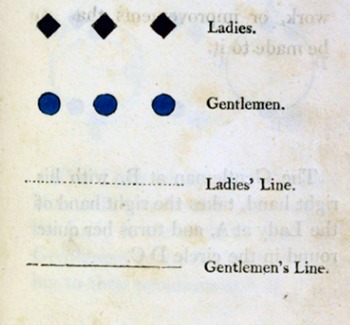
Noticing that Tibetan dances were principally in a circular form, Dai choreographed dances in rows so that dancers were able to interact with each other. Rows were often used in European rural dances. An example can be found in a guide to country dancing by Thomas Wilson, (1774-1854), an exponent of dance. He describes the beginning of a country dance with two opposing rows of ladies and gentlemen (Wilson Reference Wilson1808). Figure 1 is an illustration from the guide showing a row of women, represented by diamond shapes, standing directly opposite a row of men, represented by circles.
Illustration of Social Dance (Wilson Reference Wilson1808).

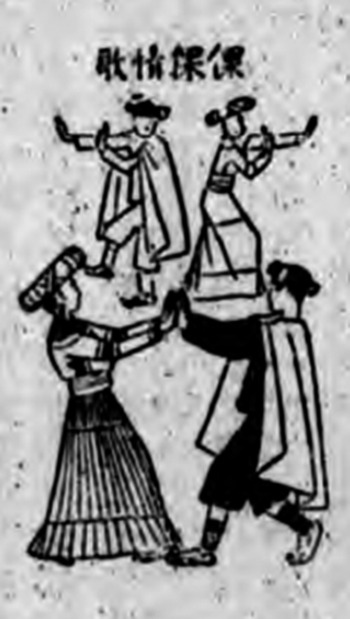
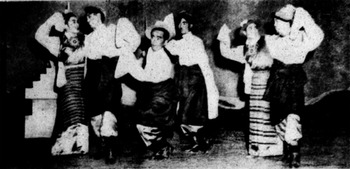
Choreography based on two opposing rows of dancers was widely used in ethnic minority dance. Figure 2 is photograph which shows a dance by the Lolo people who inhabit the Liangshan: four dancers stand in two rows comprising two couples and female dancers clapping one another’s hands. Figure 3, a cartoon of a Lolo dance, replicates the rows which we see in the photograph, highlighting the interaction between male and female dancers. It corresponds with Dai’s Tibetan choreography.
Photograph of Dance of Lolo’s Love Song ( Jinri huakan 1946, 3).

Cartoon of Dance Representing Lolo (A Long Reference Long1946, 41).

The choreography of Lolo dance does not draw on field work, and Dai never visited the land of the Lolo people or had an opportunity to see their dance in the 1930s and 1940s. She writes:
Using their music, I composed a dance entitled the Love Song of Lolo. When I visited the place where the Yi live, I strongly felt that the dance I choreographed was not at all like the dances of the Yi people. If I had had a proper opportunity of watching their dance, a chance of watching their dance, I would not have choregraphed the dance in the way I did (Dai 2016, 138).Footnote 12
我根据音乐编了舞蹈倮倮情歌。多年后我去彝族的倮倮人生活的地区, 深感当年自己根据想像所编的节目, 一点也没有倮倮人舞蹈的样子。当年如果我真的看过他们的舞蹈, 绝不会把它编成这种样子。
Despite intellectuals and choreographers highlighting the significance of field work as a means of producing the most ‘authentic’ dance in Chinese form, not all ethnic minority dances were derived from local material. European social dances played a very important role, as a way of imagining and creating ethnic minority dance; western social dance became a physical grammar of ethnic minority dance choreography.
Besides the use of rows, duet arrangement found in western ballroom dance was used in the adaptation of Tibetan dances. In her memoir of the choreography the Chunyou 春游 (Jotting in the spring), Dai recalls:
In 1946, I choreographed a Tibetan folk dance, entitled Jotting in the Spring.…‥ In the first part, the movement is based on marching whilst…… In the second part, the dancers stand in two opposing rows, facing one another.…‥ In the third part an ancient A’ruola dance is performed by two dancers. The woman stands on the right, and the man on the left. The man’s right hand touches the right-hand side of the woman’s waist; the woman’s left hand touches the man’s left shoulder (Dai 2016, 137).
1946 年, 我还编了一个藏族民间舞蹈, 名为<春游>.…‥ 第一个是行进的舞蹈……第二个舞蹈就是舞者 站成两排, 面对面在原地舞蹈。.…‥第三个是用古老的阿若拉舞, 它是双人舞蹈, 女在右, 男在左。男的右手扶女的右腰, 女的左手搭在男的左肩上。
Dai uses two rows of dancers in Jotting in the spring, besides adding the ancient “A’ruola” dance. The expression “A’ruola’ cannot be traced in the history of European dance (Wallace Reference Wallace1986; Franks Reference Franks1963). Nor indeed can we certain of the precise name of this dance. The description of dancing in pairs, with the man placing his hand on the women’s waist and the woman placing her hand on his shoulder, is likely reminiscent of several dances in Europe, including Baroque court dances, when lines and duet arrangement were applied in court dances. Dai studied ballet for many years in Trinidad and London before she came to China (Dai Reference Dai2003). Ballet contains heavy training in partnering and character dance. Particularly in character dance class, male and female students pair with one another and dance in lines (Homans Reference Homans2011). Several scholars have highlighted the influence of ballet on modern Chinese dances (Cui Reference Cui2023; Wilcox Reference Wilcox2019; Ma Reference Ma2023). Considering the training background of Dai, the use of lines and pairs could be an influence from ballet.
Intriguingly, ethnic minority dance was viewed as equivalent to a ballroom dance in the 1930s and 1940s. In an article entitled “边疆的交际舞 The ballroom dance of the frontier” published in 1939, the author claimed that ethnic minority dance in the frontier was equivalent to Western ballroom dance:Footnote 13
Popular dances these days include the Foxtrot, the Charleston, the Tango, and the Waltz……However., you may be surprised to learn that Chinese ballroom dance is really interesting. I would propose to introduce some of these to readers. (Xing Jun Reference Xing1939).
日下流行的什么狐步舞, 却尔斯登舞, 探戈舞, 华尔斯舞, 其实值不得那么地惊赏, 假是读者们会经到西藏的地方, 你可看见各种的舞术, 令你惊叹起来说:我们中国的交际舞, 是太有趣了! 现在特将几种介绍给读者吧。
Recognising the popularity of western ballroom dance in China, including the Foxtrot, Charleston, Tango, and Waltz, the author took the view that China had similar domestic dances. By comparing the dance of ethnic minorities to Western social dance, it complicates our understanding of the dynamic relationship between China and the West. For the Han Chinese, both ethnic minorities and the West were regarded as the ’Other.’Footnote 14 The frontier dance, which incorporated both Western and local ethnic elements, defined the cultural ’Other’ and contributed to the construction of Chineseness, which was constituted in the light of the “Other”. The Author further listed three ballroom dances in China including the Weilang 偎郎, Ge xianzi 歌弦子, and Tiao guochun 跳锅椿. He describes the ‘Weilang’ of Qiang and Tibet in detail:
The Weiliang from the Qiang and the Tibetan is a kind of ballroom dance, but it doesn’t take place every day of the year, only in the spring and autumn. On a lovely day when the flowers and trees are in bloom…, the young people in the village assemble. Wine is prepared. Musicians play the conch and four-stringed Qin on the grass. The women dress up and approach the men that take their fancy. With hands outstretched and displaying her waist, she asks a man to dance with her. The man is supposed to stand up immediately, face her and move in step. They dance to the music in high spirits. At the climax, she holds her hand aloft and sings loudly. The nervousness of the man’s heart strings are echoed by the lyrics. The song, music, rhythm and dance step are as one. Their movements are so beautiful, and their expressions so sincere. As the song changes, so does the dance step! (ibid.)
羌戎的【偎郎】, 也是交际舞的一种, 但他们的跳, 不是成年成日的跳, 他们的跳, 一定要选在春秋两季, 日丽风和的辰光, 那时花开如锦, 碧叶成荫, 约齐了全村的青年, 备办了葡萄酒, 在青草地上铺着 XX 伴奏的乐工, 就吹动了海螺, 弹起四弦琴, 一种交响乐泛汛在郊原里, 女的打扮舒齐了, 便走到她所看中的那位男子面前, 展 手摆腰, 请与共舞。男的就赶快站起来, 和她对面, 协调着步伐, 踏着音节就开始沉入那酣歌欢舞里了, 舞到热 烈的时候, 扬着手引吭高歌, 把平日自己羡慕青年的词句轻轻唱起来弹动男子们紧张的心弦, 歌, 音, 乐拍和步 伐都是一致的, 动作是那么美丽, 表情是那么真挚, 歌曲翻新, 步伐也随着翻新了!
This description of the Qiang and Tibetan dance has all the hallmarks of a western social occasion involving wine, music, song, and dance.Footnote 15 It is not known exactly which weilang this might be since it is untraceable among current Qiang dance. A very popular genre with a similar name of dance of Qiang is Shalang 莎朗, which in 2011 was recognised as forming part of the cultural heritage of Sichuan province. The Shalang dance is a circular dance, popular as much with the young as with the elderly, and enjoyed by men and women alike. The description of the Qiang dance, quoted above, to a great extent negates the existing Qiang dance tradition (Xiu Hua Reference Xiu2007, 41-43). Instead, Republican-era performers imagined that they were adopting a western tradition: well-dressed young people attending a party with music and wine; young men and women dancing to the accompaniment of music and choosing the partners they wished.Footnote 16 In Republican-era China, western ballroom dances and customs were used to reimagine the ethnic minority dances in the frontiers. The combination of Western and local materials in dance choreography aligns with Siyuan Liu’s study of cultural hybridity in Wenmingxi in modern China. This form combines elements from Euro-American spoken theatre, Chinese indigenous theatre, and shinpa (itself a hybridized form of Western-style theatre and kabuki) (Liu Reference Liu2013). The creative choreography of hybridity in frontier dance reflects a desire among urban Han Chinese to pursue both modernity and exotic Minzu culture within the context of colonial modernity and the construction of a hierarchical nationalism in modern China.
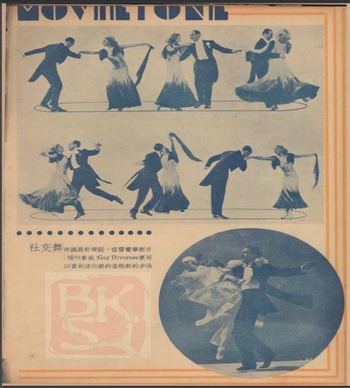
Western ballroom dances were introduced to China in the late Qing period and first found favour in the concession areas of coastal port cities (Liu Qingyi Reference Liu2009, 25-34). However, it was not until the 1920s that they became a popular entertainment amongst the urban Chinese. With the development of dance halls run by Chinese merchants in the 1930s and 1940s, western ballroom dances became popular amongst the general public in Shanghai (Gui Qiang Reference Gui2013, 53-57). Its steps and movements were introduced to Chinese people in popular periodicals; Waltz schools were even established to teach people the dance (Liu Reference Liu2009, 25-34). Figure 4 is a poster published in a popular periodical which features photographs of waltzes danced by the American stars Fred Astaire and Ginger Rogers who appeared in Gay Divorcee directed by Mark Sandrich (1900-1945) in 1934. The Chinese text in the centre of the images describes the newest ballroom dance in America. We can see Astaire holding Roger’s waist with his right hand, in the bottom right of photograph, in a sequence reminiscent of Dai’s description of the old “A’ruola dance”.
Three Images of Social Dance (Diansheng 1935, 1).

Figure 4. Long description
The layout contains three main photographic sections. The top row features three rectangular photos, left to right, each showing a man and woman in evening wear executing progressive ballroom dance movements: first, the man steps forward as the woman turns; next, they hold hands and rotate; finally, the woman twirls with her dress flaring. The second row repeats this left-to-right sequence with three more photos: the couple spins, the man bows and kisses the woman's hand, and the woman extends her scarf. At the bottom right, a large circular photo captures the man lifting the woman mid-dance, her dress billowing. Chinese and English text appears below the rectangular panels, with a stylized B K S logo in a square.
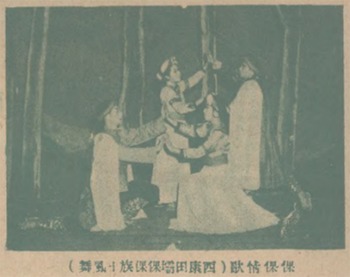
Dance patterns similar to duet can be seen in another Tibetan dance entitled Ba’an xianzi 巴安弦子also choreographed by Dai. Figure 5 is a photograph of Dai’s performance of a Ba’an xianzi staged in 1946 at Bianjiang Yingyue Wudao Dahui, Chongqing. In the background, we can see the Marnyi Stone which symbolises Tibet.Footnote 17 Three couples, comprising a man and a woman, are on stage. In the couples to the left and right, the man holds the woman’s waist. The physical movements in Figure 5 are similar to some of those which feature in the waltz in Figure 4.
Photograph of Dance Representing the Tibetan, Ba’an xianzi (Guo Qinfang Reference Guo1946, 12).

It is important to realize that it was uncertain how exactly the bodily movements in frontier dance were similar to those in Western ballroom dances. To place frontier dance as equivalent to “imagined” Western ball room dance was to emphasize the interactions between female and male dancers among ethnic minorities; dance was regarded as an important part of partner selection and marriage. It is uncertain whether it was the influence of court dance, countryside dance, ballet or ballroom dance which influenced the exact bodily movement in frontier dance. Furthermore, the boundaries of different genres of dances could not be taken for granted. For example, several European ballroom dances including Tango, Rumba, and Samba originated in folk dances in Latin America (Savigliano Reference Savigliano1995). Ballet was inseparable with several European court dances in its earlier stages of development (Zhu Reference Zhu2001, 7-8). Overall, it is evident the duet arrangement in European dance played an important role for the adaption of frontier dance. The aim of the adaption was to increase the interaction between male and female dancers, which was in line with an imagined and exotisied frontier.
The annotation for the above image explains how singing and dance provided entertainment for both Tibetan women and men. Xianzi 弦子 is a local dance in Ba’an. Many young men and women wearing new clothes assembled in fields to sing and dance at festivals (Guo Qinfang 1946, 12). The annotation makes a particular link between the Xianzi and young people, highlighting the interaction of young men and women. In fact, Xianzi is the Han Chinese name for the “Xie 谐”dance in Tibetan. Song and dance were combined to the accompaniment of a plucked string instrument. After prayer in the temple, people of all ages would dance the Xianzi at major festivals. Important themes rendered in song included eulogies of the people’s hometowns, nature, customs, celebrated places and love (Danzeng Ciren Reference Danzeng2000, 257; Zhaxi Jiangcuo Reference Zhaxi2017).
By no means is love the only theme in ballroom dance. In his cultural history of dancing and dance halls in Britain, James Nott notes how ballroom dance became popular among young British people, representing a vital feature of a distinctive youth culture in Britain. It “allowed a relatively ordered, safe, and ritualistic environment in which to grow up, offering tastes of independence and first encounters with the opposite sex……dance halls became central to the display of increasingly distinctive styles and patterns of behaviour” (Nott Reference Nott2015, 158). However, when ballroom dance is applied to the construct of ethnic minority dance, it is associated exclusively with love affairs among young men and women, reflecting a Han-centred romantic imagining of the frontier.
The bodily contact in a pair is a physical grammar shared between frontier dance and European ballroom dance, but it was received differently in China. When ballroom dances were introduced in Republican-era China, some commentators were critical of the spread of the waltz and the foxtrot because of the physical contact they entailed between women and men (Ci Qing Reference Ci1946, 7; Jian Ying Reference Jian1933, 10). A consciousness of gender was relevant for stage performance as it had been in traditional opera which, in early modern history, and in the context of a patriarchal society, was performed either exclusively by female or exclusively by male actors to prevent any physical contact between men and women (Li Reference Li2003).
Gender on the modern Chinese stage remains a contested issue. The new cultural movement, which took place in the second decade of the 20th century, paved the way for mixed-gender performance in modern China (Liu Reference Liu2009, 35-50). Nannv heyan 男女合演 (a collaborative performance among male and female actors) which was introduced by astute owners and managers of theatre companies in the late Qing dynasty, was a marginal practice and something of a novelty. Nannv heyan remained a debatable practice throughout the first half of twentieth century; each city had its own robust regulations for legitimising and prohibiting Nannv heyan (Deng Reference Deng2023). However, western ballroom dance was uncritically used by Han Chinese dancers and choreographers in order to adapt and invent frontier dance. This suggests a sexualized representation of the frontier, which will be discussed further in the next section.
The Transformation of Ethnographic Customs into Dance: Imagining a Romantic Frontier with Free love
In addition to western elements, ethnography and tradition were vital components in the adaptation of non-Han dances for the stage. Choreographers of frontier dance have often created stories for their dances. They have tried to incorporate the local customs of ethnic minorities into dance, showing a strong interest in the marriage customs of non-Han people. The design of paired dances discussed in the previous section is also inseparable from the Han Chinese romanticised imagination of marriage customs on the frontier which existed for a long time. In other words, choreographers attempted to transform established and traditional non-Han ethnographic marriage customs through new forms of physical movement. Western ballroom dance, involving men and women dancing as couples, neatly coincided with an imperial perspective of a sexualized frontier and the Han Chinese fantasy of a frontier associated with free love. This reflects the unbalanced power dynamics of multiethnic Chinese nationhood. In her study of Chinese nationalism, Julian Schneider observed the hierarchical dichotomy between the civilized Han Chinese and the barbarian ’Other’ (Schneider Reference Schneider2022, 242–64). The sexualized representation of ethnic minorities aligns with Schneider’s observations on Chinese nationalism.
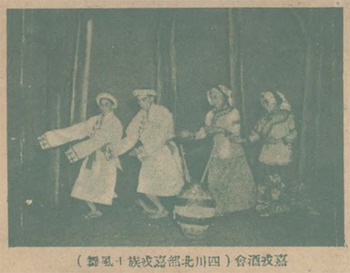
The translation of ethnography through the medium of dance was an important way of choreographing frontier dance. An example is the creation of the Jiarong jiuhui 嘉戎酒会 by Peng Song 彭松 (1916-2016), who was the student of Dai. He travelled to Western Sichuan to study Tibetan dances. When he returned to Chongqing, he choreographed Tibetan dances, two of which, Jiarong jiuhui and Duangong qugui 端公驱鬼were included in the programmes of Bianjiang yinyue wudao dahui . Figure 6 is a photograph of a staged performance of the Jiarong jiuhui. Four dancers, two women and two men, move sideways in a row; a wine jar with a drinking straw stands in front of them. Peng, writing about his travels, recounts that he was invited to a wedding where he witnessed a performance of the Guozhuang 锅庄 a dance of the Jiarong people: after their performance, the dancers sat down and drank from a wine jar using bamboo straws; the wine was made of rice and tasted sweet. Peng set out to translate Tibetan wedding customs and dances into the idiom of dance. Peng’s ethnographic approach to the choreography of Tibetan dance is clear from his memories of how he created the dance:
The other dance I choreographed was Jiarong Jiuhui (or wine party in Jiarong); this dance is based on observation of (Tibetan) life. It comprises three parts: in the first, female and male dancers stand in a half-circle holding hands; they begin dancing to slow music. Then they climb hills, holding each other’s backs to attend a wine party. In the second part they drink around the wine jar; they gradually get drunk and begin to dance excitedly. In the third part, they dance with abandon, twisting faster and faster until the end of the dance (Peng Reference Peng2011, 5).
Photograph of a Dance of a Wine Party in Tibet, Jiarong jiuhui ( Jinri huakan 1946, 3).

我编的另一舞蹈是嘉戎酒会, 这个舞蹈是依据我所见到的生活加以改编加工的, 共分 三段: 第一段是男女牵手站成一个半圆, 慢声起舞, 然后他们扶背爬山去赴酒会。第 二段是围着坛子饮酒, 渐渐人醉, 兴奋起舞。第三段进入欢乐的尽情的舞蹈, 在越转越快, 越转越快的急剧舞蹈中结束。
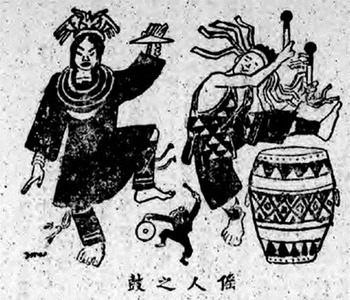
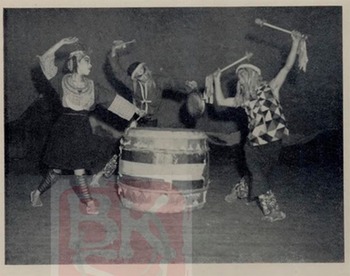
Peng choreographed three scenes of Tibetan daily life reflecting a strong ethnographic approach to the study of the frontier. As Ma observes, Peng worked closely with anthropologists during his fieldwork in West Sichuan where Li Fanggui, a well-known linguistic scholar was undertaking research with two students. Peng’s fieldwork was guided by Li (Ma Reference Ma2023, 159). Scenes which include women and men coming together, consumption of alcohol to the point of inebriation and joyful dancing reflect a popular imagining of the frontier, which frequently appeared in Han Chinese frontier writing. Ethnic minority marriage customs had long appealed to the imagination of the Han Chinese. Choreographers set out to translate non-Han marriage customs into new forms of dance. Besides her Tibetan dances described, Dai choreographed a Uyghur dance, Kanba erhan 坎巴尔罕devising a love story between a Uyghur woman and a coachman. In Figure 7, the text on the right side narrates part of a love story, as a female actress and a male actor appear to make eye contact through a window. A young women’s society from Hangzhou also performed a Uyghur dance, and they wrote a love story between a young woman and a young man for the dance ( Dalu huabao 1949, 17). The underlying meaning of the interaction between male and female actors is clear in a cartoon of Yao drum dance in Figure 8, based on stage performance of a Yao drum which is shown in Figure 9. There are three figures in both images; the cartoonist deliberately depicts the third figure in miniscule form, thus highlighting a duet arrangement, and evoking a frontier characterised by free love among young women and men. This is closely associated with the Han Chinese conceptualisation of love and marriage in Republican-era China. Intellectuals in Republican-era China re-imagined new forms of marriage which dispensed with parental permission or a matchmaker’s negotiations but offered a free choice of partner (Zhu Reference Zhu2020, 131-41). In various ways, ethnic minority marriage customs corresponded with the Han image of a utopian world which offered novel sexual mores defined by free love, free sex and new-style marriage.Footnote 18 Frontier dance functioned not only as an apparatus to unify China as a multiethnic nation but also as a new medium for urban Han Chinese to experience social ideas that were popular among them, through the lens of frontier dance. By representing alien customs, it redefined the dichotomy of ’self’ and ’other,’ as well as the boundary between ’in here’ and ’out there,’ through which the identity of Han Chinese was constituted.
Photograph of a Uyghur Dance, Kanba erhan (Guo Qinhang Reference Guo1947, 28).

Cartoon of a Yao Drum Dance (A Long Reference Long1946, 41).

Photograph of a Yao Drum Dance by Dai Ailian and her Students (Guo Qinhang Reference Guo1947, 27).

Regarding the reception of frontier dance among locals, one review after watching Dai’s performance of the drum dance of the Yao is particularly informative. The audience criticized the authenticity of the dance by comparing it with other local drum dances they had seen, in terms of bodily movement, drums, costumes, and the gender of performers (Chen Zhiliang Reference Chen1946: 10). It is important to note the dynamic reception of the hybrid frontier dance and its association with identity among different audiences. For most urban Han Chinese, the adapted dance became part of their modern life and a way of experiencing multiethnic Chinese nationhood. Frontier dances became popular media for representing ethnic minorities and for shaping and performing Chinese national identity during a moment of historical transformation. Later, in the PRC, dance continued to play a significant role in Chinese ethnopolitics, and the involvement of local artists added complexity to the two-way flow in the construction of dance. Frontier dance is thus a complex, ongoing negotiation—an intentional encounter between cultures and performing traditions. In her study of ethnic motifs in Shen Congwen’s fiction from the 1920s and 1930s, Yanshuo Zhang reveals Shen’s contradictory reflections on ethnicity: while he created a utopian vision of Miao land, he simultaneously lamented the historical discrimination against the Miao, envisioning ethnic equality (Zhang Reference Zhang2021a, 343-65). The non-Han people were also romanticized in frontier dance; however, the sexualized representations suggest a hierarchical view of ethnicity.
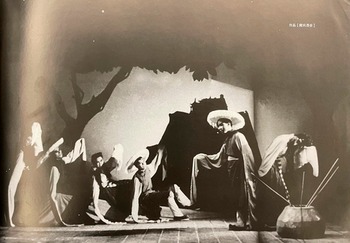
Choreographers were able to create ethnic minority dance by drawing on existing ethnographic accounts. The sources of a similar dance, Zangmin jiuhui 藏民酒会 (Wine Party of Tibetan people) choreographed by Liang Lun for Zhongguo gewu juyishe 中国歌舞剧艺社, and performed in Singapore in 1947, were based on ethnographic accounts. Figure 11 is a photograph which shows a performance of the dance on stage. A group of male and female dancers can be seen standing against the backdrop of a large tree. The four figures on the left hold their arms outstretched, displaying their costumes’ long sleeves. In the right hand corner, a sturdy jar with drinking straws, resembles those used in the performance of Jiarong jiuhui in Figure 10. In his dance album, Liang recalls how he choreographed the Tibetan dance:
This dance shows Tibetan women and men drink flirting in a festival, before finally collapsing on the ground in a drunken stupor……I was unable to visit Tibet in order to collect materials relating to Tibetan dance and lifestyle. I could only rely on music, painting, and text to trace material. Add imagination and the dance is created. This beautiful Tibetan dance aims to stimulate the patriotism of the Chinese overseas (Liang Reference Liang2011, 57).
Photograph of Zangmin jiuhui dance, 1947.

Photograph of Women in Hangzhou Performing a Dance Representing the Tibetan, Jiarong jiuhui ( Dalu hubao 1949, 17).

舞蹈表现藏族男女在节日中饮酒谈情, 最后都愉快地醉倒在地上。.……我当时由于环境限制不能赴西藏去生活和收集舞蹈素材, 只好在音乐, 绘画以及文字中找资料, 通过想象去塑造舞蹈形象。以这一优美的藏族民族舞蹈去激发华侨的爱国情感。
Peng’s Zangmin jiuhui draws on many visual and textual sources; it is evident that existing ethnography became relevant for dance creation. This kind of story depicting male and female Tibetans drinking and carousing at festivals is similar to Peng’s account of the story behind Qiangrong jiuhui. The use of jars with straws suggest that Liang conceivably may have seen the photographs of Dai and Peng’s performances of Jiarong jiuhui, which had previously been published in popular pictorial periodicals, like Jinri huakan. The long sleeves of the costumes were also probably borrowed from the long sleeves of Tibetan dancers shown in Figure 5. In another photograph showing a group of aforementioned women performing frontier dance in Hangzhou (Figure 11), the hair decorations of the three figures on the right who are dressed as men resemble those in Figure 6. The jar, immediately in front of them, which has straws sticking out of it is probably borrowed from the Jiarong jiuhui choreographed by Peng.
The consumption of alcohol became another popular trope in the choreography of non-Han dances. The wine party which is inherited from an ethnographic tradition developed in late imperial China, is frequently used in ethnic minority dance. In 1948, when Jia Zuoguang created Elunchun, 鄂伦春舞 dance, he utilised their customs and daily life, which include hunting, laughter, feasting, and the consumption of alcohol by men and women alike, in the grammar of dance (Jia Reference Jia2014, 30-31).Footnote 19
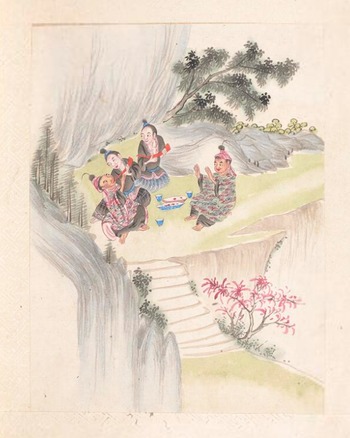
The representation of non-Han people drinking alcohol has enjoyed a long visual tradition in Chinese ethnography. In Republican-era China, the choreography of ethnic minority drinking scenes was inherited from an ethnographic tradition derived from late imperial China. The Miao albums which comprise a genre of ethnographic illustrations depicting the environment, customs and daily life of ethnic minorities in Southern China, show how non-Han people were represented drinking alcohol. In Figure 12, an image of Qingjiag Heimiao 清江黑苗, we can see a group of Miao sitting together, surrounded by wine vessels and plates; two women are trying to coax a man to drink an alcoholic drink from a horn cup. The accompanying text on the next page reads: “On a sunny spring day, women and men serenade each other as they take alcohol to the high mountains. Those who are attracted to one another, drink from a horn cup. 每逢春晴和, 携酒高岗, 男女唱和, 相悦者,饮以牛角.” Similarly, the image of Bai Zhongjia from the Miao albums, discussed in the first section, depicts women and men chasing one another whilst playing on the drums, a scene which is sexually suggestive. The Miao albums were widely circulated. They became important source material in the promotion of a popular understanding of the ethnography of the frontier which, in late imperial China (Zhu Reference Zhu2018, 29-62; Hu Reference Hu2017; He Reference He2013). Through its depiction of drinking scenes, a pre-existing ethnography could influence a modern non-Han representation of dance.
Illustration of black Miao (Anonymous, Qingjiang Miao in Guizhou quansheng bashi er zhong miaotu, collection of University of Manchester).

Figure 12. Long description
At the lower center foreground, four individuals in elaborately patterned robes and headwear are seated on green grass. Two figures on the left play red wind instruments, while the other two, to the right, gesture with raised hands. In front of the group is a blue-and-white bowl, three blue cups, and a small dish. Behind them, stone steps ascend diagonally from the bottom left to the upper right, bordered by shrubs and a flowering tree with pink blossoms. The background features steep gray cliffs on the left and right, with a pine tree and yellow-green bushes at the upper center. The scene is framed by pale textured borders.
The ways in which ethnic minorities are depicted drinking can have sexual connotations. Indeed, non-Han people were frequently eroticised in their representation. The eroticisation of ethnic minorities during the People’s Republic is widely applicable to China’s ethnic minorities which included the Mosuo, Dai, Miao, and Tibetan peoples. A number of studies on contemporary China refer specifically to sexuality in the context of ethnic minorities. Sandra Hyde has shown that in the rural Dai minority area of Xishuangbanna, Yunnan, Han prostitutes from Sichuan and Guizhou dressed like Dai women as a means of making themselves sexually attractive to visiting Han businessmen (Hyde Reference Hyde and Chen2001, 333– 48). Christina Mathieu, in her work on the Mosuo, an ethnic group in West Yunnan, known by the Han Chinese as a country of women, has equated Han views of Mosuo sexuality as something simultaneously alluring, dirty, and primitive (Mathieu Reference Mathieu, Finnane and Mclaren1999, 81–105). Eileen Walsh has explored Mosuo engagement with ethnic tourism by considering sexuality (Walsh Reference Walsh2005, 448–86). The anthropologist Louisa Schein has demonstrated how the Miao were represented as exotic and erotic by cosmopolitan Han Chinese in the 1980s (Schien Reference Schien2000; Schien Reference Schien1997, 69–98). Additionally, Roger Hall examines the growing interest in the American frontier in Western theatres during the late 19th and early 20th centuries, identifying several elements that represent the frontier, with the sexualization of the ’Other’ being one of them (Hall Reference Hall2001, 230–31). With its scenes of alcohol drinking, and free love among young women and men, the choreography of ethnic minority dance has, throughout Chinese history, reflected an imagined and eroticized frontier.
In his study of Indian art and performance, Norman Denzin highlights the global commercialization of indigenous art (Denzin Reference Denzin2016, 13–22). While sources on the commercial dimension of frontier dance are limited, it is evident that several frontier dances were performed in theatres, with tickets being sold (Shenbao 1946). Therefore, in addition to its intimate relationship with ethnopolitics, the commercialization of frontier dance is another important aspect to consider. In her study of Miao albums in late imperial China, Zhu examines how popular ethnographies circulated as commodities in the marketplace, and how particular gendered and sexualized images, including dance, contributed to the popularity of Miao albums (Zhu Reference Zhu2018, 29-62). Commerce and profit could have been factors influencing the choreography of frontier dance, as well as the sexualized representation of ethnic minorities.
The enduring influence of traditional ethnography on ethnic minority dance is reflected in the continued use of Tiaoyue from late imperial China, as a way of describing ethnic minority dance. This is evident in Liang Lun’s Axi tiaoyue , discussed in the first section of this article. The dance which depicts young Yi minority women and men playing with one other in the moonlight inherits the imperial Han Chinese fantasy of an ‘exotic’ frontier with different marriage customs and sexuality. In her study of anthropological photography in Republican-era China, Jing Zhu has demonstrated the continuing influence of traditional Chinese ethnography in the making of modern photography. During the Republican era, photographers continued to display a particular interest in ethnic minority marriage customs and dance on the Southwest frontier. In order to contrive preconceived and desired images of dance based on traditional ethnography, photographic scenes could be arranged, designed or performed (Zhu Reference Zhu2022b: 604-34). The choreography of dance in the Republican era, shares a similar trajectory with photographic practice in terms of the influence of traditional ethnography. This section has highlighted the long-established ethnographic tradition of representing the customs and daily lives of ethnic minorities on the frontier which plays a highly significant role in the choreography of frontier dance. The inherited ethnographic tradition of sexualizing the ethnic ‘Other’ suggests that the idea of Zhonghua minzu is not only inclusive but also hierarchical, with imbalanced power relations between Han Chinese and ethnic minorities in the 1940s. Dances representing ethnic minorities continued to play a significant role in the People’s Republic of China in constructing a unified and multiethnic nation. The naming and categorization of frontier dances evolved over time—reframed as folk dance, minzu dance, and shaoshu minzu dance—according to shifting ethnopolitical agendas. Although the history of frontier dance was relatively short, its legacy in shaping representations of ethnic minority dances has been foundational and enduring.
Conclusion
This paper has examined the ways and methodology in which frontier dance was created in the 1940s. The choreography of frontier dance in Republican-era China represents the convergence and reorganisation of many sources: Western, local, ethnographic, and traditional. This paper complicates our understanding of the mobility of dance, and its creative adaptation contextualised by Chinese ethnopolitics. The frontier dance in the 1940s became an arena for the intellectual and corporal encountering of both local, traditional, and transnational sources of multiple dances. Frontier dance emerged as a useful political and social tool, enjoying popularity for a short period of time.
The competition and coalescence of multiple sources render frontier dance an unstable, ambiguous and intricate concept. The desire for a particular use determines which part of the source material of frontier dance was highlighted within a specific context. When frontier dance was reckoned a useful tool for constructing “Chineseness” and envisioning a unified and multiethnic China, local material was highlighted in a dialogue which completely rejected westernised dance. However, when the rural dance of ethnic minorities was transformed into concert dance, Western dance was considered an essential ingredient in the adaptation of non-Han dances. Western social dance entailing row formation and men and women dancing as couples became one of the principal physical tropes of the choreography of frontier dance. The popularity of Western ballroom dance coincided with a Han Chinese visualisation of a romantic frontier equated with youthful free love. The duet in Western ballroom dance coincides neatly with an enduring traditional and ethnographic representation of the frontier in Chinese history.
The nature of adaptation of dance reflected a hierarchy of ethnicity in Republican-era China. Ethnic minority dances were regarded as a crude primary source which required to be refined. Moreover, the use and design of the duet as well as the incorporation of love stories in frontier dance, conjured up romantic imagining of a frontier as a place of free love. It reflected a continuing eroticised and sexualized representation of the frontier. Choreographers attempted to transform established and traditional non-Han ethnographic marriage customs through new forms of physical movement. The term Tiaoyue which originated in late imperial China continued to be used to describe ethnic minority dances encountered in the field by the Han Chinese as well as concert dances representing ethnic minorities. On the occasions when choreographers were unable to visit the frontier, an existing ethnography and an imagined frontier became important sources of encoding frontier dance. Anthropology and a traditional ethnography of representing the frontier play important roles in the choreography of frontier dance either in terms of field work and the collection of source materials or the imagination of frontier custom and dance. The invention of frontier dance in the 1940s complicates our understanding of the mobility, adaptation and transformation of dance across time and space.
Acknowledgement
I am deeply grateful for the invaluable suggestions and feedback on multiple versions of this paper offered by Dr. Miao Fangfei. I sincerely appreciate the constructive and insightful comments provided by the anonymous reviewers and the dedicated works of editors of Dance Research Journal. My heartfelt thanks go to Mr. Alastair Learmont for his generous assistance with proofreading. I also appreciate for the support of China Studies department, Xi’an Jiaotong Liverpool University to my research on dance studies.