


Impact statement
This perspective article invites researchers to shift how plastics research is imagined and enacted – namely, from treating shorelines as lifeless sites of inquiry, and instead, as places foundational for life, with abundance, histories and ancestral lifeways sustained by descendants of those who call such places home. Grounded in ke Kumulipo (a Hawaiian genealogical creation chant) and the moʻolelo of Waimānalo, the paper models a descendant-informed way of working. One that privileges humble, reverent relation, traditional and linguistic practices specific to place, the insights and priorities of those who care for the lands, seas, and skies that researchers might have the privilege to access. This means changing what counts as legitimate research beginning with an ethical (re)orientation to scientific inquiry that begins with invitation, ends in (co)cultivation of community-accountable outcomes, that is defined at each stage by informed, lineal descendants of a particular place, along with their invited, aspiring allies. These shifts would cultivate immediate and durable solutions – in our case, cleaner beaches and ancestrally guided ways of doing plastics scholarship that remembers and recovers what it means to be in right relation with lands and waters of Waimānalo.
No ka ʻŌlelo Hawaiʻi Footnote 1
In this paper, we privilege ʻŌlelo Hawaiʻi as a foundation and repository of knowledge specific to the lands, waters and skies of Hawaiʻi. Privileging ʻŌlelo Hawaiʻi answers to a place that allows us to exist, engage and receive nourishment in the process of crafting these very words. This politics of privileging ʻŌlelo Hawaiʻi is not an exclusion, but rather a radical act of inclusion. Consider this an invitation to further competency, uplift, amplify and privilege the original languages of all places as a means of building and deepening right relations with descendants and aspiring allies of our places.
We also enact a politics of privilege alongside our efforts to afford broad access by providing glosses at the end of each page. Once a word is glossed, it may not be glossed again. We provide the most relevant glossed meaning for our conversation and include resources to invite further relationships with a specific term or concept. It is due to the resilience, strength and foresight of Kanaka Hawaiʻi that we have access to this profound and intimate wisdom today. What Kanaka Hawaiʻi ancestors have seeded through these lifeways since antiquity, we strive to perpetuate through our glosses. We invite you to consider each word used as an intentional, generous invitation and an act of radical inclusion. Ua lehulehu a manomano ka ʻikena a ka Hawaiʻi.Footnote 2
Kakaʻa kamaliʻi, heʻe puʻeone Footnote 3
Nestled beneath the surface of the fine-grained sandy shoreline of Kapua in Waimānalo (Sterling and Summers, Reference Sterling and Summers1978) reside the Peʻeone.Footnote 4 Peʻeone are marbled mole crabs, no larger than a few inches, whose smooth oval shells resemble the shell of a honu.Footnote 5 LawaiʻaFootnote 6 consider the Peʻeone a valued bait for catching pāpio,Footnote 7 moiFootnote 8 and ʻōʻio.Footnote 9 In ke Kumulipo, a Hawaiian genealogical creation chant that expresses the interdependent relationality and cooperative, complimentary nature of all living beings, Peʻeone are members of the earth – diggers, mounders and aerators. Thus, connecting a great chain of relatives. However, in recent years, the Peʻeone have disappeared. These once-abundant creatures can no longer be found as easily in the sand of the kahakaiFootnote 10; an absence that calls into question the well-being of all living relatives in the web of creation. As van Dooren might argue, the loss of Peʻeone does not only represent the loss of a single species, but the loss of ancestors, and with them, the loss of entire worlds of cultural practice, spiritual connection and ways of knowing and being intertwined with ʻāinaFootnote 11 as a source of life (van Dooren, Reference van Dooren2022).
A number of researchers gesture toward one toxic material potentially correlated with the decline of Peʻeone: plastics. In her field research on plastics settling on Hawaiʻi shores, Delorme et al. (Reference Delorme, Poirion, Lebreton, le Gac, Kāne and Royer2025) found that 91% of plastics were buried below the surface layer. These plastics occupy the very same habitat as the Peʻeone and are often hidden beneath the surface and under-examined in existing plastics research (Delorme et al., Reference Delorme, Poirion, Lebreton, le Gac, Kāne and Royer2025). In 2022–2024, plastics researcher, Astrid E. Delorme, came to Kapua with metrics, systematic excavation tools and an intent to document buried plastics in an effort to improve global pollution models and produce scientific findings to guide further interventions to ocean plastic pollution. Yet, as we discuss in this perspectives paper, the living history of Kapua, perpetuated and told through a Kanaka Hawaiʻi descendent and ‘āina steward of this place, ke Kumu Kimeona Kāne, offered a much-needed ethical (re)grounding for conducting research. Rather than inquire into an analysis of plastics, then, we adopt a line of inquiry that ke Kumu Kimeona Kāne invited by asking: Where have the sand turtles gone?
This perspective piece elaborates a joint moʻoleloFootnote 12 as woven through ke Kumu Kimeona Kāne’s generous invitation to teach about his home and Delorme’s openness to listen and reconsider her conventional approach to plastics inquiry. We recount this moʻolelo as one way to speak toward a broader ethical imperative of conducting research that honors the intimate histories of a place by first privileging descendent-led relations and understandings of a specific place, in our case, ke Kumu Kimeona Kāne’s lifelong devotion to caring for Waimānalo. We also discuss how attention to creation histories of a place, such as ke Kumulipo, invites a Kanaka Hawaiʻi-based (re)framing of research that inverts a deficit-based attention to plastics accumulation in favor of an asset-based attention to the webs of living relations researchers might work to contribute to. We conclude by discussing insights and lessons emanating from this critical, and ongoing relationship between ke Kumu Kimeona Kāne and Delorme, and how this example offers one expression of descendant-informed research that expresses responsibilities to regeneration of places, including all living beings – even those small and hidden, like the Peʻeone.
We begin by introducing ourselves to honor our distinctive social locations and positionalities entering this work (Jones and Jenkins, Reference Jones, Jenkins, Denzin, Lincoln and Smith2008; Burgess et al., Reference Burgess, Cormack and Reid2021). As Jones and Jenkins (Reference Jones, Jenkins, Denzin, Lincoln and Smith2008) articulates, writing as a “we” particularly across distinctive Native-settler collaborations represents an “always already contested and risky territory” (p. 483). The following statements strive to honor tensions imbued in any use of “we” even as we write with care for one another and ever-deepening intimacies to engage in this necessarily shared, yet distinctively positioned work (Fukumitsu et al., Reference Fukumitsu, Kāne, Chang, Rajala, Cortez, Hofmann, Jornet, Lotz-Sisitka and Markauskaite2025).
Johanna Kapōmaikaʻi Stone: We descend from the headwaters of Kailua, Koʻolaupoko, Oʻahu. I guide us in the reclamation of our ancestral languages as a powerful pathway to remembering self and right relationship with each other and place. This relationship is founded upon ʻāina as our greatest chief, teacher and elder. I am a student of, and advocate for the reestablishment of our original food systems as a potent pathway to heal both our inner and outer climates. As a 2024 recipient of the Presidential Award for Meritorious Teaching, 2025 will be my tenth year in service through teaching Hawaiian language at University of Hawaiʻi at Mānoa.
Astrid E. Delorme: I am a French and Swedish Researcher and an aspiring ally. I am trained in Green and Sustainable Chemistry, and my research focuses on intervention strategies for plastics. I understand my kuleana as listening, learning, and using my positionality in relation to academia and scientific plastic debates to challenge extractive logics and amplify descendant-led perspectives. I am a student of ʻŌlelo Hawaiʻi and ʻāina.
Kimeona Kāne: I am a cultural and lineal descendant of Waimānalo, Koʻolaupoko, Oʻahu. I am a community advocate, a haumānaFootnote 13 of Kumu Kinohi Fukumitsu in Uhau Humu Pōhaku,Footnote 14 a speaker of ʻŌlelo Hawaiʻi and a kauwāFootnote 15 to ʻāina. My kuleana is to speak for and care for my home of Waimānalo and to share its stories and knowledge with those who approach with humility.
Rufino Varea: I am an Indigenous Scientist from Fiji and a Marine Ecotoxicologist. My work bridges the natural sciences with Indigenous worldviews to inform policy that addresses marine pollution. My kuleana is to bring a broader Moana perspective to this Hawaiʻi-grounded work, ensuring our conversation contributes to regional and global efforts for justice.
Ethan Chang: I am a Hawaiʻi Asian of Japanese and Chinese descent born and raised in Kailua, Koʻolaupoko on Oʻahu. As a haumāna of ke Kumu Kimeona Kāne and community-based education researcher, I have chosen to join in projects that strive to answer to the people and places that formal institutions of learning have historically failed to serve. I am also a student of ʻŌlelo Hawaiʻi and ʻāina.
Waimānalo: Inspired by ʻĀina of Kaʻōnohi et al. (Reference Deluze, Enos, Mossman, Gunasekera, Espiritu, Jay, Jackson, Connelly, Han, Giardina, McMillen and Meyer2023), we choose to honor Waimānalo as a co-author as not only a “site” of transformation but as a living presence whose teachings directly spark transformative shifts in scientific perspectives included in this project, and beyond. We write with Waimānalo as an active teacher and a source from which this knowledge continues to emerge.
In 2022, Delorme arrived in Hawaiʻi as a visiting researcher studying buried plastics at Kapua, Waimānalo. Through efforts to steward ‘āina and deepened invitations to aloha ‘āina offered by ke Kumu Kimeona Kāne, Delorme came into relation with Stone and Chang, who are haumāna of uhau humu pōhaku under ke Kumu Kimeona Kāne. Shared conversations on and with ‘āina led to joint interests in thinking through, and ultimately, writing this paper. Varea’s expertise on plastics and advocacy at national and international scales of plastics conversations infused added precision to our work and deepened ties between our Waimānalo-specific work and broader Moana Nui imperatives. Our contributions to this paper thus represent, as Alfred eloquently articulates, an attempt to write “from within change”; that is, “with the plain intent of instigating further contention” in ways that reverberate beyond our daily efforts to love and steward our places (Alfred, Reference Alfred2005). A change we hope to be accountable to Waimānalo and our people.
In determining authorship order, we heeded the guidance of Liboiron et al. (Reference Liboiron, Ammendolia, Winsor, Zahara, Bradshaw, Melvin, Mather, Dawe, Wells, Liboiron, Fürst, Coyle, Saturno, Novacefski, Westscott and Liboiron2017) which emphasizes authorship decisions rooted in accountability, workload and issues of equity. As Liboiron et al. (Reference Liboiron, Ammendolia, Winsor, Zahara, Bradshaw, Melvin, Mather, Dawe, Wells, Liboiron, Fürst, Coyle, Saturno, Novacefski, Westscott and Liboiron2017) state, “rather than attempt to circumvent author order, we stay with the trouble.” By adopting this perspective, we acknowledge the challenges within the dominant scientific system while working toward greater fairness in the way contributions are recognized (Liboiron et al., Reference Liboiron, Ammendolia, Winsor, Zahara, Bradshaw, Melvin, Mather, Dawe, Wells, Liboiron, Fürst, Coyle, Saturno, Novacefski, Westscott and Liboiron2017). In this same vein, we recognize the many unnamed authors whose insights and contributions guided us: kūpuna, wahi, and stewards in and beyond Hawaiʻi who continually devote for a more thriving and sustainable plastics-free world. We write this work with and for Waimānalo, and for each of us, waging struggles in our distinctive places, for an abundant future guided by the teachings of sustainable pasts.
He kānaka, he pōkiʻi Footnote 16 : Notes on a kanaka Hawaiʻi-informed approach to research
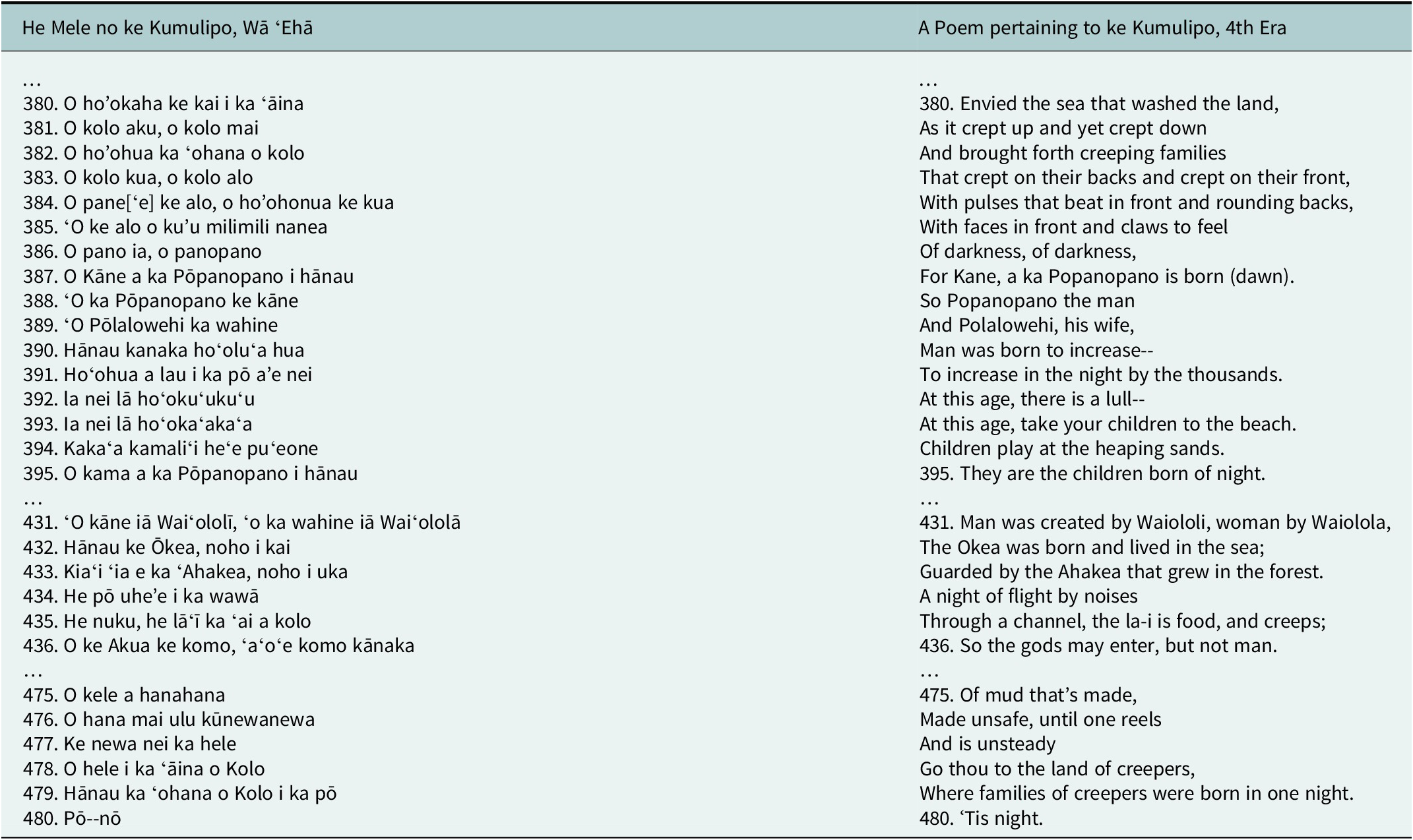
When ke Kumu Kimeona Kāne asked, “Where have the sand turtles gone?” he breathed life into a Kanaka Hawaiʻi-informed approach to inquiry. Such an approach is grounded in ancestral teachings, a number of which are imbued in ke Kumulipo, a koʻihonua, or creation history documenting the meteorological, geological, celestial and oceanic evolutionary process that shaped and gave birth to the ecosystems that sustain life today.Footnote 17 Significantly, ke Kumulipo details the world’s birth order, from the eldest to the youngest (Table 1). The coral polyp, which provides oxygen for all, is the firstborn. Humans are the youngest. Humans depend on the rest of creation for sustenance. These relationships are not merely symbiotic or reciprocal; they are familial (Trask, Reference Trask1999). Ke Kumulipo thus embodies our teachings of kinship in ornate, archaic, poetic form.
Excerpt of He Mele no ke Kumulipo, Wā ʻEhā (with English translations provided by Liliʻuokalani (Reference Liliʻuokalani1897) and supplemented by Johanna Kapōmaikaʻi Stone)

Inspired by the articulations of our Turtle Island relations (Ausubel, Reference Ausubel2008; Nelson, Reference Nelson2008), framing our ancestral teachings as “original instructions,” these teachings are found in our histories, poetry, chant, song, prayers and dance. The histories of our ancestral places, our native lands, are important frameworks of value sets and behaviors (Poepoe, Reference Poepoe1906) that enable us to uphold the balance of the perpetual cycles of creation. This firmly ground us upon a foundation of our place-based kinship teachings that enable us to thrive and stand strong – hand in hand with each other. These kinship teachings outline for us our positionality as humans in our environment. These teachings, as ke Kumulipo does below, detail for us our inherent, humble dependence all the elder beings around us, along with our familial relation to all the beings of our ecosystems, and our ecosystems themselves (Kalimahauna, Reference Kalimahauna1962a, Reference Kalimahauna1962b). Thus, when we stand firm upon these foundational teachings, we are able to be the sustenance of our place (Kahalemaile, Reference Kahalemaile and Kahalemaile1871), and reciprocate that which also sustains us. In this way we clearly see that all blessings are reciprocal, and all flourishing is mutual (Kimmerer and Burgoyne, Reference Kimmerer and Burgoyne2024). Thus, it is of the utmost importance for us to reimplement the compass of our original instructions, our ancestral knowledge systems, so that we are informed and equipped with the time-tested behaviors appropriate for our place, so that we are indeed positively contributing members to our ecosystems and thus sustaining that which sustains us. These are ways to embody our role as the youngest siblings to the rest of creation, as outlined for us below, in ke Kumulipo.
Recognizing our position as the youngest descendants, we humbly and reverently acknowledge our radical dependence on our elders, who take the form of mountains, flyers, crawlers, four-leggeds, swimming ones, coral, wind, rain – and, as illustrated below, Peʻeone.
In the selected excerpt above, we see the sand realm, the realm of the crawlers. We see each crawler being born, and each having a counterpart that acts as a guardian. The crawlers are bio-indicators that offer insight into the broader health (or suffering) of all beings. The birth order in these lines identifies who feeds who. Humans do not yet enter this realm: “O ke Akua ke komo, ʻaʻoʻe komo kānaka.” Thus, humans are entirely fed, nourished and dependent on the vitality of the one realm, the sand column. This excerpt of ke Kumulipo reminds kanaka of our elders, including those who may be overlooked, undervalued, or altogether forgotten. However, this space is a foundation for our ecosystems.
By asking about Peʻeone, ke Kumu Kimeona Kāne named what was otherwise huna and invited Delorme to contend with how tools from outside might exist with/in a Kanaka Hawaiʻi epistemological and ontological paradigm. As we detail in the following section, insights about our interconnectivity imbued in ke Kumulipo cannot be read or studied in isolation. The substantive teachings about kin relations imbued in ke Kumulipo are learned through those very relations. The following depicts a coming into relation between ke Kumu Kimeona Kāne and Delorme, and how, through ke Kumu Kimeona Kāne’s guidance, Delorme attempted to bring her European-trained approaches to plastics inquiry into more responsible alignment with ancestral knowledge teachings, such as that found in ke Kumulipo. By illustrating this moʻolelo in concrete terms, we aim to spark curiosities and possibilities for other researchers and stewards seeking to contribute to abundant solutions.
Coming into right relation: A Moʻolelo of researcher humility and descendant leadership
In 2018, ke Kumu Kimeona Kāne felt a pull to change his professional career when an organization, 808 Cleanups, entered his beloved home community of Waimānalo, Koʻolaupoko to clean plastics and other debris accumulating along Waimānalo’s shores. Ke Kumu Kimeona Kāne recounted, “I was so embarrassed that someone from outside our community had to come in and clean it” (Budiono, Reference Budiono2022). Caring for Waimānalo, however, was never a professional job but always a matter of personal responsibility learned and lived into since ke Kumu Kimeona Kāne was a child. 808 Cleanups promptly recruited ke Kumu Kimeona Kāne to deepen how their organization honors and perpetuates Kanaka Hawaiʻi cultural practices through active, voluntary restoration efforts. Serving as the Director of Community Outreach of 808 Cleanups simultaneously opened greater latitude for ke Kumu Kimeona Kāne to deepen parallel, extra-institutional efforts to teach uhau humu pōhaku to anyone willing and devoted to consistent restoration of themselves and ‘āina.
In 2022, Delorme began a field study that investigated the “end-of-life” and legacy plastics carried to the shores of Hawai‘i by ocean currents. Her study included the shores of Kapua in Waimānalo and focused on the vertical distribution of these plastics in the sand column. She found that 91% of the recovered plastic particles were buried below the surface. Delorme’s study involved systematic excavation and sampling at various depth intervals in the sand column (down to 1 m) and documented the abundance, size and burial depth of plastics aimed at improving global pollution models and guiding more effective intervention strategies. But the initial study did not involve the community of Waimānalo – including those connected to Kapua – particularly in relation to deciding what is important to research, designing appropriate methods, or informing the analysis and implications of empirical findings.
As a part of Delorme’s work and eventually her moving to Waimānalo, she wanted to find ways to actively contribute to the places where she now resided and studied. Delorme joined the 808 Cleanups in Waimānalo led by ke Kumu Kimeona Kāne, which did not just involve beach cleanups, but also removing invasive Buffalo grass, planting native Naupaka Kahakai, listening to mo’olelo of Waimānalo – deepening Delorme’s understanding of Waimānalo and aloha ‘āina. As their pilinaFootnote 18 deepened, Delorme shared more of her analyses with ke Kumu Kimeona Kāne. It was through sustained time together caring for Waimānalo that, on one occasion, ke Kumu Kimeona Kāne asked, “Where are the sand turtles?” He reflected on the abundance of Peʻeone on the shores of Waimānalo he caught as a child and wondered whether plastics now settled into and evicted the Peʻeone from their homes. “What did this mean for the webs of ancestral relations depending on Peʻeone?” ke Kumu Kimeona Kāne asked.
Ke Kumu Kimeona Kāne’s inquiry did not begin with plastics, but rather, with ke Kumulipo. “Who is this plastic pollution disturbing?” pointed toward a living universe of beings that Delorme previously interpreted as simply a vast, empty, lifeless sandy repository for plastics. Ke Kumu Kimeona Kāne began with relationships, continuity and abundant life – a worldview that insisted on kinship relations and responsibilities to one another. Delorme’s inquiry began with “objective” science – seeking to isolate plastic particles from the sand column and examine them as indicators of environmental loss, degradation, and scarcity. Ke Kumu Kimeona Kāne’s began with childhood memories that fueled lifelong responsibilities to care for the very places in which my data collection took place.
Over time, Delorme realized her plastics research mirrored other excavations just next to Kapua at Hūnānāniho that ignored deeper histories. At Bellows Air Force Station in Hūnānāniho, military operations seek to locate and disarm unexploded ammunition left by the U.S. military. In their efforts to rectify these hazardous weapons, the military also uncovered iwiFootnote 19 kūpuna. Such events highlight a profound double-bind created by U.S. occupation and militarization of Hawaiʻi: a need to clean the ʻāina of unexploded ordinances for public safety and a need to respect the right of iwi kūpuna to remain huna. Ke Kumu Kimeona Kāne is one of several stewards in Waimānalo who the military contacts to engage in ceremonial protocols and ensure the iwi kūpuna are handled with care. But as Ke Kumu Kimeona Kāne explained to Delorme, these well-intentioned efforts to remove unexploded ordinances interrupt the capacities of Kanaka Hawaiʻi to remain on ʻāina even after transitioning into Pō.Footnote 20
As Delorme reflected on the U.S. military’s role in excavating unexploded ordinances at Hūnānāniho, she recognized how her own practices of digging for plastics represented a similar disregard for the sacredness of Kapua. Both the military and Delorme focused primarily on immediate goals; activities that erased a long fetch of history shaping life at Hūnānāniho and Kapua, as well as the living, interdependent beings buried in the sands expressed by ke Kumulipo. Despite Delorme’s good intentions, she was adding to the potential harms and burdens of cultural practitioners like ke Kumu Kimeona Kāne, who held the kuleana to care for Hūnānāniho and Kapua, both of which are in Waimānalo.
Shared time with and teachings of ke Kumu Kimeona Kāne provided Delorme with a way of doing more ethical plastics scholarship. Delorme chose to rethink my approach to inquiry as guided by knowledge keepers like ke Kumu Kimeona Kāne, the teachings of ke Kumulipo, as well as the offerings of Kanaka Hawaiʻi scholars and methodologies (Oliveira and Wright, Reference Oliveira and Wright2016). Even as such an approach did not dismiss the offerings of Western tools – seeking only to embed empirical offerings within much longer histories of creation and more expansive ontological teachings of life and living – I was repeatedly met with the question: “Where is the science?” We chose to author this piece together as one means of naming and addressing these barriers in an effort to support future plastics researchers seeking to engage in a more honest reckoning with the often sordid, continuing colonial histories of place and seeking to reconcile these histories of harm through responsible relations with Kanaka Hawaiʻi knowledge keepers.
Discussion: Humble insights and implications from Kapua to continued scholarship and a global plastics treaty
We offer this story of Kāne and Delorme to unearth the structures that often keep us trapped in cycles of harm and reproduce what might be called, “faux solutions.” Well-meaning individuals like Delorme can, at times, carry currents of inherited saviorism, arrogance, and implicit assumptions of the superiority of a Euro-centric, materialist worldview – one that has contributed to the very problems they now seek to solve. Breaking this cycle of harm requires a foundational shift: a return to research that is relational, restorative, descendant-informed (in this case, Kanaka Hawaiʻi-informed), and grounded in the wisdom and insights of ancestral knowledge systems, such as those found in ke Kumulipo. If we expect our science to cultivate action and to seed sustainable transformations that unsettle the political machinery of plastic production, we require a wider ‘upenaFootnote 21 of intimacies – and broader coalition of activated communities within and beyond academia – for doing this (Osorio, Reference Osorio2021).
One way of circumnavigating faux solutions is through descendent-informed scholarship. By this, we mean an approach that begins by asking: “Who is the plastic disturbing?” Such a question surfaces relationships, continuities and accountabilities that are often rendered invisible when starting from an “objective” position – such as centering plastic rather than kinship. It requires researchers to step with humility, to prioritize listening to people of place whose genealogies, practices, and kuleana are intertwined with that ʻāina, and to center their knowledge and moʻolelo as guiding. In Kapua, this meant foregrounding the knowledge held in the one – the stories of Peʻeone, the protection ke Kumulipo calls for, and the kuleana that comes with it. Descendant-informed research – and the interventions it guides – is more accountable to place and people, and better positioned to sustain the abundance ke Kumulipo calls us to protect.
When Delorme first approached ke Kumu Kimeona Kāne’s workdays in Waimānalo, she did not arrive as a scientist imposing research questions but as a learner seeking to listen. It was through the offerings ke Kumu Kimeona Kāne provided that she was able to move in right relation through deepened ethical responsibilities to place, sharpened research questions, and a more holistic acknowledgement concerning the many ecologies of life and livelihoods at stake. In a descendant-informed approach, it is only research if such work is invited and contributory as deemed by those who descend from and steward the very places researchers might have the privilege to access. In this way, researchers’ methodologies might take guidance from descendants like ke Kumu Kimeona Kāne of Waimānalo, to align and inform their work in service of specific places and pressing community concerns. Such an approach animates the ‘ōlelo noʻeau; I ka wā ma mua, i ka wā ma hopeFootnote 22; a proverb that enlists each of us to build sustainable futures by (re)turning to lessons of the past. As Beamer et al. (Reference Beamer, Elkington, Souza, Tuma, Thorenz, Köhler, Kukea-Shultz, Kotubetey and Winter2023) similarly put it in efforts to address our current, plastics-dependent and extractivist economy: “A future circular economy is possible because Hawaiʻi has already demonstrated the existence of an ancestral circular economy within the global market economy is possible” (Beamer et al., Reference Beamer, Elkington, Souza, Tuma, Thorenz, Köhler, Kukea-Shultz, Kotubetey and Winter2023).
Native communities, who steward relational knowledge and descendant informed practices, also offer essential solutions to the Plastic Pollution crisis. However, Native communities are systematically sidelined in the UN Plastic Treaty negotiations (International Indigenous Peoples’ Forum on Plastics, 2024). To offer one example, a critical oversight in current negotiations is the relegation of Indigenous Peoples to the role of “stakeholders,” rather than “right-holders” (UN General Assembly, 2007; International Indigenous Peoples’ Forum on Plastics, 2024). As the International Indigenous Forum on Plastics stated in the final Plenary at the UN Plastic Treaty negotiations (INC-5.1, Busan):
“Decisions are being made about our lands, waters, knowledge, and futures without us at the table. Indigenous peoples are not stakeholders. We are rights holders and knowledge holders and critical partners in the fight against plastic. To exclude us is to undermine the very foundations of this treaty’s legitimacy”
(Society of Native Nations on behalf of the International Indigenous Peoples’ Forum on Plastics, 2024).Descendent-informed research offers one way that plastics scholars might position themselves in service of Native leaders and cultural knowledge-keepers. If invited to share in relations of knowing and being, such work offers one way to match actions with the rhetoric and intent of honoring Indigenous peoples as “rights holders.” We write in service of furthering this critical work, in pursuit of more responsible, regenerative science, in service of Native peoples as rights holders, and in a spirit of unrelenting love and aloha for Peʻeone. As stewards of place, we invite readers and all those ready to join us as servants to ʻāina, on ʻāina, through our distinctive and collective restorative efforts (Stone, Reference Stone2022).
Open peer review
To view the open peer review materials for this article, please visit http://doi.org/10.1017/plc.2025.10033.
Data availability statement
No datasets were generated or analyzed for this study.
Acknowledgements
A.E.D. acknowledges that STORAGE is endorsed as “No. 93.2. PlaSTic On beaches: 3D-distRibution and weathering” as part of the UN Decade of Ocean Science for Sustainable Development 2021-2030 and is attached to the Ocean Decade Programme “15. Early Career Ocean Professionals (ECOPs). We would like to acknowledge Emeritus Professor of International Law and Indigenous Human Rights, Maivân Clech Lâm, and David Maslow for their many patient discussions.
Author contribution
All authors: J.K.S., A.E.D., K.K., R.V., E.C., W.W., contributed to the Conceptualization, Formal analysis, Methodology, Investigation, Resources, Writing – original draft.
Financial support
This work was carried out under the Marie Sklodowska-Curie project STORAGE, which A.E. D. has received funding from the European Union’s Horizon Europe research and innovation program under the Marie Sklodowska-Curie grant agreement No 101061749.
Competing interests
The authors declare that this research was conducted independently, without any commercial or financial relationships that could be construed as a potential conflict of interest. The Marie Sklodowska-Curie project was received with no vested interest, and the views expressed in this paper are solely the author’s own. These views do not reflect, nor are they intended to serve or disadvantage, the institutional hosts of this project.

 Open access


Comments
Dear Editors of Plastics,
We are pleased to submit our perspective manuscript titled “ʻWhere have the sand turtles gone?’: A Moana Nui Orientation to Plastics Research” for consideration in Cambridge Prisms: Plastics.
Our perspective manuscript speaks to Plastics’ mission by exploring the deep entanglement of plastics, people, and nature. Focusing on Moana Nui (the Pacific), we show how pervasive plastic pollution not only threatens human and environmental health, but also disrupts relational systems of justice, rights, and reciprocity. By centering our discussion on the disappearance of the Peʻeone (sand turtles) rather than on the immediate impacts of plastic pollution, we illustrate how their loss signals deeper disruptions in the web of life. Our paper integrates the rich lessons from the Kumulipo, Hawaiʻi’s creation story, to propose a descendant-informed research approach that honors ancestral guidance and fosters right relations with Moana Nui.
Many environmental studies in Moana Nui remain disconnected from localized knowledge systems, often resulting in solutions that do not align with the specific challenges of these regions. Our manuscript aims to invite readers to rethink plastics research and environmental stewardship. We advocate for descendant-informed practices that weaves ancestral guidance into plastics research. This approach reframes “solution-seeking” by prioritizing place-based relationalities and intergenerational stewardship—which we believe aligns with the interdisciplinary perspective that Plastics seeks to showcase. We would greatly appreciate your valuable feedback and hope you find our work both suitable for and contributory to the global aims of Plastics.
We confirm that this manuscript has not been published previously and is not under consideration for publication elsewhere