




Introduction
Beef has a considerably higher climate impact than meat from monogastric animals and plant-based foods, through causing emissions of the greenhouse gases carbon dioxide (CO2), methane (CH4), and nitrous oxide (N2O) (Clune, Crossin and Verghese, Reference Clune, Crossin and Verghese2017; Moberg et al., Reference Moberg, Walker Andersson, Säll, Hansson and Röös2019; Poore and Nemecek, Reference Poore and Nemecek2018). The high climate impact is mainly due to methane emissions from enteric fermentation in the rumen of cattle during feed digestion and emission of greenhouse gases during the production of feed, mainly carbon dioxide from fossil fuels and nitrous oxide from soils. Additional emissions include nitrous oxide and methane from manure management and energy use, and nitrous oxide from excreta produced by animals during grazing (Hammar, Hansson and Röös, Reference Hammar, Hansson and Röös2022; von Greyerz et al., Reference von Greyerz, Tidåker, Karlsson and Röös2023). Climate impacts from beef production are commonly quantified using a life cycle perspective, meaning that all impacts throughout the life cycle are considered, i.e., impacts from production of inputs such as fertilizers and fuels, on-farm activities such as feed production and animals, transport, slaughter, meat processing, final preparation, and waste management. For beef (and other animal products), a common simplification is to only include the climate impact up to farm gate (Hammar, Hansson and Röös, Reference Hammar, Hansson and Röös2022; von Greyerz et al., Reference von Greyerz, Tidåker, Karlsson and Röös2023), since most of the impact occurs before that point (Moberg et al., Reference Moberg, Walker Andersson, Säll, Hansson and Röös2019). Moreover, in studies of different on-farm management practices, impacts beyond the farm gate can be considered similar and hence do not influence comparisons. Swedish beef has an estimated climate impact of approximately 19 kg carbon dioxide equivalents (CO2e) per kg of carcass weight at the farm gate (Ahlgren et al., Reference Ahlgren, Behaderovic, Wirsenius, Carlsson, Hessle, Toräng, Seeman and Kvarnbäck2022) which is similar to the global average of approximately 20 kg CO2e kg−1 of carcass weight (Clune, Crossin and Verghese, Reference Clune, Crossin and Verghese2017). However, emissions vary substantially depending on how the beef is produced (Ahlgren et al., Reference Ahlgren, Behaderovic, Wirsenius, Carlsson, Hessle, Toräng, Seeman and Kvarnbäck2022; Clune, Crossin and Verghese, Reference Clune, Crossin and Verghese2017; Poore and Nemecek, Reference Poore and Nemecek2018). Thus, beef is a food item with considerable climate impact, but cattle systems add value to the food system in other ways and such cases can be considered multifunctional.
An important value provided by cattle is production of nutrient-dense foods from biomass unsuitable for human consumption (such as grass and straw), due to the ability of ruminants to digest cellulose-rich feeds (Karlsson, Reference Karlsson2022). Using these feed types reduces food–feed competition and can also reduce the area of cropland needed to feed a growing global population (Van Zanten et al., Reference Van Zanten, Herrero, Van Hal, Röös, Muller, Garnett, Gerber, Schader and De Boer2018) and the climate impact from feed production (van Hal et al., Reference van Hal, Weijenberg, de Boer and van Zanten2019). In addition, grazing by cattle on semi-natural pastures with natural, cultural, and historical values plays a crucial role in promoting biodiversity by providing a habitat for endangered species (Eriksson, Reference Eriksson2022). Unfortunately, these vital landscapes are undergoing rapid decline, primarily due to ceased grazing. In Sweden, the Prioritized Action Framework for Natura 2000 includes the goal of restoring 84,000 ha of semi-natural grassland by 2027 (Swedish Environmental Protection Agency, 2021b).
When calculating the climate impact of beef, commonly only the beef and milk produced are taken into account, but not other values that can be provided by beef production systems. Accounting for additional values, e.g., the grazing services that cattle provide, can affect the climate impact per kg beef. For example, von Greyerz et al. (Reference von Greyerz, Tidåker, Karlsson and Röös2023) showed that including non-provisioning ecosystem services in the assessment can substantially reduce the climate impact per kg of beef.
The intensity of emissions from feed production varies depending on feed type and production system. The nutritional content of the feed also affects emissions from manure management and enteric fermentation in animals (IPCC, Reference Calvo Buendia, Tanabe, Kranjc, Baasansuren, Fukuda, Ngarize, Osako, Pyrozhenko, Shermanau and Federici2019a). This means that reducing emissions from feed production does not always lead to a lower climate impact per kg of beef or of the farm as a whole. Therefore, it is important to apply a life cycle perspective, i.e., to include all emission sources, when studying the climate impact from these systems. Methodological choices in life cycle assessment, such as how emissions from shared processes are allocated to different products (e.g., how emissions from cereal cultivation are divided between grain and straw), also influence the climate impact associated with feed production (Flysjö, Cederberg and Strid, Reference Flysjö, Cederberg and Strid2008).
Beef is produced either as a dairy system by-product from culled cows, bull calves, and surplus heifer calves, or in suckler beef systems. Beef from dairy systems and suckler beef systems each comprises approximately half of Sweden's domestic beef supply (The Federation of Swedish Farmers, 2023). In suckler systems, calves stay with the dams until 6–8 months of age and are then weaned, finished, and slaughtered as young cattle. After weaning, male calves reared as bulls are usually reared indoors on a feed ration consisting of about 50% grass-clover silage and 50% grain and other types of concentrate, and slaughtered at approximately 18 months of age. However, male calves can also be reared as steers on forage and grazing, typically reaching a higher slaughter age (on average approximately 26 months). This is usually also the case for heifers (Ahlgren et al., Reference Ahlgren, Behaderovic, Wirsenius, Carlsson, Hessle, Toräng, Seeman and Kvarnbäck2022). Beef is also obtained from culled suckler cows.
Suckler cows typically graze during summer and are kept indoors and fed forage, mostly grass-clover silage, during winter (Ahlgren et al., Reference Ahlgren, Behaderovic, Wirsenius, Carlsson, Hessle, Toräng, Seeman and Kvarnbäck2022). However, ad libitum provision (a common management system) of early cut forage can lead to overfeeding. Using more fiber-rich forage such as cereal straw could reduce winter feed intake and thus environmental impact and feed costs (Jardstedt, Reference Jardstedt2019).
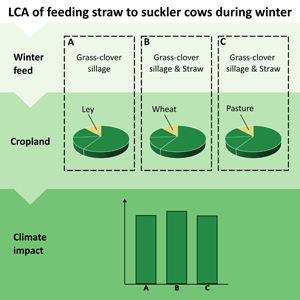
The aim of this study was to assess the climate impact replacing part of the grass-clover silage fed to suckler cows with straw during winter. The climate impact was assessed per kg beef (carcass weight) and for the farm as a whole. Effects on total food production at the farm level were also studied.
Methods
System description
This study compares two types of winter feed for suckler cows: one consisting of a combination of grass-clover silage and straw, and the other using only grass-clover silage. For the other cattle (bulls and heifers, respectively), the feed remained the same across scenarios. The study was based on modeling a theoretical farm of 33 ha cropland and a variable area of semi-natural pasture (depending on the increased amount of grazed grass as a result of the reduced intake associated with feeding of straw during winter) (Fig. 1). The farm was assumed to be located in the Götaland forest district in southern Sweden, producing beef in a typical Swedish integrated beef suckler system as described by Ahlgren et al. (Reference Ahlgren, Behaderovic, Wirsenius, Carlsson, Hessle, Toräng, Seeman and Kvarnbäck2022).
Cropland use (ha) in (left) the reference scenario and (right) the straw scenario.

It was assumed that the farm kept 30 suckler cows and borrowed two bulls for breeding from a neighboring farm. Each cow gave birth to one calf per year, weaned at 7 months of age, and half the calves were assumed to be bull calves. All bull calves and the heifer calves not used for replacement were assumed to be fattened to beef on-farm. Replacement and mortality rates were set according to Ahlgren et al. (Reference Ahlgren, Behaderovic, Wirsenius, Carlsson, Hessle, Toräng, Seeman and Kvarnbäck2022) (Table 1). The spring-born calves grazed together with the suckler cows until weaning, after which bulls for beef were kept indoors until slaughter, while heifers also grazed for 5 months in the following summer before finishing. Cows and breeding bulls had an average yearly grazing period of 5.5 months. It was assumed that suckler cows and their calves grazed only semi-natural pasture while older growing animals also grazed ley aftermath. The animals were assumed to graze 1656 kg dry matter of forage per ha from the semi-natural pasture during the grazing season, based on reported average feed intake rates for different pasture types (Ahlgren et al., Reference Ahlgren, Behaderovic, Wirsenius, Carlsson, Hessle, Toräng, Seeman and Kvarnbäck2022).
Production characteristics in the reference and straw scenarios

Bulls and heifers were fed forage, cereals, legumes, and mineral supplements during the stable period (Table 1), using intakes from Ahlgren et al. (Reference Ahlgren, Behaderovic, Wirsenius, Carlsson, Hessle, Toräng, Seeman and Kvarnbäck2022). Feed losses were accounted for by assuming that 11% of forages and 2% of other feeds were wasted after field to mouth. The weaned bull calves were fed grass-clover silage, cereals, and legumes whereas the weaned heifers were fed grass-clover silage and mineral supplements during winter. Breeding bulls were fed the same feed as finishing bulls until 15 months old. Afterward, they were fed whole-crop silage and mineral supplement during winter, and grazed during summer.
All feed was assumed to be produced on-farm, except for mineral supplements. Cropland and semi-natural pasture use in the scenarios was calculated based on livestock diet and crop yields (Fig. 1). Assumed yields, energy use, and nitrogen demand for cultivation are shown in Table 2. All cropping was assumed to be conventional, using ley yields from Ahlgren et al. (Reference Ahlgren, Behaderovic, Wirsenius, Carlsson, Hessle, Toräng, Seeman and Kvarnbäck2022) and standard yields for conventional cropping in the Götaland region in 2022 (Swedish Board of Agriculture, n.d.b.). Amount of straw available for harvest was approximated using the fraction of straw harvested for crops from Nilsson and Bernesson (Reference Nilsson and Bernesson2009), with similar biomass distribution as in Bertilsson and Nilsson (Reference Bertilsson and Nilsson2020) (used for other calculations). Field losses from Andersson et al. (Reference Andersson, Frostgård, Hjelm and Kvarmo2022) were used for forages. The amount of nitrogen added to soil as synthetic fertilizer was calculated as the difference between total nitrogen demand (approximated with recommendations for fertilization; Andersson et al., Reference Andersson, Frostgård, Hjelm and Kvarmo2022) and nitrogen from manure produced on-farm. Leys provide nitrogen for the next crop grown on the same field and the amount was assumed to be 40 kg nitrogen per hectare (ha) for mixed leys (grass and clover) and 15 kg for grass leys (Andersson et al., Reference Andersson, Frostgård, Hjelm and Kvarmo2022). For energy use in cropping, data from Flysjö, Cederberg and Strid (Reference Flysjö, Cederberg and Strid2008) were used (Table 2). This included cultivation, drying, and ensiling.
Yield, nitrogen demand, and energy use for production of the different crops

The manure from suckler cows and heifers was assumed to be in the form of deep-bedded manure during the winter season. In the summer, all excretion took place on pasture. The manure from the bulls was assumed to be in the form of slurry (Ahlgren et al., Reference Ahlgren, Behaderovic, Wirsenius, Carlsson, Hessle, Toräng, Seeman and Kvarnbäck2022).
The energy source used in animal houses was assumed to be electricity (Moberg et al., Reference Moberg, Walker Andersson, Säll, Hansson and Röös2019) and the total amount of electricity used was set at 88 MWh yr−1 (Baky, Sundberg and Brown, Reference Baky, Sundberg and Brown2010).
Reference scenario
From calving to grazing (70 days yr−1), all cows were assumed to be fed grass silage. From housing to calving (120 days yr−1), suckler cows were fed grass-clover silage. During summer grazing they were only feeding on the pastures (Fig. 2). Feed intakes from Ahlgren et al. (Reference Ahlgren, Behaderovic, Wirsenius, Carlsson, Hessle, Toräng, Seeman and Kvarnbäck2022) and Jardstedt et al. (Reference Jardstedt, Nadeau, Olaf Nielsen, Nørgaard and Hessle2020) were used (Table 1).
Feed rations fed during different periods of the year in the reference and straw scenarios.

Straw scenarios
The feed for suckler cows were the same in both straw scenarios. From calving in spring through summer grazing until housing the feed types were the same as in the reference scenario, but with different levels of intake. From housing to calving (120 days yr−1), the feed differed from the reference scenario. In the straw-feeding scenarios, suckler cows were fed a combination of straw and grass-clover silage, replacing 56% of grass-clover silage fed to the suckler cows in the reference with straw during this period (Table 1; Jardstedt et al., Reference Jardstedt, Nadeau, Olaf Nielsen, Nørgaard and Hessle2020; Holmström Reference Holmström2022). The intake of straw and grass-clover silage was calculated using NorFor (n.d.). Grass silage from Jardstedt et al. (Reference Jardstedt, Nadeau, Olaf Nielsen, Nørgaard and Hessle2020) was used, and the intake from grazing was calculated in accordance with Spörndly (Reference Spörndly2003), based on the pastures' chemical composition. For the other cattle (bulls and heifers), the feed rations where the same as in the reference scenario (Table 1). Feed rations for suckler cows during different periods of the year are shown in Figure 2.
By replacing parts of grass-clover silage with straw from cereal production (grown on-farm, see below), less cropland area was needed to grow feed. Two scenarios with different uses of this ‘spared’ land were assessed:
• Straw-food: suckler cows were fed a combination of straw and grass-clover silage as winter feed with the spared cropland area used to grow wheat for human consumption.
• Straw-pasture: suckler cows were fed a combination of straw and grass-clover silage as winter feed with the spared cropland area converted to pasture for cattle grazing.
Feed intake on grass was assumed to be higher for cows in the straw scenarios where the cows were partly fed with straw during the previous winter compared with cows fed only grass-clover silage (Table 1; Hessle Reference Hessle2022) since suckler cows eat more while on pasture when previous nutrient intake have been restricted by feeding on straw during winter. In the straw-food scenario, it was assumed that some previously abandoned semi-natural pastures needed to be restored, as the ‘spared’ cropland was used to produce additional wheat. Semi-natural pastures can be restored from different land types, but since most former pasture in Sweden is forested, deforestation will potentially occur. In the straw-pasture scenario, the spared cropland provided the extra permanent pasture needed. For this new pasture established on former cropland in the straw-pasture scenario, total yield (including grass not grazed) was calculated to be 3660 kg ha−1, based on Ahlgren et al. (Reference Ahlgren, Behaderovic, Wirsenius, Carlsson, Hessle, Toräng, Seeman and Kvarnbäck2022). Production characteristics for all scenarios are shown in Table 1.
Climate impact calculations
Processes up to the farm gate were considered in the climate impact assessment, including production of inputs (i.e., synthetic fertilizer, diesel, fuel oil, electricity, and mineral feed), feed production on-farm, methane emissions from animals, and manure management. Production and maintenance of buildings and machinery were excluded, as were manufacture of medicines, scouring agents, and other substances used in small volumes. Transport of inputs makes only a small contribution to emissions from these systems (Moberg et al., Reference Moberg, Walker Andersson, Säll, Hansson and Röös2019), and was therefore also excluded. System boundaries are shown in Figure 3.
System boundaries applied for the different scenarios, with included processes and products.

The climate impact results were presented for the farm as a whole and per kg of carcass weight, where carcass weight was assumed to be 53–61% of live weight (Ahlgren et al., Reference Ahlgren, Behaderovic, Wirsenius, Carlsson, Hessle, Toräng, Seeman and Kvarnbäck2022). Beef production generates a range of beef meat cuts and also by-products in the form of offal and blood. The entire climate impact from beef production was allocated to the carcass, even though some of the by-products (skin, entrails, blood, and bones) are used in other applications. The economic value of the by-products is substantially lower than that of beef, meaning that if economic allocation would have been used only a small share of emissions would have been allocated to the by-products. Thereof, this simplification had no substantial effect on the comparison between the two systems.
The farm also produced wheat grain. All emissions from wheat cultivation are usually allocated to the grain, considering the straw as a by-product when used for bedding (Berglund et al., Reference Berglund, Clason, Bååth Jacobsson, Bergström Nilsson and Sund2013) or a waste product when returned to the soil (Moberg et al., Reference Moberg, Walker Andersson, Säll, Hansson and Röös2019). The same approach was used in this study, to reflect the ability of cattle to upcycle biomass unsuitable for human consumption, in this case from straw to beef, as suggested in van Hal et al. (Reference van Hal, Weijenberg, de Boer and van Zanten2019). Thus, all emissions from wheat cultivation were allocated to the grain and the straw used as feed was considered ‘free’ from any environmental burden. The impact on the results of using this approach was tested in a sensitivity analysis by allocating emissions between the grain and straw based on the economic value of the two products. For straw, the value of straw used for bedding was assumed to be €0.1 kg−1 dry matter of straw (Jardstedt, Reference Jardstedt2019) assuming an exchange rate from Swedish krona (SEK) to € of 10:1. The economic value of wheat was set to €0.204 kg−1 of wheat grain (Swedish Board of Agriculture, n.d.a.), using the same exchange rate. The allocation factors in the sensitivity analysis resulted in 84 and 16%, for grain and straw respectively in the reference scenario, and 69 and 31% in the straw scenarios. For wheat cultivation on spared land in the straw-food scenario, the straw was assumed not to be used, but left in the field. For this wheat, all emissions were allocated to the grain.
Emissions of CO2, CH4, and N2O were accounted for by weighting of these gases using the Global Warming Potential with a time horizon of 100 yr (GWP100). Weighting factors were taken from the latest IPCC report (AR6) (fossil CH4 29.8, biogenic CH4 27.0, N2O 273) (IPCC, Reference Masson-Delmotte, Zhai, Pirani, Connors, Péan, Berger, Caud, Chen, Goldfarb, Gomis, Huang, Leitzell, Lonnoy, Matthews, Maycock, Waterfield, Yelekçi, Yu and Zhou2021). Emission sources included were: CH4 from enteric fermentation, CH4 and N2O from manure management, N2O from soils (from feed production and grazing animals), CO2 from soil carbon stock changes (from feed production), CO2, CH4, and N2O from production of purchased products (feeds, synthetic fertilizers, breeding bulls, energy), and CO2 from deforestation. More details on the climate impact calculations are given in the Supplementary materials (SM).
Methane emissions from enteric fermentation were calculated with a tier 3 approach (Swedish Environmental Protection Agency, 2021a), recommended for Swedish cattle by Bertilsson (Reference Bertilsson2016) using methods from Nielsen et al. (Reference Nielsen, Volden, Åkerlind, Brask, Hellwing, Storlien and Bertilsson2013) and Nielsen (Reference Nielsen2012). These methods are based on feed intake and nutritional values of the feed. Methane emissions from manure management were calculated with the tier 2 approach in IPCC (Reference Calvo Buendia, Tanabe, Kranjc, Baasansuren, Fukuda, Ngarize, Osako, Pyrozhenko, Shermanau and Federici2019a) (Equation SM3), based on volatile solids content in excreted manure, which was also calculated according to IPCC (Reference Calvo Buendia, Tanabe, Kranjc, Baasansuren, Fukuda, Ngarize, Osako, Pyrozhenko, Shermanau and Federici2019a). A more detailed description of these calculations can be found in the SM.
Direct and indirect emissions of N2O from manure management were calculated with a tier 2 approach using emission factors from IPCC (Reference Calvo Buendia, Tanabe, Kranjc, Baasansuren, Fukuda, Ngarize, Osako, Pyrozhenko, Shermanau and Federici2019a), based on nitrogen content in the manure, which was also calculated according to IPCC (Reference Calvo Buendia, Tanabe, Kranjc, Baasansuren, Fukuda, Ngarize, Osako, Pyrozhenko, Shermanau and Federici2019a). Direct and indirect emissions of N2O from manure on pasture were calculated based on emissions factors from IPCC (Reference Calvo Buendia, Tanabe, Kranjc, Baasansuren, Fukuda, Ngarize, Osako, Pyrozhenko, Shermanau and Federici2019a). The fraction of nitrogen excreted on pastures was taken to be proportional to the time the cattle spent outdoors (i.e., all nitrogen excreted during the grazing period was assumed to be deposited on pasture). A more detailed description of these calculations can be found in the SM. Emissions of N2O from land used for feed production were calculated using methods and emission factors from IPCC (Reference Calvo Buendia, Tanabe, Kranjc, Baasansuren, Fukuda, Ngarize, Osako, Pyrozhenko, Shermanau and Federici2019b) (Table S3 in the SM), including both direct and indirect emissions. The amount of crop residues was calculated using biomass distribution data from Bertilsson and Nilsson (Reference Bertilsson and Nilsson2020). Nitrogen content in above-ground crop residues from ley and whole crop silage was calculated based on their protein content. For the other crops, nitrogen contents in above-ground residues were based on the Swedish national inventory report (Swedish Environmental Protection Agency, 2021a). Nitrogen contents in below-ground residues were based on the same report (Swedish Environmental Protection Agency, 2021a).
Emissions from inputs (electricity, heating oil, diesel, synthetic fertilizers, purchased feed) were calculated using factors from various references (Table S4 in the SM). Values for energy demand for feed production were taken from Flysjö, Cederberg and Strid (Reference Flysjö, Cederberg and Strid2008).
Changes in soil carbon stocks as a result of the changes in crop production were modeled using the introductory carbon balance model (Andrén, Kätterer and Karlsson, Reference Andrén, Kätterer and Karlsson2004), which divides carbon into one old and one young carbon pool. The young pool can further be subdivided into three sub-pools receiving carbon from three different sources: above-ground crop residues (such as straw), below-ground residues (such as roots), and other carbon amendments (such as manure). Changes in total soil carbon stocks was calculated for a 30-yr period which is the time period the model was calibrated for (Andrén and Kätterer, Reference Andrén and Kätterer1997), with mean annual change in soil carbon over the 30 yr taken as yearly loss or sequestration of carbon, and hence of CO2 to and from the atmosphere. Soil carbon stock changes were expressed as the difference between the studied scenario and the reference system, in which the soil was assumed to be in steady state (neither loosing nor sequestering carbon). Carbon stock change in soil under semi-natural pastures was not included, as it is relatively small (Karltun, Jacobson and Lennartsson, Reference Karltun, Jacobson and Lennartsson2010). A more detailed description of the calculations of soil carbon stock changes can be found in the SM.
Emissions from potential deforestation to create more semi-natural pasture in the straw-food scenario were calculated based on average timber stocks for the Götaland region of 129 tons of dry matter per hectare (Swedish University of Agricultural Sciences, 2022). The tree biomass removed in deforestation was assumed to contain 50% carbon, which was emitted as CO2. The emissions from deforestation were distributed over 100 yr, which was the same time period as was used for the GWP factors. Emissions from changes in soil carbon stocks on deforested soils were not included since these are uncertain and have been shown to be small in afforestation of grasslands in northern Europe (Bárcena et al., Reference Bárcena, Kiær, Vesterdal, Stefánsdóttir, Gundersen and Sigurdsson2014).
Food production
The amount of meat produced per year was calculated based on annual number of animals slaughtered and their slaughter weight (Ahlgren et al., Reference Ahlgren, Behaderovic, Wirsenius, Carlsson, Hessle, Toräng, Seeman and Kvarnbäck2022). Meat production by-products in the form of offal and blood were accounted for using data from Strid, Wallin and Stenberg (Reference Strid, Wallin and Stenberg2022). The amount of wheat grain produced was calculated based on yield and area. Energy, protein, and fat content in meat, offal, blood, and wheat (flour, bran, germ) were calculated based on data in the Swedish food database (National Food Agency, 2023). The quantities of energy, protein, and fat obtained from animal sources (beef, offal, and blood) and plant sources (wheat) were considered separately, as they differ in terms of quality and digestibility (Bajželj, Laguzzi and Röös, Reference Bajželj, Laguzzi and Röös2021; Joye Reference Joye2019). Food production was expressed as current use of offal, blood, and wheat as human food and also as maximum potential use as human food. At present, not all human-edible offal is used for human consumption (Strid, Wallin and Stenberg, Reference Strid, Wallin and Stenberg2022), nor is all wheat grain (Tillgren, Reference Tillgren2021). Approximately 80% of wheat grain is consumed as refined wheat (Amcoff et al., Reference Amcoff, Edberg, Enghardt Barbieri, Lindroos, Nälsén, Pearson and Warensjö Lemming2012), which does not include the bran and the wheat germ. In addition, a substantial amount of wheat grain harvested in Sweden does not reach current quality standard for milling and is used as animal feed or for bioenergy. Data on the fraction of the harvested wheat that reaches milling standard are lacking, so a range of 65–100% was assumed, where 65% represented the current average situation and 100% a theoretical situation where quality standards are lowered so that all wheat can be used for human consumption, although not all in the form of high-rising white bread (with some intake as, e.g., muesli; Tillgren, Reference Tillgren2021). In the maximum potential case, it was assumed that all wheat was consumed as wholegrain. For offal and blood, current utilization rates of blood and different offal from large slaughterhouses (Strid, Wallin and Stenberg, Reference Strid, Wallin and Stenberg2022) represented the current use, while for the maximum potential it was assumed that all blood and offal was used as food.
Results
Climate impacts
When carbon stock changes were excluded, the climate impact of feed production was 3.7, 3.4, and 3.2 kg CO2e kg−1 carcass weight in the reference scenario, straw-food scenario, and straw-pasture scenario, respectively (Fig. 4). Thus, the straw-food scenario had 8% lower feed production impact than the reference scenario, while the straw-pasture scenario had 15% lower impact.
Climate impact of feed production (kg CO2e kg−1 carcass weight beef) in the reference, straw-food, and straw-pasture scenarios, comprising N2O emissions from managed soils and CO2, CH4, and N2O emissions from mineral feed, fertilizer production, and energy use, but excluding emissions of CO2 from soil carbon stock changes.

The climate impact of the whole farm (excluding carbon stock changes) was 210 tons CO2e in the reference and straw-food scenarios, and 200 tons CO2e in the straw-pasture scenario. Thus, the climate impact for the straw-food scenario was the same as that for the reference scenario, whereas the climate impact for the straw-pasture scenario was lower. On including emissions associated with deforestation and soil carbon stock changes in cropland the total climate impact was 220 and 210 ton CO2e in the straw-food and straw-pasture scenarios, respectively (Fig. 5).
Climate impact of (top panel) the whole farm and (bottom panel) 1 kg of beef carcass weight in the reference, straw-food, and straw-pasture scenarios. The following emissions were included: CO2 from deforestation (allocated over 100 yr), CO2 from soil carbon stock changes, CO2, CH4, and N2O from feed production and energy use in barns, N2O from manure on pasture, CH4 and N2O from manure management and CH4 from enteric fermentation.

The climate impact of beef was 24 kg CO2e kg−1 carcass weight in all three scenarios when deforestation and soil carbon stock changes in cropland were excluded. On including deforestation and soil carbon stock changes in feed production, the climate impact increased to 26 kg CO2e in the straw-food scenario, while the climate impact in the straw-pasture scenario remained similar to that in the reference scenario (Fig. 5). Total carbon stock changes are included in the SM.
The climate impact of wheat was 0.27 kg CO2e kg−1 dry matter in the reference scenario and 0.24 and 0.20 kg CO2e kg−1 dry matter in the straw-food and straw-pasture scenarios, respectively, when soil carbon stock changes in feed production was excluded. On including carbon stock changes, the total impact decreased to 0.19 kg CO2e kg−1 dry matter in the straw-food scenario and increased to 0.48 kg CO2e kg−1 dry matter in the straw-pasture scenario.
Food production
The amount of food and macronutrients (beef, offal and blood, wheat) produced on-farm in the different scenarios are presented in Table 3. The reference and straw-pasture scenarios produced the same amount of food since the spared land was used for pasture in the straw-pasture scenario, with no additional food production. In the straw-food scenario, the spared land was used to grow more wheat, which led to a 79% increase in production of wheat and thereof more energy, protein, and fat.
Amounts of food and macronutrients produced on-farm in the reference, straw-food, and straw-pasture scenarios

The higher ranges represent the maximum potentials with all wheat consumed as whole grain and the lower range represent the current average situation with 65% of the wheat kernel to human consumption.
Allocation of wheat emissions
When part of the emissions from wheat cultivation were allocated to the straw based on its economic value (using value for straw as bedding) instead of allocating all emissions to the grain, the climate impact per kg carcass weight was scarcely affected, only increasing by a few percent in the two straw-scenarios (Table 4). The climate impact of wheat production was more strongly affected, with a reduction of 16, 46, and 32% in the reference, straw-food, and straw-pasture scenarios, respectively.
Climate impacts of beef and wheat production in the reference, straw-food, and straw-pasture scenarios when using different methods for allocation of emissions from wheat cultivation

Discussion
Methane emissions from enteric fermentation in the rumen make up approximately two-thirds of the climate impact of beef from suckler herds. Methane emissions from enteric fermentation were similar in all scenarios despite changes in feed. There are several models for calculating methane emissions, possibly leading to varying results. The models used in this study are recommended for Swedish systems by Bertilsson (Reference Bertilsson2016) and is used in the Swedish National Inventory Report (Swedish Environmental Protection Agency, 2021a). The model for suckler cows considers dry matter intake and concentration of fatty acids (Nielsen et al., Reference Nielsen, Volden, Åkerlind, Brask, Hellwing, Storlien and Bertilsson2013). If using another model for the suckler cows in this study, based on the model in Nielsen et al. (Reference Nielsen, Volden, Åkerlind, Brask, Hellwing, Storlien and Bertilsson2013), which also takes into account the neutral detergent fiber concentrations in feed (which is higher in straw), emissions would be approximately 20% higher for all suckler cows. However, the differences between the scenarios would be only a few percent.
Feed production is also a major contributor to the climate impact of livestock products. When carbon stock and land use change were not included in the assessment, feed production in the reference scenario of this study had a lower climate impact compared with that reported by Moberg et al. (Reference Moberg, Walker Andersson, Säll, Hansson and Röös2019) for average Swedish meat from suckler herds. This was due to a lower use of mineral fertilizers in the present study.
Comparing the three scenarios in this study, the climate impact of feed production was lower in the straw-food and straw-pasture scenarios than in the reference scenario, as less ley needed to be harvested for winter feed when straw was used. Even though the emissions from feed production decreased by 8 and 15% in the straw-food and straw-pasture scenarios, feed-related impacts only made up approximately 15% of the total climate impact, thereof having only a small overall effect. The climate impact from feed production in straw-food decreased less than in straw-pasture since need for nitrogen was higher due to cropping of more wheat. Manure management emissions were slightly lower in the two straw-scenarios, since less manure excretion occurred indoors due to the reduced feed intake during indoor periods. However, the reductions from manure management indoors were offset by increased N2O emissions from pasture, due to the greater amount of manure excreted on pasture. This, in turn, derived from higher feed intake on pasture. Nitrogen input from crop residues on new pasture also contributed to additional N2O emissions.
When deforestation and soil carbon stock changes in cropland were considered in the analysis, the straw-food scenario had a greater total impact than the other scenarios. Grass-clover leys have a higher carbon input to soils than cereals (Börjesson et al., Reference Börjesson, Bolinder, Kirchmann and Kätterer2018). Consequently, growing more wheat at the expense of grass-clover ley, while also removing more straw from wheat cultivation (for use as feed), led to carbon losses from the soil in the straw-food scenario. This led to an increase in the climate impact of 7%. In the straw-pasture scenario, conversion of cropland to new pasture resulted in carbon emissions from soils due to lower yield from the new pasture compared with the previous grass-clover ley crop. This carbon loss from soil accounted for only a small proportion of total emissions from the farm in the straw-pasture scenario. This might seem counterintuitive, since conversion of cropland to pasture usually leads to carbon being sequestered in soil (Guo and Gifford, Reference Guo and Gifford2002). However, the land use change considered here was from high-yielding ley cultivation on cropland to more low-yielding pasture, resulting in a carbon loss from soil and hence net emissions of CO2.
In the straw-food scenario, greater pasture area was needed due to higher feed intake on grazing compared with the reference scenario. As the spared cropland was used for wheat production in the straw-food scenario, new pasture had to be established and it was assumed that this would involve deforestation since most Swedish productive land not used as agricultural land is under forest (Statistics Sweden, 2019). However, in Sweden there are extensive areas of unused grassland or land currently used at low intensity that could be converted to pasture without causing emissions from deforestation. The emissions from deforestation are also influenced by the type of forest land converted, which affects factors such as dry matter content and land coverage that vary considerably (Swedish University of Agricultural Sciences, 2022). Moreover, semi-natural pastures provide multiple values (feed for cattle to produce beef, biological and cultural values) and how to allocate the impacts of deforestation between these values is open for debate. Normally, the impacts from restoration and maintenance of semi-natural pastures are allocated to the food product from the grazing livestock, considering only the food as valuable output. However, some studies have allocated part of the impacts to the cultural and biological values, with major effects on the results (Bragaglio et al., Reference Bragaglio, Braghieri, Corrado and Napolitano2020; Kiefer, Menzel and Bahrs, Reference Kiefer, Menzel and Bahrs2015; von Greyerz et al., Reference von Greyerz, Tidåker, Karlsson and Röös2023). The time period over which deforestation emissions are allocated also impacts the results. When using a 100-yr allocation period as we did here, deforestation related emissions contributed with 4% to the total climate impact. If using, e.g., a 20-yr allocation period the contribution from deforestation would be five times higher, contributing with approximately 20% to the total climate impact. We did not include emissions from changes in soil carbon stocks due to deforestation as they were assumed to be small in this context (Bárcena et al., Reference Bárcena, Kiær, Vesterdal, Stefánsdóttir, Gundersen and Sigurdsson2014). However, how soils are affected by different land uses is highly variable depending on a range of factors (e.g., soil type, climate, management). Such soil carbon changes could affect results in some situations.
This study evaluated two scenarios for the land ‘spared’ when using straw as feed: growing food (wheat) for humans or converting the cropland to pasture. When the land spared was used for wheat cultivation (straw-food scenario), on-farm production of wheat increased considerably, i.e., more food was produced on the same area. According to some previous studies, ‘number of people fed per hectare’ is an important sustainability indicator in a world with limited land resources and a growing population (Cassidy et al., Reference Cassidy, West, Gerber and Foley2013; Röös et al., Reference Röös, Bajzelj, Weil, Andersson, Bossio and Gordon2021), so using the spared land to produce more food is a beneficial option from that perspective. Ultimately, however, agronomic and/or economic factors will determine whether growing wheat or other crops for direct human consumption can be considered feasible. In the forested regions of Sweden, fields are often small and scattered in the landscape, which can make cash cereal cropping challenging. In addition, farms in these regions are often small and do not have the necessary machinery, e.g., harvesters and drying facilities. A straw-food scenario may therefore not be suitable for all farms of the studied type. Another issue is that regional average wheat yields were assumed in this study, but farms with suckler herds are often located on marginal land, so wheat yield may have been overestimated. Predicting future conditions for different types of agricultural production is challenging due to, e.g., changing climate and uncertainty in markets due to the geopolitical situation.
When the land spared was converted to permanent pasture (straw-pasture scenario), the area of pasture on the farm increased and the potential climate impact of deforestation was avoided. However, converting cropland suitable for growing food into pasture would potentially increase food–feed competition.
How a farmer decides to use spared or available land will depend on many factors, such as economic incentives, personal preferences, and environmental conditions, which can change over time. Agri-environmental payment and support currently play a significant role in farmers' income, and thus in their production choices. The payment and support can act as an economic incentive to create desirable farm characteristics, e.g., agri-environmental payments for maintaining semi-natural pasture can encourage grazing on these lands (Holmström et al., Reference Holmström, Kumm, Andersson, Nadeau, Segerkvist and Hessle2021). Other possible uses of spared land not considered in this study could be cultivating ley for biogas production (Gissén et al., Reference Gissén, Prade, Kreuger, Nges, Rosenqvist, Svensson, Lantz, Mattsson, Börjesson and Björnsson2014) to replace fossil energy on-farm, thereof potentially reducing emissions, or continued cultivation of ley for feeding an increased cattle stock, which would increase farm-level emissions considerably. All these factors vary over time, making it uncertain which scenario will prevail.
Moreover, inclusion of perennial leys in the crop rotation has many benefits, e.g., replacing some of the cereals in monoculture cereal production with perennial crops can improve soil health and reduce reliance on pesticides (Martin et al., Reference Martin, Durand, Duru, Gastal, Julier, Litrico, Louarn, Médiène, Moreau, Valentin-Morison, Novak, Parnaudeau, Paschalidou, Vertès, Voisin, Cellier and Jeuffroy2020). The theoretical farm considered in this study was assumed to have over one-third of the crop rotation as grass-clover, which is a substantial proportion and well within what can be considered good practice (Karlsson et al., Reference Karlsson, Carlsson, Lindberg, Sjunnestrand and Röös2018).
To account for the value of upgrading straw to human-edible biomass, none of the climate impact from wheat cultivation was allocated to the straw in this study. To assess the effect of this allocation choice on the results, in sensitivity analysis 31% of the climate impact from wheat cultivation was allocated to the straw, and therefore to beef instead of wheat. This did not affect the climate impact of beef substantially (<2% increase in impact), since feed-related impacts only made up approximately 15% of the total climate impact of beef. However, the effect of allocation method on the climate impact will vary depending on proportion of straw in the total feed ration and the assumed economic value of the straw. In this study, the proportion of straw in total feed over the year was set to 11% for the suckler cows and was even lower for the entire system since only the suckler cows (and not the offspring) consumed straw. Allocating 31% of the climate impact to straw strongly affected the climate impact of wheat, however, which was reduced by up to 42% depending on scenario.
Data for feed intake in this study were collected from a few different data sources to cover all animal categories, but application on a farm in practice might look slightly different. For example, we included small amounts of pure grass silage in addition to grass-clover silage, but a farm might only have grass-clover leys and feed this forage harvested at different times to match the nutritional needs of different animal categories. However, we believe that this would not have major influence on the results.
A challenge with straw feeding is to ensure that it works well in practice. The average suckler herd in Sweden has only 21 cows and 90% of all farms with suckler herds have fewer than 50 suckler cows (Swedish Board of Agriculture, 2022). Feeding straw to small herds may involve alternating between providing whole bales of either straw or grass-clover silage on a daily basis. However, this method has been shown to be unsuitable for some animals, e.g., some cows might consume substantial amounts on days they are fed silage, which can result in digestive problems (Dahlström and Arnesson, Reference Dahlström and Arnesson2016). Another way to feed straw is by mixing straw and grass-clover silage in a mixer or full feed wagon. The mixing makes sorting out the preferred grass and clover particles more difficult for the animals, resulting in higher and steadier intake of straw (Dahlström and Arnesson, Reference Dahlström and Arnesson2016). However, farmers with herds of fewer than 100 suckler cows do usually not have the financial resources to invest in a mixer/full feed trailer. The potential to scale up straw feeding in Sweden thus depends on availability, price, and practical scope for good implementation.
Upgrading straw to meat using beef cattle did not yield any notable climate benefit. However, there are other potential positive effects. Using agricultural residues as feed and thereof upgrading it to high-value food increases its value (Mottet et al., Reference Mottet, de Haan, Falcucci, Tempio, Opio and Gerber2017). Replacing parts of the grass-clover silage with straw can consequently be a way to refine these materials into valuable food products, adding value to these agricultural residues. This approach reduces the need to produce additional feed, thereby decreasing cropland use while maintaining the same level of food production. The spared land can be repurposed, potentially allowing more food to be grown and feeding more people on the same area of land. Additionally, this feeding strategy increased the use of semi-natural pastures using the same number of cattle, showing potential to maintain more semi-natural pastures (important for biodiversity conservation in Sweden; Eriksson Reference Eriksson2022) without increasing the number of animals (hence keeping methane emissions down). However, removing straw from soils resulted in CO2 emissions due to losses of soil organic carbon. Nonetheless, Björnsson and Prade (Reference Björnsson and Prade2021) indicate that measures can be implemented to prevent losses in soil organic carbon when removing cereal straw.
Conclusions
On the theoretical Swedish farm considered in this study, using a combination of cereal straw and grass-clover silage as winter feed for suckler cows reduced the climate impact associated with feed production compared with feeding only grass-clover silage. However, it also reduced feed intake indoors and increased biomass intake on pasture during the grazing season, and hence increased the grazing area required. The total climate impact of beef per kg of carcass weight, and of the farm as a whole, increased when the additional grazing area required generated by deforestation. If deforestation was not necessary, e.g., when grazing was established on the cropland spared by replacing some grass-clover silage with straw (straw-pasture scenario), the climate impact was comparable to that of beef from suckler cows exclusively fed a grass-clover mixture during the winter (reference scenario). Therefore, upcycling the by-product straw to meat had no notable effect on the climate impact, indicating that using crop residues as feed does not always entail a climate benefit. However, increasing the area of pasture can have a positive effect on biodiversity if more biologically rich semi-natural pastures are maintained or restored. When the land spared by replacing some grass-clover silage with straw as winter feed was used for increased wheat production (straw-food scenario), total food production from the system increased, which can have indirect positive benefits, e.g., potentially spared emissions from food production elsewhere.
Supplementary material
The supplementary material for this article can be found at https://doi.org/10.1017/S1742170524000255.
Acknowledgments
We would like to thank Kristina Holmström at Hushållningssällskapet Sjuhärad/the Department of Animal Environment and Health, Swedish University of Agricultural Sciences, for calculating the suckler cows' intake of the mixture of grass-clover and straw.
Author contributions
K. G.: conceptualization, methodology, formal analysis, writing—original draft, visualization. N. E.: conceptualization, methodology, writing—review and editing, supervision. M. J., A. H., and K. A. S.: conceptualization, resources, writing—review and editing. E. R.: conceptualization, methodology, writing—review and editing, supervision, project administration, funding acquisition.
Funding statement
This work was supported by Mistra (K. G., N. E., M. J., A. H., K. A. S., and E. R., Mistra Food Futures DIA 2018/24 #8); and Interreg Öresund-Kattegatt-Skagerrak European Regional Development Fund (A. H. and M. J. Grant number ÖKS-4-2011-47); and Region Västra Götaland, Agroväst (A. H. and M. J.); and the Swedish University of Agricultural Sciences (A. H. and M. J.).


 Open access

