


Introduction
Educational attainment is one of the strongest predictors of cognition in late life (Glymour, Kawachi, Jencks, & Berkman, Reference Glymour, Kawachi, Jencks and Berkman2008; Jefferson et al., Reference Jefferson, Gibbons, Rentz, Carvalho, Manly, Bennett and Jones2011), and this relationship appears to be causal (Caamaño-Isorna, Corral, Montes-Martínez, & Takkouche, Reference Caamaño-Isorna, Corral, Montes-Martínez and Takkouche2006). However, less is known about potential upstream, early-life determinants of both educational attainment and later-life cognition. Studies consistently support the association between early-life factors and later-life health and cognitive outcomes (Bowen & González, Reference Bowen and González2010; Fors, Lennartsson, & Lundberg, Reference Fors, Lennartsson and Lundberg2009; Glymour & Manly, Reference Glymour and Manly2008; Jefferson et al., Reference Jefferson, Gibbons, Rentz, Carvalho, Manly, Bennett and Jones2011; Mantri, Nwadiogbu, Fitts, & Dahodwala, Reference Mantri, Nwadiogbu, Fitts and Dahodwala2019). During early-life, school and household contextual factors are extremely salient and can reflect both promotive and deleterious environments. Because preserved cognitive functioning in later life is an essential component of healthy aging (Castro-Lionard et al., Reference Castro-Lionard, Thomas-Antérion, Crawford-Achour, Rouch, Trombert-Paviot, Barthélémy, Laurent, Roche and Gonthier2011), identifying early indicators of educational and cognitive outcomes can prove beneficial. Better characterization of life course risk and protective pathways underlying later-life cognitive performance is needed for the development of preventative measures and policies.
Early-Life Contextual Factors
Geographic location can have lasting influences on the community, resources, and opportunities available to an individual. In the United States, Southern birth and residence has been associated with lower global cognition in late life (Lamar et al., Reference Lamar, Lerner, James, Yu, Glover, Wilson and Barnes2020). Liu and colleagues (Reference Liu, Glymour, Zahodne, Weiss and Manly2015) demonstrated that this effect was more pronounced among Black individuals than Whites. These findings could be representative of the inequities caused by Jim Crow era policies and racial turmoil that many Black older adults experienced during their childhood (Liu et al., Reference Liu, Glymour, Zahodne, Weiss and Manly2015). Early residence may indirectly influence later-life cognition through various pathways including its impact on childhood school and household factors.
Schooling represents a critical early-life context. School racial demographics, school type (i.e., private, public), and educational quality (e.g., teacher-student ratio) reflect differences in opportunities and experiences with schooling. As a legacy of the Jim Crow era, school racial composition serves as a proxy for resources and opportunities (Card & Krueger, Reference Card and Krueger1992) due to links between residential segregation and school funding in the U.S. (Boozer, Krueger, & Wolkon, Reference Boozer, Krueger and Wolkon1992; Johnson, Reference Johnson2011; Margo, Reference Margo1982). Although most baby boomers attended school after Brown v. Board of Education of Topeka (347 U.S. 483, 495 [1954]), racial inequities in school funding persisted for this generation due to the use of property taxes to finance public schools (Henderson, Reference Henderson2004). The ruling of San Antonio Independent School District v. Rodriguez (411 U.S. 1 [1973]) further solidified inequitable financing strategies for schooling (Straus & Lemieux, Reference Straus and Lemieux2016). Another school-level contextual factor that reflects available resources for students is school type. Private school admission is often dependent on family wealth, limiting the pool of students to those who are more advantaged (Walton, Reference Walton2010). Thus, both racial composition and school type are relevant to school quality. Because higher quality education is associated with better cognitive functioning (Crowe et al., Reference Crowe, Clay, Martin, Howard, Wadley, Sawyer and Allman2013; Sisco et al., Reference Sisco, Gross, Shih, Sachs, Glymour, Bangen, Benitez, Skinner, Schneider and Manly2015), it is important to understand links between each of these school factors and later-life cognition. Indeed, educational quality is an important factor to consider when evaluating cognition in diverse samples (Manly, Jacobs, Touradji, Small, & Stern, Reference Manly, Jacobs, Touradji, Small and Stern2002).
In addition to educational quality, childhood socioeconomic status (SES) is predictive of cognition in later life (Fors et al., Reference Fors, Lennartsson and Lundberg2009; Jefferson et al., Reference Jefferson, Gibbons, Rentz, Carvalho, Manly, Bennett and Jones2011). Parental education and household composition (e.g., number of adults/children in the home) are common indicators of childhood SES. Higher levels of parental education were associated with better cognition at age 65 in a regional sample of older Americans (Greenfield & Moorman, Reference Greenfield and Moorman2019), and larger family size was associated with lower levels of educational attainment and worse cognition in a nationally representative study of older adults in Sweden (Fors et al., Reference Fors, Lennartsson and Lundberg2009). Household factors that serve as proxies for childhood SES have the potential to influence schooling, educational attainment, and later-life cognition.
The Current Study
Previous literature has been inconsistent when evaluating the effects of early- versus later-life factors on cognition. González and colleagues (Reference González, Tarraf, Bowen, Johnson-Jennings and Fisher2013) found no association between childhood SES and later-life cognition after considering adulthood SES (i.e., educational attainment, income, wealth), suggesting that the effects of childhood SES may only operate through later SES. Other studies revealed that childhood SES was a unique predictor of cognition in later life above and beyond adulthood SES (Greenfield & Moorman, Reference Greenfield and Moorman2019; Fors et al., Reference Fors, Lennartsson and Lundberg2009). This points to the potential for other plausible mechanisms by which early-life factors could influence later-life cognition. Literature evaluating early-life influences on later-life cognition is largely focused on childhood SES, with relatively less consideration of other contextual variables (e.g., school characteristics). Additionally, early-life factors have typically been evaluated individually or as a composite, limiting the interpretation of intermediating paths among them.
The current study sought to reevaluate associations of early-life factors on cognition in later-life by investigating a comprehensive group of contextual exposures in childhood within a mediational framework. Specifically, the study aimed to determine 1) which early-life regional, school-level, and household-level factors were associated with later-life cognition; and 2) the extent to which educational attainment mediated these relationships. Based on prior research, we hypothesize that early-life factors will each be associated with later-life cognition, and educational attainment would at least partially mediate these associations. The novelty of evaluating these relationships in a sequential mediation framework helps develop a more comprehensive understanding of the lasting effects of early-life context on cognitive aging. In turn, this can highlight associations among early-life exposures and mechanistic pathways that impact later-life cognition.
Methods
Participants and Procedures
Participants were part of the Michigan Cognitive Aging Project (MCAP) (Zahodne, Reference Zahodne2021). MCAP began in 2017 as a prospective, longitudinal study of cognitive decline in adults 55 years of age and older. Participants were recruited through voter registration lists in tandem with census data to collect a racially balanced sample of non-Hispanic White (NHW) and non-Hispanic Black (NHB) individuals residing in Southeast Michigan. Additional participants joined the study through word-of-mouth. Individuals were included if they resided in Wayne or Washtenaw counties, did not report a dementia diagnosis, were fluent in English, and were at least 55 years old at the initial visit. Although MCAP is a longitudinal cohort, only baseline data were available at the time of study, making it cross-sectional (N = 500). Individuals who attended school outside the U.S. were excluded (N = 14). An additional participant was excluded due to missingness on covariates, bringing the final analytic sample to 485. Characteristics of the sample are displayed in Table 1.
Sample characteristics
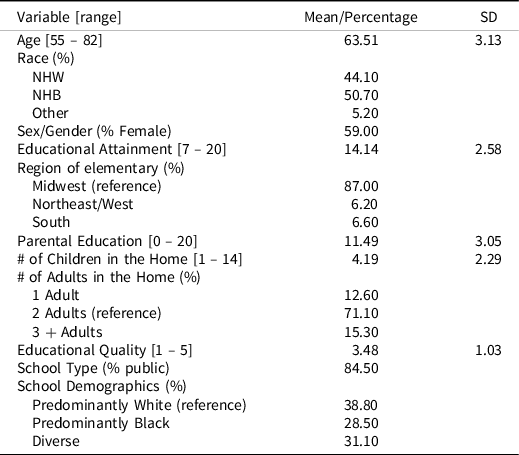
Note. Educational quality was scored on a scale from 1 (poor) to 5 (excellent).
Evaluations were completed at the University of Michigan (UM), the UM Detroit Center, or in the participant’s home. A comprehensive neuropsychological battery was conducted to evaluate cognitive performance. Health, psychosocial, and demographic questions were also administered. Informed consent was obtained from all participants, and study procedures were approved by the UM Institutional Review Board in accordance with the Helsinki Declaration.
Early-Life Exposures
Household SES was operationalized via parental education and household composition. Parental education was the average of mother’s and father’s education (0–20 years); when only one parent’s education was reported, that value was used (N = 87). Household composition questions were utilized from the REGARDS childhood ancillary study (Zahodne et al., Reference Zahodne, Sharifian, Manly, Sumner, Crowe, Wadley, Howard, Murchland, Brenowitz and Weuve2019). The number of children living in the household at age 10 was self-reported by the participant as a continuous variable. The number of adults living in the household at age 10 was self-reported. Based on visual inspection of its distribution, this variable was categorized into three groups: one adult, two adults, and three or more adults (see Supplementary materials). The two-adult household served as the reference group.
School region reflects the participant’s location of elementary school. Location of elementary school was recorded at the state level and converted into U.S. census regions. If location of elementary was not reported, location of birth was used as a proxy (N = 11). Regions included the Midwest, Northeast, South Atlantic, South Central, and West. The South Atlantic (N = 11) and South Central (N = 21) regions were combined to form the South region. Due to minimal representation of the Western U.S., participants who attended school in the West (N = 7) were combined with the Northeast region based on similar global cognition scores. After consolidating regions, the Midwest, Northeast/West, and South represented the regions used in this study. The Midwest served as the reference group.
School racial demographics reflect the racial breakdown of schools the participant attended for the majority of their schooling. The racial composition of the student body was self-reported as percentages of White, Black, and other. Schools were categorized as either predominantly White (>80% White), predominantly Black (>80% Black), or diverse (<80% White or Black). These categories were determined through natural cutoffs in the distribution of reported school racial demographics (see Appendix). Predominantly White schools served as the reference group.
School type was recorded as either public, private, or both. Participants who reported attending both types of school (N = 11) were included in the private school category to account for additional benefits afforded by private school attendance. Public school served as the reference group.
Educational quality of grade school was self-reported on a scale from 1 (i.e., excellent) to 5 (i.e., poor). These values were reverse coded so that higher values represented higher quality education.
Educational Attainment
Educational attainment was conceptualized as a potential mediator for links between early-life exposures and later-life cognition and operationalized as years (0–20). Degree achieved was self-reported and converted to its year equivalent (e.g., Associate’s degree = 14 years). A GED was equated to 11 years of schooling. Participants also reported additional years of schooling that did not result in a degree; if additional years were reported, one year was added to their total educational attainment. For example, if someone reported a High School diploma with 3 additional years of schooling without a higher degree, that would equate to 13 years of educational attainment.
Outcome
Global cognition served as the outcome for this study. Scores on a comprehensive neuropsychological battery were previously subjected to a confirmatory factor analysis and summarized into five cognitive domains: episodic memory, executive functioning, visuospatial processing, language, and processing speed (Zahodne, Reference Zahodne2021). The episodic memory factor was indicated by the CERAD Word list task (immediate, delayed, and recognition), Craft Story (immediate and delayed), and the delayed trial of the Benson Complex Figure task. The executive functioning factor was indicated by Number Span Backward, Color Trails II, and Stroop Color-word Interference. The visuospatial factor was indicated by Judgement of Line Orientation, MoCA Cube copy, and the copy trial of the Benson Complex Figure task. The language factor was indicated by letter fluency (F, A, S), animal fluency, and the Multilingual Naming Test. The processing speed factor was indicated by Color Trails I, Symbol Digit Modalities Test, and Stroop Color. Factor scores corresponding to each of the five domains were standardized and averaged to create a composite measure of global cognition; higher scores indicated better performance. Exploratory analyses considered individual cognitive domain factor scores as outcomes.
Covariates
Age, race, and sex/gender were used as covariates in all analyses because they could potentially confound associations between early-life contextual factors and later-life cognition. Later-life factors that could influence cognition (e.g., later-life health, depression, anxiety) were not included as covariates because they are plausible mechanisms underlying effects of early-life contextual factors and educational attainment on cognition, and their inclusion could result in underestimation of the parameters of interest.
Age in years was recorded at time of entry into MCAP. Race (White, Black or African American, American Indian or Alaska Native, Asian, Native Hawaiian or Other Pacific Islander, Mixed, and Other) and ethnicity (Hispanic or non-Hispanic) were self-reported. Race/ethnicity was recoded to represent three mutually exclusive categories: non-Hispanic White, non-Hispanic Black, and Other (e.g., Hispanic of any race, Asian). Sex/gender was self-reported and operationalized as a dichotomous variable (Female or Male).
Statistical Analyses
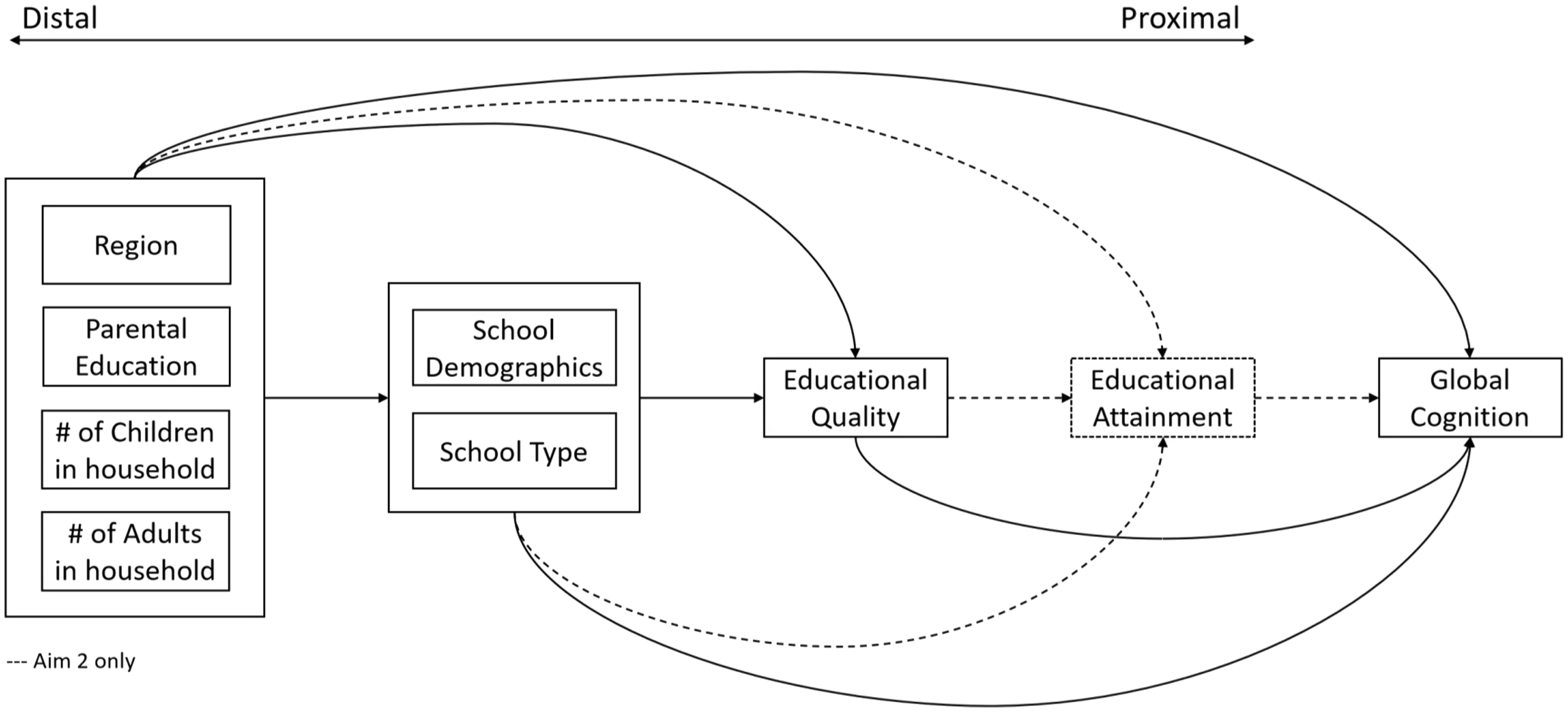
Descriptive statistics and correlations were computed using SPSS version 27 (IBM Corp., Armonk, NY). Sequential mediation models were conducted in Mplus version 8 to depict a life course approach allowing for potential causal pathways among exposures (Muthén & Muthén, 2017). The exposures were ordered according to their hypothesized proximity to the outcome (i.e., later-life global cognition). For example, indicators of childhood SES were modeled as distal exposures since they could influence other early-life variables such as school type and educational quality but are unlikely to be influenced by these exposures due to temporal implausibility. All paths were modeled simultaneously. Each exposure was regressed onto all upstream (i.e., distal) exposures, and all exposures were regressed onto covariates. Associations between variables that did not have clear causal relations or temporal ordering (e.g., school demographics and school type) were modeled as correlations.
Figure 1 displays the conceptual model. Total effects from the aim 1 models identify the associations between each early-life exposure and later-life global cognition. An exposure’s total effect represents its association with global cognition while also considering all likely mediating paths. Sensitivity analyses tested for differential impacts of school demographics on global cognition by race and if the exclusion of participants from the West region (N = 7) altered findings. For the second aim, educational attainment was added to the sequential mediation model. All total, indirect, and direct effects were estimated. Indirect effects were calculated to understand the extent to which educational attainment could explain associations between early-life factors and global cognition. Direct effects were evaluated to determine if early-life factors were associated with global cognition regardless of educational attainment, which would point to additional life course mechanisms of association.
Conceptual Model. This figure illustrates the ordering of early-life factors within the sequential mediation model. Each exposure was independently regressed onto exposures that were more distal. Exposures that were not regressed onto each other were grouped together for simplicity.
Results
Aim 1: Which Early-Life Contextual Factors Are Associated with Cognition in Later Life?
Results from the aim 1 sequential mediation model are shown in Table 2. Attending private school, having parents with higher levels of education, and reporting higher quality early education were all associated with better global cognition. Conversely, attending either a predominantly Black or diverse school and having three or more adults in the home were associated with worse global cognition. Region of schooling and number of children in the home did not have a total effect on global cognition.
Standardized regression estimates of associations between early-life factors and later-life global cognition
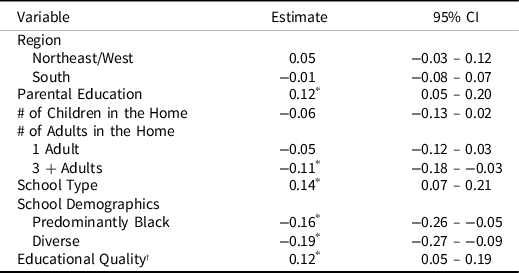
Note. Aim 1 Results.
† Direct Effect.
* p < .05.
There was little evidence that total effects were driven by sequential associations among early-life contextual factors. One exception was the association between school type and educational quality. Additionally, there were intermediating effects between educational quality and other school characteristics, such that attending a predominantly Black or diverse school was associated with lower quality education, while attending a private school was associated with higher quality education. Another intermediate path existed between parental education and school type such that higher levels of parental education were associated with attending a private school.
Sensitivity analyses
Differential impact of school demographics by race
A race-stratified model was analyzed to detect the differential impact of school demographics on global cognition depending on an individual’s race. For the model to converge, region was excluded from analyses, and the predominantly Black and diverse school categories were merged to account for the small portion of non-Hispanic White individuals who attended predominantly Black schools (N = 3). The analysis showed that attending a predominantly Black or diverse school was associated with worse later-life cognition in both Black (β = −0.206, 95% CI [−0.325 – −0.087]) and White (β = −0.135, 95% CI [−0.258 – −0.013]) participants, but this association was stronger among Black participants. Only total effects were evaluated for this sensitivity analysis.
Excluding west region
An additional model excluded participants from the West (N = 7) who were originally combined with the Northeast region based on similar global cognition scores. The sensitivity analysis showed minimal changes in effects; patterns of associations and significance remained the same compared to the original aim 1 model.
Individual cognitive domains
Additional exploratory analyses were conducted to evaluate the impact of early-life factors on specific cognitive domains. Generally, early-life factors were less related to episodic memory compared to other domains (e.g., executive functioning, language). School factors were more consistently related to all domains of cognition compared to household factors.
Aim 2: Does Educational Attainment Mediate the Association Between Early-Life Contextual Factors and Global Cognition?
Figure 2 shows indirect and direct effects from the sequential mediation analysis for aim 2. Receiving higher quality education, having parents with higher levels of education, and attending grade school in the Northeast/West or South (compared to the Midwest) were all indirectly associated with better global cognition through higher educational attainment. Educational attainment accounted for 25% of the effect of educational quality and 48.76% of the effect of parental education on global cognition. Attending a predominantly Black or diverse school was indirectly associated with worse global cognition through lower educational attainment. Educational attainment accounted for roughly half the effects of attending predominantly Black (50%) or diverse schools (49%). Among exposures associated with global cognition, school type and number of adults in the home were the only early-life factors that did not have an indirect effect on cognition through educational attainment.
Standardized parameter estimates and standard errors for direct and indirect effects of early-life factors through educational attainment on global cognition; intermediating direct effects are also presented. All depicted estimates were significant at p < .05 level. For simplicity, non-significant paths are not shown. † Direct effect.

Aside from mediating pathways involving educational attainment, the indirect path from attending private school to better global cognition through higher educational quality identified in aim 1 remained. Educational quality accounted for 14% of this effect. Direct effects on global cognition were also evidenced. Receiving higher quality education and attending private school were both directly associated with better global cognition independent of educational attainment. Conversely, having three or more adults in the home was directly associated with lower global cognition independent of educational attainment.
Discussion
This study of a racially and socioeconomically diverse sample of older adults living in Southeastern Michigan enhances understanding of life course contextual factors that influence later-life cognition. Specifically, it extends the literature by parsing out the effects of household and school factors in early-life on cognitive functioning later in life. Based on relative magnitudes of associations identified in Aim 1, these findings further suggest that school factors (e.g., school demographics) may be stronger predictors of later-life global cognition than household factors (e.g., household composition). However, these results could also reflect differences in measurement precision. Educational attainment served as a mechanism for many of these associations (i.e., region of elementary schooling, parental education, school racial composition, and educational quality), but not all (i.e., school type, number of adults in the home). These findings highlight multiple points of intervention early in the life course to maximize later-life cognitive health and help to clarify mechanisms by which early-life contextual factors may influence later-life cognition.
Early-Life Factors and Later-Life Cognition
Of the seven early-life factors examined in this study, the strongest predictors of later-life cognition were related to school context. Specifically, attending a private school compared to a public school was associated with better cognition in later life. Attending a predominantly Black or diverse school compared to a predominantly White school was associated with worse cognition in later life. The root of these findings can be traced back to inequitable school funding strategies that served to increase racial disparities in educational quality (Henderson, Reference Henderson2004). As depicted in the sequential mediation model, the effects of school type and school racial composition were partially explained by school quality. Consistent with previous literature, higher level of educational quality in grade school was associated with better cognitive outcomes later in life (Mantri et al., Reference Mantri, Nwadiogbu, Fitts and Dahodwala2019; Sisco et al., Reference Sisco, Gross, Shih, Sachs, Glymour, Bangen, Benitez, Skinner, Schneider and Manly2015). Together, these results indicate that school quality is a critical early-life context for later-life cognition, and both school type and racial composition are important indicators of school quality in this age cohort. Additionally, the negative cognitive outcomes associated with attending a predominantly Black or diverse school were 50% larger among Black individuals than among White individuals, which may be reflective of racial disparities in the availability of compensatory resources outside of the school context (e.g., at home or in the neighborhood).
School factors may be more salient predictors of cognitive outcomes than household factors because educational attainment is a stronger predictor of cognition than other SES indicators (Cagney & Lauderdale, Reference Cagney and Lauderdale2002). This may be because education is a multi-componential exposure that directly affects not only the development of core cognitive abilities, but also economic, social, psychological, behavioral, and physical functioning. However, household factors can promote other benefits outside of educational attainment that indirectly support healthy cognitive aging (Lövdén et al., Reference Lövdén, Fratiglioni, Glymour, Lindenberger and Tucker-Drob2020).
Indeed, parental education and number of adults in the home at age 10 were also found to predict later-life cognition in this study, in addition to school factors. Aligning with previous literature, higher levels of parental education were associated with better cognition in later life (Greenfield & Moorman, Reference Greenfield and Moorman2019). While a previous study found that having only one biological parent in the home compared to two was related to poorer cognitive performance later in life (Fors et al., Reference Fors, Lennartsson and Lundberg2009), we did not find differential effects of one- or two-adult households on later-life cognition. Instead, we found that compared to a two-adult household, having three or more adults in the household was associated with worse cognition in later life. This finding may coincide with previous literature depicting detrimental effects of family financial or psychosocial instability (e.g., relatives or nonrelatives joining or leaving the home) during childhood (Perkins, Reference Perkins2019).
Exploratory analyses suggested that there are differences in associations across individual cognitive domains. For example, parental education was not associated with episodic memory or processing speed but was associated with executive functioning, language, and visuospatial functioning. These results reflect similar findings in prior research (Greenfield & Moorman, Reference Greenfield and Moorman2019). This pattern may suggest that episodic memory is more sensitive to late-life processes (e.g., cognitive aging) than to early-life factors. These hypothesis-generating exploratory findings should be evaluated further in future studies.
Educational Attainment as a Mechanism
One of the mechanisms by which these early-life exposures could impact cognition is educational attainment. In the current study, educational attainment emerged as a key mechanism underlying the lasting effects of parental education, school racial demographics, region of elementary, and educational quality on later-life cognition.
Previous literature on whether childhood SES is associated with later-life cognition independent of educational attainment has been mixed (Greenfield & Moorman, Reference Greenfield and Moorman2019; González, et al., Reference González, Tarraf, Bowen, Johnson-Jennings and Fisher2013). In the current study, different childhood SES indicators (e.g., parental education, household composition) supported both possibilities. Specifically, the association between household composition (e.g., three or more adults in the home) and later-life cognition was not mediated by educational attainment. In contrast, educational attainment accounted for roughly half the association between parental education and global cognition. Together, these findings demonstrate different aspects of childhood SES may influence later-life cognition through unique mechanisms and highlights the important role of parental education for educational attainment.
Attending school in the Northeast/West or the South rather than the Midwest was only related to better cognition through its association with higher educational attainment. However, previous literature showed opposite effects, finding Southern birth and residence to be associated with worse cognition later in life compared to the Midwest (Lamar et al., Reference Lamar, Lerner, James, Yu, Glover, Wilson and Barnes2020). These conflicting findings may be explained by age and current residence of the sample. Given that all participants were residing in Southeast Michigan at the time of data collection, region of childhood residence may be conflated with migration. It may be that individuals who migrated were those who had the psychosocial and financial resources to do so (i.e., healthy migrant effect; Aldridge et al., Reference Aldridge, Nellums, Bartlett, Barr, Patel, Burns, Hargreaves, Miranda, Tollman, Friedland and Abubakar2018). While lower cognitive performance among individuals who resided in the South during childhood has been reported in other regional samples in New York (Liu et al., Reference Liu, Glymour, Zahodne, Weiss and Manly2015) and Chicago (Lamar et al., Reference Lamar, Lerner, James, Yu, Glover, Wilson and Barnes2020), those studies assessed older individuals (i.e., mean age 75) at an earlier point in time than the current study. Thus, participants in those studies who migrated from the South to the North did so during an earlier period of the Great Migration (Tolnay, Reference Tolnay2003) when migration was highly normative, and selection pressures were likely to have been weaker. The participants in the current study migrated later or after the Great Migration, when migration was less normative. Nevertheless, the current finding still supports previous research indicating that schooling is a mechanism by which childhood residency affects later-life cognition (Liu et al., Reference Liu, Glymour, Zahodne, Weiss and Manly2015).
The negative association between attending a predominantly Black or diverse school and cognition was no longer significant after educational attainment was accounted for, highlighting the importance of educational outcomes. Similar to the relationship with parental education and cognition, educational attainment accounted for around half the association between school racial demographics and cognition. This emphasizes drastic differences in school conditions amongst predominantly White and predominantly Black schools around the 1960s (Boozer et al., Reference Boozer, Krueger and Wolkon1992; Donohue & Heckman, Reference Donohue and Heckman1991). These schooling disparities reduced educational opportunities for students who did not attend predominantly White schools, which in turn was associated with worse cognitive outcomes. As expected, educational attainment was also a mechanism of association between educational quality and cognition.
Other Mechanisms/Direct Effects
Although educational attainment proved to be a main mechanism in which early-life factors can influence later-life cognition, it is apparent that other mechanisms also play a role in these associations. Specifically, number of adults in the home, educational quality, and school type were associated with cognition when controlling for educational attainment and other early-life factors. Depending on cultural influences within the family, having more adults in the home could potentially be a sign of family closeness and an enriching environment, which would have psychosocial benefits and improve cognitive trajectories (Lee, Ryan, Ofstedal, & Smith, Reference Lee, Ryan, Ofstedal and Smith2021). However, it may also reflect fewer resources for family members, a stressful home environment (e.g., caretaking, disruption of family structure), or household instability (Perkins, Reference Perkins2019) which may be more aligned with the finding of the current study.
Educational attainment only accounted for 25% of the association between educational quality and cognition, indicating other potential benefits of educational quality that improve cognitive outcomes. Curriculum may be a mechanism in which school quality leads to improved outcomes (Diette, Reference Diette2012). Outside of improved educational attainment, higher educational quality as early as preschool has been found to be associated with other positive social outcomes such as lower frequency of incarceration, improved employment rates, and higher annual earnings (Schweinhart et al., Reference Schweinhart, Montie, Xiang, Barnett, Belfield and Nores2005). Additionally, receiving higher quality education has also been linked to improved health outcomes (e.g., improved self-rated health, smoking habits, obesity, mortality) (Frisvold & Golberstein, Reference Frisvold and Golberstein2011).
Educational quality, but not educational attainment, was a mediator of the association between attending private school and better later-life cognition, accounting for roughly 14% of this effect. When accounting for all other variables, the association between school type and cognition remained. This points to other potential benefits associated with private school attendance, outside of its relation to higher educational quality. Attending private schools may reflect greater family wealth, beneficial social connections, and a more cognitively stimulating environment (Dronkers & Robert, Reference Dronkers and Robert2008).
Limitations, Strengths, & Future Directions
The current study had limitations. Since MCAP is a regional sample, evaluating the connection between region of elementary and global cognition is not straightforward. Outside of the Midwest, there was a limited sample of participants across census regions. Merging regions may have decreased the specificity and accuracy of findings. Additionally, rurality in childhood was not considered which may contribute to differences in cognitive outcomes (Greenfield & Moorman, Reference Greenfield and Moorman2019). Another limitation is that all childhood factors were retrospectively self-reported, which raises concerns about reporting accuracy. Furthermore, since educational quality was self-reported, objectivity in this measure was compromised. Measures such as student-teacher ratio, number of schooling days, and per-pupil spending could capture educational quality more accurately. However, these state-level measures of quality may be an overgeneralization, so the perceived school quality measure used in the current study may better capture educational experiences at the individual level. The lack of a measure of cognitive functioning in childhood is another limitation. Of note, disparities in children’s cognitive functioning due to household or school disadvantages may manifest very early, so future cognitive aging studies should carefully consider the timing of any available childhood measures, as they could represent confounders and/or mediators of the effects of early-life factors (Lee & Burkam, Reference Lee and Burkam2002).
This study utilized cross-sectional data to conduct mediation analyses; however, the exposures used were fixated to specific time points, making them temporally distinct (e.g., region of elementary/birth, household composition at the age of 10, educational attainment in adulthood). Additionally, global cognition was only measured once, coinciding with the rest of the exposures. This does not allow us to look at cognitive change over time. However, since disparities are more prominent for initial cognitive level than cognitive change, this is a minor limitation (Manly & Mungas, Reference Manly and Mungas2015).
Strengths of this study include the racially diverse and regionally representative sample of older adults, use of a comprehensive neuropsychological battery, inclusion of multiple indices of childhood SES and school factors, and use of more descriptive measures of education (e.g., continuous scale from 0–20). Additionally, the incorporation of a sequential mediation framework to model potential mechanistic paths among early-life factors likely prevented underestimation of effects and provides additional clarity on the unique effects of these interrelated early-life factors on cognition.
Future research should evaluate the impact neighborhood resources and childhood adversity may have in cognitive outcomes. It may also be beneficial to include parental occupation and family wealth during childhood. Delineating the effects of household composition (e.g., multigenerational homes) in future studies should also be prioritized. Other potential mediators such as stress, social relations, and occupational experiences may provide areas for future research.
Conclusion
The current study found that early-life household and school factors were associated with later-life cognition. Educational attainment appeared to be a main mechanism of impact for early-life contextual factors on cognitive trajectories. Indeed, education has been shown to mediate early-life factors to improve cognition even in the presence of low early-life SES (Bertola et al., Reference Bertola, Benseñor, Barreto, Giatti, Moreno, Viana, Lotufo and Suemoto2021). The current study suggests that policies for equal access to quality education for children should be at the forefront of intervention work to reduce racial disparities and optimize cognitive aging. School finance reforms that support equal access to high quality early-childhood programs (e.g., rigorous curriculum) should continue to be emphasized (Lafortune et al., Reference Lafortune, Rothstein and Schanzenbach2018). However, some early-life factors appeared to operate through paths outside of education. Educational attainment is only one mechanism by which some of these factors can influence later-life cognition. Further research is needed to characterize other mechanisms throughout the life course that could serve as points of intervention.
Supplementary material
To view supplementary material for this article, please visit https://doi.org/10.1017/S135561772200090X
Financial Support
This work was supported by the University of Michigan Department of Psychology, Columbia University Department of Neurology, and the National Institute on Aging through grants R01AG054520, P30AG059300, P30AG012846, P30AG024824, P30AG053760. Afsara B. Zaheed supported by: National Institute on Aging [F31AG067717]. Ketlyne Sol supported by: National Institute on Aging [P30AG059300; K01AG073588], National Center for Advancing Translational Sciences [KL2TR002241; UL1TR002240], National Institute for Nursing Research [U01NR020556], and the Antonia Lemstra Fund at the Michigan Alzheimer’s Disease Resource Center.
Conflict of interest
The authors have nothing to disclose.


 Open access

