


Introduction
In recent decades, Chinese families have undergone significant transformations marked by rapid ageing, low fertility and changes in family structure and norms surrounding familial obligations. Recent statistics reveal that the proportion of individuals aged 60 years is projected to reach 28 per cent of the total population in China by 2040 (The Lancet 2022), which will drive up the demand for health care and long-term care services for older adults. In response to the rapidly growing older population and social transformation, the Chinese government has released an ambitious set of schemes for developing ageing services and support systems, prioritizing home-based care as the primary component, supported by community-based services and supplemented by institutional care (Feng et al. Reference Feng, Lin, Wu, Zhuang and Glinskaya2023; Glinskaya and Feng Reference Glinskaya and Feng2018).
Although an overarching policy directive exists in China favouring home- and community-based services (HCBS) provided by the public and private sectors as the preferred mode of service delivery, the actual implementation shows a series of problems on both the demand and the supply sides. Issues include the inability to change the mindset among the public, low levels of utilization and purchase intention, lack of information transmission, unmet needs, and mismatches between the supply and the demand sides (Feng and Wu Reference Feng and Wu2023; Fu and Guo Reference Fu and Guo2022; Glinskaya and Feng Reference Glinskaya and Feng2018; Wang et al. Reference Wang, Ke, Sankaran and Xia2021). Compounded by the early developmental stage of the long-term care insurance (LTCI) system, obtaining a holistic understanding of older adults’ rationales regarding HCBS purchase intentions can provide valuable insights for optimizing resource allocation and ensuring the precise delivery of eldercare services.
When predicting health service utilization and utilization intention for HCBS, the Behavioral Model of Service Use (Andersen Reference Andersen1995) and the Reasoned Action Model (Fishbein and Ajzen Reference Fishbein and Ajzen1975) are the best-known analytical frameworks that conceptualize health-care utilization as a function of predisposing factors, enabling factors, need-related factors, attitudes and beliefs. Existing studies have highlighted the important associations between older adults’ social support, living arrangements, perceptions of the care-giving role and health-care utilization (Li Reference Li2004; Salinas-Rodríguez et al. Reference Salinas-Rodríguez, Moreno-Tamayo, Hernández-Serrato, Enríquez-Rosas and Manrique-Espinoza2018; Valtorta et al. Reference Valtorta, Moore, Barron, Stow and Hanratty2018). However, an important and largely unexplored topic in this field is the role of older adults’ social relationships, including the role of their intergenerational relationships and various forms of social support networks in HCBS-related decision-making processes. To the best of our knowledge, no study has systematically explained how a constellation of different forms of social support, intergenerational relationships, family characteristics and attitudes simultaneously shape the HCBS purchase intentions of older Chinese adults.
Based on the 2018 and 2020 waves of the Chinese Longitudinal Aging and Social Survey (CLASS), this study attempted to answer the following research questions: (i) what are the types and main characteristics of the intergenerational relationships and social support networks of impaired older Chinese adults and (ii) how do intergenerational relationships and various types of social support network influence impaired older adults’ HCBS purchase intentions? To address these issues, based on the well-defined theoretical framework of the Behavioral Model of Service Use (Andersen Reference Andersen1995), the Reasoned Action Model (Fishbein and Ajzen Reference Fishbein and Ajzen1975) and Social Network Theory (Berkman Reference Berkman2000; Scott and Carrington Reference Scott and Carrington P2014), we investigated the interplay between the vertical/dyadic dimension (intergenerational relationships) and the horizontal dimension (diverse forms of social support networks) in impaired older adults’ HCBS purchase intentions. Our findings will contribute significantly to the ongoing conversation on ‘social support and HCBS services utilization’ to enhance comprehension of older adults’ HCBS purchase intentions from a comprehensive viewpoint.
Literature review
Home- and community-based services purchase intention
Purchase intention refers to the likelihood that a consumer plans to acquire a specific product and serves as a critical variable in predicting purchasing behaviour (Fishbein and Ajzen Reference Fishbein and Ajzen1975). According to the theory of planned behaviour (Ajzen Reference Ajzen, Kuhl and Beckmann1985), human behaviour can manifest through both behavioural intentions and actual behaviour. Behavioural intention is considered an indicator of the readiness to engage in a specific behaviour. The stronger a person’s behavioural intention, the more likely that individual is to engage in actual behaviour. In relation to the older population, HCBS refers to a series of health-care, personal care and social services provided to older adults who live at home but cannot live independently owing to chronic physical, functional and/or mental impairment (Weaver and Roberto Reference Weaver and Roberto2017). Thus, HCBS plays a pivotal role in the long-term care system and is designed to assist adults in securely staying within their homes and deferring the need for institutionalization (Thomas Reference Thomas2014).
Upon examining HCBS-related behaviour in China, prior scholarly research has explored the determinants affecting older adults’ HCBS needs and/or utilization behaviour (Fu and Guo Reference Fu and Guo2022; Meng et al. Reference Meng, Xu and Davidson2021; Wang and Liu Reference Wang and Liu2023). However, there has been a notable absence of comprehensive investigations into the factors influencing older adults’ HCBS purchase intentions. Given the absence of a universal HCBS and LTCI system in China, actual utilization may be subject to selection bias, and needs may not effectively reflect the genuine requirements of the older population. In comparison to needs or actual utilization behaviour, purchase intention not only directly identifies potential demand but also more accurately pinpoints the effective needs of impaired older adults. For example, older adults who are unable to utilize services owing to institutional barriers are willing to pay for them if they become available.
As mentioned already, previous empirical studies applying the Behavioral Model of Service Use (Andersen Reference Andersen1995) and the Reasoned Action Model (Fishbein and Ajzen Reference Fishbein and Ajzen1975) have delineated that individual and familial characteristics of older adults may function as predisposing factors (i.e. age, sex, education, occupation; e.g. Liu et al. Reference Liu, Zeng, Li and Wang2013), enabling factors (i.e. financial condition, the care-giver–recipient relationship, living arrangements, care-giving intensity; Weaver and Roberto Reference Weaver and Roberto2017), need factors (i.e. chronic disease, ability to perform activities of daily living [ADLs] and instrumental activities of daily living [IADLs]; Chen and Thompson Reference Chen and Thompson2010) and attitudes and beliefs (Tang et al. Reference Tang, Wu, Yeung and Yan2009) during the health service utilization and decision-making process. However, older adults’ social relationship dynamics are largely unexplored. For example, the level of access older adults have towards formal and informal support, as well as the type and quantity of support available, will also influence their behaviour and reactions to specific situations. The hierarchical compensatory model posits that the care-giving preferences of older adults are determined by the primacy of their relationships: the spouse is the primary choice for care-giving, followed by adult children, friends, neighbours and formal organizations (Cantor Reference Cantor1975). Thus, for older adults whose primary care-givers are family members, additional informal help is expected to reduce the need for formal services.
Types of social support network and the HCBS purchase intention
Terminologies such as social support networks and social networks are frequently used interchangeably; however, they represent distinct concepts (Holt-Lunstad and Uchino Reference Holt-Lunstad, Uchino, Glanz, Rimer and Viswanath2015). Social networks encompass the interrelationships among individuals that affect the flow of resources and opportunities (Hooyman and Kiyak Reference Hooyman and Kiyak2009, 275). One’s kin relationships (e.g. with family members and relatives) and non-kin relationships (e.g. with friends, acquaintances, colleagues and neighbours) comprise one’s social network. Social support networks refer to the assistance and resources available to individuals through social networks (Cavanaugh Reference Cavanaugh, Nordhus, VandenBos, Berg and Fromholt1998).
Members or components of social support networks are essential because they shed light on who might provide support. Unlike assistance and services provided by professional organizations and individuals, unpaid social support provided by family members, relatives, friends and occasionally neighbours is defined as ‘informal support’. For most individuals, informal support is a pervasive aspect of their daily lives (Lipman and Longino Reference Lipman and Longino1982). An informal support network can respond spontaneously and idiosyncratically to the matters at hand. This offers support that considers the uniqueness of the individual being helped (Lipman and Longino Reference Lipman and Longino1982, 143). Older adults are deeply embedded in viable kin and non-kin networks, where they give and receive instrumental and emotional support. With the evolution of the structures of non-kin relationships that comes in late adulthood, kin relationships may undergo notable changes such as spousal death and the migration of adult children. These alterations can render partner and kin relationships less stable, highlighting the significance of non-kin networks.
For example, contact with others and access to other types of social network, such as senior clubs or community activities, may provide emotional or belonging support and information (Martire et al. Reference Martire, Schulz, Mittelmark and Newsom1999); reduce stress; and improve the physical, mental and social wellbeing of older adults (contact networks and emotional support; Cohen and Wills Reference Cohen and Wills1985). Some social support networks can practically assist older adults in medical appointments or shopping (i.e. instrumental or tangible support). Instrumental support is important when older adults experience functional limitations.
Existing theoretical models, such as social convoy theory (Kahn and Antonucci Reference Kahn, Antonucci, Baltes and Grim1980), socioemotional selectivity theory (Carstensen Reference Carstensen and Jacobs1993) and social network theory (Berkman Reference Berkman2000; Scott and Carrington Reference Scott and Carrington P2014), have confirmed that the categories (family, friends, colleagues and acquaintances) and the various resources (emotional, functional and material) in specific sub-networks hold different levels of significance. Although a vast body of empirical research in sociology and gerontology has extensively investigated the different member compositions of informal support networks to provide support, promote social participation and health behaviours, and improve the overall wellbeing of older adults (e.g. Bonsang Reference Bonsang2009; Bremer et al. Reference Bremer, Challis, Hallberg, Leino-Kilpi, Saks, Vellas, Zwakhalen and Sauerland2017; Chen et al. Reference Chen, Su, Chen and Chen2022; Wang et al. Reference Wang, Yang and Avendano2022; Zhang et al. Reference Zhang, Sun and L’Heureux2021), only a few have investigated how the composition of informal support networks influences HCBS utilization or purchase intentions (Li Reference Li2004; Logan and Spitze Reference Logan and Spitze1994). Despite this evidence, there is a need for recalibration to explore how various social support networks influence older adults’ HCBS purchase intentions.
The intergenerational relationship: the cornerstone within social support networks
Socioemotional selectivity theory (Carstensen Reference Carstensen and Jacobs1993) suggests that older adults prioritize emotional regulatory goals over knowledge-related goals. Consequently, their networks comprise more relatives and fewer friends and non-kin relations. Therefore, it is essential to examine kin and non-kin relationships separately to understand their impact on the intention to purchase HCBS.
As the de facto social unit that provides care for older adults and the innermost convoy, the family is perceived to contain the strongest, closest set of social ties likely to provide care and support for older adults, especially in Asian societies (Kahn and Antonucci Reference Kahn, Antonucci, Baltes and Grim1980). When a spouse is unavailable, adult children are the most common source of informal care (Cantor Reference Cantor1975, Reference Cantor1989; Chappell and Audrey Reference Chappell and Audrey1991). Normative expectations regarding the provision of assistance and reciprocity can also shape the composition of individuals who become part of the care network. For example, in many Asian societies, normative expectations associated with filial piety create a framework that guides behaviours related to the provision of assistance and reciprocity within families (Dang and Zhang Reference Dang and Zhang2022; Vangen and Herlofson Reference Vangen and Herlofson2024). Previous studies have confirmed that the number of children, living arrangements and filial piety affect the needs of Chinese older adults’ HCBS utilization (Liu Reference Liu2024). However, focusing solely on these factors is insufficient to understand the purchase intentions of impaired older adults, as it also fails to capture the dynamics of evolving family relationships. As we delve into the realm of the family, it is essential to concentrate on unravelling the intergenerational relationship, which embodies the comprehensive nature of family care.
Intergenerational solidarity (hereinafter, IS) refers to ‘sentiments and behaviours that link family members across generations’ (Bengtson and Mangen Reference Bengtson, Mangen, Mangen, Bengtson and Landry1988, 144). The Intergenerational Solidarity Framework (ISF) proposed by Bengtson and Roberts (Reference Bengtson and Roberts1991) is the most widely validated and applied framework for analysing intergenerational relationships in different social contexts. It involves an examination of six dimensions of IS: structural solidarity (opportunities for intergenerational exchange); associational solidarity (contact frequency); functional solidarity (exchange of support); affectual solidarity (positive feelings for each other); consensual solidarity (agreement in values, lifestyles and opinions); and normative solidarity (commitments and obligation towards family members). Already, ISF has been widely applied to understand intergenerational relationships in the Chinese context.
The intergenerational relationship in the contemporary Chinese context
Existing studies on the typologies of intergenerational relationships within the current Chinese context have yielded categories exhibiting both similarities and differences. Although the classification and the generalization of intergenerational relationships in China vary because of differences in measurement indicators and research samples, scholars consistently agree that contemporary Chinese family intergenerational relationships exhibit both ‘reciprocity’ and ‘imbalance’.
‘Reciprocity’ has traditionally been regarded as a norm, value, principle or central element of social and economic interactions across various societies, playing a crucial role in maintaining stability within social systems (Gouldner Reference Gouldner1960; Twum-Danso Imoh Reference Twum-Danso Imoh2022). Thus, whether exchanges are equivalent or not is an important measure of the types of reciprocity. For example, Sahlins (Reference Sahlins and Banton1965) identified three types of reciprocity: generalized reciprocity (i.e. giving without expecting an immediate or specific return); balanced reciprocity (i.e. rights and duties are interlocked); and negative reciprocity (i.e. selfish or exploitative exchange). Reciprocity is also a fundamental principle governing Chinese family relationships. However, this principle is subject to continuous transformation in the context of modernization. Fei (Reference Fei1983) explained the traditional Chinese model for intergenerational support, known as ‘raising children to provide for old age’, emphasizing the reciprocal relationship where parents nurture their children, who later care for their ageing parents, continuing the cycle with their offspring. For example, the most dominant reciprocal intergenerational relationship confirmed in existing studies is the ‘tight-knit’ IS, characterized by mutual economic and tangible support, shared beliefs and emotional closeness (Chen and Zhou Reference Chen and Zhou2020; Deng et al. Reference Deng, Yan and Yao2024; Li and Zhang Reference Li and Zhang2023; Tao et al. Reference Tao, Zhong and Huang2022). Thus, reciprocal intergenerational relationships facilitate the maintenance of welfare exchanges within the family. However, as contemporary Chinese families navigate the value ambivalence between collectivism and individualism, this will ultimately lead to diversity and complexity in their IS. For instance, the ‘distant-but-intimate’ and ‘staying-in-touch-but-independent’ IS types have also been widely observed in empirical studies, reflecting the family dynamics of rural-to-urban migrant households amid China’s dramatic urbanization and demographic transformation (Guo et al. Reference Guo, Chi and Silverstein2012). The hallmark of these long-distance reciprocal relationships is that because direct physical care cannot be provided to parents, economic compensation given in exchange for older parents’ support with grandparenting and tangible assistance is seen as an expression of filial piety and intergenerational reciprocity.
While intergenerational reciprocity may initially seem uniform, the underlying motivations can vary significantly. It may arise from a mutual decision to meet each generation’s needs or stem from the specific demands of one generation. In some instances, it may represent a necessary compromise between both parties. According to Xu (Reference Xu2023), ‘reciprocity’ in contemporary Chinese family does not represent a continuation of the traditional family system; rather, it is a form of immediate relational equity arising from the necessity of mutual support to meet objective needs during a period of rapid and profound social transformation.
In essence, intergenerational relationships often exhibit an ‘imbalance’, which could also be interpreted as Sahlins’ (Reference Sahlins and Banton1965) ‘generalized reciprocity’ or ‘negative reciprocity’. It reflects the pragmatic tendencies inherent in contemporary family dynamics. Tao et al. (Reference Tao, Zhong and Huang2022) note that as cultural imperatives become less dominant in driving intergenerational cohabitation, the practical needs of both parents and children increasingly play a crucial role in shaping family living arrangements. Recent empirical studies have increasingly become aware that it is not only the needs of parents but also those of the children that contribute to intergenerational cohabitation. While parents require long-term care, financial assistance and emotional support, adult children also seek help from their ageing parents for household tasks, childcare and financial aid for home purchases (Xu Reference Xu2023). This is exemplified by the ‘material-oriented-detached’ IS, wherein adult children tend to seek financial assistance and practical help from their parents at home but do not cultivate a close emotional bond or fully endorse the notion of filial duty (Cui and Jin Reference Cui and Jin2015; Ma Reference Ma2016). Conversely, in traditional imbalanced intergenerational relationships, children often sacrifice self-interest, dedicating themselves more deeply under the influence of authoritative filial piety (Dang and Zhang Reference Dang and Zhang2022; Zhang et al. Reference Zhang, Sun and Yan2024).
Despite extensive discourse on the diversity of intergenerational relationships among older Chinese adults’ families, the IS of impaired older adults remains largely unexplored when examined through a multi-dimensional lens. Owing to the declining capacity and the increased need for physical and instrumental care, IS among impaired older adults exhibits unique characteristics. Impaired older adults may relocate to live with their adult children or interact more frequently with them, even if they do not live nearby. Regarding functional support, a discernible increase in upward functional and economic support may be observed among impaired older adults, which constitutes the manifestation or reciprocation of prior downward economic or grandparent support for their children. Nevertheless, not all IS types are intimate and harmonious. In the context of impaired older adults, these relationships may incur conflicts and rupture parent–child dynamics owing to challenges and pressures faced by adult children in providing support, as well as limitations in their care-giving capacity (Deng et al. Reference Deng, Yan and Yao2024; Zhang et al. Reference Zhang, Sun and Yan2024).
Theoretical framework and hypotheses
Based on the Behavioral Model of Service Use (Andersen Reference Andersen1995) and the Reasoned Action Model (Fishbein and Ajzen Reference Fishbein and Ajzen1975), three groups of variables (predisposing, enabling and need factors) were included to identify the factors that influence HCBS purchase intentions. Incorporating Social Network Theory (Berkman Reference Berkman2000; Scott and Carrington Reference Scott and Carrington P2014), we included two important external factors in our framework: older adults’ IS and various social support networks (for the conceptual framework, please see Figure S1 in the Supplementary Material).
Hypothesis 1 (H1): Older adults with imbalanced intergenerational relationships are more likely to purchase HCBS than those with reciprocal relationships.
Hypothesis 2 (H2): The relationship between intergenerational dynamics and the intention to purchase HCBS will be moderated by the social support networks (i.e. contact network, emotional network, instrumental network) of older adults.
Hypothesis 2a (H2a): For older adults with reciprocal intergenerational relationships with their most dependent child, an increase in social support network (i.e. contact network, emotional network, instrumental network) members will lead to a decline in their intention to purchase.
Hypothesis 2b (H2b): For older adults with imbalanced intergenerational relationships with their most dependent child, an increase in social support network (i.e. contact network, emotional network, instrumental network) members will lead to an increase in their intention to purchase.
Hypothesis 3 (H3): Older adults with traditional eldercare attitudes (i.e. consider eldercare to be their adult children’s responsibility) are less likely to purchase HCBS than those with modern eldercare attitudes (i.e. consider eldercare not to be their adult children’s responsibility).
Methods
Data source and study sample
This study used nationally representative samples from the 2018 and 2020 waves of CLASS (http://class.ruc.edu.cn), a survey, launched in 2014, that gathers biennial data and employs a consistent national probability sample. The 2018 and 2020 waves were ideal for this study as they collected consistent measures of IS and informal support networks spanning two years. There were 11,419 and 11,398 participants in the 2018 and 2020 waves, respectively. To construct our analytical samples, we first restricted the participants to older adults aged 60 years and above with at least one child (referred to as parents later). It should be noted that we focused only on impaired older Chinese adults with declining physiological capacities, given that this sample of older adults was on the cusp of requiring support and purchasing HCBS. Thus, older adults with the minimum score on IADL were excluded from the study (the minimum value of IADL represents fully healthy older adults, indicating their ability to independently perform daily tasks without assistance). Subsequently, we selected older adults’ most dependent children to match the parent–child dyadic sample and excluded any samples with missing information for key variables. The final analytical sample size was 3,397 (person-years = 4,545). For more detailed information about the selection of study participants, please see Figure S2 in the Supplementary Material.
Measurements
Dependent variable: HCBS purchase intention
The questionnaire asked participants whether they would be willing to pay for various HCBS, including home visits, service hotlines, accompanying to medical appointments, assistance with shopping, legal aid, housework, meal assistance, delivery, daycare or eldercare centres, and psychological counselling. Participants were provided with the option of selecting either ‘willing’ or ‘unwilling’ for each service. A binary coding system was employed, wherein values of 0 and 1 were assigned to denote ‘unwilling’ and ‘willing’ choices, respectively (as seen in Table S1). In addition to generating the purchase intention for each of the nine types of services individually, we also created an outcome variable representing the overall purchase intention for HCBS, with a value of 1 assigned to samples expressing a preference to purchase in at least one of the nine items.
Independent variable: intergenerational solidarity
The ISF developed by Bengtson and Roberts (Reference Bengtson and Roberts1991) was applied to evaluate the IS of the study sample. Five IS dimensions were included: structural (geographical distance); associational (in-person and digital contact); functional (upward/downward economic support, upward/downward housework support and grandparenting); affectual (emotional closeness); and consensual (functional and emotional consensus).
According to a previous study (Li and Zhang Reference Li and Zhang2023), if we were to average the intergenerational relationships in multi-child families (e.g. calculating the mean of support or housework assistance provided by all children), it would obscure the mutual effects among them. Thus, considering the hierarchical nature of care-giving preferences among older adults, we focused only on the IS of older adults’ most dependent adult children. We applied K-means cluster analysis to construct an indicator of IS types for parents with their most dependent children (see Analytic strategy for details). For the measurement details, please refer to Tables S2 and S3 in the Supplementary Material.
Moderator: various social support networks
We measured older adults’ social support networks using the ‘friends network’ component of the Lubben Social Network Scale. The ‘relatives network’ section was excluded to prevent collinearity with the independent variable. The LSNS-6 was categorized into three dimensions: contact, emotional and instrumental networks. Participants rated each question in one of six categories: none, 1, 2, 3–4, 5–8 and 9 or higher, with a total score ranging from 0 to 40. The network size was constructed by summing the unweighted points from these questions (ranging from 0 to 5). A higher score indicates a larger network. For further details, please refer to Table S4 in the Supplementary Material.
Covariates
We took into account the following covariates: (1) predisposing factors (socio-demographic characteristics of parents and children) – age (continuous variable), sex (dummy variable: 1 = male), marital status (dummy variable: 1 = married) educational level (dummy variable: 1 = high school level and above), living arrangement (dummy variable: 1 = living alone), hukou (1 = urban), region (1 = east, 2 = central, 3 = west, 4 = northeast), number of children (continuous variable) and adult children’s age, sex, educational level, marital status and economic status (categorical variable: 1 = very difficult, 2 = somewhat difficult, 3 = basically sufficient, 4 = fairly generous, 5 = very generous); (2) enabling factors – pension (dummy variable: 1 = present), family income (continuous variable), attitudes towards responsibility for eldercare (dummy variable: 1 = children’s responsibility), HCBS availability (dummy variable: 1 = available) and community participation (continuous variables); and (3) need factors – older adults’ IADL scores and the number of chronic diseases. For further details, please refer to Tables S5 and S6 in the Supplementary Material.
Analytic strategy
First, the underlying types of IS among impaired older adults in China were identified using K-means cluster analysis by applying the ISF (Bengtson and Roberts Reference Bengtson and Roberts1991). The K-means clustering tool is effective for generating various types of relationship based on different cohesion indicators (Carstensen Reference Carstensen and Jacobs1993), and the nine manifest variables in this study meet the requirements of the model. Second, in addition to studying the types of IS related to purchase intention, different forms of social support network, such as contact, emotional and instrumental networks, are likely to affect older adults’ purchase intentions. Thus, we gradually incorporated predictive factors as well as interactions between IS and various forms of social support network and used a random effects model to address our research question. Given that the dependent variable – HCBS purchase intention – is a binary variable, we employed the binary logistic regression model to identify the influencing factors. Differences were considered statistically significant at p < 0.05. Finally, to examine whether the relationship between IS, social support networks and the interaction term between them and the purchase intention for HCBS varies according to older parents’ attitudes towards eldercare responsibility, we assessed the moderating effects within the stratified samples from random effect models. All analyses were performed using Stata version 17.0.
Results
Types of intergenerational solidarity and social networks
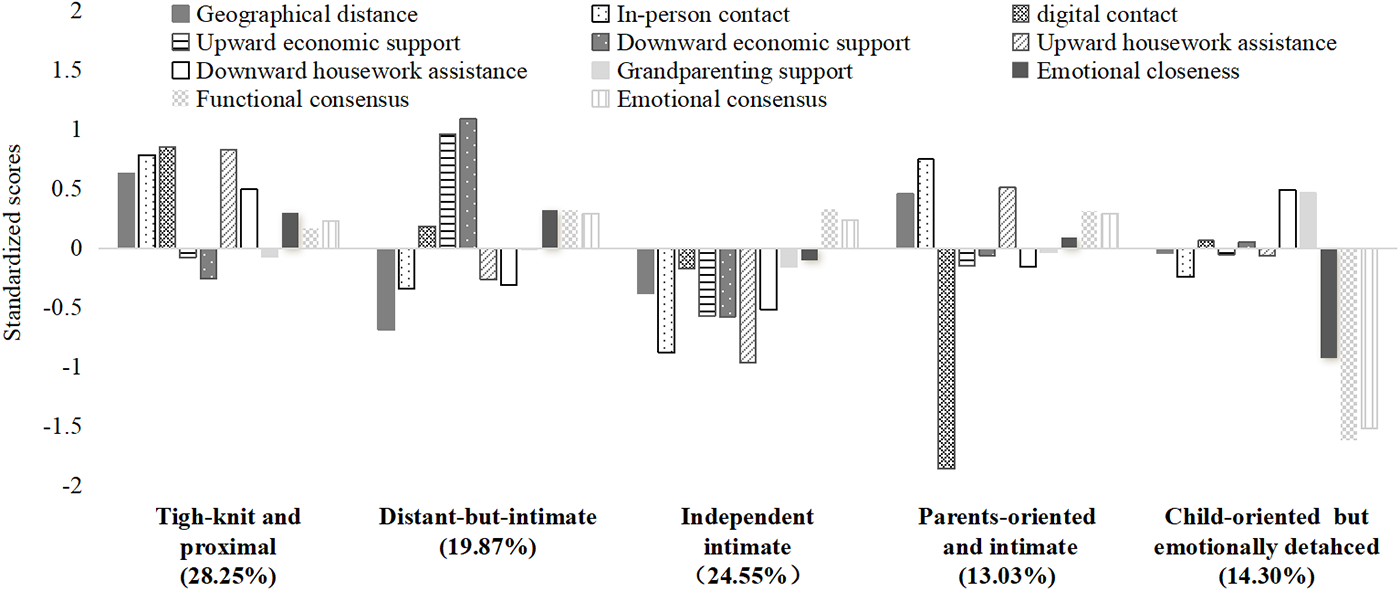
Figure 1 shows the distribution of the five types of IS among impaired parents and their most dependent children. The five types of IS are tight-knit and proximal (28.25%), parent-oriented and intimate (13.03%), distant but intimate (19.87%), child-oriented but emotionally detached (14.30%) and independent-intimate (24.55%). For the ‘tight-knit and proximal’ type, there is an intimate bond between parents and children characterized by a high degree of engagement in mutual housework support and intimacy. In contrast, in the ‘parent-oriented and intimate’ type, bilateral economic exchange is limited, and adult children provide substantial housework support for older adults. Additionally, compared with that of the other four types, the digital contact among the ‘parent-oriented and intimate’ IS type is the least. In cases of ‘distant but intimate’, despite geographical separation, a robust connection was observed, marked by the highest level of economic exchanges and relatively intimate emotional communication. In the context of ‘child-oriented but emotionally detached’, not only was there a lack of instrumental support from children but the emotional closeness level was also the most impoverished; however, older parents contribute substantially to housework and grandparenting support. In the scenario of an ‘independent-intimate’ type, there were minimal functional exchanges, in terms of both economics and housework; however, a considerably strong emotional and functional consensus persisted.
Intergenerational solidarity (IS) types identified among impaired older adults.

Based on the indicators of ISF, we can find that the most reciprocal IS was the ‘tight-knit and proximal’ IS, followed by the ‘distant but intimate’ IS, the ‘independent-intimate’ IS, the ‘parent-oriented and intimate’ IS and the ‘child-oriented but emotionally detached’ IS. As the reference group, ‘independent-intimate’ was the most neutral.
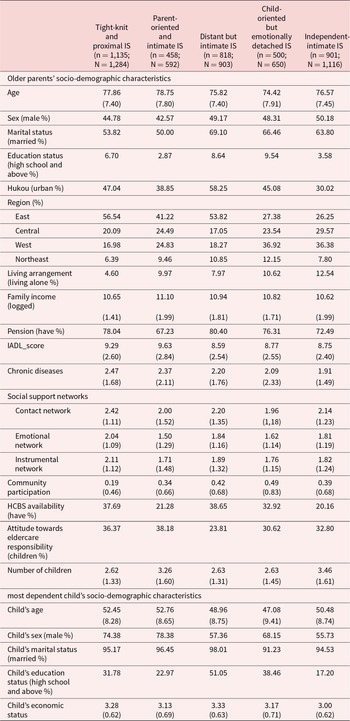
Table 1 presents the descriptive statistics of the parents and their most dependent children for the five IS types. In terms of the socio-demographic status, the ‘distant but intimate’ and ‘child-oriented but emotionally detached’ types had better education compared with the other three types. The health condition of the ‘parent-oriented and intimate’ category was the worst (highest IADL score). Regarding the size of various social support networks, ‘tight-knit and proximal’ IS parents exhibited noteworthy larger social networks compared with the other four types. Adults in the ‘child-oriented but emotionally detached’ group had the smallest contact social support network among the five types, while those in the ‘parent-oriented and intimate’ group had the smallest emotional and instrumental social support network; however, the ‘child-oriented but emotionally detached’ group had the highest level of community participation.
Descriptive statistics of study variables
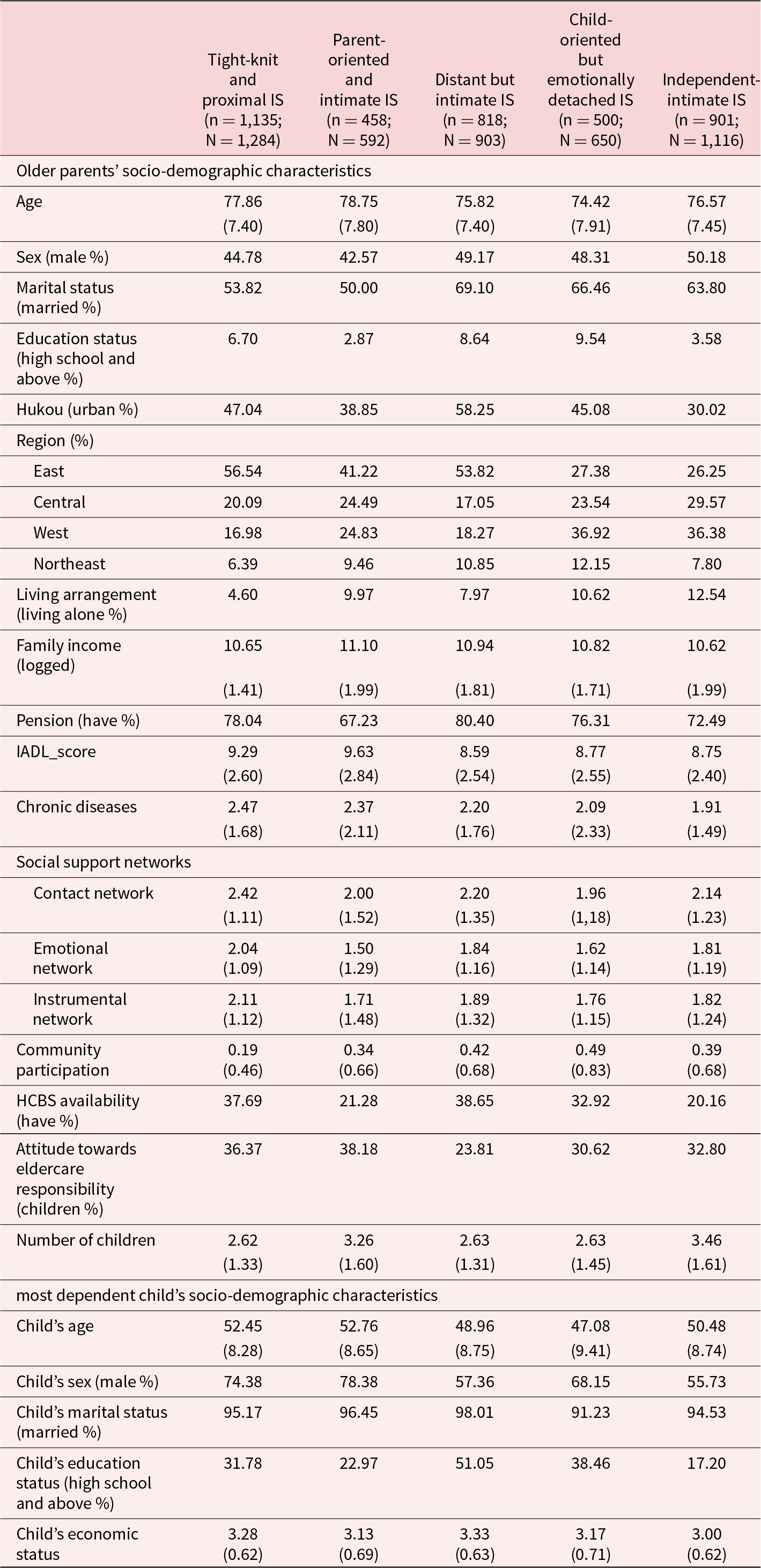
Notes: n = persons; N = person-years; IS = intergenerational solidarity; HCBS = home-and community-based service.
In terms of the availability of HCBS supply, older adults within the ‘tight-knit and proximal’ and ‘distant but intimate’ types had better supply status; approximately 37.69 per cent and 38.65 per cent of the older adults had HCBS supply in their community, respectively. However, only 20.16 per cent of older adults within the ‘independent-intimate’ group had HCBS supply in their community. Regarding the HCBS purchase intention, for ‘tight-knit and proximal’ IS, the preferences were service hotlines (19.4%), housework assistance (16.8%) and meal assistance or delivery (14.3%). For ‘parent-oriented and intimate’ IS, the preferences were housework assistance (7.3%), meal assistance and delivery (6.4%) and daycare or eldercare centres (6.3%). For ‘independent-intimate’ IS, the preferences were home visits (7.9%), daycare or eldercare centres (5.0%) and service hotlines (4.5%). Interestingly, older adults in the ‘child-oriented but emotionally detached’ group had the highest intention to purchase hotline services (13.5%). It is noteworthy that purchase intention towards psychological counselling was the lowest among the five groups (please see Supplementary Figure S3 for more details).
Effects of intergenerational solidarity on purchase intention
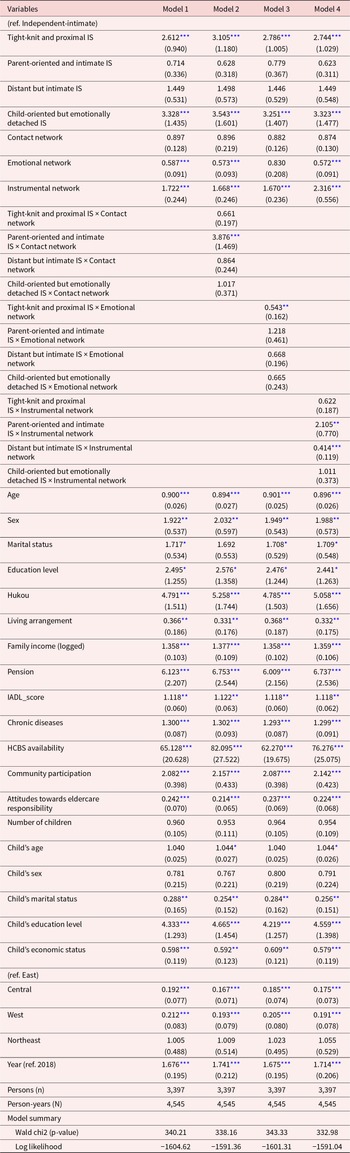
Results in Model 1 of Table 2 revealed that compared to the ‘independent-intimate’ IS, ‘tight-knit and proximal’ (OR = 2.612, p < 0.001) and ‘child-oriented but emotionally detached’ (OR = 3.328, p < 0.001) displayed a significantly heightened purchase intention. Both reciprocal and imbalanced IS demonstrated significant positive correlations with HCBS purchase intention. The ‘distant but intimate’ IS exhibited stronger purchase intention, while the ‘parent-oriented and intimate’ IS displayed the lowest purchase intentions, though these two groups were not statistically significant. Thus, H1 was rejected.
Odds ratio estimates of the binary logistic regressions
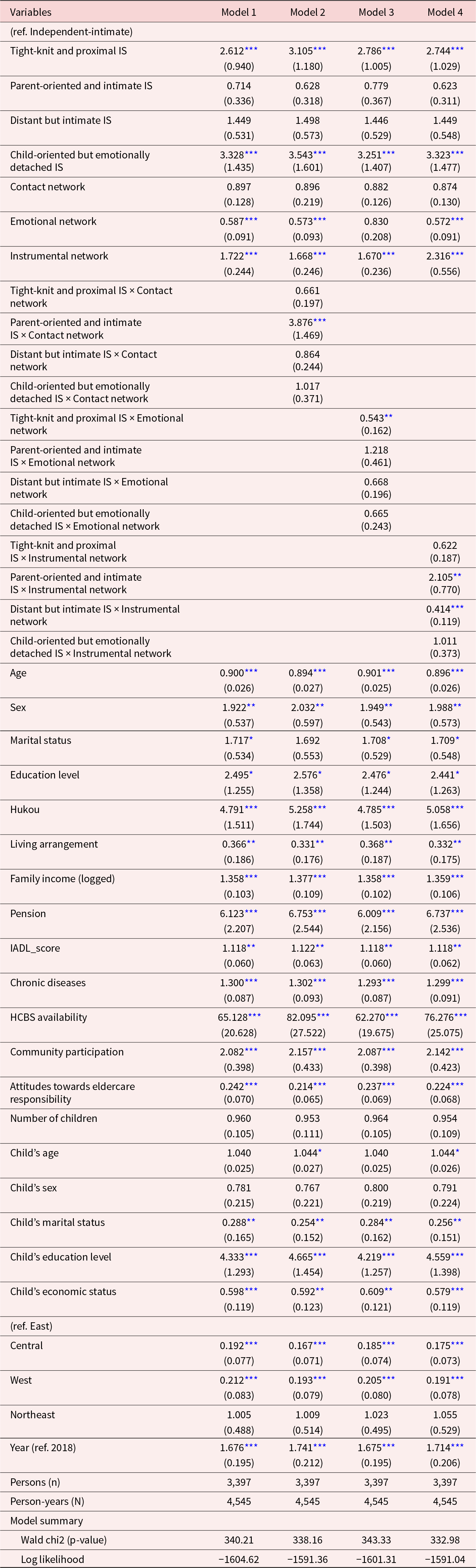
Notes:
*** p < 0.001; **p < 0.05; *p < 0.1
IS = intergenerational solidarity; HCBS = home-and community-based service; IADL = instrumental activities of daily living.
Additionally, individuals who were male, married, had at least a high school education, lived in urban areas, had a higher family income, received a pension, had poorer health (indicated by a higher IADL score and presence of chronic disease), resided in communities that offered HCBS and engaged in community activities were significantly more likely to show higher purchase intentions.
Older adults whose most dependent children were older, married with relatively better education level and economic status exhibited higher purchase intention. In addition, compared to older adults in the east region, those who live in the middle and west regions were associated with lower purchase intentions. Compared to older adults in the eastern region, those in the central and western regions showed weaker intentions to purchase HCBS.
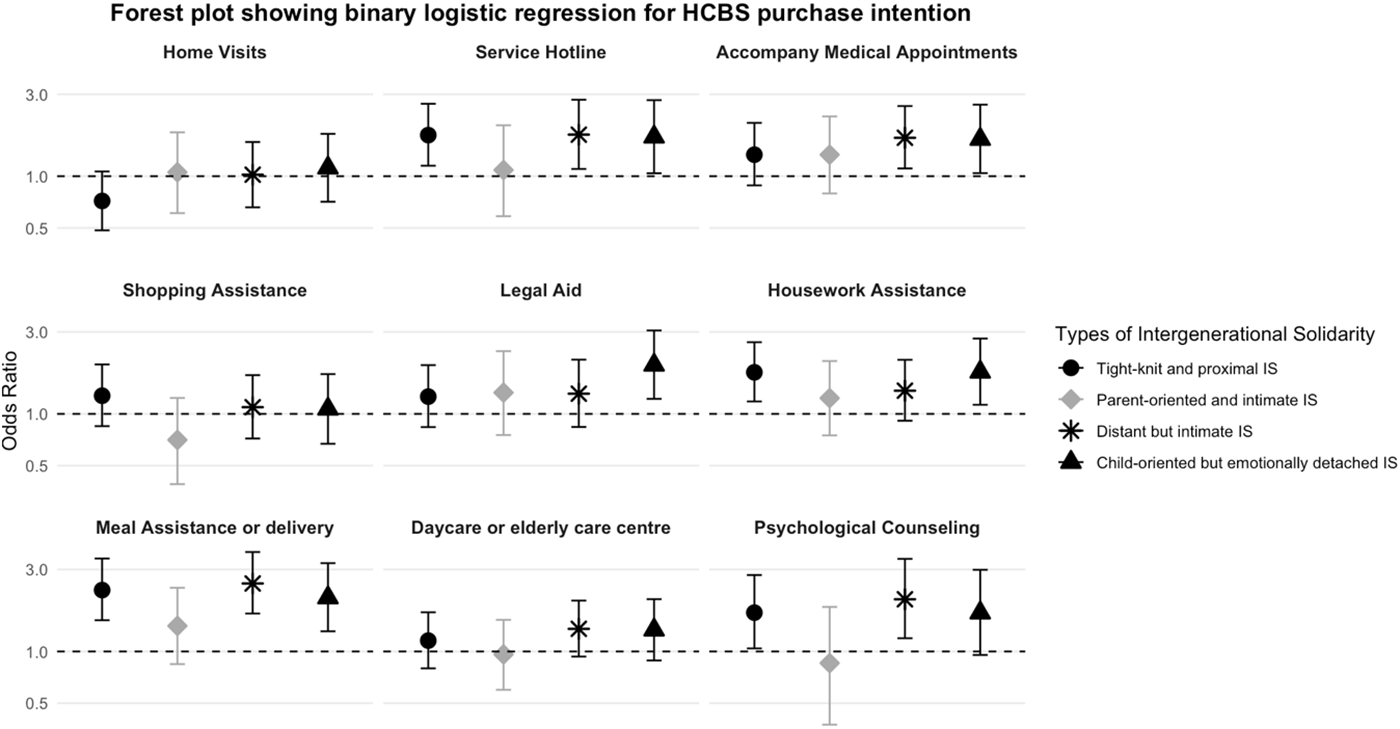
To better visualize the regression results among the different types of IS, a forest plot of regression was drafted. As illustrated in Figure 2, older adults with a ‘tight-knit and proximal’ IS had high purchase intentions for services such as ‘service hotlines’, ‘housework assistance’, ‘meal assistance or delivery’ and ‘psychological counselling’. Those with a ‘distant but intimate’ IS demonstrated positive purchase intentions for similar ranges of services, including ‘service hotlines’, ‘accompanying to medical appointments’, ‘meal assistance or delivery’ and ‘psychological counselling’. Meanwhile, older adults with a ‘child-oriented but emotionally detached’ IS expressed interest in an even wider array of services, ranging from ‘service hotlines’ to ‘accompanying to medical appointments’, ‘legal aid’, ‘house assistance’, ‘meal assistance or delivery’ and ‘psychological counselling’. In contrast, the ‘parent-oriented and intimate’ IS group showed little to no interest in purchasing any HCBS (please see Supplementary Table S7 and Figure S4 for more details).
Forest plot showing binary logistic regression for the HCBS purchase intention.

Effects of various social support networks on purchase intention
As shown in Model 1 of Table 2, regarding the effects of social support networks, older adults with larger instrumental networks and emotional networks exhibited a higher likelihood of purchase intention (OR = 1.722, p < 0.001). Conversely, adults with a broader emotional network were less likely to purchase HCBS than those with fewer social connections (OR = 0.587, p < 0.001).
The interactions between IS and various social support networks were integrated into Models 2, 3 and 4 of Table 2, respectively. Older adults with ‘parent-oriented and intimate’ IS with a larger contact network showed significantly stronger purchase intentions. Specifically, their likelihood of purchasing is nearly four times higher compared to those without this combination (OR = 3.876, p < 0.001). Older adults with ‘tight-knit and proximal’ IS who also have a larger emotional network exhibited significantly lower purchase intentions. Specifically, their likelihood of making a purchase is approximately 45.7 per cent of that of older adults without this combination (OR = 0.543, p < 0.001).
In terms of the instrumental network, older adults in the ‘parent-oriented and intimate’ group with a larger instrumental network demonstrated more than double the purchase intention of the reference group (OR = 2.105, p < 0.001). Conversely, those in the ‘distant but intimate’ group with a larger instrumental network showed only 41.4 per cent of the purchase intentions of the reference group (OR = 0.414, p < 0.001).
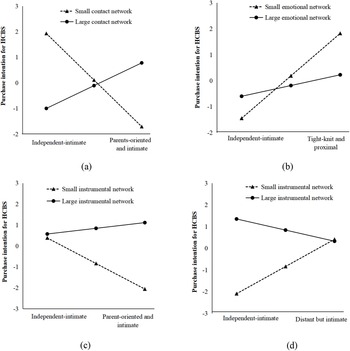
To facilitate visualization of the effects of various social support networks and IS, we plotted four simple slopes (Figure 3). Compared with older adults whose IS type corresponds to ‘independent-intimate’, a larger contact network and instrumental network among ‘parent-oriented and intimate’ older adults exhibited a higher willingness to purchase HCBS (Figures 3a, c). The ‘distant but intimate’ IS type saw a decrease in purchasing HCBS likelihood in a larger instrumental network (Figure 3d). Also, the ‘tight-knit and proximal’ IS type showed an increased likelihood of purchasing HCBS in a larger emotional network (Figure 3b). Therefore, H2a was supported and H2b was partially supported.
Simple slopes for significant interaction.

Effects of older adults’ eldercare attitudes on purchase intention
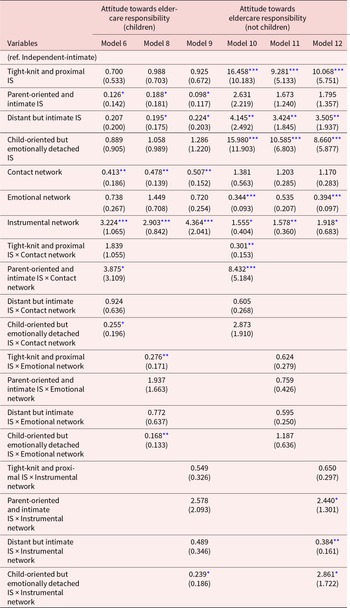
According to the findings depicted in Table 2, concerning the effect of adults’ eldercare attitudes on their purchase intentions, older adults who attributed responsibility for eldercare to their adult children exhibited a decreased likelihood of purchasing services. This finding was further substantiated by the stratification of the samples based on attitudes towards eldercare; see more details in Tables 3 and 4.
Odds ratio estimates of the binary logistic regressions by attitude towards eldercare groups
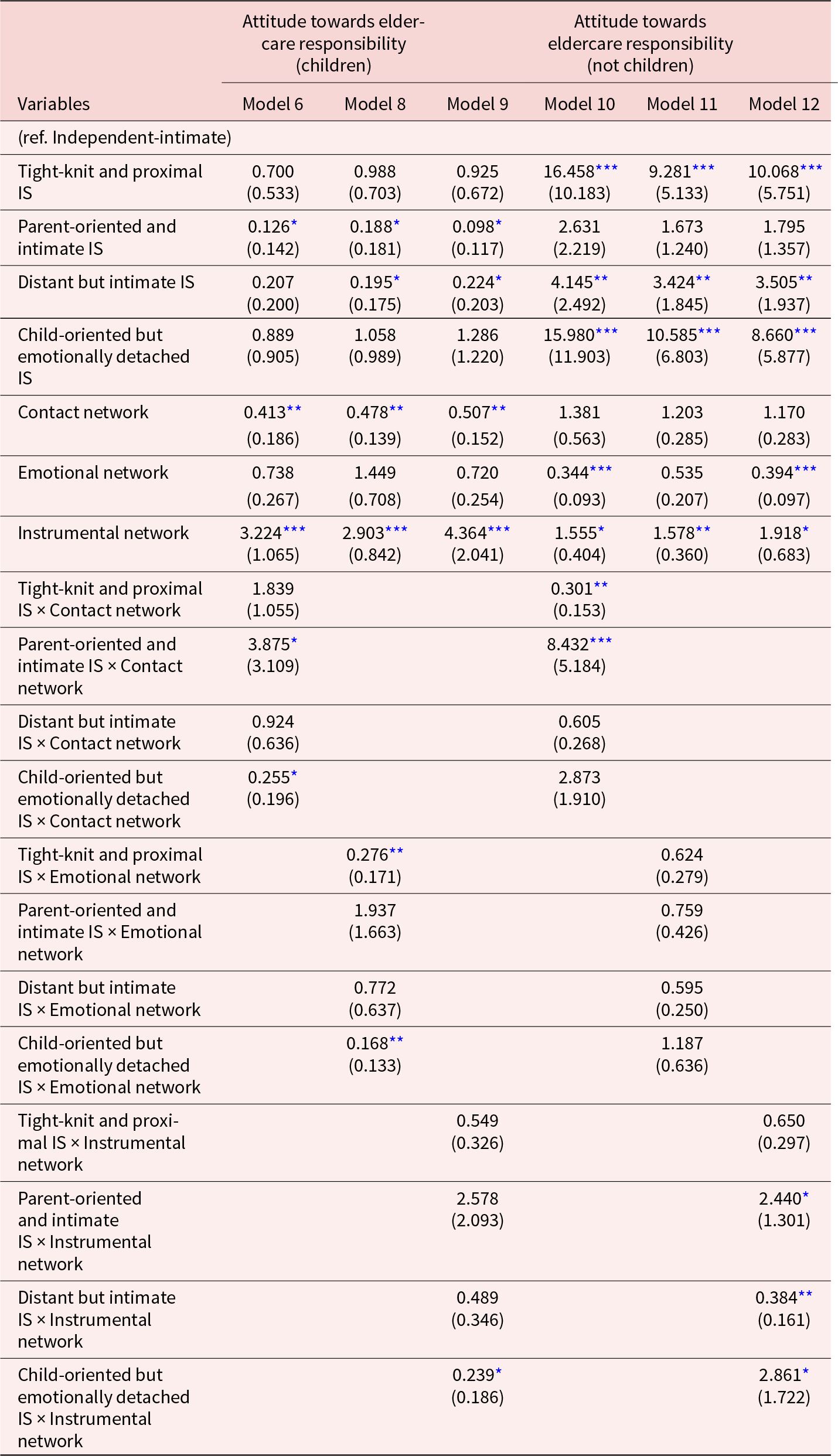
Notes:
*** p < 0.001; **p < 0.05; *p < 0.1.
IS = intergenerational solidarity; HCBS = home- and community-based service; IADL = instrumental activities of daily living.
Relationship between intergenerational relationships and the home- and community-based service (HCBS) purchase intention under the moderation of various social support networks

Notes: ‘+’ represents want to purchase HCBS; ‘–’ represents don’t want to purchase HCBS; *< 0.05; ** < 0.01; *** < 0.001.
‘Modern’ represents attribute eldercare not as children’s responsibility (government, society, older adult themselves and spouse, or government/children/older adult sharing responsibilities).
Among older adults who did not attribute eldercare responsibility to their adult children, those with ‘tight-knit and proximal’, ‘distant but intimate’ and ‘child-oriented but emotionally detached’ IS showed a marked odds ratio to purchase HCBS. The exception is older adults with ‘parent-oriented and intimate’ IS. With older adults who do attribute eldercare responsibility to their adult children, those with ‘parent-oriented and intimate’ and ‘distant but intimate’ IS are also likely to purchase HCBS.
Consistent with the results from the full sample, the interaction effects of the ‘parent-oriented and intimate’ IS and contact network remained significant across all sub-samples. In contrast to the findings from the full sample, the interaction effect between ‘tight-knit and proximal’ IS and emotional network was significant only in the sub-sample of older adults who hold traditional eldercare attitudes (children as care-givers). Moreover, the interactions involving ‘parent-oriented and intimate’, ‘distant but intimate’ and instrumental networks were significant only in the sub-sample of those who did not wish to rely on children for eldercare. Additionally, when considering different attitudes towards responsibility for eldercare, the moderating effects of the three types of social support network were significant in the ‘child-oriented but emotionally detached’ IS group. Specifically, the contact network and the emotional network suppressed the purchase intentions of older adults who relied on children for eldercare, while the instrumental network improved the purchase intentions of those not dependent on children for eldercare. Thus, H3 was partially supported.
Discussion
Using the 2018 and 2020 waves of the CLASS survey, based on the ISF proposed by Bengtson and Roberts (Reference Bengtson and Roberts1991), this article seeks to contribute to the existing literature by categorizing seemingly different intergenerational relationships into two overarching types based on the essence of intergenerational exchanges: (1) reciprocal intergenerational relationships, characterized as ‘tight-knit and proximal’ IS and ‘distant but intimate’ IS, demonstrating reciprocal exchanges in housework assistance, economic support and intimate bond; and (2) imbalanced intergenerational relationships, characterized as ‘parent-oriented and intimate’ IS and ‘child-oriented but emotionally detached’ IS, demonstrating imbalanced exchanges of support and less intimacy.
Furthermore, integrating the Behavioral Model of Service Use (Andersen Reference Andersen1995), the Reasoned Action Model (Fishbein and Ajzen Reference Fishbein and Ajzen1975) and Social Network Theory (Berkman Reference Berkman2000; Scott and Carrington Reference Scott and Carrington P2014), we explored how these intergenerational relationships and the social support networks of older adults interact to influence older adults’ HCBS purchase intentions. Our findings provide a novel perspective on how impaired Chinese older adults attempt to address their needs within the context of modern kinship structure and the relationships between informal support networks of friends, neighbours and formal care services. The following striking findings emerged from our analysis.
Unmet needs, emotional detachment and remote proximity contribute to HCBS purchase intention
Without considering the moderating effect of social support networks, in contrast to previous studies (Fu and Guo Reference Fu and Guo2022; Wang et al. Reference Wang, Ke, Sankaran and Xia2021), we found that impaired older adults exhibited a pronounced inclination towards purchasing HCBS in China irrespective of their intergenerational relationships. Odds ration estimates of binary logistic regressions suggested that older adults with ‘child-oriented but emotionally detached’ IS type exhibited the highest purchase intentions, followed by ‘tight-knit and proximal’. When considering attitudes towards responsibility for eldercare, older adults with ‘distant but intimate’ IS also demonstrated significant purchase intention. These three distinct groups highlight the critical factors influencing HCBS purchase intention: unmet needs, emotional detachment and remote proximity.
Older adults of the ‘child-oriented but emotionally detached’ IS type represent the population most urgently in need of HCBS. In particular, older adults who consider eldercare not to be their children’s responsibility are more likely to purchase service hotlines, accompanying to medical appointments, legal aid, housework assistance, meal assistance and psychological counselling. This is because, while they provide substantial support for grandparenting, they have restricted social networks, amid strained relationships with, and emotional detachment from, their children. Careful interpretation of the data suggests that emotional detachment may potentially be a key motivation for purchasing HCBS. Their unmet needs are explicit, objective and noticeable.
Contrary to our expectations, although older adults with ‘tight-knit and proximal’ IS receive substantial housework support from their most dependent children, they still exhibit relatively high intentions to purchase HCBS. The services they wished to purchase included service hotlines, housework assistance and meal assistance. We posit that, despite receiving considerable support from their children, their needs remain unmet. Given the relatively worse health conditions and limited intergenerational economic exchange but high levels of tangible support, we hypothesize that they might live with the adult child owing to physical capacity decline; however, the support provided by their kin network may not fully meet their needs. Descriptive statistics revealed that older adults with ‘tight-knit and proximal’ IS type had the strongest intention to purchase service hotlines. It is notable that, in China, the family-oriented culture emphasizes unity and harmony, along with the belief that ‘family disgrace should not be revealed to the outsider’. Previous studies have confirmed that service hotlines in China promptly provide compassionate responses to address psychological crises stemming from widowhood and loneliness in later adulthood (Xu et al. Reference Xu, Liu and Li2022). Given the inclination towards purchasing psychological consulting services in Figure 2, these results might imply that this group’s psychological needs remain unmet, leading them to seek service hotlines to fulfil their emotional and psychological support needs. Compared with older adults with ‘child-oriented but emotionally detached’ IS, their needs are more implicit and difficult to discover.
Older adults with a ‘distant but intimate’ IS type, despite having a higher level of consensus and intimacy, engage in reciprocal economic exchanges with their most dependent children. As their most dependent children live at a considerable distance, and they have declining capacity owing to older age, they will ultimately have unmet IADL needs not only for meal assistance or delivery, accompaniment to medical appointments and daycare but also for mental support through psychological counselling, informational support, and service hotlines. This is especially the case among older adults who have a modern attitude towards responsibility for eldercare.
Reciprocal intergenerational relationships exhibited fewer HCBS purchase intentions under the moderation of social support networks
Another major notable theoretical contribution of this study is including intergenerational relationships and social support networks in Andersen’s Behavioral Model of Service Use. We found that, instead of boosting purchase intention, expanding social support networks decreases the HCBS purchase intentions for older adults with reciprocal intergenerational relationships (i.e. ‘tight-knit and proximal’ IS and ‘distant but intimate’ IS). The findings suggest that a larger instrumental support network decreases purchase intention among older adults with ‘distant but intimate’ IS, especially among those with modern eldercare attitudes. It might indicate that their intention to purchase HCBS may cease once the instrumental network is sufficiently engaged, such as when there is an increase in the availability of informal resources for daily services, including accompanying to medical visits, assisting with meal delivery and aiding in shopping. We observed that for older adults with ‘tight-knit and proximal’ IS, different attitudes towards responsibility for eldercare influence purchase intention differently. For older adults who do not attribute responsibility for eldercare to their adult children, with an expansion of the contact network their HCBS purchase intention decreases.
For older adults who consider that eldercare is their children’s responsibility, with an expansion of the emotional network their HCBS purchase intention decreases. Considering this result alongside the types of HCBS services preferred, we may conclude that care provided by adult children often meets older adults’ physical and instrumental needs but may fall short in addressing their emotional and psychological needs. As a result, older adults rely on informal networks to fulfil these aspects of care. These findings echo the conclusion of the hierarchical compensatory model (Cantor Reference Cantor1975, Reference Cantor1989). It implies that older adults turn to formal care only when kin are unavailable or cannot absorb the care-giving burden. As the inner convoy for older adults, the intergenerational care dyad is preferred as the cornerstone of the support system.
Imbalanced intergenerational relationships exhibited diverse HCBS purchase intentions under the moderation of social support networks
In contrast to the findings in reciprocal dyads, we found notable heterogeneity among older adults’ different types of social support network and their correlation with their HCBS purchase intentions (i.e. ‘parent-oriented and intimate’ IS and ‘child-oriented but emotionally detached’ IS). Empirical findings suggest that either the younger or the older generation gives too much, and the resulting relational tension and emotional detachment from the imbalanced intergenerational relationship drives them to seek external assistance.
For older adults with ‘parent-oriented and intimate’ intergenerational solidarity (IS), the moderating effect of the contact network revealed that a larger contact network increased HCBS purchase intention, regardless of the older adults’ attitudes towards eldercare responsibility. A possible explanation is that the social support networks of older adults within this IS type are typically tightly-knit and predominantly composed of family members. Consequently, these networks may lack diverse perspectives. Among the group termed ‘parent-oriented and intimate’ older adults, owing to traditional values of filial piety, their adult children may be hesitant to seek formal services. These findings are consistent with previous studies of care-giver network composition (Logan and Spitze Reference Logan and Spitze1994; Vacca and Bianchi Reference Vacca and Bianchi2024), which suggest that diverse or friend-centred networks not only obtain a wider range of informal support but also acquire more information and knowledge regarding service utilization. Expanding older adults’ contact networks can lead them to form new acquaintances, exposing them to information about care options, including the potential benefits of HCBS. The diffusion of eldercare beliefs within these expanded networks may also influence their purchase intentions. This explains why the correlation between the interaction of these two IS types and contact networks and HCBS purchase intention was more pronounced among older adults who prefer not to depend on their children for eldercare.
Similar findings were also found in the instrumental network. Our findings suggest that for older adults with ‘parent-oriented and intimate’ IS, a larger instrumental network correlates with a higher intention towards purchasing HCBS. These correlations were further confirmed among older adults with modern eldercare attitudes (not considering eldercare to be their children’s responsibility). This finding agrees with earlier studies by Logan and Spitze (Reference Logan and Spitze1994), who found that older adults who received help from friends were more likely to use HCBS because of their awareness of older persons’ needs and their familiarity with community services. Another explanation might include the fact that they still need formal support to complement their unmet needs.
Conversely, among those identified as ‘child-oriented but emotionally detached’, given their relatively smaller social network and significant involvement in grandparenting support within the five groups, we propose that some older adults in this IS type could be ‘Chinese grandparent migrants’ or ‘grandparent care-givers’, potentially experiencing social support deficits (Guo et al. Reference Guo, Ngai and Sun2024). Thus, with the expansion of contact, emotional and instrumental networks, for older adults with traditional eldercare attitudes their purchase intention towards HCBS declines significantly. For older adults with a modern attitude towards eldercare, HCBS purchase intention significantly increases as their instrumental network expands. This may be because the demands of housework and grandparenting can lead to burnout and intergenerational conflicts, making these individuals more aware of the limitations of care provided by their kin network. As a result, they may perceive the value of HCBS when additional instrumental support is available.
Policy implication
This study provides not only theoretical contributions but also practical implications for the design of public policy related to gerontological social work practice. First, older adults’ psychological needs shall not be neglected even among older adults with tight-knit intergenerational relationships. Both forest plot and moderation results suggest that, besides ‘meal assistance and delivery’, ‘psychological counselling’ is the most significant service that older adults would like to purchase. Mutuality of obligations may have guaranteed that adult children undertake care-giving roles and behave in a ‘socially accepted reciprocal manner’. However, it may overlook older adults’ deeper, more subtle psychological and emotional needs. Organizing regular community gatherings or intergenerational programmes outside the home may facilitate the expansion of older adults’ informal networks to ‘complement’ their implicit psychological needs.
Second, community participation may be a powerful mediator for expanding older adults’ social networks, disseminating new health and care ideas within the community and providing instrumental assistance. Within the constraints of this study, we may not be able to further explore internal mechanisms among community participation, informal support networks and HCBS purchase intention. However, as positive correlations between community participation and intention to purchase HCBS were found in the regressions, we hypothesize that community participation could expand older adults’ social networks and further promote their utilization of formal support. Friends and neighbours derived from community participation may serve as effective mediators and ‘service ambassadors’ between care-giving families and service providers. In addition, we found that older adults with ‘child-oriented but emotionally detached’ and ‘distant but intimate’ IS have relatively small social networks but a high level of community participation (see Table 1 for more details). Our data may not allow us to provide definitive explanations; however, one explanation for this phenomenon may be that unmet psychological needs can be fulfilled through community participation by maintaining meaningful social connections in later life.
Third, expanding friend-focused social networks through community participation may complement older adults’ diverse needs to ‘ageing-in-place’. Owing to dramatic demographic changes, population ageing and constraints on public sector spending, there has been a notable surge of interest among researchers and policy makers in examining the role of older adults’ various social support networks as a ‘complement’ or even ‘substitute’ for decreasing formal support resources globally (Bremer et al. Reference Bremer, Challis, Hallberg, Leino-Kilpi, Saks, Vellas, Zwakhalen and Sauerland2017; Logan and Spitze Reference Logan and Spitze1994; Zhang et al. Reference Zhang, Sun and L’Heureux2021). Contact networks developed through community participation could serve as foundational layers from which instrumental and emotional networks emerge. These networks provide crucial information and resources that help individuals access various forms of support. As individuals within a contact network interact and build relationships, some may transition to more intimate roles and form an emotional network. This transition enhances the depth of available support, encompassing both emotional and instrumental assistance. This dynamic underscores the interconnected nature of social support systems and the importance of contact networks in fostering robust emotional and instrumental networks (for more details about the internal mechanism, please check Figure S5 in the Supplementary Material).
Limitations
The findings of this study should be interpreted with caution. First, constrained by data availability, the measurement of IS was based solely on the self-reported data of older adults in relation to their most dependent children. To gain a more comprehensive evaluation of the family decision-making process, future research should consider incorporating multi-subject intergenerational assessments. Second, although we included the 2018 and 2020 waves of CLASS, the current study may not adequately capture the evolving dynamics of IS and social support networks over time; IS and social support networks are never fixed and may change with the functional capacity of older adults. Longitudinal research is required to further elucidate these changes in older adults’ decision-making processes. Third, the current measurement of older adults’ social support networks focuses only on the size of those networks. The dynamics of dependence and interdependence within the network, along with the degree of closeness, also play a role in influencing differences in purchase intention. Thus, to understand the different functions of social support networks, future studies may include the measurement of composition, density, geographical dispersion or qualitative data. Despite these limitations, this study is among the first to comprehensively examine the diverse effects of IS and social support networks on older adults’ HCBS purchase intentions.
Conclusion
This study provides a nuanced picture and a multi-dimensional approach to examine impaired older Chinese adults’ intergenerational relationships and the different facets of their social support networks. In particular, we found that older adults with ‘child-oriented but emotionally detached’ and ‘tight-knit and proximal’ intergenerational relationships are the most likely users of HCBS. Additionally, this study found that social support networks moderate the intention to purchase HCBS differently for imbalanced dyads compared to reciprocal dyads. Our findings provide practical insights for gerontological social work practice, highlighting the ‘bridge’ functions of community participation.
Supplementary material
The supplementary material for this article can be found at https://doi.org/10.1017/S0144686X25000091.
Author contributions
All authors worked collectively to develop the framework and interpretation of the results: YZ substantially contributed to the developing of the theoretical framework and manuscript drafting, while SX significantly contributed to the statistical analysis plan and conducted the statistical analyses. All authors critically reviewed and revised the manuscript draft and approved the final version for submission.
Acknowledgement
The authors would like to express their sincere gratitude to the two anonymous reviewers for their valuable time and constructive feedback. Their insightful comments and meticulous critiques significantly improved the quality of this work. We deeply appreciate their expertise and dedication to advancing scholarly discourse in the field.
Financial support
This work was supported by the Waseda University Grants for Special Research Projects (2025C-274), Japan’s Grant-in-Aid for Research Activity Start-Up Project (JP24K22677), and Open Access funding provided by Fudan University.
Competing interests
The authors declare no potential competing interests.
Ethical standards
The data for this study were obtained from the China Longitudinal Ageing Social Survey, conducted by the China Survey and Data Center at Renmin University of China since 2014 with approval from the academic review committee.



 Open access

