


Introduction
Organizations currently face a range of well-known issues of varying degrees of urgency and impact. However, there is also a need to reduce the likelihood of being surprised by novel issues. Hence workers in some areas, such as medicine and the arms industry, routinely review emerging technologies and issues (Quiggin, Reference Quiggin2007). Governments also undertake routine horizon scanning (van Rij, Reference Van Rij2010) and may supplement this by analysing specific areas in more detail (e.g. King & Thomas, Reference King and Thomas2007). In view of the problems resulting from past failings to foresee issues and impacts (European Environment Agency, 2001) there have been calls for scanning of future environmental issues (e.g. Holmes & Clark, Reference Holmes and Clark2008; Sutherland et al., Reference Sutherland, Bailey, Bainbridge, Brereton, Dick and Drewitt2008; Sutherland & Woodroof, Reference Sutherland and Woodroof2009), including looking at legislative issues (Sutherland et al., Reference Sutherland, Barlow, Clements, Harper, Herkenrath and Margerison2011a).
Horizon scanning has not been developed with the aim of predicting the future but of examining possible developments, with the objective of considering the likely consequences and the possible responses required (King & Thomas, Reference King and Thomas2007; Lawton, Reference Lawton2007). Horizon scanning has been defined as the systematic search for potential threats and opportunities that are currently poorly recognized (Sutherland & Woodroof, Reference Sutherland and Woodroof2009). For example, Sutherland et al. (Reference Sutherland, Clout, Côté, Daszak, Depledge and Fellman2010) brought together professional horizon scanners, experts in specific animal and plant groups and representatives of organizations with wide environmental interests to undertake a formal process to identify 15 issues with potential impact on biological diversity that they suggested warranted further consideration (see Sutherland et al., Reference Sutherland, Fleishman, Mascia, Pretty and Rudd2011b, for a detailed account of the methods).
Organizations routinely face the challenge of balancing the conflicting demands of current, often well-documented issues, which may require immediate attention, against the consideration of future issues, which may never materialize or may develop slowly, allowing time for appropriate responses in the future. Experience has shown that although the concept of horizon scanning may be of interest for those involved in strategic (i.e. policy making) activities there are serious challenges in integrating horizon scanning results with routine (i.e. tactical) decision-making activities (Defra, 2006). Horizon scanning outputs are often not taken up by conservation organizations because the scanning is detached from their established priorities.
Here we suggest an explicit collective process that organizations can use to review and use the results of horizon scanning, thus better linking horizon scanning with its target audiences and their day-to-day decision making. We believe it is novel in two ways. Firstly, although there may be single assessments of impact and urgency we are unaware of any previous collaborative processes of individual assessments. Even collaborative forward planning work undertaken by environmental coalitions such as the Wildlife and Countryside Link has focused purely on a short-term standard opportunities and threats analysis. Secondly, each organization states triggers that would cause it to change the priority with which it may respond to specific horizon scanning issues. This differs considerably from the usual demand for further research. We describe how such a process could operate and trial it by assessing the response of a range of organizations to previously identified horizon scanning issues. Such a collective analysis of horizon scanning can help organizations fully appreciate the consequences of potentially unforeseen issues, and can promote cross-organizational collaboration in responses. The type of process we recommend provides a way of deciding priorities and the timing of possible action by conservation organizations.
The process
We suggest that there are three main components to the process of responding to horizon scanning (assuming the horizon scanning itself is already completed): (1) ranking of the urgency and impact of issues by individual organizations, (2) sharing of rankings across organizations to allow results to be refined, and (3) publishing and disseminating results so that other organizations can gain from the findings and researchers have the opportunity to study the issues identified as being important.
Many horizon scanning programmes include a process for ranking issues in terms of potential impact and selecting issues for further exploration. Common criteria used include potential impact, and the likelihood or probability of occurrence (SKEP, 2006). For example, Sutherland et al. (Reference Sutherland, Bailey, Bainbridge, Brereton, Dick and Drewitt2008) assessed each issue according to likelihood, opportunity and threat. The degree of knowledge and level of controversy about an issue has also been used and can signal where more research is needed, or where stakeholder consultation at an early stage would be particularly useful. However, these generic ranking systems typically seek to describe the issue, rather than assess how organizations view it from their perspective. We suggest that from an organizational perspective there are two key aspects to assess: urgency and impact. Urgency distinguishes issues that require some immediate policy development or research from those that can simply be tracked to review their progress. Impact examines effects on the organization's work or concerns (i.e. the extent to which the issue is likely to be important to the organization should it develop).
We designed a classification scheme for ranking issues using the criteria of urgency and impact (Table 1). Impact was divided into three categories: non-existent or minor, moderate, or substantial potential impact.
A proposed classification of the issues according to the degree of urgency and potential impact of the issue. Larger circles indicate greater urgency and darker shading higher impact.
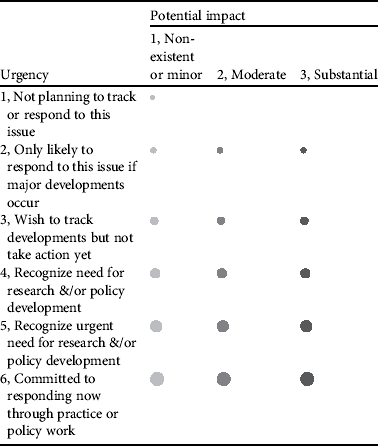
How urgently the organization plans to respond was divided into six categories: (1) not planning to track or respond to this issue, (2) only likely to respond to this issue if major developments occur, (3) wish to track developments but not take action yet, (4) recognize need for research and policy development, (5) recognize urgent need for research and/or policy implementation or development, (6) committed to responding now through practice or policy work. For urgency, categories 1–3 acknowledge that the organization plans not to take any action beyond tracking developments. Categories 4 and 5 acknowledge the need for research and policy development but not necessarily carried out by the organization itself. Category 6 is sufficiently urgent that the organization is committed to action.
The combinations of moderate or substantial impact (on an organization's work or concerns) were considered incompatible with an urgency rating of ‘Not planning to track or respond to this issue’ (Table 1). However, we retained the combination of committed to responding now through practice or policy work with issues whose impact was identified as non-existent or minor. The logic is that some issues may affect only a minor part of the organization's interests but may still be easy to manage and thus merit an active response. Our methods have three novel components: the quantification of responses, the assessment of triggers that would change classification, and the cross-organizational collation of priorities.
Methods
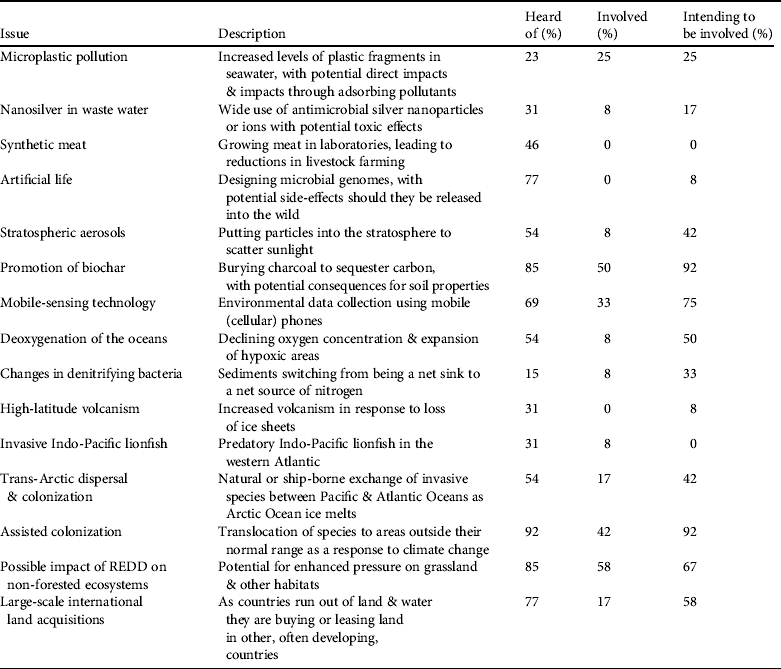
This process of classifying impact and urgency was trialled using the 15 horizon scanning issues identified by Sutherland et al. (Reference Sutherland, Clout, Côté, Daszak, Depledge and Fellman2010), as summarized in Table 2. A range of organizations was invited to identify representatives to participate in this process. These representatives, who were mostly senior scientists or managers, assessed each issue purely in relation to the concerns of their organization according to the criteria (Table 1) by discussing them with relevant policy makers and practitioners within their organizations. They also identified triggers that, if they occurred, would result in their organization upgrading their classification of impact and urgency. They were also asked to state if they had previously heard of each issue and whether their organization was already working on each issue.
A summary, in the original order, of the horizon scanning issues identified by Sutherland et al. (Reference Sutherland, Clout, Côté, Daszak, Depledge and Fellman2010), where fuller details and references are given, the percentage of the 12 organizational representatives who had previously heard of each of the issues raised, whether their organizations were involved in the issue prior to the horizon scanning, and the percentage of organizations intending to be involved in the future (i.e. responses at urgency level 4 or above in Table 3).
The 12 organizations included UK government agencies (Joint Nature Conservation Committee, Natural England, Scottish Natural Heritage), an intergovernmental body (UN Environment Programme—World Conservation Monitoring Centre), UK and international non-governmental organizations (Birdlife International, British Trust for Ornithology, Butterfly Conservation, Fauna & Flora International, National Trust, Royal Society for the Protection of Birds, Woodland Trust), and the Cambridge Conservation Initiative (via its Director), which is a collaboration between the University of Cambridge and nine conservation organizations, of which five also provided independent assessments of the issues (Birdlife International, British Trust for Ornithology, Fauna & Flora International, Royal Society for the Protection of Birds, UN Environment Programme—World Conservation Monitoring Centre). The same scoring was used whether the issue was new to the organization or whether they were already aware of it. Organizations' representatives were shown the scores of all other organizations and given the opportunity to rescore.
Results
Whether the issues had been heard of varied considerably, from changes in denitrifying bacteria, which just 15% of participants were aware of, to assisted colonization, which 92% already knew about (Table 2). Twelve of the 15 issues were already being considered by one or several organizations. Only three issues were not being considered by any of the organizations; synthetic meat, artificial life and high-latitude volcanism. The possible impact of reducing emissions from deforestation and forest degradation (REDD) on non-forest habitats was being considered by over half the organizations.
Overall the 12 organizations assessed 24% of issues as having non-existent or minor, 43% moderate and 33% substantial potential impact (Table 3). In terms of urgency, 14% were classified as not planning to track or respond to these issues, 24% as only likely to respond if major developments occur, 21% as wish to track developments but not take action yet, 20% as recognize need for research and/or policy development, 14% as recognize urgent need for research and/or policy development, and 7% as committed to responding now through practice or policy work.
Assessment, by 12 organizations*, of actions required to address 15 issues identified by horizon scanning (Table 2), with the median (the middle ranked number) and interquartile range (IQ) for impact and urgency. Larger circles indicate greater urgency and darker shading higher impact (see Table 1 for further details).
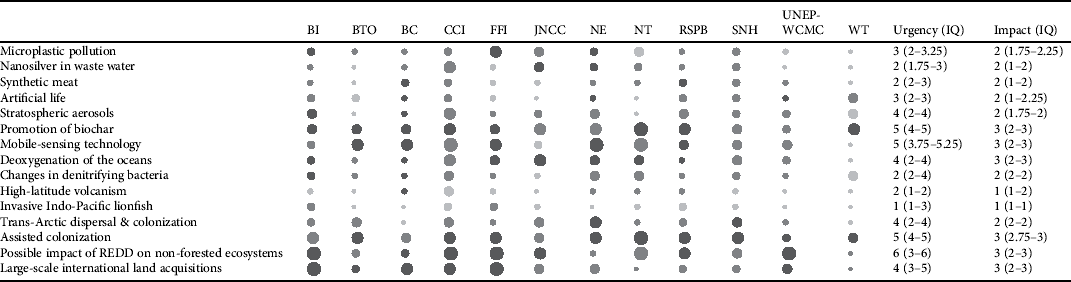
* BI, Birdlife International; BC, Butterfly Conservation; BTO, British Trust for Ornithology; CCI, Cambridge Conservation Initiative; FFI, Fauna & Flora International; JNCC, Joint Nature Conservation Committee; NE, Natural England; NT, National Trust; RSPB, Royal Society for the Protection of Birds; SNH, Scottish Natural Heritage; UNEP-WCMC, UN Environment Programme World Conservation Monitoring Centre; WT, Woodland Trust
In our two stage process, following examination of the responses of others and further contemplation, the expectations of action were unchanged or only slightly changed (<10%) for seven issues but substantially increased (25–50%) for the remaining eight.
Organizations differed in the degree to which they considered that responses were needed (Table 3). For example, the Woodland Trust's remit is restricted to woodland conservation in the UK and as such many of the issues, such as those relating to marine environments, are not relevant to them. At the other extreme, some of the large international organizations, such as BirdLife International, have programmes around the world in a wide range of habitats and thus most of the topics are relevant to some part of the organization. The issues varied markedly in the extent to which organizations considered them to be urgent and of high impact (see Table 3 for the mediation scores). The issues with the greatest immediate impact were the promotion of biochar, deoxygenation of the oceans, assisted colonization, and the impact of REDD on non-forest ecosystems. The spread of invasive lionfish and high latitude volcanism were considered to have the lowest impact.
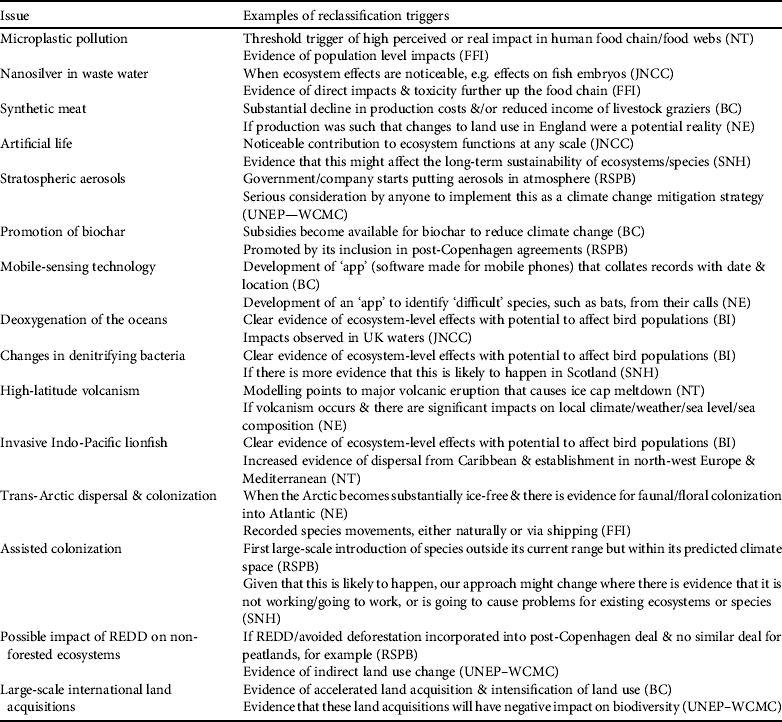
Organizations identified triggers that would probably cause them to change their classifications of issues (Table 4), and found this exercise useful in clarifying what aspects they may need to remain alert to for each issue, even if not tracking an issue in detail. Many of the triggers relate to changes in evidence. This should not be seen as a research prioritization exercise but, rather, should research change the evidence in the way stated, then the issue would be reclassified.
Examples of triggers that would cause organizations to reclassify their assessment of urgency and impact of the various horizon scanning issues (Table 2). These triggers will differ considerably between organizations according to their sphere of interest. Abbreviations of organizations as beneath Table 3.
This horizon scanning for new issues is being repeated annually. We plan to coordinate the routine assessment of the output, using the methods described here, with the assessment placed on the Cambridge Conservation Initiative website.
Discussion
As horizon scanning becomes more widespread in a range of areas, including medicine (Storz et al., Reference Storz, Kolpatzik, Perleth, Klein and Haussler2007; Gwinn et al., Reference Gwinn, Grossniklaus, Yu, Melillo, Wulf and Flome2011), epidemiology (Morgan et al., Reference Morgan, Kirkbride, Hewitt, Said and Walsh2009), business (Brown, Reference Brown2007), and criminology (White & Heckenberg, Reference White and Heckenberg2011), as well as conservation (Sutherland et al., Reference Sutherland, Clout, Côté, Daszak, Depledge and Fellman2010), there is a need to think clearly about how information from scans can be used by organizations. Horizon scanning can be used as part of ‘adaptive foresight’ (Eriksson & Weber, Reference Eriksson and Weber2008): instruments that deliberately challenge policy makers to look at the uncertainties and the unexpected and develop resilient policies towards sustainability (van Rij, Reference Van Rij2010). The 12 conservation organizations showed wide variation in action on particular issues (Table 2). Although some action (or inaction) may already have been based on the results of horizon scanning, in most cases our experience is that it results from a more ad hoc process and, in the case of doing nothing, to limitations in the ability to consider and assess these issues. The process outlined here provides a means whereby a decision to do nothing, to continue as before or to raise the level of engagement becomes active and based on the examination of information.
Only three of the 14 authors were also authors of the original horizon scanning exercise (Sutherland et al., Reference Sutherland, Clout, Côté, Daszak, Depledge and Fellman2010). The high ranking of the issues showed that the original exercise had succeeded in identifying issues that were generally of concern to policy makers and practitioners. Furthermore the public nature of such an exercise allows organizations to benchmark (Keehley & Abercrombie, Reference Keehley and Abercrombie2008; Sutherland & Peel, Reference Sutherland and Peel2011) their assessment against that of others, especially those with similar objectives, and to reflect further on the impact and urgency they are assigning each issue. This also leads to opportunities to collaborate by sharing reviews of horizon scanning, alerting those with similar concerns over any changes or joining forces to conduct in depth research into issues (van Rij, Reference Van Rij2010).
Organizations will differ in the extent to which it is appropriate for them to respond to horizon scanning, depending upon the breadth of their interests. However, by undertaking the process described in this paper, which brings together a wide range of organizations that are likely to be affected by the issues concerned, there are three additional benefits. Firstly, where there is a broad level of agreement that an issue is of widespread concern national or international bodies are provided with the impetus to undertake further research in the area. For example, within the UK, government departments or national research councils could sponsor research to help develop the relevant evidence base. Secondly, some of the organizations that undertook the review independently may see common interests with others, and pool resources to undertake further work on an issue, thereby facilitating a more effective use of financial resources. Thirdly, researchers may respond to the identification and prioritization of issues by carrying out research or review, or by promoting the issues.
However, we have some general caveats. Conservation organizations are typically very busy and with severely stretched resources. Although the rankings of organizations were based on internal consultations it may be difficult to engage the organizational leadership, including both non-executive board members and executive directors, widely and deeply enough to ensure genuine commitment. Given the pressure of other priorities it is also not clear that management will necessarily stand behind prioritized issues with resources and actions. These practical issues are likely to result in a gap between knowing that an issue is important and doing something substantive to address it. It will be important to assess the value and effectiveness of this collaborative horizon scanning assessment by monitoring whether the organizations involved acted on the issues identified, modified their responses to changing conditions, or acted in a collaborative manner to react to issues of common concern.
We are aware of three disadvantages of horizon scanning and assessing priorities in the manner we describe. Firstly, if done inappropriately it could result in too much effort being spent contemplating improbable issues far ahead, to the detriment of more immediate and important considerations. Secondly, the rational process of explicitly deciding not to act on some issues may appear callous to some audiences, such as an organization's membership or employees. Thirdly, this process is probably easiest for organizations with narrow objectives, constrained, for example, by taxon, habitat or region. Two large global organizations, although supportive of the process, decided that it would be too impractical for them to assess these issues in relation to their multitude of global interests.
Acknowledgements
We thank the individuals within the various organizations who helped with the assessment of the priorities, Stephanie Prior for collating the scores, Kent Redford and Mark Spalding for discussion of the process and the referees and Martin Fisher for useful suggestions. This is an activity of the Cambridge Conservation Initiative. William Sutherland is funded by the Arcadia fund.
Biographical sketches
The authors are academics, practising conservationists from conservation organizations, or members of environmental research organizations. Many are members of the Cambridge Conservation Initiative. This article is a component of the horizon scanning programme of the Cambridge Conservation Initiative, which seeks to identify forthcoming issues in conservation.



