





Introduction
The order Rickettsiales includes obligate intracellular alpha proteobacteria and contains the families of Anaplasmataceae, Midichloriaceae and Rickettsiaceae (Ferla et al., Reference Ferla, Thrash, Giovannoni and Patrick2013). Within this order, several species are of particular importance for veterinary and public health. Anaplasma platys and Ehrlichia canis, the causative agents of canine cyclic thrombocytopenia and canine monocytic ehrlichiosis, respectively, are amongst the most important bacteria in veterinary medicine (Harrus et al., Reference Harrus, Waner, Neer and Greene2012; Atif et al., Reference Atif, Mehnaz, Qamar, Roheen, Sajid, Ehtisham-Ul-Haque, Kashif and Ben Said2021; Diniz and Moura de Aguiar, Reference Diniz and Moura de Aguiar2022). Rickettsia massiliae, a member of the spotted fever group rickettsiae, is known to be zoonotic human cases are reported (García-García et al., Reference García-García, Portillo, Núñez, Santibáñez, Castro and Oteo2010; Oteo and Portillo, Reference Oteo and Portillo2012; Portillo et al., Reference Portillo, Santibáñez, García-Álvarez, Palomar and Oteo2015).
The main vector of these bacteria is ticks from the Rhipicephalus sanguineus group (Bremer et al., Reference Bremer, Schaefer, Wagner, Ewing, Rikihisa, Needham, Jittapalapong, Moore and Stich2005; Parola et al., Reference Parola, Socolovschi, Jeanjean, Bitam, Fournier, Sotto, Labauge and Raoult2008). In Argentina, 2 different taxa, namely R. sanguineus sensu stricto (previously known as R. sanguineus sensu lato ‘temperate lineage’) and R. linnaei (previously known as R. sanguineus sensu lato ‘tropical lineage’) (Nava et al., Reference Nava, Venzal, González-Acuña, Martins and Guglielmone2017, Reference Nava, Beati, Venzal, Labruna, Szabó, Petney, Saracho-Bottero, Tarragona, Dantas-Torres, Santos Silva, Mangold, Guglielmone and Estrada-Peña2018; Šlapeta et al., Reference Šlapeta, Halliday, Chandra, Alanazi and Abdel-Shafy2022) are present. Rhipicephalus linnaei was found only in the provinces of Formosa and Salta, above 24° southern latitude, while R. sanguineus sensu stricto is distributed in almost all regions of Argentina (Nava et al., Reference Nava, Mastropaolo, Venzal, Mangold and Guglielmone2012; Cicuttin et al., Reference Cicuttin, De Salvo, La Rosa and Gury Dohmen2015a, Reference Cicuttin, Tarragona, De Salvo, Mangold and Nava2015b; Sebastian et al., Reference Sebastian, Mera, Sierra, Neira, Hadid, Flores and Nava2021; Copa et al., Reference Copa, Flores, Tarragona, Lamattina, Sebastian, Gil, Mangold, Venzal and Nava2023). Besides A. platys, E. canis and R. massiliae, ticks from the R. sanguineus group are involved as potential vector of other pathogenic agents such as Babesia vogeli, Babesia gibsoni and Hepatozoon canis (Dantas-Torres and Figueredo, Reference Dantas-Torres and Figueredo2006; Baneth and Allen, Reference Baneth and Allen2022).
Knowledge of tick-borne microorganism in the Patagonian region of Argentina is scarce. Borrelia burgdorferi sensu lato was detected in Ixodes sp. cf. I. neuquenensis and I. sigelos collected from rodents in the provinces of Chubut, Río Negro and Santa Cruz (Sebastian et al., Reference Sebastian, Bottero, Carvalho, Mackenstedt, Lareschi, Venzal and Nava2016), Hepatozoon sp. in Amblyomma tigrinum collected on foxes in Santa Cruz province (Millán et al., Reference Millán, Travaini, Cevidanes, Sacristán and Rodríguez2018) and ‘Candidatus Rickettsia andeanae’ and Ehrlichia sp. in Amblyomma pseudoconcolor collected on Chaetophractus villosus in Río Negro province (Sebastian et al., Reference Sebastian, Winter, Abate, Tarragona and Nava2022). Further, Winter et al. (Reference Winter, Sebastian, Tarragona, Flores, Abate and Nava2024) reported the molecular detection of ‘Candidatus Anaplasma boleense’ and two strains of Ehrlichia sp. in A. tigrinum collected on different hosts and of the vegetation from Rio Negro province, within Ehrlichia sp. strain Viedma which may be present in this geographical region associated with the tick species A. pseudoconcolor and A. tigrinum. However, there are no studies on ticks from the R. sanguineus group in the Patagonian region of Argentina.
Therefore, the aim of the study was to investigate the presence of tick-borne rickettsial bacteria with veterinary and public health relevance in R. sanguineus s.s. collected on dogs in the Patagonian region from Argentina.
Material and methods
Sampling site, tick sampling and identification
Between November 2022 and August 2023, ticks were collected on 14 stray dogs in Valcheta (40°40′47.5″S; 66°09′57.3″W), Río Negro province, Patagonian region, Argentina. This small village is located in a transition area between the ‘Monte’ and ‘Estepa’ phytogeographic areas (Oyarzabal et al., Reference Oyarzabal, Clavijo, Oakley, Biganzoli, Tognetti, Barberis, Maturo, Aragón, Campanello, Prado, Oesterheld and León2018).
Ticks were collected manually from the dogs during routine veterinary treatment and investigation. Afterwards, the collected ticks were stored in ethanol (96%), and morphologically determined following Nava et al. (Reference Nava, Beati, Venzal, Labruna, Szabó, Petney, Saracho-Bottero, Tarragona, Dantas-Torres, Santos Silva, Mangold, Guglielmone and Estrada-Peña2018).
Molecular detection of tick-borne rickettsial bacteria
Before DNA extraction, ticks were successively washed in hypochlorite (10 vol%), PBS (1X) and distilled water. Afterwards, ticks were pooled in batches of 1–10 specimens, according to tick development stage and individual host. The DNA extraction was carried out with the High Pure PCR Template Preparation Kit (Roche, Germany) according to the manufacturer's instructions. Concentration and purity of the DNA samples were verified via Nanodrop measurements. For the detection of rickettsial bacteria, 4 conventional PCR assays were carried out. Shortly, 2 assays detecting different fragments of the 16S rDNA gene of Anaplasmataceae family members were used for the detection of Anaplasma spp. and Ehrlichia spp. while the genes gltA and ompA served as targets for the detection of Rickettsia species. Used oligonucleotides and assay references are given in Table 1. In all PCR reactions, ultra-pure water was used as negative control while DNA of Anaplasma marginale and Rickettsia parkeri were chosen as positive control for the detection of the genes for 16S rRNA and gltA/ompA, respectively.
Oligonucleotides used for the molecular detection of rickettsial bacteria in DNA samples of Rhipicephalus sanguineus sensu stricto ticks collected on dogs from Valcheta, Rio Negro province, Patagonia, Argentina

Data analysis
Positive PCR amplicons were purified using the High Pure PCR Product Purification Kit (Roche, Germany) and sent to INTA Castelar (Genomics Unit, Buenos Aires, Argentina) for sequencing. Obtained partial sequences were edited using BioEdit Sequence Alignment Editor (Hall, Reference Hall1999) with optional manual edition, aligned with the program Clustal W (Thompson et al., Reference Thompson, Higgins and Gibson1994), and compared with sequences deposited in GenBank. Phylogenetic analyses for the gltA and ompA partial sequences were performed with maximum-likelihood (ML) methods by using the program Mega X (Kumar et al., Reference Kumar, Stecher, Li, Knyaz and Tamura2018). Best-fitting substitution models were determined with the Akaike Information Criterion using the ML model test implemented in MEGA X. Support for the topologies was tested by bootstrapping over 1000 replications, and gaps were excluded from the comparisons.
Results and discussion
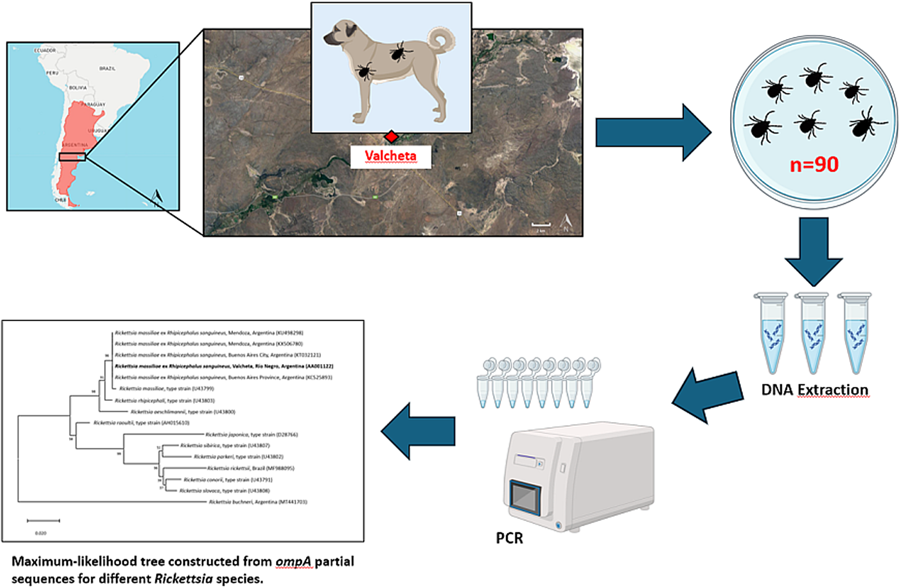
A total of 90 specimens of R. sanguineus s.s. ticks (3 larvae, 72 nymphs, 6 females and 9 males) were collected on 14 dogs from Valcheta, Río Negro province (see Fig. 1, Table 2). Additionally, a co-infestation of R. sanguineus s.s. ticks with 1 female of A. tigrinum was observed (this tick was not included in the rickettsial bacterial detection assay). Both tick species are known to infest dogs and were also previously identified in the Patagonian region of Argentina (Nava et al., Reference Nava, Venzal, González-Acuña, Martins and Guglielmone2017).
Map of Rio Negro province, Patagonia, Argentina showing the sample locality (Valcheta: 40°40′47.5′′S; 66°09′57.3′′W) of the Rhipicephalus sanguineus sensu stricto ticks used for the detection of tick-borne rickettsial bacteria. The map was created with QGIS version Prizren 3.34.0.

Rhipicephalus sanguineus sensu stricto collected on dogs in Río Negro province, Patagonia, Argentina with results of the molecular detection of tick-borne rickettsial bacteria

L., larva; N., nymph; F., female; M., male.
a positive sample in the gltA PCR assay
b positive sample in the gltA and ompA PCR assays
Thirty-three tick pools were tested by the different PCR assays of which 3 were positive in the 16S rDNA PCR (Parola et al., Reference Parola, Roux, Camicas, Baradji, Brouqui and Raoult2000) for Anaplasmataceae bacteria (1 pool of larvae and 2 pools of nymphs), 2 in the gltA PCR (2 pools of females) and 1 in the ompA PCR (1 pool of females). From the three Anaplasmataceae positive samples, 2 partial 16S rDNA sequences belonging to A. platys could be generated: (I) a 273 bp fragment (GenBank acc. no. PP838794) from a pool of 10 nymphs of R. sanguineus s.s. and (II) a 301 bp fragment (GenBank acc. no. PP838795) from a pool of 8 R. sanguineus s.s. nymphs. Unfortunately, no sequence could be generated from the larval pool. The both obtained sequences were 100% identical to each other (273 bp/273 bp) and with partial sequences of A. platys strains detected in Argentina (GenBank acc. no. JX261979, KC525894, KF826282, KF826284) and other parts of the world (e.g. GenBank acc. no. KP717550, KP903296, KT359590, OP164858, OQ132527). Anaplasma platys is known as the causative agent of canine infectious cyclic thrombocytopenia (Diniz and Moura de Aguiar, Reference Diniz and Moura de Aguiar2022) and was firstly detected in R. sanguineus ticks from Northeastern Argentina in 2011 (Oscherov et al., Reference Oscherov, Milano, Lobo, Anda and Escudero2011). Eiras et al. (Reference Eiras, Craviotto, Vezzani, Eyal and Baneth2013) detected A. platys in dogs with suspected rickettsial disease in Buenos Aires province, Argentina. This rickettsial bacterium was also found in dogs from Buenos Aires City (Cicuttin et al., Reference Cicuttin, Brambati, Rodríguez Eugui, Lebrero, De Salvo, Beltrán, Gury Dohmen, Jado and Anda2014), Salta (Dias Cordeiro et al., Reference Dias Cordeiro, Figueiroa, Trova, Mesquita Araujo, Rodrigues de Almeida, Ramos, Ricci and da Fonseca2020), Córdoba and Santa Fe provinces (Mascarelli et al., Reference Mascarelli, Tartara, Pereyra and Maggi2016). Further, Cicuttin et al. (Reference Cicuttin, De Salvo, La Rosa and Gury Dohmen2015a, Reference Cicuttin, Tarragona, De Salvo, Mangold and Nava2015b) showed the presence of A. platys in different R. sanguineus populations that belonged to the species R. linnaei in northern Argentina. In accordance with the results of the current and previous studies, it can be stated that both species – R. linnaei and R. sanguineus s.s. – could be potential vector of A. platys in Argentina. Laatamna et al. (Reference Laatamna, Strube, Bakkes, Schaper, Aziza, Ben Chelef, Amrane, Bedraoui, Dobler and Chitimia-Dobler2022) also detected A. platys in R. sanguineus s.s. ticks collected on dogs from Algeria, which is consistent with the results of the presented study. The vectorial competence of R. sanguineus s.s. for A. platys was demonstrated under laboratory conditions by Snellgrove et al. (Reference Snellgrove, Krapiunaya, Ford, Stanley, Wickson, Hartzer and Levin2020).
Two partial sequences of the gltA gene from Rickettsia spp. were generated from female tick pools collected on different dogs. Both sequences (GenBank acc. no. PP856476, PP856477) showed sequence identities from over 99.24% to different sequences of R. massiliae, including some strains detected in Argentina. Further, an ompA partial sequence (GenBank acc. no. PP856478) from one of these gltA positive pools also could be generated and the BLAST comparison confirmed the identification of the sample as R. massiliae. This could be strengthened by the result of the phylogenetic analysis of the sequence (see Fig. 2).
Maximum-likelihood tree constructed from ompA partial sequences for different Rickettsia species. The partial generated in this study is written in bold letters. Numbers represents bootstrap support generated from 1.000. Genbank accession numbers are given in brackets. The alignment length was 432 bp and the General Time Reversible (GTR) substitution model with Gamma distribution and invariant sites was used.

Within the Maximum-likelihood tree constructed from ompA partial sequences for different Rickettsia species, the sequence generated in this study forms a clade with other strains of R. massiliae detected in Argentina and the type strain, which clearly separates (bootstrap value 96) from Rickettsia rhipicephali as the next related species. Rickettsia massiliae was previously detected in Argentina in canine blood samples and R. sanguineus ticks from Buenos Aires City (Cicuttin et al., Reference Cicuttin, Rodríguez Vargas, Jado and Anda2004), Buenos Aires province (Cicuttin et al., Reference Cicuttin, Brambati, Rodríguez Eugui, Lebrero, De Salvo, Beltrán, Gury Dohmen, Jado and Anda2014) and Mendoza province (Monje et al., Reference Monje, Cielo Linares and Beldomenico2016). This spotted fever group Rickettsia was described for the first time in 1993 (Beati and Raoult, Reference Beati and Raoult1993), and it is associated with ticks of the genus Rhipicephalus. Further, R. massiliae is related to infections in humans, although reports of human cases are rare (Portillo et al., Reference Portillo, Santibáñez, García-Álvarez, Palomar and Oteo2015). So far, there is one confirmed case of disease in humans caused by R. massiliae (García-García et al., Reference García-García, Portillo, Núñez, Santibáñez, Castro and Oteo2010) reported for Argentina. This association has public health relevance because R. sanguineus ticks are known to infest humans (Guglielmone et al., Reference Guglielmone, Nava and Robbins2021).
Within this study we present the molecular detection of 2 rickettsial bacteria associated to R. sanguineus s.s. in a region of Argentina where no data about this topic were available so far. To our best knowledge the findings of A. platys and R. massiliae in R. sanguineus represent to most austral reports of these pathogens.
Data availability statement
Partial sequences of the detected rickettsial agents are available on the NCBI GenBank database.
Acknowledgements
Parts of the study were realized within a bilateral research project between the German Academic Exchange Service (DAAD, Germany) and the National Scientific and Technical Research Council (CONICET, Argentina).
Authors’ contributions
Conceptualization: LMIM, MW and PSS; Data curation: PSS; Funding acquisition: MW, SDA, SN and PSS; Investigation: LMIM, MW, AO and PSS; Methodology: LMIM, MW and VH; Project administration: PSS; Resources: MW and VH; Supervision: PSS; Visualization: PSS; Writing – original draft: LMIM and PSS; Writing – review & editing: LMIM, MW, AO, SN and PSS.
Financial support
The study was partially financed by Universidad Nacional de Río Negro (PI UNRN 40-C- 983), Instituto Nacional de Tecnología Agropecuaria (PE-E5-I109), Asociación Cooperadora INTA Rafaela and Agencia Nacional de Promoción Científica y Tecnológica (PICT 2019-970).
Competing interests
The authors declare they have no competing financial interests or personal relationships that could have influenced the work reported in this manuscript.
Ethical standards
All applicable institutional, national and international guidelines for the care and use of animals were followed.


 Open access

