





Introduction
In 2024, farmers in the United States harvested 44,112 ha of watermelons with a production value of US$686 million (USDA-NASS 2025). In 2024, Indiana ranked sixth among watermelon-producing states, with a harvest of 3,238 ha worth $75 million (USDA-NASS 2025). Most watermelons in the United States are grown in a plasticulture production system consisting of polyethylene-covered raised beds spaced 1.5 to 2.1 m apart (Phillips et al. Reference Phillips, Nair, Escalante, Cloyd and Meyers2025). One of the benefits of plasticulture production is that polyethylene mulch inhibits the germination and/or successful emergence of most weeds, allowing producers to focus weed control efforts on planting holes and the portion of the field between rows, often referred to as the row middles. Weed interference can limit watermelon yield as well as production and harvesting efficiency. Troublesome weeds in cucurbit production areas in Canada and the United States include pigweeds (Amaranthus spp.), nutsedges (Cyperus spp.), common lambsquarters (Chenopodium album L.), and morningglories (Ipomoea spp.) (Van Wychen 2022). Yield loss to these and other weeds is common due to watermelon’s slow initial growth and decumbent growth habit.
Interference from just one to four Palmer amaranth (Amaranthus palmeri S. Wats.) plants per 15 cm × 15 cm watermelon planting hole can decrease yield, fruit number, and mean fruit weight when competition begins shortly after transplantation (Bertucci et al. Reference Bertucci, Jennings, Monks, Schultheis, Louws and Jordan2019). Similarly, ivyleaf and pitted morningglory (I. hederacea Jacq. and I. lacunosa L., respectively) of 3 to 24 plants in a 27-m2 plot (equivalent to 1,111 to 8,889 plants ha−1) resulted in a yield loss of 58% to 99%, a 49% to 98% decrease in fruit number, and a 17% to 45% reduction in mean watermelon fruit weight (Arana et al. Reference Arana, Meyers, Guan and Johnson2022a). Furthermore, the authors of that study reported that morningglory interferes with harvesting efficiency when vines wrap around watermelon plants, making fruit less visible and slowing hand-harvest operations. Likewise, Gilbert et al. (Reference Gilbert, Stall, Chase and Charudattan2008) reported that American black nightshade (Solanum americanum Mill) interference reduced watermelon yield in both mulched and bare ground production systems. Similar watermelon yield reduction has been observed from interference by yellow nutsedge (Cyperus esculentus L.) (Buker et al. Reference Buker, Stall, Olson and Schilling2003) and smooth pigweed (Amaranthus hybridus L.) (Terry et al. Reference Terry, Stall, Shilling, Bewick and Kostewicz1997).
Although the row middles of plasticulture can be maintained free of weeds with cultivation early in the season, once the watermelon vines grow into the row middle, cultivation can take place only if the vines are physically turned back toward the bed to avoid damaging them. Because this process is labor-intensive, most growers opt to manage weeds in the row middles by applying a residual herbicide after forming the beds and laying the plastic but before transplanting the crop. Pretransplant applications of herbicides are often directed to the row middles to avoid contact with the polyethylene mulch, which could cause crop injury. Growers in Indiana typically use a combination of clomazone and ethalfluralin as a standard pretransplant treatment for managing weeds in row middles. To extend weed control, a post-transplant, in-season herbicide (a layby application) may be applied to the row middles. To limit contact with the watermelon vines, this layby herbicide can be applied before watermelon vines reach the row middles, or vines can be turned and the herbicide can be directed to limit contact with the watermelon foliage. Although watermelon growers in Indiana have not widely adopted the use of layby herbicides, herbicides with postemergence activity (e.g., imazosulfuron) are available.
In recent years, flumioxazin, S-metolachlor, and fomesafen have been approved for use in Indiana under a special local needs exemption via section 24(c) of the Federal Insecticide, Fungicide, and Rodenticide Act (FIFRA). In addition, bicyclopyrone has also been approved for use throughout the nation to control broadleaf weeds and some grass weeds. These herbicides have given Indiana watermelon farmers more options for controlling weeds. Furthermore, a premix of flumioxazin and pyroxasulfone is being evaluated for use on watermelon through the IR-4 Project (IR-4 Project 2025). Flumioxazin and fomesafen are protoporphyrinogen oxidase inhibitors (categorized as Group 14 herbicides by the Weed Science Society of America [WSSA]) that are primarily absorbed by plant roots and are mobile in xylem (Shaner Reference Shaner2014). In susceptible plants, lipids and proteins are oxidized, leading to a loss of chlorophyll and carotenoids, and to leaky cell membranes. S-metolachlor and pyroxasulfone (WSSA Group 15 herbicides) inhibit the synthesis of very-long-chain fatty acids (Shaner Reference Shaner2014). Both herbicides are considered phytotoxic only to emerging seedlings and are generally used to manage small-seeded annual grass and broadleaf weed species. Bicyclopyrone (WSSA Group 27) inhibits p-hydroxyphenylpyruvate dioxygenase (HPPD), thereby disrupting plastoquinone and carotenoid biosynthesis and causing bleaching injury in susceptible plants (Edmunds Reference Edmunds2022).
Although published research exists on the use of these herbicides individually and in limited combinations, little research has investigated the incorporation of tank mixes and overlapping herbicide applications to achieve season-long weed control in the row middles of plasticulture-grown watermelon. Meyers et al. (Reference Meyers, Guan, Egel and Nowaskie2021) applied clomazone (210 g ai ha−1) + ethalfluralin (672 g ai ha−1), flumioxazin (107 g ai ha−1), and flumioxazin (88 g ha−1) + pyroxasulfone (112 g ai ha−1) to row middles 1 d before transplanting the triploid watermelon cultivar Fascination, and reported no adverse effects on the crop. However, a preplant broadcast application of flumioxazin over the top of the plastic resulted in greater crop injury and smaller and fewer watermelon fruits. Arana et al. (Reference Arana, Meyers, Johnson and Guan2022b) broadcast-applied S-metolachlor along with fomesafen at rates from 210 to 840 g ai ha−1 at 6 to 7 d before transplanting Fascination watermelon; the authors reported foliar bronzing and stunting injury but no reduction in marketable watermelon yield or fruit number. Bertucci et al. (Reference Bertucci, Jennings, Monks, Jordan, Schultheis, Louws and Waldschmidt2018) applied bicyclopyrone (34.5 or 50.0 g ai ha−1) to preformed rows before laying plastic mulch and 1 d before transplanting or 2 wk after transplanting (WAP) the Exclamation and Traveler watermelon cultivars. They reported only minimal, transient crop injury and no adverse effect on yield.
The objective of this study was to evaluate herbicide-based weed management programs for plasticulture-grown triploid watermelon by combining pretransplant and layby applications to achieve season-long weed control.
Materials and Methods
Experiments were conducted at the Meigs Horticulture Research Farm in Lafayette, Indiana, in 2022 (40.2913°N, 86.8778°W) and 2023 (40.2924°N, 86.8795°W). Soil in both years was a Toronto-Millbrook silt loam (fine-silty, mixed, superactive, mesic Udollic Epiaqualfs) with 2.4% organic matter, pH 6.9, in 2022; and with 2.2% organic matter, pH 6.6, in 2023. Seeds of Fascination triploid watermelon (Syngenta Seeds, Downers Grove, IL) and Wingman pollenizer watermelon (Bayer-Seminis, St. Louis, MO) were planted into 50-cell black seedling flats filled with a peat-based potting media (Metro-Mix 360; Sun Gro Horticulture, Agawam, MA) in a greenhouse at the Southwest Purdue Agricultural Center, in Vincennes, Indiana (38.7390°N, 87.4866°W) on April 20, 2022, and May 1, 2023. Both the triploid and pollenizer cultivars used in this study are commercial grower standards. Fascination bears fruit that weigh 6.8 kg to 9.1 kg with seedless red flesh in the early to mid-maturity harvest range (Syngenta Seeds 2026) but it must be planted with either a pollenizer or seeded (diploid) cultivar of watermelon for adequate pollination (Phillips et al. Reference Phillips, Nair, Escalante, Cloyd and Meyers2025). Wingman consists of strong, compact vines that flower over an extended period, providing pollen to triploid melons (Bayer-Seminis 2026).
The field sites were prepared by tilling with a disc plow followed by a field cultivator. Raised beds were created in two passes with a bed-shaper/plastic layer (model 2550 series II; Rain-Flo Irrigation, East Earl, PA) on June 6, 2022, and June 7, 2023. In the first pass, raised beds were formed. In the second pass, a single subsurface drip tape was installed near the center of the bed, and the bed was simultaneously covered with black polyethylene mulch. Crop fertilization, irrigation, and disease and insect management followed standard practices (Phillips et al. Reference Phillips, Nair, Escalante, Cloyd and Meyers2025).
Treatments consisted of a factorial of four pretransplant herbicide tank mixes by three layby herbicides, arranged in a randomized complete block design with four replications. See Table 1 for a list of herbicide rates, trade names, and manufacturer information. Additionally, a nontreated weedy control was included for comparison. Pretransplant herbicides were applied directly to the row middles 1 d prior to transplanting watermelon using a CO2-pressurized backpack sprayer calibrated to deliver 188 L ha−1 at 193 kPa and equipped with two 11004XR nozzle tips (Spraying Systems Co., Glendale Heights, IL). Pretransplant herbicides included 1) ethalfluralin + clomazone, 2) fomesafen + S-metolachlor, 3) flumioxazin + S-metolachlor, and 4) flumioxazin + pyroxasulfone. Watermelon seedlings were hand-transplanted on June 8, 2022, and June 12, 2023, using a water-wheel transplanter that punched holes in the polyethylene mulch. Plots consisted of two plastic-covered raised beds, each 7.3 m long and 1.8 m apart, oriented east-to-west, resulting in a plot area of approximately 27 m2. Six Fascination triploid watermelon seedlings were transplanted 1.2 m apart in a single row on top of each raised bed, with Wingman pollenizer watermelon seedlings planted between every other triploid watermelon seedling. Thus, each plot, representing a single experimental unit, contained 12 triploid plants and 6 pollenizer plants. At 5 wk after being transplanted (WAP), watermelon vines were hand-placed immediately adjacent to the plastic-mulched row in plots scheduled to receive a layby application to limit watermelon vegetation in the row middles. Layby applications were then applied to the row middles of the same plots that had already received the pretransplant herbicide treatments, using the same sprayer equipment in a post-directed manner to limit watermelon plant exposure. Layby treatments included 1) no herbicide (none), 2) bicyclopyrone, and 3) imazosulfuron. Bicyclopyrone was evaluated as a new herbicide option for layby use, with imazosulfuron included as a registered standard for comparison.
Herbicides used in plasticulture watermelon trials in 2022 and 2023.

a Estimated herbicide cost was calculated using the product price per unit multiplied by the amount of product required per hectare at the application rate used in this study. Prices were estimated on the basis of an internet search of several regional suppliers (2026) and a conversation with D. Nowaskie, Agronomy Sales Specialist at Superior Ag.
Data collection included a visual assessment of crop injury on a scale from 0% (no injury) to 100% (complete death) compared with plants in nontreated weedy control plots at 2, 4, 6, and 8 WAP. Weed control was also evaluated at 2, 4, 6, and 8 WAP on a scale of 0% (no control) to 100% (complete control) relative to the nontreated weedy control. Fascination watermelon fruits were harvested weekly for 4 consecutive wk, starting on August 10, 2022, and on August 9, 2023. The criteria for determining the right harvest time for watermelons included necrosis of the tendril next to the fruit peduncle and a yellow ground spot. The weight of each fruit was recorded and classified as marketable (≥4 kg) or nonmarketable (<4 kg). Total marketable yield and the number of fruits were calculated by adding up all the marketable watermelons harvested across all four harvests. Total and marketable fruit number and yield, as well as mean fruit weight, were converted to a percentage of the weedy control plot within each replicate.
All data were subjected to ANOVA using the GLIMMIX procedure with SAS software (v.9.4, SAS Institute, Cary, NC) with the fixed effects of pretransplant and layby herbicide application and random effects of year and replication within year. To meet the assumptions of ANOVA, crop injury and weed control data were subjected to a negative binomial adjustment. When ANOVA indicated a significant treatment-by-year interaction (P < 0.05), data were analyzed separately by year. When ANOVA indicated a significant treatment effect, means were separated using the Tukey HSD test (P < 0.05). Mean crop injury and weed control data were back-transformed using the ilink function to facilitate the interpretation of results.
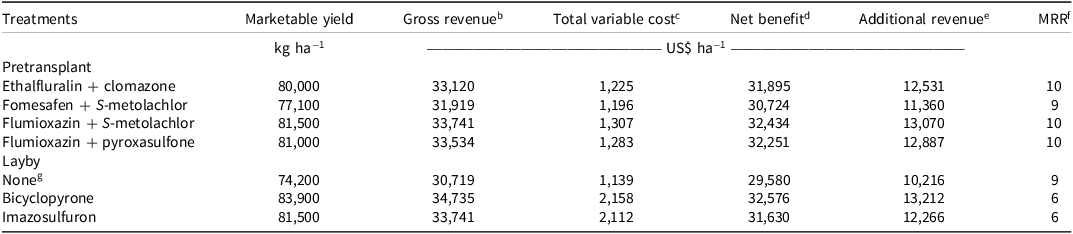
Additionally, to evaluate the economic impact of the herbicide treatments, a partial budget analysis was developed following the criteria outlined by Alimi and Manyong (Reference Alimi and Manyong2000). Gross revenue was calculated by multiplying the marketable yield for each herbicide program by a fixed crop value of $0.414 kg−1 (USDA-NASS 2024). Net benefit was defined as the gross revenue minus the variable costs associated with each herbicide program. Variable costs included herbicide product costs, application pass costs, and labor for vine movement and watermelon harvest. Herbicide product estimated costs are presented in Table 1, based on regional internet pricing and crop advisor input obtained via email (D. Nowaskie, Agronomy Sales Specialist at Superior Ag, personal communication). Costs represent the price per hectare for the specific application rates (g ai ha−1) used in this study. Application pass costs were established at $22 ha−1 per pass based on the criteria explained by Langemeier (Reference Langemeier2025). Layby treatments required an additional $715 ha⁻1 for manual vine movement, calculated using a labor rate of $14.47 h− 1 and a labor requirement of approximately 49.4 h ha− 1, based on the watermelon budget developed by Fonsah and Hancock (Reference Fonsah and Hancock2026). The same labor rate was used to estimate harvesting costs, which increased proportionally with yield.
To determine the efficiency of the investment, the marginal rate of return (MRR) was calculated by dividing the additional revenue generated by each herbicide program (relative to the weedy control) by its total variable cost. For each herbicide treatment, additional revenue was computed as the difference between its net benefit and that of the weedy control. The MRR was then calculated by dividing the additional revenue relative to the weedy control by the total variable cost of the herbicide treatment. For decision-making purposes, herbicide programs were considered economically acceptable when the MRR ≥1.0, meaning each herbicide program had to generate at least $1 of additional net benefit for every $1 of additional cost relative to the nontreated weedy control.
Results and Discussion
Weed Control
The most prevalent weeds observed in both years were common purslane (Portulaca oleracea L.), ivyleaf morningglory (Ipomoea hederacea Jacp.), velvetleaf (Abutilon theophrasti Medik.), common lambsquarters (Chenopodium album L.), redroot pigweed (Amaranthus retroflexus L.), and waterhemp [Amaranthus tuberculatus (Moq.) J.D Sauer]. Additionally, Canada thistle [Cirsium arvense (L.) Scop.] and slender amaranth (Amaranthus viridis L.) were present in 2022. Weed control assessments conducted at 2 and 4 WAP considered only the main effect of pretransplant herbicide because layby herbicides were not applied until 5 WAP. Except for weed control 6 WAP (P = 0.0380), all weed control data lacked significant treatment-by-year interaction and were analyzed pooled across 2022 and 2023. Additionally, weed control at 6 WAP and 8 WAP lacked significant interaction between the treatment factors of pretransplant and layby applications. Therefore, the main effect of pretransplant treatment was analyzed pooled across layby treatments, and the main effect of layby treatment was analyzed pooled across pretransplant treatments.
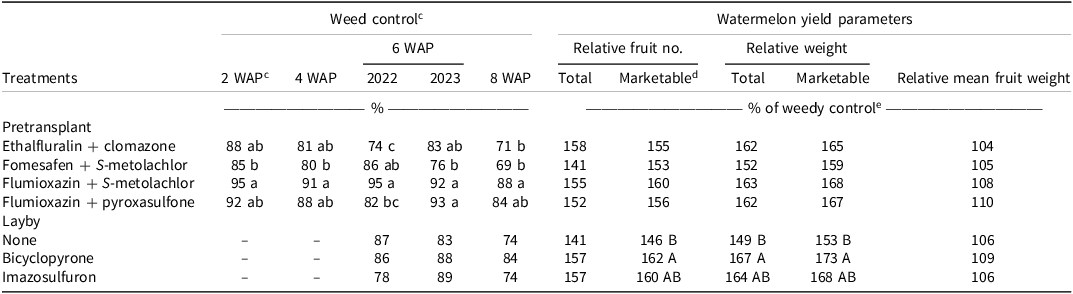
At 2 WAP, the greatest weed control was provided by flumioxazin + S-metolachlor (95%), followed by flumioxazin + pyroxasulfone (92%) and ethalfluralin + clomazone (88%), but greater than fomesafen + S-metolachlor (85%) (Table 2). This trend was also observed at 4 WAP. Data for weed control at 6 WAP exhibited a significant treatment-by-year interaction and were therefore analyzed separately by year. In 2022, the highest weed control was achieved with flumioxazin + S-metolachlor (95%), similar to fomesafen + S-metolachlor (86%) but greater than flumioxazin + pyroxasulfone (82%) and ethalfluralin + clomazone (74%). In 2023, the most control was provided by flumioxazin + either S-metolachlor (92%) or pyroxasulfone (93%), followed by ethalfluralin + clomazone (83%), and fomesafen + S-metolachlor (76%). By 8 WAP, weed control ranged from 69% (fomesafen + S-metolachlor) to 88% (flumioxazin + S-metolachlor). Flumioxazin + pyroxasulfone and ethalfluralin + clomazone provided 84% and 71% weed control, respectively. Weed control at 6 WAP and 8 WAP did not differ among layby herbicide treatments.
Effect of pretransplant and layby herbicide treatments on weed control and watermelon yield parameters pooled across 2022 and 2023. a , b
a Abbreviation: WAP, weeks after transplant.
b Different lower and uppercase letters within each column represent significant differences among pretransplant and layby treatment means, respectively, based on the Tukey HSD test (α = 0.05).
c Visually rated on a scale of 0% (no control) to 100% (complete control). Predominant weed species included common purslane, ivyleaf morningglory, velvetleaf, common lambsquarters, redroot pigweed and waterhemp.
d A marketable watermelon is one that weighs more than 4 kg.
e The nontreated weedy control yielded 9,259 total fruit ha−1 weighing 53,300 kg ha−1, including 7,407 marketable fruit ha−1 weighing 48,500 kg ha−1, and a mean fruit weight of 5.9 kg fruit−1.
Crop Injury
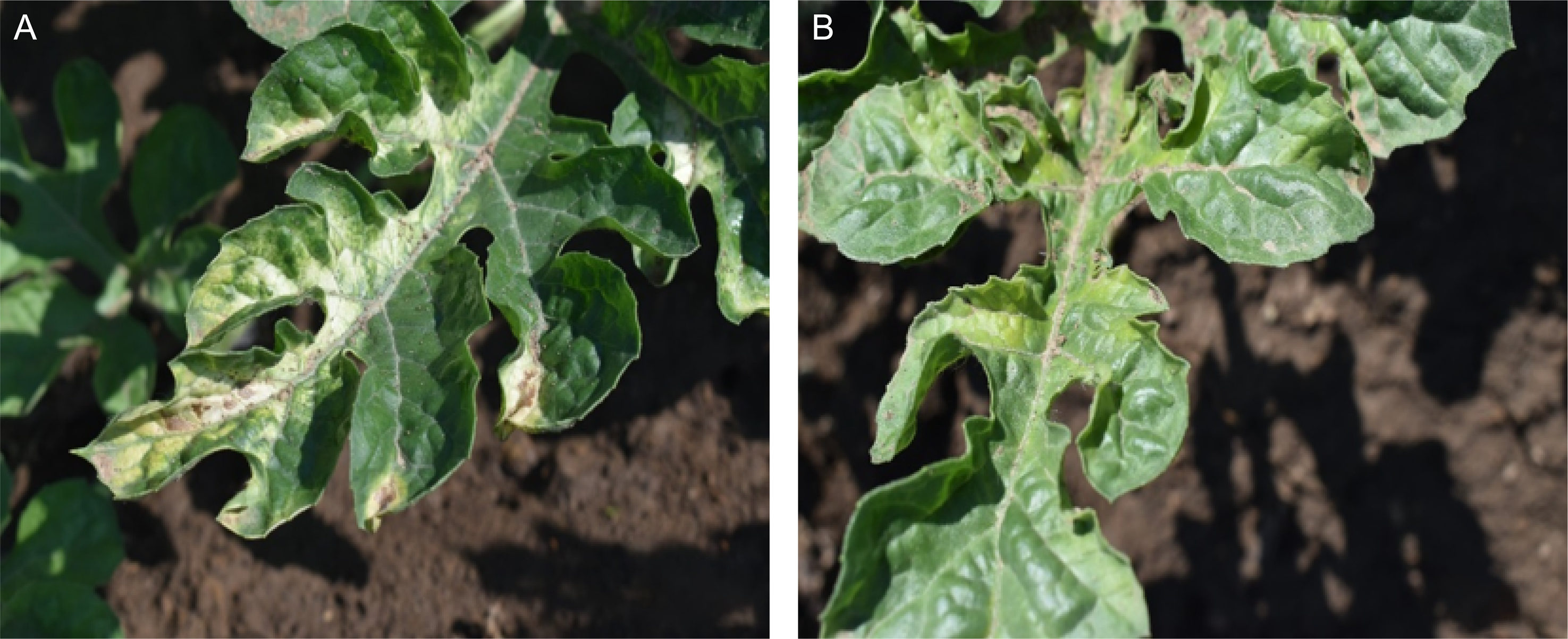
Crop injury data were pooled across years because there was no significant treatment-by-year interaction. Additionally, due to a lack of pretransplant application by layby application interaction, injury data were analyzed for each main effect (pretransplant and layby applications), pooled across all levels of the other main effect. No discernible crop injury was observed for the first 4 WAP from the pretransplant herbicide applications. At 6 WAP, 1 wk after the layby application, minor injury was observed in both years. Injury did not differ among pretransplant treatments and ranged from 1% to 3% (data not shown). Among the layby treatments, bicyclopyrone caused the greatest injury (7%), followed by imazosulfuron (2%) and no herbicide (0%) (data not shown). Injury from bicyclopyrone and imazosulfuron was observed on watermelon leaves, with bicyclopyrone causing bleaching and imazosulfuron causing chlorosis (Figure 1). Both resulted in minor, transient symptoms that were not detectable by 8 WAP (Table 2). These results align with the findings reported by Bertucci et al. (Reference Bertucci, Jennings, Monks, Schultheis, Louws and Jordan2019), that bicyclopyrone initially caused 15% bleaching injury when applied postemergence, but crop injury was reduced to nearly 0% at 4 wk after application.
Watermelon leaves 1 wk after a layby application of bicyclopyrone (A) and imazosulfuron (B), exhibiting bleaching and chlorosis injury, respectively, at the Meigs Horticulture Research Farm, Lafayette, Indiana, in 2022.

Watermelon Yield, Marketable Fruit Number, and Mean Fruit Weight
Due to a lack of treatment-by-year interaction, watermelon yield parameter data were pooled and analyzed across 2022 and 2023. Due to a lack of significant interaction between the treatment factors of pretransplant and layby applications, the main effect of pretransplant treatment was analyzed pooled across layby treatments, and the main effect of layby treatment was analyzed pooled across pretransplant treatments. All data were analyzed as a percentage of the weedy control, which yielded 9,259 total fruit ha−1 weighing 53,300 kg ha−1, including 7,407 marketable fruit ha−1 weighing 48,500 kg ha−1. The mean fruit weight of the weedy control was 5.9 kg fruit−1. There were no differences among pretransplant treatments for any watermelon yield parameters. Compared with the weedy control, each pretransplant treatment resulted in 41% to 58% and 53% to 60% increases in total and marketable fruit numbers, respectively, and 52% to 63% and 59% to 68% increases in total and marketable fruit weights, respectively (Table 2). Compared with the weedy control, mean fruit weight increased by 4% to 10% under all pretransplant treatments.
Among layby treatments, bicyclopyrone provided a similar relative increase in marketable fruit number (62%), total fruit weight (67%), and marketable fruit weight (73%) to imazosulfuron (60%, 64%, and 68%, respectively) and a greater relative increase for those same watermelon yield parameters compared with when no layby application was made (46%, 49%, and 53%, respectively). Relative increases for total fruit number (41 to 57%) and mean fruit weight (6 to 9%) did not differ among layby applications.
Results from the present study indicate that weed interference had a proportionally greater effect on watermelon fruit number than on mean individual fruit weight. Across all pre‑transplant and layby herbicide treatments evaluated, total fruit number increased by 41% to 58% relative to the nontreated weedy control, whereas mean individual fruit weight increased by only 4% to 10%. These differences in response magnitude suggest that yield losses associated with weed interference in this study were driven primarily by reductions in fruit number rather than by reductions in individual fruit weight. Similarly, Gilbert et al. (Reference Gilbert, Stall, Chase and Charudattan2008) reported that interference from American black nightshade (Solanum americanum Mill.) reduced watermelon fruit number, but not individual fruit weight. However, Arana et al. (Reference Arana, Meyers, Guan and Johnson2022a) reported that individual watermelon fruit weight decreased by 17% to 45% and fruit number by 49% to 98% as morningglory density increased from 3 to 24 plants per 27 m2. One difference between the findings of Arana et al. (Reference Arana, Meyers, Guan and Johnson2022a) and the present study is the location of the weed species: weeds appeared within planting holes in the former study and between rows in the latter.
Partial Budget Analysis
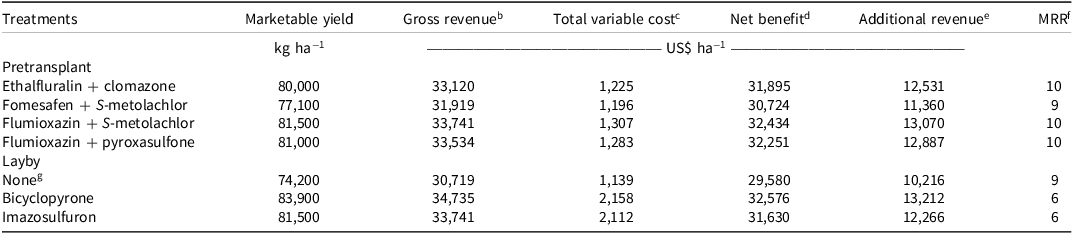
Relative to the nontreated weedy control, which yielded 48,500 kg ha−1 of marketable fruit, resulting in a gross revenue of $20,079 ha⁻1 and a net benefit of $19,364 ha−1 after accounting for $715 ha−1 in harvest labor costs, pretransplant herbicide treatments generated an average MRR of $9.75 for every dollar invested (Table 3). When a layby application was added, the return decreased by approximately $3 per dollar invested compared with programs that did not include a layby application. All herbicide programs exceeded the MRR ≥1 acceptability threshold.
Partial budget analysis of herbicide programs in watermelon production calculated using average yield data from the 2022 and 2023 field trials relative to a nontreated weedy control. a
a Abbreviation: MRR, marginal rate of return.
b Gross revenue was calculated as marketable yield multiplied by a fixed crop value of US$0.414 kg−1.
c Total variable costs included herbicide product cost based on the price per hectare for each product, application pass cost set at US$22 ha−1 per pass (with layby requiring two passes), additional labor required for vine movement in layby treatments ($715 ha−1), and labor for watermelon harvest, which was set at $715 ha−1 for the nontreated weedy control (49.4 h ha−1 at $14.47 h−1) and increased proportionally with yield for all other treatments.
d Net benefit was defined as gross revenue minus total variable costs.
e Additional revenue was calculated as the difference between the net benefit of each herbicide program and that of the nontreated weedy control. The weedy control yielded 48,500 kg ha−1, resulting in a gross revenue of US$20,079 ha−1 and a net benefit of $19,364 ha−1 after accounting for $715 ha−1 in harvest labor (49.4 h ha−1 at $14.47 h−1). All additional revenue values were calculated relative to this baseline.
f MRR was calculated by dividing the additional revenue generated by each herbicide program relative to the nontreated weedy control divided by its total variable cost. Economic acceptability was defined as an MRR ≥1.0, meaning each herbicide program had to generate at least $1 of additional net benefit for every $1 of additional cost relative to the nontreated weedy control.
g For the layby “None” treatment the pre‑transplant grower standard (ethalfluralin + clomazone) was included in the variable cost calculations. This treatment did not require vine movement labor or the additional application pass associated with layby herbicide programs.
Practical Implications
Flumioxazin + either S-metolachlor or pyroxasulfone provided the most consistently acceptable weed control, while fomesafen + S-metolachlor and ethalfluralin + clomazone were more variable. The application of a pretransplant herbicide mixture, regardless of which one, resulted in at least a 53% increase in marketable fruit number compared with fruit from a weedy control plot. From an economic standpoint, all herbicide programs exceeded the minimum acceptable MRR of ≥1, indicating that growers can expect at least an additional dollar of net benefit for every dollar invested relative to a nontreated weedy control. When a pretransplant herbicide was applied, adding a layby herbicide did not improve weed control and slightly reduced economic return. Currently, the application of imazosulfuron is limited by a 48-d preharvest interval, which would necessitate making a layby application no later than 3 wk after transplanting. However, the current preharvest interval for bicyclopyrone is 14 d, allowing for more flexibility. In this study, watermelon vines were turned before making layby applications. Both products used at layby in this study are required, by label restrictions, to be applied in a manner that avoids contact with watermelon foliage. Flumioxazin, fomesafen, and S-metolachlor are all currently registered for special local needs in Indiana through section 24(c) of FIFRA. It is important to note that this study included only one triploid cultivar, Fascination, and that crop response to the herbicides used in this study may differ by cultivar, production system, and production-related environmental factors, including soil texture, rainfall, and temperature. Before use, growers and herbicide applicators should confirm that these products are labeled for use in the state or province where their watermelon crop is grown.
Acknowledgments
We thank Chloe Henscheid, Dennis Nowaskie, Luis Medina, and Paul Howard for assisting with this research.
Funding
Rupp Seeds, Inc. provided watermelon seeds for this research. This work was supported by the U.S. Department of Agriculture–National Institute of Food and Agriculture via Hatch project 7000862.
Competing Interests
The authors declare they have no competing interests.


 Open access

